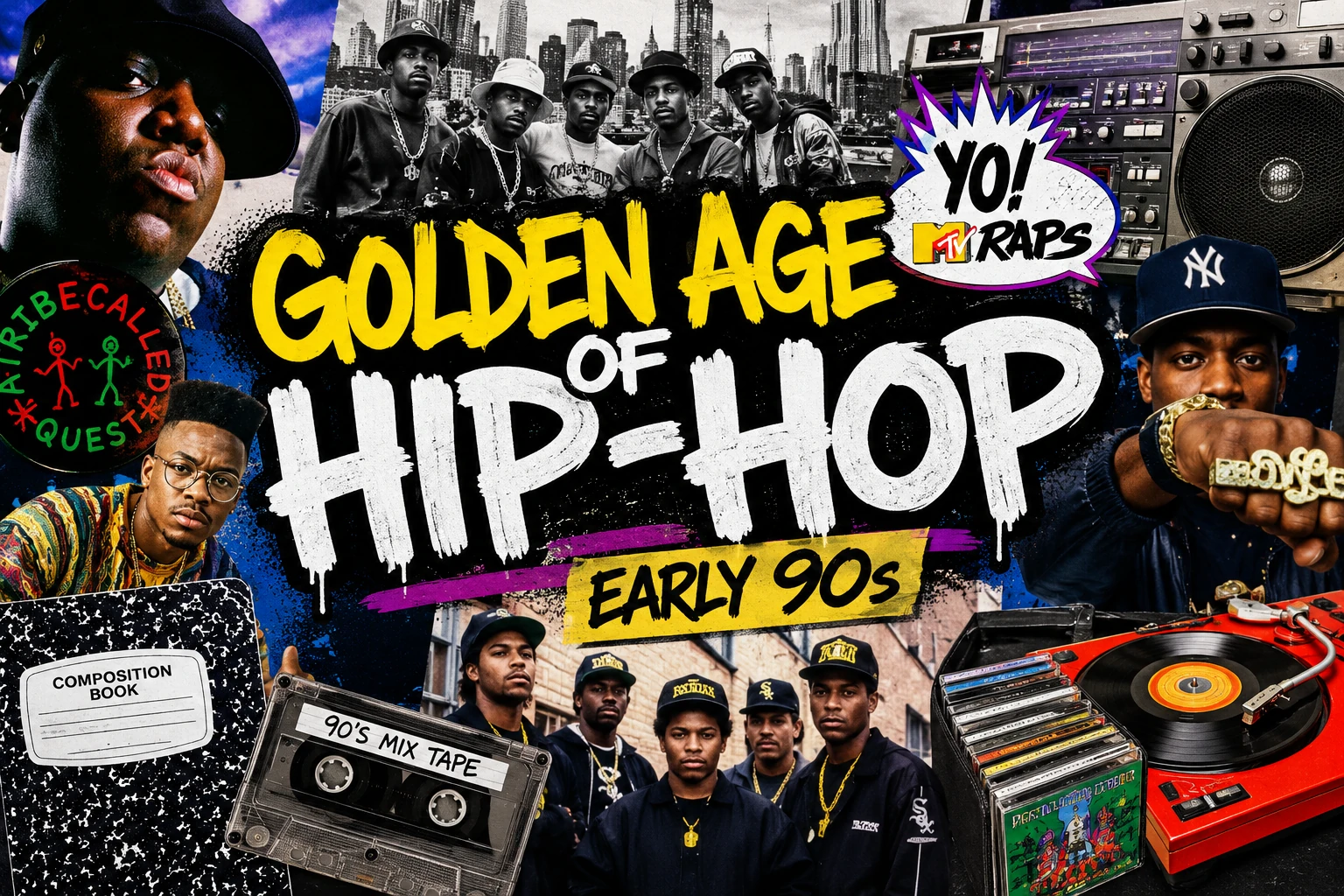
Golden Age Hip-Hop in the Early 90s
Golden age hip-hop in the early 90s was the sound of drums cracking out of boomboxes, jazz loops turning dusty records into new worlds, Native Tongues weirdness making rap feel smarter and looser, Yo! MTV Raps putting faces to voices, street reporting getting sharper, conscious rap getting louder, and regional scenes starting to kick holes in the map. It was messy, brilliant, crowded, competitive, sample-heavy, album-driven, style-obsessed, and somehow still less exhausting than trying to untangle a cassette tape with a pencil.
Golden age hip-hop in the early 90s was the period when rap’s late-80s momentum exploded into a deeper, sharper, more album-driven culture. It was built on boom bap drums, dense sampling, jazz rap, Native Tongues creativity, East Coast lyricism, West Coast street reporting, conscious rap, early gangsta rap, college radio, mixtapes, hip-hop on MTV, and classic albums that still anchor the larger 90s hip-hop story.
What “Golden Age Hip-Hop” Actually Means
“Golden age hip-hop” can mean slightly different things depending on who is talking, how old they are, how deep their crates go, and whether they still own a hoodie that smells vaguely like a basement party from 1992. Some people use it for the late 80s. Some stretch it through the mid-90s. Some use it as shorthand for the era when sampling was wild, MCs had to be sharp, albums mattered, regional scenes were still forming, and hip-hop had not yet been fully flattened into mainstream product.
For this page, the focus is the early 90s version of the golden age: roughly the moment when late-80s innovation carried into a new decade and rap started expanding in every direction at once. Boom bap got harder. Jazz rap got cooler. Political rap got sharper. Gangsta rap got louder. Women in hip-hop pushed more visibly. MTV helped nationalize the culture. Radio started paying attention, even if it still acted confused half the time. Albums became events. Crews mattered. Labels mattered. Regions mattered. And your friend with the best mixtapes suddenly became the most important person in the school hallway.
This was not one sound. That is the whole point. The early 90s gave you A Tribe Called Quest, De La Soul, Public Enemy, Ice Cube, Dr. Dre, Gang Starr, Pete Rock & CL Smooth, Main Source, Queen Latifah, MC Lyte, Cypress Hill, Black Sheep, Naughty by Nature, Geto Boys, Brand Nubian, Das EFX, Digable Planets, Arrested Development, and a ridiculous number of records that could all be called hip-hop without sounding like copies of each other.
It was also the era when hip-hop became a full cultural operating system. It was not just records. It was clothes, videos, slang, magazines, flyers, college radio, cassette dubs, park jams, mixtapes, record stores, graffiti walls, haircuts, sneakers, jackets, TV appearances, arguments in lunchrooms, and album covers you studied like they contained classified information. The music was the center, but the culture around it gave everything weight.
The early 90s sit at a perfect pressure point in the larger 90s Hip-Hop and Rap map. This is where the late-80s spark becomes the decade’s engine. It leads into the classic-album explosion covered in Best 90s Hip-Hop Albums, the landmark singles in 90s Hip-Hop Songs That Defined the Decade, and the deeper crate cuts in Forgotten 90s Hip-Hop Songs.
The phrase “golden age” can make the era sound polished and museum-safe. It was not. It was noisy. It was uneven. It was experimental. It had bad ideas right beside genius ideas. It had artists trying on identities, producers chopping anything that moved, labels guessing wrong, programmers misunderstanding the culture, and listeners taping songs off the radio with the DJ talking over the intro like a public menace. That chaos is part of why it still feels alive.
The Golden Age Was Built From Old Records and New Attitude
Producers turned jazz, soul, funk, breaks, movie snippets, basslines, horns, and dusty drums into something that felt like the future wearing a Starter jacket.
Albums became worlds
Early 90s hip-hop albums were not just containers for singles. They had skits, moods, crews, recurring characters, sound palettes, liner notes, and enough personality to make the CD booklet feel important.
Production got wild
Before sample clearance fully tightened the leash, producers built dense collages out of breaks, horns, basslines, scratches, voices, and whatever else they could rescue from a crate.
You had to have a voice
The early 90s rewarded personality: flow, slang, perspective, humor, politics, menace, weirdness, and the ability to sound like nobody else on the tape.
The Early 90s Did Not Come Out of Nowhere
The early 90s golden age was the payoff from everything the late 80s had already started building: harder drums, stronger MC identities, political urgency, DJ culture, sampling ambition, and the idea that rap could carry full albums, not just singles.
The late 80s handed the 90s a loaded backpack.
By the time the 90s arrived, hip-hop had already been through several revolutions. Run-D.M.C. had pushed rap into a bigger arena. Public Enemy had made noise, politics, and urgency feel inseparable. Rakim had raised the bar for flow and internal rhyme. Boogie Down Productions had turned knowledge and battle energy into a philosophy. N.W.A had cracked open a harder West Coast reality. De La Soul and the Native Tongues had shown that rap could be playful, surreal, sample-rich, and still deeply serious under the colors.
That is why this post works as the cross-decade bridge from 80s Rap, R&B & Dance into the deeper early-90s rap explosion. The 80s built the runway. The early 90s hit the throttle and made the whole damn decade shake.
You can hear that transition in the way early 90s records balanced old-school DJ culture with new-school album ambition. Scratches still mattered. Breaks still mattered. But the records were becoming more cinematic, more personal, more political, more layered, and more tied to specific neighborhoods, crews, and scenes.
Then the 90s made everything bigger.
The new decade gave hip-hop more media, more albums, more video exposure, more radio tension, more regional rivalry, more commercial pressure, more creativity, and more ways to argue with your friends about who was overrated. Basically, the culture upgraded and the debates got worse, as nature intended.
The early-90s bridge also overlaps with New Jack Swing, Rap, and R&B in the 90s, because rap was not evolving alone. R&B hooks, dance production, radio crossover, and club energy were all starting to crash into each other in ways that helped shape the decade’s mainstream sound.
The early 90s were also the moment when hip-hop stopped feeling like a single lane and started feeling like a whole freeway system. You could be jazzy, political, grimy, funny, gangsta, spiritual, danceable, abstract, regional, radio-friendly, underground, or all of that before the second verse.
The Core Ingredients of Early 90s Golden Age Hip-Hop
The golden age was not magic dust. It was a stack of ingredients all hitting at the same time: better producers, sharper MCs, bigger albums, stronger visuals, more regional identity, and a fan culture that treated music discovery like a part-time job.
The beat had to knock
A golden age record could be jazzy, political, funny, or abstract, but the drums still had to land. The kick and snare were the law. If the beat did not make your neck move, the record had a problem.
The crate was the lab
Producers were digging through jazz, funk, soul, rock, film scores, old breaks, and forgotten records, then turning tiny fragments into entire worlds.
Personality mattered
You could not sound generic and survive long. The era rewarded voice, flow, slang, point of view, humor, anger, cool, and weirdness.
Nobody moved alone
Groups, DJ-producer teams, collectives, guest verses, posse cuts, and label families made the music feel connected. One album could introduce a whole universe.
MTV changed the room
Videos made faces, clothes, dances, neighborhoods, and crews part of the memory. Suddenly the sound had a look, and the look mattered.
You had to work for it
Before streaming, discovery meant radio, magazines, friends, record stores, mixtapes, videos, and taking chances on albums because the cover looked serious.
Boom Bap Was the Sound of the Room Getting Serious
Kick, Snare, Loop, Repeat Until the Walls Sweat
Boom bap was not polite. It was drums, dust, swing, scratches, bass, and enough head-nod pressure to make cheap headphones beg for mercy.
Boom bap is one of those phrases that gets used so much it can start to sound like a museum label. But in the early 90s, it was not nostalgia. It was the room. It was the kick drum landing like a sneaker on concrete, the snare cracking like somebody snapped a ruler on a desk, and the loop circling until it felt less like a beat and more like weather.
Producers were not just making backing tracks. They were building pressure. DJ Premier, Pete Rock, Large Professor, Q-Tip, Marley Marl’s lingering influence, The Bomb Squad’s chaos, Prince Paul’s weird genius, Dr. Dre’s cinematic precision, and countless others were teaching listeners that production could have personality as strong as the MC.
Early 90s boom bap made rap feel physical. You did not just hear it. You felt it in car doors, Walkman headphones, basement speakers, cheap stereos, and the boombox that somebody always brought to the park even though the batteries cost more than lunch.
Boom bap also shaped how MCs rapped. The pocket mattered. The pauses mattered. The scratches mattered. The voice had to sit inside the drums without getting swallowed. The best early 90s MCs understood that the beat was not just a platform. It was an opponent, a partner, and sometimes a brick wall with a bassline.
That sound is central to East Coast Hip-Hop in the 90s, but boom bap was not only a New York thing. Its influence moved through college radio, underground scenes, regional crews, and producers everywhere who understood that a good drum break could make people involuntarily scrunch their faces like they had just smelled greatness.
The early 90s also had a kind of beautiful roughness that later eras sometimes polished away. The drums were not always clean. The loops were not always smooth. The mix was not always glossy. And that was the charm. The records felt made by people who cared more about impact than perfection, which is probably why so many of them still hit harder than songs engineered with the budget of a small municipal project.
Sampling Made the Past Sound Brand New
Early 90s hip-hop turned record collecting into world-building. Producers grabbed drums, horns, basslines, scratches, jazz fragments, soul voices, funk breaks, and tiny moments most people would have ignored — then made them feel essential.
The crate was the secret weapon.
A producer with the right records could change the temperature of a whole song. That was the magic of sample culture. A three-second horn stab could become a hook. A drum break could become a neighborhood. A bassline could turn a lyric into a threat. A weird vocal snippet could make a record feel haunted, funny, paranoid, or cool enough to ruin your standards forever.
This was part technology, part taste, part archaeology, and part “I found this record in a dusty bin and now I am making it everyone else’s problem.” Beautiful work, honestly.
Sampling also gave hip-hop a sense of argument with the past. The music did not treat old records like museum pieces. It took them apart, looped them, scratched them, sped them up, slowed them down, and forced them to answer to a new generation.
Sampling taught Gen X how to hear backward and forward at the same time.
A lot of Gen X listeners met older soul, jazz, and funk through hip-hop first. You heard the sample, then maybe years later found the original and realized the producer had been doing magic tricks with records your parents might have owned.
That is a huge part of why early 90s hip-hop still feels alive. The records were new, but they were built out of memory. They sounded modern and old at the same time, which is basically the Gen X emotional condition with better drums.
There was also a thrill to not knowing everything. You might hear a loop for years before discovering where it came from. That mystery made the music feel bigger. Every beat had a secret history, and every producer felt like someone who had found a hidden door behind the record store wall.
Sample culture also explains why early 90s hip-hop albums felt so dense. A record could have a drum break from one place, a horn from another, a bassline from somewhere else, a scratched vocal fragment, a movie line, a laugh, a shout, and a hook stitched together so tightly that it sounded inevitable. That collage quality made albums feel deep even before the lyrics started working on you.
It also created a producer culture that mattered almost as much as the MC culture. Fans started recognizing sounds. You knew a Premier record felt different from a Pete Rock record. You knew Q-Tip’s production had its own pocket. You knew Prince Paul might make the entire thing weird on purpose. You knew The Bomb Squad could make a track feel like being attacked by every radio station at once.
The downside was coming too. Sample clearance would eventually get more expensive, more restrictive, and more complicated, which changed how hip-hop records were built. But in the early 90s, you can still hear the wildness. That is part of what people mean when they romanticize the golden age. It was not just the MCs. It was the freedom of the sound.
Jazz Rap Made Hip-Hop Feel Loose, Smart, and Ridiculously Cool
Suddenly Jazz Samples Were Cooler Than Your Entire Wardrobe
Tribe, De La, Digable Planets, Guru, Us3, and the jazz-rap lane gave early 90s hip-hop a smoother, stranger, smarter kind of swing.
Jazz rap did not make hip-hop “respectable.” Hip-hop did not need a permission slip from anybody’s record collection. What jazz rap did was open up another set of colors. It made space for walking basslines, muted horns, soft keys, conversational flows, abstract lyrics, and records that sounded like they were hanging out in a smoky room where everyone somehow had better taste than you.
A Tribe Called Quest were the obvious center of gravity here, which is why A Tribe Called Quest and 90s Jazz Rap gets its own deep dive. But Tribe were part of a broader wave covered in Jazz Rap in the 90s, alongside De La Soul’s continued evolution, Digable Planets, Guru’s Jazzmatazz experiments, Main Source, Pete Rock & CL Smooth, Us3, and a whole alternative-minded scene that believed hip-hop could be playful, intellectual, funny, smooth, political, weird, and funky in the same breath.
This lane connects directly to Alternative Hip-Hop in the 90s. Not alternative as in “less hip-hop.” Alternative as in hip-hop refusing to wear the same outfit every day. Jazz rap created room for nerds, record collectors, poets, weirdos, dancers, Afrocentric style, abstract humor, and people who could quote a bassline before they could parallel park.
It also gave the early 90s some of its most replayable music. These records were warm without being soft, smart without being stiff, and cool without needing to tell you they were cool every four bars. Which, as anyone who survived the 90s knows, is the only acceptable way to be cool.
Jazz rap also changed the visual language. The videos, clothes, artwork, and overall vibe leaned toward earth tones, abstract graphics, thrifted cool, Afrocentric details, and a looser kind of style that felt different from both street-tough imagery and pop crossover shine. It was hip-hop that could hang out in a record store, a dorm room, a basement party, or a college radio booth and still own the space.
Playful but serious
Tribe, De La, Queen Latifah, Black Sheep, and the surrounding orbit made hip-hop feel bigger, funnier, more colorful, and more open without losing the drums.
Cool without trying
Upright bass, horn stabs, piano loops, and brushed textures gave rap records a warm, late-night swing that still sounds expensive even when it was made from dust.
Hip-hop got more colors
The jazz-rap wave helped prove rap did not need one image, one subject, one delivery, or one regional formula to be powerful.
Conscious Rap Gave the Early 90s a Spine
Early 90s hip-hop was not just about beats and bragging. It carried politics, history, race, poverty, police pressure, education, Afrocentric identity, neighborhood reality, and the feeling that the world was on fire but at least the drums were good.
The message did not have to kill the groove.
One lazy knock on conscious rap is that it was supposed to be serious to the point of homework. The early 90s says otherwise. Public Enemy could make political rage sound like a siren. Queen Latifah could make dignity feel smooth. Brand Nubian could move between knowledge, swagger, and controversy. Arrested Development could bring Southern-rooted spirituality into pop visibility. KRS-One could turn a record into a lecture and still make it hit.
The best message records did not pause the party. They changed what the party had to think about.
They also proved that “conscious” did not have to mean one mood. It could be angry, funny, warm, confrontational, spiritual, paranoid, educational, or just brutally observant.
The early 90s were politically loud for a reason.
This was the era of social tension, police brutality conversations, urban neglect, Afrocentric fashion and identity, campus activism, street-level frustration, and media panic about rap. Hip-hop did not invent those pressures. It reported them, shouted about them, laughed through them, argued with them, and occasionally made parents deeply uncomfortable at dinner.
That lane gets a deeper look in Conscious Rap in the 90s, but the early golden-age years are where a lot of that tone became impossible to ignore.
It also overlapped with everything else. Conscious rap crossed into jazz rap, gangsta rap, party records, women’s voices, and regional scenes. The categories were never as clean as people make them later.
Public Enemy, KRS-One, Queen Latifah, X Clan, Brand Nubian, Poor Righteous Teachers, Arrested Development, Paris, Ice Cube, Tupac’s early work, and others all pushed social commentary into the center of the conversation. Sometimes the message was explicit. Sometimes it was embedded in storytelling. Sometimes it came through fashion, album art, interview clips, video imagery, or the way an MC framed the neighborhood.
This is important because the early 90s are sometimes remembered only as a sonic golden age. They were also a political and cultural one. Hip-hop was arguing with America in public. That made it exciting, uncomfortable, powerful, and impossible to dismiss, even when critics tried very hard to dismiss it anyway.
Women Helped Shape the Golden Age, Not Decorate It
Early 90s hip-hop gets remembered through a lot of male voices, but women were central to the culture: as MCs, style leaders, political voices, battle-ready rappers, crossover stars, group members, and the people who kept proving the room was never supposed to belong to men only.
Queen Latifah carried authority.
Queen Latifah’s early 90s presence was bigger than any one record. She brought confidence, warmth, political force, and a kind of regal calm that made her feel like she was not asking to be included. She was already there. Records like “Ladies First,” “Just Another Day,” and “U.N.I.T.Y.” helped show how broad her voice could be.
Latifah also mattered because she connected so many lanes at once: Native Tongues energy, Afrocentric style, women’s empowerment, smooth storytelling, and mainstream visibility. She was not a side note to the golden age. She was part of its architecture.
MC Lyte, Yo-Yo, Salt-N-Pepa, and others kept widening the lane.
MC Lyte had already proven that sharp lyricism and command were not optional. Yo-Yo brought West Coast perspective and directness. Salt-N-Pepa moved between pop crossover, sexuality, humor, and rap credibility in a way that made them impossible to box in. Roxanne Shanté’s influence still hung over the era. Lady of Rage was loading up for the Death Row moment. Bahamadia would soon bring a different kind of precision.
The bigger story continues in Women of 90s Hip-Hop, but the early 90s foundation matters because it shows that women were present before the late-90s explosion of Lauryn, Missy, Lil’ Kim, Foxy, and others.
Women in early 90s hip-hop were also fighting against a culture that loved borrowing their energy while limiting their space. That tension shows up everywhere: in lyrics, videos, interviews, fashion, marketing, and the way history sometimes remembers women as special cases instead of central voices. The golden age looks different when you put them back where they belong.
It also makes the era richer. Women brought different stakes, different humor, different authority, different politics, different party energy, and different ways of handling image. Without them, the early 90s story gets flatter, and flat is the one thing golden age hip-hop was not.
Golden Age Hip-Hop Was Built on Crews, Not Just Solo Stars
One of the best things about early 90s hip-hop is that every record felt like it might introduce you to a whole neighborhood, label family, or crew. Solo stars mattered, but groups and collectives gave the era its density.
A creative ecosystem
Tribe, De La, Queen Latifah, Black Sheep, Jungle Brothers, Monie Love, and the surrounding orbit made hip-hop feel playful, smart, Afrocentric, stylish, and open-ended.
Craft and discipline
Gang Starr’s world helped define a cleaner, sharper East Coast sound built around Premier production, Guru’s voice, and a deep respect for skill.
Regional identities
N.W.A’s aftermath, Lench Mob, Cypress Hill’s lane, Death Row’s rise, and other West Coast circles made California rap feel like several worlds at once.
The South was building
Geto Boys, UGK, 2 Live Crew’s shadow, bass scenes, Memphis roots, and Atlanta’s early stirrings were all part of the long Southern takeover.
Chemistry was everything
Groups gave the era contrast: different voices, arguments, jokes, hooks, ad-libs, internal rivalries, and the feeling that the room was crowded in the best way.
One verse could open a door
Features and posse cuts helped build anticipation. A guest verse could turn a listener into a detective trying to find the next album.
This is why the early golden age connects so naturally to 90s Hip-Hop Groups That Changed Everything and 90s Rap Duos and Groups. The era was not just about solo dominance. It was about chemistry. Tribe worked because Q-Tip and Phife had a rhythm. Pete Rock & CL Smooth worked because producer and MC felt locked together. Salt-N-Pepa had group personality. Geto Boys had different voices pulling in different directions. De La Soul sounded like a private universe with a guest list.
Groups also made the culture feel bigger than the record in your hand. You heard names shouted out. You saw crews in videos. You read liner notes. You followed label affiliations. You learned who produced what. You started understanding hip-hop as a network, not just a playlist. That network is a huge part of why the era still rewards deep digging.
The Early 90s Turned Hip-Hop Into a Regional Arms Race
The Map Got Loud
The early 90s still had New York gravity, but the West Coast was rising fast, Southern scenes were building, and regional identity was becoming one of hip-hop’s biggest strengths.
If the early golden age has one giant story, it is expansion. New York still had enormous influence, but the idea that hip-hop belonged to one place was already collapsing. Los Angeles and Compton were changing the sound and the stakes. Oakland and the Bay were bringing their own slang and funk. Houston and the South had scenes that were way deeper than outsiders realized. Atlanta was loading. Miami bass had its own universe. New Jersey had hits, crews, and attitude. The map was getting loud.
The East Coast story gets its own full rewind in East Coast Hip-Hop in the 90s. Early 90s East Coast rap had boom bap, jazz loops, lyrical pressure, street imagery, Native Tongues creativity, and enough crews to make every record feel like it came with three cousins and a logo.
The West Coast story exploded into the mainstream through records that changed the sound of the decade. Ice Cube’s solo work, Cypress Hill’s hazy menace, Tupac’s early political and personal urgency, Dr. Dre’s production revolution, and the rise of G-funk all helped set up the deeper stories in West Coast Hip-Hop in the 90s, Gangsta Rap in the 90s, Dr. Dre and The Chronic Changed 90s Rap, and G-Funk and the 90s West Coast Sound.
Southern hip-hop was still fighting for national respect, but the foundation was already there. Geto Boys had already forced Houston into the conversation. UGK were building something deeper. Memphis, Miami, New Orleans, and Atlanta all had scenes that would matter more and more as the decade moved forward. That story eventually becomes Southern Hip-Hop in the 90s and Outkast and the Rise of Southern Hip-Hop.
New Jersey also deserves a louder mention. Naughty by Nature brought radio-dominating hooks with real rap credibility. Queen Latifah’s New Jersey roots mattered in the Native Tongues and women-in-rap story. Lords of the Underground, Redman, and others helped make Jersey feel like more than New York’s neighbor with a chip on its shoulder. Though, to be fair, that chip did excellent work.
The Bay Area had its own kind of early-90s intelligence: Too Short’s influence, Digital Underground’s funk weirdness, Hieroglyphics loading up, Spice 1’s harder edge, and a regional personality that did not sound like Los Angeles even when outsiders lumped everything together as “West Coast.” That mistake is exactly why regional context matters.
Yo! MTV Raps, Video Blocks, and Radio Made the Culture National
You Had to Catch the Video When It Aired
MTV, radio, mixtapes, and word-of-mouth did the work. Miss the video and you were stuck hoping somebody taped it without cutting off the first verse.
Early 90s hip-hop spread through a messy media system that now feels almost prehistoric. MTV mattered. Yo! MTV Raps mattered. Local radio mattered. College radio mattered. Mix shows mattered. The Source mattered. Word-of-mouth mattered. The friend with a dubbed tape mattered. The person who knew when a video was airing mattered. Information moved slower, which somehow made every discovery feel heavier.
Hip-Hop on MTV in the 90s was not just about videos. It was about visibility. Suddenly artists had looks, sets, crews, jackets, boots, cars, neighborhoods, dances, facial expressions, and visual worlds that helped the music stick. A video could make an underground-adjacent artist feel huge. It could make a regional sound look national. It could make a song feel like an event.
Radio was more complicated. Hip-hop was becoming too big to ignore, but not every song could get through daytime programming. Clean edits, crossover hooks, and accessible singles helped push rap into more cars and kitchens, which later becomes the bigger story in 90s Rap Radio Crossover. In the early golden-age years, radio was still learning what to do with rap. Hip-hop was not waiting for it to figure it out.
That tension created some of the decade’s best memories. You might hear one version on the radio, see another version on MTV, get the album version from a friend, and then discover a remix on a cassette single. Basically, every song came with homework, except the homework had drums.
Video also made style unavoidable. You did not just hear Tribe’s cool; you saw it. You did not just hear Queen Latifah’s authority; you saw it. You did not just hear Cypress Hill’s haze; you saw it. You did not just hear West Coast rap’s car culture; you saw it rolling across the screen while your TV speakers did their absolute best, which was usually not much.
The early 90s were also the last moment before hip-hop video language became fully standardized. The clips could be low-budget, strange, colorful, grimy, funny, abstract, political, or just a group of people standing around looking cooler than your entire block. That raw variety helped the era feel wide open.
The Golden Age Was Also Clothes, Magazines, Mixtapes, and CD Binder Chaos
The music was the center, but the culture around it made the era feel enormous. Hip-hop moved through fashion, magazines, record stores, posters, hallway arguments, radio dubs, cassette singles, and the sacred ritual of reading liner notes like a detective with no social life.
The look mattered because the videos mattered.
Early 90s hip-hop fashion was not one thing. You had Afrocentric colors, leather medallions, oversized jackets, baseball caps, Timberlands, Cross Colours, starter jackets, baggy denim, sportswear, gold chains, boots, braids, fades, locs, and every regional variation that came with it.
That style story eventually grows into 90s Hip-Hop Fashion, but the early golden-age years are where a lot of the visual language got louder. The clothes told you something about scene, crew, politics, region, and attitude before the first verse even landed.
The magazines and tapes were part of the experience.
Before every fact was searchable, hip-hop knowledge moved through magazines, liner notes, radio interviews, video countdowns, and the friend who claimed to know somebody’s cousin’s DJ. The Source, Rap Pages, Word Up!, local zines, record-store flyers, and mixtape inserts all made the culture feel like something you had to participate in.
A new album was not just music. It was artwork, credits, production notes, shout-outs, label logos, hidden messages, and the small print that told you who was really connected to whom. Kids today will never know the academic rigor of reading a CD booklet in bad bedroom lighting.
The technology shaped the memory too. Cassettes made albums portable and fragile. CD binders made collections feel organized until the sleeves ripped and everything turned into a plastic crime scene. Walkmans and Discmans made the music private. Boomboxes made it public. Car stereos made it physical. Dubbed tapes made discovery social. Scratched CDs made betrayal permanent.
That is why the early 90s golden age feels so different from a streaming playlist. The songs had objects attached to them. You remember where the tape was. You remember who dubbed it. You remember the store where you bought the CD. You remember the cover art. You remember the smell of the booklet. You remember trying to write the track list on a blank cassette label with a pen that absolutely gave up halfway through.
The Early 90s Hip-Hop Albums That Built the Golden Age
These albums helped define the early 90s golden-age feeling: dense production, full-world concepts, regional identity, sharper MCs, and the kind of replay value that made CD binders feel like sacred equipment.
Albums Were Not Just Product. They Were Entire Rooms.
The best early 90s hip-hop albums had sounds, crews, moods, skits, covers, liner notes, and enough personality to make you remember where you bought them.
A Tribe Called Quest — The Low End Theory
If early 90s jazz rap had a center of gravity, this album is standing there looking impossibly relaxed. The basslines are warm, the drums are crisp, the chemistry is ridiculous, and the whole thing sounds like hip-hop discovered it could be cool without yelling about it.
The Low End Theory was not just smooth. It was disciplined. The space in the production mattered. The conversational chemistry mattered. The jazz samples did not feel decorative; they felt like the furniture in the room. It is essential to the bigger story in A Tribe Called Quest and 90s Jazz Rap, but it also belongs in any serious conversation about the whole decade.
Dr. Dre — The Chronic
The Chronic did not just introduce a sound. It changed the temperature of the decade. The production was cinematic, the basslines were massive, the synths were slick, and the whole record made West Coast rap feel like a widescreen movie with lowriders and smoke in every frame.
Its impact runs through Dr. Dre and The Chronic Changed 90s Rap, G-Funk and the 90s West Coast Sound, and Snoop Dogg and the G-Funk 90s. It also marks the point where early-90s golden age energy started sliding into the bigger mid-90s West Coast takeover.
Ice Cube — Death Certificate
Ice Cube’s early solo work was furious, sharp, political, funny, ugly, complicated, and impossible to ignore. Death Certificate felt like a full cultural argument pressed onto a disc, the kind of album that made people talk even when they were not ready to talk well.
It connects to Gangsta Rap in the 90s, conscious rap, West Coast storytelling, and the era’s constant collision between art, controversy, and media panic. Cube’s early-90s work sits right in the middle of the golden age’s hardest questions.
De La Soul — De La Soul Is Dead
After being misunderstood as cartoon hippies by people who apparently listened with mittens over their ears, De La Soul came back darker, stranger, funnier, and sharper. This album dismantled their own image while still sounding wildly creative.
It belongs in the alternative hip-hop lane because it refused the easiest version of the group and made the whole room work harder. De La were not playing around, even when the jokes were excellent.
Gang Starr — Step in the Arena
Gang Starr gave the early 90s a blueprint for cool discipline: Guru’s steady voice, DJ Premier’s sharp production, jazz-inflected textures, and a no-nonsense commitment to skill. It was not flashy. It did not need to be.
This is East Coast hip-hop as craft: clean, controlled, and built to age better than most of your old sneakers. Premier’s production style would become one of the defining textures of the decade.
Main Source — Breaking Atoms
Breaking Atoms is one of those albums that gets more important the deeper you go. Large Professor’s production fingerprints are all over the early-90s sound, and the album’s influence reaches beyond casual memory.
It also connects with Forgotten 90s Hip-Hop Songs, because Main Source had records that deserve more oxygen than the usual nostalgia cycle gives them. The album is also a reminder that behind-the-scenes production influence can be just as important as chart visibility.
Pete Rock & CL Smooth — Mecca and the Soul Brother
This album is warm, soulful, head-nod heavy, and emotionally bigger than its smooth surface suggests. Pete Rock’s production gave the record a glow, while CL Smooth brought clarity and control.
It sits in the sweet spot between boom bap, jazz rap, soul sampling, and reflective early-90s craft. It also gave the decade one of its most beloved memorial records with “They Reminisce Over You.”
Brand Nubian — One for All
One for All brought Afrocentric identity, Five Percent Nation influence, sharp production, humor, swagger, and controversy into one early-90s package. It sounded like a crew with ideas and jokes and no interest in making everyone comfortable.
It belongs in the conversation around Conscious Rap in the 90s, but it also shows how messy and layered that label can be. The album could be smart, funny, flawed, funky, challenging, and deeply of its moment all at once.
Cypress Hill — Cypress Hill
Cypress Hill sounded like nothing else on the radio: nasal voices, weed smoke, dark loops, Latin hip-hop presence, and beats that felt like they were creeping through an alley. Their debut helped widen the West Coast story beyond the usual frame.
It belongs in West Coast Hip-Hop in the 90s, but it also has its own strange, smoky lane. Cypress Hill made hip-hop feel paranoid, funky, and cartoonishly sinister without turning into a joke.
Queen Latifah — Nature of a Sista’
Queen Latifah brought authority, warmth, style, and range into the early 90s, expanding what women in hip-hop could look and sound like in the mainstream. Her presence mattered beyond any one song.
That larger story continues in Women of 90s Hip-Hop, where Latifah’s early-90s importance sits beside MC Lyte, Salt-N-Pepa, Yo-Yo, Rage, Lauryn, Missy, Kim, Foxy, and more.
Geto Boys — We Can’t Be Stopped
Geto Boys forced Southern rap into conversations that were not ready for it. Their music was dark, vivid, controversial, funny, ugly, honest, and way more important than the simplified version of the 90s sometimes admits.
They are essential to Southern Hip-Hop in the 90s and the larger reality that the South was already speaking loudly before the mainstream learned how to listen.
Arrested Development — 3 Years, 5 Months and 2 Days in the Life Of…
Arrested Development brought a different Southern-rooted, Afrocentric, spiritual, organic sound into the early-90s mainstream. They were not built like the dominant gangsta or boom bap narratives, which is part of why they mattered.
Their success shows how wide hip-hop could feel in the early 90s before the industry started narrowing the lanes again. They also proved that conscious rap could cross over without sounding like a lecture in a rented van.
Naughty by Nature — Naughty by Nature
Naughty by Nature found the sweet spot between street energy and huge hooks. That balance is harder than it looks. Plenty of records tried to be both credible and catchy; Naughty made it feel natural.
“O.P.P.” became massive, but the group’s importance is bigger than one chorus. They helped prove that rap could dominate mainstream spaces without feeling completely disconnected from its base.
Black Sheep — A Wolf in Sheep’s Clothing
Black Sheep gave the Native Tongues orbit one of its funniest, sharpest, most quotable records. The album was playful without being light, clever without being stiff, and packed with personality.
“The Choice Is Yours” became the permanent memory, but the album is bigger than that one hook. It is a reminder that early 90s alternative hip-hop could move a room while still making jokes with a knife behind them.
Das EFX — Dead Serious
Dead Serious made a whole generation of rappers briefly reconsider how many syllables could fit inside one bar before the English language filed a complaint. Das EFX’s style was immediately recognizable and immediately copied.
The album is a reminder that the golden age was not just about messages or samples. Sometimes it was about a new flow style hitting the culture so hard that everybody started doing a worse version of it by Tuesday.
Digable Planets — Reachin’
Reachin’ made jazz-rap feel impossibly cool to people who suddenly wanted their dorm rooms, headphones, and personalities to sound smoother. It was relaxed, stylish, and full of left-field confidence.
The album sits in the alternative and jazz-rap lane, but its crossover success shows how much room the early 90s still had for records that did not sound like everything else.
2Pac — 2Pacalypse Now
Before Tupac became mythology, he was already politically urgent, emotionally raw, and difficult to categorize. 2Pacalypse Now is not the polished superstar version of Pac. It is the early, angry, socially aware version trying to force people to look at what they preferred to ignore.
That tension becomes central later in Tupac and the 90s Rap Mythology, but the early golden-age context matters because his later legend did not appear out of thin air.
Redman — Whut? Thee Album
Redman arrived sounding like New Jersey had left a genius troublemaker alone in a basement with funk records and questionable supervision. The album was grimy, funny, weird, loose, and completely its own thing.
Redman’s early-90s entrance is important because it shows how much personality still mattered. He was not just technically skilled. He sounded like a full character who had somehow escaped into the booth.
Early 90s Golden Age Hip-Hop Songs That Still Explain the Era
These songs are not a complete list, because the early 90s were rude enough to have too many classics. But they show the spread: jazz rap, boom bap, message records, West Coast pressure, radio breakthroughs, alternative weirdness, women’s voices, crew chemistry, and regional identity taking shape.
1. A Tribe Called Quest — “Check the Rhime”
“Check the Rhime” sounds like two friends making classic chemistry feel effortless. The call-and-response, the bassline, the relaxed confidence, the Queens identity — it all feels like early 90s hip-hop finding one of its coolest possible forms.
It is the kind of record that proves laid-back does not mean lazy. The rhythm is precise, the personalities are clear, and the hook feels like it has been waiting for you your whole life.
2. Public Enemy — “Welcome to the Terrordome”
This is the sound of pressure with no escape hatch. Public Enemy brought noise, politics, chaos, and precision into a form that made every other protest song sound like it was standing too far from the speaker.
The Bomb Squad production is dense enough to need its own emergency exit. Chuck D sounds like he is reporting from the center of an argument America keeps trying to avoid.
3. Ice Cube — “It Was a Good Day”
The genius of “It Was a Good Day” is how calm it is. Cube did not need to scream to make the details hit. The song gives you one day without disaster, and the relief says everything about the world around it.
It is sunny, smooth, funny, and quietly tense. The whole record works because the peaceful day feels almost suspicious.
4. Dr. Dre featuring Snoop Doggy Dogg — “Nuthin’ but a ‘G’ Thang”
This record changed the oxygen in the room. Dre’s production was smooth and huge, Snoop sounded like he had been born reclining, and G-funk suddenly became the decade’s new California weather system.
It also made rap feel cinematic in a new way. The groove was relaxed, but the impact was massive. The early 90s never sounded the same again.
5. Pete Rock & CL Smooth — “They Reminisce Over You (T.R.O.Y.)”
One of the most emotional records of the era, “T.R.O.Y.” proved hip-hop could mourn, celebrate, and still knock. The horn loop alone can make a whole room get quiet before the drums even finish speaking.
It is a memory record, a tribute record, a production masterclass, and one of those songs that makes people suddenly act like they were emotionally mature in 1992. They were not, but the song tried to help.
6. Black Sheep — “The Choice Is Yours”
Playful, strange, catchy, and still useful for any DJ who wants a room to prove it remembers how to yell. This is Native Tongues energy with enough bounce to become permanent.
It also shows how funny early 90s rap could be without turning lightweight. The song is full of personality, attitude, and a hook that refuses eviction.
7. Naughty by Nature — “O.P.P.”
Naughty by Nature understood the radio hook better than almost anyone, but they still had real rap energy underneath it. “O.P.P.” was massive because it was catchy, clever, mischievous, and impossible to avoid.
It is an early example of rap crossing into everywhere without losing all of its bite. Also, if you were alive then, you heard this song in places no song should have had access to.
8. Queen Latifah — “U.N.I.T.Y.”
“U.N.I.T.Y.” hit because it was direct, necessary, and strong without being joyless. Latifah made respect sound like a demand, not a request, and the record still feels like it walks into the room upright.
It is one of the key songs in the larger Women of 90s Hip-Hop story because it combined message, presence, and mainstream reach without sanding away the point.
9. Gang Starr — “Just to Get a Rep”
Gang Starr could make moral consequence sound cold and stylish. Guru’s voice and Premier’s production gave the record a steady, street-level seriousness that became a huge part of East Coast texture.
The song is not dramatic in a flashy way. It is controlled, which makes it more effective. The danger sits inside the details.
10. Main Source — “Looking at the Front Door”
Funny, frustrated, human, and more emotionally detailed than it first appears. Main Source turned relationship stress into a sharp early-90s record without losing the drums.
It also shows that golden age hip-hop had room for ordinary life. Not every song had to be a revolution or a threat. Sometimes the front door was the whole drama.
11. Cypress Hill — “How I Could Just Kill a Man”
Cypress Hill arrived sounding smoky, paranoid, Latin, West Coast, and completely separate from everyone else. This record helped prove that regional identity could be weird, dark, and hugely memorable.
The voices, production, and atmosphere made the group instantly recognizable. In a decade full of strong identities, Cypress Hill still sounded like nobody else.
12. Brand Nubian — “Slow Down”
“Slow Down” had swing, message, humor, and a sample that made the whole record feel alive. Brand Nubian could make a cautionary record move like a party without blunting the point.
That balance was very early 90s: teach, joke, groove, warn, and still make sure the drums work.
13. Digable Planets — “Rebirth of Slick (Cool Like Dat)”
This song made jazz-rap feel like it had slipped into the mainstream through a side door wearing sunglasses. Cool, smooth, stylish, and almost absurdly relaxed.
It crossed over without feeling like it was begging to cross over, which is one of the great tricks of the era.
14. Arrested Development — “Tennessee”
“Tennessee” brought memory, grief, spirituality, Southern roots, and organic instrumentation into a mainstream rap moment that sounded unlike almost anything else around it.
It is not boom bap, not gangsta rap, not standard radio rap, and not easily filed away. That is exactly why it matters.
15. Das EFX — “They Want EFX”
Das EFX made everyone briefly want to rap like their tongue had discovered a trampoline. The style got copied into the ground, but the original still has that early-90s shock-of-the-new energy.
The song is proof that flow itself could become the headline. Not just the beat. Not just the hook. The actual motion of the words.
16. Geto Boys — “Mind Playing Tricks on Me”
Dark, vulnerable, paranoid, and unforgettable. This song proved Southern rap could carry psychological storytelling with as much weight as anything from either coast.
It is one of the most important early 90s records because it took fear and mental pressure seriously in a way rap history still circles back to.
17. De La Soul — “Ring Ring Ring (Ha Ha Hey)”
De La Soul turned annoyance into art. “Ring Ring Ring” is funny, funky, and quietly brutal about industry attention, demo tapes, and people trying to get put on.
It also shows De La’s ability to make a concept feel light on the surface while cutting deeper underneath. That was one of their golden-age superpowers.
18. MC Lyte — “Poor Georgie”
“Poor Georgie” gave MC Lyte room to tell a story with humor, sadness, and control. It was not just a showcase of skill. It was character work.
Lyte’s early 90s presence matters because she could be sharp, stylish, serious, playful, and commanding without ever sounding like she was borrowing someone else’s lane.
19. Yo-Yo — “You Can’t Play with My Yo-Yo”
Yo-Yo brought West Coast confidence and feminist directness into the early 90s with a voice that deserved more attention than nostalgia usually gives her.
This song is part of the reason the women-in-rap story cannot be reduced to one city, one sound, or one type of image.
20. Naughty by Nature — “Uptown Anthem”
“Uptown Anthem” had soundtrack energy, street bounce, and the kind of hook that felt made for both headphones and crowds. Naughty by Nature knew how to make records that moved without feeling empty.
It also sits right on the line between early-90s rap credibility, movie soundtrack culture, and radio reach.
21. Pete Rock & CL Smooth — “Straighten It Out”
“Straighten It Out” is warm, funky, and clean without losing its edge. Pete Rock’s drums and horns move like they already know they are better than most things around them.
CL Smooth’s voice rides the beat with controlled confidence, proving again that smooth does not mean soft.
22. EPMD — “Crossover”
“Crossover” is one of the era’s great warnings about commercial pressure, and the joke is that it also became a record people loved on a large scale. Very hip-hop. Very funny. Very true.
EPMD’s funk-heavy sound and no-nonsense delivery made them one of the bridges between late-80s dominance and early-90s expansion.
23. Redman — “Time 4 Sum Aksion”
Redman kicked in sounding like a fully formed problem. Funky, grimy, funny, and chaotic, “Time 4 Sum Aksion” made his arrival feel like somebody had left the studio door unlocked.
It is also a perfect example of early 90s personality rap. The technical skill matters, but the voice, humor, and energy are what make it impossible to confuse with anyone else.
24. KRS-One — “Sound of da Police”
“Sound of da Police” is a late early-90s record that captures the era’s political urgency and crowd-moving force. KRS-One could turn a chant into a history lesson and still make it hit.
The song is proof that message rap did not have to be quiet, soft, or polite. It could be loud enough to make the room answer back.
25. 2Pac — “Brenda’s Got a Baby”
Before the myth fully formed, Tupac was already making records that treated pain, poverty, gender, and social failure with urgency. “Brenda’s Got a Baby” is heavy because it refuses to make tragedy neat.
It is a crucial early piece of the bigger Tupac and the 90s Rap Mythology story.
26. Lords of the Underground — “Chief Rocka”
“Chief Rocka” has that early-90s energy where a hook, a beat, and a confident group delivery could make a song feel like it had always existed.
It is also a reminder that New Jersey was not quietly standing next to New York. Jersey was making noise, and often making it with better hooks than people expected.
27. Dr. Dre featuring Snoop Doggy Dogg — “Deep Cover”
Before The Chronic fully took over, “Deep Cover” introduced the Dre/Snoop chemistry with darker, colder energy. The beat creeps, Snoop arrives like he has been waiting for the world to catch up, and the whole record sounds like a warning.
It is one of the great setup records of the decade: not just a song, but a preview of the West Coast shift that was about to hit.
28. Gang Starr — “Ex Girl to Next Girl”
Gang Starr could make relationship rap sound like it was wearing a leather jacket and checking its pager. “Ex Girl to Next Girl” is smooth, blunt, and perfectly balanced between humor and hard drums.
It shows how golden age records could handle everyday subjects without losing the hip-hop edge.
29. House of Pain — “Jump Around”
“Jump Around” became so huge that people sometimes forget how hard the record actually hits. The beat is ridiculous, the horn stab is practically a concussion, and the song became a permanent weapon for making rooms lose basic motor control.
It crosses into the party side of the decade, but it still belongs in the early-90s hip-hop explosion because it shows how aggressive rap energy could break through the mainstream.
30. Wreckx-N-Effect — “Rump Shaker”
“Rump Shaker” is pure early-90s radio and party chaos: huge hook, dance-floor energy, and enough saxophone to make the entire decade blush. It was not trying to be subtle, and honestly, subtlety was not invited.
This connects more with 90s Hip-Hop Dance and Party Songs, but it belongs here as proof that the golden age was not all serious faces and dusty crates.
31. Fu-Schnickens — “La Schmoove”
Fu-Schnickens brought speed, humor, and technical weirdness into the early-90s flow conversation. “La Schmoove” sounds like everyone involved had too much energy and somehow used it correctly.
It is also one of those records that reminds you how many different flow experiments were happening before rap’s mainstream lanes got more predictable.
32. Paris — “The Devil Made Me Do It”
Paris brought political anger, West Coast force, and a confrontational edge that made his records feel like warnings. “The Devil Made Me Do It” is not trying to comfort anyone.
It sits in the more militant side of conscious rap and shows how political hip-hop had regional variations, not just one East Coast template.
33. X Clan — “Funkin’ Lesson”
X Clan brought Afrocentric imagery, political force, funk, and a distinct visual world into the early 90s. “Funkin’ Lesson” sounds like a sermon delivered from a record crate.
It is a perfect example of how style, politics, and production could merge into one unmistakable identity.
34. Digital Underground — “Same Song”
Digital Underground brought P-Funk weirdness, humor, performance, and Bay Area looseness into the early 90s, and “Same Song” also gave a bigger spotlight to a young Tupac.
The group’s importance gets flattened when people only remember “Humpty Dance.” They were a creative world, and this song shows the range.
35. Ice-T — “New Jack Hustler”
“New Jack Hustler” is cinematic, cold, and tied directly to the era’s film/music crossover energy. Ice-T brought a street narrative that sounded like a character study with a beat.
It connects with 90s Hip-Hop Movie Soundtracks and the harder West Coast storytelling lane.
36. Salt-N-Pepa — “Expression”
“Expression” is confident, catchy, and built around a message of self-definition that still feels central to Salt-N-Pepa’s importance. They understood pop reach without letting people reduce them to pop decoration.
Their early 90s work proves that crossover appeal and hip-hop identity did not have to cancel each other out.
37. A Tribe Called Quest — “Scenario”
“Scenario” is one of the great posse cuts because it feels like the room gets more electric with every verse. Then Busta Rhymes arrives and basically knocks the furniture over.
It is also one of the clearest examples of how crews, guest verses, and video energy could turn a song into a cultural event.
38. Souls of Mischief — “93 ’Til Infinity”
Slightly later in the early-90s window, this record shows how the Bay Area alternative lane could be smooth, technical, laid-back, and brilliant all at once.
It also proves the West Coast story was never just one sound. There was G-funk, gangsta rap, party funk, underground lyricism, and a whole lot happening in between.
39. Wu-Tang Clan — “Protect Ya Neck”
This one crashes into the edge of the early-90s golden age like a group of masked cousins taking over the building. “Protect Ya Neck” changed the energy immediately: raw, crowded, aggressive, funny, and completely different.
It points toward Wu-Tang Clan’s 90s Hip-Hop Takeover and proves how quickly the era kept evolving. The golden age did not end cleanly. It mutated.
40. Nas — “Halftime”
Before Illmatic became the holy text people argue about in comment sections, “Halftime” gave listeners an early look at Nas: vivid, calm, sharp, and already sounding like he saw the whole chessboard.
This record connects directly to Nas, Illmatic, and 90s Rap Storytelling, and it shows how the early 90s set up the lyrical explosion that followed.
How the Early Golden Age Turned Into the Rest of 90s Hip-Hop
The early 90s golden age did not just stop. It changed shape. The sounds got bigger, the stakes got higher, the labels got more aggressive, radio got more involved, and the underground started drawing harder lines.
The mid-90s made everything sharper.
By 1994 and 1995, the early golden-age foundation had turned into something heavier and more competitive. Nas, Biggie, Wu-Tang, Outkast, Mobb Deep, Method Man, Warren G, Bone Thugs-N-Harmony, and many others pushed the decade into new territory. The album stakes rose. The regional stakes rose. The East Coast/West Coast conversation got louder. The South kept building. Radio got more serious about rap because rap was becoming too big to treat like a side room.
This is where early-90s boom bap, jazz rap, and conscious rap begin overlapping with the bigger superstar narratives in Biggie Smalls and East Coast 90s Rap, Tupac and the 90s Rap Mythology, and Bad Boy, Death Row, and 90s Rap Rivalries.
The late 90s changed the surface.
As the decade moved forward, the shiny-suit era, bigger radio hooks, expensive videos, Puff-style sampling, super-producer branding, and pop crossover pressure changed the sound and look of mainstream hip-hop. Some fans saw that as betrayal. Others saw it as victory. The truth, because the 90s loved making everything complicated, was both.
The early golden age still mattered underneath. Even when the videos got glossier and budgets got ridiculous, the DNA was still there: samples, drums, crews, regional identity, MC personality, and the constant argument over what hip-hop was supposed to be.
The early 90s also created the standards later artists were judged against. Was the album cohesive? Were the beats original? Did the MC have a voice? Did the record say something? Did the video matter? Did the region feel real? Did the artist have a point of view? Those questions came from the golden-age mindset, even when later records answered them differently.
That is why calling it “golden age” is not just nostalgia. The era created a measuring stick. Sometimes that measuring stick gets used unfairly by people who think nothing good happened after their favorite year, which is peak old-head behavior. But the reason the standard exists is because the early 90s really did produce an absurd amount of creative weight.
Follow the Golden Age Through the Early 90s and Beyond
The early 90s changed fast. Start with the required early-decade years, then keep moving through the rest of the 90s to watch the sound evolve from boom bap and jazz rap into G-funk, Southern rise, shiny-suit crossover, and full-decade takeover.
Why Early 90s Golden Age Hip-Hop Still Hits
The Early 90s Built the Language the Rest of the Decade Spoke
The sounds, albums, videos, regional identities, and production styles from this era shaped almost everything that came after.
Early 90s golden age hip-hop still matters because it caught the culture at a rare moment: big enough to change mainstream music, but not so fully processed that everything sounded focus-grouped. It was still rough. Still experimental. Still regional. Still competitive. Still weird. Still dangerous to people who were scared of it and deeply meaningful to people who recognized themselves in it.
It also set the stage for the rest of the decade. Without the early 90s, the later stories do not land the same way. You do not get the full impact of Nas without the boom bap and lyrical pressure already in place. You do not get Biggie without East Coast storytelling and radio crossover evolving together. You do not get Tupac without the mix of politics, vulnerability, and West Coast reality already building. You do not get Snoop without The Chronic resetting the sound. You do not get Outkast without the South already pushing against the margins.
That is why this post sits near almost every part of the completed 90s hip-hop rewind. It touches East Coast hip-hop, West Coast hip-hop, Southern hip-hop, conscious rap, alternative hip-hop, groups and crews, women in hip-hop, MTV, radio crossover, and the forgotten songs that make the era feel endless.
The golden age was not perfect. No era is. But it was alive in a way that still jumps out of the speakers. The drums still knock. The samples still glow. The videos still look like memory. The album covers still feel like artifacts. And the best records still make you want to argue about them with someone who is clearly wrong.
It also remains powerful because it rewards returning. The obvious singles still hit, but the albums keep opening up. The deep cuts still surprise you. The production details still reveal themselves. The guest verses still send you down side roads. The regional scenes still connect to later movements. That is why the early 90s are not just a nostalgia stop. They are a starting point for understanding the whole decade.
For Gen X, the memory is even bigger than the music. It is the tape hiss, the radio dub, the scratched CD, the video premiere, the borrowed magazine, the local record store, the friend who swore this group was going to be huge, the album you bought because the cover looked serious, and the moment you realized hip-hop was not just part of the 90s soundtrack. It was driving the car.
Where to Go Next in the 90s Hip-Hop Rewind
Golden Age Hip-Hop in the Early 90s FAQ
What was golden age hip-hop in the early 90s?
Golden age hip-hop in the early 90s was the period when rap expanded through boom bap production, sample culture, jazz rap, conscious rap, early gangsta rap, Native Tongues creativity, regional identity, Yo! MTV Raps visibility, and classic albums that helped define the decade.
What years count as early 90s golden age hip-hop?
For this page, early 90s golden age hip-hop mainly covers 1990 through 1993, with some overlap into 1994 because the sound and influence carried directly into albums and artists that shaped the rest of the decade.
What made early 90s hip-hop different from late 80s hip-hop?
Late 80s hip-hop built many of the foundations: harder MCs, political urgency, sampling, DJ culture, and bigger mainstream visibility. The early 90s expanded those ideas into deeper albums, wider regional scenes, stronger production identities, MTV visibility, radio crossover, and more distinct subgenres.
Was golden age hip-hop only East Coast?
No. East Coast boom bap and jazz rap were central to the early 90s golden age, but West Coast rap, early gangsta rap, Southern hip-hop, Bay Area sounds, Houston, Atlanta, Miami bass, and other regional scenes were also shaping the decade.
Why does early 90s hip-hop still matter?
Early 90s hip-hop still matters because it built the vocabulary for the rest of the decade: sample-heavy production, album-driven storytelling, regional identity, video culture, radio crossover, conscious rap, gangsta rap, alternative hip-hop, and the expectation that MCs should have a real voice.
Where should I go next?
Start with 90s Hip-Hop and Rap, then move through Best 90s Hip-Hop Albums, 50 Essential 90s Hip-Hop Songs, Jazz Rap in the 90s, A Tribe Called Quest and 90s Jazz Rap, Conscious Rap in the 90s, and Forgotten 90s Hip-Hop Songs.