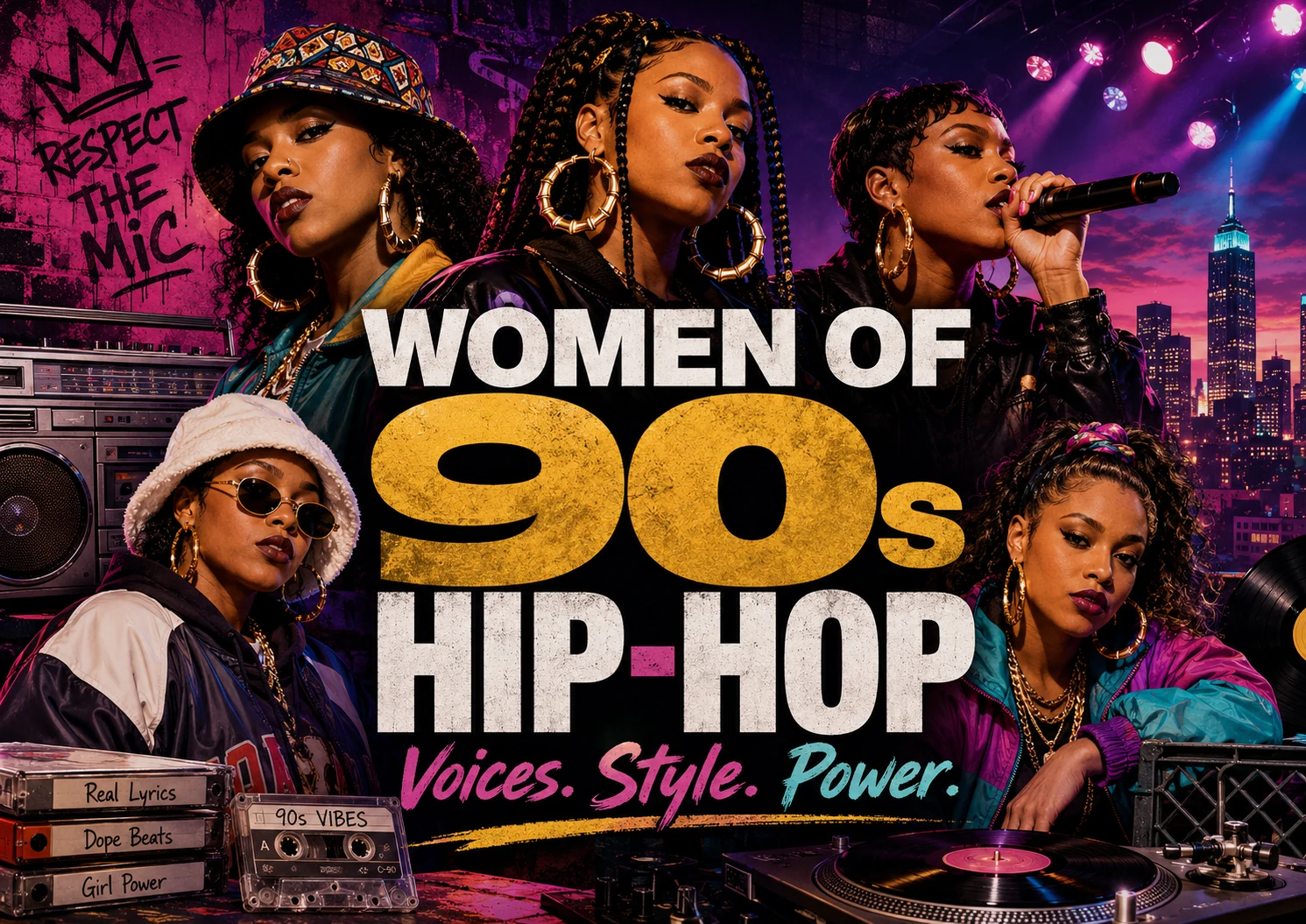
Women of 90s Hip-Hop
The women of 90s hip-hop were not side characters, guest spots, or “female versions” of anything. They were MCs, hitmakers, video-era forces, fashion detonators, underground favorites, radio regulars, album artists, and cultural voices who changed how 90s hip-hop sounded, looked, argued, danced, dressed, flirted, fought back, and talked to Gen X in real time.
The women of 90s hip-hop included Queen Latifah, Salt-N-Pepa, MC Lyte, Yo-Yo, Lauryn Hill, Missy Elliott, Lil’ Kim, Foxy Brown, Da Brat, Bahamadia, Lady of Rage, Lisa “Left Eye” Lopes, Gangsta Boo, Mia X, Eve, and more. They shaped rap through lyrics, classic 90s hip-hop albums, videos, fashion, radio, party records, politics, sexuality, and the everyday Gen X soundtrack.
Keep the 90s Hip-Hop Rewind Going
This page connects to the bigger 90s rap map: songs, albums, regions, MTV, radio, style, conscious rap, and the records that made the decade impossible to ignore.
Women Did Not Just Participate in 90s Hip-Hop. They Changed the Room.
The lazy version of 90s hip-hop history treats women like a sidebar. A few names, a few hits, maybe one “important female rapper” sentence, and then right back to the same five guys in hoodies and Timberlands. That version is not just incomplete. It is boring, and worse, it misses how the decade actually felt if you were watching MTV, taping radio mixes, buying CD singles, reading magazines, or arguing about videos in a cafeteria.
Women were everywhere in the decade’s rap culture. They were on the radio. They were on MTV. They were on soundtracks. They were in clubs, on BET, in magazine spreads, in CD binders, on mixtapes, on posse cuts, in rap crews, on R&B hooks, in fashion conversations, and in the middle of debates about respect, sex, power, image, street credibility, motherhood, feminism, crossover, and who got to define what “real hip-hop” was supposed to look like.
What made the women of 90s hip-hop so important was range. Queen Latifah could command respect with regal force. Salt-N-Pepa could turn sexuality, humor, and confidence into mainstream rap power. MC Lyte could out-rap half the room with clean precision. Yo-Yo could bring West Coast feminism with backbone. Lauryn Hill could rap, sing, preach, confess, and dominate without choosing one lane. Missy Elliott could make the future sound like it had a warped VHS filter. Lil’ Kim and Foxy Brown could flip luxury, sex, and image into control. Bahamadia could make quiet sound dangerous. Lady of Rage could tear through a Death Row track like she had been waiting patiently for everyone else to stop wasting time.
This is also why this page belongs beside 50 Essential 90s Hip-Hop Songs and Best 90s Hip-Hop Albums. If you remove the women, the decade gets thinner, flatter, less stylish, less complicated, and honestly a lot less fun. Nobody needs that version. We already lived through dial-up. We suffered enough.
This Was Not Just Music. It Was How the 90s Looked, Sounded, and Talked Back.
For Gen X, women in 90s hip-hop were part of everyday life in a way that is hard to explain if you did not have to wait for a video to come on TV. These songs were not floating around in an endless digital buffet. You caught them in pieces: on the radio during the ride home, on a dubbed tape with somebody yelling over the intro, on a CD single from the mall, on a soundtrack you bought for one song and then pretended you meant to buy the whole thing.
Salt-N-Pepa was the sound of school dances, sleepovers, roller rinks, and house parties where somebody’s older cousin had access to speakers that should have required a permit. Queen Latifah was the voice of self-respect before “empowerment” became a marketing department with tote bags. MC Lyte was for the heads who knew clean delivery mattered. Lauryn Hill made everyone quiet down because suddenly the room had feelings. Missy made every video feel like the TV had eaten a comic book and a spaceship. Lil’ Kim and Foxy made image part of the argument, whether adults liked it or not. Spoiler: adults did not.
The lifestyle part matters because 90s hip-hop was not separated from clothes, hair, makeup, jackets, boots, hoop earrings, sports jerseys, sunglasses, CD binders, car stereos, radio countdowns, lunchroom debates, and the general Gen X skill of pretending not to care while caring deeply about everything. The women of the decade shaped how rap sounded, but they also shaped how it showed up in bedrooms, lockers, malls, videos, and mirrors.
That is the bigger connection to 90s Hip-Hop Fashion. Style was not decoration. It was identity. It told you who was street, who was fly, who was conscious, who was futuristic, who was polished, who was underground, and who had clearly spent way too much time coordinating an outfit that looked “effortless.” We all saw you. It was fine.
MTV, BET, and Radio Made Women in Hip-Hop Unavoidable
The Look Was Part of the Hook
In the 90s, a song could live on radio, but a video made it feel permanent. The women who understood that became impossible to ignore.
The video era changed everything. A woman MC in the 90s was not only competing on records. She was competing in image, styling, choreography, camera presence, fashion, attitude, and whatever weird green-screen experiment the director had discovered that week. Some videos looked expensive. Some looked like the budget was “a fog machine and confidence.” Either way, they mattered.
Hip-Hop on MTV in the 90s gave women a huge visibility boost, but it also brought pressure. Every look became a statement. Every hook needed to work in a short attention span world before short attention spans got industrialized by phones. Salt-N-Pepa, Missy Elliott, Lauryn Hill, Lil’ Kim, Foxy Brown, Da Brat, and Left Eye all understood that the camera was not just watching them. It was helping define them.
Radio mattered just as much. The clean edit was its own strange art form. Half the time you knew exactly what word got removed because the silence was louder than the lyric. But radio turned records into shared experiences. It made songs travel through school buses, bedrooms, kitchen radios, mall stores, cars with questionable speakers, and mixtapes recorded off the air with the DJ stepping all over the end like a menace to society.
That crossover power is why women were crucial to 90s Rap Radio Crossover. They did not just make “female rap songs.” They made rap songs that moved across pop, R&B, dance, hip-hop, and video culture. They were not outside the mainstream looking in. They were part of what made the mainstream finally admit rap had taken over the room.
Women of 90s Hip-Hop Made Style Loud, Strategic, and Personal
The Clothes Said What the Chorus Did Not Have Time to Explain
Oversized fits, leather jackets, hoops, boots, bright colors, designer flexes, futuristic videos, and streetwear told you exactly who was in control.
Style in 90s hip-hop was never just style. It was armor, attitude, branding, politics, flirtation, self-definition, and occasionally a direct attack on your boring mall wardrobe. Women in the decade used fashion to communicate before the first verse landed.
Queen Latifah could look regal without losing street-level authority. Salt-N-Pepa made asymmetrical cuts, jackets, hoops, and bold colors feel like part of the song. MC Lyte kept it sharp and unfussy. Yo-Yo brought West Coast confidence with a stance that said she was not here to be managed. Lil’ Kim made luxury, sexuality, and high-fashion provocation into a whole visual language. Foxy Brown leaned into glamour and cold confidence. Missy Elliott treated clothes like cartoons, sculpture, armor, and comedy all at once. Lauryn Hill made natural beauty, thrift-store soul, Afrocentric touches, and timeless cool feel bigger than trend.
For Gen X kids, this stuff landed hard. You saw a video and suddenly your jacket, boots, lip liner, hoops, sunglasses, jersey, or hair part felt outdated by Friday. The mall did not always have the exact version you wanted, so everybody improvised badly and called it style. That was the 90s. We made do. Sometimes it worked. Sometimes there are photos hidden in shoeboxes for legal reasons.
This is why women are essential to the 90s Hip-Hop Fashion story. They did not just follow the look of the decade. They created the looks people copied, argued about, misunderstood, feared, admired, and watered down years later.
The Women Who Changed 90s Hip-Hop
This is not a tiny “honorable mention” corner. These artists shaped the decade in different lanes: lyricism, radio, politics, party records, fashion, albums, videos, regional scenes, underground respect, and full-on cultural takeover.
They Did Not All Sound Alike Because That Was the Whole Point
The decade had queens, technicians, party starters, street narrators, futurists, soul voices, underground favorites, and video-era icons.
1. Queen Latifah
Queen Latifah entered the 90s with something most artists spend a whole career trying to manufacture: command. She did not sound like someone trying to get attention. She sounded like attention had already been called to order. Her voice had weight, her presence had purpose, and her whole image felt rooted in self-respect before self-respect became a slogan slapped on a clearance-rack T-shirt.
What made Latifah so powerful was that she did not fit into the narrow boxes the industry loved building for women in rap. She was not just “the conscious one,” not just “the positive one,” not just “the respectable one.” She could be warm, regal, political, funny, stylish, musical, and stern enough to make the whole room sit up straighter. That range mattered, because 90s hip-hop was constantly asking women to pick a lane while men got to be entire highway systems.
Her 90s peak with Black Reign gave the decade one of its defining statements in “U.N.I.T.Y.” That song was not polite background empowerment. It was a direct response to disrespect, harassment, misogyny, and the everyday garbage women had to navigate while everybody else pretended it was just “how things were.” Latifah made it musical, memorable, and impossible to dismiss without telling on yourself.
For Gen X listeners, Latifah was one of those artists who could cross environments without losing herself. She worked on MTV. She worked on radio. She worked in headphones. She worked in the room with the older cousin who claimed everything after 1989 was fake. She had the rare ability to be accessible without being watered down.
Her style also mattered. The crowns, Afrocentric touches, jackets, confidence, and regal posture were not gimmicks. They were part of the message. She looked like she belonged on a stage, in a cipher, on a magazine cover, and in charge of a meeting where several people were about to be corrected.
Latifah connects directly to Conscious Rap in the 90s, 90s Hip-Hop Fashion, and Best 90s Hip-Hop Albums. She did not just prove women could stand inside hip-hop. She proved they could set terms, challenge the culture, make hits, and still sound like nobody’s sidekick.
2. Salt-N-Pepa
Salt-N-Pepa were already legends before the 90s really got moving, but the 90s made them unavoidable in a different way. They were not just early trailblazers being respectfully remembered. They were still making hits, still shaping style, still pushing conversations, and still giving school dances, roller rinks, house parties, and radio countdowns the kind of songs that made everybody suddenly remember they had knees.
Their genius was balance. Salt-N-Pepa could make records that were fun without being empty, sexy without surrendering control, mainstream without sounding like they had been bleached by a record-label meeting, and message-driven without turning into a guidance counselor assembly. That is harder than it looks. A lot of artists try to walk that line and end up sounding like a soda commercial with a beat.
Very Necessary was their giant 90s statement. “Shoop” was flirty, funny, and instantly memorable. “Whatta Man” worked because it brought hip-hop, R&B, humor, and admiration into one of the decade’s most recognizable records. “None of Your Business” had teeth, especially because it addressed judgment, sexuality, double standards, and the exhausting hobby society has of policing women for sport.
On MTV, they were visual stars. Their outfits, hair, confidence, choreography, and chemistry made them feel bigger than the songs without ever making the songs feel small. They understood the camera. They understood hooks. They understood that a look could hit almost as hard as a snare if you knew what you were doing.
For Gen X, Salt-N-Pepa were part of the shared social soundtrack. Their music could show up at a school dance, in a car, on a radio countdown, at a sleepover, or in a living room where someone was trying to record a video off TV and screaming at their sibling to stop walking in front of the screen. They were everywhere because the songs worked everywhere.
Their impact runs through 90s Rap Radio Crossover, 90s Hip-Hop Dance and Party Songs, and 90s Hip-Hop Fashion. Salt-N-Pepa were proof that pop reach and hip-hop attitude did not have to cancel each other out.
3. MC Lyte
MC Lyte had one of the cleanest deliveries in hip-hop, and the 90s gave her more room to prove that precision could still cut through a louder, glossier decade. Lyte did not need chaos around her to sound powerful. She had that rare voice where every syllable seemed placed on purpose, like she had measured the beat, marked the corners, and decided exactly where the damage should land.
Her 90s work mattered because she carried lyrical credibility into a period when rap was expanding commercially and visually. The culture was getting bigger, videos were getting more important, radio was getting more involved, and image was becoming harder to separate from sound. Lyte adapted without losing the thing that made her Lyte: control.
“Ruffneck” gave her a major 90s crossover moment, and it still works because it has attitude without desperation. The song is direct, catchy, sharp, and confident. It let her reach a wider audience without sounding like somebody had sanded off the edges for radio. The hook landed, the beat moved, and Lyte still sounded like an MC first.
She also represented a different kind of cool. Lyte was stylish, but never dependent on costume. She could look sharp and still make it feel secondary to the voice. In a video era increasingly obsessed with visual spectacle, that mattered. She reminded people that presence could come from posture, delivery, and command, not just explosions, fisheye lenses, and ten outfit changes.
For Gen X fans who cared about bars, Lyte had credibility that went beyond the big singles. She was the kind of rapper older heads respected, younger listeners discovered through radio and TV, and everybody should have known better than to underestimate. She did not have to be loud to be dominant. That was the whole trick.
Her place belongs beside 50 Essential 90s Hip-Hop Songs and the bigger story of Golden Age Hip-Hop in the Early 90s. MC Lyte showed that women were not guests in lyrical rap. They were part of the standard.
4. Yo-Yo
Yo-Yo brought West Coast confidence with a backbone. She came out of a scene often defined by men, street narratives, and gangsta rap mythology, but she did not enter it as decoration. She entered with her own voice, her own perspective, and a clear refusal to let the conversation happen around her like she was not standing right there.
Her connection to Ice Cube gave her early visibility, but Yo-Yo was never just an extension of someone else’s brand. That matters. She used that opening to build her own identity: sharp, direct, funny when she wanted to be, and serious about women being respected in a culture that often wanted women present but not too opinionated. Good luck with that.
Records like “You Can’t Play with My Yo-Yo” had a confrontational energy that felt very 90s in the best way. It was playful on the surface, but underneath it was a statement about boundaries, agency, and refusing to be handled. Yo-Yo brought feminist language into a West Coast rap context without making it feel imported from outside the culture.
Her music also gave another angle on West Coast Hip-Hop in the 90s. The region was not only Dre, Snoop, Cube, Death Row, lowriders, and G-funk. Women were responding to that world, challenging it, living inside it, and telling stories from positions that the mainstream rap narrative often treated as secondary.
Yo-Yo’s style felt grounded and assertive. She did not need to soften herself to be heard, and she did not need to imitate the men around her to prove she belonged. That made her important in a decade full of double standards. She could be West Coast, political, feminine, tough, funny, and community-minded all at once.
Her legacy belongs beside Conscious Rap in the 90s and Gangsta Rap in the 90s, because she shows how those lanes overlapped. Yo-Yo was not a side note to West Coast rap. She was one of the voices making the region more complete.
5. Lauryn Hill
Lauryn Hill did not just become one of the most important women in 90s hip-hop. She became one of the most important artists of the decade, period. There are performers who have hits, and then there are performers who shift the emotional temperature of a room. Lauryn was the second kind.
With the Fugees, Lauryn often felt like the gravity holding everything together. She could rap with authority, sing with ache, and make a verse feel like it had both street-corner confidence and church-basement wisdom. When The Score exploded, it was not just because the songs were good. It was because Lauryn’s presence made the group feel bigger, deeper, and more emotionally complete.
Then came The Miseducation of Lauryn Hill, which was not just an album. It was a cultural event with a notebook, a diary, a sermon, a breakup letter, a love song, a warning, and a mirror all stuffed inside the jewel case. It blurred hip-hop, soul, reggae, gospel, motherhood, heartbreak, faith, fame, and self-respect in a way that felt massive and intimate at the same time.
Lauryn’s genius was that she did not separate skill from feeling. She could outrap people, outsing people, and outwrite people, but the real force was emotional truth. She made listeners feel like they were being told something they already knew but had never heard said out loud that cleanly before.
For Gen X, Lauryn hit in every environment. Headphones. Dorm rooms. Car rides. Radio. MTV. Family cookouts. Bedrooms where somebody was pretending they were not going through something. Her songs became shared emotional vocabulary before everyone started turning pain into social captions.
The deeper rewind is Lauryn Hill, the Fugees, and Hip-Hop Soul, but she belongs here because any story about women in 90s hip-hop without Lauryn is basically a CD binder missing the disc everybody came over to borrow.
6. Missy Elliott
Missy Elliott made late-90s hip-hop feel like the future had crashed through the ceiling and landed on a soundstage full of trash bags, fisheye lenses, cartoon logic, alien drums, and jokes only she was cool enough to explain. She was weird, funny, sexy, stylish, musical, and completely uninterested in being shaped into a predictable rap star.
Supa Dupa Fly was the shift. With Timbaland, Missy helped create a sound that felt minimal and huge at the same time. The beats bounced, skipped, twitched, and left space where other producers would have panicked and filled everything with noise. Missy knew how to use that space. She could rap, sing, whisper, joke, chant, and turn a tiny phrase into something your brain refused to delete.
Her video presence was just as important. Missy understood that hip-hop on MTV was not just about showing up on screen. It was about creating images people would remember forever. The inflated suit, the surreal rooms, the choreography, the colors, the camera angles — she treated video like another instrument.
What made Missy radical was that she made weirdness commercial without sanding it down. Labels are usually very brave about creativity right up until creativity looks unusual, sounds unusual, or cannot be summarized in one terrible meeting. Missy made the unusual the whole point, and then she made it hit.
She also reshaped the relationship between hip-hop and R&B. Missy could write and produce across lanes, move between singing and rapping, and make songs feel like they belonged to clubs, bedrooms, radio, and outer space. That range helped define late-90s music culture.
She gets a deeper rewind in Missy Elliott and Late-90s Hip-Hop Weirdness, because Missy did not just have hits. She changed what imagination looked like in rap.
7. Lil’ Kim
Lil’ Kim changed the visual and lyrical language around women in mainstream rap so sharply that people are still arguing about it, copying it, misunderstanding it, and pretending they were not influenced by it. She walked into the late-90s with sexuality, luxury, aggression, vulnerability, fashion, humor, and star presence all turned up at once.
Hard Core was the key statement. It sat inside the Bad Boy universe, but Kim was not just an accessory to that world. She brought her own tone: explicit, glamorous, tough, stylish, funny, and completely aware of the power in making people uncomfortable. She understood that image could be a weapon, not just decoration.
Her connection to Biggie and Junior M.A.F.I.A. gave her a platform, but her impact came from what she did with it. Kim took the language of male bravado and flipped it. She took the camera and stared back. She took fashion and turned it into confrontation. She took sexuality and made it her own performance instead of something handed to her by somebody else’s gaze.
The 90s were not exactly subtle about double standards. Men could be explicit and get called raw. Women could be explicit and suddenly everyone became a media studies professor with a concerned face. Kim forced those contradictions into the open. She made people reveal what they were really uncomfortable with: not sex, but control.
For Gen X, Kim was part of the late-90s visual explosion: glossy videos, designer references, magazine covers, radio singles, and a fashion language that jumped from rap media into mainstream pop culture. You did not have to own Hard Core to know the image. That is cultural saturation.
Kim belongs beside The Shiny Suit Era of Late-90s Rap, 90s Rap Radio Crossover, Biggie Smalls and East Coast 90s Rap, and 90s Hip-Hop Fashion. She was not just part of the look. She changed the look.
8. Foxy Brown
Foxy Brown brought a cold, polished confidence to late-90s rap. Her voice sounded young but controlled, glamorous but hard, commercial but not soft. She fit perfectly into the era when rap, R&B hooks, designer styling, radio singles, and video gloss were all merging into one very expensive-looking machine.
Ill Na Na captured that moment. Foxy sounded comfortable over slick production and alongside major features, but she did not disappear into the polish. That mattered. A lot of late-90s rap could get so shiny that the artist started to look like another accessory. Foxy’s voice had enough bite to keep the shine from swallowing her.
She also embodied a particular kind of East Coast glamour. Not the whimsical kind. Not the approachable “girl next door” thing. Foxy’s image was colder, sharper, more luxurious, and less interested in being liked by everybody. She was part of the shift where women in rap could occupy expensive-looking spaces without pretending the money made them softer.
Her career also shows how intense the scrutiny was for women in that era. Every image choice, lyric, outfit, rivalry, and collaboration got dissected differently than it would have for a male rapper doing the exact same things with half the charisma. The 90s loved women rap stars, but it also loved putting them through obstacle courses and calling it criticism.
For Gen X listeners, Foxy was tied to radio, video countdowns, mixtape appearances, rap/R&B crossover, and the late-90s sense that hip-hop had entered a more glamorous and competitive phase. She was part of the sound of rap becoming bigger, slicker, and more visible.
Foxy belongs in the same conversation as 90s Rap Radio Crossover, East Coast Hip-Hop in the 90s, and 90s Hip-Hop Fashion. She helped define the cold-glamour lane of late-90s rap.
9. Da Brat
Da Brat brought a different kind of energy to the 90s: tomboy style, fast-talking confidence, funk, humor, bounce, and a flow that could ride radio-friendly production without losing its edge. She did not feel like a label’s attempt to create a safe, softened rap star. She felt like somebody who walked into the studio already knowing where the snacks were and where the beat needed to go.
Funkdafied made her a major commercial force and helped prove women MCs could sell serious records without fitting the narrow glamour mold that the industry kept trying to impose. Da Brat had charisma, voice, and an image that stood apart from both the conscious queen lane and the polished late-90s luxury lane.
Her sound was tied to Jermaine Dupri and So So Def, which gave her records a bounce that worked on radio, in cars, and in party settings. The production could be funky and accessible, but Da Brat’s delivery kept it from becoming too clean. She had enough grit in her voice to make the songs feel lived-in instead of manufactured.
Her image mattered too. Da Brat’s tomboy style gave 90s audiences another version of women’s hip-hop presence. She did not have to perform glamour to be visible. She did not have to package herself around sex appeal to be charismatic. She could wear braids, jerseys, oversized fits, and confidence, and the whole thing made sense because it was hers.
For Gen X, Da Brat fit perfectly into the era’s mixtape/radio/video ecosystem. You could hear her on the radio, catch the video, see the So So Def connection, and place her inside the broader 90s moment where rap and R&B were constantly borrowing each other’s furniture.
Da Brat’s lane connects to 90s Rap Radio Crossover, 90s Hip-Hop Dance and Party Songs, and the wider 90s hip-hop fashion story. She gave the decade funk, flow, and a different kind of cool.
10. Bahamadia
Bahamadia was proof that quiet could hit hard. She did not need to bulldoze a beat, scream for attention, or build a personality out of volume. Her voice was calm, smoky, controlled, and precise, which made the rhymes feel even sharper. In a decade full of huge personalities, she made restraint feel like power.
Kollage remains one of the decade’s essential underground-leaning records. It is smooth, jazzy, lyrical, and deeply tied to a different kind of hip-hop confidence. Bahamadia sounded like she trusted the listener to lean in, which is rare in a genre where everyone is usually trying to win the volume war before the snare even drops.
Her Philly identity mattered. The 90s map often gets reduced to New York, Los Angeles, Atlanta, Houston, and whatever city the documentary has B-roll for. But Philadelphia had its own soul, grit, and lyrical tradition. Bahamadia brought that into the conversation with a style that felt both grounded and elevated.
Her importance is not about chart dominance. It is about craft, tone, and credibility. She gave the decade another model for women in rap: not glossy, not gimmicky, not packaged for easy consumption, but skilled, cool, and absolutely in control. She was not trying to be larger than life. She was trying to be better than lazy listeners deserved.
For Gen X hip-hop heads, Bahamadia was one of those names that proved you were listening deeper than the radio. She was CD binder credibility. She was record-store conversation. She was the artist someone put you onto when they were tired of hearing the same five names from people who thought MTV was the whole planet.
Bahamadia sits naturally beside Forgotten 90s Hip-Hop Songs and the deeper end of Best 90s Hip-Hop Albums. Casual listeners may not mention her first, but the deeper shelf absolutely needs her.
11. Lady of Rage
Lady of Rage had one of those voices that sounded like it could dent a car door. She was not a background presence in the Death Row universe. She was a lyrical force who could step into one of the loudest, most masculine rap ecosystems of the decade and still sound like nobody should test her unless they had excellent insurance.
Her appearances around Death Row gave her visibility, but she earned attention because she could rap. Period. No asterisk, no qualifier, no polite little “for a female rapper” nonsense. Throw that phrase into the sun and let it stay there.
“Afro Puffs” became her signature record because it had everything: voice, attitude, identity, production, and a hook that made the style part of the statement. Rage sounded powerful without sounding like she was imitating the men around her. She did not borrow authority. She brought her own.
Her placement inside the West Coast hip-hop and Death Row story matters because that story often centers Dre, Snoop, Pac, and the label’s bigger male mythology. But the sound of that world is incomplete without Rage cutting through it with that unmistakable command.
She also represented a style of women’s rap that did not need pop crossover to justify itself. Rage was not chasing a softened lane. She could stand in the middle of G-funk, gangsta rap, and hard West Coast records and sound completely at home.
Her legacy is connected to G-Funk and the 90s West Coast Sound, Gangsta Rap in the 90s, and the broader women-in-rap story because she made one thing extremely clear: bars were not optional, and she had plenty.
12. Lisa “Left Eye” Lopes
Left Eye lived in a space that often gets filed under R&B because of TLC, but that misses how much hip-hop attitude, cadence, writing, style, and personality she brought into the group’s identity. She was the spark, the chaos, the commentary, the rap voice, and often the reason a smooth song suddenly got a mischievous edge.
TLC worked because the blend worked: T-Boz’s cool, Chilli’s sweetness, and Left Eye’s unpredictable fire. Left Eye gave the group a hip-hop pulse that made their records feel sharper than standard pop/R&B polish. Her verses were playful, rhythmic, and full of personality, but they also carried warning signs if you were paying attention.
She mattered visually too. The glasses, colors, face markings, futuristic styling, and fearless camera presence made her one of the decade’s most recognizable video-era figures. She understood image in a way that fit perfectly with 90s MTV culture. Not image as decoration. Image as character, signal, and attitude.
Left Eye also gave TLC’s social commentary a different charge. Songs about safe sex, self-worth, relationships, desire, and consequences hit differently because the group could balance accessibility with edge. Left Eye often supplied the edge. She made the songs feel less like lessons and more like your coolest, most chaotic friend telling you the truth.
For Gen X, TLC and Left Eye were inescapable: radio, MTV, school dances, mall stores, bedroom posters, award shows, and conversations about videos the next day. She was part of the soundtrack and the visual memory. You did not just hear Left Eye. You remembered how she looked while saying it.
Her place here matters because 90s rap crossover did not stay neatly inside genre lines. Hip-hop culture moved through R&B, pop, fashion, dance, and video. Left Eye was one of the clearest examples of that blend working at full power.
13. Eve
Eve arrived at the very end of the 90s, but she mattered immediately because she represented where the next wave was heading. She had Ruff Ryders energy, Philly confidence, mainstream-ready presence, and a voice that could sound tough without flattening her personality into some one-dimensional “hard female rapper” label. Again with the labels. The 90s loved labels almost as much as starter jackets.
Her 1999 arrival came during a major mood shift. DMX had helped knock some gloss off late-90s rap, Swizz Beatz was bringing a harder, sharper production style, and Ruff Ryders felt like a new kind of crew energy. Eve stepped into that world with enough identity to stand out immediately.
What made Eve important was balance. She could be street, stylish, vulnerable, tough, funny, and radio-friendly without sounding like a committee assembled her from leftover trend pieces. She had edge, but she also had warmth. She could hold her own inside a rougher late-90s sound while still feeling accessible enough to carry into the 2000s.
Eve also mattered because she entered at a moment when women in rap were being pulled between multiple expectations: glamour, toughness, crossover, authenticity, sex appeal, lyrical credibility, and video presence. She did not solve those contradictions because nobody could, but she navigated them with more control than the industry probably deserved.
For Gen X listeners closing out the decade, Eve felt like a bridge. She was technically a 90s arrival, but her full impact pointed forward. That makes her an important endpoint here: the decade did not end with one version of women in hip-hop. It ended with another door opening.
Eve connects to The Shiny Suit Era of Late-90s Rap as a counterweight, and to Best 90s Hip-Hop Albums through the late-90s Ruff Ryders shift. She was not the end of the story. She was the signal that the next one was already loading.
The Underground, Regional, and Overlooked Women Deserve More Than a Footnote
The biggest names matter, but the decade was wider than the obvious MTV and radio rotation. Some women shaped regional scenes, underground credibility, crew records, street tapes, and deep-cut memory.
Gangsta Boo
Gangsta Boo brought a raw Memphis presence that cut through the darkness of Three 6 Mafia’s world. Her delivery was sharp, confident, and completely unbothered, and she helped prove that Southern women were not waiting for coastal approval before making noise.
Memphis rap had its own atmosphere: eerie, hard, lo-fi, hypnotic, and darker than the glossy narratives that dominated TV. Gangsta Boo fit that world without sounding like she was being swallowed by it. Her voice carried command in a scene where command was mandatory.
She belongs in the larger Southern Hip-Hop in the 90s story because the South was not just Atlanta, Houston, Miami, or New Orleans. Memphis had teeth, and Gangsta Boo was one of the reasons people eventually had to admit it.
Mia X
Mia X was No Limit’s first lady and a major New Orleans presence during the label’s late-90s explosion. She had authority, personality, and a voice that fit the tank-heavy world of No Limit without getting swallowed by it.
No Limit’s universe was loud, prolific, regional, and visually impossible to ignore. The covers looked like somebody gave a haunted gaming computer a record-label budget. Inside that chaos, Mia X brought skill and presence that helped widen what New Orleans rap could look like.
Her place in the decade matters because New Orleans was becoming a major force, and women were part of that rise. That is part of the reason Southern hip-hop in the 90s cannot be told like a one-man parade with tank graphics.
Heather B
Heather B had a rugged East Coast presence and a voice that sounded built for basement speakers. She never became a giant pop name, but she had the kind of credibility that made her records matter to listeners who were paying attention beyond the obvious singles.
Her work carried that mid-90s street-level energy: direct, hard, unfussy, and built for people who liked their rap without a lot of decorative frosting. She was not chasing the shiny lane, and that made her stand out in a decade increasingly pulled toward video gloss.
She fits the same deeper-shelf energy as Forgotten 90s Hip-Hop Songs: artists who did not always dominate the chart but absolutely belonged in the conversation.
Monie Love
Monie Love bridged the Native Tongues era into the early 90s with personality, intelligence, and a flow that brought a different kind of brightness to the scene. She was sharp, playful, and connected to one of the most important creative circles of the era.
Her voice mattered because it added movement and charm without sacrificing skill. She could sound light on her feet while still keeping the rhymes tight. In the early-90s golden age, that kind of energy helped keep the music expansive and unpredictable.
Her presence matters because women were woven into Golden Age Hip-Hop in the Early 90s, not placed on top of it later for decoration. The Native Tongues world was cooler because voices like hers were in it.
Boss
Boss brought a hard-edged early-90s style that challenged expectations around image, authenticity, and women’s place in gangsta rap’s orbit. Her moment was complicated, but it is part of the decade’s story because 90s hip-hop was full of contradictions.
She occupied a lane that made people uncomfortable for reasons that say a lot about the era. Men could perform toughness in countless ways and be treated as complex. Women doing the same thing were often turned into debates about authenticity, image, and whether the industry was packaging hardness.
That complication is exactly why she belongs here. The 90s were not clean. They were arguments with beats, and her story sits close to the larger messiness of Gangsta Rap in the 90s.
Rah Digga
Rah Digga emerged in the late 90s with serious lyrical credibility and Flipmode Squad visibility, setting up a bigger run just beyond the decade. Her presence mattered because she represented the bar-heavy lane that refused to disappear.
She was part of the late-90s reminder that women MCs could be technical, aggressive, funny, and crew-certified without being forced into one easy marketing box. She sounded like someone who wanted respect from the cipher first, then everything else after.
Her late-90s arrival also shows how the decade fed directly into the 2000s. Women in rap were not fading out; the stage was changing, and Rah Digga was one of the voices making sure skill still had a place near 90s hip-hop groups and crews.
The Crossover Lane Was Not Selling Out. Sometimes It Was Taking Over.
Women Helped Make Rap Mainstream Without Making It Smaller
Hooks, videos, remixes, soundtrack cuts, R&B blends, and dance-floor records made the decade travel.
There is a tired argument that crossover automatically means compromise. Sometimes, sure. The 90s had plenty of label decisions that smelled like boardroom cologne. But women in hip-hop often used crossover as leverage. They took radio, MTV, R&B hooks, fashion, and pop visibility and turned them into power.
Salt-N-Pepa made pop-facing rap feel confident and adult without losing humor. Lauryn Hill made hip-hop soul feel enormous and intimate. Missy Elliott made weirdness commercially undeniable. Lil’ Kim and Foxy Brown made glamorous rap feel sharp instead of soft. Da Brat made funk and radio bounce work with tomboy confidence. Left Eye brought rap personality into one of the biggest R&B groups of the decade.
This crossover lane also shaped how Gen X consumed music. You might hear a song first on radio, see it later on MTV, tape it off a countdown, buy the CD single, then find the remix on a soundtrack. Songs did not just drop into your phone like a tiny corporate notification. They traveled. You had to catch them like wildlife.
That is why this page links naturally to 90s Rap Radio Crossover, 90s Hip-Hop Movie Soundtracks, and 90s Hip-Hop Dance and Party Songs. Women were not just participating in crossover rap. They helped make it memorable.
The Albums and Songs That Kept Showing Up in Gen X Memory
A lot of women’s 90s hip-hop history gets flattened into singles, but the album story matters too. Black Reign, Very Necessary, The Miseducation of Lauryn Hill, Supa Dupa Fly, Hard Core, Ill Na Na, Funkdafied, Kollage, and other records were part of the decade’s album culture.
These albums lived in the same CD binders as Illmatic, The Chronic, Ready to Die, Doggystyle, Aquemini, and the rest of the records in Best 90s Hip-Hop Albums. They were not separate from the main story. They were on the same shelf, usually with a cracked case and a booklet somebody absolutely borrowed and never returned.
The singles mattered because they traveled so widely. “U.N.I.T.Y.,” “Shoop,” “Ruffneck,” “Doo Wop (That Thing),” “The Rain,” “Crush on You,” “Get Me Home,” “Funkdafied,” “Afro Puffs,” and “None of Your Business” were not niche footnotes. They were part of the shared soundtrack. Some were party records. Some were message records. Some were radio smashes. Some were weird little future transmissions. All of them helped shape the decade.
If 50 Essential 90s Hip-Hop Songs is the broad canon, this page is the reminder that women helped build that canon and then got weirdly minimized by people who apparently lost half their CD collection and all their context.
The songs that talked back
Queen Latifah, Yo-Yo, MC Lyte, Lauryn Hill, and others made records that pushed back against sexism, disrespect, and narrow expectations without sacrificing the groove.
The songs that moved the room
Salt-N-Pepa, Da Brat, Missy, Kim, Foxy, and Left Eye made records that worked on radio, in videos, at parties, and in cars with speakers fighting for their lives.
The songs the heads remember
Bahamadia, Heather B, Lady of Rage, Gangsta Boo, Mia X, and others gave the decade deeper regional and underground texture beyond the usual highlight reel.
Follow the 90s Sound Around Them
The women of 90s hip-hop were part of a bigger radio and MTV ecosystem. These year pages show the pop, R&B, dance, alternative, and rap songs that were sharing the same air.
Why the Women of 90s Hip-Hop Still Matter
The Decade Sounds Smaller Without Them
Remove the women and the 90s loses hooks, bars, fashion, argument, attitude, soul, weirdness, and half the good cafeteria debates.
The women of 90s hip-hop still matter because they made the decade bigger. They expanded what rap could sound like, what a rapper could look like, what topics could be centered, what images could be powerful, and what kinds of confidence could live on screen and in speakers.
They also exposed the double standards of the era. Men could be sexual, aggressive, political, flashy, soft, hard, funny, or contradictory and be treated as complex. Women did the same things and got turned into debates. Too hard. Too sexy. Too conscious. Too commercial. Too underground. Too loud. Too quiet. Too much. The 90s loved putting women in boxes, and the best women in hip-hop spent the decade kicking holes in the cardboard.
Their influence is everywhere now: in rap delivery, fashion, pop-rap crossover, visual albums, hip-hop soul, women-led posse energy, genre blending, video aesthetics, designer flexes, natural style, futuristic weirdness, and the ongoing refusal to let rap history be told like only men held the mic.
For Gen X, the legacy is also personal. These songs are tied to real places: bedrooms with posters, mall stores, radio countdowns, school dances, summer car rides, dorm rooms, house parties, VHS video blocks, CD binders, and conversations that happened before everyone had a comment section in their pocket. The women of 90s hip-hop were part of the soundtrack, the style guide, the attitude adjustment, and the memory pile.
Where to Go Next in the 90s Hip-Hop Rewind
Women of 90s Hip-Hop FAQ
Who were the most important women in 90s hip-hop?
Some of the most important women in 90s hip-hop include Queen Latifah, Salt-N-Pepa, MC Lyte, Yo-Yo, Lauryn Hill, Missy Elliott, Lil’ Kim, Foxy Brown, Da Brat, Bahamadia, Lady of Rage, Lisa “Left Eye” Lopes, Gangsta Boo, Mia X, and Eve.
Why were women important to 90s hip-hop?
Women were important to 90s hip-hop because they shaped the music, videos, radio hits, fashion, politics, party records, underground scenes, and cultural conversations of the decade. They brought lyricism, hooks, style, confidence, social commentary, sexuality, humor, and emotional depth into the center of hip-hop culture.
What 90s hip-hop songs by women still stand out?
Key 90s hip-hop songs by women include “U.N.I.T.Y.,” “Shoop,” “Ruffneck,” “Doo Wop (That Thing),” “The Rain,” “Crush on You,” “Get Me Home,” “Funkdafied,” “Afro Puffs,” “None of Your Business,” and “Ladies First,” among many others.
What albums by women helped define 90s hip-hop?
Important albums include Queen Latifah’s Black Reign, Salt-N-Pepa’s Very Necessary, Lauryn Hill’s The Miseducation of Lauryn Hill, Missy Elliott’s Supa Dupa Fly, Lil’ Kim’s Hard Core, Foxy Brown’s Ill Na Na, Da Brat’s Funkdafied, and Bahamadia’s Kollage.
How did women influence 90s hip-hop fashion?
Women influenced 90s hip-hop fashion through oversized streetwear, leather jackets, hoop earrings, bold colors, boots, jerseys, designer looks, natural styles, futuristic video outfits, glamorous late-90s styling, and personal looks that became part of the music’s identity.
Where should I go next?
Start with 90s Hip-Hop and Rap, then check out 50 Essential 90s Hip-Hop Songs, Best 90s Hip-Hop Albums, Lauryn Hill, the Fugees, and Hip-Hop Soul, Missy Elliott and Late-90s Hip-Hop Weirdness, and 90s Hip-Hop Fashion.