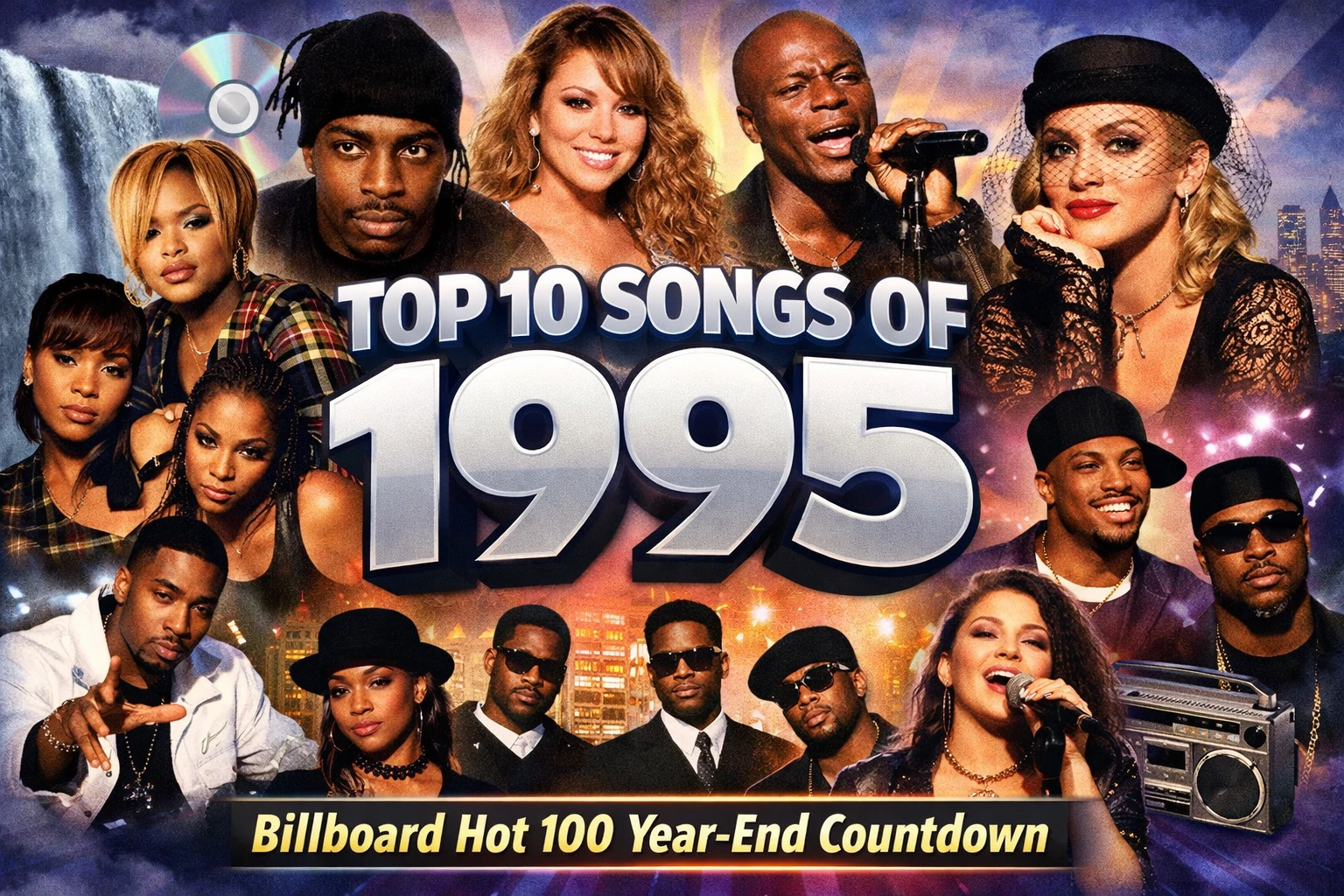
Top 10 Songs of 1995: Billboard’s Biggest Hits, Ranked
The top 10 songs of 1995 capture the moment the middle of the decade stopped easing into the room and started taking over the building. Billboard’s year-end Hot 100 mixed hip-hop gravity, polished R&B, soundtrack drama, Eurodance, slow jams, adult-pop heartbreak, and party records that could hijack a room before anyone reached the volume knob.
This was the year Coolio turned a movie soundtrack single into something darker than the usual chart blockbuster, TLC owned two of the top three positions, Seal made one of the strangest songs on radio feel completely natural, and Mariah Carey pushed glossy pop closer to the hip-hop-connected future waiting around the corner.
Boyz II Men still controlled the slow-jam empire. Madonna proved she could dominate without knocking down the walls. Monica arrived sounding more composed than most adults, Real McCoy kept Eurodance moving, and Montell Jordan created an opening line that still starts parties before the first verse gets settled.
The ranking uses Billboard’s 1995 year-end Hot 100, so these are the biggest U.S. singles of the year based on cumulative chart performance—not a personal ranking of the best songs of 1995 and not a modern nostalgia poll.
“Gangsta’s Paradise” by Coolio featuring L.V. was Billboard’s number-one year-end song of 1995. TLC’s “Waterfalls” and “Creep,” Seal’s “Kiss from a Rose,” and Boyz II Men’s “On Bended Knee” completed the top five.
Billboard Hot 100 Year-End Ranking
The year-end order reflects chart performance across Billboard’s full eligibility period. A weekly number-one run matters, but timing and longevity matter too—which is why “Gangsta’s Paradise” finished first for the year even though several songs spent more weeks at number one.
1995 Was the Year the Mainstream Got Heavier
The biggest songs of 1995 did not abandon the polished side of early-90s radio, but they gave it more weight. Hip-hop was no longer visiting the pop chart as a novelty or a side attraction. R&B was not merely crossing over. It was helping decide what the center of American music sounded like.
Even the lighter records carried sharper edges. TLC paired silky production with relationship politics and stories about consequences. Mariah Carey wrapped pure joy around a sample-driven groove. Monica turned a bad mood into a boundary. Madonna delivered heartbreak with the lights lowered instead of the sirens turned on.
Then there was “Gangsta’s Paradise,” a number-one year-end song that felt serious, tense, and almost impossibly dark beside the usual radio comfort food. By 1995, the charts could hold that record, “Fantasy,” “Another Night,” and “This Is How We Do It” at the same time without asking any of them to behave alike.
Quick List: Top 10 Songs of 1995
- #1 “Gangsta’s Paradise” — Coolio featuring L.V.
- #2 “Waterfalls” — TLC
- #3 “Creep” — TLC
- #4 “Kiss from a Rose” — Seal
- #5 “On Bended Knee” — Boyz II Men
- #6 “Another Night” — Real McCoy
- #7 “Fantasy” — Mariah Carey
- #8 “Take a Bow” — Madonna
- #9 “Don’t Take It Personal (Just One of Dem Days)” — Monica
- #10 “This Is How We Do It” — Montell Jordan
1995 Billboard Year-End Top 10 at a Glance
This table shows Billboard’s complete 1995 year-end top 10, each single’s weekly Hot 100 peak, and the number of weeks it spent at number one.
| Year-End Rank | Song | Artist | Hot 100 Peak | Weeks at #1 |
|---|---|---|---|---|
| #1 | “Gangsta’s Paradise” | Coolio featuring L.V. | #1 | 3 |
| #2 | “Waterfalls” | TLC | #1 | 7 |
| #3 | “Creep” | TLC | #1 | 4 |
| #4 | “Kiss from a Rose” | Seal | #1 | 1 |
| #5 | “On Bended Knee” | Boyz II Men | #1 | 6 |
| #6 | “Another Night” | Real McCoy | #3 | 0 |
| #7 | “Fantasy” | Mariah Carey | #1 | 8 |
| #8 | “Take a Bow” | Madonna | #1 | 7 |
| #9 | “Don’t Take It Personal (Just One of Dem Days)” | Monica | #2 | 0 |
| #10 | “This Is How We Do It” | Montell Jordan | #1 | 7 |
Listen to the Top Songs of 1995
The companion playlist brings together the biggest songs of 1995 with the wider sound of the year: hip-hop, R&B, Eurodance, soundtrack hits, slow jams, pop, alternative rock, party records, and the songs that followed Gen X from the car stereo to the food court and back again.
Use the playlist while reading the countdown, then continue into the complete 90s Music archive for more Billboard year-end songs, hip-hop, R&B, slow jams, alternative music, grunge, pop hits, and Gen X radio memories.
Countdown: The Top 10 Songs of 1995
The countdown runs from Montell Jordan at #10 to Coolio at #1, with chart peaks, weeks at number one, deeper 1995 music context, and lived-in Gen X memories for every song.
“This Is How We Do It”
Montell Jordan
Why It Hit
Because the opening line could start a party before anybody had agreed there was going to be one. “This Is How We Do It” does not politely enter the room. It announces itself like the room already belongs to Montell Jordan and the rest of us should be grateful the address was shared.
The record works because it feels specific and universal at the same time. Montell is describing a neighborhood party, not some vague pop fantasy built in a conference room. The details give the song personality, but the hook opens the door wide enough for everybody to join.
The Slick Rick connection in the groove gives the track a familiar hip-hop foundation, while Montell’s vocal keeps it planted in R&B. It is smooth without becoming soft, rhythmic without trying to prove anything, and confident without sounding as though confidence required a committee meeting.
Why It Mattered in 1995
Seven weeks at number one showed how completely hip-hop soul and party-centered R&B had moved into the mainstream. This was not a club record briefly escaping its format. It was one of the central pop songs of the year.
Its success also captured a change in where mainstream cool was coming from. The record did not need a movie, a giant ballad arrangement, or a carefully scrubbed pop identity. It brought its own setting, language, rhythm, and swagger straight onto Top 40 radio.
Gen X Rewind
This is cookout music, house-party music, school-dance music, skating-rink music, and “somebody just turned the whole room up” music.
The first few seconds still trigger a physical response. People who claimed they were not dancing suddenly had opinions about where the good part of the floor was. The song did not request participation. It assumed it.
“Don’t Take It Personal”
Monica
Why It Hit
Because Monica arrived sounding cooler and more self-possessed than half the adults on the chart. “Don’t Take It Personal (Just One of Dem Days)” is built around a simple truth that should have saved everybody a great deal of unnecessary conversation: sometimes the mood has nothing to do with you.
The song never turns that message into melodrama. Monica does not plead for understanding or write a legal brief explaining her behavior. She states the boundary, lets the groove carry it, and sounds completely certain that the other person will survive the inconvenience.
That restraint makes the record stronger. The production is smooth, the rhythm stays patient, and Monica’s vocal remains grounded. She sounds young, but never tentative. The song feels like an introduction to an artist who already knows exactly how she wants to occupy the room.
Why It Mattered in 1995
The hit helped establish teenage R&B as a major force rather than a watered-down version of adult material. Monica did not need to imitate an older singer’s emotional life. The record made teenage frustration and independence sound credible on their own terms.
Its number-two peak and year-end top-10 finish also showed how strong the R&B lane had become. A debut single with a low-key groove and a very specific emotional attitude could compete with soundtrack spectacles, Eurodance, and established superstars.
Gen X Rewind
This is Walkman-on, bedroom-door-closed, do-not-ask-me-a follow-up-question music. We had fewer wellness terms in 1995, but we understood needing everybody to back off for a minute.
The song still feels familiar because the mood never expired. Bad day. Limited patience. Nothing personal. Please stop making it worse by asking whether it is personal.
“Take a Bow”
Madonna
Why It Hit
Because Madonna understood that reinvention did not always need a spotlight, a megaphone, and several people calling an emergency meeting. “Take a Bow” is quiet by her standards: soft-focus, controlled, wounded, and far more interested in disappointment than provocation.
Babyface’s production gives the song a warm, polished R&B frame without burying Madonna inside it. The arrangement moves patiently, the vocal stays restrained, and the chorus lands as a slow emotional release rather than a giant pop explosion.
That restraint makes the lyric cut deeper. The song treats a failed relationship like a performance whose final act has finally become obvious. Madonna sounds hurt, but she also sounds as though she has already begun leaving the theater.
Why It Mattered in 1995
Seven weeks at number one made “Take a Bow” one of the longest-running chart-toppers of Madonna’s career. It also showed that she could adapt to the smoother R&B-centered mainstream without chasing younger artists or surrendering her identity.
In a year crowded with emerging voices and changing styles, the record reminded everyone that Madonna’s greatest skill was not simply causing a reaction. It was recognizing where pop was moving and finding a version of herself that belonged there.
Gen X Rewind
This is the sound of finding out Madonna could still control the room without trying to knock down the walls. She changed the lighting, lowered her voice, and won anyway.
It brings back the grown-up side of 1995 radio: late-night drives, quiet stores, heartbreak delivered through expensive speakers, and the strange dignity of being emotionally demolished with excellent posture.
“Fantasy”
Mariah Carey
Why It Hit
Because Mariah Carey was already operating at superstar level, and “Fantasy” made that level look almost unfair. The Tom Tom Club sample gives the song immediate lift, the groove feels open and playful, and Mariah sounds as though singing circles around everybody else is just how she spends a pleasant afternoon.
The record is joyful without becoming lightweight. The rhythm keeps it moving, the melody keeps it bright, and the layered vocals provide all the technical fireworks anyone could reasonably request. Nothing about it feels labored, even though almost nobody else could have made it sound this easy.
That ease is part of the appeal. Earlier Mariah hits had already established the ballads and vocal power, but “Fantasy” lets her sound loose, youthful, and completely at home inside a sample-driven pop record.
Why It Mattered in 1995
“Fantasy” pointed toward the future of mainstream pop. Sampling, hip-hop production, R&B vocals, pop melody, and remix culture were beginning to connect more openly, and Mariah would become one of the most important artists in that bridge.
Its eight weeks at number one confirmed that rhythmic, hip-hop-connected pop was no longer an experiment for her. It could be every bit as dominant as the giant ballads that had built her early career.
Gen X Rewind
This is open-window, summer-stereo, roller-coaster, bright-day euphoria. The song made ordinary parking lots feel slightly more glamorous than the available evidence supported.
Hearing it now brings back the polished optimism still floating through 1995—the CD single, the video rotation, the amusement-park energy, and the feeling that the chorus might improve the weather.
“Another Night”
Real McCoy
Why It Hit
Because 1995 still had plenty of room for Eurodance when the chorus arrived this fully armed. “Another Night” is built from the classic combination: bright synths, hard dance beat, emotional female hook, rhythmic male verses, and enough romantic urgency to power a laser-light display.
The song manages to feel energetic and melancholy at the same time. The beat says movement. The lyric says longing. Together they create the very specific mid-90s sensation of processing heartbreak in a room where nobody has stopped dancing.
It also wastes no time explaining itself. The chorus is immediate, the structure is familiar after one listen, and the production gives every section a clear job. You did not need to know anything about European club music. The record translated itself.
Why It Mattered in 1995
Its number-three peak and year-end #6 finish show how much life remained in Eurodance on American radio. The genre was not confined to clubs or novelty compilations. The right record could compete with the largest R&B, hip-hop, and pop releases in the country.
“Another Night” also represents the broadness of the 1995 mainstream. A German dance act could sit between Boyz II Men and Mariah Carey on the year-end chart while Coolio and TLC occupied the top three.
Gen X Rewind
This is roller-rink, arcade, laser-light, mall-store, portable-CD-player music. Pure mid-90s motion with just enough sadness to make the movement feel important.
The record still sounds like fluorescent light reflecting off a polished floor while somebody checks whether the batteries can survive one more song. They usually could not.
“On Bended Knee”
Boyz II Men
Why It Hit
Because Boyz II Men had turned immaculate harmonies into a commercial superpower, and “On Bended Knee” lets that machine operate at full emotional capacity. The song is large without being loud, polished without being cold, and patient enough to let every plea land.
The arrangement gives each voice room while keeping the group blend at the center. The verses carry regret, the chorus expands into desperation, and the harmonies make one damaged relationship sound like a national emergency.
That was the Boyz II Men advantage. They could take pain, apology, devotion, and complete emotional collapse and make the performance feel formal rather than chaotic. The feelings were falling apart. The suits remained pressed.
Why It Mattered in 1995
“On Bended Knee” followed “I’ll Make Love to You” to number one, replacing the group’s own record at the top of the Hot 100. That level of chart control showed how completely Boyz II Men had become the standard for mainstream vocal-group ballads.
Its six weeks at number one also proved the slow-jam empire had not weakened as hip-hop and more rhythmic R&B moved toward the center. The mainstream was widening, but Boyz II Men still owned a very large section of it.
Gen X Rewind
This is slow-dance, breakup, call-the-dedication-line, stare-at-the-phone music. If anybody had feelings in the mid-90s, Boyz II Men were already there waiting with four matching parts.
It brings back school gyms, bedroom stereos, late-night radio, dramatic apologies, and relationships that lasted eleven days but somehow required a five-minute vocal arrangement to process.
“Kiss from a Rose”
Seal
Why It Hit
Because it sounded like nothing else on American radio. “Kiss from a Rose” is ornate, mysterious, slightly overgrown, and almost medieval compared with the smooth grooves and programmed beats surrounding it. Seal sings as though normal pop rules were reviewed and politely declined.
The melody twists instead of moving in a straight line. The harmonies keep opening new doors, the arrangement swells and retreats, and the whole record feels like a ballad that wandered into a cathedral and found the acoustics too good to leave.
None of that should have made it an easy mainstream hit. That was precisely the attraction. The song offered enough beauty to pull people in and enough mystery to keep them trying to figure out what had just happened.
Why It Mattered in 1995
Its connection to Batman Forever gave the song a larger second life, but the soundtrack could not manufacture its staying power. The record lasted because it remained singular after the movie promotion had done its job.
The number-one peak also proved the mainstream could still reward a song that was sophisticated, structurally unusual, and nearly impossible to compare with anything else in the top 10. Radio had become broader, not merely louder.
Gen X Rewind
This is the song that made everybody stop pretending they understood every lyric and simply commit to the feeling. That was the correct decision.
It brings back summer movie promotion, dramatic videos, enormous soundtrack albums, and the brief moment when Batman, Seal, and a vaguely ancient-sounding love song all occupied the same cultural sentence without anyone finding it unusual.
“Creep”
TLC
Why It Hit
Because TLC knew how to make a song feel casual and disruptive at the same time. “Creep” glides on a sleek groove, relaxed vocals, and a horn line that enters the room already dressed better than everybody else.
Underneath that smooth surface is a messy relationship story told from a perspective mainstream pop did not often give women. The song does not present its choices as pure or heroic. It presents them as a response to betrayal, with all the complications left intact.
TLC never oversells the argument. T-Boz delivers the lead with low-key authority, the harmonies remain controlled, and the group’s attitude does more work than a giant vocal climax ever could. The song sounds confident because it refuses to explain itself to death.
Why It Mattered in 1995
Four weeks at number one made “Creep” TLC’s first Hot 100 chart-topper and confirmed that the group had moved from exciting breakthrough act to cultural center. They were no longer adapting to the mainstream. The mainstream was adapting to them.
The record also showed how sophisticated R&B crossover had become. Production, image, choreography, fashion, lyrical perspective, and vocal identity all worked together without making the song feel manufactured.
Gen X Rewind
This is the moment mainstream R&B stopped feeling as though it needed permission to be smarter, sharper, and much cooler than the rest of the room.
The video alone could reset the temperature of an afternoon. The silk pajamas, the choreography, the confidence—TLC made everybody else look as though they had received the dress code too late.
“Waterfalls”
TLC
Why It Hit
Because “Waterfalls” pulled off something mainstream pop rarely manages without becoming unbearable: it carried a serious message while remaining a record people genuinely wanted to hear again and again.
The production is smooth and hypnotic, giving the stories room to unfold without turning the song into homework. The verses deal with consequences, addiction, violence, illness, and choices that cannot be easily reversed. The chorus remains soothing even while warning that the situation is not.
Left Eye’s verse gives the record another emotional and rhythmic shift, while the group’s vocal blend keeps the entire song connected. Nothing feels pasted together for importance. The message grows naturally from the music.
Why It Mattered in 1995
Seven weeks at number one made “Waterfalls” one of the largest chart events of the year, but the cultural impact went well beyond the weekly ranking. The song, video, fashion, performances, and conversation surrounding it all arrived as one complete event.
It proved a socially aware R&B song could dominate without sanding down its subject matter. TLC did not have to choose between meaning and crossover appeal. They made each side strengthen the other.
Gen X Rewind
This is the sound of summer growing up without losing the hook. Everybody knew the chorus. Everybody watched the video. Most people absorbed more of the warning than they realized at the time.
It brings back music television when a major video still felt like an appointment, the room went quiet when it came on, and the same four minutes could be entertainment, conversation, fashion, and a public-service announcement without announcing itself as any of those things.
“Gangsta’s Paradise”
Coolio featuring L.V.
Why It Hit
Because “Gangsta’s Paradise” changed the emotional weather of mainstream radio. The Stevie Wonder foundation gives it a haunted sense of familiarity, L.V.’s chorus sounds almost ceremonial, and Coolio delivers the verses with enough gravity to make the song feel less like entertainment than a warning already in progress.
The production refuses the easy route. There is no bright hook waiting to reassure the listener, no comic release, and no attempt to make the subject lighter for pop radio. The beat moves with the weight of a slow march, and every section reinforces the feeling that choices, environment, fear, and consequence are closing in.
Coolio’s performance is what keeps the record human. He does not deliver the verses from a distance or pretend the narrator has solved the problem. The tension comes from recognizing the trap while still being inside it.
Why It Mattered in 1995
The connection to Dangerous Minds gave the single an enormous cultural runway, but the movie alone does not explain why the song became Billboard’s biggest record of the year. The track connected because it carried a level of seriousness listeners could feel before processing every line.
Its year-end victory marked how central hip-hop had become to American popular culture. This was not a novelty rap record, a party crossover, or a softened version of the genre designed to avoid making anyone uncomfortable. One of the darkest songs in the top 10 finished above everything else.
That result tells the story of 1995 better than any tidy genre summary could. TLC, Seal, Boyz II Men, Mariah Carey, Madonna, Eurodance, and Montell Jordan all had major years, but the song at the top carried tension, social weight, and hip-hop authority directly into the center of the chart.
Gen X Rewind
This is late-night video-countdown, car-speaker, too-young-to-fully-process-it music. Even younger listeners understood immediately that the song was carrying something heavier than romance, fun, or ordinary pop drama.
Hearing it now brings back the serious side of the mid-90s: movie soundtracks that became cultural events, music videos built like short films, and the moment when the chart could place a genuine shadow at number one for the entire year.
Keep Rewinding 1995
Continue through the same year with television, movies, toys, videos, and the larger 90s music archive. Together, these pages connect Billboard’s biggest songs of 1995 to the rest of the culture surrounding them.
1995 Rewind Verdict
1995 was one of those chart years where everything seemed to be happening at once. Hip-hop reached a new level of mainstream authority. TLC became unavoidable. R&B stayed polished and dominant. Pop ballads still had real power. Eurodance was hanging on, and the whole thing somehow held together without sounding remotely tidy.
“Gangsta’s Paradise” is dark, cinematic, and serious. “Waterfalls” carries real consequences without losing the hook. “Creep” is cool enough to make the room feel underdressed. “Kiss from a Rose” is strange and beautiful. “Fantasy” points toward the pop-and-hip-hop future.
“On Bended Knee” keeps the slow-jam machinery operating at full capacity. “Take a Bow” lowers the lights. “Another Night” keeps the roller rink moving. Monica makes a bad mood sound like a reasonable policy, and Montell Jordan is still waiting to start the party.
For Gen X, these songs are CD singles, school dances, mall stores, cookouts, bedroom stereos, video countdowns, car rides, summer afternoons, and the sound of the decade becoming wider, darker, smoother, weirder, and more commercially unstoppable.
FAQ: Top Songs of 1995
What was the #1 song of 1995?
“Gangsta’s Paradise” by Coolio featuring L.V. was Billboard’s number-one Hot 100 year-end song of 1995.
What were the top five songs of 1995?
The top five were “Gangsta’s Paradise,” “Waterfalls,” “Creep,” “Kiss from a Rose,” and “On Bended Knee.”
Why does this ranking use Billboard’s year-end Hot 100?
The year-end chart measures cumulative U.S. chart performance across Billboard’s eligibility period rather than personal opinion or modern nostalgia.
How long was “Gangsta’s Paradise” at #1?
Coolio and L.V. spent three weeks at number one on the Billboard Hot 100 with “Gangsta’s Paradise.”
How long was “Waterfalls” at #1?
TLC’s “Waterfalls” spent seven weeks at number one on the Billboard Hot 100.
How long was “Fantasy” at #1?
Mariah Carey’s “Fantasy” spent eight weeks at number one on the Billboard Hot 100.
Did Monica’s “Don’t Take It Personal” reach #1?
No. “Don’t Take It Personal (Just One of Dem Days)” peaked at number two, but its longevity helped it finish ninth on Billboard’s 1995 year-end chart.
Which songs in the top 10 reached #1?
“Gangsta’s Paradise,” “Waterfalls,” “Creep,” “Kiss from a Rose,” “On Bended Knee,” “Fantasy,” “Take a Bow,” and “This Is How We Do It” reached number one.
Why was TLC so dominant in 1995?
“Creep” and “Waterfalls” showed two different sides of TLC’s appeal: relationship attitude and socially aware storytelling, both supported by memorable production, videos, fashion, and major crossover reach.
Why does 1995 music sound so varied?
Hip-hop, R&B, Eurodance, soundtrack songs, slow jams, adult-pop ballads, and sample-driven pop were all succeeding in the mainstream at the same time.
Is there a playlist for the top songs of 1995?
Yes. The companion Smells Like Gen X Spotify playlist is embedded on this page.
Where can I find more 1995 nostalgia?
The same-year links connect to the top television shows, movies, toys, videos, and the wider 90s Music archive.