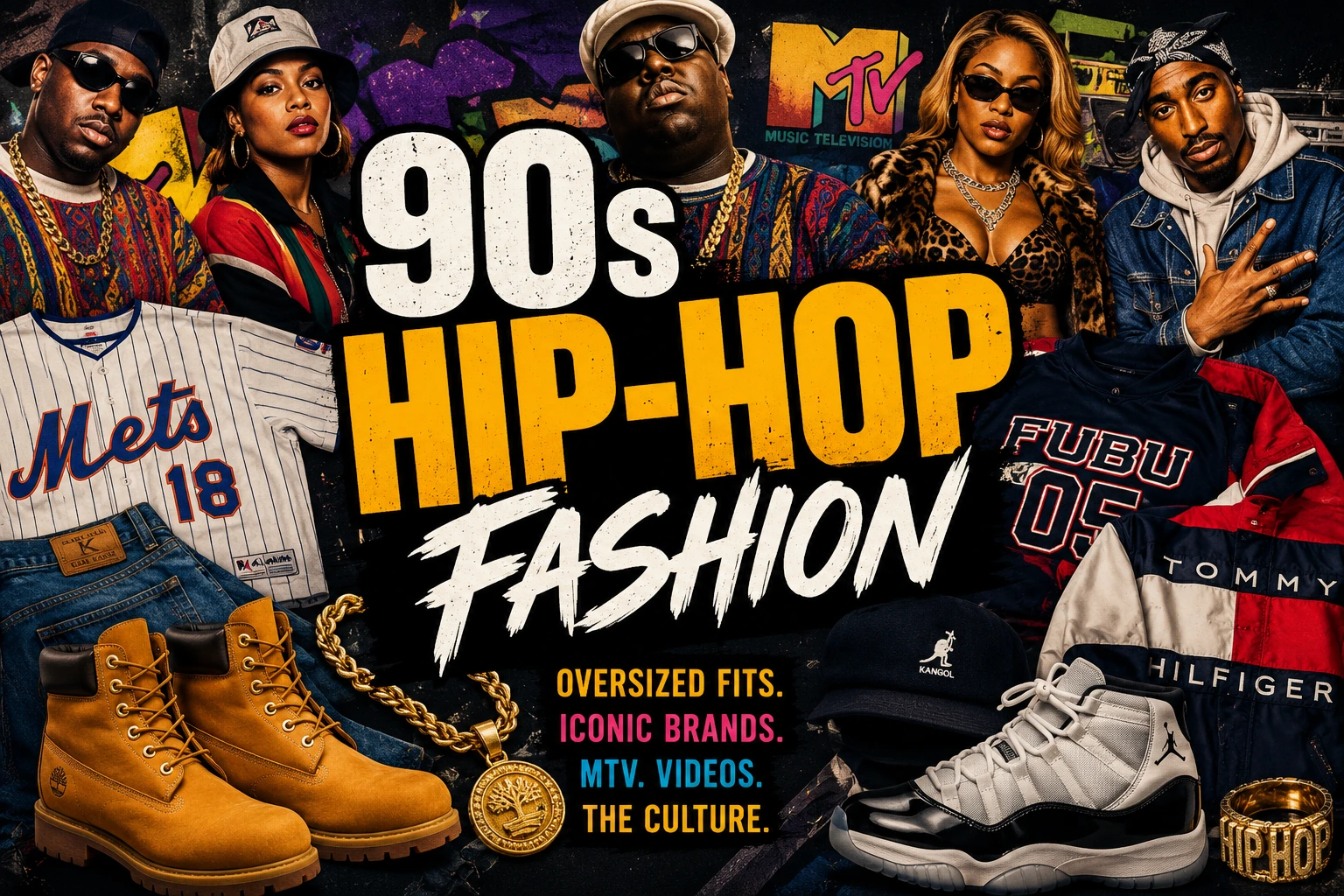
90s Hip-Hop Fashion
90s hip-hop fashion was not just “baggy clothes,” even though, yes, half the decade looked like everyone had borrowed pants from a refrigerator. It was oversized jerseys, Timberlands, tracksuits, starter jackets, bucket hats, Kangols, gold chains, bamboo earrings, sportswear, Cross Colours, Karl Kani, FUBU, Polo, Tommy, shiny suits, regional style codes, video looks, mall attempts, and every Gen X kid trying to dress like MTV had personally approved the fit. Hip-hop did not just change the sound of the decade. It changed the silhouette.
90s hip-hop fashion mattered because it turned rap into something you could see immediately: oversized fits, jerseys, Timberlands, tracksuits, logo-heavy labels, shiny suits, regional style, women’s rap fashion, MTV video looks, and mall-copycat chaos. It belongs directly inside the larger 90s Hip-Hop and Rap story, the wider 90s Music universe, and the full 90s nostalgia map because hip-hop style moved from videos and album covers into school hallways, clubs, bedrooms, car rides, movie soundtracks, and every mall in America.
90s Hip-Hop Fashion Made the Music Visible
90s hip-hop fashion mattered because it gave the music a silhouette. You could hear the beat, sure, but you could also see the shape of the culture from across a hallway: the jeans too wide, the jersey too long, the boots too heavy, the jacket too loud, the logo too big, the chain catching light, the hat tilted with enough confidence to qualify as a personality disorder.
Hip-hop had always had style, but the 90s turned that style into one of the decade’s main visual languages. The clothes were not decoration. They were identity, region, class, attitude, aspiration, humor, protection, performance, rebellion, status, and occasionally proof that nobody in the fitting room had been given a measuring tape.
The fashion also moved fast because the media machine got louder. Hip-Hop on MTV in the 90s made rap visual every afternoon. A video could turn a jacket, a suit, a pair of boots, a jersey, a pair of sunglasses, or a weird silhouette into a national memory. You did not need to live in New York, Atlanta, Houston, Los Angeles, Oakland, Miami, or New Orleans to see the look. The TV delivered it right into your room, usually between commercials that aged like milk.
Radio helped too. When rap crossed into mainstream rotation, fashion followed. 90s Rap Radio Crossover was not only about hooks and clean edits. It was about rap becoming daily life, and daily life includes clothes. If the song was everywhere, the image attached to it was everywhere too.
Hip-hop fashion also connected to 90s Hip-Hop Movie Soundtracks. Urban dramas, basketball movies, soundtrack CDs, and mall music-store displays helped make jerseys, boots, chains, caps, and oversized silhouettes feel like part of the same cultural weather system as the songs.
Hip-hop fashion also connected to the wider 90s mood: bigger, louder, more branded, more casual, more mall-driven, more video-conscious, more athletic, more ironic without always meaning to be. This was the decade when streetwear, sportswear, luxury labels, workwear, clubwear, and music-video fantasy all started crashing into one another.
And yes, there were crimes. Many of us committed them. Jeans wide enough to hide a smaller pair of jeans. Jerseys down to the knees. Jackets with enough color-blocking to give a geometry teacher hope. Boot laces left loose like gravity was optional. Hats that looked like they were installed by committee. The 90s had style, but it also had no fear of looking insane in hindsight.
That is why the fashion still hits. It was personal. It was visible. It was copied. It was argued over. It was expensive if you wanted the real thing and tragic if you got the knockoff that fooled absolutely no one. Hip-hop fashion helped turn the decade into something you can recognize in one blurry photo.
Oversized Everything Was Not a Mistake. It Was the Whole Point.
Baggy jeans, giant shirts, huge jackets, long jerseys, and big silhouettes gave 90s hip-hop fashion its instantly recognizable shape. Subtlety stayed home and filed taxes.
The Shape Was the Statement
Big jeans, big jackets, big shirts, big attitude. The 90s silhouette did not whisper. It blocked an entire doorway.
The oversized fit is the first thing most people remember, because it was everywhere. Jeans were loose. Shirts were long. Jackets had room for weather systems. Jerseys hung like curtains. Shorts were not shorts so much as fabric events. The whole silhouette rejected tightness, polish, and anything that looked like it had asked permission.
But oversized fashion was not just random bagginess. It carried attitude. It made the body look larger, less exposed, more armored, more casual, more rooted in street style than runway polish. It gave performers room to move. It gave videos a bigger visual shape. It gave regular kids a way to feel like they were wearing confidence, even if they were just standing outside a locker pretending not to care.
The look also crossed over with the harder side of the decade. The rugged silhouettes around East Coast Hip-Hop in the 90s, the low-slung ease of West Coast Hip-Hop in the 90s, and the independent-label flash of Southern Hip-Hop in the 90s all had different versions of big. The size was shared. The attitude changed by region.
It also made brand visibility easier. A giant shirt gave a logo room to breathe. A giant jacket became a billboard. A jersey became an identity flag. A tracksuit became a full-body statement. This matters because 90s hip-hop fashion was deeply tied to labels, names, and visible affiliation.
For Gen X, oversized fashion was extremely copyable. You did not need a stylist. You needed a mall, a thrift rack, an older cousin, a sports store, a suspiciously big shirt, and enough nerve to wear jeans your parents insisted were “falling off.” They were not falling off. They were communicating. Poorly, sometimes, but communicating.
The foundation
Wide denim became one of the decade’s most visible style codes, from street corners to school hallways to mall food courts.
The extra-large era
Long tees, giant button-ups, and massive hoodies gave the whole look a relaxed but armored shape.
The weather system
Puffers, bombers, leather jackets, starter jackets, and oversized outerwear made every entrance look like a video intro.
Jerseys, Starter Jackets, and Team Gear Turned Sportswear Into Streetwear
Hip-hop took sportswear out of the arena and made it everyday style: jerseys, warm-ups, caps, team jackets, basketball shorts, and athletic logos that suddenly looked right next to a microphone.
The Team Was the Fit
Basketball jerseys, caps, warm-ups, and oversized sports jackets made the line between fan gear and hip-hop fashion disappear.
Sportswear was one of the main engines of 90s hip-hop fashion. Jerseys, caps, Starter jackets, warm-ups, basketball shorts, team logos, and athletic cuts moved from games and school gyms into videos, clubs, street photos, and everyday outfits. The court and the stage started sharing a closet.
Basketball mattered especially. Hip-hop and basketball were already culturally intertwined: courts, sneakers, mixtapes, neighborhood status, highlight culture, trash talk, and the idea that style and performance were not separate things. That is why basketball jerseys looked so natural in rap videos. They already belonged to the same visual universe.
Sportswear was also readable. A team jacket said something before you opened your mouth. A cap could signal city, loyalty, style, or just the fact that the color matched your fit and you were not above pretending it meant more. Jerseys gave the body a bold graphic frame. In the 90s, clothing often needed to work from across the room, and sportswear did the job.
This also links back to 90s Hip-Hop Movie Soundtracks, because basketball movies, urban dramas, and sports-adjacent soundtracks helped make jerseys, courts, sneakers, and rap feel like one giant cultural loop. The music, the movies, the clothing, and the car stereo all fed each other.
Sportswear also belonged beside 90s Hip-Hop Dance and Party Songs. Gym floors, school dances, pep rallies, basketball courts, skating rinks, and house parties all blurred together when the right beat hit and everyone suddenly thought they were in a video despite all available evidence.
For regular Gen X kids, sportswear was one of the easiest entry points. You could buy a cap. You could get a jacket. You could wear a jersey over a tee. You could look vaguely video-ready while possessing zero musical talent and a jump shot that should have been reported. The clothes gave you access to the vibe without requiring you to earn a record deal.
Timberlands, Sneakers, and Boots Carried the Whole Fit
Shoes were not background details. In 90s hip-hop fashion, the footwear could tell you the region, the mood, the budget, the weather, and whether someone had been saving for weeks.
The Fit Started at the Floor
Timbs, high-tops, chunky sneakers, loose laces, and scuffed soles carried more cultural information than half the album reviews.
Footwear was one of the fastest ways to spot the 90s hip-hop look. Timberlands became iconic because they were heavy, rugged, practical, and stylish in a way that felt like they were not trying too hard. They looked good with baggy denim, jackets, hoodies, and the kind of face that said you had no time for nonsense, even if you were literally late to algebra.
Sneakers mattered just as much. Basketball sneakers, high-tops, classic silhouettes, chunky runners, and clean white pairs all moved through hip-hop fashion. Shoes were status. Shoes were taste. Shoes were regional. Shoes were conversation starters. Shoes were also the thing your parents asked, “How much did those cost?” in a tone that meant the trial had already started.
The way the shoes were worn mattered too. Loose laces. Thick socks. Baggy denim breaking over the top. Boots not fully tied. Sneakers kept spotless or absolutely destroyed depending on the person. The details told the story.
Footwear also connected hip-hop to workwear, basketball, streetwear, and city life. That is part of why East Coast Hip-Hop in the 90s and West Coast Hip-Hop in the 90s looked different on the ground. The climate, the streets, the cars, the clubs, and the scenes all shaped what made sense.
Shoes were also one of the few parts of the outfit where the obsession never really left. People can laugh at some 90s fashion now — and should, because some of those pants were legally architecture — but the footwear influence stayed alive. Sneakers and boots still carry the DNA of that decade.
Cross Colours, Karl Kani, FUBU, Tommy, Polo, and the Logo Era
90s hip-hop fashion loved a visible name. Sometimes it was Black-owned streetwear. Sometimes it was prep brands getting remixed. Sometimes it was luxury aspiration. Sometimes it was a mall knockoff that fooled absolutely nobody.
The Name Became Part of the Look
Streetwear, sportswear, prep labels, and designer names all got pulled into hip-hop’s visual language.
The 90s were a logo decade. Subtle branding existed, technically, but a lot of hip-hop fashion wanted the name visible enough to qualify as a subtitle. Cross Colours, Karl Kani, FUBU, Walker Wear, Phat Farm, Pelle Pelle, Polo, Tommy Hilfiger, Nautica, Guess, Coogi, and other labels all moved through the conversation in different ways.
Some brands were built from inside or near the culture. Others were adopted, remixed, flipped, and made cooler by the people wearing them. Hip-hop had a gift for taking clothes from one context and making them mean something else. Prep labels could become streetwear. Workwear could become fashion. Sportswear could become identity. Luxury could become aspiration, parody, and power all at once.
FUBU mattered because the name itself was a statement. For Us, By Us was not just branding; it was a response to an industry that wanted hip-hop’s influence but did not always respect the people creating it. Wearing the brand could feel like participation, not just consumption.
Cross Colours brought a different kind of early-90s energy: bold color, Afrocentric messaging, oversized cuts, and a visual optimism that stood apart from the darker, heavier looks that also defined the decade. Karl Kani helped make designer streetwear feel connected to hip-hop ambition, especially as rap became more commercially powerful.
Then there were the adopted brands. Polo, Tommy, Nautica, and other labels became part of the hip-hop wardrobe not because they were originally built for rap, but because hip-hop made them feel different. The culture had enough style gravity to rewrite what clothes meant. A shirt could leave the country club and end up in a video, where it suddenly looked like it had been waiting for the bassline the whole time.
The brand story also sits beside 90s Rap Radio Crossover. Once rap records were on mainstream radio, the clothes entered more mainstream spaces too. Music sold the lifestyle, videos showed the outfit, and malls tried to package the whole thing with fluorescent lighting and a receipt.
The flip side was mall desperation. Everyone wanted the look. Not everyone had the budget. That created substitutions, knockoffs, almost-logos, suspicious embroidery, and outfits that said, “I tried,” which is not always a crime, but is sometimes evidence.
Brand lanes that mattered
- Black-owned streetwear: FUBU, Karl Kani, Cross Colours, Walker Wear, and brands that spoke directly to hip-hop audiences.
- Sportswear: Team gear, athletic jackets, jerseys, caps, warm-ups, and sneakers.
- Prep labels remixed: Polo, Tommy, Nautica, and pieces that changed meaning once hip-hop wore them differently.
- Luxury and aspiration: Designer references, expensive fabrics, jewelry, fur, leather, and the visual language of “we made it.”
What logos did
- Made the fit readable from across a room, hallway, video, or club.
- Turned clothing into status without needing a long explanation.
- Helped artists build image that fans could copy at the mall.
- Blurred culture and commerce in ways the 90s never fully stopped arguing about.
Women in 90s Hip-Hop Made Fashion Sharper, Louder, Sexier, Smarter, and Stranger
Any 90s hip-hop fashion story that only talks about men in oversized jerseys is already missing half the closet. Women in rap shaped the decade’s style in ways that were bold, varied, and often more complicated than the industry knew how to handle.
Women of 90s Hip-Hop pushed fashion across multiple lanes: Queen Latifah’s regal strength, Salt-N-Pepa’s playful confidence, MC Lyte’s cool control, Lil’ Kim’s high-fashion sexuality, Foxy Brown’s glam toughness, Da Brat’s tomboy funk, Lauryn Hill’s natural soul, Missy Elliott’s futuristic silhouettes, and a whole range of looks that refused to be boxed into one acceptable version of “female rapper.”
That range matters. Some artists leaned into streetwear. Some into glamour. Some into Afrocentric style. Some into tomboy cuts. Some into designer labels. Some into body-conscious looks. Some into surreal video shapes. Some changed the frame completely.
Missy Elliott deserves special attention because her fashion was not just about outfits. It was about architecture. The giant inflated suit in “The Rain,” the metallic sci-fi looks, the goggles, the severe lines, the shiny textures, the playful exaggeration — all of it turned the body into a shape that video could not ignore. That connects directly to Missy Elliott and Late-90s Hip-Hop Weirdness, where the visuals were part of the music’s operating system.
Lauryn Hill’s style worked differently. Her look carried natural beauty, thrifted warmth, soul, intellect, Caribbean influence, and anti-gloss authority. It connected to the deeper emotional pull of Lauryn Hill, the Fugees, and Hip-Hop Soul, where fashion did not need to scream to have weight.
Lil’ Kim and Foxy Brown pushed another important lane: high-glam, luxury-coded, sexually assertive rap fashion. That look was not just “revealing clothes.” It was power, provocation, designer fantasy, vulnerability, control, and media warfare all happening under bright lights. The 90s did not always know what to do with women who treated image as a weapon instead of an apology.
Regal authority
Afrocentric style, strength, hats, structure, and a presence that made fashion feel like command.
Playful confidence
Bright jackets, asymmetry, attitude, sexiness, fun, and outfits that looked like the party had a thesis.
Future shapes
Suits, goggles, metallics, exaggerated silhouettes, and the refusal to look like anybody else on the channel.
Luxury provocation
Designer fantasy, color, sexuality, and the kind of visual confidence that made red carpets nervous.
New York, L.A., Atlanta, Houston, Miami, and New Orleans Did Not Dress the Same
One of the best parts of 90s hip-hop fashion is that it was regional. The national industry liked to simplify rap into big categories, but the clothes told a more detailed story. New York did not dress exactly like Los Angeles. Atlanta did not look like Houston. Miami bass had a different energy than East Coast streetwear. New Orleans and Southern independent labels brought their own visual language.
East Coast Hip-Hop in the 90s often carried a colder, heavier, city-coded look: boots, hoodies, denim, leather, army jackets, dark colors, oversized denim, rugged streetwear, and the kind of layering that made sense when winter was not kidding.
West Coast Hip-Hop in the 90s had its own visual temperature: flannels, work shirts, khakis, Chucks, lowrider style, Raiders gear, sunglasses, and the relaxed but sharp silhouettes tied to G-Funk and the 90s West Coast Sound.
Southern Hip-Hop in the 90s brought bass, bounce, drawls, independent hustle, bright cover-art energy, club looks, oversized fits, regional label branding, and a different kind of visual loudness. The South was not just changing how rap sounded. It was changing how rap looked.
Outkast helped widen that visual vocabulary. Outkast and the Rise of Southern Hip-Hop made Atlanta style feel funky, futuristic, country, cosmic, thrifted, sharp, strange, and deeply local all at once. They were proof that “hip-hop fashion” did not have to mean copying the coasts.
Regional style mattered because clothes became proof that hip-hop was not one thing. It was many cities, many temperatures, many economies, many attitudes, many climates, many scenes. The national audience could watch the videos and learn the difference, assuming they were paying attention and not just trying to copy the pants.
Rugged city layers
Boots, hoodies, denim, leather, army jackets, cold-weather grit, and streetwear built for concrete.
Car culture cool
Flannels, workwear, khakis, Chucks, sunglasses, lowrider influence, and warm-weather confidence.
Bass, bounce, and flash
Club energy, oversized fits, bright visuals, independent label identity, and region-first confidence.
MTV Turned Hip-Hop Fashion Into a National Mood Board
The video era made outfits unforgettable. A song got in your ears, but the clothes got burned into your brain.
The Video Was the Closet
MTV made every jacket, jersey, suit, boot, chain, lens, and silhouette feel like a national style announcement.
MTV did for 90s hip-hop fashion what radio did for hooks: it repeated the image until it became memory. A video could make an outfit iconic in three minutes. Suddenly the jacket, the boots, the glasses, the jersey, the suit, the colors, the hair, the jewelry, and even the camera angle became part of the song.
That is why Hip-Hop on MTV in the 90s is required reading for this topic. Fashion was not an afterthought. It was part of the video’s job. The clothes told you who the artist was before the first verse finished clearing its throat.
MTV also connected fashion back to 50 Essential 90s Hip-Hop Songs. A record became bigger when the look became unforgettable. The song lived in the speakers, but the outfit lived in the memory.
The video era also created copycat culture. A look could leave a video and land in the mall within weeks. Maybe not the exact brand. Maybe not the exact fit. Maybe not the exact quality. But the idea traveled fast. Gen X kids saw it, wanted it, tried it, and sometimes emerged from the fitting room looking like the music video had lost a lawsuit.
Videos also made fashion more theatrical. The late 90s especially pushed this hard: bigger budgets, bigger colors, more stylized sets, surreal lenses, shiny rooms, dance crews, luxury signals, and outfits designed not just to be worn but to be remembered. That visual escalation feeds directly into The Shiny Suit Era of Late-90s Rap.
MTV did not invent hip-hop fashion, but it amplified it. It took local and scene-specific looks and gave them national exposure. That made the fashion more influential, but also more commercial. Once the look was on TV, everyone wanted a piece of it: labels, advertisers, magazines, malls, and kids with no concept of laundry instructions.
The Shiny Suit Era Made Rap Fashion Look Like Luxury Got Into a Fight With a Fisheye Lens
By the late 90s, some hip-hop fashion got glossy, expensive, bright, metallic, coordinated, and unapologetically extra. Subtlety was not invited, and honestly, it would have killed the vibe.
The Gloss Took Over
Glossy suits, bright colors, designer energy, fisheye flash, and videos that looked like money had discovered motion blur.
The shiny suit era is easy to clown because, well, look at it. Some late-90s rap videos looked like the entire wardrobe department had been dipped in reflective candy. But the excess was not random. It reflected a moment when commercial rap was loud about success, visibility, money, motion, and the right to be seen.
The Shiny Suit Era of Late-90s Rap was fashion, video language, sample culture, radio crossover, and luxury signaling all tangled together. The suits were not just clothes. They were visual proof that rap had moved into bigger rooms.
This was also the era of coordinated outfits, glossy fabrics, huge sunglasses, designer references, expensive-looking sets, fisheye lenses, and videos that turned success into spectacle. It was aspirational, ridiculous, effective, and extremely late 90s. You could make fun of it and still admit it was memorable.
The shiny suit look was also tied to 90s Rap Radio Crossover. The same records that worked on Top 40 radio often came with video looks built to be readable from a couch across the room. Big hook, big sample, big suit, big budget. The late 90s did not believe in half-measures.
The shiny suit era also had tension. Some fans saw the gloss as proof rap had gotten too commercial. Others saw it as celebration. Both can be true. Hip-hop had fought for space in the mainstream; now some artists were dressing like they intended to keep the lease.
For Gen X, shiny suit fashion is one of those visual memories that instantly time-stamps a clip. You see the fabric, the lens, the colors, the set, the jewelry, and you know exactly where you are: late 90s, remote in hand, MTV on, probably waiting for the next video and pretending you did not love the hook.
The Mall Tried to Sell Everybody the Video Look, and We Fell for It
The mall was where 90s hip-hop fashion became dangerous for regular people. MTV gave you the vision. The mall gave you the attempt. Sometimes it worked. Sometimes you walked out looking like you had been styled by a clearance rack with confidence issues.
This is where Gen X memory gets personal. The oversized shirt you thought was perfect. The jacket you begged for. The cap you wore everywhere. The boots you treated like an investment. The jeans your parents hated. The fake version of a brand you hoped no one would inspect too closely. The outfit you wore to a dance because you thought you were about to become a problem. The photo that now lives in a drawer for legal reasons.
Mall culture spread hip-hop fashion because it made the look accessible. Not everyone could get the rare piece or the expensive label, but everyone could chase the silhouette. Baggy jeans. A tee. A jacket. A jersey. Sneakers. A chain. A hat. A little attitude. Maybe too much attitude. Probably too much.
The mall also flattened regional differences. A kid in the suburbs could borrow pieces of East Coast, West Coast, Southern, shiny-suit, sportswear, and R&B style all at once. The result was not always accurate, but it was very 90s: a collage of whatever MTV, radio, friends, magazines, and local stores made available.
That is why 90s hip-hop fashion reaches beyond music. It belongs to the larger 90s experience: malls, music videos, school hallways, car rides, Saturday afternoons, CD stores, sneaker stores, and the belief that the right jacket could fix your entire personality by Monday.
And because this is Smells Like Gen X, we have to admit the truth: a lot of us were doing our best with limited funds, one mirror, bad lighting, and a heroic misunderstanding of proportion. That is not failure. That is character development.
The Essential 90s Hip-Hop Fashion Pieces
This is not a museum inventory. It is the stuff that made the decade instantly readable: the pieces that showed up in videos, school photos, concerts, mall walks, album-cover memory, and every hallway where someone thought they had the fit.
The everyday staples
- Baggy jeans
The foundation of the decade. Loose denim gave 90s hip-hop fashion its most recognizable shape. - Oversized tees
Long, loose, graphic, plain, branded, layered, or worn under jerseys. The bigger the shirt, the more 90s the decision. - Hoodies
Practical, street-coded, layered under jackets, and perfect for looking like you had somewhere more important to be. - Timberland-style boots
Rugged, heavy, city-ready, and forever tied to the East Coast side of the decade’s visual memory. - Basketball sneakers
Shoes carried status, taste, and sometimes your entire allowance history. - Starter jackets and team jackets
Sportswear that became school-hallway currency, especially when the colors hit right. - Baseball caps
Team identity, city pride, color matching, or just the fastest way to complete the look.
The statement pieces
- Basketball jerseys
Oversized, bold, and video-ready. They turned sports fandom into everyday streetwear. - Tracksuits and warm-ups
Comfortable, coordinated, athletic, and perfect for looking like you were either headed to practice or a video shoot. - Bucket hats and Kangols
One tilt could change the whole fit. One wrong tilt could ruin the school photo. - Gold chains
Status, flash, confidence, and occasionally the reason a parent said, “Where did you get that?” - Bamboo earrings
Essential to women’s hip-hop fashion and one of the decade’s most iconic accessories. - Leather jackets and bombers
Tough, cinematic, and perfect for making a video entrance feel heavier. - Shiny suits
Late-90s excess in fabric form. Ridiculous? Sometimes. Unforgettable? Absolutely.
The best part is that these pieces did not live separately. A full 90s fit might mix sportswear, workwear, streetwear, jewelry, regional cues, and whatever the mall had in stock. That mashup is exactly why the decade still feels connected to 50 Essential 90s Hip-Hop Songs, Best 90s Hip-Hop Albums, and the broader 90s Hip-Hop and Rap timeline. The clothes were part of the record. The record was part of the clothes.
90s Hip-Hop Fashion Still Shapes the Way Style Talks
The decade’s fashion did not stay in old videos. Oversized silhouettes, sneakers, streetwear, visible logos, sportswear, luxury remixing, and video-first style all kept echoing.
The Fit Never Left
Baggy denim, sneakers, streetwear, logos, sportswear, and video fashion still carry the fingerprints of the 90s.
The legacy of 90s hip-hop fashion is huge because it helped build the modern relationship between music, streetwear, sportswear, luxury, and visual identity. Today, that connection feels obvious. In the 90s, it was still being negotiated in real time through videos, magazine spreads, album covers, mall racks, school hallways, and artists who knew the fit mattered as much as the first single.
Hip-hop fashion helped make streetwear central. It helped make sneakers a language. It helped turn sportswear into everyday style. It helped transform logos into status and identity. It helped make the music video a fashion runway with better drums. It helped prove that artists did not just sell records; they sold images, moods, silhouettes, and possibilities.
It also left behind a lot of nostalgia because people actually wore this stuff. This was not only celebrity fashion. It was school fashion. Mall fashion. Club fashion. Concert fashion. Bus-stop fashion. Bedroom-poster fashion. “I swear this looks good” fashion. “Please do not show that photo at Thanksgiving” fashion.
That is why 90s hip-hop fashion belongs next to 90s Music, not tucked away as a side detail. The clothes were part of how the decade felt. They were tied to radio crossover, MTV, movie soundtracks, women in rap, regional identity, album culture, and the bigger 90s Hip-Hop and Rap story.
The best proof is simple: you can still spot the influence instantly. A baggy silhouette. A throwback jersey. Timbs with denim. A bucket hat. A tracksuit. A big logo. A puffer. A shiny late-90s video look. The decade keeps coming back because the visual language was too strong to stay buried.
Where to Go Next
90s hip-hop fashion connects to the entire visual side of the decade: MTV, shiny suits, women in rap, regional scenes, radio crossover, albums, soundtracks, party records, and the wider 90s nostalgia universe.
90s Hip-Hop Fashion FAQ
What defined 90s hip-hop fashion?
90s hip-hop fashion was defined by oversized silhouettes, baggy jeans, jerseys, Timberlands, sneakers, tracksuits, Starter jackets, bucket hats, gold chains, bamboo earrings, visible logos, streetwear labels, sportswear, regional style, and MTV video looks.
Why were clothes so oversized in 90s hip-hop?
Oversized clothes became part of hip-hop’s visual identity because they carried attitude, comfort, movement, streetwear influence, rebellion against fitted mainstream polish, and a larger-than-life silhouette that worked in videos, on stage, and in everyday style.
What brands were popular in 90s hip-hop fashion?
Important 90s hip-hop fashion brands and labels included Cross Colours, Karl Kani, FUBU, Walker Wear, Phat Farm, Pelle Pelle, Polo, Tommy Hilfiger, Nautica, Guess, Coogi, and sportswear brands tied to sneakers, jackets, jerseys, and team gear.
How did MTV influence 90s hip-hop fashion?
MTV made hip-hop fashion national by putting videos in constant rotation. A jacket, jersey, suit, hairstyle, accessory, or silhouette could become instantly recognizable because fans saw it repeatedly on TV and copied the look in malls, schools, clubs, and everyday life.
How did women shape 90s hip-hop fashion?
Women shaped 90s hip-hop fashion through many different looks: Queen Latifah’s regal Afrocentric style, Salt-N-Pepa’s playful confidence, Lauryn Hill’s natural hip-hop soul look, Missy Elliott’s futuristic silhouettes, Lil’ Kim’s luxury provocation, Foxy Brown’s glam toughness, and Da Brat’s tomboy streetwear energy.
What should I read next?
Start with Hip-Hop on MTV in the 90s, then read The Shiny Suit Era of Late-90s Rap, Women of 90s Hip-Hop, 90s Rap Radio Crossover, and the main 90s Hip-Hop and Rap page.