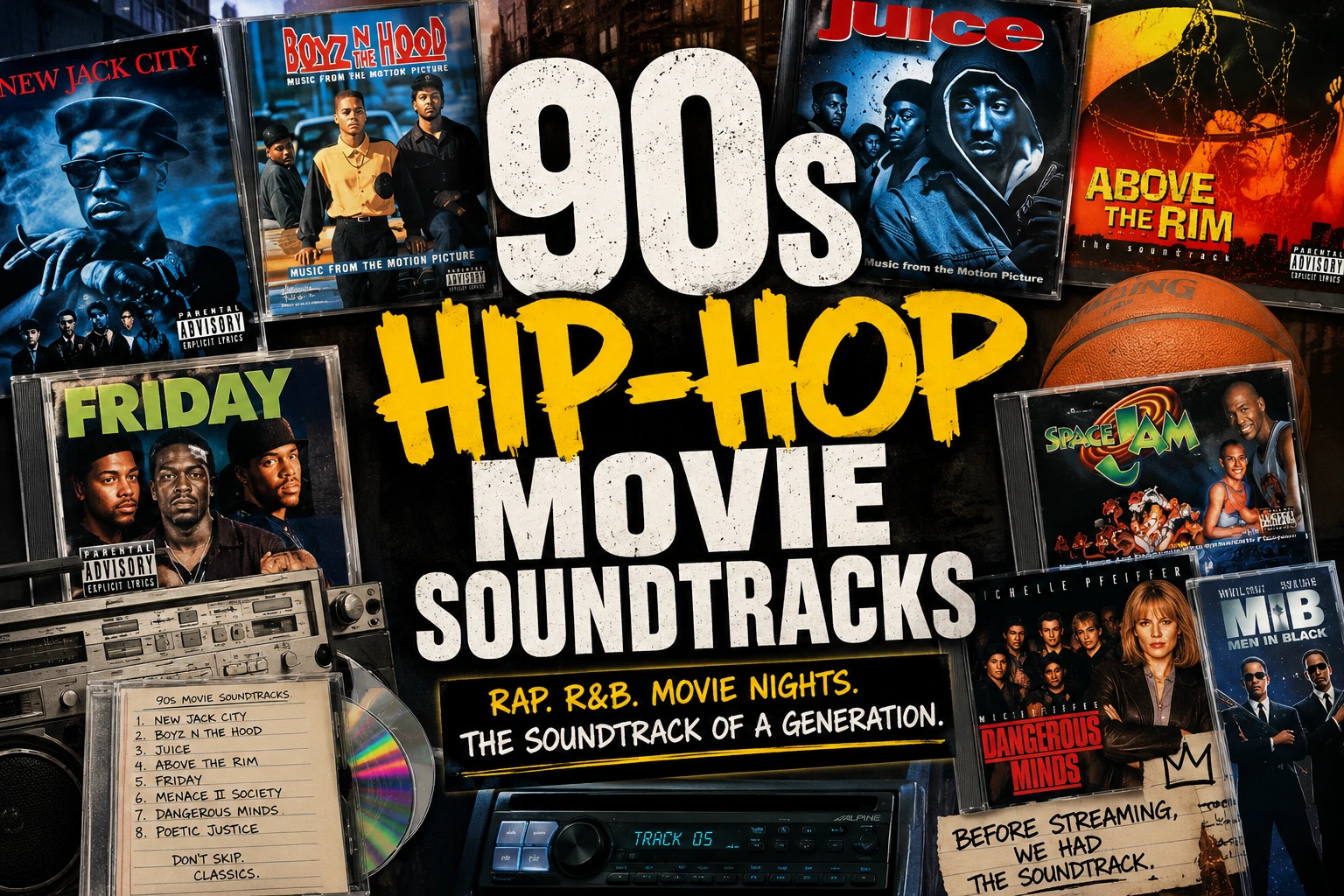
90s Hip-Hop Movie Soundtracks
90s hip-hop movie soundtracks were not just the songs playing under the credits while everyone looked for their jacket. They were mall CD purchases, Blockbuster weekends, car-stereo tests, urban-drama mythology, basketball-court anthems, action-movie tie-ins, teen-movie party cuts, R&B hooks, rap remixes, and those soundtrack albums you bought for two songs and somehow played for an entire summer. In the 90s, the movie soundtrack became its own weird little universe — part marketing tool, part cultural snapshot, part radio machine, part CD-binder trophy, and part “the movie was fine, but the soundtrack slapped.”
90s hip-hop movie soundtracks mattered because they turned movies into music events and pushed rap, R&B, and crossover singles into daily Gen X life. Albums tied to films like New Jack City, Juice, Above the Rim, Friday, Dangerous Minds, Space Jam, Men in Black, and plenty of urban dramas, action movies, basketball films, and teen comedies helped connect 90s Hip-Hop and Rap, 90s Rap Radio Crossover, New Jack Swing, Rap, and R&B in the 90s, Hip-Hop on MTV in the 90s, and the wider 90s Music story.
90s Movie Soundtracks Were the CD-Binder Version of a Shared Universe
The 90s movie soundtrack was a very specific object. It was not just music from a movie. It was a thing you bought, carried, stacked, loaned out, lost, rebought, scratched, shoved into a giant black CD wallet, and defended even when half the tracks were clearly there because somebody owed somebody a label favor.
Hip-hop soundtracks were even more powerful because they lived at the intersection of film, radio, MTV, rap, R&B, retail, car stereos, and Gen X weekend rituals. The movie got you in the door. The soundtrack followed you home. Sometimes the song was bigger than the film. Sometimes the soundtrack explained the movie better than the script did. Sometimes the soundtrack was the reason anybody remembered the movie existed at all. No disrespect, but the 90s produced a lot of movies where the soundtrack had stronger legs than the plot.
These albums also helped hip-hop reach listeners who might not have bought a traditional rap album yet. A soundtrack could feel like a safer entry point: one disc, multiple artists, maybe a hit single, maybe an R&B slow jam, maybe a club track, maybe a street record, maybe something your local radio station played every twelve minutes until the chorus started living in your dental work.
That made soundtracks essential to the bigger 90s Hip-Hop and Rap story. They were not side quests. They were part of the delivery system. Albums, radio, MTV, soundtracks, movie trailers, award shows, and mall retail all worked together. The decade did not have streaming playlists. It had compilations with movie logos on them and jewel cases that cracked if you looked at them with attitude.
Soundtracks also helped rap and R&B keep braiding together. A movie soundtrack could put a hard rap cut, a smooth R&B ballad, a New Jack Swing groove, a remix, a pop-leaning rap single, and a slow jam all on the same disc. That is why this page connects directly to New Jack Swing, Rap, and R&B in the 90s, Lauryn Hill, the Fugees, and Hip-Hop Soul, and 90s Rap Radio Crossover. The soundtrack aisle was one of the places where those sounds stopped pretending they were separate.
And yes, the soundtrack business was marketing. Of course it was. The movie industry saw that the album could push the film, the single could push the album, the video could push the single, and the radio could push the whole thing until nobody could escape. But the best 90s hip-hop soundtracks did more than market. They captured a mood. They told you what a movie wanted to feel like, even when the movie itself got distracted by plot, explosions, basketball montages, or a third act written by someone who clearly had somewhere else to be.
For Gen X, these soundtracks were lifestyle. They belonged to Friday-night rentals, mall record stores, car rides, school buses, dorm-room stereos, bedroom CD towers, Discman batteries, movie posters, MTV video blocks, and conversations that started with, “Did you see it?” and ended with, “Yeah, but did you get the soundtrack?”
The Soundtrack CD Was a Whole Lifestyle Before Playlists Came Along and Got Smug
Before playlists, the soundtrack CD was the curated chaos. It told you what a movie felt like, what the label wanted you to buy, and what your summer might sound like if you had twenty bucks and poor impulse control.
The Soundtrack Was the Playlist
One disc, too many moods, two undeniable singles, three skipped tracks, and enough nostalgia to make a cracked jewel case feel sacred.
The soundtrack CD was the 90s playlist, except heavier, more expensive, easier to scratch, and somehow more emotionally important. You could not just drag songs into a folder. You bought the disc. You committed. You accepted the filler. You learned the track list because skipping songs took effort, especially if your Discman had the shock protection of a nervous squirrel.
Hip-hop soundtracks were perfect for that format because they offered variety without making you think too hard. You might get a huge rap single, a smooth R&B hook, a remix, a posse cut, a club song, a slow jam, a song from an artist you already loved, and some random track you only knew because it was track seven on a soundtrack you played until the case cracked.
This mattered because the CD era made compilation albums feel valuable. A soundtrack could work like a sampler platter for a label roster, a genre moment, a movie mood, or a radio lane. It was a low-risk way to discover artists. It was also a very efficient way for record labels to sneak one single into your life and then make you pay for fourteen songs. Corporate genius. Mildly evil. Very 90s.
The soundtrack also felt connected to the movie in a physical way. You saw the poster. You rented the VHS. You watched the video on MTV. You heard the single on the radio. Then you saw the CD in the store with the same title and thought, “Well, obviously I need this.” That chain is exactly why Hip-Hop on MTV in the 90s matters so much to this story. The video made the soundtrack feel like an event.
The CD packaging mattered too. The jewel case, the cover art, the foldout booklet, the track list, the tiny production credits, the movie stills, the parental advisory sticker when applicable — all of it made the soundtrack feel official. Owning the disc meant owning a little piece of the movie’s world.
And once it entered the car, everything changed. Soundtracks were made for car listening. Rap soundtracks especially. They moved through cheap speakers, aftermarket systems, factory stereos, busted tape adapters, and cars where one door handle did not work but the bass still had ambition. A song tied to a movie scene could become a driving song, a summer song, a parking-lot song, a pre-party song, or a “turn that up before I forget who I am” song.
The CD era also created accidental deep cuts. You bought a soundtrack for the hit, then some lesser-known track became your personal favorite because you were too lazy to skip it and eventually Stockholm syndrome did the rest. That is how a lot of Forgotten 90s Hip-Hop Songs survive in memory. Not every beloved track was chosen. Some survived because the skip button was across the room.
Mall money went fast
A soundtrack CD could eat a whole weekend budget, but if it had two hits and a cool cover, suddenly financial responsibility was for adults.
The jewel case casualty
Once the disc entered the CD binder, the case was basically entering witness protection under a bed somewhere.
The real testing lab
If the bass, hook, or slow jam worked in the car, the soundtrack had done its job. If it skipped over every pothole, welcome to the 90s.
Blockbuster Weekends, Mall Record Stores, and the Sacred Art of Buying the Soundtrack First
The 90s soundtrack experience did not happen in one place. It happened across a whole weekend ecosystem. You saw the trailer. You heard the song. You caught the video. You rented the movie. You went to the mall. You stared at the soundtrack CD. You checked the track list. You pretended you were deciding. You bought it anyway. Then you played the same three songs until everyone in the car threatened to walk.
Blockbuster was part of it because movie culture still required effort. You had to physically go to a store, wander the aisles, judge boxes, argue over what to rent, and pray the movie you wanted was not gone except for the empty display case mocking you from the shelf. Soundtracks fed that ritual. A movie with a great soundtrack felt like it had more gravity. It was not just a rental. It was a whole vibe.
Mall record stores were the other half. The soundtrack wall was a weird little universe: action movies, teen comedies, romantic dramas, basketball films, urban dramas, superhero movies, horror movies, and random compilations with one song everyone wanted. You could browse soundtracks like you were browsing moods. Street. Smooth. Funny. Dark. Romantic. Party. Explosive. Basketball. Leather-jacket sadness. Very sophisticated taxonomy.
Soundtracks also fit the way Gen X consumed culture: not neatly, not algorithmically, not one lane at a time. A single soundtrack could have rap, R&B, pop, rock, reggae, dance, and some artist you had never heard of but would defend because track nine was secretly great. That messy mix is part of the broader 90s Music story. The decade did not live in clean boxes, no matter how hard radio formats tried.
The best soundtrack albums gave you a way to keep the movie mood after the credits. If the film was an urban drama, the soundtrack kept the tension and atmosphere alive. If it was a basketball movie, the soundtrack made every driveway hoop feel like a montage. If it was an action movie, the soundtrack let the studio pretend explosions and rap singles were spiritually connected. If it was a teen movie, the soundtrack made the party scenes, car rides, school hallways, and awkward crushes feel bigger.
And sometimes you bought the soundtrack before seeing the movie. That was a real thing. The single got you. The video got you. The track list got you. By the time you saw the actual film, the soundtrack had already built a version of it in your head. Occasionally the imaginary movie was better. Again, no disrespect. Just facts from the CD aisle.
Urban Dramas Made the Soundtrack Feel Like Part of the Story
The strongest urban-drama soundtracks did not just decorate the movie. They carried atmosphere: street pressure, moral tension, friendship, ambition, grief, survival, and the feeling that the city itself had a bassline.
The Soundtrack Had Stakes
These were not random songs slapped under credits. The best ones felt like the neighborhood, the car ride, the corner, the pressure, and the ending you could feel coming.
Urban dramas were where the 90s hip-hop soundtrack often felt most necessary. These movies were already built around place, pressure, friendship, danger, identity, and hard choices. A strong soundtrack could make that world feel deeper. It could give a scene emotional weight, street energy, or radio afterlife.
This is why soundtracks from films like New Jack City, Juice, Boyz n the Hood, Menace II Society, Above the Rim, Set It Off, Jason’s Lyric, Higher Learning, and Belly mattered in different ways. Some were rap-heavy. Some leaned R&B. Some mixed both. Some were more atmospheric than hit-driven. But they all lived in the same 90s idea: the music could carry the world beyond the screen.
The urban-drama soundtrack was also where rap’s storytelling power lined up naturally with film. Hip-hop already knew how to build scenes: the corner, the ride, the room, the block, the crew, the tension, the memory, the warning. That is why these soundtracks connect so naturally to Nas, Illmatic, and 90s Rap Storytelling, East Coast Hip-Hop in the 90s, and Gangsta Rap in the 90s. Rap had cinematic instincts long before film studios figured out how to package them.
The best tracks did not feel like generic marketing tie-ins. They felt like they belonged to the film’s emotional weather. A hard rap song could extend the danger. An R&B track could humanize the characters. A posse cut could make the soundtrack feel like a block party with consequences. A slow jam could turn one scene into a memory.
These albums also carried the moral complexity of the movies. Not always perfectly. The 90s could be heavy-handed one minute and brilliant the next. But the soundtracks often captured the contradictions: glamour and danger, ambition and loss, friendship and betrayal, money and cost, romance and survival. That made them more than background music. They were mood documents.
For Gen X, these soundtracks were part of how certain movies felt bigger than the VHS box. You could watch the film once and keep the soundtrack around for years. The songs became portable scenes. Put the CD in, and suddenly you were back in the movie’s world without rewinding a tape or paying late fees to an employee who looked personally disappointed in you.
New Jack City Showed How Rap, R&B, Crime Drama, and Soundtrack Culture Could Lock Together
New Jack City is one of the key early-90s soundtrack moments because it sits right at the collision point of rap, New Jack Swing, R&B, street drama, and mainstream crossover.
New Jack City belongs near the front of this story because it feels like an early-90s cultural handshake between film, hip-hop, R&B, and street drama. The movie had style, danger, moral panic, quotable energy, and a soundtrack that helped sell the world around it.
The title alone says a lot. “New Jack” was not just a phrase sitting on the poster. It connected the movie to the sound and style of the era. New Jack Swing, Rap, and R&B in the 90s had already made the dance floor, radio, and street edge feel like they belonged in the same conversation. New Jack City brought that energy into crime-drama cinema.
The soundtrack mattered because it showed how a movie album could be more than a collection of songs. It could sell an aesthetic: slick, dangerous, urban, dramatic, rhythmic, smooth, and tense. It could pull R&B fans and rap fans into the same store aisle. It could give the film a commercial afterlife outside the theater.
It also helped establish a template the decade kept using: movie plus soundtrack plus radio single plus video equals cultural event. That machine would get bigger and slicker later, especially through 90s Rap Radio Crossover and Hip-Hop on MTV in the 90s, but New Jack City already had the bones of it.
Lifestyle-wise, this was the kind of soundtrack that belonged to early-90s cars, bedrooms, and parties where the music had just enough polish to move through R&B spaces and enough edge to stay tied to the movie’s street drama. It was smooth and tense at the same time, which is basically the early 90s wearing a leather jacket.
Juice Made the Soundtrack Feel Like Turntables, Tension, and Teenage Pressure
Juice is one of those 90s movies where the soundtrack feels baked into the film’s identity. It is not just that the movie had music in it. The movie understood music as part of character, place, ambition, friendship, and danger. The DJ element mattered. The street energy mattered. The feeling of teenage pressure mattered. The soundtrack carried that.
The movie sits at a perfect early-90s intersection: hip-hop as youth culture, hip-hop as ambition, hip-hop as neighborhood sound, hip-hop as image, and hip-hop as the thing that could make a story feel more immediate. It belongs beside the rise of Golden Age Hip-Hop in the Early 90s, because that era carried both musical inventiveness and cultural weight.
Juice also helped feed Tupac’s screen mythology. Even before his late-90s legend became impossibly large, his presence in Juice showed how naturally rap charisma could translate to film. That connection matters for the eventual larger story around Tupac and the 90s Rap Mythology: the movies and the music were not separate lanes. They fed each other.
The soundtrack’s energy felt less like a random companion album and more like an extension of the movie’s nervous system. The tracks carried DJ culture, street pressure, early-90s rap identity, and the sense that youth could turn dangerous fast when pride, fear, masculinity, and survival all got mixed together.
For Gen X, Juice lived in that VHS-era zone where a movie could become a sleepover watch, a dorm-room reference, a quote machine, and a soundtrack memory all at once. You did not just remember scenes. You remembered the sound around the scenes.
The DJ thread
Juice gave hip-hop culture inside the movie a real role. The turntables were not just decoration. They were tied to identity and escape.
The pressure cooker
The soundtrack helped keep the movie’s energy tense, young, and restless, like every choice had bass underneath it.
Above the Rim Turned Basketball, Rap, Death Row Energy, and R&B Hooks Into One CD-Binder Classic
If 90s soundtrack culture had a basketball court, a car stereo, a slow jam, and a label logo all fighting for space, Above the Rim was right there.
The Court Had a Sound
Basketball movies gave hip-hop and R&B a natural home: driveways, gyms, city courts, locker rooms, car rides, and every kid pretending the last shot needed slow motion.
Above the Rim is one of the most important 90s hip-hop soundtrack moments because it understood something obvious but powerful: basketball and rap already shared space. The court, the car, the street, the crew, the ambition, the rivalry, the highlight, the swagger — the connection was natural.
The soundtrack also arrived with major label power and a sound that moved through rap and R&B lanes. It had hard records, smooth records, crossover energy, and the kind of mood that made it useful beyond the movie. You did not need to be watching the film to feel the soundtrack working. That is how you know a soundtrack had escaped.
Basketball soundtracks hit differently because the songs could become personal montage fuel. Suddenly a driveway hoop became Madison Square Garden. A gym run became cinema. A layup line became a music video. Reality did not support this level of drama, but that never stopped us. The 90s taught an entire generation to imagine every minor athletic effort in slow motion.
Above the Rim also sits near the broader West Coast and Death Row energy that shaped mid-90s rap visibility. It naturally connects to West Coast Hip-Hop in the 90s, G-Funk and the 90s West Coast Sound, Dr. Dre and The Chronic Changed 90s Rap, Snoop Dogg and the G-Funk 90s, and Bad Boy, Death Row, and 90s Rap Rivalries.
The R&B side mattered too. 90s basketball movies often needed both grit and emotion. A rap track could carry competitive heat; an R&B record could carry romance, longing, memory, or that very 90s feeling that every serious life choice needed a slow jam hovering nearby.
For Gen X, this was soundtrack culture at peak usefulness. You could play it in the car, at a party, before a game, after a game, while doing absolutely nothing athletic, or while staring at a hoop in the driveway like a championship depended on whether you could hit from the cracked part of the pavement.
Basketball Movies Were Basically Built for 90s Hip-Hop Soundtracks
Basketball and hip-hop did not need Hollywood to introduce them. They were already hanging out. The court was social space, performance space, argument space, fashion space, and music space. Movies just made the connection more obvious and gave the soundtrack labels somewhere to put the songs.
Films like White Men Can’t Jump, Above the Rim, Blue Chips, Sunset Park, Space Jam, and plenty of related sports-adjacent 90s titles understood that basketball scenes needed music with bounce, swagger, tension, or emotional lift. A court montage without the right track is just people sweating under bad lighting. Add the right song and suddenly everyone thinks they have a vertical leap.
Basketball soundtracks were also lifestyle soundtracks because they traveled into real courts and driveways. You did not have to be good. That was not the point. The music let everybody feel cinematic for a few minutes before reality arrived in the form of a missed jumper, a rolled ankle, or your friend yelling “Kobe” years before that even made timeline sense.
These soundtracks also helped rap and R&B move through younger audiences because basketball films were easy group watches. Friends watched them. Teams watched them. Kids quoted them. The soundtrack became social currency. If a song worked in a basketball movie, it could work in a gym, a car, a party, or a bedroom where someone was definitely not doing homework.
Built-in rhythm
Dribbling, sneakers, crowds, trash talk, and movement already had percussion. Hip-hop belonged there naturally.
Instant drama
Put the right song under practice footage and suddenly a layup drill thinks it is an Oscar contender.
After-game energy
The soundtrack moved from gym bags to car stereos, which is where most 90s music had to prove itself.
Jerseys everywhere
Basketball movies helped blur sportswear, streetwear, rap videos, and everyday 90s hip-hop fashion.
Friday Proved a Comedy Soundtrack Could Still Carry Real Hip-Hop Weight
Friday is important because it showed another side of 90s hip-hop soundtrack culture: comedy, neighborhood life, weed haze, backyard energy, West Coast funk, and songs that made the movie’s world feel lived-in without turning everything into heavy drama.
Not every hip-hop soundtrack had to come from a crime drama or action movie. Sometimes the soundtrack belonged to a day in the neighborhood, a porch, a couch, a car rolling by, a cookout vibe, an argument, a joke, and the kind of laid-back chaos that somehow becomes more quotable than half the decade’s serious films.
Friday also connects to West Coast sound and lifestyle. It was not only about danger or glamour. It was about humor, timing, neighborhood characters, and the everyday absurdity of a day that keeps getting dumber. The soundtrack understood that. It had groove, smoke, funk, and enough hip-hop identity to make the movie’s world feel complete.
This is where G-Funk and the 90s West Coast Sound becomes part of the soundtrack conversation. That sound was not only for gangsta rap mythology or car-speaker dominance. It could also carry comedy, heat, slow-motion cruising, and backyard laziness with menace around the edges.
For Gen X, Friday is also pure rental-era memory. It was passed around, quoted until everyone became unbearable, and absorbed as a hangout movie. The soundtrack belonged to that same world: not just watching a story, but hanging out inside it.
Action Movies Used Rap Soundtracks Like Explosions With Better Hooks
By the late 90s, action movies wanted rap singles, R&B hooks, remix energy, and videos that made the movie look louder than the script.
The Explosion Needed a Hook
Action soundtracks turned rap singles into marketing fuel, car-stereo bait, and end-credit victory laps with sunglasses.
Action movies eventually figured out that rap could make explosions feel cooler. This was not complicated science. You had car chases, gunfire, one-liners, leather jackets, city skylines, buddy-cop tension, and enough slow-motion walking to damage a sidewalk. Add a rap single with a big hook and suddenly the trailer had attitude.
Bad Boys, Men in Black, Wild Wild West, Blade, Rush Hour, and other late-90s action or action-comedy projects helped push soundtrack rap into big studio machinery. Some of it was great. Some of it was shameless. Some of it was both, because the 90s had a gift for making shameless things work through sheer confidence.
Action soundtracks were different from urban-drama soundtracks because they often leaned more toward branding. The song did not always need to deepen the story. Sometimes it just needed to make the movie look like an event. That is where 90s Rap Radio Crossover comes in. A big rap single tied to a film could move across radio, MTV, trailers, award shows, and CD retail with terrifying efficiency.
Will Smith became one of the clearest examples of this lane. His late-90s movie singles were massive because they were clean, catchy, film-branded, radio-friendly, and built for all-ages repetition. Hip-hop purists could argue, and they did, because arguing was also a 90s hobby. But the machine worked. The song sold the movie; the movie sold the song; MTV and radio did the rest.
Action soundtracks also helped rap become part of family-friendly mainstream entertainment, which was both a breakthrough and a compromise. On one hand, rap was everywhere. On the other hand, the version attached to a blockbuster often had to be polished, edited, and safe enough not to make advertisers spill their coffee.
For Gen X, action-rap soundtracks were part of the late-90s blockbuster ecosystem: giant posters, fast-food tie-ins, trailers before movies you actually wanted to see, music videos full of clips from the film, and soundtrack CDs that made the whole thing feel bigger than it probably was. The song could make the movie feel iconic even when the villain had the depth of a screensaver.
Teen Movies Used Hip-Hop and R&B to Make Hallways, Parties, and Car Rides Feel Cooler Than They Were
Teen movies were not usually hip-hop movies, but their soundtracks pulled rap and R&B into school dances, party scenes, makeover montages, car rides, and suburban chaos.
The Party Needed Bass
Even when the movie was built around crushes, malls, cliques, or senior-year panic, rap and R&B gave the soundtrack actual movement.
Teen movies in the 90s had a very specific soundtrack problem: they needed to sound cool without scaring the multiplex. That meant alternative rock, pop, R&B, dance, ska, one-hit wonders, and hip-hop could all crash into the same CD like the music supervisor had been locked in a mall overnight.
Hip-hop and R&B were especially useful in teen movies because they made social scenes move. Party scene? You needed rhythm. Car ride? You needed bass. School dance? You needed a song that could survive awkward swaying and someone’s terrible attempt at confidence. Mall scene? You needed something that felt like youth culture was happening, even if the actors were all 27.
This is where rap soundtracks cross over with broader 90s movie-soundtrack culture. Alternative rock had its own massive lane, but hip-hop and R&B gave teen movies a different kind of electricity. The music made hallways feel cooler, parties feel bigger, and suburban characters seem slightly less like they were written by adults who had not spoken to a teenager since 1984.
Teen movie soundtracks also helped younger listeners discover rap and R&B in mixed-genre settings. A kid might buy a soundtrack for a pop or rock song and end up playing the hip-hop track repeatedly. Or buy it for the rap cut and end up tolerating a ballad. This was how the CD era broadened taste by accident: you owned the whole disc, so eventually the disc trained you.
The teen-movie lane also connects to 90s Hip-Hop Dance and Party Songs, 90s Hip-Hop One-Hit Wonders, and Forgotten 90s Hip-Hop Songs because soundtracks often needed songs that worked instantly in a social scene. These were not always lyrical monuments. Sometimes the job was simple: make the party look like someone remembered to invite music.
For Gen X, those songs became attached to school memories even when the actual movie had nothing to do with your life. The soundtrack version of high school had better lighting, better clothes, better parties, and fewer fluorescent cafeterias. We accepted the fantasy because the songs were doing heavy lifting.
The Soundtrack Aisle Was Where Rap and R&B Kept Moving Into the Same Apartment
One reason 90s hip-hop soundtracks mattered so much is that they made rap/R&B crossover feel normal. Not special. Not experimental. Normal. A soundtrack could move from a rap track to a smooth R&B ballad to a New Jack Swing cut to a remix without apologizing for the genre traffic.
That was the decade’s sound in miniature. Rap was moving into radio. R&B was adopting hip-hop drums and slang. Producers were building tracks that lived between dance floor, bedroom, car, and video. The soundtrack format made that blend feel natural because movies already needed multiple emotional temperatures.
A drama needed tension and tenderness. A romance needed slow jams and confession. A basketball movie needed swagger and vulnerability. An action movie needed hype and a credit-roll single. A comedy needed party records and groove. Rap and R&B together could cover all of that. Very efficient. The 90s loved efficiency as long as it came in a jewel case.
This is why soundtrack culture belongs beside New Jack Swing, Rap, and R&B in the 90s. That earlier bridge made it easier for soundtrack albums to mix rhythm, melody, street edge, and radio polish. The soundtrack did not have to choose between rap attitude and R&B smoothness. It wanted both and took both.
It also connects to Lauryn Hill, the Fugees, and Hip-Hop Soul and Women of 90s Hip-Hop. By the mid-to-late 90s, hip-hop soul had shown that rap and R&B could carry emotional depth, not just crossover convenience. Soundtracks used that language constantly, especially in films that needed vulnerability beneath street or social pressure.
The result was a generation of listeners trained to hear rap and R&B as connected. That connection did not start with soundtracks, but soundtracks spread it. If the CD was in the car, everybody heard both. The hardcore track and the slow jam shared a ride whether they liked it or not.
What rap gave the soundtrack
- Street atmosphere for urban dramas and crime stories.
- Hype energy for action movies, basketball scenes, and trailers.
- Regional identity through East Coast, West Coast, Southern, and local sounds.
- Character voice when a track felt like it came from inside the movie’s world.
- Radio edge when a film needed a single with teeth.
What R&B gave the soundtrack
- Emotional weight for romances, dramas, and closing credits.
- Smooth hooks that helped songs move through radio.
- Slow-jam gravity for scenes that needed feelings with better lighting.
- Crossover polish that made albums work for more listeners.
- Replay value because a great hook survives even when the movie does not.
A Soundtrack Single Could Make a Movie Feel Bigger Than the Movie Actually Was
The best soundtrack singles did not just support the film. They escaped it, ran through radio and MTV, and made the movie look like an event even if the script was held together with sunglasses and confidence.
The Single Escaped the Movie
Once a soundtrack song hit radio and MTV, it could drag the film into pop culture whether the movie deserved it or not.
The 90s soundtrack machine worked best when the single escaped the movie. That was the dream. The film gave the song a platform, but the song did not stay obediently inside the credits. It went to radio. It got a video. It showed up on MTV. It appeared in trailers. It got played in cars. It became bigger than the scene it was attached to.
This is why 90s Rap Radio Crossover is central to soundtrack culture. A soundtrack song with the right hook could move through formats quickly. Rap verses, R&B choruses, clean edits, remixes, and movie branding made a powerful combination. The label got a hit. The studio got exposure. The listener got a song they could not escape. Everyone won, except anyone who worked retail near a store speaker.
MTV completed the circuit. A soundtrack video could include movie clips, artist performance footage, dramatic lighting, car shots, rooftop shots, and enough editing to make the film look like the most important cultural object since sliced bread. That is why Hip-Hop on MTV in the 90s belongs right here. The video sold the soundtrack and the movie at the same time.
The clean edit was also part of the machine. Soundtrack songs often needed broader access, especially when tied to big studio films. That meant radio versions, TV-safe edits, and sometimes lyrics chopped so awkwardly that the silence became part of the beat. Gen X heard enough clean edits to develop a sixth sense for missing words. We knew what was gone. We were not fooled.
Soundtrack singles also gave artists another route to mainstream recognition. A rapper might reach audiences through a movie tie-in that would not have found the album otherwise. An R&B group might land a huge ballad because the film gave it context. A pop-friendly rap record could become a family-friendly monster because the movie made it feel universal.
There was a downside. Movie branding could flatten a song, especially when the track felt designed by committee. But when it worked, it really worked. The best soundtrack singles did not feel like commercials. They felt like songs that happened to bring a whole movie along for the ride.
The Best Soundtrack Cuts Either Owned the Movie or Escaped It Completely
Some soundtrack songs were scene-setters. Some were radio monsters. Some became personal deep cuts. Some made you remember a movie you had not watched in twenty years.
Soundtrack lanes that mattered
- The urban-drama atmosphere cut — The song that made the movie’s world feel heavier, sharper, and more real.
- The basketball anthem — The track that made a gym, court, or driveway feel like a life-or-death montage.
- The R&B slow jam — The one that carried romance, heartbreak, memory, or closing-credit feelings.
- The action-movie single — The big hook tied to explosions, trailers, sunglasses, and an artist walking through movie clips.
- The comedy hangout groove — The track that made the neighborhood, party, or porch feel alive.
- The teen-party record — The song that turned a school dance or house party into something much cooler than real life.
- The forgotten deep cut — The track nobody bought the soundtrack for, but everyone who owned the CD secretly loved.
Soundtracks that belong in the conversation
- New Jack City — Early-90s rap/R&B/crime-drama crossover energy.
- Juice — DJ culture, street pressure, and teenage tension.
- Boyz n the Hood — A film whose music helped carry heavy social and neighborhood atmosphere.
- Above the Rim — Basketball, rap, R&B, and mid-90s soundtrack muscle.
- Friday — Comedy, West Coast groove, neighborhood life, and hangout-movie replay value.
- Dangerous Minds — A soundtrack single becoming larger than the movie’s classroom drama.
- Space Jam — Family blockbuster, basketball branding, R&B dominance, and soundtrack ubiquity.
- Men in Black — Late-90s action-comedy rap crossover turning movie branding into a radio/video machine.
The soundtrack cut had to do a job. Sometimes the job was emotional. Sometimes it was promotional. Sometimes it was pure hype. Sometimes it was “please make this movie seem cooler than the third act.” The best tracks did the job and then kept living after the movie moved to the rental shelf.
This is why soundtrack songs belong beside 50 Essential 90s Hip-Hop Songs, 90s Hip-Hop Songs That Defined the Decade, and Best 90s Hip-Hop Albums. A song did not need to come from a traditional album to define a moment. Sometimes the movie tie-in made the song even more memorable because it had both a sound and a visual association.
The deeper cuts matter too. They are where personal nostalgia lives. Everyone remembers the huge single. But the track you discovered because you owned the soundtrack and did not feel like skipping? That one belongs to you. That is the weird intimacy of CD-era listening. Algorithms recommend things now. In the 90s, laziness and scratches did half the work.
90s Hip-Hop Soundtracks Moved With the Decade
Early-90s soundtracks leaned into New Jack Swing, urban drama, and emerging rap visibility. Mid-90s albums got heavier with basketball, street films, R&B, and radio singles. By the late 90s, blockbuster tie-ins and crossover machines were everywhere.
The early 90s were about establishing the soundtrack as a serious rap/R&B vehicle. Films like New Jack City, Boyz n the Hood, and Juice showed that hip-hop and R&B could carry film worlds with real cultural weight. These years connect naturally to 1990 Songs, 1991 Songs, and 1992 Songs, where rap, R&B, New Jack Swing, and pop crossover were all shifting fast.
The mid-90s were where soundtracks became harder to separate from rap’s mainstream expansion. Above the Rim, Jason’s Lyric, Friday, Dangerous Minds, Waiting to Exhale, and other soundtrack albums moved through radio, R&B, hip-hop, and movie marketing at once. Those years belong beside 1993 Songs, 1994 Songs, 1995 Songs, and 1996 Songs.
The late 90s turned the soundtrack into a full pop-culture machine. Space Jam, Men in Black, Bulworth, Rush Hour, Wild Wild West, Belly, and other projects showed how rap, R&B, blockbuster branding, MTV, radio, and celebrity could all lock together. That late-decade pressure connects to 1997 Songs, 1998 Songs, and 1999 Songs, when crossover was no longer an experiment. It was the air.
The full decade matters because soundtrack culture was not static. It moved from New Jack-era blend to street-drama realism, from basketball swagger to R&B dominance, from movie-specific atmosphere to blockbuster single machines. Each phase tells you something about where hip-hop sat in the larger entertainment economy.
These Soundtracks Stick Because They Are Attached to Rituals, Not Just Movies
The reason 90s hip-hop movie soundtracks still matter is not only the songs. It is the rituals around the songs. The rental store. The mall. The car. The bedroom stereo. The scratched CD. The poster. The video. The radio edit. The friend who borrowed the disc and returned it looking like it had been dragged behind a bike.
Soundtracks created multi-sensory memory. You remember the movie scene, but you also remember where you heard the song afterward. Maybe it was in a car. Maybe at a party. Maybe on the radio during a summer job. Maybe in a school hallway. Maybe in a dorm room where someone had the same five CDs in rotation and acted like this was a personality.
They also stick because they were mixed-genre by design. A soundtrack could pull together rap fans, R&B fans, pop listeners, movie fans, and casual buyers. That made them social objects. You did not need everyone in the room to agree on an artist. The soundtrack gave everyone something to tolerate until their favorite track came around.
The best ones also caught transition moments. Early-90s New Jack Swing. Mid-90s gangsta rap visibility. Hip-hop soul. West Coast dominance. R&B slow-jam power. Late-90s blockbuster crossover. MTV video culture. Soundtracks were little snapshots of these shifts, which makes them useful for tracing the larger 90s music story.
They also remind us how physical music used to be. You had to own the disc or know someone who did. You read the track list. You memorized the order. You recognized the cover from across the room. You knew which songs skipped. You knew which track started with the volume too low and which one blasted your speakers into legal trouble. Streaming is convenient. It is not the same as fighting a jewel case in a mall parking lot.
90s Hip-Hop Soundtracks Helped Make Rap the Language of Movies, Radio, Cars, and Memory
The 90s soundtrack boom proved that hip-hop could sell a movie, deepen a movie, outshine a movie, and keep living long after the VHS went back to the store.
The Songs Outlived the Rental
The movies went back. The CDs stayed. That is why these soundtracks still feel like weekends, cars, malls, and late-night TV glow.
The legacy of 90s hip-hop movie soundtracks is that they helped make rap part of the full entertainment machine without trapping it in one lane. Rap could be street narrative, basketball hype, action-movie branding, comedy groove, teen-party energy, romantic tension, or late-night car music. Soundtracks gave it more rooms to move through.
They also helped prove that soundtrack albums could be culturally important on their own. Some soundtrack CDs were better remembered than the movies. Some gave huge singles a home. Some introduced listeners to artists. Some preserved a specific moment in rap and R&B crossover. Some were messy but lovable, which is basically the 90s in a plastic case.
This page connects naturally to the big 90s Hip-Hop and Rap story because soundtracks were one of the ways hip-hop escaped category limits. They connected albums to films, films to radio, radio to MTV, MTV to malls, malls to cars, and cars to memory. That is not just music history. That is lifestyle architecture.
They also connect to Hip-Hop on MTV in the 90s because the music video often made a soundtrack single feel unavoidable. They connect to 90s Rap Radio Crossover because the best soundtrack singles knew how to move through clean edits and big hooks. They connect to 50 Essential 90s Hip-Hop Songs because some soundtrack songs became part of the decade’s permanent playlist.
Most of all, these soundtracks are Gen X memory objects. They belong to the era when a movie night required leaving the house, music required buying the disc, and discovering a song sometimes meant reading the back of a soundtrack CD in fluorescent mall lighting while your friend complained you were taking too long.
The movie might fade. The case might crack. The disc might skip. But the right soundtrack song can still bring back the whole scene: the rental store, the car ride, the couch, the TV glow, the mall, the poster, the stereo, the friend group, and the feeling that the weekend had a soundtrack whether it deserved one or not.
Where to Go Next
Movie soundtracks connect to the whole 90s hip-hop ecosystem: radio crossover, MTV videos, R&B bridges, essential songs, albums, regional scenes, party records, fashion, artist mythology, and the wider 90s music mess.
90s Hip-Hop Movie Soundtracks FAQ
Why were 90s hip-hop movie soundtracks so important?
90s hip-hop movie soundtracks were important because they connected movies, rap, R&B, radio, MTV, mall CD culture, and Gen X movie-night rituals. They helped soundtrack songs become hits outside the films and gave movies a musical afterlife.
What were some major 90s hip-hop movie soundtracks?
Major 90s hip-hop and rap/R&B soundtrack moments include New Jack City, Juice, Boyz n the Hood, Above the Rim, Friday, Dangerous Minds, Space Jam, Men in Black, Set It Off, Belly, and other urban dramas, basketball movies, action films, and crossover projects.
How did movie soundtracks help rap crossover in the 90s?
Movie soundtracks helped rap crossover by giving songs multiple platforms at once: the film, the soundtrack CD, radio, MTV videos, trailers, retail displays, and sometimes clean edits that reached broader audiences.
Why did rap and R&B appear together on so many 90s soundtracks?
Rap and R&B appeared together because movies needed multiple moods: tension, romance, party energy, street atmosphere, and emotional release. 90s R&B hooks and rap verses were already blending on radio, so soundtracks made that crossover feel natural.
Why do 90s soundtrack CDs feel so nostalgic?
They feel nostalgic because they were tied to physical rituals: Blockbuster rentals, mall record stores, CD binders, car stereos, Discman batteries, movie posters, MTV videos, and buying a full album for one song because streaming did not exist yet.
What should I read next?
Start with 90s Rap Radio Crossover, then read 50 Essential 90s Hip-Hop Songs, New Jack Swing, Rap, and R&B in the 90s, Hip-Hop on MTV in the 90s, and the main 90s Hip-Hop and Rap page.