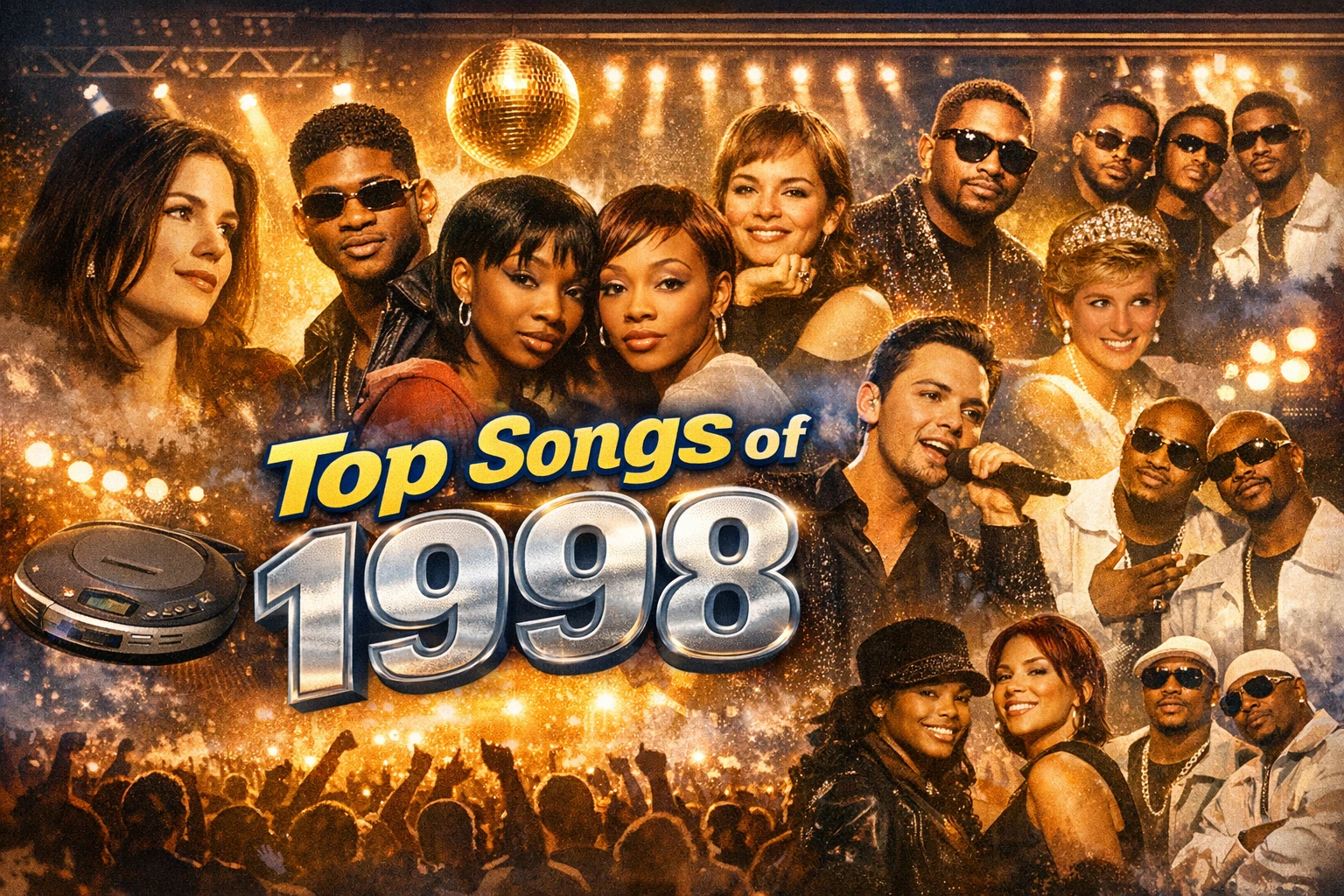
Top 10 Songs of 1998: Billboard’s Biggest Hits, Ranked
The top 10 songs of 1998 capture the moment the late 90s stopped easing into the room and started acting like it owned the building. Billboard’s year-end Hot 100 was led by sleek R&B, but country-pop, giant love songs, danceable grief, adult-radio endurance, and singer-songwriter anxiety all managed to share the same dial.
This was the year Next turned one very specific dance-floor problem into the biggest song in America, while Brandy and Monica turned a duet into a 13-week argument. Shania Twain proved country was no longer visiting pop radio, and Savage Garden made romantic promises large enough to require local permits.
Janet Jackson found motion inside grief, Usher moved from promising young singer to genuine star, K-Ci & JoJo gave every wedding DJ a permanent assignment, and Paula Cole turned a thoughtful adult-pop song into the opening signal for an entire generation of creek-side teenage drama.
The ranking uses Billboard’s 1998 year-end Hot 100, so these are the biggest U.S. singles of the year based on cumulative chart performance—not a personal ranking of the best songs of 1998 and not a modern nostalgia poll.
“Too Close” by Next was Billboard’s number-one year-end song of 1998. “The Boy Is Mine,” “You’re Still the One,” “Truly Madly Deeply,” and “How Do I Live” completed the year’s top five.
Billboard Hot 100 Year-End Ranking
The year-end order reflects performance across Billboard’s full chart period. A weekly number-one run helps, but timing and staying power matter too—which is how Paula Cole finished tenth for the year despite never climbing higher than number eleven in any single week.
1998 Was the Year R&B Set the Pace
The biggest songs of 1998 make the direction of the mainstream fairly obvious. R&B was no longer one strong lane among several. It was setting the speed, attitude, vocal style, production polish, and emotional temperature for the rest of the chart.
Next, Brandy, Monica, Usher, K-Ci & JoJo, and Janet Jackson occupied six places in the year-end top 10. They did not all sound alike, either. The list moved from sly dance-floor grooves to romantic duets, slow jams, wedding ballads, and a celebration of life disguised as a club record.
The rest of the chart was built around crossover. Shania Twain and LeAnn Rimes made country-pop part of ordinary Top 40 life. Savage Garden supplied widescreen romance, Elton John carried a historic single into another chart year, and Paula Cole proved radio persistence could outweigh a modest weekly peak.
Quick List: Top 10 Songs of 1998
- #1 “Too Close” — Next
- #2 “The Boy Is Mine” — Brandy and Monica
- #3 “You’re Still the One” — Shania Twain
- #4 “Truly Madly Deeply” — Savage Garden
- #5 “How Do I Live” — LeAnn Rimes
- #6 “Together Again” — Janet Jackson
- #7 “All My Life” — K-Ci & JoJo
- #8 “Candle in the Wind 1997” / “Something About the Way You Look Tonight” — Elton John
- #9 “Nice & Slow” — Usher
- #10 “I Don’t Want to Wait” — Paula Cole
1998 Billboard Year-End Top 10 at a Glance
This table shows Billboard’s complete 1998 year-end top 10, each single’s weekly Hot 100 peak, and the number of weeks it spent at number one.
| Year-End Rank | Song | Artist | Hot 100 Peak | Weeks at #1 |
|---|---|---|---|---|
| #1 | “Too Close” | Next | #1 | 5 |
| #2 | “The Boy Is Mine” | Brandy and Monica | #1 | 13 |
| #3 | “You’re Still the One” | Shania Twain | #2 | 0 |
| #4 | “Truly Madly Deeply” | Savage Garden | #1 | 2 |
| #5 | “How Do I Live” | LeAnn Rimes | #2 | 0 |
| #6 | “Together Again” | Janet Jackson | #1 | 2 |
| #7 | “All My Life” | K-Ci & JoJo | #1 | 3 |
| #8 | “Candle in the Wind 1997” / “Something About the Way You Look Tonight” | Elton John | #1 | 14 |
| #9 | “Nice & Slow” | Usher | #1 | 2 |
| #10 | “I Don’t Want to Wait” | Paula Cole | #11 | 0 |
Listen to the Top Songs of 1998
The companion playlist brings together the biggest songs of 1998 with the wider sound of the year: R&B, country-pop, slow jams, dance music, adult ballads, alternative radio, singer-songwriter records, soundtrack hits, and the tracks that followed Gen X from car stereos to mall speakers and wedding receptions.
Use the playlist while reading the countdown, then continue into the complete 90s Music archive for more Billboard year-end songs, hip-hop, R&B, slow jams, alternative music, grunge, pop hits, and Gen X radio memories.
Countdown: The Top 10 Songs of 1998
The countdown runs from Paula Cole at #10 to Next at #1, with chart peaks, weeks at number one, deeper 1998 music context, and lived-in Gen X memories for every song.
“I Don’t Want to Wait”
Paula Cole
Why It Hit
Paula Cole’s place in the 1998 top 10 is one of the best reminders that a year-end chart measures more than one dramatic peak. “I Don’t Want to Wait” never entered the weekly top 10, yet it stayed in circulation long enough to become part of the country’s daily background.
The song earns that endurance through restraint. Cole does not begin with a giant chorus or immediately announce an emotional emergency. She starts with family history, fear, inherited damage, and the possibility of choosing a better life before time makes the decision for you.
The chorus opens the record without turning it into empty uplift. There is hope in the song, but it comes from somebody who understands why hope may be difficult. That tension gave the track more staying power than a simpler motivational anthem would have carried.
Why It Mattered in 1998
Finishing tenth for the year after peaking at number eleven was a remarkable endurance story. It showed how repeated radio exposure, broad format appeal, and cultural familiarity could outweigh a modest weekly peak.
Its use as the opening theme for Dawson’s Creek permanently attached the song to the television atmosphere of 1998. The opening notes became a signal that somebody near a creek was about to overthink a relationship for the next hour.
Gen X Rewind
This is the sound of teen television discovering that the opening credits could arrive carrying several generations of unresolved family trauma.
It belongs to Thursday-night television, VCR timers, bedroom radios, college apartments, and the moment a network drama could make an entire town feel emotionally overqualified for high school.
“Nice & Slow”
Usher
Why It Hit
“Nice & Slow” is where Usher’s early promise began turning into something much more permanent. He was still young, but the record did not present him like a kid being allowed into an adult format. It gave him the room, pacing, and confidence of a singer who already belonged there.
The spoken opening immediately establishes the mood. There is no need to wait for the chorus or interpret the setting. Usher provides the time, location, vehicle, and general plan before the beat has fully settled into the seat.
The production understands patience. The rhythm glides, the vocal remains controlled, and every element behaves as though rushing would damage the atmosphere. That confidence helped the song cross into pop without sanding away the R&B identity that made it work.
Why It Mattered in 1998
Two weeks at number one made “Nice & Slow” Usher’s first Hot 100 chart-topper and confirmed that his career had moved beyond potential. The machinery for a much larger run was now clearly in place.
It also belongs comfortably among the essential R&B songs of the 1990s, arriving during a period when young male singers were expected to sound polished, romantic, confident, and old enough to make the rest of us wonder who had approved the lyrics for school dances.
Gen X Rewind
This is pager-on-the-belt, lights-low, parents-not-listening- closely-enough music.
Plenty of middle-school listeners knew every word before fully understanding why the adults in the room suddenly looked concerned. The 90s did not believe in age-appropriate radio rotation.
“Candle in the Wind 1997” / “Something About the Way You Look Tonight”
Elton John
Why It Hit
By 1998, Elton John’s double-sided single had already moved beyond ordinary chart success. It was a physical reminder of one of the largest public mourning events of the decade, and the record’s commercial force was simply too large to remain contained inside the final months of 1997.
“Candle in the Wind 1997” supplied the historical and emotional gravity. “Something About the Way You Look Tonight” gave the release another side rooted in classic Elton John adult pop: elegant, familiar, romantic, and perfectly built for long-term radio play.
Together, the songs gave the single an unusual range. One side was inseparable from a specific international loss. The other could continue living as a conventional love song after the original news cycle had faded.
Why It Mattered in 1998
Finishing eighth on a second year-end chart showed just how massive the release had become. Most hits disappear from the annual conversation once the calendar turns. This one carried enough sales, airplay, and cultural memory to remain one of America’s biggest singles.
It also represents the last moment in the decade when a veteran adult-pop superstar could overwhelm the singles market through a physical release attached to one enormous public event.
Gen X Rewind
This is the sound of one year refusing to release its grip on the next.
The single remained in record stores, family collections, car CD players, and public memory long after ordinary hits would have been replaced by the next stack of jewel cases.
“All My Life”
K-Ci & JoJo
Why It Hit
“All My Life” sounds almost suspiciously sincere, which is precisely why it worked. K-Ci & JoJo stepped away from much of the harder, more volatile energy associated with Jodeci and delivered a song with no defensive posture at all.
The piano, strings, choir-like backing vocals, and direct declaration of devotion give the track the structure of a ceremony. It does not feel like somebody considering love. It feels like somebody has already booked the room, called the family, and placed the rings near the cake.
K-Ci’s rougher vocal texture keeps the polish from becoming sterile. The performance sounds emotional enough to be trusted, while JoJo’s smoother presence helps the song hold its shape as the arrangement becomes larger.
Why It Mattered in 1998
Three weeks at number one turned “All My Life” into far more than an R&B hit. It became a wedding song, prom song, dedication song, anniversary song, and permanent emergency option for anybody asked to assemble a romantic montage.
The crossover also showed the commercial range of singers who had come from the new jack swing and hip-hop soul era. They could retain the emotional intensity of that world while moving into a ballad large enough for every mainstream format.
Gen X Rewind
This is slow-dance, cake-cutting, radio-dedication music.
Somebody used it at your prom. Somebody used it at a wedding. Somebody used it for a relationship that lasted three weeks. The song treated every occasion with the same permanent commitment.
“Together Again”
Janet Jackson
Why It Hit
“Together Again” carries grief without behaving like a traditional grief song. Janet Jackson placed loss inside bright keyboards, house-influenced rhythm, warm vocals, and a chorus built to lift rather than collapse.
That choice does not hide the sadness. It changes the way the sadness moves. Instead of treating remembrance as a room everyone must sit inside quietly, the song turns memory into motion and connection into something that can still produce joy.
Janet’s restraint is essential. She does not oversing the tribute or push the listener toward one approved emotion. The warmth of the performance allows happiness, pain, and acceptance to occupy the record at the same time.
Why It Mattered in 1998
Two weeks at number one demonstrated Janet’s ability to move between pop, R&B, and dance music without sounding like she was borrowing any of them. The song felt fully at home everywhere it played.
It also belongs to the broader late-90s pop and dance explosion, but it brought a level of emotional maturity that separated it from simpler celebration records. The beat invited movement; the song gave the movement a reason.
Gen X Rewind
This is one of those songs that feels good immediately and becomes sadder as you get older.
At first, it was a bright Janet Jackson song on the radio. Years later, the words begin finding people who are no longer available to hear them with you.
“How Do I Live”
LeAnn Rimes
Why It Hit
“How Do I Live” did not dominate through one explosive chart moment. It dominated by refusing to leave. The song entered the national atmosphere in 1997, remained there through 1998, and started to feel less like a current single than part of the building’s ventilation system.
The emotional premise is enormous and extremely simple: losing this person would make ordinary life impossible. LeAnn Rimes delivers that idea with enough power to fill an arena but enough country-rooted directness to keep the song from becoming completely abstract.
The record also worked across formats without sounding like a compromise. Country listeners heard emotional clarity. Pop listeners heard a giant romantic ballad. Adult contemporary heard something dependable enough to keep in rotation until the furniture changed.
Why It Mattered in 1998
Its year-end #5 finish came after placing ninth in 1997, making the record one of the most extraordinary endurance stories of the decade. It never reached number one, but it outlasted countless songs that did.
The single also helped make country-pop crossover feel ordinary rather than exceptional. By 1998, listeners no longer needed a formal introduction before a country artist appeared between R&B, pop, and adult-radio hits.
Gen X Rewind
This is the radio equivalent of wallpaper you somehow became emotionally attached to.
You heard it in cars, stores, offices, waiting rooms, and weddings. Eventually the question was no longer how anybody could live without the person in the song. It was how any of us had lived before hearing the chorus again.
“Truly Madly Deeply”
Savage Garden
Why It Hit
“Truly Madly Deeply” sounds like a love song that never met a small promise it respected. The lyric does not offer simple affection. It offers geography, atmosphere, dreams, comfort, eternity, and what appears to be full-time emotional property management.
That scale could have collapsed into parody, but Darren Hayes sells the declarations with enough vulnerability to keep the song tender. His voice sounds open rather than overpowering, giving the oversized promises a personal center.
The production helps by remaining smooth and patient. The song rises gradually, lets the chorus provide the widest view, and then settles back into something intimate enough for listeners to place themselves inside it.
Why It Mattered in 1998
Two weeks at number one only tell part of the story. “Truly Madly Deeply” became a long-term radio resident, moving easily between Top 40, adult contemporary, weddings, dedications, and every romantic setting requiring a song that had already promised everything.
It also showed how strongly international pop was flowing into the American mainstream. Savage Garden did not need to disguise the record as anything other than polished, emotional pop made for the largest possible audience.
Gen X Rewind
This is starry-sky, candlelight, legally concerning promise music.
People slow-danced to it, dedicated it over the radio, and used it to communicate levels of commitment that may not have survived until the next Savage Garden single.
“You’re Still the One”
Shania Twain
Why It Hit
Shania Twain’s crossover power often came wrapped in humor, swagger, and a raised eyebrow. “You’re Still the One” takes a quieter route. It replaces the punch line with gratitude and turns lasting love into something sturdy rather than sentimental.
The lyric is not about first attraction or romantic fantasy. It is about survival—staying together after other people assumed the relationship would fail. That gave the song a grown-up confidence that reached well beyond teenage pop listeners.
The production is polished enough for pop radio without completely removing the country identity. The acoustic texture, phrasing, and plainspoken message remain visible beneath the sheen, which is why the crossover feels natural rather than negotiated.
Why It Mattered in 1998
A number-two peak and year-end #3 finish confirmed that Shania was no longer merely an enormous country star. She was one of the central pop artists in America, and format boundaries were becoming increasingly theoretical around her.
The song helped redefine what country crossover could sound like. It did not arrive dressed as a novelty or ask pop listeners to admire the genre from a respectful distance. It simply joined the main rotation and stayed there.
Gen X Rewind
This is the song that made long-term commitment sound commercially viable.
It belongs to anniversaries, weddings, adult-radio drives, and couples quietly enjoying the fact that everyone who said it would never last had been forced to revise the forecast.
“The Boy Is Mine”
Brandy and Monica
Why It Hit
“The Boy Is Mine” understood that a duet did not need to be cooperative. Brandy and Monica were placed inside a musical standoff, and the contrast between them gave the song enough tension to power an entire summer.
Brandy sounds cooler and more measured. Monica brings more visible confrontation. Neither approach wins outright, which allows listeners to choose a side and treat the record like an argument that had somehow become available for purchase.
The production remains smooth and restrained while the singers trade lines. That patience is essential. A louder track would have swallowed the performances. Instead, the beat leaves enough room for every pause, response, and shift in tone to feel like part of the confrontation.
Why It Mattered in 1998
Thirteen weeks at number one made “The Boy Is Mine” the longest-running chart-topper of 1998 and one of the defining R&B crossover records of the decade.
Its position among the 50 essential 90s R&B songs is secure because the record combined vocal identity, narrative, star power, video chemistry, and radio precision without sacrificing the smoothness that made it replayable.
It also confirmed that two young Black women could command the absolute center of mainstream pop without being separated into a side category. The argument belonged to everyone.
Gen X Rewind
This is school-bus debate, lunch-table politics, and everybody choosing a side despite having no relationship with the boy in question.
The video only made the rivalry feel more real. By the time the final reveal arrived, the audience had spent months discussing a relationship none of us had been invited to join.
“Too Close”
Next
Why It Hit
The funniest possible outcome for 1998 is that after all the giant ballads, crossover prestige, wedding vows, and historic chart runs, the year belonged to “Too Close.” That result makes complete sense once the groove starts.
The song works before the listener understands the joke. The beat is immediate, the bass line is impossible to ignore, and the vocal arrangement gives the chorus the smooth, repeated pull of a classic late-90s R&B record.
Then the lyric becomes clear, and the song turns into something even more memorable: a very polished discussion of a dance-floor situation most radio programmers probably hoped nobody would explain during the afternoon shift.
Why It Mattered in 1998
Five weeks at number one and a year-end #1 finish placed “Too Close” at the absolute center of a year already dominated by R&B. The genre was not merely crossing into pop. It was deciding what pop sounded like.
The record also illustrates how much late-90s R&B could accomplish through groove and personality. There was no giant vocal showcase or expensive emotional concept. The song understood the club, understood the joke, and understood exactly how often the chorus needed to return.
Its continued place among the decade’s essential R&B records comes from that split-level appeal. Younger listeners heard an irresistible song. Older listeners heard the same irresistible song and realized somebody had allowed the subject onto daytime radio.
Gen X Rewind
This is one of those songs half the country sang before fully processing what had happened on the dance floor.
School dances played it. Roller rinks played it. Radio stations played it. Adults heard the lyrics, looked around, and apparently decided stopping the record would require too much paperwork.
By the time everybody caught the meaning, the hook had already won. That may be the most accurate possible summary of pop culture in 1998.
Keep Rewinding 1998
Continue through the same year with television, movies, toys, videos, and the larger 90s music archive. Together, these pages connect Billboard’s biggest songs of 1998 to the rest of the culture surrounding them.
1998 Rewind Verdict
1998 was the year R&B stopped sharing control and started setting the pace. Six of the year-end top 10 songs came from artists working inside R&B, but the list still had enough range to include country crossover, Australian pop, adult-radio endurance, and one enormous single carried over from 1997.
“Too Close” is groove, mischief, and radio efficiency. “The Boy Is Mine” turns a duet into a national argument. “You’re Still the One” makes country-pop feel like ordinary mainstream infrastructure, while “Truly Madly Deeply” promises every available romantic service.
“Together Again” moves through grief instead of sitting still inside it. “All My Life” gives weddings a permanent assignment. Usher begins looking inevitable, Paula Cole refuses to leave, and LeAnn Rimes continues one of the longest chart goodbyes anybody had ever attempted.
For Gen X, these songs are CD singles, mall speakers, school dances, wedding receptions, bedroom stereos, television openings, grocery stores, car rides, and the sound of the decade becoming smoother, brighter, more commercial, and very close to the Y2K blast radius.
FAQ: Top Songs of 1998
What was the #1 song of 1998?
“Too Close” by Next was Billboard’s number-one Hot 100 year-end song of 1998.
What were the top five songs of 1998?
The top five were “Too Close,” “The Boy Is Mine,” “You’re Still the One,” “Truly Madly Deeply,” and “How Do I Live.”
Why does this countdown use Billboard’s year-end Hot 100?
The year-end chart measures cumulative U.S. chart performance across Billboard’s chart period rather than personal opinion or present-day nostalgia.
How long was “Too Close” at #1?
Next spent five weeks at number one on the Billboard Hot 100 with “Too Close.”
How long was “The Boy Is Mine” at #1?
Brandy and Monica spent 13 consecutive weeks at number one with “The Boy Is Mine.”
Did “You’re Still the One” reach #1?
No. Shania Twain’s “You’re Still the One” peaked at number two, but its staying power carried it to third on Billboard’s 1998 year-end chart.
Did “How Do I Live” reach #1?
No. LeAnn Rimes peaked at number two, but the song’s extraordinary chart run made it one of the biggest hits of both 1997 and 1998.
Did “I Don’t Want to Wait” reach the weekly top 10?
No. Paula Cole’s song peaked at number eleven, but its long chart run and heavy radio presence carried it to number ten on the 1998 year-end chart.
Which songs in the 1998 top 10 reached #1?
“Too Close,” “The Boy Is Mine,” “Truly Madly Deeply,” “Together Again,” “All My Life,” “Nice & Slow,” and Elton John’s double-sided single reached number one.
Why was R&B so dominant in 1998?
R&B had become one of the main engines of American pop music. Its production, vocal style, slow jams, dance-floor grooves, and younger stars were succeeding across radio formats rather than remaining inside one category.
Why was “Too Close” such a big song?
The song combined a powerful groove, an immediate chorus, polished R&B production, crossover appeal, and a double meaning that became funnier once listeners realized what the lyric was describing.
Is there a playlist for the top songs of 1998?
Yes. The companion Smells Like Gen X Spotify playlist is embedded on this page.
Where can I find more 1998 nostalgia?
The same-year links connect to the top television shows, movies, toys, videos, and the wider 90s Music archive.