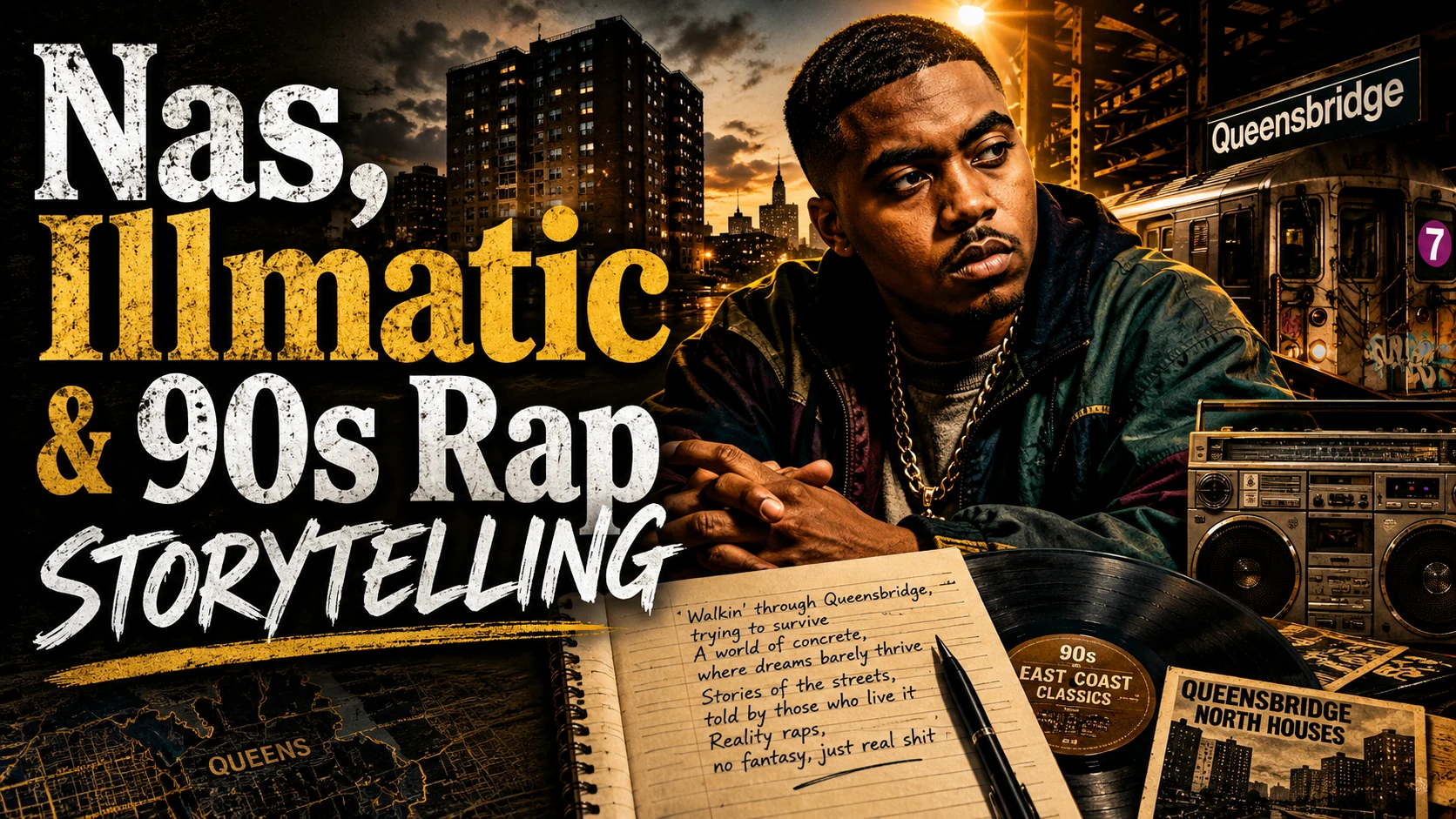
Nas, Illmatic, and 90s Rap Storytelling
Nas did not just make a classic 90s rap album. He made Queensbridge feel like a movie you could hear through cheap headphones, a boombox with weak batteries, or a CD player you guarded like it contained nuclear codes. Illmatic turned street corners, project stairwells, subway noise, rooftop daydreams, paranoia, ambition, boredom, danger, and teenage memory into rap storytelling so sharp that an entire generation suddenly acted like we all knew what “internal rhyme schemes” meant. Sure we did, genius. Right after lunch period.
Nas, Illmatic, and 90s rap storytelling matter because Nas turned Queensbridge street life into cinematic hip-hop without making it feel staged. Released in 1994, Illmatic became one of the defining albums of East Coast hip-hop in the 90s, with songs like “N.Y. State of Mind,” “The World Is Yours,” “Life’s a Bitch,” “One Love,” “Memory Lane,” and “It Ain’t Hard to Tell.” It connected boom bap production, New York rap lyricism, street reporting, poetic detail, and Gen X headphone culture into one of the greatest albums in 90s hip-hop.
Keep the 90s Hip-Hop Rewind Going
This Nas and Illmatic rewind connects directly into the bigger 90s rap map: 90s Hip-Hop and Rap, East Coast Hip-Hop in the 90s, Best 90s Hip-Hop Albums, 50 Essential 90s Hip-Hop Songs, Golden Age Hip-Hop in the Early 90s, and Conscious Rap in the 90s. Because if you are building a serious 90s hip-hop section and do not give Illmatic its own room, the whole house is going to look suspicious.
Why Illmatic Still Feels Bigger Than Its Runtime
Illmatic is one of those albums that creates a problem for every article written about it. Everyone already knows it is great. Everyone already knows it is important. Everyone already knows hip-hop heads have been talking about it like it came down from a mountain with smoke around it and a five-mic rating carved into stone. So the lazy version of the conversation is easy: “Nas was lyrical, the beats were classic, Queensbridge, boom bap, greatest album ever, please clap.”
That is not enough. Not for this album. Not for 90s hip-hop. Not for anyone who remembers how records actually moved through Gen X life before everything became algorithm soup. Illmatic was not just a rap album you heard. It was an album people passed around, argued over, studied, misquoted, rewound, paused, borrowed, lost, replaced, and treated like proof that a rapper could make a whole neighborhood feel like a nervous system.
The album is short, but it does not feel small. That is the trick. There is no bloat, no filler parade, no exhausted third act where the artist suddenly remembers the label wanted a radio record with a guest singer and a hook built for mall speakers. Illmatic moves like a tight film. It has an opening mood, a location, a voice, a cast of shadows, a sense of weather, and an ending that leaves you feeling like you walked through a whole life in under an hour.
Nas sounded young, but not inexperienced. That was part of the shock. He had the voice of someone still close to the age of the kids listening through foam headphones, but the writing sounded like the kid had already been watching the world with old eyes. He was not just bragging. He was observing. He was not simply reporting danger. He was showing how danger changes the way time feels. He was not just saying Queensbridge existed. He was making Queensbridge visible in fragments: corners, elevators, hallways, dice games, police pressure, friends, boredom, memory, ambition, mourning, and that specific teenage feeling that the world is both too big and already closing in.
That is why Nas, Illmatic, and 90s rap storytelling deserves its own deep rewind. The album is not only a key entry in Best 90s Hip-Hop Albums. It is one of the records that changed the standard for detail. After Illmatic, listeners expected more from rap narration. More precision. More atmosphere. More emotional control. More images that did not feel like generic street scenery. Nas made the street feel specific, and specificity is where storytelling starts.
The wild thing is that Illmatic never sounds like it is begging to be called literature. That is why it works. It is not standing there in a tweed jacket asking you to notice the symbolism. It just raps. The poetry is inside the movement. The imagery is inside the slang. The structure is inside the rhythm. The wisdom is inside the exhaustion. Nas did not turn hip-hop into homework. He turned homework into something people actually wanted to copy into notebooks, which is a different miracle entirely.
For Gen X, this mattered because we were already living in the golden age of overthinking music without calling it overthinking. We read liner notes like sacred documents. We judged people by what was in their CD binder. We paused videos to study jackets, boots, record-store stickers, and facial expressions. We carried music around physically, which made every album feel like an object with weight. Illmatic had that weight. Even before the mythology calcified around it, the record felt serious in your hands.
And yes, hip-hop heads could be absolutely unbearable about it. Let us be honest. Somebody somewhere heard Illmatic and immediately turned into a record-store philosopher with cargo pants and an opinion about every snare. But the obnoxiousness came from real awe. The album created that reaction because it felt like a standard had shifted. People wanted to talk about it because the record made talking feel necessary.
That is what separates Illmatic from a lot of classics. Some albums are classic because they are huge. Some are classic because they had hits. Some are classic because they represent a scene. Illmatic is classic because it made listeners feel like rap could compress an entire environment into a few verses and still leave room for mystery. It did not overexplain itself. It trusted you to catch up. Which, honestly, was rude, because some of us were still trying to figure out how to program the VCR.
Queensbridge Was Not Just Where Illmatic Happened

The Neighborhood Was the Camera
Nas did not describe Queensbridge like scenery. He wrote it like a place with memory, pressure, noise, silence, danger, jokes, and ghosts.
The first thing Illmatic understands is place. Not “place” in the tourist-brochure sense. Not the movie version where a city exists so someone can run past a landmark while the soundtrack gets dramatic. Queensbridge on Illmatic feels like a living system. It has corners, windows, stairs, courtyards, roofs, apartments, friends, enemies, routines, sounds, smells, whispers, and a constant pressure that makes even quiet moments feel loaded.
That is why Nas belongs in any serious conversation about 90s rap storytelling. He did not merely tell listeners that life was hard. He showed how hard life changes attention. On Illmatic, details matter because details are survival. Who is outside? Who is watching? Who changed? Who did not come home? Who is making money? Who is pretending not to be scared? Who is bored enough to make a bad decision? Who is smart enough to see the trap and still not have many options?
Queensbridge was already part of hip-hop history before Nas released his debut. But Illmatic gave the neighborhood a different kind of mythic weight. It did not turn Queensbridge into a fantasy. It made the mythology feel documentary. That is a hard balance. Too much realism and the album becomes flat reporting. Too much mythology and the neighborhood becomes a cartoon. Nas walked between both like he had a camera in one hand and a notebook in the other.
The album also captures the strange way a neighborhood can feel massive and claustrophobic at the same time. To outsiders, Queensbridge might be a location. To Nas, it is a whole world. The people inside it are not background extras. They are influences, warnings, memories, threats, jokes, mentors, tragedies, and mirrors. That is what makes the storytelling so effective. The environment is not there to decorate the lyrics. The environment shapes the narrator.
This matters to the broader story of East Coast Hip-Hop in the 90s because New York rap was obsessed with place. Boroughs mattered. Blocks mattered. Projects mattered. Crews mattered. Corners mattered. The specificity was part of the identity. You could hear Queens, Brooklyn, the Bronx, Harlem, Staten Island, and different corners of the city talking to each other, battling each other, borrowing from each other, and trying to define the sound of the decade.
But Nas made Queensbridge feel internal. He did not just rap about where he was from. He rapped like the place had entered his nervous system. The paranoia, the observation, the ambition, the mourning, the humor, the flashes of beauty — all of it feels filtered through a mind that cannot separate memory from geography. The neighborhood is not behind him. It is inside the voice.
For Gen X listeners, that sense of place hit hard because we were consuming hip-hop through physical media that made scenes feel far away and close at the same time. You could be in a suburban bedroom, a college dorm, a car, a bus stop, a basement, or a mall parking lot and still feel like Illmatic had put you near those Queensbridge hallways for 39 minutes. That was the power of the writing. It traveled without becoming vague.
And it did not sound like a documentary narrator explaining the situation to people who needed everything translated. Nas did not flatten Queensbridge for outsiders. He wrote from inside it. If you caught the references, good. If you did not, keep listening. That confidence is part of why the album holds up. It does not beg to be understood by everyone. It gives you the world and lets you decide whether you are paying attention.
That is the first major storytelling lesson of Illmatic: setting is not just where the story happens. Setting is pressure. Setting is memory. Setting is rhythm. Setting is what the narrator notices first and what he cannot stop noticing later. Nas made Queensbridge feel like a character because, in his writing, it was.
How Nas Changed 90s Rap Storytelling

The Verses Moved Like Scenes
Nas wrote like somebody watching the block, watching himself, watching time, and somehow making every detail land before the beat changed.
The easiest way to explain Nas as a storyteller is this: he made verses feel edited. Not edited in the watered-down radio sense. Edited like film. A close-up here. A jump cut there. A detail that seems small until it changes the mood. A line that moves from street observation to inner monologue before you realize the camera turned around.
On Illmatic, Nas does not always tell stories in a neat beginning-middle-end format. That is important. Some rappers tell stories like short films with clear plots. Nas often tells stories like memory. Fragments. Images. Voices. Warnings. Little scenes. Sudden reflections. A joke that turns dark. A threat that becomes philosophy. A line that sounds like bragging until you realize it is grief wearing a jacket.
That style was perfect for 90s hip-hop because the decade was already moving fast. Rap was getting more regional, more competitive, more lyrical, more visual, more commercial, more dangerous, more scrutinized, and more creatively insane. The best MCs were not just rhyming words. They were building worlds. Nas entered that moment and made the world-building feel effortless.
The difference is density. Nas could make one line do the work of three. He could describe a person, a mood, a location, and a social condition without pausing to explain what he had done. That is why people listened repeatedly. The first listen gave you atmosphere. The second gave you images. The third gave you structure. The fourth made you realize there were lines you had been nodding to without fully unpacking them. By the fifth, you were probably annoying someone in a record store. It happened. We all know someone.
His storytelling also worked because it was not sentimental. There is emotion all over Illmatic, but the album rarely stops to announce it. Nas does not constantly tell you how to feel. He gives you the image and lets the feeling catch up. That restraint is a huge part of the album’s power. A lot of 90s rap could be direct, dramatic, and confrontational, which was great. Nas had another gear: understatement that somehow made everything heavier.
This is where the album overlaps with Conscious Rap in the 90s, even though Illmatic is not a “message album” in the obvious, slogan-heavy sense. It is conscious because it notices. It is conscious because it understands conditions. It is conscious because it shows what poverty, violence, ambition, and pressure do to the mind. Nas is not standing at a podium. He is standing in the scene, and somehow that makes the social commentary hit harder.
The storytelling is also deeply visual. That is why people keep using words like “cinematic” around Illmatic, even if the word has been beaten half to death by music writers and guys with YouTube channels who own too many hats. But in this case, it fits. Nas writes like he sees the scene before he says it. You can feel camera movement in the lyrics: looking down from a window, cutting to the street, zooming into a thought, pulling back to the neighborhood, jumping into memory, snapping back to danger.
He also sounds like someone aware that childhood is ending while it is ending. That is one of the most important emotional threads in Illmatic. It is not only an album about street life. It is an album about the accelerated adulthood that comes from growing up around pressure. The narrator is young, but childhood is already being treated like something that got stolen and pawned. That gives the album its haunted feeling.
Gen X understood that feeling in different ways, even outside Nas’s world. We were the latchkey generation, the “figure it out” generation, the “walk it off” generation, the generation that learned too much from TV, older cousins, unsupervised afternoons, bad decisions, and music that was probably not age-appropriate but absolutely necessary. Illmatic spoke from a specific place, but the feeling of being young and already tired traveled far.
Nas also changed storytelling by making technical skill feel invisible. The internal rhymes, patterns, and word choices are ridiculous, but the album rarely sounds like a technical exercise. That matters. A rapper can show skill in a way that makes you admire the machinery but not care about the song. Nas made the machinery serve the atmosphere. The craft was there to deepen the world, not to wave at itself in the mirror.
That is why Illmatic still functions as a measuring stick. It is not because every rapper after Nas needed to sound like him. That would be boring, and also impossible without becoming a museum exhibit. The standard was not “rap like Nas.” The standard was “make your details matter.” Tell the truth of your place. Build atmosphere. Do not waste lines. Do not confuse length with depth. Do not explain what the image can carry.
The album’s storytelling also helps explain why it belongs next to 50 Essential 90s Hip-Hop Songs. “N.Y. State of Mind” is not just essential because it is lyrical. It is essential because it feels like being dropped into a mind mid-survival. “The World Is Yours” is not just essential because the beat is beautiful. It is essential because it turns ambition into something fragile, defiant, and slightly doomed. “One Love” is not just a letter song. It is a whole emotional architecture.
And that is the real achievement: Nas made rap storytelling feel compact and endless at the same time. The album is brief. The world is not. The songs end. The images keep moving. That is why we are still talking about it decades later, because apparently some albums refuse to stay in their original decade and just keep showing up to remind everybody what detail sounds like.
The Production Made Illmatic Feel Like New York Breathing Through Speakers

Dust, Drums, Jazz, Static, and Nerves
DJ Premier, Pete Rock, Large Professor, Q-Tip, and L.E.S. gave Nas beats that felt unified without sounding identical.
The production on Illmatic is one of the reasons the album still feels impossible to overinflate. You can try to call it overrated, but then the drums come in and your argument starts looking for the nearest exit. The beats are dusty, sharp, warm, tense, jazzy, grimy, and weirdly elegant. They do not smother Nas. They frame him.
That matters because Illmatic had multiple producers, which could have turned into a messy sampler platter. Instead, the album feels unified. DJ Premier, Pete Rock, Large Professor, Q-Tip, and L.E.S. each bring different textures, but the record never sounds like a compilation. It sounds like different windows in the same building. The light changes, the room changes, the view changes, but the world is still Queensbridge.
DJ Premier’s work gives the album some of its most iconic hard edges. Premier had a way of making scratches, drums, and chopped fragments sound like moral punctuation. His beats did not simply loop. They leaned forward. They made the rapper sound like he was entering a room where everyone already knew the stakes.
Pete Rock brings warmth and lift, especially on “The World Is Yours.” That beat is gorgeous without becoming soft. It gives Nas room to dream, but the dream still has concrete under it. That is the genius. The song feels hopeful, but not naive. It floats, but the strings are tied to the block.
Large Professor’s presence matters because he connects Nas to the deeper architecture of New York rap. Large Pro was not just a producer on the album. He was part of the pathway that helped Nas enter the conversation before Illmatic arrived. His production brings that classic New York intelligence: dusty, precise, and built for someone who has actual bars instead of just volume.
Q-Tip’s contribution matters because it ties Illmatic to the jazzier, more fluid side of A Tribe Called Quest and 90s Jazz Rap. Tip’s touch does not turn the album into Native Tongues sunshine. It adds texture. It reminds you that New York hip-hop was not one color. It had grit, swing, abstraction, smoke, humor, and mood.
L.E.S. helps complete the album’s sonic identity with work that feels rooted and cinematic. The production choices across the record give Nas space to be visual without turning the beats into background wallpaper. That is harder than it sounds. A rapper as dense as Nas needs production that can support complexity without fighting it. Illmatic gets that balance right.
The album also sits beautifully inside the larger story of Golden Age Hip-Hop in the Early 90s. The production is sample-based, but not lazy. Jazz-influenced, but not sleepy. Street-rooted, but not one-dimensional. It is boom bap with atmosphere. The drums hit, but the spaces matter too. There is room for silence, tension, memory, and that little crackle that made every beat feel like it had been pulled from a milk crate during a blackout.
For Gen X listeners, this sound is half the memory. Before streaming cleaned everything up into infinite convenience, records had physical texture. Cassettes hissed. CDs skipped if you looked at them wrong. Speakers distorted. Car systems rattled. Headphones leaked sound. Illmatic sounded good through all of it because the production had bones. The beats did not need perfect conditions. They were built for imperfect listening.
That is a huge part of why the album aged well. Some 90s records are great but sound trapped in a very specific production trend. Illmatic sounds like 1994 in the best possible way, but it does not sound like a novelty of 1994. It sounds like New York hip-hop distilled to mood, rhythm, and pressure. It belongs to its year, but it does not expire there.
And because the production is so controlled, Nas can move freely. He can be frantic on “N.Y. State of Mind,” reflective on “Life’s a Bitch,” expansive on “The World Is Yours,” intimate on “One Love,” and surreal on “It Ain’t Hard to Tell.” The beats are different rooms, and Nas knows exactly how to stand in each one.
That is why Illmatic is not just a lyrical album. It is an album album. A whole object. A sequence. A sonic world. You cannot separate Nas from the beats any more than you can separate a movie from its lighting. The production tells you where you are before Nas even starts explaining why that place matters.
The Illmatic Track Breakdown: Every Song Pulls Its Weight

No Filler, No Loitering, No Wasted Space
Illmatic is short enough to fit in one sitting and deep enough to ruin your afternoon if you start unpacking every line.
Part of the reason Illmatic became such a mythic 90s hip-hop album is that there is nowhere to hide. The album does not give you a bloated tracklist where the classics can hang out while the filler quietly ruins the carpet. Every song has a job.
The Genesis
“The Genesis” is not a normal intro. It is a doorway. It brings in voices, street noise, conversation, memory, and atmosphere before the album truly starts. In a decade full of skits, intros, interludes, voicemail bits, and random studio chaos, this one works because it establishes place instead of wasting time.
The intro tells you that Illmatic is going to be local, conversational, and lived-in. It does not clear its throat. It opens the door and lets the block talk first.
N.Y. State of Mind
“N.Y. State of Mind” is where the album becomes undeniable. This is not just one of Nas’s best songs. It is one of the defining records of East Coast hip-hop in the 90s. The beat feels tense, shadowy, and immediate. Nas enters like someone dropped into the scene mid-chase.
The storytelling is frantic but controlled. The images arrive fast, but they are not random. You feel the city, the danger, the paranoia, the ambition, and the narrator’s mind racing to keep up with everything around him. It is cinematic without acting fancy about it.
This is also where Nas makes technical skill feel like survival instinct. The rhymes are dense, but the density fits the mood. The writing feels crowded because the world feels crowded.
Life’s a Bitch
“Life’s a Bitch” brings AZ into the album with one of the most memorable guest verses in 90s rap. The song has a strange glow to it: reflective, resigned, stylish, and quietly tragic. It sounds like young men trying to speak casually about mortality because admitting fear directly would break the whole posture.
That is part of the Gen X connection too. We were experts in pretending not to feel things while absolutely feeling them at full volume. “Life’s a Bitch” has that same emotional contradiction. It is smooth and fatalistic, elegant and exhausted.
The World Is Yours
“The World Is Yours” is one of the most important songs in the 50 Essential 90s Hip-Hop Songs conversation because it turns ambition into something complicated. The title sounds triumphant. The mood is more fragile than that. It is hope with shadows around it.
Pete Rock’s production gives the song lift, but Nas keeps the writing grounded. The result is not a cartoon victory lap. It is a young person trying to imagine possibility while surrounded by reasons not to believe in it. That tension is why the song still hits.
One Love
“One Love” is one of the great letter songs in hip-hop. Nas writes to incarcerated friends and turns updates into storytelling. The format could have been simple. Instead, it becomes a map of loyalty, loss, neighborhood change, family strain, and the way life keeps moving even when people get removed from it.
Q-Tip’s production gives the track a smoky, reflective mood that makes the writing feel intimate. Nas is not just telling someone what happened. He is trying to preserve connection against distance, prison walls, and time.
Memory Lane
“Memory Lane” is exactly what the title promises, but not in a soft-focus nostalgia way. This is memory as survival archive. Nas looks backward without pretending the past was clean. He makes childhood, danger, neighborhood status, friendship, and loss feel tangled together.
This is one of the tracks that explains why Nas belongs near Conscious Rap in the 90s. The song does not preach. It remembers. Sometimes memory is the message.
Represent
“Represent” is the album at its most direct and hard-nosed. It carries the classic New York rap stance: the neighborhood, the crew, the voice, the warning. But even here, Nas does not become generic. The details keep the record from turning into a simple tough-guy anthem.
DJ Premier gives the track the kind of beat that feels like concrete wearing headphones. Nas uses it to root the album back in Queensbridge identity after the reflective turns of the previous songs.
It Ain’t Hard to Tell
“It Ain’t Hard to Tell” closes the album with one of Nas’s most surreal, image-heavy performances. The song is confident, abstract, quotable, and almost dreamlike. After all the street detail, the album ends by reminding you that Nas is not only a reporter. He is an imagination machine.
Large Professor’s production gives the closer brightness and bounce without losing the album’s edge. It feels like the credits rolling, except the credits are rhyming better than most people’s lead single.
The tracklist is why Illmatic has survived so much discussion. You can argue rankings. You can argue influence. You can argue whether it is the greatest rap album ever, because hip-hop heads need cardio too. But it is hard to argue that the album wastes space. Every song adds a different angle to the world.
That economy is part of the lesson. Illmatic is not long, but it is dense. It does not need to prove depth by running forever. It proves depth by making every moment count. Which is something a lot of 90s CDs did not understand, especially once everybody realized you could fill 74 minutes and apparently decided that meant you should. We survived many unnecessary skits, people. Many.
How Gen X Actually Experienced Illmatic

This Was Headphone Music Before Headphones Became a Lifestyle Brand
Illmatic traveled through CD binders, dubbed tapes, record stores, magazine hype, bedroom stereos, and arguments that could ruin an entire lunch table.
To understand Illmatic, you have to remember how albums moved in the 90s. Not streamed. Not suggested. Not auto-played because some algorithm decided you had listened to enough “classic hip-hop vibes” to deserve a mood board. Albums moved through people. Friends. Cousins. Older siblings. Record-store clerks. College-radio DJs. Mixtape makers. Magazine writers. Someone with a car. Someone with a better stereo. Someone who always had the import version of something and made sure everyone knew it.
Illmatic had that kind of movement. It was not just an album sitting on a shelf. It was a recommendation with attitude. Somebody handed it to you like you were about to be tested. Somebody said, “Listen to the lyrics.” Somebody else said, “No, really listen.” Great. Nothing makes teenage listening more relaxing than being assigned a moral obligation by a guy wearing Timberlands indoors.
But they were not wrong. Illmatic rewarded attention in a way that made casual listening feel almost disrespectful. You could play it in the background, sure, but the album kept pulling you back. A phrase would jump out. A detail would land late. A rhyme pattern would reveal itself after the third listen. A beat would sound simple until you noticed the mood holding everything together.
Gen X had a specific relationship with repeated listening because we did not have infinite instant access. If you owned the CD, that CD got played. If you had the tape, that tape got worn. If somebody dubbed it for you, you lived with the hiss like it was part of the production. Music was less disposable because access required effort. You did not casually skip through all of recorded history while waiting for a coffee. You listened to what you had.
That made Illmatic hit differently. It became an album you lived with. The kind of album that sat near the front of the binder. The kind you had to replace if it got scratched. The kind that made you read credits. The kind that made you care who produced what. The kind that made you understand why 90s hip-hop albums were not just collections of songs. They were worlds.
The magazine culture mattered too. The Source, Vibe, Rap Pages, liner notes, ads, interviews, reviews, and word-of-mouth arguments created a whole ecosystem around records. Illmatic arrived in that ecosystem and quickly became the kind of album people used to measure taste. Owning it meant something. Knowing it meant more. Quoting it correctly meant you were safe at least until the next debate.
And because Gen X was Gen X, the album also got absorbed into personality. We did not just like music. We weaponized it socially. Your favorite rapper said something about you. Your favorite album said something about you. Your ability to explain why Illmatic mattered said something about you, even if that something was “this person has been in the record store too long and should hydrate.”
There was also the headphone factor. Illmatic is absolutely headphone music. Not in the glossy modern “immersive audio experience” way where a press release tells you to enjoy the spatial mix. It is headphone music because the details feel private. The album sounds like you are inside someone’s thoughts while the city moves outside the window. Listening alone made the record heavier. Listening with friends made it argumentative. Both were valid 90s experiences.
The album also fit into the broader 1994 music chaos. If you look at 1994 songs, the year was packed with pop, R&B, rock, radio, and crossover moments. Hip-hop was not isolated. It was fighting for space inside a crowded decade. But Illmatic did not need to dominate pop radio to become culturally massive. It built its reputation through depth, credibility, and the kind of listener devotion that lasts longer than a chart run.
That is one of the most important Gen X points. Not every defining album of the 90s was defined by being inescapable. Some were defined by becoming sacred within the right circles and then expanding outward. Illmatic was not a blockbuster in the same way some later rap albums were. It became something more durable: a standard.
And standards are annoying. Once an album becomes a standard, people start using it to judge everything else. That can get exhausting. But with Illmatic, the standard was earned. It was not about sales hype. It was not about a marketing campaign. It was not about a shiny video budget. It was about writing, beats, atmosphere, and the feeling that a young MC had captured a whole world before most people that age had figured out their hair.
That is the Gen X memory of Illmatic: an album that demanded attention without asking permission. It lived in headphones, cars, bedrooms, dorms, record stores, buses, basements, and arguments. It made rap feel like cinema, literature, news, confession, and neighborhood mythology, but without ever stopping to call itself any of that. It just played.
Illmatic and the East Coast Hip-Hop Moment
Illmatic did not arrive in a vacuum. Nothing in 90s hip-hop did. The decade was too loud, too competitive, too regional, and too fast-moving for any classic to just float in by itself like a motivational poster. Nas arrived during a period when East Coast rap was redefining itself, defending itself, and sharpening its identity while the rest of the country was making sure New York could not pretend to be the whole map anymore.
The West Coast had exploded into national dominance with G-funk, gangsta rap, and a sound that could take over cars, clubs, radio, MTV, and suburban bedrooms with equal force. If you were following West Coast Hip-Hop in the 90s, you know the pressure was real. Dr. Dre, Snoop, Tupac, Death Row, and that entire lane changed the center of gravity. New York could not just assume everyone was looking east.
That is part of why Illmatic matters so much in the East Coast Hip-Hop in the 90s story. It did not respond by chasing the West Coast sound. It doubled down on New York detail. Dusty drums. Dense bars. Project imagery. Cold atmosphere. Jazz fragments. Street reporting. Rhymes that made listeners rewind instead of just ride.
Nas was not alone in that East Coast recalibration. Wu-Tang Clan had already kicked in the door with raw group mythology and Staten Island grit. Biggie was about to become a giant, bringing Brooklyn charisma, storytelling, humor, and commercial force into the center. Mobb Deep would make Queensbridge darkness even colder. Jay-Z would bring Brooklyn hustler sophistication and wordplay into the second half of the decade. The East Coast did not have one answer. It had a whole argument.
Nas’s answer was Illmatic: short, dense, cinematic, lyrical, and unbothered by the need to become shiny. It was not anti-commercial in a performative way. It simply sounded like its priorities were somewhere else. The album cared about the line, the scene, the beat, the mood, and the truth of the voice. If radio caught up, fine. If not, the album still knew what it was.
This is why comparing Nas and Biggie is both useful and exhausting. They were both essential East Coast voices, but they did different things. Biggie Smalls and East Coast 90s Rap is about charisma, narrative control, humor, menace, hit-making, and the ability to make rap feel cinematic and commercial without losing personality. Nas was more interior, more observational, more compressed. Biggie could make a story feel like a movie scene with dialogue and swagger. Nas could make a thought feel like a whole block.
The East Coast needed both. It needed Wu-Tang’s group mythology. It needed Biggie’s voice. It needed Nas’s precision. It needed Mobb Deep’s bleakness. It needed Tribe’s warmth. It needed Gang Starr’s discipline. It needed the late-90s underground pushback. That is why the regional story is not one lane. It is a messy, brilliant pileup of styles.
Illmatic also fits into the East Coast tradition of lyricism as credibility. In New York rap, bars mattered like rent. You could have style, voice, beats, and image, but if the lyrics were weak, somebody was going to say so loudly and with unnecessary confidence. Nas entered that environment with a debut so lyrically strong that it immediately changed expectations.
This is where the album connects to Golden Age Hip-Hop in the Early 90s. The golden age was not just about fun, samples, and innovation. It was about standards. Originality mattered. Voice mattered. Production mattered. MC skill mattered. Illmatic absorbed those standards and made them feel newly severe.
The album also helped bridge early-90s golden age values and mid-90s street realism. It had the sample craft and lyrical discipline of the earlier era, but the atmosphere was darker, more compressed, more fatalistic. It did not sound like a party. It sounded like walking home alert. That shift matters because 90s hip-hop was not standing still. The mood was changing.
And the East Coast was changing with it. Illmatic helped define a version of New York rap that was not only hard, not only lyrical, not only street, not only jazz-influenced, not only conscious, and not only cinematic. It was all of that at once. Which is why the album is so hard to reduce and so easy to praise badly.
If you are building the 90s hip-hop master map, Illmatic works like a load-bearing wall. It connects to the East Coast page, the album page, the essential songs page, the conscious rap page, the golden age page, and the future 90s Hip-Hop Groups That Changed Everything page because Nas’s world was surrounded by crews, producers, borough identities, and scenes that made the decade bigger than any one album.
Nas Made Lyricism Feel Like Survival, Not Decoration
The word “lyrical” has been abused so badly that it should probably be sent to a quiet cabin for recovery. People use it to mean smart, dense, serious, underground, difficult, boring, fast, backpack-adjacent, or “I personally own vinyl.” But with Nas on Illmatic, lyrical actually means something precise: every line carries pressure.
Nas was not just rhyming to impress other rappers, although he absolutely did that too. He used rhyme patterns to create movement. He used internal rhymes to compress information. He used imagery to control mood. He used slang to preserve place. He used detail to make the world feel specific. The technical skill does not sit on top of the songs like a trophy. It is inside the storytelling.
That is why Illmatic became such a headphone album. You could catch the surface immediately: the beats, the voice, the mood, the classic lines. But repeat listens revealed how much was happening inside the writing. Nas could move through observation, memory, threat, philosophy, joke, and confession in a few bars without making the transitions feel formal.
The rhyme schemes mattered, but not because rap should be graded like a worksheet. Nobody needs a chalkboard breakdown of every syllable unless they have chosen that life. The point is that the patterns make the writing feel alive. They create momentum. They make the thoughts feel like they are snapping into place faster than the world can collapse around them.
Nas’s lyricism also works because he does not over-polish the humanity out of it. The writing is brilliant, but it is not sterile. There is slang, mess, contradiction, humor, arrogance, fear, wisdom, and teenage impatience. He sounds like someone with extraordinary verbal control describing a world that refuses to be controlled. That tension gives the album its pulse.
One of the reasons Nas became such a standard for 90s rap lyricism is that he made complexity feel accessible without simplifying it. You did not need a college class to feel the record. You could understand the mood immediately. But if you wanted to dig, there was more. That is the sweet spot. Art that hits right away and keeps hitting later is how you end up with decades of people still arguing about one album like it owes them money.
The other key is voice. Nas’s voice on Illmatic has a strange calm inside the chaos. He can sound urgent, but rarely out of control. He can describe danger without sounding surprised by it. He can sound wise without sounding old. That voice sells the writing because it feels earned. The narrator is not trying to impress you with toughness every second. Sometimes he sounds like he is simply telling you what the world has already done.
That is where Illmatic overlaps with conscious rap and street reporting at the same time. Nas does not need to announce a political thesis. The politics are in the conditions. The consciousness is in the observation. The storytelling is in the details. The lyricism is the delivery system.
The album also made listeners more demanding. After hearing Nas write this way, weak details started sounding weaker. Generic street imagery started sounding generic. Vague tough talk started sounding like someone had copied the homework without understanding the question. Illmatic raised the standard by being specific.
Specificity is the whole game. Queensbridge is not “the streets.” It is Queensbridge. Nas is not just “a young rapper.” He is a young narrator shaped by a specific environment, specific voices, specific losses, and specific ambitions. That is why the album travels. Specific art often travels farther than generic art because it feels true before it tries to feel universal.
Gen X understood that too, even if we did not phrase it like that because we were busy pretending sarcasm was a personality. The music that stuck with us was specific. Specific videos. Specific jackets. Specific mixtapes. Specific mall stores. Specific radio moments. Specific basement parties. Illmatic stuck because its world had edges.
Images That Do Work
Nas uses small details to imply larger systems. A hallway, a corner, a friend, a letter, a moment of paranoia — each detail points to a bigger world without stopping to explain itself.
Young but Ancient
The voice on Illmatic sounds young and old at the same time. That contradiction gives the album its haunted power: teenage energy carrying adult exhaustion.
No Wasted Lines
The album’s writing is dense because the world is dense. Nas compresses scene, mood, character, and thought into lines that still feel conversational.
Why Illmatic Always Shows Up in Best 90s Hip-Hop Albums Conversations
There are albums people call classic because everyone is afraid not to. Illmatic is not one of those. Yes, it has become almost ritualized in hip-hop debate. Yes, people mention it so often that the conversation can start to feel like a required chant. But the reason it keeps showing up is simple: the album still works.
It works as an album. It works as a debut. It works as a New York document. It works as a lyrical showcase. It works as a production showcase. It works as a mood piece. It works as a Queensbridge story. It works as a Gen X memory object. It works inside the Best 90s Hip-Hop Albums conversation because it is not merely historically important. It still plays.
That last part matters. Some important albums feel like homework later. You respect them, but you do not reach for them. You acknowledge their influence with the enthusiasm of filling out a form at the DMV. Illmatic avoids that fate because the songs still have charge. The beats still knock. The writing still moves. The atmosphere still holds. The album still feels alive, not embalmed.
Its short length also helps. Illmatic does not overstay. It does not wander around looking for a second radio single. It does not test your loyalty with a bloated middle section. It comes in, builds the world, gives you the images, drops the standards, and leaves. That makes it unusually replayable. It is dense, but not exhausting in the way some long albums can be.
In the 90s, though, short albums were not always rewarded commercially in the same way. The CD era encouraged length because the format had room, and many artists decided room was the same thing as necessity. Illmatic feels almost punk in comparison. Not sonically, obviously. Please do not start that argument at a cookout. But structurally, it is ruthless. No fat. No wandering. No filler pretending to be depth.
It also holds up against the giants around it because it does something distinct. The Chronic changed the sound of West Coast rap and mainstream hip-hop production. Ready to Die made Biggie a narrative and commercial force. Enter the Wu-Tang turned group mythology into a new kind of hip-hop universe. The Low End Theory made jazz rap feel effortless and cool. Illmatic made lyrical street cinema feel like the ultimate New York statement.
That is why ranking debates get messy. Each classic is doing something different. The problem with “greatest album” arguments is that people often pretend there is one measuring stick. There is not. Illmatic is not great for the same reasons The Chronic is great. It is not great for the same reasons Biggie is great. It is great because it makes a specific kind of perfection feel possible: concise, cinematic, lyrical, atmospheric, and brutally focused.
The album also shaped how later listeners heard debut albums. After Illmatic, a debut could be judged as a statement of world-building, not just an introduction. That is a blessing and a curse. It gave rappers a model of excellence, but it also created an impossible standard. Not every debut needs to be Illmatic. Most cannot be. Some should not try. The world does not need hundreds of teenagers attempting cinematic Queensbridge precision from places where the main danger was a strict homeowners association.
Still, the influence is real. Nas showed that a debut could arrive fully formed, or at least feel that way. He showed that production curation mattered. He showed that a young MC could sound like a writer without losing street credibility. He showed that a short album could feel massive. He showed that rap lyricism could be dense, visual, and emotionally loaded without becoming stiff.
That is why Illmatic will always sit near the top of any serious 90s hip-hop albums list. Not because people are afraid to move it. Because every time you try to move it too far, the album starts playing again and makes your argument look underdressed.
The Legacy of Nas, Illmatic, and 90s Rap Storytelling

The Album Ended Fast. The Argument Never Did.
Illmatic became a standard for lyricism, place-writing, production curation, debut albums, and hip-hop storytelling.
The legacy of Illmatic is strange because it is both inspiring and unfair. Inspiring because the album shows what happens when voice, place, production, timing, and talent lock in. Unfair because it created a standard that almost nobody, including Nas himself, could escape. Imagine being so good on your first album that people spend the rest of your career comparing you to your teenage self. That is less a compliment than a haunted house.
But that is what classics do. They freeze a moment and then refuse to stay frozen. Illmatic belongs to 1994, but every later generation discovers it as if it just happened. New listeners hear the album and understand the hype faster than expected. That is rare. Some legendary records require context before they hit. Illmatic benefits from context, but it does not depend on it.
The album’s influence on rap storytelling is obvious. Nas made detail feel mandatory. He made location feel psychological. He made observation feel lyrical. He made internal life part of street reporting. He made a young narrator sound like someone carrying more memory than his age should allow. That combination became one of the templates for serious rap writing.
But the legacy is not only technical. It is emotional. Illmatic captures the feeling of being young in a world that keeps asking you to grow up wrong. It captures ambition without security, intelligence without safety, memory without comfort, and pride without innocence. That emotional complexity is why the album keeps finding new listeners. The details are Queensbridge. The feeling travels.
It also changed the way people talked about producers and album construction. Before and after Illmatic, hip-hop heads cared about beats, obviously. But this album became one of the prime examples of production curation as architecture. Different producers, one world. Different textures, one mood. Different rooms, one building. That became part of the album’s legend.
The album also became a key reference point for debates about commercial success versus cultural impact. Illmatic did not become mythic because it dominated every chart or crossed over like a pop earthquake. It became mythic because the right listeners heard it deeply, talked about it obsessively, and kept passing it forward. That kind of cultural impact can outlast a bigger initial moment.
That matters for understanding the broader 90s hip-hop ecosystem. The decade had massive hits, regional explosions, MTV moments, soundtrack smashes, underground classics, radio crossovers, and albums that slowly became sacred. Illmatic belongs to that last group, though it also produced songs that became essential. Its reputation grew because the album kept rewarding attention.
The Gen X relationship to the album is part of that legacy too. We were there when myth-building still required human effort. You had to talk. Argue. Loan the CD. Dub the tape. Read the review. Find the poster. Watch the video. Catch the interview. Debate the rating. Defend the ranking. The culture around Illmatic was not passive. It was built by listeners who treated music like it mattered because, for us, it did.
The album also sits in a fascinating place between early-90s golden age values and the darker mid-90s realism that would reshape East Coast rap. It has the craft, sampling, and lyrical discipline of the golden age, but the mood points forward. It is not nostalgic inside its own moment. It is already aware that things are getting heavier.
That is why it still fits with so many parts of the master plan. It belongs with East Coast hip-hop because it is a New York landmark. It belongs with best albums because it is an album-length standard. It belongs with essential songs because multiple tracks became canon. It belongs with conscious rap because its observation is social commentary. It belongs with forgotten 90s hip-hop songs because the album’s deeper tracks matter as much as the obvious classics. It belongs with 90s hip-hop groups because the world around Nas was shaped by crews, producers, borough identity, and competitive scenes.
The legacy is also a warning: greatness can become a cage. Nas would go on to have a long, complicated, important career with highs, experiments, misfires, returns, arguments, and more classics than lazy narratives admit. But Illmatic became the ghost in the room. Every Nas album after it had to answer the same unfair question: Is it Illmatic? Of course it was not. Nothing else was supposed to be.
Still, that is the price of making something that feels complete. Illmatic is not perfect because it has no flaws in some laboratory sense. It is perfect because its choices create a world that feels whole. It knows what it is. It knows what to leave out. It knows when to end. It knows how to make the listener feel like the album is longer than it is because the images keep echoing after the music stops.
That is the final reason Nas, Illmatic, and 90s rap storytelling still matters. The album did not just raise the bar for rappers. It raised the bar for listeners. It asked us to pay attention. It trusted us to hear the details. It rewarded the rewind. And for a generation raised on physical media, scratched discs, dubbed tapes, magazine debates, and headphone solitude, that was enough to make it permanent.
Follow Illmatic Through the 90s Soundtrack
Illmatic is a 1994 landmark, but its influence stretches across the whole decade. Follow the larger 90s music timeline through the year pages.
Where to Go Next in the 90s Hip-Hop Rewind
Nas, Illmatic, and 90s Rap Storytelling FAQ
Why is Illmatic considered one of the best 90s hip-hop albums?
Illmatic is considered one of the best 90s hip-hop albums because of its sharp lyricism, cinematic storytelling, Queensbridge atmosphere, classic boom bap production, short no-filler structure, and lasting influence on East Coast hip-hop, rap storytelling, and debut albums.
What makes Nas such an important 90s rap storyteller?
Nas became an important 90s rap storyteller because he used detail, mood, memory, internal rhyme, and street observation to make Queensbridge feel vivid and human. His writing on Illmatic made scenes feel cinematic without overexplaining them.
What are the most important songs on Illmatic?
Important Illmatic songs include “N.Y. State of Mind,” “The World Is Yours,” “Life’s a Bitch,” “One Love,” “Memory Lane,” “Represent,” and “It Ain’t Hard to Tell.” Each track adds a different angle to Nas’s Queensbridge world.
How did Illmatic affect East Coast hip-hop in the 90s?
Illmatic helped define East Coast hip-hop in the 90s by emphasizing lyricism, street detail, New York atmosphere, boom bap production, and album-length world-building at a time when regional rap scenes were becoming more competitive and influential.
Was Illmatic a conscious rap album?
Illmatic is not a conscious rap album in the slogan-heavy sense, but it belongs near the conscious rap conversation because it uses street reporting, social observation, memory, poverty, pressure, and survival to show how environment shapes a young mind.
Who produced Illmatic?
Illmatic features production from DJ Premier, Pete Rock, Large Professor, Q-Tip, and L.E.S. The album is famous for feeling unified even though multiple producers contributed to its sound.
Why does Illmatic still matter to Gen X hip-hop fans?
Illmatic still matters to Gen X hip-hop fans because it was experienced through CD binders, cassette dubs, record stores, magazine reviews, headphones, and word-of-mouth arguments. It became a physical and cultural memory object, not just a streaming-era classic.
Where should I go next after this Nas and Illmatic article?
Start with 90s Hip-Hop and Rap, then read East Coast Hip-Hop in the 90s, Best 90s Hip-Hop Albums, 50 Essential 90s Hip-Hop Songs, and Biggie Smalls and East Coast 90s Rap.