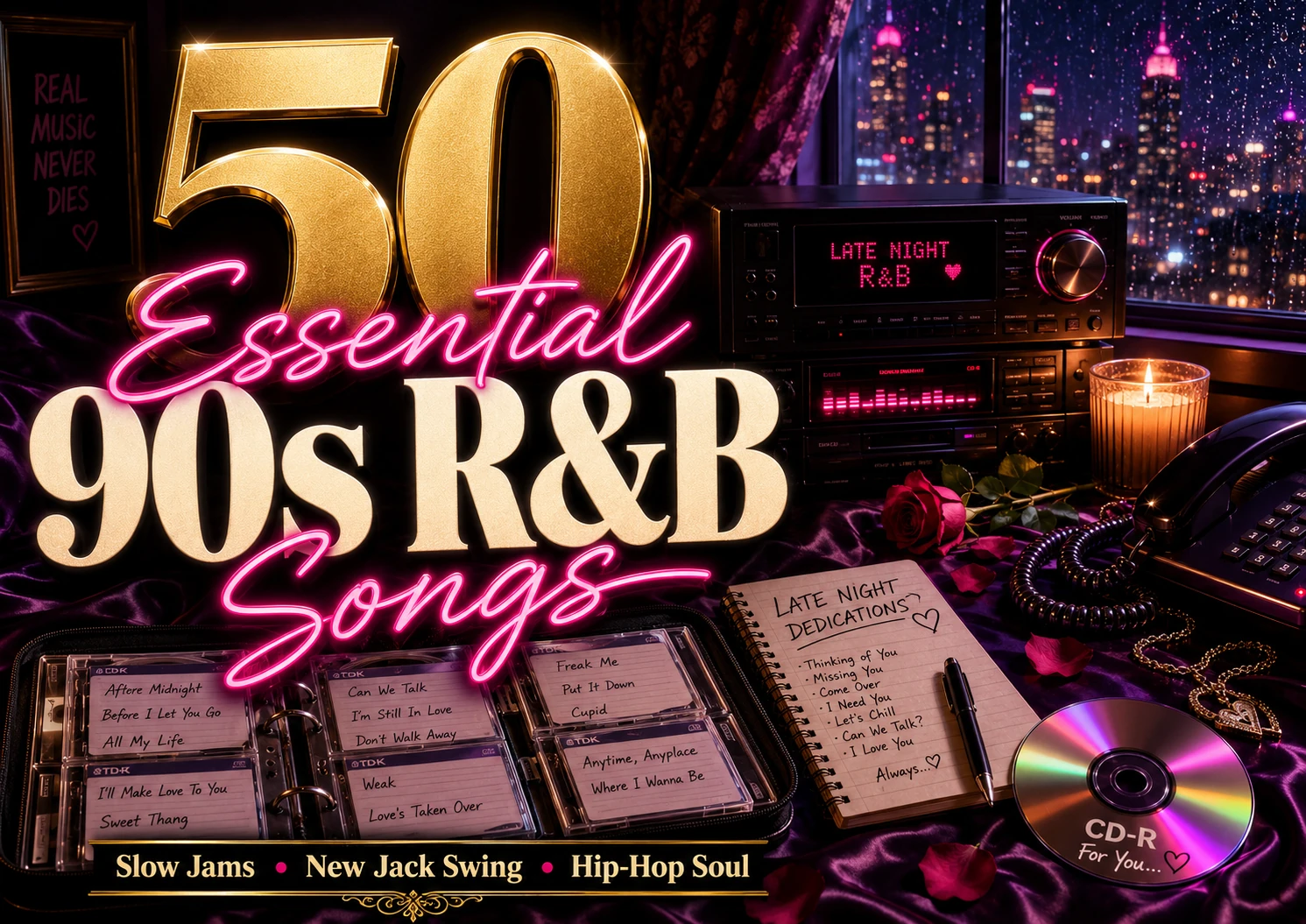




50 Essential 90s R&B Songs That Still Hit Like the Lights Are Low

50 Essential 90s R&B Songs That Still Hit Like the Lights Are Low
Slow Jam Damage
New Jack Swing
Hip-Hop Soul
CD Single Glow
Video Countdown Heat
90s Music • R&B Songs

50 Essential 90s R&B Songs: Slow Jams, New Jack Swing, Hip-Hop Soul & Love Songs

The 90s did not just give us R&B songs. It gave us a whole emotional operating system: slow jams on clock radios, New Jack Swing in oversized jackets, hip-hop soul with streetlights in it, girl groups with actual authority, male groups pleading like rent was due, soundtrack ballads bigger than the movies, and late-90s records that sounded like the future had just walked into the studio wearing sunglasses indoors.

Quick Answer

The essential 90s R&B songs are the records that explain the decade: Boyz II Men ballads, Mary J. Blige hip-hop soul, TLC cool, Whitney soundtrack power, Mariah crossover sparkle, Jodeci slow-jam drama, En Vogue authority, Aaliyah’s future-facing calm, SWV vulnerability, Toni Braxton heartbreak, Brandy and Monica teen-R&B polish, Janet’s grown groove, D’Angelo and Erykah neo-soul warmth, Blackstreet crossover, Usher’s late-90s takeoff, and a whole CD binder full of songs that made everybody act emotionally older than they were.

Before the Countdown

What Makes a 90s R&B Song Essential?

It has to explain the decade, not just sound good in a playlist

A great 90s R&B song could do a lot of work. It could run the radio, soundtrack a movie, start a slow dance, make a video countdown feel important, turn a remix into a whole new record, or live in your CD binder until the plastic sleeve ripped and you blamed somebody else. This list is not just about chart gravity or vocal gymnastics. It is about the records that still tell you what 90s R&B felt like when it was happening in real time.

That means the list has to cover the whole room: New Jack Swing, hip-hop soul, slow jams, R&B ballads, girl groups, male vocal groups, teen R&B, R&B/pop crossover, movie soundtrack songs, rap features, late-night Quiet Storm energy, dance-floor R&B, and the late-90s neo-soul lane that made the decade feel warmer, stranger, and more grown without turning into homework.

And because this is Smells Like Gen X, we are not pretending the songs lived in a museum. They lived in mall record stores, car stereos, clock radios, school gyms, VHS soundtracks, BET and MTV countdowns, mixtapes, CD towers, and bedrooms where someone absolutely practiced a phone call before making it. Very dignified. Very normal. Everyone was fine.

The 90s R&B canon is not one mood. It is a whole messy apartment building: slow jams upstairs, New Jack Swing in the hall, hip-hop soul by the front door, and a ballad crying in the parking lot.
The Big Lanes

The 90s R&B Sounds Running Through This List

The decade kept mutating. The early 90s still had New Jack Swing bounce in its sneakers. The mid-90s got moodier, smoother, and more emotionally reckless. The late 90s went futuristic, glossy, and neo-soul warm all at once, because apparently one personality was not enough.

New Jack Swing

Bell Biv DeVoe, Guy, Johnny Gill, Ralph Tresvant, Hi-Five, and the Teddy Riley blueprint kept R&B dancing as the 90s opened. Drum machines, swingbeat snap, leather jackets, choreography, and enough confidence to fog a mall mirror.

Slow Jams & Ballads

Boyz II Men, Jodeci, Whitney, Toni, Brian McKnight, Keith Sweat, Silk, H-Town, and every song that made radio dedications feel like public testimony. Some were beautiful. Some were awkward in the family car. Both things can be true.

Hip-Hop Soul

Mary J. Blige, Faith Evans, Total, 112, remixes, rap features, streetwear, harder drums, and a new emotional texture. This is where R&B stopped sounding untouched and started sounding lived-in.

Groups Everywhere

Boyz II Men, Jodeci, TLC, SWV, En Vogue, Xscape, Blackstreet, Dru Hill, Shai, Soul for Real. The 90s were the group era, and every harmony sounded like somebody had either fallen in love or made a terrible choice.

Soundtracks & Video Culture

The Bodyguard, Waiting to Exhale, countdown shows, big-budget videos, radio edits, remix singles, and songs that outlived the movies, the outfits, and possibly several relationships.

Late-90s Future & Neo-Soul

Aaliyah, Timbaland, Missy’s orbit, D’Angelo, Maxwell, Erykah, Lauryn, Destiny’s Child, Usher, and the sound of R&B splitting into tomorrow while still keeping one hand on the old soul records.

The Look

The 90s R&B Rooms This List Walks Through

This was not just music coming out of speakers. It had a whole set design: rain on windows, CD singles in plastic sleeves, velvet shadows, pagers, flyers, dance-floor shine, video countdown glow, and slow-jam evidence scattered everywhere like somebody was building an emotional crime scene.

New Jack Swing Era section image with boombox, cassette singles, pager, sneakers, dance playlist, and video countdown glow
New Jack Swing Era section image.

New Jack Swing Era

Boombox bounce, cassette singles, video countdown heat, and the early-90s confidence that made every dance floor look like a group audition.

Slow Jam Damage section image with late-night stereo, candlelight, corded phone, rain, rose petals, and dedication notebook
Slow Jam Damage section image.

Slow Jam Damage

Candlelight, clock radios, corded phones, handwritten dedications, and songs that made everyone suddenly way too grown for their own good.

Hip-Hop Soul Takeover section image with streetwear, CD-Rs, flyers, stereo equalizer, city lights, and 90s R&B crossover mood
Hip-Hop Soul Takeover section image.

Hip-Hop Soul Takeover

Harder drums, streetwear, bass-heavy stereo glow, and R&B getting a little rougher around the edges in the best possible way.

Girl Groups Ruled Everything section image with vanity lights, microphones, matching outfits, lip gloss, backstage pass, and 90s girl group energy
Girl Groups Ruled Everything section image.

Girl Groups Ruled Everything

Harmony, attitude, coordinated outfits, lip gloss, microphones, and the quiet confidence of knowing the whole decade was listening.

Soundtrack R&B section image with VHS tapes, movie tickets, soundtrack CD, popcorn, late-show notes, and TV glow
Soundtrack R&B section image.

Soundtrack R&B

VHS stacks, movie tickets, soundtrack CDs, TV glow, and songs that made the scene stick even when the movie got returned late.

Quiet Storm section image with night-drive dashboard, radio tuner, rain, city lights, coffee, cassette, notebook, and after-dark 90s R&B mood
Quiet Storm section image.

Quiet Storm

Rainy dashboards, glowing radio dials, late-night thoughts, and the grown-folks corner of 90s R&B that never had to raise its voice.

Fast Scan

The Quick List: 50 Essential 90s R&B Songs

Need the whole CD binder at a glance before the deep dive starts? Here it is. Scroll like you are flipping through cracked jewel cases in the passenger seat.

01Boyz II Men — “End of the Road” 02Mary J. Blige — “Real Love” 03TLC — “Creep” 04Mariah Carey — “Fantasy” 05Whitney Houston — “I Will Always Love You” 06Jodeci — “Forever My Lady” 07En Vogue — “My Lovin’ (You’re Never Gonna Get It)” 08Aaliyah — “One in a Million” 09SWV — “Weak” 10Toni Braxton — “Un-Break My Heart” 11Brandy — “I Wanna Be Down” 12Monica — “Don’t Take It Personal (Just One of Dem Days)” 13Janet Jackson — “That’s the Way Love Goes” 14D’Angelo — “Brown Sugar” 15Maxwell — “Ascension (Don’t Ever Wonder)” 16Erykah Badu — “On & On” 17Blackstreet feat. Dr. Dre — “No Diggity” 18Usher — “You Make Me Wanna…” 19Dru Hill — “Tell Me” 20Xscape — “Just Kickin’ It” 21Mariah Carey — “Always Be My Baby” 22Whitney Houston — “Exhale (Shoop Shoop)” 23Boyz II Men — “I’ll Make Love to You” 24Jodeci — “Come and Talk to Me” 25Keith Sweat — “Twisted” 26Ginuwine — “Pony” 27112 feat. The Notorious B.I.G. and Mase — “Only You (Remix)” 28Faith Evans — “Soon as I Get Home” 29Total feat. The Notorious B.I.G. — “Can’t You See” 30Brownstone — “If You Love Me” 31Brian McKnight — “Anytime” 32Tevin Campbell — “Can We Talk” 33Tony! Toni! Toné! — “Anniversary” 34Mint Condition — “Breakin’ My Heart (Pretty Brown Eyes)” 35Shai — “If I Ever Fall in Love” 36H-Town — “Knockin’ da Boots” 37Silk — “Freak Me” 38Bell Biv DeVoe — “Poison” 39Guy — “Let’s Chill” 40Johnny Gill — “Rub You the Right Way” 41Ralph Tresvant — “Sensitivity” 42Hi-Five — “I Like the Way (The Kissing Game)” 43Color Me Badd — “I Wanna Sex You Up” 44Soul for Real — “Candy Rain” 45Groove Theory — “Tell Me” 46Adina Howard — “Freak Like Me” 47Missy “Misdemeanor” Elliott — “The Rain (Supa Dupa Fly)” 48Lauryn Hill — “Ex-Factor” 49Next — “Too Close” 50Destiny’s Child — “Bills, Bills, Bills”
The Countdown

50 Essential 90s R&B Songs, Rewound Properly

This is not a sterile ranking that acts like feelings can be filed alphabetically. Every record below gets the year it hit, the backstory, the sound lane, and where it actually lived in 90s life: mall CD racks, clock radios, school dances, car stereos, BET countdowns, soundtrack shelves, awkward slow dances, and those late-night dedication shows that made everybody act like they were starring in a movie with terrible lighting.

#01
1992 Songs Slow Jam / Ballad The final-scene cryer

Boyz II Men — “End of the Road”

Ballad takeoverProm-night meltdownHarmony standard
Year / Moment

1992 Songs: Released in 1992 and tied hard to the Boomerang soundtrack era, this was the ballad that turned heartbreak into a national group project.

Backstory

Babyface, L.A. Reid, and Daryl Simmons helped build the clean, dramatic production, leaving Boyz II Men room to stack those harmonies until the walls started sweating feelings.

Where It Lived

School dances, radio dedications, bedroom stereos, and car-window staring. This was the song that made a three-week relationship feel like joint property had to be divided.

This is the 90s R&B ballad moment where subtlety packed a bag, left town, and did not forward its address. Boyz II Men turned heartbreak into a full group project: stacked harmonies, dramatic pauses, adult-level despair, and the kind of chorus that made teenagers act like their three-week relationship had involved legal paperwork.

What makes it essential is not just the emotion. It is the scale. 90s R&B could be intimate, but this record showed how huge a slow song could feel without becoming empty. It belongs to radio dedications, school dances, candle aisles at the mall, and anyone who ever stared out a car window like they were in a music video while their parent was just trying to find a parking space.

The deeper rewind

As an entry point into 90s R&B songs, it explains the decade’s ballad language: the lead vocal pleads, the harmonies answer, the production stays clean, and every note acts like feelings are a contact sport. From here, the path runs straight into the bigger 90s slow jams conversation and the full Boyz II Men ballad takeover.

#02
1992 Songs Hip-Hop Soul Timbs on heartbreak

Mary J. Blige — “Real Love”

Hip-hop soulStreet-level feelingMary enters
Year / Moment

1992 Songs: Released in 1992 from What’s the 411?, this is one of the records that made hip-hop soul feel like its own weather system.

Backstory

The beat had hip-hop texture, but Mary brought the ache, grit, and church-trained force. Smooth enough for R&B radio, rough enough to feel like real life.

Where It Lived

Timberlands, oversized jackets, hoop earrings, basement speakers, and the right to dance while still looking like you had been through something.

“Real Love” is where 90s R&B stops sounding like it was polished behind glass and starts sounding like it came out of a real room with real people in it. Mary J. Blige did not glide into the decade; she walked in with ache, confidence, rough edges, and a voice that made everybody else suddenly seem a little too tidy.

The genius is how the song moves. It has enough bounce for the party, enough soul for the headphones, and enough emotional truth to make it bigger than either lane. This is the sound of hip-hop soul before the term got flattened into a history-book label. It was streetwear, drums, confession, and a hook that felt like every young person trying not to look too vulnerable.

The deeper rewind

For Gen X, this is CD-single energy with real-life damage underneath. It connects directly to hip-hop soul in the 90s, the women who changed the sound, and the bigger Mary story that turned R&B from glossy romance into lived-in survival music.

#03
1994 Songs Girl Group / Hip-Hop Soul Silk pajamas with consequences

TLC — “Creep”

Coolest side-eyeGirl-group controlVideo-era R&B
Year / Moment

1995 Songs: Released in late 1994 and everywhere in 1995, this helped make CrazySexyCool feel less like an album and more like a full decade mood board.

Backstory

Dallas Austin’s groove gave TLC room to sound relaxed while the subject matter stayed messy. That was the trick: chaos with excellent lighting.

Where It Lived

Silk pajamas on MTV, living-room choreography, school gossip, and the kind of cool that made everybody think they could pull off sunglasses indoors.

“Creep” is what happens when a song sounds smooth enough for radio but morally messy enough to start a lunch-table argument. TLC made the whole thing feel effortless: slick groove, cool vocal delivery, video style burned into the decade, and a storyline that refused to turn women into cardboard angels or villains.

That is why it still matters. 90s R&B was not only about flowers, apologies, and people begging outside imaginary rain-soaked windows. It was also about complicated behavior, self-protection, bad decisions, and sounding incredible while admitting the situation is already sideways.

The deeper rewind

This is a core piece of the 90s R&B groups story because TLC understood image, attitude, melody, and culture as one package. It also points toward the deeper TLC 90s R&B cool page and the wider women of 90s R&B rewind.

#04
1995 Songs R&B Pop Crossover Daydream with a boom box

Mariah Carey — “Fantasy”

Pop/R&B crossoverRemix cultureRoller-rink sparkle
Year / Moment

1995 Songs: Released in 1995, this was Mariah’s bright mid-90s crossover moment: pop sugar, R&B bounce, and remix culture waiting in the hallway.

Backstory

The song’s glow came from the hook and groove, but its bigger story is how Mariah helped make pop, R&B, and hip-hop remixes share the same radio lane.

Where It Lived

Food courts, roller rinks, summer radio, and cassette rewinds. This sounded like the mall had been freshly airbrushed.

“Fantasy” is pure mid-90s sugar rush, but the important thing is how it helped make pop, R&B, and hip-hop feel like they were sharing the same mall escalator. Mariah was already massive, but this era made her crossover language sharper: bright hooks, R&B phrasing, hip-hop-friendly rhythm, and a remix universe that mattered almost as much as the single.

The record feels like summer, roller rinks, radio countdowns, and the kind of pop-R&B joy that made the decade less divided than people sometimes pretend. It did not need to pick one lane. That was the whole point. The 90s were learning that a song could be glossy, soulful, playful, and street-adjacent without apologizing to anybody’s format meeting.

The deeper rewind

For this list, “Fantasy” represents the R&B/pop crossover explosion and the growing importance of 90s R&B remixes and rap features. It also sets up the bigger Mariah conversation: ballads, remixes, radio dominance, and that late-90s bridge where R&B helped reshape pop.

#05
1992 Songs Power Ballad / Soundtrack The room goes silent

Whitney Houston — “I Will Always Love You”

Vocal earthquakeSoundtrack giantFinal scene energy
Year / Moment

1992 Songs: Released in 1992 for The Bodyguard, then still dominating into 1993, this was less a single than a weather event with a key change.

Backstory

Whitney took a song already known in another world and turned it into a skyscraper vocal performance. The arrangement starts bare, then the voice becomes the special effect.

Where It Lived

Movie theaters, family cars, award-show clips, grocery stores, and everyone learning the hard way that they should not attempt that note in public.

This is the record that made every average singer in America briefly overestimate themselves in the shower. Whitney Houston did not just sing a ballad; she made the entire decade understand the difference between having a nice voice and having a voice that could rearrange the furniture.

Yes, the song has roots outside R&B, and yes, it became bigger than any one format. That is exactly why it belongs here. 90s R&B was never trapped in a tiny box. It lived on soundtracks, crossed into pop, owned adult radio, and still came back to soul, phrasing, drama, and vocal authority.

The deeper rewind

Lifestyle-wise, this is VHS-era romance, big-screen heartbreak, soundtrack CDs, and people getting very quiet when the song started because everybody knew the big moment was coming. It is a direct doorway into 90s R&B movie soundtracks and Whitney’s 90s power ballad era.

#06
1991 Songs Slow Jam / Group R&B Dark room devotion

Jodeci — “Forever My Lady”

Raw romanceGroup pleadingChurch meets street
Year / Moment

1991 Songs: Released in 1991, this introduced Jodeci as the group that brought church-trained vocals into a rougher, darker 90s R&B lane.

Backstory

DeVante Swing and the group helped shift male R&B from polished matching-suit romance toward leather, tension, and late-night edge.

Where It Lived

Bedroom stereos, low lamps, oversized shirts, and parents realizing these groups were absolutely not singing about holding hands at the library.

Jodeci made 90s R&B feel less like perfect candlelight and more like somebody had knocked over the candle, kept singing, and somehow made it hotter. “Forever My Lady” is tender, but it does not feel delicate. It has church in the vocals, street in the styling, and enough slow-jam commitment to make the whole room lean in.

This was not the old tuxedo version of male harmony. Jodeci sounded rawer, darker, more physical, and more dangerous to everyone’s decision-making. That shift mattered. After them, a lot of male R&B groups had to choose whether they were going to sound clean, rough, or some unstable combination of both.

The deeper rewind

For Gen X, this is slow-dance gym floor anxiety with grown-up production values. It connects to Jodeci and the raw side of 90s R&B, the broader 90s R&B groups lane, and the late-night playlist that nobody’s parents wanted explained.

#07
1992 Songs Girl Group / Funk R&B Polished but not playing

En Vogue — “My Lovin’ (You’re Never Gonna Get It)”

Vocal authorityGirl-group standardFunky Divas
Year / Moment

1992 Songs: Released in 1992 from the Funky Divas era, this was En Vogue turning a refusal into a vocal masterclass.

Backstory

The track snapped with funk attitude while the harmonies stayed surgical. It felt classic and current, polished and sharp, all at once.

Where It Lived

Hairbrush microphones, living-room choreography, carpool volume boosts, and a three-minute reminder that standards are not a personality flaw.

“My Lovin’” is not a plea. It is a verdict. En Vogue brought the kind of vocal power that made attitude sound expensive: harmonies locked in, production snapping, lead lines slicing through the room, and a message that did not need a dramatic explanation because the answer was already no.

This is why the girl-group side of 90s R&B cannot be treated like a sidebar. En Vogue had elegance, bite, fashion, funk, and enough vocal precision to make a lot of groups sound like they were still in rehearsal. The song is danceable, quotable by title alone, and still sharp enough to cut through nostalgia haze.

The deeper rewind

It points straight into En Vogue’s 90s girl group standard and the full women of 90s R&B page. Also, it is a reminder that harmony can smile at you while taking your keys.

#08
1996 Songs Future R&B Blue neon whisper

Aaliyah — “One in a Million”

Future R&BTimbaland spaceLate-90s cool
Year / Moment

1996 Songs: Released in 1996, this sounded like R&B had discovered a secret futuristic room in the studio and locked the adults out.

Backstory

Timbaland’s off-center production and Aaliyah’s calm, precise vocal created a new kind of cool: sparse, romantic, and slightly from tomorrow.

Where It Lived

Late-night video blocks, headphones, blacklight bedrooms, and city rides where the beat felt like it was sneaking around the room.

“One in a Million” sounds like the late 90s found a secret door to the 2000s and decided not to tell everyone yet. The beat does not behave like standard R&B. It slides, clicks, pauses, and leaves space where older records would have filled every corner with polish.

Aaliyah’s vocal is the key. She does not try to bulldoze the track. She floats through it, cool and controlled, making the empty space feel intentional instead of unfinished. That restraint was a whole new kind of power. The decade had plenty of vocal fireworks; this was the sound of the fuse burning quietly.

The deeper rewind

For anyone tracing essential 90s R&B songs, this is where the future starts whispering. It belongs with Aaliyah and the future of 90s R&B, the video countdown era, and the remix-friendly world where R&B became sleeker, stranger, and cooler than it had any right to be.

#09
1993 Songs Slow Jam / Girl Group Crush collapse

SWV — “Weak”

Girl-group slow jamRadio takeoverVulnerable hook
Year / Moment

1993 Songs: Released in 1993, this became one of the decade’s definitive girl-group ballads, turning a crush into a full medical emergency.

Backstory

The production stayed clean so SWV’s blend could carry the song. No gimmicks needed. Just melody, warmth, and a chorus built to ruin composure.

Where It Lived

Notebook margins, phone-call courage, slow-dance panic, and the moment someone at the skating rink suddenly forgot how arms worked.

“Weak” is one of those 90s R&B songs that sounds simple until you realize how perfectly it captures the specific humiliation of having feelings. SWV did not overcomplicate it. They let the melody do the damage, then let the harmonies make the damage prettier.

This song is crush logic in its purest form: you are trying to be cool, you are absolutely not cool, and now a three-part harmony has exposed you. It fit radio, mixtapes, school dances, bedroom stereos, and the kind of phone calls where nobody said what they meant until it was too late.

The deeper rewind

It earns its spot because it shows how 90s R&B girl groups could be soft without being weak in the actual sense. The song sets up the deeper SWV 90s R&B story and the bigger conversation around slow jams that still hit.

#10
1996 Songs Ballad Expensive heartbreak

Toni Braxton — “Un-Break My Heart”

Dark velvetBreakup balladVocal drama
Year / Moment

1996 Songs: Released in 1996, this was Toni Braxton’s grand heartbreak moment, the kind of ballad that made regular sadness look underdressed.

Backstory

Diane Warren’s drama and David Foster’s polish met Toni’s deep contralto, giving the song weight instead of just volume.

Where It Lived

Candle aisles, rainy windows, dramatic videos, and staring at a landline like it owed you an apology.

Toni Braxton made heartbreak sound like velvet curtains, low lighting, and a room nobody should enter without permission. “Un-Break My Heart” is massive, but it is not bright. It is dark, elegant, wounded, and dramatic enough to make every breakup seem like it required orchestration.

The power is in the tone. Toni’s voice sits lower and richer than the typical 90s ballad showcase, which gives the song weight. It does not beg in glitter. It aches in burgundy. That difference matters in a decade loaded with big singers and bigger choruses.

The deeper rewind

For the 90s R&B canon, this is the heartbreak monument: a ballad with pop reach, R&B texture, and full emotional collapse. It belongs next to 90s R&B ballads, Toni’s dark velvet era, and all the late-night listeners who acted fine and were definitely not fine.

#11
1994 Songs Teen R&B Quiet confidence

Brandy — “I Wanna Be Down”

Teen R&BCool restraintRadio smooth
Year / Moment

1994 Songs: Released in 1994, this introduced Brandy as a teen R&B voice with grown-level cool and zero need to shout for attention.

Backstory

The laid-back groove and stacked background vocals let Brandy sound casual, melodic, and mature without pretending she was older than the song needed.

Where It Lived

School hallway confidence, denim everything, Saturday radio, and practicing a smooth look in the mirror until reality intervened.

“I Wanna Be Down” did not need to shout to announce Brandy. That was the trick. The song was smooth, relaxed, and controlled, with a vocal that sounded youthful without sounding thin. It carried teen R&B into the decade’s center without making it feel disposable.

This is the kind of song that lived in the space between school, radio, TV, and real music taste. Brandy’s whole early presence felt like a 90s media crossover: the voice, the image, the sitcom glow, the videos, the radio format, and the sense that younger R&B did not have to be childish.

The deeper rewind

It pairs naturally with the later Brandy and Monica moment, but on its own it is a perfect piece of mid-90s R&B polish. Start here before heading into Brandy and Monica’s teen queen era and the broader women of 90s R&B page.

#12
1995 Songs Teen R&B / Hip-Hop Soul Do not test me today

Monica — “Don’t Take It Personal (Just One of Dem Days)”

Teen R&BMood swing anthemAtlanta heat
Year / Moment

1995 Songs: Released in 1995, this was Monica stepping into the decade with a record that sounded young, direct, and already tired of explaining itself.

Backstory

Dallas Austin’s groove gave the song enough bounce for radio while Monica’s vocal gave it more force than her age made reasonable.

Where It Lived

Pager-era boundaries, school hallway drama, crossed arms, long phone cords, and being bothered while pretending you were absolutely not bothered.

Monica arrived sounding like she had already had enough, which is impressive because she was still basically a kid. “Don’t Take It Personal” works because it turns a mood into a groove: not a crisis, not a breakup, just one of those days where everyone should maybe back up and let the bassline handle it.

The song matters because it gave teen R&B edge without forcing it into cartoon attitude. Monica had weight in her voice, a directness in her delivery, and a cool that did not feel borrowed. The production sits right in that mid-90s pocket where R&B, hip-hop rhythm, and radio polish were all sharing a couch.

The deeper rewind

It is also a good reminder that 90s R&B was geographically wider than people sometimes say. Atlanta was not only a hip-hop story. The city had R&B heat too, which makes this a natural lead-in to Xscape and Atlanta R&B and the Brandy/Monica era.

#13
1993 Songs R&B Pop Couch-lit cool

Janet Jackson — “That’s the Way Love Goes”

R&B pop controlWarm grooveGrown-up Janet
Year / Moment

1993 Songs: Released in 1993, this was Janet turning the volume down and somehow making the whole room lean closer.

Backstory

Jimmy Jam and Terry Lewis built a warm, looping groove that favored mood over fireworks. Janet’s restraint made the record feel grown without getting dusty.

Where It Lived

Late-night radio, living-room stereos, slow head nods, and videos where everyone looked cooler than anyone at your actual school dance.

“That’s the Way Love Goes” is Janet turning the temperature down and somehow making the room hotter. After the huge, disciplined machinery of late-80s Janet, this felt looser, warmer, more intimate, and fully in control without needing to announce it every four seconds.

The groove is the whole argument. It does not rush. It does not beg. It just sits there, smooth and confident, like it knows everybody else will eventually catch up. That kind of restraint became one of the decade’s most important R&B/pop languages.

The deeper rewind

For 90s R&B, Janet is the bridge: dance, control, video language, sensuality, and production that helped blur pop and R&B into one very expensive-looking mood. This track belongs with Janet Jackson’s 90s R&B pop control and the late-night side of the decade.

#14
1995 Songs Neo-Soul Vinyl in low light

D’Angelo — “Brown Sugar”

Neo-soul seedWarm grooveGrown-up R&B
Year / Moment

1995 Songs: Released in 1995, this helped make neo-soul feel like a real lane instead of a side conversation for people with better record collections.

Backstory

D’Angelo mixed soul, funk, gospel shading, and hip-hop looseness into something that sounded old-school and brand new at the same time.

Where It Lived

Incense, coffeehouse flyers, basement speakers, thrift-store jackets, and someone announcing they were really into album cuts now.

“Brown Sugar” did not sound like it was chasing the radio; it sounded like the radio had wandered into a warm room and decided to stay. D’Angelo brought a different texture to mid-90s R&B: older soul language, loose groove, live-musician feel, and a calm confidence that stood apart from the decade’s bigger ballads and shinier videos.

This is where the neo-soul conversation starts warming up. The song feels vintage without being a costume. It has smoke, bass, keys, and enough modern R&B shape to keep it from becoming a museum piece. It was grown without acting ancient, which is a very delicate 90s achievement.

The deeper rewind

It connects to the late-90s wave that would include Maxwell, Erykah Badu, Lauryn Hill, and a whole lane of music that made soul feel tactile again. File this under neo-soul in the late 90s and D’Angelo, Maxwell, and the rise of neo-soul.

#15
1996 Songs Neo-Soul Incense and bassline

Maxwell — “Ascension (Don’t Ever Wonder)”

Neo-soul glowGrown grooveLate-night warmth
Year / Moment

1996 Songs: Released in 1996, this brought Maxwell’s sleek neo-soul style into the room like it had reservations and better lighting.

Backstory

The production favored atmosphere and groove while Maxwell’s falsetto floated over it without turning the whole thing into background wallpaper.

Where It Lived

Apartment speakers, late-night drives, candlelight, and the brief 90s belief that owning one black turtleneck made you emotionally advanced.

“Ascension” sounds like a room with better lighting than yours. Maxwell brought smoothness back without making it feel plastic: falsetto glide, warm production, live-band feel, and a groove that did not need to elbow anyone for attention.

By the late 90s, some R&B was getting glossier and more futuristic, while neo-soul was moving in another direction: warmer, looser, more musicianly, and more connected to the soul records older cousins and parents kept acting superior about. Maxwell made that lane feel contemporary instead of dusty.

The deeper rewind

This is essential because 90s R&B was not only slow jams and radio smashes. It was also the return of texture. “Ascension” belongs in the neo-soul conversation and the best 90s R&B albums path where whole records mattered as much as singles.

#16
1997 Songs Neo-Soul Too cool for the room

Erykah Badu — “On & On”

Neo-soul coolDifferent energyLate-90s shift
Year / Moment

1997 Songs: Released in 1997, this made neo-soul feel like a fully furnished apartment with incense, jazz records, and opinions.

Backstory

Erykah Badu blended jazz, soul, hip-hop rhythm, and unmistakable phrasing into something relaxed, strange, funny, and completely its own thing.

Where It Lived

Dorm rooms, headwraps, late-night conversations, thrift-store cool, and that one friend who started saying “energy” before anyone knew how to stop them.

“On & On” walked into late-90s R&B like it had read the room, disagreed with the room, and decided to redecorate it. Erykah Badu sounded relaxed, strange, funny, spiritual, grounded, and completely unbothered by whatever everyone else was doing.

That mattered because by 1997, R&B had a lot of lanes already operating at full speed: futuristic production, slow-jam drama, teen stars, soundtrack ballads, and glossy club records. Badu’s arrival made another lane feel alive: earthy, jazzy, thoughtful, but still catchy enough to live outside the coffeehouse stereotype.

The deeper rewind

For Gen X listeners, this is the late-90s moment when grown-up R&B got weird in the best way. It connects to Erykah Badu and late-90s neo-soul cool, Lauryn-adjacent hip-hop soul, and the broader neo-soul in the 90s lane.

#17
1996 Songs R&B Crossover Late-night swagger

Blackstreet feat. Dr. Dre — “No Diggity”

Crossover grooveTeddy Riley polishRap/R&B bridge
Year / Moment

1996 Songs: Released in 1996, this was the cleanest example of R&B and hip-hop sharing the same couch without either side looking awkward.

Backstory

Teddy Riley updated his New Jack Swing legacy with a darker groove, while Dr. Dre’s feature gave the record hip-hop gravity and extra cool.

Where It Lived

Car stereos, house parties, leather jackets, dance-floor head nods, and people who were not cool briefly believing the song had fixed that.

“No Diggity” is one of those records that makes the whole room nod before anybody has decided whether they are dancing. The piano loop, the groove, the vocal cool, the rap/R&B chemistry — everything lands like the song knows it is better dressed than the rest of the playlist.

It is also a perfect example of New Jack Swing’s late-90s glow-up. Teddy Riley’s blueprint had evolved from early-decade swingbeat flash into a slicker, darker, more crossover-friendly sound. The record feels grown, street-aware, polished, and impossible to overplay even though radio bravely tried.

The deeper rewind

This is essential because it links New Jack Swing, rap features, and late-90s R&B crossover into one clean groove. It also sets up Blackstreet’s 90s R&B crossover story.

#18
1997 Songs Late-90s R&B Messy but polished

Usher — “You Make Me Wanna…”

Late-90s takeoffTeen-to-grown bridgeSmooth confession
Year / Moment

1997 Songs: Released in 1997, this turned Usher from promising young singer into a late-90s R&B force with choreography, guilt, and excellent timing.

Backstory

Jermaine Dupri’s crisp production gave the song a sharp bounce while Usher made a messy situation sound dangerously smooth.

Where It Lived

Call-waiting drama, shiny videos, school lockers, and the point where R&B started looking very ready for the TRL era.

“You Make Me Wanna…” is the sound of Usher stepping into the late-90s R&B spotlight with enough polish to make the next decade nervous. The song is smooth, but the scenario is messy, which is basically the 90s R&B business model in one sentence.

What makes it work is the balance: youthful enough for teen radio, grown enough to sit next to adult R&B, danceable without being a club record, and dramatic without collapsing into full ballad theater. It is the kind of song that made late-90s R&B feel sleek but still personal.

The deeper rewind

This belongs on the list because it marks the new male R&B lane taking shape: video-ready, choreographed, emotionally slippery, and built for radio dominance. From here, head toward Usher’s late-90s R&B takeoff and the danceable R&B side of the decade.

#19
1996 Songs Group R&B Chrome hallway pleading

Dru Hill — “Tell Me”

Late-90s group heatVocal fireworksBaltimore drama
Year / Moment

1996 Songs: Released in 1996, this introduced Dru Hill with darker group energy, big lead vocals, and late-90s drama waiting right at the door.

Backstory

The track mixed hip-hop rhythm, group harmony, and Sisqó’s unmistakable vocal presence, giving Dru Hill a rougher edge than many softer male groups.

Where It Lived

Smoky videos, oversized jackets, basement parties, and one group member singing like the rent was due in six minutes.

“Tell Me” is late-90s male group R&B with drama already loaded in the chamber. Dru Hill had vocal muscle, shiny video energy, and Sisqó’s lead presence cutting through everything like someone had handed the song a spotlight and told it to make bad decisions.

The group mattered because they arrived after the first wave had already changed the rules. Boyz II Men had the polished harmony lane. Jodeci had the raw slow-jam lane. Blackstreet had crossover sleekness. Dru Hill came in with a more theatrical late-90s charge: bigger ad-libs, more tension, more video-era intensity.

The deeper rewind

This song belongs in the essential 90s R&B conversation because it captures the second-wave male group sound right before the decade tipped into a new era. It feeds directly into Dru Hill and late-90s R&B drama and the larger 90s R&B groups page.

#20
1993 Songs Girl Group / Southern R&B Front porch smooth

Xscape — “Just Kickin’ It”

Atlanta R&BGirl-group warmthLaid-back groove
Year / Moment

1993 Songs: Released in 1993, this gave Xscape a smooth breakout and helped put Atlanta R&B firmly into the decade’s conversation.

Backstory

Jermaine Dupri’s production kept the groove easy and radio-ready, while the group’s vocals kept it warm, local, and believable.

Where It Lived

Summer nights, porch conversations, school crushes, local radio, and open windows with nowhere important to be.

“Just Kickin’ It” is the kind of relaxed R&B record that does not feel like it is trying to win a war, which is why it wins anyway. Xscape brought Atlanta warmth, real harmonies, and a low-key confidence that made the song feel like hanging out before feelings got expensive.

The track matters because it shows that 90s R&B groups were not all working the same formula. Xscape had a different texture: Southern, conversational, church-rooted, street-adjacent, and comfortable enough to make the groove feel lived in.

The deeper rewind

This is where the Atlanta R&B story starts becoming impossible to ignore. It connects to Xscape and the Atlanta R&B sound, the bigger women of 90s R&B lane, and the Southern music world blooming around it.

#21
1996 Songs R&B Pop Car-window sunshine

Mariah Carey — “Always Be My Baby”

Radio foreverWarm pop-R&BSingalong comfort
Year / Moment

1996 Songs: Released in 1996, this became one of Mariah’s most durable 90s R&B-pop records, built for radio, memory, and irresponsible sing-alongs.

Backstory

Jermaine Dupri and Manuel Seal helped give the track its warm bounce, while Mariah kept the vocal sweet without turning the song into a gymnastics meet.

Where It Lived

Cookouts, open windows, cassette singles, grocery-store nostalgia, and everyone confidently singing the parts they cannot hit.

“Always Be My Baby” is one of those songs that sounds like it has been on the radio since electricity was invented. It is warm, effortless, and built around a hook that slips into memory like it paid rent there.

What makes it 90s R&B-essential is the blend: pop brightness, R&B phrasing, easy groove, and Mariah’s vocal control making the whole thing feel lighter than it actually is. It is not the biggest vocal mountain on this list, but it may be one of the most durable mood machines.

The deeper rewind

It belongs next to the Mariah crossover and remix story because the 90s needed artists who could move between formats without sounding like tourists. This is daytime radio, summer nostalgia, and CD-single comfort food, all in one.

#22
1995 Songs Soundtrack / Adult R&B The sigh heard everywhere

Whitney Houston — “Exhale (Shoop Shoop)”

Soundtrack R&BQuiet powerWaiting to Exhale era
Year / Moment

1995 Songs: Released in 1995 for Waiting to Exhale, this was Whitney proving she could own the room quietly after already proving she could blow the roof into another zip code.

Backstory

Babyface wrote and produced a calm, elegant song built around release instead of fireworks. Whitney’s restraint is the whole flex.

Where It Lived

Late-night radio, soundtrack CDs, grown-up conversations from the next room, and saying “I’m fine” with several chapters missing.

“Exhale” is Whitney proving she did not always need to level the building to own the room. The song is restrained, warm, mature, and built around the kind of hook that feels less like a chorus and more like a collective sigh from everybody who had been through it.

The 90s soundtrack era was enormous for R&B, and this song is one of its cleanest examples. Movies did not just borrow songs; the songs became memory anchors for the films, the trailers, the radio run, and the CD people kept in the car long after the movie left theaters.

The deeper rewind

This track opens the door to 90s R&B movie soundtracks, Babyface’s writing machine, and Whitney’s second major 90s identity: not just The Voice, but a soundtrack-era force who could sing big or barely lift her voice and still win.

#23
1994 Songs Slow Jam / Ballad Awkward slow dance alert

Boyz II Men — “I’ll Make Love to You”

Slow jam giantGroup balladMiddle-school panic
Year / Moment

1994 Songs: Released in 1994, this became one of the decade’s unavoidable slow jams, a song so candlelit it practically needed a fire marshal.

Backstory

Babyface gave Boyz II Men the perfect romantic setup: lush, polished, direct, and clean enough for radio while still making parents tense up.

Where It Lived

Valentine’s Day blocks, prom-night swaying, awkward hand placement, and radio dedications that sounded like they came with silk sheets.

This song was everywhere, which means an entire generation had to pretend it was totally normal for it to play at school dances where nobody knew what to do with their hands. Boyz II Men took the slow jam into maximum dramatic territory, and America responded by acting like scented candles were now federal infrastructure.

What makes it essential is the group’s control. The song could have become pure cheese in lesser hands. Instead, the harmonies, pacing, and vocal handoffs made it a blueprint for 90s romantic R&B: direct, polished, enormous, and only slightly dangerous in a gymnasium setting.

The deeper rewind

It belongs in the 90s slow jams canon and the Boyz II Men deep dive. It also proves that no decade committed to slow songs harder than the 90s, for better, worse, and several deeply uncomfortable dance-floor memories.

#24
1992 Songs Slow Jam Landline courage

Jodeci — “Come and Talk to Me”

Slow jam heatJodeci rawnessPhone-call energy
Year / Moment

1993 Songs: Tied to Jodeci’s early-90s rise and especially remembered through its 1992–1993 remix life, this became one of their signature slow-burn invitations.

Backstory

The song’s sweetness met the group’s rougher image, turning a simple approach line into a full R&B tension exercise.

Where It Lived

Standing near the wall at a dance, pretending to be casual, and hoping the DJ gave you a chance to become someone with courage.

“Come and Talk to Me” is practically a landline with harmonies. It captures that very specific early-90s energy where approaching someone felt like a military operation, especially if you had to do it without texting, social media, or the emotional cowardice tools future generations would enjoy.

Jodeci made the song feel direct but not clean-cut. There is desire in it, but also nerves, swagger, and a little chaos. The production leaves room for the vocals to do the work, and the vocals do not waste the opportunity.

The deeper rewind

This is one of the essential male-group slow jams because it shows Jodeci’s gift for turning a simple premise into a full mood. It fits the raw side of 90s R&B, the late-night R&B lane, and every mixtape that made somebody braver than they actually were.

#25
1996 Songs Slow Jam / Quiet Storm Pleading as a lifestyle

Keith Sweat — “Twisted”

Begging excellenceQuiet storm dramaLate-night sweat
Year / Moment

1996 Songs: Released in 1996, this gave Keith Sweat a major mid-90s slow-jam moment and proved his pleading style still had plenty of gas.

Backstory

The groove was smoother and darker than early New Jack Swing, but Keith’s anxious romantic signature remained fully operational.

Where It Lived

Late-night radio, slow drives, cologne-ad energy, and saying “nah, I’m good” in a tone that fooled absolutely nobody.

Keith Sweat made begging into a brand before branding departments ruined the word. “Twisted” is one of his signature 90s moments: smooth, anxious, dramatic, and somehow both relaxed and completely unable to relax.

The song’s genius is that it does not pretend desire is dignified. 90s slow jams often worked because they admitted what people were trying not to say out loud. Keith delivered that feeling with a voice that sounded like it had been pacing by the phone for hours.

The deeper rewind

This is essential because Quiet Storm, late-night R&B, and New Jack-derived slow jams all meet here. It leads naturally into Keith Sweat and 90s slow jam drama, and yes, the tone should be funny without making the music a punchline.

#26
1996 Songs Future R&B / Club Weird beat, no shame

Ginuwine — “Pony”

Timbaland bounceLate-90s strangeClub slow-burn
Year / Moment

1996 Songs: Released in 1996, this sounded like somebody plugged R&B into a strange machine and decided the machine was now the producer.

Backstory

Timbaland’s rubbery, futuristic beat gave Ginuwine the perfect weird playground. The production was sparse, bold, and instantly recognizable.

Where It Lived

Dance-floor confusion turning into commitment, car speakers vibrating, and an adult asking “what is this?” with authentic concern.

“Pony” is proof that the late 90s were not just getting smoother; they were getting weirder. The beat sounds like R&B discovered a science lab, pressed the wrong button, and somehow invented a classic.

Ginuwine’s vocal rides the track without trying to tame it, which is the whole point. The song is seductive, strange, minimal, and instantly recognizable. In a decade full of lush harmonies and big ballads, this thing showed up sounding like the future had been left unattended.

The deeper rewind

It belongs on the essential list because it marks the Timbaland-era shift toward negative space, odd percussion, and sleek late-90s R&B that would help shape what came next. Pair it with Aaliyah, Missy-adjacent production, and 90s R&B dance and club songs.

#27
1996 Songs Hip-Hop Soul / Remix Shiny suit hallway

112 feat. The Notorious B.I.G. and Mase — “Only You (Remix)”

Bad Boy R&BRap feature eraCrossover smoke
Year / Moment

1996 Songs: Released in 1996, the remix made 112 a key part of the Bad Boy R&B machine, where hooks, rap features, and glossy videos all shared the same jacket.

Backstory

112 brought the harmonies while Biggie and Mase placed the record inside the hip-hop/R&B crossover lane that ruled the middle of the decade.

Where It Lived

Shiny shirts, club-ready R&B, summer-night cars, and the era when every remix needed a rap feature or it felt underdressed.

“Only You” in remix form is the Bad Boy R&B machine doing exactly what it did best: smooth vocals, rap presence, club-ready polish, and enough crossover confidence to make the radio feel like one giant velvet rope.

This is the lane where 90s R&B and hip-hop stopped acting like separate parties and started sharing the same video budget. The vocals stay sweet, the rap features sharpen the edge, and the whole thing feels built for radio, clubs, and anyone trying to look cooler than they were.

The deeper rewind

It is essential less as a pure vocal showcase and more as a document of how the decade worked. It belongs with R&B remixes and rap features, hip-hop soul, and the broader 90s hip-hop and rap crossover.

#28
1995 Songs Hip-Hop Soul / Ballad Apartment-light ache

Faith Evans — “Soon as I Get Home”

Bad Boy soulWarm heartbreakUnderrated power
Year / Moment

1995 Songs: Released in 1995, this gave Faith Evans a warm, soulful signature inside the Bad Boy universe.

Backstory

The arrangement kept things restrained, letting Faith’s gospel-rooted softness and adult emotional weight do the work.

Where It Lived

Apartment-key sadness, late-night phone calls, cable video blocks, and waiting for someone to call because nobody had a glowing phone glued to their hand yet.

Faith Evans brought warmth to hip-hop soul. “Soon as I Get Home” has the ache of a classic R&B ballad, but it sits inside a 90s world where the drums, phrasing, and Bad Boy atmosphere make everything feel more grounded.

The song is not flashy in the way some 90s vocal showcases are flashy. Its power is steadier. Faith sings like someone who understands the problem, not someone auditioning to out-sing the furniture. That gives the record a durability that nostalgia keeps rewarding.

The deeper rewind

It belongs here because 90s R&B was full of voices that made the middle ground matter: not always the loudest, not always the glossiest, but emotionally exact. This track leads into hip-hop soul, Bad Boy R&B, and the deeper women-led side of the decade.

#29
1995 Songs Hip-Hop Soul / Remix Culture Leather jacket smooth

Total feat. The Notorious B.I.G. — “Can’t You See”

Bad Boy R&BHip-hop soulStreetlight groove
Year / Moment

1995 Songs: Released in 1995 from the New Jersey Drive soundtrack, this introduced Total with moody Bad Boy atmosphere and a Biggie feature.

Backstory

The track sat where soundtrack culture, hip-hop soul, and label-brand energy overlapped. Total sounded cool, smoky, and wrapped around the beat.

Where It Lived

Late-night BET, soundtrack CDs, oversized shades, Timberlands, and speakers just a little too big for the room.

“Can’t You See” is one of those mid-90s R&B records that makes the whole Bad Boy universe click: smooth girl-group vocals, a rap feature that feels integrated instead of stapled on, and a groove built for nighttime radio and car speakers.

Total did not sound like traditional polished R&B. They sounded cooler, more street-level, more tied to the hip-hop rooms happening around them. That mattered because 90s R&B was changing not just musically but visually: clothes, videos, attitude, remix packages, everything.

The deeper rewind

This is an essential hip-hop soul connector. It belongs with rap-feature R&B, hip-hop soul, and the broader story of girl groups who were not trying to sound like anyone’s polite throwback.

#30
1994 Songs Girl Group / Soul R&B Say it with your chest

Brownstone — “If You Love Me”

Vocal trio heatUnderrated classicMid-90s soul
Year / Moment

1995 Songs: Released in late 1994 and popular in 1995, this gave Brownstone one of the decade’s strongest vocal-group statements.

Backstory

The song paired a firm mid-tempo groove with powerhouse harmonies and a direct message: talk is cute, proof is better.

Where It Lived

Car-radio volume, breakup confidence, living-room singing, and the friend-group consensus that receipts matter.

“If You Love Me” is one of those songs that gets stronger the louder you play it, which is dangerous because the vocals already came in with shoes on the couch. Brownstone delivered a mid-90s R&B classic with real force, tight harmony, and a hook that made uncertainty sound like a challenge.

The song matters because it shows how deep the decade’s girl-group field really was. TLC, En Vogue, SWV, and Xscape get a lot of the oxygen, but Brownstone belongs in the conversation because the record hits with grown-up soul and radio immediacy at the same time.

The deeper rewind

This track is essential for anyone building a real 90s R&B playlist that does not stop at the obvious names. It feeds naturally into women of 90s R&B, forgotten 90s R&B songs, and the group-vocal lane.

#31
1997 Songs Ballad / Quiet Storm Very serious piano face

Brian McKnight — “Anytime”

Piano heartbreakAdult R&BQuiet storm crossover
Year / Moment

1998 Songs: Released in 1997 and especially prominent in 1998, this became Brian McKnight’s great quiet-heartbreak record of the late 90s.

Backstory

The piano-led arrangement leaned on vocal control and melody instead of production tricks. McKnight made restraint do the damage.

Where It Lived

Late-night radio, lonely drives, breakup reflection, and the DJ deciding everyone needed to stare into space for four minutes.

“Anytime” is a late-90s ballad built for people who wanted heartbreak with clean piano, strong vocals, and zero interest in pretending this was casual. Brian McKnight knew exactly how to make adult R&B feel dramatic without tipping fully into soap opera.

The song belongs in the essential list because it shows the decade’s more polished ballad lane after the early-90s explosion. It is not as loud as the biggest Whitney or Boyz II Men moments, but it has that quiet, controlled sadness that late-night radio loved like a favorite child.

The deeper rewind

This track connects to 90s R&B ballads, Quiet Storm and late-night R&B, and the grown-up corner of the decade where everyone wore better clothes and somehow had worse relationship problems.

#32
1993 Songs Teen R&B / Ballad Locker-door courage

Tevin Campbell — “Can We Talk”

Teen classicCrush anthemBabyface magic
Year / Moment

1993 Songs: Released in 1993, this became one of the great teen-crush R&B records, polished enough for adults and nervous enough for everybody else.

Backstory

Babyface and Daryl Simmons gave Tevin Campbell a sleek, melodic platform that made a teenage confession sound timeless.

Where It Lived

Passing notes, hallway bravery, practicing phone calls, and risking a parent answering the house phone like a social grenade.

“Can We Talk” is basically the national anthem for people who had feelings but no plan. Tevin Campbell brought a young voice with serious control, and the song captured that exact moment where a crush felt like a high-stakes negotiation and you had maybe three seconds to not ruin your life.

The Babyface polish is part of the magic. The song is clean, melodic, and emotionally direct without becoming corny. It has the sweetness of teen R&B but enough musical strength to stay grown in memory.

The deeper rewind

For Gen X and elder millennial listeners, this is hallway, house phone, after-school radio, and courage arriving six hours too late. It belongs with Babyface’s songwriting machine, teen R&B, and the slow-jam side of the early 90s.

#33
1993 Songs Soul R&B / Group Grown folks smiling

Tony! Toni! Toné! — “Anniversary”

MusicianshipOakland soulCelebration groove
Year / Moment

1993 Songs: Released in 1993, this gave Tony! Toni! Toné! a warm celebration record that sounded retro-soulful without being stuck in the past.

Backstory

The group’s musicianship and old-school instincts made the song feel played, not assembled, with romance that had actual grown-folks balance.

Where It Lived

Family parties, wedding receptions, slow dancing near folding tables, and younger people realizing adults had better records than expected.

“Anniversary” sounds like R&B decided to dress better, hire a band, and stop rushing. Tony! Toni! Toné! brought musicianship, funk, soul, warmth, and a live feel that made the song stand apart from the heavier programmed sounds surrounding it.

The record is essential because 90s R&B was not only about slow-jam pleading and video-era gloss. It also had artists carrying real instrumental tradition into the decade without sounding retro for retro’s sake. This one feels celebratory, relaxed, and built to last.

The deeper rewind

It points directly to Tony! Toni! Toné! and 90s R&B musicianship, the album conversation, and the neo-soul warmth that would become more visible later in the decade.

#34
1991 Songs Band R&B / Slow Jam Real instruments, real drama

Mint Condition — “Breakin’ My Heart (Pretty Brown Eyes)”

Live-band R&BSlow jam musicianshipBand energy
Year / Moment

1992 Songs: Released in the 1991–1992 early-90s R&B window, this gave Mint Condition a signature slow jam with live-band backbone.

Backstory

Mint Condition stood out because they were a real band in a producer-heavy era, and the musicianship gave the record a different kind of weight.

Where It Lived

Quiet Storm radio, slow dances, live-show energy, and that one uncle being annoyingly correct when he said, “Now this is real music.”

Mint Condition brought something a little different to the early 90s: a real band feel in a decade increasingly dominated by producers, samples, programming, and studio architecture. “Breakin’ My Heart” gives you musicianship, melody, and slow-jam ache without losing the groove.

That matters because 90s R&B had more musical variety than lazy nostalgia usually gives it credit for. Some songs were built like machines. Some floated on samples. Some leaned into vocal groups. And some, like this, felt played in the best sense.

The deeper rewind

This is a key bridge between classic soul tradition and 90s polish. It belongs with the deeper album and musicianship conversation, Tony! Toni! Toné!, neo-soul precursors, and every listener who knew the band lane deserved more respect.

#35
1992 Songs Male Group R&B Stairwell harmony showdown

Shai — “If I Ever Fall in Love”

A cappella introHarmony flexEarly-90s classic
Year / Moment

1992 Songs: Released in 1992, this became the rare a cappella-style R&B record that felt like a hit, not a vocal exercise from choir class.

Backstory

The near-a cappella version put the group’s blend right up front. No studio smoke machine could hide weak harmonies here.

Where It Lived

Stairwell singing, school talent shows, hallway acoustics, and friends briefly believing they could harmonize before reality got involved.

“If I Ever Fall in Love” is the kind of song that made every group of guys in a stairwell briefly believe they had a record deal. Shai leaned hard into harmony, and the result is one of the early-90s vocal-group records that still feels instantly recognizable.

The song is essential because it puts harmony at the center without needing massive production fireworks. In an era full of beats, videos, and remixes, this track reminded everyone that voices arranged well could still stop the room.

The deeper rewind

It sits perfectly beside 90s R&B groups, Boyz II Men, Jodeci, and the whole early-decade male harmony wave. Also, it should come with a warning label for anyone who thinks a cappella is easy.

#36
1993 Songs Slow Jam Parents changed the station

H-Town — “Knockin’ da Boots”

Slow jam heatEarly-90s grownLate-night radio
Year / Moment

1993 Songs: Released in 1993, this brought Southern R&B heat into the mainstream slow-jam lane with a title that was not hiding from anybody.

Backstory

H-Town used smooth harmonies and a slow groove to make a very direct concept radio-friendly, which was peak 90s engineering.

Where It Lived

Late-night radio with the volume suddenly lowered, awkward car rides with parents, and lyrics that made innocence leave the room.

“Knockin’ da Boots” is not here to be subtle, and honestly, subtlety would have looked ridiculous on it. H-Town delivered one of the early 90s slow jams that made radio feel dangerous if your parents were in the car.

The song matters because 90s R&B slow jams were not all polite romance. Some were direct, sweaty, ridiculous, and impossible to forget. That was part of the decade too. You had prom ballads on one side and grown-folks late-night programming on the other, and teenagers heard both because radio had no mercy.

The deeper rewind

This belongs with slow jams that still hit and late-night R&B, the lane where the volume knob became a family survival tool.

#37
1992 Songs Slow Jam Absolutely not family-friendly radio

Silk — “Freak Me”

Slow jam boldness90s heatNo subtlety detected
Year / Moment

1993 Songs: Released in 1993, this became one of the decade’s most direct bedroom R&B hits, which is the polite version of the sentence.

Backstory

Silk came through Keith Sweat’s orbit, and the song had all the slow tempo, group vocals, and intimate production that lane required.

Where It Lived

Diving for the radio knob when a parent walked in, then pretending you were just adjusting the antenna like a model citizen.

“Freak Me” is a reminder that 90s R&B could be wildly romantic, beautifully sung, and still make everyone in the room suddenly very interested in the wallpaper. Silk did not tiptoe into the slow-jam lane. They kicked open the door and dimmed the lights themselves.

The record belongs here because it shows the decade’s more explicit slow-jam language without pretending that side did not exist. 90s R&B had church-trained vocals and after-midnight subject matter, which is exactly why so many of these songs created awkward car rides and legendary mixtapes.

The deeper rewind

It fits the 90s slow jams path and the grown-up side of the genre. Just do not act surprised when the nostalgia gets a little sweaty. The 90s were not always trying to be appropriate.

#38
1990 Songs New Jack Swing / Dance R&B House party warning sign

Bell Biv DeVoe — “Poison”

New Jack SwingR&B party bombDangerously catchy
Year / Moment

1990 Songs: Released in 1990, this is one of the great decade-openers: sharp, funky, cocky, and already dressed like the 90s had plans.

Backstory

After New Edition, Bell Biv DeVoe leaned into a tougher R&B/hip-hop hybrid with drums that snapped and a hook that turned caution into a party chant.

Where It Lived

High-top fades, leather jackets, basketball-court radios, and school dances where everyone suddenly thought they had footwork.

“Poison” is the sound of New Jack Swing kicking the 90s door open with dance-floor confidence and questionable judgment. Bell Biv DeVoe made R&B feel sharper, hipper, and more street-corner than a lot of late-80s polish had allowed.

The song is essential because it captures the transition. The decade had not fully turned toward hip-hop soul yet, but the drums were harder, the attitude was different, and R&B was dressing like it had somewhere loud to be.

The deeper rewind

It is one of the cleanest entry points into New Jack Swing in the 90s, the early-decade dance lane, and the bridge back to 80s rap, R&B, and dance. Also, yes, everyone still knows the title warning.

#39
1990 Songs New Jack Swing / Slow Jam Cool couch energy

Guy — “Let’s Chill”

Teddy Riley blueprintNew Jack slow jamSmooth confidence
Year / Moment

1991 Songs: Released as part of Guy’s early-90s run, this showed the smoother side of the New Jack Swing universe.

Backstory

Teddy Riley’s influence gave the song rhythmic snap, but the track eased into a romantic pocket instead of attacking the dance floor.

Where It Lived

Cassette-deck warmth, house parties winding down, track jackets, and using “chill” before the word got ruined by apps and bad date invitations.

“Let’s Chill” is New Jack Swing after the party moved to the couch. Guy and Teddy Riley helped define the bridge between 80s R&B/dance energy and the smoother, more romantic 90s slow-jam world that followed.

The song does not hit with the same explosive party force as “Poison,” but that is the point. It keeps the rhythm language and softens the room. The result is early-90s R&B that still moves but knows when to sit down and talk reckless.

The deeper rewind

This belongs with Teddy Riley’s New Jack Swing blueprint, New Jack Swing in the 90s, and the slow-jam evolution that would take over the decade.

#40
1990 Songs New Jack Swing / Dance R&B Full suit, full confidence

Johnny Gill — “Rub You the Right Way”

New Jack energySolo powerhouseEarly-90s dance R&B
Year / Moment

1990 Songs: Released in 1990, this gave Johnny Gill a major solo moment and helped plant New Jack Swing firmly in the new decade.

Backstory

The track matched Gill’s powerful adult vocal with uptempo swingbeat production, creating a dance record with serious singing underneath.

Where It Lived

Video-show choreography, new-decade optimism, bright lights, and the era when an R&B singer needed both pipes and a routine.

Johnny Gill had the voice of someone who could make even a dance record sound like it had been lifting weights. “Rub You the Right Way” brings New Jack rhythm, solo vocal muscle, and that early-90s confidence where R&B still had one foot in the late-80s club glow.

The record is essential because it shows how big and bright the New Jack lane still was at the start of the decade. Before hip-hop soul darkened the palette and slow jams took over half the planet, R&B could still move like a sharply dressed parade.

The deeper rewind

It fits the New Jack Swing page, the Teddy Riley/producer conversation, and the early-90s year pages where R&B was still dancing before the full emotional avalanche arrived.

#41
1990 Songs New Jack Swing / Pop R&B Sensitive but styled

Ralph Tresvant — “Sensitivity”

Solo New Edition glowSoft new jackEarly-90s smooth
Year / Moment

1990 Songs: Released in 1990, this gave Ralph Tresvant a smooth solo signature built around gentle swagger and New Jack rhythm.

Backstory

The song mixed pop-R&B accessibility with a lighter vocal tone, giving the New Edition family tree another early-90s branch.

Where It Lived

Clean sneakers, school-dance optimism, cassette singles, and believing sensitivity might actually work as a strategy.

“Sensitivity” is early-90s R&B smoothness with New Edition history still hovering in the background. Ralph Tresvant brought a lighter, softer solo lane into a moment when New Jack Swing was everywhere and every former group member seemed ready for a breakout.

The song matters because the early 90s were full of transition stories: group members going solo, dance beats softening into romance, and R&B learning how to be youthful without sounding flimsy. “Sensitivity” sits right in that space.

The deeper rewind

It earns its place as part of the New Jack-to-90s R&B bridge. For a deeper route, connect it to New Jack Swing in the 90s, the 1990 songs timeline, and the broader solo-artist lane that shaped the decade’s first act.

#42
1991 Songs Teen R&B / New Jack Swing Locker note energy

Hi-Five — “I Like the Way (The Kissing Game)”

Teen R&B joyNew Jack sweetnessSchool dance spark
Year / Moment

1991 Songs: Released in 1991, this became a teen R&B classic with enough New Jack bounce for the dance floor and enough sweetness for crush-season radio.

Backstory

Hi-Five brought youthful energy to a groove that still had early-90s snap, proving the sound could be playful without losing movement.

Where It Lived

School bus singing, locker decorations, mall dates, neon windbreakers, and a hook innocent enough to cause ridiculous behavior.

“I Like the Way” is pure early-90s teen R&B joy: light, catchy, sweet, and built for school dances where everyone was suddenly pretending they had rhythm. Hi-Five made the New Jack influence feel younger and brighter without draining the groove.

The song is essential because not every 90s R&B record was heartbreak, seduction, or adult relationship chaos. Some of it was crushes, smiles, choreography, and the extremely high-stakes social politics of whether someone liked you back before lunch was over.

The deeper rewind

It belongs in the early-decade R&B map with New Jack Swing, teen R&B, and the lighter side of a decade that would soon become very committed to emotional damage.

#43
1991 Songs R&B Pop Crossover Parents hated the title

Color Me Badd — “I Wanna Sex You Up”

New Jack pop crossoverEarly-90s unavoidableAwkward title hall of fame
Year / Moment

1991 Songs: Released in 1991 and tied to the New Jack City soundtrack, this became one of the decade’s most awkward family-car crossover hits.

Backstory

Color Me Badd blended smooth group vocals, pop reach, and early-90s R&B production into a song whose title did not believe in subtlety.

Where It Lived

Cassette singles, movie soundtracks, school gossip, and parents pretending not to hear the hook because the alternative was a conversation nobody wanted.

This song has one of the most aggressively early-90s titles ever released into public society, and somehow everyone survived. Color Me Badd delivered a pop-R&B crossover hit that was slick, catchy, ridiculous, and absolutely unavoidable for a while.

The record is essential less because it is the deepest R&B statement and more because it captures a real piece of the era: New Jack influence, harmonized pop-soul vocals, radio boldness, movie-adjacent memory, and the kind of hook that made adults dramatically concerned.

The deeper rewind

It belongs on this list as a time capsule of early-90s R&B crossover and as proof that the decade had no shortage of nerve. It fits with 90s R&B one-hit wonders, dance-pop overlap, and songs people remember whether they admit it or not.

#44
1994 Songs Teen R&B / Group Sugar-rush harmonies

Soul for Real — “Candy Rain”

Teen harmoniesMid-90s sweetnessRadio crush song
Year / Moment

1995 Songs: Released in late 1994 and huge in 1995, this gave Soul for Real a bright teen-R&B classic with hip-hop-friendly bounce.

Backstory

Heavy D’s involvement helped keep the track sweet without turning it into pure bubblegum. The groove had enough knock to survive the sugar.

Where It Lived

School dances, bus rides, candy-colored videos, CD singles, and hallway choreography that deserved neither applause nor legal action.

“Candy Rain” is mid-90s R&B sweetness in its purest form. Soul for Real brought youthful harmony, a sugary hook, and a groove that sounded like every radio station had suddenly decided your crush needed a soundtrack.

The song matters because teen R&B was not filler in the decade; it was a major lane. These records lived at school, on radio, on video countdowns, and in the weird emotional zone where listeners were old enough to have feelings but young enough to have no clue what to do with them.

The deeper rewind

This track fits the 90s R&B groups story, the teen R&B side of the decade, and the lighter songs that kept the genre from becoming one giant heartbreak courtroom.

#45
1995 Songs Smooth R&B City night glide

Groove Theory — “Tell Me”

Smooth grooveOne-hit wonder debateCool restraint
Year / Moment

1995 Songs: Released in 1995, this became a sleek mid-90s R&B classic that sounded relaxed, stylish, and allergic to overdoing it.

Backstory

Amel Larrieux’s airy vocal and the understated groove made the song fit between mainstream radio R&B and the coming neo-soul wave.

Where It Lived

Coffeehouse cool without the homework, late-afternoon radio, city sidewalks, and sunglasses indoors that somehow got away with it.

“Tell Me” glides. That is the best word for it. Groove Theory made a mid-90s R&B record that feels cool without trying hard, romantic without overacting, and sophisticated without making the room yawn.

The song’s essential quality is its ease. In a decade full of big choruses and dramatic vocal peaks, this one works by staying smooth and controlled. It is the kind of track that made adult-leaning R&B feel young and made young listeners feel like they had better lighting than they did.

The deeper rewind

It belongs with forgotten and underrated 90s R&B songs, the one-hit-wonder discussion, and the smooth side of the mid-90s where less was sometimes exactly enough.

#46
1995 Songs R&B / Hip-Hop Soul The nice-girl script got shredded

Adina Howard — “Freak Like Me”

Bold R&BMid-90s heatNo permission asked
Year / Moment

1995 Songs: Released in 1995, this gave Adina Howard a bold, funky R&B hit that made the slow-jam lane a little less polite.

Backstory

The track used familiar funk flavor while putting Howard’s directness front and center, flipping a double standard that radio usually let men keep.

Where It Lived

Club radio, lowered adult eyebrows, confident car singing, and the moment “can she say that?” became “why not?”

“Freak Like Me” is Adina Howard walking straight through the polite rules and not looking back. It was bold, direct, catchy, and important because 90s R&B did not only give desire to men with slow-jam harmonies and dramatic lighting.

The song matters because it changed the emotional temperature of mid-90s R&B. It was not coy. It was not begging. It was not waiting around for approval. That confidence made it a crucial piece of the decade’s women-led R&B story, even when people acted shocked because people love acting shocked.

The deeper rewind

It fits beside women of 90s R&B, hip-hop soul attitude, and the louder, more direct side of the genre that refused to be wallpaper.

#47
1997 Songs Hip-Hop / R&B Crossover Trash bag couture from space

Missy “Misdemeanor” Elliott — “The Rain (Supa Dupa Fly)”

R&B-adjacent futureMissy worldLate-90s weird
Year / Moment

1997 Songs: Released in 1997, this announced Missy Elliott as a futuristic force and made late-90s R&B/hip-hop feel weirder in the best possible way.

Backstory

Timbaland’s sparse production and Missy’s genre-blurring delivery turned the track into a whole new language of rhythm, humor, and visual imagination.

Where It Lived

Late-night MTV/BET, warped camera lenses, shiny suits, headphones, and realizing the future had bass and excellent styling.

This is the list’s biggest edge-case entry, and it earns the slot because late-90s R&B cannot be explained without Missy Elliott’s world leaking into it. “The Rain” is more hip-hop than traditional R&B, but the mood, production language, video impact, and crossover ecosystem are central to where the sound was going.

Missy and Timbaland made the late 90s feel like the studio had been rewired by aliens with excellent taste. Space, bounce, strange textures, memorable visuals, and an absolute refusal to sound like anyone else — that energy changed R&B as much as rap.

The deeper rewind

Keep this one connected to R&B remixes and rap features, Aaliyah’s future-facing R&B, and the larger 90s hip-hop and rap lane.

#48
1998 Songs Neo-Soul / Hip-Hop Soul Adult damage, beautifully arranged

Lauryn Hill — “Ex-Factor”

Neo-soul heartbreakHip-hop soul depthLate-90s classic
Year / Moment

1998 Songs: Released in 1998 from The Miseducation of Lauryn Hill, this became one of the decade’s deepest heartbreak records.

Backstory

Lauryn Hill brought songwriting detail, vocal ache, and hip-hop soul perspective into a track that felt personal without ever feeling small.

Where It Lived

Headphones, journal pages, dorm rooms, late-night reflection, and people suddenly quoting relationship truths like they had earned a degree in emotional damage.

“Ex-Factor” is not just a breakup song. It is the sound of emotional exhaustion with enough beauty around it to make everyone keep listening even when it starts pointing at their own terrible patterns.

Lauryn Hill brought rap phrasing, soul tradition, church feeling, hip-hop reality, and sharp songwriting into one late-90s package. The result sits in the overlap between R&B, neo-soul, hip-hop soul, and singer-songwriter confession without feeling like a committee built it.

The deeper rewind

It belongs on any serious 90s R&B list because it explains the late-decade shift toward deeper, warmer, more self-aware soul. It connects to neo-soul in the 90s, Lauryn/Fugees crossover, and the songs that made heartbreak sound intelligent instead of just loud.

#49
1997 Songs R&B Crossover / Dance Club problem, radio solution

Next — “Too Close”

Late-90s crossoverDance-floor awkwardnessR&B radio giant
Year / Moment

1998 Songs: Released in 1997 and a major 1998 smash, this proved the late-90s slow jam had fully moved onto the dance floor.

Backstory

The groove was slick, physical, and blunt, giving Next a record that was smoother than dance music but much less subtle than a candlelit ballad.

Where It Lived

School dances, clubs, radio edits, awkward chaperones, and an entire generation pretending not to understand exactly what was happening.

“Too Close” is late-90s R&B crossover with a beat, a hook, and a premise that made everyone suddenly very mature when adults asked what the song was about. Next made it catchy enough for radio, danceable enough for parties, and awkward enough to become permanently lodged in memory.

The song matters because the late 90s had a growing lane of R&B records that were not exactly slow jams, not exactly club songs, and not exactly pop. They were all three, which is why they traveled so well.

The deeper rewind

It belongs with 90s R&B dance and club songs, one-hit/signature-hit debates, and the late-decade crossover zone where R&B became slicker, bigger, and occasionally impossible to explain in front of your mother.

#50
1999 Songs Girl Group / Late-90s R&B The receipts are organized

Destiny’s Child — “Bills, Bills, Bills”

New era loadingGirl-group precisionLate-90s attitude
Year / Moment

1999 Songs: Released in 1999, this closed the decade with a crisp girl-group record that sounded like R&B was already packing for the 2000s.

Backstory

The production was tight, the arrangements were sharp, and Destiny’s Child brought late-90s precision to the lane built by En Vogue, TLC, SWV, and Xscape.

Where It Lived

TRL-era energy, shiny videos, mall fashion changing, early cell phones creeping in, and romance suddenly requiring financial paperwork.

“Bills, Bills, Bills” closes the list because it sounds like the next era pulling into the driveway with the radio already up. Destiny’s Child had precision, attitude, vocal arrangement, and a late-90s sharpness that pointed directly toward what R&B and pop would become in the early 2000s.

The song is essential because 90s R&B did not end with a fade-out. It evolved. By 1999, the girl-group lane was tighter, the beats were crisper, the videos were sharper, and the lyrical attitude had moved from romantic pleading to financial accountability, which is a lot less candlelit but extremely useful.

The deeper rewind

It belongs here as the handoff: TLC, En Vogue, SWV, Xscape, Brandy, Monica, Aaliyah, and Destiny’s Child all help explain how women shaped the decade’s sound and where R&B was heading next. Finish here, then go back to the 90s Music page and pretend you are only going to click one more thing.

The Lifestyle Part

Where These Songs Actually Lived

The reason these songs still work is that they were not just audio files floating in the cloud like tiny ghosts. They had locations. They had props. They had terrible lighting. They had social consequences.

The Mall CD Rack

90s R&B lived in the CD single section, the soundtrack wall, the new-release rack, and that one store employee who acted personally offended if you bought the radio edit instead of the album.

The Clock Radio

Late-night R&B was a whole separate world: dedications, quiet voices, slow jams after midnight, and the volume turned just low enough that nobody yelled from the hallway.

The School Dance

The fast songs were fun, but the slow songs were where everybody suddenly aged thirty years emotionally while still wearing sneakers and smelling like body spray.

The Car Stereo

These songs were built for rides home, parking lots, windows cracked open, and the silent panic of a parent realizing the slow jam lyrics were not exactly about holding hands at the library.

The Video Countdown

R&B videos mattered: choreography, fashion, rain machines, group formations, dramatic couches, and enough satin to make a bedroom set look like a luxury hotel with feelings.

The Mixtape

A 90s R&B mixtape was emotional strategy. Side A said “I’m cool.” Side B said “please call me.” Nobody was fooled, but the sequencing mattered.

Keep Rewinding

The First 90s R&B Run

This page is the big first stop, but the first real R&B lane now runs in this order: Slow Jams → Groups → Women → Albums → New Jack Swing → Hip-Hop Soul → Soundtracks. Those are the next natural clicks once the whole batch goes live.

For the broader decade-wide rewind, head back to the full 90s Music page. That is where this R&B lane connects with hip-hop, alternative, pop, dance, movie songs, one-hit wonders, and the rest of the decade’s beautiful mess.
FAQ

90s R&B Songs FAQ

What are the essential 90s R&B songs?

The essential 90s R&B songs are the records that define the decade’s main sounds: slow jams, New Jack Swing, hip-hop soul, R&B ballads, girl groups, male vocal groups, soundtrack songs, dance-floor R&B, R&B/pop crossover, and late-90s neo-soul. Start with Boyz II Men, Mary J. Blige, TLC, Whitney Houston, Mariah Carey, Jodeci, En Vogue, Aaliyah, SWV, Toni Braxton, Brandy, Monica, Janet Jackson, D’Angelo, Maxwell, Erykah Badu, Blackstreet, Usher, and the rest of the list above.

What was the biggest sound in 90s R&B?

There was not one single sound. The decade opened with New Jack Swing, moved heavily into slow jams and hip-hop soul, kept big vocal ballads on the radio, gave girl groups and male groups huge cultural power, and ended with futuristic late-90s production and neo-soul warmth.

What is the difference between 90s slow jams and 90s R&B ballads?

Slow jams usually lean into groove, intimacy, late-night radio, dedications, and mood. R&B ballads usually lean into big vocals, piano drama, heartbreak, prom slow dances, and soundtrack-ready emotional explosions. The 90s had plenty of songs that lived in both lanes, because the decade enjoyed making everything complicated.

Why are rap features and hip-hop soul included?

Because hip-hop changed 90s R&B in a major way. The drums got harder, the videos looked different, remixes became events, streetwear entered the visual language, and R&B vocals started sitting next to rap verses as if they had always belonged together.

Where should I go next after this list?

Go to 90s Slow Jams That Still Hit for the late-night side, Best 90s R&B Albums for the CD-binder classics, 90s R&B Groups for the harmony era, and 90s Music for the full decade-wide rewind.

Get the Weekly Gen X Drop

New videos, rewinds, and savage nostalgia — first.

SUBSCRIBE WATCH VIDEOS

MORE REWINDS