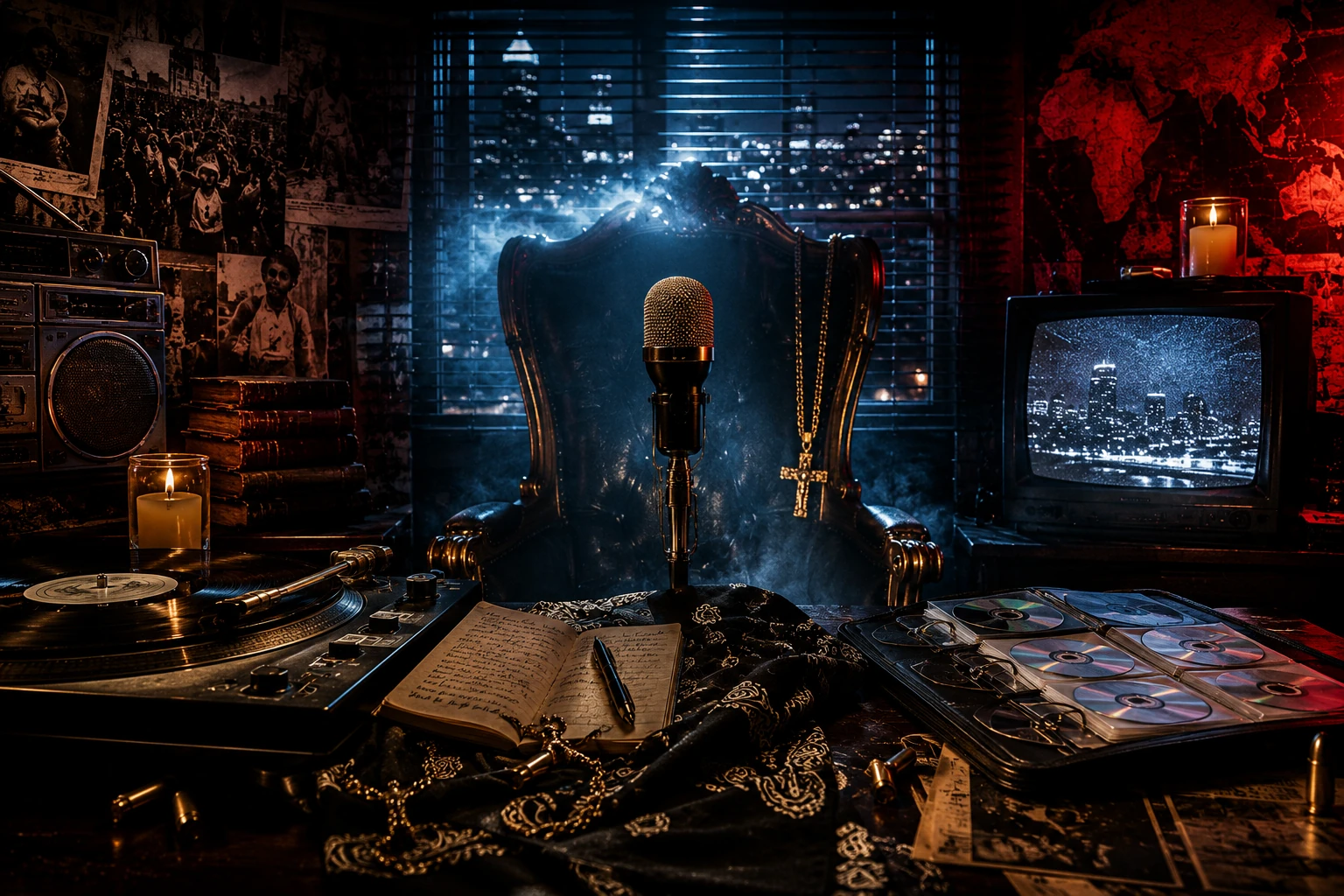
Tupac and the 90s Rap Mythology
Tupac and the 90s rap mythology became bigger than music because 2Pac never fit into one clean box. He was political and reckless, vulnerable and furious, funny and haunted, tender and combative, charismatic enough to own a camera, and complicated enough that the media kept flattening him into whatever headline it needed that week. He belongs inside the larger 90s hip-hop and rap story, but he also overwhelms it — because his songs, movies, interviews, Death Row era, rivalry years, tragedy, and legacy still feel like the decade arguing with itself.
Tupac became one of the central figures of 90s rap mythology because his music carried pain, politics, vulnerability, rage, humor, contradiction, and prophecy energy all at once. His career moved through social commentary, movie stardom, gangsta rap, Death Row intensity, media pressure, and the Bad Boy and Death Row rivalry era, but reducing 2Pac to any one of those lanes misses the point. Tupac became mythic because he felt unfinished, overloaded, brilliant, human, and too big for the machine that was selling him.
Before Tupac Became a Symbol, 2Pac Was an Artist Carrying Too Much at Once
Not One Image. A Whole Collision.
Tupac’s mythology was built from politics, music, fame, film, vulnerability, Death Row pressure, media heat, and the frozen image left behind.
The Myth Came Later
Before every quote became prophecy and every photo became iconography, Tupac was a young artist moving through pressure, ambition, anger, and a lot of unfinished life.
Tupac is difficult to write about because the myth got there first. For a lot of people, 2Pac exists less like a regular artist and more like a monument: the stare, the interviews, the courtroom photos, the movie clips, the Death Row era, the songs that sound like warnings, and the feeling that the whole 90s rap story somehow ran through him even when it did not.
That mythology is powerful, but it can also make Tupac harder to actually hear. When an artist becomes that symbolic, people start treating every lyric like scripture, every mistake like destiny, every contradiction like proof of some master plan. That is not fair to the artist, and it is not fair to the music. 2Pac was not a statue. He was young, talented, impulsive, thoughtful, angry, funny, generous, reckless, theatrical, and under a level of public pressure that would have cracked most people before lunch.
The reason Tupac still matters is not that he was perfect. Perfect artists are usually boring, and the 90s already gave us enough plastic perfection to clog a landfill. 2Pac mattered because he was combustible. He made songs that sounded like diary pages, speeches, revenge fantasies, love letters, street reports, prayers, warnings, and late-night phone calls. Sometimes Tupac was trying to save people. Sometimes he sounded like he was daring the world to destroy him first.
That is why Tupac’s place in 90s Music is so complicated. He was not just one of the decade’s biggest rappers. He was one of the decade’s biggest emotional weather systems. His records carried the mood of an era that loved fame, feared youth, marketed danger, misunderstood hip-hop, turned pain into product, and then acted surprised when the pressure had consequences.
To understand Tupac, you have to resist the easy version. He was not just the West Coast side of a rivalry. He was not just a gangsta rap icon. He was not just a political rapper. He was not just an actor. He was not just a tragic figure. He was all of those things at once, and sometimes those identities fought each other in public.
That collision is the mythology. Not the poster version. The actual collision: pain, ambition, politics, performance, fame, fear, loyalty, anger, humor, media pressure, legal pressure, record-label pressure, and a public that wanted Tupac to explain himself while also buying the most dramatic version of him.
The myth made Tupac larger
Tupac’s death froze his image in time, and the culture turned that image into something almost impossible to separate from the music. That is why later generations often meet the legend before they meet the artist.
The problem is that legends are tidy. 2Pac was not tidy.
The music kept 2Pac human
The songs are where the complexity still breathes. Tupac could sound brave, scared, furious, sweet, paranoid, funny, wounded, and unstoppable — sometimes within the same album side.
That emotional range is why the records still hit harder than nostalgia.
Tupac’s Political Roots Were Not Decoration. They Were in the Wiring.
Tupac’s political consciousness did not appear because a record label needed an angle. It came from family history, movement history, theater, reading, debate, and growing up around language that treated art as something connected to struggle.
The Message Was in the Wiring
Tupac’s political voice was not a borrowed outfit. It came from the world around him, the family history behind him, and the pressure inside him.
One of the easiest mistakes people make with Tupac is treating his political side like a phase or a branding detail. It was deeper than that. His family background, especially the influence of his mother Afeni Shakur and the political environment around him, shaped how 2Pac understood power, poverty, race, policing, and public voice. Tupac’s politics were not always neat, but they were not fake.
This matters because Tupac’s early music did not arrive as simple outlaw theater. Songs like “Brenda’s Got a Baby” and “Keep Ya Head Up” showed a rapper trying to tell stories about women, poverty, vulnerability, neglect, and survival in ways that did not fit the lazy gangsta rap in the 90s box people later used for him. Those records were not soft. They were social commentary with emotional teeth.
Tupac was also shaped by performance. Before the full rap-star mythology, he had theater training, dance background, and a sense of presence that made him unusually camera-ready. He understood how to project. He understood intensity. He understood how to turn emotion into a scene. That matters because his music and acting fed each other. He was not just rapping; he was performing lived contradiction.
His politics were also messy because real people are messy. 2Pac could speak about community uplift and then make records full of vengeance. He could defend women in one song and participate in the misogyny of the era in another. He could sound like a revolutionary and then sound like a young man drowning in fame and anger. That does not make the politics fake. It makes the person complicated.
And that complication is important inside the bigger conscious rap in the 90s conversation. Tupac was not always placed neatly in the “conscious rap” lane because his career also moved through gangsta rap, party records, movie stardom, and Death Row mythology. But his political and social records are part of that same decade-long conversation about what hip-hop could say, who it could defend, and how much truth mainstream America could tolerate before it started clutching pearls like it had a sponsorship deal with pearls.
Politics were close to home
Tupac’s political voice was shaped by the world he came from, not added later as a marketing accessory.
2Pac wrote about damage
His early social records focused on poverty, neglect, women, youth, and survival before the outlaw image took over the headlines.
The message was not tidy
Tupac could be compassionate and reckless, political and self-destructive. That tension is part of the actual story.
The Early 2Pac Records Were Already Fighting the Simplified Version of Him
Before Tupac became the face of late-90s rap mythology, his early catalog showed a writer pulled between social concern, personal anger, performance, street pressure, and a need to be heard immediately.
2Pac Made Big Problems Feel Personal
The early songs were not just statements. They were close-up stories about systems, people, pressure, survival, and damage.
Tupac’s early records are essential because they show how many versions of him were already present. He was not waiting for the Death Row era to become intense. The intensity was there. The question was where it pointed. Sometimes it pointed toward social commentary. Sometimes it pointed toward grief. Sometimes it pointed toward anger at the systems around him. Sometimes it pointed inward, which is where some of his strongest songs live.
“Brenda’s Got a Baby” remains crucial because it showed Tupac’s gift for turning a social issue into a human story. The song does not work because it lectures. It works because it narrows the camera. It makes the listener follow one person into a larger system of neglect. That storytelling approach would become one of 2Pac’s greatest strengths: he could make big issues feel personal without sanding off the pain.
“Keep Ya Head Up” showed another side. Tenderness, encouragement, frustration, and social critique could all sit inside a record that still felt direct. Tupac did not sound like he was politely submitting an essay. He sounded like he was talking to people he cared about, and that made the song feel less like a statement and more like a lifeline.
Early 2Pac also had anger, ego, humor, and confrontation. That mix mattered because he was never going to stay in one lane. The industry often prefers artists who are easy to package, but Tupac made that difficult. He could be marketed, sure — everyone can be marketed if the machine wants badly enough — but he kept complicating the product.
The early music also shows why Tupac belongs in the bigger 50 essential 90s hip-hop songs conversation. His records were not just hits or headlines. They were emotional documents from a decade where rap was becoming the place young people could say things pop radio was not built to handle.
Listening back now, the early records also make the later mythology feel more tragic. You can hear the concern before the armor gets heavier. You can hear the writer before the symbol becomes impossible to escape. You can hear a young artist trying to build a voice while the world is already deciding what it wants him to represent.
Tupac Was a Rap Star Who Looked Like He Had Escaped From a Movie Screen
Tupac’s acting career matters because film changed how people saw him. His roles made him feel bigger than music, and his screen presence helped turn his public image into something cinematic before the myth had fully hardened.
The Camera Loved the Contradiction
Tupac did not just perform songs. He carried scenes. That made fame stronger, but it also made the public image harder to control.
Tupac’s movie presence is one of the reasons his mythology grew so quickly. Some rappers became stars through records alone. 2Pac had records, interviews, court coverage, magazine covers, and actual film roles adding layers to the image. He was not just a voice coming out of speakers. He was a face, a body, a glare, a smile, a character, a scene.
Juice mattered because Bishop felt unforgettable: charismatic, frightening, wounded, unstable, and magnetic. That role became dangerously easy for people to confuse with Tupac himself, which is part of the problem with celebrity. Play a role too well and suddenly the public decides it knows your soul. Very normal. Very fair. Great job, everyone.
Poetic Justice showed a softer screen presence, one that could carry romance, humor, charm, and frustration. That mattered because it complicated the image. Tupac could play menace, but he could also play tenderness. He could be charming. He could be vulnerable. He could be funny. The camera did not just catch rage. It caught range.
Film also made 2Pac feel like a crossover figure before the language around crossover had fully caught up. He was moving through rap, drama, celebrity, magazine culture, and youth identity all at once. That made him bigger than a traditional rap star, but it also meant every public moment became part of a larger character the world thought it understood.
His screen work connects to the wider 90s ecosystem where rap and film kept feeding each other. That is why 90s hip-hop movie soundtracks matter so much. Movies helped rap songs travel. Rap helped movies feel current. Artists became actors. Actors appeared in videos. Soundtracks became CD-binder staples. The lines blurred.
For Tupac, those blurred lines were especially powerful. The actor made the rapper feel more cinematic. The rapper made the actor feel more dangerous. The interviews made both feel more personal. By the mid-90s, 2Pac was not just releasing art. He was living inside an image machine that turned every move into narrative.
The dangerous role
Bishop became one of the decade’s most memorable rap-adjacent screen characters, and the public kept confusing performance with person.
The softer camera
Tupac’s romantic and vulnerable side mattered because it complicated the harder image that later dominated coverage.
The image expanded
Movies helped make 2Pac feel larger than rap, which gave him more reach and more pressure at the same time.
Tupac’s Toughest Songs Were Often the Ones Where He Sounded Scared
Tupac’s vulnerability is the part that keeps the mythology from becoming hollow. The anger was real, but so was the fear. So was the grief. So was the loneliness. So was the need to be understood before the world turned him into a headline again.
The Heart Behind the Armor
The vulnerability is why Tupac still connects. The rage made headlines. The fear and grief made people stay.
The reason Tupac’s music still feels alive is that his vulnerability keeps breaking through the armor. He could sound invincible one minute and exhausted the next. He could threaten the whole world and then sound like he was asking whether anyone actually loved him. That emotional whiplash is not a flaw in the catalog. It is one of the reasons the catalog still hurts.
“So Many Tears” is one of the clearest examples. It is not just a rap song about paranoia. It sounds like someone trying to outrun ghosts while knowing the ghosts have better endurance. Tupac’s voice carries fear, exhaustion, guilt, and fatalism without losing force. That is harder than swagger. Swagger is easy. Fear without collapse takes skill.
“Dear Mama” is another essential piece because it gave 2Pac’s tenderness a full stage. The song is loving, complicated, wounded, grateful, and honest without pretending family pain comes with a clean bow on top. It is one of the records that makes the caricature version of Tupac look especially lazy. The man who made “Dear Mama” cannot be reduced to outlaw mythology without losing half the story.
“Keep Ya Head Up” matters for the same reason. Tupac could write with care. He could speak to women, community, struggle, and survival with sincerity. That does not erase the contradictions elsewhere in his music, especially the misogyny that also existed around and sometimes inside his work. But it proves the contradiction was real. He was not one note.
Tupac’s vulnerability also made fans feel personally connected to him. Some artists impress you. 2Pac made people feel like they knew him, even when they did not. That is powerful, but it can also become dangerous. Fans start hearing confession in everything. They start treating lyrics as autobiography, interviews as prophecy, pain as access. The artist becomes public property.
That is why the vulnerability matters more than the myth. The myth makes Tupac untouchable. The vulnerability makes him human. And the human version is more interesting, more moving, and more tragic than the poster version ever could be.
2Pac Belonged to Gangsta Rap, But Gangsta Rap Was Never Big Enough to Hold All of Him
Tupac’s relationship to gangsta rap is complicated. He helped define the 90s image of outlaw rap, but he also made political records, emotional records, songs for women, party records, movie records, and confessionals that stretched far beyond one label.
Tupac is central to gangsta rap in the 90s, but he is also one of the best examples of why that label can become too small. His Death Row records, outlaw imagery, confrontational interviews, and late-career intensity fit the gangsta rap conversation. But his catalog was never just that.
2Pac could make revenge music that sounded like a speeding car. He could make grief music that sounded like a confession booth. He could make party records that still carried tension underneath the hook. He could make social records that sounded like speeches from a street corner. He could make love songs, tribute songs, protest songs, movie songs, and songs that felt like he was trying to leave evidence for a future that might misunderstand him.
The gangsta rap label also became useful to the media because it simplified Tupac. It gave television a way to frame the danger. It gave critics a way to dismiss the complexity. It gave fans a harder image to rally around. But Tupac’s actual appeal came from the fact that he kept exceeding the label. He was too emotional to be just a tough guy. Too political to be just a thug. Too reckless to be just a conscious rapper. Too tender to be just an outlaw. Too angry to be just a poet.
That is why his West Coast period should be understood inside West Coast hip-hop in the 90s, but not trapped there. Tupac was born in New York, shaped by multiple cities, tied to California mythology, and ultimately claimed by fans everywhere. The West Coast chapter made him enormous, but the full story is broader than geography.
His gangsta rap records also reveal the genre’s contradictions. They could be thrilling and troubling. They could sound like survival and performance. They could carry real anger and also amplify destructive mythology. Tupac embodied that tension more visibly than almost anyone. He made the genre feel emotionally urgent, but he also showed how fast the image could become dangerous.
That is the grown-up version of the conversation. Not “Tupac was good” or “Tupac was bad.” Not “gangsta rap was real” or “gangsta rap was fake.” The better question is what happens when art, trauma, persona, commerce, politics, and public hunger all squeeze into the same microphone.
Death Row Made 2Pac Louder, Faster, Shinier, and More Dangerous to the Myth Machine
The Death Row era did not invent Tupac’s intensity, but it amplified it. The label’s sound, image, speed, and media heat turned him into the loudest figure in rap almost overnight.
The Volume Went All the Way Up
2Pac’s Death Row period was productive, explosive, charismatic, excessive, emotional, and impossible to separate from the mythology that followed.
Tupac’s Death Row era feels like someone hit fast-forward on an already intense life. The records came fast. The interviews got louder. The image hardened. The videos got bigger. The pressure intensified. Suddenly 2Pac was not just a major artist; he was the center of a cultural storm with a label, a coast, a media narrative, and millions of fans projecting meaning onto him.
Death Row was already powerful before Tupac arrived. Dr. Dre and The Chronic had changed the sound of mainstream rap. Snoop Dogg’s G-Funk 90s had made West Coast cool feel effortless. The label had bass, image, danger, polish, and dominance. Tupac added emotional volatility and superstar gravity.
All Eyez on Me is the center of the Death Row chapter. It is huge in every way: long, confident, uneven in places, brilliant in others, catchy, furious, funny, paranoid, luxurious, wounded, defiant, and packed with the feeling of someone trying to say everything before the room changes again. The album does not feel edited down to safety. It feels like a flood.
That flood is part of the appeal. Tupac sounded unleashed. He could move from party records to threats to confessions to love songs to loyalty anthems to pure adrenaline. The album’s excess became part of its identity. It felt like the opposite of restraint, which made perfect sense for an artist and label living inside an era with very little restraint anywhere.
But the same energy that made the Death Row era compelling also made it unstable. The public image got harder to control. The rivalry story intensified. Interviews became part of the performance. Media attention became part of the fuel. Fans wanted the loudest version of 2Pac, and the loudest version was not always the safest version for Tupac himself.
That is why the Death Row chapter connects directly to Bad Boy, Death Row, and 90s Rap Rivalries. Tupac’s Death Row period cannot be separated from the label’s momentum, the West Coast image, the media machine, and the conflict narrative that kept growing around him. But it also should not be reduced to those things. The music still matters.
The output accelerated
Tupac recorded and released with an urgency that made the Death Row period feel like a compressed career inside a pressure cooker.
The outlaw frame hardened
The public version of 2Pac became louder, sharper, more defiant, and easier for media to flatten into a single image.
The songs still carried range
Even inside the hardest image, Tupac’s records still carried pain, humor, party energy, love, paranoia, and grief.
The Rivalry Made Tupac Bigger, But It Also Flattened Him
Tupac’s role in the rivalry era is famous, but fame is not the same as understanding. The story turned 2Pac into a symbol of West Coast defiance, Death Row intensity, and media spectacle, but that symbol was smaller than the person.
The rivalry years are the most over-discussed and under-understood part of Tupac’s story. Everyone knows the big labels: East Coast versus West Coast, Bad Boy versus Death Row, Biggie versus Tupac, media chaos, award-show tension, diss records, magazine covers, tragedy. But knowing the labels is not the same as understanding how the machine worked.
2Pac became the perfect figure for that machine because he was already intense, articulate, wounded, funny, angry, and quotable. He gave interviews that felt like events. He had a presence the camera could not ignore. He had songs that sounded like headlines before anyone wrote the headline. Tupac was made for media, and media was not made to protect him from itself.
The rivalry also turned Tupac into a team flag for listeners. If you loved West Coast rap, Death Row, G-Funk, or the outlaw image, 2Pac could feel like the loudest possible symbol. If you loved Biggie and Bad Boy, Tupac could become the antagonist in a story that was already too simplified. Fans picked sides because fans do that. We are tribal little weirdos with CD binders. It was inevitable.
But that framing flattened both Tupac and Biggie. Biggie was more than New York’s representative. 2Pac was more than West Coast fury. Both were artists with range, humor, darkness, and unreal talent. Both were young. Both were under pressure. Both got turned into symbols by an industry and media culture that loved a clean storyline.
Tupac’s rivalry-era songs and interviews are still part of his story, but they should not become the whole story. The conflict was real, the public pressure was real, and the consequences were real. But if the only 2Pac someone knows is rivalry-era 2Pac, they are missing the political records, the tender records, the acting work, the early social commentary, the vulnerability, the humor, and the complexity that made the rivalry version so explosive in the first place.
That is why the rivalry should be treated carefully. Not ignored. Not sanitized. Not turned into gossip bait. Carefully. It is music history, media history, business history, and tragedy all tangled together. Tupac did not become mythic because of the rivalry alone. The rivalry became mythic because 2Pac was already too big for the story they tried to put him in.
The Media Could Not Handle Tupac’s Contradictions, So It Sold the Loudest One
Tupac was a dream and a nightmare for 90s media: brilliant, volatile, camera-ready, controversial, articulate, angry, funny, wounded, and always capable of producing a quote that could carry a magazine cover.
2Pac understood media better than many artists, but understanding the machine does not mean the machine cannot hurt you. He knew how to command an interview. He knew how to speak in memorable lines. He knew how to project intensity. He knew how to make a camera feel like it had to pay attention. That was part charisma, part training, part intelligence, part survival instinct.
But the media also had its own needs. It needed stories. It needed headlines. It needed good guys, bad guys, rebels, victims, villains, prophets, and cautionary tales. Tupac could be all of those things depending on the clip, which made him irresistible. The problem is that real people are not meant to be edited into whatever category fills airtime.
Television often treated Tupac like a controversy engine. Magazines treated him like a cover waiting to happen. Radio treated the songs as public events. Fans treated interviews like evidence. Critics treated contradictions like hypocrisy instead of proof that the person was complicated. Everyone wanted the definitive 2Pac, and there was no definitive 2Pac.
That is why Hip-Hop on MTV in the 90s matters so much here. MTV helped rap become visual, but visual culture can flatten people fast. A video, interview, or news segment can make an artist feel larger than life, but it can also reduce them to a few images that repeat until they become the only version people remember.
Radio mattered too. Tupac’s records moved through edited singles, full album cuts, requests, mix shows, cars, bedrooms, parties, and late-night listening sessions. That is where 90s rap radio crossover connects. 2Pac could be too intense for polite pop culture and still central to everyday listening. The contradiction was the point.
The media machine also helped create the feeling that Tupac was always speaking from the edge of disaster. Some of that came from the music. Some came from his life. Some came from how the coverage framed him. And some came from what listeners brought to him afterward, especially after his death, when every old interview started sounding like a warning even when it had not been meant that way.
Essential 2Pac Songs That Built the Myth and Kept the Human Being Visible
Tupac’s catalog is too large and emotionally tangled for a neat list, but these songs show the range: social commentary, grief, vulnerability, defiance, party energy, paranoia, love, anger, and the strange sense that 2Pac was always trying to outrun the ending.
Core Tupac tracks
- “Brenda’s Got a Baby”
Early social storytelling that made systemic neglect feel personal instead of abstract. - “Keep Ya Head Up”
Compassion, critique, encouragement, and one of the clearest examples of Tupac’s tenderness. - “I Get Around”
Party 2Pac, charisma 2Pac, video-era 2Pac — proof that he could be playful without losing presence. - “Dear Mama”
A complicated love letter that made family pain, gratitude, and vulnerability feel huge. - “So Many Tears”
Paranoia, grief, fear, and fatalism wrapped into one of Tupac’s most haunting performances. - “Me Against the World”
The title says the worldview: pressure from every direction and no safe place to put it. - “California Love”
The Death Row arrival as celebration, spectacle, comeback, and West Coast blockbuster. - “Ambitionz Az a Ridah”
Pure Death Row-era defiance, adrenaline, and myth-making velocity. - “I Ain’t Mad at Cha”
Reflection, loss, friendship, change, and one of those songs that only became heavier with time. - “Hail Mary”
Dark, spiritual, paranoid, and inseparable from the late mythology around Tupac’s final era.
What the songs reveal
- 2Pac was never one mood. Tupac could be joyful, wounded, furious, tender, paranoid, political, funny, and exhausted.
- The voice carried urgency. Even relaxed songs often sounded like time was running out.
- The catalog argues with itself. That is not a weakness. That is why it still feels human.
- Tupac made pain public. 2Pac’s gift was turning private damage into communal memory.
- Hooks mattered. The songs traveled because the melodies, choruses, and production had real crossover power.
- The myth changed the listening. After Tupac’s death, many songs became haunted by hindsight, whether or not they were written that way.
Tupac’s songs belong all over the larger 90s hip-hop songs that defined the decade conversation because his records did not just occupy one lane. They crossed radio, MTV, albums, movies, cars, parties, and bedrooms. Some were hits. Some were deep cuts. Some became emotional documents. Some became prophecy by accident.
2Pac also belongs in the 90s hip-hop dance and party songs discussion, even though Tupac is often remembered through heavier themes. “California Love” and “I Get Around” were part of the party side of the decade. Tupac could move the room. The fact that he could also break your heart three songs later is the whole point.
The Tupac Albums Show the Artist Changing Faster Than the World Could Explain Him
Tupac’s albums are not just releases. They are chapters in acceleration: social commentary, personal pressure, fame, prison-era tension, Death Row overload, and posthumous mythology.
2Pacalypse Now
The early political and social-commentary foundation: raw, urgent, angry, and focused on systems, survival, and stories mainstream rap coverage often mishandled.
Strictly 4 My N.I.G.G.A.Z…
A bigger, more visible Tupac: still political, still emotional, but now moving more clearly through radio, video, controversy, and personality.
Me Against the World
The introspective masterpiece: fear, paranoia, pressure, vulnerability, and a sense that 2Pac was both famous and cornered.
All Eyez on Me
The Death Row blockbuster: massive, charismatic, excessive, defiant, messy, brilliant, and central to the late-90s mythology.
The Don Killuminati
Dark, urgent, theatrical, and haunted by timing. It became impossible for fans to hear it outside the shadow of Tupac’s death.
The posthumous era
The posthumous releases kept Tupac present, but they also complicated the catalog by extending the myth after 2Pac could no longer shape it.
Tupac’s album run belongs in the best 90s hip-hop albums conversation because the records show a decade’s worth of pressure compressed into a few years. You can hear the politics. You can hear the fame. You can hear the anger hardening. You can hear the vulnerability refusing to disappear. You can hear the machine getting louder around him.
Me Against the World is especially important because it captures Tupac at his most introspective and cornered. It is not the loudest album, but it may be the one that explains him most clearly. The title is not just branding. It is a worldview, and the songs make that worldview feel emotionally real.
All Eyez on Me is the opposite kind of essential: big, crowded, fast-moving, confident, sometimes excessive, and totally inseparable from the Death Row era. It feels like 2Pac trying to outrun silence. That energy made the album iconic, but it also makes the album feel exhausting in the most 90s way possible.
The posthumous catalog is its own strange chapter. It kept Tupac’s voice in circulation, but it also meant the public kept receiving new versions of him after he was gone. That helped the myth grow, but it also made the line between artist, archive, memory, and industry product harder to untangle.
Tupac’s Contradictions Are Not a Problem to Solve. They Are the Story.
Trying to make 2Pac consistent misses the point. The contradictions are why he still feels alive: revolutionary and celebrity, feminist-sounding and misogynistic, tender and cruel, reflective and reckless, poet and provocateur, actor and person, symbol and young man.
The Tupac people celebrated
- The political voice who called out poverty, police, racism, and social neglect.
- The vulnerable writer who made grief, fear, and family pain feel public.
- The charismatic performer who could hold a camera, stage, interview, or song with ridiculous force.
- The loyal friend who turned love, crew, and family into part of the music’s emotional charge.
- The cultural icon whose image still speaks to people who were not alive when the records dropped.
The 2Pac people wrestle with
- The reckless public figure whose actions and words sometimes escalated danger around him.
- The misogyny that existed alongside songs that defended and celebrated women.
- The outlaw persona that could empower fans but also harden into destructive mythology.
- The media participant who understood attention but sometimes fed the same machine that flattened him.
- The unfinished life that makes every judgment feel incomplete because there was no older Tupac to complicate the younger Tupac.
Tupac’s contradictions are not side notes. They are the actual story. People often try to pick the version of him they prefer: activist Tupac, outlaw 2Pac, poet Tupac, movie-star Tupac, Death Row 2Pac, vulnerable Tupac, angry 2Pac, prophetic Tupac. But the whole point is that all of those versions existed together, and they did not always get along.
That is what makes Tupac more interesting than the polished icon version. Icons are clean. 2Pac was not clean. He was brilliant and flawed in public. He said things that still inspire people and things that still deserve criticism. He made songs that comforted people and songs that intensified dangerous myths. He challenged systems and sometimes performed the same destructive scripts those systems created.
This is also why his relationship to women in 90s hip-hop needs honest context. Tupac made records that uplifted women and records that participated in the misogyny of the era. Both are true. Pretending one cancels the other makes the conversation weaker. The 90s were full of contradictions, and 2Pac carried many of them louder than most.
The temptation with dead artists is to sand down the parts that do not fit the tribute. That is not respect. Respect is taking the whole person seriously enough to avoid turning Tupac into a bumper sticker. 2Pac deserves the full conversation: the brilliance, the damage, the tenderness, the cruelty, the politics, the performance, the fear, the ego, the art, and the unfinished future.
That is why Tupac still feels so alive in cultural memory. He was unresolved. The songs argue with each other. The interviews argue with the songs. The movies complicate the interviews. The Death Row era complicates the early political records. The death complicates everything. Nothing sits still. Neither did he.
Tupac’s Death Froze the Image Before Life Had a Chance to Complicate It
This is where nostalgia has to back off. Tupac’s death is not a branding moment, not a trivia answer, and not a mythology accessory. It was a real loss that changed hip-hop, fans, friends, family, and the way every later generation hears the music.
The Loss Was Real Before It Was Symbolic
The culture turned Tupac into legend almost immediately. But before legend, there was a young artist gone, and futures no one got to hear.
Tupac was killed in 1996, and that fact changed how everything before it sounded. Songs became heavier. Interviews became haunted. Lyrics became evidence. Photos became relics. Fans started reading backward through the catalog as if the ending had been written into every line. That is what death does to art when an artist dies young. It turns the work into a map people use to search for warnings.
The tragedy is that Tupac’s image froze before time could complicate it. We never got middle-aged Tupac. We never got old interviews where he looked back and contradicted his younger self. We never got the bad albums, comeback albums, weird creative detours, political evolutions, apologies, regrets, reinventions, or elder-statesman moments that long careers sometimes allow. He remained permanently young, intense, and unresolved.
That frozen image is part of why the mythology is so strong. If 2Pac had lived, he would have changed. Everyone does, unless they are a 90s sitcom character stuck in syndication. But because he died at the height of the storm, the public kept the storm version. Death Row Tupac. Outlaw 2Pac. Interview Tupac. Furious, laughing, defiant, wounded Tupac. That version became permanent in a way no living artist can control.
The culture also turned grief into product quickly, because pop culture is very good at doing the worst thing efficiently. Tributes, covers, documentaries, posthumous releases, posters, shirts, specials, rumors, theories, and debates kept the story alive. Some of that came from love. Some came from commerce. Usually both, because the music industry has never met a contradiction it could not invoice.
This is why the story needs careful handling. Tupac’s death is central to the mythology, but it should not be treated like the mythology’s coolest detail. It was a human loss. It altered families, friends, communities, collaborators, fans, and hip-hop itself. The fact that his music still matters should deepen the respect, not turn the tragedy into decoration.
The same care applies to Biggie’s death in 1997. The two losses are linked in public memory because of the rivalry era, but each deserves human weight outside the storyline. That is why this Tupac page should sit beside the future Biggie Smalls and East Coast 90s Rap page, not in competition with it. The culture lost two artists. The point is not to keep score.
Tupac’s Legacy Is Not Just Influence. It Is the Feeling That 2Pac Is Still Arguing With the Present.
Tupac’s legacy survives because it is not just nostalgia. His songs still feel urgent. His contradictions still feel familiar. His image still travels. His interviews still circulate. His influence still shows up in rap, film, activism, fashion, fandom, and the way people talk about authenticity.
Tupac’s influence is obvious on the surface. Rappers borrowed the emotional directness, the outlaw image, the political rage, the melodic hooks, the tattooed vulnerability, the martyr energy, the confessional tone, the ability to make songs feel like speeches, and the idea that a rapper could be actor, activist, rebel, poet, headline, and cultural argument at the same time.
But his deeper influence is emotional. 2Pac made intensity feel like truth. That is powerful and risky. He taught generations of artists that vulnerability could sit beside aggression, that pain could be public, that social critique could live next to party records, that contradiction could be part of authenticity. He also showed how quickly authenticity can become a trap when audiences demand the loudest version of a person forever.
Tupac also changed the way fans think about prophecy in music. Because he died young and wrote so often about death, betrayal, fear, and pressure, listeners keep finding signs. Some of that is natural grief. Some of it is mythmaking. Some of it is the human need to believe tragedy had a pattern. But art is not always prophecy. Sometimes a young artist is describing the danger around him because the danger is real.
His legacy also runs through 90s hip-hop fashion, visual culture, posters, dorm rooms, barber shops, documentaries, tattoos, social media quotes, and every “realness” debate rap has had since. 2Pac became a reference point for emotional truth, even when people use the reference lazily.
The best way to remember Tupac is not as a flawless saint or a cartoon outlaw. It is as an artist whose work captured the 90s at full contradiction: political and commercial, tender and violent, famous and hunted, performative and painfully sincere, Black youth culture becoming mainstream power while the mainstream kept misunderstanding what it was buying.
That is why Tupac belongs near the center of the 90s Hip-Hop and Rap map. Not because he was the only important artist. He was not. Not because he was simple. He was definitely not. He belongs there because his career shows the decade’s whole pressure system: music, movies, politics, gangsta rap, media, fame, grief, capitalism, and the tragic speed of becoming a legend before becoming an elder.
Where to Go Next
Tupac and the 90s Rap Mythology FAQ
Why is Tupac so important to 90s rap?
Tupac is important to 90s rap because his music combined politics, vulnerability, anger, storytelling, movie-star presence, gangsta rap intensity, and emotional honesty. 2Pac became one of the decade’s most powerful figures because he represented so many contradictions at once.
Was 2Pac only a gangsta rapper?
No. Tupac was part of gangsta rap history, especially during his Death Row era, but his catalog also included social commentary, political songs, love songs, party records, grief records, movie soundtrack moments, and deeply vulnerable confessionals.
What are Tupac’s most important 90s songs?
Important Tupac songs from the 90s include “Brenda’s Got a Baby,” “Keep Ya Head Up,” “I Get Around,” “Dear Mama,” “So Many Tears,” “Me Against the World,” “California Love,” “Ambitionz Az a Ridah,” “I Ain’t Mad at Cha,” and “Hail Mary.”
What was Tupac’s Death Row era?
Tupac’s Death Row era was the highly visible, fast-moving period when he released All Eyez on Me, became central to West Coast rap mythology, and was pulled deeper into the Bad Boy and Death Row rivalry story. It amplified his fame, sound, image, and public pressure.
Why is 2Pac’s legacy so complicated?
Tupac’s legacy is complicated because he was brilliant and flawed, political and reckless, tender and aggressive, vulnerable and performative. His death froze his image before he had time to grow older, change, explain himself, or complicate the myth in real time.
How did movies shape Tupac’s image?
Movies shaped Tupac’s image by making him visible beyond music. Roles in films like Juice and Poetic Justice showed his screen presence, charisma, menace, tenderness, and emotional range, helping turn 2Pac into a larger 90s cultural figure.
What should I read next?
Start with Bad Boy, Death Row, and 90s Rap Rivalries, then go to Biggie Smalls and East Coast 90s Rap, Gangsta Rap in the 90s, and the main 90s Hip-Hop and Rap page.