West Coast Hip-Hop in the 90s: G-Funk, Gangsta Rap, Lowriders, and the California Takeover
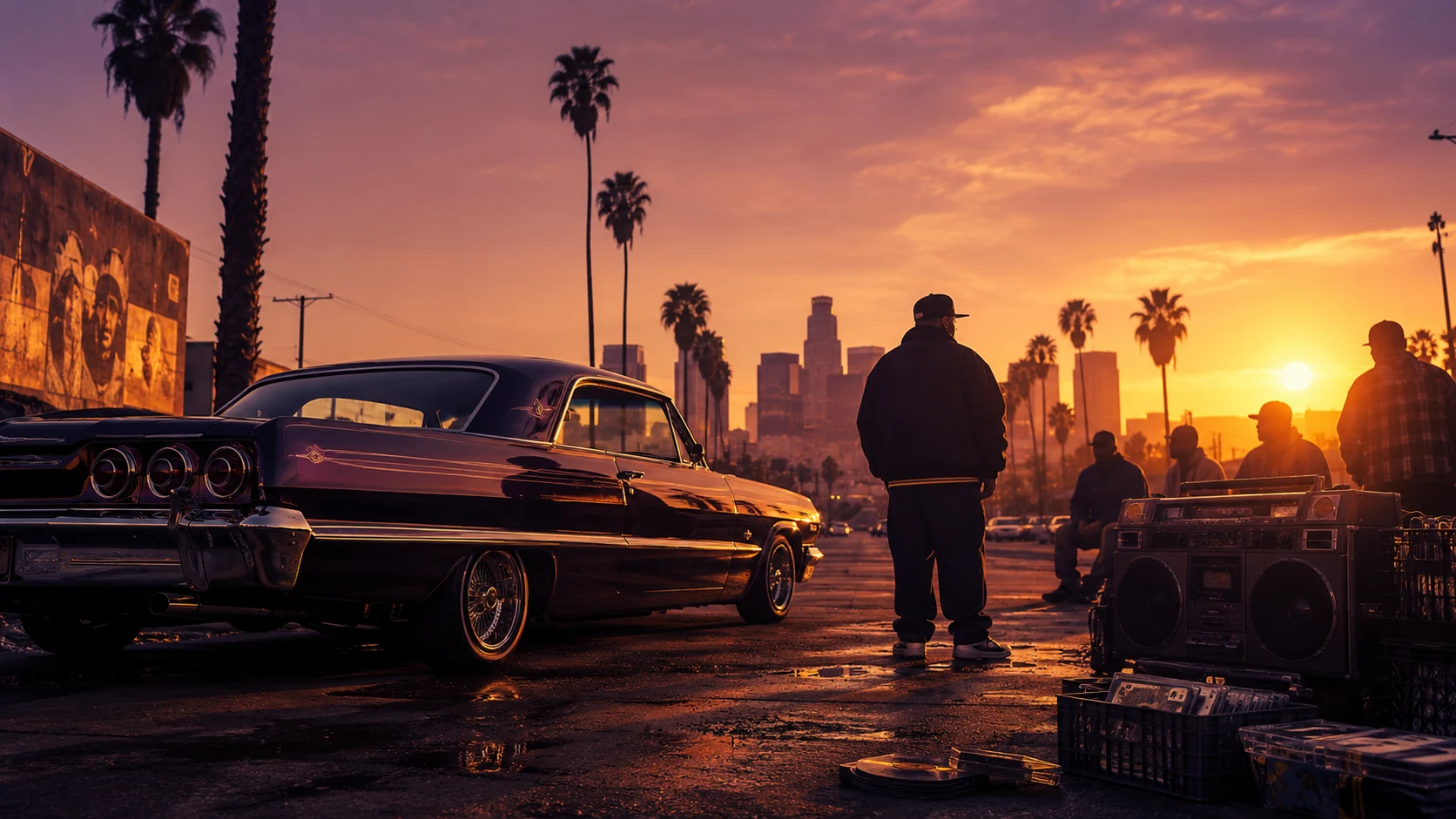
West Coast hip-hop in the 90s sounded like sun glare on chrome, bass rattling a trunk loose, police helicopters in the distance, backyard parties that got out of hand, lowriders crawling under palm trees, and producers who realized a whining synth line could make the whole country lean back at the same time. It was smooth, dangerous, funny, political, cinematic, commercial, underground, and one of the loudest reasons the bigger 90s Music story still feels like somebody left the trunk speakers on overnight.
West Coast hip-hop in the 90s was defined by G-Funk, gangsta rap, lowrider culture, California street storytelling, trunk-rattling bass, laid-back menace, radio-ready hooks, and regional scenes from Compton, Long Beach, South Central Los Angeles, Oakland, Vallejo, Inglewood, Watts, and the Bay Area. Dr. Dre, Snoop Dogg, 2Pac, Ice Cube, Cypress Hill, Warren G, Nate Dogg, DJ Quik, Too $hort, E-40, Spice 1, MC Eiht, Tha Dogg Pound, The Pharcyde, Souls of Mischief, Hieroglyphics, Yo-Yo, The Lady of Rage, and many more made the West Coast one of the defining forces of 90s hip-hop and rap.
Why West Coast Hip-Hop Mattered So Much in the 90s
West Coast hip-hop in the 90s did not just add another regional flavor to the decade. It changed the center of gravity. The sound got warmer, wider, funkier, heavier, smoother, and more cinematic. The imagery changed too: lowriders, palm trees, swap meets, backyard parties, block tension, police pressure, sunlit menace, and music videos that made California feel like both paradise and warning label.
The larger 90s hip-hop and rap story needs the West Coast because the decade would be lopsided without it. If East Coast hip-hop in the 90s often sounded like winter concrete, hard drums, and dense lyric notebooks, West Coast rap brought basslines you felt in your chest, hooks that traveled fast, and street narratives that could sound relaxed until you actually listened to what was being said.
That combination was the trick. A lot of West Coast rap had sunshine on the surface and trouble underneath. The music could cruise, but it was not carefree. It could be funny, but it was not lightweight. It could be commercial, but the best records still carried place, attitude, politics, mourning, paranoia, ego, humor, and survival.
The West Coast also proved that hip-hop did not have to sound like New York to be legitimate. That sounds obvious now, but in the early 90s, the regional power shift was huge. California artists were not asking to be approved by the old map. They built their own lanes, their own slang, their own sonic weather, and eventually forced the whole country to turn the bass up.
And it was not just Los Angeles. That is the part people keep flattening because apparently geography became too difficult after the third VH1 documentary. The Bay Area had its own language, business sense, funk, humor, and independent grind. Long Beach had its own smooth menace. Compton had history and heat. Oakland had game. Vallejo had E-40 turning slang into a contact sport. The West was a whole coastline of scenes, and the 90s were when the rest of the country finally had to deal with it.
It made rap feel cinematic in a different way
West Coast records often felt widescreen. The production had space. The bass rolled. The hooks opened up. The stories moved through streets, cars, parties, traffic stops, studios, neighborhoods, and whole social systems. It was not always dense in the East Coast sense, but it could be just as vivid.
The best West Coast rap made geography audible. You could hear heat, distance, car culture, local slang, neighborhood pride, and the feeling of driving around with nowhere safe or smart to go. Even the fun records had a little danger parked nearby with the engine running.
It changed the mainstream without going soft
West Coast rap became massive because the records worked everywhere: cars, clubs, MTV, radio, house parties, dorm rooms, and suburban bedrooms where someone’s mom absolutely did not read the parental advisory sticker closely enough.
But commercial reach did not automatically mean the edge disappeared. The biggest records could be catchy and still full of danger, grief, anger, politics, street detail, ego, and consequences. That is why the music hit so hard. It knew how to slide through the radio without pretending everything was fine.
Before the 90s: The West Coast Was Already Building Pressure
The 90s explosion did not appear out of nowhere. The West Coast had already been building its own identity through electro-funk, party records, street reporting, political anger, independent hustle, and artists who were tired of pretending hip-hop only had one headquarters. That bridge from late-80s rap into early-90s dominance is exactly why the 80s Rap, R&B & Dance lane matters too.
The street-reporting lane
Ice-T helped push West Coast rap toward a colder, more narrative street perspective before the 90s even arrived. His records showed that Los Angeles stories could be sharp, dangerous, and fully their own thing.
The Compton blast
N.W.A. changed the conversation by making Compton impossible to ignore. Their late-80s impact set the stage for Ice Cube, Dr. Dre, Eazy-E, MC Ren, and the larger 90s West Coast takeover.
The independent game
Too $hort helped show how West Coast rap could move through local tapes, street buzz, Oakland attitude, and independent hustle. The Bay Area was never waiting around for somebody else to hand it a permission slip.
By the time the 90s started, the West Coast already had ingredients that would define the decade: funk roots, car culture, local crews, street narratives, independent distribution, LAPD tension, gang realities, party energy, and a regional confidence that did not need to sound like anybody else.
The early 90s turned that pressure into national force. Ice Cube became one of rap’s most important solo voices. Dr. Dre rebuilt his sound into something smoother and more devastating. Snoop Dogg arrived sounding like he had been born inside the pocket. Cypress Hill made Los Angeles weird, smoky, and unmistakable. The Bay Area kept developing its own language, humor, and hustle. The West Coast was not warming up anymore. It was taking over the stereo.
What made the setup so powerful was that the West Coast already had conflict baked into the music. Artists were dealing with police harassment, gang violence, economic pressure, racial tension, street politics, media panic, and a national audience that often loved the records while misunderstanding almost everything underneath them. The 90s did not create that tension. The 90s amplified it until it was coming out of every speaker.
The 90s West Coast Hip-Hop Timeline
The West Coast did not take over in one clean wave. It moved in bursts: Ice Cube’s solo explosion, Dre and Death Row rewriting the sound, Snoop becoming a superstar, the Bay Area building its own universe, 2Pac becoming myth, and the late-90s scene trying to figure out what came after the biggest storm in rap.
Ice Cube goes solo and the West gets louder
Cube’s solo arrival made it clear the West Coast was not going to be a side story. His early-90s records were angry, political, funny, harsh, and impossible to ignore.
Cypress Hill and 2Pac expand the picture
Cypress Hill brought a smoky, paranoid, Latin-rooted L.A. weirdness, while 2Pac’s early work started revealing a voice that could be political, wounded, furious, and deeply personal.
The Chronic changes the national sound
Dr. Dre’s production, Snoop’s voice, Death Row’s image, and the G-Funk feel made West Coast rap suddenly sound like the future arriving in a lowrider.
Doggystyle, Black Sunday, and 93 ’til Infinity
1993 was when Snoop became a superstar, Cypress Hill crossed over even harder, and Souls of Mischief proved the Bay’s jazzier underground could be just as timeless as the mainstream.
Regulate smooths out the G-Funk lane
1994 gave Warren G and Nate Dogg a cooler, more melodic version of the sound, while soundtracks and radio kept West Coast rap everywhere.
The Bay, Death Row, and alternative L.A. keep expanding
1995 kept stacking lanes: E-40, DJ Quik, Tha Dogg Pound, The Pharcyde, and others showed how many West Coast sounds were running at once.
2Pac becomes central to the mythology
1996 was the brightest and darkest year of the West Coast run: All Eyez on Me, Death Row spectacle, “California Love,” and the tragedy surrounding Pac.
The aftermath era begins
The West Coast had to keep moving after Death Row’s peak and Pac’s death. Westside Connection, Bay Area releases, and underground scenes carried different versions of the torch.
The mainstream map shifts
Southern rap rose fast, East Coast glossy rap dominated radio, and the West Coast started looking for the next major chapter while its 90s classics kept aging into permanent fixtures.
The decade closes with the legacy already locked
By the end of the decade, the West Coast had changed hip-hop’s production language, visual identity, regional politics, and commercial scale. The next era would sound different, but it was still driving on roads the 90s paved.
What the West Coast Sound Actually Was
“West Coast sound” does not mean one beat, one flow, or one city. Dr. Dre did not sound like DJ Quik. Cypress Hill did not sound like Too $hort. The Pharcyde did not sound like Death Row. E-40 did not sound like Snoop. But there were shared instincts: bass, funk, space, groove, attitude, slang, melody, and a feeling that the music was built to move through speakers, cars, and neighborhoods.
The trunk test
West Coast production often understood the car as a listening room. The bass could not just be present. It had to move air, shake mirrors, and make cheap speakers beg for retirement.
The groove was the engine
Parliament-Funkadelic DNA, rubbery basslines, synth leads, guitar licks, and laid-back drum programming gave many West Coast records that cruising motion.
Room to lean
Compared with many dense East Coast beats, West Coast production often left more space. That space made the flow feel smoother, the hooks bigger, and the bass heavier.
Sunny but not safe
The sound could feel warm and relaxed while the subject matter was anything but. That contrast is why so much 90s West Coast rap still feels magnetic.
A lot of West Coast rap understood mood better than people gave it credit for. It did not always try to overwhelm you with syllables. Sometimes the whole point was confidence, pocket, timing, and letting the beat breathe. Snoop could make a line feel legendary because he knew exactly where not to rush. Too $hort could make blunt simplicity feel like wisdom from someone who had already seen every bad idea twice. E-40 could bend language until the whole rhythm changed shape.
The production also had regional memory in it. Funk was not just a sample source. It was part of the cultural bloodstream. The basslines, synths, and grooves connected 90s rap to older West Coast party music, car culture, backyard gatherings, and the kind of local musical history that does not always fit neatly into a textbook. The records sounded new because they knew what old records to steal from lovingly and loudly.
The Cities, Neighborhoods, and Scenes That Shaped the Sound
West Coast hip-hop in the 90s was not just “California rap” as one giant sunburned blur. The map mattered. Compton, Long Beach, South Central, Oakland, Vallejo, Inglewood, Watts, Leimert Park, and the Bay Area all brought their own language, humor, pressure, production habits, and local pride.
The pressure point
Compton carried enormous symbolic weight in 90s rap because N.W.A. made it nationally visible, then Dre, Cube, Eazy-E, MC Ren, MC Eiht, DJ Quik’s nearby Compton-rooted story, and others kept the area central to the West Coast conversation.
The smooth menace
Long Beach became essential through Snoop Dogg, Warren G, Nate Dogg, Tha Dogg Pound connections, and a style that could sound laid-back while still carrying serious street weight.
Street cinema and conflict
South Central shaped the decade’s imagery, stories, and tension. It was central to the movies, videos, soundtracks, and street narratives that made 90s West Coast rap feel cinematic.
Game, grit, and independence
Oakland brought Too $hort, Digital Underground connections, Spice 1’s nearby Bay Area darkness, independent hustle, local slang, and a confidence that did not need Los Angeles to validate it.
E-40’s language lab
Vallejo mattered because E-40 and the Click turned local slang, offbeat flow, family business, and Bay Area hustle into a style that sounded like nobody else.
L.A. voices with edge
Inglewood, Watts, and surrounding Los Angeles areas helped fill out the West Coast sound with artists, producers, crews, and stories that made the region feel bigger than one headline city.
The creative counterweight
The Good Life Café and Leimert Park scenes helped develop a more lyrical, experimental, jazz-connected Los Angeles lane through artists tied to Freestyle Fellowship, Project Blowed, and the wider underground.
Never just a side note
The Bay had its own humor, slang, funk, darkness, and independent movement. Too $hort, E-40, Spice 1, Mac Dre, Souls of Mischief, Hieroglyphics, and others made the Bay a whole world, not a footnote.
The other side of L.A.
The Pharcyde, Freestyle Fellowship, Jurassic 5’s roots, Dilated Peoples’ late-90s rise, and other artists proved the West Coast was not only gangsta rap and G-Funk. There was weirdness, jazz, humor, and technical craft too.
G-Funk Turned the West Coast Into a National Sound
G-Funk was not the whole West Coast, but it became the sound most people instantly associate with 90s California rap: deep bass, whining synths, slow grooves, funk samples, melodic hooks, and a vibe that could feel relaxed and threatening at the same time. The deeper ride belongs on G-Funk and the 90s West Coast Sound, but this page cannot talk about the West without giving it the steering wheel for a minute.
Synth Lines, Bass Weight, and the Sound of Cruising Trouble
G-Funk made danger sound smooth. That was the whole magic trick. The records could glide, bounce, and shimmer while the stories underneath were full of pressure, ego, police tension, neighborhood loyalty, and consequences.
It was party music with a shadow, car music with a warning label, and radio music that still sounded like it came from a place with rules you probably did not understand.
Dr. Dre and The Chronic changed 90s rap by organizing the sound so powerfully that the rest of the decade had to deal with it. The drums snapped clean. The bass sat heavy. The synths curled around the track like smoke. The hooks opened everything up. And then Snoop Dogg and the G-Funk 90s arrived with a flow so relaxed it made everyone else sound like they were late for work.
Warren G and Nate Dogg brought another side of the sound: smoother, more melodic, less apocalyptic, but still rooted in Long Beach atmosphere. DJ Quik had his own polished funk lane with cleaner musicianship, swing, and personality. Above the Law helped shape early G-Funk ideas before the sound became mainstream shorthand. The point is simple: G-Funk was not one record. It was a whole mood with a lot of fingerprints on the steering wheel.
The brilliance of G-Funk was how inviting it sounded. You could nod along before you realized the lyrics were about conflict, survival, revenge, police pressure, street codes, or people making terrible choices in excellent rhythm. That was the West Coast sweet spot: the groove opened the door, then the story reminded you not to get too comfortable.
The architect
Dre made the sound feel expensive, heavy, and cinematic. The production was clean enough for radio and hard enough to make the whole block turn around.
The pocket king
Snoop’s delivery made G-Funk feel effortless. He floated over beats that other rappers would have attacked like they owed rent.
The melodic lane
Warren G and Nate Dogg made G-Funk smoother and more soulful, with hooks that could turn a street story into a sing-along.
The polished funk specialist
Quik’s production had bounce, musicianship, humor, and a clean funk sensibility that separated him from the darker Death Row orbit.
Death Row Made West Coast Rap Feel Unavoidable
Death Row Records became one of the defining labels of the 90s because it understood sound, image, controversy, danger, charisma, videos, radio, and mythology. It was brilliant, chaotic, influential, and combustible enough that even the success felt like it came with sirens.
Big Studios, Bigger Records, and a Whole Lot of Bad Decisions Nearby
The Death Row era made West Coast rap feel massive: cleaner mixes, bigger hooks, darker headlines, expensive videos, and records that sounded like they were built to take over every speaker in America.
The sound was massive
The Chronic and Doggystyle made Death Row sound like the center of the decade. The records had hooks, groove, swagger, humor, menace, and production so clean it practically wore sunglasses indoors.
Death Row also understood voices. Dre had the production authority. Snoop had the effortless cool. Tha Dogg Pound brought group chemistry. Nate Dogg made hooks feel like permanent fixtures. The label knew how to make records feel like events.
The mythology was even bigger
Death Row’s image became almost as powerful as the music: videos, cars, red-carpet menace, magazine covers, controversy, and a sense that the label was both dominating and unraveling in public.
That mythology can overwhelm the actual records, which is annoying because the records are still the reason any of it matters. Strip away the headlines and you still have some of the most important rap production, hooks, voices, and albums of the 90s.
The label’s peak felt like a movie no one was fully controlling. Every release seemed to arrive with music, image, conflict, and rumor attached. That was part of the power and part of the problem. Death Row knew how to dominate attention, but attention is a wild animal. It does not stay trained for long.
What gets lost in the chaos is how much craft was actually there. The hooks were strong. The mixes were clean. The voices were distinctive. The videos were memorable. The records sounded huge on expensive systems and still worked on cheap bedroom stereos with one blown speaker and a milk crate pretending to be furniture.
Gangsta Rap Was More Than the Moral Panic Version
The 90s conversation around gangsta rap often got flattened into panic: violent lyrics, parental advisory stickers, angry politicians, nervous parents, and news segments hosted by people who clearly had not listened to the albums beyond one scary quote. But the music was more complicated than the outrage machine wanted it to be.
Gangsta rap could be confrontational, ugly, funny, exaggerated, political, irresponsible, brutally honest, theatrical, mournful, and socially revealing all at once. It was not one moral category. Ice Cube could turn rage into critique. MC Eiht could make street stories feel documentary. Spice 1 could get dark enough to make the room uncomfortable. Cypress Hill could bring paranoia, humor, smoke, and surreal menace. 2Pac could move from rage to tenderness to contradiction so fast that the audience barely had time to reset.
The genre also reflected real conditions: policing, poverty, gang conflict, surveillance, racism, economic abandonment, neighborhood trauma, and the constant feeling that young people were being judged by the same systems that helped create the mess. That does not mean every lyric was noble. Some of it was reckless. Some of it was ugly. Some of it was cartoonish. But reducing all of it to “bad influence music” is lazy, and Gen X already had enough lazy adults yelling at album covers in the 90s.
The strange part is that the panic often helped sell the records. Every warning label, banned video, outraged news clip, and adult complaint made the music feel even more like forbidden knowledge. For a teenager in the 90s, that little black-and-white advisory sticker might as well have said, “Congratulations, this is probably the good one.”
Rage with structure
Cube’s best 90s records were angry, funny, political, paranoid, and surgically direct. He could make a song feel like a newspaper column written with a brick.
Compton realism
MC Eiht brought a grounded, hard-edged storytelling style that made the music feel street-level and cinematic without needing to over-explain itself.
Bay Area darkness
Spice 1’s records carried a grim, violent, almost horror-movie edge that made him one of the decade’s most intense West Coast voices.
2Pac and the West Coast Mythology
2Pac’s 90s run is bigger than one region, but his Death Row period became inseparable from West Coast mythology. He was not simply a California rapper, and pretending otherwise erases too much of his biography. But by the mid-90s, his image, records, videos, conflicts, and contradictions were central to how the world understood West Coast rap.
The contradiction was the point
2Pac could be tender, furious, reckless, political, spiritual, paranoid, funny, wounded, and combative, sometimes in the same album stretch. That is why the simple summaries never work. He was not one thing. He was too many things at once, and the records often sounded like he knew time was running out.
His West Coast-era music carried huge hooks and public spectacle, but it also carried grief, loyalty, betrayal, ambition, and a constant awareness of death. That made the records feel bigger than radio success.
The image became enormous
By 1996, 2Pac was not just releasing songs. He was generating mythology in real time: videos, interviews, tattoos, headlines, beefs, courtroom drama, Death Row energy, and albums that sounded like dispatches from a life moving too fast.
That mythology can make it hard to hear the music clearly, but the best records still punch through: the voice, the urgency, the hooks, the pain, the charisma, and the feeling that every performance was trying to win an argument with history.
The reason 2Pac remains so central to the West Coast story is not just that he made huge records. It is that his music carried emotional range at a scale rap had rarely seen. He could write for the club, the courtroom, the funeral, the prison letter, the revenge fantasy, the mother, the friend, the enemy, the movement, and the mirror. That range made him impossible to shrink down to one image.
In the West Coast chapter, Pac became a symbol of everything moving too fast: fame, anger, loyalty, media pressure, regional conflict, label chaos, and a young artist trying to turn every contradiction into output. It was thrilling and tragic because it felt like the records were racing the clock.
The Bay Area Had Its Own Whole Universe
Any West Coast recap that treats the Bay Area like a bonus chapter needs to go stand in the corner and think about what it did. The Bay had its own slang, independent grind, funk, humor, darkness, oddball flows, street stories, and business mindset. It was not Los Angeles junior varsity. It was its own world.
Fog, Slang, Tapes, Streetlights, and Independent Muscle
The Bay Area gave 90s West Coast hip-hop its own language, its own hustle, and its own refusal to sound like anyone else. It was not a side quest. It was a whole map.
Too $hort brought game, simplicity, humor, and a conversational style that made whole records feel like someone leaning against a car telling you exactly how the world worked, whether you asked or not. E-40 turned language itself into a playground, bending flow and slang into something so individual that imitation usually sounded like a medical episode. Spice 1 gave the Bay a darker, harder edge. Mac Dre built a local legend that would grow even larger later. The Hieroglyphics/Souls of Mischief side brought jazz, abstraction, and underground cool.
That range is why the Bay matters. It was not just one sound. It could be player talk, mobb music, backpack jazz, street darkness, family crews, independent labels, and local slang that traveled because it was too distinctive to ignore.
The Bay also had a different relationship with business. Independent distribution, local loyalty, regional tapes, and direct connection to fans mattered. There was a do-it-yourself attitude that felt less like a branding exercise and more like survival. People moved records out of trunks, stores, local networks, and word of mouth. Basically, streaming without the convenience and with more actual human contact, which sounds exhausting now because we have become weak.
Oakland game
Too $hort’s style was direct, funny, blunt, and instantly recognizable. He made simplicity feel like confidence instead of limitation.
Language champion
E-40’s flow and vocabulary made him one of the most original voices of the decade. Nobody bent phrases like him.
Dark edge
Spice 1 brought intensity, menace, and a grim storytelling style that made the Bay’s harder lane impossible to ignore.
Jazz and ease
Souls of Mischief showed another Bay Area dimension: clever, jazzy, loose, lyrical, and effortlessly cool.
The West Coast Was Not Only G-Funk and Gangsta Rap
The 90s West Coast also had a smart, weird, playful, jazz-heavy, experimental, and underground side that gets buried when people only talk about Death Row and lowriders. That side matters because it proves the region had way more range than the usual highlight reel, and it also explains why the rap section can sit naturally beside the broader 90s Alternative & Grunge universe without feeling like two different websites fighting over the Discman.
Awkward, funny, brilliant
The Pharcyde made Los Angeles sound weird, vulnerable, horny, funny, self-deprecating, and musically adventurous. They were the antidote to everyone trying to look invincible all the time.
Bay Area brain trust
Del, Souls of Mischief, Casual, and the wider Hiero universe gave the Bay a lyrical, independent, jazz-tinted identity that still has cult loyalty for a reason.
Technical and fearless
Freestyle Fellowship and the Los Angeles underground stretched flow, rhythm, and lyrical possibility in ways that quietly influenced a lot more people than the charts showed.
The alternative West Coast lane is important because it complicates the story. If your only picture of 90s California rap is Dre, Snoop, Cube, and 2Pac, you are missing the kids making jazz-rap, abstract rhymes, oddball videos, underground cypher records, and albums that felt like someone let the art-school weirdos borrow the sampler while everyone else was at the cookout.
That range helped the West Coast stay creatively alive even when the mainstream conversation narrowed into coast-versus-coast drama and label mythology. The underground kept experimenting. The Bay kept inventing language. L.A. kept producing artists who refused to fit the expected uniform.
Women of West Coast Hip-Hop in the 90s
The West Coast story also needs the women who helped shape its image, sound, hooks, attitude, and counterarguments. Yo-Yo, The Lady of Rage, Conscious Daughters, Suga-T, Michel’le’s Death Row-adjacent presence, and other voices made the scene bigger than the usual male-heavy retellings. The full national story belongs on Women of 90s Hip-Hop, but the West Coast chapter deserves space here.
Yo-Yo mattered because she was not just participating in the scene. She was talking back to it. Her records could be sharp, funny, feminist, direct, and firmly West Coast without letting the boys decide the whole conversation. The Lady of Rage had one of the strongest voices in the Death Row universe, and the fact that she did not get pushed even harder remains one of those classic 90s industry mistakes, right up there with making everything a maxi-single and pretending CD longboxes were normal.
Conscious Daughters and Suga-T brought Bay Area presence and perspective, showing that women were part of the region’s independent networks, family crews, local scenes, and street-level language. Their contributions make the West Coast map more accurate, and honestly, more interesting.
Sharp, direct, necessary
Yo-Yo brought confidence, critique, and West Coast authority, often challenging the same attitudes that the scene was busy celebrating.
Death Row power
The Lady of Rage had one of the strongest voices in the Death Row orbit: commanding, rugged, and impossible to treat as decoration.
Bay Area presence
Conscious Daughters brought Bay Area energy, perspective, and style into a scene that too often gets remembered through only the loudest male names.
Family business
Suga-T’s role in the Click and the E-40 orbit helped show how Bay Area rap could be family, business, slang, and personality all moving together.
Labels, Street Teams, Independent Hustle, and the West Coast Business Brain
West Coast hip-hop in the 90s was not only about sound. It was also about how records moved: major-label muscle, independent networks, local stores, swap meets, street teams, tapes, vinyl, car stereos, and word of mouth. Some records were national events. Some moved like neighborhood secrets. Both mattered.
Major-Label Muscle, Independent Hustle, and Studio Smoke
Some records moved through big-budget videos and national campaigns. Others moved hand-to-hand through local stores, trunks, tapes, and word of mouth. The West Coast needed both.
Major labels made the sound enormous
Death Row, Ruthless, Priority, Interscope, Loud, Tommy Boy, and other labels helped push West Coast rap into national visibility. Videos got bigger, budgets got louder, radio campaigns got serious, and suddenly the sound that once felt regional was running through every mall, car, and cable box in America.
Priority especially mattered because it had already been central to West Coast rap’s rise through N.W.A. and Ice Cube. Ruthless carried the N.W.A. aftermath. Death Row turned the whole thing into a blockbuster. The major-label machine did not create the culture, but once it smelled money, it bought a very large megaphone.
The independent side kept it local
The Bay Area’s independent energy was a different kind of power. Artists and labels could build loyal audiences without waiting for New York approval or mainstream radio to wake up. Local stores, regional tapes, trunk sales, and neighborhood loyalty kept music moving in ways the charts did not always measure.
That hustle matters because it explains why some West Coast legends have deeper roots than their national chart positions suggest. A record did not need to dominate MTV to dominate a city, a scene, or a car full of people who knew every word.
Radio, Car Culture, Swap Meets, and the Trunk Test
West Coast rap was built for movement. Bedroom speakers worked, sure, but the real test was the car: windows down, bass up, cheap air freshener swinging for its life, and somebody in the backseat asking to rewind the tape like that was a normal request in traffic.
If the Bass Didn’t Move the Car, What Were We Even Doing?
The West Coast sound understood that cars were more than transportation. They were listening rooms, status symbols, neighborhood stages, and mobile proof that the mix was working.
Radio mattered because it turned local heat into daily repetition. A song could start as a neighborhood favorite and then become inescapable once DJs picked it up. But West Coast rap also lived outside official channels. Swap meets, local stores, mixtapes, cassette dubs, street teams, and friends with suspiciously good connections helped music move before everything was a link.
The car made the production choices obvious. Deep bass, clean drums, synth leads, and strong hooks were not just aesthetic decisions. They were survival strategies. If a record sounded weak in a car, it had a problem. If it sounded great in a car, it could become a whole lifestyle before the label finished printing posters.
Lowrider culture also gave the music a visual and physical context. Chrome, paint, hydraulics, slow cruising, parking-lot gatherings, and neighborhood pride made the sound feel attached to actual public life. West Coast rap did not simply describe car culture. It moved through it.
Soundtracks Helped Make West Coast Rap Feel Like a Movie
The 90s were a ridiculous era for soundtrack albums, and hip-hop was right in the middle of it. West Coast rap fit naturally into movie soundtracks because so much of the music already felt cinematic. The bigger soundtrack story lives on 90s Hip-Hop Movie Soundtracks, but the West Coast piece is too important to leave out.
VHS Tapes, Jewel Cases, Car Headlights, and End-Credit Anthems
West Coast rap already sounded cinematic, so soundtrack albums felt natural. The best songs did not just support the movies — they made the whole era feel bigger.
Urban cinema and West Coast rap fed each other
Films like Boyz n the Hood, Menace II Society, Above the Rim, Friday, and other 90s movies helped shape how audiences saw Los Angeles, street life, humor, tension, and youth culture. The soundtracks did not just sit next to the movies. They extended the world.
A good soundtrack record could make a film feel larger, and a good film could make a song feel permanently tied to a scene. That is why some tracks from this era still feel like they come with opening credits attached.
The soundtrack was part of the release
In the 90s, a soundtrack could be its own event. You bought the CD for one song and then discovered three more, because apparently we had patience then. West Coast artists used soundtracks to break singles, deepen mythology, and put harder records into wider circulation.
Soundtracks were also a bridge between rap fans, movie fans, and people who just liked whatever was on the radio that summer. That crossover mattered. It helped make West Coast rap feel unavoidable even when you were not actively looking for it.
Essential West Coast Artists and Groups of the 90s
No single list catches every important West Coast name from the 90s, because California and the Bay Area were ridiculous like that. But these are the artists and groups that shaped the decade’s sound, image, slang, arguments, videos, albums, and trunk-rattling damage.
Dr. Dre
The producer who made West Coast rap sound cinematic, expensive, heavy, and impossible for the rest of the country to ignore.
Snoop Dogg
A voice so relaxed it made the beat lean back. Snoop turned effortless delivery into a whole West Coast signature.
Ice Cube
Political, funny, furious, paranoid, and sharp enough to make every line sound like it arrived with paperwork.
2Pac
Contradiction, charisma, pain, rage, tenderness, spectacle, and a voice that made every record feel like time was running out.
Warren G & Nate Dogg
Warren G gave G-Funk a smoother lane, while Nate Dogg made choruses feel like scripture for people sitting in cars too long.
DJ Quik
Polished funk, clean drums, musical detail, and enough personality to make production feel like handwriting.
Cypress Hill
Paranoid, smoky, funny, menacing, and instantly recognizable, Cypress Hill made L.A. rap feel surreal and heavy.
Too $hort
Blunt, funny, conversational, and independent-minded, Too $hort made Oakland game feel like a permanent institution.
E-40
A language inventor with an elastic flow. E-40 made the Bay sound like nobody else on earth.
Tha Dogg Pound
Daz and Kurupt brought chemistry, flow, production, and muscle to the Death Row universe.
The Pharcyde
Funny, awkward, jazzy, and beautifully strange, The Pharcyde proved the West Coast had more than one uniform.
Souls of Mischief
Loose, lyrical, jazzy, and effortlessly cool, Souls of Mischief made the Bay’s underground feel timeless.
Hieroglyphics
Del, Casual, Souls, and the wider Hiero family built an independent underground universe with serious staying power.
MC Eiht
Compton realism with a voice that sounded like it came from a movie you were not sure you should be watching.
Spice 1
Grim, violent, intense, and cinematic, Spice 1 gave Bay Area rap one of its darkest 90s lanes.
Eazy-E
A West Coast spark plug whose 90s presence kept the N.W.A. aftermath messy, funny, hostile, and important.
MC Ren
Ren’s voice and writing helped keep the harder Compton lane sharp after N.W.A. reshaped the map.
Westside Connection
Ice Cube, Mack 10, and WC turned regional pride into a late-90s stomp with zero interest in subtlety.
Mack 10
Mack 10 brought blunt force, regional pride, and late-90s West Coast group energy.
Freestyle Fellowship
Technical, jazz-touched, and fearless with flow, they helped expand what L.A. rap could sound like.
Above the Law
Often underrated in G-Funk conversations, Above the Law helped shape the sound before the mainstream caught up.
Yo-Yo
Smart, direct, and fearless, Yo-Yo pushed back inside a scene that needed her voice more than it usually admitted.
The Lady of Rage
One of the strongest voices in the Death Row orbit, with presence powerful enough to cut through the label’s loudest moments.
Conscious Daughters
Bay Area presence, perspective, and style from a duo that made the regional map bigger and more accurate.
Essential West Coast Hip-Hop Albums of the 90s
These are the albums that explain the decade’s West Coast sound: G-Funk landmarks, gangsta rap pressure, Bay Area independence, alternative L.A. weirdness, Death Row dominance, and records that sounded best when the bass was making your car’s plastic interior reconsider its life choices. For the bigger decade-wide album run, keep Best 90s Hip-Hop Albums nearby.
Albums Built for Cars, Bedrooms, Parties, and Arguments
West Coast albums in the 90s could feel like movies, block parties, police reports, funk sessions, smoke-filled rooms, underground cyphers, or revenge letters with bass.
The Chronic — Dr. Dre
The record that made G-Funk a national force and turned West Coast production into the decade’s biggest flex.
Doggystyle — Snoop Doggy Dogg
Smooth, funny, dangerous, hooky, and built around one of the most natural rap voices ever recorded.
AmeriKKKa’s Most Wanted — Ice Cube
Furious, political, funny, and explosive, with Cube turning his solo arrival into a full warning shot.
Death Certificate — Ice Cube
Dense, confrontational, angry, complicated, and impossible to ignore. Cube at his sharpest and most combustible.
The Predator — Ice Cube
Post-riot urgency, mainstream reach, and some of Cube’s biggest records without losing his edge.
All Eyez on Me — 2Pac
Huge, sprawling, charismatic, reckless, emotional, and central to the mythology of 90s West Coast rap.
Me Against the World — 2Pac
Introspective, wounded, reflective, and proof that Pac’s emotional range was bigger than the headlines.
The Don Killuminati: The 7 Day Theory — Makaveli
Dark, paranoid, urgent, and haunting, released into a world already drowning in 2Pac mythology.
Regulate… G Funk Era — Warren G
A smoother Long Beach lane with melodic hooks, relaxed menace, and Nate Dogg doing Nate Dogg things.
Quik Is the Name — DJ Quik
Compton funk, clean bounce, humor, and production that separated Quik from everyone else immediately.
Safe + Sound — DJ Quik
Polished, funky, sharp, and one of Quik’s strongest examples of musical control.
Cypress Hill — Cypress Hill
Smoky, paranoid, funny, and menacing, with a sound that felt nothing like the rest of L.A. rap.
Black Sunday — Cypress Hill
Bigger, darker, weedier, and full of hooks that made Cypress Hill impossible to avoid.
Bizarre Ride II the Pharcyde — The Pharcyde
Goofy, vulnerable, jazzy, strange, and deeply original. L.A. rap refusing to act tough for no reason.
Labcabincalifornia — The Pharcyde
More mature, more melancholy, and proof that their weirdness could deepen instead of just repeat itself.
93 ’til Infinity — Souls of Mischief
Bay Area jazz-rap perfection: loose, smooth, lyrical, and still cooler than most things trying to be cool.
No Need for Alarm — Del the Funky Homosapien
Sharper, stranger, and more rugged than his debut, with Del pushing Bay Area lyricism into its own lane.
In a Major Way — E-40
Slang, personality, bounce, and Bay Area identity from one of rap’s most original voices.
187 He Wrote — Spice 1
Dark, intense, violent, and cinematic Bay Area gangsta rap with no interest in comfort.
Short Dog’s in the House — Too $hort
Oakland game, blunt humor, funk, and the sound of someone who had already figured out his lane.
Get in Where You Fit In — Too $hort
Another strong example of Too $hort’s player-talk style, Bay Area confidence, and funk-rooted delivery.
We Come Strapped — MC Eiht
Compton street realism with a voice and atmosphere that made the record feel like a film scene.
Dogg Food — Tha Dogg Pound
Death Row chemistry, G-Funk polish, and Daz/Kurupt working inside the label’s biggest sound.
Bow Down — Westside Connection
Late-90s West Coast chest-thumping with Ice Cube, Mack 10, and WC turning regional pride into a stomp.
Black Mafia Life — Above the Law
An important early G-Funk-era record that helped shape the sound before it became shorthand.
Niggaz4Life — N.W.A.
Controversial, abrasive, and part of the bridge from N.W.A.’s late-80s explosion into the 90s West Coast era.
Seasoned Veteran — Richie Rich
Bay Area smoothness, street presence, and regional flavor that deserves more attention outside the West.
Til My Casket Drops — C-Bo
Sacramento intensity and proof that Northern California’s harder lanes were bigger than casual listeners realized.
Necessary Roughness — The Lady of Rage
Death Row power, strong delivery, and a reminder that Rage deserved more spotlight than the label gave her.
Delinquent Habits — Delinquent Habits
Latin West Coast flavor, party energy, and a different angle on California rap’s 90s range.
Essential West Coast Hip-Hop Songs of the 90s
This list stays West Coast on purpose. It does not replace the full 90s hip-hop and rap rewind, and it leaves room for the deeper Forgotten 90s Hip-Hop Songs page. This is the California-and-Bay temperature check: smooth, hard, smoky, funny, funky, grimy, underground, and loud enough to make cheap speakers surrender.
Core Tracks, 1–25
- “Nuthin’ but a ‘G’ Thang” — Dr. Dre feat. Snoop Dogg
The G-Funk mission statement that made the whole country lean back. - “Gin and Juice” — Snoop Doggy Dogg
House-party chaos, Long Beach cool, and a hook that still works like a time machine. - “California Love” — 2Pac feat. Dr. Dre
A massive West Coast anthem built like a victory parade with bass. - “It Was a Good Day” — Ice Cube
Laid-back, funny, peaceful, suspiciously calm, and one of the great West Coast storytelling records. - “Regulate” — Warren G feat. Nate Dogg
Long Beach smoothness, narrative tension, and Nate Dogg turning a hook into public property. - “Who Am I? (What’s My Name?)” — Snoop Doggy Dogg
Snoop’s arrival as a solo superstar, with enough bounce to qualify as a weather system. - “Let Me Ride” — Dr. Dre
Cruising music with polish, swing, and the confidence of someone who knows the mix is perfect. - “Dre Day” — Dr. Dre feat. Snoop Dogg
Diss record, video event, and early Death Row attitude all packed into one smirking track. - “Check Yo Self” — Ice Cube
Cube turning warning, humor, and swagger into a record built for every radio and car window. - “Wicked” — Ice Cube
Furious, loud, and wired straight into Cube’s early-90s rage machine. - “You Know How We Do It” — Ice Cube
One of Cube’s smoothest moments, proving menace and relaxation could ride together. - “Natural Born Killaz” — Dr. Dre & Ice Cube
Dark, cinematic, aggressive, and exactly as subtle as the title suggests. - “Ain’t No Fun” — Snoop Doggy Dogg feat. Nate Dogg, Warren G & Kurupt
Wildly 90s, extremely quotable, and carried by one of the most memorable hooks in the Death Row orbit. - “Murder Was the Case” — Snoop Doggy Dogg
Darker, more dramatic Snoop, tied to one of the decade’s most memorable soundtrack moments. - “Doggy Dogg World” — Snoop Doggy Dogg
Retro funk, smooth performance, and Snoop fully inside his superstar pocket. - “Ambitionz Az a Ridah” — 2Pac
Urgent, defiant, and built like a door getting kicked open. - “I Ain’t Mad at Cha” — 2Pac
Reflective, melodic, and heavy with the kind of hindsight that feels unfair after the fact. - “How Do U Want It” — 2Pac feat. K-Ci & JoJo
Radio-ready Pac with charisma, swagger, and a hook built for the summer. - “To Live & Die in L.A.” — 2Pac
A late-era love letter to Los Angeles with warmth, sadness, and myth already circling it. - “Hail Mary” — Makaveli
Haunting, paranoid, and impossible to separate from the darker side of 2Pac’s final chapter. - “How I Could Just Kill a Man” — Cypress Hill
Smoky, raw, tense, and one of Cypress Hill’s defining early blasts. - “Insane in the Brain” — Cypress Hill
The crossover smash that made Cypress Hill unavoidable without making them normal. - “Hits from the Bong” — Cypress Hill
So committed to the bit it basically smells through the speakers. - “Hand on the Pump” — Cypress Hill
Harder, darker, and proof their sound had more bite than the novelty summaries admit. - “Passin’ Me By” — The Pharcyde
Awkward, funny, vulnerable, and one of the greatest anti-cool rap songs of the decade.
Core Tracks, 26–50
- “Runnin’” — The Pharcyde
Melancholy, mature, and proof that weirdos can age beautifully when the beat is right. - “Drop” — The Pharcyde
Creative, strange, and tied to one of the decade’s most memorable videos. - “93 ’til Infinity” — Souls of Mischief
Bay Area jazz-rap perfection that still sounds like permanent summer shade. - “Mistadobalina” — Del the Funky Homosapien
Oddball Bay Area energy with a hook that refuses to leave your brain. - “Catch a Bad One” — Del the Funky Homosapien
Sharper, darker, and a reminder that Del could get rugged without losing the weirdness. - “I Got 5 on It” — Luniz
Bay Area crossover magic, smoke, bass, and one of the decade’s most indestructible hooks. - “Sprinkle Me” — E-40 feat. Suga-T
Bay Area slang, family chemistry, and E-40 sounding like a whole dictionary with hydraulics. - “Captain Save a Hoe” — E-40
Funny, messy, slang-heavy, and very much a record from a decade that did not file HR paperwork. - “Dusted ’n’ Disgusted” — E-40 feat. 2Pac, Mac Mall & Spice 1
Bay Area and Pac energy colliding on a track full of regional weight. - “The Ghetto” — Too $hort
One of Too $hort’s most reflective records, proving his lane had more range than critics wanted to admit. - “Gettin’ It” — Too $hort
Late-90s Too $hort smoothness with the confidence of someone who had already been doing this forever. - “Born and Raised in Compton” — DJ Quik
Quik announcing himself with funk, bounce, and Compton pride. - “Tonite” — DJ Quik
Party energy, polished funk, and Quik making the whole thing sound easy. - “Dollaz + Sense” — DJ Quik
A diss record with bounce, precision, and the rare ability to sound fun while being vicious. - “Safe + Sound” — DJ Quik
Smooth menace, polished production, and one of Quik’s strongest mid-90s moments. - “Streiht Up Menace” — MC Eiht
Dark, cinematic, and tied to the era when soundtracks felt like required reading. - “All for the Money” — MC Eiht
Compton grit with enough hook to move beyond the hardcore lane. - “Trigga Gots No Heart” — Spice 1
Cold, grim, and one of the decade’s most intense soundtrack-linked West Coast tracks. - “I Gotcha Back” — Spice 1
Bay Area darkness with loyalty and menace sitting in the same car. - “Black Superman” — Above the Law
Early G-Funk gravity from a group that deserves more credit in the sound’s origin story. - “Foe Life” — Mack 10
Hard West Coast energy from one of the late-90s voices who helped keep the regional sound loud. - “Bow Down” — Westside Connection
Regional pride turned into a stomp, with Ice Cube, Mack 10, and WC sounding extremely done with everyone. - “Afro Puffs” — The Lady of Rage
A powerful Death Row-era showcase from a voice that deserved way more room. - “You Can’t Play with My Yo-Yo” — Yo-Yo feat. Ice Cube
Direct, confident, and a necessary counterpunch inside early-90s West Coast rap. - “This D.J.” — Warren G
Smooth, melodic, relaxed, and proof Warren G’s G-Funk lane had more than one classic moment.
The Producers Who Built the West Coast Sound
The West Coast sound did not come from one producer, one studio, or one magic keyboard that somebody bought at a mall and accidentally changed history with. It came from funk records, local scenes, DJs, engineers, producers, musicians, and people who understood that bass could be both musical and structural damage.
The clean earthquake
Dre made West Coast production sound huge, clean, funky, and cinematic. His mixes had muscle and shine at the same time.
Musical precision
Quik brought funk, musicianship, bounce, polish, and personality, proving West Coast production had more than one center.
Melodic smoothness
Warren G’s production gave G-Funk a cooler, smoother Long Beach lane, especially when Nate Dogg was there to make hooks immortal.
G-Funk foundation
Above the Law’s production work helped shape the G-Funk sound before the whole world learned the shorthand.
Death Row engine
Daz helped power the Death Row sound through production, group work, and records that kept the label’s run moving.
Smoke and menace
Muggs gave Cypress Hill a dark, dusty, paranoid sound that separated them from both G-Funk and standard gangsta rap.
Bay Area weight
Ant Banks helped shape Bay Area funk and street sound with production that deserves more national attention.
Late-90s polish
Battlecat’s work helped carry West Coast funk and bounce into the late 90s and beyond with clean, recognizable style.
The producers mattered because the West Coast sound was often about feel before anything else. The pocket had to be right. The bass had to sit right. The synth had to curl just enough. The drums had to knock without crowding the voice. The hook had to open up the record without turning it into empty radio candy.
That is why the best 90s West Coast production still feels physical. It was designed for movement: cruising, bouncing, nodding, parking-lot hanging, party drifting, and that very specific 90s ritual where someone adjusted the bass knob like they were launching a space shuttle.
Videos, Lowriders, Jerseys, Khakis, Chucks, and California Mythology
West Coast hip-hop videos in the 90s gave the decade a visual language: lowriders, palm trees, liquor stores, backyard parties, football jerseys, khakis, Chucks, swap meets, blue skies, police lights, Death Row gloss, Bay Area slang, and enough slow-motion car shots to make every teenager think their friend’s busted sedan was a cinematic object. That MTV-era image machine also connects to the wider 90s nostalgia map, because apparently the decade’s official hobby was turning music videos into personality traits.
Chrome, Palm Trees, Fish-Eye Lenses, and Trouble in Daylight
The videos made California feel like a place where everything looked good and something could still go wrong by the second verse. That tension became part of the decade’s visual memory.
Cars as culture
Lowriders were not just props. They carried history, neighborhood identity, style, pride, and the perfect excuse for bass to become a public event.
The uniform
Work shirts, khakis, Chucks, caps, and jerseys became part of the West Coast rap image, copied everywhere by people nowhere near California.
The national amplifier
MTV helped turn regional images into national shorthand: palm trees, cars, house parties, street corners, and Death Row spectacle.
Movies made it bigger
Films and 90s hip-hop movie soundtracks helped make West Coast rap feel inseparable from the decade’s urban cinema.
The visual language was powerful because it gave the music instant place. You did not need a caption to know where the video wanted you to think you were. A slow cruise, a backyard party, a sun-blasted street, a liquor-store corner, a line of cars, a Raiders jacket, a pair of Chucks, or a low-angle shot of a crew could communicate whole chapters of the West Coast story before the first verse even landed.
And because 90s cable TV repeated videos until they became part of your nervous system, those images traveled everywhere. Suddenly kids nowhere near California knew the look, the slang, the bounce, and the posture. Whether they understood it was another issue. The 90s were not exactly a golden age of context.
West Coast vs. East Coast Without Turning It Into Tabloid Junk
The East/West contrast matters, but reducing the whole decade to beef, headlines, and tragedy is lazy. The real difference was also musical, visual, regional, commercial, and cultural. This page stays focused on the West Coast, while East Coast Hip-Hop in the 90s carries the colder, denser, borough-driven side of the map.
Different climates, different drums
West Coast rap often leaned into funk, bass, space, melody, car culture, and slow-rolling groove. East Coast rap often leaned into dense lyrics, hard drums, dusty samples, and claustrophobic city pressure. Neither side was one thing, but the contrast made the decade feel huge.
The problem was never that the regions sounded different. That was the good part. The problem was when the industry and media turned musical difference into tabloid fuel.
The music mattered more than the mythology
The rivalry narrative became so loud that it sometimes drowned out the actual records. That is a shame, because the actual records are why anyone still cares. The beats, voices, albums, hooks, videos, slang, and local scenes are the lasting story.
The smarter way to hear the decade is not as a scoreboard. It is a map: East, West, South, Midwest, underground, mainstream, party records, political records, street records, weird records, and everything in between.
Why 90s West Coast Hip-Hop Still Holds Up
90s West Coast hip-hop still holds up because it was not just a sound. It was a whole sensory memory: bass, sunlight, danger, humor, funk, politics, style, cars, videos, slang, and hooks that still know exactly where the chorus goes.
The sound still moves
The basslines, synths, drums, and funk textures still feel physical. These records were built for motion, and that motion has not expired.
The personalities were huge
Snoop, Cube, Pac, Dre, E-40, Quik, Too $hort, B-Real, Nate Dogg, and others had voices you could identify instantly.
The choruses traveled
West Coast rap understood hooks. That helped the records move from regional scenes into cars, radio, MTV, and memory.
It was bigger than one lane
G-Funk, gangsta rap, Bay Area slang, L.A. underground, party records, political anger, and weird jazz-rap all lived on the same map.
The biggest reason the era still works is that the records had identity. You can hear where they are from. You can hear the cars, studios, neighborhoods, parties, arguments, and contradictions. The music did not feel like generic rap with palm trees pasted on top. At its best, it sounded local enough to be real and big enough to take over the country.
That is the West Coast 90s legacy: a region that made hip-hop wider, smoother, funkier, louder, more cinematic, and more commercially dominant without losing the tension that made the best records matter in the first place.
It also left fingerprints everywhere. Later rap production kept borrowing the bass weight, the melodic hooks, the relaxed menace, the independent blueprint, and the idea that regional identity could be a strength instead of something to hide. The West Coast did not just win a few years of radio. It helped teach hip-hop how big the map could be.
90s Songs by Year
West Coast rap was one massive part of the 90s soundtrack, but the decade was crowded. Use the year pages to see what else was fighting for radio space, MTV time, and room in the CD binder.
Where to Go Next
West Coast Hip-Hop in the 90s FAQ
What defined West Coast hip-hop in the 90s?
West Coast hip-hop in the 90s was defined by G-Funk, gangsta rap, funk-heavy production, trunk-rattling bass, lowrider culture, California street storytelling, melodic hooks, Bay Area slang, and regional scenes from Los Angeles, Compton, Long Beach, Oakland, Vallejo, and beyond.
Who were the biggest West Coast rap artists of the 90s?
Major West Coast artists included Dr. Dre, Snoop Dogg, 2Pac, Ice Cube, Cypress Hill, Warren G, Nate Dogg, DJ Quik, Too $hort, E-40, Spice 1, MC Eiht, Tha Dogg Pound, The Pharcyde, Souls of Mischief, Hieroglyphics, Yo-Yo, The Lady of Rage, Westside Connection, and others.
What is G-Funk?
G-Funk is a West Coast hip-hop sound built around deep bass, melodic synth leads, funk samples, slower grooves, smooth hooks, and laid-back delivery. It became one of the defining sounds of 90s rap through artists and producers like Dr. Dre, Snoop Dogg, Warren G, Nate Dogg, DJ Quik, Above the Law, and others.
Was all 90s West Coast rap gangsta rap?
No. Gangsta rap was a major part of the West Coast story, but the region also had G-Funk, Bay Area mobb music, underground jazz-rap, alternative L.A. groups, party records, political records, and experimental scenes tied to artists like The Pharcyde, Hieroglyphics, Souls of Mischief, Freestyle Fellowship, and others.
What were essential West Coast rap albums from the 90s?
Essential albums include The Chronic, Doggystyle, AmeriKKKa’s Most Wanted, Death Certificate, The Predator, All Eyez on Me, Me Against the World, Regulate… G Funk Era, Quik Is the Name, Cypress Hill, Black Sunday, Bizarre Ride II the Pharcyde, 93 ’til Infinity, In a Major Way, Dogg Food, and Bow Down.
What made West Coast rap different from East Coast rap?
West Coast rap often leaned into funk, bass, space, melody, car culture, and smoother grooves, while East Coast rap often leaned into hard drums, dusty samples, dense lyrics, and city-specific pressure. Both regions had huge variety, but the contrast helped define 90s hip-hop.
Why was Death Row Records so important?
Death Row Records was important because it helped make West Coast rap nationally dominant through Dr. Dre, Snoop Dogg, Tha Dogg Pound, Nate Dogg, 2Pac, major videos, G-Funk production, and a label image that became one of the decade’s biggest rap mythologies.
Why does 90s West Coast hip-hop still hold up?
It still holds up because the production, basslines, hooks, voices, regional identity, videos, slang, car culture, album craft, and personality remain strong. The best records sound specific to the West Coast while still feeling huge everywhere.
What should I read next?
Start with the main 90s Hip-Hop and Rap rewind, then keep going with East Coast Hip-Hop in the 90s, G-Funk and the 90s West Coast Sound, Dr. Dre and The Chronic Changed 90s Rap, and Snoop Dogg and the G-Funk 90s.