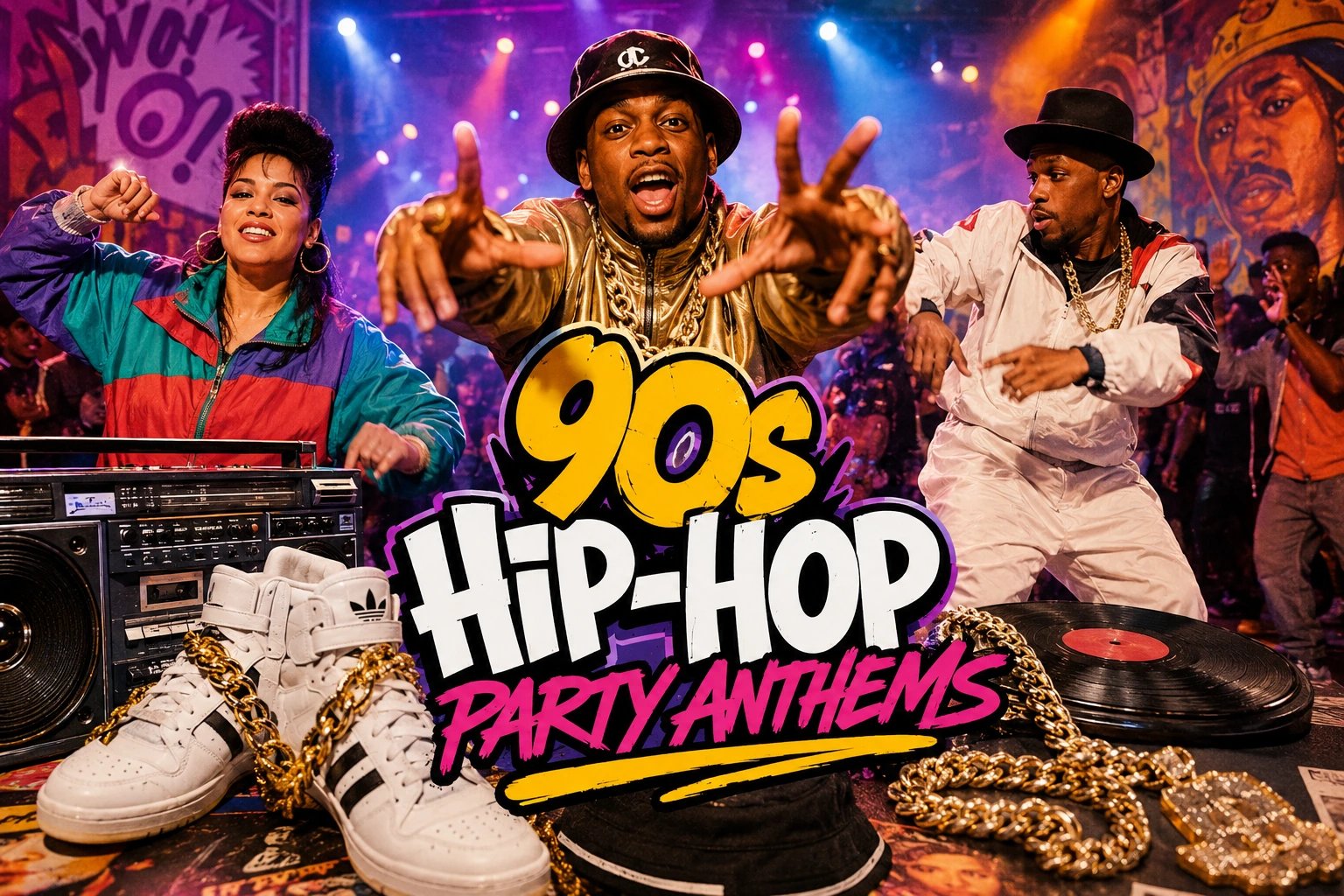
90s Hip-Hop Dance and Party Songs
90s hip-hop dance and party songs were not just background music. They were school-dance survival tests, skating-rink commands, house-party accelerants, club records, car-stereo weapons, MTV moments, clean-edit miracles, and the soundtrack to Gen X pretending rhythm was optional. Some were goofy. Some were genius. Some were so overplayed you wanted to throw the radio into traffic. And yet, decades later, the right beat still hits and suddenly everyone is sixteen again, wearing terrible jeans, yelling the hook, and making choices the yearbook photographer should have stopped.
The best 90s hip-hop dance and party songs include records like “Jump Around,” “O.P.P.,” “Hip Hop Hooray,” “This Is How We Do It,” “Shoop,” “Whatta Man,” “Rump Shaker,” “Tootsee Roll,” “C’mon N’ Ride It,” “I Got 5 on It,” “Mo Money Mo Problems,” “Feel So Good,” “Back That Azz Up,” “Gettin’ Jiggy Wit It,” and plenty of bass-heavy, goofy, radio-ready, club-tested songs that made Gen X move whether we deserved the confidence or not. This post belongs inside the larger 90s Hip-Hop and Rap guide, the wider 90s Music rewind, and the full 90s nostalgia map.
Press Play on the 90s Hip-Hop Party Rewind
Before we start arguing over which song destroyed the most school dances, skating rinks, house parties, car stereos, and gym floors, here is the playlist version. Hit play, then keep scrolling through the full Gen X damage report below.
90s Hip-Hop Party Songs Were the Sound of Everybody Losing Their Mind Together
90s hip-hop dance and party songs mattered because they were the records that escaped the headphones and took over rooms. Not every classic rap record is a party record, and not every party record is a lyrical monument. That is fine. Party songs have a different job. They are supposed to move the room, make the hook stick, give the DJ a weapon, and convince regular people with no training, no shame, and no coordination that now is their moment.
This side of 90s rap is essential to the larger 90s Hip-Hop and Rap story because hip-hop was never only about serious album statements, street narratives, or lyrical combat. It was also about DJs, crowds, call-and-response, bass, dancing, house parties, parks, clubs, block parties, school gyms, car stereos, skating rinks, and making people react immediately. The party was not a side quest. It was part of the foundation.
The 90s made that foundation huge. Rap party records moved through 90s Rap Radio Crossover, MTV videos, clean edits, soundtrack singles, club remixes, cassette singles, CD singles, and every boombox or dashboard that could survive the bass. The songs lived everywhere: the gym, the basement, the mall, the car, the dance floor, the rink, the summer party, the bus ride, the dorm room, and the friend’s house where someone’s parents were absolutely not home.
These records also made hip-hop social for people who did not necessarily own every album. A casual listener might not know the deep cuts, the producers, the regional history, or the full album context, but they knew when “Jump Around” hit. They knew “Hip Hop Hooray.” They knew “Shoop.” They knew “This Is How We Do It.” They knew the hook, the movement, the chant, the part where everyone pointed, jumped, clapped, bounced, or shouted the clean version with suspicious accuracy.
That accessibility sometimes made party rap easy to dismiss. Too goofy. Too commercial. Too repetitive. Too hooky. Too dance-oriented. Too much fun, which is apparently a crime in some parts of music criticism. But dismissing these records misses the point. Songs that move people are not automatically lesser. A great party record is engineering. It has to work fast, survive bad speakers, make sense in public, and still hit after being played for the 400th time by a DJ who clearly had no backup plan.
The best 90s hip-hop dance and party songs also preserve lifestyle memory. You remember where you heard them. The school dance. The roller rink. The summer cookout. The club. The dorm hallway. The car with one speaker buzzing like a lawn mower. The tape you wore out. The MTV video. The party where someone tried a move they had no business attempting. That is why these records are still powerful. They are not only songs. They are location stamps.
This post also connects naturally to Forgotten 90s Party Anthems, because the decade had more party fuel than the obvious hits. It connects to Forgotten 90s Hip-Hop Songs, because plenty of room-rocking records fell out of everyday conversation. It connects to 90s Hip-Hop One-Hit Wonders, because one gigantic party song could make an artist immortal at every wedding reception, school reunion, and badly lit bar for the rest of time.
And for the big-picture song map, this page should sit beside 50 Essential 90s Hip-Hop Songs and 90s Hip-Hop Songs That Defined the Decade. Those pages cover the decade’s broader legacy. This one covers what happened when the beat left the headphones and started wrecking gym floors.
School Dances Turned 90s Rap Into a Gym-Floor Social Experiment
If a 90s hip-hop party song could survive the clean edit and still move a gym full of awkward teenagers, it had passed one of the decade’s hardest tests.
The Clean Edit Did the Lord’s Work
Teachers heard the safe version. Students heard the real one in their heads. Everybody pretended this was fine.
The school dance is where 90s hip-hop party songs became collective memory. A gym, bad lights, a folding table DJ setup, maybe some balloons, definitely a few teachers standing around like mall security, and then one rap record would hit and the whole room changed. Suddenly the awkwardness had a beat.
Clean edits were the miracle and the comedy. They made the songs playable in public spaces where adults were pretending they had control. Everyone knew the missing words. Everyone knew the real version existed. The clean edit would drop out, reverse, mute, replace, or scramble the obvious part, and a whole gym full of teenagers would mentally fill in the blank with Olympic-level precision.
Songs like “Hip Hop Hooray,” “Jump Around,” “This Is How We Do It,” “Shoop,” “Whatta Man,” “Rump Shaker,” “Tootsee Roll,” and “C’mon N’ Ride It” had the kind of hooks and chants that could survive bad acoustics. That mattered because school gyms were not built for bass. They were built to make sneakers squeak and make every song sound like it was being played inside a cafeteria tray.
These records also created shared movement. Some songs had obvious gestures. Some had dances. Some had a call-and-response section. Some just made everyone jump because jumping was the only choreography most of us could manage without paperwork. The 90s were full of kids who did not “dance” so much as bounce with intent.
This is why the school-dance side of 90s rap belongs beside 90s Rap Radio Crossover. The songs that made it into school events were often the ones that had already crossed the radio line. They were recognizable, edited, hook-heavy, and safe enough for adults to misunderstand.
The school dance also helped turn songs into life markers. You may not remember the date. You may not remember the outfit, unless a photo exists and still threatens your dignity. But you remember the song. You remember the floor. You remember the exact moment when everyone rushed in at once because the beat told them it was safe to stop leaning against the wall.
Suspiciously obvious
The radio version made the song school-safe while somehow making everyone more aware of the missing words.
Bad acoustics, great memory
Every beat bounced off the walls like it was trapped in a locker, and somehow the songs still worked.
Participation pending
Some people danced. Some people watched. Some people waited for one song to justify their whole outfit.
The Club Cuts Were Built to Make the Room Move Before Anyone Had Time to Think
Club records did not need a long explanation. They needed a beat, a hook, bass, space to move, and enough urgency to make the DJ look like a genius for three minutes.
The DJ Had Weapons
The best records grabbed the room fast: bass first, hook next, dignity last.
Club cuts are a different breed from radio smashes. A radio record can grow on you. A club record has about eight seconds to prove it belongs. The drums need to hit. The bass needs to move air. The hook needs to be obvious. The energy needs to tell the room what to do before anyone starts pretending they are “just listening.”
90s hip-hop club records came from multiple directions. New York brought chant-heavy crowd records and East Coast bounce. The West brought laid-back funk that could still fill a floor. The South brought bass, bounce, and regional dance energy that became more powerful as the decade went on. Rap/R&B crossover brought smoother songs that could move from radio into the club without changing clothes.
This is where a lot of the decade’s regional variety mattered. East Coast Hip-Hop in the 90s gave the party a different kind of energy than West Coast Hip-Hop in the 90s. Southern Hip-Hop in the 90s changed the room with bass, bounce, chants, and club language that did not wait for coastal approval.
The club also exposed which records were pretending. A song could be clever, popular, expensive, or video-heavy, but if it did not move a room, the floor would tell on it. Great party rap had to survive public testing. That is why so many of these songs still work. They were pressure-tested in rooms full of people who had no obligation to care.
By the late 90s, club records also connected to The Shiny Suit Era of Late-90s Rap. The glossy video singles were not just for MTV. Many were built for nightlife, bottle-service fantasy, dance-floor confidence, and the idea that success should have a beat you could move to.
House Parties Were Where the Songs Got Personal
Before playlists did all the work, somebody had to bring the tape, CD, speaker, boombox, or questionable stereo setup. The wrong song could kill the room. The right song could make the whole night.
The Stereo Was the Centerpiece
One good tape, one brave DJ friend, one overloaded speaker, and suddenly the living room had delusions of nightclub grandeur.
House parties gave 90s hip-hop dance songs their most personal setting. No big club system. No MTV lighting. No professional DJ booth. Just a living room, basement, backyard, dorm room, or bedroom with furniture pushed against the wall and a stereo that was fighting for its life.
The music mattered because it controlled the room. A party tape or CD stack had to be sequenced with care. Too many slow songs and the energy died. Too many aggressive records and the room got weird. Too many novelty songs and people started judging the host. The best 90s party rap had just enough familiarity, bass, humor, and movement to keep everyone in the same orbit.
This is where songs like “O.P.P.,” “Hip Hop Hooray,” “Jump Around,” “I Got 5 on It,” “Regulate,” “This Is How We Do It,” “Shoop,” and “Whatta Man” became social glue. They were not all the same kind of party record, but they could all change the mood. Some made people dance. Some made people chant. Some made people lean back against a wall and act cooler than their shirt allowed.
House parties also created the Gen X version of playlist anxiety. Except instead of a phone, it was a stack of CDs, a mixtape, or a cassette single where rewinding took commitment. Someone always wanted to hear the same song again. Someone always wanted to skip ahead. Someone always touched the stereo without permission. Society survived somehow.
The house-party lane also overlaps with Forgotten 90s Party Anthems. A lot of songs that once worked in rooms do not get the same nostalgia spotlight today because they were more functional than canonical. But functional matters. A record that kept the room alive did its job.
Skating Rinks Made Party Rap Feel Like It Had Wheels
The skating rink was one of the most underrated places 90s hip-hop party songs lived: lights low, floor shining, bass bouncing, and everyone trying not to wipe out during the best part.
The Beat Had Wheels
Some songs did not just make people dance. They made a whole rink lean into the turn.
Skating rinks were one of the secret temples of 90s party music. The lighting was dramatic for no reason. The carpet looked like a bowling alley had a migraine. The sound system was either incredible or deeply haunted. And when the DJ dropped the right hip-hop record, the whole floor moved like a low-budget music video on wheels.
Not every rap party song worked at the rink. The best rink records had bounce, momentum, repetition, and enough groove to carry people around the floor. Bass-heavy songs worked. Dance records worked. Call-and-response worked. Anything with a simple hook worked. Anything too lyrically dense risked becoming background while someone’s rental skate tried to murder them.
The rink also made regional party rap feel bigger. Bass music, Miami influence, Southern bounce, and club rap all found a home in spaces where movement mattered more than chin-stroking. That connects to Southern Hip-Hop in the 90s, because the South understood party function, bass response, and crowd participation in a way that changed the decade’s physical energy.
The skating rink is also where some goofy records became undeniable. A song could be lyrically ridiculous and still work perfectly when the lights went down and the floor started moving. That is the point. The body does not always care whether the critic approves. Sometimes the hook hits, the bass moves, and the roller rink has spoken.
MTV Made Party Rap Visual. Radio Made It Unavoidable.
A party rap song could start in clubs or regional scenes, but MTV and radio could turn it into national memory.
The Hook Got a Visual
The video showed you the move. The radio made you hear it ten more times before dinner.
MTV and radio turned 90s hip-hop party songs into national events. A record could be big locally, huge in clubs, or hot in a regional scene, but once the video hit rotation and the clean edit started getting daytime spins, the song had a new life. Suddenly it was not just a record. It was a shared cultural object.
This connects directly to Hip-Hop on MTV in the 90s. Party rap was perfect for video because the camera could show movement: dancers, crews, clubs, block parties, cars, skating-rink energy, school-dance gestures, fashion, and the general feeling that everyone on screen had somewhere better to be than math class.
MTV also helped create visual choreography for the audience. Even when a song did not have an official dance, the video gave people clues. How do you stand? What do you do with your hands? How much confidence is too much? The answer, in the 90s, was usually “whatever you are doing, somehow more.”
Radio did the repetition work. 90s Rap Radio Crossover was the reason many party records jumped from hip-hop spaces into everyone’s day. The hooks were clean enough, big enough, and familiar enough to live in Top 40, urban radio, mix shows, countdowns, and school-event playlists.
Soundtrack culture helped too. A party record could live on a CD, show up in a movie-adjacent video, hit radio, and suddenly belong to the same memory bank as 90s Hip-Hop Movie Soundtracks. The decade loved a song that could move from a movie trailer to a dance floor without changing shoes.
This is why so many 90s hip-hop party songs became bigger than their original scenes. MTV gave them the look. Radio gave them the repetition. The mall gave them the soundtrack placement. The school dance gave them social trauma. The car stereo gave them volume. Gen X supplied the bad decisions.
50 Essential 90s Hip-Hop Dance and Party Songs
This is not a museum ranking. It is a room-tested, Gen X memory list: records that moved parties, gyms, cars, clubs, rinks, MTV blocks, radio rotations, and the part of your brain that still knows the hook without permission.
The Room-Tested List
Some are classics. Some are ridiculous. Some are both, which is where the decade did its finest work.
1. House of Pain — “Jump Around”
This is less a song than a crowd-control device. The beat hits, the horn squeals, and suddenly everyone thinks the structural integrity of the floor is someone else’s problem. “Jump Around” crossed scenes because it was simple, aggressive, funny, and instantly physical. It did not ask for dance skills. It demanded vertical commitment.
2. Naughty by Nature — “Hip Hop Hooray”
The hook was a built-in group activity, which is why it destroyed rooms. “Hip Hop Hooray” had bounce, chant, personality, and that arm-swinging crowd move that made everyone feel unified for about four minutes. Naughty by Nature understood party rap without making it feel disposable.
3. Naughty by Nature — “O.P.P.”
“O.P.P.” was naughty enough to feel dangerous, clean enough to travel, and catchy enough to become unavoidable. The genius was the hook: everybody could chant it, even if half the room pretended not to know what it meant. Perfect early-90s crossover chaos.
4. Montell Jordan — “This Is How We Do It”
Technically riding the rap/R&B line, but no 90s party conversation survives without it. The song felt like a Friday night in audio form: smooth, celebratory, instantly familiar, and impossible to hear without picturing someone raising a plastic cup like they had just solved life.
5. Salt-N-Pepa — “Shoop”
“Shoop” was playful, confident, funny, flirtatious, and completely in control. Salt-N-Pepa made party rap feel smart and fun without begging for approval. The groove was laid-back but still moved the room, and the hook had the kind of bounce that made it work everywhere.
6. Salt-N-Pepa with En Vogue — “Whatta Man”
A rap/R&B crossover masterclass. Salt-N-Pepa brought attitude and charm, En Vogue brought vocal polish, and the whole thing became a party record that worked at dances, on radio, and in every room where people suddenly remembered they had standards.
7. Wreckx-N-Effect — “Rump Shaker”
Subtle? Absolutely not. Effective? Annoyingly, yes. “Rump Shaker” was horn-driven, goofy, huge, and built for rooms that did not need lyrical introspection at that exact moment. It belongs here because the beat did exactly what it was hired to do.
8. 69 Boyz — “Tootsee Roll”
A dance instruction record with no interest in dignity. “Tootsee Roll” is the kind of song that proves party rap lives by different laws. Was it deep? No. Did it work in gyms, rinks, parties, and clubs? Unfortunately for all of our reputations, yes.
9. Quad City DJ’s — “C’mon N’ Ride It (The Train)”
This song is basically a public transportation announcement for people who lost control of their knees. It was goofy, communal, loud, and impossible to resist in the exact environments where judgment had already left the building.
10. Tag Team — “Whoomp! (There It Is)”
A chant record so powerful it escaped music and became a sports-arena, commercial-break, party-room, and wedding-reception organism. It is the definition of a song that was everywhere, then somehow stayed everywhere.
11. DJ Kool — “Let Me Clear My Throat”
Pure live-party energy. The record feels like a DJ grabbing the room by the collar and reminding everyone why call-and-response is undefeated. It is messy, sweaty, loud, and perfect for the exact moment when a party needs oxygen.
12. Digital Underground — “The Humpty Dance”
Weird, funky, funny, and completely its own thing. “The Humpty Dance” brought personality to the party in a way few records could. It was goofy, but not empty. It had character, funk, quotables, and enough strangeness to make the room better.
13. Sir Mix-A-Lot — “Baby Got Back”
A novelty record, a body anthem, a cultural argument, and a party grenade all at once. “Baby Got Back” became unavoidable because the hook was huge and the concept was impossible to miss. It also became one of the decade’s clearest examples of a rap song becoming pop-culture furniture.
14. Coolio — “1, 2, 3, 4 (Sumpin’ New)”
Coolio could do darker crossover, but this one lived in the party lane: bright, hooky, radio-friendly, and built for people who wanted rap with a bounce instead of a lecture. It is one of those records that instantly sounds like mid-90s radio sunlight.
15. Luniz — “I Got 5 on It”
Darker, smoother, and more hypnotic than a lot of party records, but absolutely essential. “I Got 5 on It” worked because the groove was undeniable. It was not a jump-around record. It was a lean-back, nod-hard, everybody-knows-the-hook record.
16. Warren G featuring Nate Dogg — “Regulate”
Smooth enough for radio, funky enough for the car, and cool enough to slow the party down without killing it. “Regulate” proves that not every party record needs to shout. Sometimes the room just needs to cruise. It belongs right next to the larger West Coast Hip-Hop in the 90s story.
17. Dr. Dre featuring Snoop Dogg — “Nuthin’ but a ‘G’ Thang”
A groove so laid-back it somehow became a party command. This is where the G-Funk 90s West Coast Sound became unavoidable in social spaces: cars, parties, dorm rooms, and anywhere people wanted to feel cooler than they were.
18. Snoop Doggy Dogg — “Gin and Juice”
Relaxed, catchy, funny, and permanently tied to 90s party imagery. “Gin and Juice” did not sprint. It coasted. That was the genius. It made the party feel like it was already happening before the first verse finished.
19. 2Pac featuring Dr. Dre and Roger Troutman — “California Love”
Giant, cinematic, and built like an event. “California Love” is bigger than party rap, but it absolutely owned parties. The beat, the hook, the video, the West Coast confidence — everything about it felt like the room had just been upgraded.
20. The Notorious B.I.G. featuring Puff Daddy and Mase — “Mo Money Mo Problems”
A late-90s shiny-suit party missile: bright sample, huge hook, glossy video, and commercial rap confidence turned all the way up. It belongs equally to The Shiny Suit Era of Late-90s Rap and every party where people shouted the chorus like they had financial problems worth celebrating.
21. Mase — “Feel So Good”
Smooth, glossy, sample-driven, and pure late-90s radio-party energy. Mase made the shiny suit lane feel effortless, like the party had already started and he was just arriving late on purpose.
22. Puff Daddy featuring Mase — “Can’t Nobody Hold Me Down”
A sleek commercial-rap statement with a hook built to loop forever. It helped set the tone for late-90s party rap where success, shine, samples, and radio hooks all moved together.
23. Jay-Z — “Hard Knock Life (Ghetto Anthem)”
A massive sample flip, a huge chantable hook, and a crossover moment that pushed Jay-Z deeper into mainstream spaces. It was not a goofy party record, but it absolutely worked in rooms because everyone knew the hook instantly.
24. DMX — “Ruff Ryders’ Anthem”
Rawer than the shiny stuff, but still a room-destroyer. “Ruff Ryders’ Anthem” brought aggression, chant energy, and a beat simple enough to become a public command. It was the rough counterweight to late-90s gloss.
25. Busta Rhymes — “Put Your Hands Where My Eyes Could See”
Sleek, weird, stylish, and video-heavy without feeling like standard shiny suit rap. Busta brought movement, personality, and theatrical energy that made his party records feel like events from another planet.
26. Busta Rhymes — “Woo Hah!! Got You All in Check”
Loud, animated, chaotic, and perfect for waking up a room. Busta was never background music. He arrived like the party had been too calm and needed professional disruption.
27. Missy Elliott — “The Rain (Supa Dupa Fly)”
Not a traditional party banger, but one of the coolest late-90s grooves ever to enter a room. Missy and Timbaland made the beat feel sparse, strange, futuristic, and impossible to ignore. It changed the temperature without yelling.
28. Missy Elliott featuring Da Brat — “Sock It 2 Me”
Slick, funky, strange, and futuristic. This is the late-90s party lane after Missy rewired it with space-age visuals and Timbaland bounce. It connects directly to Missy Elliott and Late-90s Hip-Hop Weirdness.
29. Da Brat — “Funkdafied”
Smooth, funky, confident, and underrated as a party record. Da Brat brought style and flow to a groove that worked in cars, rooms, and anywhere the beat had enough low end to behave properly.
30. Lil’ Kim featuring Lil’ Cease — “Crush on You”
Colorful, flashy, playful, and built for the late-90s video era. “Crush on You” was party-ready because the hook, style, and visual identity all worked together. It was fashion, flirtation, and radio bounce in one bright package.
31. Foxy Brown featuring Blackstreet — “Get Me Home”
Smooth rap/R&B crossover built for night drives, parties, and radio. Foxy brought cool control, Blackstreet brought polish, and the song lived in that late-90s lane where rap and R&B were basically sharing the same pager.
32. Queen Latifah — “U.N.I.T.Y.”
Not a party novelty, but it absolutely moved through public spaces with power. Queen Latifah made a record with message, strength, and enough groove to work beyond headphones. It belongs because dance-floor energy and substance are not enemies.
33. A Tribe Called Quest — “Award Tour”
Smooth, jazzy, warm, and perfect for parties that wanted cool instead of chaos. Tribe’s party energy was different: less jump-around, more head-nod, smile, groove, and pretend your outfit was more effortless than it was. That lane connects beautifully with A Tribe Called Quest and 90s Jazz Rap.
34. A Tribe Called Quest — “Scenario”
A posse cut that could detonate a room full of people who knew the verses. “Scenario” is not party rap in the novelty sense; it is party rap in the “everyone suddenly thinks they are in the cypher” sense.
35. Black Sheep — “The Choice Is Yours”
The hook became a public utility. “You can get with this…” was built for response, remixing, shouting, and DJ use. It is one of those early-90s records that never fully left the party toolkit.
36. Lords of the Underground — “Chief Rocka”
Rugged, catchy, and built around a hook that could grab a room fast. This is the kind of record that reminds you East Coast party rap could be hard-edged without losing crowd function.
37. Onyx — “Slam”
Pure mosh-pit rap energy. “Slam” was aggressive, chant-heavy, and perfect for rooms where people apparently wanted the dance floor to become a minor emergency. It brought hardcore energy into party spaces.
38. Cypress Hill — “Insane in the Brain”
Weird voice, huge hook, funky beat, and massive crossover reach. It could work at parties, on alternative-leaning radio, in cars, and with people who owned exactly one rap CD and made it this one.
39. Coolio featuring L.V. — “Fantastic Voyage”
Bright, funky, and built for movement. “Fantastic Voyage” had the kind of easygoing party energy that made it work across radio, cookouts, dances, and cars without feeling like it was trying too hard.
40. Heavy D & The Boyz — “Now That We Found Love”
Rap, dance, R&B, and pop joy all blended together. Heavy D made movement feel warm and welcoming, which is why this record worked anywhere people wanted a party without the room turning hostile.
41. MC Hammer — “U Can’t Touch This”
By the 90s, this was everywhere: videos, commercials, dances, living rooms, and every place parachute pants could cause public concern. Hammer made rap dance-pop unavoidable, and even the haters knew the hook.
42. MC Hammer — “2 Legit 2 Quit”
Too big, too long, too much, and absolutely part of the decade. It had gestures, spectacle, and the kind of public-participation hook that made it perfect for arenas, gyms, and anyone who confused confidence with cardio.
43. Vanilla Ice — “Ice Ice Baby”
Yes, it belongs here. Not because it is the deepest record in the room, but because it was a 90s party fact. It was everywhere, everyone knew it, and denying that is just nostalgia laundering.
44. Will Smith — “Gettin’ Jiggy Wit It”
Clean, shiny, goofy, and incredibly effective. Will Smith made party rap safe for every room, which is why some people mocked it and everyone still heard it constantly. It was late-90s crossover polish with a giant smile.
45. Will Smith — “Miami”
A postcard disguised as a party song. Bright, breezy, hooky, and designed for warm-weather fantasy. It connected pop-rap, travel imagery, and late-90s radio sunshine in the most unapologetically clean way possible.
46. Pras featuring Ol’ Dirty Bastard and Mýa — “Ghetto Supastar”
Soundtrack single, rap/R&B/pop blend, and late-90s crossover glue. It worked because the hook was smooth, the personalities were strange together, and the whole thing felt like radio had been engineered in a lab.
47. Wyclef Jean — “We Trying to Stay Alive”
Familiar sample energy, Fugees-adjacent cool, and a party feel that sits right in the late-90s crossover pocket. It is not a gym-floor shout record. It is a stylish groove record with pop memory baked in.
48. Q-Tip — “Vivrant Thing”
Sleek, grown, danceable, and cooler than most late-90s party records had any right to be. Q-Tip made a club-friendly track that felt stylish instead of desperate, which is harder than it sounds.
49. Juvenile featuring Mannie Fresh and Lil Wayne — “Back That Azz Up”
The late-90s party door getting kicked open by New Orleans bounce and Cash Money energy. It became one of those records that could change a room immediately, and it points straight to how Southern rap would dominate the next era.
50. Trick Daddy featuring Trina — “Nann”
Raw, regional, late-90s, and club-ready in a way that pointed toward the next wave of Southern rap visibility. It was not polished like the shiny suit lane. It was rougher, louder, and built for different rooms.
The South Knew Party Function Before the Industry Fully Caught Up
No 90s hip-hop party guide is complete without talking about bass, bounce, and regional party rap. For too long, national conversations treated Southern party records like novelty or local flavor, which is a fancy way of saying people missed the point. The South understood body music, bass pressure, crowd response, chant hooks, dance instruction, and regional identity at a deep level.
Miami bass, New Orleans bounce, Atlanta party records, Memphis underground energy, Houston car culture, and Florida club records all helped shape how 90s rap moved people physically. Not every one of these songs got the same prestige as New York lyricism or West Coast album classics, but plenty of them did the most important party job: they made the room react immediately.
This is why Southern Hip-Hop in the 90s matters so much. The South did not just arrive later as a commercial force. It spent the 90s building regional party languages that would take over huge parts of rap in the 2000s. If you want to understand where the next era came from, listen to what was already moving clubs, cars, rinks, and local scenes in the 90s.
Songs like “Tootsee Roll,” “C’mon N’ Ride It,” “Back That Azz Up,” and plenty of regional bass records worked because they were built around participation. The hook was not just something you heard. It was something you did. The beat gave instructions. The crowd answered. The floor became part of the song.
Low end as law
Bass records were built for cars, clubs, rinks, and speakers brave enough to accept the assignment.
Call, response, movement
Bounce turned crowd participation into a regional language that would only get bigger after the decade ended.
Party maps widened
The South expanded what national rap parties could sound like, even before the mainstream fully admitted it.
Women in 90s Hip-Hop Made Party Records Smarter, Funnier, Sexier, and Sharper
A lot of 90s party rap conversations get lazy and default to male artists yelling over bass. That misses a huge part of the decade. Women in hip-hop did not just participate in party rap; they made some of its smartest, most memorable, most confident records.
Women of 90s Hip-Hop shaped the party from multiple angles. Salt-N-Pepa made flirtation, humor, confidence, and hooks feel effortless. Queen Latifah brought authority and groove. Da Brat brought funk and tomboy cool. Lil’ Kim brought fashion, color, sexuality, and late-90s visual power. Foxy Brown brought smooth confidence. Missy Elliott took party music into the future and made weirdness danceable.
“Shoop” and “Whatta Man” are essential because they show how women controlled the mood without sacrificing personality. They were fun, but not flimsy. Sexy, but not passive. Commercial, but not empty. Those songs worked because the artists sounded like they were in charge of the room.
Missy changed the rules later in the decade. Her records did not always follow standard party formulas. The beats were stranger. The videos were weirder. The spaces were futuristic. But the grooves worked. That is why Missy Elliott and Late-90s Hip-Hop Weirdness belongs in this conversation. She proved a party record could sound like it came from a spaceship and still make people move.
Party control
Hooks, humor, confidence, and records that made the dance floor feel like a conversation they were leading.
Authority and groove
Latifah brought message, presence, and rhythm without needing to choose between power and movement.
Glam and command
Late-90s style, sexuality, confidence, and rap/R&B polish with attitude fully intact.
Future party
Missy made weirdness danceable and turned late-90s video energy into a new kind of party language.
The Shiny Suit Era Turned Party Rap Into a Luxury Video Fantasy
By the late 90s, party rap had a new kind of gloss. Big samples, shiny videos, designer-coded outfits, dance crews, expensive sets, and rap/R&B hooks turned certain songs into full visual events. The party was not just happening in a room anymore. It was happening on MTV with lighting, wardrobe, and a budget that looked like it needed its own accountant.
The Shiny Suit Era of Late-90s Rap gave party records a luxury fantasy layer. “Mo Money Mo Problems,” “Feel So Good,” “Been Around the World,” “Can’t Nobody Hold Me Down,” and other glossy records were built around familiar samples, big hooks, and video identity. They were not always subtle, but subtle was not the assignment.
The shiny suit party record worked because it made success feel danceable. It was not just “we made it.” It was “we made it, the floor is reflective, the suit is loud, the sample is familiar, and you already know the hook.” It was commercial rap looking at the mainstream and refusing to enter quietly.
This late-90s gloss also showed how party rap could become lifestyle branding. The clothes, cars, rooms, jewelry, clubs, and dance crews were part of the record’s identity. You did not just hear the song. You remembered the video. You remembered the look. You remembered the shine. You remembered thinking, “This is ridiculous,” and then not changing the channel.
The Forgotten Party Cuts Deserve Their Own Apology Letter
Not every 90s hip-hop party song gets the same nostalgia spotlight. Some became permanent cultural fixtures. Others were huge in the moment, worked in rooms, lived on radio, moved rinks, kept house parties alive, then slowly vanished from the standard throwback playlist. That does not mean they failed. It means nostalgia got lazy.
This is why Forgotten 90s Party Anthems is such an important companion to this page. The decade had tons of party records that are not always treated like “serious” classics but absolutely did the job. Sometimes the job was making people dance. Sometimes it was keeping a party from dying. Sometimes it was giving one friend a reason to yell “this is my song” for the ninth time that night.
The same thing applies to Forgotten 90s Hip-Hop Songs. A record can fall out of rotation for reasons that have nothing to do with quality: changing tastes, missing videos, sample clearance headaches, regional memory, radio burnout, or the simple fact that the 90s produced too much music for one nostalgia playlist to carry.
And then there are the 90s Hip-Hop One-Hit Wonders. Party rap made one-hit immortality possible because one record could be enough. If your song moved enough rooms, you did not need a long catalog to stay alive in memory. One giant hook could buy you three decades of cookouts, DJ sets, retro nights, and people yelling the chorus like it was civic duty.
90s Party Rap Changed Shape Every Year
The party side of 90s hip-hop did not stay still. Early-90s dance-pop rap, mid-90s radio crossover, regional bass, rap/R&B blends, and late-90s shiny gloss all took turns running the room.
The early 90s still had a lot of dance-pop rap energy: MC Hammer, Vanilla Ice, Digital Underground, C+C-adjacent club culture, and the sense that rap was entering mainstream party spaces in loud, sometimes goofy, impossible-to-ignore ways. Those songs belong beside broader year-by-year pages like 1990 Songs, 1991 Songs, and 1992 Songs.
The middle of the decade widened the lane. Party rap got funkier, smoother, more radio-friendly, and more varied. Salt-N-Pepa, Coolio, Warren G, Montell Jordan, Da Brat, Luniz, and regional party records helped make 1993, 1994, 1995, and 1996 feel loaded with room-moving crossover possibilities.
The late 90s brought gloss, giant hooks, bigger video budgets, and the start of Southern rap’s next wave. 1997, 1998, and 1999 are where shiny suits, Missy weirdness, Jay-Z crossover, DMX intensity, and New Orleans bounce all shared space in the same chaotic countdown universe.
The Best 90s Hip-Hop Party Songs Still Work Because the Room Remembers
The technology changed. The dance floors changed. The jeans got smaller, then bigger again because fashion has no shame. But the songs still know how to move people.
The Hook Survived
The songs stayed alive because they were attached to rooms, rides, dances, parties, and memories with bass.
The legacy of 90s hip-hop dance and party songs is simple: the room remembers. A song that moved people in 1993 can still move people now because the physical memory is stored somewhere deeper than taste. You hear the hook and the body remembers the gym, the car, the skating rink, the party, the club, the couch, the friend group, the outfit, the bad lighting, and the exact level of confidence you had no right to possess.
These records also helped normalize hip-hop as everyday music. Not just something for heads. Not just something for late-night specialty shows. Not just something parents worried about. Party rap helped make hip-hop part of public life: radio, TV, sports arenas, dances, stores, movies, weddings, reunions, and every event where someone eventually says, “Play something people know.”
That makes these songs central to the wider 90s Hip-Hop and Rap story. They were not always the deepest records, but they carried the culture into shared spaces. They helped rap become social, visible, repeatable, danceable, and impossible to ignore.
They also preserve the weird democracy of the dance floor. A song did not need to be critically approved to matter. It needed to work. If it made people move, it earned its place. That is why a truly honest 90s hip-hop memory has room for Tribe, Tupac, Biggie, Missy, Salt-N-Pepa, Naughty by Nature, House of Pain, Miami bass, New Orleans bounce, shiny suit records, one-hit wonders, and songs so goofy you still know every word.
The best party songs are not embarrassed by joy. That may be their greatest strength. They do not stand in the corner trying to look serious. They hit the floor, grab the room, and remind everyone that hip-hop has always been about movement as much as message.
Where to Go Next
90s hip-hop party songs connect to radio crossover, MTV videos, fashion, forgotten anthems, one-hit wonders, regional rap, shiny suits, women in hip-hop, movie soundtracks, and the bigger 90s music map.
90s Hip-Hop Dance and Party Songs FAQ
What were the best 90s hip-hop dance and party songs?
Some of the best 90s hip-hop dance and party songs include “Jump Around,” “Hip Hop Hooray,” “O.P.P.,” “This Is How We Do It,” “Shoop,” “Whatta Man,” “Rump Shaker,” “Tootsee Roll,” “C’mon N’ Ride It,” “I Got 5 on It,” “Mo Money Mo Problems,” “Feel So Good,” “Back That Azz Up,” and “Gettin’ Jiggy Wit It.”
Why were clean edits so important for 90s hip-hop party songs?
Clean edits helped rap songs move into school dances, daytime radio, MTV, skating rinks, and public events. They made party records easier to play in mainstream spaces while still letting listeners mentally fill in the original lyrics.
What made a 90s hip-hop song work at parties?
A strong 90s hip-hop party song usually had a big hook, memorable beat, bass, call-and-response, danceable tempo, recognizable sample, or simple movement cue. The best ones worked fast and could move a room even through bad speakers.
Were 90s hip-hop party songs always commercial?
No. Some party songs were major radio crossover hits, but others came from clubs, regional scenes, bass music, underground spaces, mixtapes, and local party culture. A record did not have to be polished to move a room.
How did MTV affect 90s hip-hop party songs?
MTV helped turn party rap songs into visual memories. Videos showed the clothes, dances, rooms, cars, crews, and movement attached to a song, making the record easier to remember and copy.
What should I read next?
Start with 90s Hip-Hop and Rap, then read 90s Rap Radio Crossover, Forgotten 90s Party Anthems, 90s Hip-Hop One-Hit Wonders, and Hip-Hop on MTV in the 90s.