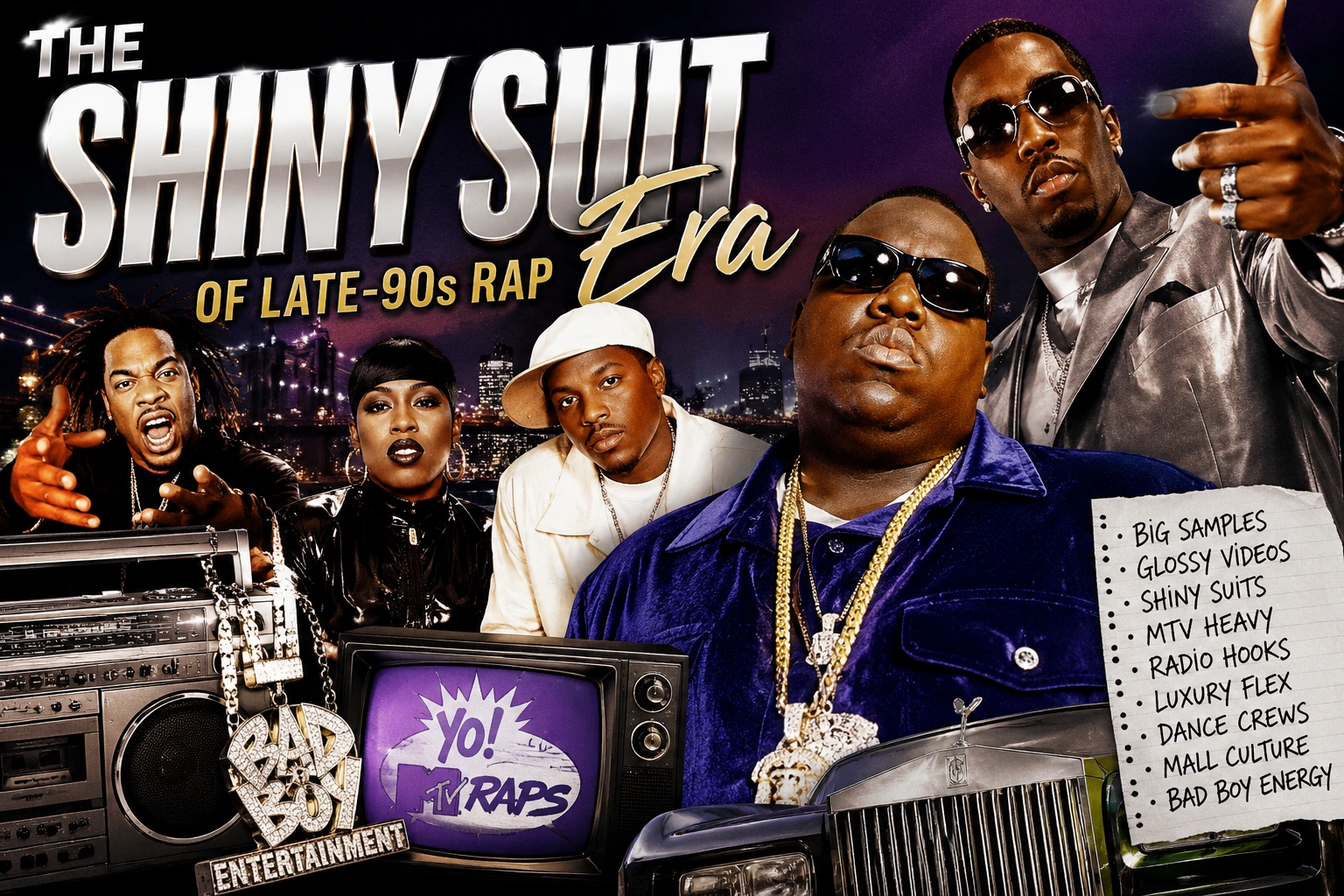
The Shiny Suit Era of Late-90s Rap
The shiny suit era of late-90s rap was glossy videos, giant samples, radio hooks, dance crews, fisheye lenses, champagne-room lighting, leather couches nobody should own, luxury fantasy, and enough reflective fabric to blind a satellite. It was commercial rap in full widescreen mode: loud, slick, over-the-top, expensive-looking, occasionally ridiculous, and absolutely impossible for Gen X to ignore when MTV and radio were feeding it to us like a sugar cereal with a parental advisory sticker.
The shiny suit era of late-90s rap was the glossy commercial moment when hip-hop videos leaned hard into luxury, big samples, radio-friendly hooks, dance crews, fisheye lenses, bright suits, MTV spectacle, and mainstream success you could see from orbit. It sits inside the larger 90s Hip-Hop and Rap story, connects directly to 90s Rap Radio Crossover, Hip-Hop on MTV in the 90s, 90s Hip-Hop Fashion, and the wider 90s Music universe.
The Shiny Suit Era Was Rap Success Turned Into a Music Video Theme Park
The shiny suit era was the moment late-90s rap decided subtlety was for people with smaller video budgets. It was glossy, sample-heavy, hook-friendly, fashion-forward, camera-hungry, and completely allergic to looking low-key. If early-90s hip-hop often looked gritty, local, smoky, and street-level, the shiny suit era looked like somebody opened a champagne bottle inside a fisheye lens and yelled, “Make the floor reflective.”
This was not just about literal shiny suits, although there were plenty of those and some of them could probably redirect traffic. The phrase stands for a broader late-90s commercial rap style: big-budget videos, polished hooks, familiar samples, luxury imagery, coordinated outfits, dancers, label-brand spectacle, expensive rooms, and a kind of visual confidence that said rap had not only entered the mainstream — it had taken over the lobby and redecorated.
The shiny suit era belongs inside the larger 90s Hip-Hop and Rap story because it shows what happened after hip-hop became too big for mainstream radio and MTV to keep at arm’s length. Earlier in the decade, rap fought for space. By the late 90s, rap was filling that space with chrome, samples, suits, dancers, and hooks your brain still files under “unavoidable.”
It also connects directly to 90s Rap Radio Crossover. The shiny suit era was built for repetition. The songs often had huge choruses, clean edits that worked, R&B hooks, familiar samples, and enough pop gravity to live between other Top 40 hits without feeling like an alien transmission. That was the point. These records were designed to move through radio, MTV, clubs, malls, car stereos, school dances, soundtrack CDs, and every room where somebody said, “I hate this song,” then immediately sang the hook.
It was also a visual sequel to the fashion explosion covered in 90s Hip-Hop Fashion. The early and mid-90s gave us oversized denim, Timbs, sportswear, workwear, jerseys, regional looks, and streetwear identity. The shiny suit era did not erase that. It put a glossy commercial layer on top: metallic fabrics, designer references, leather, sunglasses, suits, jewelry, and the “we made it” look turned up until the knob broke off.
And yes, the era was ridiculous. That is part of why it still rules the memory bank. The videos were too shiny. The suits were too loud. The dancing was too coordinated. The samples were sometimes too obvious. The rooms were too expensive. The camera angles made everyone look like they were rapping from inside a crystal ball. But it was also fun, catchy, ambitious, and culturally important. Gen X did not always respect it. We absolutely watched it anyway.
The shiny suit era was rap success performing itself in public. It was hip-hop saying, “You wanted crossover? Fine. Here is crossover with a wind machine, a luxury couch, and a beat you already know from your parents’ record collection.” It was commercial, messy, sometimes brilliant, sometimes corny, and always visible from orbit.
By the Late 90s, Rap Was Big Enough to Look Expensive
The shiny suit era did not come from nowhere. It came from hip-hop’s commercial explosion, MTV’s video economy, radio crossover, label competition, sample culture, soundtrack culture, and a decade obsessed with visible success.
The shiny suit era happened because rap had gotten huge. Not important — it was already important. Huge. Commercially huge. Visually huge. Radio huge. MTV huge. Soundtrack huge. Mall huge. By the late 90s, hip-hop was no longer begging mainstream culture for attention. It was commanding attention, then charging admission.
Labels were spending more. Videos had bigger budgets. Artists were becoming household names. Hip-Hop on MTV in the 90s had turned rap stars into daily visual presences. A song did not just need to sound like a hit. It needed to look like one. The video became a business card, a fashion spread, a fantasy sequence, a brand launch, and a declaration of market dominance.
Radio mattered too. 90s Rap Radio Crossover had taught labels that big hooks could move rap across formats. If a record could work on hip-hop radio, pop radio, MTV, clubs, soundtracks, and mall speakers, it had a longer life and a much larger audience. That encouraged a sound with bigger choruses, cleaner edits, recognizable samples, R&B features, and production that felt polished enough for mainstream rotation.
The soundtrack economy mattered right alongside radio. By the late 90s, a rap or rap-adjacent single could live on a movie soundtrack, get a video full of film clips, hit radio, show up on MTV, and suddenly become part of the broader 90s Hip-Hop Movie Soundtracks machine. Soundtracks gave crossover rap another runway, and shiny-era songs knew exactly how to take off.
The late 90s were also an era of public success. Rap had always talked about aspiration, survival, money, status, and making it out. But the shiny suit era made those ideas visual at scale. The clothes, cars, jewelry, hotels, clubs, dancers, and city lights were not random props. They were a message: hip-hop had made it into rooms it was once excluded from, and now it was going to decorate those rooms loudly enough to upset the neighbors.
The sound was just as important as the look. Big samples gave casual listeners instant recognition. R&B hooks opened the door wider. Danceable tempos helped records cross into parties and school events. Clean versions made radio play easier. The formula could be powerful when it worked and painful when it felt forced. The 90s gave us both, because balance was apparently not in the budget.
This is why the shiny suit era sits near the end of the 90s Music timeline. It feels like a late-decade climax: the moment hip-hop’s commercial machine got loud, glossy, confident, and maybe a little drunk on its own reflection. It did not represent all of rap, not even close. But it represented one very specific moment when rap looked at mainstream America and said, “You hear us now? Great. Watch this.”
Videos needed to pop
Bigger budgets meant brighter looks, bigger sets, more dancers, and visuals built to survive constant rotation.
Hooks got huge
Rap singles needed choruses, clean edits, and familiar sounds that could jump from hip-hop radio to Top 40.
Money became visual
The clothes, cars, jewelry, and luxury sets turned commercial success into something you could see instantly.
MTV Made the Shiny Suit Era Look Even More Unavoidable
The shiny suit era was built for video: glossy rooms, moving cameras, dancers, luxury props, dramatic lighting, and that late-90s fisheye look that made everything feel expensive and slightly warped.
The Video Sold the Fantasy
Radio made the hook repeat. MTV made the suit, room, car, dance crew, and camera angle impossible to forget.
MTV was the shiny suit era’s natural habitat. A glossy rap single could do well on radio, but the video made it a full event. The camera moved. The lights flashed. The suits glowed. The dancers appeared. The sample hit. The hook arrived. The set looked like somebody spent an entire label advance on reflective surfaces and said, “Worth it.”
This is why Hip-Hop on MTV in the 90s is so important to understanding this era. By the late 90s, rap videos were not side content. They were part of how hits were built. The visual identity of a record could help push it into memory as much as the chorus did.
The shiny suit video had a language. Fisheye lenses. Wide-angle distortion. Bright suits. Metallic fabrics. Dancers in formation. Puffy jackets. Sunglasses indoors. Cars polished beyond reason. Champagne fantasy. Expensive hotel energy. Urban skyline shots. Club scenes. Slow-motion entrances. And a general sense that everyone in the video had somewhere more expensive to be immediately after filming.
MTV also turned style into evidence. If a record was big enough, the video looked big. If the video looked big, the record felt bigger. That loop mattered. It trained Gen X viewers to read production value as cultural force. If the suit was shiny, the sample was familiar, the lens was wide, and everyone was dancing in a hallway that looked like a luxury spaceship, you knew the song was being pushed like a federal program.
The MTV connection also tied shiny suit rap to 90s Hip-Hop Fashion. The clothes became just as memorable as the tracks. A record could put the hook in your head, but the video put the jacket in the mall. Every shiny suit, oversized leather coat, designer frame, matching outfit, and glossy late-90s video look became part of the decade’s style conversation.
MTV also placed shiny-era rap right next to the rest of the late-90s overload: teen pop, R&B videos, alternative leftovers, movie soundtrack singles, dance records, and TRL-era chaos. That broader screen environment connects the shiny suit era to the full 90s experience, because by the end of the decade everything felt like it was fighting for space on the same countdown.
For Gen X, this was couch culture. You watched after school, before going out, while getting ready, while eating something microwaved, or while waiting for the one video you actually wanted. And even if you rolled your eyes at the shiny excess, you still knew the hook. You still knew the look. You still watched.
Big Samples Gave Late-90s Rap a Built-In Memory Button
One reason shiny suit rap crossed over so hard: the samples were huge, familiar, and often impossible to miss. The beat would start and your brain already had a file open.
The Hook Arrived Pre-Loaded
Familiar samples helped late-90s rap move fast through radio, MTV, parties, and every car stereo with one working speaker.
Big samples were one of the shiny suit era’s secret weapons, except not that secret because sometimes the sample walked into the room wearing a name tag. Late-90s commercial rap often leaned on recognizable records: soul, funk, disco, pop, rock, and R&B fragments that older listeners knew and younger listeners could latch onto instantly.
This worked because familiarity is powerful. A sample could make a new rap record feel like it had already been in your life. It gave the song a shortcut into memory. For casual listeners, the sample was the welcome mat. For hip-hop fans, the flip was the question: did they do something fresh with it, or did they just put drums under your parents’ record and call it a day?
Sometimes the big sample strategy was brilliant. A familiar loop could become something new through flow, production, attitude, and context. Sometimes it was shameless in a way that only the late 90s could get away with. This was the era when the music industry discovered that nostalgia plus rap plus MTV plus clean edits could print money, and then behaved exactly how you would expect.
Big samples also helped with 90s Rap Radio Crossover. A familiar sample lowered the barrier for pop radio, especially when paired with a clean hook and polished video. Program directors who were nervous about rap could recognize the sample, and suddenly the record felt less like a risk and more like a ratings-friendly remix of memory.
The sample approach also created generational weirdness. Gen X heard the rap version first, then later discovered the original record and had that strange moment of “Wait, this was already a song?” Meanwhile, older relatives heard the sample and complained that “they ruined it,” which was legally required behavior at family gatherings.
This is why shiny suit rap still feels tied to the late-decade sound of 90s Music. It was built on the past, sold in the present, and repeated until it became its own nostalgia layer. A sample could be a bridge, a cheat code, a tribute, a shortcut, or a crime scene. Sometimes all five.
It also sits beside the more album-focused side of the decade. If Best 90s Hip-Hop Albums is about the full-length statements that gave the decade depth, the shiny suit era is about what happened when labels learned that one familiar loop, one giant hook, and one expensive video could turn a single into a cultural weather event.
The Shiny Suit Era Knew Exactly How to Build a Radio Hook
The late-90s rap machine understood that if the hook worked, the song could travel: radio, MTV, mall speakers, school dances, clubs, soundtrack CDs, and your friend’s car with the rattling trunk.
The Chorus Did the Heavy Lifting
Big hooks helped shiny suit rap cross formats, survive clean edits, and invade every corner of late-90s daily life.
The shiny suit era knew the hook was the key. Not every record was lyrically deep. Not every song needed to be. The point was movement, memory, repetition, and reach. If the chorus worked, the record could travel across radio formats, through MTV rotation, into clubs, onto soundtracks, and all the way into school dances where everyone knew the clean version and mentally supplied the rest.
This is where the shiny suit era overlaps hard with 90s Rap Radio Crossover. Clean edits mattered. R&B hooks mattered. Familiar samples mattered. A chorus that popped mattered. The single had to survive daytime radio and still feel big enough for night.
Rap and R&B chemistry was central to that formula. Smooth hooks could make a rap single softer around the edges without erasing its personality. That crossover lane connects to New Jack Swing, Rap, and R&B in the 90s and later to Lauryn Hill, the Fugees, and Hip-Hop Soul, though the shiny suit version often leaned more commercial, more polished, and way more interested in showing you the budget.
The hook-first strategy also explains why some shiny suit records were everywhere. They were built to be everywhere. They were built for Top 40 stations that wanted rap but wanted it digestible. They were built for MTV countdowns. They were built for clubs. They were built for CD singles. They were built for mall speakers. They were built for the part of your brain that cannot throw away choruses even after twenty-five years of trying.
The radio hook also tied shiny-era rap to party culture. These records could sit right next to 90s Hip-Hop Dance and Party Songs because they were designed to move bodies, fill gym floors, survive school dances, and make clean edits do Olympic-level gymnastics.
Of course, the formula had a downside. Once labels saw the machine working, everyone wanted a giant sample, a glossy video, a recognizable hook, and a shiny visual identity. Some songs nailed it. Some sounded like a boardroom wearing sunglasses. That is the late 90s for you: greatness and calculation sitting on the same leather couch.
The Fashion Was Loud Because the Moment Was Loud
Shiny suits were not just clothes. They were visual punctuation: success, excess, commercial confidence, luxury fantasy, and “yes, this video cost more than your school’s entire AV department.”
Success Had a Shine to It
The suits, sunglasses, jewelry, and glossy fabrics made commercial rap look like it had entered the luxury suite and locked the door.
The shiny suit look was one of the most recognizable late-90s hip-hop fashion moments because it was not trying to blend in. Glossy fabrics, metallic finishes, coordinated outfits, oversized leather, designer shades, jewelry, expensive-looking textures, and bright colors all helped create a look that screamed success from across the room.
This belongs directly to the larger story of 90s Hip-Hop Fashion. Earlier in the decade, hip-hop fashion was often built around streetwear, sportswear, oversized denim, boots, team jackets, regional codes, and workwear. The shiny suit era did not erase those looks. It added a glossy commercial layer on top of them.
The shiny suit image worked because it matched the sound. Big samples, big hooks, big videos, big brands, big rooms. The clothes were not subtle because the records were not subtle. The whole thing was designed to be readable from a distance, which was perfect for MTV, magazine spreads, award shows, and any living room where the TV was too small but the video still needed to land.
Some of the look was aspirational. Some was celebration. Some was marketing. Some was pure late-90s chaos. But it all reflected a shift: hip-hop success was now visual at mainstream scale. Rap artists were no longer just telling you they made it. They were showing you the suit, the car, the room, the chain, the dancers, and the lighting package.
The look also made sense next to the rise of late-90s glossy video culture. The same decade that gave us oversized streetwear and regional style also gave us luxury rap fantasy, designer-coded outfits, shiny rooms, and videos that looked like the inside of a nightclub designed by a credit card commercial.
The look is easy to parody now because it was so specific. But that is also why it is memorable. A truly bland era cannot be mocked this well. The shiny suit era gave us enough visual identity to survive decades of jokes, rewatches, and “what were they wearing?” conversations. That is not failure. That is impact with questionable tailoring.
The shiny suit checklist
- Reflective fabrics: metallic, satin, glossy leather, and suits that looked like they required eye protection.
- Designer-coded styling: luxury textures, expensive sunglasses, tailored jackets, and clothes that screamed “the video budget cleared.”
- Coordinated crews: matching looks, color stories, dancers, extras, and label-family visual branding.
- Jewelry and accessories: chains, watches, rings, shades, and enough shine to make the lighting crew nervous.
What the look said
- We made it: success was no longer hidden. It was staged, lit, and camera-ready.
- We are mainstream now: these videos were designed for everyone to see, not just the heads.
- We can sell the lifestyle: the clothes, sets, cars, and clubs became part of the song’s appeal.
- We know this is extra: sometimes the excess was the joke, the flex, and the strategy all at once.
Dance Crews Made the Videos Feel Like Commercial Rap Had Choreography Homework
Late-90s shiny suit rap loved a dance crew, a synchronized step, a hallway formation, a tunnel shot, and at least one moment where everyone moved like the label had paid for rehearsal time.
The Hook Had Footwork
If the chorus was built for radio, the dance crew made sure the video had a body.
Dance crews were a huge part of the shiny suit visual language. Not every late-90s rap video had choreography, but enough of them did that the era started to feel like every hook needed backup dancers, a hallway, a room with too many lights, and a coordinated move that kids would attempt badly at dances.
This was part of the crossover machine. A song with a big hook and visible movement had more ways to spread. The radio gave you the chorus. MTV gave you the move. The club gave you the room. The school dance gave you the humiliation. Everybody contributed.
Dance also helped shiny suit rap sit beside 90s Hip-Hop Dance and Party Songs. These records were not always built for headphone analysis. Some were built to move bodies, fill rooms, and create a shared moment. That does not make them less important. Hip-hop’s roots include party energy, DJ culture, crowd response, and movement. The shiny suit era just added more lights and a larger dry-cleaning bill.
The dance crews also made videos feel expensive. Choreography says planning. Planning says budget. Budget says the label believes in the single. In the late 90s, belief often looked like coordinated outfits and eight people stepping in formation behind the rapper while a camera made the room look like a luxury spaceship.
For Gen X, the dance element is part of why the videos still replay so clearly in memory. You remember the hook, sure. But you also remember the move. The room. The lighting. The formation. The glossy surfaces. The feeling that the entire video had been designed to make you say, “This is too much,” right before you watched it again.
The Artists Who Defined, Survived, Bent, or Pushed Back Against the Shine
The shiny suit era was not one person, one label, or one outfit. It was a late-90s commercial zone with Bad Boy at the center, but it also touched Mase, Puff Daddy, Biggie’s posthumous presence, Busta Rhymes, Missy Elliott, Jay-Z, DMX, rap/R&B collaborations, soundtrack singles, and the whole MTV/radio machine.
The shiny suit era is strongly associated with the Bad Boy orbit because that label understood commercial rap spectacle better than almost anyone in the late 90s. Puffy was not just a producer or executive presence. He became part of the video language: the ad-libs, the dancing, the suits, the samples, the luxury visuals, the feeling that the party had a budget line item.
Puff Daddy’s role was bigger than the records alone. He represented the executive-star hybrid: producer, label head, performer, brand, hype man, video presence, and walking reminder that late-90s rap was becoming corporate without losing its appetite for spectacle. His public image helped define the shiny era’s core message: success should be seen, heard, repeated, and dressed like the lights are always on.
Mase became one of the era’s smoothest symbols. His flow was laid-back, polished, radio-ready, and perfectly suited to the shiny suit world. He could sound like he was barely raising his voice while the entire video around him looked like an expensive fever dream. That contrast was part of the appeal. Mase made commercial ease feel like a style.
Biggie’s presence hung over the late-90s commercial moment in a more complicated way. His charisma, voice, storytelling, and success helped shape the era, but the posthumous rollout also made the glossy late-90s machine feel tied to grief, tribute, legacy, and commercial momentum all at once. That tension is one reason the era still feels bigger than simple nostalgia.
Busta Rhymes belonged near the shine but did not fit inside it neatly. He had color, movement, video imagination, charisma, and huge visual presence, but his energy was more animated, chaotic, and surreal than purely glossy. His late-90s videos helped show that commercial rap could be wild without just being expensive wallpaper.
Missy Elliott belongs near this conversation even though she was never just “shiny suit rap.” Missy Elliott and Late-90s Hip-Hop Weirdness shows another side of late-90s video excess: futuristic, funny, strange, surreal, and totally original. If shiny suit rap was luxury spectacle, Missy was the alien broadcast interrupting the party and making it better.
Jay-Z’s late-90s rise also overlaps with the shiny era. “Hard Knock Life” brought a giant hook, a familiar sample, and mainstream reach, but Jay’s image was less about dancing in the middle of a glossy party and more about turning street-coded intelligence into commercial force. He benefited from the same late-90s crossover environment while carrying a different kind of ambition.
DMX became the rough counterweight. His breakthrough made the late 90s feel less uniformly shiny. He brought barking intensity, darkness, prayer, aggression, and a street-level urgency that seemed to shove the polished room door open. That contrast mattered. The shiny suit era looked dominant, but it was not the only thing happening.
Lauryn Hill and the Fugees also ran alongside the late-90s crossover world from a different emotional lane. Lauryn Hill, the Fugees, and Hip-Hop Soul offered warmth, depth, reggae influence, soul, and emotional authority. That contrast matters because the late 90s were not only glossy. They were layered.
The shiny suit era also overlapped with a broader late-90s rap economy: East Coast Hip-Hop in the 90s feeding the commercial center, Southern Hip-Hop in the 90s gaining national force, rap/R&B blends dominating radio, soundtrack singles moving records through movie culture, and MTV making visual identity unavoidable.
The executive star
Producer, performer, label presence, ad-lib machine, dancer, and the era’s most visible symbol of commercial rap spectacle.
Smooth cool
Laid-back delivery, shiny videos, and radio-ready charisma made him one of the era’s clearest voices.
Legacy and gravity
His voice and posthumous presence gave the late-90s commercial moment emotional weight beneath the gloss.
Weird future
Missy took late-90s video excess somewhere stranger, funnier, and more futuristic than the shiny formula.
Animated chaos
Busta made videos feel like cartoons, nightmares, parties, and performance art crashed into the same frame.
Commercial ambition
Jay’s late-90s crossover showed how a huge sample and sharp persona could move street rap into wider space.
The counterweight
DMX punched through the gloss with raw intensity, reminding everyone that late-90s rap had more than one temperature.
The hook machine
Singers, choruses, remixes, and radio blends helped shiny-era rap move through Top 40, MTV, and school dances.
Key Songs From the Shiny Suit Era and Its Late-90s Crossover Orbit
This is not a strict chart ranking. It is a map of the records that carried the sound, look, and crossover energy: glossy videos, big hooks, familiar samples, rap/R&B blends, MTV memory, soundtrack gravity, and late-90s commercial rap force.
Core shiny suit era records
- Puff Daddy featuring Mase — “Can’t Nobody Hold Me Down”
A perfect early warning shot for the era: familiar sample energy, smooth delivery, glossy confidence, and a hook built to move through radio. - The Notorious B.I.G. featuring Puff Daddy and Mase — “Mo Money Mo Problems”
Bright, sample-heavy, video-ready, and almost too catchy to resist. The whole shiny-suit formula in one unavoidable package. - Puff Daddy featuring The Notorious B.I.G. and Busta Rhymes — “Victory”
Darker, more cinematic, and still massive. Proof that the era could do blockbuster scale without only sounding like a party. - Puff Daddy featuring Faith Evans and 112 — “I’ll Be Missing You”
Tribute record, radio juggernaut, grief anthem, and commercial crossover moment that showed how big rap could become in mainstream spaces. - Mase — “Feel So Good”
Smooth, shiny, sample-driven, and built for late-90s rotation. This is basically a designer suit with a chorus. - Puff Daddy featuring Mase and The Notorious B.I.G. — “Been Around the World”
Luxury travel fantasy, big sample polish, and the late-90s belief that every video should look like a passport got rich. - Mase featuring Total — “What You Want”
Rap/R&B crossover done with soft-focus radio polish, smooth flow, and a hook that fit perfectly into late-90s rotation. - The Lox featuring DMX and Lil’ Kim — “Money, Power & Respect”
Not purely shiny, but sitting right in the late-90s crossover zone: street edge, big hook, label-family energy, and MTV presence. - Cam’ron featuring Mase — “Horse & Carriage”
Glossy, playful, Harlem-flavored, and very late-90s in its bounce, confidence, and visual energy. - Ma$e — “Lookin’ at Me”
Polished, radio-aware, and full of that late-90s “the video is part of the record” energy.
Late-90s crossover orbit
- Jay-Z — “Hard Knock Life (Ghetto Anthem)”
Huge sample, major crossover reach, and a sharp example of late-90s rap turning familiarity into a mainstream weapon. - DMX — “Ruff Ryders’ Anthem”
The rough counterweight. Not shiny, not soft, not polite, and still everywhere. The antidote playing on the same TV. - Busta Rhymes — “Put Your Hands Where My Eyes Could See”
Video weirdness, charisma, movement, and a reminder that late-90s visual rap could be theatrical without being shiny-suit glossy. - Missy Elliott — “The Rain (Supa Dupa Fly)”
Not shiny suit rap, but absolutely essential to the late-90s video conversation. Weird, futuristic, iconic, and impossible to ignore. - Missy Elliott featuring Da Brat — “Sock It 2 Me”
Space-age visuals, Timbaland bounce, and a video world that made late-90s rap feel like it had escaped the future. - Will Smith — “Gettin’ Jiggy Wit It”
Pop-rap crossover with shiny-era polish. Lighter, cleaner, and more family-room friendly, but part of the same mainstream late-90s climate. - Pras featuring Ol’ Dirty Bastard and Mýa — “Ghetto Supastar”
Soundtrack crossover, big hook, rap/R&B/pop blend, and late-90s radio gravity all rolled into one. - Wyclef Jean — “Gone Till November”
Cinematic, melodic, genre-blurred, and proof that late-90s crossover did not always need a shiny room to feel huge. - Lauryn Hill — “Doo Wop (That Thing)”
Soulful, sharp, classic, and a reminder that late-90s hip-hop could dominate without chasing the shiny formula. - Q-Tip — “Vivrant Thing”
Sleek, stylish, danceable, and grown without being boring. A cooler late-90s lane living near the same radio universe.
The key thing is that “shiny suit era” is not only a playlist. It is a mood: rap records built to work across radio crossover, MTV video memory, club movement, mall culture, soundtrack placement, and late-90s brand visibility. Some records wore the suit literally. Some only shared the commercial environment. Some pushed back against it. Together, they show why the late 90s felt so crowded, glossy, loud, and impossible to escape.
For a wider song map, this era belongs beside 50 Essential 90s Hip-Hop Songs, 90s Hip-Hop Songs That Defined the Decade, and 90s Hip-Hop Dance and Party Songs. The shiny suit moment was not the whole decade. It was the part that wore sunglasses indoors and made sure the chorus hit before the first commercial break.
The Shiny Suit Era Lived in Cars, Malls, Bedrooms, Dances, and Basic Cable
This era was not only videos and charts. It was how late-90s rap showed up in real Gen X life: car stereos, CD singles, mall stores, school dances, countdown shows, party rooms, and that one friend who suddenly dressed like a video had hired them.
The shiny suit era landed because it had places to live. It lived on MTV after school. It lived on the radio during rides home. It lived in mall clothing stores where the speaker system acted like it had a record deal. It lived in school dances where clean edits did all the legal work while everyone filled in the missing words. It lived in car stereos, CD binders, basement parties, skating rinks, dorm rooms, and the part of your brain that still hears a giant sample and immediately smells mall pretzels.
The car mattered. A shiny-era rap record could feel ridiculous on TV and still hit hard in the car. The bass, the hook, the familiar sample, the ad-libs, the R&B chorus — all of it sounded bigger when the speakers were rattling and the dashboard lights made the whole thing feel like a low-budget music video. Even a hand-me-down car with one working speaker could briefly feel like it had a video budget.
The mall mattered too. The shiny suit era was deeply connected to mall culture: CD stores, clothing racks, sneaker stores, posters, magazines, music videos playing in electronics sections, and kids trying to translate a million-dollar video into a $39.99 outfit. That gap between fantasy and budget is where a lot of Gen X fashion trauma was born.
School dances were another test. If a shiny-era record could survive the clean edit and still move the gym, it became part of shared memory. Teachers heard the safe version. Students heard the real one in their heads. Somebody attempted a dance move from the video. Somebody else stood by the wall in a shirt three sizes too big and called it mysterious. The 90s were a lot of things, but subtle was not one of them.
MTV made the lifestyle feel aspirational, but also kind of absurd. The videos showed hotels, clubs, cars, dancers, suits, lights, and jewelry. Regular life offered lockers, buses, food courts, and a Blockbuster return slot. That contrast was part of the fun. You knew your life did not look like the video. But for three minutes, the video made late-90s rap feel like a door into somewhere brighter, louder, richer, and probably impossible to clean.
This lifestyle layer is why the shiny suit era still works as nostalgia. It is attached to where we were when we heard it. Not just the song, but the room. Not just the video, but the couch. Not just the outfit, but the mall mirror. Not just the hook, but the ride home. The shiny suit era was commercial rap as atmosphere, and that atmosphere still hangs around the larger 90s Hip-Hop and Rap memory.
Dashboard fantasy
The hook, bass, sample, and ad-libs made even a busted car feel briefly connected to the video universe.
Budget translation
MTV sold the fantasy. The mall sold the attempt. Results varied wildly and should be handled with compassion.
Clean edit chaos
School dances turned radio hooks into social memory, awkward movement, and teachers pretending they understood the lyrics.
The Shiny Suit Era Hit Hardest at the End of the Decade
The late 90s were the sweet spot: rap radio crossover, MTV countdown culture, R&B hooks, big samples, blockbuster videos, and commercial rap becoming one of the main sounds of the era.
1997 was a huge transition year for late-90s rap. Radio crossover, tribute records, glossy videos, Missy Elliott’s arrival, and Bad Boy’s commercial force all made the year feel like a new page had turned. Rap was not just showing up on mainstream radio. It was shaping the sound of it.
1998 pushed the machine even harder. Shiny visuals, rap/R&B blends, big samples, Jay-Z’s commercial rise, DMX’s rougher counter-energy, and MTV countdown culture all collided. The late-90s mainstream was crowded, glossy, and loud, and rap was one of the main reasons.
By 1999, the shiny suit era was part of the broader late-millennium overload. Teen pop, R&B, rap, TRL, club records, soundtrack singles, and radio crossover all fought for space. Hip-hop was no longer an outsider in the mainstream. It was in the room, on the screen, on the radio, in the mall, and probably wearing something reflective.
These years matter because they show the shiny suit era as part of a bigger late-90s acceleration. The sound got bigger. The videos got brighter. The hooks got stronger. The budgets got louder. And the arguments about commercial rap got much harder to avoid.
The Backlash Was Loud Because the Era Was Loud
The shiny suit era brought hits, videos, money, and exposure — but it also brought criticism that rap had become too commercial, too glossy, too sample-dependent, and too far from the street-level grit some fans wanted.
Too Much Shine?
For every radio hit and glossy video, there was someone yelling that rap had gotten too commercial. Sometimes they had a point. Sometimes they needed to relax.
The shiny suit era inspired backlash because it was impossible to ignore. When something gets that big, fans start arguing over what was lost in the process. Was the music too commercial? Were the samples too obvious? Were the videos too expensive? Were the hooks too pop? Were the suits too shiny? The answer to that last one is yes, obviously, but that does not settle the bigger argument.
Some criticism was fair. The formula could get lazy. A familiar sample plus a glossy video plus a clean hook did not automatically equal greatness. Some records felt like they had been assembled by executives who believed “urban crossover” was a personality. There were moments when the machine got too visible, and the song underneath did not always survive inspection.
But the backlash could also flatten the era unfairly. Commercial does not automatically mean bad. Fun does not automatically mean fake. A big hook does not erase hip-hop roots. Party records matter. Dance records matter. Radio records matter. Style matters. Visibility matters. Hip-hop was born from moving crowds, and the shiny suit era moved a lot of crowds, even if some of those crowds were in malls wearing terrible jeans.
The real issue was balance. The 90s had so many lanes: Conscious Rap in the 90s, Alternative Hip-Hop in the 90s, street classics, underground records, regional movements, radio smashes, shiny videos, party songs, and albums with serious depth. The shiny suit era became controversial partly because it was so visible that it could seem like it represented all rap, even though it did not.
DMX’s late-90s breakthrough made that contrast obvious. Here was a darker, rougher, rawer energy punching through the same mainstream system. That did not erase the shiny era, but it did remind everyone that rap’s center of gravity was not only glossy. Jay-Z’s rise did something different again: commercial ambition with sharper edges. Missy rewired the video language. Southern rap widened the map. The late 90s were crowded with counterpoints.
Gen X lived the contradiction. You could complain about the shiny suits and still know every chorus. You could prefer gritty album cuts and still stop flipping channels when the glossy video came on. You could make jokes about the fisheye lens and still admit the song hit in the car. That hypocrisy is not a bug. It is the operating system.
The shiny suit backlash matters because it reveals how protective hip-hop fans were of the culture during a moment of massive commercialization. People were not just mad about clothes. They were asking what happened when rap became mainstream business at full power. That question is still relevant, even if the suits are thankfully less reflective now.
The Shiny Suit Era Still Matters Because It Captured Rap’s Commercial Glow-Up in Real Time
The era may get clowned, but it left a serious mark: bigger videos, bigger hooks, sample nostalgia, rap/R&B crossover, fashion spectacle, lifestyle branding, and the idea that hip-hop could dominate mainstream culture visually as well as musically.
The Shine Never Fully Left
The suits changed, but the formula — hooks, videos, fashion, samples, lifestyle, and visual dominance — kept echoing.
The shiny suit era still matters because it captured hip-hop’s commercial glow-up in real time. You can see the scale changing. The videos got bigger. The hooks got bigger. The samples got more familiar. The fashion got louder. The budgets got obvious. Rap was no longer just crossing into mainstream space. It was shaping what mainstream space looked and sounded like.
It also helped cement the relationship between rap, R&B, radio, MTV, fashion, and lifestyle branding. Today that relationship feels normal. In the late 90s, it was still being built in public through videos, remixes, CD singles, soundtrack placements, award-show looks, mall racks, and enough shiny fabric to qualify as infrastructure.
The era’s influence is everywhere in modern pop and rap promotion. Big sample flips. Nostalgia hooks. Visual branding. Luxury imagery. Artist-as-lifestyle marketing. Fashion partnerships. Video-first rollouts. The shiny suit era did not invent all of that, but it helped prove how powerful it could be when rap was operating at mainstream scale.
The legacy also includes the criticism. The era forced hip-hop fans to argue about commercialism, authenticity, selling out, crossover, visibility, and whether a great rap song could wear an expensive suit without losing its soul. Those debates did not end with the 90s. They just changed clothes.
For Gen X, the shiny suit era is stuck in memory because it was everywhere: MTV, radio, parties, school dances, car stereos, mall stores, CD singles, and late-night video blocks. You could roll your eyes, but you could not escape it. And honestly, a lot of it still hits harder than some people want to admit.
That is the real legacy. The shiny suit era was excessive, commercial, funny, flawed, catchy, ambitious, and unforgettable. It belongs in the same big decade conversation as 90s Hip-Hop Songs That Defined the Decade, 50 Essential 90s Hip-Hop Songs, and the full 90s Hip-Hop and Rap rewind because it captured a moment when rap’s mainstream power became impossible to miss.
Where to Go Next
The shiny suit era connects to the late-90s rap machine: MTV, radio crossover, fashion, party records, movie soundtracks, hip-hop soul, Missy’s weirdness, women in rap, regional rap, and the bigger 90s music universe.
The Shiny Suit Era of Late-90s Rap FAQ
What was the shiny suit era of late-90s rap?
The shiny suit era was a late-90s commercial rap moment defined by glossy videos, bright suits, luxury visuals, big samples, radio-friendly hooks, dance crews, fisheye lenses, MTV rotation, and rap’s mainstream success becoming highly visible.
Why is it called the shiny suit era?
The phrase comes from the glossy, flashy visual style associated with many late-90s rap videos: metallic fabrics, bright suits, coordinated outfits, expensive sets, luxury imagery, and a polished commercial look.
Who were the biggest artists connected to the shiny suit era?
Puff Daddy, Mase, The Notorious B.I.G.’s late-90s orbit, The Lox, Lil’ Kim, and other Bad Boy-associated artists are strongly tied to the shiny suit era. Busta Rhymes, Missy Elliott, Jay-Z, DMX, Lauryn Hill, and others also shaped the late-90s commercial rap conversation around it, either by sharing the crossover space or pushing against the gloss.
What are some key shiny suit era songs?
Key records include “Mo Money Mo Problems,” “Can’t Nobody Hold Me Down,” “Feel So Good,” “Been Around the World,” “I’ll Be Missing You,” “Victory,” “What You Want,” “Money, Power & Respect,” and related late-90s crossover records like “Hard Knock Life,” “Put Your Hands Where My Eyes Could See,” “The Rain,” and “Ruff Ryders’ Anthem.”
How did MTV shape the shiny suit era?
MTV made the shiny suit era more powerful by putting glossy rap videos into heavy rotation. The videos turned songs into visual events, making the clothes, dance crews, sets, cars, jewelry, and fisheye-camera style part of the memory.
How did radio crossover connect to the shiny suit era?
The shiny suit era relied on radio-friendly hooks, clean edits, recognizable samples, and rap/R&B crossover. Those elements helped late-90s rap singles move through hip-hop radio, Top 40, MTV, clubs, malls, and school dances.
Why did some fans criticize the shiny suit era?
Some fans criticized the shiny suit era because it could feel too commercial, too glossy, too sample-heavy, or too disconnected from grittier hip-hop traditions. The backlash was part of a larger debate about crossover, authenticity, and rap’s mainstream success.
What should I read next?
Start with 90s Rap Radio Crossover, then read Hip-Hop on MTV in the 90s, 90s Hip-Hop Fashion, 90s Hip-Hop Movie Soundtracks, and the main 90s Hip-Hop and Rap page.