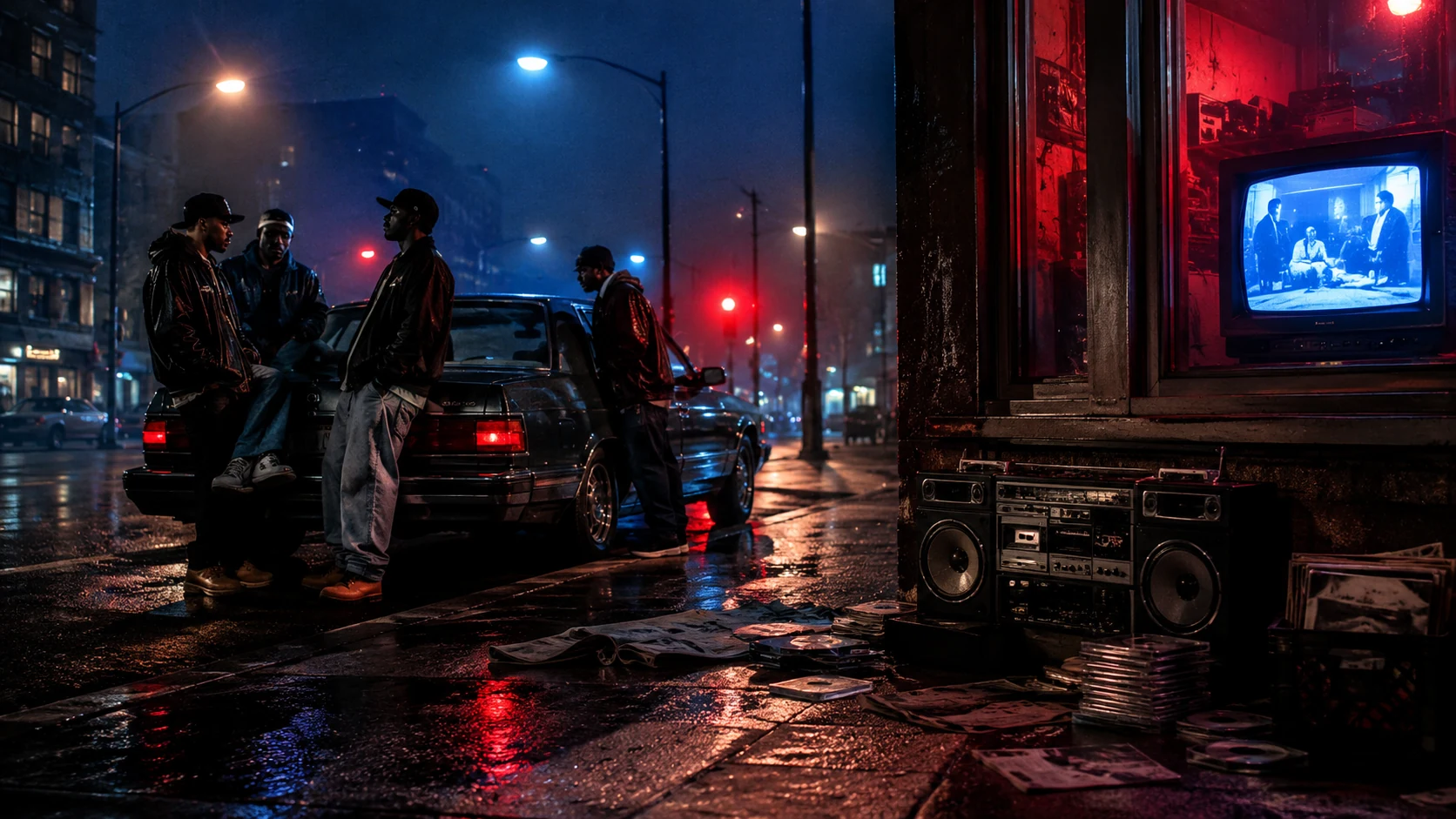
Gangsta Rap in the 90s
Gangsta rap in the 90s was controversial, cinematic, commercial, political, exploitative, misunderstood, massively influential, and impossible to ignore. It turned street-level stories into national arguments, made West Coast hip-hop in the 90s feel like the loudest room in the country, pushed G-Funk and harder street records into cars and cable TV, and forced the wider 90s hip-hop and rap conversation to deal with realism, performance, violence, poverty, police, media panic, parental advisory stickers, and the fact that America loved buying the music it also loved yelling about.
Gangsta rap in the 90s became one of the decade’s most powerful and controversial forms of music because it mixed street realism, cinematic storytelling, hard production, regional pride, social commentary, shock value, humor, and commercial force. Artists like Ice Cube, Dr. Dre, Snoop Dogg, 2Pac, Scarface, Geto Boys, Ice-T, MC Eiht, Above the Law, Too $hort, Spice 1, Cypress Hill, and others made records that reflected real conditions, exaggerated personas, challenged authority, fueled moral panic, and sold millions. It was never just one thing — and that is exactly why it still matters inside the larger 90s Music story.
Gangsta Rap Was Never Just “Violent Music.” That Was the Lazy Take.
The Songs Sounded Like Scenes
Gangsta rap could be testimony, theater, warning, fantasy, survival logic, social commentary, or all of it crashing together in one verse.
The lazy 90s take was simple: gangsta rap was dangerous, corrupting, loud, obscene, and responsible for every teenager suddenly owning a black T-shirt and an opinion. That take was everywhere — cable news, newspaper columns, talk shows, parent groups, politicians, school offices, and living rooms where someone’s dad had just discovered the word “explicit.”
The reality was messier. Gangsta rap could be street reporting. It could be horror movie exaggeration. It could be autobiography. It could be character work. It could be social commentary. It could be protest. It could be exploitation. It could be swagger. It could be grief. Sometimes it was all of those things in the same verse, which made it a little harder to summarize between commercials.
That complexity is why the genre hit so hard. Gangsta rap forced mainstream listeners to hear stories about neighborhoods, police, poverty, survival, violence, drug economies, masculinity, fear, anger, and status that polite pop culture preferred to keep off-camera. Then the industry realized controversy sold records, and suddenly the same culture yelling “this is dangerous” was stacking those CDs at the front of the store.
For Gen X, gangsta rap was not just something you read about in a think piece. It was a sound coming out of car speakers, bedroom stereos, MTV, late-night radio, school parking lots, and somebody’s older cousin’s CD collection. It was music adults warned you about, which of course made it about 500 percent more interesting. Nice work, adults.
The genre also made people choose what kind of listener they were going to be. Were you hearing social conditions? Performance? Shock? Marketing? Humor? Warning? Fantasy? All of it? Gangsta rap made that impossible to avoid. It was not passive background music. It demanded a reaction, and the 90s supplied plenty of those, usually from people who had heard exactly one edited clip and were ready to testify before Congress.
It was storytelling
At its best, gangsta rap was cinematic reporting from places mainstream media usually flattened into stereotypes. The records could be harsh because the conditions were harsh. That does not make every lyric documentary truth, but it does mean the genre carried social weight.
Listeners heard street corners, police pressure, survival logic, neighborhoods, paranoia, anger, humor, and pride. That was part of the point.
It was also performance
The other half matters too. Gangsta rap also used persona, exaggeration, battle-rap aggression, shock, and mythmaking. Some records were closer to movies than diaries.
The mistake was acting like it had to be either “real” or “fake.” The genre lived in the uncomfortable space between testimony, theater, commerce, and survival.
The 90s Did Not Invent Gangsta Rap. They Turned It Into a National Argument.
Gangsta rap had roots in the 80s, especially through records that used street narratives, police confrontation, criminal storytelling, and hard-edged regional identity before the 90s made the sound unavoidable.
The late-80s groundwork matters. Ice-T helped define early West Coast street narrative. Schoolly D’s influence was already in the bloodstream. N.W.A. made Compton a national flashpoint and changed how much attention rap could command from authorities, parents, critics, fans, and anyone with a microphone and a bad understanding of youth culture.
By the time the 90s arrived, the fuse was already lit. N.W.A. had shown that rap could describe police harassment, neighborhood tension, and street survival with a level of directness that terrified the mainstream. The controversy was not a side effect. It became part of the engine.
But the 90s changed the scale. The sound got bigger. The videos got brighter. The albums sold more. The arguments moved from regional scenes into national news. And the same stores that put warning stickers on the covers kept ringing up the sales, because capitalism has never once been embarrassed by its own hypocrisy.
The shift from the late 80s into the early 90s also changed what rap albums could feel like. Instead of just singles, you had fully built worlds: intros, skits, crew appearances, recurring voices, local slang, production moods, album-cover mythology, and a sense that buying the CD meant entering a whole universe. That made gangsta rap feel bigger than a subgenre. It felt like a place.
That bridge from the 80s into the 90s connects naturally to the wider 80s Rap, R&B & Dance story. The late-80s gave the ingredients; the 90s turned them into a cultural storm.
The blueprint formed early
Street narratives, police confrontation, and regional identity were already taking shape before the 90s made them unavoidable.
Compton became a symbol
N.W.A. made gangsta rap impossible to ignore and gave the next decade a controversy machine already warmed up.
The argument went national
Once sales, videos, radio, politicians, and parental panic all collided, gangsta rap became a national conversation.
The West Coast Made Gangsta Rap Feel Cinematic
Gangsta rap existed beyond California, but the West Coast gave the 90s version its biggest image: cars, bass, sunshine, police sirens, lowrider culture, studio polish, street reporting, and danger that looked different from New York’s colder, denser grit.
Sunshine, Bass, Tension, and a Whole Lot of Smoke
West Coast gangsta rap did not sound like New York. It had room, funk, cars, open streets, heavy low end, and a different kind of cinematic threat.
The 90s West Coast sound changed how gangsta rap moved. It was not just harder beats and harder talk. It was atmosphere. Drums hit clean. Basslines rolled. Synths stretched. Hooks got bigger. Cars became part of the mix. Videos made the geography visible. The whole thing felt like a movie you were not sure you were supposed to be watching.
That is why West Coast hip-hop in the 90s is such an important part of this story. Ice Cube brought solo rage and political bite. Dr. Dre and The Chronic turned production into architecture. Snoop Dogg and the G-Funk 90s made the sound feel effortless. 2Pac brought contradiction, vulnerability, fury, charisma, and myth. MC Eiht, Compton’s Most Wanted, Above the Law, DJ Quik, Cypress Hill, Too $hort, Spice 1, and others expanded the map.
West Coast gangsta rap also made contradiction part of the sound. It could be smooth and brutal. Funny and bleak. Stylish and paranoid. Commercial and confrontational. A song could sound perfect at a party and still carry stories that were not party material at all. That tension is part of why the records lasted.
The West Coast also gave the genre a visual vocabulary the mainstream could understand instantly: palm trees, lowriders, studio rooms, backyard parties, police lights, neighborhood streets, and cable-TV color saturation. It looked bright while the content stayed dark, which made it feel even more surreal. The 90s were excellent at cognitive dissonance. We had dial-up internet and thought JNCOs were a reasonable design choice.
It Was Bigger Than California, No Matter What MTV Made It Look Like
The West Coast gave gangsta rap its biggest 90s mainstream image, but the genre’s real map was wider. Houston, Oakland, Memphis, New Orleans, New York, Cleveland, and other cities all had street narratives, regional production styles, and local realities that shaped the decade.
The Map Was Never One Coast
California got the loudest spotlight, but Houston, Oakland, Memphis, New Orleans, New York, and other cities had their own street stories and sounds.
The national flashpoint
Compton and L.A. became shorthand for the genre in the mainstream imagination: N.W.A. aftershock, Ice Cube, Dre, Snoop, MC Eiht, Death Row, G-Funk, police tension, and video-ready West Coast mythology.
Player talk and darker edges
Too $hort, Spice 1, E-40, and Bay Area scenes brought different street languages: slower funk, slang, hustler storytelling, independent grind, and a regional voice that never needed L.A.’s permission.
Psychological weight
Scarface and Geto Boys gave gangsta rap a haunted Southern gravity: paranoia, guilt, street consequence, mental pressure, and storytelling that often felt more tragic than celebratory.
Underground darkness
Memphis rap carried horror-film atmosphere, cassette culture, low-budget grit, and an eerie minimalism that would influence later Southern rap far beyond the 90s.
Bounce, street rap, and label hustle
New Orleans brought bounce energy, neighborhood chants, street narratives, and eventually a business model that helped Southern hip-hop push toward the center.
Street realism, not always the same label
New York had its own street-rap intensity — darker, denser, colder, and often lyrically sharper — even when it was not always marketed under the gangsta rap label.
This regional spread matters because “gangsta rap” became a media shortcut, but the music itself was not one uniform sound. L.A. records did not feel like Houston records. Bay Area records did not feel like New York street rap. Memphis tapes did not feel like Death Row blockbusters. Local conditions shaped local sounds.
That is why the next step after the West Coast run should include Southern hip-hop in the 90s. The South was not waiting around to be invited into the conversation. It was building its own language, its own production, its own independent networks, and its own street stories while the coasts took most of the TV oxygen.
The Artists Who Made the 90s Argument Impossible to Ignore
Gangsta rap in the 90s was not one city, one sound, or one personality type. It stretched across regions and approaches: West Coast G-Funk, Compton rage, Southern darkness, Oakland player talk, Houston weight, New York street realism, and crossover records that brought the subject matter into pop’s living room.
Rage with structure
Cube’s early solo work mixed anger, politics, dark humor, and cinematic writing. He made the post-N.W.A. era feel sharper and more confrontational.
The studio architect
Dr. Dre and The Chronic helped turn gangsta rap into a polished mainstream force without making it feel harmless.
The cool in the storm
Snoop’s G-Funk 90s proved gangsta rap could be laid-back, funny, catchy, stylish, and still tense.
The contradiction
2Pac’s gangsta-era mythology mixed vulnerability, fury, politics, ego, pain, and performance. That complexity deserves its own careful rewind in Tupac and the 90s Rap Mythology.
Southern gravity
Scarface and Geto Boys brought psychological darkness, street fatalism, and Houston weight into a conversation too often reduced to East vs West.
The early storyteller
Ice-T helped define the street narrative before the 90s explosion and remained central to the genre’s controversy and evolution.
Compton cinema
MC Eiht and Compton’s Most Wanted gave gangsta rap a grounded, neighborhood-specific voice that felt less glossy and more documentary.
Oakland’s long game
Too $hort brought Bay Area player talk, independent hustle, funk, blunt humor, and a voice that influenced the decade without needing mainstream approval first.
Bay Area menace
Spice 1’s records brought paranoia, violence, and street darkness with a Bay Area edge that never sounded like a copy of L.A.
Horror in daylight
Geto Boys gave the genre psychological intensity and Southern perspective, proving gangsta rap could be disturbing without needing West Coast polish.
The mainstream shadow
“Gangsta’s Paradise” showed that the genre’s themes could reach the absolute center of pop culture without sounding lightweight.
The missing pressure point
Women rappers challenged hip-hop’s male-dominated narratives, and the genre’s treatment of women remains one of the hardest parts of the legacy to discuss honestly.
The Production Made the Stories Hit Harder
Gangsta rap was defined by lyrics and image, but production shaped the mood. The 90s gave the genre everything from grimy loops and sirens to G-Funk bounce, Southern darkness, cinematic keys, hard drums, lowrider bass, and radio-ready hooks.
The production changed depending on region. West Coast records often leaned into funk, bass, and space. New York street records could feel colder, dustier, and more claustrophobic. Southern gangsta rap often carried deeper blues, paranoia, and psychological weight. The media wanted one scary label. The music refused to be that simple.
G-Funk and the 90s West Coast sound made gangsta rap smoother and more commercially explosive. But smooth did not mean safe. A polished Dre beat could make a hard story travel farther. A Snoop hook could make the danger sound relaxed. A low-end bassline could make a song feel physically larger than the room.
That production power is why gangsta rap crossed so hard. It was not just controversy selling records. The music sounded great. The hooks worked. The mixes hit. The videos looked memorable. The records fit in cars and on MTV and on radio in ways that made them impossible to contain.
The best gangsta rap production also understood tension. A bright sample could sit under a dark story. A smooth bassline could carry paranoia. A party bounce could hold a threat. A hook could make a hard song travel into places where the verses made everyone uncomfortable. That tension was not a bug. It was the engine.
Smooth menace
Synth whines, basslines, funk samples, and slow bounce made West Coast gangsta rap feel huge.
Dust and pressure
Hard drums, minimal loops, and darker textures helped street narratives feel immediate and uncomfortable.
Psychological dark
Geto Boys and Scarface brought a different kind of gravity: haunted, reflective, tense, and deeply regional.
The crossover trapdoor
Once the hooks got bigger, the songs moved farther — and the mainstream had to deal with what it was singing along to.
Realism, Persona, Exploitation, and the Messy Truth in the Middle
The hardest part of discussing gangsta rap is refusing easy answers. Some songs were rooted in lived conditions. Some were exaggerated personas. Some were grim warnings. Some were commercialized violence. Some were all of that at once. That is the part the 90s talk-show circuit usually skipped because nuance has terrible ratings.
What critics often missed
- Context mattered. Many records came from real environments shaped by poverty, policing, drugs, violence, and neglect.
- Rap had characters. Not every lyric was a sworn deposition. Hip-hop has always included persona, exaggeration, battle language, and theatrical threat.
- Listeners were not stupid. Fans could understand entertainment, anger, fantasy, and reality at the same time. Shocking, apparently.
- The industry benefited from outrage. Controversy sold records, and labels knew it. Moral panic became free marketing with worse hair.
- The music revealed uncomfortable systems. Police abuse, economic abandonment, drugs, violence, and survival economies did not appear because rappers mentioned them. They were already there.
What fans should not ignore
- Some records glamorized harm. Pretending otherwise makes the conversation weaker, not smarter.
- Misogyny was real. The genre’s brilliance does not erase the way many records treated women. That belongs in the discussion.
- Commerce changed incentives. Once “dangerous” sold, labels pushed the most marketable version of danger.
- Myth can swallow people. The image could become bigger than the artist, and the consequences were not always abstract.
- Shock value could flatten complexity. Some records opened doors; others turned trauma into branding. The 90s did both because subtlety was apparently on vacation.
A thoughtful look at gangsta rap has to hold both sides at once. The genre gave voice to conditions that mainstream America preferred not to hear about, but it was also packaged, sold, simplified, and sometimes flattened by the industry that profited from it. The records could be brilliant and troubling. They could be necessary and exploitative. They could be art and product.
That is why the best conversation is not “was gangsta rap good or bad?” That is a child’s worksheet. The better question is: what did this music reveal, what did it distort, who profited, who got blamed, and why did so many people who claimed to hate it keep watching, buying, quoting, and arguing about it?
It is also why gangsta rap sits in tension with conscious rap in the 90s. The two lanes were often framed like opposites, but that was too simple. Gangsta rap could contain political critique. Conscious rap could contain anger. Both were responding to the same decade, just with different tools and different expectations from the audience.
The 90s Loved Yelling About Gangsta Rap While Buying It by the Truckload
If gangsta rap had an unofficial backup singer, it was moral panic. Politicians, parent groups, cable-news panels, school officials, and newspaper columnists all lined up to explain why the music was destroying society. Meanwhile, the albums kept selling. Funny how that worked.
The Warning Sticker Was Basically an Ad
For a lot of Gen X kids, the explicit sticker did not say “avoid this.” It said “this is probably the one everybody is talking about.”
The Parental Advisory sticker was supposed to warn people. In practice, it often worked like a neon sign. If you were a teenager in the 90s, that little black-and-white label did not always scare you away. It made the CD look more official, like the music had passed a danger inspection and received certification from nervous adults.
Gangsta rap became a perfect target because it was loud, Black, youth-driven, confrontational, profitable, and easy to clip out of context. A politician could quote a line, ignore the song’s setting, avoid the social conditions behind it, and score a quick culture-war point. Cable television could do the same thing with worse lighting.
The problem is that panic flattened everything. It treated reportage like instruction. It treated character like confession. It treated satire like policy. It treated listeners like empty containers waiting to be corrupted. And it often ignored the uncomfortable possibility that the music was not creating the country’s problems — it was describing some of them very loudly.
That does not mean every criticism was wrong. Gangsta rap absolutely deserved criticism, especially around misogyny, homophobia, violence, and the industry’s appetite for selling danger. But the loudest public arguments were often less interested in honest criticism than in finding a convenient villain with a beat.
The weirdest part is how often the panic helped the music travel. If a record was controversial enough to make adults nervous, kids wanted to know why. If a news segment warned everyone about an album, half the audience treated it like a recommendation. The 90s basically invented rage marketing before the internet perfected it and made everyone insufferable.
MTV and Radio Turned the Controversy Into Everyday 90s Life
Gangsta rap did not stay underground once MTV, radio, soundtracks, and retail figured out the demand. The same records that terrified adults moved through video countdowns, car stereos, school dances, mall stores, and late-night requests.
The Videos Made the Argument Visual
Cars, neighborhoods, crews, studio sets, news clips, street scenes, and cable-TV repetition turned gangsta rap into an image as much as a sound.
MTV mattered because it made the music visible. A record could be controversial on paper, but a video gave it atmosphere, style, fashion, location, and memory. That is why Hip-Hop on MTV in the 90s is such a crucial chapter. Videos made the music harder to dismiss because now audiences could see the world the songs were building.
Radio mattered because hooks moved the music into daily life. Gangsta rap did not need to be cleaned into harmlessness to cross over. Sometimes the edits were awkward, sure, but the records still hit. “Nuthin’ but a ‘G’ Thang,” “Gin and Juice,” “Regulate,” “Gangsta’s Paradise,” and other records showed that mainstream listeners would make room for songs carrying heavier stories if the hook, mood, and production were strong enough.
That is where 90s rap radio crossover gets interesting. The mainstream did not suddenly become brave. It became unable to ignore the audience. The demand was too loud, the songs were too good, and the cultural gravity had shifted.
Soundtracks helped too. By the mid-90s, rap songs could move through movies, trailers, and CD racks, especially when urban dramas and youth films became part of the same ecosystem. That road runs straight into 90s hip-hop movie soundtracks, where gangsta rap’s mood often fit the screen almost too well.
Music videos also gave viewers a shortcut into regional identity. You did not need to know Long Beach, Compton, Oakland, Houston, or South Central personally to recognize the visual codes once MTV repeated them enough. That was powerful, but also risky. A video can introduce a world, but it can also turn that world into a set of images people think they understand after three minutes and a commercial for soda.
Clean Versions, Edited Videos, Banned Tapes, and the Joy of Making Adults Nervous
The 90s censorship machine was a whole experience: edited radio versions, blanked-out videos, Walmart-friendly albums, confiscated tapes, school rules, parental warnings, and that hilarious moment when adults realized the clean version still sounded pretty intense.
How censorship showed up
- Radio edits that sometimes removed so much language the song sounded like it was having technical difficulties.
- MTV edits that let the image travel even when the lyrics got chopped into Swiss cheese.
- Retail restrictions where some stores refused explicit versions or pushed edited copies instead.
- School crackdowns where tapes, shirts, lyrics, and album covers could become instant hallway drama.
- Parental Advisory panic that often turned warning labels into teenage treasure maps.
Why it backfired
- Forbidden music travels faster. Tell teenagers not to hear something and suddenly you have created a distribution plan.
- Edited versions created curiosity. If the clean version sounded that tense, people wanted to know what got removed.
- Controversy built mystique. Every angry news segment made the music feel more important.
- The audience was already there. Censorship did not create demand. It revealed how big the demand already was.
- The sticker became part of the aesthetic. The warning looked like danger, and danger sold.
The censorship fight also showed how little control the old gatekeepers had left. By the 90s, kids were getting music through friends, siblings, dubbed tapes, mall stores, radio recordings, Columbia House-style chaos, and whatever somebody’s cousin had in the car. Adults could complain, but the music was already moving.
That is part of why gangsta rap feels so tied to the pre-streaming era. You had to work a little to get the uncensored version. You had to know someone. You had to borrow the CD. You had to tape the song off the radio and tolerate the DJ talking over the intro like a criminal. Music felt physical because access was physical.
For Gen X, Gangsta Rap Was a CD Binder, a Car Stereo, and a Warning Sticker
The lifestyle memory matters because this music was not experienced as an academic debate. It lived in bedrooms, cars, school parking lots, mall music stores, house parties, dorm rooms, cassette dubs, and that one friend’s system that made the whole trunk sound like it was filing a complaint.
The Whole Argument Rode Around in the Passenger Seat
CD binders, cassette adapters, car stereos, mall music stores, and dashboard glow turned gangsta rap into daily-life memory.
The covers had gravity
Gangsta rap albums looked serious on the shelf. The sticker, the art, the titles, the rumors — everything said, “Your parents will hate this.” Sales pitch complete.
The bass did the arguing
Some records were built for cars first. The low end made the stories feel physical, not theoretical.
The images stuck
Videos turned artists into characters and songs into scenes. You remembered the sound and the whole look around it.
Everybody had an opinion
Even kids who did not own the albums knew the singles, the rumors, the controversies, and which adult was mad this week.
The 90s also made music harder to escape in the best way. You did not have an algorithm politely feeding you a playlist based on mood. You had radio, MTV, CDs, tapes, friends, siblings, cousins, music magazines, and whatever somebody had in the car. Discovery was messier, slower, and somehow more intense.
Gangsta rap thrived in that environment because it carried rumor energy. People talked about the records before you heard them. They talked about the videos. They talked about who was dissing who. They talked about which album had the wildest cover, which song got banned from someone’s house, which teacher confiscated a tape, and which parent absolutely did not understand the difference between reporting and endorsing.
That is why the era still feels so alive. It was not just songs. It was a whole social experience: borrowing CDs, reading liner notes, staring at album art, hearing edited versions on the radio, finding the uncensored version later, and realizing the grown-ups had once again made the forbidden thing more interesting by waving a flashlight at it.
The fashion and visual language traveled too. Oversized clothes, flannels, workwear, caps, jerseys, sunglasses, sneakers, lowrider imagery, album-cover poses, and video styling all moved through mainstream youth culture with wildly uneven results. Some people looked cool. Some people looked like they had been styled by a mall kiosk and a bad decision. For the full style rewind, that lane belongs with 90s hip-hop fashion.
Essential Gangsta Rap Songs of the 90s
This is not a complete list — the genre is too deep for that — but these records show how wide gangsta rap became in the 90s: West Coast G-Funk, Compton rage, Houston darkness, crossover seriousness, Bay Area menace, soundtrack dominance, and songs that became shorthand for entire scenes.
Core 90s Tracks
- Ice Cube — “It Was a Good Day”
A deceptively calm classic that turns ordinary peace into something almost suspicious because the surrounding world is so tense. - Dr. Dre feat. Snoop Dogg — “Nuthin’ but a ‘G’ Thang”
The G-Funk crossover moment that made West Coast gangsta rap sound smooth, huge, and unavoidable. - Snoop Doggy Dogg — “Gin and Juice”
Laid-back party storytelling with enough cultural staying power to survive every decade after it. - 2Pac — “Ambitionz Az a Ridah”
Pure late-90s intensity, image, defiance, and mythology colliding at full volume. - Scarface — “I Seen a Man Die”
Southern gangsta rap with moral weight, reflection, and a sense of consequence that hits harder than empty shock. - Geto Boys — “Mind Playing Tricks on Me”
Psychological paranoia, street trauma, and horror-movie tension turned into one of the genre’s most important records. - Coolio feat. L.V. — “Gangsta’s Paradise”
The mainstream emotional earthquake. Serious, cinematic, haunted, and central to 1995. - MC Eiht — “Streiht Up Menace”
Compton storytelling that felt grounded, cold, and built from street-level detail. - Above the Law — “Black Superman”
A crucial West Coast/G-Funk-adjacent record that helped shape the sound’s darker polish. - Warren G feat. Nate Dogg — “Regulate”
Smoother and more melodic, but still tied to the street narrative and G-Funk crossover lane. - Spice 1 — “Trigga Gots No Heart”
Bay Area darkness with street-film energy and a harder edge than the smoother West Coast radio records. - 2Pac — “So Many Tears”
Not a simple gangsta rap flex — more like pain, paranoia, guilt, and vulnerability wrapped in one of Pac’s strongest performances.
Why These Songs Mattered
- They were cinematic. The best records felt like scenes, not just verses.
- They had hooks. The genre crossed over because the production and choruses worked.
- They carried contradiction. Humor, fear, pride, paranoia, swagger, grief, and performance often lived in the same song.
- They traveled through media. MTV, radio, soundtracks, and CD stores made the songs unavoidable.
- They forced conversation. The records made people argue about art, crime, censorship, race, money, youth, and reality.
- They did not all sound alike. Houston, Compton, Long Beach, Oakland, and mainstream crossover records each had their own temperature.
A lot of these songs also belong in the broader 50 essential 90s hip-hop songs conversation because they were not just genre records. They became decade records. They shaped how the 90s sounded even for people who only heard the edited versions between pop hits and R&B ballads.
They also show why the “gangsta rap” label can be useful but limiting. Some of these songs are party records. Some are nightmares. Some are warnings. Some are boasts. Some are confessionals. Some are radio memories. The genre was never as flat as its loudest critics wanted it to be.
The Albums That Made Gangsta Rap Impossible to File Away
The singles got the attention, but the albums built the world. Some were polished blockbusters. Some were darker and more regional. Some were messy, brilliant, troubling, and iconic all at once. Very 90s, in other words.
The Albums Felt Dangerous Before You Even Hit Play
The covers, stickers, rumors, guest features, skits, and production credits made these records feel like objects, not just music.
AmeriKKKa’s Most Wanted
A furious solo arrival that mixed political edge, dark humor, street reporting, Bomb Squad chaos, and post-N.W.A. independence.
Death Certificate
One of the decade’s most confrontational rap albums: brilliant, provocative, controversial, offensive, political, and impossible to discuss casually.
The Chronic
The production earthquake that made gangsta rap smoother, bigger, more cinematic, and more commercially powerful.
Doggystyle
The debut that turned Snoop into a superstar and made G-Funk feel like the sound of 1993–1994.
The Diary
Dark, reflective, Southern, and heavy with consequence. A key reminder that gangsta rap was bigger than California.
We Can’t Be Stopped
Raw, controversial, disturbing, and central to Houston’s place in the national gangsta rap conversation.
Me Against the World
More introspective than simple gangsta mythology, but crucial to understanding Pac’s fear, pressure, vulnerability, and public image.
All Eyez on Me
The blockbuster Death Row spectacle: massive, confident, excessive, charismatic, and loaded with the contradictions that made Pac impossible to simplify.
Compton detail
Compton’s Most Wanted brought a grounded, less glossy documentary feel that helped keep the genre tied to specific places.
These albums also explain why the genre belongs in the best 90s hip-hop albums conversation. They were not just controversial. They were carefully built, sonically distinct, regionally important, and full of moments that shaped how rap albums were expected to feel.
The album format mattered because it let artists build worlds: skits, intros, recurring characters, crew appearances, transitions, threats, jokes, grief, bravado, and production moods that carried across an hour. The CD binder era made those worlds portable. Suddenly, the whole controversy could ride around in a backpack next to a Discman with dying batteries.
The best albums also made you sit with contradictions longer than a single could. A hit song might give you the hook and the image. The album gave you the world around it — the jokes, paranoia, filler, genius, ugly moments, brilliant sequencing, and the parts that make hindsight more complicated than nostalgia wants it to be.
2Pac Made Gangsta Rap Mythology Feel Personal
2Pac’s relationship to gangsta rap is too complicated to reduce to a label. He was political, vulnerable, angry, theatrical, charismatic, reckless, poetic, contradictory, and completely central to the way the 90s remembered rap as both art and life.
Pac’s gangsta-era image was powerful because it carried contradiction. He could sound wounded and furious, reflective and reckless, political and self-destructive, compassionate and combative. That made him feel bigger than genre. He was not just performing toughness; he was turning pressure into identity.
That is why the deeper story belongs on Tupac and the 90s Rap Mythology. His role in gangsta rap cannot be handled as just a list of songs or controversies. It needs the full picture: his early political voice, film presence, vulnerability, Death Row era, media image, contradictions, and the way his death froze the conversation into something almost impossible to untangle.
Pac also shows how dangerous the line between art and mythology can become. The public wanted him to be symbol, villain, poet, outlaw, activist, star, and headline all at once. That is too much weight for any person. The music still carries it, but looking back honestly means remembering that the myth was built out of a real human being, not just a poster on a bedroom wall.
His story also complicates the idea of “gangsta rap” as a fixed lane. Pac could make political records, grief records, revenge records, party records, tender records, and furious records. The media often preferred the simplest version because simple stories are easier to sell. Pac’s music kept refusing to stay that simple.
The Rivalry Era Turned Rap Beef Into Mass Entertainment
Gangsta rap’s most famous 90s rivalries were not just music. They were label politics, regional pride, media amplification, real danger, business incentives, fan identity, and a press machine that often treated tension like content.
The Music Was Real. The Hype Machine Was Too.
The rivalry era showed how quickly art, business, media, ego, danger, and audience appetite could become one ugly feedback loop.
The Bad Boy/Death Row story is one of the most over-told parts of 90s rap, but it is also one of the most misunderstood. People love the drama because drama is easy. The harder part is talking about the labels, the media, the fans, the regional tension, the business incentives, and the way real conflict became entertainment until entertainment stopped feeling separate from real life.
That is why the full story belongs on Bad Boy, Death Row, and 90s Rap Rivalries. The goal should not be tabloid recycling. The goal should be understanding how the music industry, press, regional pride, and superstar mythology helped turn rap conflict into a spectacle with consequences.
Gangsta rap did not invent rap beef. Hip-hop had battle energy from the start. But the 90s changed the scale. MTV, magazines, radio, labels, fans, and news coverage turned every tension point into a national story. Suddenly, conflict had a distribution network. That is when things got ugly.
The rivalry era also shows how easily cultural storytelling can become a trap. Fans wanted sides. Magazines wanted covers. Labels wanted momentum. TV wanted drama. The audience wanted meaning. The artists were stuck inside the machine, and the machine was very good at turning pressure into profit.
Gangsta Rap Changed the 90s, Then the 90s Changed Gangsta Rap
The legacy is not clean. It never was. Gangsta rap gave voice to realities mainstream culture avoided, changed rap production, built superstars, fueled censorship fights, carried social commentary, sold danger, amplified stereotypes, and reshaped pop culture. That is why it still needs more than a shrug or a nostalgia playlist.
Gangsta rap changed how hip-hop sounded. It made bass heavier, hooks bigger, albums more cinematic, videos more memorable, and regional scenes more important. It helped make the West Coast nationally dominant and forced the industry to understand that rap was not a side category anymore. It was becoming the center.
It also changed how mainstream America talked about rap. Not always intelligently, obviously. But it forced conversations around censorship, policing, poverty, violence, race, youth culture, misogyny, media exploitation, and artistic responsibility. Some of those conversations were honest. A lot were panic dressed up as concern. The 90s loved a costume.
The genre’s influence kept spreading long after the first 90s wave cooled. Its production ideas, personas, visual language, business models, warning-label mystique, and street-to-mainstream pipeline shaped hip-hop for decades. You can hear its fingerprints in later rap even when the sound changed completely.
But looking back with the full Gen X rewind means not turning it into either a museum trophy or a moral disaster area. Gangsta rap in the 90s was art, commerce, testimony, performance, warning, fantasy, exploitation, rebellion, and product. It was messy because the culture around it was messy. That is exactly why it still hits.
The honest legacy is this: gangsta rap made America listen to stories it did not want to hear, then watched America package those stories for profit. It gave listeners some of the decade’s greatest records and some of its hardest questions. It sounded incredible in a car. It looked unforgettable on MTV. It made parents nervous, politicians loud, critics divided, labels rich, and fans loyal. That is not a simple legacy. That is a 90s legacy.
Where to Go Next
Gangsta Rap in the 90s FAQ
What was gangsta rap in the 90s?
Gangsta rap in the 90s was a major hip-hop subgenre built around street narratives, crime stories, police confrontation, survival, neighborhood identity, swagger, humor, fear, and social tension. It could be realistic, theatrical, political, exploitative, or all of those things at once.
Why was 90s gangsta rap so controversial?
90s gangsta rap was controversial because of its explicit language, violent imagery, criticism of police, misogyny, criminal narratives, and commercial popularity. It became a target for politicians, parents, media outlets, and censorship debates, even as it sold millions of records.
Who were the biggest gangsta rap artists of the 90s?
Major 90s gangsta rap artists included Ice Cube, Dr. Dre, Snoop Dogg, 2Pac, Scarface, Geto Boys, Ice-T, MC Eiht, Compton’s Most Wanted, Above the Law, Too $hort, Spice 1, Cypress Hill, and others across West Coast, Southern, Bay Area, and street-rap scenes.
Was gangsta rap only a West Coast thing?
No. The West Coast gave 90s gangsta rap its most famous mainstream image through Dr. Dre, Snoop Dogg, Ice Cube, 2Pac, and Death Row, but Southern artists like Scarface and Geto Boys were also central, Bay Area rappers had their own lane, and street realism existed in multiple regions.
What are essential 90s gangsta rap albums?
Essential 90s gangsta rap albums include Ice Cube’s AmeriKKKa’s Most Wanted and Death Certificate, Dr. Dre’s The Chronic, Snoop Dogg’s Doggystyle, Scarface’s The Diary, Geto Boys’ We Can’t Be Stopped, and 2Pac’s Me Against the World and All Eyez on Me.
Why does 90s gangsta rap still matter?
90s gangsta rap still matters because it changed hip-hop production, made regional rap nationally powerful, forced debates about censorship and social conditions, shaped MTV and radio, built major rap superstars, and left a complicated legacy that still influences hip-hop today.
What should I read next?
Start with West Coast Hip-Hop in the 90s, then go to Tupac and the 90s Rap Mythology, Bad Boy, Death Row, and 90s Rap Rivalries, and the main 90s Hip-Hop and Rap page.