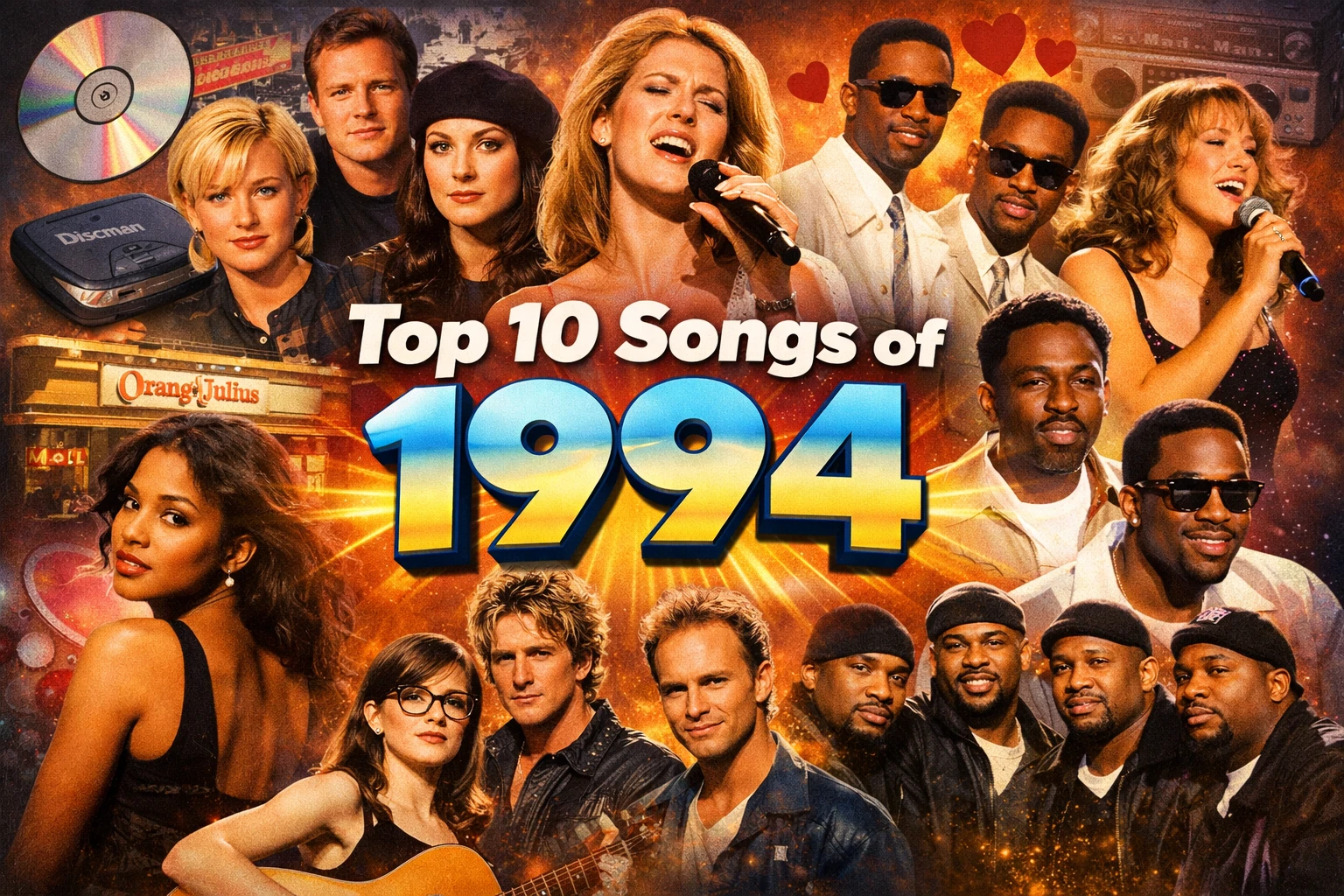
Top 10 Songs of 1994: Billboard’s Biggest Hits, Ranked
The top 10 songs of 1994 capture the moment the decade stopped warming up and fully took control. Billboard’s year-end Hot 100 mixed Swedish Euro-pop, blockbuster ballads, polished R&B, acoustic alternative pop, soundtrack drama, and slow jams built to occupy every school dance in America.
This was the year Ace of Base placed three songs inside the year-end top 10, All-4-One turned a country love song into an 11-week pop takeover, Boyz II Men ruled the Hot 100 for 14 weeks, and Lisa Loeb proved an anxious acoustic conversation could compete with the largest voices on radio.
The ranking uses Billboard’s 1994 year-end Hot 100, so these are the biggest U.S. singles of the year based on cumulative chart performance—not a personal ranking of the best songs of 1994 and not a modern nostalgia poll.
“The Sign” by Ace of Base was Billboard’s number-one year-end song of 1994. “I Swear,” “I’ll Make Love to You,” “The Power of Love,” and “Hero” completed the year’s top five.
Billboard Hot 100 Year-End Ranking
Year-end position reflects cumulative chart performance across the eligibility period. A song’s weekly peak matters, but staying power matters too—which is why records can finish high on the annual chart even when another single spent more total weeks at number one.
1994 Was the Year Pop Split Into Multiple Lanes
The biggest songs of 1994 sound less like one unified trend than several radio formats occupying the same building. Euro-pop was bright and rhythmically cool. Adult-contemporary ballads were still operating at blockbuster scale. R&B groups were dominating the Hot 100, while acoustic alternative pop was beginning to slip into the mainstream without asking anyone’s permission.
Ace of Base, All-4-One, Boyz II Men, Celine Dion, Mariah Carey, Lisa Loeb, Toni Braxton, Bryan Adams, Rod Stewart, and Sting were not chasing the same sound. Together they show how wide American Top 40 had become by the middle of the decade.
Quick List: Top 10 Songs of 1994
- #1 “The Sign” — Ace of Base
- #2 “I Swear” — All-4-One
- #3 “I’ll Make Love to You” — Boyz II Men
- #4 “The Power of Love” — Celine Dion
- #5 “Hero” — Mariah Carey
- #6 “Stay (I Missed You)” — Lisa Loeb & Nine Stories
- #7 “Breathe Again” — Toni Braxton
- #8 “All for Love” — Bryan Adams, Rod Stewart & Sting
- #9 “All That She Wants” — Ace of Base
- #10 “Don’t Turn Around” — Ace of Base
1994 Billboard Year-End Top 10 at a Glance
This table shows Billboard’s complete 1994 year-end top 10, each single’s weekly Hot 100 peak, and the number of weeks it spent at number one.
| Year-End Rank | Song | Artist | Hot 100 Peak | Weeks at #1 |
|---|---|---|---|---|
| #1 | “The Sign” | Ace of Base | #1 | 6 |
| #2 | “I Swear” | All-4-One | #1 | 11 |
| #3 | “I’ll Make Love to You” | Boyz II Men | #1 | 14 |
| #4 | “The Power of Love” | Celine Dion | #1 | 4 |
| #5 | “Hero” | Mariah Carey | #1 | 4 |
| #6 | “Stay (I Missed You)” | Lisa Loeb & Nine Stories | #1 | 3 |
| #7 | “Breathe Again” | Toni Braxton | #3 | 0 |
| #8 | “All for Love” | Bryan Adams, Rod Stewart & Sting | #1 | 3 |
| #9 | “All That She Wants” | Ace of Base | #2 | 0 |
| #10 | “Don’t Turn Around” | Ace of Base | #4 | 0 |
Listen to the Top Songs of 1994
The companion playlist brings together the biggest songs of 1994 with the wider sound of the year: Euro-pop, R&B slow jams, soundtrack ballads, adult-contemporary drama, acoustic alternative pop, dance music, hip-hop, and the records that never stopped following Gen X through the mall.
Use the playlist while reading the countdown, then continue into the complete 90s Music archive for more Billboard year-end songs, pop hits, slow jams, hip-hop, alternative music, grunge, and Gen X radio memories.
Countdown: The Top 10 Songs of 1994
The countdown runs from Ace of Base at #10 to Ace of Base again at #1, with chart peaks, weeks at number one, deeper 1994 music context, and lived-in Gen X memories for every song.
“Don’t Turn Around”
Ace of Base
Why It Hit
Because Ace of Base had figured out how to make heartbreak sound strangely cheerful. “Don’t Turn Around” moves with the light reggae-pop glide that made the group instantly recognizable, but the lyric underneath that bright surface is built around pride, rejection, and trying not to let somebody see the damage on the way out.
That emotional contrast is the song’s strongest commercial trick. The beat stays easy, the melody remains smooth, and the chorus arrives without any visible strain. You could hear it casually in a store and absorb the hook before realizing the narrator is performing a fairly elaborate act of emotional self-defense.
By this point, Ace of Base no longer sounded like a novelty import. Their production style had become its own reliable radio language: clipped rhythm, calm vocals, cool synth textures, and melodies designed to linger without shouting. “Don’t Turn Around” used that formula without feeling like a copy of the group’s two larger hits.
Why It Mattered in 1994
The song’s year-end top-10 finish completed one of the most unusual chart sweeps of the decade. Ace of Base placed three separate singles inside Billboard’s 1994 year-end top 10, showing that the group’s American success was not resting on one runaway record.
It also demonstrated how completely international pop had entered the U.S. mainstream. “Don’t Turn Around” did not resemble the year’s giant R&B ballads or acoustic alternative crossover. It created its own lane and made that lane feel normal.
Gen X Rewind
This is emotional boundaries delivered through a food-court sound system. The words say dignity. The beat says you may continue shopping.
Hearing it now brings back the strange calm of mid-90s pop: songs about rejection and regret moving through malls, family cars, swimming pools, and department stores as if nobody involved had raised a voice.
“All That She Wants”
Ace of Base
Why It Hit
Because it sounded almost suspiciously different from the American Top 40 surrounding it. “All That She Wants” is sparse for a major pop hit: clipped percussion, shadowy keyboards, low-key vocals, and a hook that settles into the brain without needing a giant chorus or vocal explosion.
The production feels cool and emotionally detached, which made the record stand apart during a period when many of the largest hits were selling maximum sincerity. Ace of Base did not try to overwhelm the room. They lowered the temperature, created a strange atmosphere, and trusted repetition to do the work.
Its restraint made the song feel modern. Every element has room to breathe, and nothing seems interested in proving how expensive the recording session was. The rhythm carries the song, the melody stays slightly eerie, and the vocal never breaks the spell by trying too hard.
Why It Mattered in 1994
“All That She Wants” helped establish the lighter, rhythm-driven side of the mid-90s pop landscape. It showed that a major American crossover hit did not need to sound American, follow the dominant R&B-ballad formula, or arrive with a soundtrack attached.
The single’s number-two peak and year-end top-10 finish also helped set up “The Sign” as more than a lucky follow-up. By the time Ace of Base reached number one, listeners already understood the group’s sonic world.
Gen X Rewind
This is one of those records that can turn an ordinary room into 1994 within three seconds. No decorations required. Just the opening rhythm and suddenly somebody is carrying a shopping bag from a store that no longer exists.
It remains permanently attached to early CD culture, music-video afternoons, summer radio, and the brief period when detached Swedish cool seemed capable of taking over every speaker in America.
“All for Love”
Bryan Adams, Rod Stewart & Sting
Why It Hit
Because the early 90s were still completely invested in the giant soundtrack power ballad, and “All for Love” arrived wearing a cape. The song combines three instantly recognizable voices, a sweeping cinematic arrangement, and a chorus designed to make ordinary emotions feel large enough for a movie screen.
Bryan Adams brings the weathered directness, Rod Stewart supplies the unmistakable rasp, and Sting adds polish and control. Instead of competing for space, the voices reinforce the song’s central promise. Every new entrance makes the record sound more committed to its own scale.
The production never pretends subtlety is the goal. Drums arrive with weight, guitars expand behind the vocals, and the chorus behaves as though it has been waiting for a castle wall to appear. That complete lack of irony made the song effective rather than merely excessive.
Why It Mattered in 1994
“All for Love” represents the last great stretch of the blockbuster soundtrack ballad as a nearly automatic chart weapon. Movie tie-ins could still launch songs into the center of radio culture, especially when recognizable stars and a universal romantic message were attached.
Its three weeks at number one proved there was still an enormous audience for maximal adult pop even as hip-hop, R&B, alternative rock, and younger global pop were changing the shape of the mainstream.
Gen X Rewind
This is the sound of sitting in traffic while feeling as if somebody should be galloping toward a castle. The actual surroundings rarely deserved the music.
It brings back a period when movie soundtracks did not quietly support a film. They marched into radio, took over the room, and remained there until everyone knew the chorus.
“Breathe Again”
Toni Braxton
Why It Hit
Because Toni Braxton could make longing sound expensive. “Breathe Again” is smooth, melancholy, and built around a voice that carries authority without needing to turn every line into a vocal competition.
The production gives her room. Strings and keyboards create an elegant frame, the rhythm moves patiently, and nothing crowds the low, textured center of Toni’s performance. She sounds emotionally exposed but never uncontrolled, which makes the heartbreak feel adult rather than theatrical.
That balance was essential to the record’s crossover appeal. The song had the finish expected by pop and adult-contemporary radio, but its emotional weight remained grounded in contemporary R&B. It could move between formats without losing its identity.
Why It Mattered in 1994
“Breathe Again” helped confirm Toni Braxton as one of the defining voices of the decade. She did not sound like a variation on the brighter pop divas surrounding her. Her lower register, controlled phrasing, and heavy emotional tone created a lane that belonged specifically to her.
The song’s year-end position is also a reminder that weekly number-one status was not required for a record to dominate a year. Its number-three peak and long cultural life were enough to place it above several chart-toppers on the annual ranking.
Gen X Rewind
This is late-night radio, bedroom-stereo music, and feelings far more sophisticated than most of us were qualified to manage.
Toni was delivering grown-up heartbreak while younger Gen X listeners were still trying to determine whether a three-day relationship counted as a major emotional event. At the time, the answer was obviously yes.
“Stay (I Missed You)”
Lisa Loeb & Nine Stories
Why It Hit
Because it felt as though an actual person had wandered into the middle of the pop machine. “Stay (I Missed You)” is conversational, acoustic, nervous, slightly tangled, and almost aggressively human beside the giant vocal showcases surrounding it.
Lisa Loeb does not perform the lyric like a polished declaration. She circles the argument, questions herself, changes emotional direction, and sounds as though the conversation is happening in real time. That uncertainty gives the song its tension.
The acoustic arrangement keeps every word exposed. There is no enormous production wall available to hide behind, which makes the record feel intimate even while it is playing on national radio. Listeners could hear the breath, hesitation, frustration, and unfinished thinking inside the performance.
Why It Mattered in 1994
The success of “Stay” showed how far alternative and singer-songwriter textures had moved into the mainstream. A record did not need heavy guitars to benefit from the culture’s growing appetite for music that felt less manufactured and more specific.
Its three-week run at number one also made the contrast impossible to dismiss. An acoustic song built around anxious self-analysis could stand beside Celine Dion, Mariah Carey, Boyz II Men, and Ace of Base without becoming louder or smoother.
Gen X Rewind
This is coffeehouse-meets-CD-era magic. It made overthinking sound poetic and turned one pair of glasses into a national visual event.
The song still brings back the quieter edge of 1994: movie soundtracks, small apartments, handwritten thoughts, and the belief that every complicated conversation deserved an acoustic guitar.
“Hero”
Mariah Carey
Why It Hit
Because Mariah Carey could turn an inspirational message into a full-scale vocal event without losing the song’s emotional center. “Hero” is direct, earnest, and built on a melody broad enough to feel personal in a bedroom and enormous in an arena.
In another singer’s hands, that level of sincerity might have collapsed into generic uplift. Mariah’s control keeps the record grounded. She begins with restraint, allows the emotion to build, and saves the largest vocal moments until the arrangement has earned them.
The lyric is uncomplicated by design. It does not require a specific romantic story or detailed personal situation. The listener supplies the struggle, and the song supplies the emotional reinforcement.
Why It Mattered in 1994
“Hero” expanded Mariah Carey’s role in the culture. She was already one of the decade’s dominant vocalists, but this record became something larger than another hit single. It entered graduations, talent shows, benefit performances, television moments, and personal milestone soundtracks.
Its four weeks at number one also showed that the empowerment ballad could compete directly with romantic slow jams and Euro-pop. The record did not need a romantic partner, a dance-floor groove, or a movie storyline to command the chart.
Gen X Rewind
This is the song that made everyone believe personal growth might be one key change away. Most of us required more work than that. Mariah had done her part.
It remains attached to school assemblies, televised emotional moments, bedroom singalongs, and every situation where somebody needed a song to make perseverance sound dramatically achievable.
“The Power of Love”
Celine Dion
Why It Hit
Because Celine Dion does not believe in doing anything halfway, and 1994 rewarded that level of commitment. “The Power of Love” begins as a controlled ballad and keeps expanding until the arrangement and vocal appear to be testing the structural limits of the room.
Celine’s performance is technically enormous, but precision is what keeps it from becoming noise. She controls the quieter lines, shapes the build, and makes every increase in power feel deliberate. The largest notes land because the song has been climbing toward them from the beginning.
The production also places the record directly at the intersection of pop, adult contemporary, and prestige balladry. It sounds polished enough for older listeners, dramatic enough for younger pop audiences, and vocally impressive enough to become an event on first exposure.
Why It Mattered in 1994
“The Power of Love” established Celine Dion as a dominant American pop force rather than simply an exceptional singer with crossover potential. Four weeks at number one proved there was a massive audience for her particular combination of control, scale, and emotional seriousness.
The record also represents the 90s mega-ballad at full wattage. Before pop moved more aggressively toward rhythmic production and less formal vocal styles, songs like this could still stop the entire chart and demand silence.
Gen X Rewind
This is the sound of a singer moving straight through subtlety and taking the wall with her. Quiet singing had been informed of the session but was not invited.
It brings back slow dances, adult-contemporary radio, department-store speakers, dramatic car rides, and the widespread belief that every love song needed at least one note visible from space.
“I’ll Make Love to You”
Boyz II Men
Why It Hit
Because Boyz II Men and Babyface had essentially cracked the code for 90s slow-jam dominance. “I’ll Make Love to You” is patient, polished, direct, and built around harmonies so smooth that the record feels inevitable almost immediately.
The production leaves plenty of room for the group’s vocal blend. The verses stay intimate, the chorus expands without becoming cluttered, and every harmony reinforces the promise at the center of the song. Nothing distracts from the mood.
Its greatest commercial strength is the balance between intimacy and scale. The performance sounds personal enough for a private dedication but polished enough to dominate national radio. It is effectively a whisper delivered through mass distribution.
Why It Mattered in 1994
Fourteen weeks at number one made “I’ll Make Love to You” one of the defining chart events of the decade. This was not simply a successful R&B single crossing into pop. It was the center of American popular music for an entire season.
The record confirmed that Boyz II Men had moved beyond their initial breakthrough into a level of chart authority few groups ever reach. Their harmonies, formal presentation, and romantic material were not operating at the edge of the mainstream. They were controlling it.
Gen X Rewind
This is the song that turned every slow dance into a federal case and every bedroom stereo into a high-risk environment for emotional decision-making.
It remains inseparable from dedications, school dances, cassette singles, late-night radio, and the period when Boyz II Men could release a ballad and simply reserve the top of the chart for the next several months.
“I Swear”
All-4-One
Why It Hit
Because 1994 could still turn a soft-focus promise song into a national obsession. “I Swear” is deeply earnest, but the vocal blend, patient arrangement, and instantly memorable melody keep that sincerity from feeling empty.
The song does not rush toward its chorus. It settles into the promise, allows each line to land, and lets the harmonies gradually widen the emotional frame. That patience made it useful for dedications, slow dances, weddings, and nearly any public situation requiring maximum romantic commitment.
All-4-One’s version also demonstrates how effectively a strong song can move between genres. The composition had already connected with country audiences, but the group’s polished pop-R&B treatment expanded the emotional scale without changing the central message.
Why It Mattered in 1994
Eleven weeks at number one made “I Swear” one of the year’s defining radio events. It stayed on top long enough to become environmental rather than occasional—the kind of record people encountered whether or not they had chosen it.
Its success also reinforced the power of male vocal groups during the first half of the 90s. Harmonies, direct romantic lyrics, and polished ballad production had become one of the most dependable combinations in mainstream music.
Gen X Rewind
This is prom-song, wedding-song, dedication-line, and “this is a suspicious amount of sincerity for a Tuesday afternoon” music.
It brings back gymnasium decorations, rented formalwear, answering-machine messages, cassette singles, and the era when an 11-week love-song takeover somehow felt completely normal.
“The Sign”
Ace of Base
Why It Hit
Because “The Sign” feels like the entire year compressed into one radio-perfect machine. It is bright, melancholy, rhythmically cool, slightly strange, and unusually calm for a song that became this enormous.
The groove is light enough to move easily across pop and dance radio, while the chorus lifts immediately without turning into a vocal contest. The production carries the clean, open quality that made Ace of Base sound imported from a cooler and less emotionally frantic version of the mainstream.
Beneath the polished surface is a breakup song about finally recognizing what should have been obvious. That emotional clarity gives the chorus more weight than its sunny delivery initially suggests. It feels liberated and bruised at the same time.
Why It Mattered in 1994
Six weeks at number one made “The Sign” a major weekly-chart force, but its year-end victory came from something larger: reach. The song worked in cars, malls, bedrooms, offices, grocery stores, school events, pools, restaurants, and nearly every other place American speakers had been installed.
It also represented the global direction pop was taking. The biggest American song of the year came from a Swedish group using reggae-influenced rhythm, European production, and an approach that did not fit neatly inside the dominant U.S. ballad or R&B lanes.
Ace of Base placing three songs in the year-end top 10 made the achievement even more striking. “The Sign” was not an isolated novelty. It was the center of a sustained pop takeover.
Gen X Rewind
This is dashboard-stereo, food-court, summer-window, pool, department-store, and “how is this playing again?” music. It did not merely receive heavy rotation. It became part of the air supply.
Hearing the chorus now immediately restores the bright, clean, slightly artificial surface of 1994—the CD racks, mall lighting, music-video afternoons, and moment when Swedish pop seemed perfectly equipped to explain everybody’s relationship mistakes.
Keep Rewinding 1994
Continue through the same year with television, movies, toys, videos, and the larger 90s music archive. Together, these pages connect Billboard’s biggest songs of 1994 to the rest of the culture surrounding them.
1994 Rewind Verdict
1994 was a chart year that refused to choose one identity. Swedish Euro-pop sat beside enormous romantic ballads, R&B slow jams, soundtrack spectacle, acoustic alternative pop, and some of the largest voices the decade could produce.
“The Sign” is cool efficiency and global pop crossover. “I Swear” is soft-focus romantic commitment stretched across 11 weeks at number one. “I’ll Make Love to You” is Boyz II Men and Babyface operating the slow-jam machine at imperial scale. “Stay” sounds like one private argument accidentally became everyone’s business.
“Breathe Again” proves Toni Braxton could make heartbreak feel like velvet. “The Power of Love” and “Hero” show how strongly the mainstream still responded to controlled vocal scale, while Ace of Base placing three songs in the year-end top 10 confirms that global pop was no longer visiting. It had moved in.
For Gen X, these songs are CD singles, bedroom stereos, mall speakers, food courts, car rides, school dances, waiting rooms, music-video afternoons, and the sound of the decade becoming glossy, sentimental, international, acoustic, dramatic, and strangely calm all at once.
FAQ: Top Songs of 1994
What was the #1 song of 1994?
“The Sign” by Ace of Base was Billboard’s number-one Hot 100 year-end song of 1994.
What were the top five songs of 1994?
The top five were “The Sign,” “I Swear,” “I’ll Make Love to You,” “The Power of Love,” and “Hero.”
Why does this ranking use Billboard’s year-end Hot 100?
The year-end chart measures cumulative U.S. chart performance across the eligibility period rather than personal opinion or modern nostalgia.
How long was “The Sign” at #1?
Ace of Base spent six nonconsecutive weeks at number one on the Billboard Hot 100 with “The Sign.”
How long was “I Swear” at #1?
All-4-One’s “I Swear” spent 11 weeks at number one on the Billboard Hot 100.
How long was “I’ll Make Love to You” at #1?
Boyz II Men spent 14 weeks at number one with “I’ll Make Love to You.”
Did “Breathe Again” reach #1?
No. Toni Braxton’s “Breathe Again” peaked at number three, but its longevity helped it finish seventh on Billboard’s 1994 year-end chart.
Which songs in the top 10 reached #1?
“The Sign,” “I Swear,” “I’ll Make Love to You,” “The Power of Love,” “Hero,” “Stay (I Missed You),” and “All for Love” reached number one.
Why did Ace of Base have three songs in the top 10?
The group’s distinct reggae-influenced Euro-pop sound crossed heavily into American radio, giving “The Sign,” “All That She Wants,” and “Don’t Turn Around” enough sustained chart activity to finish inside the year-end top 10.
Why were ballads so dominant in 1994?
R&B groups, pop vocalists, soundtrack singles, and adult-contemporary radio all supported large romantic ballads, giving them unusually broad crossover reach.
Is there a playlist for the top songs of 1994?
Yes. The companion Smells Like Gen X Spotify playlist is embedded on this page.
Where can I find more 1994 nostalgia?
The same-year links connect to the top television shows, movies, toys, videos, and the wider 90s Music archive.