Hip-Hop on MTV in the 90s
Hip-hop on MTV in the 90s was not just music videos between commercials. It was the moment rap became something Gen X watched, decoded, argued about, dressed from, taped off TV, quoted at lunch, and carried into bedrooms, dorm rooms, malls, school buses, and living rooms where somebody always yelled, “Put it back, I was watching that.” From Yo! MTV Raps and after-school video blocks to Hype Williams fish-eye madness, shiny suits, TRL pressure, Missy Elliott weirdness, Biggie and Tupac mythology, Wu-Tang chaos, Outkast cool, and the clean-edited rise of rap crossover TV, MTV helped turn 90s hip-hop into a full visual language.
Hip-hop on MTV in the 90s mattered because it changed rap from something many people heard into something millions watched, copied, debated, and remembered visually. Yo! MTV Raps gave rap a dedicated national TV space, music videos turned artists into icons, and later TRL-era pressure pushed rap further into mainstream pop culture. The MTV era connects directly to 90s Rap Radio Crossover, Missy Elliott and Late-90s Hip-Hop Weirdness, The Shiny Suit Era of Late-90s Rap, 90s Hip-Hop Fashion, and the larger 90s Hip-Hop and Rap story.
MTV Did Not Create 90s Hip-Hop, But It Changed How America Saw It
Let’s get one thing straight before the nostalgia machine starts wearing sunglasses indoors: MTV did not create hip-hop. Hip-hop was born from neighborhoods, DJs, MCs, dancers, graffiti writers, park jams, block parties, crews, records, tapes, local scenes, and communities long before cable TV figured out there was money in showing the culture between commercials for soda and acne cream.
But MTV absolutely changed how huge parts of America encountered hip-hop in the 90s. It changed what rap looked like to suburban kids, rural kids, mall kids, college kids, latchkey kids, and anybody with cable, a remote, and enough free time to watch three hours of videos while pretending homework was a future problem. For a lot of Gen X, MTV was not the birthplace of rap. It was the glowing portal.
That portal mattered. Before streaming, before YouTube, before TikTok chopped music into tiny attention-span snacks, videos were events. If you missed a premiere, you missed the conversation. If you caught it, you talked about the clothes, the cars, the camera angles, the dancing, the guest cameos, the weird set, the clean edit, the censored word that was hilariously obvious, and whatever your parents said while walking through the room and instantly regretting it.
Hip-hop on MTV turned rap into a full sensory package. The beat mattered, but so did the image. The lyrics mattered, but so did the jacket. The hook mattered, but so did the setting. A video could make an artist feel mythic, dangerous, hilarious, stylish, strange, untouchable, or larger than the album cover. That visual power is why this story sits right in the middle of the broader 90s Hip-Hop and Rap map.
MTV gave national visibility to regional sounds that already had local heat. It made New York rap look like city pressure, street corners, rooftops, clubs, ciphers, and black-and-white grit. It made West Coast rap look like sunshine, lowriders, palm trees, hydraulics, house parties, and danger riding shotgun. It helped Southern hip-hop slowly push through old media bias by giving viewers visual proof that rap was not only an East Coast/West Coast conversation. That connects directly to East Coast Hip-Hop in the 90s, West Coast Hip-Hop in the 90s, and Southern Hip-Hop in the 90s.
The channel also helped rap cross into mainstream daily life. Not overnight. Not evenly. Not without gatekeeping. MTV could be late, awkward, cautious, and very aware of advertisers with nervous faces. But by the end of the decade, rap was not some side lane MTV could keep contained. It was woven through countdowns, video blocks, celebrity culture, fashion coverage, movie tie-ins, award shows, TRL hysteria, and the entire late-90s machine.
That is why 90s Rap Radio Crossover and MTV are basically two sides of the same scratched CD. Radio made rap unavoidable in cars and kitchens. MTV made it unavoidable in bedrooms and living rooms. One made the song part of the day. The other made the image part of memory.
For Gen X, the MTV rap era was lifestyle, not just programming. It was watching Yo! MTV Raps and suddenly learning what the artists looked like outside a magazine photo. It was keeping the TV on while getting ready to go out. It was learning style from videos and then absolutely failing to pull it off at the mall. It was recording clips on VHS with the commercial breaks still attached. It was arguing whether a video was soft, hard, funny, corny, brilliant, fake, overplayed, or the greatest thing ever until next week.
Most importantly, MTV made hip-hop visual without making it simple. The screen carried contradictions: street rap and pop crossover, political voices and party records, women claiming space and labels trying to package them, regional pride and national marketing, underground edge and glossy excess, authenticity debates and million-dollar video budgets. Very 90s. Very messy. Very “why is my VCR blinking 12:00 while I’m watching a masterpiece?”
The Real MTV Experience Was a Couch, a Remote, and Somebody Yelling From the Kitchen
Before every video lived in your pocket, hip-hop videos lived on TV time. You waited, watched, flipped channels, argued, and hoped nobody changed it right before the good one came on.
The modern internet makes old MTV sound almost impossible. You could not just search a song and watch it instantly. You had to wait. Like a pilgrim. A very bored pilgrim with a remote control and maybe a bowl of cereal at 4:30 in the afternoon.
That waiting changed the relationship to videos. If a new rap video was in heavy rotation, you caught it by being there. You watched video blocks like a fisherman watching the water. Maybe you got two videos you did not care about, one commercial, a station ID, a VJ talking, and then finally the one you wanted. That delay made the payoff bigger. It also made the bad videos feel like personal attacks.
Hip-hop videos became part of the rhythm of home life. You watched before school if you were lucky. You watched after school while pretending you were about to start homework. You watched late at night when the house got quiet. You watched on weekends when MTV ran blocks long enough to ruin an entire afternoon. The TV was not background exactly. It was company. Annoying, loud, stylish company.
The living room experience mattered because hip-hop was entering spaces where it had not always been welcome. Parents who barely understood rap suddenly saw the visuals. Siblings fought over the remote. Friends gathered around a TV to catch a premiere. The video became a shared object. A song could be personal in your headphones, but MTV made it communal.
This is where the lifestyle part kicks in. Videos shaped what people wore, how they danced, what they quoted, what sneakers they wanted, what jackets they begged for, what haircuts they attempted, and what sunglasses they wore indoors despite having no record deal and no business doing that near a food court. MTV did not just reflect 90s Hip-Hop Fashion. It spread it.
Videos also turned physical media into trophies. If you saw a video enough times, you wanted the tape, the CD single, the album, the soundtrack, the magazine cover, the poster, the shirt, the whole thing. MTV could send you to the mall with no money and a full list of problems. The connection between videos and CD culture is why this page naturally ties into Best 90s Hip-Hop Albums and 50 Essential 90s Hip-Hop Songs.
There was also something weirdly social about video memory. You did not just say, “I like that song.” You said, “Did you see that video?” The clothes, the camera, the car, the dancers, the setting, the celebrity cameo, the weird effect, the one shot everyone remembered — those became part of the conversation. MTV made rap songs into scenes.
And yes, sometimes those scenes were ridiculous. The 90s were allergic to subtlety. Fog machines. Wet streets. Empty warehouses. Rooftops. Helicopter shots. Slow motion. Fish-eye lenses. Leather pants. Giant phones. Cars polished like they were entering a witness protection program. But that visual excess was part of the fun. It made the decade feel bigger than life, which is impressive because real life was mostly dial-up tones, school lockers, and waiting for someone to get off the phone.
The homework lie
You came home, dropped the bag, turned on MTV, and told yourself homework was “after this video.” That video became four more videos. Classic academic strategy.
The couch trap
MTV could eat an entire Saturday because one good video might be twenty minutes away and nobody wanted to risk missing it.
The homemade archive
If you taped videos off TV, you became your own terrible archivist, complete with commercials, cut-off intros, and tracking lines from hell.
Yo! MTV Raps Made Hip-Hop Feel Like It Had a National Living Room
Yo! MTV Raps mattered because it gave rap a dedicated TV space when mainstream music television still treated hip-hop like something it could schedule carefully and contain.
The Screen Opened Up
Rap finally had a national TV room where interviews, videos, freestyles, style, attitude, and regional energy could sit in front of the same audience.
Yo! MTV Raps was a big deal because it gave hip-hop a place on MTV that felt intentional. Not a random video dropped between hair metal and dance-pop. Not a token slot. A space. That matters. In the 90s, getting a dedicated TV space meant visibility, legitimacy, and access to people who might never hear a local rap radio show or buy a mixtape from somebody’s cousin’s trunk.
The show helped turn hip-hop into national conversation without making it feel entirely sanitized. Interviews mattered. Artist personalities mattered. Style mattered. Regional differences mattered. You could see how rappers talked, dressed, joked, carried themselves, and reacted outside the tightly edited performance clip. That was huge in a pre-social-media world where most fans did not have constant access to artists.
For many Gen X viewers, Yo! MTV Raps was where rap culture felt reachable and mysterious at the same time. It was on your TV, but it did not feel like it belonged to your living room. It felt like the living room was lucky to have it passing through. That tension was powerful: mainstream access without losing the feeling that hip-hop had its own codes.
The show also gave viewers a sense of scope. Hip-hop was not one thing. You could see party records, political rap, street narratives, comedy, regional slang, fashion differences, production styles, crews, solo stars, and videos that looked like they came from totally different worlds. That wider view lines up with the whole 90s Hip-Hop and Rap story: the decade was too big to summarize with one sound.
It also helped rap videos feel like news. A premiere could matter. An interview could change how you heard a record. A guest appearance could make you understand an artist’s charisma. The show was not just a playlist. It was a gateway into culture, personality, image, and argument.
And because this was the 90s, access still felt scarce. You could not follow every artist instantly. You got pieces: a video, an interview, a magazine profile, a radio appearance, maybe a poster, maybe a CD booklet if the packaging was not shredded by the time you got it open. Yo! MTV Raps made those pieces feel bigger because they were moving on screen.
The show also deserves credit for helping place rap beside other forms of youth culture without pretending it was just another pop product. It could be messy, funny, intense, regional, political, commercial, underground-adjacent, and mainstream at once. That is exactly what made 90s hip-hop such a force.
Early-90s MTV Rap Still Felt Like Something You Had to Catch
Before rap became unavoidable on countdowns and late-90s pop culture, there was a stretch where hip-hop on MTV still felt slightly gated, scheduled, and precious.
Early in the decade, rap on MTV did not feel as omnipresent as it would later. You had to catch it. You watched the right shows, the right blocks, the right late-night stretches, the right countdowns. Rap was gaining ground, but the channel still treated it like something that needed a container.
That container could be frustrating, but it also created anticipation. A rap video showing up felt like a jolt. It could break up the flow of rock, pop, metal, dance, and whatever adult-contemporary ballad had a singer walking through fog in a leather coat. When a rap video hit, the energy changed.
Early-90s MTV rap also showed how wide the field already was. Public Enemy could bring political urgency. A Tribe Called Quest could bring jazz warmth and conversational cool. Dr. Dre and Snoop could bring West Coast cinematic swagger. Queen Latifah could bring authority. Cypress Hill could bring smoky menace. De La Soul could bring playful weirdness. LL Cool J could bring charisma. Rap was not waiting to become diverse. It already was.
This is why MTV matters as a visual map. It let viewers see difference. A Tribe Called Quest and 90s Jazz Rap did not look like Dr. Dre and The Chronic. West Coast videos did not move like New York videos. A politically charged video did not dress like a party video. That visual contrast taught viewers that hip-hop was a universe, not a single hallway.
The early 90s also made the relationship between MTV and radio complicated. Some songs were huge in one lane before the other caught up. Some rap records had video presence before pop radio fully embraced them. Some had local heat, then cable visibility, then wider radio exposure. The pathway was not one straight line. That is why this topic works hand-in-hand with 90s Rap Radio Crossover.
For Gen X, those early MTV rap moments felt like discoveries. You were not just hearing a song; you were getting a look at an entire world. The clothes, city, slang, movement, crew, props, and energy told you something. Sometimes you understood it. Sometimes you only thought you understood it, which is why suburban kids made some truly tragic fashion choices. History must be honest.
Rap still felt scheduled
Before late-90s saturation, hip-hop on MTV often felt like something you caught through dedicated shows, blocks, and lucky timing.
The videos taught difference
Regional sounds, fashion codes, political energy, party culture, and album identity became visible in ways radio alone could not deliver.
90s Hip-Hop Videos Turned Songs Into Whole Worlds
The best 90s hip-hop videos did not just show artists performing. They built worlds: city blocks, lowrider scenes, dream spaces, warehouses, shiny rooms, clubs, house parties, and strange little universes that made the song unforgettable.
The Image Became the Hook
A great video could make a song bigger, stranger, cooler, funnier, harder, softer, or impossible to forget.
A 90s hip-hop video could do a lot of jobs. It could sell the song. It could introduce the artist. It could explain the album’s mood. It could show where someone was from. It could create a fashion moment. It could make a regional scene feel national. It could make a rapper look dangerous, glamorous, funny, political, surreal, untouchable, or all of the above before the second verse.
The simplest videos still mattered because they gave faces to voices. A street performance clip, a rooftop scene, a club setup, a cypher, a car, a basketball court, a record store, a subway platform — those images gave the song a body. They made hip-hop feel lived-in.
But as the decade went on, the videos got bigger and more stylized. Budgets grew. Directors developed signature looks. Labels realized that the video could break an artist almost as much as radio. Suddenly the image was not just promotion. It was identity.
That is why 90s hip-hop videos are so tightly linked to 90s Hip-Hop Fashion. A song might tell you what someone sounded like, but the video told you how the era dressed itself. Oversized jerseys, leather, Timberlands, tracksuits, sunglasses, denim, bandanas, shiny suits, sportswear, designer logos, puffy jackets, camouflage, clean sneakers, gold chains, and whatever hat angle everyone suddenly needed to copy — MTV put it all in motion.
Videos also made regional identity visible. G-Funk and the 90s West Coast Sound came with visual language: cars, sunshine, palm trees, house parties, lowrider energy, smoke, neighborhood scenes, and California cool. East Coast videos often leaned into city density, rooftops, winter jackets, concrete, subway-adjacent energy, clubs, corners, and black-and-white grit. Southern videos eventually brought their own codes: bass culture, cars, regional style, Pen & Pixel flash, and different ideas of party and hustle.
The video era also made rap more cinematic. A video could turn a song into a short film, even when the plot was basically “everyone looks cool in several locations.” That was enough. We were not asking for character development. We were asking for mood, clothes, lighting, and one shot memorable enough to talk about at school.
Then came the more surreal side. Missy Elliott turned videos into full weird worlds. Busta Rhymes made high-energy visual chaos feel like a superpower. Hype Williams made fish-eye lenses and glossy color palettes feel like the official language of late-90s rap. The Shiny Suit era made the video budget itself part of the aesthetic. It was not enough to hear success. You had to see it glitter.
That visual escalation changed how hip-hop was remembered. Some 90s rap songs are permanently attached to their videos. You hear the opening and your brain sees the outfit, the car, the room, the lens, the crowd, the dance, the smoke, the suit, the street, the skyline. MTV turned memory into a split-screen: sound on one side, image on the other, both refusing to leave.
The Directors Turned Rap Videos Into a Visual Arms Race
The 90s were the decade when video directors became part of the hip-hop story, because the look of a video could change how a song landed.
The Camera Had a Sound
By the late 90s, certain video looks were so strong they felt like production styles: fish-eye gloss, gritty black-and-white, rooftop drama, luxury overload, and surreal futurism.
The music video director became a major part of 90s hip-hop’s expansion. The best directors did not just film rappers performing. They gave the song a visual personality. They turned records into worlds and, in some cases, made the video feel almost as important as the track itself.
Hype Williams is the obvious name because his late-90s style became almost impossible to separate from the era: fish-eye lenses, bright color, glossy surfaces, wide frames, expensive-looking surrealism, and images that felt both cartoonish and luxurious. That look was perfect for artists who wanted to seem larger than life because the camera literally made everything look larger than life.
But the decade had multiple visual languages. Some videos went gritty and documentary-like. Some went cinematic. Some leaned into comedy. Some became street portraits. Some used horror, sci-fi, animation, or pure glamour. Some had no plot beyond “we have a warehouse and fog machine,” and somehow those still worked because the 90s trusted fog machines way too much.
What matters is that directors helped hip-hop translate across audiences. A video could explain a record’s attitude faster than a review. A dark video made a song feel dangerous. A colorful video made it feel playful. A performance-heavy video showed charisma. A cinematic video suggested stakes. A funny video made the artist feel approachable. A glossy video made success feel physical.
This is one reason Missy Elliott and Late-90s Hip-Hop Weirdness matters so much to the MTV story. Missy understood that the video was not decoration. It was part of the song’s architecture. The camera was another instrument. The outfit was another hook. The set was another beat.
The same was true in a different way for The Shiny Suit Era of Late-90s Rap. Those videos were not subtle. They were visual flexes: champagne, suits, lights, dancers, expensive rooms, and camera movements that suggested the budget had consumed a small nation. You can laugh at the excess now, but you cannot deny that it worked. The image became the point.
Directors also helped turn rap into appointment viewing. A new video from a major artist could feel like a premiere. You wanted to see what world they built this time. Was it street? Glossy? Funny? Dark? Futuristic? Movie-like? Completely insane? The answer mattered because the video could change the song’s life.
Street-level realism
Concrete, corners, rooftops, stairwells, clubs, record stores, and black-and-white city atmosphere gave rap videos documentary weight.
Budget as spectacle
By the late 90s, some videos looked like success had been sprayed with chrome, lit from below, and sent through a fish-eye lens.
The surreal turn
Missy, Busta, and late-90s visual risk made hip-hop videos feel like cartoons, dreams, sci-fi sets, and fever visions with better drums.
MTV Made 90s Hip-Hop Fashion Move
Magazine photos were great, but videos showed the clothes walking, dancing, leaning on cars, standing on rooftops, and making half the mall think it had style.
The Screen Sold the Fit
MTV helped turn jerseys, Timberlands, tracksuits, leather, denim, puffy jackets, shiny suits, and regional style into national memory.
MTV did something magazines and album covers could not fully do: it made hip-hop fashion move. Clothes looked different when someone walked, danced, leaned, laughed, performed, or stood in a crew with the right posture. A jacket was not just a jacket. It was attitude with sleeves.
This is why 90s Hip-Hop Fashion is inseparable from MTV. The channel helped spread style codes across places that did not invent them. Oversized fits, sneakers, jerseys, leather, tracksuits, Timberlands, bandanas, sunglasses, denim, hats, puffy coats, chains, and later shiny suits traveled through videos faster than most parents could say, “You are not wearing that to school.”
The problem, of course, was translation. A look that worked perfectly in a video did not always survive the trip to a suburban mall, an eighth-grade hallway, or a family barbecue. Not everyone could pull off oversized everything, but that did not stop anyone from trying. The 90s were brave that way. Also deeply embarrassing.
MTV made regional fashion visible too. New York had one visual language. Los Angeles had another. Atlanta and the South brought different codes. Houston, New Orleans, Memphis, Miami — each scene carried its own relationship to cars, weather, clubs, streetwear, luxury, and local identity. Videos taught viewers that rap style was not universal. It was regional, coded, and constantly changing.
Women in hip-hop also used MTV to challenge narrow expectations. Women of 90s Hip-Hop looked radically different from one another on screen: Queen Latifah’s authority, Salt-N-Pepa’s pop confidence, Lil’ Kim’s high-fashion sexual command, Foxy Brown’s luxury edge, Lauryn Hill’s natural and intellectual presence, Missy Elliott’s surreal body-shape experiments, and countless others navigating an industry that always had opinions and rarely had sense.
MTV could flatten that complexity at times, because television loves packaging people into easy shapes. But it also gave viewers visual proof that women in hip-hop were not one thing. They could be regal, funny, glamorous, street, political, playful, sexual, vulnerable, strange, stylish, and lyrically serious. Sometimes all in the same video block.
The late-90s shiny-suit moment was the fashion-video connection turned all the way up. Clothing became spectacle. Videos became runways with bass. The look was easy to parody, but it marked a real shift: rap success was no longer just heard in the beat or the bars. It was seen in fabric, lighting, dancers, cars, champagne, suits, and rooms that looked too expensive to breathe in.
For Gen X, this is why MTV style memory hits so hard. You remember not just the song, but the coat. The sunglasses. The suit. The boots. The jersey. The braids. The color palette. The way everybody in the video looked cooler than anyone in your actual school, including the people who absolutely thought they were in the video.
MTV and Radio Turned Rap Into an Everyday 90s Presence
Radio made rap travel through cars and kitchens. MTV made it travel through screens, bedrooms, malls, dorms, and the entire visual memory of the decade.
The Screen and the Radio Worked Together
Once rap had both the radio hook and the video image, the culture moved faster, louder, and deeper into daily life.
Rap’s 90s crossover did not happen through one machine. It happened through several machines arguing with each other: radio, MTV, BET, record labels, movie soundtracks, clubs, mixtapes, magazines, retail, award shows, and kids taping videos off TV like that was a legitimate media strategy. Which, honestly, it was.
90s Rap Radio Crossover is the sound side of that story. Clean edits, huge hooks, remix culture, R&B choruses, pop-friendly singles, and late-decade Top 40 gravity all helped rap move into places it had not dominated before. MTV was the image side. It turned the radio hit into a visual object.
When those two forces lined up, a record became almost impossible to escape. You heard it in the car. You saw it after school. You heard it in the mall. You saw it on a countdown. You heard it at a dance. You saw it in a friend’s basement. You heard the clean version so many times that the missing words became part of the rhythm. That was 90s crossover: repetition with visuals.
Some artists benefited because videos clarified their charisma. Some benefited because the visuals made the song feel bigger. Some benefited because the video softened the record for a broader audience. Some benefited because the video made the record feel dangerous, funny, glamorous, emotional, or expensive. MTV could turn a song into a lifestyle signal.
That crossover pressure also changed how singles were built. Hooks mattered. Visual concepts mattered. Guest features mattered. A record that could live on radio and MTV had a different kind of power than a record that lived only in one lane. This did not always make the music better, because the industry’s idea of “bigger” often meant “please add a chorus and stop scaring advertisers.” But sometimes it produced undeniable records.
The late 90s were especially intense because rap and R&B were practically fused in mainstream space. That connects to New Jack Swing, Rap, and R&B in the 90s and Lauryn Hill, the Fugees, and Hip-Hop Soul. Those earlier and parallel bridges helped make MTV’s rap/R&B crossover feel normal by the end of the decade.
MTV also helped soundtrack culture blur with rap visibility. A song from a movie could get a video, the video could sell the soundtrack, the soundtrack could sell the movie, and suddenly everyone had a CD with one rap track, one R&B ballad, one alt-rock song, and twelve tracks they skipped for the rest of their life. The 90s were very generous with filler.
The key point is that MTV did not replace radio. It amplified it. The video gave the song a face. The radio gave the video repetition. Together, they made rap a daily 90s presence that was impossible to keep contained in one audience, one format, or one scene.
MTV Helped Turn Regional Rap Into National Mythology
East Coast grit, West Coast sunshine, Southern style, Midwest speed, and local scenes all became easier for outsiders to imagine once the videos gave them pictures.
Regional rap existed long before MTV made outsiders aware of it. But videos helped turn local identity into national imagery. That imagery could be powerful, useful, distorted, oversimplified, or all of the above. Television loves turning complicated places into a few repeatable symbols. The 90s were no exception.
New York videos often carried density: buildings, rooftops, winter coats, corners, streets, subway energy, clubs, record stores, and lyrical pressure. That visual language fit the sound of East Coast Hip-Hop in the 90s, where bars, crews, producers, and albums often felt like city arguments recorded on wax.
West Coast videos brought another kind of visual power: sunshine, palm trees, cars, lowriders, house parties, smooth menace, and the whole world of G-Funk and the 90s West Coast Sound. Dr. Dre and The Chronic gave that sound a visual identity viewers could instantly recognize, even if they were nowhere near California.
Southern hip-hop had a more complicated MTV path because national media was slow to understand the South’s power. But as the decade moved on, visuals helped challenge old assumptions. Outkast and the Rise of Southern Hip-Hop made Atlanta look and sound like the future. No Limit and Cash Money understood branding and spectacle. Miami bass had party energy that made bodies move before critics bothered to catch up. The South eventually proved that the old coastal lens was too small.
MTV also helped turn individual artists into regional symbols. Tupac’s videos fed a mythology that mixed West Coast identity, charisma, pain, danger, and vulnerability. Biggie’s videos gave New York luxury, humor, street memory, and star presence a new visual scale. Wu-Tang videos made Staten Island and Shaolin mythology feel like a whole alternate rap universe. Outkast videos made Atlanta look cooler, weirder, funkier, and more imaginative than many outsiders had expected.
This regional imagery could inspire fans, but it could also flatten reality. People learned places through videos and then acted like they understood them. A three-minute clip is not a sociological degree, no matter how many times someone watched it while eating microwaved pizza rolls. But those visuals still mattered because they gave regional rap a national frame.
That frame shaped how Gen X remembers the decade. Certain cities now feel attached to certain colors, cars, jackets, skylines, rooms, and camera movements because MTV repeated those images until they became memory. Hip-hop was already regional. MTV made the regions visible to everyone with cable.
Concrete and pressure
Rooftops, corners, subway energy, winter gear, black-and-white grit, and lyrical seriousness filled the visual field.
Sunshine and menace
Lowriders, palm trees, house parties, smooth G-Funk cool, and cinematic California imagery traveled hard.
Slow national catch-up
Atlanta, Houston, New Orleans, Miami, Memphis, and other scenes pushed through old media bias with their own visual codes.
Rap got bigger
MTV helped viewers see that hip-hop was not one city, one look, one sound, or one story.
Women in Hip-Hop Used MTV to Expand the Frame, Even When the Frame Was Annoying
MTV gave women in hip-hop visibility, but visibility came with pressure: image, styling, sexuality, respectability, marketability, and a culture that constantly wanted women to explain themselves.
Women in 90s hip-hop had to deal with a lot of nonsense. That is the academic term. Nonsense. The music industry wanted them marketable. Critics wanted them explainable. Male fans often wanted them to fit whatever role was convenient. Video directors wanted an image. Labels wanted a lane. MTV wanted something that would hold the screen. And through all that, women kept making the decade bigger anyway.
This is why Women of 90s Hip-Hop belongs right in the center of the MTV story. The screen made women more visible, but it also intensified the scrutiny. Every outfit, pose, lyric, haircut, stance, and video concept got read as a statement whether the artist asked for that burden or not.
Queen Latifah brought authority and Afrocentric power. Salt-N-Pepa brought pop confidence, dance energy, sex-positive style, and huge video presence. MC Lyte brought lyrical seriousness and cool control. Lil’ Kim and Foxy Brown pushed luxury, sexuality, and aggression into the screen in ways that forced conversations. Lauryn Hill brought emotional authority, natural style, and a refusal to fit one clean category. Missy Elliott made surreal body language and strange video worlds feel like power.
MTV amplified all of that. It made women in hip-hop easier to see, copy, discuss, argue over, and misunderstand. A video could make an artist iconic, but it could also trap them inside one image. That was the double edge. The screen could open doors and build cages at the same time. Very entertainment industry. Very “we love your individuality, now please make it more brand-safe.”
Missy’s MTV presence was especially important because she broke the expected visual rules. She did not have to make herself smaller, softer, thinner, simpler, or easier to categorize. The “The Rain” video looked playful, protective, futuristic, funny, and defiant. It turned body shape into architecture. It turned a suit into a statement without flattening the statement into a lecture.
Lauryn Hill’s video presence worked differently. Her image carried seriousness, warmth, intellect, soul, motherhood, and emotional weight. Her MTV-era visibility connected directly to Lauryn Hill, the Fugees, and Hip-Hop Soul, where rap, R&B, reggae, and soul became a deeper late-90s language.
The important thing is that women in hip-hop did not simply appear on MTV. They used the channel, fought its limits, bent its expectations, and gave Gen X viewers more versions of rap power than the industry seemed prepared to handle.
Missy Elliott Proved MTV Rap Could Get Weird and Still Take Over
Missy is one of the clearest examples of MTV turning hip-hop into a full visual universe — not just performance, but concept, costume, camera, comedy, and future shock.
If you want one late-90s example of MTV hip-hop becoming a full visual language, Missy Elliott is the cheat code. Her videos did not simply show her performing songs. They built worlds. Glossy, strange, futuristic, funny, body-bending worlds where the beat, camera, outfit, and joke all moved together.
That is why Missy Elliott and Late-90s Hip-Hop Weirdness connects so strongly to this page. Missy understood MTV better than almost anyone because her records already sounded visual. Timbaland’s beats had space, bounce, odd percussion, and strange textures. Missy’s voice turned those spaces into character. The videos gave the character a whole planet.
“The Rain” was the landmark because it looked like nothing else. The giant suit. The fish-eye lens. The glossy weirdness. The sense that the camera was bending around her instead of the other way around. That video made Missy instantly recognizable in a way only MTV could deliver at the time.
“Sock It 2 Me” expanded the universe with sci-fi playfulness. “She’s a Bitch” made the visuals colder, darker, more metallic, and more severe. “Hot Boyz” pulled her into late-90s crossover gravity without erasing the off-center Missy identity. Across those videos, MTV was not just a distribution channel. It was part of the art.
Missy also proved that weird did not have to mean marginal. Her videos were bizarre, but they were also sticky. You remembered them after one viewing. That was everything in the channel-flip era. If a video could make you stop the remote, it had power. Missy made the remote feel useless.
Her MTV run also helped reframe what mainstream rap image could be. Not every video had to be street realism, luxury flex, club party, or romantic crossover. It could be surreal. It could be funny. It could be futuristic. It could be body-conscious without using the same old visual script. It could be strange and still be everywhere.
The Shiny Suit Era Turned MTV Rap Into Champagne, Chrome, and Fisheye Excess
By the late 90s, some hip-hop videos looked like the budget had exploded and everyone decided subtlety was for people with less lighting.
The late-90s shiny-suit moment is one of the most MTV-friendly rap eras ever because it was built for the screen. The songs had big hooks. The videos had bright lights. The clothes had shine. The rooms looked expensive. The camera moved like it had too much sugar. The whole thing was a flex you could watch.
The Shiny Suit Era of Late-90s Rap gets laughed at now, sometimes fairly, because the excess could be absurd. But absurd does not mean unimportant. The era represented rap’s commercial dominance becoming visual. Success was no longer just a chart number or radio spin. It was a video full of suits, dancers, champagne rooms, sports cars, glossy floors, and camera angles that made everyone look like they were being viewed through a door peephole on a spaceship.
MTV was the perfect delivery system for that kind of spectacle. A shiny-suit video did not need subtlety because subtlety was not the product. The product was impact. You were supposed to stop flipping channels. You were supposed to see the money. You were supposed to understand that rap was no longer asking to be included in mainstream pop culture. It was decorating the room.
The shiny era also connects to 90s Rap Radio Crossover because the records were built to move. Big hooks, familiar samples, clean edits, R&B choruses, and visual glamour worked together. The sound made radio easier. The video made the record feel huge.
For Gen X viewers, shiny-suit videos were part of the late-90s lifestyle wallpaper. They were on while you got ready to go out. They were on in dorm rooms. They were on at parties before someone switched the TV to a game. They were on in the background while everyone argued about who sold out, who looked ridiculous, who had the best verse, and whether those suits were cool or a federal emergency.
The shiny-suit era also shows MTV’s power to freeze an aesthetic in memory. You can hear certain records and immediately see the gloss. The camera. The dance crew. The sample. The suit. The late-90s smile that said everyone knew the budget was ridiculous and nobody cared.
TRL Changed the Rules by Making Rap Compete Inside Pop’s Daily Popularity Machine
By the end of the decade, hip-hop videos were not only living in rap-specific spaces. They were moving through countdown culture, pop hysteria, fan voting, celebrity appearances, and the weird daily scoreboard of late-90s youth culture.
The Countdown Got Crowded
By the late 90s, rap videos were competing inside the same daily pop machine as boy bands, teen pop, rock, R&B, and whatever the millennium threw at the wall.
TRL changed MTV’s energy because it turned videos into daily competition. The countdown made youth culture feel like a scoreboard. Who was up? Who dropped? Who debuted? Who got screamed at by teenagers outside a window? Who had the fans calling? Who had the video that would not die no matter how tired everyone claimed to be of it?
For hip-hop, this mattered because rap was no longer only inside dedicated rap spaces. It was competing in the same pop arena as boy bands, teen pop, rock acts, R&B stars, and movie-soundtrack monsters. That could be annoying, but it also showed how far rap had traveled. The music that once had to fight for space was now part of the daily center.
TRL-era pressure also changed how videos were talked about. A video’s popularity became visible. The countdown made success feel like a daily sports result. People could argue about whether something deserved to be number one, whether it was overplayed, whether fans were rigging the phones, and whether Carson Daly was somehow holding the entire late-90s youth economy together with a microphone and the emotional range of a vending machine.
Rap in the TRL era had to sit next to the full pop explosion. That context matters. By 1999, teen pop was huge, nu-metal was rising, R&B was dominant, and hip-hop was everywhere. MTV became a collision zone. A rap video might be followed by a boy band, then a rock video, then an R&B clip, then a commercial that made everyone feel bad about their jeans.
This created pressure on rap videos to be instantly legible. A record needed a hook. The artist needed a look. The video needed a concept strong enough to survive the channel’s attention economy. Some artists leaned into spectacle. Some leaned into humor. Some leaned into fashion. Some leaned into cinematic drama. Some leaned into all of it because the late 90s had no chill.
TRL also helped blur the line between artist and celebrity. Rap stars were not only in videos. They were in interviews, countdown appearances, movie tie-ins, award-show moments, magazine spreads, and celebrity news. MTV did not just play music. It made fame visible as a daily process.
For Gen X and older millennials, that late-90s MTV moment still feels specific: the studio window, the screaming crowd, the countdown graphics, the daily repetition, the way every video felt like part of a larger competition for cultural oxygen. Hip-hop had gone from fighting for airtime to fighting for ranking. That is a massive shift.
Hip-Hop on MTV Was Lifestyle: Clothes, Rooms, Cars, Posters, CD Binders, and Bad Remote Etiquette
The videos did not stay on the screen. They leaked into how people dressed, talked, decorated, drove, shopped, danced, and remembered the decade.
The reason hip-hop on MTV still hits as nostalgia is that it was tied to everyday life. Not glamorous everyday life. Regular everyday life. The couch with the questionable cushions. The bedroom with posters and a stereo. The CD binder with cracked sleeves. The mall trip where you pretended you could afford everything. The school hallway where everyone repeated the same hook until it became a public-health issue.
MTV videos gave Gen X a style board before style boards existed. You saw a jacket, a sneaker, a chain, a hat, a jersey, a pair of sunglasses, a car, a room, a dance move, a haircut, or an attitude and thought, “I could do that.” Often you could not. But the ambition was there, and sometimes ambition wore a giant oversized shirt that made you look like a folded tent.
Videos also shaped social space. They were on before parties. They were on in dorm rooms. They were on while people got ready. They were on at sleepovers, in basements, in living rooms, and in bedrooms where the TV volume had to stay low because somebody was supposed to be asleep. A music video could set the mood before anyone even played a CD.
Cars mattered too. Rap videos made cars feel like moving stages: lowriders, luxury sedans, SUVs, convertibles, street scenes, parking lots, late-night rides, daytime cruising. Even if your actual car was a hand-me-down with fabric seats and a mysterious smell, the video version of car culture shaped what the music felt like. This is where MTV overlaps with radio: the video showed the car, the radio lived inside it.
The mall was part of the ecosystem. You watched videos, then went to stores and saw watered-down versions of what the videos made cool. Hats, jerseys, jackets, sneakers, chains, CDs, posters, magazines, headphones, blank tapes, and whatever weird accessory suddenly felt necessary because a rapper wore it in a video. MTV did not just advertise music. It influenced shopping lists.
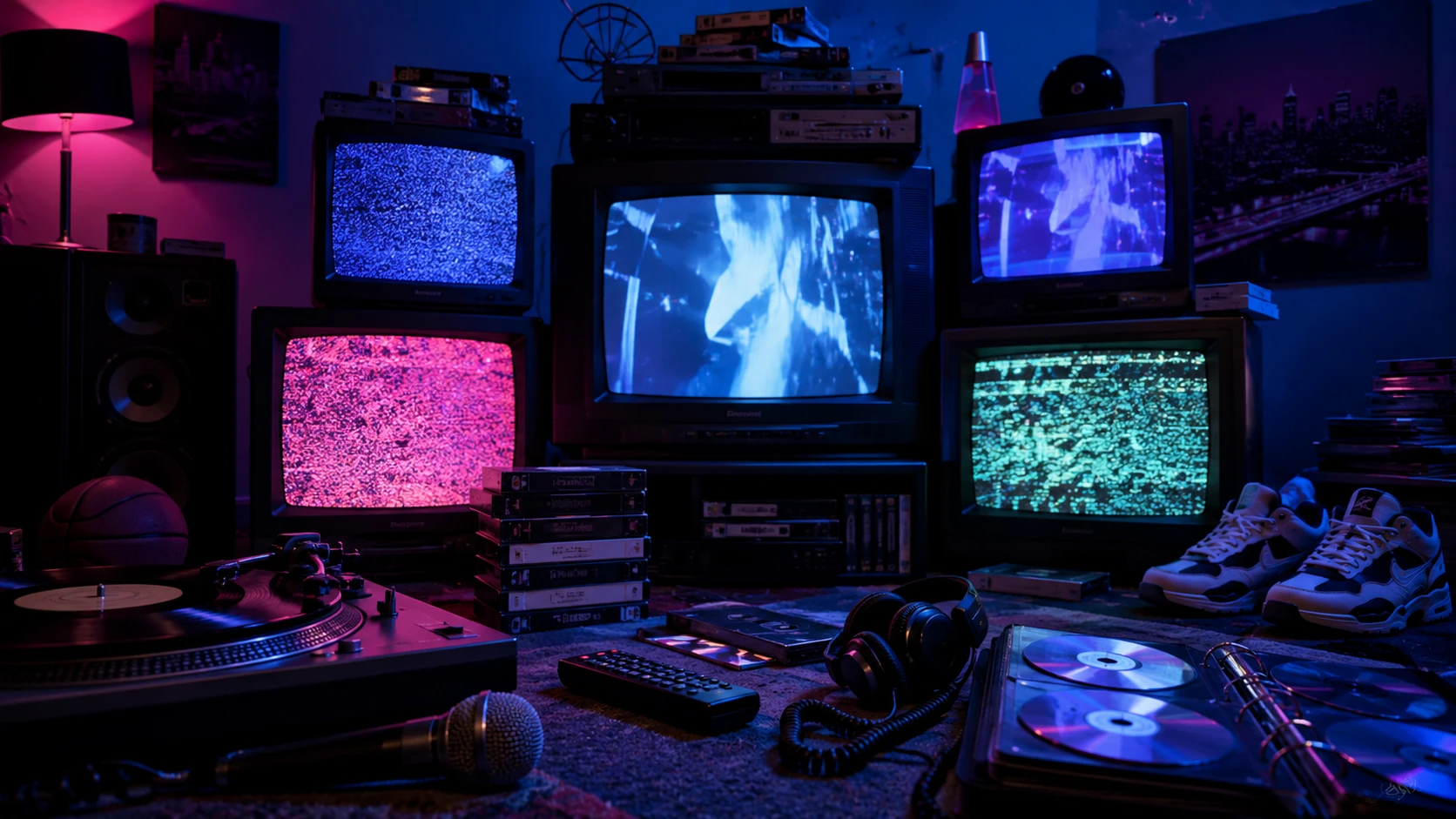
Then there was the bedroom shrine. CDs stacked near the stereo. Posters. Magazine clippings. A TV/VCR combo if you were lucky. Tapes labeled in terrible handwriting. Remote controls with missing battery covers. Headphones with one side going out. That was the real home of 90s music obsession. MTV fed it constantly.
The lifestyle memory also includes argument. Was the video corny? Was the artist selling out? Was the song too pop? Was the video better than the song? Was the clean edit ruining it? Was the remix better? Did the video make the record bigger than it deserved? Did the outfit work? Who had the best cameo? Why was everything wet and shiny? These were important civic debates.
That is why hip-hop on MTV in the 90s is not just a media story. It is a lifestyle story. It is about how music moved through rooms, clothes, bodies, stores, cars, TVs, conversations, and memory. It is about the decade learning that rap was not only a sound. It was a way to look at the world, dress for the world, argue with the world, and occasionally embarrass yourself trying to copy the world.
Essential 90s Hip-Hop Videos That Show What MTV Changed
This is not every important video, because the 90s had no respect for your free time. But these are the kinds of clips that show how rap used MTV: street portraits, regional identity, pop crossover, fashion, comedy, surrealism, and glossy dominance.
Early and mid-90s foundations
- Public Enemy videos — Political urgency turned visual, proving rap clips could carry argument, protest, and media critique.
- A Tribe Called Quest videos — Warm, playful, stylish, and tied to the jazz-rap side of the decade, connected naturally to A Tribe Called Quest and 90s Jazz Rap.
- Dr. Dre and Snoop’s West Coast visuals — G-Funk style, cars, sunshine, house-party energy, and California mythology, tied to Dr. Dre and The Chronic.
- Wu-Tang Clan videos — Grit, crew energy, mythology, and a visual identity that made Staten Island feel like a whole rap universe.
- Nas video moments — Street-level storytelling and New York atmosphere tied to Nas, Illmatic, and 90s Rap Storytelling.
- Queen Latifah and Salt-N-Pepa videos — Authority, pop confidence, style, and the screen presence of women shaping the decade.
Late-90s escalation
- Missy Elliott videos — Surreal sets, fish-eye lenses, futuristic styling, comedy, body-shape play, and full video-world control.
- Biggie video moments — Charisma, luxury, humor, New York scale, and the visual shift into late-90s rap stardom.
- Tupac video moments — Mythology, vulnerability, defiance, West Coast imagery, and the screen presence of a star larger than the frame.
- Outkast videos — Atlanta cool, Southern futurism, funk, individuality, and the visual proof that rap’s map was expanding.
- Bad Boy shiny-suit videos — Gloss, samples, fisheye flash, suits, dancers, and the video budget becoming part of the hook.
- Busta Rhymes videos — Cartoon energy, wild movement, visual chaos, and proof that rap videos could be strange and still land hard.
The point is not that every video had to be expensive or surreal. The point is that hip-hop learned how to use the screen in multiple ways. A gritty clip could make a record feel real. A glossy clip could make success feel undeniable. A funny clip could make an artist unforgettable. A weird clip could make the song feel like a portal. MTV gave all those approaches national reach.
This is also why the video conversation belongs beside 50 Essential 90s Hip-Hop Songs and 90s Hip-Hop Songs That Defined the Decade. Some records defined the decade sonically. Others became decade-defining because the video fused itself to the song so tightly that your memory refuses to separate them.
The MTV Rap Story Changed Every Year Because the Decade Would Not Sit Still
The 90s hip-hop video arc moved from dedicated rap blocks to full crossover saturation. By the end, MTV could not tell the story of youth culture without rap sitting near the center.
In the early 90s, hip-hop on MTV still felt like something you had to seek out through the right shows and blocks. Rap was visible, but not yet the entire channel’s daily oxygen. That made every major video feel like a find. The dedicated programming mattered because it gave rap a space before the wider machine fully understood what it had.
By the middle of the decade, everything had gotten bigger. Regional identities were sharper. East Coast and West Coast imagery had national weight. G-Funk videos made California feel cinematic. New York videos carried street pressure and lyrical seriousness. Women in hip-hop were using the screen in different ways. Rap albums were becoming CD-binder staples. The video was now part of how an album lived.
By 1996 and 1997, the crossover pressure was undeniable. Rap and R&B overlap was everywhere. The Fugees, Bad Boy, Tupac, Biggie, Missy, Busta, and countless others were using videos to build worlds around records. MTV was no longer just introducing rap to viewers. It was helping organize the visual memory of rap’s mainstream takeover.
By 1998 and 1999, the channel had become a crowded battlefield. TRL was turning videos into daily ranking drama. Teen pop was exploding. Shiny rap was everywhere. R&B and hip-hop were fused into radio/video culture. Missy was making weirdness mainstream. The end of the decade felt like every genre had been shoved into the same elevator and told to look good on camera.
The year pages matter because they show the wider soundtrack around the MTV rap story. Rap videos did not exist in isolation. They were competing with pop, rock, R&B, dance, ballads, soundtrack cuts, and whatever song your local radio station decided to overplay until everyone developed a twitch.
Hip-Hop on MTV Changed How the 90s Remembered Rap
The MTV era gave 90s hip-hop a visual memory bank: videos, outfits, rooms, cars, camera angles, countdowns, interviews, premieres, and images that still play in your head before the beat even drops.
The Image Stayed
MTV helped turn rap videos into memory: the suit, the car, the rooftop, the lens, the countdown, the remote, and the room where you first saw it.
Hip-hop on MTV changed how the 90s remembered rap because it fused sound to image at scale. The songs were already powerful, but the videos gave them visual hooks that refused to leave. A record could live in your ears. A video could live in your brain like a tiny cable channel with terrible scheduling and excellent taste.
The legacy is not simple. MTV gave visibility, but it also filtered, packaged, delayed, edited, and sometimes misunderstood the culture. It could elevate rap while also trying to make it advertiser-safe. It could give artists a national platform while still favoring certain kinds of images. It could show the culture and flatten it. Both things can be true, because the 90s were never neat and neither was MTV.
Still, the impact is undeniable. MTV made rap impossible for mainstream youth culture to ignore. The channel helped turn artists into icons, videos into events, fashion into national signals, regional styles into visual myths, and crossover records into daily life. By the end of the decade, hip-hop was not waiting outside the pop-culture house. It was inside, rearranging the furniture, changing the music, and probably taking over the TV.
The MTV era also shaped how later platforms worked. YouTube, social media clips, video premieres, visual albums, meme culture, and artist branding all owe something to the music-video age. The difference is that 90s viewers had scarcity. You could not watch anything instantly. You waited, watched, taped, missed, caught, argued, and remembered. That made the videos feel bigger.
For Smells Like Gen X, this page matters because it connects the whole 90s hip-hop section: radio crossover, Missy’s weird visual future, late-90s shiny excess, fashion, women in hip-hop, albums, and the big 90s hip-hop picture.
But reader-facing nostalgia matters too. Hip-hop on MTV is the memory of watching a video premiere like it was a sports event. It is the memory of seeing a rapper’s outfit and immediately wanting something you could not afford. It is the memory of learning regional style through a screen. It is the memory of clean edits, weird camera lenses, late-night blocks, countdowns, VJs, commercials, and the sacred act of yelling at someone for changing the channel.
That is the real legacy. MTV made 90s hip-hop something you could see, not just hear. And once Gen X saw it, the image stuck.
Where to Go Next
Hip-hop on MTV connects to nearly every major 90s rap lane: radio crossover, fashion, shiny-suit excess, women in hip-hop, albums, essential songs, regional scenes, and the bigger 90s music landscape.
Hip-Hop on MTV in the 90s FAQ
Why was hip-hop on MTV important in the 90s?
Hip-hop on MTV was important because it helped turn rap into a national visual culture. Music videos gave artists a look, a setting, a fashion language, and a personality that radio alone could not provide. MTV helped rap move into living rooms, bedrooms, malls, dorm rooms, countdowns, and everyday Gen X memory.
What role did Yo! MTV Raps play in 90s hip-hop?
Yo! MTV Raps gave hip-hop a dedicated national TV space where videos, interviews, artist personalities, regional differences, style, and rap culture could reach viewers who might not have access to local scenes or specialty radio programming.
How did MTV change 90s rap videos?
MTV helped make rap videos more central to an artist’s identity. As the decade went on, videos became bigger, glossier, stranger, more cinematic, more fashion-driven, and more important to how fans remembered songs.
How did MTV help rap crossover?
MTV helped rap crossover by giving songs a visual identity that could travel beyond radio. A hit video could make an artist more recognizable, help a song reach wider audiences, and turn rap into part of daily pop culture alongside radio, soundtracks, magazines, and countdown shows.
What was TRL’s impact on hip-hop?
TRL pushed hip-hop videos into MTV’s daily pop-culture scoreboard. Rap videos competed beside pop, rock, R&B, teen pop, and soundtrack hits, showing how far hip-hop had moved from dedicated rap blocks into the center of youth culture.
How did MTV affect 90s hip-hop fashion?
MTV made hip-hop fashion move. Videos spread oversized fits, jerseys, Timberlands, tracksuits, leather, denim, shiny suits, regional style, sunglasses, sneakers, and visual codes to viewers far beyond the scenes where those styles started.
How does Missy Elliott connect to hip-hop on MTV?
Missy Elliott is one of the strongest examples of hip-hop using MTV as a full visual universe. Her late-90s videos used fish-eye lenses, futuristic sets, humor, body-shape play, and strange fashion to make rap videos feel surreal, funny, and impossible to ignore.
What should I read next?
Start with 90s Rap Radio Crossover, then read Missy Elliott and Late-90s Hip-Hop Weirdness, The Shiny Suit Era of Late-90s Rap, 90s Hip-Hop Fashion, and the main 90s Hip-Hop and Rap page.