Hottest Christmas Toys of the 80s The Gifts We Lost Our Minds Over
The decade when Christmas shopping became a contact sport
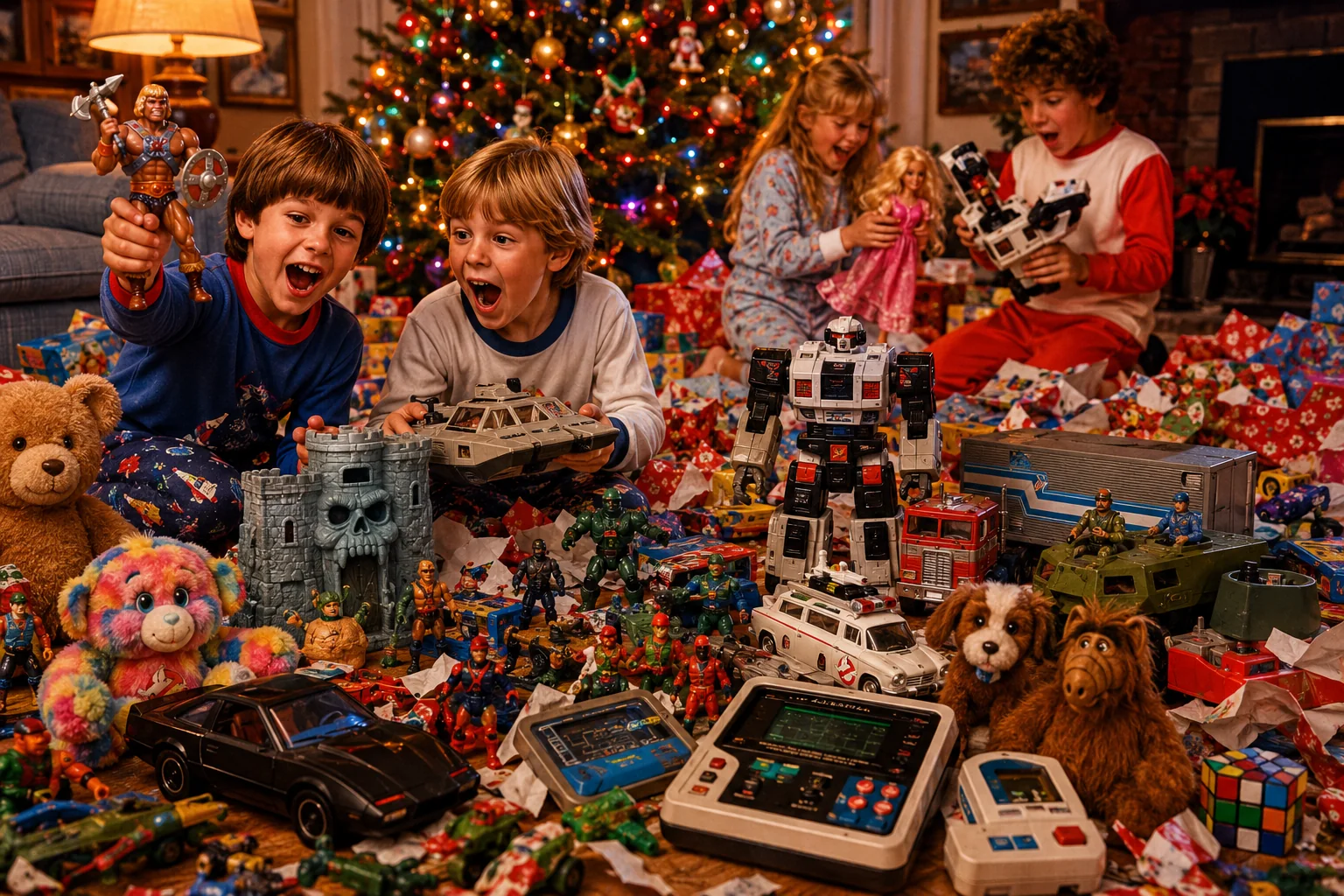
The 80s toys aisle did not believe in moderation. It believed in cartoon tie-ins, talking bears, transforming robots, game cartridges, impossible shortages, glossy wish books, and commercials loud enough to make a child feel personally betrayed by a parent who said no. These were the popular 80s Christmas toys that turned ordinary December shopping into a family operation.
The most iconic toys of the 80s are remembered for their impact across the whole decade. This countdown is about a more specific kind of madness: the must-have Christmas gifts that created the biggest yearly rush through scarcity, commercials, store rumors, playground pressure, and the unmistakable shape of the box under the tree.
How the holiday heat was measured
What made the hottest 80s Christmas toys impossible to ignore?
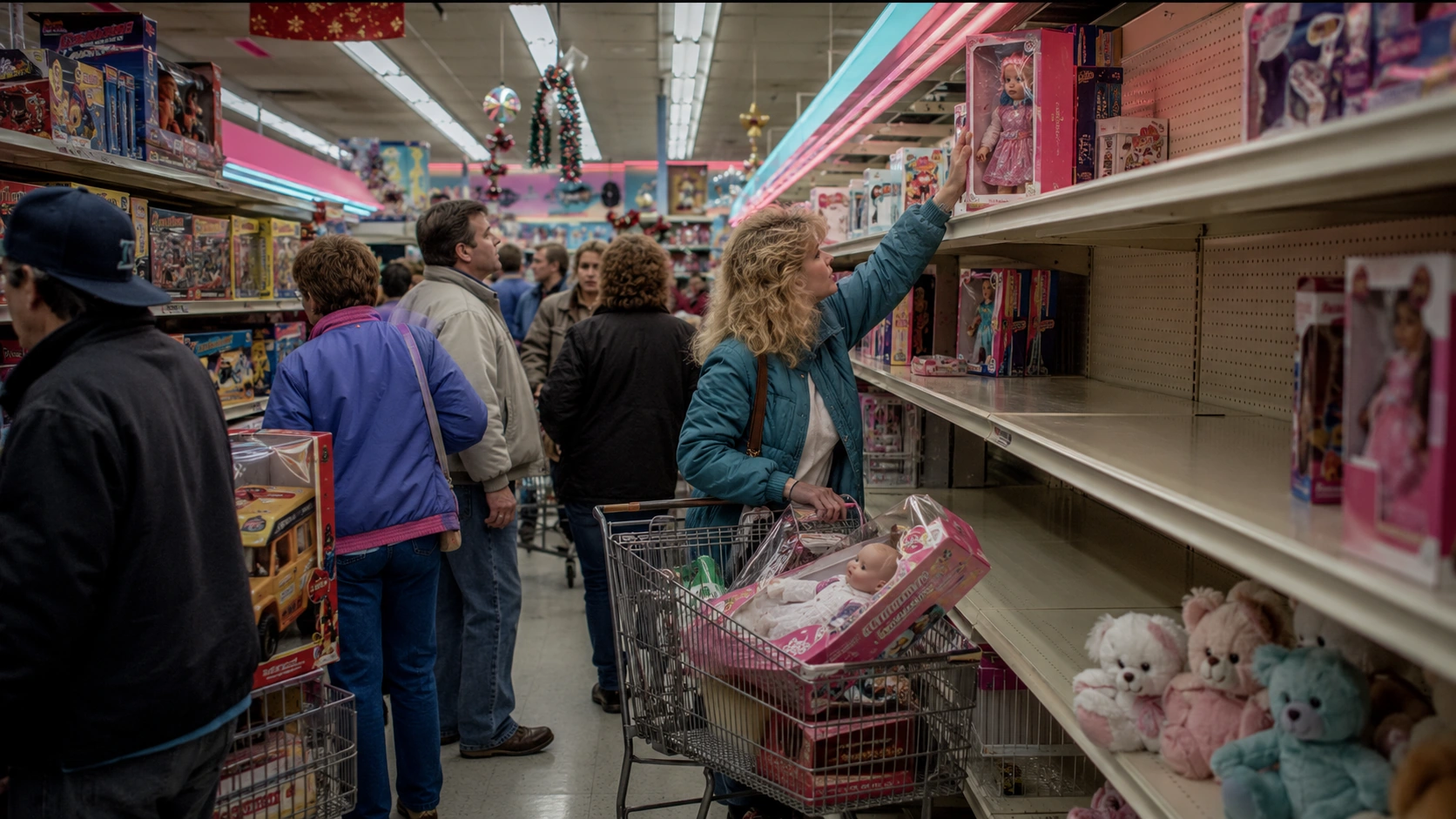
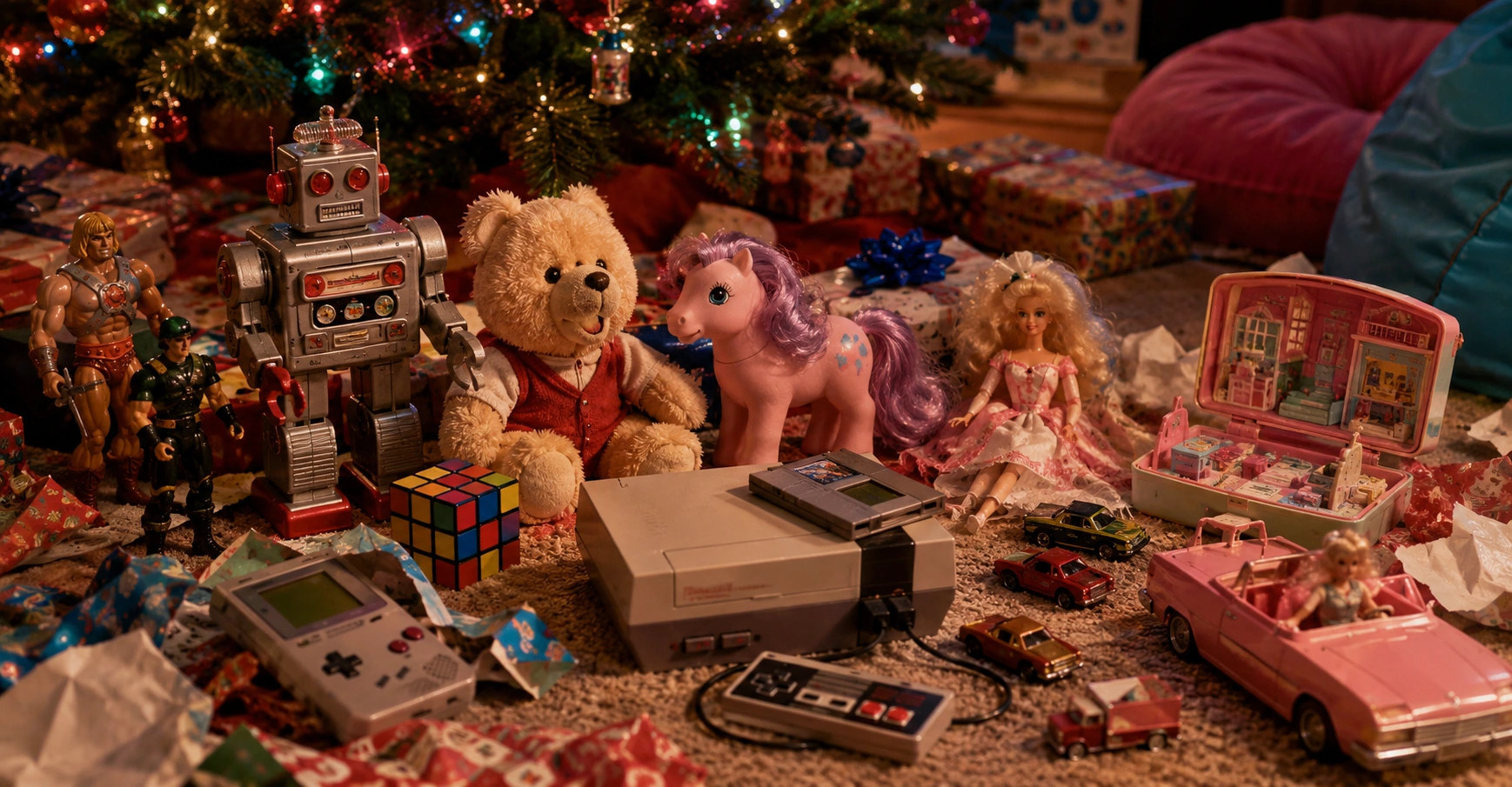
A Christmas toy could be popular without becoming a holiday event. The toys in this post earned their places through some combination of five forces: kids asking for them by name, retailers struggling to keep them in stock, commercials creating urgency, television or movie exposure keeping them visible, and the social pressure that started the moment another kid got one first.
Did kids ask for the exact brand, character, model, or set rather than a generic substitute?
Did stores run short, impose limits, create lines, or turn the search into a family mission?
Did cartoons, movies, commercials, news coverage, or playground conversation keep the toy impossible to ignore?
Did the box feel like the main event when it appeared under the tree?
Does the toy still trigger catalog pages, store aisles, batteries, wrapping paper, and household negotiations?
The result is a year-by-year holiday ranking, not a unit-sales ledger. Some toys carried over for several Christmas seasons. Others burned white-hot for one year and then became permanent nostalgia. That difference is part of the story.
How the wish lists were made
How 80s toy commercials built the Christmas wish list
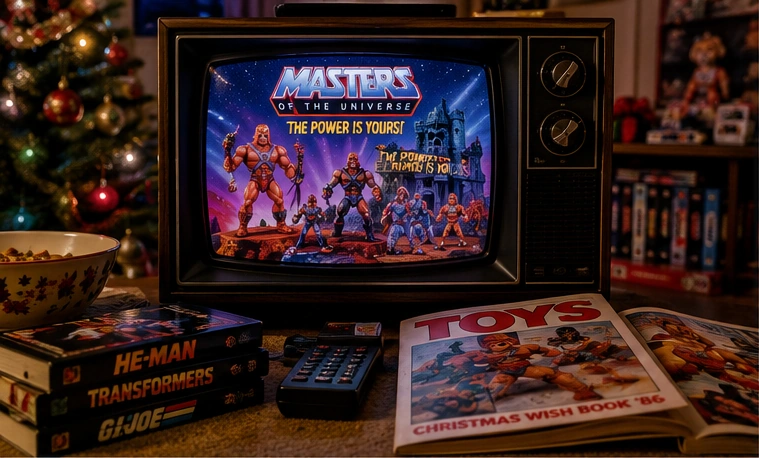
Christmas demand in the 80s was built long before December. Commercials showed complete collections, enormous playsets, organized battle scenes, children reacting at unsafe excitement levels, and accessories performing much better than they would later perform on shag carpet.
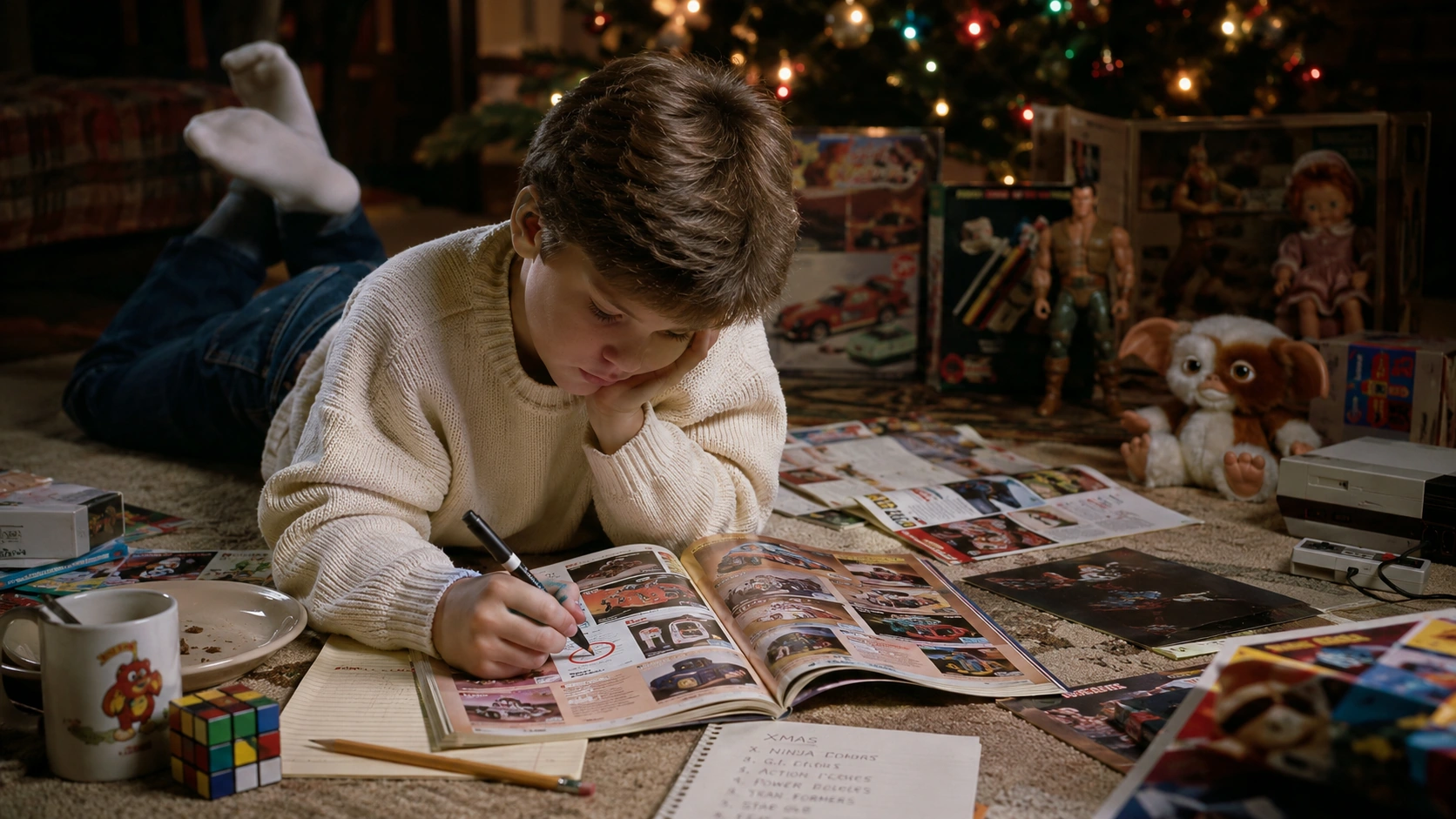
Cartoons gave the products voices, enemies, powers, and cliffhangers. Catalogs turned the whole operation into a visual checklist. By the time holiday shopping started, kids had already rehearsed the argument for months. Rewatch the original sales pitches in the archive of 80s toy commercials and videos.
Why the decade kept escalating
Action figures, electronic toys, dolls, and video games battled for Christmas morning
The action-figure arms race
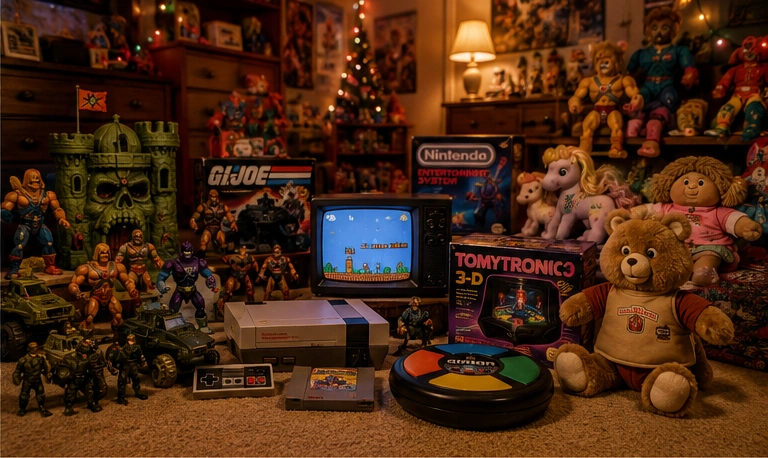
He-Man, G.I. Joe, Transformers, Ghostbusters, and TMNT turned figures into ecosystems of villains, vehicles, headquarters, cartoons, and collecting pressure. The full battle continues in our guide to 80s action figures.
The battery takeover
Talking toys, programmable vehicles, memory games, laser gear, and electronic learning toys made technology feel personal. Keep rewinding through 80s electronic toys and gadgets.
The living-room console war
Atari, Intellivision, Nintendo, and Game Boy moved play onto screens and created gifts that could keep generating new requests through cartridges and accessories. Explore more 80s video game toys.
Christmas heavyweight: Rubik’s Cube
The hottest Christmas toys of 1980
The puzzle that turned every adult into a liar about being “almost finished”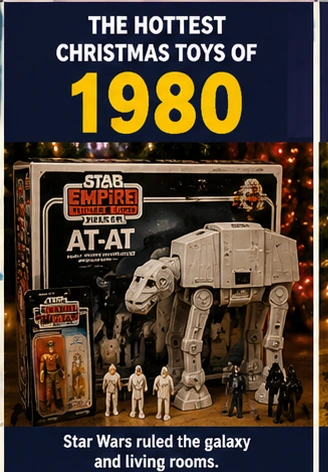
Christmas 1980 arrived with the decade still wearing some late-70s carpeting, but the toy aisle was already changing fast. Electronic games were moving deeper into the living room, licensed characters were becoming full retail systems, and a small colored cube had escaped the puzzle shelf to become a national obsession. The hottest gifts were not all brand-new releases. Holiday demand in the early 80s often built around products that had gathered momentum through television, schoolyard visibility, department-store displays, and the brutal logic of children seeing another child own something first.
The 1980 wish list was short, handwritten, and completely unreasonable. It usually assumed the local store had an infinite supply of Atari cartridges, Star Wars figures, and adults willing to solve a cube before dinner.
What the shelves felt like
Christmas 1980 still had plenty of familiar carryover toys, but the balance was changing. The aisle now placed electronic sound, home gaming, licensed movie figures, scented characters, and brain-teasing novelty products beside the classic dolls, cars, and construction sets. That variety mattered because children were no longer asking only for a type of toy. They were learning to ask for a specific brand, a specific cartridge, a specific character, or a specific version shown in a commercial. The request had become more precise, and precision is where holiday pressure begins.
Rubik’s Cube won the season’s cultural argument because it crossed every boundary. It could be sold in a toy store, department store, bookstore, airport shop, or drugstore and still feel like the same essential object. Atari represented the bigger financial leap, but the cube had reach. It appeared at school, at work, on television, and in adults’ hands. Christmas 1980 proved that a toy did not need a fictional universe if the entire country was already trying to beat it.
Craze Level: National emergency for people who hated being outsmarted by plastic
Rubik’s Cube
Rubik’s Cube was the perfect Christmas hit because it looked affordable, intelligent, portable, and harmless—right up until it consumed the whole room. Kids twisted it during commercials, adults carried it to work, and every family eventually had one cube that had been “temporarily” taken apart or had its stickers peeled and rearranged by a future criminal mastermind. It did not need batteries, a cartoon, or a giant playset. The object itself was the challenge, the status symbol, and the public proof that somebody else could solve it faster than you.
What made it especially dangerous at Christmas was how easily it fit into every shopping plan. It was inexpensive enough for an aunt, uncle, or grandparent, looked educational enough to satisfy adults, and created instant competition the moment somebody opened it. One cube could occupy an entire holiday visit, with relatives passing it around, claiming they knew a method, and quietly making the colors worse.
Keep going: the Rubik’s Cube craze.
Big-Ticket Heat: The living room changed forever
Atari 2600
An Atari 2600 under the tree was not one present. It was a declaration that the television had been reassigned. The console already had momentum by 1980, but Christmas turned cartridges into an endless second layer of begging. One child wanted Space Invaders, another wanted Adventure, and the parent mainly wanted everyone to stop arguing over who had been playing for forty-seven minutes. The box felt expensive, futuristic, and slightly dangerous to the family routine—which was exactly why kids wanted it.
The Atari box had true main-gift presence. It was large, expensive, and clearly connected to the family television, which made it feel bigger than anything that stayed in a bedroom. Christmas shopping also became layered: one relative could buy the console, another could add a cartridge, and somebody else could contribute controllers. By breakfast, the entire household had a stake in who got the first turn.
Character Heat: The doll aisle suddenly smelled like dessert
Strawberry Shortcake
Strawberry Shortcake was more than a doll with a scent gimmick. The line looked like an entire soft-focus world built from greeting-card sweetness, tiny pets, coordinated friends, and enough berry-themed accessories to take over a bedroom. At Christmas, the appeal was expansion: once one character arrived, the shelf suddenly looked incomplete without the rest. The packaging was cheerful, the colors photographed beautifully in catalogs, and the fragrance made the toy feel different before the box was even fully opened.
Christmas catalogs made the Strawberry Shortcake world look complete and coordinated in a way a single store shelf rarely could. Kids could identify the exact friend, pet, or accessory missing from the collection, and the scent gave every newly opened box an immediate payoff. The line also worked beautifully as a group gift because several smaller pieces could be wrapped separately and still feel like one big reveal.
The rest of the sweet-smelling, soft-bodied takeover lives with 80s dolls, plush toys, and pet-toy chaos.
Electronic Heat: Four colors, four sounds, one family feud
Simon
Simon made electronic play feel clean, modern, and instantly understandable. Watch the lights, remember the pattern, repeat it, and try not to collapse under pressure while everyone stared. It worked as a child’s gift and as a family-room challenge, which made it especially strong at Christmas. The rounds were short, the failure was public, and an adult could confidently say “this is easy” seconds before getting eliminated by a sequence a nine-year-old had already memorized.
Simon was built for the hours after the main presents were opened. It moved easily from child’s toy to family challenge, and every round created an audience. The lights and tones made it look impressive in a dim Christmas living room, while the simple rules meant nobody needed to read a thick manual. The only real preparation was finding batteries before the stores closed.
Simon belongs beside the decade’s 80s electronic toys and gadgets and the family-room games that made adults weirdly competitive.
Movie Heat: Hoth moved directly onto the carpet
Star Wars: The Empire Strikes Back Toys
The Empire Strikes Back gave the Star Wars toy machine a fresh wave of vehicles, figures, creatures, and cold-weather excuses to keep rebuilding the galaxy. Kids did not need a full set to feel involved; one figure could start an afternoon. But Christmas encouraged scale. A vehicle suggested a base, the base suggested more figures, and the figures suggested that somebody should probably buy a tauntaun. The movie made the line feel current again, while the toys made the movie continue long after the theater lights came up.
Holiday shopping around The Empire Strikes Back was driven by scale. A single figure was manageable; an AT-AT, snowspeeder, or playset became the thing a child mentioned in every conversation from Thanksgiving onward. The larger boxes looked spectacular under the tree and instantly changed the geography of the living room. Christmas morning did not end with opening the vehicle—it began with finding enough figures to crew it.
The bigger plastic battle continues through the decade’s 80s action figures.
Keep the whole year going with the top toys of 1980 and the biggest fads of 1980.
Christmas heavyweight: Rubik’s Cube
The hottest Christmas toys of 1981
The obsession kept spinning while home gaming got louder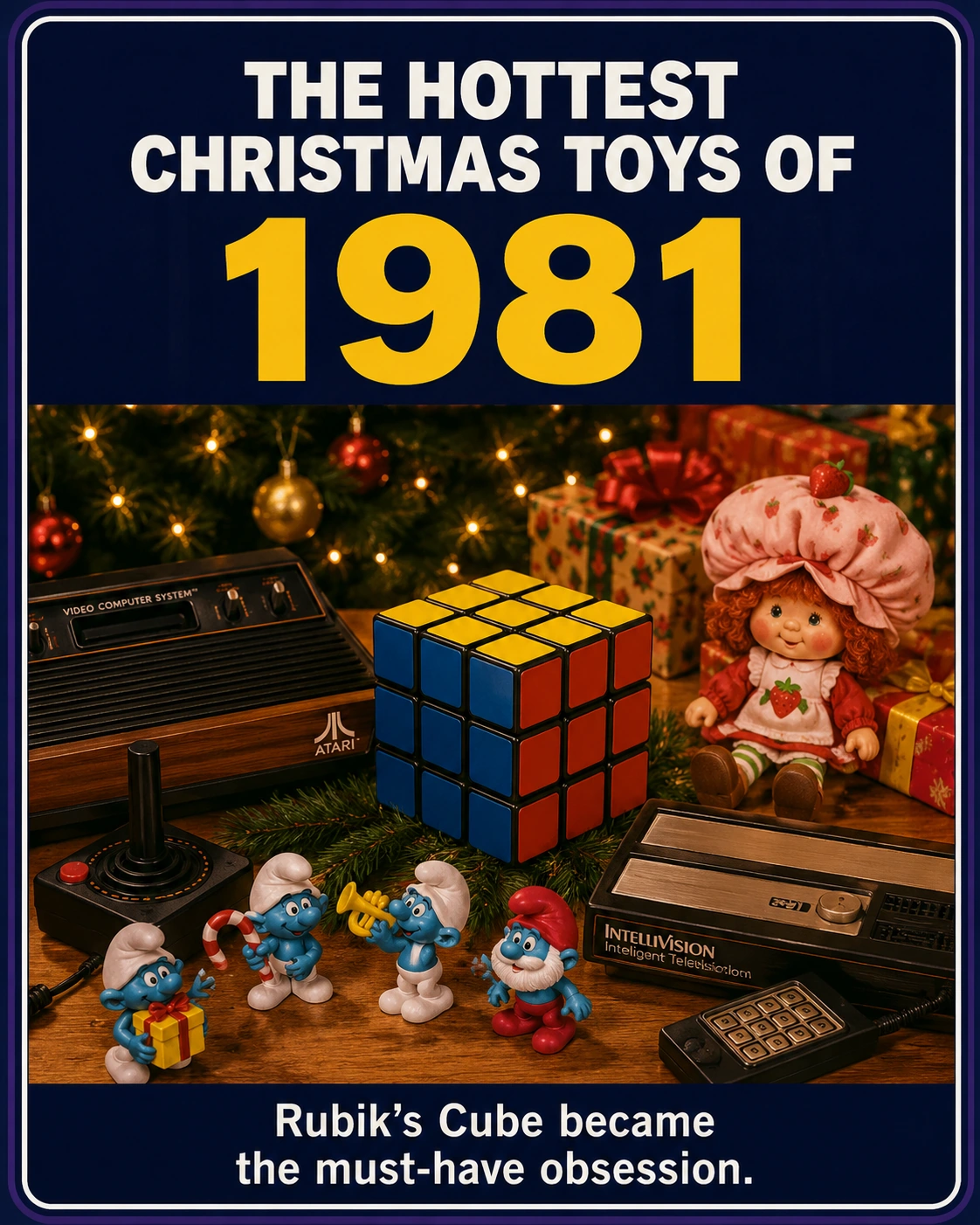
By Christmas 1981, the decade had found its commercial rhythm. Toys no longer just appeared in stores; they arrived through commercials, cereal aisles, Saturday mornings, school conversation, and glossy catalog spreads that made every bedroom in America look tragically under-equipped. Rubik’s Cube remained unavoidable, Atari kept growing, and character lines became easier to recognize from across the aisle. The season was less about one completely new toy taking over than about several early-decade crazes reaching full household saturation.
The 1981 catalog was studied like intelligence material. Pages were folded, items were circled, and every price was treated as a problem for adults to solve.
When the early crazes became household fixtures
The 1981 season was powered by repetition and recognition. Atari cartridges, Strawberry Shortcake characters, Smurf figures, and Rubik’s Cube displays had spent enough time in public view that children no longer needed an introduction. They needed the missing piece. This is where the 80s collecting instinct became obvious: one product could create a permanent list of follow-up gifts. The console needed games, the character needed friends, and the figure collection needed another pose that looked almost identical to adults but completely different to the person making the list.
The retail advantage belonged to products available at multiple prices. A full console could be the main family gift, while cartridges, figures, and small puzzles could be distributed among grandparents, aunts, uncles, and anyone else asking what the child wanted. That gift ladder helped strong brands dominate the whole morning. Christmas did not need to produce one box from one person. It could assemble an entire product world through coordinated relatives who had accidentally joined a merchandising strategy.
Carryover Craze: Still sitting on every coffee table
Rubik’s Cube
Rubik’s Cube entered a second Christmas with even more cultural weight. By then, owning one was practically assumed; solving one was still suspicious. The cube had become a party trick, school distraction, desk ornament, and reminder that spatial reasoning could ruin a perfectly good evening. Holiday displays leaned into the challenge, and the gift remained ideal for relatives who wanted something inexpensive that looked educational. They were not the people who had to listen to it clicking for three straight hours.
By its second huge Christmas, the cube had become a safe gift for almost anyone and a deeply unsafe gift for household peace. Solution books, imitation puzzles, and speed-solving boasts kept the challenge visible all season. It was also the rare toy that adults opened on purpose, which meant children often had to recover their own present from a parent who had become convinced the final side was only three moves away.
Console Heat: Every cartridge became another Christmas argument
Atari 2600
Atari’s Christmas power came from the fact that the console created a permanent gift category. Even families that already owned the system still had a list full of cartridges, controllers, and arcade promises. The excitement was immediate: tear the wrap, connect the cartridge, and begin fighting over turns before breakfast. Unlike a toy with one built-in play pattern, Atari suggested a future in which the same machine could keep becoming something else. That idea was nearly as important as the games themselves.
The real holiday pressure had shifted from simply owning Atari to owning the right games. Wish lists became title-specific, and box art did a remarkable job of making every cartridge feel like a completely different universe. That gave relatives an easy assignment, but it also created the risk of duplicates, wrong versions, or a game nobody had asked for because the clerk said it was popular.
Collecting Heat: One doll was merely the opening offer
Strawberry Shortcake
Strawberry Shortcake stayed strong because the line was built for multiplication. Friends, pets, playsets, and themed accessories made a Christmas morning pile feel like a complete little neighborhood. The dolls were visually distinct enough for kids to know exactly which character was missing, and adults could find gifts at several price levels. That combination—recognizable characters, collectible variety, and a world that looked good in a catalog—was pure early-80s retail engineering.
The line’s Christmas strength came from how neatly it could be expanded. A child might ask for one specific doll, while adults could add a pet, furniture, a carrying case, or another friend without ruining the surprise. Catalog photography encouraged the idea of a full little community, so every successful gift also revealed three more empty spaces that would need attention later.
Tiny-Figure Heat: Blue people everywhere, for reasons nobody questioned
The Smurfs
The Smurfs were ideal stocking-stuffer material and dangerously easy to collect. One figure looked cute; fifteen figures looked like a small blue occupation force. Their television visibility made even simple PVC characters feel familiar, while the wide variety of poses gave kids a reason to keep looking for another one. At Christmas, they worked at every scale—from one inexpensive figure to a larger display of mushroom-house chaos—and they proved how effectively television could turn tiny characters into a major toy presence.
Smurf figures were almost engineered for stockings. They were small, recognizable, affordable, and available in enough poses that an adult could usually find one the child did not already own. The danger was that one figure looked lonely once it was opened. A few Smurfs quickly became a village, and a village immediately began asking where its mushroom house was.
The Smurfs were one more example of 80s cartoons that sold us the toys before kids had time to ask whether they needed another tiny blue person.
Console Rival Heat: The expensive argument against Atari
Intellivision
Intellivision sold a more sophisticated fantasy: sharper sports, complicated controllers, and the sense that this console might be for serious people. To kids, that mainly meant another machine they desperately wanted access to. Its Christmas appeal came from competition with Atari and from the growing belief that home video games were not a passing novelty. The controller overlays looked technical, the advertising felt confident, and households began choosing sides long before console wars had a name.
Intellivision carried a slightly more serious Christmas aura than many competing systems. The controller overlays, sports titles, and technical presentation gave adults a way to justify the price as a sophisticated family purchase. Kids were less interested in the justification than the screen. The system often became the centerpiece of the holiday visit, especially when a relative who had criticized video games suddenly demanded a rematch.
The console rivalry gets louder in the full rewind through 80s video game toys.
Keep the whole year going with the top toys of 1981 and the biggest fads of 1981.
Christmas heavyweight: He-Man and the Masters of the Universe
The hottest Christmas toys of 1982
The year action figures started arriving with entire mythologies attached
Christmas 1982 marks the point where the 80s toy aisle begins to look unmistakably like the 80s. Action figures became broader worlds instead of isolated characters. Dolls and collectibles gained bigger casts. Electronics kept spreading. Television did not merely advertise toys; it gave them personalities, enemies, catchphrases, vehicles, and reasons to demand a second shelf. The biggest holiday winners were products that could turn one purchase into a long-term campaign.
This was the Christmas when parents started realizing the figure was cheap because the castle, vehicle, pet, villain, and five supporting characters were not.
The year the toy aisle learned to build universes
In 1982, toy companies increasingly sold continuity. He-Man, G.I. Joe, and My Little Pony did not end when the first box was opened. The packaging introduced names, factions, symbols, allies, enemies, places, and future purchases. Even the simplest character seemed connected to a larger world. This made Christmas especially powerful because a few wrapped gifts could appear to launch an entire ongoing story. A figure, a vehicle, and one rival character were enough to transform the floor into a setting that would keep expanding for years.
Television, comics, mini-comics, and advertising reduced the amount of imagination needed to start while increasing the amount of imagination possible afterward. Kids knew who should fight, where the conflict belonged, and which missing character would improve the story. The toy did not replace imagination; it arrived with a dramatic first draft. That shift explains why the early-decade action lines became such durable Christmas machines and why parents started looking at playset prices with quiet disbelief.
Action-Figure Heat: Muscles, magic, and a castle shaped like a skull
He-Man and the Masters of the Universe
He-Man hit the holiday aisle with the visual subtlety of a cymbal crash. The figures were chunky, colorful, easy to pose, and immediately readable from across a room. Even before the animated series reached full power, the mini-comics, packaging art, creatures, vehicles, and Castle Grayskull created the impression of a giant fantasy saga already underway. Christmas demand was fueled by the line’s ecosystem: getting He-Man felt great, but getting He-Man without Skeletor was clearly an administrative failure.
Christmas displays made the Masters of the Universe line look less like a group of figures and more like a fully operational fantasy kingdom. The huge painted art, creatures, vehicles, and Castle Grayskull gave adults obvious price tiers and kids obvious priorities. The figure might fit in a stocking, but the castle was the box whose shape could be identified under wrapping paper from across the room.
The full Eternian takeover belongs in He-Man toys, where the castle, creatures, and cartoon machine get the room they deserve.
Keep going: He-Man toys.
Collectible Heat: Pastel horses with combable hair and no known limit
My Little Pony
My Little Pony understood something important: a toy could feel collectible without looking aggressive or complicated. The ponies combined bright bodies, long hair, symbols, names, and accessories into characters that were easy to recognize and difficult to stop collecting. At Christmas, the line looked especially strong because small figures, larger sets, brushes, carrying cases, and play environments could all appear in one coordinated pile. The result was colorful, personal, and quietly engineered to make one pony look lonely.
The ponies were especially effective holiday gifts because choosing one felt personal. Color, mane, symbol, and name all mattered, and children usually knew exactly which pony they meant. Brushes and small accessories made the opening feel interactive immediately, while multiple packages could be arranged into a bright, coordinated Christmas-morning display that looked far more expensive than any one piece.
The pony aisle keeps going through My Little Pony toys in the 80s and the larger world of 80s dolls and plush toys.
Keep going: My Little Pony toys in the 80s.
Mission Heat: File cards, vehicles, and a war taking over the floor
G.I. Joe: A Real American Hero
The 3.75-inch G.I. Joe relaunch made scale the secret weapon. Smaller figures allowed more vehicles, larger bases, and entire squads to fit into a child’s room—at least in theory. File cards made every character feel official, while the comic and advertising gave the conflict a sense of ongoing structure. At Christmas, the line was perfect for layering: a figure in the stocking, a vehicle under the tree, and a headquarters-sized request that parents pretended not to see.
G.I. Joe Christmas lists required adults to learn code names, vehicle names, and the difference between two figures wearing nearly identical shades of green. The small scale made figures easy add-on gifts, but the vehicles created the real holiday spectacle. A jeep or aircraft opened in the morning could send the entire squad into service before breakfast, usually across terrain made from wrapping paper and couch cushions.
The mission continues with G.I. Joe toys and the wider 80s action figure arms race.
Keep going: G.I. Joe toys.
Gaming Heat: The cartridge pile kept growing
Atari 2600
Atari remained a major Christmas force because the system had become a family-room fixture and every new game looked like a new reason to keep playing. The home-console dream was still powerful: arcade energy without quarters, closing times, or strangers watching you fail. Holiday shoppers could buy a big system bundle or a single cartridge, which kept Atari visible at several price points. The only problem was that the box art often promised an intergalactic epic and the screen occasionally delivered two squares negotiating.
Atari still had tremendous holiday power because a new cartridge could refresh a console the family already owned. That made it a reliable gift category even when the hardware was not new. The commercial promise and the package art mattered enormously; kids often knew what they wanted from screenshots and arcade familiarity. Christmas morning was when the difference between the imagined game and the actual pixels finally arrived.
Movie Heat: The alien was everywhere, whether the toys deserved it or not
E.T. Toys
E.T. became such a cultural event that toy versions did not need much explanation. Plush figures, dolls, wind-up toys, and licensed oddities appeared because the character had already done the hard work of making audiences care. At Christmas, the emotional connection mattered as much as play value. Kids wanted a piece of the movie, adults recognized the face, and retailers knew the title would pull attention. Not every product became a classic, but the holiday visibility was impossible to ignore.
E.T. gifts worked because the movie had already created the emotion. Plush toys and character figures were less about complex play than about bringing the alien home. For holiday shoppers, that recognition was useful: the face was familiar, the character felt gentle, and the gift carried a little of the movie’s sentiment. It was one of those years when adults could buy licensed merchandise without needing a child to explain the entire mythology first.
Keep the whole year going with the top toys of 1982 and the biggest fads of 1982.
Christmas heavyweight: Cabbage Patch Kids
The hottest Christmas toys of 1983
The year Christmas shopping turned into breaking news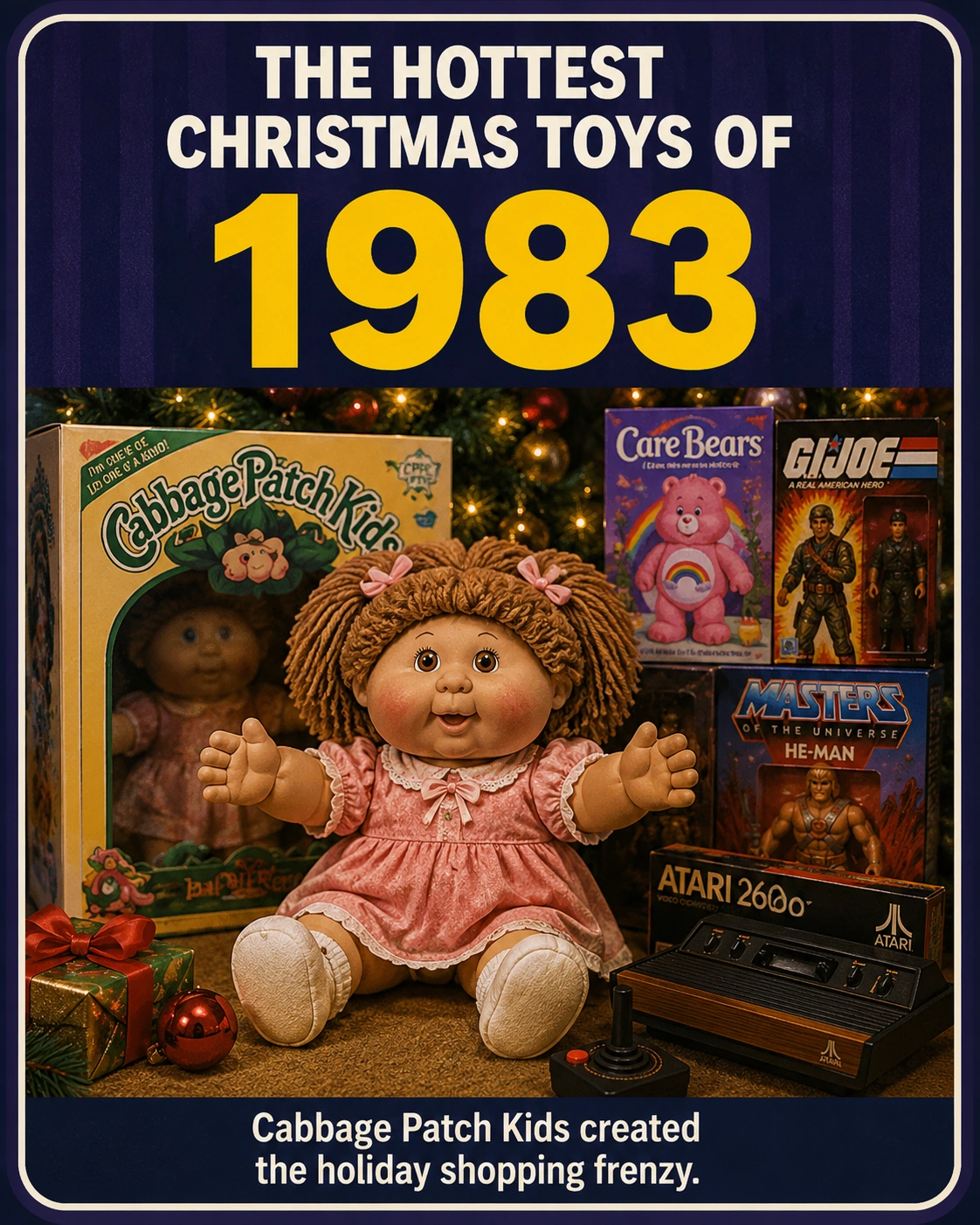
No year captures 80s Christmas toy panic more completely than 1983. Cabbage Patch Kids did not simply sell well; they became a national scarcity story. Television news showed crowds, stores rationed inventory, and parents discovered that a doll with adoption papers could trigger behavior normally associated with the collapse of civilization. Around that frenzy, Care Bears, He-Man, G.I. Joe, and electronic favorites kept the entire toy aisle moving at full volume.
If your parent found the exact Cabbage Patch Kid you wanted in 1983, that person had contacts, luck, stamina, or a willingness to abandon all remaining dignity.
When scarcity became part of the product
Cabbage Patch Kids changed the emotional temperature of holiday shopping because not finding the toy became part of the story. Scarcity transformed ordinary demand into proof of importance. Every empty shelf confirmed that the dolls were special. Every news segment created more urgency. Every parent who found one became evidence that success was possible, while every parent who did not find one had to consider substitutes that children had already decided were unacceptable. The product and the hunt became inseparable.
The frenzy also showed how national media could magnify a toy shortage. Local retail problems became shared cultural events. Families who had no intention of buying a Cabbage Patch Kid still knew about the chaos. That visibility benefited the entire category, because Christmas toy shopping itself became newsworthy. The aisle was no longer only where gifts were purchased; it was where the decade performed its appetite in public.
Scarcity Heat: The undisputed heavyweight champion of 80s toy panic
Cabbage Patch Kids
Cabbage Patch Kids turned the adoption concept, individually styled faces, names, paperwork, and limited supply into the decade’s defining holiday frenzy. The dolls felt personal before they were even removed from the box, and that emotional hook made substitutes unacceptable. Parents were not shopping for any doll; they were searching for the right child. The shortages amplified everything. Store lines, news coverage, arguments, and impossible demand transformed a toy purchase into a mission with witnesses.
The hunt became part of the gift. Parents traded store rumors, arrived before opening, called relatives in other towns, and treated delivery information like classified intelligence. Because each doll had a name and individual look, simply finding any box was not always enough. The final Christmas-morning payoff carried the weight of everything that had happened before it: the lines, the shortages, the near misses, and the adult who somehow walked in with the impossible package.
The full story of lines, shortages, and adult panic is waiting in the 1983 Cabbage Patch Kids frenzy.
Keep going: the 1983 Cabbage Patch Kids frenzy.
Plush Heat: Feelings acquired logos and conquered the bedroom
Care Bears
Care Bears arrived with a color-coded emotional system simple enough for kids and merchandisers to understand instantly. The belly symbols, names, colors, and personalities made them collectible, while plush construction made them feel like legitimate bedtime companions. Christmas displays leaned into softness and character variety, and the line benefited from the same world-building energy reshaping action figures. The difference was that Care Bears defeated sadness with hugs instead of a missile-launching vehicle.
Care Bears gave shoppers a gentler alternative to the season’s doll panic, but the line still encouraged exact requests. Children knew the colors, belly symbols, and personalities, which meant a substitute could be spotted immediately. The plush bodies also gave the packages warmth and volume under the tree. A Care Bear was not merely displayed after opening; it was usually carried through the rest of Christmas Day.
Care Bears sit right in the middle of 80s dolls, plush toys, and pet-toy chaos—the softer side of a decade that still knew how to create a collecting emergency.
Cartoon Heat: Eternia became required viewing and required inventory
He-Man and the Masters of the Universe
By 1983, He-Man had the cartoon power needed to turn figures into personalities and playsets into destinations. Castle Grayskull was no longer just a bizarre green fortress; it was the center of an entire after-school universe. Christmas demand spread across heroes, villains, beasts, vehicles, and role-play accessories. The line was loud, physical, and easy to understand: every character looked like something important had already happened to him.
The cartoon had turned Christmas shopping into character selection. Kids no longer wanted just a strong fantasy figure; they wanted the villain or creature seen after school that week. The line’s bright packaging and exaggerated shapes made it easy to scan an aisle quickly, but the sheer number of choices complicated the mission. A parent could leave with the right logo and still discover that the wrong warrior had been purchased.
Expansion Heat: More figures, more vehicles, less visible carpet
G.I. Joe: A Real American Hero
G.I. Joe grew through detail and accumulation. Figures came with names, specialties, gear, and file-card biographies, making even secondary characters feel necessary. The vehicles expanded the scale of play and the size of holiday requests. At Christmas, a few figures could create a squad, but the catalog always showed the larger truth: there were jeeps, planes, tanks, bases, and enemies waiting to turn the bedroom floor into a permanent operational zone.
The smaller figure size made G.I. Joe a perfect holiday layering system. Several relatives could contribute figures without coordinating, while a parent handled the larger vehicle or base. Christmas morning then became an immediate assembly and inventory session: weapons, backpacks, missiles, stickers, and file cards all had to survive the wrapping-paper chaos. Losing one tiny part before lunch was practically a seasonal tradition.
Carryover Heat: Still powerful, even as the market started wobbling
Atari 2600
Atari remained deeply embedded in Christmas culture even as the home-game market entered a more chaotic phase. Families already owned the hardware, kids still recognized the cartridges, and the promise of a new game on Christmas morning remained immediate. The console’s holiday strength came from habit as much as novelty. It had become part of how kids understood the television: not only as something to watch, but as something to control.
Even as the video-game market became messy, Atari still occupied established space on Christmas lists. Families already owned the machine, stores still stocked cartridges, and children still associated the platform with arcade play at home. The holiday aisle could be confusing, though, with crowded shelves and wildly uneven games. A familiar title or strong box image often made the decision when reliable information did not.
Keep the whole year going with the top toys of 1983 and the biggest fads of 1983.
Christmas heavyweight: Transformers
The hottest Christmas toys of 1984
Robots in disguise, parents in denial, toy shelves under siege
Christmas 1984 was the year conversion became a retail superpower. Transformers and GoBots turned vehicles into robots and ordinary package windows into demonstrations of possibility. Cabbage Patch Kids remained incredibly hot, He-Man still ruled fantasy, G.I. Joe kept expanding, and Trivial Pursuit somehow convinced adults that a board game belonged in the center of the holiday conversation. It was one of the decade’s deepest Christmas toy seasons because nearly every major category had a genuine event-level product.
A 1984 toy commercial could show a robot changing forms in three seconds. Christmas morning revealed that a child needed twenty minutes, the instructions, and an adult with stronger thumbs.
The deepest toy Christmas of the decade
Christmas 1984 may have offered the broadest collection of simultaneous heavyweights. Cabbage Patch Kids still carried emotional prestige. He-Man and G.I. Joe had mature ecosystems. Transformers and GoBots made mechanical conversion feel new. Trivial Pursuit captured adults. Care Bears and Strawberry Shortcake remained visible, and home gaming still occupied valuable shelf space. A child could build a persuasive list without crossing into another category, while a family shopping for several ages could encounter a headline product in almost every department.
Transformers earned the top spot because the concept was instantly demonstrable. A commercial could show the complete promise in seconds: vehicle, movement, robot, character. The transformation also made the toy feel clever and substantial in the hands. Even when the process required instructions and patience, the finished change created a small performance. Christmas morning was full of people passing the figure around, checking the joints, and trying to reverse whatever step had just gone wrong.
Transformation Heat: Two toys in one, plus a full television mythology
Transformers
Transformers combined mechanical novelty with character storytelling at exactly the right moment. A vehicle becoming a robot was already a powerful toy idea; giving that robot a name, faction, voice, personality, cartoon role, and collectible tech-spec card made the line feel enormous. Christmas demand was boosted by variety. Small figures worked as stocking gifts, while larger characters felt like major events. The packaging window invited kids to study the engineering before the box was even opened.
Transformers were made for dramatic Christmas reveals. The packaging showed both forms, the box size often hinted at status, and the first challenge began before the toy was ready to play: figuring out the transformation without snapping anything important. Character-specific demand also made shopping harder. A child who wanted Optimus Prime did not consider another robot an equivalent solution, no matter how patiently the adult explained inventory.
The robot war gets its full treatment in G1 Transformers toys and the cartoons that made every vehicle look suspicious.
Keep going: G1 Transformers toys.
Carryover Frenzy: The shortage eased, the obsession did not
Cabbage Patch Kids
Cabbage Patch Kids remained a dominant Christmas gift because the 1983 panic had made the dolls cultural trophies. More availability did not reduce the emotional appeal; it gave more families a realistic chance to join the adoption ritual. New faces, outfits, names, and variations kept the line personal, while the previous year’s chaos supplied permanent credibility. A Cabbage Patch Kid under the tree still looked like proof that the shopper had completed an important mission.
The second major Cabbage Patch Christmas was less chaotic than the first but still carried enormous emotional weight. More families had a chance to find one, and the previous year’s news coverage had made the dolls feel permanently important. Shoppers still studied faces, hair, outfits, and names, because the adoption concept made choice feel personal. The right doll was not just purchased; it was matched.
Fantasy Heat: The cartoon-toy machine at full strength
He-Man and the Masters of the Universe
He-Man entered Christmas 1984 as an established empire. The line had heroes, villains, creatures, vehicles, castles, and enough strange anatomy to make every peg look dramatic. The animated series kept characters active in kids’ minds, while the toy line gave them physical control over the stories. Holiday shopping became less about finding He-Man himself and more about locating the specific villain, beast, or oversized playset that had become essential since last Christmas.
By 1984, holiday demand had moved beyond the obvious main characters. Kids were asking for specific beasts, vehicles, villains, and playsets that adults had never seen advertised outside a Saturday morning. That made the catalog essential. It translated the entire Eternian population into a shopping checklist and demonstrated how much larger the collection could become if everyone in the extended family cooperated.
Robot Heat: The other transforming army had speed and shelf presence
GoBots
GoBots benefited from the same transformation fever that made 1984 feel mechanical. The figures were often smaller, direct, and easy to collect, giving kids another way into the vehicle-to-robot fantasy. Christmas displays could present rows of machines ready to change forms, and the category’s sudden popularity meant many households had mixed robot loyalties. The playground debate over which line was better was less important than the fact that both lines had made ordinary cars look suspicious.
GoBots often entered Christmas shopping as both a legitimate favorite and the practical answer when another transforming robot could not be found. Their smaller size and lower price made them easy for relatives to add, while the transformation gimmick still delivered the mechanical payoff kids wanted. On Christmas morning, brand loyalties sometimes softened once there were several robots available for an immediate battle.
GoBots belong with the forgotten toys of the 80s that were once everywhere and now trigger an immediate “I had that” response.
Adult Heat: The board game that took over the grown-up table
Trivial Pursuit
Trivial Pursuit became a holiday phenomenon because it made adults feel informed, competitive, and personally insulted by a tiny wedge of plastic. It belonged on Christmas lists beside toys because it dominated family gatherings and retail attention at a scale far beyond a normal board-game release. The rules were easy, the arguments were immediate, and the questions had just enough authority to make people challenge the card rather than accept that they were wrong.
Trivial Pursuit was the rare holiday phenomenon whose biggest arguments began after the children had left the room. It was wrapped for adults, opened after dinner, and quickly turned the table into a courtroom. The game’s popularity made it an easy family gift, while its reputation made people feel that owning it was almost mandatory. Every gathering seemed to include one person who knew obscure geography and another who questioned the wording of every card.
The argument continues with 80s board games and family-room toys.
Keep the whole year going with the top toys of 1984 and the biggest fads of 1984.
Christmas heavyweight: Teddy Ruxpin
The hottest Christmas toys of 1985
A talking bear, a new console, and Christmas batteries vanishing on contact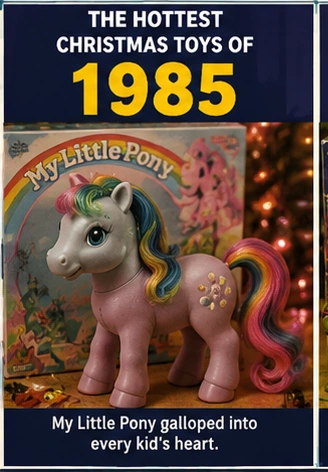
Christmas 1985 pushed toys toward performance. Teddy Ruxpin talked and moved. Nintendo began establishing a new vision of home gaming. She-Ra expanded the Masters of the Universe world, My Buddy leaned into companionship, and Jem brought music-video glamour into the doll aisle. The hottest gifts increasingly promised more than an object. They promised a character that spoke, a system that opened new worlds, or a whole media experience that continued after the wrapping paper was gone.
1985 was a strong year to discover that “batteries not included” was not a warning. It was a personal attack delivered at 7:12 on Christmas morning.
When toys started performing for the child
The hottest gifts of 1985 increasingly did something visible. Teddy Ruxpin moved and spoke. Nintendo responded to the controller. Jem and She-Ra carried television identities. My Buddy arrived at a scale that changed the room. A gift could now demonstrate its value immediately, which made commercials more powerful and Christmas morning more theatrical. The first activation became part of the memory: the mouth moved, the screen lit up, the cassette started, or the figure emerged from a box large enough to suggest major importance.
This performance culture raised expectations. A toy with electronics needed to work right away. A console needed the correct cables and a television willing to cooperate. A talking character required batteries that had not been borrowed by another gift. The technology made the experience impressive, but it also created new points of failure. Much of 80s Christmas nostalgia involves an adult kneeling beside a toy with a screwdriver while a child supplied unhelpful urgency.
Tech-Plush Heat: The bear talked, blinked, and slightly unnerved the adults
Teddy Ruxpin
Teddy Ruxpin made a familiar plush form feel technologically new. The cassette-driven storytelling, moving mouth, and expressive eyes created the illusion that the toy was performing directly for the child. That made it a natural big-ticket Christmas gift: visually friendly, easy for adults to understand, and impressive the moment it started talking. The books and tapes also made the experience expandable. Of course, the magic depended on fresh batteries and a mechanism that occasionally made Teddy sound like he had seen things.
Teddy Ruxpin sold itself best when a store had a working demonstration. Seeing the mouth and eyes move made the bear feel more advanced than a photograph could explain. That also created practical holiday pressure: parents needed the correct batteries, the included book and tape, and enough quiet for the first performance. Christmas morning could be magical or slightly mechanical depending on how quickly the cassette engaged.
Teddy’s talking, blinking holiday act fits squarely inside 80s electronic toys and gadgets.
Gaming Heat: The beginning of a new living-room takeover
Nintendo Entertainment System
The Nintendo Entertainment System entered the American market carefully, but the Christmas appeal was obvious. The system looked more controlled and purposeful than the clutter left by the earlier game crash, and Super Mario Bros. gave the machine an instantly memorable personality. For households that encountered it in 1985, the NES felt like a reset: smoother games, stronger characters, and the promise that home gaming was not dead. It was merely waiting to take over again.
In 1985, Nintendo still felt mysterious in many parts of the country, which made the package look even more futuristic. The console’s design, controller, Zapper, and game imagery promised a cleaner new beginning for home gaming. For the families who found one during the early rollout, it was not yet the obvious national gift it would become. It felt like discovering the next thing before everyone else.
The console comeback becomes a full decade story in 80s video game toys.
Keep going: 80s video game toys.
Fantasy-Doll Heat: Swords, capes, horses, and no interest in staying delicate
She-Ra: Princess of Power
She-Ra blended fashion-doll appeal with fantasy action in a way that felt connected to He-Man without simply copying the boys’ aisle. The characters wore bright outfits, carried weapons, rode winged horses, and belonged to a continuing conflict. At Christmas, the line supported figures, creatures, playsets, and role-play energy, giving kids a larger heroic world rather than a single doll. The result was glamorous, muscular, dramatic, and perfectly 1985.
She-Ra made holiday shopping feel expansive because the line could satisfy several kinds of play at once. There were figures, horses, outfits, castles, and heroic accessories, all presented with enough color and scale to stand out under the tree. The Christmas appeal came from receiving a whole world rather than a single fashion doll. The sword, cape, and fantasy setting made the opening feel like the start of an adventure.
She-Ra connected fantasy action with the larger world of 80s dolls and plush toys without asking anybody to choose between swords and sparkle.
Companion Heat: A child-sized pal with excellent commercial recognition
My Buddy
My Buddy was sold as companionship made physical: a soft doll large enough to feel present in the room and durable enough to be carried through ordinary childhood damage. The advertising made the relationship clear and repetitive, ensuring that even adults who forgot the details remembered the song. At Christmas, the size of the box added impact, while the concept appealed to kids who wanted a toy that felt less like a collectible and more like a permanent sidekick.
My Buddy’s size made the gift feel substantial before the paper came off. The doll was large enough to occupy a real seat, travel through the house, and appear in family photographs whether anyone planned that or not. The commercial had already taught children the relationship they were supposed to imagine, so Christmas morning required very little setup. The new companion was immediately assigned a name, a place, and probably somebody else’s pillow.
Pop-Star Heat: Music-video fantasy moved into the doll aisle
Jem and the Holograms
Jem brought neon hair, stage clothes, instruments, alter egos, and full music-industry drama into play. The dolls did not merely attend parties; they performed, competed, changed identities, and existed inside a media world built for the MTV age. Christmas packaging emphasized glamour and accessories, while the band structure encouraged collecting multiple characters. The line looked like the decade sounded—bright, synthetic, ambitious, and completely unwilling to use one color when seven would fit.
Jem’s holiday strength was visual. Bright hair, metallic fabrics, instruments, and stage accessories created a box that looked energetic even beside other dolls. The band format also encouraged coordinated gifting: one person could buy Jem while someone else added another member, an outfit, or performance gear. The result was less like receiving one doll and more like assembling a Christmas-morning pop group.
Jem belongs with the decade’s dolls, plush toys, and glorious aisle chaos—only with more synthesizers.
Keep the whole year going with the top toys of 1985 and the biggest fads of 1985.
Christmas heavyweight: Nintendo Entertainment System
The hottest Christmas toys of 1986
The console era returned with plumbers, ducks, and a national case of controller hand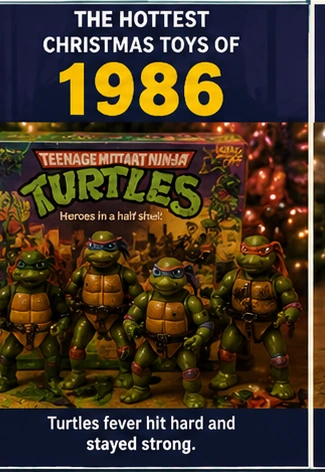
Christmas 1986 belongs to Nintendo. The NES moved from promising newcomer to dominant wish-list machine, helped by recognizable games, stronger retail confidence, and a growing sense that every household knew somebody who had one. Teddy Ruxpin remained hot, Lazer Tag turned dark rooms into combat zones, Pound Puppies filled the plush aisle, and The Real Ghostbusters translated movie-and-cartoon energy into figures and playsets. The season combined traditional toys with a new gaming center of gravity.
The NES box under the tree created instant authority. Every cousin suddenly wanted to visit, every sibling had a turn system, and every adult eventually tried Duck Hunt from three feet away.
The year Nintendo became the center of gravity
By 1986, the NES had begun reorganizing the hierarchy of Christmas gifts. Traditional toys still mattered, but the console could absorb attention for the entire day and continue generating desire through future games. It created a powerful family purchase argument: one machine, many possible experiences, and a software library that could supply birthdays and holidays indefinitely. Kids saw Mario, Zelda, sports, action, and secrets. Adults saw a large expense that might at least remain relevant longer than a novelty toy.
At the same time, Lazer Tag and Teddy Ruxpin showed that electronics were not limited to screens. Sensors, sounds, moving faces, and cassette mechanisms made technology feel embedded in objects. The decade’s toy companies were teaching children to expect feedback. The toy should answer, score, light up, speak, or confirm a hit. Christmas morning became a test lab staffed by children with no patience and adults holding instruction sheets upside down.
Decade Heat: The Christmas gift that rewired the late 80s
Nintendo Entertainment System
By Christmas 1986, Nintendo had the combination every toy company wanted: hardware, characters, recognizable packaging, compelling commercials, and games that children could discuss in detail before they had ever played them. Super Mario Bros. made the system feel joyful and expansive, while the Zapper added an immediate living-room demonstration. The NES was expensive enough to be the main gift and flexible enough to generate future cartridge requests for years. It did not join the toy box. It reorganized it.
By Christmas 1986, the NES had become the gift that reorganized the entire morning. The console came first, then the game boxes, then the negotiations over who played. Super Mario Bros. gave everyone a common starting point, while the Zapper provided an easy demonstration for adults. The system also created a durable gift economy: every future holiday could now include another cartridge.
Keep going: 80s video game toys.
Carryover Tech Heat: Still talking, still blinking, still eating batteries
Teddy Ruxpin
Teddy Ruxpin stayed strong because the performance remained unlike ordinary plush toys. Children could follow the book, listen to the story, and watch the bear appear to narrate the experience. Parents saw a reading-oriented gift with visible technology; kids saw a character who talked directly to them. The line’s expanding tape library also made Teddy more than a one-morning novelty, assuming the cassette mechanism behaved and nobody inserted a mixtape just to see what happened.
The carryover demand remained strong because Teddy was still one of the few toys adults wanted to demonstrate for visitors. New tapes and books gave repeat buyers something to add, while first-time owners got the full performance experience. The practical Christmas lesson was immediate: talking plush required maintenance. Fresh batteries, aligned cassettes, and careful handling mattered more than any commercial had suggested.
Action-Tech Heat: The hallway became a neon battlefield
Lazer Tag
Lazer Tag made electronic combat feel futuristic, physical, and slightly more official than pointing a plastic blaster at somebody and yelling. The sensors, lights, sounds, and wearable gear gave the game rules and feedback, while the branding looked imported from a science-fiction training academy. At Christmas, the biggest challenge was that one set was not enough; the experience required opponents, space, batteries, and adults willing to accept that the furniture had become cover.
Lazer Tag created a shopping problem that single-player toys did not: one child needed somebody else equipped to play. Sets, extra sensors, and additional blasters made the gift larger and more expensive, but also more social. The first test often happened in a darkened hallway after dinner, with furniture becoming cover and adults learning that electronic beeps could continue much longer than expected.
Lazer Tag was one of the loudest examples of 80s electronic toys and gadgets escaping into the hallway and backyard.
Keep going: 80s electronic toys and gadgets.
Plush Heat: Adoption without the retail riots
Pound Puppies
Pound Puppies used floppy bodies, sad eyes, names, and an adoption idea to make stuffed dogs feel personal. They were soft enough for bedtime, expressive enough to choose favorites, and available in variations that encouraged collecting without losing the core emotional appeal. Christmas displays made them look like a group waiting for homes, which was devastatingly effective. The concept invited children to rescue one, while adults appreciated a gift that did not make electronic noises at dawn.
Choosing the exact Pound Puppy was part of the holiday appeal. The floppy ears, face, color, and adoption theme made the toy feel selected rather than generic. The package looked like a little carrying kennel, so the presentation supported the rescue idea before the puppy was removed. It was also a gift that could be hugged immediately, requiring no assembly and only minimal adult technical support.
The adoption pitch continued through 80s dolls, plush toys, and pet-toy chaos.
Cartoon Heat: Proton packs, ghosts, slime, and a firehouse problem
The Real Ghostbusters Toys
The Real Ghostbusters toy line converted the movie’s premise into a broad cartoon-driven play system. Figures came with wild ghosts, vehicles carried equipment, and the Firehouse Headquarters gave the line a recognizable home base. The toys were funny, creepy, colorful, and full of action features, which made them especially strong at Christmas. A child could ask for one figure and still leave adults staring at a catalog page featuring the Ecto-1, proton gear, and an entire building.
Ghostbusters gifts produced some of the messiest, most satisfying Christmas play of the decade. Figures came with strange ghosts, vehicles added moving parts, and role-play equipment invited children to patrol the house. The larger Firehouse box could dominate the tree area, while smaller figures and slime products filled the gaps. By afternoon, the living room had usually acquired a supernatural incident nobody else could see.
The Firehouse, Ecto-1, and proton-pack wish list belong with 80s cartoons that sold us the toys.
Keep the whole year going with the top toys of 1986.
Christmas heavyweight: Nintendo Entertainment System
The hottest Christmas toys of 1987
Nintendo owned the wish list while every commercial invented another emergency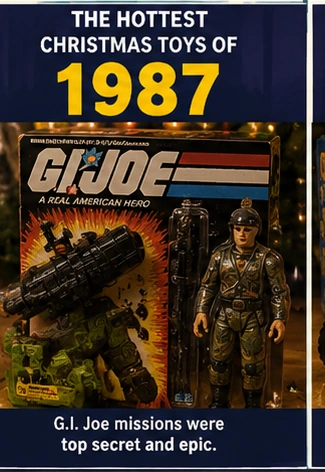
Christmas 1987 felt like the peak form of the 80s toy machine. Nintendo had become a household obsession, cartoon characters crossed into every category, novelty toys could explode through one commercial, and licensed plush products appeared almost instantly after a television or advertising hit. Koosh Ball proved simplicity could still win, California Raisins turned claymation fame into collectibles, and ALF became the rare television alien invited directly into children’s bedrooms.
By 1987, asking for “Nintendo” was not specific enough. The list needed games, controllers, codes, magazines, and at least one promise that homework would still happen.
Peak commercial confidence
The 1987 holiday season reflected a toy industry that understood how to turn visibility into merchandise at remarkable speed. Nintendo remained dominant, but novelty hits and licensed characters could emerge from television almost fully formed. California Raisins figures are the perfect example: advertising created personalities, entertainment expanded them, and retail supplied physical versions before the cultural moment cooled. ALF followed a similar path from sitcom character to plush presence.
Koosh Ball succeeded from the opposite direction. It did not require a show, lore, or collectible biography. The object sold itself through touch and movement. That contrast made 1987 feel especially 80s: the same wish list could include a complex game console, a television alien, a claymation raisin, and a ball made of rubber strands. The decade did not demand consistency. It demanded that every product find a memorable hook and repeat it until children could recite the commercial.
Wish-List Heat: The machine everybody knew and nobody wanted to stop playing
Nintendo Entertainment System
Nintendo’s Christmas dominance expanded because the system had moved beyond novelty into culture. Games were traded in conversation before they were traded physically, characters were recognizable, and magazine tips turned secrets into schoolyard currency. The NES offered a perfect holiday ladder: a full console for the big gift, cartridges for relatives, controllers for practical adults, and accessories for anyone vulnerable to a dramatic commercial. The system made every future birthday and Christmas easier to plan.
The 1987 Christmas list was no longer satisfied by the word Nintendo. Kids named exact cartridges, knew which friends had which games, and had already absorbed tips from magazines and playground conversations. That specificity helped relatives shop, but it also raised the stakes. A new game could take over the entire break from school, while the wrong game could remain suspiciously sealed until somebody found the receipt.
Novelty Heat: A rubbery object that somehow felt impossible to put down
Koosh Ball
Koosh Ball succeeded because the sensory appeal was immediate. It was soft, easy to catch, strange to hold, and visually unlike the hard plastic occupying most toy shelves. The product required no story, instruction manual, batteries, or character universe. At Christmas, it worked as a stocking gift, desk toy, casual game, and object adults picked up while claiming they were only examining it. Its simplicity made it stand out in a decade famous for excess.
Koosh Ball was the ideal small gift in a year filled with expensive electronics. It could be placed in a stocking, passed around the room, and understood instantly. The texture made people keep touching it, and the soft construction gave adults false confidence about indoor throwing. Within minutes, every holiday gathering had somebody testing how accurately it could be tossed across the furniture.
For the toys that survived on pure playground appeal, head outside with 80s backyard toys, bikes, and blasters.
Commercial Heat: Claymation soul singers became tiny collectibles
California Raisins Figures
The California Raisins are one of the purest examples of 80s advertising escaping its original purpose. The characters began as a marketing idea, became television celebrities, and then turned into collectible figures, plush toys, music, and licensed merchandise. At Christmas, the figures benefited from instant recognition and manageable prices. They were funny, displayable, and deeply tied to the commercial culture of the moment, even if nobody had ever requested that dried fruit develop choreography.
California Raisins merchandise benefited from instant recognition and a wide range of inexpensive gift options. The figures could be collected, displayed, or tucked into stockings, while the characters’ television fame made them feel current without needing a long explanation. They were also ideal for relatives shopping from memory: find the singing raisin, wrap it, and trust the commercial to have done the rest.
The figures make even more sense after revisiting the California Raisins commercial that turned dried fruit into celebrities.
Sitcom Heat: The sarcastic alien moved from prime time to the bed
ALF Plush and Talking Toys
ALF was practically designed for plush conversion: furry, expressive, recognizable, and already treated like a member of a suburban family. Talking versions added novelty, while standard plush toys gave kids a less mechanically complicated version of the character. Christmas demand came from television familiarity. Adults knew exactly who he was, children heard the jokes, and the box did not need to explain the premise. It only needed enough room for the nose.
ALF was a strong holiday gift because the character already visited the living room every week. Plush versions turned the sarcastic alien into something children could carry around, while talking toys added novelty for the first demonstration. The large face and unmistakable nose gave the package immediate recognition. It was one of the few gifts that could make adults quote television dialogue before the child had finished opening it.
ALF belongs in the wonderfully strange world of 80s dolls and plush toys, even if he would probably object to the category.
Pop-Fashion Heat: The doll aisle discovered synthesizers
Barbie and the Rockers
Barbie and the Rockers brought concert fashion, bright metallic colors, big hair, instruments, and 80s pop-star styling into a familiar brand. The line felt current because it mirrored the decade’s music-video look rather than treating fashion as timeless. At Christmas, dolls, outfits, accessories, and stage fantasies could build into a complete performance world. Barbie had already survived several cultural shifts; this version proved she could put on a jacket, find a keyboard, and join the neon economy.
Barbie and the Rockers looked built for Christmas photography. Metallic fabrics, bright colors, instruments, and stage-ready packaging made the line sparkle under tree lights. The band concept also encouraged multiple boxes, outfits, and accessories to appear together. Opening the dolls felt like assembling a tour rather than adding one more figure to the shelf, which suited the decade’s music-video fantasy perfectly.
Keep the whole year going with the top toys of 1987 and the biggest fads of 1987.
Christmas heavyweight: Teenage Mutant Ninja Turtles
The hottest Christmas toys of 1988
Four turtles, one rat, endless figures, and absolutely no restraint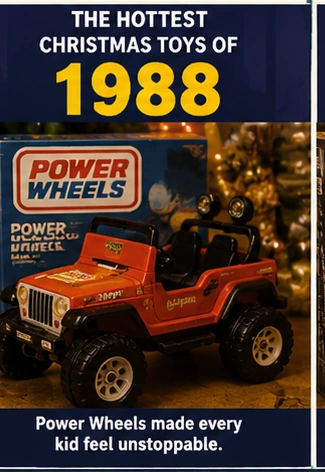
Christmas 1988 introduced one of the last great action-figure explosions of the decade. Teenage Mutant Ninja Turtles were strange enough to feel new and simple enough to understand instantly: four heroes, color-coded masks, martial arts, pizza, jokes, and a villain army waiting to be collected. Nintendo remained enormous, while Skip-It, Dino-Riders, and Koosh Ball showed that the holiday aisle still had room for outdoor movement, dinosaur spectacle, and simple tactile fun.
The TMNT aisle solved the problem of remembering names by giving every child a favorite color, weapon, and turtle personality before adults understood what was happening.
The last great action-figure launch of the decade
Teenage Mutant Ninja Turtles arrived with a concept so specific that it became easy to remember. Each word added another layer of absurdity, but the finished combination was perfectly clear to kids. The turtles had colors, weapons, personalities, a mentor, a villain, a cartoon, and a food obsession. The toy line could begin with four core figures and then expand almost without limit. That structure made it ideal for Christmas and for every gift-giving occasion afterward.
The season also showed the continued split between screen play and physical play. Nintendo could hold a child indoors for hours, while Skip-It demanded movement and Dino-Riders created huge carpet battles. Koosh Ball occupied the middle as a toy that could be used almost anywhere until an adult declared that it could not. The strongest Christmas lists mixed categories freely. Kids did not see a conflict between electronics and action figures. They wanted both, preferably before breakfast.
Action-Figure Heat: The final great plastic takeover of the decade
Teenage Mutant Ninja Turtles
The original TMNT figures arrived with bold sculpts, distinctive colors, weird villains, strong weapons, and a premise that sounded like children had invented it during a sugar rush. That was the advantage. The line felt funny and action-packed at the same time, while the cartoon gave every figure a role. At Christmas, demand spread quickly from the four turtles to Splinter, Shredder, Foot Soldiers, vehicles, and playsets. The sewer had become premium real estate.
TMNT created the kind of fast-moving Christmas demand that made adults learn four names, four colors, four weapons, and a growing list of mutants under pressure. The figures were visually distinct, but the line expanded quickly enough that shopping still required precision. The best Christmas mornings produced a full team. The more common result was two turtles, one villain, and a promise that Raphael would be found later.
Turtlemania belongs with the last great wave of 80s action figures and the cartoon-powered toy aisle.
Gaming Heat: Still the default answer to “what do you want?”
Nintendo Entertainment System
Nintendo remained a Christmas anchor because the software library kept renewing the system’s appeal. Kids wanted specific games, knew magazine screenshots, traded rumors, and could identify desirable cartridges from box art alone. The NES was no longer just a console; it was a shared language. A family that already owned the hardware could still build an entire Christmas around games and accessories, while a family without one faced increasingly sophisticated lobbying.
By 1988, Nintendo could anchor Christmas without a new console because the software had become the event. Kids compared games before the holidays, ranked box art, and traded information about secrets they had not yet personally discovered. A single cartridge could occupy the entire school break. That made game boxes deceptively powerful: small enough to hide, expensive enough to matter, and capable of silencing a room for hours.
Playground Heat: Exercise disguised as a plastic ankle hazard
Skip-It
Skip-It turned repetition into competition. Swing the ball, jump the cord, build a rhythm, and try not to destroy the nearest lamp or sibling. The toy looked simple in the box and impressive in commercials, where children moved with the confidence of trained athletes. At Christmas, it offered an active alternative to consoles and figures while still feeling novel enough to deserve wrapping paper. It also revealed which family rooms had badly underestimated required clearance.
Skip-It looked especially persuasive in holiday commercials because the children using it never hit furniture, siblings, or themselves. The actual Christmas-morning version required space, rhythm, and immediate experimentation. It was an active gift in a console-heavy era, easy to understand and difficult to master gracefully. If weather allowed, it moved outside. If not, the family room became a testing facility.
The ankle bruises continue in the guide to 80s backyard toys, bikes, and blasters.
Spectacle Heat: Dinosaurs wearing lasers because the decade demanded it
Dino-Riders
Dino-Riders combined two ideas children already loved—dinosaurs and futuristic weapons—without wasting time on restraint. The dinosaur sculpts gave the line visual weight, while armor, riders, and equipment turned prehistoric creatures into vehicles. At Christmas, the larger dinosaurs delivered real box presence and made smaller figures feel part of a broader conflict. The premise required almost no explanation. A Tyrannosaurus wearing battle gear was already a complete sales argument.
Dino-Riders boxes had tremendous visual impact. The dinosaurs were large, the armor looked complicated, and the riders suggested an entire conflict built onto prehistoric creatures. That combination made the line feel expensive and spectacular even before assembly. Christmas morning involved attaching equipment, matching tiny parts, and deciding whether scientific accuracy still mattered once the Tyrannosaurus had lasers.
Dino-Riders earned a permanent place among the forgotten toys of the 80s that were too ridiculous to forget completely.
Stocking Heat: Still weird, still satisfying, still being thrown indoors
Koosh Ball
Koosh Ball remained strong because it crossed age groups and use cases. It could be tossed, squeezed, displayed, bounced badly, or kept on a desk as a strangely calming object. The colors made it visually loud, but the play was low-pressure. In a Christmas season dominated by franchises and electronics, Koosh still offered immediate fun without setup. It was the rare toy that could be passed around the room before the wrapping paper had been cleared.
By its second major holiday season, Koosh had become a reliable add-on gift for nearly any age. It filled the gap between the expensive main present and the small stocking item, and it created immediate group play. The ball did not need a franchise or explanation. It needed one person to toss it, another to catch it, and an adult to announce that nobody should throw it near the tree.
Keep the whole year going with the top toys of 1988.
Christmas heavyweight: Nintendo Game Boy
The hottest Christmas toys of 1989
Portable gaming arrived, the Power Glove disappointed beautifully, and the decade refused to leave quietly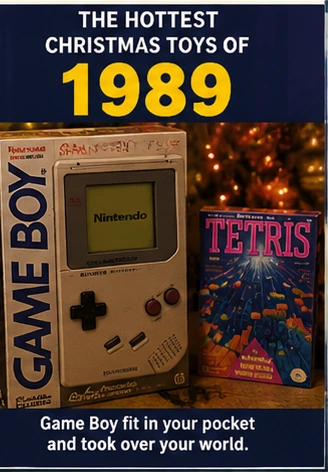
Christmas 1989 closed the decade with portability, accessories, compact worlds, and one final wave of character-driven demand. Game Boy made Nintendo travel. Power Glove advertising made children believe the future had arrived slightly ahead of schedule. Polly Pocket turned entire playsets into compacts, TMNT expanded at alarming speed, and Micro Machines proved that smaller toys could create bigger collections. The 80s ended not by calming down, but by miniaturizing the chaos.
The final Christmas of the 80s gave us Tetris music, tiny dolls, mutant turtles, miniature cars, and a glove that looked cooler than it worked. That is almost too perfect.
The decade ended by making everything portable
Game Boy, Polly Pocket, and Micro Machines all reduced scale while increasing access. Nintendo moved away from the family television. Polly Pocket folded rooms and figures into a compact. Micro Machines made large collections possible in small spaces. These toys fit the late-80s desire for systems that could travel, expand, and remain personal. The child could carry the experience rather than waiting to return to the room where the toy lived.
The Power Glove represented another late-decade instinct: accessories could become headline gifts themselves. The controller was no longer only a tool; it could be marketed as identity and attitude. Even when the experience failed to match the commercial, the desire was real because the product looked like a piece of the future. Christmas 1989 ended the decade with exactly the right mix of genuine innovation, miniature collecting, franchise overload, and technology sold slightly ahead of reality.
Portable Heat: Tetris moved into the car, the couch, and every waiting room
Nintendo Game Boy
Game Boy turned Nintendo’s biggest advantage—compelling games—into something a child could carry. The hardware was not colorful or glamorous, but the screen, controls, cartridge slot, and pack-in power of Tetris made the system instantly understandable. At Christmas, the box promised private access to gaming without control of the family television. That was revolutionary for children and suspiciously appealing to adults who wanted the living room back.
Game Boy’s Christmas power came from freedom. It promised gaming without waiting for the television, which children understood instantly and adults sometimes appreciated even more. Tetris made the system feel useful from the first minute, while cartridges suggested years of expansion. The practical holiday concern was battery supply; the machine was portable, but the power demands followed everywhere it went.
Portable gaming closes the decade inside the larger story of 80s video game toys.
Keep going: 80s video game toys.
Commercial Heat: The future looked amazing in thirty seconds
Nintendo Power Glove
The Power Glove became a Christmas desire object through pure visual confidence. It looked like wearable technology from a movie and suggested that ordinary controller use was about to become obsolete. The reality was more complicated, but holiday heat is not awarded for long-term satisfaction. Kids saw the glove, heard the attitude, and imagined controlling games with futuristic gestures. The product remains memorable precisely because the advertising dream was so much smoother than the calibration experience.
The Power Glove was sold through imagination first. Its appearance suggested that the ordinary controller had become outdated and that game play was about to feel like science fiction. That made it an irresistible box under the tree even before anyone attempted setup. Christmas morning delivered spectacle, adjustment, calibration, and eventually the realization that looking futuristic and controlling a game were two separate achievements.
The commercial promise is still best understood through 80s toy commercials and videos.
Pocket-World Heat: A whole dollhouse hiding inside a compact
Polly Pocket
Polly Pocket made miniaturization feel magical. The outside looked like a small case; the inside opened into rooms, furniture, stairways, scenery, and tiny figures that could vanish into upholstery forever. At Christmas, the compacts were visually satisfying, portable, collectible, and available in different themes. The line fit the late-80s appetite for complete worlds while solving the storage problem by making everything almost comically small.
Polly Pocket’s compact size made the opening feel like a reveal within a reveal. The closed case looked small and tidy; opening it exposed rooms, furniture, and tiny figures arranged inside. That transformation suited Christmas perfectly because the gift offered more detail than the package size suggested. It also introduced a seasonal challenge that would define the line: keeping track of pieces smaller than the bows scattered around them.
The tiny compact world belongs with 80s dolls, plush toys, and miniature chaos.
Franchise Heat: The turtles expanded faster than parents could track
Teenage Mutant Ninja Turtles
By Christmas 1989, TMNT had moved beyond a hot new line into a full-scale franchise. The core heroes were joined by increasingly strange mutants, vehicles, role-play gear, and larger environments. The cartoon kept the characters active, the colors made them easy to identify, and the humor made the property feel less rigid than traditional military or fantasy lines. The biggest problem was not deciding whether a child wanted turtles. It was determining which turtles had not already been purchased.
By Christmas 1989, the turtle section could overwhelm even adults who had successfully shopped the line a year earlier. New mutants, vehicles, disguises, and environments made the wish list more specific and the store search more complicated. The upside was that nearly any TMNT box looked exciting under the tree. The downside was learning that a child could identify the one figure everyone had overlooked.
Miniature Heat: Tiny vehicles, giant collections, rapid-fire commercials
Micro Machines
Micro Machines made scale itself the hook. The vehicles were small enough to collect in large numbers, arrange in detailed scenes, carry in cases, and lose with terrifying efficiency. The fast-talking commercials matched the product’s energy and made the line feel packed with variety. At Christmas, a set could deliver the satisfying appearance of abundance without requiring a box the size of a refrigerator. Of course, the long-term storage system was usually the floor.
Micro Machines made quantity part of the Christmas appeal. A relatively small package could hold several vehicles, and a few sets together created the look of a major collection. The commercials trained kids to notice themes, cases, and play environments, while the tiny scale made every surface usable. Christmas morning produced instant traffic systems—and an equally instant risk that one car would disappear into the wrapping paper.
Micro Machines also fit the decade’s shelf of forgotten and half-remembered 80s toys, even if the commercial voice is still living in everybody’s head.
Keep the whole year going with the top toys of 1989.
Before online shopping and overnight delivery
Why Christmas toy shopping in the 80s felt like a full-contact sport
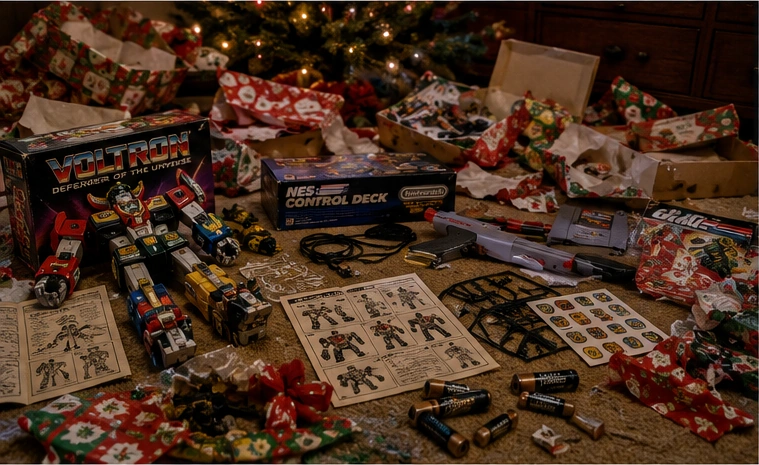
The search happened in public. Parents drove to stores, called other stores, checked newspaper ads, asked relatives, and tried to interpret vague information from employees who had already answered the same question two hundred times. There was no inventory map showing three units at a location forty minutes away. There was a rumor, a phone number, and the possibility that somebody else was already driving there.
Kids experienced the hunt through partial information. A television commercial proved the toy existed. A catalog showed the ideal version of ownership. A classmate claimed an uncle had found one. A parent said “we’ll see,” which could mean anything from “already hidden in the closet” to “there is no chance on Earth.” The uncertainty magnified desire because nobody could quietly check availability from the couch.
The packaging also mattered more than we admit. Christmas morning was a visual event. Large boxes suggested importance. Window packaging revealed enough to confirm success without giving away every detail. Bright logos, painted battle scenes, cartoon characters, and impossible collections made the unopened toy feel like a portal. The box was not trash yet. For a few minutes, it was part of the experience.
Then came assembly. Stickers had to be placed. Batteries had to be found. Tracks had to connect. Parents attempted instructions while children hovered at a distance measured in inches. Electronic toys made their first sound. Action figures disappeared into wrapping paper. Tiny accessories began their journey toward heating vents. By noon, the living room looked like a retail location had experienced a controlled explosion.
That ritual explains why these toys remain so vivid. We do not remember only the product. We remember waiting, asking, doubting, seeing the shape of the box, recognizing the logo, and realizing that an adult had somehow located the exact thing. The hottest Christmas toys of the 80s were objects, but they were also stories about effort, scarcity, family routines, commercials, and the annual belief that one gift could change everything.
The decade-wide winners
The exact toy mattered—and substitutes were not fooling anybody
Cabbage Patch Kids, 1983. No other 80s toy combined emotional demand, visible scarcity, store chaos, and national news coverage at the same level. The dolls became shorthand for Christmas toy panic itself.
Nintendo Entertainment System. The NES could anchor the whole morning and then create years of follow-up demand through cartridges, controllers, magazines, and accessories. It was not one gift; it was a future gift plan.
He-Man, Transformers, and G.I. Joe share the damage. Each line used media to make characters matter and catalogs to make collections look incomplete. They turned one figure into a permanent campaign for shelf space.
Rubik’s Cube. No batteries, no screen, no cartoon, and no explanation needed. The cube became a challenge, public performance, desk object, school distraction, and affordable gift with almost universal recognition.
Teddy Ruxpin. A cassette mechanism, moving face, books, and plush body combined learning language with just enough mechanical uncanniness to become unforgettable. It was comforting until the batteries began to weaken.
Game Boy. Portable Nintendo, Tetris, cartridges, and freedom from the household television made it a perfect closing act. The decade that moved play onto screens ended by letting children carry the screen away.
These titles are not claims about one universal national sales chart. They describe different kinds of Christmas power: scarcity, staying power, media reach, portability, spectacle, and the ability to make a child recognize the box from across the room.
How one hot toy filled the whole tree
The big Christmas gift was only the beginning
The strongest 80s brands were built across price levels. A console or playset could be the main present. A figure, cartridge, outfit, cassette, vehicle, or small character could come from another relative. Stocking stuffers filled the gaps. That structure made a franchise easier for an entire family to shop and made the Christmas pile look coordinated even when nobody had planned it together.
It also meant the child could ask for the same brand from six different people without technically repeating a request. One person bought the hero. Another bought the villain. Somebody else found the vehicle. The grandparents handled the large box. By the end of the morning, the family had accidentally assembled a retail ecosystem.
What happened after the wrapping paper disappeared
Why yesterday’s hottest Christmas toys became today’s collectibles
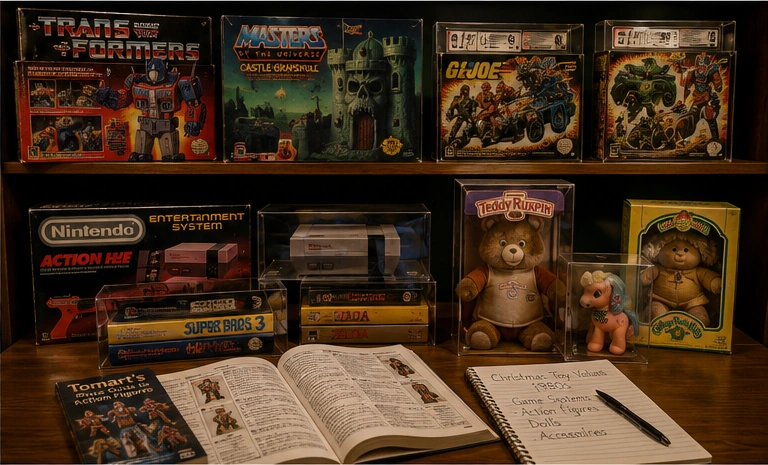
Holiday heat and present-day value are related, but they are not the same thing. A toy could have been everywhere in 1986 and still be common today. Another might be valuable because children lost the accessories, destroyed the packaging, applied the stickers badly, or simply played with it exactly as intended.
Condition, completeness, regional variations, short production runs, sealed packaging, paperwork, and working electronics matter far more than somebody’s optimistic asking price. The deeper collector breakdown belongs in valuable 80s toys worth money today.
The geography of the hunt
Toy stores, wish books, and the rumor somebody had one left
The Christmas toy hunt moved through a network that now feels almost ceremonial. Dedicated toy stores offered the deepest selection and the biggest visual shock. Department stores mixed toys with clothing, appliances, perfume counters, and exhausted adults carrying bags from three unrelated missions. Discount chains sometimes became the surprise hero because a shipment appeared without warning. Drugstores and grocery stores handled smaller items, figures, puzzles, and stocking gifts. Every stop had a different possibility.
Catalogs were the controlled fantasy version of shopping. The page showed the full line, the perfect playset, the accessories arranged correctly, and a child who appeared to own enough space for all of it. Circling an item felt like taking action even though the actual decision belonged to adults with budgets. The catalog also taught kids the names of products they had never seen in person. By December, children could discuss model numbers, playset features, and package sizes with the confidence of retail consultants who contributed no money.
Newspaper inserts supplied urgency. A sale price, limited quantity, or early opening time could change a family’s Saturday. Telephone calls mattered, but store employees rarely offered certainty. “We might get a truck” was not information; it was a weather forecast for plastic. Parents built routes, divided responsibilities, and asked friends to watch for the exact box. The system depended on cooperation until the doors opened, at which point everybody remembered they were competing.
That physical search gave the final gift more history. The child usually did not know which stores had been visited, which relative had helped, or how many times an adult had heard “sold out.” But the effort was inside the box anyway. The hottest Christmas toys of the 80s carried the invisible story of the hunt, which is one reason parents sometimes remember the acquisition more clearly than children remember the toy.
Online shopping makes finding a product easier, but it also removes much of that public drama. There is less standing in an aisle comparing boxes, less calling across town, less driving based on a rumor, and less accidental discovery of something else. The 80s toy hunt was inefficient, exhausting, and occasionally ridiculous. It was also an experience shared by families, store employees, television news crews, and every kid waiting at home while pretending not to investigate the closets.
December 26 and the long aftermath
What happened after the hottest toy finally made it home
The first day was usually pure demonstration. Every feature had to be tested, every figure introduced, every cartridge loaded, and every adult summoned to admire something they had already spent weeks trying to locate. The second day was when the toy entered real life. Packaging disappeared, pieces spread out, rules were modified, stickers went on crooked, and the product stopped looking like the catalog photograph.
Some gifts became permanent centers of play. Nintendo systems stayed connected to the television. Castle Grayskull, the G.I. Joe headquarters, and larger playsets occupied territory the family had not formally surrendered. Plush characters moved onto beds. Small figures migrated into drawers, school bags, pockets, and heating vents. Talking toys continued performing until the batteries weakened enough to make their voices sound like evidence from a haunted house.
The hottest toy also changed social life. Kids visited the house with the new console, the complete turtle set, the big vehicle, or the doll nobody else had found. Ownership created temporary expertise. The child who had the toy knew how it worked, which accessory mattered, what secret feature the commercial had skipped, and how long everybody else would have to wait for a turn. Christmas demand carried directly into January playground status.
Then the next commercial arrived. The complete gift from December suddenly had a new figure, expansion, cassette, cartridge, costume, or vehicle. The 80s toy business was brilliant at turning satisfaction into a preview of the next missing item. That is why these Christmas memories feel both complete and unfinished. We remember getting the thing we wanted—and almost immediately discovering the next thing.
The Christmas list was never really finished
Keep rewinding the 80s toy aisle
One holiday countdown can only hold so much plastic, cardboard, battery corrosion, and family-room negotiation. These are the next places to go when the wrapping paper is gone but the toy-store memory is still doing laps.
Christmas toy questions
Questions about the hottest Christmas toys of the 80s
What was the biggest Christmas toy craze of the 80s?
Cabbage Patch Kids in 1983 created the decade’s most famous holiday frenzy. Demand, shortages, store lines, and national news coverage turned the dolls into a retail event far beyond ordinary toy popularity.
What were the hottest Christmas toys of 1984?
Transformers, Cabbage Patch Kids, He-Man, GoBots, Trivial Pursuit, and G.I. Joe were among the strongest Christmas gifts of 1984. Robot-conversion toys were especially hot that season.
What was the hottest Christmas toy of 1985?
Teddy Ruxpin was one of the clearest headline gifts of Christmas 1985, while Nintendo Entertainment System, She-Ra, My Buddy, and Jem also carried strong holiday buzz.
When did Nintendo become a major Christmas toy?
Nintendo began building momentum in 1985 and became a dominant Christmas gift in 1986. The NES remained one of the decade’s most wanted gifts through the late 80s.
What was the hottest Christmas toy of 1989?
Nintendo Game Boy was one of the defining gifts of Christmas 1989, joined by Power Glove, Teenage Mutant Ninja Turtles, Polly Pocket, and Micro Machines.
Are these the same rankings as the annual Top 10 toy pages?
No. The annual pages cover the wider toy year. This guide ranks Christmas demand, scarcity, advertising, media buzz, and wish-list culture specifically.