Frame by Frame • Grape by Grape • 1986 Broadcast FeedWill Vinton • Buddy Miles • Late Show • ClaymationFour Raisins • One Motown Groove • Entire Decade ConfusedFrame by Frame • Grape by Grape • 1986 Broadcast FeedWill Vinton • Buddy Miles • Late Show • ClaymationFour Raisins • One Motown Groove • Entire Decade Confused
Smells Like Gen X • Classic 80s Commercials
California Raisins 1986 Commercial
The Claymation Soul Group That Hijacked the 80s
The California Raisins 1986 commercial should have been thirty seconds
of advertising nonsense that disappeared before the next sitcom came back from break.
Instead, four wrinkled Claymation singers in sunglasses walked across an end table,
performed “I Heard It Through the Grapevine” and became legitimate pop-culture celebrities.
Will Vinton’s studio supplied the tactile animation. Buddy Miles supplied the voice.
A Motown classic supplied instant recognition. The California raisin industry supplied
the part nobody expected to become cool. Gen X watched the whole thing escape television
and spread into records, lunch boxes, figurines, specials, cartoons and a merchandising
universe that briefly made dried fruit feel more famous than most human beings.
This was not merely an ad with memorable characters. It was the moment a produce campaign
formed a band, found a groove and apparently hired an agent.
The California Raisins were Claymation rhythm-and-blues characters created by
Will Vinton Studios for the California raisin industry. Their breakout 1986
commercial, “Late Show,” featured the sunglass-wearing Raisins performing
“I Heard It Through the Grapevine” with vocals by Buddy Miles. The campaign
became so popular that it expanded into records, licensed merchandise,
television specials and a CBS Saturday-morning cartoon.
Industry conceptIntroduced in 1984
Television breakthrough“Late Show” in 1986
Signature song“I Heard It Through the Grapevine”
Original runCharacters retired in 1994
Before the Sunglasses
How California Raisins Became an Advertising Problem Worth Solving
Raisins were useful, familiar and almost aggressively unglamorous. That was the problem.
The California raisin industry needed more than another reminder that dried grapes could
be dropped into cereal or packed into a lunch. It needed a reason for consumers to notice
the category at all.
The California Dancing Raisin concept was introduced by industry marketing staff in 1984.
The central idea was not yet the full band Gen X remembers, but the creative door had opened:
if the product itself could not perform, perhaps a character version of the product could.
By 1986, the campaign had the pieces that made the concept explode. Advertising agency
Foote, Cone & Belding developed the commercial idea. Will Vinton Studios turned the
characters into physical performers. Buddy Miles recorded the vocal. “I Heard It Through
the Grapevine” supplied a joke that worked before the animation even began—and a groove
strong enough to keep the joke from feeling cheap.
1984
California raisin industry marketing staff introduce the California Dancing Raisin
concept to increase awareness and demand.
1986
The “Late Show” commercial breaks through, sending the characters to the top of
Adweek’s rankings and establishing the look most viewers remember.
1988–1989
Demand for licensed memorabilia peaks as the characters spread into records,
figurines, clothing, household items and nearly every merch aisle that would have them.
1994
The original California Dancing Raisins are officially retired after a decade-long
trip from marketing concept to full pop-culture franchise.
The campaign’s first tested animated thirty-second commercial reportedly cost
$300,000 to develop. That was serious money for a food-category advertisement,
but the expense showed on screen. The Raisins did not look like a throwaway gag.
They looked like characters with a lighting crew, a rehearsal schedule and very
specific opinions about who should get the solo.
Watch It Like It Is 1986
What Happens in the “Late Show” California Raisins Commercial
The commercial begins at a distance. A couple sits on a couch with an end table full
of ordinary snacks. Then movement appears among the food. A line of raisins steps into
view while the opening of “I Heard It Through the Grapevine” starts building underneath them.
The setup is deliberately domestic. This is not a fantasy concert arena or a cartoon
world where everything already talks. The Raisins invade a recognizably normal living room,
which makes the impossible performance funnier. They are tiny, but they carry themselves
like the room has been waiting all night for the headliner.
Broadcast Still 01The Tiny Soul Group That Took Over the Living Room
Editorial recreation: a late-80s lounge performance inspired by the campaign’s
miniature soul-group energy. This is not an archival California Raisins advertising still.
Frame 01: ordinary snack table
The spot begins in a familiar environment, making the arrival of a miniature soul group
feel even stranger.
Frame 02: the line forms
The characters enter with synchronized confidence. Before we know anything else,
we understand that they have done this before.
Frame 03: shades and swagger
Sunglasses, body language and timing turn the Raisins into performers rather than
cute produce mascots.
Frame 04: the song completes the joke
“Grapevine” connects the product to the performance while giving the commercial
enough musical authority to survive the pun.
The announcer identifies them simply as California raisins from California vineyards.
The line is almost unnecessary by that point. The animation has already repositioned the
product from something sitting quietly in a box to a traveling act capable of stealing
the entire commercial break.
The spot also understands when to leave. It does not stop the performance for a nutrition
lecture or a list of product benefits. The ad creates desire indirectly: first remember
the characters, then remember what they are made of. That was a risky order for a commodity
campaign, but it was the reason the work felt like entertainment instead of homework.
Built One Tiny Movement at a Time
Why Claymation Made the Raisins Feel Weirdly Real
Ordinary cel animation could have made the idea funny. Stop-motion clay animation made it
physical. The Raisins occupied real miniature sets. Their bodies caught light, cast shadows
and moved with the tiny imperfections that come from objects being adjusted frame by frame.
Will Vinton had helped popularize the term Claymation for his studio’s approach to clay
animation. With the Raisins, that medium did more than distinguish the commercial visually.
It solved the central creative problem. Dried fruit already has wrinkles, irregular shapes
and a surface that looks almost handmade. Clay turned those supposed disadvantages into character.
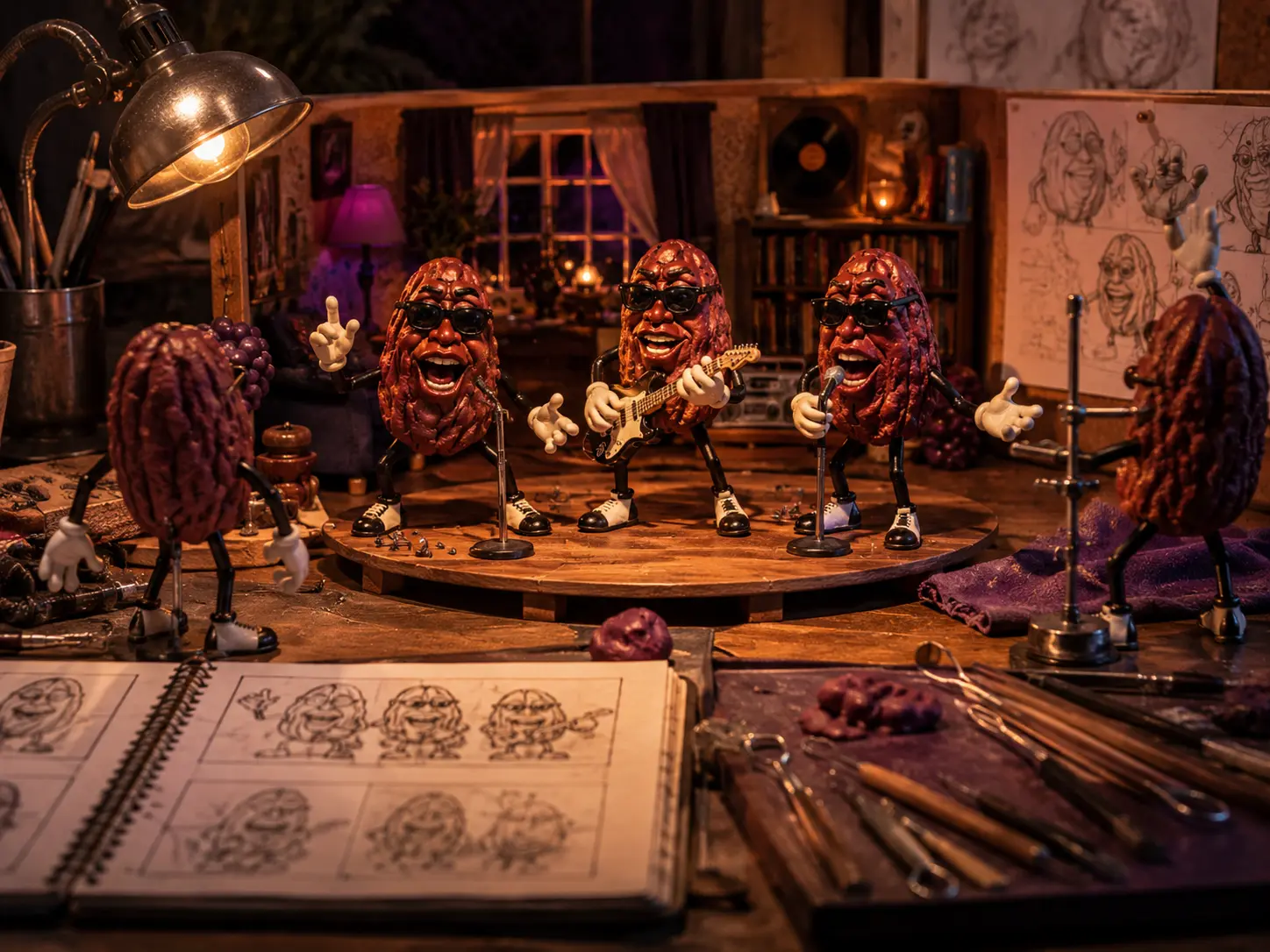
Studio File 02Character Models, Storyboards and Frame-by-Frame Performance
Editorial recreation: a stop-motion workbench showing the kind of miniature set,
character models and hand-built production environment behind Claymation advertising.
Texture became personality
The uneven surfaces and creases made every character look slightly different,
which helped the group feel cast rather than copied.
Weight made the dancing funnier
The figures did not glide like drawings. They leaned, shuffled and bounced like
small physical performers trying to own a much larger room.
Labor made it look expensive
Viewers might not have known the production process, but the frame-by-frame detail
made the campaign feel crafted rather than disposable.
That handcrafted quality separated the ads from cheaper commercial animation. You could
almost sense the animators behind the movement—the shoulder lift, the turn of a head,
the timing of a mouth shape against Buddy Miles’ vocal. The work had enough detail to
reward repeated viewing, which mattered when national television was repeating the same
commercial across millions of living rooms.
The Smithsonian’s National Museum of American History now holds original California Raisin
figures made by Will Vinton Productions. That feels appropriate. These were tools of advertising,
but they were also physical artifacts from a major chapter in American stop-motion animation.
The Groove Did Half the Selling
Why “I Heard It Through the Grapevine” Was the Perfect Song
The product connection is obvious enough to make an ad writer groan: grapes become raisins,
and information travels through a grapevine. But obvious wordplay does not automatically
produce an iconic commercial. The song worked because the musical reference carried real weight.
Buddy Miles gave the joke a grown-up voice
Buddy Miles recorded the campaign vocal, bringing rock, soul and rhythm-and-blues authority
to characters that might otherwise have felt like a novelty act for small children.
The performance drew on a song deeply associated with Marvin Gaye’s classic recording.
That gave the commercial instant recognition while helping the tiny group behave like
seasoned professionals rather than mascots learning a jingle.
The campaign borrowed older musical cool and paired it with a new visual technology.
That combination was perfect for Gen X. The song already belonged to the cultural air;
the Claymation presentation made it feel newly strange. Kids could enjoy the characters.
Adults recognized the musical reference. Nobody had to pretend the raisins themselves
were naturally glamorous.
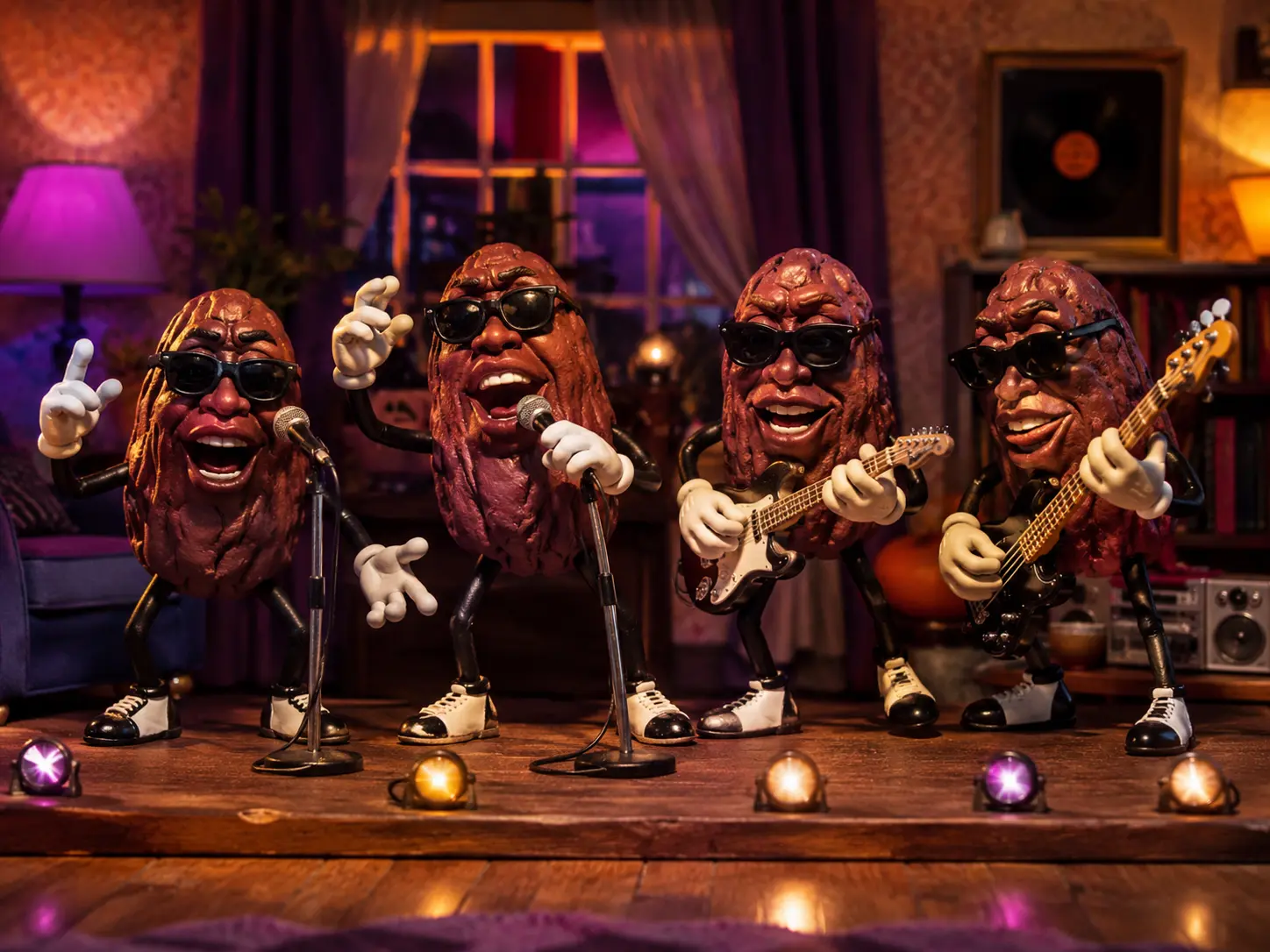
Performance Reel 03Claymation Soul Under Purple and Amber Stage Lights
Editorial recreation: the campaign reimagined as a tiny late-night soul performance,
with microphones, guitars, stage lights and enough swagger to carry the “Grapevine” joke.
Music also gave the campaign somewhere to go. The characters could release recordings,
perform other songs and operate as a group beyond one thirty-second spot. By 1988,
the California Raisins had multiple albums and a Billboard Hot 100 hit, proof that
the fictional band had become more than an advertising device.
The Guest List Gets Ridiculous
When Ray Charles and Michael Jackson Joined the Raisin Universe
Once the campaign became a phenomenon, it could do something ordinary produce advertising
could never manage: attract actual music stars into the fiction. Ray Charles appeared in
California Raisin advertising, and Michael Jackson was transformed into a dancing raisin
for a spot that debuted in thousands of movie theaters.
Those collaborations confirm how completely the campaign had reversed the usual relationship
between celebrity and product. The stars did not merely hold a package or sing a revised jingle.
They entered the Raisins’ world and became clay versions of themselves.
Ray Charles
A genuine musical legend strengthened the campaign’s rhythm-and-blues identity
instead of treating the characters like a disposable joke.
Michael Jackson
The biggest pop star of the era appeared as a transformed Raisin in a theatrical
campaign spot—an absurdly high level of validation for dried-fruit mascots.
The Raisins remained the stars
Celebrity appearances expanded the universe without replacing the original group,
which already had a recognizable performance identity of its own.
The Michael Jackson connection also makes a natural companion to the
1984 Pepsi and Michael Jackson campaign
, another case where pop music, television advertising and spectacle became nearly
impossible to separate.
Then the Raisins Invaded the House
How the Merchandise Craze Turned a Commercial Into a Collecting Habit
Demand for California Raisins merchandise began within a year of the campaign’s launch
and peaked during 1988 and 1989. The characters appeared on clothing, bedding, lunch boxes,
school supplies, figurines, toys and enough household objects to make it seem as if the
entire licensing industry had temporarily misplaced its adult supervision.
Hardee’s figurines became especially memorable because fast-food promotions placed the
characters directly into kids’ hands. A television commercial could be forgotten.
A small plastic Raisin sitting on a dresser, bookshelf or bedroom floor became part of
the physical record of childhood.
This is where the campaign’s Gen X footprint became permanent. The Raisins were no longer
only thirty seconds between programs. They were in school bags, toy boxes, kitchen cabinets
and flea-market bins. Even people who did not care about raisins could end up owning several
members of the band.
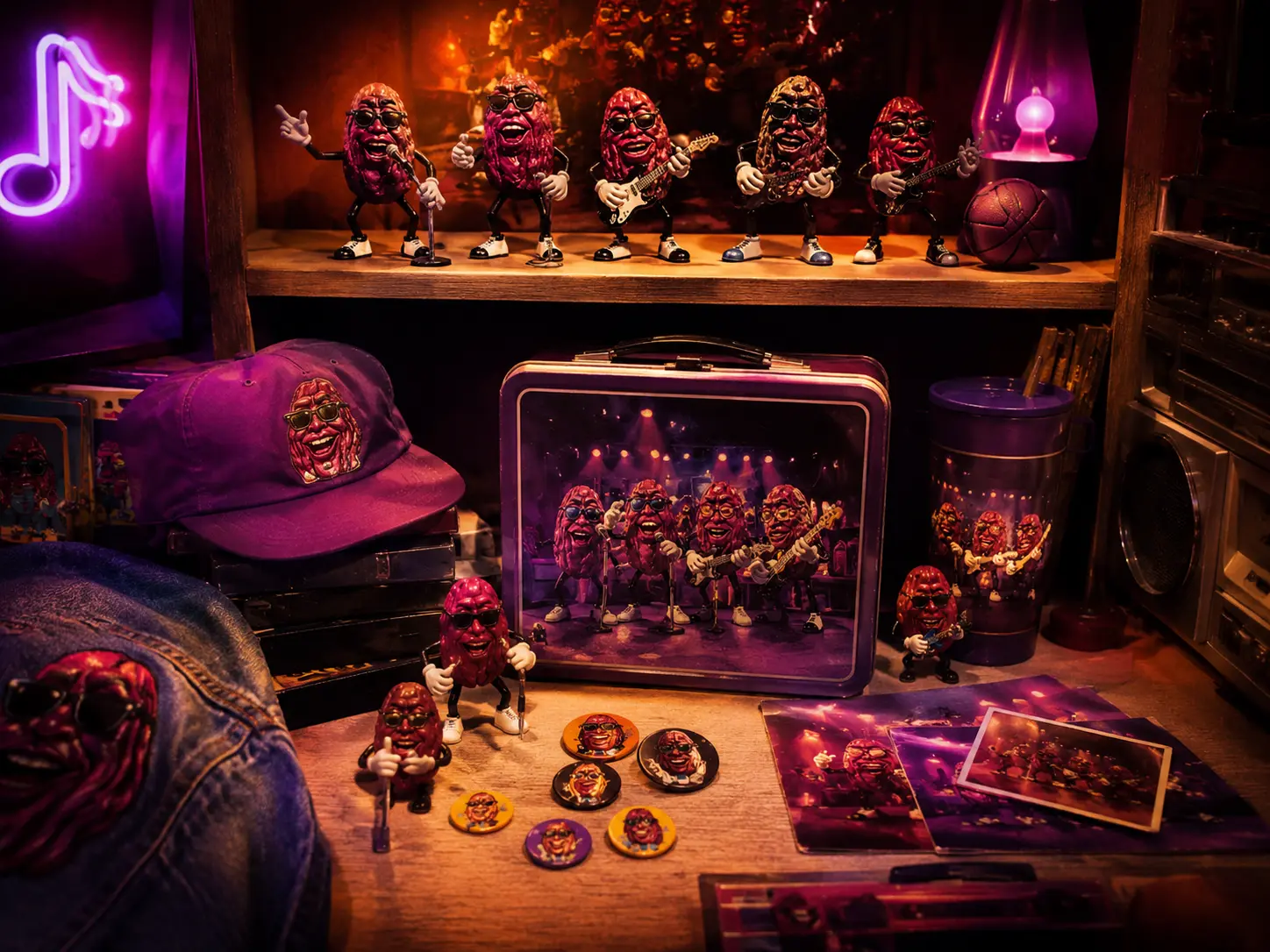
Collector File 04When the Commercial Took Over the Bedroom Shelf
Editorial recreation: a late-80s collector’s display inspired by the figurines,
lunch boxes, clothing, buttons and other licensed objects that pushed the campaign into everyday life.
That crossover also places the characters beside the decade’s larger toy and collecting culture.
The most iconic toys of the 80s were increasingly supported
by television, character universes and licensing systems. The California Raisins ran the process
backward: television advertising created the characters first, and the merchandise aisle followed.
Records
Albums and singles allowed the fictional band to continue performing after the commercial ended.
Fast food
Promotional figurines gave millions of kids inexpensive physical versions of the characters.
Household goods
Licensed products spread the Raisins into bedrooms, kitchens, school supplies and holiday collections.
Peak craze
Official campaign history places the height of memorabilia demand in 1988 and 1989.
The Commercial Gets Its Own Programming
From “Meet the Raisins” to Saturday-Morning Television
Plenty of commercial mascots become recognizable. Very few receive enough audience affection
to support television stories of their own. The California Raisins crossed that line with
specials that treated the group as an established musical act with personalities, history
and the usual entertainment-business complications.
Meet the Raisins! played like a mock documentary about the band and received an
Emmy nomination in 1989. The Television Academy lists the CBS special among the nominees for
Outstanding Animated Program. That recognition is a useful reminder that the Raisins were
not merely popular; the animation community took the work seriously.
CBS also aired The California Raisin Show as a Saturday-morning cartoon during the
1989–1990 season. The shift to traditional two-dimensional animation made production easier
for a weekly series, although it also removed some of the tactile weirdness that made the
original Claymation characters special.
Commercials
Short performances established the characters, their confidence and their musical identity.
Television specials
Longer Claymation stories expanded the fictional band into an entertainment property.
Saturday mornings
A weekly CBS cartoon confirmed the campaign’s reach, even if the format could not fully
reproduce the charm of the clay originals.
The expansion worked because the ads had already behaved like miniature entertainment.
The characters did not require a complete reinvention before moving into programming.
They needed names, longer plots and enough backstage drama to fill the extra minutes.
One Campaign in a Decade of Commercial Overkill
Why the California Raisins Worked Better Than an Ordinary Mascot
The 80s commercial break was packed with characters, slogans and celebrity campaigns.
The Raisins stood out because the campaign did not ask one mascot to repeat one product benefit.
It created a group capable of performing, changing songs, welcoming guest stars and carrying
stories into other media.
The California Raisins solved a weak product hook with a strong entertainment engine.
The campaign did not pretend dried fruit was naturally rebellious, glamorous or musically gifted.
It built characters so committed to that fiction that viewers willingly played along.
It also understood the importance of tonal confidence. The commercials never seemed embarrassed
by the premise. The Raisins did not pause to wink at the audience or explain why the joke was funny.
They acted like professionals. That total commitment made the absurdity feel complete rather than desperate.
Most importantly, the campaign had room to expand. A catchphrase can wear out. A one-note mascot can
become predictable. A fictional band can perform new songs, welcome guest artists, release records,
star in specials and sell different kinds of merchandise. The Raisins had range, which remains a
ridiculous sentence and an accurate explanation.
Why We Never Fully Forgot Them
Why the California Raisins Still Feel So Specifically Gen X
Gen X grew up during the final era when one national commercial campaign could become common knowledge
almost overnight. We did not choose to follow the California Raisins. They arrived repeatedly during
sitcoms, cartoons, sports and prime-time specials until the entire country understood the reference.
The campaign also represents the decade’s talent for making bizarre ideas feel completely normal.
A group of singing raisins did not remain an eccentric advertisement. They received albums, toys,
celebrity collaborators and a Saturday-morning series. The culture did not merely accept the premise.
It built shelving for it.
They were impossible to confuse
The clay texture, sunglasses and soul-group staging gave the campaign a visual identity no competitor could borrow casually.
They crossed age groups
Kids liked the characters, adults recognized the music and collectors found more objects than any household needed.
They escaped the television
Figurines, records and specials turned a repeated commercial memory into something physical and social.
There is another reason they remain memorable: the campaign contains almost the entire 80s media machine
in miniature. Advertising created awareness. Music created cool. Animation created novelty. Television
created repetition. Licensing created ownership. Saturday mornings extended the story. Then nostalgia
kept the characters alive after the marketplace moved on.
Rewind Verdict
The California Raisins worked because every piece of the campaign took the ridiculous premise seriously.
Will Vinton’s Claymation gave the characters physical charm. Buddy Miles gave them musical authority.
National television made them familiar, and the licensing machine made them unavoidable. For a few
glorious years, dried fruit had a better entertainment career than most actors—and Gen X somehow
considered that normal.
Keep Rewinding 1986
The Music, Movies, Television, Toys and Fads Around the Campaign
The Raisins arrived during a year already operating at peak mid-80s saturation.
Radio, MTV, multiplexes, network television and the toy aisle were all competing
to become the loudest part of childhood.
Questions About the California Raisins Commercials
When were the California Raisins introduced?
The California Dancing Raisin concept was introduced by California raisin industry marketing staff in 1984.
When did the famous California Raisins commercial air?
The breakout “Late Show” commercial debuted in 1986 and helped turn the characters into national celebrities.
Who created the California Raisins animation?
Will Vinton Studios created the sunglass-wearing characters using its signature Claymation approach.
Who sang for the California Raisins?
Musician Buddy Miles provided the lead vocal for the campaign version of “I Heard It Through the Grapevine.”
Why were the California Raisins so popular?
The campaign combined tactile stop-motion animation, familiar soul music, confident character acting and an absurd idea executed without apology.
Did the California Raisins have a television show?
Yes. They appeared in animated television specials and had a CBS Saturday-morning cartoon during the 1989–1990 season.
What happened to the original California Raisins?
Their popularity declined in the early 1990s, and the original California Dancing Raisins were officially retired in 1994.
Are original California Raisin figures in a museum?
Yes. The Smithsonian’s National Museum of American History holds original figures made by Will Vinton Productions.
Campaign History Sources
Dates, production details, awards, television expansion and memorabilia history were checked against
the California raisin industry’s official campaign history and national museum and television archives.