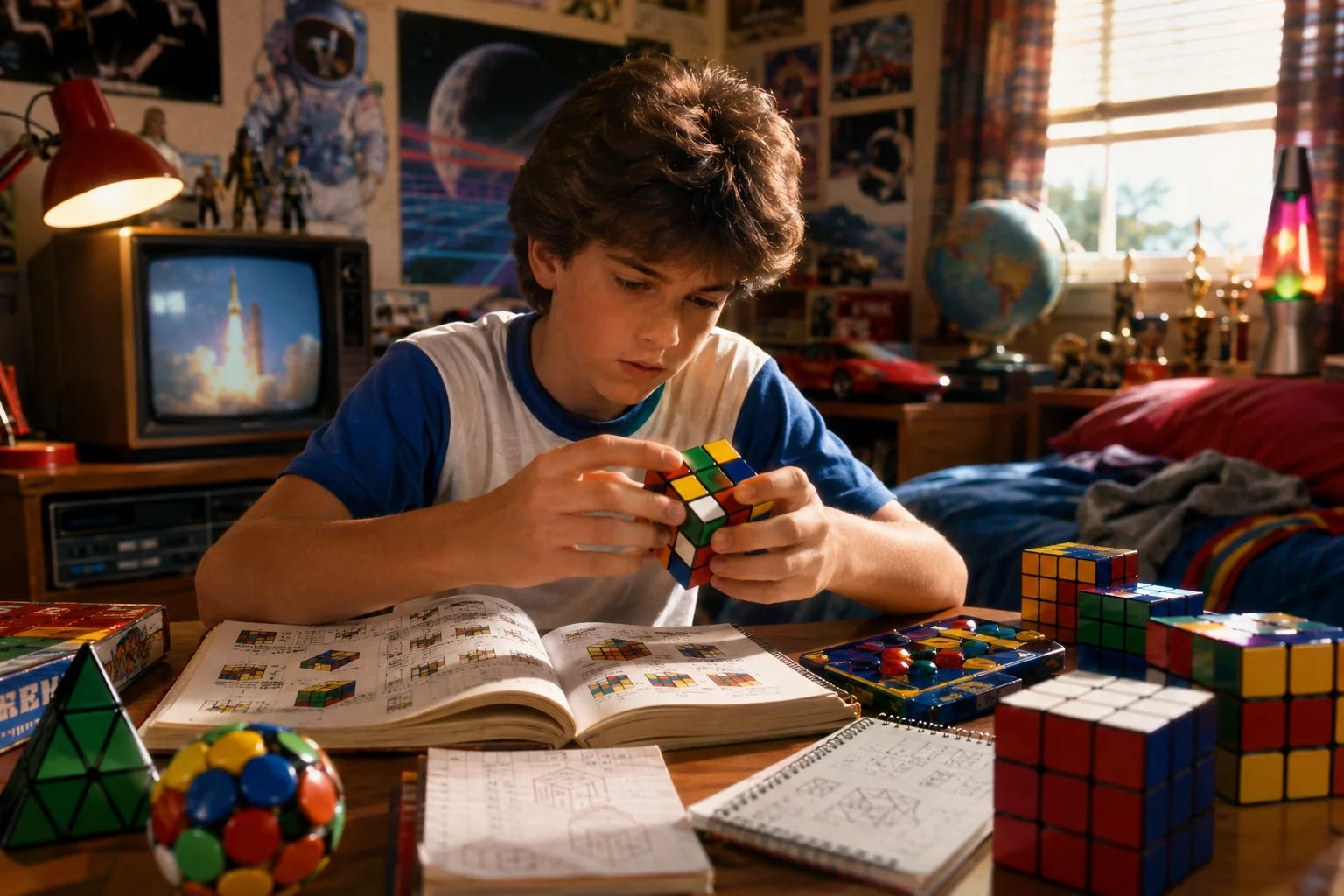
Rubik’s Cube and the 1980s Puzzle Craze
The Cube looked innocent enough: six colors, nine squares per side, no batteries, no instructions anyone wanted to read, and no obvious reason it should dominate desks, bedrooms, classrooms, television, bookstores, shopping malls, and the last functioning nerve in an entire generation.
One small cube. One enormous early-80s cultural malfunction.
The Rubik’s Cube 1980s craze was different from most toy fads because it did not arrive with characters, a cartoon, a vehicle, a dollhouse, or a story. It was an object: a black plastic cube covered in colored stickers. The entire pitch was visible in one glance—mix the colors and put them back. Fine. Easy. Hand it over.
That confidence generally lasted until the second side. One face could be solved through patience, luck, or stubbornness. Then the edges stopped cooperating. A corner went where an edge belonged. The side you had proudly completed fell apart while you tried to repair the top. Five minutes became an hour. An hour became a weekend. The Cube sat on the coffee table with four colors mixed together, silently implying that the problem was not the puzzle.
The toy became one of the defining objects in the larger 80s toys universe. It belonged beside Atari, Simon, Merlin, electronic football, board games, action figures, dolls, and the family-room clutter that made the decade feel permanently under construction.
Rubik’s Cube also crossed age lines better than almost any toy of the era. Kids carried it to school. College students turned it through lectures. Adults worked on it during lunch. Grandparents studied solution diagrams. Teachers treated it as educational right up until the clicking started during class.
The Cube was not only a product. It became a challenge, status symbol, conversation piece, book category, contest event, joke, desk accessory, cartoon character, knockoff opportunity, and shorthand for intelligence. Plenty of toys sold well in 1980. Very few made millions of people admit, in public, that a two-inch plastic object had beaten them.
The man behind the craze was trying to solve a design problem, not create the world’s loudest classroom distraction
The Early History of Rubik’s Cube and Ernő Rubik’s Invention
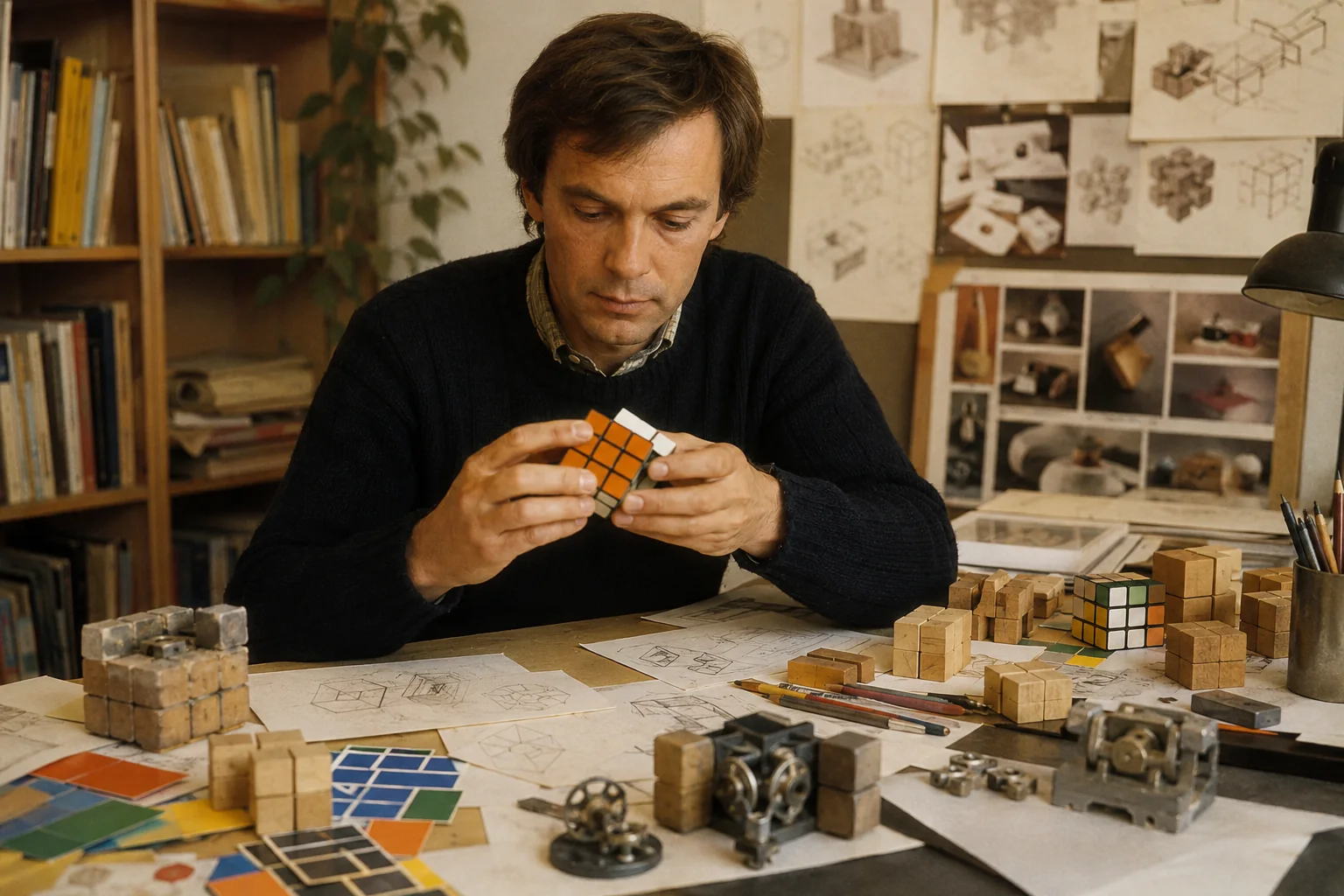
Ernő Rubik was a Hungarian architect, sculptor, and design teacher working in Budapest. In 1974, he began exploring how parts of a three-dimensional object could move independently without the entire structure falling apart. That mechanical question became the foundation of the Cube.
The original problem was movement
Rubik was interested in structure and spatial relationships. The key challenge was not creating colored faces. It was designing a mechanism that allowed rows of smaller cubes to rotate while keeping the larger cube intact.
Rubber bands were not the answer
Early experiments with ordinary fastening methods did not provide the movement or stability he wanted. The eventual internal mechanism allowed the visible pieces to interlock around a core while still rotating in layers.
Color turned a mechanism into a puzzle
Once the sides were marked with different colors, movement produced patterns. Scrambling the colors revealed the real challenge: restoring order was far more difficult than creating disorder.
Rubik had to solve his own invention
The first scramble was not followed by a hidden instruction sheet. Rubik reportedly needed weeks to work out a solution. This should have been a warning to the rest of us. Instead, the toy was eventually marketed with the emotional tone of “you can probably figure it out.”
The Hungarian patent came before worldwide fame
Rubik applied for a Hungarian patent in 1975. The mechanism was patented locally, and early production began in Hungary before the puzzle reached the international market.
The invention sat between art, mathematics, and engineering
The Cube was visually pleasing even when scrambled. It had symmetry, color, motion, pattern, and mechanical elegance. The fact that it could also make a grown adult mutter at furniture was simply added value.
Before it carried Rubik’s name, it was the Magic Cube—and it was already causing trouble in Hungary
From the Hungarian Magic Cube to the 1980s Rubik’s Cube Craze
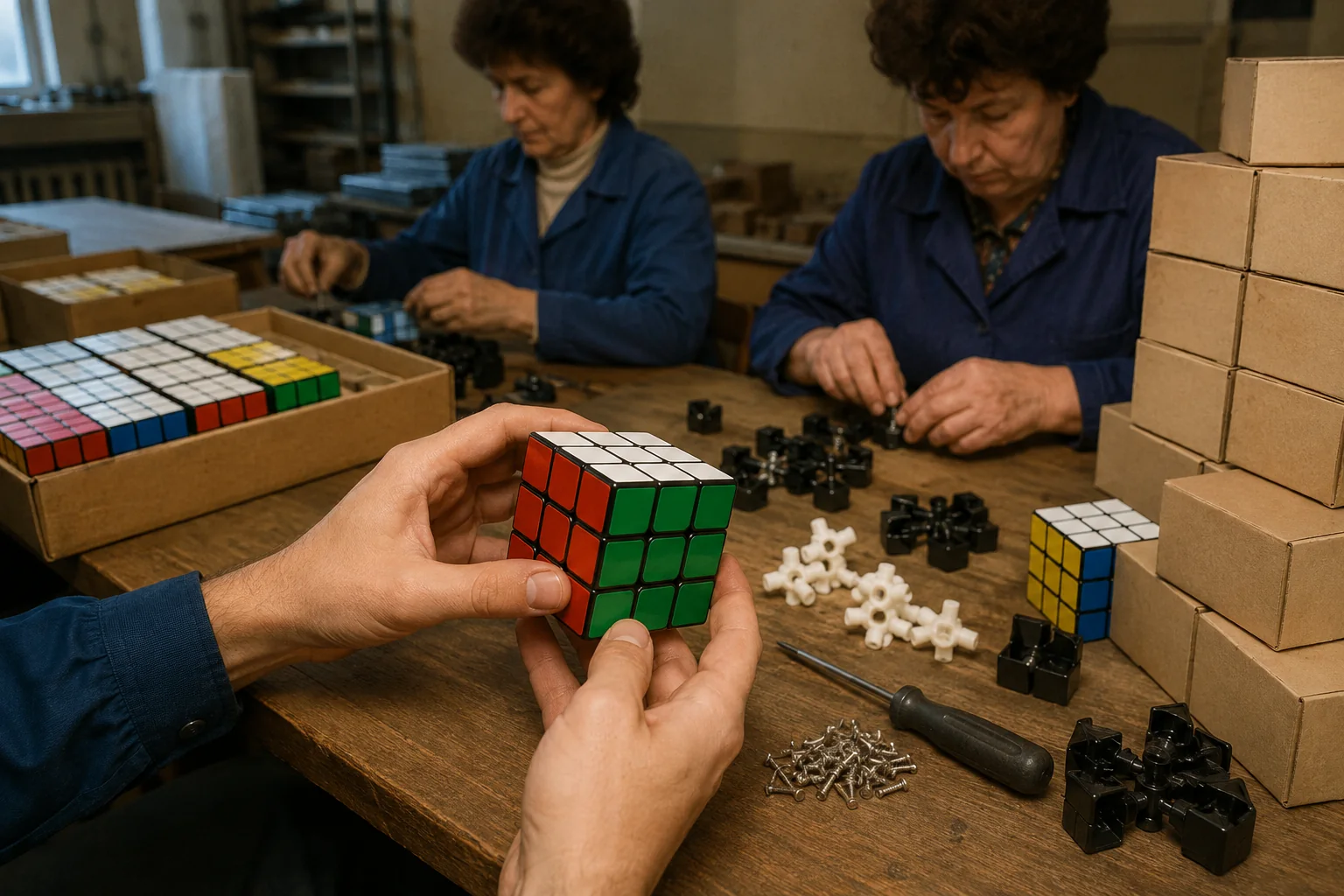
The early history of Rubik’s Cube begins with a puzzle sold in Hungary as the Magic Cube. Those first versions were heavier and mechanically different from many later mass-market cubes, but the basic experience was already complete: twist the layers, scramble the colors, and discover how quickly confidence can leave a room.
Hungary was not an easy launchpad for a global toy craze
The puzzle emerged from a communist-era economy with tightly controlled exports. Moving from local production to international distribution required more than a good invention. It required business partners who could bring the object to major toy markets.
International toy fairs exposed the puzzle to the West
Businessmen and puzzle advocates helped demonstrate the Magic Cube beyond Hungary. The object had an advantage at a trade show: no long explanation was necessary. One twist showed movement. A scramble showed the problem.
Tom Kremer and Seven Towns helped push the international deal
The puzzle needed commercial representation, manufacturing capacity, and distribution. That business work helped connect Rubik’s invention with Ideal Toy Corporation.
Ideal changed the name
“Magic Cube” was descriptive but difficult to protect as a distinctive international identity. The puzzle was renamed Rubik’s Cube, connecting the product directly to its inventor.
The name made the object feel authoritative
Rubik’s Cube sounded like a recognized challenge rather than a generic plastic puzzle. The name became part of the mystique. If you could solve it, you had solved the Cube.
The packaging emphasized challenge rather than character
The product did not need a fictional world. The solved cube was the promise. The scrambled cube was the enemy. The customer supplied the plot.
Twenty-six moving pieces, fifty-four colored squares, and no possibility that random twisting was going to save you
How the Original 3×3 Rubik’s Cube Works
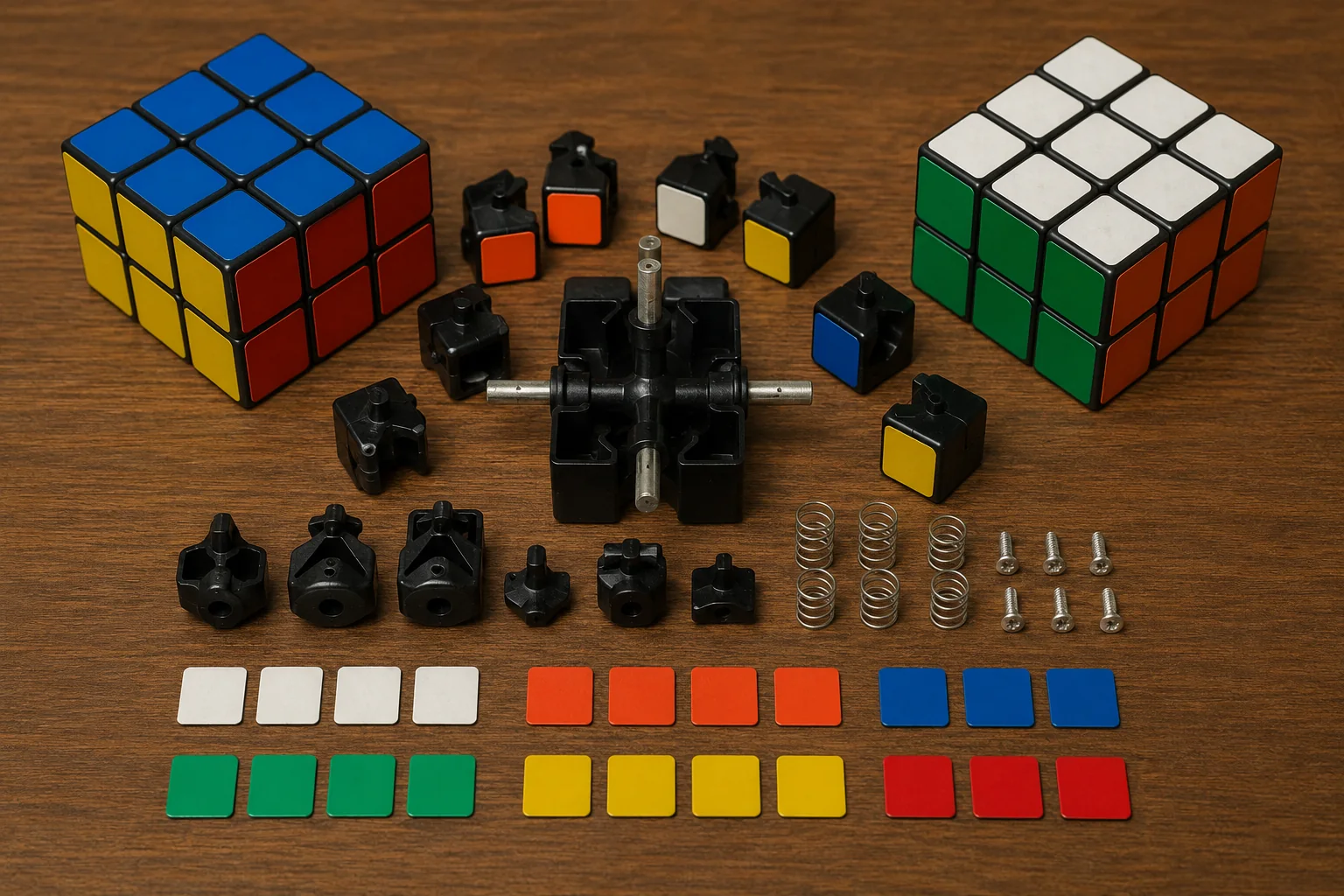
The classic Cube is a 3×3×3 combination puzzle. From the outside, it appears to contain 27 small cubes, but the center is occupied by the internal mechanism. The visible puzzle consists of corner pieces, edge pieces, and center pieces that rotate around the core.
The centers define the six faces
Each center piece remains associated with its side. The other pieces move around those centers. That fixed relationship is one reason replacing stickers or reassembling a Cube incorrectly can create impossible color schemes.
Corner pieces carry three colors
Eight corners occupy the Cube’s outer corners. Each one belongs in one exact position and one exact orientation. Getting the right corner near the right area is not enough. It must also face correctly.
Edge pieces carry two colors
Twelve edges sit between corners. Like the corners, each has a correct location and orientation. The Cube’s difficulty comes from moving one group without destroying another.
The internal mechanism is the real invention
The colors made the puzzle famous, but the core made it possible. Layers can rotate because the pieces lock together around a central structure instead of behaving like 27 independent blocks.
There are more than 43 quintillion possible arrangements
The number is so large that it mostly functions as a formal explanation for why “I’ll just keep turning it” was not a strategy. The overwhelming majority of visible scrambles are nowhere near solved.
The goal is simple enough for a child to explain
Make every side one color. That clarity is essential. A puzzle can be impossibly deep and still sell to millions if the finish line is obvious.
The mechanism produced a recognizable sound
Original and early mass-market cubes clicked and scraped as layers turned. In a quiet classroom, one Cube could be heard from three rows away. Five Cubes sounded like a small office testing defective staplers.
The world market met the Cube in 1980 and immediately stopped doing anything productive
Rubik’s Cube in the 80s: The 1980 International Launch
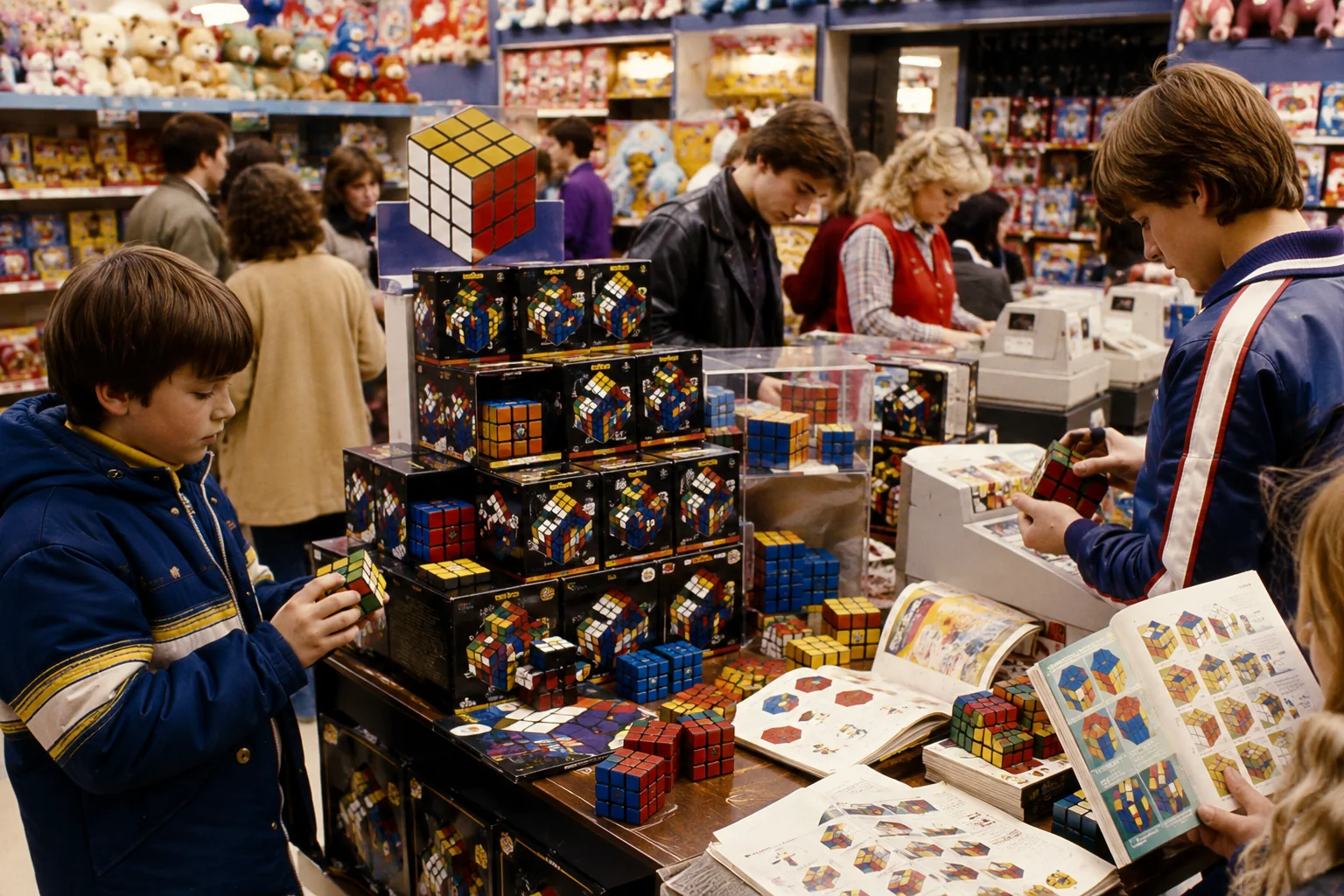
Rubik’s Cube reached the international market in 1980 through Ideal. It arrived at exactly the right moment: portable puzzles, electronic games, family-room toys, and intellectual challenges were all competing for attention, and the Cube looked unlike anything else.
The packaging made the challenge visible
A solved Cube displayed six clean colors. A scrambled Cube displayed chaos. The customer understood both the product and the promise before opening the package.
The price made experimentation possible
The Cube was not a giant playset or electronic system. Families could buy one as a gift, desk toy, stocking stuffer, or impulse challenge without treating it as a major household investment.
The top toys of 1980 suddenly included a silent plastic puzzle
In a market full of electronic beeps, licensed characters, dolls, vehicles, and games, Rubik’s Cube succeeded by being compact and self-contained. It needed no board, opponent, batteries, television, or setup—an oddly quiet rival to the electronic toys and gadgets of the 80s.
The Cube worked in every setting
Bedroom, kitchen table, office desk, college dorm, car ride, airport, waiting room, school bus, lunch table—the product did not care where it was used.
Adults gave the toy legitimacy
Parents did not see it as mindless. Teachers could describe it as educational. Engineers and mathematicians found it genuinely interesting. This helped the Cube avoid being confined to one age group.
The frustration became advertising
Someone struggling with a Cube attracted questions. Someone solving one attracted a crowd. The puzzle demonstrated itself in public.
The box was small, the demand was huge, and every relative believed this was finally the educational gift kids wanted
Rubik’s Cube at Christmas 1980

The Cube became one of the defining gifts of the 1980 holiday season. It fit under the tree, inside a stocking, or beside a larger present. It also looked educational enough that adults could feel responsible while children immediately scrambled it beyond recognition.
The gift worked for almost anyone
A child, teenager, college student, parent, or office worker could receive the same object. Few toys crossed generations that easily.
The solved package created false optimism
A new Cube looked orderly. The colors lined up. The mechanism turned smoothly enough. There was no visible warning that the first confident scramble might remain unsolved until 1987.
One Cube could occupy the entire family
The child tried. The parent took over. A sibling offered advice. An uncle claimed he knew a trick. The toy moved around the room while dinner cooled.
It belonged among the hottest Christmas toys of the 80s
The Cube did not need a character shortage or television tie-in to become a holiday phenomenon. The challenge itself created urgency.
The small package hid a long lifespan
A doll could be dressed. A vehicle could be raced. The Cube could remain unfinished for months, returning whenever somebody forgot how the previous session ended.
Parents underestimated the sound
A battery-free toy seemed peaceful. Then the family spent the next week hearing plastic layers turn through every television program.
By 1981, the Cube was in the toy aisle, bookstore, classroom, newspaper, office, and probably your aunt’s purse
The Peak of the Rubik’s Cube Craze in 1981
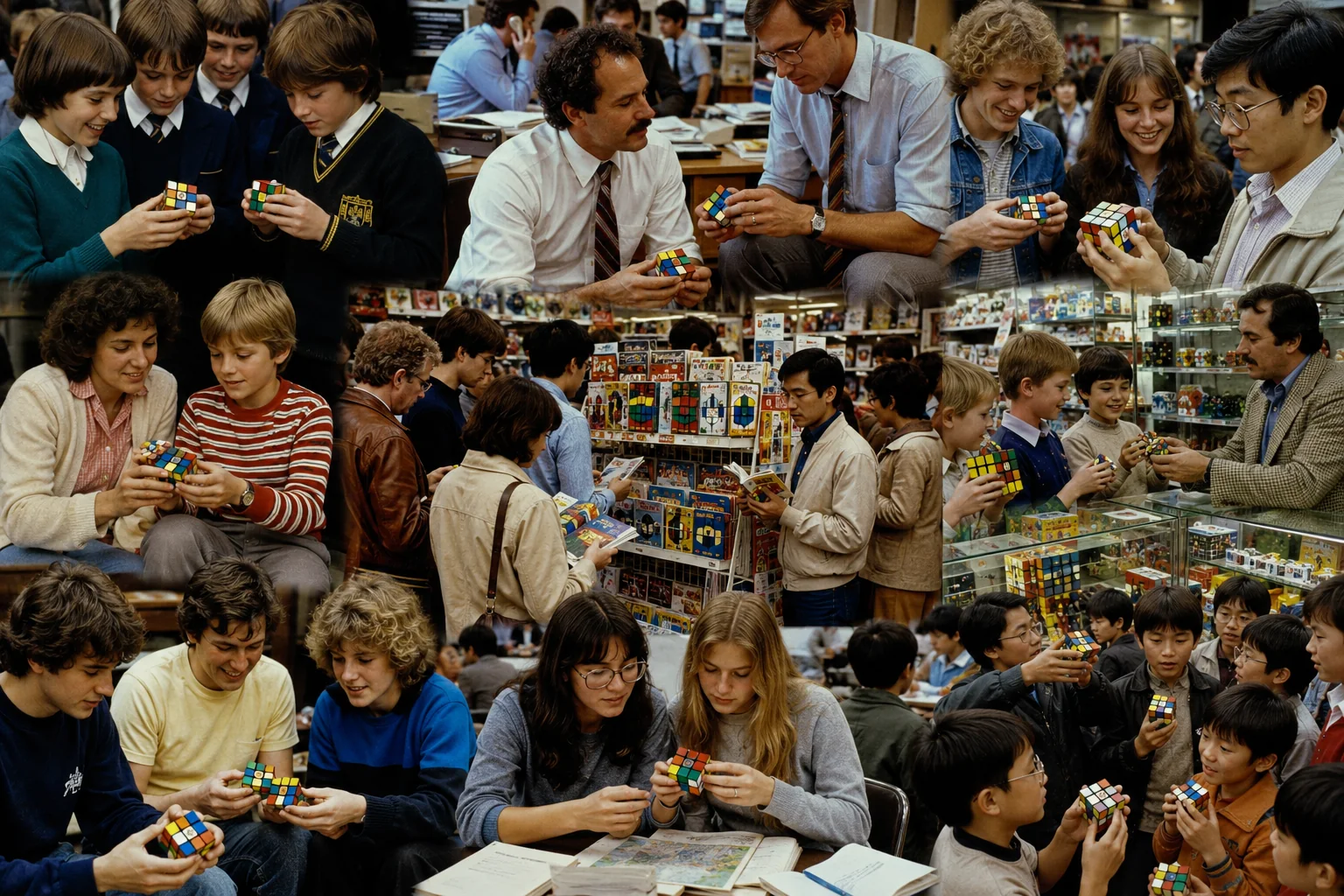
The 1980 Rubik’s Cube craze became a full global phenomenon in 1981. Sales surged, solution books dominated bestseller lists, competitions appeared, imitators flooded stores, and the Cube became one of the most recognizable objects on Earth.
The top toys of 1981 lived in the Cube’s shadow
Rubik’s Cube was no longer one successful puzzle among many. It was the craze other companies wanted to imitate. Every toy buyer suddenly needed a twisting, sliding, folding, geometric challenge.
The Cube became socially contagious
Seeing one person twist it made another person want to try. The owner could hand the puzzle across the table without explaining rules or finding extra pieces.
Public success created public embarrassment
A solver could become locally famous. Everyone else could demonstrate forty minutes of failure in front of friends.
The bookstores proved how difficult it was
A toy fad creating one successful solution guide would have been impressive. The Cube created an entire shelf. Buying the puzzle and then buying a book to make the puzzle usable became normal.
The media loved visible obsession
Television could show turning hands, timed solves, giant cubes, crowds, and frustrated faces. Newspapers could publish diagrams, profiles, records, and stories about a toy that had invaded adult life.
The craze created its own language
Cubers, algorithms, layers, corners, edges, speedsolving, scrambles, moves, and notation entered ordinary conversations. People who had never enjoyed mathematics began discussing sequences of rotations over lunch.
The Cube reached museums and cultural institutions
Its design was treated as more than a toy. The object’s geometry, mechanism, color, and cultural impact made it worthy of serious attention even while millions of owners were peeling stickers.
The Cube fit in a backpack and could ruin an entire lunch period without needing batteries
Rubik’s Cube at School in the 80s
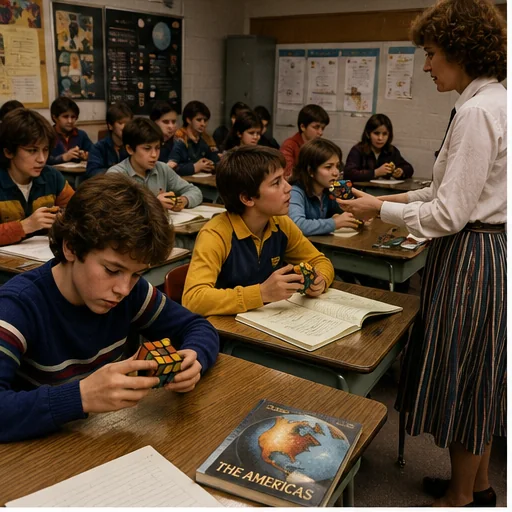
The Cube was almost perfectly designed for schoolyard spread. It was portable, visible, tradeable, competitive, quiet enough to attempt during class, and loud enough to get noticed by a teacher.
Every school developed a local expert
One kid could solve it. Another could complete two layers. A third claimed his cousin could do it in under a minute. The rest of the class supplied skepticism and scrambled cubes.
Solving one side became beginner credibility
A complete face looked impressive to anyone who had not tried the next step. The owner could place the solved color upward and avoid discussing the other five sides.
Teachers confiscated cubes for educational reasons
The puzzle might have been intellectually respectable, but it was still a distraction. The repetitive click of turning layers could outlast even the most patient math teacher.
Backpacks damaged stickers and alignment
Books, lunch, pencils, loose papers, and bus-floor impacts wore down the Cube. Stickers lifted. Plastic scratched. Layers tightened. The white side slowly became off-white.
Sticker peeling became the forbidden solution
Removing and replacing stickers could make the Cube appear solved, assuming the stickers survived, the colors were placed correctly, and nobody noticed the wrinkled evidence.
Taking the Cube apart was the advanced form of cheating
Some owners pried out pieces and reassembled the puzzle. This could produce a solved Cube, a broken Cube, or an impossible Cube that no solution book could repair.
Speed became social power
A child who could solve the Cube on demand had a portable performance. No stage was needed. Just a scramble, a timer, and a crowd prepared to accuse the solver of memorizing a trick.
The goal was obvious. The consequences of every move were not.
Why Almost Everyone Owned a Rubik’s Cube and Almost Nobody Solved It
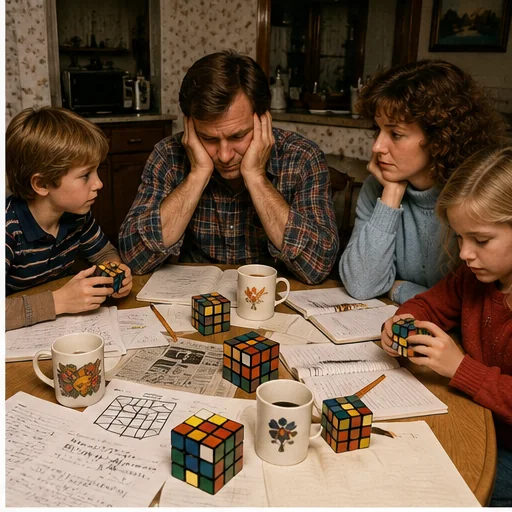
Rubik’s Cube looked approachable because every move was simple. Turn one face. Turn another. The difficulty came from interaction: improving one area changed other areas, and the puzzle punished attempts to solve each face independently.
Random twisting creates motion, not progress
A scramble can always be made more scrambled. Without a repeatable method, the owner may occasionally improve a few pieces while moving the rest farther away.
The visible goal hides the invisible structure
Most beginners think in colored faces. The Cube is actually a system of specific corners and edges moving around fixed centers. That distinction is not obvious when somebody hands you the toy at Christmas.
Local success can damage global progress
Putting one red piece in place may move three correct blue pieces. The Cube teaches that a move can look wrong now because it creates a useful position later. Children generally prefer moves that look right immediately.
Some pieces cannot be moved alone
A corner cannot simply be lifted and placed where it belongs. Sequences move groups of pieces. Solving requires controlling those cycles rather than making one direct move.
The puzzle demands memory and planning
A method reduces the problem into stages, but the solver still must recognize cases and perform sequences accurately. One wrong turn can erase several minutes of careful progress.
Patience was not included in the box
The Cube could be understood instantly and solved slowly. That gap between expectation and reality created much of the frustration.
The puzzle made failure visible
A half-finished crossword can be closed. A scrambled Cube sits on the table displaying every unresolved decision in six bright colors.
The first side was encouragement. The second side was the trap door.
The One-Side Trap Every 80s Rubik’s Cube Owner Knew

Solving one face is the moment many beginners believe they are close. The color looks complete. The Cube suddenly appears less chaotic. Then somebody points out that the side edges do not match the surrounding centers, or the next face destroys the first.
A solid face is not necessarily a solved layer
Nine blue stickers can face upward while the side colors around the top row remain mismatched. The face is visually complete but structurally wrong.
The first face rewards intuitive play
With enough trial and error, most people can gather one color. This creates confidence before the deeper structure becomes unavoidable.
The second layer exposes the real puzzle
Now pieces must be placed while preserving earlier work. The solver needs controlled sequences rather than hopeful turning.
The last layer looks close and behaves badly
By the time five sides appear partly organized, the remaining pieces may require moves that temporarily ruin the visible progress. This feels like sabotage.
Parents often inherited the unfinished Cube
A child would complete one side, become stuck, and hand the problem to an adult with the emotional confidence that adults knew everything.
The one-side display became a compromise
Place the solved face upward on the desk. Nobody sees the bottom. The Cube is not solved, but the room can move on.
The toy came without a useful method, so the publishing industry arrived with diagrams and confidence
The 1981 Rubik’s Cube Solution-Book Boom
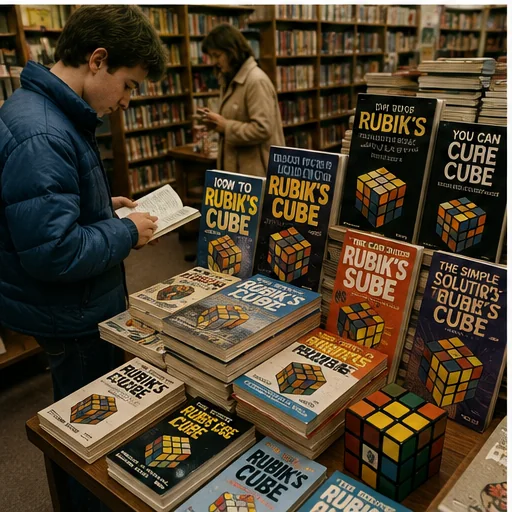
Solution books became one of the clearest measures of the craze. Millions of people bought a puzzle and discovered they needed a second product to understand the first. Bookstores filled with guides promising a simple method, a fast method, a child’s method, or at least a method that would stop the family argument.
The Simple Solution to Rubik’s Cube became a phenomenon
James G. Nourse’s short paperback became the bestselling book of 1981 and sold millions of copies. A compact puzzle guide outperforming ordinary fiction told the entire story of the craze.
Patrick Bossert proved children could teach adults
The teenage author of You Can Do the Cube offered an approachable guide that sold internationally. The title sounded supportive. The diagrams still required attention.
David Singmaster helped formalize Cube notation
Move notation gave solvers a way to describe rotations consistently. Letters representing faces turned physical movement into written sequences.
Three bestseller slots could be occupied by Cube books
At the height of the fad, solution guides were not a niche. They were mainstream publishing. People who had not bought a paperback in months suddenly needed diagrams of corner movement.
Guides transformed magic into procedure
The first successful solve felt impossible until the owner followed a repeatable method. Once the stages worked, the Cube shifted from mysterious object to learnable skill.
The books looked terrible after heavy use
Pages bent. Corners folded. Pencil marks appeared. The paperback remained open beside the Cube while the reader repeatedly lost the correct row.
Borrowed books became school currency
A student who owned a solution guide had information other Cube owners wanted. The book might circulate farther than the toy.
We were not doing advanced mathematics. We were memorizing little dances for plastic squares.
Rubik’s Cube Algorithms and Move Notation in the 80s
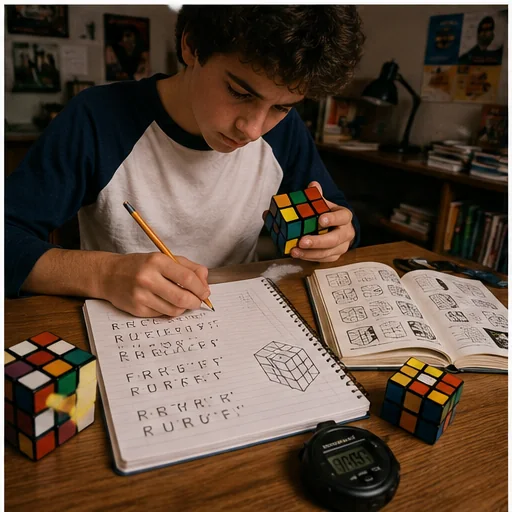
A Cube algorithm is a sequence of moves designed to change certain pieces while preserving others. The word sounded intimidating in 1981, but the practical experience was closer to learning a short routine.
Notation made moves shareable
Instead of writing “turn the right side upward,” guides could use a letter. Clockwise, counterclockwise, and double turns could be represented compactly.
Algorithms reduced a giant problem into small cases
The solver did not need to consider all possible arrangements. A method identified a limited number of situations and assigned a known sequence to each.
Muscle memory eventually replaced the book
After repetition, hands could perform common sequences while the solver watched piece movement. This is where speed began.
One wrong move could corrupt the sequence
Losing count or turning the wrong face often produced a new pattern that the book did not illustrate. The solver then faced the classic 80s decision: backtrack, restart, or blame the Cube.
The method did not make the accomplishment fake
Some people dismissed a learned solution as “just memorization.” That was like dismissing music because the pianist had practiced. Understanding, recognition, memory, and accurate movement were the skill.
The best methods balanced simplicity and speed
Beginner methods used fewer concepts but more moves. Advanced methods demanded more recognition and memorization in exchange for faster solves.
A solitary desk puzzle became a sport the moment somebody brought a stopwatch
Rubik’s Cube Contests, Mall Competitions, and Early Speedsolving
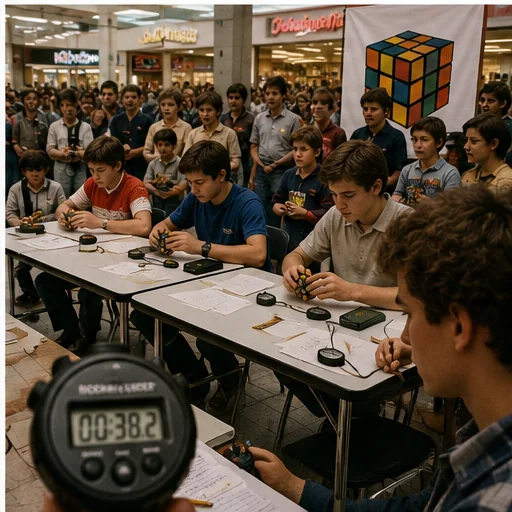
Competitions changed the Cube from a private challenge into a performance. Stores, schools, clubs, media outlets, and regional organizers held timed events. A solver now needed accuracy under pressure while strangers watched every turn.
The scramble had to be fair
A timed contest required comparable starting positions. Organized competition introduced controlled scrambles, judges, inspection rules, and timing procedures.
Mechanical quality suddenly mattered
A stiff Cube cost time. A loose Cube could misalign. Competitors adjusted, lubricated, and broke in puzzles to improve turning.
Finger technique became visible
Fast solvers did not rotate the Cube like beginners. Small flicks moved faces while the hands maintained control. The puzzle began to look athletic.
Inspection became part of strategy
Before the timer, a competitor could study the scramble and plan an opening. Pattern recognition began before the first move.
Local records created legends
A school or shopping mall did not need a world-class time to produce excitement. The fastest person in the building became the expert everyone remembered.
Television loved the stopwatch
A timed solve had suspense, visible movement, and a clear finish. The Cube was suddenly a game show segment waiting to happen.
Speedsolving survived the retail fad
The mass craze cooled, but people who loved the skill continued comparing methods and times. That smaller community preserved the competitive side until the internet helped it grow again.
In 1982, the best solvers in the world gathered in Budapest and made the rest of us look like we were opening a jar
The First Rubik’s Cube World Championship in 1982
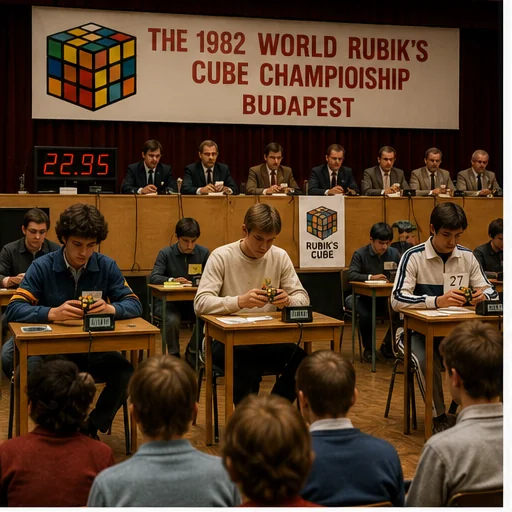
The first major World Rubik’s Cube Championship took place in Budapest in June 1982. Competitors from multiple countries solved under standardized conditions, turning the worldwide fad into an official international contest.
Budapest brought the puzzle home
The championship took place in the city where Ernő Rubik created the Cube. The global phenomenon returned to its point of origin with cameras, timers, competitors, and national representatives.
Minh Thai won in 22.95 seconds
The American competitor’s winning single solve became the official benchmark of the first championship. For ordinary owners still trying to finish a second layer, twenty-two seconds sounded less like skill and more like a special effect.
The event represented the top toys of 1982 aftershock
By 1982, the initial sales explosion was beginning to cool, but the World Championship showed that the Cube had already created a serious competitive culture.
Times were measured with the technology available
The standardized speedcubing equipment used today did not yet exist. Judges and organizers worked with physical timers and procedures appropriate to the period.
The championship would stand alone for years
Large official world competition did not immediately continue on a modern schedule. The next major world championship revival came decades later.
The footage captured an early sport
Competitors used methods, hardware, and turning styles that look different from modern speedcubing, but the essential drama remains recognizable: inspect, start, turn, stop, look at the time.
The commercial did not need a cartoon battle. It only needed someone solving the thing faster than you.
Rubik’s Cube Commercials and Television Coverage
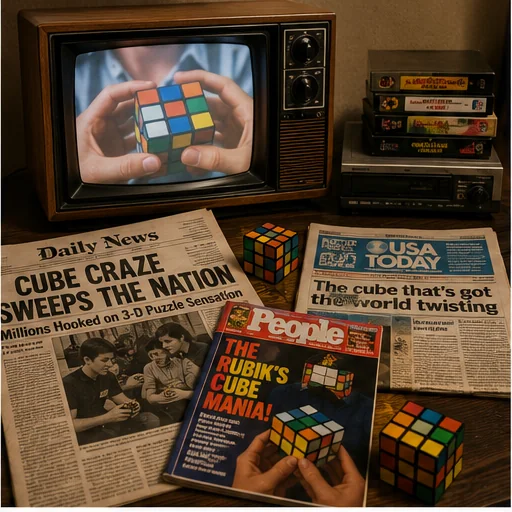
Rubik’s Cube advertising focused on challenge, fascination, popularity, and the promise that the puzzle could be mastered. The product itself supplied the visual movement.
The bright colors worked on television
Turning faces created constant pattern changes. Close-up shots made the Cube readable even on a small television screen.
The ads sold intelligence and persistence
Owning the Cube suggested curiosity. Solving it suggested mastery. The product could be marketed as fun without looking frivolous.
Fast hands created aspiration
A commercial solver moved with confidence. Viewers saw the Cube snapping into order and assumed the same experience might occur at home.
The mystery remained intact
Advertisements rarely explained enough to remove the challenge. The customer still had to buy the Cube—or the Cube and a book.
The ads belonged in the archive of 80s toy commercials and videos
The Cube commercials sit beside louder character-driven ads but feel distinctly early 80s: simple product, dramatic challenge, enthusiastic announcer, and a family suddenly treating a puzzle like a national event.
Demonstrations became word-of-mouth commercials
The strongest advertisement was a person solving one in public. A completed Cube produced immediate questions about method, time, and whether the solver could do it again.
The Cube escaped the toy shelf and appeared on shirts, mugs, clocks, notebooks, posters, and anything else with six printable colors
Rubik’s Cube Merchandise and 80s Pop-Culture Saturation
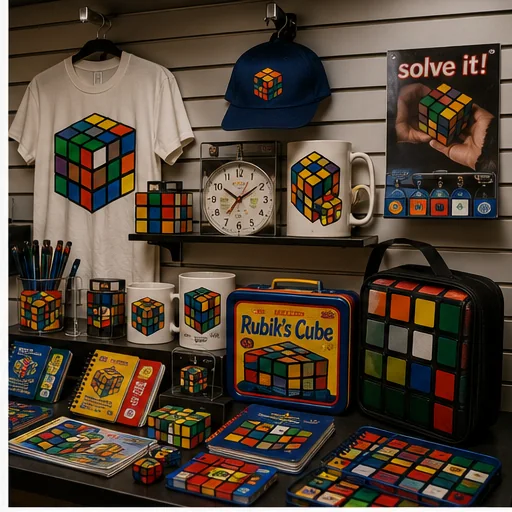
Once the Cube became recognizable, its color grid could sell almost anything. The design was simple enough to reproduce and strong enough to remain visible even when the product had nothing to do with puzzles.
The pattern became graphic shorthand
Six bright colors separated by black lines communicated “Rubik’s Cube” without showing the full object. The design worked on clothing, stationery, packaging, and room decor.
Desk accessories extended the office craze
Cube-shaped containers, calendars, radios, clocks, and novelty objects brought the pattern into adult spaces.
Books went beyond solutions
Publishers produced pattern guides, puzzle theory, competitions, cartoons, and books about other twisty puzzles. The publishing boom continued feeding itself.
Large display Cubes became event attractions
Oversized Cubes appeared at fairs, stores, exhibitions, and public events. The familiar object became surreal when enlarged to furniture size.
Museum attention separated design from fad
The Cube could be examined as industrial design, mathematical object, sculpture, and cultural artifact. It belonged in a display case even after retail excitement cooled.
The design became one of the decade’s visual icons
A DeLorean, a cassette tape, an arcade cabinet, and a scrambled Cube can establish the 80s without dialogue. The colors became part of the decade’s visual vocabulary.
If it twisted, clicked, jammed, and arrived in six colors, somebody was selling it by 1981
Rubik’s Cube Knockoffs, Counterfeits, and Copycat Puzzles
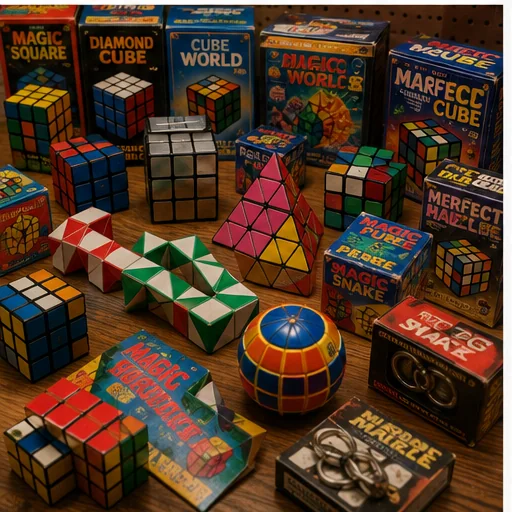
The worldwide success produced an enormous imitation market. Some copies followed the basic 3×3 format. Others changed size, shape, color, mechanism, or name just enough to claim a separate identity.
Weak international protection encouraged copies
The original Hungarian patent did not create simple worldwide control. Manufacturers in multiple countries moved quickly to meet demand.
Cheap cubes often turned poorly
Stiff layers, rough plastic, crooked stickers, loose caps, and misaligned pieces separated many imitations from better-made originals.
The sound revealed quality
A good Cube had a consistent mechanical feel. A cheap copy could scrape, catch, squeak, or lock halfway through a turn.
Sticker colors and layout varied
Some copies used different shades or opposite-color arrangements. This mattered little to casual owners and a great deal to anyone following a specific diagram.
Novel shapes multiplied
Balls, barrels, diamonds, pyramids, linked puzzles, sliding puzzles, and shapeshifting designs appeared. The twisty-puzzle category exploded beyond the original cube.
Knockoffs helped spread the craze
Imitations were not only a business problem. They made Cube-like puzzles available at more prices and in more markets.
Collectors now separate official history from fad debris
An early imitation may have little mechanical quality but strong historical interest. It documents how quickly manufacturers chased the craze.
The Cube proved millions of people would pay to become confused, and the toy industry took careful notes
Rubik’s Cube and the Boom in 80s Puzzle Toys
The Cube’s success expanded interest in mechanical puzzles, geometric challenges, brain teasers, and portable games. Toy companies searched for the next object that could trigger the same public obsession.
Twisting became a category
Different cube sizes, pyramids, dodecahedrons, skewed shapes, linked mechanisms, and color-matching puzzles appeared across the market.
Sliding puzzles returned with new energy
Number tiles, picture puzzles, maze puzzles, and rearrangement challenges benefited from renewed interest in compact brain teasers.
The family room became a puzzle laboratory
The Cube belonged naturally with 80s board games and family-room toys. It could sit beside Trivial Pursuit, Simon, Perfection, cards, jigsaw puzzles, and whatever game had been abandoned after a disputed rule.
Packaging borrowed the Cube’s visual language
Black grids, bright colors, mathematical claims, challenge ratings, and words like “master,” “logic,” and “genius” appeared on competing products.
Educational marketing became powerful
Parents could justify a purchase as mental exercise. Children could accept the same item as a fad. The buyer and user did not need the same reason.
Most follow-ups lacked the original simplicity
Many puzzles were clever. Few matched the Cube’s perfect combination of one-hand portability, obvious goal, visual transformation, mechanical satisfaction, and enormous depth.
The original Cube was too easy, said nobody in your house—and yet a 4×4 arrived anyway
Rubik’s Revenge and the Bigger 4×4 Cube Challenge
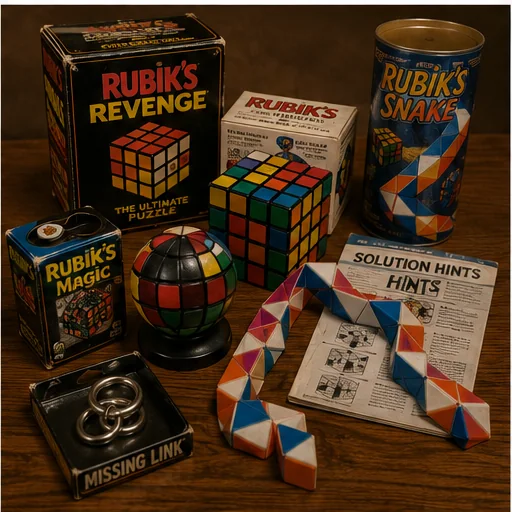
Rubik’s Revenge expanded the familiar format to a 4×4×4 puzzle. The extra layer increased the number of moving pieces and removed the fixed visible centers that helped define the classic Cube’s faces.
The puzzle looked familiar enough to be dangerous
A casual owner could see the six colors and twisting layers and assume the experience would be the same with one more row. It was not.
Movable centers added new complexity
The solver had to build center groups before handling edges and corners in familiar ways. The puzzle introduced problems that do not occur on an ordinary 3×3.
Parity created situations that looked impossible
Certain arrangements appear unsolvable through ordinary 3×3 logic. Specialized sequences are required because the larger mechanism allows cases the original Cube cannot produce.
The larger puzzle rewarded serious cubers
People who had mastered the classic Cube wanted another challenge. Revenge gave them a clear next step.
Casual buyers discovered the name was accurate
The product title implied the Cube had returned personally to settle a score. After ten minutes, this felt entirely plausible.
Not every Rubik-branded puzzle asked for six solved faces. Some just asked what shape you thought that was supposed to be.
Rubik’s Snake, Magic, Missing Link, and Other 80s Puzzles
The Cube’s success created demand for related puzzles carrying Rubik’s name or sharing the same mechanical spirit. Some focused on patterns and shapes rather than one solved color arrangement.
Rubik’s Snake turned into objects
Triangular segments rotated into balls, animals, geometric forms, and whatever the instruction booklet claimed the current shape resembled.
Missing Link used sliding and rotating sections
The puzzle combined color or symbol alignment with a linked mechanism. It looked more industrial than playful, which made it feel intellectually serious.
Rubik’s Magic used folding panels
Linked rectangular tiles could be folded through a sequence to transform the displayed pattern. The movement felt almost impossible until the hands learned the route.
Pyraminx offered a pyramid alternative
The triangular twisty puzzle became one of the most visible non-cube challenges of the era and remains part of modern speedcubing.
Novelty stores became puzzle museums
Walls filled with twisting, sliding, folding, interlocking, and maze-based objects. Every package implied the buyer might be clever enough to master it. Many vanished after the fad and now belong naturally beside the forgotten toys of the 80s that briefly seemed capable of becoming the next Cube.
The original Cube remained the standard
Other puzzles could be harder, stranger, or more visually dramatic. None replaced the 3×3 as the object everyone recognized.
By 1983, somebody had looked at a silent geometric puzzle and decided it needed a face, magic powers, and a Saturday morning theme song
Rubik, the Amazing Cube and the 1983 Cartoon
The craze eventually produced an animated series, Rubik, the Amazing Cube. The show transformed the puzzle into a living magical character who could fly and use powers when his colored squares were aligned.
The cartoon solved the character problem
The original toy had no face or personality. Animation gave the Cube eyes, a voice, movement, emotions, and a group of children to join on adventures.
The show arrived after the retail peak
By 1983, the most explosive part of the fad had cooled. The cartoon demonstrated how far cultural recognition had traveled even as toy sales declined.
Menudo performed the theme
The use of the Puerto Rican boy band placed the show firmly inside early-80s television culture, where a puzzle could share airtime with Pac-Man and receive a pop theme song.
The concept required the Cube to be solved
Rubik’s magic depended on his colored sides being aligned. This created an elegant television rule and a constant reminder that the audience’s own Cube probably was not.
The series turned a fad object into licensed entertainment
The series turned a fad object into licensed entertainment. It also fit the larger era when 80s cartoons and toy advertising constantly borrowed from one another. Rubik’s Cube completed that journey backward: the product became famous first, and the character arrived later.
The cartoon remains a perfect artifact of the craze
It is difficult to imagine another era approving a magical talking combination puzzle as the center of an adventure series. In 1983, the meeting probably ended before lunch.
Three years from international launch to world championship, publishing empire, knockoff flood, and visible exhaustion
Rubik’s Cube Craze Timeline: 1980, 1981, and 1982
The international breakout
Ideal launches Rubik’s Cube broadly. The compact puzzle becomes a major holiday gift and enters toy stores, offices, schools, and family rooms around the world.
Peak Cube mania
Sales explode. Solution guides dominate publishing. Contests multiply. Knockoffs flood markets. The Cube becomes a global cultural object rather than one successful toy.
The world championship and the beginning of fatigue
The first World Championship takes place in Budapest. Serious speedsolving becomes visible just as mass-market demand begins to cool and retailers face too many Cube-like products.
1980 made the challenge universal
The Cube could be understood without language, which helped it cross countries quickly. Every market saw the same six-color problem.
1981 turned frustration into an industry
Books, competitions, displays, newspaper stories, accessories, and copies all depended on the fact that millions of owners wanted help or recognition.
1982 separated fad buyers from long-term cubers
Casual owners moved on. Dedicated solvers kept improving methods and speed. The mass craze shrank, but the skill survived.
The timeline was unusually compressed
The Cube went from international novelty to worldwide saturation to declared fad collapse in only a few years. The cultural recognition remained long after the retail curve dropped.
The world did not run out of possible combinations. It ran out of people who wanted another cube-shaped product.
Why the Rubik’s Cube Craze Crashed
By late 1982 and into 1983, sales fell sharply. Retailers had stocked heavily, imitators had crowded the category, and many consumers already owned a Cube they had not solved.
The product did not wear out quickly
One Cube could last for years. A household did not need a replacement every season, especially when the first one remained scrambled on a shelf.
Ownership reached saturation
The puzzle sold across age groups and markets with extraordinary speed. Once almost everyone who wanted one had one, growth became difficult.
Imitations damaged the category
Cheap copies increased supply, confused buyers, reduced quality expectations, and made the market look larger than the underlying demand.
Too many follow-up puzzles arrived
Retailers faced cubes, larger cubes, snakes, pyramids, linked puzzles, sliding puzzles, and novelty shapes. The category became cluttered.
Frustration reduced repeat enthusiasm
A toy that remains unsolved can be compelling. It can also become a plastic monument to failure. Not every owner wanted a sequel.
Media moved to the next obsession
Arcade games, home video games, action figures, character cartoons, and new electronic toys competed for attention. The growing world of 80s video-game toys offered screens, sound, licensed characters, and the novelty of something that did not sit on the desk silently judging you.
The crash did not erase recognition
Sales could collapse while the object remained famous. The Cube had already become too visually distinctive to disappear.
The fad died. The Cube ignored the announcement.
Why Rubik’s Cube Never Actually Went Away
Rubik’s Cube survived because the puzzle remained complete after the craze. It did not depend on an active cartoon, a current celebrity, replacement cartridges, or a specific generation of children.
The challenge resets forever
Solve it, scramble it, and the puzzle becomes new again. The same object can provide hundreds of attempts without additional content.
The design does not age quickly
A cube is not tied to one fashion silhouette or character style. The black grid and six colors remain legible across decades.
The skill can always improve
A first solve may take hours. The next may take minutes. Advanced solvers chase efficiency, recognition, and finger speed.
The puzzle became a gift-store constant
Even when the fad ended, the Cube remained available in toy stores, bookstores, museum shops, novelty stores, airport stores, and educational sections.
New generations rediscovered it without nostalgia
A child did not need to know about 1981 to understand the goal. The puzzle could restart its relationship with each generation.
The internet solved the instruction problem
Videos, diagrams, forums, apps, and interactive guides made learning easier than studying a tiny paperback beside a kitchen lamp.
The Cube moved from fad to classic
A fad is remembered because it was briefly everywhere. A classic remains useful after everyone stops talking about it. Rubik’s Cube became both.
The kid who could solve it in a minute became an internet community that measures hundredths of a second
From the 80s Cube Craze to Modern Speedcubing
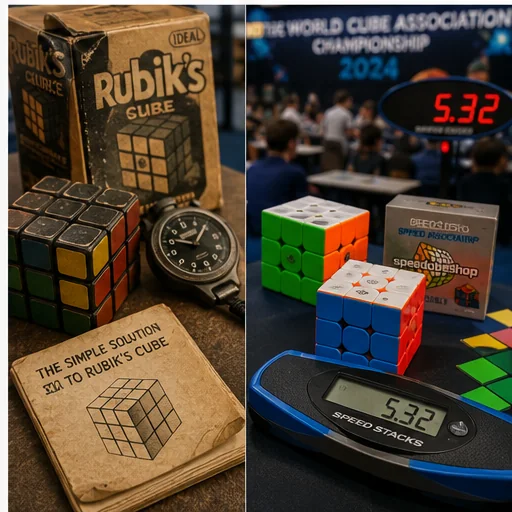
Competitive cubing revived strongly in the internet era. Solvers could share methods, compare times, organize events, watch demonstrations, and buy hardware designed specifically for speed.
The 2003 World Championship restarted international competition
More than two decades after the 1982 event, cubers gathered again for a major world championship. The community now had email groups, websites, and a growing international network.
The World Cube Association formed in 2004
The WCA standardized rules, recognized events, tracked records, and supported competitions around the world.
Modern cubes turn differently
Speedcubes use improved mechanisms, adjustable tension, magnets, rounded internal pieces, better plastics, and lubricants. They corner-cut and move with a smoothness early-80s owners would consider suspicious.
Competitions expanded beyond the 3×3
Events include multiple cube sizes, blindfolded solving, one-handed solving, fewest moves, Pyraminx, Megaminx, Square-1, Clock, and other twisty puzzles.
Online video turned speedsolving into entertainment
Record solves, tutorials, reconstructions, competitions, and reaction videos brought the skill to audiences far beyond local clubs.
The community values methods and hardware
Modern cubers discuss algorithms, turning style, setup, magnets, lubricants, color neutrality, lookahead, and inspection with a level of detail that makes the 1981 solution pamphlet look like a note passed in class.
The original 1982 record remains historically impressive
Modern times are dramatically faster, but early competitors worked with slower hardware, fewer shared resources, and a young competitive culture.
A scrambled Cube is common. The right early box, insert, logo, mechanism, and sticker condition are another matter.
Collecting Vintage Rubik’s Cubes and 80s Puzzle Toys
Vintage Cube collecting depends on age, market, manufacturer, packaging, mechanism, logo, sticker condition, inserts, rarity, and whether the object is an official Rubik’s product or one of thousands of period imitations.
Early Hungarian Magic Cubes are a separate category
Pre-international examples connect directly to the puzzle’s origins. Construction, packaging, markings, colors, and provenance matter.
Ideal-era packaging adds historical value
A Cube with its original box, display container, booklet, or solution material represents the 1980–82 retail experience more completely than a loose puzzle.
Sticker condition is visible immediately
Peeling, fading, scratches, residue, replacement stickers, and incorrect placement affect originality. A heavily played Cube can still be meaningful, but it is not mint.
Logo style helps identify era and market
Center logos, printed marks, stickers, box art, and distributor information can separate releases.
Imitations can be collectible
A knockoff may not carry official value, but strange packaging, unusual mechanisms, regional distribution, and fad-era design can make it historically interesting.
Related puzzles broaden the collection
Rubik’s Revenge, Snake, Magic, Missing Link, Pyraminx, solution books, contest material, merchandise, and cartoon items document the craze beyond the original 3×3.
Sold prices matter more than enthusiastic listings
The guide to valuable vintage 80s toys belongs to the price question. Exact identification and completed sales are more useful than one seller’s belief that every old Cube funded retirement.
Personal history can matter more than rarity
The Cube with worn stickers and a name written on the box may be ordinary to the market and irreplaceable to the owner.
Before you pry out a corner with a screwdriver, remember that the Cube has already survived forty years without your help
Cleaning and Restoring a Vintage Rubik’s Cube
Restoration should begin with identification. An ordinary later Cube can tolerate different treatment than an early Hungarian example, a rare promotional cube, or a puzzle with original paper stickers and packaging.
Photograph the Cube before disassembly
Record color orientation, logo placement, damage, and piece positions. If the Cube has been incorrectly assembled, the photos may help explain the problem.
Do not force a stiff layer
Resistance can come from dirt, misalignment, warped parts, damaged pieces, or an unsuitable mechanism. Force can crack tabs or pop pieces.
Use gentle cleaning first
A soft cloth and minimal moisture are safer than soaking. Strong chemicals can cloud plastic, remove printing, lift stickers, or change color.
Original stickers deserve caution
Water, heat, adhesive removers, and scrubbing can destroy paper or vinyl stickers. Replacement sets improve appearance but change originality.
Lubrication should match the mechanism
Modern speedcube lubricants may not be appropriate for every vintage plastic. Use small amounts and avoid household oils that can attract dirt or damage materials.
Reassembly can create impossible states
A corner twisted in place or an edge flipped during assembly can produce a Cube that no legal sequence can solve. The problem may be physical, not intellectual.
Boxes and books need separate care
Paper packaging should stay dry, flat, and away from direct sunlight. The best Cube in the world does not help a box damaged by basement moisture.
It was a fad, a design classic, a mathematical object, a competitive sport, and the reason one face of every family Cube looked suspiciously newer
Why Rubik’s Cube Still Defines the 1980s Puzzle Craze
Rubik’s Cube earned a permanent place among the most iconic toys of the 80s because it captured the decade without depending on a character or screen. It was colorful, clever, portable, international, competitive, educational, frustrating, and instantly recognizable.
The object is visually perfect
A solved Cube represents order. A scrambled Cube represents chaos. The contrast can be understood without words.
The challenge is honest
The Cube does not hide information or depend on luck. Every move is visible. The solution exists. Failure belongs entirely to the relationship between the solver and the object, which is rude but fair.
The toy invited obsession
The Cube could be turned absentmindedly, studied seriously, timed competitively, displayed decoratively, or abandoned dramatically.
It connected generations
Adults who failed in 1981 can hand the same puzzle to children who learn from a video and solve it before dinner. This is inspiring and also unacceptable.
It transformed puzzle culture
The Cube created markets for solution books, competitions, twisty puzzles, speed hardware, instructional media, and international communities.
It became larger than the craze
The retail explosion ended. The design remained. That is the difference between a famous fad and a durable invention.
The Cube belongs in the wider 80s nostalgia landscape
Its clicking sound, black grid, primary colors, folded solution book, peeling stickers, and permanently mixed final layer are as specific to the era as a cassette case or arcade token.
Gen X remembers the unfinished version
Most memories are not of a perfect solve. They are of one completed side, two promising rows, a borrowed book, a loosened sticker, a cousin who claimed he could do it, and a Cube placed back on the shelf before it damaged the weekend further.
The questions that appear whenever somebody finds a scrambled Cube in a desk drawer
Rubik’s Cube in the 80s: Frequently Asked Questions
Who invented Rubik’s Cube?
Hungarian architect, sculptor, and design teacher Ernő Rubik created the puzzle in 1974 while exploring three-dimensional movement and structure.
What was Rubik’s Cube originally called?
It was originally sold in Hungary as the Magic Cube before the international product was renamed Rubik’s Cube.
When did Rubik’s Cube come out in the United States?
Rubik’s Cube reached the broad international and U.S. market in 1980 through Ideal Toy Corporation.
Why was Rubik’s Cube so popular in the 80s?
The goal was instantly understandable, the puzzle was portable and affordable, and solving it became a visible test of intelligence and persistence. Sales, contests, solution books, television coverage, and knockoffs amplified the craze.
How many possible combinations does a Rubik’s Cube have?
The standard 3×3×3 Cube has more than 43 quintillion possible configurations.
Can a Rubik’s Cube be solved by random twisting?
Random turns could eventually reach a solution in theory, but the number of possible states makes that approach completely impractical. Repeatable solving methods use planned sequences.
Why can most people solve one side but not the whole Cube?
One face can often be completed intuitively, but solving the full Cube requires placing corners and edges correctly while preserving earlier work. A solid-color face may not even represent a correctly solved layer.
What was the bestselling Rubik’s Cube solution book?
James G. Nourse’s The Simple Solution to Rubik’s Cube became the bestselling book of 1981 and sold millions of copies.
Who won the first Rubik’s Cube World Championship?
Minh Thai won the 1982 World Championship in Budapest with a solve of 22.95 seconds.
When was the first Rubik’s Cube World Championship?
The first major official World Rubik’s Cube Championship took place in Budapest, Hungary, in June 1982.
What is speedcubing?
Speedcubing is the competitive practice of solving the Cube or related twisty puzzles as quickly as possible under standardized rules.
What is an algorithm in Rubik’s Cube solving?
An algorithm is a memorized sequence of turns that moves certain pieces in a predictable way while preserving other parts of the puzzle.
What was Rubik’s Revenge?
Rubik’s Revenge is a 4×4×4 twisty puzzle that expands the original Cube with more pieces, movable centers, and additional solving cases.
Was there a Rubik’s Cube cartoon?
Yes. Rubik, the Amazing Cube was a 1983 animated series that turned the puzzle into a magical living character.
Why did the Rubik’s Cube craze end?
By 1982–83, ownership had reached saturation, sales slowed, copies flooded the market, retailers overstocked puzzle products, and consumers moved toward new toy and video-game trends.
Are original Rubik’s Cubes from the 1980s valuable?
Some early Hungarian cubes, rare promotional versions, unusual regional releases, sealed Ideal-era examples, and complete boxed puzzles can be collectible. Most ordinary loose cubes are not automatically valuable.
Can replacing the stickers make a vintage Cube less collectible?
Yes. New stickers may improve display appearance, but they remove original material and can hide wear or incorrect color placement. Collectors usually prefer honest original condition, while restored examples should be clearly described as restored.
Can a Cube become impossible to solve?
A legally scrambled Cube is always solvable. A Cube can become impossible through incorrect reassembly, a twisted corner, a flipped edge, or misplaced stickers.
Why do modern speedcubes turn faster than 80s cubes?
Modern cubes use redesigned internal pieces, adjustable tension, magnets, smoother plastics, lubricants, and mechanisms that tolerate slight misalignment.
What is the best vintage Cube to collect first?
Start with the version you remember: an Ideal-era 3×3, a boxed 1980s release, a Rubik’s Revenge, Snake, Magic, or even a period knockoff with personal meaning.