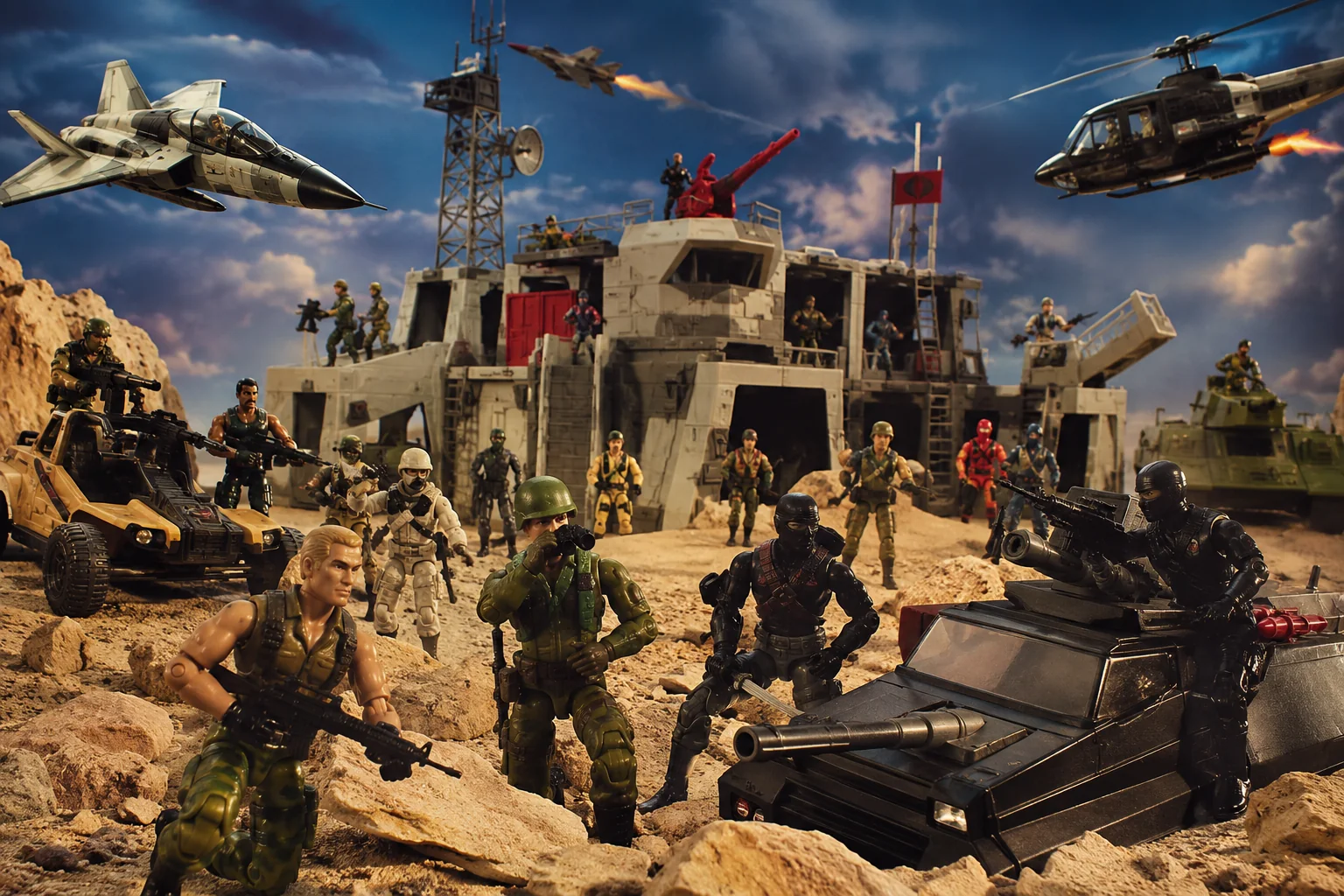
G.I. Joe Toys in the 80s: How A Real American Hero Took Over the Floor
The figures were small enough to fit in a pocket, articulated enough to look like they meant business, and backed by vehicles so large that the living room became contested territory. Then Cobra showed up, the file cards got personal, and childhood logistics were never simple again.
The battlefield started somewhere between the couch and the coffee table.
G.I. Joe toys in the 80s did something few action lines ever managed: they made the supporting cast feel as important as the stars. The 80s G.I. Joe action figures included leaders, commandos, sailors, medics, pilots, machine gunners, dog handlers, firefighters, mountain climbers, and specialists whose job titles sounded like they came from a military manual nobody under twelve had ever read. Duke mattered. Snake Eyes mattered. Scarlett mattered. Cobra Commander mattered. So did the rest of the unit.
The 1982 A Real American Hero relaunch became one of the defining chapters in the history of 80s toys. The figures were smaller than the original 12-inch G.I. Joe, but the world around them was much larger. Hasbro could make teams, vehicles, bases, jets, tanks, command centers, and eventually an aircraft carrier long enough to make parents question every decision that had brought them to that Christmas morning.
Among the decade’s 80s action figures, G.I. Joe built one of the deepest worlds in the aisle. It also became a central force in the 80s action figure wars. He-Man brought muscles and sorcery. Transformers brought mechanical magic. G.I. Joe brought a fully staffed military organization with dossiers, chain of command, vehicle assignments, enemy intelligence, and enough loose accessories to turn vacuuming into an act of aggression.
The line worked because it offered order and chaos at the same time. The file cards explained who everyone was. The vehicles told you what they did. Cobra provided the enemy. Then kids ignored half the official structure, promoted whoever they liked, reassigned vehicles, invented missions, and let Snake Eyes handle nearly everything because he was Snake Eyes.
That balance of detail and freedom is why A Real American Hero remains one of the most iconic toys of the 80s. The toys gave children a world with rules, but never so many rules that the backyard could not become the Arctic, the sandbox could not become a desert, and a laundry basket could not become Cobra headquarters before dinner.
Before Cobra, file cards, and tiny rifles, Joe was twelve inches tall
Before A Real American Hero: The Original G.I. Joe and the Road to 1982
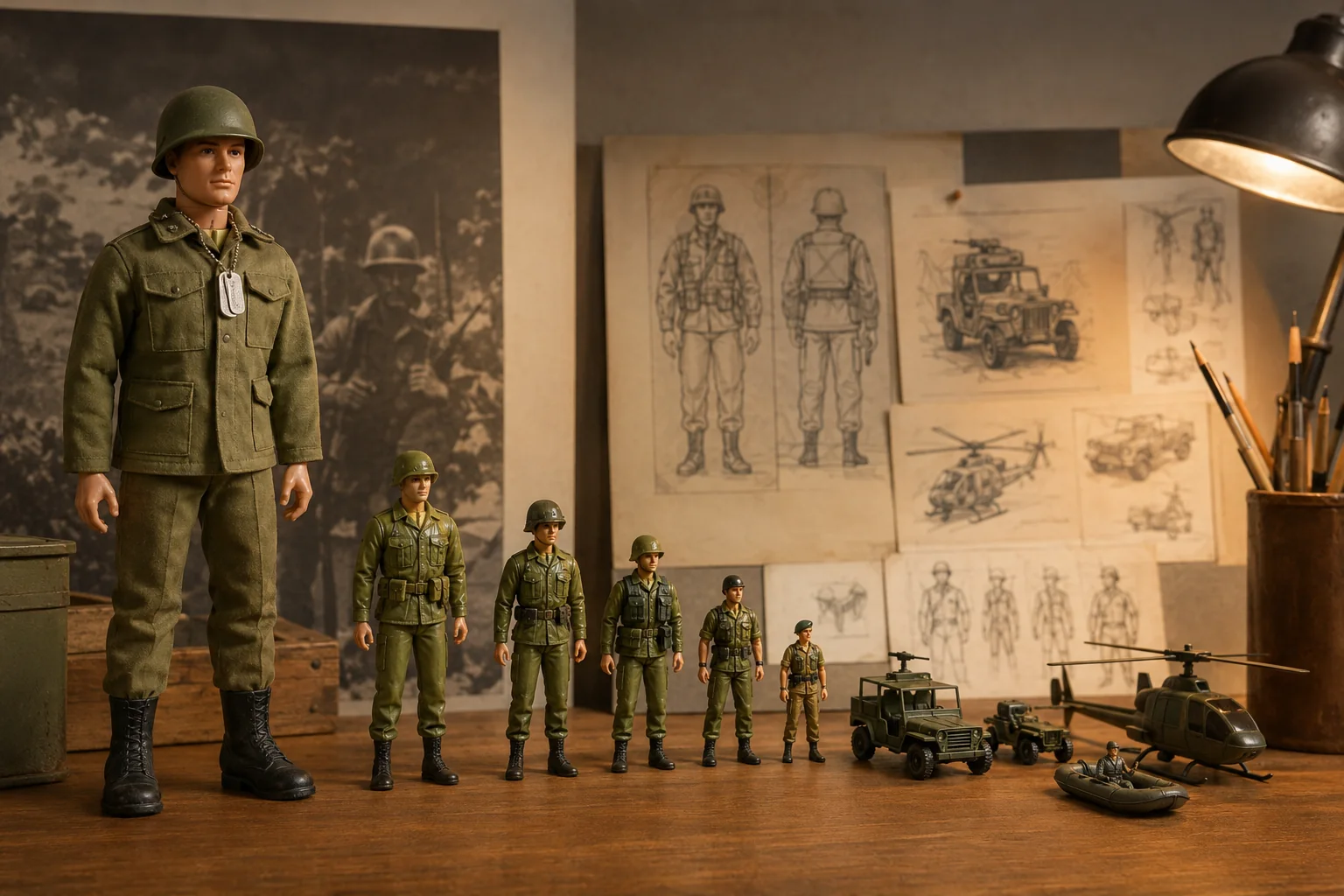
G.I. Joe began in 1964 as a 12-inch military action figure. Hasbro avoided calling it a doll because somebody in a meeting understood that boys might reject the word while happily spending an afternoon changing a plastic soldier’s uniform. “Action figure” became the category, and the original Joe became one of the most important toys ever made.
The early figure was large, articulated, and built around uniforms, equipment, branches of service, and realistic adventure. It was a different kind of play from the 1980s line. The original Joe was often one adaptable hero. A Real American Hero would become an entire organization.
The 12-inch figure created the category
The original figure had enough movement to hold weapons, wear uniforms, ride in vehicles, and perform missions. That physical poseability separated him from ordinary dolls and static soldiers. Kids could outfit him for combat, rescue, diving, space travel, or exploration.
Vietnam changed the cultural weather
By the late 60s and early 70s, military play carried different baggage. Hasbro shifted the brand toward the Adventure Team, emphasizing exploration, rescue, wildlife, and scientific missions. The beards became famous. So did the strange feeling that these guys had clearly finished one war and gone directly into freelance archaeology.
Plastic costs and scale mattered
A 12-inch figure required more plastic, more fabric, larger vehicles, and more shelf space. By the late 70s, the toy industry had learned a different lesson from Star Wars: small figures could support enormous casts, vehicles, and playsets while staying affordable enough for repeated purchases.
Star Wars changed the size of childhood armies
Kenner’s 3.75-inch Star Wars figures showed that kids would collect dozens of characters if the scale was manageable. A small figure could fit into vehicles that would have been ridiculous at 12 inches. The toy aisle had discovered how to make a universe without making every parent rent storage.
The name still had power
Even after the original line faded, “G.I. Joe” remained recognizable. Hasbro did not need to invent a new military brand. It needed to reinvent what Joe meant for a generation raised on Star Wars, Saturday morning cartoons, comic books, and teams with very clear villains.
A smaller figure, a bigger universe, and a terrorist organization with excellent branding
The 1982 G.I. Joe: A Real American Hero Toys Relaunch
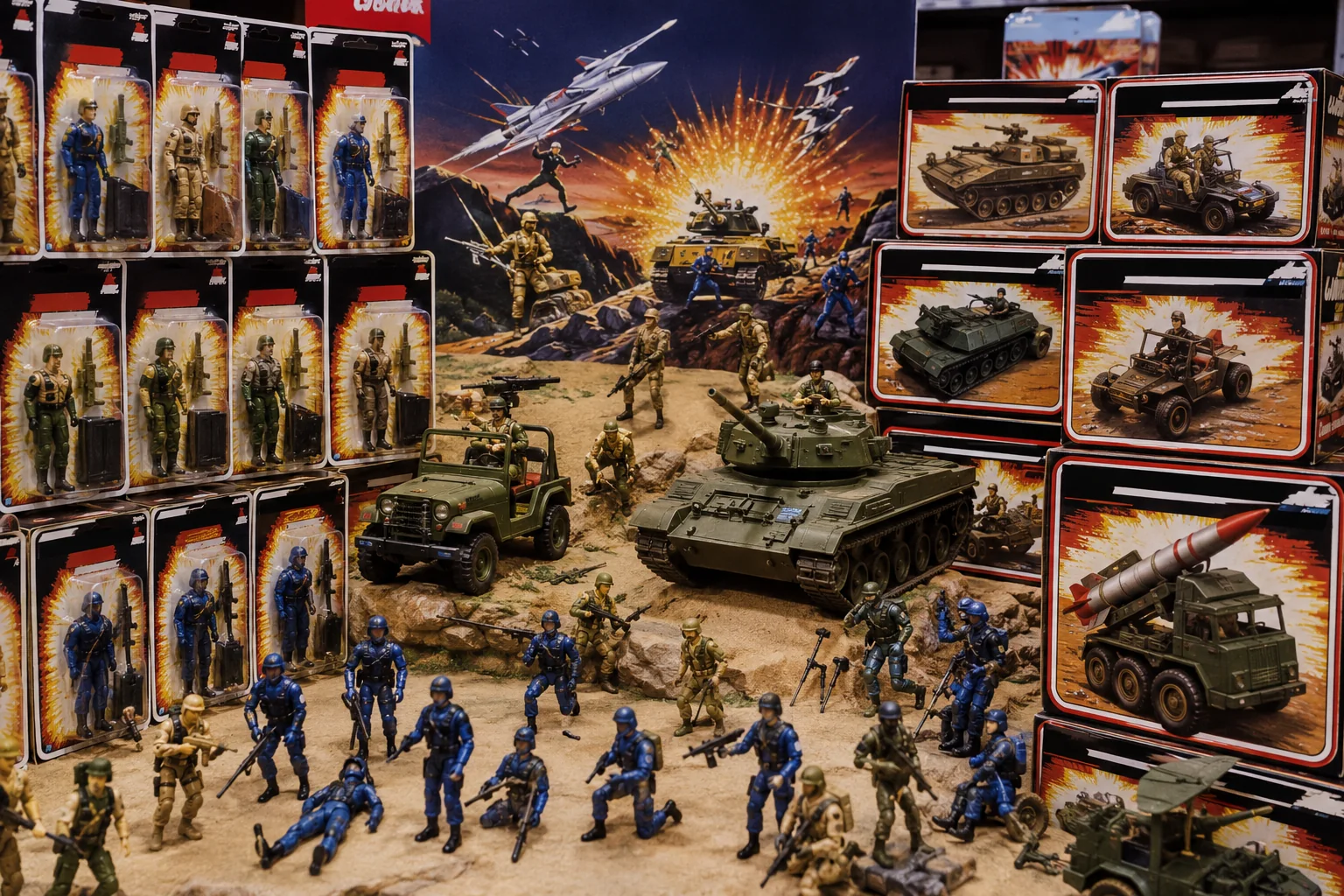
In 1982, Hasbro introduced the 3.75-inch G.I. Joe versus Cobra saga. These were the G.I. Joe toys 80s kids would come to recognize as A Real American Hero: military specialists, detailed accessories, file cards, enemy factions, and vehicles designed as seriously as the characters. The scale matched the action-figure world children already understood, but the line did not feel like a copy of anything else.
The launch arrived beside a Marvel comic series, giving the line a story foundation immediately. G.I. Joe was not simply a pack of soldiers. It was an elite counterterrorist team assembled to fight Cobra, a ruthless organization determined to rule the world through money, weapons, fear, propaganda, weather machines, mind control, ancient artifacts, and whatever else could fit into a five-part miniseries.
The first team felt like a real unit
The early Joes included Hawk, Stalker, Scarlett, Snake Eyes, Breaker, Rock ’n Roll, Grunt, Zap, Short-Fuze, Flash, Grand Slam, Steeler, and Clutch. They were not merely color variations. Each had a specialty that suggested a function inside the team.
Cobra gave the line a permanent reason to expand
Cobra Commander, Cobra officers, and Cobra soldiers created the enemy structure. Once the villains existed, every Joe needed someone to fight. Every vehicle needed an opposing vehicle. Every base needed an invasion plan.
The launch was modest compared with what followed
The first wave did not yet include the enormous cast most people remember. It established the system: figures, vehicles, file cards, comic storytelling, specialties, factions, and realistic hardware with just enough science-fiction energy to keep things interesting.
The comic arrived before the cartoon became the shared version
Marvel’s G.I. Joe: A Real American Hero comic launched with the toy line and gave the characters an ongoing war. The comic could be more grounded, tactical, and dangerous than the later cartoon. For many kids, it became the place where Snake Eyes, Stalker, Scarlett, Hawk, and Cobra felt most real.
The top toys of 1982 had serious competition
G.I. Joe entered a year filled with electronic games, Atari momentum, and the first surge of other character-driven lines. It did not become enormous overnight. It built by making the world deeper each year.
The slogan did heavy lifting
“A Real American Hero” gave the line a clear identity. It sounded serious enough for military play and broad enough for comic-book adventure. The phrase also allowed the brand to celebrate teamwork, courage, and service without requiring every story to resemble an actual war.
The figures got smaller so everything else could get completely out of hand
Why the 3.75-Inch A Real American Hero Toys Worked So Well
The smaller scale was the foundation of A Real American Hero. It made figures portable, vehicles practical, armies collectible, and giant playsets possible. A 12-inch USS Flagg would have required a marina.
Kids could collect a team instead of one hero
A basic figure cost less than a giant doll-style action figure and took up less room. Birthdays, allowance money, holiday gifts, and small rewards could add another specialist to the roster. The collection grew one carded figure at a time.
Vehicles became believable purchases
A jeep, motorcycle, tank, helicopter, or jet could be large enough to impress without becoming furniture. The 3.75-inch scale allowed Hasbro to build vehicles with cockpits, seats, storage, weapons, and moving parts that fit the figures properly.
The figures traveled easily
A Joe could fit in a pocket, lunchbox, backpack, or jacket. This was useful until the figure arrived at school, where teachers had a different interpretation of “special mission force.”
Small figures made large battles possible
Ten figures could occupy one patch of carpet without knocking over a lamp. Squads could move through couch-cushion terrain. Cobra soldiers could mass near a base. The line rewarded scale in numbers.
The figures looked detailed without becoming delicate statues
Uniforms, helmets, belts, pouches, boots, holsters, masks, and insignia gave the figures personality. They were small, but not anonymous. A silhouette could still tell you whether you were looking at Snake Eyes, Destro, Roadblock, or a standard Cobra trooper.
The scale created the USS Flagg fantasy
Once figures became small enough, Hasbro could imagine bases and vehicles that would have been impossible before. That logic reached its glorious conclusion when an aircraft carrier appeared in a toy catalog and parents realized “playset” had become a legally flexible term.
O-rings, swivel arms, tiny screws, and knees that actually bent
How 80s G.I. Joe Action Figures Were Built
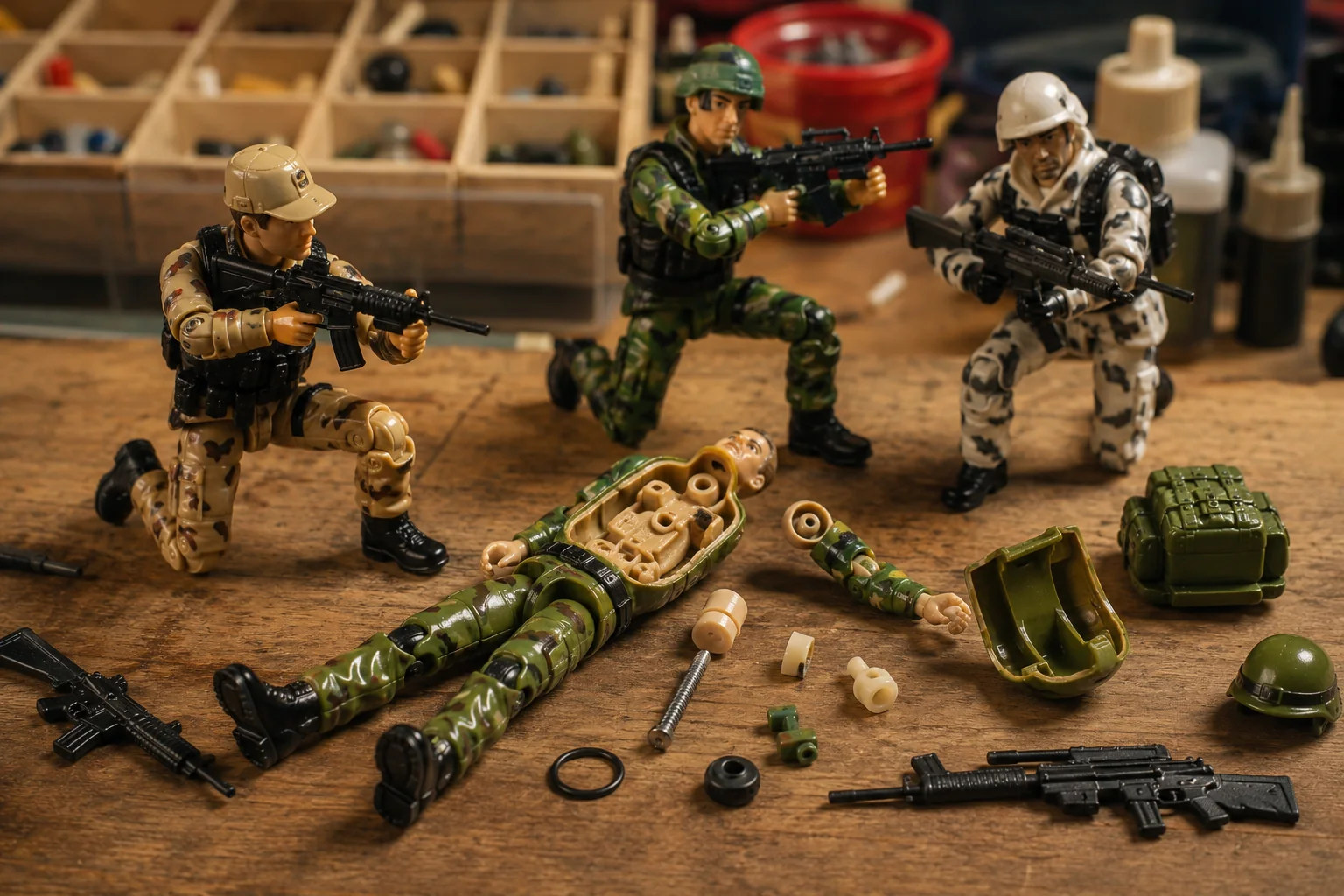
The figures were successful because they moved well. Compared with many 3.75-inch figures of the era, G.I. Joe offered a wider range of poseability. They could crouch, kneel, sit in vehicles, hold rifles, climb, aim, drive, and collapse dramatically after taking a direct hit from a missile launcher powered by one child’s index finger.
How the G.I. Joe O-Ring Figure Design Worked
An internal rubber O-ring connected the torso to the waist and hips. This allowed the figure to bend and twist at the waist while keeping the body together. The design also created one of the most common failures in vintage figures: decades later, the rubber dries out, breaks, and leaves the Joe separated into a small pile of body parts.
Straight-Arm Figures vs. Swivel-Arm Battle Grip
The first 1982 figures had straight-arm construction. Later versions added bicep swivels, allowing the forearms to rotate inward and hold weapons more naturally. “Swivel-arm battle grip” sounded like something developed after extensive military testing. It was really a better way to make a tiny soldier aim a rifle.
Knees and elbows changed the play
Bent knees allowed figures to sit correctly in vehicles, kneel behind cover, climb ladders, or fall from a base with convincing lack of workplace safety. Elbow movement made weapons, binoculars, steering controls, and communications gear more believable.
The neck articulation improved in the middle of the decade
Later figures gained ball-jointed necks that could look up and down instead of only turning side to side. That small change made a major difference when figures needed to look toward aircraft, towers, or an adult standing over the battlefield asking why the hallway was blocked.
The waist screw made repairs possible
A small screw in the back held the torso together. Collectors learned to open figures, replace broken O-rings, tighten joints, and swap parts. Children learned that taking the figure apart without permission produced a very different afternoon.
Accessories completed the job
Rifles, machine guns, backpacks, helmets, hoses, swords, binoculars, shields, animals, and specialty gear turned a figure into a role. The right accessory mattered. Snake Eyes without his sword still looked dangerous. Airtight without his hose looked like somebody had interrupted the hazmat inspection.
Thumbs and crotches took the abuse
Hard plastic hands could crack when weapons were forced into them. The narrow waist and hip piece could break during rough posing. Vintage Joe collectors know the phrase “broken crotch” because adulthood is full of dignified conversations nobody warned us about.
The package told you who the figure was before the cartoon got involved
G.I. Joe File Cards: How Tiny Biographies Made the Figures Feel Real
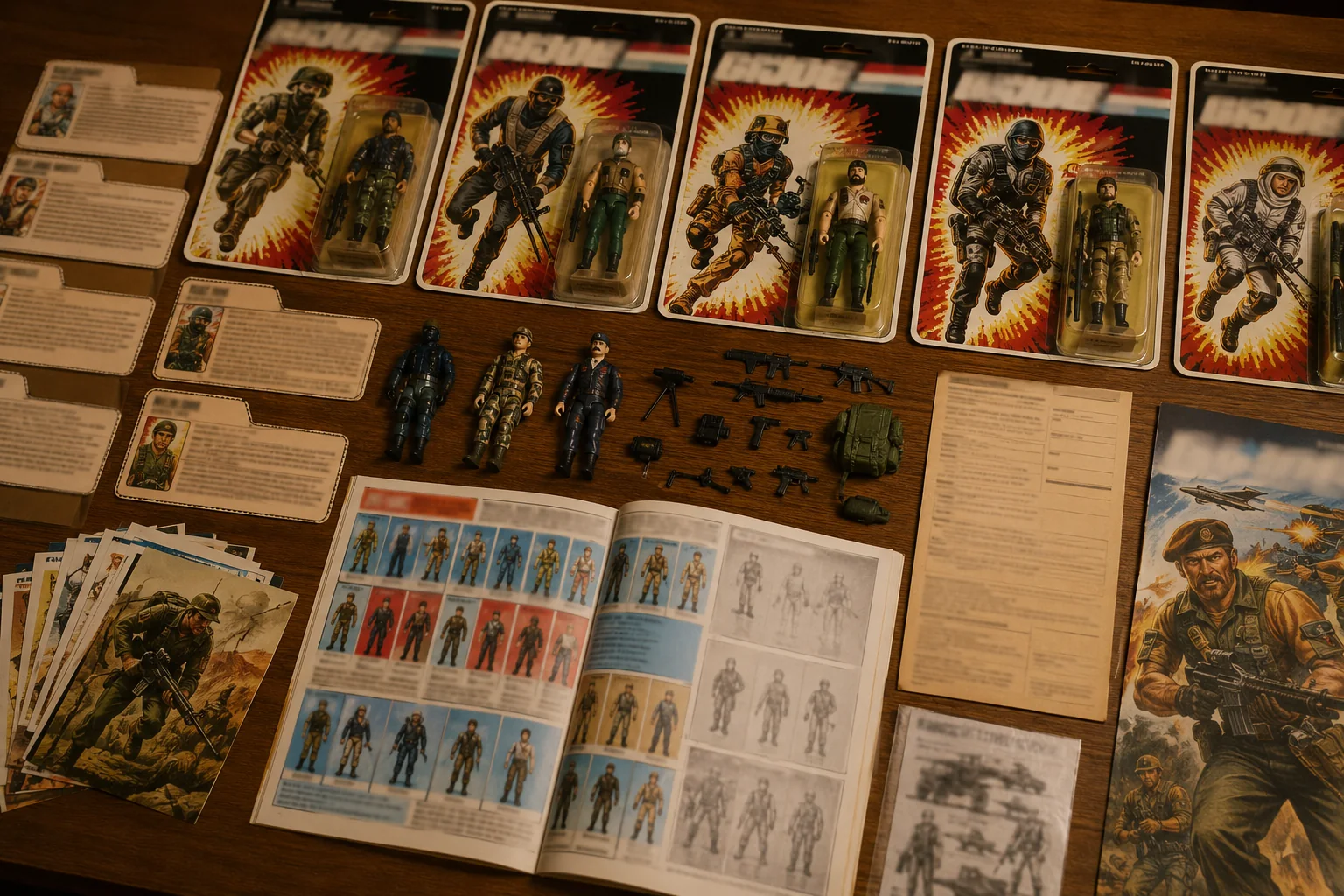
The file card on the back of the package was one of the smartest storytelling tools in the line. It gave the character a code name, real name, birthplace, military specialty, rank, training, personality, and a short description. The card could be clipped and saved, turning packaging into personnel records.
Every figure had a life outside the toy
Stalker was not simply a green-uniformed soldier. He had language skills, leadership experience, and a history with Snake Eyes and Storm Shadow. Roadblock was not merely the big guy with a machine gun. He had a personality, background, and a cooking interest that made him feel human.
Specialties explained the team structure
Laser trooper, communications officer, infantryman, explosive ordnance specialist, ranger, sailor, medic, pilot, dog handler, mountain trooper, firefighter, and machine gunner were not random labels. They suggested how missions might work.
Larry Hama gave the cards a distinctive voice
Many early file cards were written by Larry Hama, who also shaped the Marvel comic. The writing mixed military detail, humor, personality, and memorable observations. The descriptions sounded like someone inside the organization had actually met these people.
The cards encouraged reading without feeling educational
Kids studied hometowns, ranks, specialties, and personality notes because the information mattered to play. Nobody assigned a book report. The child simply needed to know whether Gung-Ho outranked Shipwreck and whether Snow Job could be trusted with a vehicle in July.
The cards settled some arguments and started others
Rank and specialty provided evidence. Personality notes provided ammunition. A file card might prove who should lead, but it could not stop a child from promoting Snake Eyes above everyone because the silent ninja had already won the vote.
Clipping the card created a collector’s dilemma
Saving the file card meant cutting the package. Keeping the package intact meant leaving the card attached. Children chose information. Adult collectors later chose regret.
File cards made even minor characters memorable
A figure who appeared briefly—or never appeared at all—in the cartoon could still feel important because the card supplied a complete identity. The package did not treat any figure like filler.
The team had leaders, specialists, ninjas, sailors, mountain climbers, and at least one guy who brought a machine gun to every conversation
80s G.I. Joe Action Figures: The Heroes Who Made the Team Feel Real
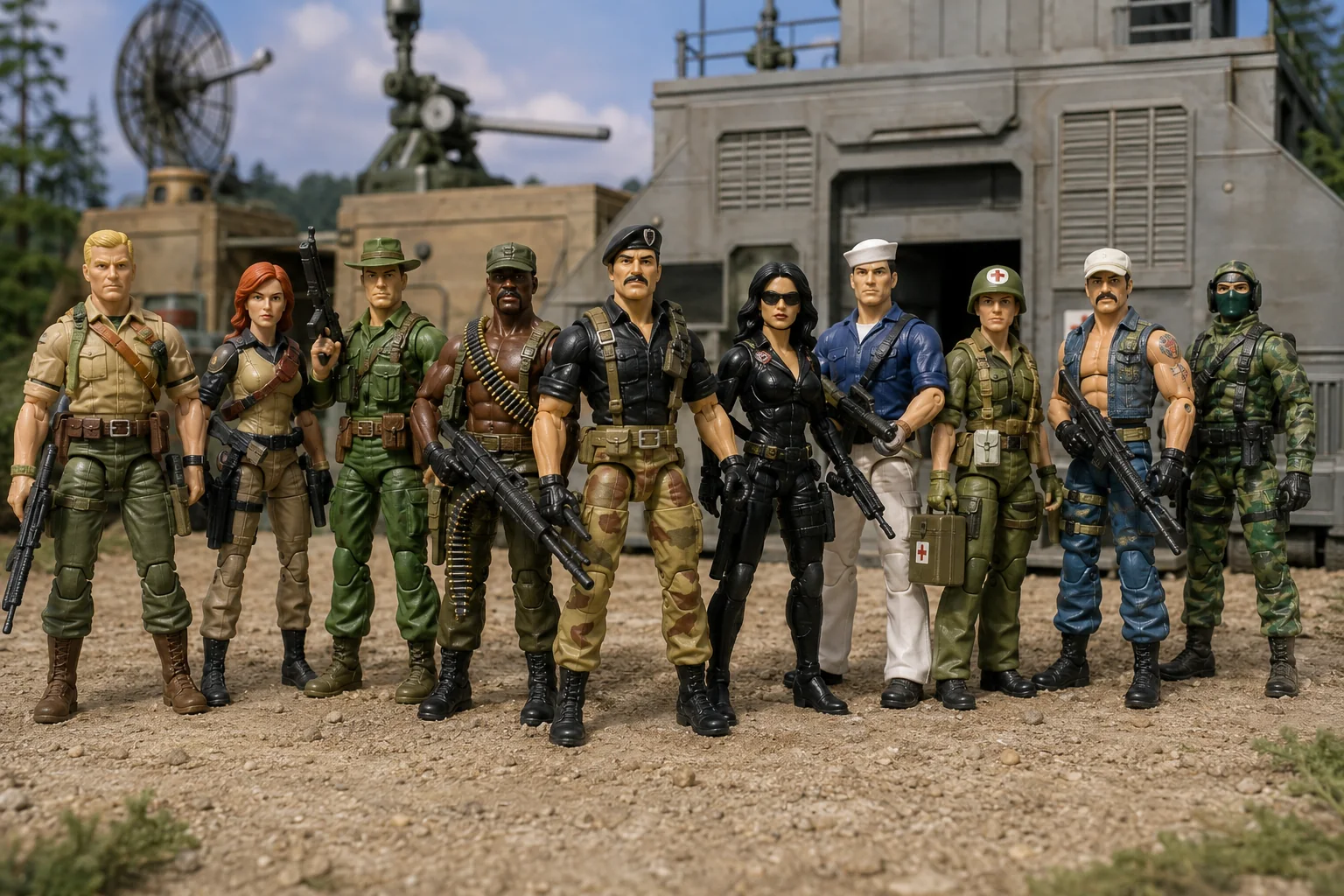
G.I. Joe succeeded because the heroes did not all perform the same function. The team felt built for missions. Different figures solved different problems, and even the most specialized character could become the lead when the afternoon’s plot required it.
Duke
The field leader many cartoon viewers recognized immediately. Blond, confident, capable, and permanently prepared to explain the mission while Cobra was already firing.
Hawk
The original commander and strategic authority. Depending on the year and media version, Hawk carried more command weight than the toy aisle sometimes gave him credit for.
Scarlett
Counterintelligence specialist, crossbow user, martial artist, and one of the essential original figures. She belonged in the center of the action from the beginning.
Stalker
Ranger, leader, linguist, and a central figure in the comic. Stalker brought seriousness and history to the team.
Roadblock
Heavy machine gunner with strength, personality, and a cooking background. His weapon was so large that it looked like the figure should have received workers’ compensation.
Gung-Ho
Marine, grenade launcher, bare chest, large tattoo, and the subtle confidence of someone who believed shirts were optional equipment.
Flint
Warrant officer, tactical leader, and beret owner. Flint looked like the guy who could command a mission and argue with Lady Jaye during the same commercial break.
Lady Jaye
Covert operations specialist with javelins and disguise skills. She gave the team another capable intelligence operative who never needed rescuing from the actual work.
Shipwreck
Sailor, parrot owner, and the Joe most likely to sound like he had already seen the mission go badly in three different ports.
Doc
The medic who brought a flare launcher instead of a standard weapon. Doc reminded children that a military team needed someone who could repair people after the rest of the figures finished falling off the coffee table.
Beach Head
Ranger and drill instructor with a masked face and no patience. Beach Head looked like even the other Joes lowered their voices when he entered the room.
Spirit
Tracker with an eagle companion and a distinctive visual identity. Spirit became one of those figures whose accessories were inseparable from the character.
The team looked better together
Individual figures were interesting. A lineup created the organization. Berets, helmets, masks, camouflage, bright specialty suits, sailor gear, and winter equipment made the shelf look like a meeting between every branch, climate, and assignment.
Specialists turned the bedroom into a mission generator
Alpine needed mountains. Snow Job needed snow or at least a white blanket. Torpedo needed water. Barbecue needed something on fire. Airtight needed toxic chemicals. The character suggested the environment.
The toy line did not require one permanent star
Duke might lead one mission. Flint could lead another. Snake Eyes could disappear into Cobra territory. Scarlett could run intelligence. Roadblock could hold the line. This kept the collection from becoming one hero surrounded by extras.
Cobra had uniforms, logos, commanders, internal politics, and the employee-retention rate of a haunted corporation
Cobra Toys and Villains: Why the Enemy Side Was Just as Collectible
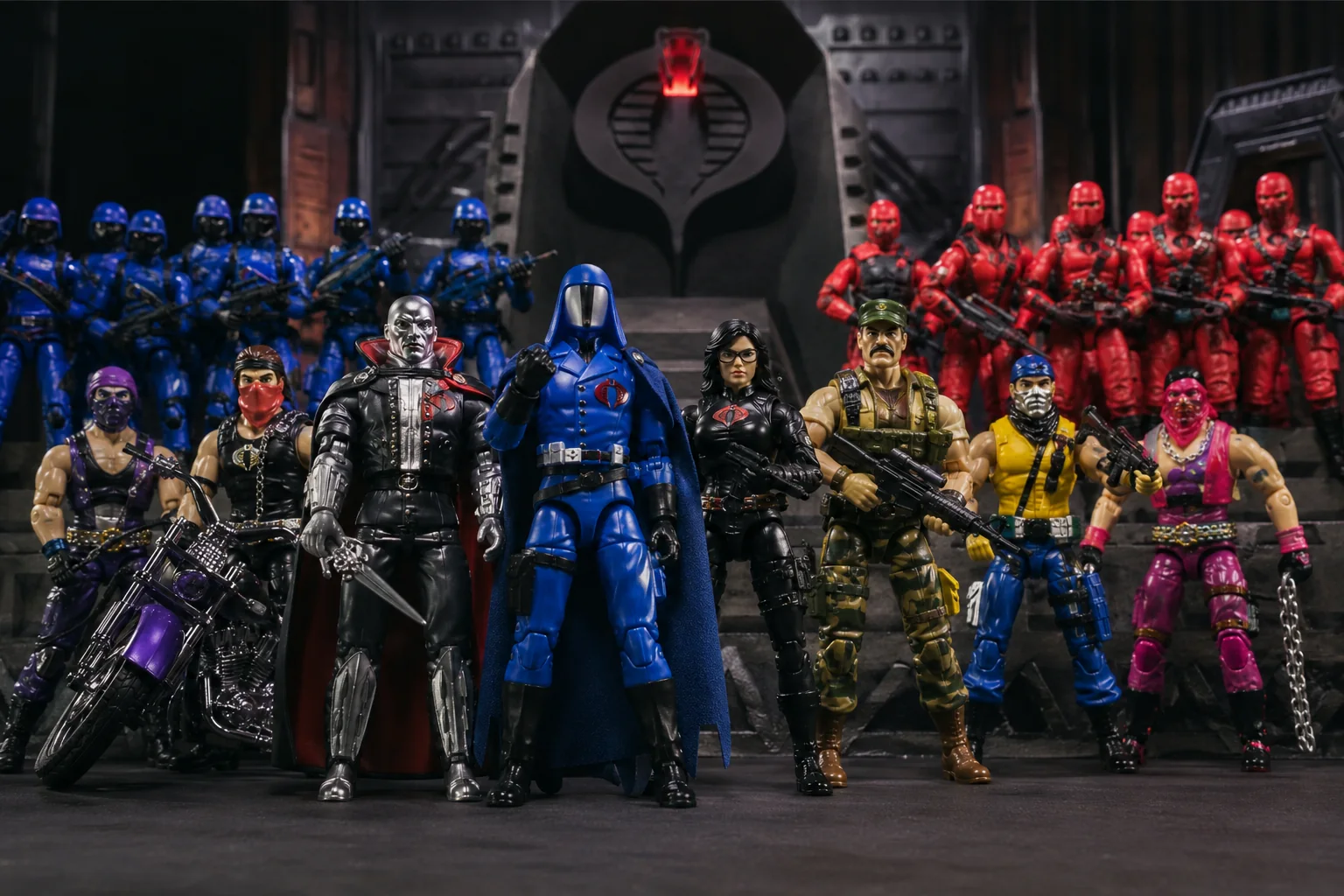
Cobra was not one villain. It was an organization with leaders, officers, soldiers, specialists, inventors, mercenaries, guards, pilots, divers, ninjas, and people whose job descriptions sounded like they had been approved by a committee made entirely of supervillains.
Cobra Commander made failure theatrical
Cobra Commander had one of the strongest villain designs of the decade. The blue uniform, faceplate or hood, gloves, insignia, and dramatic posture made him instantly recognizable. He could sound threatening while standing in a cardboard base with half his staff plotting against him.
Destro looked like a weapons dealer from another planet
The metal mask, open chest, black outfit, and oversized collar made Destro impossible to confuse with an ordinary soldier. He brought business interests, personal ambition, and a complicated relationship with the Baroness into the toy box.
The Baroness brought style and intelligence
Black uniform, glasses, long hair, and a cold visual confidence made the Baroness one of Cobra’s defining figures. She looked like she could steal classified plans and criticize everyone’s posture while doing it.
Major Bludd and Zartan expanded the villain types
Major Bludd was a mercenary with armor and a reputation. Zartan was a disguise expert, leader of the Dreadnoks, and color-changing toy gimmick wrapped in swamp-biker chaos.
The Dreadnoks made Cobra less orderly
Buzzer, Ripper, Torch, and later additions looked like the enemy had recruited directly from a roadside bar after a motorcycle incident. They brought chainsaws, blowtorches, blades, and a different kind of menace.
Troopers made army building possible
Cobra soldiers, officers, Vipers, Crimson Guards, Eels, Snow Serpents, B.A.T.s, and other troop builders gave the villains numbers. Owning duplicates made sense because these were ranks, not one-of-a-kind personalities.
The villain vehicles were often better looking
The H.I.S.S. tank, Rattler, Night Raven, Stinger, Water Moccasin, and Trouble Bubble had aggressive shapes and strong colors. Cobra equipment looked designed by people who had rejected subtlety as a weakness.
Internal betrayal created endless plots
Cobra Commander distrusted Destro. Destro had his own interests. Zartan worked for money. The Baroness had loyalties and relationships. Storm Shadow’s history shifted. Even when Cobra controlled the battlefield, the organization was one argument away from collapsing.
The silent commando and the white-clad ninja changed the entire center of the franchise
Snake Eyes and Storm Shadow: The G.I. Joe Toys Every Kid Watched for
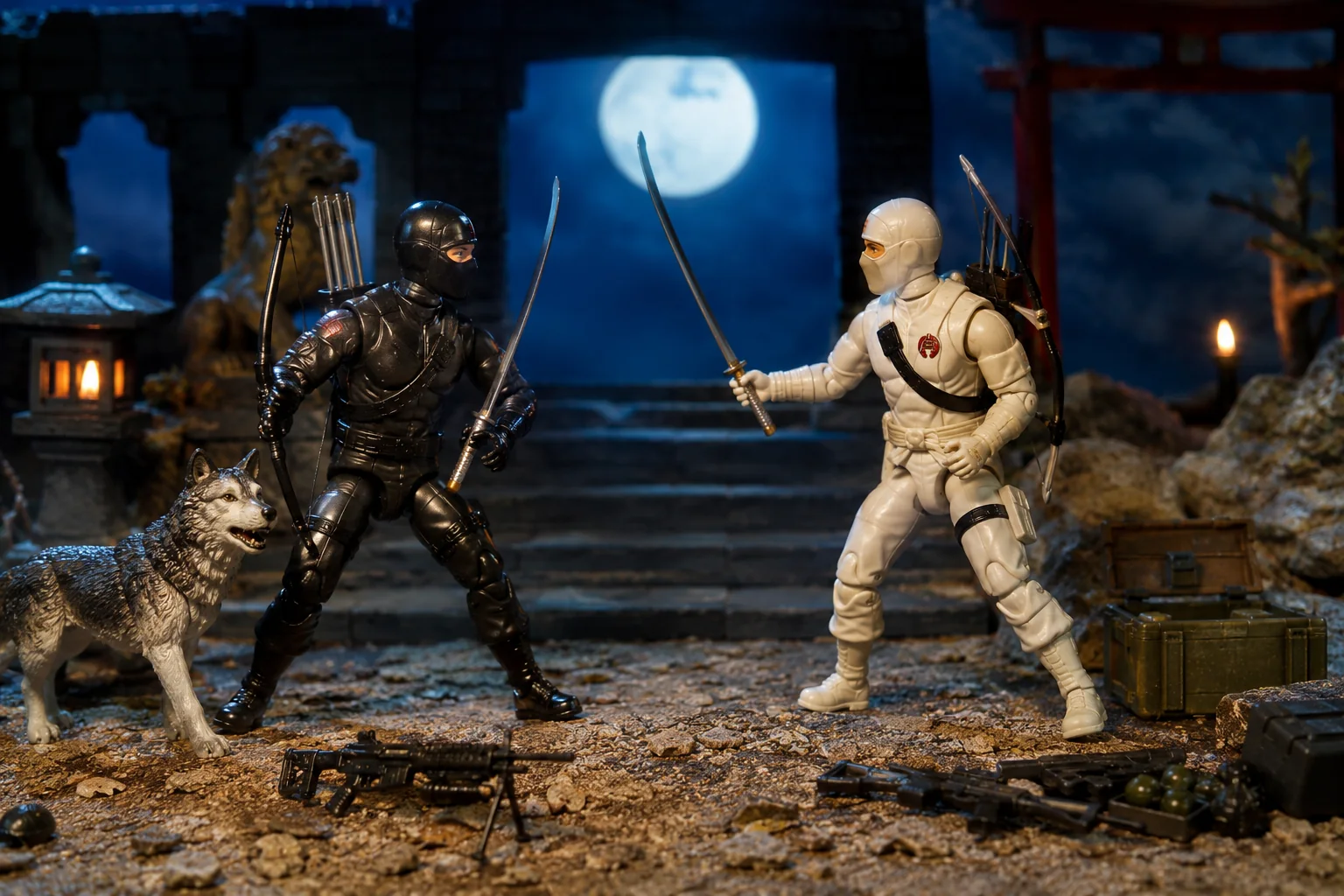
Snake Eyes and Storm Shadow became larger than the military framework around them. Their designs were simple and perfect: one all black, one mostly white. Their shared history brought mystery, rivalry, loyalty, betrayal, martial arts, and personal stakes into a line filled with tanks and laser rifles.
Snake Eyes was visually irresistible
The all-black uniform made him look secret before a child knew anything else. He had no visible face, did not speak, used weapons and martial arts, and seemed capable of completing the mission without attending the briefing.
The original figure turned limited paint into an advantage
What could have looked plain became iconic. Black plastic, visor, weapon, and compact silhouette made Snake Eyes stand out among the greens and browns. He looked like the figure from the classified part of the catalog.
Storm Shadow made the enemy side complicated
White ninja clothing, bow, swords, and Cobra affiliation created immediate contrast. Storm Shadow did not look like a standard Cobra employee. He looked like a rival with a separate story.
The comic gave their history depth
Larry Hama’s comic developed the Arashikage connection, shared past, family tragedy, and shifting loyalties. The story became one of the most enduring parts of G.I. Joe because it was personal rather than simply tactical.
The toys encouraged direct rivalry
Black versus white. Sword versus sword. Joe versus Cobra. The figures could begin fighting before the child learned the backstory. Once the story was known, every rematch carried more weight.
Later versions became major events
New Snake Eyes and Storm Shadow figures brought different uniforms, weapons, and design changes. Kids compared versions and decided which one was definitive. The answer was usually whichever one had not yet lost the sword.
Timber made Snake Eyes even cooler
A wolf companion turned the silent commando into something even more mythic. Timber became one of those animal accessories that felt like a full character and made the figure display incomplete without him.
The figures were excellent. The vehicles were the reason the hallway became impassable.
Vintage G.I. Joe Vehicles: Why the Motor Pool Made A Real American Hero Huge
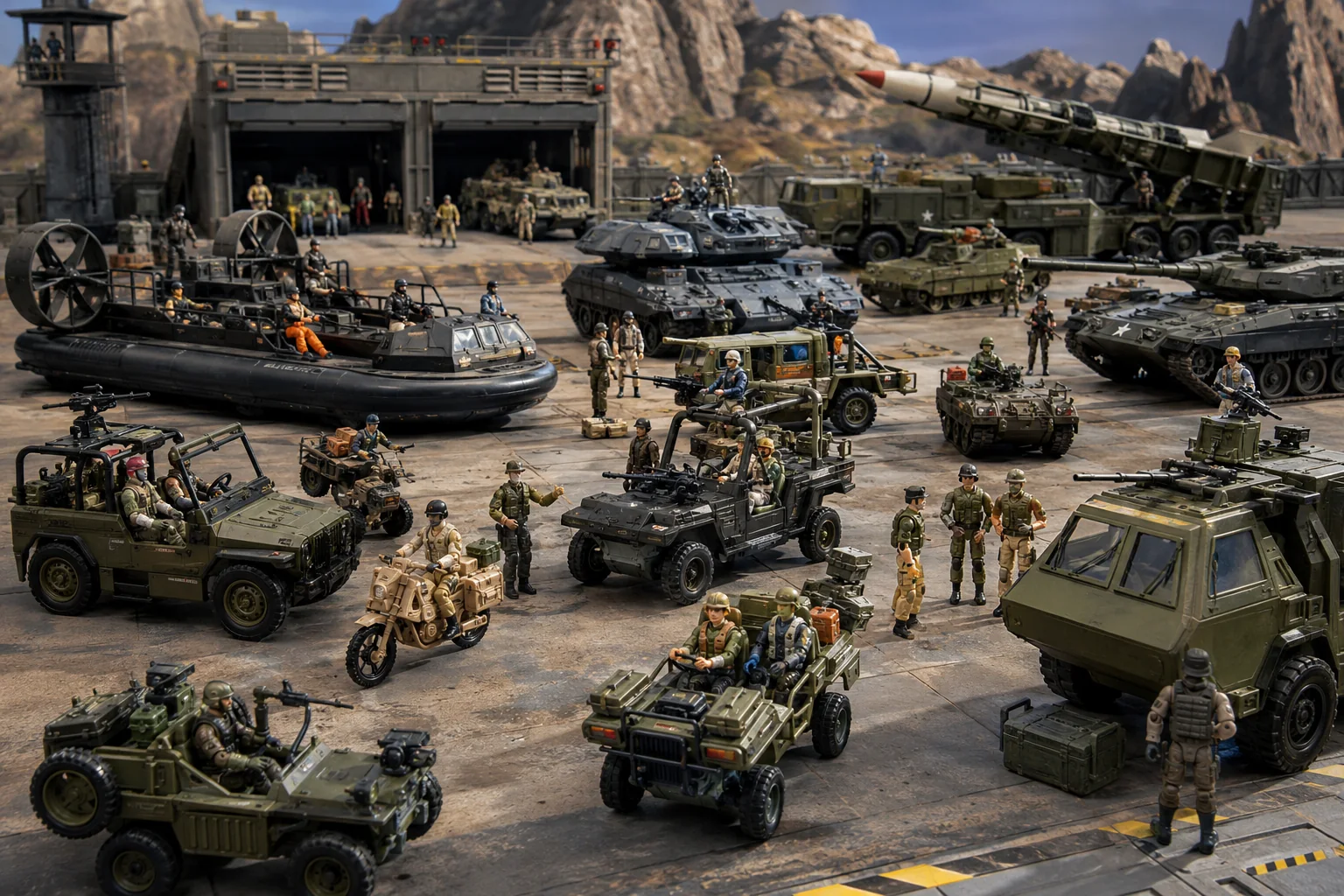
Vintage G.I. Joe vehicles were not background accessories. They were often the most memorable toys in the line. Hasbro built cockpits, seats, hatches, weapons, landing gear, engines, tow systems, storage, removable panels, and mechanical features around the 3.75-inch figures, making the motor pool feel like half the franchise rather than an optional add-on.
Vehicles made the scale feel correct
The figures sat inside rather than balancing on top. Hands could reach controls. Feet could fit near pedals. Seats, canopies, ladders, and hatches made the machines feel designed for the characters.
Driver figures increased the appeal
Many vehicles came with an exclusive driver or pilot. The vehicle did not feel complete without the person assigned to it. Steeler belonged with the MOBAT. Wild Bill belonged near the Dragonfly. Ace belonged in the Skystriker.
Realism and fantasy lived together
Some machines resembled recognizable military vehicles. Others pushed into comic-book technology. The line could offer a tank, jet, hovercraft, missile platform, space shuttle, or transforming battle station without breaking its identity.
Mechanical features gave kids something to operate
Missiles fired. Wings swept. Turrets rotated. Canopies opened. Landing gear moved. Elevators raised. Ramps folded. Wheels rolled. The vehicle became a machine for play rather than a plastic shell.
The vehicle often determined the mission
A Skystriker meant air combat. A Dragonfly meant rescue or assault. A WHALE meant water. A Snow Cat meant Arctic operations. A bridge layer meant somebody had decided the carpet contained a river.
Cobra needed matching escalation
Every Joe machine created demand for a Cobra answer. The H.I.S.S. opposed ground forces. The Rattler challenged the Skystriker. The Night Raven threatened everything in the air. The Terror Drome gave Cobra a base worthy of invasion.
The ceiling fan was neutral airspace until somebody launched a Skystriker
G.I. Joe Jets and Helicopters: Skystriker, Dragonfly, Rattler, Night Raven, and Tomahawk
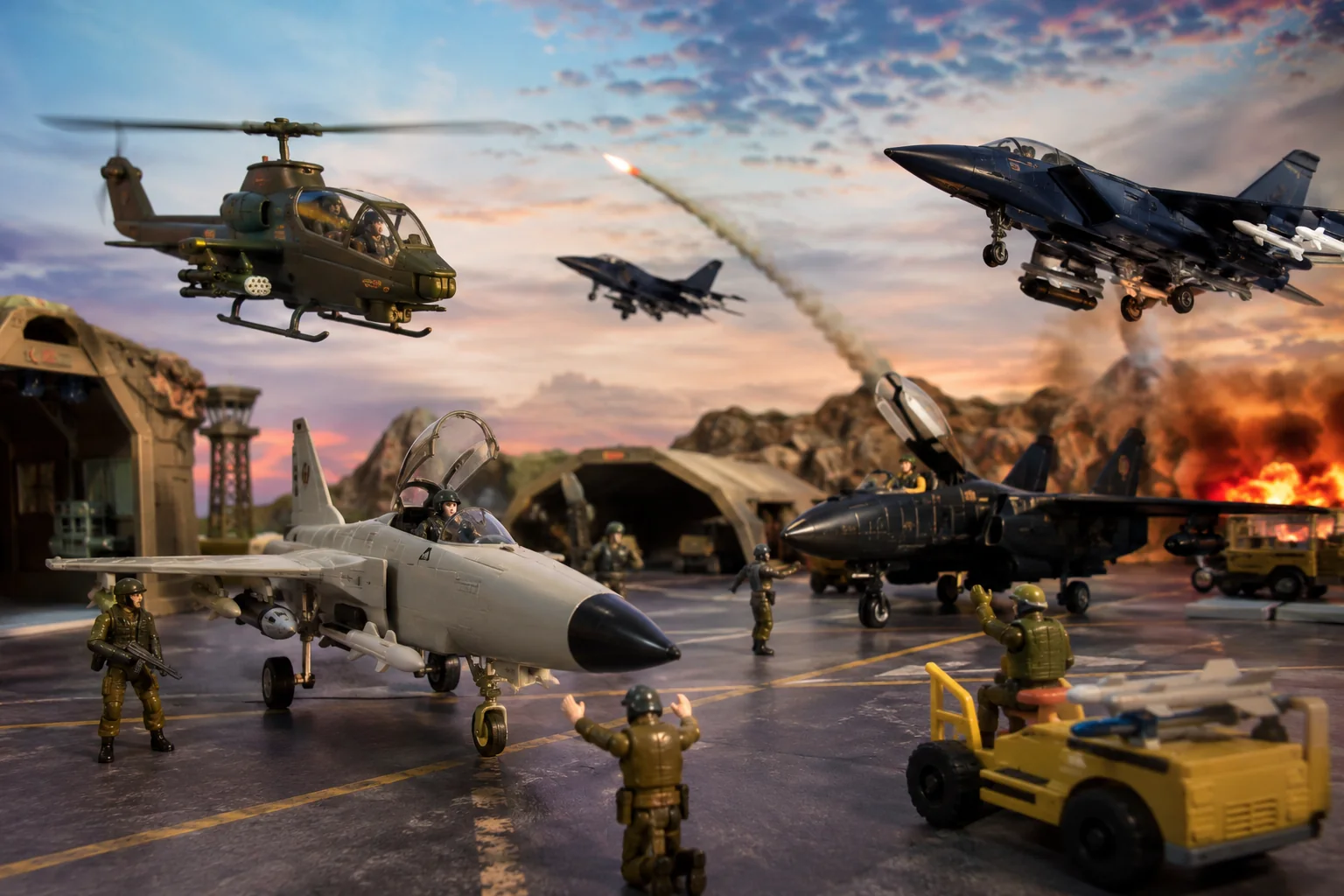
Skystriker XP-14F
The Joe fighter jet had sweeping wings, landing gear, missiles, cockpit seating, parachutes, and Ace. It looked close enough to a real jet to feel serious and toy-like enough to survive repeated missions from the couch.
Dragonfly XH-1
The attack helicopter came with Wild Bill and a long silhouette that made every bedroom feel temporarily larger. Rotors, cockpit, missiles, and skids gave it constant play value.
Cobra Rattler
The blue ground-attack jet gave Cobra one of its most recognizable aircraft. Tilted wings, aggressive shape, bombs, and Wild Weasel made it feel built for low-altitude trouble.
Night Raven S³P
Black, sleek, futuristic, and enormous, the Night Raven looked like Cobra had stolen a classified aircraft and improved the attitude.
Tomahawk
The large transport helicopter carried multiple figures, opened through the rear, and created rescue missions, troop deployments, and the constant possibility of rotor-related furniture contact.
Cobra F.A.N.G.
Small, exposed, and apparently designed by someone who considered pilot protection an unnecessary luxury. The F.A.N.G. was affordable, dangerous-looking, and perfect for quick attacks.
Why the G.I. Joe Skystriker Became a Dream Vehicle
The jet had enough detail to feel like a model and enough durability to remain a toy. The moving wings and landing gear gave the transformation-free vehicle its own mechanical ritual.
The Dragonfly made helicopters feel heroic
Wild Bill, rotating blades, side weapons, cockpit seating, and the long body created immediate recognition. It was the kind of toy that entered a room before the child carrying it.
The Rattler gave Cobra equal visual power
A villain side without serious aircraft would have felt incomplete. The Rattler’s blue color and unusual wing arrangement made it distinctly Cobra instead of a simple enemy repaint.
The Night Raven looked like the late 80s had arrived early
Its black body and futuristic profile made it feel more advanced than ordinary toy jets. It had the kind of presence that made other vehicles look like they had been cleared for local traffic only.
Tanks, jeeps, armored cars, motorcycles, and enough missiles to violate every homeowner’s policy
G.I. Joe Ground Vehicles: VAMP, MOBAT, H.I.S.S. Tank, Stinger, Snow Cat, and More
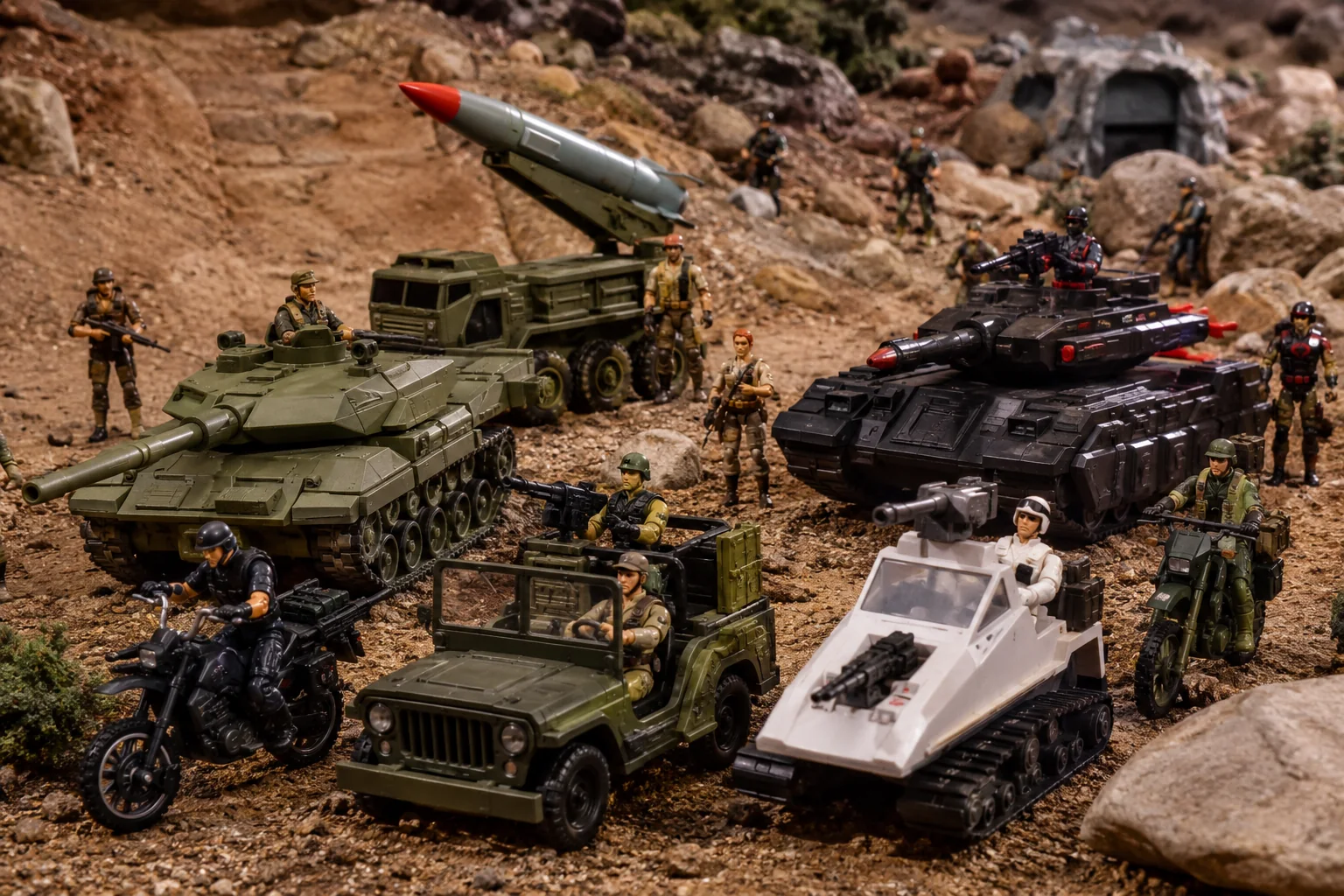
VAMP
The Joe jeep was compact, rugged, and instantly useful. Clutch fit behind the wheel, a second figure could ride along, and the rear gun made every patrol become a firefight.
MOBAT
The motorized battle tank came with Steeler and gave the original team heavy armor. Batteries turned it from vehicle into living-room hazard.
H.I.S.S. Tank
Black body, elevated cockpit, rotating cannons, treads, and one of the strongest silhouettes in the line. The H.I.S.S. looked evil without requiring explanation.
Cobra Stinger
A dark Cobra version of the jeep format with missiles and a driver. It proved one good vehicle idea could support both sides without feeling lazy.
Snow Cat
White body, orange missiles, treads, skis, and cold-weather attitude. Even in July, the Snow Cat could turn a blanket into an Arctic battlefield.
Thunder Machine
The Dreadnok vehicle looked assembled from stolen parts, bad intentions, and a complete rejection of subtle paint choices.
Wolverine
A missile tank with Cover Girl, the Wolverine brought heavy firepower and one of the most memorable early female vehicle drivers.
Bridge Layer
A tank that deployed a bridge sounds less exciting until a child discovers that every couch gap, stair edge, and book pile can become a tactical obstacle.
RAM Motorcycle
Small, quick, armed, and affordable. The RAM made it possible to add mobility without asking for a box the size of a dishwasher.
Why the Cobra H.I.S.S. Tank Became a Toy-Aisle Icon
It was simple enough to own in multiples and distinctive enough to look like a threat alone. Troop-building the vehicle made sense because Cobra clearly had a procurement department.
Small vehicles kept the line accessible
Not every machine needed to be a holiday headline. Motorcycles, gliders, small artillery, and compact vehicles gave kids lower-cost ways to expand the battlefield.
Ground vehicles handled rough play
Wheels rolled across carpet. Tanks climbed books. Jeeps survived launches off ramps that had not been approved by Hasbro. The sturdiness helped vehicles remain in rotation even after small pieces disappeared.
A base was not furniture. It merely occupied furniture-sized space.
Vintage G.I. Joe Headquarters, Playsets, and Battlefield Installations
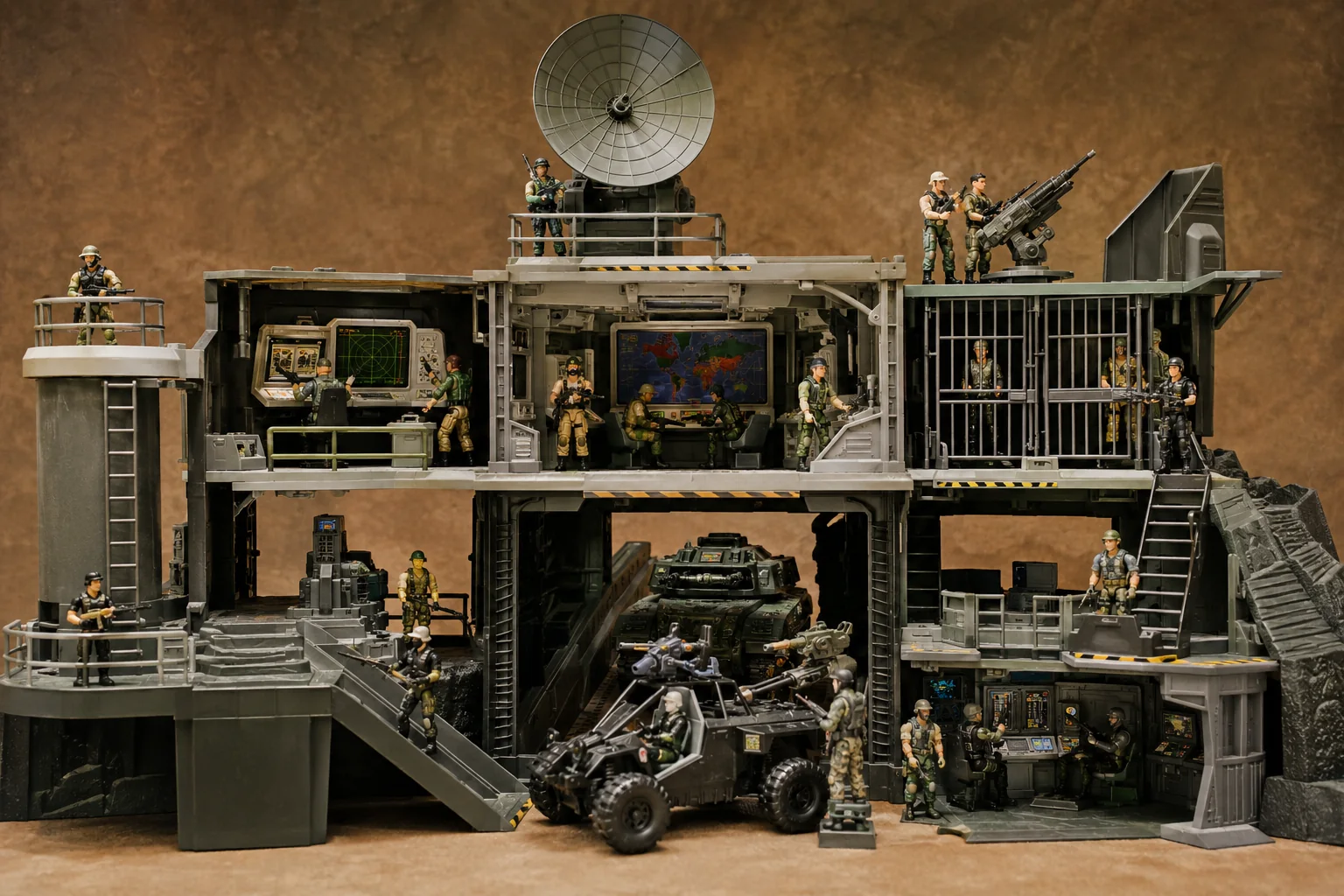
Playsets gave the war geography. A figure collection could fight anywhere, but a headquarters created command rooms, jail cells, weapon stations, landing pads, ramps, walls, and targets. It also created a new household question: where exactly is this going to stay?
The 1983 Headquarters Command Center built the home base
The early headquarters gave the Joes a recognizable command structure with walls, stations, vehicle areas, guns, and space for multiple figures. It looked like a military installation rather than a fantasy castle.
The Tactical Battle Platform created an offshore mission center
Platforms, weapons, radar, control areas, and a landing space made it useful for sea, air, and coastal stories. It could become a temporary base anywhere the floor turned blue.
The Check Point and smaller stations expanded the map
Small play environments mattered because not every family had room for a fortress. A checkpoint, watchtower, bunker, or missile station could create a mission without taking over the entire room.
Playsets organized figures between battles
Stations, chairs, ramps, cells, towers, and platforms gave figures somewhere to stand. A base could turn display into play and keep at least some accessories from disappearing into the general toy-box wilderness.
Cobra bases invited attack
A Joe headquarters needed defense. A Cobra base needed invasion. The villain structures often included obvious targets, dangerous machines, and open architecture that practically begged a child to send Snake Eyes through the side entrance.
The sets encouraged multi-stage stories
A mission could begin at headquarters, move into a vehicle, attack a Cobra installation, rescue a prisoner, and return. The playset created beginning and ending points.
The round Cobra fortress looked like a volcano, missile base, airport, and bad neighborhood association decision
Cobra Terror Drome: The Villain Playset That Could Fight Back
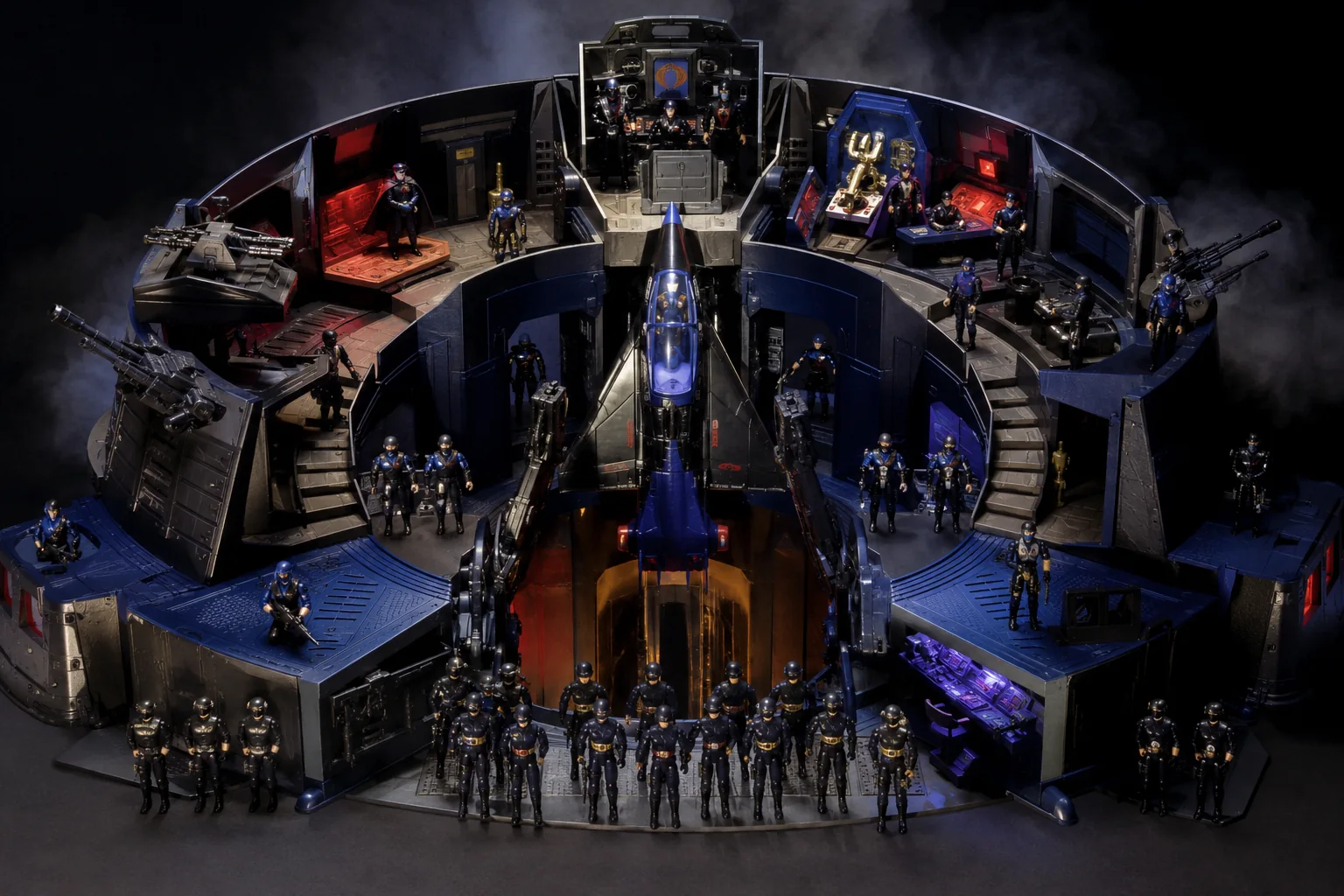
The Terror Drome gave Cobra one of the greatest bases in 80s toy history. Its circular design, multiple compartments, gun positions, launch system, and Firebat aircraft made it more than a backdrop. It was an active machine built for defense and counterattack.
The shape made it different from ordinary headquarters
The round fortress created a 360-degree battlefield. Figures could attack from multiple sides. Cobra could defend several stations. The structure looked like it had risen directly from a classified mountain.
The Firebat launch system created a centerpiece feature
A small aircraft could rise from the center, giving the playset movement and surprise. The Firebat did not simply sit beside the base. It belonged inside the mechanism.
Compartments turned the base into a working organization
Repair areas, holding spaces, weapons, command stations, and access points allowed different Cobra characters to perform roles. The playset made the villains look staffed.
The Terror Drome rewarded a large collection
One figure could stand inside. Ten looked better. Cobra troopers, Vipers, officers, guards, Destro, the Baroness, and Cobra Commander all found places. The base turned army building into a visual payoff.
It was large without becoming the USS Flagg
The Terror Drome was still a major object, but it could fit into a room without stretching from one wall toward another state. It felt enormous while remaining recognizably a playset.
The catalog called it an aircraft carrier. Parents called it absolutely not.
USS Flagg Toy: The 7½-Foot G.I. Joe Aircraft Carrier Fantasy
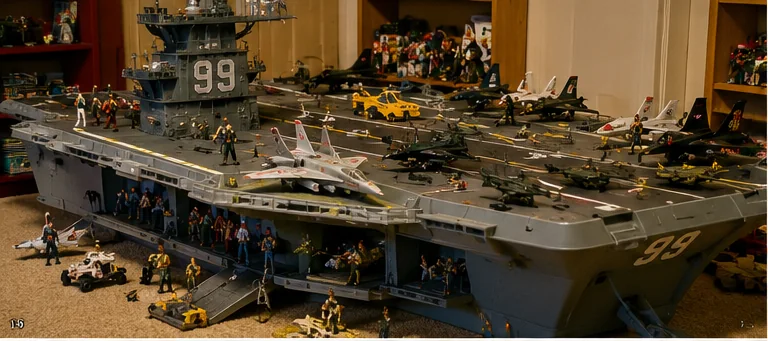
The USS Flagg is the toy that defines excess in the best possible way. Released in 1985, the aircraft carrier measured roughly seven and a half feet long. It had a massive flight deck, island superstructure, elevators, radar, missiles, deck equipment, vehicles, sound features, and the exclusive Admiral Keel-Haul figure.
How Big Was the USS Flagg Toy?
The Flagg was not a tabletop aircraft carrier unless the table was designed for a banquet. It stretched across floors, bedrooms, basements, and Christmas-morning photographs. Children did not merely own it. Families accommodated it.
The flight deck made every aircraft more important
Skystrikers, Dragonflies, Tomahawks, and smaller aircraft gained a destination. Jets could launch, land, park, refuel, and wait for the next mission. The carrier made an air fleet feel connected.
The island structure gave the ship a command center
Towers, radar, controls, platforms, and deck operations gave figures multiple levels. Keel-Haul could command. Shipwreck could report. Ace could ignore landing instructions.
The sound system made the carrier feel alive
Announcements and microphone features brought voices onto the deck. A child could call general quarters, issue orders, or make noises that caused an adult in another room to reconsider the batteries.
The Flagg became a catalog legend even for kids who never owned it
Most children did not have one. That scarcity helped create the memory. The image alone was enough: a toy so large it looked like the smaller vehicles had been arranged on a display table, except the display table was the toy.
Assembly became a family operation
Deck plates, clips, supports, walls, railings, decals, towers, elevators, and accessories required time. This was not a box opened and played with in three minutes. The adults had joined the Joe team whether they wanted to or not.
Completeness is now a collector nightmare
Deck clips, railings, antennas, tow vehicles, fuel trailers, ladders, missiles, microphones, stickers, support pieces, and small fittings can all disappear. A mostly complete Flagg may still contain a shopping list long enough to require its own file card.
It belongs in the story of the hottest Christmas toys of the 80s
The Flagg was not the toy every child received. It was the toy every child noticed. That makes it a perfect symbol of 80s holiday ambition: enormous, detailed, impractical, unforgettable, and fully prepared to occupy the living room until further notice.
The comic did not feel like an instruction manual. It felt like somebody took the toys seriously.
Marvel’s G.I. Joe: A Real American Hero Comic and the Larry Hama Difference
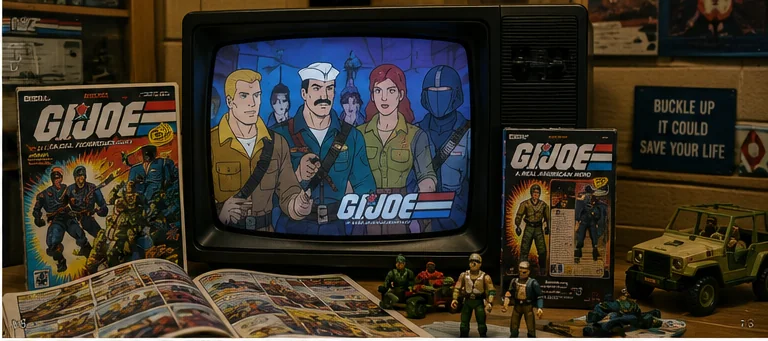
The Marvel comic gave G.I. Joe a depth that exceeded ordinary licensed storytelling. Larry Hama shaped characters, histories, military relationships, humor, grief, loyalty, and consequences. The comic could support the toys while still telling stories that readers remembered decades later.
The comic began with the toy line
The first issue introduced the team, Cobra, and the larger conflict in 1982. That timing mattered. The toys arrived with an ongoing narrative rather than waiting for television to define them.
Characters developed beyond the package
Snake Eyes, Stalker, Scarlett, Hawk, Storm Shadow, Cobra Commander, Destro, and others gained history through missions and relationships. The comic made the roster feel like people who had known one another before the reader arrived.
The military detail created credibility
Ranks, specialties, tactics, equipment, and chain of command appeared naturally. The stories were still comic-book adventures, but the organization behaved with enough structure to make the fantasy feel grounded.
Issue #21 proved the series could take risks
The famous “Silent Interlude” told a Snake Eyes rescue story without dialogue. The issue matched the character’s silence and showed that a toy-based comic could use visual storytelling with confidence.
The comic allowed real consequences
Characters could be injured or killed. Missions could fail. Cobra politics could become dangerous. The world felt less reset-button-friendly than television.
File-card and comic voices reinforced each other
The same character detail appeared across packaging and story. A specialty mentioned on the card could matter in a mission. A relationship from the comic could make the figure feel more important.
The comic gave lesser-known figures a chance
Not every toy became a cartoon star. The comic could focus on specialists, soldiers, and supporting characters in ways that made a seemingly minor figure suddenly necessary.
Laser rifles, weather machines, five-part miniseries, and a world where every parachute opened
The G.I. Joe Cartoon: How Sunbow Turned the Toy Line Into Daily Television
The Sunbow/Marvel Productions animated series brought the characters into homes with voices, catchphrases, personalities, music, and constant motion. The cartoon was brighter and less deadly than the comic, but it made the enormous cast familiar to millions of children.
The early miniseries format made events feel huge
The MASS Device and Revenge of Cobra stories unfolded across multiple episodes. The structure created cliffhangers and made Cobra’s latest machine feel like a national emergency rather than a twenty-minute inconvenience.
The opening sequence was a mission briefing with music
The theme introduced the basic conflict quickly: G.I. Joe, Cobra, freedom, danger, and a promise that the battle could happen anywhere on land, sea, or air. Kids did not need a quiet explanation.
Distinct voices made the roster manageable
Cobra Commander hissed. Destro sounded controlled. Shipwreck sounded exhausted. Roadblock rhymed. Flint commanded. Lady Jaye challenged him. The voices separated figures who might otherwise have blurred into the same green-uniformed team.
The cartoon softened violence through lasers and escape
Vehicles exploded while pilots parachuted safely. Laser fire filled the screen without producing the consequences shown in the comic. The show delivered constant combat while staying within afternoon television limits.
Cobra became gloriously theatrical
Weather dominators, mind control, ancient weapons, genetic schemes, giant organisms, space stations, and reality-bending devices moved the line beyond military realism. Cobra was less a terrorist organization than a weekly science-fiction funding crisis.
The show sold vehicles through action
A toy sitting on a shelf was interesting. A Skystriker diving through an episode or a H.I.S.S. tank charging a base became urgent. The cartoon demonstrated why the machine belonged in the war.
The broader machine was one of the great 80s cartoons that sold us the toys
Animation, packaging, comics, and commercials reinforced one another. The show gave characters emotional familiarity. The ad showed exactly how the plastic version moved. The store provided the final step.
The battle ended, then a kid learned not to touch a fallen power line
“Knowing Is Half the Battle”: The G.I. Joe Public-Service Endings
The public-service announcements at the end of episodes became one of the most remembered parts of the cartoon. A Joe would appear when children faced a real-life problem, offer advice, and close with the phrase that became inseparable from the brand.
The lessons covered everyday danger
Fire safety, strangers, traffic, swimming, electricity, bullying, medicine, and household hazards appeared in short scenes. The message arrived after twenty minutes of laser combat, which somehow made the advice feel official.
The format gave characters life outside combat
Joes were not only soldiers. They became adults who knew what to do when a child found a dangerous object, faced peer pressure, or made a bad choice.
The closing phrase became larger than the show
“And knowing is half the battle” survived as a cultural reference because it was repeated, simple, and attached to useful advice. The other half of the battle was apparently listening before the animation budget ran out.
The segments softened the brand for parents
A military toy cartoon ending with safety advice provided reassurance. The show could deliver weapons, explosions, and Cobra plots while reminding everyone that the heroes cared about responsible behavior.
Gen X remembers the rhythm instantly
Problem. Joe appears. Advice. Child understands. Catchphrase. Credits. The formula was so consistent that decades later, people can parody it without explaining the original.
The announcer sounded like the toy aisle had declared a national emergency
Why 80s G.I. Joe Toy Commercials Worked So Well
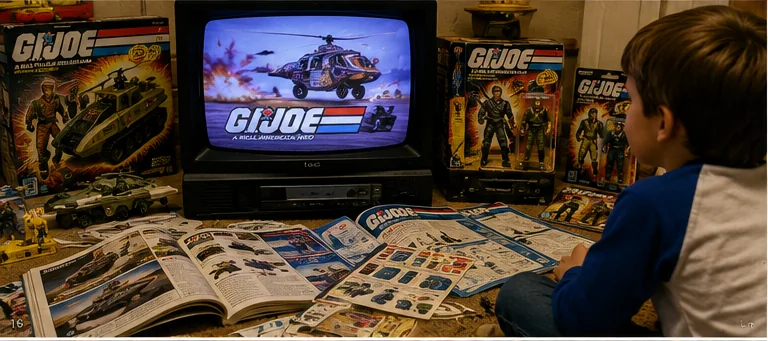
G.I. Joe commercials moved fast because the line had too much to show. Figures, vehicles, bases, missiles, enemies, comics, and new specialties had to fit into seconds. The ads used dramatic voices, quick cuts, kid hands, explosions, and names shouted like military alerts.
The commercials showed the entire system
A figure did not appear alone. It rode in a vehicle, attacked a base, faced Cobra, and connected to other toys. The ad made one purchase look like the entrance to a larger operation.
Vehicle features became demonstrations
Wings moved. Missiles launched. Turrets rotated. Ramps lowered. Figures loaded into seats. The commercial proved the machine’s functions before a child reached the store.
Comic commercials blurred entertainment and advertising
Animated ads promoted the Marvel comic with the same excitement used for toys. Reading the story and buying the figure felt like related parts of the same experience.
Names became impossible to forget
Skystriker. H.I.S.S. Tank. Dragonfly. Terror Drome. USS Flagg. The announcer delivered product names with the seriousness of military hardware procurement.
Kids controlled the action
Hands pushed vehicles, moved figures, launched missiles, and opened playsets. The ad did not simply display the toy. It showed ownership in motion.
Cobra often looked like the better deal
Black tanks, blue jets, strange bases, masks, villains, and aggressive designs gave the enemy side visual advantage. A good commercial could make a child want the vehicle that had just lost.
The archive remains addictive
Rewatching 80s toy commercials and videos reveals how much story was packed into thirty seconds. The ads were loud because the toys were competing with He-Man, Transformers, Nintendo, cereal, and whatever else appeared before the show returned.
The card art exploded. The file card informed. The catalog destroyed your sense of enough.
G.I. Joe Packaging, Explosion Cardbacks, Blueprints, and Christmas Catalogs
The packaging made every figure look like it had been caught in the middle of an operation. Character art burst from the card. The logo announced the team. The Cobra symbol identified the enemy. The back provided file-card intelligence and a look at other figures.
The explosion background created instant energy
The original card design placed the character against a painted burst that made even a communications specialist look like he had just escaped a refinery.
Character portraits elevated the figure
The art showed expression, equipment, and personality beyond the small sculpt. A figure with limited facial paint could still have a dramatic identity through the package.
Vehicle boxes sold battles, not products
Painted scenes showed aircraft diving, tanks charging, missiles firing, and figures operating every station. The box suggested the entire mission before the parts were assembled.
Blueprints extended the technical fantasy
Vehicle instructions and diagrams made the machines feel like equipment with systems, names, and functions. Kids studied them even after assembly because the paper made the toy seem official.
Catalog inserts revealed the size of the problem
Opening one vehicle introduced ten more. A child who felt satisfied for three minutes could study the catalog and discover the collection lacked Arctic forces, naval support, Cobra air power, and a headquarters.
Christmas catalogs became strategic documents
Figures were circled. Vehicles were starred. The USS Flagg occupied a large photo and an even larger part of the imagination. Catalog pages showed ideal collections untouched by missing missiles or sibling diplomacy.
Packaging now affects value
Uncut file cards, intact bubbles, clean boxes, inserts, blueprints, catalogs, and unused decals matter to collectors. Children saw cardboard between them and the toy. Adults see historical evidence of restraint nobody actually practiced.
The mission began indoors, crossed the backyard, and ended when somebody stepped on a rifle
How Kids Actually Played With G.I. Joe Toys in the 80s
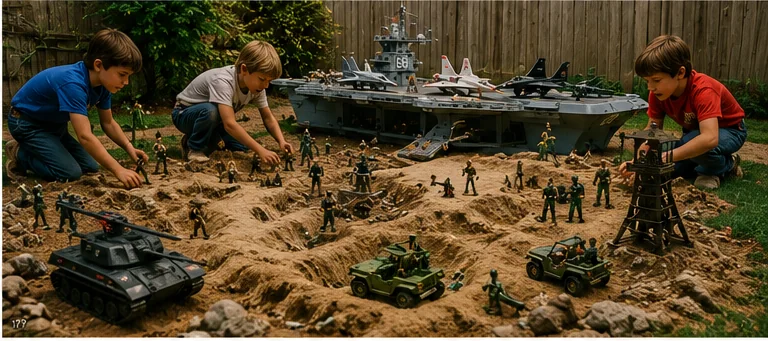
G.I. Joe play was unusually organized for something that looked like complete chaos. Figures had specialties. Vehicles had crews. Bases had functions. Cobra had objectives. Yet the official structure remained flexible enough for every child to create a different war.
The bedroom became headquarters
Dressers became cliffs. Beds became mountain ranges. Blankets became snow. Desks became control towers. The floor became a map whose borders changed whenever an adult needed to walk through.
The backyard added real terrain
Dirt created trenches. Sandboxes became deserts. Puddles became oceans. Bushes became jungle. The toys collected mud, water, grass, and the kind of wear collectors now describe with very calm voices.
Vehicles created deployment
Figures did not simply appear in battle. They arrived in VAMPs, helicopters, tanks, jets, and boats. A mission could begin with loading the team, which sometimes took longer than the actual rescue.
Specialties shaped the story
Breaker handled communications. Doc treated casualties. Alpine climbed. Torpedo entered the water. Airtight investigated toxic waste. The character’s job could generate the entire mission.
Cobra bases required infiltration
Snake Eyes entered quietly. Scarlett gathered intelligence. Stalker led a team. Roadblock handled the front gate. The child could stage an operation rather than a simple fistfight.
Parachutes made stairs dangerous
Some figures and accessories encouraged drops from balconies, stairwells, porches, or bedroom windows. The parachute might open. The figure might land. The adult response was far more predictable.
Casualties were temporary until the comic changed the rules
A figure could be declared injured, captured, or dead, then return ten minutes later because the collection lacked replacements. Comic readers sometimes treated consequences more seriously. Cartoon viewers knew parachutes would probably appear.
Other toy lines joined the battlefield
Transformers became giant robots or vehicles. He-Man became a super-soldier from another dimension. Plastic dinosaurs became Cobra experiments. The G1 Transformers toys and He-Man toys had their own worlds until the kid running the floor decided otherwise.
File-card knowledge, missing accessories, version arguments, and one kid who definitely had the Flagg
G.I. Joe Schoolyard Culture, Trading, and Playground Intelligence
G.I. Joe did not stay at home. The figures were portable, the characters were numerous, and the television schedule gave everyone shared information. School became the place where ownership, rumors, comics, and toy knowledge were compared.
Small figures traveled too well
A Joe fit in a pocket, which made bringing one to school easy and getting it confiscated easier. Weapons and backpacks traveled separately and returned less reliably.
Version knowledge became status
Kids knew which Snake Eyes was cooler, which Cobra Commander had the hood, which Storm Shadow belonged to which side, and whether a figure had swivel arms. This information had no effect on grades and enormous effect on lunch-table authority.
File cards supplied trivia
Real names, hometowns, ranks, and specialties became facts worth remembering. A child might forget a spelling word and correctly recite Roadblock’s military specialty.
Trading required accessory accounting
A figure with a backpack and rifle had more value than the same figure alone. A complete animal companion could change the deal. A broken thumb was disclosed only by children with strong moral character.
The comic created a deeper tier of knowledge
Cartoon viewers knew the voices and episodes. Comic readers knew histories, deaths, rivalries, and missions that made certain characters feel different. The two versions created arguments that could not be resolved before recess ended.
The kid with the huge playset became a destination
A child who owned the Terror Drome, Headquarters, Defiant, or USS Flagg did not merely own a toy. That child’s house became a regional operations center.
One carded figure was a gift. The aircraft carrier was a household policy decision.
G.I. Joe at Christmas: Figures, Vehicles, Catalog Dreams, and the Big Gift Hierarchy
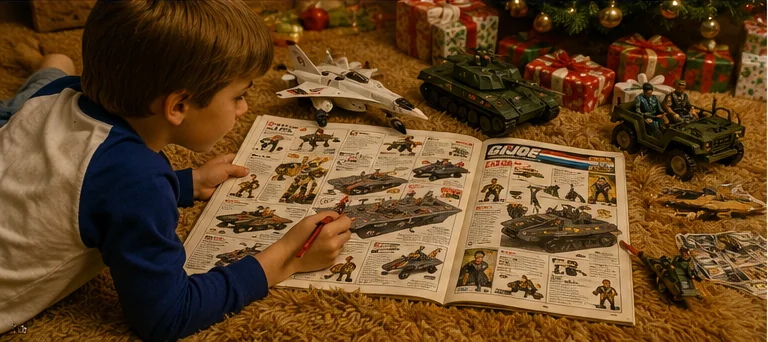
G.I. Joe was built for repeated gift-giving. The line offered small figures, accessory packs, medium vehicles, large vehicles, headquarters, and giant playsets. Families could find something at nearly every price level, which meant the brand could appear at birthdays, holidays, report-card rewards, and desperate store negotiations.
Carded figures filled the lower price tier
A figure could become a stocking stuffer, small gift, or add-on. The problem was choosing one from a roster where every specialty suddenly seemed essential.
Vehicles became the main-event gifts
A VAMP, H.I.S.S. tank, Dragonfly, Skystriker, Rattler, or Snow Cat delivered a larger box and an obvious expansion to the battlefield. The included driver made the gift feel complete.
Large playsets became Christmas morning landmarks
Headquarters, Terror Drome, Defiant, and USS Flagg boxes dominated photographs. Assembly delayed play. Stickers extended the process. Adults discovered the toy contained more pieces than expected.
Catalogs created impossible lists
A child could circle the entire page. Parents responded with budgeting, realism, and selective interpretation. The child responded by adding more stars beside the Flagg.
The brand grew through the top toys of 1983
The early line expanded with more characters, Cobra presence, vehicles, and stronger recognition. G.I. Joe was becoming more than a launch-year experiment.
By the top toys of 1984, the aisle was a war zone
Transformers arrived, He-Man was established, Cabbage Patch Kids remained powerful, and G.I. Joe answered with deeper rosters and vehicles. The line survived because it offered a different kind of world.
The top toys of 1985 included peak G.I. Joe ambition
The USS Flagg, new characters, major vehicles, and the full cartoon era made 1985 one of the brand’s defining years.
Five years from a small relaunch to an aircraft carrier that could block a doorway
G.I. Joe Toys by Year: The 1982–1986 Rise of A Real American Hero
The A Real American Hero system begins
The first 3.75-inch figures, early vehicles, Cobra enemy force, file cards, and Marvel comic establish the new world. The line is recognizable but still smaller than the giant operation it will become.
Swivel arms, more Cobra, stronger vehicles, and growing character identity
The figure engineering improves, the roster expands, and the brand begins to feel like a continuing universe rather than a single launch assortment.
Major characters and vehicles push the line toward the center of the decade
More recognizable Joes and Cobra figures appear, vehicles become increasingly ambitious, and animated promotion prepares the brand for daily television dominance.
The peak roster, the full cartoon era, and the USS Flagg
Snake Eyes, Flint, Lady Jaye, Shipwreck, Alpine, Airtight, Snow Serpents, Crimson Guards, Eels, major vehicles, and the giant aircraft carrier make the year feel like the brand’s full-scale invasion.
Terror Drome, Serpentor, Vipers, B.A.T.s, and larger science-fiction ideas
The top toys of 1986 came from a crowded market. G.I. Joe responded with a stronger Cobra army, major bases, new factions, and designs that moved further from realistic military equipment.
1982 built the bones
The original figures, file cards, vehicles, and comic established a system Hasbro could expand. The line did not need to introduce everything at once.
1983 improved the body and the enemy
Swivel-arm battle grip made posing better. Cobra became more than a commander and generic troops. The world gained depth.
1984 broadened the personality
Characters became visually louder, vehicles more memorable, and media support stronger. The line was now competing at the highest level of the toy aisle.
1985 became the memory year
For many Gen X kids, 1985 contains the definitive G.I. Joe experience: cartoon episodes, major characters, iconic vehicles, Christmas demand, and the Flagg fantasy.
1986 pushed toward spectacle
Serpentor, Battle Android Troopers, the Terror Drome, specialized Vipers, and bigger science-fiction ideas made Cobra more visually diverse and less tied to ordinary military realism.
The colors got louder, the specialties got stranger, and Cobra kept hiring
Late-80s G.I. Joe Toys: Tiger Force, Python Patrol, Battle Force 2000, and the Changing Line
G.I. Joe remained active after the mid-decade peak, but the market changed. Nintendo was absorbing more attention. The original cartoon era weakened. Hasbro responded with new sub-teams, repaints, futuristic equipment, larger specialty concepts, and increasingly colorful designs.
Tiger Force repainted familiar heroes for a new mission
Yellow-and-black camouflage gave existing figures and vehicles a unified sub-team identity. The colors were not subtle, but the team looked connected immediately.
Python Patrol gave Cobra its own repaint program
Gray, green, yellow, and red patterns transformed familiar Cobra troops and vehicles into a specialized unit. The line could reuse molds while giving collectors another formation to complete.
Battle Force 2000 leaned into the future
Advanced vehicles and technology moved the Joes toward science fiction. Individual machines could combine into a larger base concept, which sounded brilliant until the parts began migrating into different toy boxes.
Eco-Warriors and specialty themes reflected changing trends
Environmental threats, bright hazard colors, space concepts, ninjas, and futuristic armor pushed the brand into new territory. Some kids loved the variety. Others missed the greens, browns, and realistic vehicles.
The roster became enormous
Years of characters, versions, troops, vehicles, and sub-teams made the line difficult to summarize. That scale created collector depth but weakened the clean simplicity of the earliest Joe-versus-Cobra years.
Nintendo changed the competition
By the late 80s, action figures were competing with the video-game toys and systems changing the room. Nintendo could occupy an entire afternoon without requiring setup, cleanup, or a search for one missing rifle. G.I. Joe still offered imagination and physical play, but the center of kid culture was shifting.
Among the top toys of 1989, G.I. Joe was still standing, but the clean early-decade mix of military realism, file-card personality, and straightforward Joe-versus-Cobra conflict had become a much larger and stranger operation. The line had not forgotten how to be fun. It had simply accumulated a lot of departments.
By the Top Toys of 1989, the Original Formula Was Stretching
The top toys of 1988 reflected a market pulled between traditional action figures, louder electronic toys, and Nintendo. Tiger Force, Iron Grenadiers, and other specialized groups kept the G.I. Joe shelves busy even as the competition for a kid’s afternoon became less polite.
The Top Toys of 1988 Arrived in a Changing Toy Room
By the time the top toys of 1987 were filling catalogs, G.I. Joe had become less a single toy line than a supply chain. The Defiant space complex, new vehicles, specialized troops, and expanding factions showed how far the 1982 relaunch had traveled from its first compact roster.
The Top Toys of 1987 Showed G.I. Joe at Full Scale
The late years are now full of sleeper favorites
Figures that once felt like the line’s strange final stretch can become difficult to find complete. Bright accessories, fragile parts, exclusive sub-teams, and shorter windows of attention make some late releases surprisingly interesting.
The figure survived. The thumbs, crotch, rifle, backpack, hose, file card, and vehicle antenna negotiated separately.
Collecting Vintage G.I. Joe Toys and Action Figures Today
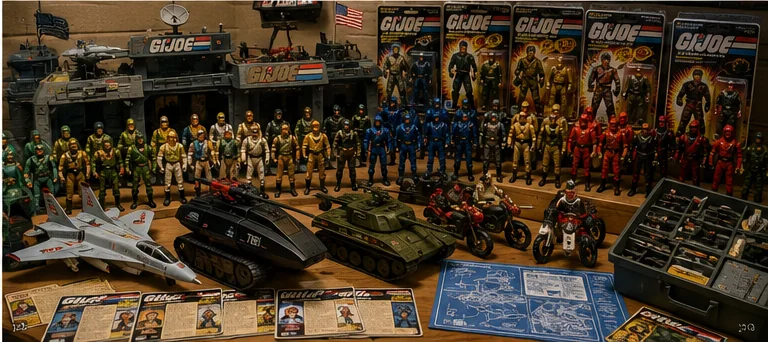
Collecting vintage G.I. Joe toys from the 80s depends on exact versions, completeness, condition, accessories, packaging, file cards, and vehicle parts. A familiar character name does not guarantee a high value, and one optimistic listing does not turn every childhood figure into a mortgage payment.
G.I. Joe Figure Versions and Years Matter
Straight-arm and swivel-arm releases differ. Paint changes matter. Different years may reuse the same character with new uniforms. A Snake Eyes figure from one wave is not interchangeable with every other Snake Eyes.
O-rings are replaceable, but originality still matters
A broken O-ring is common and repairable. Replacement screws and rings can restore function. The repair should be disclosed, but it does not carry the same concern as a glued torso or mismatched body parts.
Thumbs and crotches require inspection
Weapons stress hands. Hip movement stresses the waist piece. A figure can look complete in a photo while hiding cracks. Close inspection matters.
Original Weapons, Backpacks, and Accessories Drive Completeness
Backpacks, rifles, hoses, helmets, animals, stands, microphones, missiles, and small specialty pieces can be more difficult to find than the figure. The right tiny gray gun may cost more than a loose replacement body.
File cards and packaging add another level
An uncut cardback, clean file card, sealed bubble, or complete box changes the category. Vehicles with blueprints, unused decals, cardboard inserts, and driver figures are more complete historical objects.
Vehicles are parts inventories
Missiles, canopies, landing gear, antennas, steering wheels, guns, panels, hoses, clips, and small attachments can all be missing. A vehicle that looks 95 percent complete may contain the expensive five percent.
Large playsets require patience and floor space
A USS Flagg or Terror Drome purchase should include detailed photos, parts lists, condition notes, shipping plans, and a realistic answer to where it will go. Nostalgia does not increase square footage.
Sold prices are more useful than asking prices
Real research compares completed sales for the exact figure, version, condition, and accessories. The guide to valuable 80s G.I. Joe toys belongs to the value question; this history remains focused on why the line mattered.
Reproduction parts should be disclosed
Replacement weapons, decals, file cards, and custom parts can make a display complete, but they are not original. Collectors can choose restoration. They should not have restoration chosen secretly for them.
Play wear can be the point
A mint figure is beautiful. A worn figure with a repaired O-ring and one rubbed elbow may be the exact Joe a Gen X kid remembers holding. Condition and emotional value are not always the same measurement.
The line changed, disappeared, returned, and still reports for duty
Why G.I. Joe: A Real American Hero Still Defines 80s Action Figures
A Real American Hero remains powerful because the line created a complete play ecosystem. Figures, vehicles, file cards, comics, cartoons, commercials, playsets, and enemy forces all supported one another. A child could enter through any part and understand the larger war.
The figure design became a standard
Small scale, strong articulation, accessories, specialty uniforms, and vehicle compatibility created expectations other lines had to meet. The figures felt made to do things.
The character depth outlived the products
Snake Eyes, Storm Shadow, Scarlett, Stalker, Duke, Cobra Commander, Destro, the Baroness, Roadblock, Flint, and others survived because they had identities beyond color schemes.
The vehicles remain nearly unmatched
Few action lines offered the same range from motorcycles and jeeps to aircraft carriers and space systems. The ambition still looks absurd and admirable.
The file cards remain one of the best package features ever used
A few paragraphs turned plastic into personality. The cards encouraged reading, role play, collecting, and a sense that every figure belonged to a real organization.
The Joe-versus-Cobra conflict stayed clear
The heroes had jobs. The villains had plans. The symbols were readable. The conflict could support military realism, science fiction, ninjas, spies, adventure, and comedy without losing the central structure.
The brand became part of the larger 80s nostalgia landscape
Even people who did not own the Flagg remember the cartoon, the slogan, the figures, the Cobra logo, or the commercials. G.I. Joe occupied enough toy aisles, televisions, comics, and bedrooms to become shared cultural furniture.
The toys still reward actual play
A vintage Joe can bend, kneel, sit in a vehicle, hold gear, and join a mission. The design still communicates use. These were never only display pieces.
The line belongs among the decade’s giants
G.I. Joe belongs beside He-Man and Transformers on any list of the most iconic toys of the 80s because each line offered a different kind of world. He-Man made fantasy physical. Transformers made machines transform. G.I. Joe made teamwork, specialties, vehicles, and a cardboard personnel file feel like the most important things on Earth.
The questions that come up whenever an old footlocker or vehicle box gets opened
G.I. Joe Toys in the 80s FAQ
What year did G.I. Joe: A Real American Hero toys begin?
Hasbro launched the 3.75-inch G.I. Joe: A Real American Hero line in 1982. The first wave introduced the Joe team, Cobra enemies, vehicles, file cards, and the Marvel comic.
Why did G.I. Joe figures get smaller in the 80s?
The smaller scale reduced material costs and allowed Hasbro to create larger casts, vehicles, and playsets. The success of 3.75-inch Star Wars figures also showed that children would collect many small characters connected to a larger world.
How tall were the original 80s G.I. Joe action figures?
A Real American Hero figures were generally described as 3.75 inches tall, though exact height varied slightly by character and sculpt.
What is an O-ring G.I. Joe figure?
An O-ring figure uses a small rubber ring inside the torso to connect the upper body, waist, and hips. The design allows waist movement but the rubber can dry out and break over time.
What is swivel-arm battle grip?
Swivel-arm battle grip added rotation at the upper arms, allowing figures to hold rifles and equipment more naturally. It improved on the straight-arm construction of the earliest 1982 figures.
Who wrote the original G.I. Joe file cards?
Larry Hama wrote many of the early file cards while also writing the Marvel comic. The cards mixed military specialties, biographies, personality, humor, and character detail.
What was the biggest G.I. Joe toy of the 80s?
The USS Flagg aircraft carrier was the largest and most famous playset in the A Real American Hero line. Released in 1985, it measured roughly seven and a half feet long.
Did the USS Flagg come with a figure?
Yes. The USS Flagg included Admiral Keel-Haul, along with deck equipment, vehicles, accessories, and the large carrier structure.
What was the Cobra Terror Drome?
The Terror Drome was Cobra’s large circular headquarters playset. It included multiple stations, weapons, compartments, and a central launch system for the Firebat aircraft.
Why was Snake Eyes so popular?
Snake Eyes combined a mysterious all-black design, martial arts, military skill, silence, a hidden face, and a deep comic-book history with Storm Shadow, Scarlett, and Stalker. The figure looked secret before kids knew the story.
Was Storm Shadow originally a Cobra figure?
Storm Shadow first appeared in the toy line as a Cobra ninja, but his history and loyalties became more complicated in the comic. Later versions placed him on different sides.
What was the difference between the G.I. Joe comic and cartoon?
The Marvel comic was generally more grounded, character-driven, and willing to show lasting consequences. The Sunbow cartoon used brighter science-fiction plots, laser weapons, safer combat, distinct voices, and public-service endings.
What does “Knowing is half the battle” mean?
The phrase ended the cartoon’s public-service announcements. A Joe taught children a safety or life lesson, and the closing line reminded viewers that understanding a danger or problem was an important first step.
Are vintage G.I. Joe toys from the 80s valuable?
Some are valuable, but prices depend on the exact version, condition, accessories, file card, packaging, and current sold results. Complete vehicles and playsets can be valuable because so many small parts are commonly missing.
What breaks most often on vintage G.I. Joe figures?
Internal O-rings commonly fail. Thumbs, waist crotch pieces, elbows, knees, and small accessory connections can also crack or loosen.
Which 80s G.I. Joe vehicle is the most iconic?
The answer depends on the collector, but the H.I.S.S. tank, Skystriker, Dragonfly, VAMP, Rattler, Night Raven, and USS Flagg are among the most recognized.
Did G.I. Joe figures come with stands?
Most original A Real American Hero figures did not rely on display stands the way many modern collector figures do. They were designed to stand, sit in vehicles, kneel, and move through play environments.
What is the best vintage G.I. Joe figure to start collecting?
Start with a character you remember. A complete favorite with original accessories is usually more satisfying than chasing the most expensive rarity with no personal connection.
Who were the original 1982 G.I. Joe figures?
The original A Real American Hero team included Hawk, Stalker, Scarlett, Snake Eyes, Breaker, Rock ’n Roll, Grunt, Zap, Short-Fuze, Flash, Grand Slam, Steeler, and Clutch. Cobra Commander, Cobra officers, and Cobra soldiers established the enemy side.
Why are complete vintage G.I. Joe vehicles hard to find?
The vehicles came with missiles, antennas, canopies, guns, hoses, clips, steering wheels, panels, drivers, blueprints, and other small parts. The main vehicle often survived childhood while the exact pieces needed to complete it scattered across basements, toy boxes, yards, and several moves.