What Were the 6 Biggest Fads of 1985?
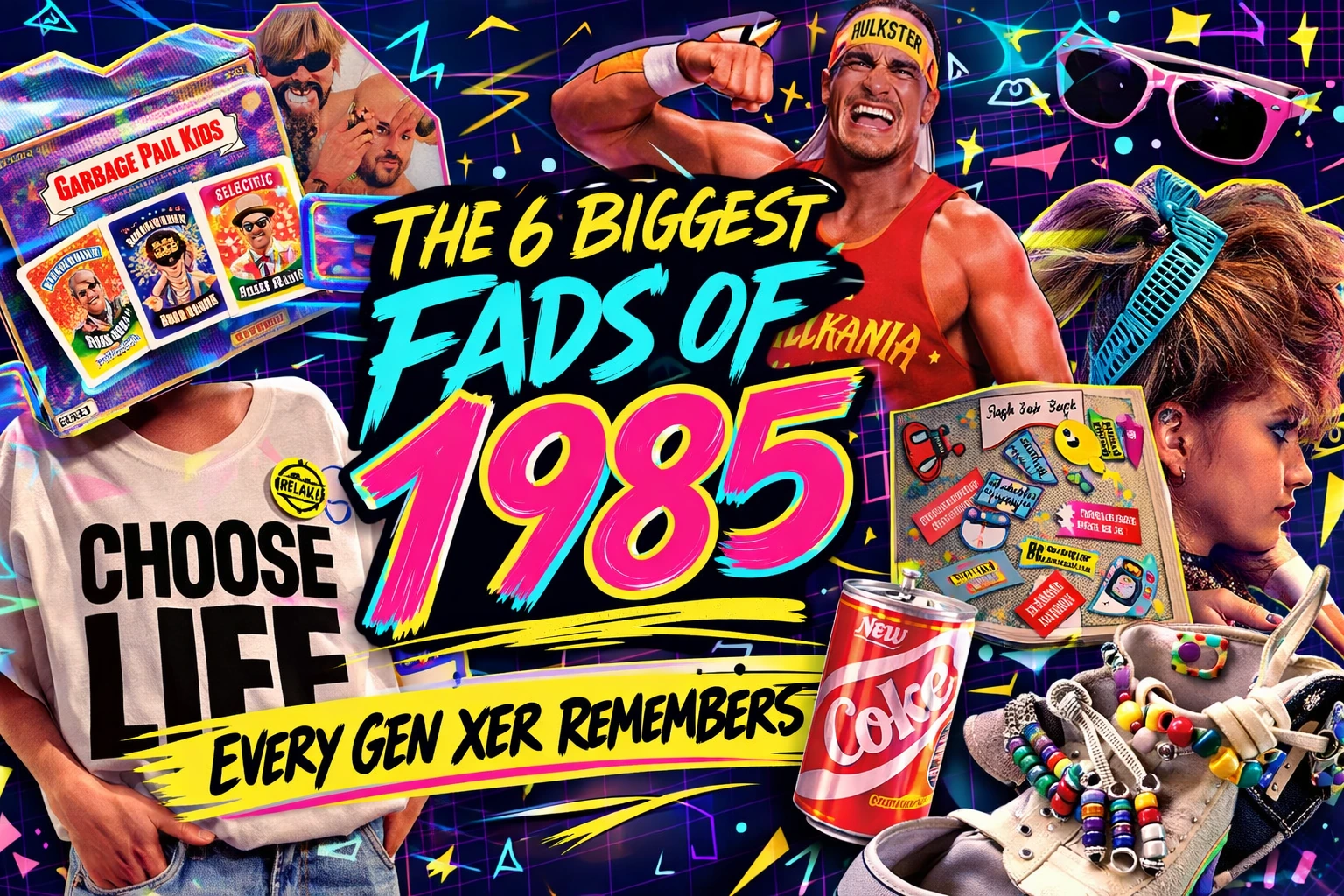
1985 was not a passive fad year. It expected participation. Kids traded gross-out cards, clipped beaded safety pins to their Keds, copied wrestlers, built their hair with tools and chemicals, and wore shirts large enough to carry the entire message by themselves.
Even the adults got pulled in. Coca-Cola changed its formula and somehow turned the soda aisle into a national argument. For a few months, everybody had an opinion about taste tests, corporate betrayal and whether the old Coke should be stored in the basement like emergency supplies.
Basically, 1985 gave Gen X a locker full of contraband, a wrestling voice and bangs with structural ambition.
The biggest trends became things people did.
That is the connecting thread. These fads created trades, rituals, arguments, poses, hairstyles, outfits and tiny social economies. They did not sit quietly on a shelf.
What Were the Six Biggest Fads of 1985?
The six biggest fads of 1985 were Garbage Pail Kids, Hulkamania, Choose Life and slogan-shirt fashion, friendship pins, banana clips with giant bows and Aqua Net bangs, and the New Coke craze. Together they capture the year’s mix of schoolyard collecting, wrestling catchphrases, MTV fashion, homemade accessories, high-maintenance hair and consumer-brand drama.
Why 1985 Was Such a Participatory Fad Year
The best 1985 fads came with instructions nobody had written down. Garbage Pail Kids were meant to be traded and compared. Friendship pins were made, exchanged and clipped somewhere visible. Hulkamania required an impression. Big hair required a morning production schedule. Slogan shirts worked only when the words could be read from the other side of the mall.
That made the year unusually social. The fad was not complete until other people had seen it, heard it, judged it or tried to trade for it. Even New Coke depended on participation. The entire country became a giant uncontrolled taste panel with no moderator and absolutely no indoor voice.
The school day gave every trend a stage
School concentrated all of it. Cards moved through desks. Pins appeared on shoes. Hair arrived pre-sprayed. Wrestling phrases traveled down hallways. The same slogan shirt could show up on three people before lunch and make all three believe the other two had copied them.
Adult disapproval made several fads stronger
Garbage Pail Kids became more interesting once schools confiscated them. Wrestling became more fun when adults complained it was too loud or ridiculous. Big hair survived because parents had already lost the argument by the time the bathroom door opened.
How Fads Spread in 1985 Before Social Media
Trends moved through overlapping physical networks. A shirt appeared in a video, reached the mall, showed up at school and became normal before most adults had learned what it meant. A card pack appeared at the corner store and could circulate through five owners before the final bell.
The process was slower than a modern feed, but it was harder to avoid. The evidence stood beside you in line, sat behind you in class and sprayed Aqua Net in the bathroom while you were still trying to brush your teeth.
How These 1985 Fads Were Ranked
The countdown weighs visibility, everyday participation, school-life presence, cultural reach and long-term Gen X memory. A trend ranks higher when it escaped advertising and became something ordinary people repeatedly did, wore, traded or quoted.
Garbage Pail Kids take the top spot because the fad lived inside everyday school culture. Hulkamania ranks second because it escaped wrestling and became a language, pose and costume. Slogan fashion, friendship pins and hair routines made the year visible, while New Coke turned an ordinary product decision into a temporary national obsession.
The Rest of 1985: Music, Movies, TV and Toys
The fad list was only one part of the year. Radio and MTV were packed with Madonna, Tears for Fears, Simple Minds, a-ha and Whitney Houston. Back to the Future, The Breakfast Club, Rocky IV and Rambo: First Blood Part II owned the multiplex, while the toy aisle looked like every Saturday-morning cartoon had been given shelf space.
Why These Six Belong on the 1985 List
A real fad has to escape the store shelf and move into regular life. It must show up in classrooms, bathrooms, living rooms, mall corridors and the things people repeat until everyone around them considers moving away.
Every item on this list did that. New Coke created arguments. Hair created routines. Friendship pins created tiny social signals. Slogan shirts turned clothing into public announcements. Hulkamania turned television viewers into performers. Garbage Pail Kids turned the school day into a trading economy.
That is what makes the list feel lived-in instead of merely famous. These were not six objects sitting beside each other in a display case. They changed what people did during an ordinary day in 1985.
What 1985 Looked Like From Inside the School Day
Somebody had Garbage Pail Kids hidden inside a notebook. Somebody else had friendship pins clipped along both shoes like a tiny beaded honor guard. The bathroom smelled like hairspray before homeroom. One kid said “brother” in every sentence. Another wore a giant slogan shirt and looked like the closing credits of a music video.
Then you went home and heard adults arguing about Coke. Not politics, not interest rates—Coke. The entire year seemed to have been designed by people who believed every product, hairstyle and television character deserved its own national conversation.
The 1985 Fad Countdown
- #6 New CokeA formula change turns the soda aisle into a national grievance department.
- #5 Banana Clips, Bows and Aqua NetThe bathroom counter becomes a beauty-construction site.
- #4 Friendship PinsBeaded safety pins become handmade social signals clipped to shoes and jackets.
- #3 Choose Life and Slogan FashionOversized shirts start announcing the wearer before the wearer speaks.
- #2 HulkamaniaWrestling catchphrases, poses and merchandise become a mainstream kid language.
- #1 Garbage Pail KidsGross-out sticker cards become trades, status, contraband and classroom chaos.
New Coke and the Cola Meltdown
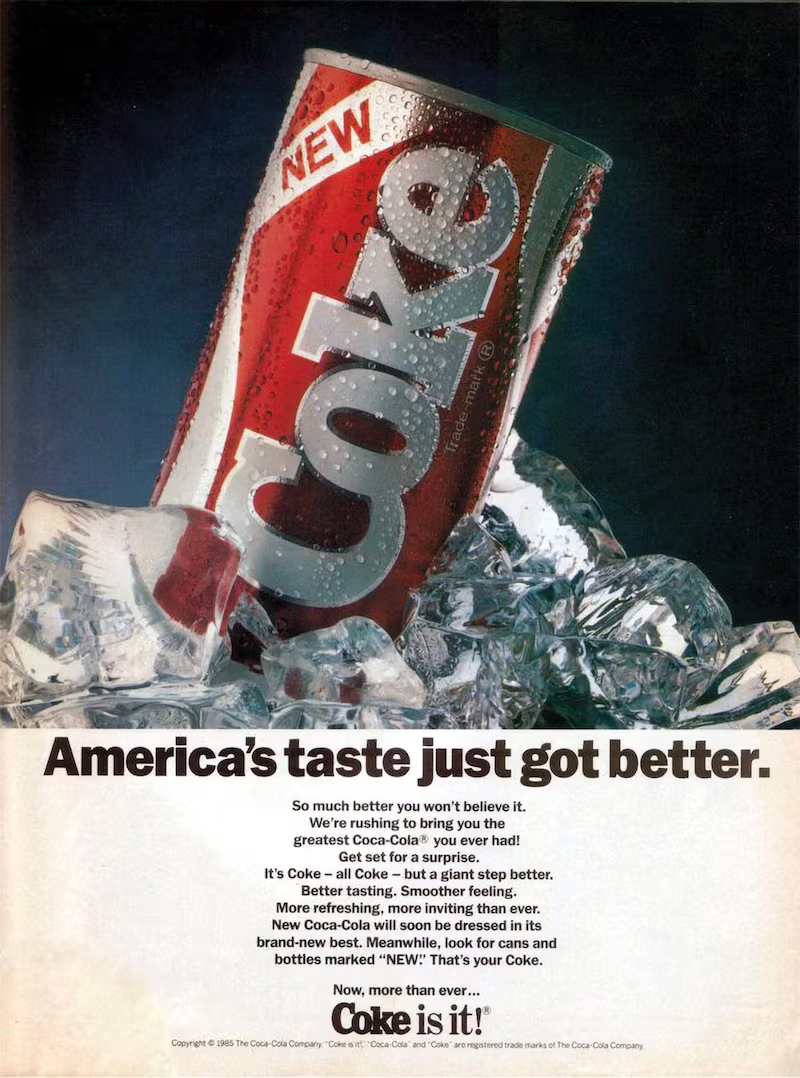
New Coke was the rare fad driven by outrage instead of affection. Coca-Cola introduced a sweeter formula and removed the familiar version, apparently assuming consumers would taste the improvement, nod politely and continue with their afternoon.
That is not what happened. People called, wrote letters, hoarded old stock and discussed cola with the gravity of a constitutional issue. Kids noticed because adults could not stop talking about it.
The Cola Wars had already trained everybody to think in sides. Pepsi ran taste tests. Coke sold history. When Coca-Cola replaced the original formula, the change felt larger than flavor. A familiar object had vanished from refrigerators, restaurants and vending machines because executives believed the data had found a better answer. Our complete history of New Coke in 1985 digs deeper into the formula change, Project Kansas, consumer backlash and Coca-Cola Classic comeback.
That made every can a test. People compared, judged and argued. Some genuinely liked the new formula. Others disliked the taste. Many were angrier that the old version had been removed. The reaction blurred together until New Coke became less a beverage than a summer-long cultural event.
Coca-Cola brought the original back as Coca-Cola Classic after 79 days, which gave consumers the rare feeling that a giant company had reversed course because the public had yelled loudly enough.
Why It Became a Fad, Not Just a Flop
New Coke created repeated participation: taste comparisons, conversations, jokes, hoarding and media coverage. The product failed, but the national argument behaved exactly like a short-lived craze.
What Gen X Saw
Adults suddenly cared deeply about soda branding. The grocery aisle became dramatic, and the return of Coca-Cola Classic was treated like somebody had restored a missing piece of the country.

Banana Clips, Giant Bows and Aqua Net Bangs
By 1985, hair was no longer something you simply had. It was something you built. You clipped it, teased it, lifted it, sprayed it and then hoped the finished structure survived the bus ride.
Banana clips pulled the hair upward, giant bows added scale and Aqua Net handled the load-bearing work. The final result looked effortless only to people who had never watched it happen.
The morning routine had choreography. A banana clip needed to close without grabbing the scalp. Bangs had to be teased high enough to announce the decade but not so high they collapsed before lunch. Hairspray was applied with the confidence of an industrial sealant.
Music videos and mall salons gave the look constant reinforcement. Big hair photographed well, moved dramatically and matched the oversized clothing around it. The decade did not reward subtle effort. It rewarded effort that could be recognized from across a hallway.
The accessories also made the fad accessible. A full salon transformation cost money. A clip, bow and can of spray could create a version at home, usually while someone else pounded on the bathroom door.
The 1985 Hair Tool Kit
Teasing comb, banana clip, giant bow, curling iron and enough Aqua Net to make the mirror permanently tacky.
What the Photos Preserved
School portraits captured the height, shape and commitment forever. The hairstyle may have lasted a semester; the yearbook evidence remains under family custody.
Friendship Pins
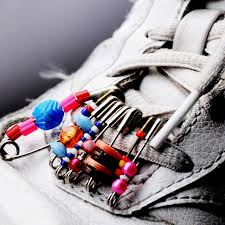
Friendship pins were a perfect school fad because they made something tiny feel important. A few beads on a safety pin could become a gift, a trade, a color-coded statement or a small object carrying far more emotional weight than the materials justified.
They appeared on shoelaces, jackets, bags and anywhere else a pin could attach without an adult asking too many questions.
The homemade nature of the fad mattered. Kids could build them at a kitchen table or sleepover, choose the colors and decide who received one. That gave friendship pins a personal layer mass-produced accessories could not match.
They also created visible social coding. A shoe covered in pins suggested friends, effort and participation. A new pin could be noticed immediately. A missing one could start questions no adult wanted to mediate.
Like many great school fads, friendship pins were cheap, portable and easy to copy. The barrier to entry was low, but the possibility of turning a tiny object into a major event remained extremely high.
The Sleepover Production Line
Safety pins, plastic beads and several people making color decisions with the intensity of a diplomatic summit.
Why the Shoes Mattered
Keds and similar sneakers placed the pins at eye level whenever people sat on floors, bleachers or classroom desks. The accessory became part decoration and part public record.
Choose Life and Slogan-Shirt Fashion
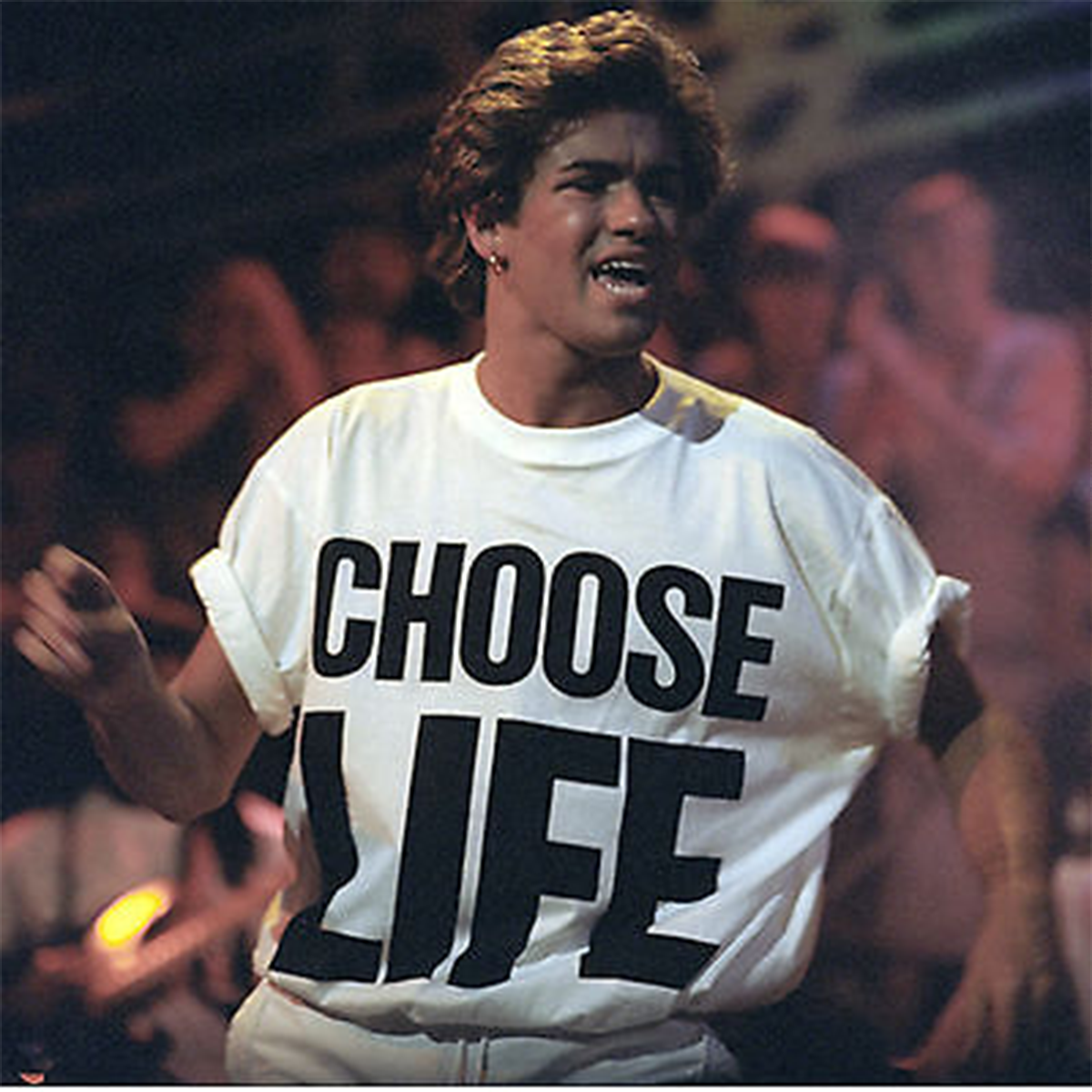
Mid-80s clothing was not satisfied with looking bright. It wanted to communicate. The oversized Choose Life shirt became one of the clearest pop-fashion images of the era, helped by music-video visibility and the decade’s complete lack of interest in small type.
The silhouette was loose, the lettering was huge and the message could be read before anybody had decided whether they wanted a conversation.
Slogan fashion fit MTV perfectly. A video image had only seconds to register, and large text worked immediately. The shirt became both costume and graphic design, which made it easy to remember and easy for retailers to imitate.
The wider fad included bold words, oversized tops and clothing that treated the chest like advertising space. It matched a decade already comfortable with logos, catchphrases and brands behaving like personality types.
For Gen X, the look also offered an easy shortcut to attitude. You did not need to explain the outfit. The outfit had already prepared a statement large enough for television.
Why MTV Loved It
Giant lettering stayed readable through quick cuts, small television screens and VHS copies recorded from another room.
The Shirt Did the Talking
The wearer could project confidence, humor or pop awareness without changing facial expression or interrupting the song.
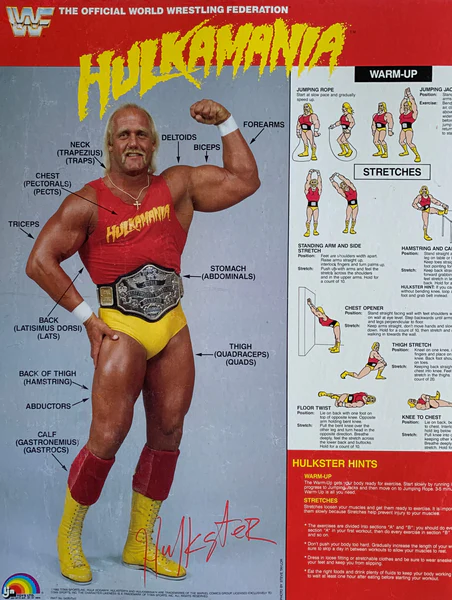
Hulkamania
Hulk Hogan was less a wrestler than a human exclamation point. The bandana, mustache, flexing, shirt ripping, finger pointing and giant voice made Hulkamania almost impossible for kids not to imitate.
By 1985, wrestling had become loud mainstream entertainment, and Hulk Hogan gave the entire phenomenon a recognizable face, color scheme and vocabulary.
The easiest part to copy was the language. “Brother” entered sentences where it had no business. Kids pointed, flexed and warned each other about prayers and vitamins. Couch cushions became ring ropes, and household furniture entered an era of unnecessary risk.
Hulkamania spread because it offered a complete role. You could wear the colors, repeat the lines, perform the poses and believe that enthusiasm alone could make your arms look larger.
Merchandise reinforced everything. Shirts, figures, posters and televised events meant the fad appeared in bedrooms, toy aisles and playground conversations long after the match had ended.
The Kid Version
A terrible voice impression, one flex in front of the mirror and an imaginary shirt rip performed on clothing a parent had specifically asked you not to stretch.
Why It Spread So Easily
The colors were bold, the phrases were short and the poses required no equipment beyond confidence and nearby witnesses.
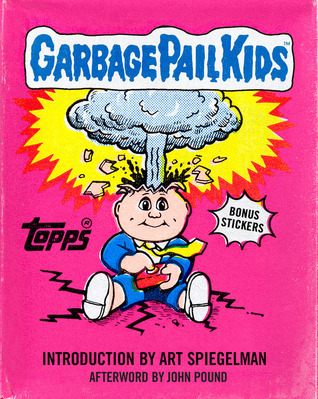
Garbage Pail Kids
Nothing on this list feels more specifically like an ordinary 1985 school day. Garbage Pail Kids were gross, funny, portable, tradeable and disliked by adults with exactly the right intensity to make children believe they had discovered forbidden art.
The cards lived in pockets, desks, pencil boxes and secret stacks. They were not merely owned. They circulated.
Cheap wax packs made participation easy. The artwork was detailed enough to study, the pun names were easy to remember and the A/B name system gave kids more cards to chase even when the illustration looked familiar. Our complete history of Garbage Pail Kids in the 1980s digs deeper into the original 1985 series, wax packs, school bans, lawsuit, cartoon, movie and collector legacy.
Trading turned the product into a social system. Duplicates had value. Popular characters carried status. A card somebody else wanted could change hands several times before the bell. The negotiations were completely unregulated and therefore excellent preparation for adulthood.
School bans strengthened the fad. Once teachers confiscated the cards, they became evidence that the adult world did not understand something children considered important. That is premium childhood marketing.
Why the Classroom Mattered
School provided the audience, the trading market, the gossip network and the authority figure likely to remove supply.
Why the Cards Outlived the Craze
The artwork, names and first-series characters remained memorable enough to support revivals, collectors and adult nostalgia decades later.
What Happened to the Biggest Fads of 1985?
Several of these fads never truly vanished. Slogan shirts became normal clothing. Collectible cards became a major adult hobby. Wrestling remained mainstream entertainment. Even friendship pins live on whenever handmade accessories return.
New Coke had the strangest afterlife because the failure became more valuable than the product. Garbage Pail Kids had the strongest revival because the artwork and collecting system still function after the original schoolyard chaos disappeared.
The Final Verdict on the Biggest Fads of 1985
1985 was built from small performances. Kids traded cards, clipped pins to shoes, sprayed hair into place, copied wrestlers and let oversized shirts speak for them. Adults joined the show by turning a cola formula into a national argument.
Garbage Pail Kids win because they touched the most parts of ordinary school life. Hulkamania follows because the fad became a language and personality. Slogan fashion, friendship pins and hair routines made the year instantly visible, while New Coke gave 1985 its strangest corporate subplot.
Together, the six trends explain why the year remains so easy to recognize. You do not need a calendar. Show a stack of Garbage Pail Kids beside a yellow wrestling shirt, giant bangs and a New Coke can, and the decade identifies itself.
Keep Exploring the Biggest 1985 Stories
The two largest product-driven fads on this list have full standalone histories, while the same-year pages rebuild the music, television, movie and toy world surrounding them.
Questions About the Biggest Fads of 1985
What were the biggest fads of 1985?
The six biggest fads were Garbage Pail Kids, Hulkamania, Choose Life and slogan-shirt fashion, friendship pins, banana clips with giant bows and Aqua Net bangs, and the New Coke craze.
What was the number-one fad of 1985?
Garbage Pail Kids rank first because the cards became part of everyday school culture through collecting, trading, classroom bans, gross-out humor and social status.
Why are Garbage Pail Kids ranked above Hulkamania?
Hulkamania was enormous, but Garbage Pail Kids lived more directly inside the school day. The cards were carried, traded, argued over and confiscated during ordinary daily life.
Was New Coke really a fad?
It behaved like one. People tasted it, compared it, complained, hoarded old Coke and followed the reversal as a national pop-culture event. The craze was brief but unusually intense.
What hair trends were popular in 1985?
Banana clips, oversized bows, teased bangs, high-volume styles and heavy hairspray use were among the most recognizable hair trends of the year.
What were friendship pins?
Friendship pins were safety pins decorated with colored beads and commonly clipped to sneaker laces, jackets or bags. Kids made, traded and gave them to friends.
Why was the Choose Life shirt popular?
The oversized slogan shirt became a memorable pop-fashion image through music-video visibility. Its bold lettering matched the mid-80s preference for clothing that made an immediate visual statement.
How big was Hulkamania in 1985?
Hulkamania crossed wrestling, television, toys, clothing and everyday speech. Kids copied Hulk Hogan’s catchphrases, voice, poses and shirt-ripping performance.
How did fads spread in 1985?
They spread through MTV, television commercials, wrestling broadcasts, school hallways, malls, magazines, older siblings and direct word of mouth.
Which 1985 fad had the longest legacy?
Garbage Pail Kids and Hulkamania produced the strongest named legacies, while slogan shirts and collectible-card culture became lasting parts of fashion and entertainment.
Were Garbage Pail Kids banned in schools?
Many schools and teachers prohibited or confiscated the cards because they distracted students, encouraged trading and featured gross-out imagery adults considered inappropriate.
What else defined pop culture in 1985?
MTV pop, soundtrack hits, Back to the Future, The Breakfast Club, Rocky IV, network television and major cartoon-driven toy lines all helped define the year around these fads.