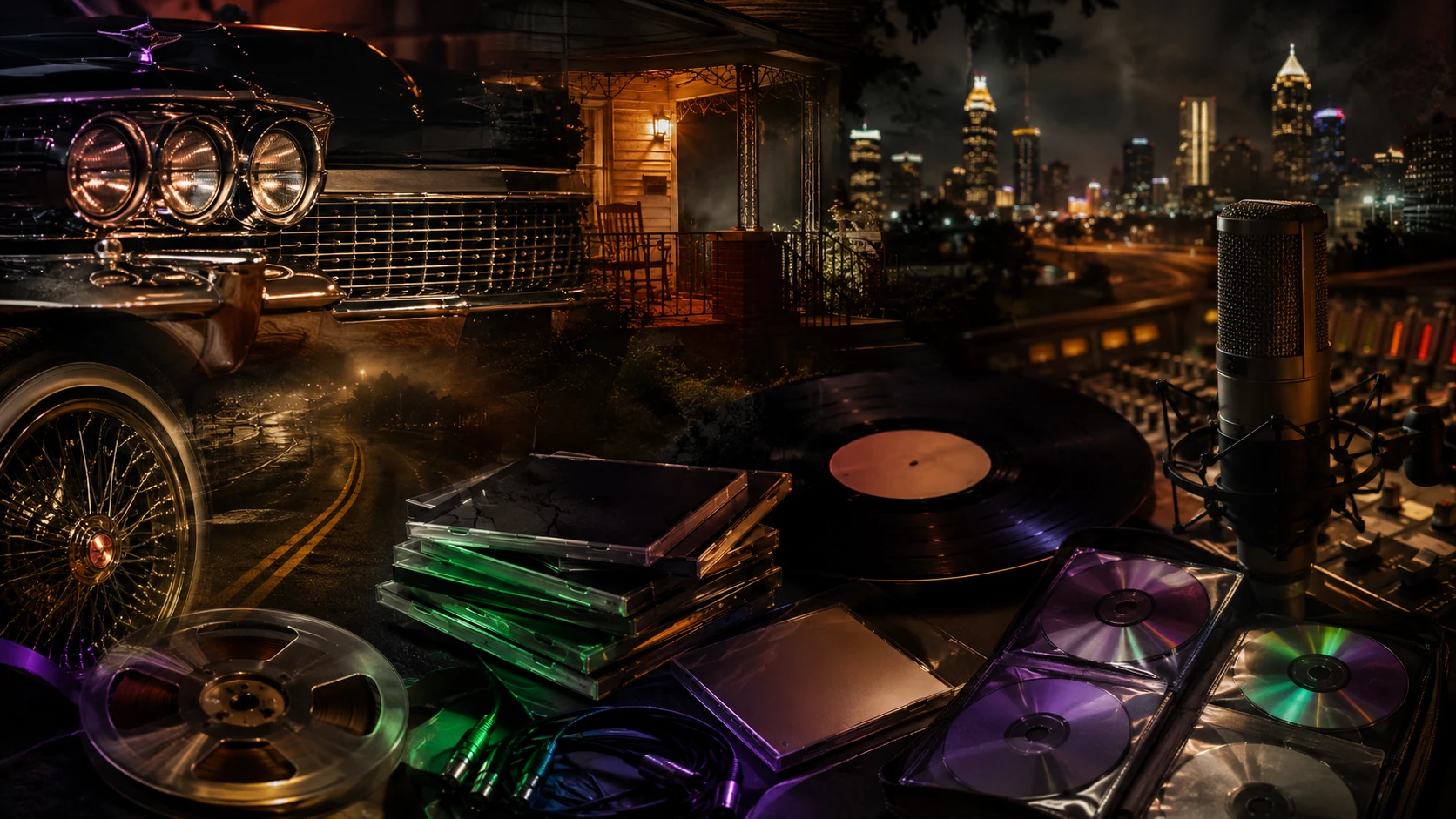
Outkast and the Rise of Southern Hip-Hop
Outkast did not ask the rap industry for permission to matter. Big Boi, André 3000, Organized Noize, Dungeon Family, Atlanta bass, Cadillac funk, cosmic weirdness, and three monster 90s albums helped make Southern hip-hop impossible to dismiss. The South was not late to hip-hop. The rest of the country was late to listening.
Outkast mattered because they helped turn Atlanta into one of 90s rap’s most creative centers and made Southern hip-hop in the 90s harder for the national industry to ignore. They did not invent Southern rap, and they were not the only Southern artists doing important work, but their 90s run — Southernplayalisticadillacmuzik, ATLiens, and Aquemini — proved the South could be lyrical, funky, experimental, deeply local, wildly imaginative, and commercially powerful without copying New York or Los Angeles. Big Boi brought technical control, grounded cool, and player precision. André 3000 brought vulnerability, restless imagination, and cosmic left turns. Organized Noize and Dungeon Family gave them a whole Atlanta universe to move through.
Outkast Did Not Invent Southern Rap. They Made Ignoring It Look Ridiculous.
The easiest way to misunderstand Outkast is to act like Southern hip-hop was sitting around in silence until two teenagers from Atlanta showed up with Cadillacs, metaphors, and a suspicious amount of future in their pockets. That version is clean, dramatic, and wrong enough to deserve its own parental advisory sticker.
The South had already been building. Houston had Scarface, Geto Boys, Rap-A-Lot, UGK down the road in Port Arthur, and a heavy street-reporting tradition that rubbed shoulders with the bigger national conversation around Gangsta Rap in the 90s. Miami bass had already turned low-end pressure into a lifestyle. Memphis was making dark underground tapes that would echo for decades. New Orleans was about to prove that independent labels could move like armored trucks. The larger story is all over Southern Hip-Hop in the 90s, because the South was never one sound, one city, or one convenient footnote.
Outkast’s role was different. They gave Atlanta a voice that national listeners could not easily box up and dismiss. They were lyrical but not East Coast cosplay. Funky but not West Coast imitation. Southern but not simplified. Experimental but not allergic to hooks. Funny but not novelty. Weird but not “guy at the party explaining his dream journal” weird. The records worked.
That last part matters. A lot of artists get praised later for being ahead of their time, which sometimes means they made music that was interesting on paper and exhausting on speakers. Outkast were ahead of their time and still had songs. Hooks. Bass. Verses. Characters. Jokes. Car-test moments. Lines you remembered after one listen. They were not asking listeners to eat their vegetables. They were handing over a full plate and somehow the vegetables had low-end.
The 90s rap conversation had a bad habit of sorting greatness by geography. New York had the borough mythology and the lyrical gatekeeping that powered East Coast Hip-Hop in the 90s. Los Angeles had G-Funk, Death Row, lowriders, and sunny menace, which you can hear all over West Coast Hip-Hop in the 90s and G-Funk and the 90s West Coast Sound. Both scenes mattered. Both changed the decade. But the map was always bigger than the magazines made it look.
Outkast helped make that painfully obvious. They arrived inside a decade where hip-hop was becoming bigger, richer, more visual, more regional, more commercial, and more contested. MTV mattered. Radio mattered. CD booklets mattered. Magazine covers mattered. The Source mattered. Mall record stores mattered. Car stereos mattered. So did the feeling of hearing something from somewhere else and realizing your old map was garbage.
They also landed after the early-90s foundation had already been stretched by the jazzy, political, and crate-digging energy of Golden Age Hip-Hop in the Early 90s. Outkast inherited that idea that rap could be smart, funny, musical, and deeply specific — then ran it through Atlanta heat, Southern bass, Dungeon Family weirdness, and Cadillac chrome.
Outkast did that to people. They made listeners recalibrate. Atlanta was not a side road. Atlanta was a destination. Southern drawl was not a weakness. It was rhythm. Organized Noize warmth was not soft. It was world-building. Big Boi was not the “regular” one. André 3000 was not the “random” one. Together, they made one of the most important three-album runs of the 90s.
That is why Outkast sits so high in the larger 90s Hip-Hop and Rap story. They were not just a great Southern group. They were one of the decade’s great acts, period. By the end of the 90s, anyone still pretending Southern rap was background noise had either stopped listening or started lying.
Before Atlanta Became Rap’s Capital, Outkast Made It Feel Like a Whole World
Atlanta was not yet the default center of rap gravity. Outkast helped make the city feel cinematic, funky, strange, stylish, local, and impossible to shrug off.
The City Was Already Talking
Outkast made Atlanta sound lived-in: porch lights, car systems, studio rooms, humid nights, slang, humor, pride, and bass in the trunk.
Atlanta in the early 90s was not yet the rap capital later generations would treat like it had always owned the deed. It was a city with deep Black cultural history, college energy, club life, regional radio, car culture, fashion, church echoes, porch talk, and a creative scene learning how much power it had.
The national rap conversation, though, still loved its coastal tunnel vision. New York had the borough mythology, the lyricist pressure, the mixtapes, the grimy videos, and the “real hip-hop” gatekeepers standing outside the club like they personally invented drums. Los Angeles had G-Funk, gangsta rap, lowriders, Death Row, Snoop, Dre, 2Pac, and enough smoke-filled imagery to make every music video look like it needed ventilation. Those scenes mattered, obviously. The problem was pretending they were the whole map.
Atlanta had to fight through a different kind of dismissal. The drawl got underestimated. The slang got treated like a novelty. The bass got misread as simplicity. The Southern sense of humor got mistaken for unseriousness by people whose entire worldview apparently depended on whether a rapper sounded cold enough.
Outkast did not solve that by sanding down Atlanta. They did the opposite. They made Atlanta the point. The drawl was part of the rhythm. The Cadillac imagery was part of the geography. The jokes were part of the intelligence. The funk was not decoration. It was oxygen.
That is why the early records hit differently. Outkast did not sound like they were visiting Atlanta for a photo shoot. They sounded like they came from a city with its own weather system. You heard the neighborhood, the car, the studio, the family pressure, the jokes, the heat, the ambition, and the confidence of people who knew they belonged even if the industry still needed a map.
Atlanta also gave Outkast something that separated them from a lot of 90s rap acts: a sense of local culture that could stretch without snapping. They could rap about cars and girls and weed and ambition, then pivot into alienation, spirituality, paranoia, politics, regret, or cosmic imagery without sounding like a different group had walked into the booth. The city held the contradictions together.
That mattered because the South was often treated like it needed to prove it could be “serious.” Outkast refused the whole assignment. They were serious and funny. Stylish and reflective. Street-level and surreal. Commercial enough to move units, but too odd to feel like product. Atlanta gave them a language where all of that could exist.
Atlanta’s rise also shows why regional posts matter so much in the 90s rap story. You cannot understand Outkast by only comparing them to New York or Los Angeles. You need the wider Southern map, the radio environment, the local studio culture, and the way 90s Rap Radio Crossover slowly made room for records that did not sound like the old coastal templates.
When you listen back now, it is obvious that Atlanta’s later dominance did not come from nowhere. The infrastructure, taste, producers, clubs, radio, labels, and creative circles were already forming. Outkast became one of the loudest proof points. Not the only engine, but one of the ones that made the whole country feel the road vibrating.
The coastal bias was real
A lot of 90s rap coverage acted like the story had two main addresses: New York and Los Angeles. Outkast helped force Atlanta into that conversation without trying to sound like either one.
The local identity was the weapon
Outkast did not hide the accent, the slang, the cars, the funk, or the Southern weirdness. They turned those things into the reason the music worked.
Organized Noize Did Not Just Make Beats. They Built the Weather.
Rico Wade, Ray Murray, and Sleepy Brown gave Outkast a warm, funky, soulful, bass-heavy universe that felt handmade, humid, and alive.
Funk in the Floorboards
Organized Noize made production feel like place: bass, soul, live instrumentation, smoke, warmth, and Atlanta atmosphere.
Outkast’s story does not work without Organized Noize. Rico Wade, Ray Murray, and Sleepy Brown did not simply hand Big Boi and André 3000 some beats and call it a day. They built a sound-world. Their production had funk, soul, bass, live instrumentation, gospel undertones, warm keyboards, low-end movement, and that basement-studio magic that makes a record feel touched by actual humans instead of assembled in a fluorescent conference room.
A lot of 90s rap production was built around loops that hit hard and stayed out of the way. Organized Noize could do hard, but they also made songs feel like rooms. Their tracks had temperature. They had wood grain. They had humidity. They had that feeling of a lamp glowing in a basement while somebody rewinds a tape for the fourth time because the hook finally landed.
That mattered because Outkast needed music flexible enough to hold contradiction. The records had to carry player talk, street detail, jokes, cosmic imagery, young-man anxiety, political flashes, and spiritual weight. A flat beat would have made that feel crowded. Organized Noize gave the songs space to stretch.
Their sound was Southern without being predictable. It pulled from funk and soul, but it was not nostalgia cosplay. It carried church and family echoes without turning every song into a sermon. It had live-feeling looseness without losing the drum pressure. It could make a song feel like a porch, a car, a basement, a block, and a spaceship before the second hook.
Organized Noize also understood the emotional temperature of Outkast. Big Boi and André were young, but the music around them did not treat them like novelty teens. The production made room for confidence and doubt. It let the verses be stylish without floating away. It gave the hooks enough soul to feel communal. It made the weird stuff feel grounded and the grounded stuff feel larger than life.
They also helped make Outkast and Goodie Mob feel connected without sounding identical. Outkast could be funky, stylish, slippery, surreal, and melodic. Goodie Mob could be heavier, more political, more rooted in community pressure and Southern Black consciousness, which is why Outkast can sit near Conscious Rap in the 90s without ever sounding like they were trying to wear a backpack just to prove a point.
That distinction matters because a lot of scenes get flattened in hindsight. People look back and act like everyone from the same city had one sound. Atlanta did not. Organized Noize gave the city a foundation broad enough to support multiple identities. Outkast and Goodie Mob both carried that DNA, but they expressed it differently.
For Outkast, that meant the production was never just background. It was part of the argument. The sound said Atlanta had its own musical memory, its own rhythm, its own way of riding bass and melody, and its own way of turning local life into something strange enough to feel universal. It also gave them a path into the stranger side of the decade that connects naturally with Alternative Hip-Hop in the 90s, even though Outkast were too Southern, too funky, and too slippery to be trapped in one label.
The groove had roots
Organized Noize production pulled from funk and soul in a way that felt lived-in, not pasted on like retro wallpaper.
The trunk mattered
Outkast records were headphone records, sure, but they were also car records. The low end was part of the architecture.
The room had a smell
The best Organized Noize tracks feel warm, smoky, human, and specific. They do not sound like generic rap templates.
Dungeon Family Was a Creative Ecosystem, Not a Logo on a Flyer
Outkast, Goodie Mob, Organized Noize, and the larger Dungeon Family circle made Atlanta feel like a shared creative world instead of one lucky breakout story.
The Room Had Range
The Dungeon gave Atlanta rap a place to get funky, political, strange, soulful, hilarious, paranoid, and brilliant without asking anyone to pick one lane.
Dungeon Family mattered because it was bigger than one group. It was a creative environment where Outkast, Goodie Mob, Organized Noize, and a larger Atlanta circle pushed each other into stranger, deeper, better music. The name gets thrown around now like a neat historical label, but the power was in how messy and alive it felt.
The Dungeon was not some corporate studio with a catered lunch and a mission statement. It was basement energy. Couches, cables, notebooks, smoke, snacks, voices, arguments, jokes, ideas, pressure, and music that sounded like it came from people breathing the same air. That environment gave Outkast a context. They were not floating alone. They came from a room.
That matters because Outkast’s records often feel populated even when Big Boi and André are the focus. There is a sense of community in the margins: voices, hooks, production choices, humor, warmth, background energy, and the feeling that the music came from a house where ideas were bouncing off the walls.
Goodie Mob’s presence matters here. While Outkast often pushed Atlanta toward funk, surrealism, style, and cosmic expansion, Goodie Mob brought a heavier social and spiritual charge. Soul Food made “Dirty South” feel like a declaration, not a punchline. It carried community memory, political frustration, family pressure, hunger, faith, and critique.
That wider Dungeon Family atmosphere is why Outkast fits naturally beside Conscious Rap in the 90s and Alternative Hip-Hop in the 90s. They were not exactly either thing, but they borrowed energy from both lanes. They could make you think, laugh, dance, squint, and wonder if your CD player had accidentally picked up a transmission from 2007.
Dungeon Family also gave Outkast permission to be broad. They did not have to pick between player talk and spiritual anxiety, humor and critique, hood detail and cosmic metaphor. The family around them was already making music that stretched. That makes a difference. Creative freedom is easier when the room does not flinch every time someone has a weird idea.
The group dynamic also places Outkast right in the middle of the broader 90s fascination with crews, collectives, and duos. If you zoom out from Atlanta, the decade is full of chemistry experiments: Wu-Tang, A Tribe Called Quest, Fugees, Bone Thugs, Cypress Hill, and plenty more. That is why 90s Hip-Hop Groups That Changed Everything and 90s Rap Duos and Groups are natural next stops after this one.
It also made Atlanta feel like more than a location. It felt like a creative weather system. Organized Noize gave the atmosphere. Outkast gave the flash. Goodie Mob gave the gravity. Together, they made Atlanta’s 90s rap rise feel like something organic instead of an industry stunt.
The Contrast Was the Engine
Big Boi was not “the normal one,” and André 3000 was not just “the weird one.” That take is lazy enough to need a nap.
Grounded Cool Met Cosmic Nerve
Big Boi and André 3000 worked because they did not chase the same kind of greatness. The friction made the music move.
The laziest Outkast take is that Big Boi was “the normal one” and André 3000 was “the weird one.” Please place that opinion next to the broken MiniDisc player and back away slowly.
Big Boi was a ridiculous technician. He had pocket, swing, breath control, humor, detail, speed, and style. His verses could be fast without sounding cluttered, slick without sounding soft, and cool without becoming background furniture. He made hard rapping sound casual, which is exactly how people end up underrating it. When someone makes something difficult look effortless, casual listeners assume it was effortless. It was not.
Big Boi also gave Outkast a grounded center. He brought player confidence, Atlanta detail, rhythmic precision, and a sense of cool that did not need to announce itself every four seconds. He could carry a verse like he was leaning against the car, but the mechanics underneath were elite.
Listen to how Big Boi moves through the first three albums and you hear an MC who keeps tightening the screws. On the debut, he sounds young but already sharp, with a voice built for Cadillac speakers and lines that move with clean, controlled force. On ATLiens, he gets colder and more precise, matching the album’s spacey mood without losing his street-level grounding. By Aquemini, he is fully locked in — funny, technical, stylish, and often doing more inside a verse than people notice because the delivery feels so smooth.
André 3000 moved differently. His imagination kept mutating. He could be funny, wounded, paranoid, romantic, philosophical, absurd, vulnerable, and sharp in the same song. His weirdness worked because it had feeling underneath it. He was not just wearing strange clothes or reaching for odd images because “quirky” looked good in a press photo. He was exposing a restless mind trying to make sense of fame, identity, love, fear, spirituality, and being treated like an outsider even while becoming essential.
André’s evolution across the 90s is one of the reasons Outkast’s run feels so alive. On the debut, he is still tied to the player framework, but you can already hear the edges bending. On ATLiens, the alienation becomes central. He sounds like success has made him more aware of distance, pressure, and the strange feeling of being watched. By Aquemini, he is writing with a broader emotional range: funny, direct, romantic, critical, wounded, cosmic, and human.
Together, they created motion. Big Boi could anchor the song without flattening it. André could send it into orbit without losing the groove. One kept a hand on the wheel. The other kept asking why the car could not fly. Somehow the Cadillac stayed on the road.
The contrast also protected Outkast from becoming predictable. If a song leaned too grounded, André could tilt the ceiling. If a song drifted too far into orbit, Big Boi could bring the tires back to pavement. That push-pull is why the records have such replay value. You are not just hearing two rappers take turns. You are hearing two worldviews negotiate in real time.
The chemistry also helps explain why Outkast could stand beside the decade’s other iconic group energies without sounding like anyone else. They had the creative nerve that makes A Tribe Called Quest and 90s Jazz Rap feel so warm and strange, but Outkast filtered that kind of looseness through Southern bass, funk, and a completely different sense of place.
That is why Outkast belongs in any serious conversation about 90s Hip-Hop Groups That Changed Everything and 90s Rap Duos and Groups. Their chemistry was not based on sameness. It was based on contrast, tension, trust, and the shared confidence to let each other be different.
Big Boi
Grounded, technical, stylish, sharp, and wildly underrated by anyone who thinks calm delivery means simple writing. Big Boi gave Outkast control, swing, precision, and player confidence.
He was not the “safe” half. He was the engine room. His best verses are packed with internal rhythm, quick turns, humor, and low-key complexity that never begs for applause.
André 3000
Restless, vulnerable, funny, strange, emotional, and fearless enough to keep pushing the music into places nobody else was mapping. André made imagination feel personal.
His weirdness landed because it was tied to songs, feelings, and questions. It was not empty eccentricity. It was an artist refusing to shrink himself into one version.
Southernplayalisticadillacmuzik Put Atlanta in the Driveway With the Trunk Open
The 1994 debut introduced Outkast as young, Southern, funky, stylish, funny, and fully aware that the rest of the country needed to catch up.
The Debut Had a Whole Address
Southernplayalisticadillacmuzik made Atlanta sound like cars, corners, bass, humor, smoke, ambition, and teenage confidence stretching into history.
Released in 1994, Southernplayalisticadillacmuzik introduced Outkast with a title so gloriously long it looked like it might need its own parking space. It was Southern, funny, stylish, proud, and completely uninterested in making itself smaller for people who needed every regional identity translated into coastal approval.
The title alone was a statement. It was not neat. It was not industry-friendly. It was not trying to fit cleanly on a tiny CD spine. It mashed together Southern identity, player culture, Cadillac imagery, and music into one ridiculous, beautiful word avalanche. That title told you the album would not be shrinking itself for anyone.
“Player’s Ball” was the first major doorway. It had holiday-season roots, but it did not feel like a novelty record. It felt smooth, confident, and already lived-in. Big Boi and André sounded young, but not unsure. That is a huge difference. A lot of debut acts sound like they are auditioning. Outkast sounded like they had already backed into the spot and left the engine running.
The song worked because it had looseness and control at the same time. The hook was easy to remember. The production was warm. The verses had character. The whole thing felt local but not small. It sounded like Atlanta, but it did not sound trapped inside Atlanta. That was the trick Outkast would keep perfecting.
The album’s title track made the mission plain: Cadillac music, Southern slang, funk warmth, trunk bass, and identity that did not apologize for itself. It was not a generic rap album with Atlanta references sprinkled on top like seasoning from a mall food court. The Atlanta-ness was baked in.
“Ain’t No Thang” gave the album a harder early edge, showing that Outkast could talk noise without becoming generic. “Hootie Hoo” leaned into personality and local language. “Crumblin’ Erb” carried smoke, melody, and mood. The record knew how to move from party energy to street detail to hazy reflection without sounding like it was switching channels.
“Git Up, Git Out” showed a deeper side early. With Goodie Mob in the mix, the song carried frustration, motivation, wasted potential, discipline, and the pressure to make something of your life before life makes something of you. It was advice without sounding like a guidance counselor wearing a backwards cap.
That song matters because it points toward the larger Dungeon Family worldview. Southern rap was not only about cars, girls, weed, and money, even when those things were part of the picture. It could also be about responsibility, self-destruction, community pressure, spiritual exhaustion, and the fear of becoming exactly what the world expected you to become.
The debut also matters because Big Boi and André already sound like different artists who belong together. Big Boi’s flow has snap, confidence, and control. André has a looseness and imagination that keeps pulling at the edges. They are not fully evolved yet, but the chemistry is there. You can hear the whole future starting to hum under the floor.
In the bigger 1994 rap landscape, this album had to fight for attention against a ridiculous year. The decade was stacked, and rap was moving fast. But Southernplayalisticadillacmuzik did something crucial: it opened the national door without polishing away the local grain. Outkast did not make Atlanta acceptable by making it invisible. They made Atlanta the reason to listen.
That debut also belongs beside the bigger album conversation. When people talk about the best 90s hip-hop albums, Outkast’s first three records are not bonus Southern entries. They are central to how the decade expanded. And when people talk about 50 Essential 90s Hip-Hop Songs, the early Outkast singles are part of the reason the list cannot just be coastal monuments and radio giants.
For a broader look at what else was blasting out of the decade’s speakers around this moment, take the detour through 1994 Songs. Outkast did not exist outside pop culture. They cut through a crowded 90s soundtrack and made Atlanta feel like it had its own gravitational pull.
The first doorway
Smooth, confident, and instantly distinctive, “Player’s Ball” introduced Outkast without making them sound like anyone else’s regional idea.
The mission statement
“Southernplayalisticadillacmuzik” put the cars, bass, drawl, funk, humor, and Atlanta pride right in the title and dared people to keep up.
The deeper warning
The song showed early that Outkast could do more than swagger. They could write pressure, advice, regret, and motivation into something that still knocked.
“The South Got Something to Say” Was a Correction, Not a Catchphrase
The 1995 Source Awards moment became legendary because it voiced what Southern artists and fans already knew: the music was there. The listening was the problem.
André 3000’s “the South got something to say” moment at the 1995 Source Awards has been quoted so many times that it risks turning into a motivational poster. But the line still matters because it was not branding. It was a correction.
The South already had something to say. Houston had been saying it. Miami had been saying it. Memphis had been saying it. New Orleans was saying it. Atlanta was saying it. The issue was not silence. The issue was that too many people with magazines, microphones, and industry power were slow to listen unless the accent came from a place they already understood.
The timing was perfect in that messy 90s way where everything important happened under bad lighting and worse security. East Coast and West Coast tension was dominating the rap conversation, the same larger environment that eventually made Bad Boy, Death Row, and 90s Rap Rivalries feel like more than just label drama. Media loved clean battle lines. Fans loved regional pride. Labels loved drama until the consequences showed up. Into that atmosphere came André, young and annoyed, reminding everybody that the map had more than two corners.
The moment also mattered because Outkast had already done the musical work. The line did not land because a rapper from Atlanta wanted attention. It landed because the records existed. Southernplayalisticadillacmuzik had already made the argument in sound. Organized Noize had already built the atmosphere. Big Boi and André had already shown the chemistry. Goodie Mob and Dungeon Family had already deepened Atlanta’s story.
That is why the quote should not be treated like the beginning of the South. It was not a starter pistol. It was a flare. It lit up something already moving in the dark.
The line also aged better than a lot of industry opinions from that era. By the late 90s and early 2000s, the South was not asking for acknowledgment. It was reshaping the sound of mainstream rap. Atlanta, New Orleans, Houston, Memphis, Miami, and other Southern scenes helped change the language, production, business models, radio, clubs, mixtapes, fashion, and the whole idea of where rap’s center could be.
So yes, the quote matters. But the music matters more. Without the records, the quote is just a sentence. With the records, it becomes prophecy with bass — and it sends you straight back to the wider story of Southern Hip-Hop in the 90s.
ATLiens Made Atlanta Sound Like a Planet
ATLiens pushed Outkast into colder, spacier, more mature territory without abandoning the city that made them.
Stars in the Windshield
ATLiens turned outsider status into power: Atlanta streetlights, alienation, maturity, bass, space, and a cooler kind of confidence.
If Southernplayalisticadillacmuzik was the trunk-open arrival, ATLiens was the strange green glow coming from inside the car. Released in 1996, the album made Outkast sound darker, spacier, and more inward. It did not abandon Atlanta. It made Atlanta feel like a planet.
The title itself did a ridiculous amount of work: ATL plus aliens. Home and outsider status fused together. It captured what Outkast had become. They were Southern artists in a rap industry still struggling with Southern identity. They were successful but suspicious of success. They were young but already thinking about what attention does to people. They were inside the culture and somehow still observing it from orbit.
The production shifted. The warmth was still there, but the edges felt cooler. The music had more negative space. The grooves were less crowded. The mood felt more nocturnal, more paranoid, more reflective. If the debut sounded like driving through Atlanta with the windows down, ATLiens sounded like sitting in the car after the party ended, staring through the windshield, wondering who you were becoming.
“Elevators” is the centerpiece because it sounds smooth until you realize how much tension is underneath it. The song is about rising, but not in a cheesy motivational-poster way. It is about success, distance, fake friends, old expectations, and the awkwardness of people treating you differently once your name starts moving. The elevator goes up, but now everybody wants to know what floor you are on.
Big Boi’s verse work on the album is especially important because he keeps the music from floating away. He adapts to the colder mood without losing his grounded authority. His delivery is controlled, his rhythms stay sharp, and his writing makes the strange atmosphere feel connected to real streets and real people.
André, meanwhile, leans further into introspection. The album gives him more room to sound uncertain, observant, frustrated, and spiritually restless. His weirdness on ATLiens is not yet the full-blown visual and emotional explosion people associate with later André, but you can hear the transformation. He sounds like an artist realizing that being different might not be a liability. It might be the whole gift.
“ATLiens” sharpened that outsider identity even more. Outkast made alienation sound like a strength. They were not trying to fit into a pre-approved rap category. They were building a category around themselves, which is much cooler and also much harder to explain to people who need every album sorted like a Blockbuster aisle.
That shift also makes ATLiens one of the best bridges between regional rap and the decade’s more left-field lane. It was not “alternative” in the coffee-shop sense, but the album belongs in the same larger conversation as Alternative Hip-Hop in the 90s, where artists bent the shape of rap without losing the beat.
“Jazzy Belle” showed how Outkast could handle relationships and gender politics without flattening the subject into easy moralizing. “Two Dope Boyz” reminded everyone the group could still rap hard. The whole album kept balancing atmosphere and bars, weirdness and control, identity and growth.
What makes ATLiens so important is that it proved Outkast were not trapped by their breakthrough. They could have made Southernplayalisticadillacmuzik again with a bigger budget and called it a career path. Instead, they moved left. They got colder. Stranger. More internal. More themselves.
That is the moment Outkast stopped feeling like a promising Southern duo and started feeling like one of the decade’s most imaginative acts. They had not abandoned the trunk. They had just installed a telescope in it. Drop it beside the wider soundtrack of 1996 Songs, and it still sounds like the future parked outside the house with the lights off.
Why “Elevators” mattered
It turned success into something complicated: rise, distance, suspicion, pressure, and the strange feeling of seeing people change because your life started moving.
Why the album mattered
ATLiens proved Outkast were not trapped by their debut. They could evolve, get weirder, get colder, and still sound completely like Atlanta.
Aquemini Refused to Pick One Lane, Which Is Exactly Why It Worked
Aquemini is where Outkast’s duality became a full artistic philosophy: Southern rap, funk, soul, live instrumentation, street stories, cosmic humor, and emotional weight all in one room.
The Whole Universe Fit in the Car
Aquemini made Big Boi and André 3000’s contrast feel like destiny: grounded, cosmic, funny, serious, funky, strange, and still somehow one album.
Then came Aquemini in 1998, and Outkast stopped being merely important. They became undeniable. This is the record where their contrast turned into a full creative language. The title fused Aquarius and Gemini, but it also captured the album’s whole personality: dual, fluid, contradictory, unified, unpredictable, and somehow perfectly balanced.
Aquemini sounds like Southern hip-hop refusing to shrink. It has funk, soul, live-band looseness, street detail, family tension, spiritual anxiety, absurd humor, politics, heartbreak, lust, memory, and cosmic dust floating around the speakers. It is not weird at the expense of songs. It is weird because the songs are strong enough to hold more life.
The album opens with a sense of confidence that feels earned. Outkast had already survived the debut pressure and the second-album evolution. By 1998, they sounded like they knew the room was theirs — not because the industry handed it over, but because they had rebuilt the room while everyone else was arguing about who got the corner office.
“Return of the ‘G’” is one of the great opening statements because it addresses criticism without sounding defensive. Outkast had been called too weird, too soft, too different, too something by people who wanted artists to stay inside whatever box made them comfortable. The song answers by basically saying: you thought the evolution meant the edge was gone? Cute. Listen closer.
“Rosa Parks” brought stomping, harmonica-laced, front-porch energy into a record that still sounded futuristic. It had bounce, chant, attitude, and a hook that could move through radio without leaving its personality at the door. Plenty of artists chase crossover and come back sounding like they were assembled by committee. “Rosa Parks” crossed over while still sounding like Outkast had the keys.
The title track, “Aquemini,” is one of the clearest statements of the album’s deeper emotional logic. Big Boi and André are different forces, but they are not pulling the group apart. The tension is the identity. The song feels reflective, patient, and mature in a way that makes the earlier records sound like steps toward this moment.
“Skew It on the Bar-B” connected Outkast with Raekwon, which mattered because it showed regional identity and elite lyricism did not need to be enemies. This was not Atlanta borrowing East Coast credibility. It was Outkast standing next to Wu-Tang energy and sounding fully like themselves. That same cross-regional respect is why Outkast sits naturally near the larger story of Wu-Tang Clan’s 90s Hip-Hop Takeover, even though the sounds could not be more different.
“Synthesizer” pushed the futuristic side even harder. It is weird, funny, anxious, and strangely accurate about the way technology was starting to seep into identity and culture. In a late-90s world of dial-up modems, shiny music videos, digital panic, and everyone pretending their computer did not sound like a dying robot when it connected to the internet, Outkast’s future-shock instincts felt right on time.
“Da Art of Storytellin’” is where the writing cuts deep. Outkast could be funny and stylish, yes, but they could also write people into songs with enough detail to make the room get quiet. The song carries memory, sadness, character, bad decisions, and emotional specificity without turning into melodrama.
The genius of that storytelling is how visual it feels. You can see the people. You can feel the rooms. The sadness does not arrive with a big announcement. It just sits there, because that is how real sadness usually works. Outkast understood that tragedy does not always need strings and thunder. Sometimes it needs one detail sharp enough to ruin your afternoon.
That kind of vivid writing belongs next to the decade’s other storytelling giants, which is why Nas, Illmatic, and 90s Rap Storytelling makes such a good comparison point. Different city, different weather, different delivery — same larger truth that 90s rap could turn place, memory, pressure, and character into cinema without needing a movie camera.
And then there is “SpottieOttieDopaliscious,” which still feels like someone opened a humid Atlanta night and let the horns walk out. It is nightlife, attraction, mistakes, consequences, memory, and motion. It is less a normal rap song than a short film with better horns than your entire high school band budget.
The track is also a perfect example of Outkast trusting atmosphere. A less confident group would have worried about whether it had enough conventional structure. Outkast lets the groove breathe. The horns carry history. The spoken sections feel like memory. The whole song works because it understands that sometimes mood tells the truth better than a traditional verse-hook-verse setup.
“Liberation” adds another layer, stretching the album into gospel, soul, community, and release. It is not just a song; it feels like the record opening a side door into something spiritual. That matters because Aquemini is not only about style and experimentation. It is about pressure, freedom, survival, temptation, identity, and trying to stay human inside systems designed to flatten you.
That emotional and melodic range also points forward to the late-90s bridge between rap, R&B, and soul, the same lane that makes Lauryn Hill, the Fugees, and Hip-Hop Soul such an important companion piece. Outkast were not doing the same thing, but they were part of the same wider moment where rap albums could be sung, spoken, spiritual, weird, funny, political, and personal all at once.
Aquemini is considered a classic because it trusts the listener to keep up. It does not flatten itself into one mood. It does not choose between street and space, funk and rap, humor and heartbreak, hooks and experimentation. It lets the contradictions breathe, and somehow the whole thing still knocks.
In the landscape of the best 90s hip-hop albums, Aquemini stands out because it feels huge without feeling bloated, ambitious without sounding self-important, and strange without forgetting the songs. That is a brutal combination to pull off. Outkast made it look easy, which is usually a sign that it was anything but.
And inside the larger noise of 1998 Songs, Outkast sounded like they were not just competing with radio. They were building their own weather system and letting everybody else decide whether to bring a jacket.
The hit with dirt on it
Catchy enough for radio, strange enough to stay Outkast, and Southern enough to make the floorboards talk.
The writing got heavy
The song proved Outkast’s storytelling could be vivid, funny, tragic, personal, and cinematic without losing the groove.
The horns still haunt
Nightlife, bad choices, memory, and consequence wrapped in one of the most atmospheric moments in 90s rap.
The Outkast Sound Was Funk, Bass, Soul, Weirdness, and a Car That Might Leave Earth
Outkast sounded Southern without becoming predictable. Their records could ride low, float high, and still stop for jokes.
Outkast’s 90s sound was not one thing. That is the point. It had funk, soul, trunk bass, live instrumentation, Atlanta slang, street detail, jokes, spiritual pressure, family echoes, player confidence, and cosmic imagery. It sounded like the front porch met outer space and decided to split gas money.
The funk mattered because it gave the records body. Not just head-nod body. Actual movement. Car movement. Room movement. Walk-across-the-floor movement. Organized Noize built grooves that felt played, not just programmed.
The bass mattered because Southern rap understood the car as a listening environment. Outkast records worked in headphones, but they also belonged in trunks, dashboards, long rides, night streets, and the sacred 90s ritual of sitting in a parked car because the song was too good to turn off yet.
The soul mattered because it gave the records warmth. Even when the lyrics got sharp or strange, there was often a human glow underneath. Hooks felt communal. Background voices mattered. Melodies drifted in and out. The music had texture. You did not just hear a beat. You heard a room.
The humor mattered because Outkast could be strange without becoming stiff. Some experimental music acts like fun was confiscated at the door. Outkast never had that issue. They could make you laugh, then hit you with a line that made you stare out the window like your life suddenly needed a soundtrack supervisor.
The spiritual and community echoes mattered because they gave the music weight. You could hear family, church, temptation, regret, hunger, survival, and the pressure of being young and watched. Outkast did not present Southern identity like a costume rack. They presented it like atmosphere.
The cosmic imagery mattered because it turned outsider status into art. Outkast were not using space just because stars looked cool in a video treatment. Space became a metaphor for being Southern in a rap industry that acted like the South was another planet. It became a way to talk about alienation, distance, imagination, and freedom.
That combination is why Outkast overlaps with so many 90s rap conversations: 90s Hip-Hop Songs That Defined the Decade, album culture, regional pride, 90s Rap Radio Crossover, MTV visuals, fashion, and the widening idea of what rap could be.
It also explains why Outkast could live between scenes without sounding rootless. They had the musical adventurousness that connects to Jazz Rap in the 90s and Alternative Hip-Hop in the 90s, but they never lost the low-end Southern pull that made the records feel physical.
The records moved
Outkast songs had groove, bounce, looseness, and live-feeling musicality that made the records breathe.
The warmth mattered
The hooks, textures, backing voices, and Organized Noize touches gave the records emotional heat.
The sky opened
ATLiens and Aquemini made cosmic imagery feel connected to alienation, not random decoration.
The place stayed present
No matter how far the sound traveled, the city stayed in the rhythm, slang, imagery, and low-end pressure.
Outkast Helped Shift the Center of Gravity
They did not make Southern rap matter by themselves. They made it harder for everyone else to pretend it did not.
Outkast changed Southern hip-hop by forcing a different level of respect. They were too lyrical to dismiss as novelty, too funky to reduce to party rap, too Southern to mistake for anybody else, too experimental to trap in one lane, and too good to wave away unless waving things away was your entire personality.
They also broadened what Southern rap could look like nationally. Before the South’s later commercial domination, Outkast showed that the region could produce albums with deep writing, world-building, humor, social awareness, emotional vulnerability, and artistic ambition. That mattered because success changes the argument.
They helped make Atlanta feel like a long-term creative capital. The 2000s Atlanta takeover did not appear out of nowhere like a pop-up ad with better drums. It had roots in Organized Noize, Dungeon Family, Outkast, Goodie Mob, LaFace, local radio, clubs, producers, and a city that kept building while national gatekeepers were still deciding whether drawls counted.
Outkast also changed the way national listeners heard Southern voices. The drawl stopped being something to explain away. It became part of the music’s rhythm and identity. Their success helped make room for more Southern accents, more Southern slang, more Southern production ideas, and more confidence that the region did not need to translate itself to be important.
They also showed that Southern rap could be experimental without losing its audience. That is huge. There is always a risk that growth becomes alienating in the wrong way. Outkast grew by bringing listeners with them. The hooks stayed strong. The humor stayed present. The bass stayed physical. The ideas got bigger, but the records still made sense in cars, bedrooms, parties, and headphones.
That is part of why Outkast connects to essential 90s hip-hop songs and not just album-nerd conversations. Their big ideas still produced memorable records. They did not hide the medicine in homework. They made the medicine funky.
They were also one of the headlights for the South’s next era. By the time Southern rap fully dominated mainstream hip-hop, Outkast had already helped prepare listeners for the idea that the South was not secondary. It was not “next.” It was already here.
That does not erase anyone else. Houston, Miami, Memphis, New Orleans, Port Arthur, and plenty of other scenes were essential. Scarface, Geto Boys, UGK, Goodie Mob, No Limit, Cash Money, Three 6 Mafia, 8Ball & MJG, Miami bass artists, and local scenes all mattered. Outkast’s greatness becomes clearer when you place them inside that bigger Southern wave, not above it like they floated down from a spaceship with a record deal.
They also connect naturally to the party side of the decade, even though they were never just party rappers. “Player’s Ball,” “Rosa Parks,” and the trunk-rattling parts of the catalog belong near the wider movement of 90s Hip-Hop Dance and Party Songs, where bass, bounce, clubs, cookouts, school dances, and car systems all had a vote.
What They Did Not Do
- They did not invent Southern hip-hop. Houston, Miami, Memphis, New Orleans, Port Arthur, Atlanta, and other scenes were already moving.
- They did not copy the East or West. Outkast sounded like Atlanta even when the music got cosmic.
- They did not make Southern rap respectable by making it less Southern. The local details were the power source.
- They did not reduce the South to one sound. Their music made the region feel bigger, not smaller.
What They Absolutely Did
- They made Atlanta feel fully realized. The city became sound, language, mood, style, and mythology.
- They expanded respect for Southern lyricism. Big Boi and André 3000 made lazy stereotypes look foolish.
- They helped open the road. The South’s later takeover had many engines, and Outkast was one of the loudest.
- They changed the album conversation. Their 90s run belongs beside any serious list of the decade’s most important rap records.
Essential 90s Outkast Songs
The 90s Outkast catalog is a growth chart: Cadillac funk, outsider space, emotional storytelling, and Southern rap that kept getting bigger without losing the drawl.
The First Five
- “Player’s Ball” — The first big doorway. It introduced Outkast as smooth, young, confident, and already specific. The song had enough polish to travel nationally, but enough Atlanta identity to make clear this was not generic rap with a Southern sticker on it.
- “Southernplayalisticadillacmuzik” — The mission statement. Cars, bass, drawl, funk, humor, and Atlanta pride packed into a title that needs a stretch first. This is where the debut’s whole worldview comes into focus.
- “Git Up, Git Out” — Motivation, regret, wasted potential, Goodie Mob gravity, and advice that does not sound like it came from a laminated school poster. It showed early that Outkast could carry moral pressure without losing musical movement.
- “ATLiens” — Atlanta as home base and alien planet. Outsider status turned into a whole sound. The song helped define the group’s second phase: colder, spacier, more reflective, and still unmistakably Southern.
- “Elevators” — Success with consequences. Smooth on the surface, heavy underneath, and still one of their most perfect singles. It sounds like rising while realizing the elevator has mirrors on every wall.
The Next Five
- “Jazzy Belle” — Relationships, temptation, judgment, and gender politics without turning the song into a lecture with drums. It shows how Outkast could complicate a subject without draining the groove.
- “Rosa Parks” — Stomping, funky, Southern, catchy, and impossible to confuse with anyone else. It crossed over without feeling sanded down, which is basically the Outkast trick in one song.
- “Skew It on the Bar-B” — Outkast and Raekwon together, proving elite lyricism was not owned by one region. It is a cross-map conversation, not a credibility rental.
- “Da Art of Storytellin’” — Memory, sadness, character, detail, and emotional writing that still lands hard. Outkast could be funny, but this is the sound of the joke leaving the room.
- “SpottieOttieDopaliscious” — Horns, nightlife, consequences, and a humid Southern short film disguised as a song. It is one of the clearest examples of Outkast trusting mood, space, and memory.
Three Albums, One Ridiculous Evolution
Outkast’s 90s run works because each album grows without pretending the last one did not happen.
The three-album evolution is the heart of Outkast’s 90s story. The debut gives you the city and the trunk. ATLiens gives you space, distance, and maturity. Aquemini gives you the full fusion: street, funk, soul, storytelling, weirdness, humor, heartbreak, and ambition.
A lot of artists evolve by abandoning what made them interesting. Outkast evolved by widening the frame. They did not run from Atlanta. They kept finding new ways to make Atlanta bigger. The city went from Cadillac funk to alien planet to cosmic soul opera without losing its accent.
This is also why Outkast’s 90s run belongs in the same breath as the decade’s major album landmarks, not just “great Southern records.” The same 90s that gave us Nas and Illmatic, Dr. Dre and The Chronic, Wu-Tang chaos, Bad Boy polish, Death Row dominance, and underground experimentation also gave us Outkast turning Atlanta into a fully realized musical universe.
Southernplayalisticadillacmuzik
The arrival. Cadillac funk, young confidence, Organized Noize warmth, Atlanta pride, and the feeling of a group making its local identity non-negotiable.
Key songs: “Player’s Ball,” “Southernplayalisticadillacmuzik,” “Git Up, Git Out.”
Why it matters: it made Atlanta audible nationally without disguising the accent, the humor, the slang, or the car culture.
ATLiens
The leap. Cooler, spacier, more reflective, and more self-contained. Outkast became outsiders by choice and made alienation sound like power.
Key songs: “ATLiens,” “Elevators,” “Jazzy Belle.”
Why it matters: it proved the debut was not a formula. Outkast could change shape and still sound more like themselves.
Aquemini
The masterpiece. Big Boi and André’s duality becomes the engine for one of the richest, strangest, most musical rap albums of the decade.
Key songs: “Rosa Parks,” “Skew It on the Bar-B,” “Da Art of Storytellin’,” “SpottieOttieDopaliscious.”
Why it matters: it expanded what a Southern rap album could be while still sounding like it belonged in a car.
Cadillacs, Cosmic Fits, and the CD Booklet Era
Outkast’s image mattered because the 90s were still an era you could hold in your hands. CD booklets. Magazine spreads. MTV videos. Posters. Jewel cases that cracked if you looked at them with normal human pressure. The visual world around the music helped teach listeners how to see Atlanta’s sound.
Early Outkast style leaned into Cadillac cool, jerseys, braids, shades, Southern player energy, and local pride. It was not generic rap styling with a different area code. It was part of the storytelling. The cars, clothes, colors, posture, and visuals helped build the world.
Big Boi’s visual identity stayed connected to grounded cool: clean, confident, stylish, direct. He looked like the guy who knew where the party was, what time it started, and which parking spot had the best escape route. André’s visual evolution became more dramatic, but it was not a gimmick. His style shifts reflected the same creative restlessness happening in the music.
By the ATLiens and Aquemini era, Outkast’s image could be street-level and cosmic, Southern and surreal, funny and serious. That mattered in the era of Hip-Hop on MTV in the 90s, where videos did not just promote songs. They turned sound into memory.
MTV also changed the way regional identity traveled. A video could take a local sound and make the rest of the country see the cars, clothes, colors, movement, and mood around it. For Outkast, visuals were not just packaging. They were part of the argument that Atlanta had its own language.
Radio mattered too. Outkast could move through rap shows, late-night video blocks, local stations, crossover moments, and word-of-mouth in a way that felt very 90s. You did not discover everything in one algorithmic blob. You caught a video, heard a song in someone’s car, saw the album cover at the store, read a magazine blurb, borrowed a CD, dubbed a tape, or got put on by somebody with better taste than your entire lunch table.
Outkast also belongs in any real conversation about 90s Hip-Hop Fashion, because they showed Southern style did not need to fit someone else’s template. It could be Cadillac smooth, thrift-store strange, futuristic, country, city, player, poet, and alien before the hook even arrived.
Their visual identity also sits alongside the decade’s wider culture of personality and image. That is why Outkast connects to the broader story of Women of 90s Hip-Hop, Fugees-era crossover, West Coast cool, East Coast street mythology, and every other place where 90s rap style became a language before Instagram could ruin everyone’s attention span.
Outkast Helped Open the Road for the South
Their legacy is not just that they made Southern rap popular. It is that they expanded what Southern rap could be.
The South Got Louder
Outkast helped push rap’s center of gravity southward, not alone, but loudly enough that nobody could pretend not to hear it.
Outkast’s legacy is bigger than “they helped make Southern rap popular.” That is true, but it is too small. Their real legacy is that they expanded the imagination around Southern hip-hop. They showed the region could be lyrical, funky, spiritual, strange, funny, emotional, experimental, stylish, and commercially visible without hiding where it came from.
They made Atlanta sound like a creative center before the rest of the industry fully caught up. They helped prove a Southern group could build classic albums, own radio moments, dominate videos, and still keep the music rooted in local language and local weather.
Their influence runs through Atlanta’s later dominance, but it also runs through a broader respect for regional creativity in hip-hop. After Outkast, it became harder to argue that the South only made one kind of rap. The region could be street, club, trap, soul, funk, gospel, bounce, crunk, melodic, weird, political, ridiculous, brilliant, and sometimes all of it by the second verse.
The catalog still feels alive because it never depended only on nostalgia. Yes, it brings back CD binders, burned discs, MTV blocks, car stereos, record stores, and the feeling of hearing a song that made the map bigger. But the music is not just memory. It still moves. It still surprises. It still sounds like two artists refusing to choose between home and imagination.
Big Boi’s legacy is still underrated by people who heard the word “weird” attached to André and decided that was the whole story. Big Boi remains one of the great examples of technical skill hiding in plain sight because the delivery is too smooth to wave a flag over itself.
André 3000’s legacy is also bigger than eccentricity. He helped make vulnerability, imagination, and emotional contradiction feel central to rap greatness. He showed that a rapper could be strange without losing sharpness, introspective without losing humor, and stylish without becoming a mannequin for magazine captions.
Organized Noize and Dungeon Family deserve equal gravity in the legacy conversation because Outkast’s greatness came from a larger creative soil. The records were not made in a vacuum. They came from a room, a city, a network, a set of producers, voices, pressures, jokes, and possibilities.
That is why Outkast’s 90s run still matters inside the wider 90s Music story. They were part of a decade where genres crashed into each other, regional sounds took over, videos became memory machines, and albums still felt like worlds you bought at a store and carried home in a plastic bag.
If you want the other side of the national sound shift, Dr. Dre and The Chronic Changed 90s Rap shows how West Coast production rewired the decade earlier in the 90s. Outkast’s story is different, but the connection matters: both show how regional sound could become national gravity without apologizing for where it came from.
The same goes for Snoop Dogg and the G-Funk 90s. Snoop made laid-back menace sound effortless on the West Coast; Outkast made Southern funk, alienation, and Atlanta specificity sound like a universe. Different coasts, different drawls, same 90s lesson: personality could move culture as much as production.
Where to Go Next
Outkast makes the most sense when you hear them inside the larger 90s rap map: Southern rise, regional pride, album culture, MTV visuals, radio crossover, and the decade’s refusal to stay in one lane.
Outkast and Southern Hip-Hop FAQ
Why was Outkast important to Southern hip-hop?
Outkast was important because they helped make Southern hip-hop impossible to dismiss nationally. They brought Atlanta identity, Organized Noize production, lyrical skill, funk, soul, experimentation, humor, and strong album-making into the center of the 90s rap conversation.
Did Outkast invent Southern hip-hop?
No. Southern hip-hop existed before Outkast and included major scenes in Houston, Miami, Memphis, New Orleans, Port Arthur, Atlanta, and beyond. Outkast helped make Southern hip-hop harder for the national industry to ignore, but they were part of a much larger regional rise.
What was Outkast’s first album?
Outkast’s first album was Southernplayalisticadillacmuzik, released in 1994. It introduced their Atlanta-centered sound with songs like “Player’s Ball,” “Southernplayalisticadillacmuzik,” and “Git Up, Git Out.”
Why did “the South got something to say” matter?
The line mattered because it captured the frustration of Southern artists and fans who felt ignored by a national rap conversation dominated by East Coast and West Coast coverage. It was not the start of Southern rap, but it became a famous correction to the idea that the South was secondary.
What made Big Boi and André 3000 work as a duo?
Big Boi and André 3000 worked because their contrast created energy. Big Boi brought precision, cool, technical control, and grounded charisma. André brought imagination, vulnerability, emotional range, and creative restlessness. Their differences made Outkast stronger.
Why is ATLiens important?
ATLiens is important because it showed Outkast evolving beyond their debut without abandoning Atlanta. The album was spacier, darker, more mature, and more introspective, with songs like “Elevators” and “ATLiens” turning outsider identity into a defining strength.
Why is Aquemini considered a classic?
Aquemini is considered a classic because it blended Southern hip-hop, funk, soul, live instrumentation, storytelling, humor, social awareness, and experimentation into one of the richest rap albums of the 90s. It also captured the full power of Big Boi and André 3000’s creative duality.
What are the essential 90s Outkast albums?
The essential 90s Outkast albums are Southernplayalisticadillacmuzik from 1994, ATLiens from 1996, and Aquemini from 1998. Together, they show Outkast moving from Cadillac funk to cosmic alienation to full creative mastery.
What should I read next?
Start with Southern Hip-Hop in the 90s, then go back to the main 90s Hip-Hop and Rap page, plus Best 90s Hip-Hop Albums, 50 Essential 90s Hip-Hop Songs, and Hip-Hop on MTV in the 90s.