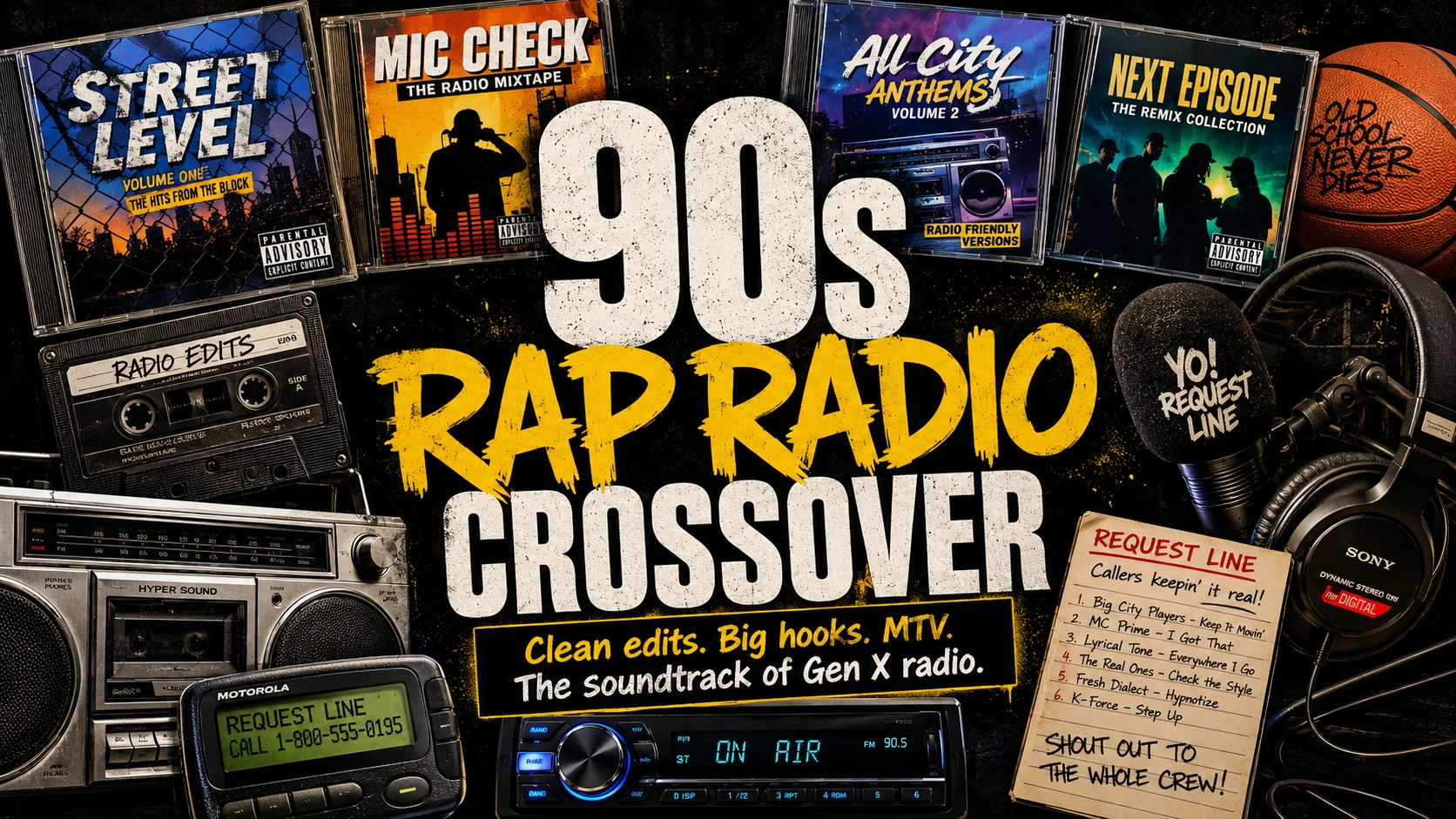
90s Rap Radio Crossover
90s rap radio crossover was the moment hip-hop moved from specialty shows, late-night blocks, college radio, mixtapes, and “my cousin has the tape” status into car stereos, Top 40 countdowns, school dances, mall speakers, MTV, soundtrack singles, request lines, and every parent’s living room whether they had emotionally prepared or not. It was clean edits, R&B hooks, huge choruses, radio remixes, video rotation, shiny suits, party records, soundtrack monsters, and that very Gen X feeling of hearing a rap song on a station that used to act like hip-hop was a suspicious package.
90s rap radio crossover mattered because it moved hip-hop from specialty programming into everyday mainstream life. Clean edits, R&B hooks, soundtrack singles, MTV videos, Top 40 countdowns, request lines, school dances, and car stereos helped rap become unavoidable by the late 90s. This page connects directly to 90s Hip-Hop and Rap, the wider 90s Music story, Hip-Hop on MTV in the 90s, The Shiny Suit Era of Late-90s Rap, 90s Hip-Hop Dance and Party Songs, and 90s Hip-Hop Movie Soundtracks.
Rap Radio Crossover Was the Sound of Hip-Hop Becoming Everyday Life
Rap radio crossover in the 90s was not just “rap songs got played more.” That is the boring version, and we did not survive dial-up internet and cassette adapters for boring versions. The real story is that hip-hop became part of the daily noise of the decade. It moved into cars, kitchens, malls, school dances, roller rinks, dorm rooms, summer jobs, countdown shows, and stations that once treated rap like it needed adult supervision.
Early in the decade, rap already had massive cultural force, but mainstream radio was not always ready to admit it. Hip-hop lived through local rap shows, college stations, mix shows, specialty programming, street tapes, clubs, record stores, and word of mouth. Then, step by step, the walls started cracking. A crossover single hit. Then another. Then a soundtrack song. Then an R&B hook with a rap verse. Then a clean edit. Then a video. Then suddenly somebody’s mom was humming a rap chorus without realizing the original version would have made her throw the radio out the window.
That transition is why 90s rap radio crossover sits at the center of the broader 90s Hip-Hop and Rap story. It is the bridge between underground credibility, regional scenes, MTV visibility, soundtrack marketing, R&B crossover, shiny late-90s commercial power, party records, and the full mainstream takeover. Radio was not the only machine, but it was the machine that made hip-hop unavoidable in ordinary spaces.
MTV made rap visual. Hip-Hop on MTV in the 90s turned videos into style, memory, and appointment viewing. 90s Hip-Hop Movie Soundtracks moved songs through Blockbuster weekends, movie trailers, and mall CD purchases. But radio did something different: it repeated. Brutally. Beautifully. Mercilessly. Radio took a song and made it live in your head until even the clean edit felt permanent.
The crossover was not clean, no matter how many edits tried to make it that way. Hip-hop entering mainstream radio created arguments about authenticity, selling out, censorship, pop hooks, R&B choruses, sample choices, label pressure, and whether a rapper could still be taken seriously after your little cousin requested the song on the same station that played boy bands. Those debates mattered because hip-hop was not just gaining audience. It was negotiating identity under a spotlight.
For Gen X, this was not abstract music history. It was lived experience. It was the car radio catching a rap song on a station that used to pretend rap did not exist. It was calling request lines and getting a busy signal because apparently the entire city had nothing better to do. It was hearing the radio version and knowing exactly where the missing words were. It was school dances playing the clean edit while teachers stood around pretending they understood the culture. It was mall stores blasting rap hooks while selling cargo pants to kids with no business wearing that many pockets.
By the end of the decade, rap was not waiting to be invited into mainstream music. It had taken the aux cord before aux cords existed. It was in Top 40 countdowns, pop radio rotations, soundtrack singles, TRL chaos, sports arenas, teen parties, sitcom references, and every scratched CD wallet in America. That is the radio crossover story: hip-hop becoming the sound of the room, whether the room was ready or not.
Before Rap Took Over Radio, You Had to Know Where to Find It
Before rap became a normal part of mainstream radio, hip-hop often lived in specialty spaces: late-night shows, mix hours, college stations, local scenes, mixtapes, clubs, and record stores where the good stuff moved faster than corporate radio.
Early-90s rap did not need Top 40 radio to be important. That is crucial. Hip-hop had already built its own systems: DJs, clubs, local radio personalities, mixtapes, college stations, specialty shows, record pools, street teams, magazines, and word of mouth. The culture was not sitting around waiting for a program director in khakis to decide it was valid.
But mainstream radio changed reach. When a rap song crossed over, it entered spaces that were not necessarily hip-hop spaces. It moved from the heads who knew to the casual listeners who just had the radio on while driving to work, riding to school, sitting in a mall food court, or trying to tape a song off the radio without the DJ talking over the intro like a criminal.
The early decade still had strong divides. Some records were huge in hip-hop circles but barely touched mainstream stations. Some songs crossed because they had a massive hook, a danceable beat, a novelty angle, an R&B feature, or a clean enough edit to survive daytime radio. Some crossed because the video made the artist unavoidable. Some crossed because a soundtrack single gave the radio station a safer way in.
This is where the larger map matters. New Jack Swing, Rap, and R&B in the 90s helped create an easier bridge because rhythm, melody, dance, and radio polish were already living in the same house. Conscious Rap in the 90s and Alternative Hip-Hop in the 90s also showed that rap’s 90s identity was never just one radio-friendly formula.
The pre-crossover era also made rap feel like a discovery. You had to know when the mix show came on. You had to catch the right station. You had to borrow the tape. You had to find the record store. You had to stay up late. That effort made the music feel earned. It also made mainstream crossover feel weird when it finally happened. Suddenly something that felt like yours was being played between pop ballads and commercials for car dealerships. Convenient? Yes. Suspicious? Also yes.
That tension never really left. Every crossover record carried a question: did radio make the song bigger, or did it sand the edges down? Sometimes both. That is the 90s in a nutshell: messy, loud, commercial, brilliant, compromised, unforgettable, and probably recorded on a cassette with the first eight seconds missing.
Specialty shows mattered
Rap radio was built by people who knew the culture before mainstream formats fully embraced it. Mix shows, late-night slots, and local personalities did real work.
Crossover changed access
Once rap entered regular rotation, casual listeners heard it without searching. That changed the audience, the business, and the arguments.
Clean Edits Were Ridiculous, Necessary, and Somehow Part of the Hook
The clean edit was where radio, advertisers, parents, program directors, artists, and the English language all got into a fight and somehow came out with a hit single.
The Silence Had Rhythm
Every Gen X listener learned to hear the missing words. The edit did not hide anything. It just made the blank spaces famous.
The clean edit deserves its own museum exhibit, preferably inside a mall next to a broken fountain. It was absurd, creative, clumsy, necessary, and sometimes so badly chopped that the missing words became more obvious than the original lyrics. Radio thought it was protecting listeners. Listeners became expert lip-readers of silence.
Clean edits mattered because they were one of the keys to crossover. A rap song could not always move through daytime radio in its album form. Stations needed radio-safe versions. Labels wanted spins. Artists wanted reach. Program directors wanted plausible deniability. Parents wanted everything to stop changing after 1986. So the clean edit became the compromise.
The edits came in different flavors. Sometimes the word was dropped out completely, leaving a hole in the beat. Sometimes it was reversed. Sometimes it was replaced by a sound effect. Sometimes the artist recorded alternate lyrics. Sometimes the edit was so awkward you wondered if the engineer was actively mad at the song. And sometimes the clean version became the version everybody knew because radio played it into the ground.
This changed how Gen X heard rap. You learned the rhythm of censorship. You knew where the silence landed. You could tell what word was missing by the shape of the blank. At school dances, the clean edit was both permission slip and punchline. The adults heard the safe version. The kids heard the original in their heads. Everybody pretended the system worked.
Clean edits also shaped crossover songwriting. If a song was going to live on radio, the hook had to survive the edit. The chorus had to be strong. The beat had to move even if the verses got sliced. That pushed certain records into easier radio shape: bigger hooks, clearer choruses, more melodic features, smoother mixes, and songs that could work on both hip-hop stations and pop-leaning formats.
This is why clean edits connect directly to 90s Hip-Hop Dance and Party Songs. A song that could get played at a school dance, party, gym event, or roller rink had a better chance of becoming a shared memory. Not necessarily a better song. A shared one. There is a difference, and the 90s specialized in that difference.
Clean edits were also tied to the parental advisory era. Hip-hop albums could be controversial, explicit, politicized, and feared by people who had definitely not listened closely. Radio versions gave the industry a way to sell the song without fully selling the album version. That compromise helped rap move wider, but it also made the gap between the real record and the public-facing version part of the decade’s tension.
Rap Radio Crossover Became Real When It Hit the Car Stereo
The car was the real testing lab. If a crossover rap song worked through factory speakers, busted tape adapters, aftermarket systems, and one blown door speaker, it had officially entered daily life.
The Dashboard Was the Arena
Rap crossover did not become real on a chart. It became real when it came through the speakers in somebody’s hand-me-down car.
The car stereo is where 90s rap crossover proved itself. Not in a boardroom. Not in a chart meeting. Not in a glossy magazine blurb. In a car. Usually a questionable car. Maybe one door handle did not work. Maybe the AC was theoretical. Maybe the backseat had fast-food evidence from three weeks ago. But if the song hit in that car, it had power.
Cars made radio social. You heard songs with friends, siblings, dates, coworkers, teammates, and whoever had shotgun privileges because they called it before anyone got to the driveway. A crossover rap song could become attached to a route: school, work, the mall, the beach, the basketball court, the movie theater, the party, the gas station, the nowhere drive because gas was cheaper and aimless cruising counted as a plan.
This was also where regional sounds traveled. G-Funk and the 90s West Coast Sound was built for car speakers. The bass, the synth lines, the slow bounce, the lowrider feel — even if you were nowhere near California, the car made the sound cinematic. That is why West Coast Hip-Hop in the 90s moved so powerfully through radio and car culture.
East Coast rap worked differently in cars. It could feel colder, denser, more lyrical, more city-coded, more headphone-like even through speakers. East Coast Hip-Hop in the 90s did not always chase crossover the same way, but when a New York record hit radio, it could make the whole car feel like a rooftop cypher got installed in the dashboard.
Southern hip-hop also benefited from car and radio culture, though national radio was slower to catch up. Bass records, Miami party tracks, Atlanta funk, Houston weight, New Orleans bounce energy, and regional club sounds all made sense in cars long before the national industry fully understood the scale. That is why Southern Hip-Hop in the 90s is part of the crossover story, even when mainstream radio lagged behind reality.
The car also created repetition. You did not choose the playlist. You had stations, tapes, CDs, maybe a Discman with a tape adapter, maybe a CD changer if someone in your family had money or suspicious priorities. Radio hits became repeated by circumstance. You heard them in traffic, in parking lots, during school drop-offs, during late-night drives, and while waiting for someone who said they would “be right out” and then took seventeen years.
Crossover rap songs lived well in those moments because they were functional. They could hype you up, fill silence, turn errands into scenes, make a boring ride feel like a video, or let everyone in the car yell the hook while pretending nobody had feelings. The car made rap part of ordinary motion.
Request Lines Made Radio Feel Interactive Before the Internet Got Loud
Before likes, streams, reposts, and comment wars, you had a phone, a busy signal, a DJ, and the blind faith that your request mattered.
Busy Signal Culture
Calling the station felt like democracy, even if the playlist had obviously been decided before you touched the phone.
The radio request line was one of the most 90s forms of fake power. You called. It was busy. You called again. Still busy. You called twenty-seven times and finally got through, only to realize you had no idea what to say to the DJ. This was youth democracy in its purest form: humiliation with a dial tone.
Request lines mattered because they made crossover feel participatory. When a rap song started blowing up, kids wanted to hear it again. They called for it. They taped it. They waited through commercials. They yelled when the DJ talked over the intro. They listened for dedications, countdowns, and “most requested” claims that may or may not have been legally meaningful.
This created a feedback loop. If a rap song was requested constantly, the station had evidence that the audience wanted it. If the station played it more, the audience requested it more. If the song had a video, MTV fed the radio memory. If it came from a movie, the soundtrack fed the movie. The whole machine started spinning faster.
Request-line culture also made crossover songs social. You did not just like a record alone. You heard other people liking it. You heard the DJ introduce it as a hit. You heard it climb. You heard friends say they requested it. You heard it at school the next day. A rap song became part of group awareness because radio made popularity audible.
The countdown mattered too. Top 8 at 8, Top 9 at 9, weekend countdowns, year-end countdowns, whatever your local station branded with too much energy and a jingle that now lives in your brain against your will. Once rap songs entered those countdowns, they were not just hip-hop records anymore. They were part of mainstream scoreboard culture.
That scoreboard culture fed the late-90s world that also belonged to Hip-Hop on MTV in the 90s. TRL and radio countdowns were cousins. One had a studio window and screaming fans. The other had DJs, request lines, and callers who sounded like they were phoning from inside a wind tunnel.
R&B Hooks Helped Rap Cross Over Without Losing the Beat
If there is one sound that defines 90s rap radio crossover, it is the rap verse meeting the R&B hook and realizing they could pay rent together.
The Chorus Opened the Door
A strong R&B hook could take a rap record from street heat to radio gravity without draining all the personality out of it.
The rap/R&B hook was one of the most important crossover weapons of the 90s. It was not new, and it did not come from nowhere, but by the mid-to-late 90s it became one of the main ways rap records moved across formats. The verse carried attitude, story, voice, or style. The hook gave radio something to grab onto and play until the entire population surrendered.
This crossover language had roots in New Jack Swing, Rap, and R&B in the 90s, where hip-hop drums, R&B melody, dance-floor energy, and radio polish were already blending. By the time rap radio crossover accelerated, audiences were trained to hear rap and R&B together. The combination felt natural because the decade had been building toward it.
The hook made a record more accessible without always making it soft. That distinction matters. Some of the best crossover rap records still had personality, bite, regional identity, or lyrical strength. The R&B hook did not erase that. It gave the song another entry point. You might come for the chorus and stay for the verse. Or come for the rapper and secretly sing the chorus louder than anyone. We saw you.
This is where Lauryn Hill, the Fugees, and Hip-Hop Soul becomes central. The Fugees helped show that rap, soul, reggae, and R&B could cross over with emotional depth, not just radio strategy. Lauryn Hill’s voice made crossover feel serious, spiritual, wounded, warm, and massive at the same time.
Women in hip-hop also shaped this lane. Women of 90s Hip-Hop were not just guests in the crossover era. They were architects of how rap could sound on radio, MTV, and soundtrack albums. Queen Latifah, Salt-N-Pepa, Lauryn Hill, Missy Elliott, Lil’ Kim, Foxy Brown, MC Lyte, Da Brat, and others navigated the pop machine in very different ways.
The danger was formula. Once the industry realized that rap plus R&B hook could equal radio money, the machine started copying itself. Some records felt natural. Some felt like executives assembled them in a conference room with a whiteboard that said “urban crossover synergy,” which should be illegal in at least twelve states. But the best ones still hit because the chemistry was real.
By the late 90s, rap/R&B crossover was not a side lane. It was mainstream music’s center of gravity. It fed radio, MTV, soundtracks, school dances, CD singles, and the entire late-decade mood. Rap had learned the chorus could be a bridge, a weapon, and occasionally a trap.
Soundtrack Singles Were Crossover Cheat Codes
If a 90s rap single came attached to a movie, it had extra lives. It could live in the film, on the soundtrack CD, in the trailer, on MTV, on radio, in mall displays, and in the car after the movie went back to the rental store. That kind of exposure was not subtle. It was a marketing Voltron.
90s Hip-Hop Movie Soundtracks were one of the strongest crossover engines of the decade. Urban dramas, basketball movies, action comedies, teen films, and blockbusters all used rap and R&B to create mood, sell scenes, and push singles into wider formats. Sometimes the soundtrack cut felt like part of the movie’s soul. Sometimes it felt like the studio taped a radio single to a poster and called it synergy. Either way, it worked often enough to matter.
Soundtrack singles gave radio a hook beyond the song. The DJ could mention the movie. The video could include clips. The CD could sit in the soundtrack section at the mall. The artist could appear on TV. The song could become a reminder that the film existed, which was helpful for movies whose plots were not exactly built for long-term storage.
The soundtrack also made rap more family-room visible in certain cases. A blockbuster tie-in could make a rap single feel safer to pop radio. A sports movie could make hip-hop feel like competition and energy. An urban drama could make the music feel serious and cinematic. A teen movie could turn a party track into a school-dance staple.
This is why soundtrack crossover belongs beside 90s Hip-Hop Songs That Defined the Decade. Some songs defined the 90s not because they came from the biggest album, but because they moved across film, radio, MTV, and daily life at the same time.
Built-in story
A soundtrack single came with scenes, clips, actors, trailers, and enough branding to make the song feel bigger instantly.
Retail gravity
The soundtrack album gave listeners a physical object to buy, borrow, scratch, lose, and weirdly cherish.
MTV fuel
Movie clips plus artist performance plus a giant hook could turn a soundtrack song into an unavoidable crossover machine.
The Biggest 90s Hip-Hop and Rap Radio Crossover Songs
This is not a strict chart ranking, and it is definitely not a “pop-rap novelty songs that scared your aunt” list. These are the rap and hip-hop crossover records that moved through radio, MTV, car stereos, school dances, soundtrack CDs, request lines, and late-90s daily life while still feeling connected to hip-hop culture.
Some of these were huge Hot 100 records. Some ruled rap radio first and then broke wider. Some were soundtrack monsters. Some were clean-edit miracles. Some became unavoidable because the hook was too strong, the video was too big, or the car stereo made the record feel like it was ten feet tall. Together, they show how hip-hop crossed over without the whole story turning into novelty pants and corporate hand-clapping.
Early-90s rap breaks through
- Naughty by Nature — “O.P.P.”
A monster hook, a coded chorus, and just enough mischief to sneak into mainstream radio while kids knew exactly what was going on and adults absolutely did not. - DJ Jazzy Jeff & The Fresh Prince — “Summertime”
Smooth, warm, clean, and endlessly replayable. This was crossover rap that did not feel desperate for approval. It just coasted into cookouts, cars, and lazy summer afternoons. - Dr. Dre featuring Snoop Doggy Dogg — “Nuthin’ but a ‘G’ Thang”
The West Coast did not just enter the mainstream. It reclined the seat, adjusted the bass, and made the whole country ride along. - Snoop Doggy Dogg — “Who Am I? (What’s My Name?)”
Snoop’s voice was basically built for radio and car speakers. Smooth, funny, menacing, relaxed, and instantly recognizable. - House of Pain — “Jump Around”
A rap record that crashed into sports arenas, parties, rock crowds, and school gyms without asking for permission. - Cypress Hill — “Insane in the Brain”
Weird voice, hard drums, stoner menace, MTV presence, and a hook that crossed over while still sounding like it came from its own smoke-filled universe. - Arrested Development — “Tennessee”
A different crossover lane: reflective, spiritual, warm, and rooted. It proved rap radio crossover did not have to be party-only or cartoonish. - A Tribe Called Quest — “Award Tour”
Tribe made crossover feel cool instead of thirsty. Jazz-rap warmth, breezy confidence, and a hook that could live on radio without losing its soul. - Digable Planets — “Rebirth of Slick (Cool Like Dat)”
Jazz-rap cool with enough mainstream glide to cross over without sanding off the weirdness. - Onyx — “Slam”
Aggressive, loud, rowdy, and somehow still a crossover record. Proof that radio sometimes let the chaos in if the hook hit hard enough.
Mid-90s crossover gets serious
- Warren G featuring Nate Dogg — “Regulate”
G-Funk storytelling, Nate Dogg hook magic, soundtrack energy, and pure car-stereo perfection. One of the cleanest examples of rap crossing over without feeling watered down. - Method Man featuring Mary J. Blige — “I’ll Be There for You/You’re All I Need to Get By”
Rap and R&B chemistry done right. Street edge, soul, romance, and radio gravity all in one record. - 2Pac featuring Dr. Dre and Roger Troutman — “California Love”
West Coast victory lap, comeback statement, club record, car record, and radio event all at once. - Coolio featuring L.V. — “Gangsta’s Paradise”
The dramatic soundtrack monster. Serious tone, huge hook, movie tie-in, and massive crossover reach without turning into a joke. - Bone Thugs-N-Harmony — “Tha Crossroads”
Melodic, spiritual, emotional, and huge. It showed that rap crossover could carry grief and still dominate radio. - Fugees — “Fu-Gee-La”
Rap, reggae flavor, soul, crew chemistry, and a hook that helped make the Fugees feel both underground-rooted and mainstream-ready. - Fugees — “Killing Me Softly”
More hip-hop soul than straight rap, but absolutely central to the crossover story. Lauryn Hill’s voice made the record feel intimate and enormous. - LL Cool J featuring Boyz II Men — “Hey Lover”
Smooth romantic rap with R&B support, built perfectly for radio without losing LL’s presence. - Junior M.A.F.I.A. featuring The Notorious B.I.G. — “Get Money”
Street, slick, catchy, and radio-ready. Biggie’s orbit helped bring a harder East Coast attitude into wider rotation. - Luniz — “I Got 5 on It”
Dark, hypnotic, regional, smoky, and still a crossover anthem. One of those records that sounded better the louder the car speakers got.
Late-90s rap takes over radio
- The Notorious B.I.G. featuring Puff Daddy and Mase — “Mo Money Mo Problems”
Glossy, hook-heavy, sample-driven, and completely built for the late-90s radio/MTV machine without losing Biggie’s charisma. - Puff Daddy featuring Faith Evans and 112 — “I’ll Be Missing You”
Tribute record, grief anthem, radio juggernaut, and one of the biggest rap crossover moments of the decade. - Mase — “Feel So Good”
Smooth delivery, big sample energy, shiny video vibe, and peak “this is playing in every mall store” crossover. - Missy Elliott — “The Rain (Supa Dupa Fly)”
Weird, cool, visual, futuristic, and impossible to separate from MTV. It made radio-friendly rap feel like it came from another planet. - Missy Elliott featuring Da Brat — “Sock It 2 Me”
Space-age video energy, Timbaland bounce, and a hook that made Missy’s weirdness feel completely mainstream. - Lauryn Hill — “Doo Wop (That Thing)”
Rap, soul, R&B, message, melody, and total authority. A crossover record that felt classic and brand new at the same time. - Jay-Z — “Hard Knock Life (Ghetto Anthem)”
Broadway sample, street perspective, giant hook, and one of the records that pushed Jay-Z into a bigger mainstream lane. - DMX — “Ruff Ryders’ Anthem”
Not glossy, not soft, not polite — and still everywhere. Proof that crossover did not always need to smile for radio. - Busta Rhymes — “Put Your Hands Where My Eyes Could See”
Busta’s charisma, weirdness, and video presence made radio crossover feel animated without becoming lightweight. - Pras featuring Ol’ Dirty Bastard and Mýa — “Ghetto Supastar”
Movie tie-in, pop hook, rap personality, and late-90s soundtrack energy all rolled into one unavoidable radio record.
Rap/R&B, club, and soundtrack crossover
- Salt-N-Pepa — “Shoop”
Flirty, funny, confident, and radio-ready. Salt-N-Pepa crossed over without sounding like they were asking permission. - Salt-N-Pepa with En Vogue — “Whatta Man”
Rap and R&B harmony working together like they had a shared lease. This is exactly the kind of crossover chemistry the decade kept chasing. - Queen Latifah — “U.N.I.T.Y.”
Message record, radio presence, and a reminder that crossover could carry substance without turning into a lecture from a folding chair. - Da Brat — “Funkdafied”
Laid-back flow, funk polish, and a major female rap crossover moment that fit perfectly into mid-90s radio. - Lil’ Kim featuring Lil’ Cease — “Crush on You”
Bright, stylish, hooky, and very late-90s. A crossover record with attitude, color, and enough video presence to burn itself into memory. - Foxy Brown featuring Blackstreet — “Get Me Home”
Rap/R&B crossover with a smooth hook, radio polish, and enough hip-hop edge to avoid floating away completely. - Wyclef Jean — “Gone Till November”
Melodic, cinematic, rap-adjacent, and built for the late-90s moment when genre borders were basically made of wet cardboard. - Juvenile featuring Mannie Fresh and Lil Wayne — “Back That Azz Up”
The clean version could sneak onto radio, but everybody knew what time it was. Southern club energy was forcing the national map to widen. - Q-Tip — “Vivrant Thing”
Sleek, stylish, danceable, and grown without being boring. A Tribe energy translated into solo radio cool. - Eminem — “My Name Is”
Shock value, comedy, controversy, Dr. Dre production, MTV rotation, and radio curiosity all crashing into one late-90s introduction.
This version of the crossover story keeps the focus where it belongs: hip-hop and rap records that crossed into wider radio life without turning the whole thing into a novelty-pop sideshow. Some were tied to movie soundtracks. Some exploded through MTV rotation. Some belong next to 90s Hip-Hop Dance and Party Songs. Some helped build the sound of late-90s shiny-suit rap. Some opened the door for the rap/R&B blend explored in Lauryn Hill, the Fugees, and Hip-Hop Soul.
Together, they show how wide 90s rap radio crossover really was. It was not one sound. It was the decade learning, awkwardly and loudly, that hip-hop could be hard, smooth, emotional, weird, danceable, cinematic, glossy, regional, radio-safe, and still powerful enough to take over the dial.
MTV Made Radio Crossover Look Bigger Than the Speakers
Radio made the song repeat. MTV gave the song a face, outfit, car, dance, room, fish-eye lens, and an entire visual memory.
The Song Got a Face
Once a crossover rap song had radio spins and video rotation, it stopped being a record and became a full 90s event.
Radio and MTV worked together like two loud roommates who refused to clean but somehow threw great parties. Radio gave the song repetition. MTV gave the song imagery. Together, they made rap crossover feel unavoidable.
This is the core of Hip-Hop on MTV in the 90s: the video turned a radio record into a visual memory. You heard the song in the car, then saw the video after school. You heard the clean edit on the radio, then saw the outfit on MTV. You heard the hook at the mall, then watched the artist perform it in a room that looked like it cost more than your entire neighborhood.
MTV helped radio crossover because it made artists recognizable. Charisma mattered. Style mattered. Video concepts mattered. Missy Elliott understood this better than almost anyone. Missy Elliott and Late-90s Hip-Hop Weirdness turned video oddness into mainstream power. Radio could play the record, but MTV made the weirdness visible.
The Shiny Suit era also depended on this radio/video feedback loop. The Shiny Suit Era of Late-90s Rap was built for both: radio hooks and visual excess. Big samples, R&B choruses, clean edits, glossy videos, expensive rooms, dance crews, suits, cars, and enough fisheye lens to make the late 90s look like it was filmed through a peephole on a spaceship.
TRL made the relationship even more obvious. A song could be a radio hit and a video countdown presence at the same time. That gave crossover a daily scoreboard. Kids could hear the song on the way home and then see it ranked on TV. Popularity became visible and audible. It was basically social media before everyone had a comments section to ruin dinner.
MTV also helped create fashion crossover. A record could put a hook in your head, but the video put a look in your closet. That connects directly to 90s Hip-Hop Fashion. Radio sold the chorus. MTV sold the jacket, the sneakers, the glasses, the jersey, the suit, and the bad decisions made afterward at the mall.
School Dances Were Where Clean Rap Crossovers Became Social Memory
A rap song reaching the school dance meant it had survived radio edits, adult supervision, bad speakers, awkward lighting, and an entire gym full of kids pretending they could dance.
The Clean Edit Entered the Gym
Nothing tested a crossover rap record like a school dance with bad speakers, chaperones, and kids who knew every missing word.
The school dance was one of the strangest proving grounds for 90s rap crossover. If a song made it there, it had passed through several filters: radio approval, clean edit survival, enough popularity for the DJ to play it, and enough plausible innocence for adults to stand around pretending they had not just allowed a censored version of chaos into the gym.
School dances made crossover rap social. A song you heard alone in the car became something everybody reacted to at once. The hook hit, the crowd moved, the clean edit dropped a word out, and every kid mentally filled it in like a choir of trouble. The adults heard a safe version. The students heard the real one. This was the 90s educational system at work.
Party records were especially useful in this space. 90s Hip-Hop Dance and Party Songs did not always need lyrical complexity. Sometimes they needed movement, a chant, a hook, a bassline, or a beat that could survive terrible gym acoustics. That is its own kind of genius.
The school dance also blurred genres. Rap, R&B, pop, dance, club tracks, soundtrack singles, and whatever slow song created maximum awkwardness all lived in the same night. That is why crossover mattered. Rap was not isolated anymore. It was part of the entire social soundtrack, right next to songs that made everybody form circles even though nobody knew why.
For Gen X, these memories stick because the environment was so specific: streamers, folding tables, gym lights, soda, bad cologne, worse perfume, teachers by the wall, and one song that suddenly made everyone act like they were in a video despite having the coordination of a shopping cart.
Radio made those songs familiar enough to work in public. The clean edit made them playable. MTV made the moves and style visible. The school dance turned them into shared embarrassment, which is the most durable form of nostalgia.
Dance and Party Records Helped Rap Cross Over Because Nobody Could Argue With the Hook
Party records were one of rap radio crossover’s easiest entry points because they were functional. They moved the room. They worked at dances, house parties, pep rallies, skating rinks, clubs, gyms, and car rides where nobody wanted to discuss lyrical density. Sometimes a song’s job was simply to make everyone stop leaning on the wall like suspicious furniture.
This did not make party records less important. In fact, it made them essential. Hip-hop has always had party roots. The idea that party rap is somehow less real ignores the fact that the culture was born from DJs moving crowds. A crossover party record could carry that original energy into mainstream spaces, even if the radio edit made it wear a name tag.
90s Hip-Hop Dance and Party Songs are a major part of this story because they show how rap traveled through bodies, not just charts. A song could become huge because people danced to it, chanted it, requested it, and used it to turn boring rooms into questionable decisions.
Party rap also connects naturally to Forgotten 90s Party Anthems, because some records were absolutely everywhere for a season and then vanished into the kind of nostalgia folder that only opens when someone says, “Wait, remember this one?”
The party lane also produced backlash. Purists could dismiss these songs as too simple, too commercial, too goofy, too clean, too pop, too whatever. Sometimes they had a point. Sometimes they were just allergic to fun. The truth is that 90s radio crossover needed party records because radio needed songs that worked instantly. A complicated album cut might be better art. A huge party hook could take over a summer.
The Shiny Suit Era Was Radio Crossover Wearing Sunglasses Indoors
The Shiny Suit era was one of the clearest examples of rap radio crossover becoming full spectacle. The records were built for radio. The videos were built for MTV. The hooks were big. The samples were familiar. The suits were loud. The lighting was expensive. The whole thing felt like someone turned commercial rap into a chrome-plated appliance and then taught it to dance.
The Shiny Suit Era of Late-90s Rap is impossible to separate from radio crossover because those records often moved through pop stations with terrifying efficiency. They had hooks that stuck, clean versions that worked, videos that looked expensive, and enough familiarity in the samples to make casual listeners feel invited.
The shiny era also connects to the broader late-90s conversation around 90s Hip-Hop Fashion. Radio sold the record, MTV sold the image, and the mall tried to sell everyone the look, even when most of us had no business dressing like we had a video budget.
People clown the shiny-suit era now because the excess is easy to parody. Fair. Some of those videos looked like a champagne commercial got trapped in a fisheye lens. But that excess was part of the point. Rap success had become visible. It was no longer just heard in the bass. It was seen in suits, cars, dancers, jewelry, video budgets, and radio repetition.
For Gen X, shiny-suit rap was late-90s background radiation. It was on the radio while you drove. It was on MTV while you got ready. It was on at parties. It was in mall stores. It was in the soundtrack aisle. It was impossible to avoid, which is both a compliment and a formal complaint.
Hooks did the work
Familiar samples, R&B choruses, and polished production helped late-90s rap singles move through pop radio with less resistance.
Videos sold the fantasy
MTV made radio hits look bigger, shinier, richer, and more impossible to ignore. The image became part of the hook.
The Artists Who Made Rap Radio Crossover Feel Bigger Than One Formula
Crossover did not sound one way. It could be street, glossy, weird, soulful, playful, cinematic, regional, smooth, funny, hard, or built around a hook your brain still refuses to evict.
The mistake is thinking 90s rap radio crossover was one sound. It was not. It was a pressure zone. Different artists crossed in different ways. Some used R&B hooks. Some used samples. Some used soundtrack placement. Some had clean party records. Some had undeniable charisma. Some were too big for radio to ignore even when radio looked nervous.
Lauryn Hill and the Fugees crossed with soul, reggae, rap, melody, and emotional authority. Their crossover did not feel like a gimmick. It felt like the mainstream finally caught up to something deeper. That is why Lauryn Hill, the Fugees, and Hip-Hop Soul belongs in this radio conversation.
Missy Elliott crossed by being strange, catchy, visual, and completely herself. Missy Elliott and Late-90s Hip-Hop Weirdness proved that radio-friendly did not have to mean boring. Her records could bounce, glitch, joke, flirt, flex, and still sound like they came from another planet.
Outkast crossed by slowly making the national map wider. Outkast and the Rise of Southern Hip-Hop showed that Southern rap could be funky, futuristic, thoughtful, weird, and commercially powerful without copying coastal formulas.
A Tribe Called Quest crossed in a cooler, quieter way. A Tribe Called Quest and 90s Jazz Rap showed how warmth, humor, jazz loops, and smart writing could reach beyond hardcore rap spaces without sounding desperate for approval.
And then there were the short-run crossover moments: huge hooks, dance records, soundtrack singles, novelty-adjacent smashes, and songs that ran through radio like they had stolen the station van. Some were great. Some were ridiculous. Some were both, which is the 90s at its most honest.
Lauryn/Fugees
Hip-hop soul moved through radio with emotional weight, not just crossover packaging.
Missy
Missy proved that strange could still be sticky enough for radio, MTV, and the whole late-90s machine.
Outkast
Atlanta’s weird, funky, thoughtful sound widened the crossover map without begging the coasts for permission.
Tribe
Jazz rap showed crossover did not always need gloss. Sometimes it just needed warmth, rhythm, and actual personality.
Every Crossover Hit Dragged the Sellout Debate Behind It Like a Broken Bumper
No 90s rap crossover discussion is complete without the sellout debate, because hip-hop fans could not simply enjoy a hit song. We had to interrogate it like it owed us money. Was it too pop? Too clean? Too shiny? Too commercial? Too soft? Too radio-friendly? Too much chorus? Too many dancers? Too many suits? Too many moms knowing the hook?
Sometimes the criticism was fair. Labels absolutely pushed formulas. Some songs were built to chase radio in ways that felt obvious. Some artists softened their edges. Some records sounded like the product of a meeting where everyone used the phrase “urban demographic” and nobody was punished.
But the sellout debate could also become lazy. A song becoming popular did not automatically make it fake. Hip-hop has always had party records, hooks, dance music, humor, style, and commercial ambition. The question was not simply whether a record crossed over. The question was what it gave up, what it kept, and whether it still sounded alive.
This is why the 90s were so interesting. The decade gave us real depth, regional masterpieces, street classics, political rap, party hits, pop crossover, shiny excess, R&B blends, soundtrack singles, and oddball records all at once. Best 90s Hip-Hop Albums sits beside 50 Essential 90s Hip-Hop Songs because the decade was not one lane. It was a freeway with no seat belts.
Gen X lived that argument in real time. You could love the album cut and still turn up the radio hit. You could clown the shiny suit video and still know every word. You could complain about clean edits and still wait for the song to come on. You could accuse a song of being too commercial while secretly taping it off the radio. The hypocrisy was part of the charm.
The truth is that radio crossover changed hip-hop forever because it forced the culture to negotiate scale. What happens when a local sound becomes national? What happens when a street record becomes a pop hit? What happens when a song built for clubs becomes a school-dance staple? What happens when the mainstream wants rap but not always the full reality behind it?
Those questions are why the crossover era still matters. It was not just bigger audiences. It was bigger tension.
The Late 90s Turned Rap Radio Crossover Into the Air Everybody Breathed
The late 90s are the sweet spot here because that is when rap crossover stopped feeling occasional and started feeling like one of the main engines of mainstream music.
By 1995, hip-hop and R&B were already deeply woven into mainstream music, but the crossover machine still had room to grow. Soundtrack singles, radio hooks, and mid-90s rap visibility were making it harder for pop radio to pretend hip-hop was a side lane.
1996 pushed the crossover story harder. The Fugees, Tupac-era radio gravity, R&B/rap blends, soundtrack culture, and MTV visibility made hip-hop feel increasingly central. Rap was no longer just appearing on mainstream radio. It was shaping the sound around it.
By 1997, late-90s rap radio crossover was becoming a full system. Glossy videos, Missy Elliott’s arrival, big samples, R&B hooks, and movie tie-ins all fed the machine. Radio and MTV were working together in ways that made rap feel unavoidable.
1998 was crossover overload in the best and worst ways. Hip-hop, R&B, pop, and soundtrack singles were all fighting for oxygen. Rap was moving through Top 40 with confidence, and the line between rap single, R&B single, video hit, and pop-culture moment was basically written in dry-erase marker.
By 1999, rap was part of the late-millennium mainstream soundtrack. TRL, radio countdowns, teen pop, R&B dominance, shiny rap, club records, and blockbuster singles all collided. If 1990 was still negotiating hip-hop’s mainstream radio place, 1999 was hip-hop standing in the middle of the room asking why everyone else was late.
These years matter because they show crossover becoming normal. Not uncontroversial. Not perfect. Normal. Rap was now part of daily radio life. Parents could complain, program directors could edit, critics could debate, but the sound was already in the car.
Rap Radio Crossover Sticks Because It Was Attached to Real Places
The reason 90s rap radio crossover still feels so vivid is that it is attached to places, not just songs. The car. The mall. The gym. The bus. The bedroom. The school dance. The record store. The parking lot. The fast-food drive-thru. The friend’s basement. The house party where someone’s parents were definitely coming home too soon.
A crossover rap song did not live in isolation. It arrived through a station ID, a DJ voice, a countdown, a request line, a clean edit, a music video, a soundtrack CD, a school dance, a car ride, a summer job, or a burned-in memory of waiting for the chorus while someone talked over the intro.
It also sticks because the songs were shared. Radio was communal even when you listened alone. Everyone in your town could hear the same hit that week. Everyone knew the hook. Everyone knew the clean edit. Everyone heard it in different places and then brought it into the same conversation. Streaming gives you everything. Radio gave everyone the same thing until resistance became pointless.
The crossover era also captured a specific Gen X tension: wanting music to stay authentic while also enjoying the convenience of hearing it everywhere. We wanted the album cut and the hit. We wanted the real version and the clean edit at the dance. We wanted to complain and still sing along. That contradiction is basically the official Gen X operating system.
Most of all, rap radio crossover sticks because it marked the point where hip-hop became part of mainstream daily life without losing the arguments that made it interesting. It got bigger, messier, shinier, more accessible, more compromised, more powerful, more debated, and more impossible to ignore.
90s Rap Radio Crossover Changed the Sound of Mainstream Music
By the end of the decade, rap was not just crossing over. It was changing what crossover meant.
The Hook Stayed
Clean edits, car radios, MTV videos, soundtrack singles, and school dances turned rap crossover into permanent Gen X memory.
The legacy of 90s rap radio crossover is that it changed the sound of mainstream music. Rap did not simply enter pop radio; it reshaped it. R&B hooks, hip-hop drums, samples, remix culture, guest verses, radio edits, soundtrack singles, and video-first promotion became normal parts of the commercial landscape.
The crossover era also changed expectations. A rap record could be street and melodic. Glossy and credible. Funny and huge. Weird and mainstream. Regional and national. Soundtrack-driven and radio-dominant. A single could live on hip-hop stations, pop radio, MTV, a movie soundtrack, and a school dance playlist all at once.
That shift helped set up everything that came after. Rap and R&B were no longer guests in mainstream radio. They became part of the center. The 90s built that bridge through clean edits, hooks, videos, labels, soundtracks, and enough repetition to make every chorus feel like public property.
For Smells Like Gen X, this page sits between the big cultural engines: MTV, movie soundtracks, shiny late-90s rap, party records, essential songs, albums, and the wider 90s Music universe.
But the real legacy is simpler: rap became part of ordinary life. Not just concerts. Not just clubs. Not just mixtapes. Not just specialty shows. Ordinary life. Car rides. Work shifts. Mall speakers. Bedroom radios. School dances. Soundtrack CDs. Summer afternoons. Countdown shows. That is what crossover really meant.
And once hip-hop became ordinary life, mainstream music was never going back.
Where to Go Next
Rap radio crossover connects to the entire 90s hip-hop map: MTV, movie soundtracks, shiny-suit rap, party records, R&B hooks, essential songs, regional scenes, albums, and the bigger 90s music story.
90s Rap Radio Crossover FAQ
What was 90s rap radio crossover?
90s rap radio crossover was the movement of hip-hop from specialty shows, local scenes, and late-night programming into mainstream radio, Top 40 countdowns, car stereos, school dances, MTV, and everyday pop culture.
Why were clean edits so important to rap crossover?
Clean edits allowed rap songs to get daytime radio play, school-dance play, TV exposure, and broader mainstream rotation. They were often clumsy, funny, and obvious, but they helped rap singles move into more public spaces.
How did R&B hooks help 90s rap crossover?
R&B hooks gave rap songs melodic choruses that worked across radio formats. The combination of rap verses and R&B hooks helped songs reach hip-hop fans, pop listeners, soundtrack buyers, and school-dance crowds at the same time.
How did MTV connect to rap radio crossover?
MTV gave radio hits a visual identity. A rap song could become bigger when listeners heard it on the radio and then saw the video on MTV, especially during the late-90s countdown era.
Why were movie soundtracks important to rap radio crossover?
Movie soundtracks gave rap singles extra platforms: the film, the soundtrack CD, trailers, radio, MTV videos, and retail displays. A soundtrack song could escape the movie and become a major crossover hit.
What years were most important for 90s rap radio crossover?
The late 90s, especially 1995 through 1999, were crucial because rap, R&B, soundtrack singles, shiny-suit videos, MTV, and Top 40 radio were all colliding. By 1999, rap was a central part of mainstream radio.
What should I read next?
Start with Hip-Hop on MTV in the 90s, then read The Shiny Suit Era of Late-90s Rap, 90s Hip-Hop Dance and Party Songs, 90s Hip-Hop Movie Soundtracks, and the main 90s Hip-Hop and Rap page.