90s Alternative & Grunge: The Sound That Hijacked the Decade
Before the 90s, “alternative” sounded like something hiding on the left side of the dial. By the middle of the decade, it was everywhere: MTV, mall stores, school parking lots, CD binders, bedroom walls, movie soundtracks, and radio stations that suddenly had very strong opinions about flannel.
This is the deep rewind of how grunge, alt-rock, college-radio weirdness, Britpop, industrial noise, post-grunge, confessional guitar rage, and awkward-guy power-pop turned into the loudest middle finger mainstream music had ever accidentally monetized.
What Was 90s Alternative and Grunge?
90s alternative and grunge was the guitar-heavy, anti-gloss music explosion that pushed underground and college-radio sounds into the mainstream. Grunge centered on heavier, darker bands like Nirvana, Pearl Jam, Soundgarden, and Alice in Chains, while alternative rock stretched wider: R.E.M., Smashing Pumpkins, Radiohead, Beck, Alanis Morissette, Oasis, Weezer, No Doubt, Garbage, Hole, Nine Inch Nails, and a whole army of bands that made radio sound less airbrushed and more like somebody spilled coffee on the mixer.
The clean definition: grunge was the dirty, heavy, mostly Seattle-associated earthquake. Alternative rock was the bigger aftershock that swallowed college rock, post-punk, power pop, industrial, Britpop, ska-punk, singer-songwriter rage, and the “this music video is weird but I cannot look away” wing of MTV.
The Gen X definition: it was the sound of a generation pretending not to care while caring so hard that every lyric ended up scribbled on a notebook, a backpack, a bedroom wall, or a burned CD label written in permanent marker like a ransom note.
Where the 90s Alternative Story Splits
The heavy center starts with the Big 4 of Grunge, then branches into Nirvana, Pearl Jam, Soundgarden, Alice in Chains, and the larger Seattle grunge scene. The song path runs through 90s alternative songs that defined the decade, grunge songs that still hit hard, 50 essential alternative songs, and 25 essential grunge songs.
The culture path is just as important: grunge fashion, MTV, MTV Unplugged, MTV and modern rock radio, 90s music CD binders, and movie soundtracks all shaped how this music felt in real life. Then the wider alternative lanes bring in women of 90s alternative rock, Britpop, industrial rock, post-grunge, ska-punk, slacker alternative, and Radiohead’s late-decade anxiety spiral.
Start Here: The Big 90s Alt-Rock Paths
The 90s alternative story is easier to follow when you treat it like a CD binder with actual sections instead of one giant pile of scratched jewel cases. Start with the big grunge bands, then move into the songs, videos, albums, radio formats, movie soundtracks, women-led alternative, and the weird side lanes that made the decade bigger than one flannel stereotype.
How alternative became the sound of a decade that was tired of pretending everything was shiny.
The Grunge Explosion Seattle goes nuclearNirvana, Pearl Jam, Soundgarden, Alice in Chains, and the moment underground rock became unavoidable.
Beyond Grunge The bigger umbrellaR.E.M., Smashing Pumpkins, Radiohead, Beck, Alanis, Hole, Garbage, No Doubt, Oasis, and more.
Essential Songs The starter shelfThe songs that explain the decade’s guitar-rock takeover without needing a 400-disc changer.
Timeline 1990 through 1999How the sound moved from underground rumble to mainstream dominance to late-decade fragmentation.
Keep Rewinding Stay in the decadeJump back to 90s Music, the year pages, and the rest of the songs fighting for room in the same CD binder.
More 90s Alt-Rock Deep Dives Keep diggingGrunge bands, MTV videos, movie soundtracks, women-led alternative, weird one-hit wonders, and all the stuff hiding behind the big songs.
Why Alternative and Grunge Took Over the 90s
The early 90s did not feel like the 80s politely evolving, and that is why the jump from 1990 Songs to 1991 Songs feels so violent in hindsight. It felt like the lights came on after a very expensive party and everyone noticed the hairspray, leather pants, power ballads, synchronized guitar poses, and chrome-plated confidence were getting a little ridiculous. Grunge did not arrive like a shiny new product. It arrived like a basement door getting kicked open by someone wearing boots they did not buy for fashion.
The timing was brutal. Rock had been living large for years, but a lot of the old arena language started to feel over-rehearsed. Pop was bright. Metal was fragmented. Hip-hop was rising with its own authority. MTV needed new visual energy. Radio needed something that did not sound like it was wearing a fog-machine budget. Teenagers and young adults wanted music that felt suspicious of polish, suspicious of certainty, and suspicious of anyone telling them to smile.
Alternative music gave them exactly that. It could sound angry, bored, funny, wounded, sarcastic, artsy, melodic, abrasive, political, goofy, or completely fried. It did not always ask to be liked. Sometimes it barely sounded like it wanted to be in the room. Naturally, everyone invited it into the room, gave it a major-label deal, and bought the shirt.
That contradiction is the whole 90s alternative story. The music often presented itself as anti-commercial, anti-rock-star, anti-fashion, and anti-gloss. Then the industry turned the anti-commercial pose into one of the most commercial looks of the decade. Flannel became a uniform. Depression became a marketing category. “Alternative” became a radio format. A refusal to pose became a pose. And somehow, the songs were still good enough to survive the irony.
Alternative did not need arena-rock armor. It had thrift-store layers, cracked voices, busted amps, and songs that felt like they meant it even when they were pretending not to.
MTV made weirdness mainstream. Videos matteredStrange visuals, moody performance clips, surreal concepts, and low-budget grit gave the music a visual mythology that looked nothing like 80s gloss.
Radio followed the kids. The dial changedModern rock and alternative formats made room for bands that would have sounded “too weird” for mainstream rotation just a few years earlier.
Albums felt like identities. The CD eraIn the 90s, an album was not just something you played. It was something you carried, defended, quoted, lent out, lost, and accused people of scratching.
The fashion was accidental until it wasn’t. Flannel economyWork shirts, boots, torn denim, thrift-store cardigans, baby-doll dresses, and combat boots became visual shorthand for “I reject the machine,” conveniently sold at the mall.
The mood matched the decade. Cynicism with hooksThe best 90s alternative songs captured disconnection, irony, boredom, frustration, and romantic disaster without needing to explain everything like a therapy worksheet.
The Grunge Explosion: Seattle Goes Nuclear
Grunge was not just one sound, even though nostalgia sometimes compresses it into one muddy flannel stereotype. It was a collision of punk bluntness, metal heaviness, classic-rock muscle, underground attitude, emotional exhaustion, and regional scene energy. Some of it was sludgy. Some of it was melodic. Some of it was furious. Some of it was wounded. All of it sounded like it had been stored in a damp practice space and fed bad coffee.
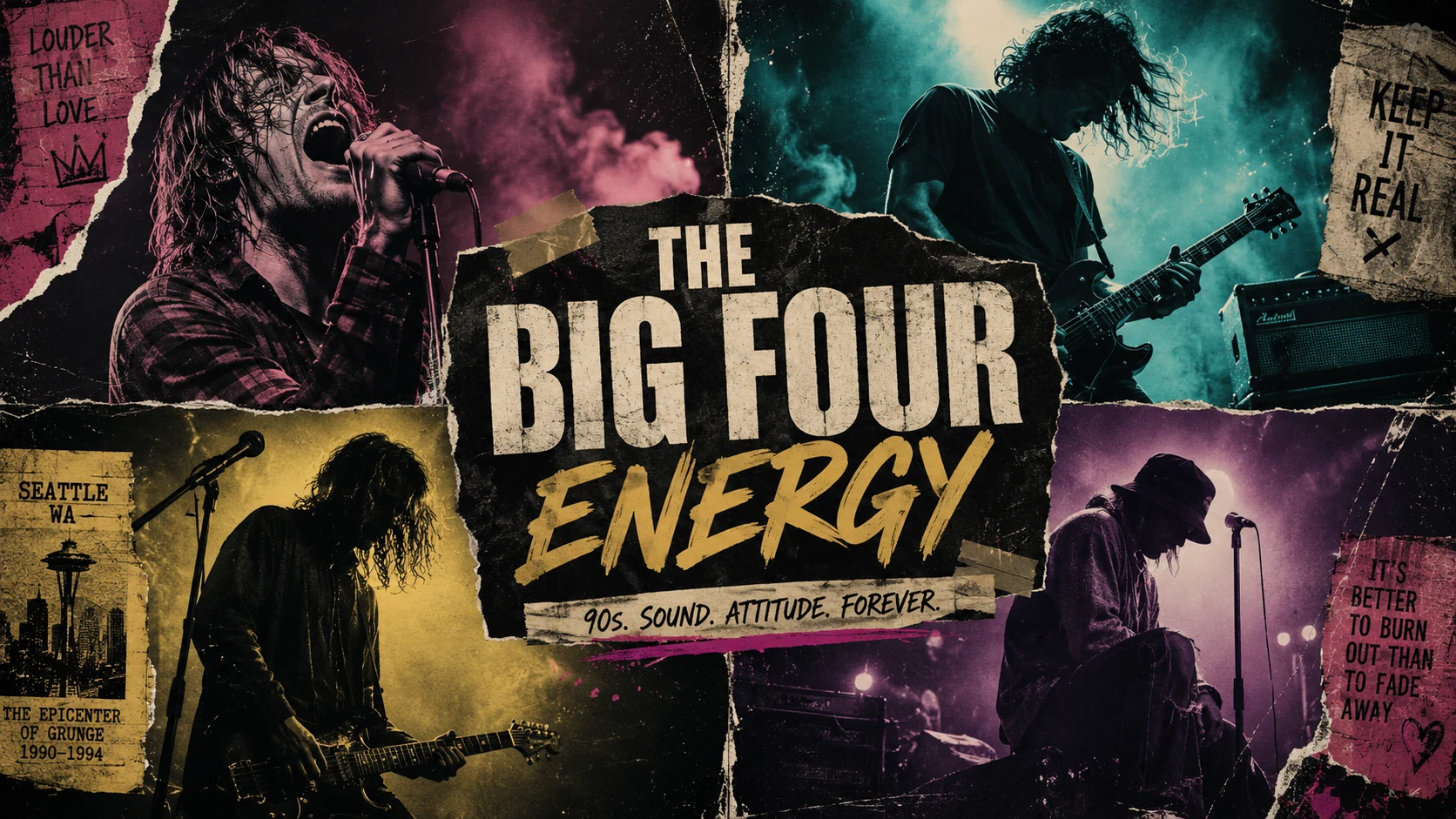
Nirvana brought punk tension and pop instincts. Pearl Jam brought arena-sized emotion without the old arena-rock costume. Soundgarden leaned heavier, stranger, and more metallic. Alice in Chains made harmony sound haunted. Together, they made mainstream rock feel less like a victory lap and more like a room full of people admitting things had gotten weird.
The thing about grunge is that it looked simple from a distance and complicated up close. The clothes were plain, but the emotions were not. The songs could be direct, but the lyrics often refused to resolve cleanly. The guitars could sound raw, but the hooks were strong enough to crack open Top 40 culture. A lot of the scene had roots in underground networks and local clubs, but once MTV and radio got involved, the sound became national almost overnight. That kind of speed does strange things. Ask any band that went from clubs to magazine covers before anyone had time to adjust their laundry schedule.
The Big Four Energy
- Nirvana made underground noise feel like pop culture detonation. They sounded like a band breaking through a wall and immediately regretting the room they entered.
- Pearl Jam turned sincerity, tension, and huge choruses into a long-running rock language. Their songs were built for catharsis, crowd voices, and staring out of car windows like life had chapters.
- Soundgarden brought heavy riffs, odd angles, and vocals that sounded like weather systems. They were not just heavy; they were strange in a way that made heavy feel bigger.
- Alice in Chains made darkness melodic, heavy, and impossible to shake. Their harmonies did not comfort; they hovered, which is somehow worse and better.
What Grunge Changed
Grunge changed the center of rock from showmanship to authenticity, or at least the performance of authenticity. Suddenly, sounding raw mattered more than sounding perfect. Looking uncomfortable became cooler than looking untouchable. And a whole generation learned that a loud quiet-loud chorus could do emotional damage from across the room.
It also changed what record labels chased. Suddenly everyone wanted a band with distortion, angst, thrift-store energy, and a singer who looked like fame had personally inconvenienced them. That created some great music, some deeply questionable signings, and a lot of very serious photos taken near brick walls.
Raw tension, melodic hooks, punk instincts, and the kind of cultural impact that made every conversation about alternative music start with them whether you wanted it to or not.
Arena-Sized Emotion Pearl JamMore classic-rock emotional sweep, more live-band gravity, more wounded sincerity, and a fan relationship that outlasted almost every trend cycle.
Heavy Alt-Rock SoundgardenHeavier, weirder, and more riff-driven, with vocals that made normal rock singing sound like someone forgot to unlock the ceiling.
Dark Harmony Alice in ChainsDark harmonies, heavy grooves, and a sound that made dread feel musical enough to replay, which is honestly very rude.
Alternative Was Bigger Than Grunge
The mistake is thinking the whole 90s alternative story begins and ends in Seattle, even though Seattle grunge is absolutely the first door most people kick open. Grunge blew the door open, but alternative was the entire crowd that rushed in behind it. Some of those artists were already veterans. Some were new. Some were heavier. Some were prettier. Some were sarcastic. Some were experimental. Some sounded like they had read too many books and then got locked in a guitar shop.
R.E.M. had already built a bridge from college rock to the mainstream, proving that mysterious lyrics, jangly guitars, and arty seriousness could become major cultural currency. The Smashing Pumpkins made guitar rock feel grand, wounded, and cinematic. Radiohead started as a guitar-era band and quickly turned into something much stranger. Beck made slacker surrealism sound like a hit single. Alanis Morissette turned confession, rage, and hooks into one of the decade’s defining pop-rock breakthroughs.
Then came the edges: Nine Inch Nails brought industrial dread into mainstream rotation. Garbage blended alt-rock, electronic texture, and detached cool. No Doubt pushed ska-punk and new wave brightness into pop territory. Hole made anger glamorous and ugly at the same time. Weezer made awkwardness catchy. Oasis and Blur brought Britpop into the American alternative conversation, because apparently the 90s also needed a transatlantic argument in sunglasses.
Alternative became less a single genre than a permission slip. If a song did not fit cleanly into classic rock, pop, metal, folk, or punk, but it had attitude, guitars, a weird video, or an emotionally unstable chorus, there was a decent chance it could be filed under “alternative” and sent to radio with a sticker that implied authenticity.
What used to feel like campus-radio currency became major-label, MTV, and arena-level business.
Women reshaped the sound. Rage, melody, controlAlanis, Hole, Garbage, Liz Phair, PJ Harvey, Tori Amos, The Breeders, and others made alternative more direct, complicated, and emotionally dangerous.
Alternative absorbed everything. Rock got porousIndustrial, Britpop, punk, folk, pop, psychedelia, noise, and electronic textures all found room under the same giant, badly labeled umbrella.
Britpop gave it swagger. Oasis, Blur, PulpWhile American alternative often wore alienation like a jacket, Britpop brought attitude, hooks, rivalry, and very confident hair.
Industrial made it darker. Noise meets machineryNine Inch Nails and industrial-adjacent sounds made alternative feel mechanical, anxious, sweaty, and not remotely interested in calming down.
Post-grunge cleaned it up. Radio aftershockBy the late 90s, the rawer early sound had been smoothed into huge modern-rock radio hits, for better, worse, and every acoustic mid-tempo single in between.
Essential 90s Alternative and Grunge Songs
This is not a strict ranking. For the full list treatment, jump to 50 essential 90s alternative songs or 25 essential grunge songs. This section is the starter shelf: the songs that explain why the decade changed so fast, why MTV looked different, and why every used CD store seemed legally required to have at least one wall of scratched jewel cases with angry fonts.
Some of these are grunge landmarks. Some are alternative-pop crossovers. Some are industrial, Britpop, post-grunge, or women-led alt-rock moments. Together, they show how wide the 90s alternative umbrella got before it collapsed under the weight of its own oversized cardigan.
The cultural detonation. Loud, messy, catchy, and instantly bigger than the band probably wanted it to be.
Pearl Jam “Alive”A huge, emotionally loaded rock anthem that helped make Pearl Jam feel like the other major pole of the grunge explosion.
Soundgarden “Black Hole Sun”Dark, psychedelic, huge, and one of the most unforgettable videos of the decade. Comforting? No. Iconic? Absolutely.
Alice in Chains “Man in the Box”Heavy, eerie, and built around a vocal sound that felt like it crawled out of a locked room.
R.E.M. “Losing My Religion”The college-rock-to-mainstream bridge, complete with mandolin, mystery, and peak early-90s moodiness.
Smashing Pumpkins “Today”Pretty, huge, damaged, and proof that alternative could sound dreamy while still carrying a bruise.
Alanis Morissette “You Oughta Know”A pop-rock exorcism that made mainstream radio sound much less polite for a while.
Beck “Loser”Slacker surrealism with a hook. It sounded like someone made a hit out of channel surfing and thrift-store dust.
Radiohead “Creep”Self-loathing with a guitar blast big enough to make awkwardness sound stadium-sized.
Nine Inch Nails “Closer”Industrial rock breaking into mainstream consciousness with menace, machinery, and zero chill.
Oasis “Wonderwall”Britpop becomes inescapable. Acoustic strumming, big feelings, and every dorm hallway learning four chords badly.
No Doubt “Just a Girl”Bright, sharp, sarcastic, and a reminder that alternative could also move, bounce, and smirk.
Hole “Violet”Fury, glamour, damage, and guitars that sound like they are actively trying to win an argument.
Garbage “Only Happy When It Rains”Detached, stylish, sarcastic, and electronic around the edges without losing the guitar bite.
Weezer “Buddy Holly”Geek power-pop with a video so memorable it practically came shrink-wrapped with the decade.
Foo Fighters “Everlong”Post-grunge becomes emotionally huge, melodic, and built for long-term replay instead of just immediate scene shock.
The Breeders “Cannonball”Weird, loose, instantly recognizable, and proof that alternative did not have to sound like it was applying for arena-rock citizenship.
Stone Temple Pilots “Plush”A huge early-90s rock-radio staple that showed how quickly the grunge-adjacent sound spread beyond Seattle.
Live “Lightning Crashes”Earnest, dramatic, very 90s, and the kind of song that made modern rock radio feel like a group therapy session with guitars.
Third Eye Blind “Semi-Charmed Life”Late-90s alternative-pop at peak deception: bright, catchy, and way darker than the bounce suggested.
Everclear “Santa Monica”Post-grunge radio catharsis with a chorus built for car windows, breakup energy, and pretending you were moving to California.
Veruca Salt “Seether”Crunchy, catchy, bratty, and a perfect example of the decade’s guitar-pop bite.
Blind Melon “No Rain”Sunny, strange, melancholy, and forever tied to one of the most recognizable video images of the decade.
The Cranberries “Zombie”Alternative’s emotional and political intensity goes massive, with a vocal performance nobody could mistake for background music.
Essential 90s Alternative and Grunge Albums
Singles made the videos unavoidable, but albums made the era feel personal. These were the CDs that got carried in binders, borrowed without being returned, stacked near stereos, and played so much that the jewel cases cracked like cheap fossil records.
The album that turned alternative from “your cool friend’s thing” into a mainstream earthquake.
Emotional heavyweight Pearl Jam — TenHuge songs, huge feelings, and the kind of record that made rock sincerity feel dangerous again.
Heavy art-grunge Soundgarden — SuperunknownBig, strange, heavy, psychedelic, and not interested in being reduced to one easy mood.
Dark harmony Alice in Chains — DirtOne of the darkest major records of the era, made unforgettable by heavy riffs and haunted vocal interplay.
College-rock crossover R.E.M. — Out of TimeA bridge between underground credibility and mainstream presence, minus the usual rock-star costume.
Alt-rock epic Smashing Pumpkins — Siamese DreamLayered guitars, bruised beauty, and the sound of alternative getting bigger without getting cheerful.
Confessional explosion Alanis Morissette — Jagged Little PillOne of the decade’s clearest examples of alternative attitude meeting pop-scale hooks and emotional wreckage.
Industrial breakthrough Nine Inch Nails — The Downward SpiralDark, mechanical, confrontational, and proof that mainstream alternative could get very uncomfortable.
Britpop anthem factory Oasis — Morning Glory?Big choruses, bigger confidence, and a reminder that 90s guitar culture was not only American angst.
Alt-pop weirdness Beck — Mellow GoldSlacker collage logic that made nonsense feel like an entire worldview.
Future fracture Radiohead — OK ComputerThe late-90s moment where guitar-era anxiety started staring directly into the digital future and blinking first.
Stylish hybrid Garbage — GarbageGuitars, electronics, sarcasm, and cool detachment blended into a late-90s alternative shape-shifter.
Women Made 90s Alternative Sharper
Any version of 90s alternative that only talks about the flannel guys is doing the decade dirty. Women-led alternative did not just add variety. It changed the emotional vocabulary of the whole scene. It brought rage, sarcasm, sexuality, vulnerability, literary detail, pop hooks, punk abrasion, and confession without asking permission to be tidy.

Alanis Morissette made betrayal sound like a stadium singalong. Hole made anger feel glamorous, ugly, public, and uncontainable. Garbage turned cool detachment into a weapon. Liz Phair made frankness feel conversational and radical. PJ Harvey brought art-rock intensity and bluesy menace. Tori Amos sat at a piano and made confession feel like a locked room opening. The Breeders turned sideways weirdness into an alt-rock hit. No Doubt, with Gwen Stefani up front, turned ska, punk, new wave, pop, and gender politics into something bright enough for radio and sharp enough to sting.
This matters because the 90s were full of male alienation, and sure, there was plenty to alienate about. But the women of alternative often expanded the frame: desire, control, hypocrisy, fame, rage, power, sex, image, danger, and survival all got louder. The decade needed that. Otherwise the whole thing would have collapsed under the weight of men in oversized sweaters staring at floorboards.
Turned personal fury and pop hooks into one of the biggest emotional shockwaves of the decade.
Hole Glamour, damage, rageMade alternative anger messy, theatrical, and impossible to separate from fame, gender, and survival.
Garbage Cool with sharp edgesBrought electronic polish, guitar bite, and a detached vocal style that sounded like it knew exactly what it was doing.
Liz Phair Indie franknessMade directness, awkwardness, intimacy, and plainspoken confidence part of the decade’s alternative language.
PJ Harvey Art-rock intensityRaw, bluesy, literary, confrontational, and never content to be filed neatly where the industry wanted her.
No Doubt Bright but not lightweightSka-punk and new wave color with pop hooks, complicated relationship dynamics, and a frontwoman who owned the frame.
MTV, Radio and Soundtracks Made Alternative Feel Huge
The 90s alternative boom was not just about albums. It was about delivery systems. MTV gave the songs a look. Modern rock radio gave them repetition. Movie soundtracks placed them inside scenes, trailers, credits, and teenage memory. CD singles made them portable. Record clubs made them financially suspicious. Together, all of it turned alternative into a lifestyle before anyone wanted to admit it was a lifestyle.
MTV made weirdness mainstream.
Alternative and grunge were perfect for MTV because they gave the channel a new visual language after the glossy 80s. Videos could be strange, cheap-looking, surreal, abrasive, or emotionally uncomfortable. Nirvana’s gym rally, Soundgarden’s nightmare suburbia, Smashing Pumpkins’ dreamlike worlds, Nine Inch Nails’ industrial dread, and Beck’s slacker collage logic all helped make the music feel like a full cultural signal.
It was not just sound. It was thrift-store sweaters, baby-doll dresses, combat boots, bleached hair, bad lighting, fisheye lenses, empty swimming pools, deadpan stares, and the kind of video that made parents walk into the room and ask if something was wrong with the TV.
Radio changed its personality.
Once alternative broke through, rock radio had to adjust fast. MTV and modern rock radio became gatekeepers for bands that did not sound like old classic-rock heroes or 80s hair-metal holdovers. Top 40 also started letting certain alternative songs in, especially when the hooks were undeniable.
That is why the 90s felt so messy in the best way. You could hear grunge, R&B, hip-hop, dance-pop, power ballads, one-hit wonders, and weird alternative songs within the same cultural moment. It was less “genre lane” and more “somebody dropped a CD binder down the stairs.”
90s Alternative and Grunge Timeline
The sound did not arrive all at once, which is why the year pages from 1990 through 1999 matter so much. It mutated across the decade, from underground breakthrough to mainstream takeover to post-grunge radio dominance and late-90s genre sprawl.
The decade begins with alternative still feeling like a side channel. College rock, industrial, early grunge, and underground scenes are already loaded; the mainstream just has not fully caught up yet. Start the year path at 1990 Songs.
The pressure breaks. Nirvana, Pearl Jam, R.E.M., and a flood of guitar-driven records make the old pop-metal and gloss-rock order suddenly look very nervous. Keep rewinding with 1991 Songs.
Alternative is no longer a secret. MTV, radio, and major labels start treating previously “weird” sounds like the new center. Grunge becomes a national visual language, which is a very funny fate for a scene that looked allergic to branding. See the bigger year mix at 1992 Songs.
The umbrella widens. Alt-rock, grunge, hip-hop, R&B, and soundtrack culture all start crashing into each other. The CD era is fully in motion, and the phrase “track 7 is underrated” becomes a personality type. Continue with 1993 Songs.
The mood shifts darker and broader. Grunge mythology hardens, post-grunge starts forming, industrial breaks wider, and alternative feels less like an invasion and more like the new map. Jump into 1994 Songs.
Alanis explodes, Britpop crosses over, No Doubt starts moving toward bigger pop visibility, and alternative attitude proves it can merge with giant hooks. Rewind the full year at 1995 Songs.
The post-grunge, ska-punk, alt-pop, and modern-rock radio era gets louder. Alternative is no longer just a disruption; it is infrastructure. Keep going with 1996 Songs.
Radiohead pushes toward the future, Foo Fighters become a durable post-grunge force, and late-90s modern rock starts sharing oxygen with teen pop, hip-hop, and electronic crossover. Rewind 1997 Songs.
The genre keeps fragmenting. Alternative now means post-grunge radio, pop-punk, ska-punk, electronic-rock hybrids, singer-songwriter crossovers, and bands that would have been called something else five years earlier. See 1998 Songs.
By the end of the decade, alternative is no longer the insurgent outsider. It is part of the mainstream furniture, competing with teen pop, rap-rock, hip-hop, R&B, and TRL-era chaos. Close the decade with 1999 Songs.
The Main 90s Alternative Deep Dives
“Alternative” became so big that the label almost stopped meaning anything specific. It was a radio format, a clothing mood, a record-store section, a personality test, and eventually just another way for major labels to say, “This one has distorted guitars and a video with bad lighting.”
Heavy, raw, melodic, wounded, and instantly mythologized until every mall had flannel like it was emergency survival gear.
College-rock crossover R.E.M., Pixies influence, 10,000 ManiacsThe older underground pipeline that proved “alternative” had been building long before the mainstream noticed.
Artier alt-rock Radiohead, Smashing Pumpkins, BeckMore ambitious, stranger, moodier, and less interested in fitting neatly inside one guitar-rock box.
Industrial and dark alternative Nine Inch Nails, Ministry-adjacent energyMachines, dread, distortion, leather, and music that sounded like a basement computer having a nervous breakdown.
Women-led alternative Alanis, Hole, Garbage, Liz PhairConfessional, furious, funny, stylish, uncomfortable, and absolutely necessary to the full story.
Post-grunge and modern rock Foo Fighters, Live, Bush, Matchbox TwentyThe radio-friendly aftershock: cleaner, bigger, more polished, and built for the back half of the decade.
Ska-punk and bright alt-pop No Doubt, Sublime-adjacent radio, Mighty Mighty BosstonesNot every alternative song was a rainy basement. Some of them bounced, skanked, smirked, and wore louder pants.
Britpop Oasis, Blur, PulpBritish guitar music brought swagger, rivalry, melody, and a completely different flavor of 90s attitude.
Movie-soundtrack alternative The Crow, Singles, Reality BitesSoundtracks made alternative feel cinematic, romantic, doomed, cool, and very suitable for end-credit staring.
90s Alternative by Year: What to Listen For
The best way to understand the 90s alternative boom is to track the decade year by year. The sound changes fast. One minute alternative feels like a breakthrough, then a movement, then an industry, then a radio format, then a late-decade pileup with teen pop and rap-rock revving in the next lane.
Alternative is bubbling underneath the mainstream. The ingredients are there; the explosion is loading.
1991 The door breaks openGrunge and college-rock crossover push into the center of the decade’s music story.
1992 The takeover goes nationalAlternative becomes a mainstream identity, not just a sound for people with better record-store access.
1993 The umbrella widensGrunge, alt-pop, college rock, and heavier modern rock all crowd the same cultural lane.
1994 The mythology hardensThe decade gets darker, bigger, and more complicated as alternative becomes inescapable.
1995 Confession and BritpopAlanis, Oasis, post-grunge, and modern rock make alternative feel broad enough to swallow pop hooks.
1996 Post-grunge infrastructureModern rock radio has its own ecosystem now. The movement has become a machine.
1997 Future anxietyRadiohead, Foo Fighters, and late-90s alternative sounds point toward a more fragmented future.
1998 Genre pileupAlternative shares space with pop-punk, post-grunge, ska, electronica crossover, and TRL-era pop pressure.
1999 The handoffBy 1999, alternative is no longer the outsider. It is part of the mainstream furniture, and the 2000s are already knocking.
90s Music Hub The full decadeJump back to the main 90s music hub for the other panels: hip-hop, R&B, pop, dance, teen hits, and more.
Forgotten Party Anthems The other 90sBecause the same decade that gave us grunge also gave us dance-floor chaos. The 90s contained multitudes, unfortunately.
Why 90s Alternative Still Hits
90s alternative still works because it captured the exact moment when mainstream music decided imperfection could sell. The voices cracked. The guitars buzzed. The videos got strange. The lyrics were often vague enough to project your whole personality onto them, which is exactly what teenagers are legally required to do.
More importantly, the era created a bridge between old-school rock and the genre-blurred music world that came after it. Grunge made heaviness emotional. Alternative made weirdness commercial. Women-led alt-rock made confession sharper and less polite. Industrial and electronic influences hinted at where rock could mutate. Britpop reminded everyone that guitar bands could still act like national sporting events. Post-grunge proved the sound could be smoothed out and sold in bulk.
For Gen X memory, the sound is inseparable from the objects around it: CD towers, mixtapes, Columbia House regret, Discman skip protection that lied to your face, posters from record stores, MTV countdowns, flannel that was somehow both anti-fashion and extremely purchased, and the sacred ritual of reading liner notes like they contained classified government files.
It also still hits because the best songs were not trapped inside the fashion. You do not need the exact boots, the exact haircut, the exact ripped jeans, or the exact dorm-room smell to understand the charge of a chorus that sounds like frustration finally getting a microphone. That is why the music keeps coming back. The industry machine around it aged in hilarious ways. The songs did not.
More 90s Alternative and Grunge Deep Dives
This is the main rewind, but the 90s alternative story goes way deeper than one page. Some lanes are obvious — the Big 4 of Grunge, Nirvana, Pearl Jam, Soundgarden, and Alice in Chains. Others are the side doors that make the decade more fun: flannel becoming a uniform, MTV turning weirdness into primetime, movie soundtracks making alt-rock feel cinematic, and CD binders turning every car ride into a filing problem.
Think of this section like the deeper shelf at the record store: the obvious classics up front, the weird stuff in the middle, and the songs you forgot you loved hiding near the back with a cracked jewel case and a price sticker that never fully came off.
The Grunge Essentials
Start here if you want the heavy center of the story. The Big 4 gives you the wide view, then the band deep dives split the sound into its different personalities: Nirvana’s cultural detonation, Pearl Jam’s emotional sweep, Soundgarden’s heavy weirdness, and Alice in Chains’ darker harmonies. The Seattle scene piece ties it all back to the place, hype, backlash, and flannel economy that made the whole thing feel bigger than music.
Culture, MTV & Listening Habits
Women Who Made Alternative Sharper
The decade gets a lot less interesting if you only talk about dudes in flannel staring at floorboards. Women of 90s alternative rock is the big overview, while women of 90s alternative rock, Hole, Garbage, and Liz Phair, and The Cranberries and Tori Amos pull the story into rage, confession, atmosphere, sarcasm, sexuality, politics, and songs that did not ask permission to be comfortable.
Subgenres & Scene Splinters
List Posts & Deep Cuts
Keep the 90s Music Rewind Going
Alternative and grunge are only one panel of the 90s music story, but this rewind plugs into the whole thing: the 90s Music hub, the year-by-year song pages, the grunge band deep dives, the MTV and soundtrack posts, and the big list pages that catch search traffic and push readers deeper into the rewind.
From here, this page works like the front door: readers can start here, jump to the Big 4 of Grunge, browse the 50 Essential 90s Alternative Songs, or fall straight into the MTV video rabbit hole like it is 1995 and homework is optional.
FAQ: 90s Alternative and Grunge
What is the difference between grunge and alternative rock?
Grunge is a heavier, darker branch of alternative rock strongly associated with Seattle and bands like Nirvana, Pearl Jam, Soundgarden, and Alice in Chains. Alternative rock is the wider umbrella that includes grunge, college rock, Britpop, industrial, post-grunge, ska-punk, power pop, and other non-mainstream sounds that crossed over during the 90s.
Who were the biggest 90s grunge bands?
The most iconic grunge bands were Nirvana, Pearl Jam, Soundgarden, and Alice in Chains. Other important names around the scene include Stone Temple Pilots, Mudhoney, Screaming Trees, and Temple of the Dog.
What song made grunge mainstream?
“Smells Like Teen Spirit” by Nirvana is the obvious cultural tipping point. It did not create the scene, but it made the mainstream impossible to keep away from it.
Was alternative music only guitar rock?
No. Guitar rock was the center of the 90s alternative boom, but the umbrella also included industrial sounds, electronic textures, folk-influenced singer-songwriters, Britpop, ska-punk, noise, art rock, and pop-adjacent acts that did not fit cleanly into older radio formats.
What are the best starter albums for 90s alternative and grunge?
Start with Nirvana’s Nevermind, Pearl Jam’s Ten, Soundgarden’s Superunknown, Alice in Chains’ Dirt, R.E.M.’s Out of Time, Smashing Pumpkins’ Siamese Dream, Alanis Morissette’s Jagged Little Pill, Nine Inch Nails’ The Downward Spiral, Oasis’ Morning Glory?, and Radiohead’s OK Computer.
Why does 90s alternative still feel so nostalgic?
Because it is tied to a full cultural package: MTV, CD binders, thrift-store fashion, movie soundtracks, dorm rooms, radio stations, school parking lots, and a very specific feeling that everything was either deeply meaningful or completely stupid. Usually both.
Where should I go next?
Start with the 90s Alternative & Grunge Hub, then jump into the Big 4 of Grunge, 50 Essential 90s Alternative Songs, and the year pages to see how the whole decade changed around it.