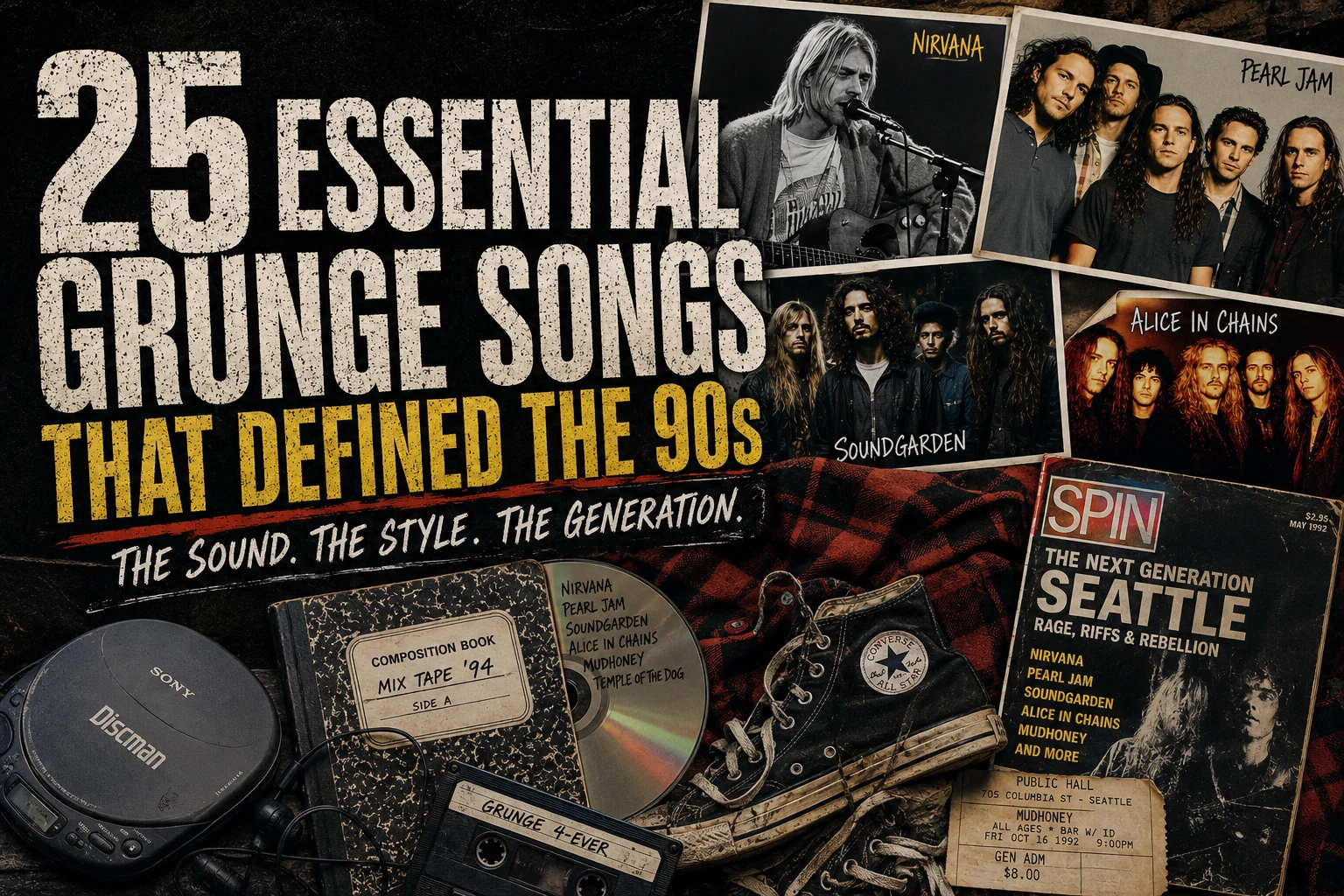
25 Essential Grunge Songs That Defined the 90s
Grunge was not just a sound. It was a whole Gen X operating system: CD binders in the passenger seat, flannel over band shirts, thrift-store boots, bedroom stereos, taped-over cassettes, MTV after midnight, college radio fuzz, record-store judgment, and the feeling that the old glossy rock world had finally been caught lying.
These are the essential grunge songs that made the 90s feel heavier, weirder, darker, louder, sadder, funnier, and more honest. Some came straight from the Seattle grunge scene. Some came from the wider alternative ecosystem that exploded after Seattle kicked the door in. Together, they explain why 90s alternative and grunge still hits like a dusty amp falling down a staircase.
What Are the Essential Grunge Songs of the 90s?
The essential grunge songs of the 90s are the tracks that turned underground heaviness, Seattle scene energy, punk sarcasm, metal weight, MTV exposure, college radio buzz, and Gen X emotional damage into a mainstream rock language. The core list starts with Nirvana, Pearl Jam, Soundgarden, and Alice in Chains, then expands to Mudhoney, Temple of the Dog, Screaming Trees, Mother Love Bone, Hole, L7, Stone Temple Pilots and the wider alternative world that orbited grunge.
This is not just a “loud guitars were loud” list. These songs mattered because they changed what rock was allowed to feel like. They made glossy excess look fake. They made sadness sound massive. They made thrift-store clothes feel like armor. They made radio darker. They made MTV stranger. They made millions of suburban Gen X kids think, “Oh good, someone else also thinks everything is broken.”
Need the Bigger Grunge Map?
This is the essential-song stack. For the full visual command center, jump to the 90s Alternative & Grunge Hub. For the big editorial story of the whole movement, go to the 90s Alternative & Grunge pillar post.
The Quick List: 25 Essential Grunge Songs
Here is the full rewind before we crawl into the amp smoke. It is ranked loosely by cultural weight, 90s impact, grunge identity, staying power, and how hard the song still hits when it comes on while you are driving with absolutely nowhere useful to be.
- “Smells Like Teen Spirit” — Nirvana
- “Alive” — Pearl Jam
- “Man in the Box” — Alice in Chains
- “Outshined” — Soundgarden
- “Touch Me I’m Sick” — Mudhoney
- “Hunger Strike” — Temple of the Dog
- “Would?” — Alice in Chains
- “Jeremy” — Pearl Jam
- “Black Hole Sun” — Soundgarden
- “Come As You Are” — Nirvana
- “Rooster” — Alice in Chains
- “Rusty Cage” — Soundgarden
- “Even Flow” — Pearl Jam
- “Nearly Lost You” — Screaming Trees
- “Heart-Shaped Box” — Nirvana
- “Plush” — Stone Temple Pilots
- “Chloe Dancer / Crown of Thorns” — Mother Love Bone
- “Down in a Hole” — Alice in Chains
- “Black” — Pearl Jam
- “Jesus Christ Pose” — Soundgarden
- “Lithium” — Nirvana
- “Doll Parts” — Hole
- “Pretend We’re Dead” — L7
- “Nutshell” — Alice in Chains
- “Fell on Black Days” — Soundgarden
Listen to the Essential Grunge Playlist
Hit play and let the 90s mood do what it does best: make the room darker, the guitars heavier, and your old CD binder feel spiritually relevant again.
What Counts as a Grunge Song?
Grunge is one of those labels everyone uses and then immediately argues about, because apparently Gen X could not even have a music genre without turning it into a parking-lot debate. At its strictest, grunge points toward the Seattle and Pacific Northwest scene: Nirvana, Pearl Jam, Soundgarden, Alice in Chains, Mudhoney, Mother Love Bone, Temple of the Dog, Screaming Trees, TAD, Green River, the Melvins, and the local ecosystem around them.
But by the early 90s, grunge became bigger than geography. MTV, modern rock radio, major labels, movie soundtracks, fashion magazines, and suburban CD collections all helped turn the sound into a national mood. That is why this list includes a few grunge-adjacent essentials like Stone Temple Pilots, Hole, and L7. They were not all Seattle bands, and they were not all the same sound, but they lived inside the larger 90s alternative rock shift that Seattle forced into the mainstream.
The core ingredients are not hard to hear: distorted guitars, heavy riffs, punk suspicion, metal weight, emotional exhaustion, sarcastic anti-star energy, rough edges, and melodies strong enough to sneak the darkness onto radio. Grunge was heavy, but not always metal. It was punk-influenced, but not always fast. It was alternative, but it became mainstream. It was anti-fashion, then somehow fashion. Very 90s. Very confusing. Very profitable for anyone selling plaid.
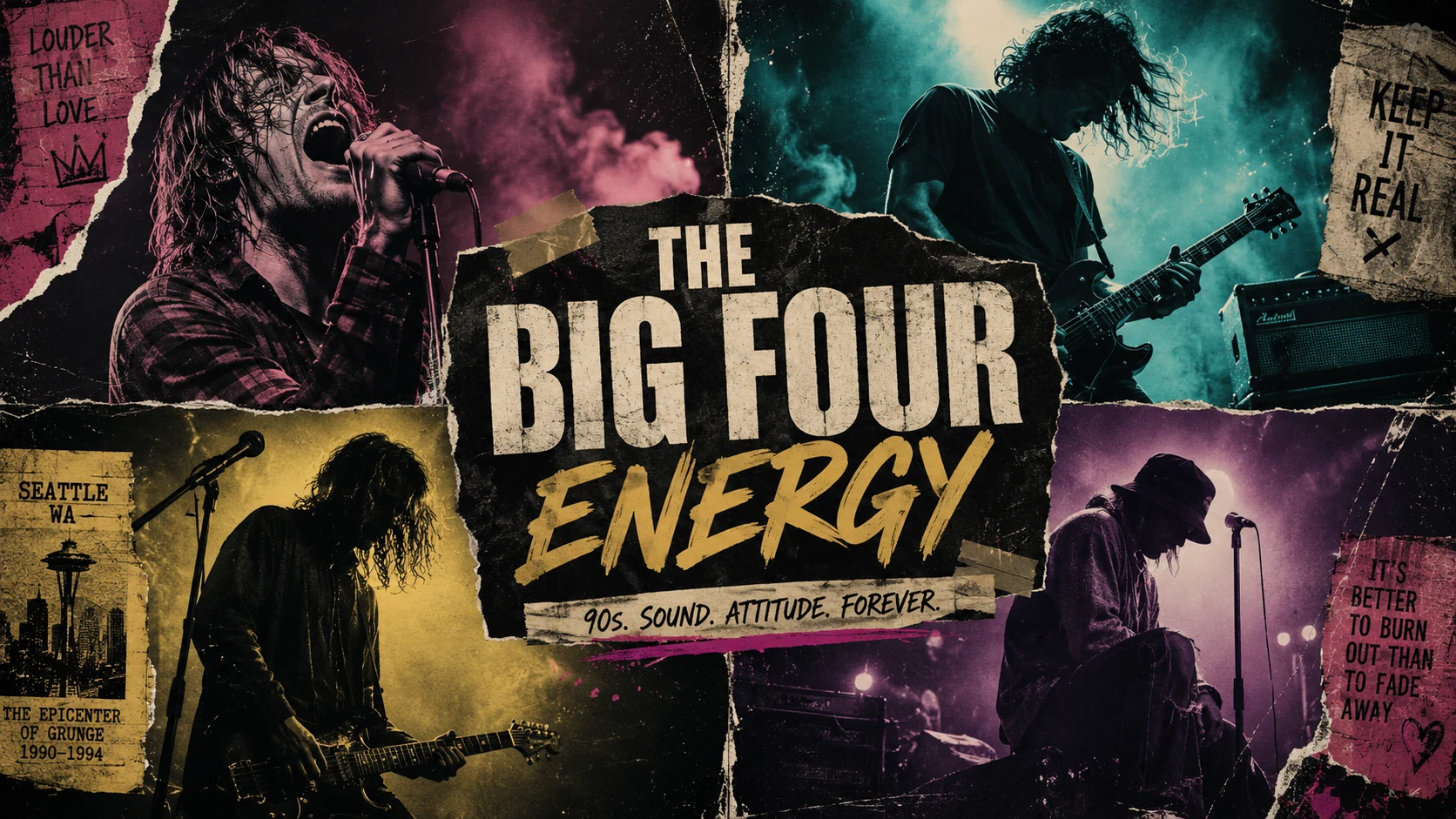
Nirvana, Pearl Jam, Soundgarden, Alice in Chains, Mudhoney, Mother Love Bone, Temple of the Dog, Screaming Trees, TAD, Green River and the Melvins.
Grunge-adjacent 90s alternative The expansionArtists outside Seattle who shared the heaviness, attitude, era, radio space, emotional tone, or cultural overlap of the grunge moment.
MTV and radio grunge The mainstream translationThe songs that turned underground heaviness into household recognition through videos, modern rock radio, and endless teenage replay.
Gen X lifestyle grunge The real memoryThe songs that lived in cars, basements, bedrooms, CD binders, record stores, dorm rooms, and late-night TV static.
The Big 4 Are the Spine of the List
You cannot build a serious essential grunge songs list without the Big 4. Nirvana cracked the mainstream open. Pearl Jam turned pain into communal release. Soundgarden made the whole thing heavier, stranger, and more musically dangerous. Alice in Chains brought the dark metallic shadow that still feels like the room got colder.
The important thing is that they did not all do the same job. Nirvana made alternative feel like a cultural rupture. Pearl Jam made it feel like a crowd singing through damage together. Soundgarden made it feel like Sabbath got lost in an art-school nightmare. Alice in Chains made it feel like confession, dread, and heavy riffs were sharing the same cigarette behind a closed door.
25 Essential Grunge Songs That Defined the 90s
These are not just tracks to throw into a playlist and call it a day. Each one represents a different piece of the grunge story: Seattle before the boom, the MTV explosion, the album era, the soundtrack era, the unplugged aftershock, the Gen X lifestyle memory, and the way 90s rock learned to sound less like a commercial and more like a cracked mirror.
“Smells Like Teen Spirit” — Nirvana
This is the obvious #1 because sometimes the obvious answer is obvious for a reason. “Smells Like Teen Spirit” did not invent grunge, but it did make the old mainstream rock order look like it had wandered into the wrong decade wearing too much hairspray. The song took underground-derived noise, pop structure, punk sarcasm, and teenage disaffection and turned it into a cultural detonation.
The genius was in the contradiction. It was catchy but ugly. Massive but annoyed by its own massiveness. Anthemic but suspicious of anthems. The chorus hit like a door being kicked open, but the whole thing still felt like a prank played on anyone expecting rock stardom to arrive clean and smiling.
For the full story of why this band shifted the decade, rewind how Nirvana changed 90s music forever. This song is the turning point where alternative stopped being the weird aisle and became the front of the store.
“Alive” — Pearl Jam
“Alive” introduced Pearl Jam as the other side of grunge: not a sarcastic detonation, but a huge emotional reckoning. Where Nirvana sounded like the system breaking, Pearl Jam sounded like a crowd trying to survive what broke. Eddie Vedder’s voice gave the song an almost mythic weight, while Mike McCready’s guitar work pushed it into classic-rock scale without losing the 90s ache.
The song’s power comes from how it changes shape depending on how you hear it. On the surface, it can feel triumphant. Underneath, it is tangled, conflicted, and much darker than a simple survival anthem. That tension became Pearl Jam’s specialty: songs that crowds could shout together while still carrying heavy emotional baggage. Very convenient for a generation that hated sincerity until the song started and then suddenly had feelings.
Pearl Jam’s whole grunge role is bigger than one hit, which is why The Other Side of Grunge: Pearl Jam is essential context. “Alive” is where that side starts becoming unavoidable.
“Man in the Box” — Alice in Chains
“Man in the Box” is where Alice in Chains made it clear that grunge could be darker, slower, heavier, and more metallic than the wider mainstream expected. The riff had weight. Layne Staley’s voice sounded like it was pushing through concrete. Jerry Cantrell’s guitar tone gave the song that grinding, hypnotic menace that separated Alice in Chains from almost everyone else in the scene.
The song helped establish Alice in Chains before the full Seattle gold rush became a national obsession. It also showed that grunge was not one sound. This was not Nirvana’s punk-pop blast or Pearl Jam’s arena catharsis. This was dread with a groove, a heavy-rock shadow that could sit next to metal but still feel unmistakably 90s.
For more on why their catalog feels so haunted, rewind Alice in Chains: The Darkest Sound of Grunge. “Man in the Box” is the doorway into that darkness.
“Outshined” — Soundgarden
“Outshined” is Soundgarden at their most accessible without sanding off what made them dangerous. It has a massive riff, an instantly memorable vocal hook, and enough oddness underneath the surface to remind you that this band was never just trying to write simple rock-radio product. Chris Cornell’s voice moves from weariness to eruption, while Kim Thayil’s guitar tone makes the whole thing feel like it was forged in a very angry garage.
The song matters because it put Soundgarden’s heavy weirdness within reach of a broader audience. They were not merely the “metal” wing of grunge, even though their riffs could absolutely knock drywall loose. They brought psychedelic dread, strange grooves, art-rock intelligence, and heavy music that sounded like it had read a book and then thrown it through a window.
The full Soundgarden story lives in Soundgarden: The Heavy, Weird Side of Grunge. “Outshined” is one of the cleanest entry points into their world.
“Touch Me I’m Sick” — Mudhoney
Before grunge became a national lifestyle package, Mudhoney sounded like the scene coughing directly into the microphone. “Touch Me I’m Sick” is filthy, funny, sneering, fuzzy, and proudly unpolished. It is not the biggest grunge hit, but it is one of the most important grunge songs because it captures the movement before MTV cleaned the lens and the mall discovered flannel.
The song is early Sub Pop energy in its purest form: garage-rock mess, punk sarcasm, fuzzed-out attitude, and a refusal to become heroic. It is the sound of grunge before anyone expected it to save rock, define a generation, or appear in fashion spreads written by people who had just learned what thrift stores were.
To understand why this matters, you need the bigger scene story in The Rise and Fall of the Seattle Grunge Scene. Mudhoney are the grime under the mythology’s fingernails. Seattle grunge scene
“Hunger Strike” — Temple of the Dog
“Hunger Strike” is less a standard grunge single than a spiritual bridge between Seattle stories. Temple of the Dog formed in the aftermath of Andrew Wood’s death, connecting Chris Cornell, Soundgarden, Mother Love Bone, and the future Pearl Jam world. That alone gives the song historical weight, but the recording itself is what turns it into mythology.
Chris Cornell and Eddie Vedder’s voices together sound like two different Seattle futures meeting in the same room. Cornell is huge, soulful, and mournful. Vedder enters with raw earth and urgency. The song feels like grief before the gold rush, before the scene became an industry target, before every camera wanted a piece of Seattle.
“Hunger Strike” belongs on this list because it shows grunge as community, tribute, and emotional inheritance. It is not just about sound. It is about the tangled human scene behind the records. Pearl Jam Soundgarden
“Would?” — Alice in Chains
“Would?” is one of the definitive songs of the grunge soundtrack era. It worked as part of Alice in Chains’ dark universe, but it also became tied to Singles, the movie and soundtrack that helped turn Seattle into a portable 90s mood. The bassline stalks. The guitars are heavy but controlled. Layne Staley and Jerry Cantrell’s voices create that haunted duality that made Alice in Chains unmistakable.
The song’s importance is partly musical and partly cultural. It is the sound of Seattle becoming something fans outside Washington could hold in their hands through a CD soundtrack. For a lot of people, Singles was not just a movie. It was a map to a scene they did not live inside.
For more on that soundtrack effect, connect this to 90s movie soundtracks and alternative rock and the best 90s alternative movie soundtrack songs.
“Jeremy” — Pearl Jam
“Jeremy” is one of the clearest examples of how grunge used MTV differently than the previous rock era. The video was not just a performance clip. It was narrative, symbolic, uncomfortable, and impossible to treat like background noise. Pearl Jam turned a heavy subject into a song that felt huge without feeling empty, and MTV made that heaviness unavoidable.
The track helped turn Pearl Jam into one of the most emotionally central bands of the decade. It had the slow build, the tension, Vedder’s voice, and the kind of chorus that could fill a stadium while still feeling like it came from a locked room. That balance is why Pearl Jam’s early songs kept growing in meaning as their audience grew.
“Jeremy” also belongs inside the larger MTV alternative rock takeover. The song showed that 90s rock videos could be heavy cultural events, not just four guys pretending fans enjoy watching them stand in a warehouse.
“Black Hole Sun” — Soundgarden
“Black Hole Sun” is Soundgarden’s strangest massive hit, which is exactly why it belongs here. It is melodic enough to become unavoidable, but the atmosphere is pure suburban apocalypse. The song floats more than it stomps, and Chris Cornell’s voice gives it a dreamy, doomed quality that made it stand apart from the heavier riff attacks elsewhere in their catalog.
The video made the song even more unforgettable. Its warped smiles, surreal imagery, and end-of-the-world brightness turned Soundgarden into part of the 90s visual memory. It was not just a hit. It was one of those clips that burned itself into the MTV era’s collective brain, right next to static, weird animation, and commercials for things we absolutely did not need.
“Black Hole Sun” matters because it proved grunge could be psychedelic, strange, beautiful, massive, and deeply unsettling all at once. Soundgarden’s heavy, weird side
“Come As You Are” — Nirvana
“Come As You Are” was the more hypnotic side of Nirvana’s breakthrough. It did not hit like “Smells Like Teen Spirit,” but it pulled listeners into the band’s world with that watery guitar line, the soft-loud tension, and Kurt Cobain’s gift for making ambiguity feel like a hook. The song was accessible without feeling clean, which is basically the Nirvana magic trick.
It helped prove that Nirvana were not a one-song explosion. They could write songs that were weird, simple, moody, and unforgettable. The track also became one of the songs that made Nevermind feel like an album people lived with, not just a cultural news event.
This is essential grunge because it captures the more internal version of Nirvana: less riot, more fog, but still carrying that anti-polish energy that made the old mainstream feel obsolete.
“Rooster” — Alice in Chains
“Rooster” is one of Alice in Chains’ most powerful songs because it expands grunge darkness beyond personal collapse into inherited trauma and war memory. Jerry Cantrell wrote it about his father’s Vietnam experience, and the song carries a slow, heavy gravity that feels different from anything else on rock radio at the time.
Layne Staley’s vocal performance turns the chorus into something enormous without making it glossy. The song builds like a storm, but it never loses its weight. It is heavy in the literal guitar sense, but also heavy in the generational sense — a song about what gets carried forward, what families absorb, and what silence does over time.
“Rooster” matters because grunge often worked best when it connected personal pain to larger histories. It was not just “I feel bad.” It was “something is wrong and it has roots.”
“Rusty Cage” — Soundgarden
“Rusty Cage” is Soundgarden’s controlled demolition mode. The song is tense, angular, aggressive, and rhythmically restless. It feels like it is constantly trying to break out of itself, which makes the title feel less like a metaphor and more like a building code violation.
What makes it essential is how much it rejects the easy version of grunge. This is not a simple slacker anthem. It is heavy, technical, sharp-edged, and weird. Soundgarden were one of the bands that kept grunge from being reduced to three chords and a sad shirt. They brought musicianship and heaviness without losing the scene’s grit.
“Rusty Cage” also connects grunge to a broader rock lineage without sounding nostalgic. It looks backward through heavy rock and forward into 90s alternative at the same time.
“Even Flow” — Pearl Jam
“Even Flow” is Pearl Jam’s early live energy condensed into one of the most durable rock songs of the decade. The riff swings, the band locks in, and Eddie Vedder delivers a vocal that feels half-mumbled, half-erupted, and fully committed to making everyone attempt the words even when nobody really knew all of them.
The song gave Pearl Jam a more kinetic side next to the emotional weight of “Alive,” “Jeremy,” and “Black.” It showed that they could be huge without becoming stiff. There was movement, groove, and stage energy in it — the feeling of a band built to play for people, not just exist in videos.
That live-centered identity helped Pearl Jam last. Their fans did not only connect to the records. They connected to the idea of the band as a continuing community. “Even Flow” is one of the early reasons why.
“Nearly Lost You” — Screaming Trees
Screaming Trees were not always centered in the simplified grunge story, but “Nearly Lost You” proves why they belong in the essential conversation. The band brought a psychedelic, rootsy, heavier-than-college-rock feel to the Northwest ecosystem, and Mark Lanegan’s voice gave them a depth that sounded older, rougher, and more weathered than the band’s era alone.
“Nearly Lost You” benefited from the Singles soundtrack moment, but it also stands on its own as one of the great grunge-era songs. It is melodic, driving, smoky, and less obvious than the Big 4 hits. It reminds you that the movement had side roads worth taking.
This song matters because grunge was never only four bands. Screaming Trees expand the map and make the whole scene feel more regional, stranger, and more textured.
“Heart-Shaped Box” — Nirvana
“Heart-Shaped Box” is essential because it captures Nirvana after the explosion, when fame had become part of the band’s burden. In Utero was rougher, more abrasive, and more resistant than Nevermind, but “Heart-Shaped Box” still had the melodic pull that made Nirvana impossible to ignore.
The song is unsettling, strange, and unforgettable. It does not sound like a band trying to recreate its breakthrough. It sounds like a band trying to live after being turned into a symbol. That is part of why it matters so much inside the grunge timeline. It is not the beginning of the boom; it is the sound of the boom getting complicated.
In the bigger story of grunge, “Heart-Shaped Box” represents the phase when the movement was already famous enough to be misunderstood by everyone, including some of the people profiting from it.
“Plush” — Stone Temple Pilots
Stone Temple Pilots were not a Seattle band, and including them in grunge lists can cause the kind of argument that makes record-store clerks visibly happier. But “Plush” belongs here because it was part of the national grunge-era radio moment. It carried the heavy guitars, dark melodic mood, and brooding vocal style that dominated early-90s rock airwaves after Seattle shifted the center.
“Plush” also shows how fast grunge’s influence spread beyond its original geography. Once the mainstream wanted this kind of rock, bands outside Seattle entered the conversation, sometimes authentically, sometimes opportunistically, sometimes both. STP became one of the biggest examples of how grunge-adjacent radio rock could thrive in the wake of the Seattle explosion.
Whether you file it under grunge, alternative, post-Seattle hard rock, or “please stop arguing and just play the song,” its 90s impact is undeniable. post-grunge and radio rock
“Chloe Dancer / Crown of Thorns” — Mother Love Bone
Mother Love Bone are essential to the Seattle story because they represent one of the major “what if” paths before grunge became a national word. “Chloe Dancer / Crown of Thorns” is beautiful, dramatic, emotional, and more glam-tinged than the simplified grunge stereotype allows. Andrew Wood’s presence gives it a theatrical vulnerability that makes the song feel like a lost future.
Its importance grew as the Seattle story unfolded. Mother Love Bone led directly into Temple of the Dog and Pearl Jam’s formation, making this song feel like a ghost in the family tree. It is not grunge in the same way “Touch Me I’m Sick” is grunge, but it is absolutely essential to understanding the emotional and musical roots beneath the boom.
The song is also a reminder that grunge did not emerge from one flavor of misery. It came from glam, punk, metal, classic rock, humor, loss, friendship, ambition, and local accidents colliding.
“Down in a Hole” — Alice in Chains
“Down in a Hole” is one of Alice in Chains’ most devastating songs because it proves heaviness does not always need to arrive through volume. The song is slow, wounded, melodic, and emotionally suffocating. Layne Staley and Jerry Cantrell’s harmonies do not just decorate the track; they make it feel like two shadows singing from the same room.
On Dirt, Alice in Chains created one of the darkest major rock albums of the decade, and “Down in a Hole” is where that darkness becomes almost tender. It is beautiful, but not comforting. It is catchy, but not light. It is the sound of grunge’s emotional honesty going somewhere radio was not always prepared to follow.
This song belongs next to the heavier Alice in Chains hits because it reveals the band’s range. They could crush you with riffs, or they could make the quiet parts feel heavier than the loud ones.
“Black” — Pearl Jam
“Black” is Pearl Jam’s emotional core, and it became one of those songs that listeners adopted like it had been personally mailed to them in a padded envelope full of heartbreak. It was not released as a standard commercial single in the same way some other Ten tracks were pushed, but that almost made it feel more personal. It belonged to fans.
The song builds from intimacy into release without turning into empty melodrama. Eddie Vedder’s vocal performance carries regret, longing, and ache, while the band gives him enough space to make the song feel lived-in. Pearl Jam’s best early work often felt like private pain made communal, and “Black” might be the clearest example.
It is essential because grunge was not just rage. It was grief, memory, loss, confusion, and the terrible dignity of pretending you were fine while rewinding the same song again.
“Jesus Christ Pose” — Soundgarden
“Jesus Christ Pose” is Soundgarden refusing to make grunge easy. It is aggressive, pounding, strange, and confrontational. The rhythm section feels like machinery with a grudge. The guitars are sharp and enormous. Chris Cornell’s voice goes full siren. The song sounds less like radio bait and more like a challenge thrown through a stained-glass window.
It belongs here because essential grunge cannot only mean the most accessible hits. The movement’s power came from how much weirdness slipped into the mainstream. Soundgarden were crucial because they kept stretching the definition of what a grunge band could be. This was not slacker rock. This was heavy music with teeth, brains, and absolutely no interest in smoothing the edges for your comfort.
The song also pushed against image, martyrdom, ego, and rock-star posing, making it a very grunge critique of the very culture grunge was about to dominate.
“Lithium” — Nirvana
“Lithium” is one of Nirvana’s best examples of emotional volatility built into song structure. The quiet parts feel unstable. The loud parts feel like release and collapse at the same time. Kurt Cobain’s gift was turning contradiction into melody, and “Lithium” is full of contradiction: comfort and discomfort, humor and pain, calm and eruption.
The song helped define the soft-loud dynamic that became one of 90s rock’s most copied tools. But with Nirvana, it did not feel like formula yet. It felt like a nervous system. The song’s shifts mirrored the way the era itself felt: bored, restless, sarcastic, raw, and suddenly too loud to ignore.
“Lithium” is essential because it captures Nirvana’s emotional architecture. The band did not just write heavy songs. They wrote songs that sounded like they were trying to hold themselves together.
“Doll Parts” — Hole
“Doll Parts” sits in the grunge-adjacent alternative universe, but leaving it out of a 90s essential heavy-guitar emotional-damage list would be ridiculous. Hole brought a different kind of wound to the decade: confrontational, feminine, messy, furious, vulnerable, theatrical, and sharp enough to cut through the male-dominated shorthand that often flattens grunge history.
The song is deceptively simple. Its power is in the exposed nerve. Courtney Love’s vocal performance does not ask for permission to be pretty, ugly, needy, angry, or broken. It lets those things exist at once, which is exactly why the song still feels raw.
This track also points toward the bigger story of women of 90s alternative rock, who made the decade louder, smarter, more complicated, and far less one-note than the flannel-bro version of history allows. women of 90s alternative rock
“Pretend We’re Dead” — L7
L7 brought punk bite, heavy guitars, humor, and feminist force into the grunge-era alternative explosion. “Pretend We’re Dead” is catchy enough to be a hit, but it never feels domesticated. It has swagger, sarcasm, and the kind of riff that sounds like it should be played from a car with at least one missing hubcap.
The song matters because it shows the broader 90s alternative ecosystem around grunge. L7 were not Seattle grunge in the narrow sense, but they absolutely belonged to the same cultural shift away from glossy rock polish and toward something heavier, messier, smarter, and more confrontational.
“Pretend We’re Dead” also captures the era’s attitude: numb but loud, sarcastic but engaged, catchy but not clean. It is a perfect Gen X contradiction with a better riff than most people deserved. women of 90s alternative rock
“Nutshell” — Alice in Chains
“Nutshell” is one of the quietest songs on this list and somehow one of the heaviest. Alice in Chains proved again that grunge did not need volume to crush you. The song is sparse, wounded, and emotionally direct in a way that still feels almost uncomfortable to hear casually.
Jar of Flies showed a different side of Alice in Chains: acoustic, reflective, and still deeply haunted. “Nutshell” became one of the band’s most beloved songs because it feels like the mask is gone. There is no big rock gesture saving the day. Just melody, atmosphere, and a voice that sounds like it is running out of places to hide.
It is essential because the softer side of grunge was often where the pain became clearest. That connects directly to MTV Unplugged and the softer side of grunge, where the amps got quieter and everything somehow got heavier. MTV Unplugged and the softer side of grunge
“Fell on Black Days” — Soundgarden
“Fell on Black Days” closes the list because it captures the deeper mood of grunge after the first explosion: not just anger, not just rebellion, but the recognition that something inside had shifted. Soundgarden made the song smooth enough for radio but heavy enough in mood to feel like a warning.
Chris Cornell’s vocal carries the track with a quiet intensity, while the band keeps the groove controlled and shadowy. It is less dramatic than “Black Hole Sun” and less aggressive than “Jesus Christ Pose,” but it may be one of Soundgarden’s most emotionally durable songs.
It matters because grunge did not only define the 90s by sounding loud. It defined the decade by making darkness articulate. “Fell on Black Days” is the sound of realizing the bright parts of the decade had shadows attached. Soundgarden’s heavy, weird side
Why These Songs Took Over MTV and Modern Rock Radio
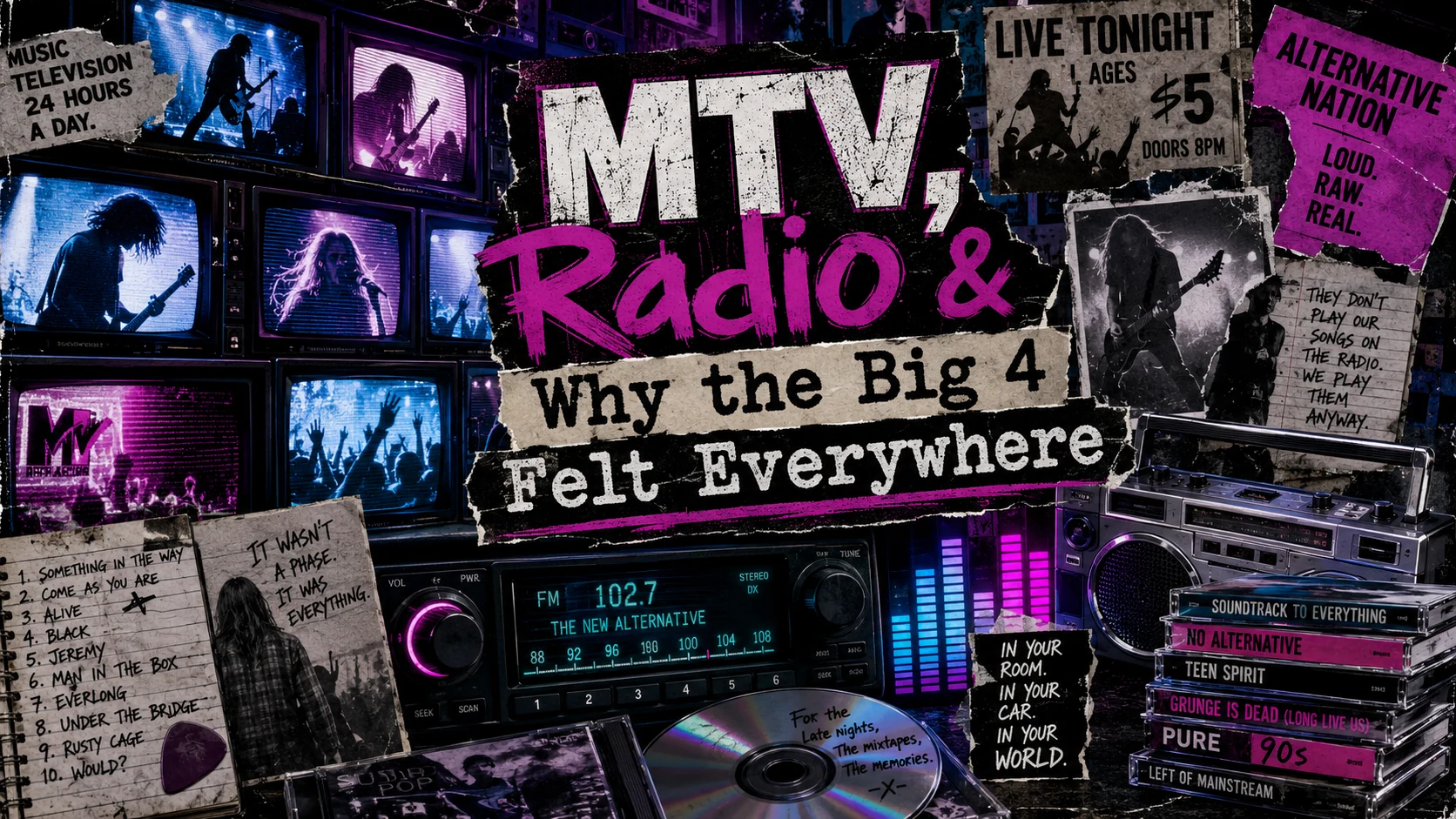
These songs did not become essential only because they were good. Plenty of good songs never leave the basement. Grunge needed distribution, and the early 90s gave it two giant amplifiers: MTV and modern rock radio. Once the videos hit rotation and the radio formats started shifting, the sound moved from local scenes and college stations into every suburban room with cable and every car with a half-functional stereo.
MTV gave grunge a visual grammar: school gyms, warehouses, surreal suburbia, live intensity, flannel, long hair, stage dives, acoustic vulnerability, and faces that looked like they would rather be anywhere else than selling themselves. That anti-star posture became part of the appeal. The old rock fantasy was about escape. Grunge’s fantasy was that maybe someone else also thought the fantasy was garbage.
Modern rock radio turned the mood into a format. Nirvana, Pearl Jam, Soundgarden, Alice in Chains, Stone Temple Pilots, Hole, L7, Screaming Trees and others could share space with the broader alternative boom. That helped the songs reach people who did not know anything about Sub Pop, Seattle, or the local family tree. They just knew the songs felt true.
The Gen X Lifestyle Behind These Songs
Grunge songs lived differently because the 90s music experience was physical. You did not just tap a playlist and let the algorithm make decisions like a tiny robot DJ with commitment issues. You bought the CD. You borrowed the CD. You dubbed the tape. You read the liner notes. You memorized the album art. You watched the video and waited for it to come back around. You heard a song on the radio and had to sit there like a hostage hoping the DJ would say the title.
These songs were part of a lifestyle that included CD towers, milk crates of records, Discman skip protection that lied to us, band shirts that became personality documents, bedroom posters, notebook doodles, local record stores, used CD bins, mall music shops, late-night MTV, 120 Minutes, thrift-store flannel, combat boots, bad coffee, worse couches, and the kind of sarcasm that came from being raised by television and left alone with sharp objects.
The songs mattered because they gave a generation a language that was not polished. They did not say everything was fine. They did not promise the future would be shiny. They did not sound like someone smiling in a convertible. They sounded like basements, rain, bad lighting, cigarette smoke, distortion, unpaid bills, school lockers, busted cars, and the sacred Gen X tradition of pretending not to care while caring so hard it caused structural damage.
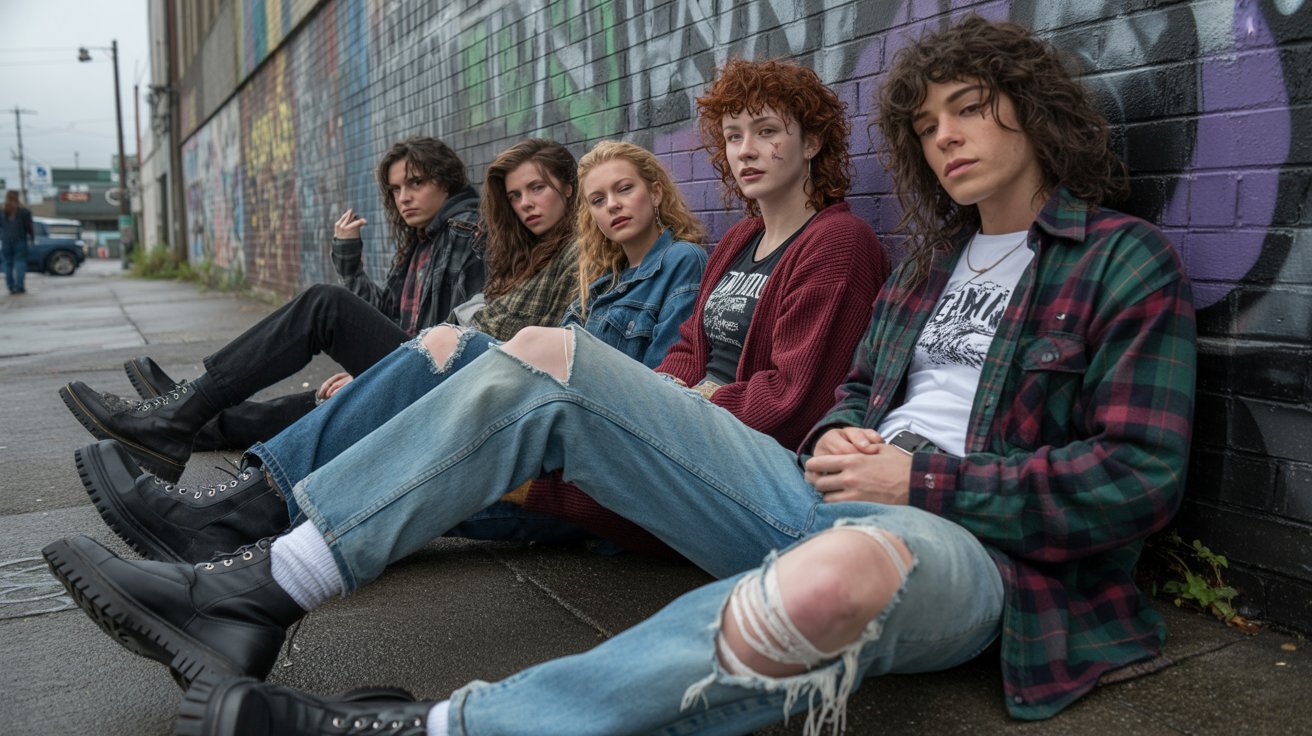
The albums you carried said who you were before social profiles existed to do the damage for you.
MTV was the campfire. Shared weirdnessVideos turned songs into cultural memory because everyone saw the same strange images at the same time.
Record stores were search engines. With judgmentYou discovered music through clerks, friends, zines, covers, imports, and the fear of buying something terrible.
It started practical, became symbolic, and then the mall found it because capitalism ruins everything eventually.
The Albums Behind the Essential Grunge Songs
The song list only tells part of the story. Grunge was an album-era movement. These songs lived inside records people played front to back because skipping around required effort and because the full album experience still mattered. Nevermind, Ten, Badmotorfinger, Dirt, Superunknown, Jar of Flies, Sweet Oblivion, Live Through This, and Bricks Are Heavy all helped define the sound around the hits.
That is why the next natural rabbit hole is Best 90s Grunge Albums. Songs made grunge travel fast, but albums made it stick. The records gave context, sequencing, mood, deeper cuts, artwork, liner-note obsession, and the emotional commitment of spending actual money on music when you could only afford so many mistakes.
Keep Rewinding the Grunge Songbook
The 25 songs are the entry point. Keep going through the hub, the Big 4, the albums, Seattle, MTV, Unplugged, fashion, post-grunge, women of alternative rock and the bigger 90s song map.
FAQ: Essential Grunge Songs
What is the most essential grunge song?
“Smells Like Teen Spirit” by Nirvana is usually the most essential grunge song because it pushed grunge and alternative rock into the mainstream and changed the direction of 90s rock.
Who are the Big 4 of grunge?
The Big 4 of grunge are Nirvana, Pearl Jam, Soundgarden, and Alice in Chains. They are the core bands most associated with the mainstream grunge explosion.
Was grunge only from Seattle?
Strictly speaking, grunge is most closely tied to Seattle and the Pacific Northwest, but the 90s grunge era also included grunge-adjacent alternative bands from outside Seattle.
What made a song grunge?
Grunge songs often blended punk attitude, metal heaviness, distorted guitars, rough production, emotional darkness, anti-glam style, and alternative-rock melody.
Why is Mudhoney important to grunge?
Mudhoney captured the early Sub Pop grunge sound before the movement became mainstream. “Touch Me I’m Sick” is one of the key pre-boom grunge songs.
Why is Temple of the Dog included on grunge lists?
Temple of the Dog connects Soundgarden, Mother Love Bone, and Pearl Jam through a tribute project that became central to Seattle grunge history.
Is Stone Temple Pilots grunge?
Stone Temple Pilots were not part of the Seattle scene, but songs like “Plush” are often treated as grunge-adjacent because they were central to the early 90s alternative and post-Seattle rock moment.
What is the darkest grunge band?
Alice in Chains are often considered the darkest major grunge band because of their metallic riffs, haunted harmonies, and songs dealing with addiction, grief, isolation, and emotional collapse.
What role did MTV play in grunge?
MTV helped turn grunge songs into visual cultural moments, making videos by Nirvana, Pearl Jam, Soundgarden, Alice in Chains and others part of the shared 90s experience.
Why do grunge songs still hit hard?
Grunge songs still hit hard because the best ones were built on strong songwriting, emotional honesty, heavy riffs, memorable voices, and a refusal to sound polished just for the sake of fitting in.
What are the best grunge albums to hear after these songs?
Start with Nevermind, Ten, Badmotorfinger, Dirt, Superunknown, Jar of Flies, Sweet Oblivion, Live Through This, and Bricks Are Heavy.
Why is grunge tied to Gen X culture?
Grunge became tied to Gen X culture because it matched the generation’s sarcasm, skepticism, thrift-store style, MTV habits, record-store discovery, emotional restraint, and suspicion of glossy mainstream narratives.
Keep the Grunge Rewind Going
Get more 70s, 80s, and 90s nostalgia, music rabbit holes, TV memories, toy chaos, and Gen X cultural therapy from Smells Like Gen X.