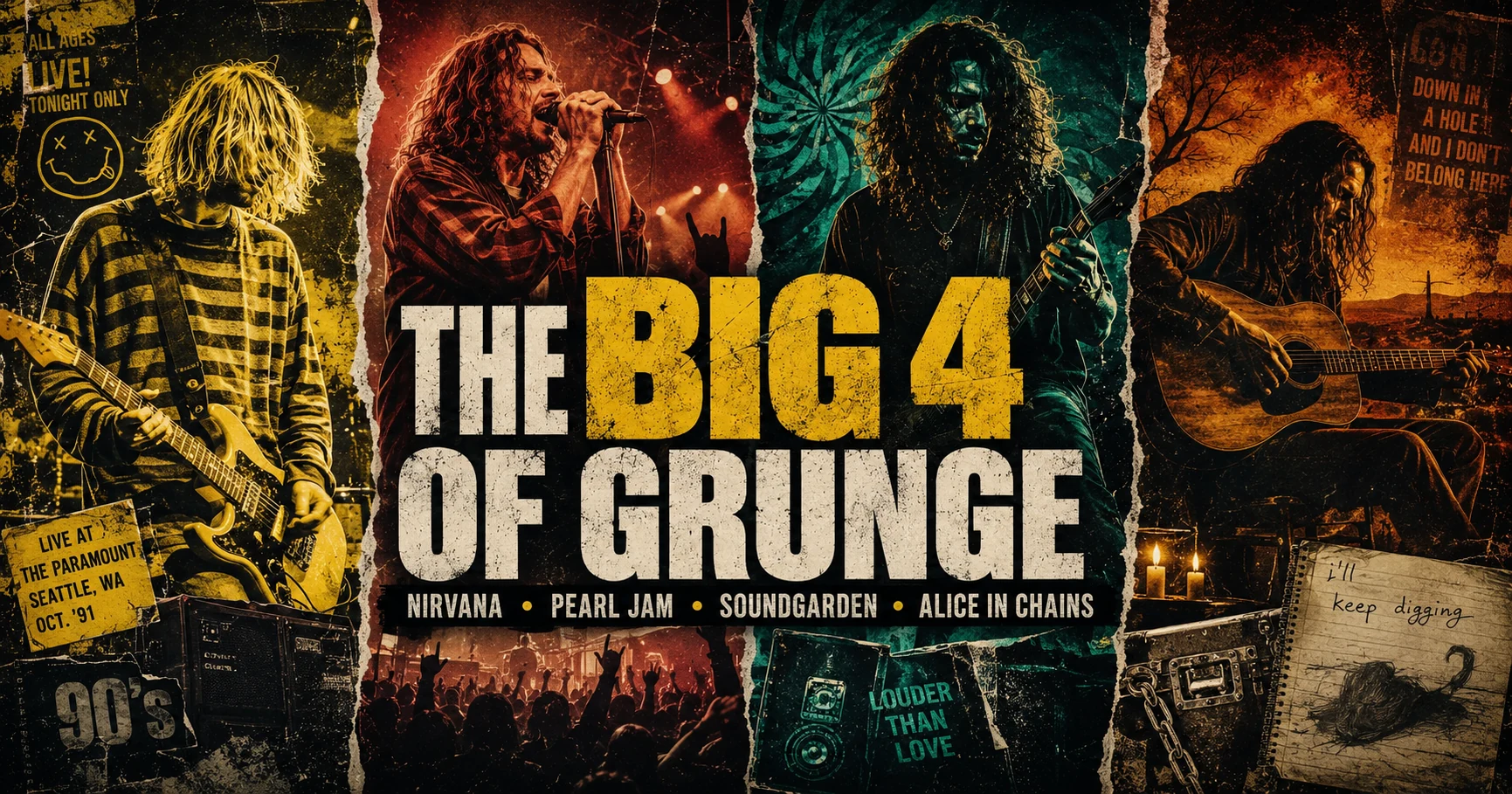
The Big 4 of Grunge Nirvana, Pearl Jam, Soundgarden & Alice in Chains
Grunge had a lot of bands, a lot of mythology, and enough flannel to upholster a mid-sized basement. But when people talk about the Big 4 of Grunge, they usually mean the four bands that pushed the sound out of the underground and into the center of 90s culture: Nirvana, Pearl Jam, Soundgarden, and Alice in Chains.
They did not sound identical. That is the whole point. Nirvana was punk chaos with pop hooks. Pearl Jam was wounded, earnest, and huge. Soundgarden was heavy, weird, and metallic. Alice in Chains was dark, haunted, and harmonized like a warning label. Together, they made 90s alternative and grunge feel unavoidable.
Who Were the Big 4 of Grunge?
The Big 4 of Grunge are Nirvana, Pearl Jam, Soundgarden, and Alice in Chains. They are considered the core four because they became the most influential, commercially visible, and culturally defining bands of the grunge explosion. Each one came from or was strongly tied to the Seattle grunge scene, and each helped turn a regional underground sound into one of the biggest forces in 90s music.
Nirvana made grunge mainstream almost overnight. Pearl Jam gave it emotional scale and long-term arena power. Soundgarden made it heavier, stranger, and more technically massive. Alice in Chains gave it a darker, doomier, more haunted edge. If you want the broader story, start with 90s Alternative & Grunge. If you want the heavy song path, go to 90s Grunge Songs That Still Hit Hard or 25 Essential Grunge Songs.
Need the Bigger Grunge Map?
This page is the four-band doorway. For the full visual command center, jump to the 90s Alternative & Grunge Hub. For the big editorial deep dive, go to the 90s Alternative & Grunge pillar post.
Why These Four Became the Grunge Mount Rushmore
The Big 4 did not become the Big 4 because someone in a record store laminated a chart and declared it law. They became the Big 4 because they were the bands most responsible for turning grunge from a regional scene into a worldwide rock language. The sound had roots before them, and plenty of other bands mattered, but these four were the ones that reshaped MTV and modern rock radio, MTV, album sales, fashion, and the whole idea of what a rock star was supposed to look and sound like.
Before grunge took over, mainstream rock still carried a lot of 80s residue: gloss, poses, giant drums, shiny production, and enough hair product to threaten the atmosphere. Then came songs that sounded less like victory laps and more like people cracking open in public. Nirvana made fame look like a trap. Pearl Jam made sincerity feel massive. Soundgarden made weird heaviness feel cinematic. Alice in Chains made darkness melodic enough to sneak into the mainstream and stay there.
That is why grunge killing hair metal is not just a meme. It was a cultural reset. Suddenly the costume changed. The videos changed. The album covers changed. The interviews changed. The clothes changed so hard that flannel became a uniform, which was very funny considering the whole thing was supposed to be anti-fashion. Nothing says rebellion like an entire mall figuring out how to sell your shirt back to you.
The band that made grunge impossible to ignore and made mainstream rock feel instantly less shiny.
The band that turned grunge into a giant, human, arena-sized thing without losing its wounded center.
The band that made grunge feel bigger, heavier, more metallic, and more surreal than the stereotype.
The band that fused grunge, metal, addiction, harmony, and dread into something beautiful and brutal.
The Big 4 of Grunge, Band by Band
The reason this foursome still dominates every grunge conversation is that each band represents a different lane. You can hear the same era moving through all of them, but the emotional temperature changes completely from band to band. Nirvana sounded like a garage catching fire. Pearl Jam sounded like a confession shouted from the back of an arena. Soundgarden sounded like Black Sabbath took a wrong turn into art rock. Alice in Chains sounded like someone harmonized with their own ghost.
That is why “Big 4” is useful even if it is a little too neat. These bands were not interchangeable mascots for flannel. They had different roots, different strengths, different relationships with fame, different ideas of heaviness, and very different long-term legacies. Together, they explain why 90s alternative and grunge became more than a sound. It became a full Gen X weather system.
Nirvana: Punk Chaos, Pop Hooks, and the Band That Made the 90s Pivot
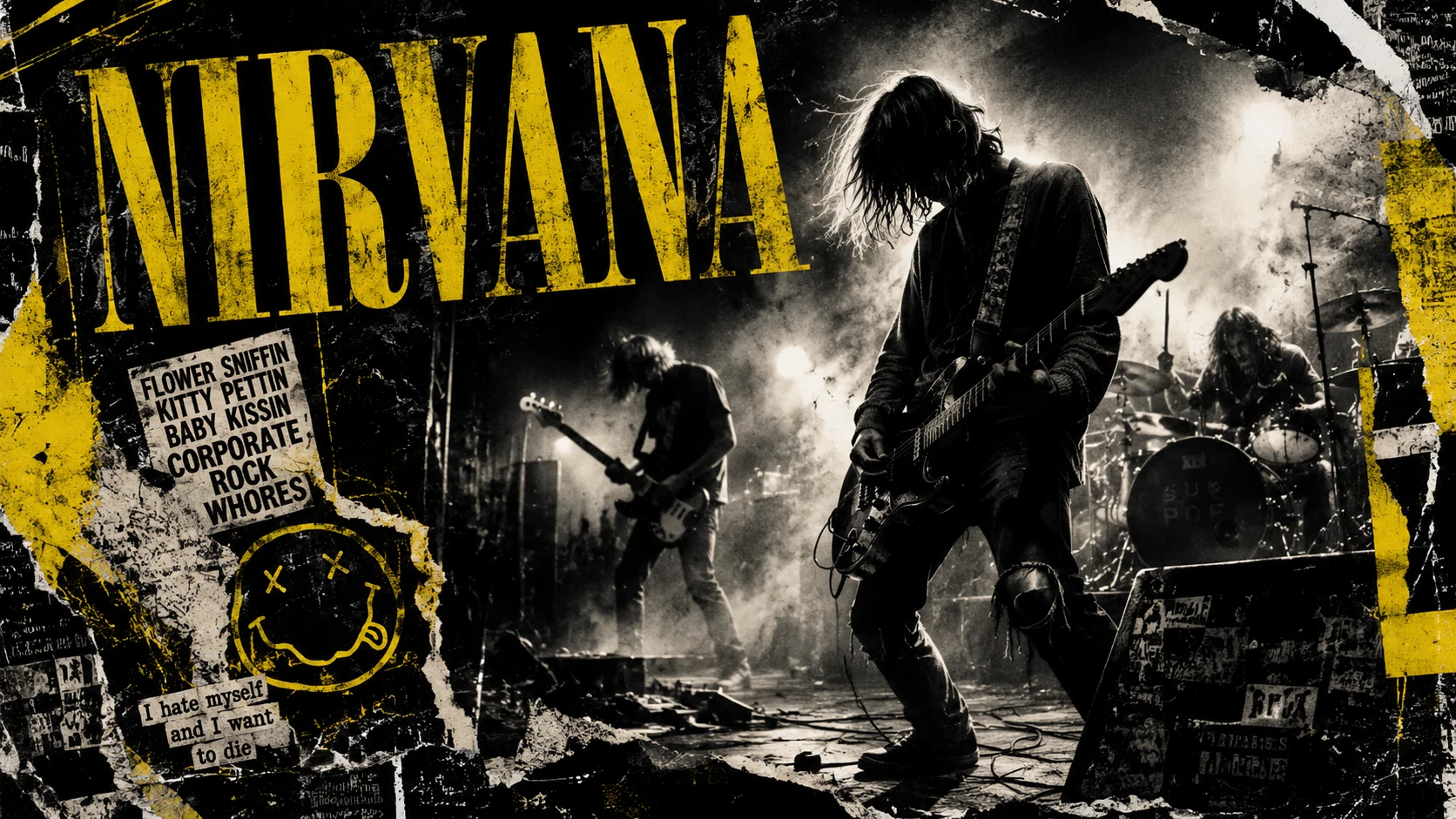
Nirvana became the most explosive symbol of grunge because they gave the mainstream a song it could not politely ignore and an image it did not know how to process. Before Nirvana broke through, alternative rock had already been building through college radio, indie scenes, punk, post-punk, and underground guitar music. But Nevermind made the shift visible to everyone. It was not just a hit album. It was a cultural door getting kicked off its hinges while the industry pretended it had meant to install a door there all along.
The key to Nirvana was contradiction. They could be abrasive and melodic, sarcastic and wounded, simple and unforgettable, sloppy on purpose and secretly sharp. “Smells Like Teen Spirit” worked because it sounded like a joke, a protest, a party, and a panic attack at the same time. “Come as You Are” was hypnotic and eerie. “Lithium” balanced tenderness and volatility. “In Bloom” mocked the kind of listener who would misunderstand the band while also giving that listener a massive chorus to sing. That was the trick: Nirvana could criticize the machine while accidentally feeding it perfect hooks.
Kurt Cobain’s songwriting had a pop instinct hiding inside punk damage. That is why Nirvana traveled farther than a lot of heavier underground bands. The songs were not complicated in the technical sense, but they were emotionally efficient. They got to the nerve quickly. The quiet-loud dynamic, the cracked vocal delivery, the distorted guitar tone, and the sense that everything might collapse at any second gave the band a danger that glossy rock could not fake.
Nirvana also changed the visual language of rock. Their videos and public image made anti-gloss feel magnetic. Suddenly the old rock-star costume looked ridiculous. The perfect hair, leather poses, and party-monster confidence of the late 80s had competition from thrift-store sweaters, deadpan interviews, and people who looked like they had been awake for three days because maybe they had. If you want the bigger cultural side of that shift, the next stop is How Grunge Killed Hair Metal.
The band’s relationship with fame is impossible to separate from its legacy. Nirvana became huge while openly seeming uncomfortable with the machinery that made them huge. That tension became part of the myth, but the music is why the myth lasted. Nevermind made the breakthrough; In Utero pushed back against being too easily consumed. One album opened the gates. The other sounded like it wanted to scrape the paint off those gates before anyone could turn them into merchandise.
Simple riffs, explosive dynamics, damaged melody, sarcasm, distortion, and choruses big enough to make the underground suddenly look mainstream.
Best starter album NevermindThe obvious starting point because it captures the exact moment grunge became unavoidable. Follow it with In Utero for the sharper, stranger aftershock.
Essential songs Start here“Smells Like Teen Spirit,” “Come as You Are,” “Lithium,” “In Bloom,” “Heart-Shaped Box,” “All Apologies.”
Why they mattered The before-and-after lineNirvana made alternative rock the center of the conversation and forced the rest of mainstream rock to explain why it suddenly looked overdressed.
How Nirvana Actually Felt in the 90s
Nirvana did not feel like “classic rock” in real time. They felt like something adults were trying to explain and failing at. You heard them in bedrooms, on MTV, through cheap car speakers, in school hallways, at parties where nobody admitted they were trying too hard, and in the background of a million conversations about whether the new music was brilliant or just noise. That was part of the charge. Nirvana made a generational divide audible without needing to give a speech about it.
The lifestyle piece was not just flannel. It was the sense that polish suddenly looked suspicious. Nirvana made thrift-store clothes, damaged guitars, messy hair, deadpan interviews, cheap-looking videos, and emotional discomfort feel more honest than the glossy rock machine that came before. That mattered because a lot of Gen X culture was already suspicious of sales pitches. Nirvana became the soundtrack for that suspicion, even as the music industry turned around and sold the suspicion back in bulk.
There was also the weird experience of watching a band this uncomfortable with fame become unavoidable. That tension gave Nirvana a gravity none of the other Big 4 bands had in quite the same way. They were everywhere, but they never seemed like they belonged to the places that were playing them. That contradiction is why Nirvana still feels unstable in memory. They were mainstream and anti-mainstream at the same time, which is a very 90s way to break everyone’s brain.
What People Sometimes Get Wrong About Nirvana
The lazy version is that Nirvana was just noise, angst, and a lucky video. That misses the craft. The songs worked because the melodies were strong, the structures were direct, and the hooks were sharper than the band’s anti-commercial posture suggested. Cobain understood pop even when he was tearing at it. That is why the songs crossed over. You can bury a melody under distortion, but if the melody is strong enough, it still claws its way out.
Another mistake is treating Nirvana as the whole grunge story. They were the cultural blast radius, not the entire landscape. The Big 4 matters because Nirvana only explains one kind of grunge energy. To understand the full era, you need Pearl Jam’s emotional scale, Soundgarden’s heavy architecture, and Alice in Chains’ haunted darkness right beside them.
Pearl Jam: The Emotional Heavyweight That Turned Grunge Into a Lifelong Thing
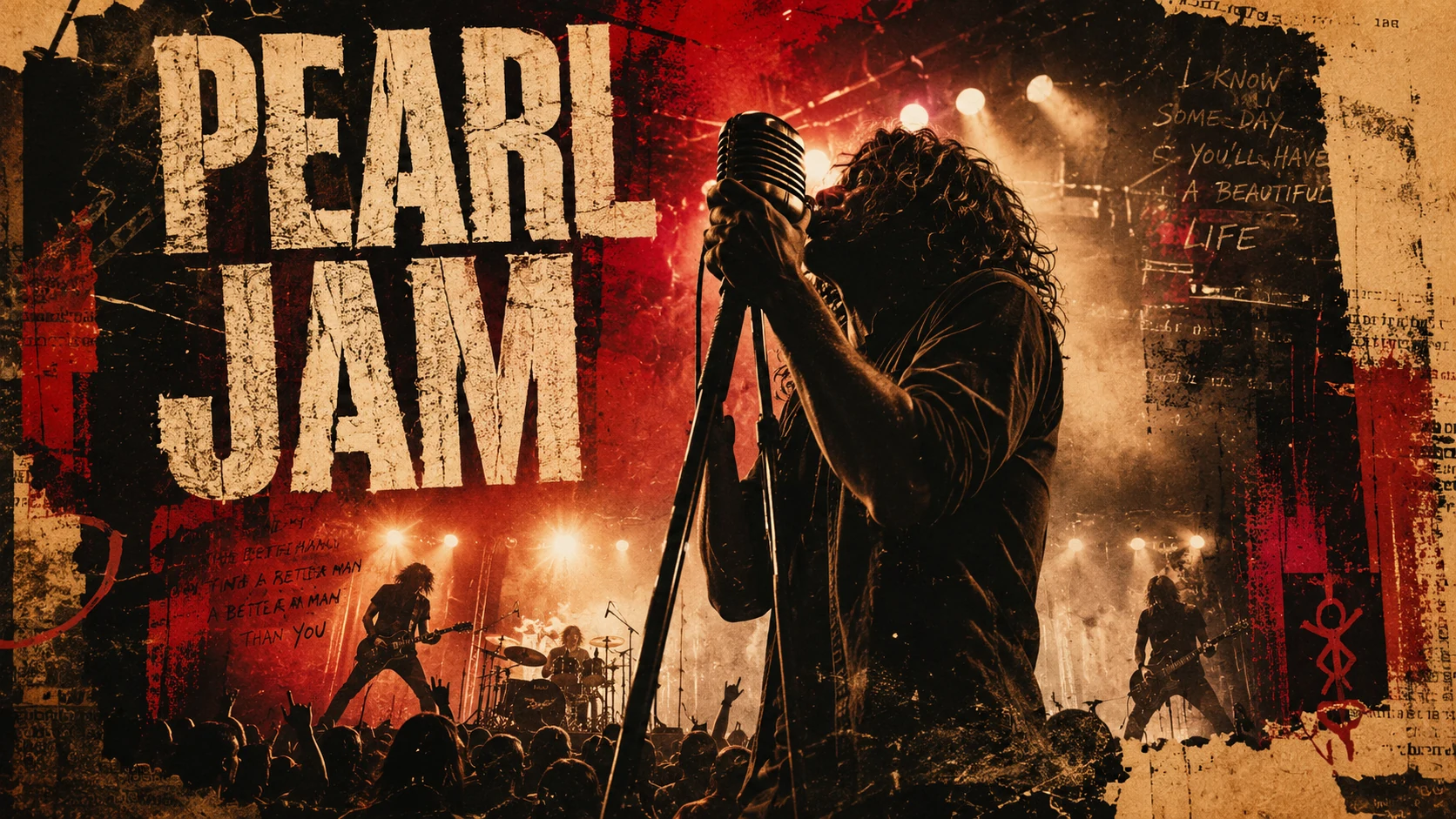
Pearl Jam’s place in the Big 4 is different from Nirvana’s. Nirvana was the detonation. Pearl Jam was the long burn. They arrived with Ten, an album that sounded massive from the beginning, but their power came less from shock and more from emotional scale. Pearl Jam made grunge feel human, wounded, serious, and enormous. If Nirvana sounded like someone rejecting rock stardom in real time, Pearl Jam sounded like a band trying to survive it without letting the songs become hollow.
Ten is central to the story because it made Pearl Jam feel fully formed almost immediately. “Alive,” “Even Flow,” “Jeremy,” “Black,” and “Oceans” were not just singles or album tracks. They were identity markers. The band’s sound had huge guitars, deep grooves, emotional vocals, and a kind of open-chested sincerity that stood apart from Nirvana’s sarcasm and Alice in Chains’ darkness. Pearl Jam could be heavy, but their heaviness often felt like grief, memory, guilt, anger, and release.
Eddie Vedder’s voice became one of the defining sounds of 90s rock, but Pearl Jam was not just a voice. The band’s chemistry mattered. Stone Gossard and Mike McCready gave the songs a guitar language that could move between classic-rock sweep, grunge grit, and jam-like looseness. Jeff Ament and the band’s rhythm section gave the songs weight and movement. Pearl Jam had roots in the Seattle scene, but they also carried a more traditional rock-band power, which helped them become one of the few grunge-era acts that could remain huge for decades.
Pearl Jam also had one of the most complicated relationships with fame in the 90s. They became massive quickly, then pushed back against parts of the industry that helped make them massive. They pulled away from some of the usual promotional machinery, fought over ticketing, made less obvious choices, and built a reputation as a live band with a deep connection to fans. That long-game credibility is a huge part of why Pearl Jam’s legacy feels different from the other Big 4 bands.
The band’s emotional range also made them a natural bridge to MTV Unplugged and the softer side of grunge. Pearl Jam could rage, but they could also ache. Their songs often worked because they felt direct without being simple. There was a sincerity there that could have gone wrong in a decade allergic to anything too polished, but Pearl Jam made it feel earned.
Huge vocals, muscular guitars, wounded storytelling, live-band energy, and choruses that sounded built to be shouted by thousands of people.
Best starter album TenThe essential entry point. It has the songs, the emotional weight, and the sound that made Pearl Jam feel instantly major.
Essential songs Start here“Alive,” “Even Flow,” “Jeremy,” “Black,” “Daughter,” “Elderly Woman Behind the Counter in a Small Town.”
Why they mattered The long-game bandPearl Jam proved grunge could be emotionally huge, musically durable, and capable of surviving beyond the first wave of hype.
How Pearl Jam Lived Outside the Singles
Pearl Jam had a different kind of 90s presence. They were not just a band you saw on MTV. They were a band people argued about, collected, traded, followed, and took seriously in a way that became part of their identity. Their fans did not just like songs. They built relationships with albums, live versions, setlists, bootlegs, B-sides, and the idea that this band was trying not to become just another machine.
In real life, Pearl Jam fit the long drives, the dorm rooms, the late-night conversations, the overloaded CD shelves, the first serious guitar attempts, and the kind of teenage or early-adult emotional weather that made you think every feeling needed a seven-minute build. They were not as sarcastic as Nirvana, not as surreal as Soundgarden, and not as bleak as Alice in Chains. Pearl Jam was where grunge became human-scale without becoming small.
That is also why Pearl Jam lasted. Their music was tied to live performance and fan loyalty in a way that outgrew the initial grunge wave. When the fashion cycle moved on and the industry started smoothing the sound into post-grunge radio rock, Pearl Jam still had a reason to exist. They were not only a 90s moment. They became a continuing conversation.
What People Sometimes Get Wrong About Pearl Jam
Because Pearl Jam became so big, it is easy to flatten them into “earnest arena grunge,” which is only partly true and kind of unfair. Yes, the band could be huge and emotional. But they were also restless, stubborn, and often at war with the expectations that came with becoming one of the biggest rock bands in the world. That tension is central to their 90s identity.
Pearl Jam’s seriousness also gets misread as a lack of edge. But in the context of the decade, refusing to play parts of the promotional game was its own kind of edge. Nirvana’s rebellion looked like rupture. Pearl Jam’s looked like resistance over time. Less spectacular, maybe, but more durable.
Soundgarden: The Heavy, Weird, Technically Massive Side of Grunge
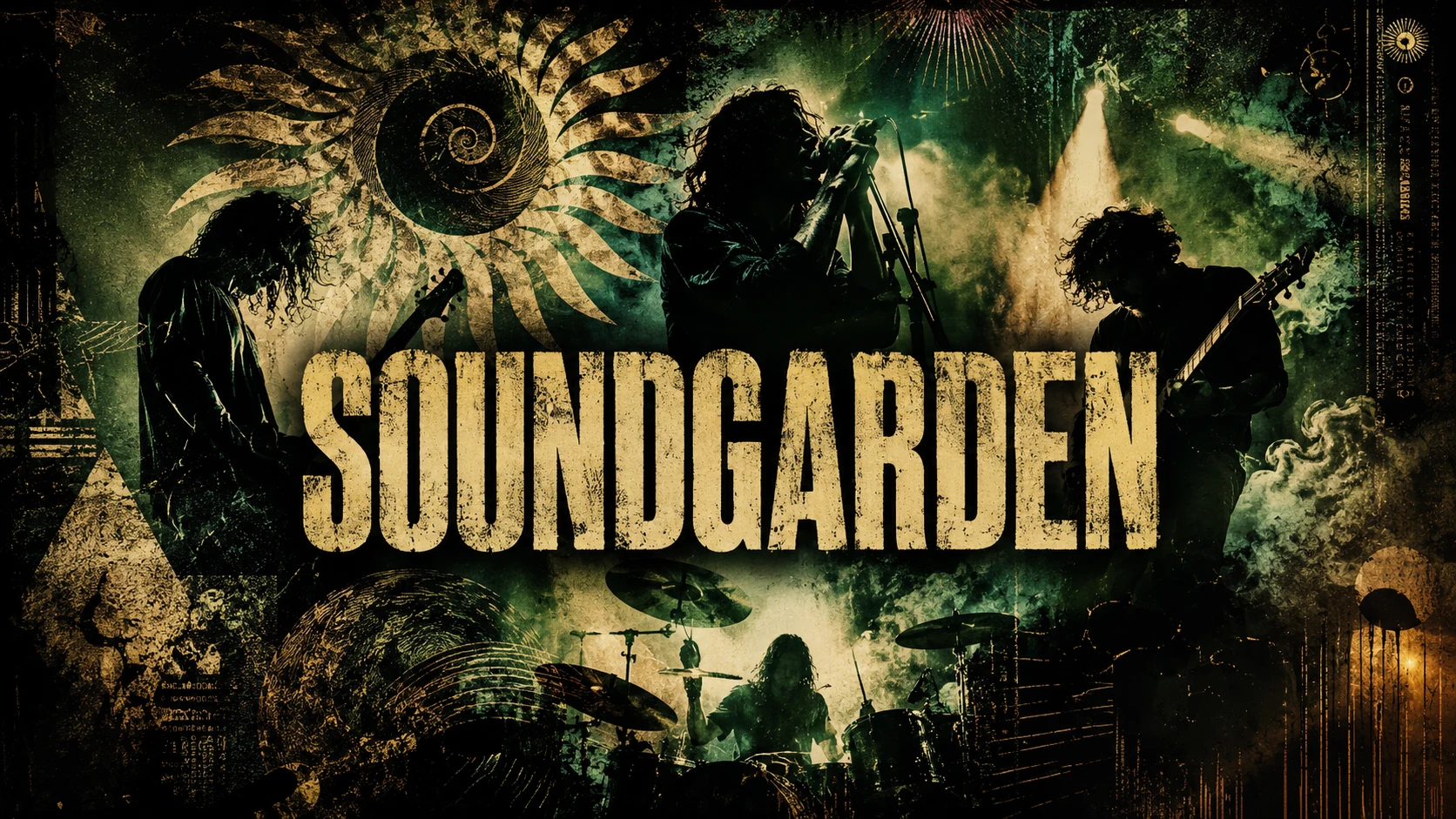
Soundgarden is the Big 4 band that most clearly proves grunge was never just one thing. They were heavier, stranger, and more musically twisted than the easy stereotype. Their roots stretched into metal, punk, psychedelia, and oddball hard rock, and they brought a level of technical intensity that made them stand apart. If Nirvana made grunge immediate and Pearl Jam made it emotional, Soundgarden made it feel huge, unstable, and architecturally weird.
Chris Cornell’s voice was one of the most powerful instruments of the decade, but Soundgarden’s greatness was not only about vocal range. The band’s riffs, time signatures, heaviness, and mood made their songs feel built from stranger materials. Kim Thayil’s guitar playing gave Soundgarden a dark, grinding texture that could be heavy without becoming generic. Ben Shepherd and Matt Cameron helped make the rhythm section feel muscular and unpredictable. They were a grunge band, yes, but they also sounded like a band that had wandered in from a heavier, weirder dimension carrying amplifiers.
Badmotorfinger is the record that shows Soundgarden’s heavy identity before the massive mainstream crossover. “Outshined,” “Rusty Cage,” and “Jesus Christ Pose” are thick, aggressive, strange, and full of the band’s pre-crossover muscle. Then Superunknown took that weight and opened it up. “Black Hole Sun” became the giant surreal hit, but the album also carried “Spoonman,” “Fell on Black Days,” “The Day I Tried to Live,” and other songs that showed how broad Soundgarden’s darkness could be.
Soundgarden’s videos also mattered because they helped define the weirder side of MTV’s alternative rock takeover. “Black Hole Sun” especially became a defining visual artifact of the decade: creepy, bright, surreal, suburban, and deeply unsettling in the way only mid-90s music videos could be. It made Soundgarden feel both accessible and bizarre, which is not an easy trick.
Their influence sits heavily on the edges of grunge, metal, alternative, and hard rock. Soundgarden gave the Big 4 its most technically ambitious and sonically heavy corner. They are the answer whenever someone tries to make grunge sound like nothing but mopey three-chord fuzz. No, friend. Sometimes it was odd meters, huge riffs, and vocals that sounded like a thunderstorm got a microphone.
Metal weight, odd rhythms, psychedelic darkness, huge vocals, grinding guitars, and songs that felt larger and weirder than standard alt-rock.
Best starter album SuperunknownThe most complete entry point for the mainstream era. Follow with Badmotorfinger for the heavier pre-crossover punch.
Essential songs Start here“Black Hole Sun,” “Outshined,” “Rusty Cage,” “Spoonman,” “Fell on Black Days,” “The Day I Tried to Live.”
Why they mattered The sound stretcherSoundgarden made grunge heavier, more technically adventurous, and more surreal than the mainstream version of the genre usually remembers.
How Soundgarden Changed the Shape of Grunge
Soundgarden made grunge feel less like a scene and more like a physical structure. Their songs had weight, corners, strange angles, and pressure. They were the band that made it impossible to pretend grunge was only sloppy punk with sad lyrics. Soundgarden could be brutal, precise, psychedelic, ugly, beautiful, and weirdly majestic — sometimes inside the same song.
In the 90s, Soundgarden occupied a different space in people’s collections. Nirvana might have been the cultural earthquake and Pearl Jam the emotional anchor, but Soundgarden was the record you put on when you wanted something heavier and more intimidating. They belonged to the same CD binder, but they did not feel like background music for the same mood. Soundgarden was less “I feel alienated” and more “the sky is melting and the riff knows why.”
Their mainstream success also says a lot about how strange the 90s were. A band this heavy and weird still had one of the most recognizable songs and videos of the decade. “Black Hole Sun” was not a normal pop crossover. It was surreal, creepy, melodic, and enormous, which is exactly why it worked. The 90s allowed a lot of very odd things to become mainstream before anyone had time to ask whether that made sense.
What People Sometimes Get Wrong About Soundgarden
Soundgarden sometimes gets reduced to “the band with ‘Black Hole Sun,’” which is like describing a haunted mansion as “the place with a nice front door.” That song is important, but it is only one piece of a much heavier and stranger catalog. Badmotorfinger especially matters because it captures the band’s muscle before the crossover moment made them part of every MTV conversation.
Another mistake is treating Soundgarden as less emotionally intense because they were more technical and heavy. The emotion is there, but it often comes through atmosphere, pressure, and scale rather than direct confession. Soundgarden did not always tell you what the wound was. They built the room around it and let you feel the walls leaning in.
Alice in Chains: The Haunted Dark Corner of the Big 4
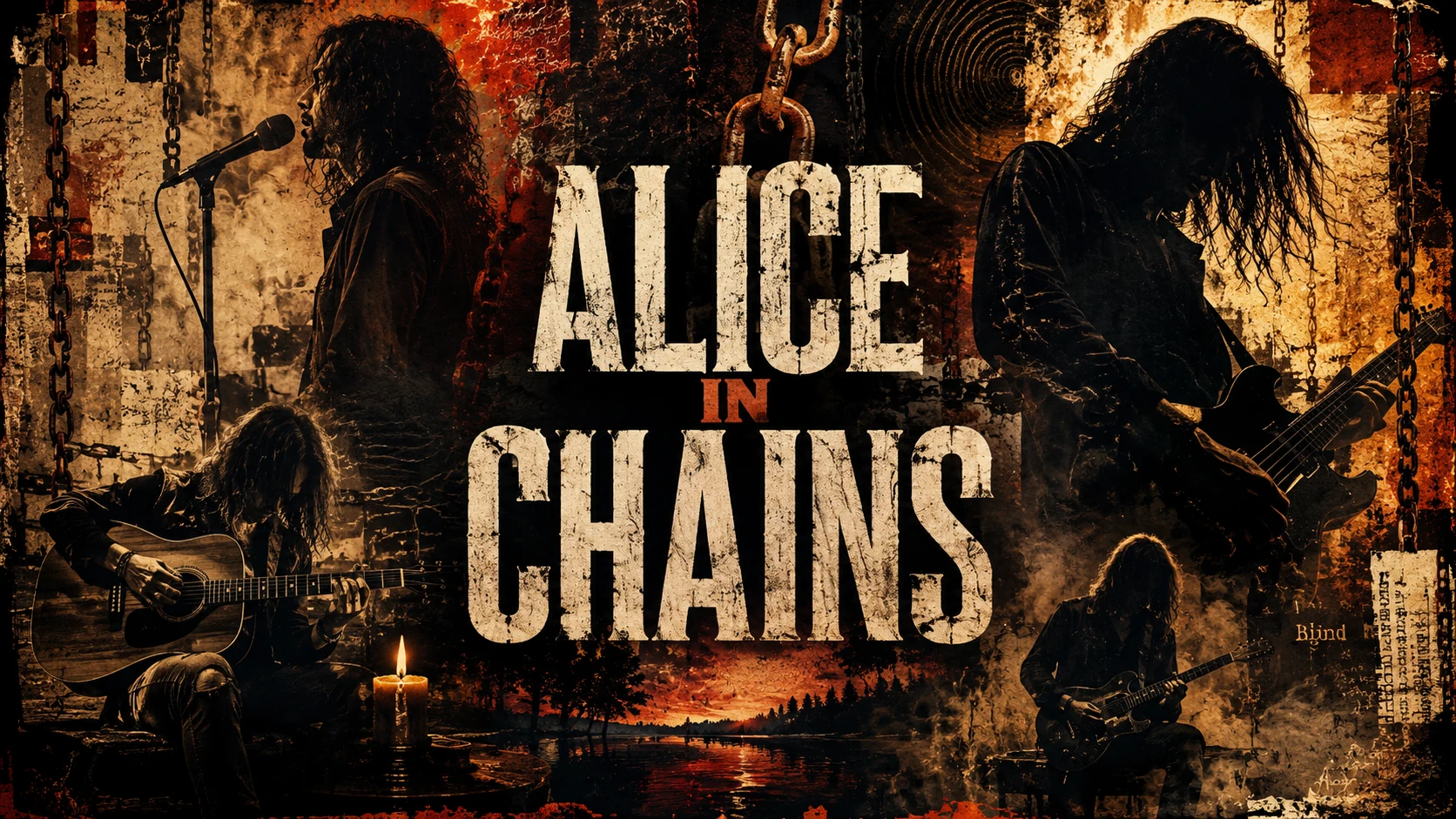
Alice in Chains was always the darkest room in the Big 4 house. They were linked to grunge, but their sound pulled heavily from metal, doom, acoustic darkness, addiction, dread, and vocal harmonies that felt beautiful and deeply unsafe. If Nirvana sounded like rupture, Pearl Jam like catharsis, and Soundgarden like cosmic heaviness, Alice in Chains sounded like the aftermath — the part where the noise fades and the damage is still sitting there.
The band’s signature came from the combination of Jerry Cantrell’s riffs and harmonies with Layne Staley’s voice. Those harmonies are one of the most identifiable sounds in 90s rock. They could make a chorus feel both gorgeous and sick. It was not just darkness for decoration. The songs often sounded trapped, circular, and heavy with consequence. Alice in Chains did not need to posture as dangerous. Their music felt dangerous because it sounded like it knew exactly where the floor gave out.
Facelift gave the band its early breakthrough with “Man in the Box,” but Dirt is the core statement. It is one of the bleakest major rock albums of the decade, and it remains essential because the heaviness is emotional as much as musical. “Rooster,” “Would?,” “Them Bones,” “Down in a Hole,” and “Angry Chair” created a world that was heavy, melodic, and almost unbearably direct in mood. The album did not just fit the grunge moment; it made the darker side of that moment impossible to ignore.
Alice in Chains also proved that acoustic did not mean lighter. Jar of Flies and the band’s MTV Unplugged performance showed a quieter version of the same darkness. Stripped down, the songs did not become safer. They became more exposed. That is why Alice in Chains belongs right at the center of MTV Unplugged and the softer side of grunge. They made acoustic performance feel like someone turned the lights down and somehow made the shadows louder.
Their legacy has grown because their sound remains so distinct. Plenty of 90s bands were dark. Alice in Chains sounded haunted in a way that almost nobody else did. They were too metal for some alternative boxes, too melodic for simple metal categories, too bleak for casual nostalgia, and too important to leave out of any serious Big 4 conversation.
Metal riffs, doom atmosphere, acoustic dread, bleak lyrics, and vocal harmonies that sounded like two ghosts arguing in tune.
Best starter album DirtThe defining Alice in Chains statement. Follow it with Jar of Flies to hear how heavy the band could be without turning everything up.
Essential songs Start here“Man in the Box,” “Would?,” “Rooster,” “Them Bones,” “Down in a Hole,” “No Excuses.”
Why they mattered The darkest signatureAlice in Chains gave grunge its most haunted sound and proved melody could make heaviness even more devastating.
How Alice in Chains Hit Differently
Alice in Chains did not feel like casual listening, even when the songs were everywhere. Their music carried a gravity that made it hard to treat as background. You could hear “Man in the Box” or “Would?” on radio and still feel like something darker had slipped into the room. They had hooks, but the hooks did not brighten the songs. They pulled you deeper.
In everyday 90s terms, Alice in Chains belonged to the darker side of the CD shelf: the music you put on alone, late, or when the room did not need brightening. Their acoustic material made that even clearer. Jar of Flies did not soften the band into coffeehouse grunge. It made the bleakness more intimate. That is why Alice in Chains’ MTV Unplugged performance still carries such weight. It feels less like a victory lap and more like a document.
The lifestyle connection here is not a costume. It is atmosphere. Alice in Chains captured the part of the 90s that was not ironic, not quirky, and not easily turned into a fun playlist thumbnail. They were the sound of consequences, addiction, exhaustion, dread, and beauty under pressure. That is a major reason their legacy has deepened rather than faded.
What People Sometimes Get Wrong About Alice in Chains
The easy mistake is calling them “grunge metal” and moving on. That description is not wrong, but it is incomplete. Alice in Chains had metal weight, but their vocal harmonies and melodic sense made the darkness far more distinctive. Plenty of bands were heavy. Very few sounded haunted in exactly that way.
Another mistake is treating their bleakness as one-note. Alice in Chains could be crushing, but they could also be subtle, acoustic, atmospheric, and strangely beautiful. Their heaviness was not only volume. It was emotional density. That is why their quieter songs can feel just as heavy as the loud ones.
What Made Each Big 4 Band Different?
The Big 4 label only works because the bands are different enough to make the category useful. If they all sounded the same, the conversation would be boring and everyone could go back to alphabetizing their CDs incorrectly. Instead, each band gives you a different emotional and musical entry point into 90s alternative and grunge.
Nirvana’s power was immediacy. Their songs felt like they were falling apart and becoming perfect at the same time. They made the old mainstream look obsolete almost overnight.
Pearl Jam was the release. Best for emotional scalePearl Jam turned pain, memory, guilt, and survival into huge rock songs that could fill arenas without sounding like empty spectacle.
Soundgarden was the expansion. Best for heavy weirdnessSoundgarden stretched grunge toward metal, psychedelia, odd rhythms, and huge vocal drama. They made the genre feel bigger and less predictable.
Alice in Chains was the descent. Best for darkness and atmosphereAlice in Chains pulled grunge into its bleakest, most haunted space, using harmonies and heavy riffs to make darkness strangely beautiful.
That balance is why the Big 4 still matter. Nirvana explains the cultural shock. Pearl Jam explains the emotional connection. Soundgarden explains the heavy musical ambition. Alice in Chains explains the darkness that made the era feel so much more complicated than a fashion trend. Together, they give grunge shape.
Essential Big 4 Grunge Songs
This is the starter shelf, not a final ranking carved into a basement wall. Each band deserves its own deep dive, but these are the tracks that help explain the different kinds of heaviness inside the Big 4: Nirvana’s punk-pop detonation, Pearl Jam’s emotional release, Soundgarden’s heavy weirdness, and Alice in Chains’ haunted darkness. The full song rabbit hole lives in 90s Grunge Songs That Still Hit Hard and 25 Essential Grunge Songs, but these are the tracks that explain why the Big 4 became the Big 4.
The grunge detonation. A song so massive it became both an anthem and a burden almost instantly.
Nirvana “Come as You Are”The more hypnotic side of Nirvana: simple, eerie, melodic, and impossible to shake once it gets in your head.
Pearl Jam “Alive”The big emotional entrance. A song that made Pearl Jam feel enormous before the decade even knew how big they would become.
Pearl Jam “Jeremy”A dark story song that became one of the most recognizable MTV-era moments in 90s rock.
Soundgarden “Black Hole Sun”Surreal, huge, darkly melodic, and attached to one of the decade’s most unforgettable videos.
Soundgarden “Outshined”Heavy, muscular, and full of the riff-driven power that made Soundgarden feel like more than standard alternative rock.
Alice in Chains “Man in the Box”The band’s breakout warning shot: heavy, hypnotic, and built around a vocal sound that felt trapped and enormous.
Alice in Chains “Would?”A perfect example of Alice in Chains’ dark melodic pull, and one of the most essential grunge-era songs.
Essential Big 4 Grunge Albums
If the songs explain the hooks, the albums explain the worlds. The Big 4 were album-era bands, and their most important records are part of why grunge hit so hard in the CD binder era. For the deeper album list, keep going with Best 90s Grunge Albums and Best 90s Alternative Albums.

The order matters too. Nevermind is the cultural explosion; Ten is the emotional foundation; Badmotorfinger is the heavy pre-crossover warning; Dirt is the dark masterpiece; Superunknown is the surreal mainstream victory; In Utero is the backlash turned into an album; Vs. is Pearl Jam pushing against the size of its own fame; Jar of Flies is proof that Alice in Chains could lower the volume and somehow make everything heavier.
These records also worked because the 90s still made albums feel like objects. You bought them, borrowed them, lost the booklet, read the credits, learned the track order, and decided entire personality traits based on which one lived closest to the front of the binder. The Big 4 were built for that kind of listening. They rewarded repetition. They had album cuts that mattered. They made the CD feel less like packaging and more like evidence.
The mainstream breakthrough record. It did not invent grunge, but it changed the size of the room forever.
Nirvana In UteroThe difficult follow-up: sharper, rawer, stranger, and more openly hostile to being turned into a product.
Pearl Jam TenOne of the defining rock albums of the decade, packed with emotional weight and arena-sized songs.
Pearl Jam Vs.The sound of a band getting bigger while pushing back against the machinery making it bigger.
Soundgarden BadmotorfingerHeavy, strange, riff-loaded, and crucial to understanding Soundgarden before the massive crossover moment.
Soundgarden SuperunknownThe big one: dark, psychedelic, heavy, melodic, and home to “Black Hole Sun.”
Alice in Chains DirtOne of the darkest major rock records of the 90s, and the clearest statement of the band’s haunted power.
Alice in Chains Jar of FliesA quieter, acoustic-leaning release that proved the band did not need maximum volume to sound devastating.
Where the Big 4 Actually Lived in 90s Life
The Big 4 were not experienced only as albums and chart positions. They lived in the physical rituals of the decade: the CD binder with one broken zipper, the poster wall, the mall music store listening station, the taped MTV block, the late-night radio show, the older sibling’s room, the friend’s car with one working speaker, the thrift-store flannel that may or may not have smelled like basement, and the school hallway where band shirts quietly sorted people into tribes.
Nirvana showed up as the rupture: the shirt, the video, the argument, the sudden sense that mainstream rock had been caught lying. Pearl Jam showed up as the emotional long haul: the album people lived with, the live band people followed, the songs that felt bigger the older you got. Soundgarden showed up as the heavy weird choice: the band that made the room feel darker, smarter, and less predictable. Alice in Chains showed up as the private soundtrack: the one that felt too heavy for casual nostalgia and too melodic to leave alone.
This is the part that gets missed when grunge is reduced to fashion. The clothes mattered, but they were not the whole story. The real lifestyle was how the music changed the mood of everyday places. A bedroom with a CD tower felt different. A car ride felt different. MTV felt different. Even silence after one of these albums ended felt different, which sounds dramatic until you remember that the 90s were basically built out of dramatic silences and badly adjusted stereo EQ.
If someone opened your CD binder in 1995, the Big 4 said something about you before you did. Nirvana meant impact. Pearl Jam meant depth. Soundgarden meant heavy taste. Alice in Chains meant you were not afraid of the dark shelf.
The MTV test Images that stuckThe Big 4 did not just have songs. They had visual memory: gym chaos, intense live clips, surreal suburbia, shadowy rooms, acoustic stages, and videos that made alt-rock feel like a whole weather pattern.
The car stereo test Road noise and distortionThis music sounded right in imperfect places: cheap speakers, parking lots, night drives, borrowed cars, and systems where the bass was either nonexistent or trying to destroy the dashboard.
The shirt test Low-key signalA Big 4 shirt was rarely just merch. It was a quiet broadcast: what you listened to, what mood you trusted, and whether you wanted your rock stars shiny or deeply uncomfortable.
That is why these bands still pull people back. They are not just remembered as songs. They are remembered as environments. Nirvana belongs to the moment everything cracked open. Pearl Jam belongs to the long emotional echo. Soundgarden belongs to the strange heavy middle distance. Alice in Chains belongs to the shadowed corner you still remember too clearly.
The Seattle Scene and the Big 4 Mythology
You cannot separate the Big 4 from the larger Seattle grunge scene, even though the story often gets flattened into a few convenient images: rain, flannel, coffee, clubs, and everyone looking like they were recently under a car. The scene was more complicated than that. It had punk roots, metal weight, indie-label infrastructure, local clubs, zines, shared bills, and a regional identity that was suddenly being studied by every label executive with a plane ticket and no shame.
The mythology became almost instant. Seattle went from regional music city to cultural shorthand. The fashion got copied. The sound got chased. The attitude got packaged. The underground became a brand before anyone could finish being annoyed by it. And because the Big 4 were the most visible bands in that transformation, they became the faces of both the music and the backlash.
That tension is part of why the era still fascinates people. Grunge was sold as authenticity, but the moment authenticity sells millions, everything gets weird. The Big 4 lived inside that contradiction. Nirvana hated the machine and became its biggest symbol. Pearl Jam fought parts of the system while filling huge rooms. Soundgarden crossed over without smoothing out completely. Alice in Chains made brutally personal darkness into mainstream music. Very normal decade. Nothing psychologically complicated here.
MTV, Radio and Why the Big 4 Felt Everywhere
The Big 4 were not just album bands. They were visual and radio events. MTV turned alternative rock into a visual language, and grunge gave the channel a whole new set of images after the glossy 80s: gyms, empty rooms, dark performance spaces, surreal suburbs, acoustic stages, damaged faces, long hair, bad lighting, and enough mood to make every video feel like it came with a warning from your guidance counselor.
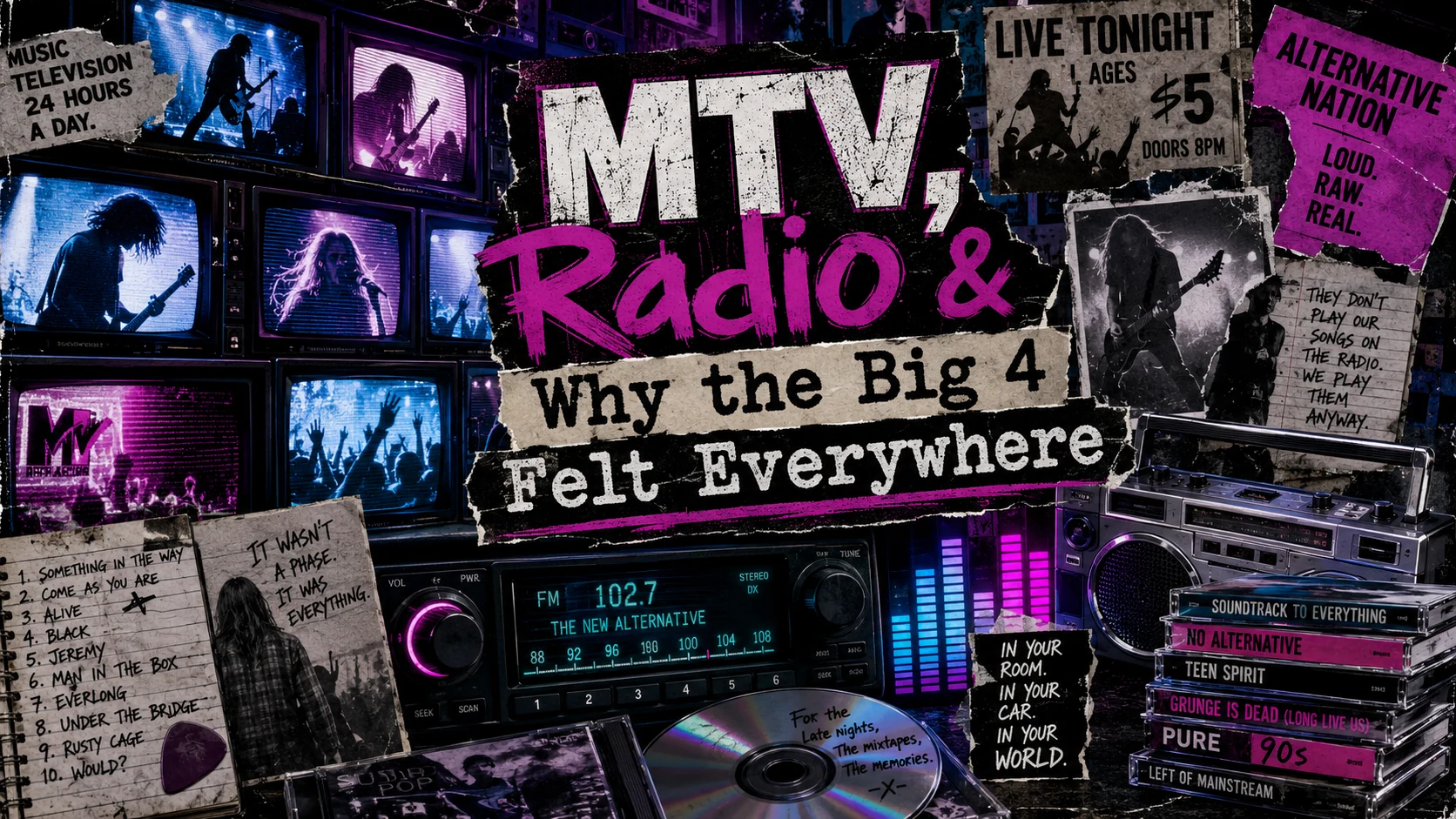
Radio mattered just as much. Modern rock radio in the 90s created a home for songs that did not fit old formats cleanly. The Big 4 could sit beside R.E.M., Smashing Pumpkins, Stone Temple Pilots, industrial rock, Britpop, and eventually post-grunge. The format helped alternative feel less like a scene and more like the default setting for an entire section of the decade.
Then there were soundtracks. Grunge and alternative were perfect for movies because the songs already sounded like emotional weather. 90s movie soundtracks and alternative soundtrack songs helped make the sound feel cinematic, especially when the movie involved alienation, romance, danger, rain, or someone staring out a window like they had just realized capitalism was going to be a problem.
Big 4 of Grunge Timeline
The Big 4 story is not just one magic year. It stretches from the underground build-up to the mainstream explosion to the mid-90s aftermath, when the sound had already changed rock and was starting to splinter into post-grunge, modern rock, and the wider alternative ecosystem.
The Seattle underground takes shape through local bands, clubs, labels, punk roots, metal influence, and a sound that is not yet a global marketing category.
The big break. Nirvana’s Nevermind and Pearl Jam’s Ten help turn grunge into a mainstream force. See the wider pop landscape on 1991 Songs.
Alice in Chains deepens the darker side with Dirt, while grunge becomes a full-blown cultural identity. Keep rewinding with 1992 Songs.
Pearl Jam’s Vs. arrives into a world where grunge is no longer underground. It is the thing everyone is trying to understand, copy, sell, or survive. See 1993 Songs.
Soundgarden’s Superunknown becomes huge, Nirvana’s story turns tragic, and the scene’s mythology gets darker and more complicated. Rewind 1994 Songs.
The original grunge wave begins to splinter. Post-grunge, modern rock, and broader alternative sounds carry pieces of the Big 4 into the rest of the decade.
Who Was the Biggest of the Big 4?
It depends what you mean by biggest, which is exactly the kind of annoying answer that sounds like it came from a record-store employee leaning on the counter. But it is true. Nirvana had the most explosive cultural impact. Pearl Jam had the longest arena-scale run. Soundgarden had the heaviest and weirdest crossover moment. Alice in Chains had the darkest signature sound and one of the most devoted long-term followings.
If the question is “who changed everything fastest?” the answer is Nirvana. They are the before-and-after line.
Pearl Jam had the biggest long-game power. LongevityIf the question is “who turned grunge into a lifelong live-band institution?” the answer is Pearl Jam.
Soundgarden had the heaviest crossover weirdness. Musical rangeIf the question is “who made grunge feel the most musically massive and strange?” Soundgarden has a very loud case.
Alice in Chains had the darkest signature. AtmosphereIf the question is “who sounded the most haunted and instantly recognizable?” Alice in Chains owns that room.
Beyond the Big 4: Other Grunge and Alt-Rock Bands That Matter
The Big 4 are the center of the mainstream grunge story, but they were not the whole scene. Stone Temple Pilots, Mudhoney, Screaming Trees, Temple of the Dog, Mother Love Bone, Melvins, L7, Hole, and many others belong in the wider conversation. Some were more underground. Some were grunge-adjacent. Some were from outside Seattle. Some got pulled into the grunge label because the 90s music industry loved a category almost as much as it loved pretending it did not. Stone Temple Pilots became one of the biggest grunge-adjacent 90s rock bands even though their relationship to the Seattle label was always messy. Mudhoney mattered because they helped define the earlier, rougher, fuzzier side of the sound before the mainstream showed up with a checkbook. Screaming Trees brought a psychedelic, bruised, rootsy quality to the wider scene. Temple of the Dog connected the Seattle family tree in a way that still feels central to the mythology. Hole and L7 helped prove that the heavier alternative world was not just a boys-in-flannel situation, which is why the wider story also needs Women of 90s Alternative Rock.
This is where the broader 90s alternative and grunge map matters. Grunge opened the door, but alternative became the bigger room. That room included women of 90s alternative rock, Hole, Garbage, and Liz Phair, The Cranberries and Tori Amos, ska-punk, slacker alternative, Radiohead, and the late-decade modern rock shift that made everything blur together like a scratched compilation CD.
Keep Rewinding the Grunge Basement
The Big 4 are the obvious doorway, but the whole basement keeps going: the Seattle story, the albums, the songs, MTV, Unplugged, flannel, hair-metal fallout and the wider 90s alternative mess.
FAQ: The Big 4 of Grunge
Who are the Big 4 of grunge?
The Big 4 of grunge are Nirvana, Pearl Jam, Soundgarden, and Alice in Chains. They are usually considered the four most iconic and influential bands of the mainstream grunge explosion because they helped bring Seattle-linked alternative rock into MTV, radio, CD stores, and 90s pop culture.
Why are Nirvana, Pearl Jam, Soundgarden and Alice in Chains called the Big 4?
They are called the Big 4 because they were the most visible, influential, and culturally defining bands associated with grunge as it moved from the Seattle underground into mainstream 90s rock culture. Each band also gave grunge a different identity: Nirvana brought punk-pop rupture, Pearl Jam brought emotional scale, Soundgarden brought heavy weirdness, and Alice in Chains brought dark harmonies and metal weight.
Which Big 4 grunge band was the most influential?
Nirvana had the biggest immediate cultural impact because Nevermind and “Smells Like Teen Spirit” pushed grunge into the mainstream almost overnight. But Pearl Jam, Soundgarden, and Alice in Chains each shaped the decade in different ways: Pearl Jam built the longest arena-scale legacy, Soundgarden expanded grunge’s heavy and experimental side, and Alice in Chains gave the genre its darkest signature sound.
Which Big 4 grunge band was the biggest commercially?
Commercially, Nirvana and Pearl Jam are usually the biggest names in the Big 4 conversation, with Nevermind and Ten becoming era-defining albums. Pearl Jam also built a massive long-term live following, while Soundgarden and Alice in Chains had major mainstream success with albums, MTV videos, and modern rock radio staples.
Which Big 4 grunge band had the longest career?
Pearl Jam had the longest and most stable long-term career of the Big 4. While Nirvana ended in the mid-90s and Alice in Chains and Soundgarden had major interruptions and tragedies, Pearl Jam continued building a deep catalog, touring reputation, and devoted fan base well beyond the original grunge explosion.
Which Big 4 grunge band was the darkest?
Alice in Chains is usually considered the darkest of the Big 4 because of their heavy sound, bleak themes, haunted vocal harmonies, and albums like Dirt and Jar of Flies. Their music often leaned closer to metal, doom, addiction, dread, and acoustic darkness than the other major grunge bands.
Which Big 4 grunge band was the heaviest?
Soundgarden and Alice in Chains both have strong claims. Soundgarden leaned into heavy riffs, odd structures, and metal influence, especially on Badmotorfinger and Superunknown. Alice in Chains brought a darker, doomier heaviness with songs like “Man in the Box,” “Them Bones,” “Would?” and “Rooster.”
Which Big 4 grunge band was the most punk?
Nirvana was the most punk of the Big 4 in attitude, songwriting economy, and underground roots. Their songs often mixed punk abrasion with pop hooks, which is why they could sound raw and catchy at the same time.
Which Big 4 grunge band was the most metal?
Alice in Chains and Soundgarden were the most metal-leaning of the Big 4. Alice in Chains had darker, doomier riffs and vocal harmonies, while Soundgarden brought heavy riffs, unusual rhythms, and hard-rock/metal power into the grunge mainstream.
What is the best Big 4 grunge album to start with?
The easiest starting point is Nirvana’s Nevermind because it captures the moment grunge broke into the mainstream. After that, go to Pearl Jam’s Ten, Alice in Chains’ Dirt, Soundgarden’s Superunknown, Soundgarden’s Badmotorfinger, Nirvana’s In Utero, Pearl Jam’s Vs., and Alice in Chains’ Jar of Flies.
What are the essential Big 4 grunge albums?
The essential Big 4 grunge albums include Nirvana’s Nevermind and In Utero, Pearl Jam’s Ten and Vs., Soundgarden’s Badmotorfinger and Superunknown, and Alice in Chains’ Dirt and Jar of Flies. Those records explain the range of the Big 4 better than any single playlist can.
What are the essential Big 4 grunge songs?
Essential Big 4 songs include Nirvana’s “Smells Like Teen Spirit,” “Come as You Are,” and “Lithium”; Pearl Jam’s “Alive,” “Jeremy,” and “Black”; Soundgarden’s “Black Hole Sun,” “Outshined,” and “Rusty Cage”; and Alice in Chains’ “Man in the Box,” “Rooster,” and “Would?”
Were all Big 4 grunge bands from Seattle?
The Big 4 are strongly tied to Seattle and the Pacific Northwest grunge scene, but the exact origins and lineup histories are more complicated than a simple city label. The important point is that all four bands were central to the Seattle-linked grunge explosion that reshaped 90s rock culture.
Were Stone Temple Pilots part of the Big 4 of grunge?
No, Stone Temple Pilots are not usually counted as one of the Big 4. They were a major 90s rock band often associated with grunge or post-grunge, but the traditional Big 4 are Nirvana, Pearl Jam, Soundgarden, and Alice in Chains.
Why is Stone Temple Pilots not included in the Big 4?
Stone Temple Pilots are usually left out because the Big 4 label is tied specifically to the Seattle-centered grunge explosion. STP became one of the biggest grunge-adjacent 90s rock bands, but they were not part of the same Seattle scene mythology as Nirvana, Pearl Jam, Soundgarden, and Alice in Chains.
Was Temple of the Dog part of grunge?
Yes, Temple of the Dog is an important part of the larger Seattle grunge story. The project connected members of Soundgarden and future Pearl Jam, and it sits right in the emotional and historical middle of the scene, even though it is not counted as one of the Big 4 bands.
Is Pearl Jam really grunge?
Yes, Pearl Jam is part of the Big 4 of grunge, though their sound often leaned more classic-rock, emotional, and arena-sized than Nirvana or Alice in Chains. That difference is exactly why Pearl Jam matters: they showed that grunge could be huge and sincere without becoming glossy 80s rock.
Is Alice in Chains grunge or metal?
Alice in Chains is both grunge and metal-adjacent. They are part of the Big 4 because of their role in the Seattle grunge era, but their sound pulls heavily from metal, doom, acoustic darkness, and haunting vocal harmonies.
Is Soundgarden grunge or metal?
Soundgarden is usually classified as grunge, but their sound has major hard-rock and metal influence. Their heavy riffs, odd rhythms, and Chris Cornell’s massive vocals made them one of the most musically powerful and technically adventurous bands in the grunge era.
Did the Big 4 of grunge kill hair metal?
The Big 4 did not kill hair metal alone, but they were a huge part of the cultural shift that made glossy 80s rock feel outdated. Nirvana’s breakthrough especially changed what MTV, radio, and record labels wanted from rock bands in the early 90s.
How did MTV help the Big 4 of grunge get so big?
MTV made the Big 4 visual. Nirvana, Pearl Jam, Soundgarden, and Alice in Chains all benefited from videos, live clips, Unplugged performances, and heavy rotation during the period when MTV could still turn a song into a cultural event almost overnight.
What made the Big 4 different from other 90s alternative bands?
The Big 4 were different because they sat at the center of the Seattle grunge story and became shorthand for the entire movement. Other 90s alternative bands were hugely important, but Nirvana, Pearl Jam, Soundgarden, and Alice in Chains defined the heaviest and most iconic version of grunge for mainstream listeners.
What is the best order to listen to the Big 4?
A good listening order is Nirvana’s Nevermind, Pearl Jam’s Ten, Alice in Chains’ Dirt, Soundgarden’s Superunknown, Soundgarden’s Badmotorfinger, Nirvana’s In Utero, Pearl Jam’s Vs., and Alice in Chains’ Jar of Flies. That order gives you the mainstream breakthrough, the emotional scale, the darkness, and the heavier weirdness.
Which Big 4 band is best for new grunge listeners?
Start with Nirvana if you want the most immediate cultural entry point, Pearl Jam if you want emotional rock songs and long-term depth, Soundgarden if you want heavier and stranger music, and Alice in Chains if you want darker, more metal-influenced grunge.
Why do the Big 4 of grunge still matter?
They still matter because they changed mainstream rock’s sound, look, mood, and attitude. The Big 4 made rock feel less polished, less obedient, more emotionally exposed, and more connected to the messy reality of 90s youth culture.