NBC Television in the 1980s: From Struggle to Ratings Machine
The long rebuild, the Thursday sequence, the Saturday breakthroughs, and the season-by-season climb that made the peacock look inevitable.
A struggling network assembled enough familiar places to turn several evenings into an audience habit.
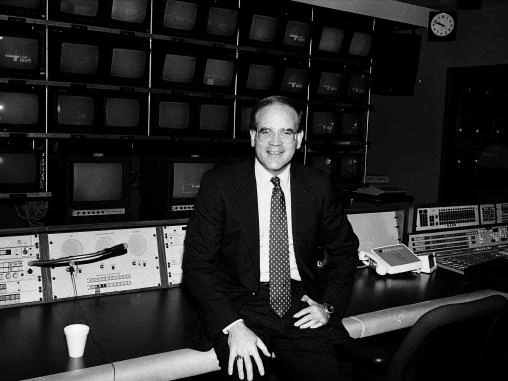
By the second half of the eighties, NBC could make a Thursday evening look less like a set of choices than a plan the household had already accepted. The comedy started, another familiar theme followed, and someone who intended to watch one show remained on the couch long enough to need a different excuse.
That apparent inevitability is misleading. NBC entered the decade as a struggling network. Its recovery depended on programs that needed time, executives making decisions before the outcome was clear, and a schedule that gradually learned how to turn one audience into another.
In 1980s television, the peacock’s climb is a story about the machinery behind familiar evenings. The viewer saw a bar, a family kitchen, a police station, or a Miami living room. The network needed those separate places to add up to something durable. Eventually they did, so convincingly that the earlier trouble became easy to forget.
Inside This Article
- The peacock did not begin the decade on top
- Tinker and Tartikoff had different jobs in the same rescue
- Hill Street Blues gave NBC something worth defending
- Patience was a decision, not a personality trait
- The bar had to become familiar before it became powerful
- The Keatons were another asset waiting for the right neighborhood
- The A-Team supplied a much louder kind of momentum
- One family changed the scale of the opportunity
- Thursday became a sequence people could remember
- Night Court kept the comedy from becoming too polite
- Second place was a breakthrough worth naming correctly
- Saturday had room for women the industry underestimated
- Another Saturday household widened the conversation
- In 1985–86, the recovery became the season title
- Miami Vice gave the network another visual language
- The winning network still needed new doors
- The slot after a giant hit could become a new world
- After the local news, NBC could become a different place
- Saturday Night Live made continuity look unstable
- A prime-time win did not settle every hour of the day
- At the top, the company changed hands
- The network learned to look like a destination
- A hit factory still produced shows people forgot
- By the late eighties, the lead had become the expectation
- A huge event was another kind of television power
- The end of 1989 was a beginning, not a preview of every later hit
- The machinery worked because the people felt familiar
- Questions from the peacock years
The peacock did not begin the decade on top
Remember NBC in the middle of its eighties winning streak and the early part of the decade starts to look suspiciously tidy. But before the Thursday-night juggernaut and the peacock’s confident promos, there was a network trying to get people to choose its shows at all. Nobody watching the early schedule had been handed the ending. The comeback happened one evening, one audience habit, and one surprise success at a time.
NBC was behind CBS and ABC in the prime-time ratings race as the decade began. That position affected more than the tone of industry coverage. A weaker schedule made it harder to launch new programs, reassure affiliates, and persuade viewers to try something on a channel they were not already choosing.
The 1980–81 television season, ending in 1981, is a useful place to start. The network had individual attractions and valuable parts of the broadcasting day. It did not yet have the prime-time identity that later made its success feel like a permanent feature of the decade.
A child was unlikely to describe this as a business problem. The household selected programs. It might like a particular NBC show without feeling any loyalty to NBC as a whole. Three letters and a familiar symbol did not automatically supply a reason to stay after the credits.
That is the fundamental difficulty of rebuilding a network. A good new program has to be noticed, sampled, and revisited. A weak surrounding schedule can make each stage harder. Success cannot be achieved simply by announcing that the next group of shows will be better.
The recovery also had to survive its own lack of clarity. Some programs that later mattered arrived before the breakthrough. Some new choices failed. There was no single evening when a complete future NBC stepped out of a conference room carrying all its eventual hits.
The early decade is more interesting when allowed to remain uncertain. The later ratings machine began as a collection of problems being addressed while the television audience was free to watch somebody else.
Tinker and Tartikoff had different jobs in the same rescue
Grant Tinker became NBC’s chairman and chief executive in 1981, following Fred Silverman’s tenure. His background included co-founding MTM, a company associated with character-driven television and respected creative work. That experience mattered to the kind of leader he became inside a network trying to rebuild.
Brandon Tartikoff was the entertainment executive closely identified with the programming recovery. It is useful to keep the roles distinct. Tinker supplied leadership and a climate in which creative decisions could be defended. Tartikoff and the programming organization worked on the shows, the schedule, and the practical problem of assembling an audience.
Neither description requires turning the recovery into a two-man magic act. Writers, performers, producers, directors, agents, studio executives, affiliate managers, marketers, and many others helped create the result. A network can encourage and select programs; it does not personally write every good scene.
The distinction matters especially in hindsight. A surviving hit looks like an obvious decision. Before success, it is a proposal, a pilot, an expensive production, or a program whose ratings are not yet reassuring. The executive’s job includes deciding what deserves another chance when certainty is unavailable.
Tinker’s Television Academy oral history places his return to NBC, his work with Tartikoff, and the rebuilding years within a longer career. That perspective helps resist the neat version in which a new boss arrives, cancels the bad television, and orders the good television everybody will eventually remember.
The actual problem was more demanding. NBC needed enough improvement to make progress visible while allowing some programs time to develop. It needed confidence without the pretense that every choice would work. It needed people willing to accept responsibility for decisions that could look foolish before they looked farsighted.
For the audience, all this management became visible indirectly. A show returned. A night acquired a stronger sequence. A familiar station suddenly offered more reasons to remain. The boardroom story mattered because it changed what appeared after dinner.
Hill Street Blues gave NBC something worth defending
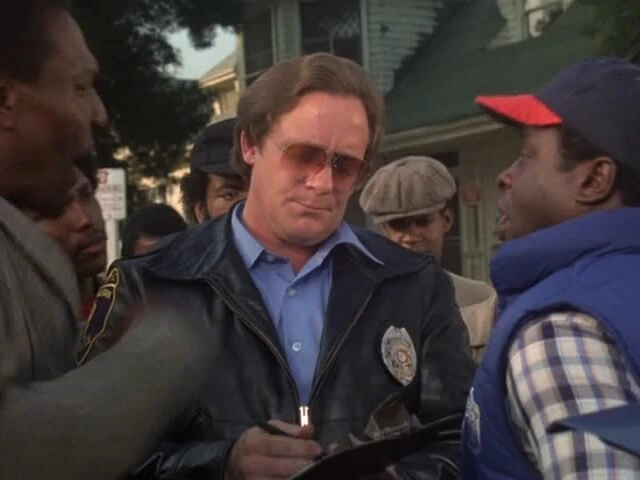
When Hill Street Blues arrived in 1981, the police station felt like it had already been open all day. People talked over one another. Cases followed officers home in their heads. Someone was angry before you knew why, and the briefing room contained more problems than one tough detective could fix. This was television that expected viewers to keep up, which is a pretty bold request for a network trying to win them back.
For NBC, that kind of program offered an identity as well as an hour of drama. It could make the network a place associated with ambitious television at a time when being associated with low ratings was not especially useful.
Critical attention and awards did not automatically solve the audience problem. They did provide another way to judge a program’s value while a network considered what it wanted to become. A show could contribute distinction before it contributed the kind of mass popularity required to win the whole season.
The network’s own historical account identifies the series as an important 1981 introduction. Its place in the recovery should be understood in those terms: a foundational creative asset, rather than a convenient fictional claim that NBC had already become the dominant network.
A viewer did not have to analyze serialized storytelling to feel the difference. Remembering names, relationships, and unfinished problems rewarded continued attention. The program asked for a little more of the audience and made its world feel fuller in return.
That was useful preparation for a network identity built partly around returning viewers. The appeal of an ensemble could deepen as its people became familiar. A schedule could benefit from programs that accumulated affection instead of exhausting a simple premise after the first encounter.
There was also a risk. A complex show could be harder to enter casually. Protecting it meant accepting that immediate broad accessibility was not the only measure worth considering. Hill Street Blues helped make the argument that NBC’s future might depend on recognizing value before a giant audience had finished recognizing it.
Patience was a decision, not a personality trait
The story of a successful renewal often becomes a lesson about patience. That is true as far as it goes, but patience is not simply waiting politely until ratings improve. A network has a finite schedule, production costs, disappointed affiliates, and other programs that want the same space.
Keeping a struggling series means deciding that its prospects justify those costs. The decision may involve the quality of the work, the audience it attracts, the possibility of a better time slot, and the network’s alternatives. A weak number alone cannot explain why one show survives while another disappears.
St. Elsewhere, which began on NBC in 1982, extended the sense that the network could support an intricate ensemble drama. Its hospital supplied another institution full of work, personality, and continuing relationships. It did not need to resemble Hill Street Blues in every detail to contribute to a recognizable creative direction.
This kind of development also complicated the meaning of progress. A network could be improving its programming reputation while still losing the overall ratings race. That gap was uncomfortable but important. It is where much of the early NBC recovery took place.
For the audience, a returning show could feel like a reliable promise. Characters would have another year. Unfinished relationships would continue. The network acquired value through the people and worlds it allowed viewers to revisit.
Not every low-rated program deserved unlimited time, and NBC did not behave as though it did. The useful lesson is more specific: a recovery can require distinguishing a weak program from a good program that has not yet found a sufficiently large audience.
The distinction is obvious only after the outcome. Before then, it is judgment under pressure. The later success of several NBC survivors should not erase the uncertainty of the decisions that kept them available long enough for viewers to make them familiar.
The bar had to become familiar before it became powerful
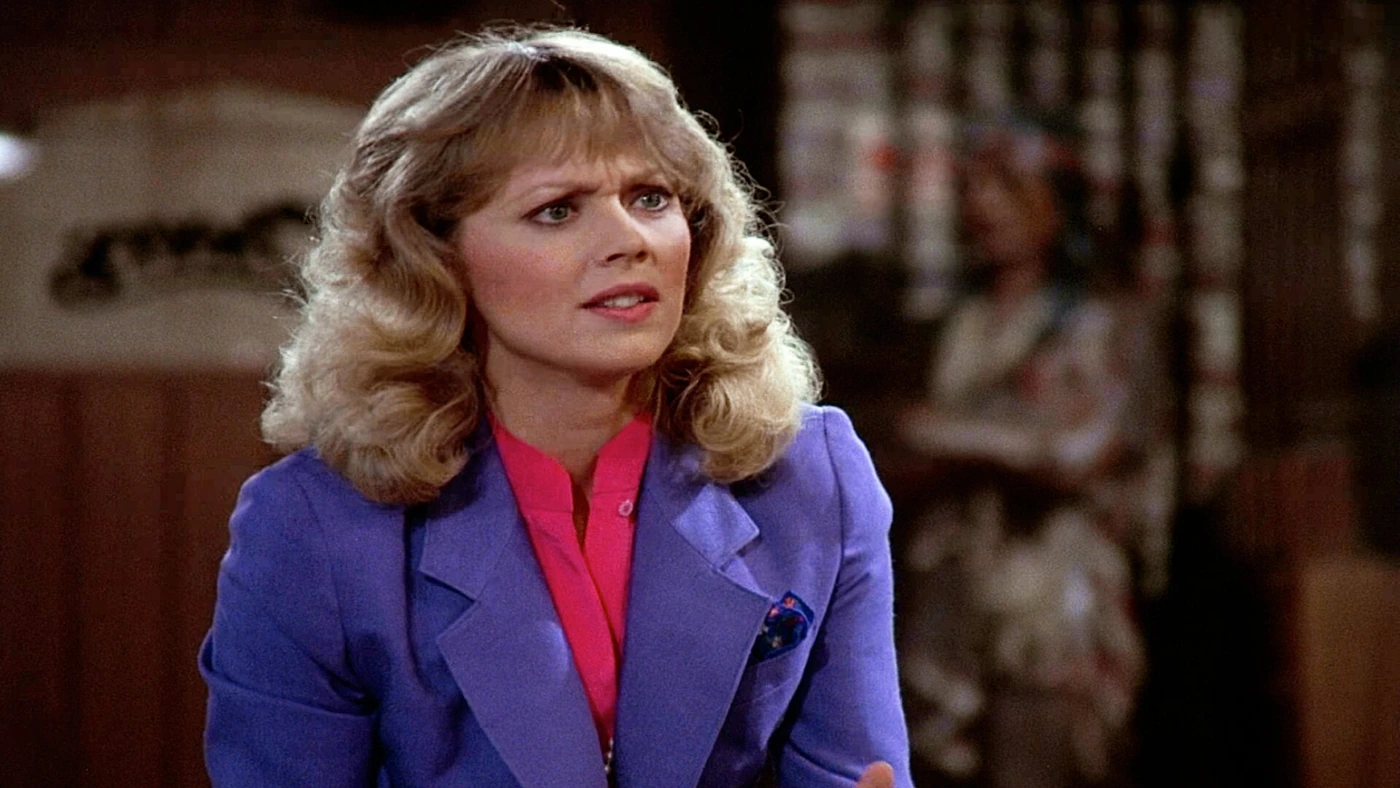
Cheers began in 1982 with a setting that promised familiarity before the audience actually possessed it. A neighborhood bar sounds welcoming. In a new television series, however, the viewer still has to learn why these particular people are worth returning to every week.
The early ratings were weak. Its later place among the network’s great successes should not be projected onto that first season. NBC was supporting a comedy whose writing and performances offered reasons for confidence before its audience supplied equally comforting evidence.
The program’s strength was cumulative. A remark became funnier because the viewer knew the person making it. A relationship mattered because the audience had watched it develop. The bar began to feel like a place with a history, including a history the viewer had helped accumulate.
That kind of attachment was valuable to a network. It could turn casual sampling into a recurring appointment. It could also help a night hold together, because a person who already wanted to visit the bar had a reason to remain near the television.
The 1982–83 season standings, filed under the year the season ended, belong to the show’s uncertain beginning. They should not be confused with its later prominence. The distance between those two stages is part of NBC’s recovery, not an inconvenience to edit away.
Cheers also demonstrated that a comedy’s sophistication did not have to make it inaccessible. The dialogue could reward attention while the human situations remained recognizable. Embarrassment, attraction, vanity, loyalty, and the desire to belong were hardly restricted to people who spent time in bars.
The network’s patience mattered, but so did the work done by the people making the series. Renewal created the opportunity. The evolving show gave viewers a reason to use it. The eventual hit was a collaboration between continued access and increasingly durable affection.
The Keatons were another asset waiting for the right neighborhood
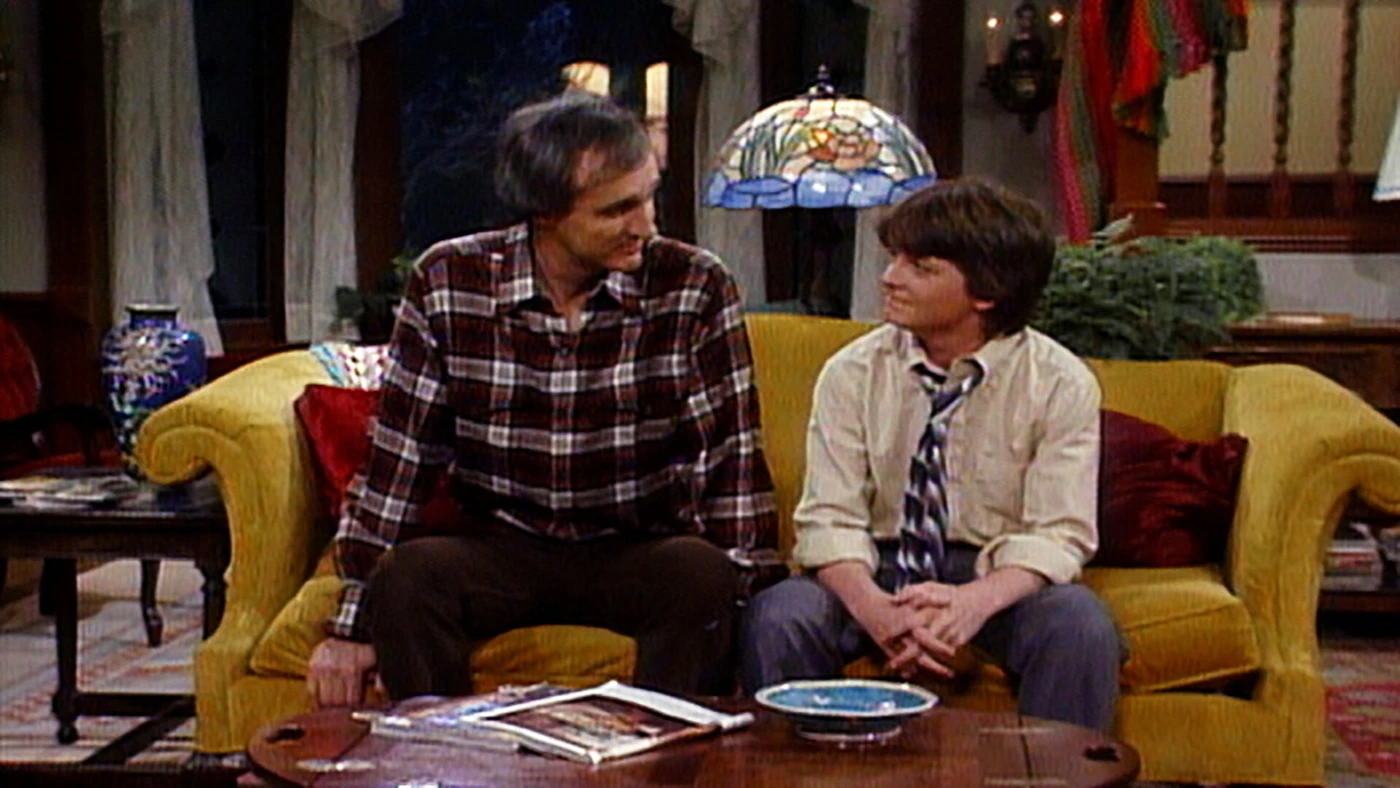
Family Ties also began in 1982. Its household offered a different kind of recurring place: parents and children whose disagreements could carry both family warmth and a recognizable argument about values.
The contrast between the parents and Alex P. Keaton gave the comedy an immediate organizing tension. It could turn an abstract generational difference into a conversation at home. Michael J. Fox’s performance became increasingly important to the program’s appeal, but the family around him supplied the context that made the character more than a string of confident declarations.
From the network’s perspective, the series was not merely another half hour to fill. It was a program with characters viewers could know, a domestic setting compatible with a broad audience, and room for the kind of repeated exposure through which a comedy becomes part of a household’s week.
Its later success beside The Cosby Show did not mean the two series were interchangeable. Their families, performances, and comic tensions differed. The compatibility came from the possibility that viewers who enjoyed one accessible family comedy might remain for another with a distinct personality.
That difference between compatibility and duplication is central to good scheduling. A second show needs to feel like a reasonable next choice without making the audience wonder why it is watching the same idea again with different furniture.
The Keatons also illustrate how a network can possess useful material before it possesses the ideal arrangement. A series may need time, attention, or a stronger surrounding schedule to reach its potential. The network’s job is partly to recognize that the program and its current ratings are related without being identical.
When NBC’s Thursday became more powerful, Family Ties was already there to benefit from and contribute to the larger habit. The recovery involved developing pieces that could work together, then finding an arrangement in which their strengths became harder to miss.
The A-Team supplied a much louder kind of momentum

Then came The A-Team in 1983, and subtlety politely stepped aside. Here was a van, a plan, a wonderfully recognizable bunch of fugitives, and enough controlled mayhem to give schoolyard conversations fresh material by Wednesday morning. NBC needed critically admired dramas, but it also needed the kid who would not stop talking about what B.A. and Hannibal had done the night before.
It was an important contrast within NBC’s identity. A network seeking a broad audience could not assume that every viewer wanted the same degree of dramatic complexity or the same kind of humor. A vigorous action series could give the lineup a different point of entry.
The characters were recognizable quickly. The vehicle, the attitudes, the competence, and the friction within the group made the show easy to identify even in a brief promotion. That clarity mattered in an environment where a viewer could decide to watch something else with a turn of the dial.
For younger viewers, the appeal could extend beyond the hour itself. Performances became impressions. A familiar gesture or phrase could enter conversation. The television series supplied a shared imaginative kit without requiring anyone to remember a complicated season-long plot.
For NBC, that kind of recognition was practical. A network needed programs that brought people in as well as programs that rewarded those who stayed. The A-Team offered a conspicuous attraction while other pieces of the schedule continued developing.
It would be a mistake to tell the recovery as though one style of television had won an argument and replaced all the others. NBC’s improvement depended on a mixture. Action, family comedy, workplace comedy, drama, news, and late-night entertainment did different jobs.
The louder hit helped keep the broader project from becoming an exercise in admired television that insufficient numbers of people watched. An audience could arrive for an explosion and later discover a bar. The network benefited from having several ways to get people through the door.
One family changed the scale of the opportunity
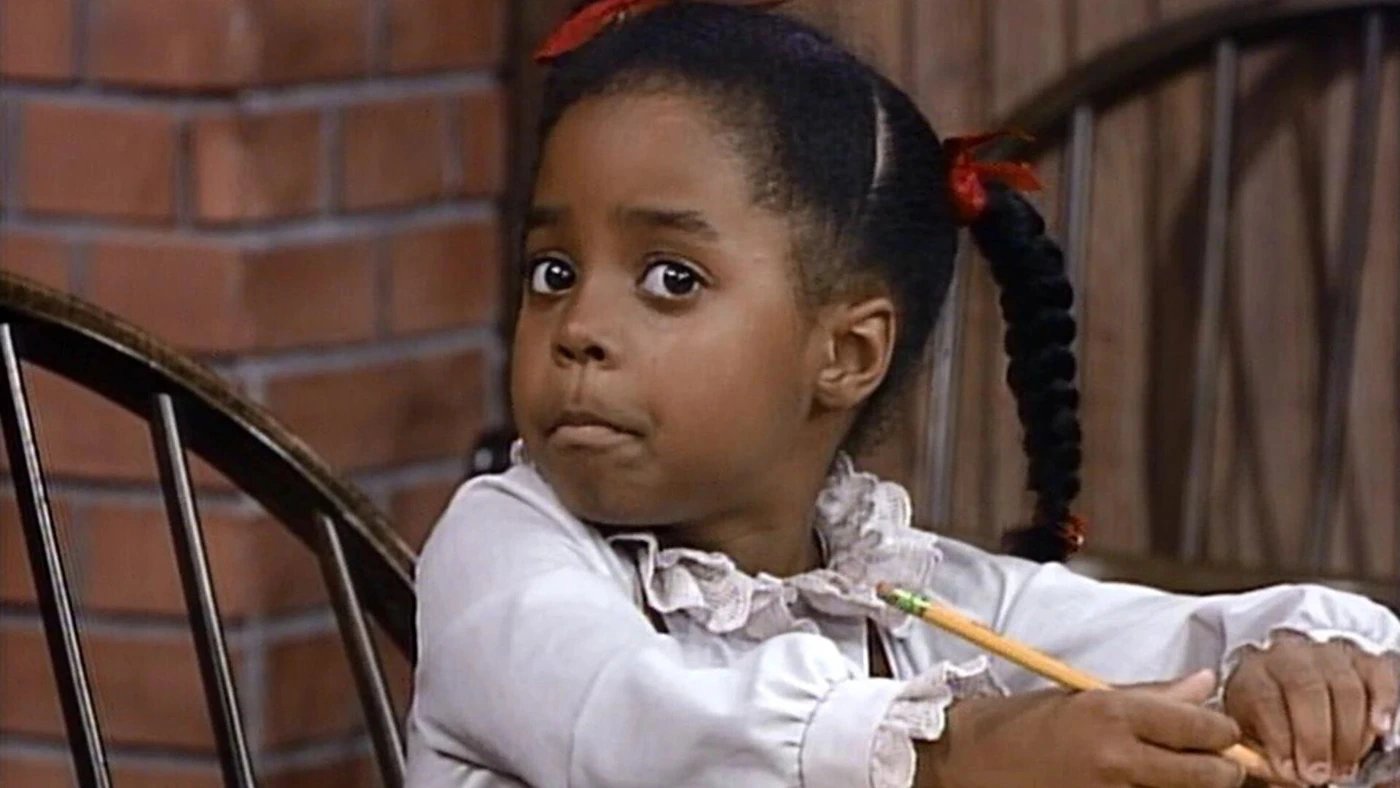
The Cosby Show premiered in September 1984 and changed the scale of NBC’s Thursday-night ambitions. The Huxtables didn’t arrive as a chart on an executive’s wall. They arrived as a household viewers wanted to visit, with familiar family friction and the kind of comic timing that made a weeknight appointment feel easy. NBC suddenly had a powerful anchor for the programs around it.
The comedy presented an affluent Black family with professional parents, children, domestic disagreements, and a confident sense of ordinary home life. Its visibility mattered within a television landscape where the range of prominent Black families had long been limited.
Its network role was also unusually clear. A strong comedy at the beginning of an evening could bring viewers to NBC before other programs began. The next half hour no longer had to find every viewer from scratch.
The correct ratings sequence is important. In the 1984–85 season, ending in 1985, The Cosby Show finished third among the season’s prime-time series, behind Dynasty and Dallas. It was a major new success, but calling it that season’s number-one series changes the evidence.
Its first-place reign followed in the next season. The distinction is small on a calendar and large in a historical explanation. NBC’s rise had stages: a powerful new program, a network climbing to second place, then a subsequent season in which both the program and the network reached the top.
Later sexual-abuse allegations against Bill Cosby changed how many viewers regard the program. A candid account can recognize that broken trust alongside the series’ documented place in NBC’s eighties recovery.
What NBC gained in 1984 was not merely an isolated hit. It gained a highly visible starting point from which a larger audience could move through the evening. The difference between those two benefits explains why the next decisions about the schedule mattered so much.
Thursday became a sequence people could remember
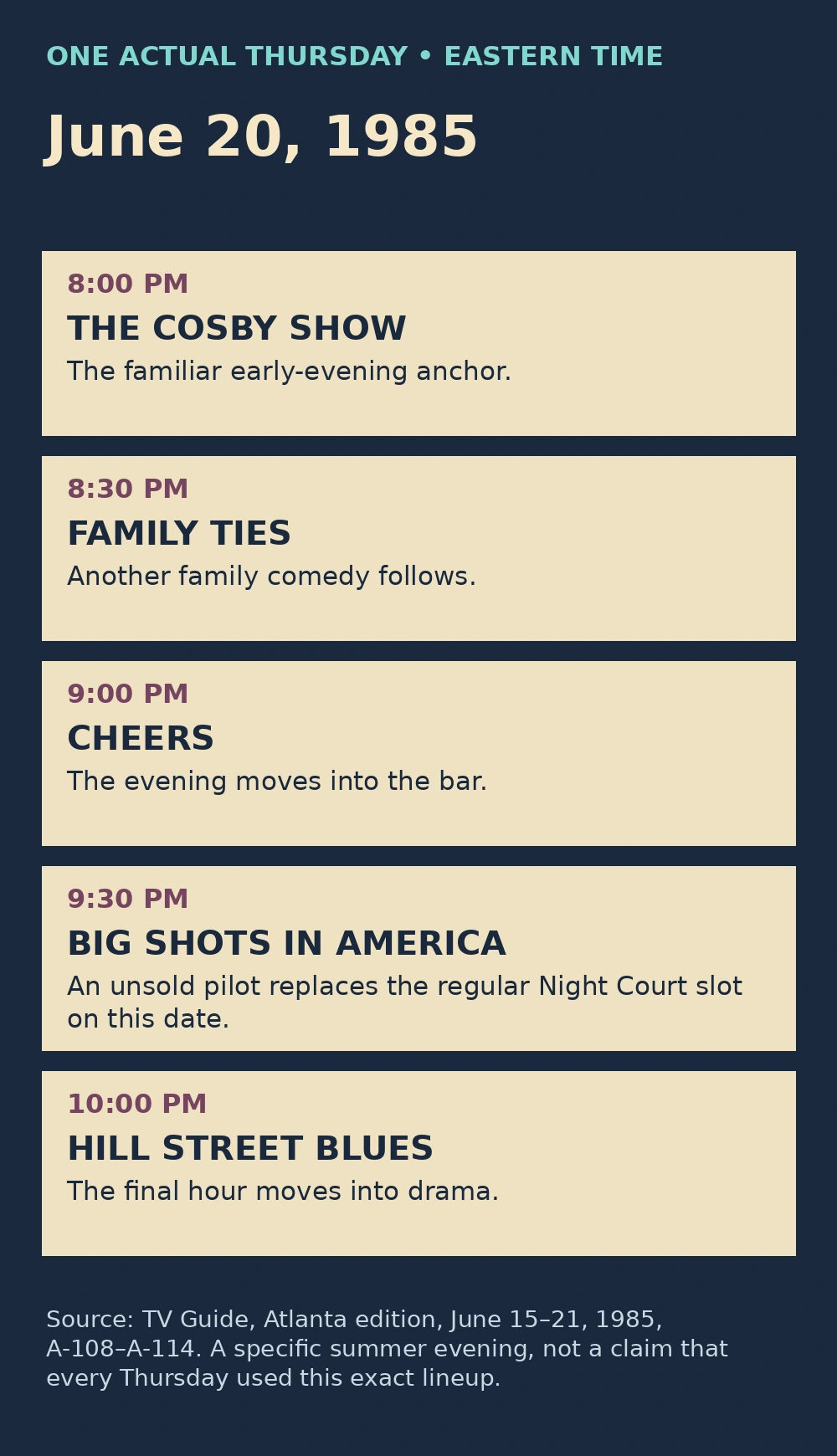
The familiar mid-decade Thursday arrangement placed The Cosby Show at eight, Family Ties at eight-thirty, Cheers at nine, Night Court at nine-thirty, and Hill Street Blues at ten in Eastern prime time. It gave the evening both a rhythm and a progression.
The first hour offered family comedy in two distinct households. The second moved into a bar and a nighttime courtroom, with different kinds of adult workplace humor. The drama at ten supplied another change in tone without requiring the viewer to change networks.
The schedule was not a guarantee that the same people watched every minute. Children went to bed. Adults changed channels. People arrived late, recorded a program, or ignored an entire evening. The arrangement created an opportunity for audience flow rather than a command that every household obeyed.
Its value was easy to feel from the sofa. The next program could seem like a reasonable continuation of the evening. The viewer did not have to make a fresh plan at every half hour, especially once the series had become familiar.
The printed schedule also made the network’s strength visible. A line of recognizable titles was a form of reassurance. People could decide in advance that Thursday was taken care of, then organize dinner, homework, or a telephone call around it.
That was the precursor to the later Must See TV identity. The formal slogan belongs to the nineties, not to the original eighties breakthrough. The habit existed before the later branding attached an especially memorable label to it.
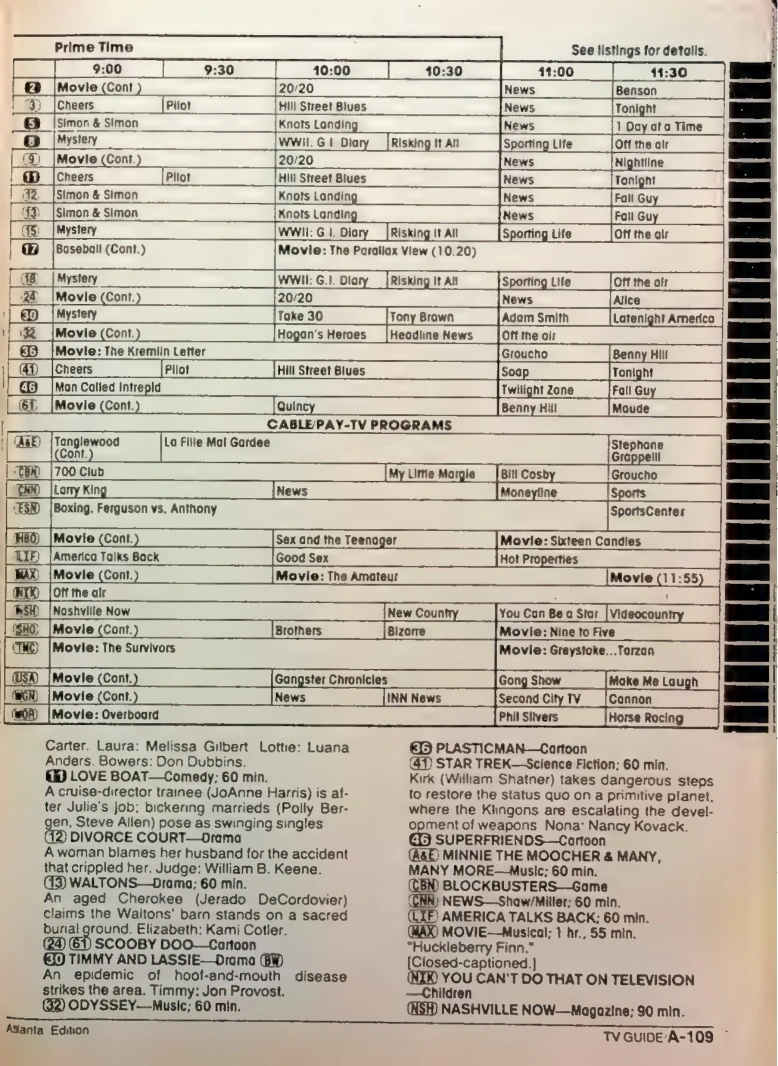
Nor was every Thursday identical. Specials, repeats, preemptions, and experiments could change a particular date. A surviving June 1985 listing even places an unsold pilot in the nine-thirty slot on one Thursday. The regular arrangement explains the strategy; the dated page reminds us that actual television evenings were allowed to depart from it.
Night Court kept the comedy from becoming too polite
Night Court arrived in 1984 looking as though someone had left the back door to the courthouse open after midnight. Harry Stone had a bench, Dan Fielding had an ego that needed its own chair, and the regulars had to deal with whatever walked into the room next. It wasn’t always refined, and that was part of the fun. NBC’s lineup had room for a little glorious disorder.
Within the Thursday sequence, it had a useful job. It could follow the bar without requiring the evening to remain in the same comic register. A workplace was still the organizing space, but the population and possibilities were different.
That difference helped the night avoid the feeling of an assembly line. The viewer could recognize a general promise of character comedy while moving among settings with their own rules. The network was building continuity through compatible pleasures, not through identical plots.
Harry Anderson’s judge supplied an off-center authority, while the ensemble made the courthouse a place where personalities repeatedly collided. The room could become absurd without losing the recognizable pressures of people trying to get through a working night.
It also demonstrated the value of a strong surrounding schedule. A program with its own merits could benefit from viewers already present, then give those viewers a reason not to leave. The help ran in both directions: the lead-in supplied opportunity; the following show had to earn continued attention.
This is where the phrase ratings machine can become misleading if it makes the programs sound passive. Scheduling mattered, but it did not write the jokes, establish the characters, or make the performances funny. The machine worked because the individual parts remained worth watching.
For a household, the calculation was less industrial. Another familiar theme began. Someone recognized a face. The next half hour looked promising enough to delay getting up. NBC’s strategy became a small personal decision repeated in living rooms the network would never see.
Second place was a breakthrough worth naming correctly
The 1984–85 prime-time season ended with CBS still first, NBC second, and ABC third. NBC’s recovery had become substantial enough to change the order of the race, but the finish was not yet the championship that later shorthand sometimes assigns to it.
Contemporary coverage treated NBC’s improvement as the season’s major surprise. That framing makes sense. A network emerging from years at the bottom could change the industry’s expectations without winning every comparison immediately.
The distinction also clarifies what The Cosby Show accomplished in its first year. It helped transform the network’s prospects. It did not single-handedly produce a first-place season before its own initial run was complete.
At the program level, the developing strength of NBC’s comedies made the recovery visible. At the network level, the total schedule still mattered. One exceptional night could not completely erase weakness elsewhere in the week.
This is the practical meaning of rebuilding. Improvement must spread. A network can have a hit while losing the season, win a week while remaining behind overall, or lead with a desired demographic while finishing second in a broader household measure. Those statements can all describe different, legitimate comparisons.
For viewers, the change was more intuitive. NBC seemed to have more things worth watching. The network’s promotions had stronger material to promote. Familiar series acquired a better context, and the next fall’s announcements could be heard with less skepticism.
The year ending in 1985 therefore deserves to stand as its own stage. It was neither the old failure nor the completed triumph. It was the point at which the recovery became difficult to dismiss and the prospect of first place became a plausible next question rather than an optimistic slogan.
Saturday had room for women the industry underestimated
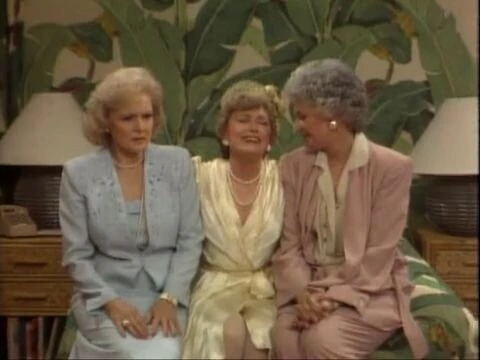
The Golden Girls made Saturday in 1985 feel less like a scheduling problem and more like an invitation. Four women, a Miami kitchen, cheesecake when needed, and enough perfectly aimed insults to keep the conversation moving. NBC had discovered that a household could be a place worth returning to even when nobody was young, rich, or remotely interested in behaving themselves.
The ages of the central characters mattered. The series placed older women at the center of friendship, desire, work, family conflict, and the business of continuing to live. It did not ask them to remain supportive figures at the edge of somebody younger’s story.
That was a creative distinction with a scheduling consequence. NBC could build strength beyond Thursday by offering a Saturday attraction that did not simply reproduce the younger-family arrangement elsewhere in the week. A broad audience could respond to a different set of lives.
The ensemble’s precision made the premise durable. Bea Arthur, Betty White, Rue McClanahan, and Estelle Getty gave the household sharply different rhythms. The jokes depended on those differences, and the affection depended on watching the characters remain together despite them.
For the network, the show demonstrated that audience appeal was not confined to the most obvious demographic picture on a development memo. An older cast could attract viewers across generations when the work was accessible, specific, and funny.
For children watching with adults, there was another pleasure: some jokes were immediately clear, while others arrived with a pause that suggested the grown-ups had heard an additional layer. The same scene could work at several levels without requiring the household to select a different program.
The series became part of the larger improvement reflected in the 1985–86 season standings. Its arrival helps explain why NBC’s recovery could become a network result. The company was no longer relying on a single strong evening to carry all its ambitions.
Another Saturday household widened the conversation
227 also arrived on NBC in 1985. Its apartment-building community, centered on Marla Gibbs as Mary Jenkins, offered a different social arrangement from a suburban family home or a Miami household of friends.
The setting made neighbors part of the ordinary machinery of comedy. A doorway, a stoop, a shared concern, or an argument could bring people into one another’s business. The world was domestic without being sealed inside one nuclear family.
Its place in the network’s development matters because NBC’s successful Black-led comedies did not all present the same household. The Huxtables, the residents of 227, and later the students of A Different World occupied different social spaces. Their distinctions should not disappear inside a broad statement about representation.
At the scheduling level, another recognizable comedy could help an evening become a habit. Viewers might arrive for a favorite performer, remain for another series, or learn a new program through proximity to one they already trusted.
That opportunity did not relieve the show of responsibility for being engaging. A lead-in can invite a viewer, but a series has to make the invitation worth accepting repeatedly. Characters, comic timing, and a setting with room for conflict did the work after the network supplied the time slot.
For NBC, Saturday strength also made the comeback less fragile. An audience attached to several nights gives a network more room to develop new material and less dependence on one particular chain of programs.
The individual histories of those shows deserve their own space. The network story concerns what their coexistence made possible: more than one appealing version of home, more than one evening worth planning around, and more chances for the peacock to appear before a program the household already wanted.
In 1985–86, the recovery became the season title
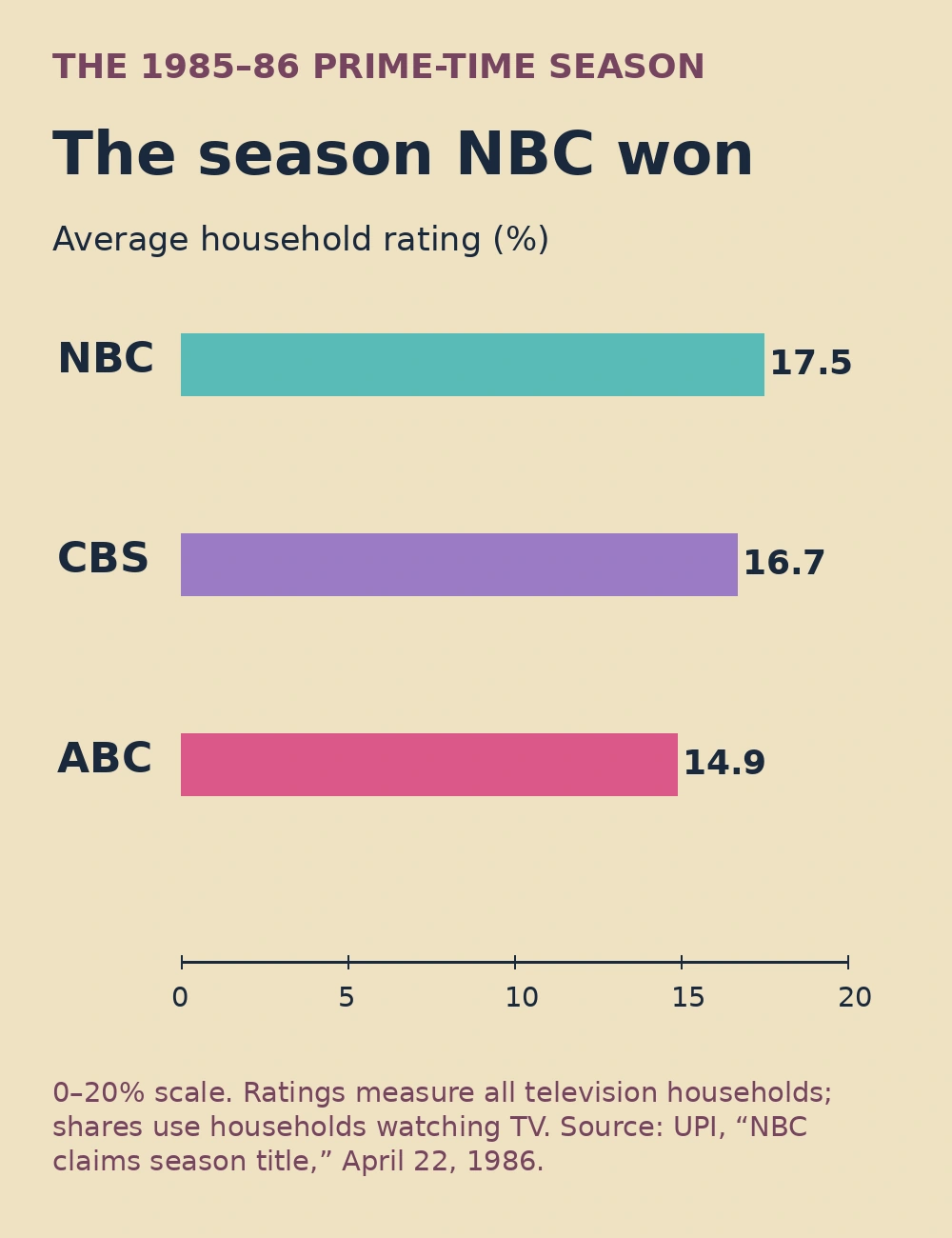
NBC won the 1985–86 prime-time ratings race. Contemporary reporting gives the season household ratings as NBC 17.5, CBS 16.7, and ABC 14.9. That is the first-place finish that belongs after the network’s second-place result in the preceding season.
The figures should be read as ratings, not as millions of viewers. A household rating measures the percentage of television households tuned to the program or schedule being measured. A share uses the smaller group of households actually using television at the time. Neither term can be casually substituted for the other.
The reported NBC share for the season was 27. That number describes a different denominator from the 17.5 rating. Keeping them separate helps explain why an article can legitimately report two different numbers for the same network without contradicting itself.
The result represented accumulated strength. The Thursday comedies mattered greatly, but the schedule also included successful programming elsewhere. Newer series joined programs that had survived the difficult earlier years. The network had become stronger through a combination of development, selection, and arrangement.
For Tinker and Tartikoff, first place supplied unusually clear external confirmation. A creative reputation and an improving lineup had become a measurable victory in the comparison the industry watched most closely.
For the household, the result was less likely to arrive as a ceremony. People had already been contributing to it by choosing programs week after week. The ratings announcement named a pattern that viewers had experienced as ordinary evenings.
That difference is part of television’s peculiar scale. A family chose a comedy because it wanted a laugh. Across many households, those choices became evidence used in programming, advertising, and corporate decisions. NBC’s recovery was visible in a table because it had already happened, in small increments, on the other side of the screen.
Miami Vice gave the network another visual language

Miami Vice gave NBC an entirely different kind of calling card. From 1984 onward, the clothes, colors, nighttime streets, and music announced the show before anyone needed to explain the case. You could recognize the mood almost immediately. A network that once struggled to give audiences a reason to tune in now had a police drama people could identify from the look of the screen.
Its importance to the network was not simply that it supplied another crime program. It gave NBC a different kind of cultural visibility. A viewer could recognize its style from a brief encounter, and its images could circulate in conversation beyond the details of a particular investigation.
That distinction helped the broader lineup feel less uniform. Hill Street Blues and Miami Vice both involved police work, yet they offered different textures, rhythms, and attractions. The network could benefit from having programs that reached viewers through different expectations.
For a Gen X audience, the relationship between television and music was particularly vivid during the decade. A drama that used songs and visual design assertively could speak to a viewer already learning to associate music with images elsewhere on the dial.
None of that means every Friday viewer became a Thursday comedy viewer, or that style alone explains ratings. A network identity is assembled from overlapping associations. A program can contribute distinctiveness even when its audience does not match the audience of every neighboring success.
The lesson for NBC was that mass appeal did not require every show to look as though it had emerged from the same room. A strong brand could contain contrast: warm domestic comedy, barroom wit, urban drama, medical ensemble work, action, and the heightened look of Miami.
The household experienced that variety as a sequence of different evenings. The network experienced it as a broader set of reasons for viewers to try NBC. Both descriptions are true, and neither requires reducing the programs to interchangeable pieces of a single formula.
The winning network still needed new doors
A ratings lead does not make development optional. Programs age, audiences change, casts leave, and successful time slots create pressure to find something that can use the opportunity. NBC’s mid-decade strength had to be renewed rather than merely admired.
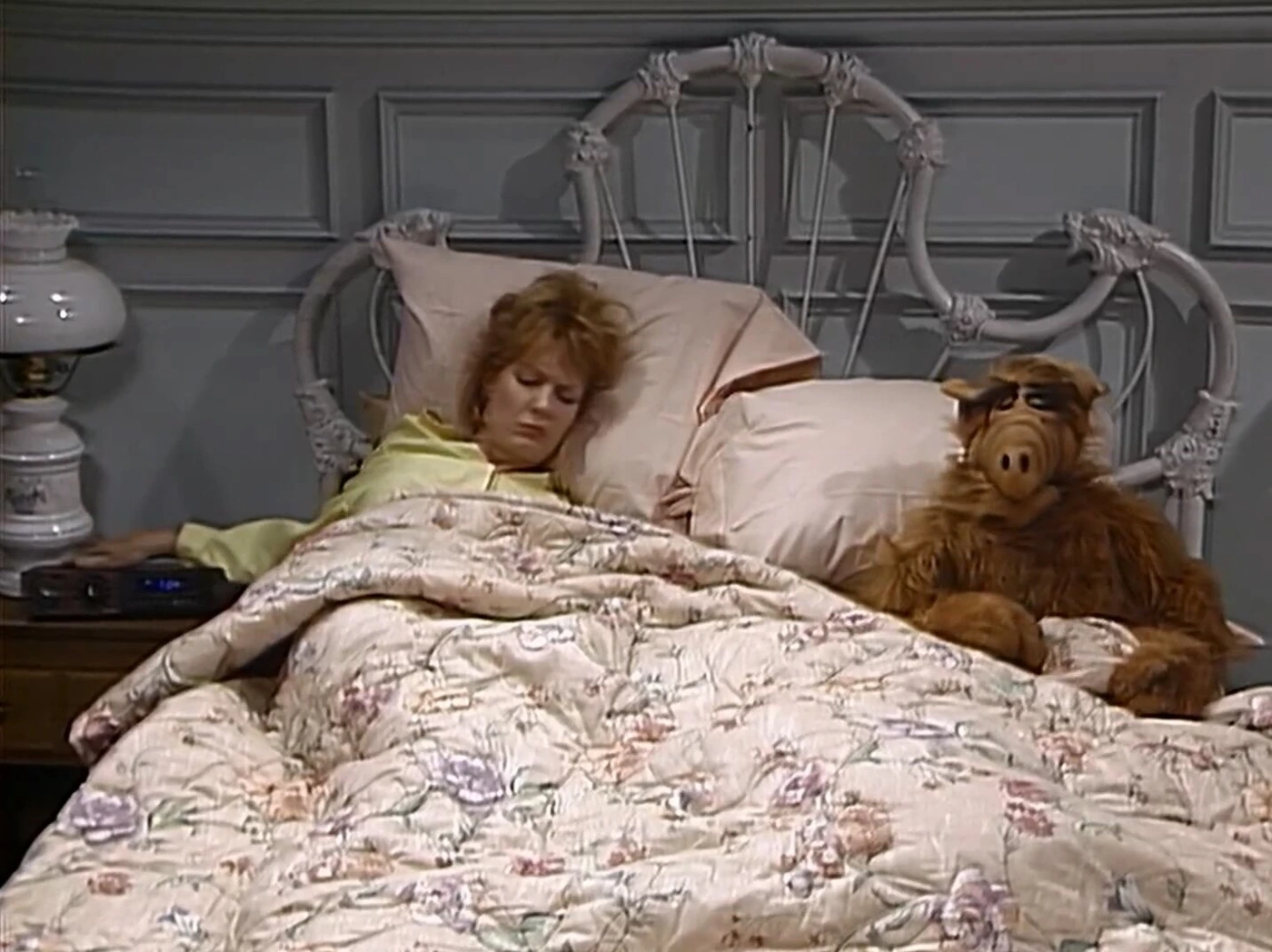
The 1986 arrivals show how varied that renewal could be. ALF brought an alien into a suburban family comedy. Matlock offered Andy Griffith as a courtroom investigator and advocate with a distinctive personal style. L.A. Law added a legal ensemble with a different setting and dramatic register.
Those were separate propositions. A child attracted to an extraterrestrial houseguest was not necessarily the ideal audience for a legal drama. The network needed a range of programs because the television week contained different viewers, moods, and household arrangements.
Matlock also illustrates why a successful network could still make room for an established performer and a relatively traditional form. Innovation and familiarity were not mutually exclusive scheduling tools. A new series could promise a dependable pleasure rather than a radical reinvention of television.
ALF’s premise worked in another direction, making the family living room absurd by adding a creature who did not belong there. Its recognizability was immediate, which mattered when a network tried to persuade people to sample a new program.
The 1986–87 season, ending in 1987, provides the proper annual context for these fall 1986 introductions. Their arrival year and their first full season-ending year are related but different labels.
The larger point is that NBC’s lead was a platform for further choices, not the end of the story. The network had earned more attention. It still needed to decide what to do with that attention once the familiar theme music stopped.
The slot after a giant hit could become a new world
A Different World premiered in 1987, following Denise Huxtable into college and inheriting the enviable position after The Cosby Show. That gave the new series a built-in audience, not a guaranteed personality. Hillman had to become a place viewers cared about on its own—complete with classmates, awkward choices, and a campus full of people who would not stay frozen in somebody else’s sitcom.
That is one of the clearest examples of scheduling power, but it should not erase the new series’ own development. A launch connection can help people arrive. It does not fully determine the identity a show will acquire once its characters and setting begin to matter independently.
The college environment opened possibilities different from those of the family home. Students, friendship, ambition, romance, and the experience of a historically Black college could occupy the center of the comedy. The program’s later adjustments and evolving ensemble helped make that world its own destination.
At the network level, the change also shows that the famous Thursday lineup was not frozen. A successful arrangement could be revised. An established show could move, a new one could be placed beside an anchor, and the network could try to convert an existing habit into support for another series.
The 1987–88 season standings belong to that first year. They are useful for understanding the network’s continuing strength without assuming that a new show’s audience emerged in isolation from its time slot.
For viewers, the transition could be gradual. A person stayed after the familiar family comedy, learned new characters, and eventually had a second reason to arrive on time. What began as proximity could become attachment.
That was the network’s hope, not an automatic outcome. NBC’s strongest advantage was the ability to offer a large introduction. The creative work still had to turn that introduction into something worth returning to once the novelty and the initial family connection had worn off.
After the local news, NBC could become a different place
Prime time was the central ratings race, but NBC’s identity extended beyond it. Johnny Carson’s Tonight Show remained a major late-night institution, and Late Night with David Letterman began on the network in 1982.
The two programs occupied related territory without offering identical experiences. Carson represented an established form of late-night hospitality, performance, and conversation. Letterman’s program could turn the conventions of television itself into material for comedy.
For a younger viewer permitted to remain awake, that later hour could feel like access to a different broadcasting country. The pacing, the jokes, the guests, and the sense of what television might do were not simply extensions of the family comedy watched earlier.
It also demonstrated the value of fitting a talent to an appropriate place. Letterman’s earlier NBC daytime show had not become a lasting daytime success. His late-night program offered another context in which his particular sensibility could develop.
A network history that counts only prime-time hits misses that ability to serve different moods across the day. The same set of letters could precede a morning program, a news broadcast, a broad comedy, and a late-night experiment.
That range did not mean one viewer watched everything. The strength lay partly in having different reasons to return at different hours. A household member who ignored the evening lineup could still think of NBC as the place where a favorite host appeared.
For Gen X, the late-night memory often includes the practical circumstances of seeing it: a holiday, a permissive parent, an older sibling, or a television watched quietly when the rest of the house had gone still. The network’s schedule extended beyond bedtime. Whether the child was allowed to follow it was a separate negotiation.
Saturday Night Live made continuity look unstable
Saturday Night Live’s eighties were not one uninterrupted version of the same show. Casts changed, production leadership changed, and the program repeatedly had to rebuild the feeling that anything might happen while remaining recognizable enough for viewers to return.
That made it a different kind of network asset from a stable situation comedy. The format’s name and time slot could endure while the people making its comedy changed substantially. Continuity depended partly on the audience accepting renewal as part of the bargain.
The decade included Eddie Murphy’s rise as a defining performer and, later, another developing ensemble under Lorne Michaels after his return. It would be misleading to treat those stages as though the same creative team had simply continued operating unchanged from the seventies.
For NBC, the show supplied cultural visibility at an hour outside the ordinary family prime-time schedule. A sketch or impression could enter conversation without every person discussing it having watched the entire broadcast.
Its unevenness also belongs in the network story. A valuable franchise can have difficult stretches. The existence of a famous title does not guarantee that every season will feel equally confident or that every audience will agree about when the program was best.
For younger viewers, that disagreement became part of learning television taste. An older person declared that the show had been better before. A teenager preferred the cast currently making the jokes. The argument could repeat each time another generation discovered the program.
The network benefited from that continuing discovery, even when the individual seasons resisted a simple upward line. NBC’s recovery was broad enough to contain a program whose identity depended on change, risk, and periodic dissatisfaction alongside the reassuring familiarity of its strongest scripted evenings.
A prime-time win did not settle every hour of the day

The phrase number-one network needs a defined comparison. NBC’s prime-time season victory did not mean that every NBC program led its competitors, that its evening news always ranked first, or that every part of the broadcasting day moved in the same direction.
News provides a useful reminder. Tom Brokaw became the sole anchor of NBC Nightly News in September 1983. That was an important institutional change, but the broadcast had its own competition and measurements, distinct from the performance of the Thursday comedies.
Morning television, daytime programming, sports, late night, and local affiliate schedules added further layers. A viewer’s relationship with NBC could be strong in one part of the day and weak in another.
Affiliates mattered because the network reached households through local stations. Those stations had their own news programs, identities, business needs, and scheduling responsibilities. The national success became tangible on a particular channel with familiar local faces around it.
That local layer helped make network television feel ordinary. A national comedy and a local weather forecast could occupy the same evening in a viewer’s mind even though they came from different organizations and served different purposes.
It also explains why a network’s reputation should not be measured only by a child remembering its most enjoyable shows. The broadcasting business had to function across hours and markets. A prime-time lead was enormously valuable without being a complete description of the company.
Keeping the distinctions visible makes the achievement more convincing. NBC did not need to win every possible comparison to complete a remarkable recovery. It needed to become first in the particular prime-time season race it had spent years losing, while continuing to manage the rest of a complicated broadcasting operation.
At the top, the company changed hands
General Electric acquired RCA, NBC’s parent company, in 1986. The network’s corporate setting changed just as its prime-time recovery had produced a season victory. Grant Tinker departed, and Bob Wright became NBC’s president.
That timing can make the history look neater than the experience was. A corporate acquisition, an executive transition, and a successful programming schedule are connected events, but they are not the same event. The programs already on the air did not begin again because the ownership changed.
The audience continued seeing familiar characters and familiar titles. The business behind them acquired a different set of reporting relationships, priorities, and expectations. A network can look continuous from a living room while changing substantially inside its organization.
For the programming side, success created both protection and pressure. Strong results made the schedule valuable. They also established a standard that the organization would expect to maintain. Winning turns an uncertain recovery into a responsibility for continued performance.
Tartikoff’s continuing role in entertainment helped connect the rebuilding years with the later period of dominance. The network’s identity did not depend on one executive occupying every position indefinitely.
The ownership change also places NBC within the larger transformation of eighties media. Television was a creative business and a corporate asset. The programs people loved existed inside organizations whose strategic decisions could extend far beyond what appeared between commercials.
That does not make the affection less real. It explains why the same evening can be described in such different languages. A viewer remembers an especially funny scene. An executive remembers a successful schedule. An owner sees a business with an unusually powerful position. The recovery mattered because all three descriptions could refer to the same hours.
The network learned to look like a destination

A successful schedule gives promotion something concrete to promise. NBC could point to recognizable faces, familiar settings, and a growing collection of programs viewers already wanted. The brand became more persuasive because the experience behind it had improved.
The network’s 1986 sixtieth-anniversary advertising provides a genuine period artifact of that confidence. Its claim to broadcasting leadership is advertising language tied to the occasion. It should not be mistaken for a neutral statement that NBC led every measure throughout its history.
That distinction is useful whenever an old promotion supplies an image for nostalgia. The advertisement tells us how the organization wanted to be seen. Ratings, schedules, and contemporary reporting tell us which parts of that presentation were supported in a particular period.
The viewer encountered the brand through repetition: a symbol, a musical phrase, a cast appearing together in a promotion, or a reminder that another favorite was coming soon. These small encounters could connect otherwise different programs in memory.
Promotion also helped an audience cross from a familiar series to an unfamiliar one. A new show advertised during a favorite program had a better chance of being noticed by the kind of viewer the network hoped to attract.
The effect was strongest when the promise and the program agreed. A lively promotion might win an initial sample, but repeated viewing depended on what followed. NBC’s growing confidence had substance because more of its titles could survive that test.
For a child, the result could feel like knowing the network’s people. A cluster of performers in a promotional spot made separate fictional worlds appear to share a larger home. The network was selling a schedule; the viewer was learning a familiar cast of television neighbors.
A hit factory still produced shows people forgot
The phrase ratings machine should not imply that NBC discovered a formula incapable of failure. Even at its strongest, the network launched programs that did not become durable hits. Development remained uncertain because an appealing idea and a successful series are different achievements.
A good time slot could help a new show receive attention. It could not guarantee that viewers would like the characters, accept the premise, or return once the initial curiosity faded. Proximity to success was an advantage, not a transferable personality.
The surviving television memory is selective. Long-running shows remain available, familiar titles receive anniversaries, and actors return to discuss beloved roles. Short-lived programs can disappear from ordinary conversation, making the successful network look more consistently successful than the actual schedule was.
The June 1985 TV Guide page is useful here too. An unsold pilot could occupy a place later remembered as part of an unbeatable lineup. The published schedule contained experiments and departures that a broad nostalgic account can easily smooth away.
That does not diminish the recovery. It clarifies its nature. NBC became stronger by making enough successful decisions, developing enough durable programs, and arranging enough of them effectively. Perfection was unnecessary and unavailable.
It also helps explain why the people involved still had demanding jobs after the first-place announcement. A network must consider replacements before the audience agrees that anything needs replacing. It must protect familiar attractions while making room for things viewers have not yet learned to want.
The peacock’s advantage was not the abolition of uncertainty. It was a stronger position from which to manage it. A network with several popular nights, trusted performers, and a clear promotional identity could take chances without asking every new show to rescue the entire company.
By the late eighties, the lead had become the expectation
NBC’s season victories continued after 1985–86. By the end of the 1988–89 season, the network had won the prime-time race four seasons in a row. What had once been a recovery was now an established competitive position.
That changed the meaning of an ordinary ratings report. A victory no longer surprised in the same way. The questions became how large the lead was, which programs were contributing, and whether the network could continue finding enough new material to support its strongest attractions.
Success also changed the competitive environment. Rivals could study the schedule, pursue their own family comedies or ensembles, and look for openings NBC had left. A successful approach becomes part of the landscape other programmers must navigate.
For viewers, the network’s strength could become almost invisible. A household did not need to announce loyalty to NBC in order to watch several NBC series. It could simply follow the shows it liked and discover that a substantial part of the week carried the same network identity.
That is one reason the peacock’s late-eighties reputation remains so strong. The audience encountered it repeatedly in association with familiar pleasures. A new program benefited from appearing in a place that already seemed capable of providing a good evening.
The lead was not a claim that every taste had been satisfied. Other networks had important hits, cable was expanding, and households continued making different choices. Dominance in a defined season race coexisted with a wider television world that no single broadcaster controlled.
The lasting achievement was the distance traveled. NBC had moved from a schedule discussed through its weakness to one competitors had to reckon with. The children who remembered only the stronger years could reasonably think it had always looked that way. The earlier seasons show how much work that impression concealed.
A huge event was another kind of television power
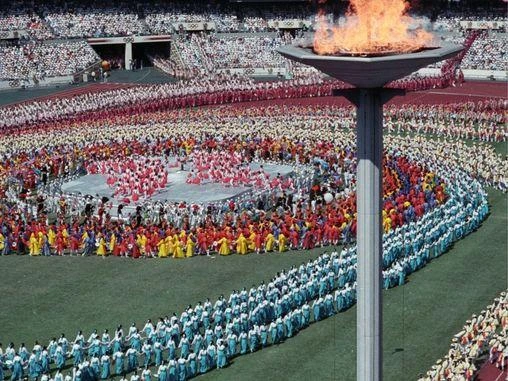
NBC’s coverage of the 1988 Seoul Olympics placed a different kind of spectacle beside its regular entertainment identity. A major international event could temporarily reorganize the schedule around sport, national attention, time differences, and the practical demands of television coverage.
The viewer’s experience differed from returning to a familiar comedy. An event offered uncertainty with a different source. The characters were real competitors, the outcome mattered outside the program, and the next memorable moment could not be written in the same way as a sitcom scene.
For a network, that kind of presentation required resources and coordination beyond commissioning a weekly series. Pictures had to be gathered, selected, explained, and delivered to an audience with different levels of knowledge about the sports involved.
It also supplied promotional opportunities. A large event audience could be shown the network’s regular attractions, while familiar network presenters helped connect the special coverage with the broader broadcasting identity.
The Olympics should not be used as a shortcut for explaining every regular-season result. An event, a weekly series, a season average, and an annual audience measure are different things. They can influence one another without becoming interchangeable evidence.
For a household, the distinction might be less formal. The television stayed on longer, unfamiliar sports became briefly important, and the usual program routine gave way to something happening far beyond the living room.
That capacity belonged to the network’s larger power. NBC could provide intimate recurring fiction and also act as a large window onto an international occasion. The late-eighties peacock was associated with both, even though the work and measurements behind them were quite different.
The end of 1989 was a beginning, not a preview of every later hit
Looking beyond the network’s eighties success can make the final year appear crowded with fully formed nineties institutions. That is another place where hindsight needs a little supervision. A debut is not the same as a completed cultural reputation.
The Seinfeld Chronicles pilot aired on NBC in 1989. The later Seinfeld phenomenon belongs largely to the following decade. Its presence at the edge of this story is evidence that the network was still trying new things, not evidence that Jerry Seinfeld’s comedy had already become the engine of NBC’s eighties lead.
Quantum Leap also began in 1989. Its premise offered a different route through weekly dramatic stories, organized around a traveler occupying other lives. A new series could add something distinctive even while the network remained associated with established comedies and legal or police ensembles.
NBC also launched CNBC in 1989, extending its business into cable. That move belongs beside the broader change described in the household arrival of cable television. A broadcast network’s company could participate in a developing medium that was also giving its viewers more alternatives.
These beginnings matter most when kept in proportion. They point toward later developments without replacing the shows and decisions that produced the actual eighties recovery. The network did not win the middle of the decade with programs whose main success had not yet occurred.
The boundary also protects the decade’s own personality. The rhythms of its family comedies, the particular ensembles, the late-night sensibilities, and the television technology of the household were not simply an early draft of the nineties.
By 1989, NBC had achieved a remarkable position and was still an organization facing an uncertain next season. The past supplied confidence, not a guarantee. The screen would go dark after the evening, and eventually the network would need another reason for the household to turn it on again.
The machinery worked because the people felt familiar
A network history naturally gathers executives, ratings, ownership changes, and schedule decisions. They explain how NBC recovered. They do not completely explain why its stronger years remain emotionally legible to people who never read a trade paper.
The household remembered the programs as places. A bar could feel familiar. A family argument could resemble something happening at home. Four women in a kitchen could make a Saturday night feel companionable. A court or a police station could become a recurring destination despite being nothing like the viewer’s ordinary life.
The network’s strongest arrangement helped those places reinforce one another. A viewer arrived for one and stayed to visit another. Repetition turned the schedule into a habit, and good writing and performances kept the habit from being merely mechanical.
That is the human meaning inside the ratings machine. The numbers accumulated because people made individual choices to spend time with characters and performers. The strategy mattered because it made those choices easier to repeat.
NBC’s eighties climb is therefore both a corporate recovery and a collection of evenings. The industry remembers the movement from last to first. The kid on the carpet remembers being allowed one more show because everyone else in the room wanted to watch it too.
Questions from the peacock years
When did NBC become the top-rated network in the eighties?
NBC won the 1985–86 prime-time television season, the season ending in 1986. It had finished second in 1984–85 after years in last place. Contemporary reporting gives the winning season’s household ratings as NBC 17.5, CBS 16.7, and ABC 14.9. A particular week’s victory or a demographic lead in an earlier period should not be confused with the full prime-time season result.
Was The Cosby Show number one in its first season?
No. For the full 1984–85 season it finished third, behind Dynasty and Dallas. It became the top-rated series in the following season. Its immediate success was still enormously important: it gave NBC a strong Thursday anchor and helped the network rise to second place before the subsequent first-place season. Keeping those stages separate explains the recovery more accurately than moving the championship backward a year.
Did NBC already call Thursday Must See TV in the eighties?
The powerful Thursday habit predates the formal slogan. NBC’s official Must See TV branding began in the nineties, in 1993. The eighties lineup was a precursor: compatible comedies followed by drama helped viewers remain on the network across an evening. It is reasonable to recognize the connection, while identifying which name belonged to the later promotional campaign.
Why do Grant Tinker and Brandon Tartikoff both appear in the comeback story?
They held different responsibilities. Tinker became chairman and chief executive in 1981 and helped create the leadership environment for rebuilding. Tartikoff was the entertainment executive identified with programming and scheduling decisions. The recovery also depended on the creative and production teams behind the series, the affiliates carrying them, and the viewers who gradually turned promising programs into repeat appointments.
Did an NBC prime-time victory mean every NBC show was first?
No. A network season result combines a defined schedule across a defined period. Individual programs could rank differently, and news, daytime, late night, sports, and local affiliate programming had their own comparisons. Household ratings, shares, ranks, and individual viewers are separate measures. A successful Thursday was central to the recovery, but the complete network result required strength beyond one show or one evening.
Sources & Further Reading
- Grant Tinker: Television Academy oral history
- NBCUniversal’s decade history
- NBC rises to second: contemporary UPI report, April 22, 1985
- NBC wins 1985–86: contemporary UPI report, April 22, 1986
- Late-decade season victory: UPI, April 18, 1989
- A dated Thursday schedule: TV Guide, Atlanta, June 15–21, 1985
- Period NBC recruitment advertisement: Broadcasting, April 7, 1986
- TV Guide on the 1993 Must See TV slogan
- Episode images and original airdate records