Family Ties in the 80s: Alex P. Keaton and the Family Sitcom Shift

Family Ties in the 80s: Alex P. Keaton and the Family Sitcom Shift
Alex wanted a corner office. Steven and Elyse just wanted him to come downstairs and eat dinner.
By Gizmo
THE SISTERS.
THE FAMILY TABLE.
INSIDE THIS ARTICLE20 sections • Jump to what you remember
If you watched Family Ties in the eighties, you probably remember two things right away: Michael J. Fox talking a mile a minute, and that enormous grin Alex P. Keaton wore whenever he was about to explain why somebody else was wrong. Usually somebody with a mortgage, a college education, and the misfortune of being his parent.
Alex was a teenager with a briefcase, a Reagan fixation, and the confidence of a guy who already had his name engraved on an office door. His parents, Steven and Elyse, were former sixties idealists who believed money wasn’t everything. Alex seemed determined to prove that money was at least a pretty convincing start. Put the three of them in a kitchen, add two sisters who could see through Alex’s nonsense, and you had a sitcom that could turn a political argument into a family squabble before the first commercial.
But here’s the thing about Family Ties: the politics got everybody’s attention, while the people kept them watching. You didn’t have to agree with Alex to enjoy watching him try to win an argument. You didn’t have to share Steven’s or Elyse’s worldview to recognize a couple of parents wondering how the kid they raised ended up so completely different from them. And you certainly didn’t need an economics degree to appreciate Jennifer rolling her eyes at her brother.
For seven seasons, from 1982 to 1989, the Keatons were part of the weekly television routine. Fox became a star, Mallory brought home a boyfriend who made Alex practically short-circuit, Tom Hanks turned up in an unexpectedly rough guest appearance, and one little love story sent an old Billy Vera song back to the top of the charts. There were big laughs, a few genuinely heartbreaking moments, and the occasional episode that put the lesson of the week right out in the open where nobody could possibly miss it.
Some of it has aged better than other parts. That’s true of most of the TV we loved. But put Alex back in that living room with his family, and the show still has a pulse. The funniest part was never that a conservative son lived with liberal parents. It was that after every argument, he still had to live with them.
A family comedy with the generation gap facing the other way
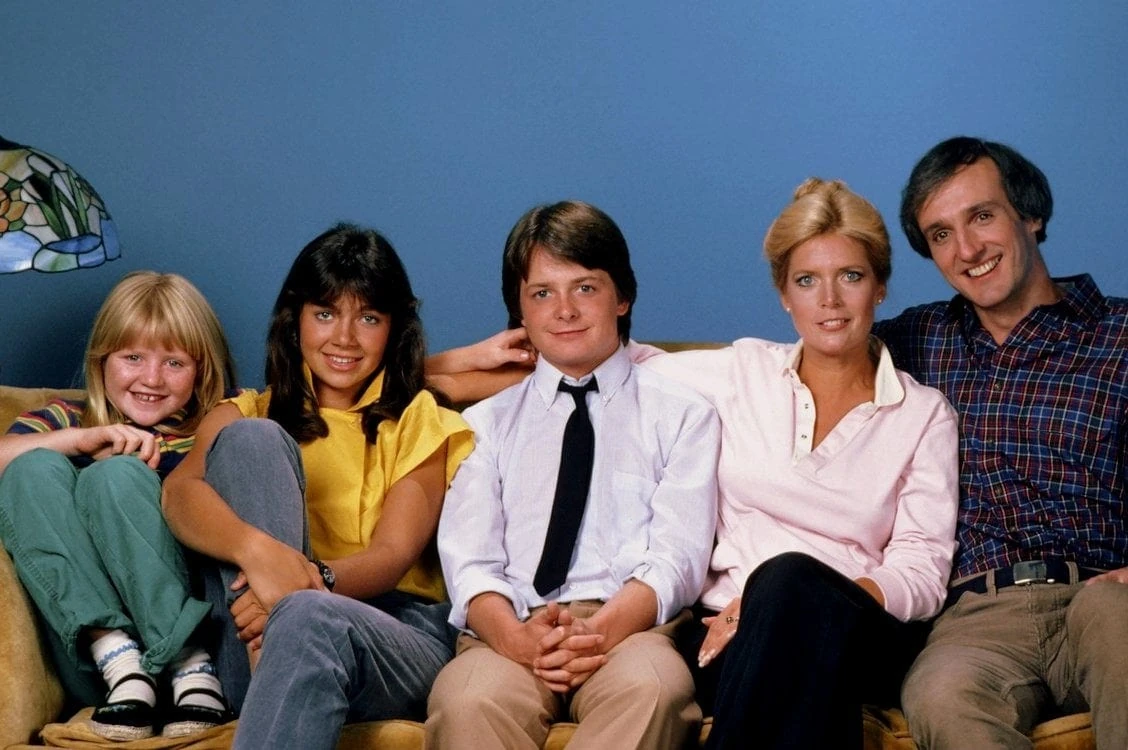
When Family Ties premiered on NBC on September 22, 1982, the joke was sitting right there in the family photo. Steven and Elyse Keaton had come out of the sixties with their ideals intact. They believed in causes, social change, and leaving the world a little better than they found it. Their oldest son looked as though he’d spent his childhood waiting for a chance to take over the stock exchange.
You had seen parents and kids fight about values on television before. Archie Bunker could turn a trip to the dinner table into a national debate. The Keatons flipped the familiar arrangement. Here the grown-ups were the ones with the counterculture past, and Alex was the kid who considered a necktie appropriate clothing for almost any occasion. If Steven announced that life was about helping people, Alex was already wondering whether that statement came with a tax deduction.
Gary David Goldberg created the show, and he gave the parents real lives. Steven worked in public television; Elyse was an architect. They weren’t cartoon hippies still sitting around waiting for Woodstock to reopen. They had careers, bills, convictions, and three children who were quickly developing convictions of their own. Their home was comfortable, and so was the sitcom setting. The debates could get loud, but you always believed these people would still be eating breakfast together in the morning.
Initially, the series leaned toward the adults. Meredith Baxter and Michael Gross were recognizable stars playing the parents, and the idea of two former idealists adjusting to middle age was a perfectly solid show on its own. Then Michael J. Fox started getting laughs. A lot of them. It didn’t take long for Alex to move toward the center of the whole thing. The kid everybody was supposed to be dealing with became the character everybody wanted to see.
That could have flattened the premise into one big Alex Keaton show, and sometimes it came close. But the family was more important than it might appear on a highlight reel of Fox’s best lines. Steven could poke a hole in Alex’s arguments without making him a villain. Elyse could end the debate with one look. Mallory had a life Alex didn’t understand, and Jennifer often looked like she would prefer her family’s conversations to have a strict time limit.
That’s why the original setup still works. The show didn’t have to ask whether Alex was right about the country every week. It could ask whether a young guy who believed he had the answer to everything could handle being told to take out the garbage. Much better question. And one with a much funnier answer.
If you grew up on seventies family television, you knew a generation gap was coming before anybody opened the front door. The Keatons just made the kid wear the conservative clothes for a change.
Fox made the certainty look wonderfully precarious
It’s easy to forget how much of Alex P. Keaton was Michael J. Fox himself making the performance look effortless. A different actor might have made the character unbearable: a smug little know-it-all in a suit, explaining the economy to everyone within earshot. Fox somehow made you want him to open his mouth again, even when you knew another lecture was coming.
Part of it was the speed. Alex could get three jokes into the time another character needed to finish one thought. But watch what Fox was doing between the words: straightening the jacket, lifting the chin, trying to look as if a teenager who still lived upstairs should already be getting invited to board meetings. Alex’s body kept betraying him. He wanted to look thirty-five, powerful, and absolutely certain of himself. He was a kid. Fox never let you forget it.
And that was the trick. Alex wasn’t just confident; he was working incredibly hard at being confident. When somebody challenged him, you could practically hear the gears turning. First came the objection, then the counterargument, then the completely ridiculous explanation for why losing the argument actually proved he had been right all along. If the boy ever ran out of things to say, the Keatons would probably have called a doctor.
Fox also understood that Alex couldn’t be a one-note political joke. He was competitive at school, jealous when somebody outperformed him, awkward with girls, and capable of being a surprisingly good brother when he forgot to make everything about himself. He could be insufferable at dinner and genuinely frightened ten minutes later. That second part made the first one easier to enjoy.
By the middle of the decade, Fox was everywhere. Back to the Future made him a movie star, but millions of people already knew him as the boy with the briefcase. He won three consecutive comedy lead-actor Emmys in 1986, 1987, and 1988. You don’t need an award to tell you a performance works, although winning three in a row is a fairly persuasive hint.
There was a special pleasure in watching Alex meet somebody he couldn’t talk into submission. A girl who wasn’t impressed by his plans. A teacher who wouldn’t give him the grade he felt he deserved. His mother, who had been listening to his speeches long enough to recognize the opening sentence. Fox could go from swaggering to completely rattled in the blink of an eye.
The real genius was that we laughed at Alex and rooted for him at the same time. The guy wasn’t always likable. Sometimes he really needed somebody to tell him to shut up. Fortunately, he lived in a house full of people who were happy to volunteer.
Steven and Elyse had lives before they became Alex’s parents
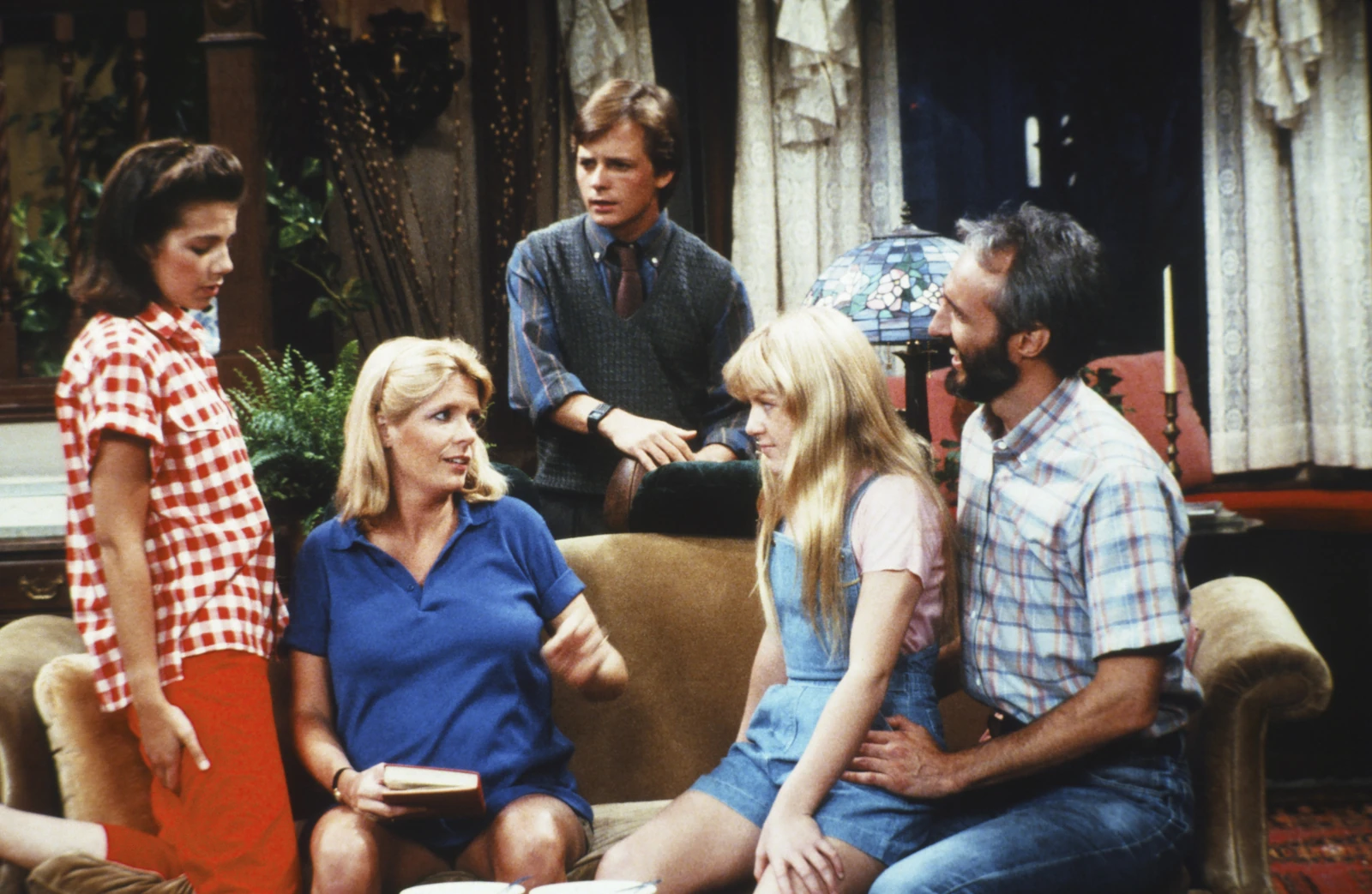
As a kid, Steven and Elyse might have seemed like a couple of reasonable adults whose primary job was to keep Alex from turning the Keaton home into a branch office of Wall Street. Watch the show again when you’re older, and you start noticing just how much work those two put into the place. No wonder they looked tired sometimes. They were raising Alex.
Michael Gross played Steven with the patience of a man who genuinely believed that if everyone could just sit down and talk things through, everything might turn out all right. He kept trying that approach even though he had years of evidence suggesting Alex considered a discussion an opportunity to deliver closing arguments. The patience was funny because you could see the effort underneath it. Steven wasn’t naturally immune to irritation. He was choosing not to lose his mind.
Meredith Baxter’s Elyse had a different strategy. She listened, took about two seconds to determine whether Alex was selling a reasonable explanation or a complete load of nonsense, and responded accordingly. Baxter gave her real authority without making her harsh. Elyse could love the kid, respect his intelligence, and still tell him he was acting like a jerk. Sometimes within the same sentence.
It’s important that the parents did things besides parent. Steven worked in public television, a detail Alex could hardly mention without finding some opportunity to question the profitability of the entire enterprise. Elyse designed buildings. She was a working architect with deadlines, ambition, and opinions that existed well beyond the kitchen. The show didn’t always spend enough time on their professional lives, but they helped make the house feel inhabited by adults rather than a pair of permanent referees.
They were also a convincing couple. Steven and Elyse had the shorthand of people who had been through a lot together. Sometimes one look was enough to decide who would take this round with Alex. Sometimes they disagreed with each other, which was far more believable than parents who always operated like a perfectly synchronized team. They had principles, but they weren’t saints. Their own children could expose the gap between what they believed in theory and what they were prepared to tolerate at home.
The sweetest moments often came when they stopped debating and simply acted like parents. They worried about the girls, they enjoyed the little victories, and they tried to make sure the family stayed connected while everyone grew up and began pulling in different directions. Their affection was never a surprise twist. It was the part you could count on.
And let’s give Steven some credit. He spent seven seasons listening to a child explain why everything in life should be run like a corporation. Most fathers would have started charging rent for the conference room.
The Keatons weren’t The Brady Bunch, but the old idea that a loving household could survive somebody doing something ridiculous was still doing plenty of work.
Mallory and Jennifer were not footnotes to a business plan

If all you remember about Mallory Keaton is that she liked clothes and wasn’t exactly competing for valedictorian, the show probably owes her an apology. Those were the easy jokes, and Family Ties went back to them plenty. But Justine Bateman made Mallory more interesting than the punch lines. She had an attitude, a sense of herself, and a pretty good idea of when her brother was being ridiculous.
Alex tended to treat Mallory’s interest in fashion as proof that she wasn’t serious about anything. That’s an awfully convenient way to dismiss somebody whose priorities are different from yours. Mallory wasn’t waiting around for Alex’s approval, and the more she developed her own relationships and plans, the clearer that became. She could be flaky, sure. So could Alex, whose obsession with the stock market was apparently considered a sign of mature judgment.
The sibling arguments were some of the show’s most dependable laughs. Fox and Bateman made it feel as if Alex and Mallory had been needling each other their whole lives. He would launch into one of his superior explanations, she would take exactly the wrong part of it seriously, and the room would belong to both of them. It wasn’t always fair to Mallory, but Bateman had enough comic timing to keep the character from disappearing under the joke.
Jennifer was a different story. Tina Yothers played the youngest of the original three with a dry, no-nonsense style that made her a welcome counterweight to her older siblings. Alex could produce a ten-minute argument; Jennifer could puncture it with one line. She looked like she’d been listening to this nonsense since birth and was just trying to get through the evening without another lecture.
There was something recognizably real about that sibling lineup. One kid wanted to be in charge. Another cared about friends, clothes, and having a life. The youngest stood off to the side and watched both of them make fools of themselves. None of them had the same idea of what mattered, yet they still understood one another’s weak spots with the precision only brothers and sisters develop.
The show could have done more with the girls as they grew older. Mallory deserved more stories that didn’t require somebody to act surprised when she showed good judgment. Jennifer deserved room to become something other than the kid with the sharp reply. Whenever the writers remembered that, the family got more interesting. Alex was funnier when he wasn’t automatically the smartest person in every situation, and Mallory and Jennifer were better characters when they weren’t written as supporting evidence for his brilliance.
Watching it today, I find myself enjoying their exasperation as much as Alex’s speeches. There’s a limit to how often you can listen to somebody tell you about the future of American business when you’re just trying to have dinner.
Nick Moore was the entrance Alex could not control
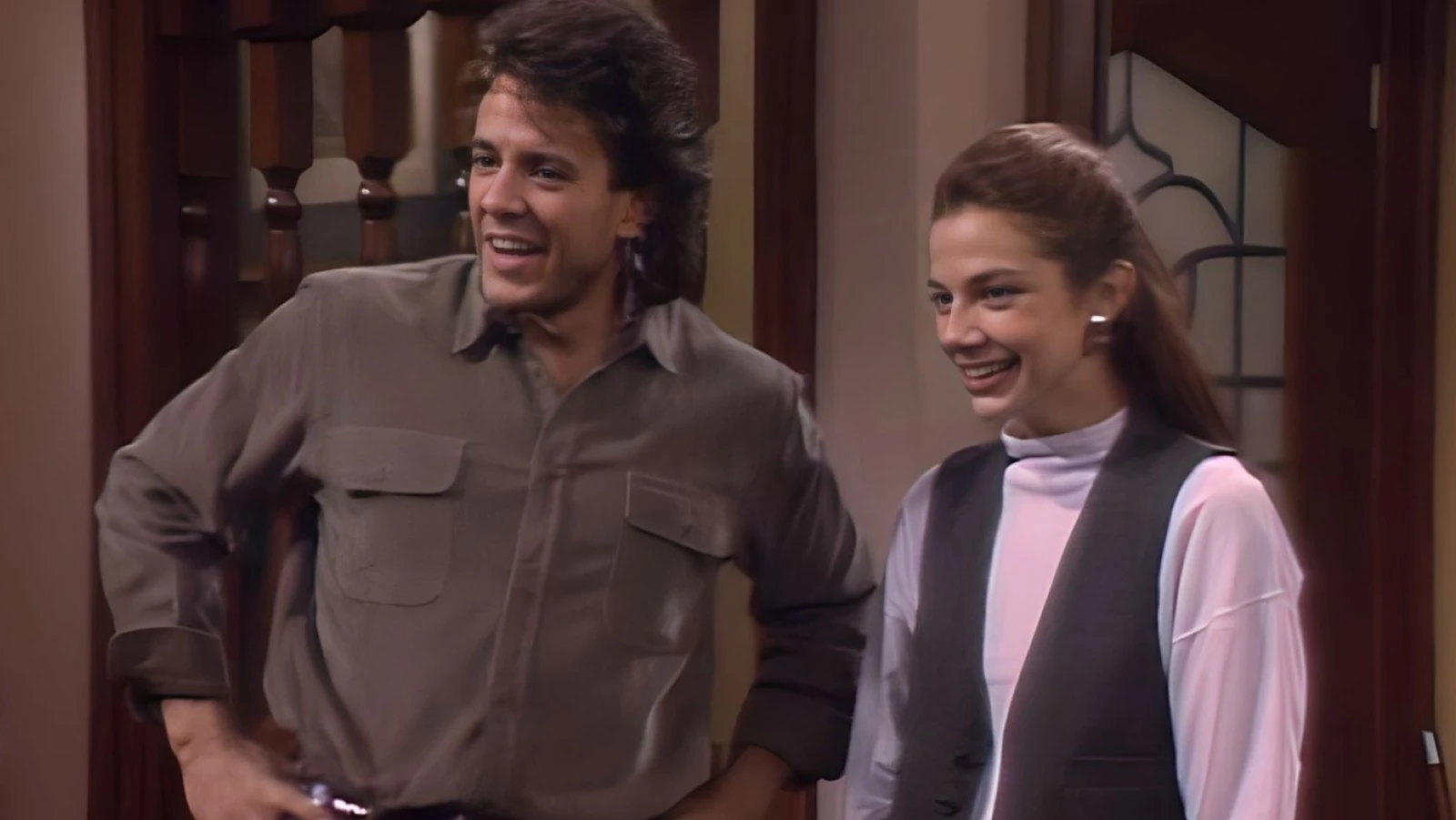
The first time Nick Moore showed up, you could almost feel Alex reaching for a security guard. Mallory had brought home a boyfriend who looked and sounded like the exact opposite of everything her big brother believed a respectable young man should be. Nick had the leather-jacket attitude, the motorcycle-guy voice, and the kind of greeting that never needed more than a couple of syllables. Alex, naturally, had an entire speech prepared.
Scott Valentine made Nick instantly recognizable. He wasn’t polished, he wasn’t chasing a corporate job, and he didn’t seem particularly bothered by what anybody thought of him. He was an artist who worked with found and discarded materials, which gave Alex approximately six thousand opportunities to explain the value of a more conventional career. Nick usually looked about as interested in that explanation as the furniture did.
That was why the character worked. Nick could walk into the Keaton kitchen, say almost nothing, and throw the room off balance. Alex saw an emergency. Steven wanted to be the tolerant, understanding dad, right up until it became clear that his daughter’s boyfriend would be sitting at the dinner table. Elyse had to manage both the visitor and everyone else’s reaction to him. Mallory, meanwhile, was perfectly happy with Nick. She hadn’t asked her family to vote.
Under the broad voice and goofy manner, Nick could be kind and unexpectedly perceptive. Sometimes his directness cut through a roomful of people who were much more articulate but hadn’t managed to say anything useful. He didn’t always understand Alex’s world, and he didn’t feel compelled to pretend. That’s a pretty effective defense against a guy who can turn a simple question into a campaign speech.
Nick was also good for Mallory. Their relationship gave her something of her own, something she was willing to defend without accepting Alex’s idea of what a successful person was supposed to look like. The writers didn’t always give her the strongest material, but she was never more determined than when somebody suggested she should rethink a choice she’d already made.
Valentine became popular enough that there was an attempt to build a separate show around Nick, The Art of Being Nick. It didn’t become the next giant sitcom. That’s not particularly mysterious. Half the fun of Nick was watching the Keatons react to him. Take him away from the people he was driving crazy, and you had a different proposition.
Still, few guest characters could cause so much trouble simply by opening the front door. One look at Alex’s face and you knew the evening was about to be excellent.
Of all the 1980s television spinoffs producers could dream up, a whole series about this particular boyfriend made a certain kind of sense on paper. It just needed the Keatons around to react.
Ellen Reed made Alex forget the prepared answer
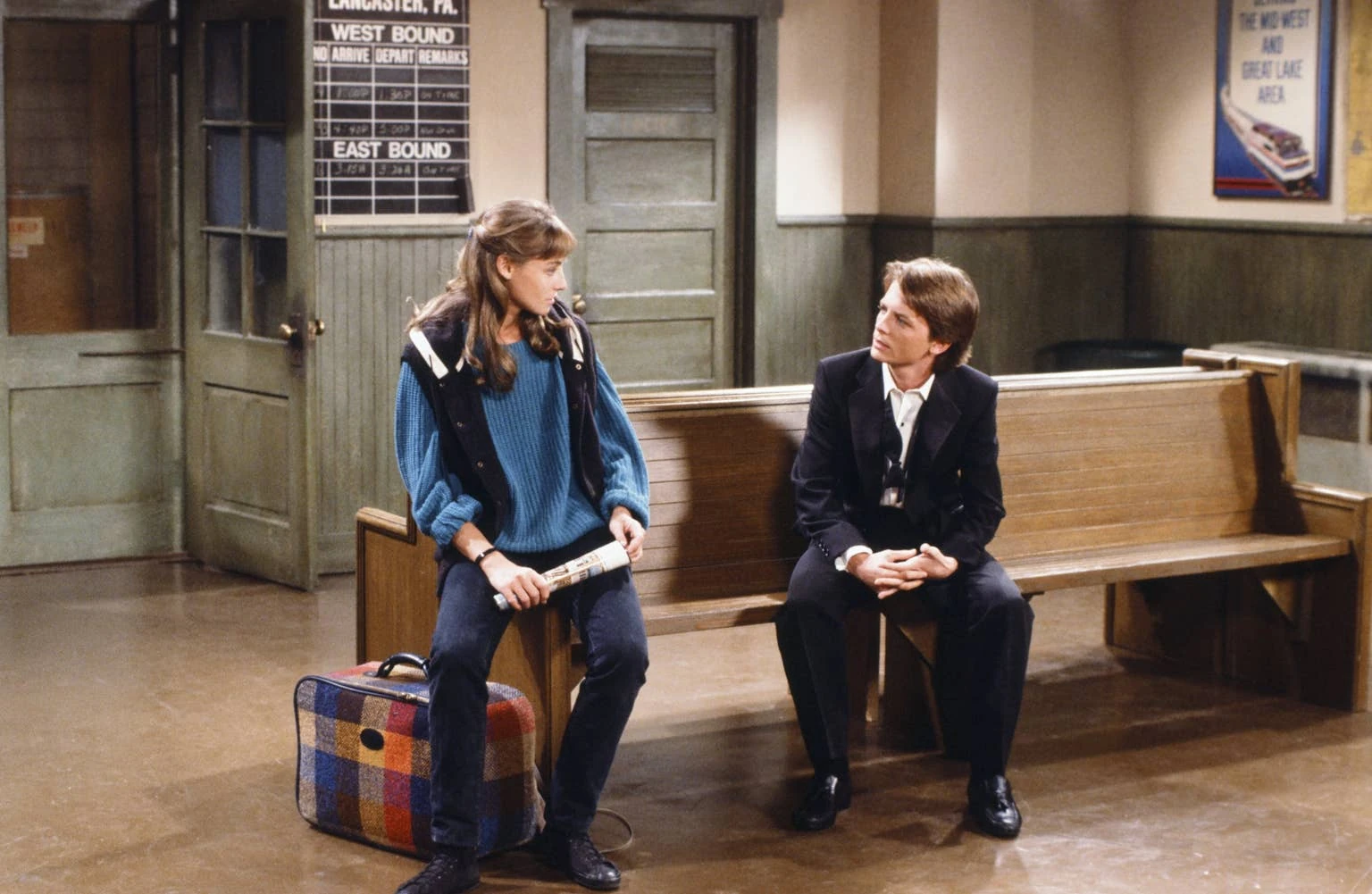
Alex was used to walking into a room with an answer. Then Ellen Reed came along, and all of a sudden the boy who could discuss economic policy at the speed of light had trouble figuring out how to talk to a girl he really liked. It was one of the best things that ever happened to the character.
Tracy Pollan played Ellen with enough confidence to keep her from becoming another person orbiting Alex. She was smart, independent, and perfectly capable of disagreeing with him. Better still, she didn’t seem especially interested in being impressed by his grand plans. Alex could charm people, annoy them, or talk them into exhaustion. Ellen was a lot harder to move.
Their relationship began in the fourth-season story The Real Thing in 1985. It’s remembered partly for the chemistry between Pollan and Fox, and partly for a train-station goodbye that managed to make one of television’s most talkative characters suddenly seem short of words. Alex knew exactly where he wanted his life to go. Knowing what to say to Ellen was another matter.
The appeal wasn’t just that Fox and Pollan were good together on screen. Their scenes let Alex be awkward in a way that didn’t feel like the usual sitcom embarrassment. Here was somebody who mattered to him more than getting the last word. Every time he tried to sound composed, you could see him fighting the urge to say something honest and frightening instead.
And Ellen had a life beyond him. That’s important. The relationship was more interesting when it felt like two young people trying to figure out whether their futures could fit together, not a contest to see whether a beautiful woman could finally straighten Alex out. She wasn’t a reward for his personal improvement. She was a person who had her own decisions to make.
Of course, everybody knows another chapter of this story now: Fox and Pollan later married in real life. It’s a lovely bit of TV history, but the romance worked for viewers before anybody knew that would happen. It didn’t need a real-world happy ending to make the on-screen story worth watching.
The characters didn’t get an easy one. Ellen’s departure left Alex trying to deal with the kind of loss no amount of planning could prevent. He could make a case for just about anything, but there wasn’t an argument in the world that was going to bring somebody back just because he wanted it badly enough.
That was new territory for a young man who generally believed effort should produce the result he ordered. It also made for some of Family Ties‘ most memorable television.
The old record that found a new audience
If you remember Alex and Ellen, there’s a good chance you can hear Billy Vera and the Beaters before you can remember exactly what either character said. At This Moment became one of those songs permanently attached to a television scene. Years later, you could hear the opening notes on the radio and find yourself back in the Keaton universe without even trying.
Here’s the part people sometimes forget: the song wasn’t written for Family Ties. It had been released back in 1981, long before Alex and Ellen became an item. The show used it during their romance in 1985 and again as their relationship unraveled. A record that had already been out in the world suddenly found millions of listeners who heard it as the sound of one particular fictional heartbreak.
That isn’t a small thing. This was the era when television could make a song feel like part of your own life. You heard it in the episode, maybe tried to catch it again on the radio, and suddenly it wasn’t just a singer telling a sad story. It was Alex standing there without an answer. A kid who always knew how to talk his way out of trouble finally had nothing useful to say.
The revived recording reached number one in January 1987, after a reissue and renewed exposure. It didn’t happen instantly after one broadcast. People responded, the interest built, and the song found a second life. For viewers who discovered it through the sitcom, it probably didn’t matter that the record had been around for years. It felt new because the emotion was new.
There was something wonderfully unlikely about it, too. In an era of synthesizers, stadium anthems, and music videos featuring approximately enough hairspray to threaten the atmosphere, an old-fashioned soul ballad came back because it fit an NBC sitcom scene. Not every eighties hit arrived wearing a leather jacket and carrying a drum machine.
It also showed how much a sitcom could accomplish by letting a song breathe. Sometimes Family Ties could be very eager to tell you how to feel. This was one of those times when it wisely got out of the way. The record did the heavy lifting, Fox gave it a face, and the audience supplied the rest.
The funny part is that Alex probably would have had a detailed economic explanation for the song’s surprise chart success. Thankfully, nobody asked him. We got to enjoy it instead.
Miami Vice could turn a Phil Collins record into the most famous night drive on television. Family Ties did something different: it made an old ballad sound like Alex had finally run out of words.
The theme promised that arguments would have somewhere to land
You knew Family Ties was coming on before anybody in the Keaton household said a word. Without Us, the theme written by Jeff Barry and Tom Scott, had that unmistakably warm eighties-sitcom feeling. It wasn’t telling you to prepare for another argument about tax policy. It was telling you that, whatever happened inside the next half hour, these people belonged together.
The best-remembered recording was the duet by Johnny Mathis and Deniece Williams, although the show began with a different vocal version by Dennis Tufano and Mindi Sterling. TV themes have a funny way of rewriting history. You watch a show long enough with one opening, and your brain quietly files every episode under that version. Years later somebody plays the earlier one, and it sounds as if you’ve wandered into a parallel universe.
The visuals added to that feeling of familiarity. Family pictures, portraits, those slightly awkward poses that real families have in their albums—suddenly the people you were about to watch seemed to have known each other long before NBC invited you into their living room. It was a small bit of television magic, and it made the arguments feel less like a writer’s premise and more like another evening in a house where people had been getting under one another’s skin for years.
There’s an old comfort in that kind of sitcom opening. Before the episode starts, you know where you are. The couches are where they ought to be. The parents are trying to be patient. Alex is about to explain something that nobody asked him to explain. Mallory and Jennifer are probably wishing there were another room they could move to for a while.
And after the episode, there was that little Ubu Productions dog logo. Sitcoms didn’t just become part of our routines because of their big dramatic episodes. They got in through the little things: a melody heard every week, a familiar living room, an end-credit sound you could recognize from across the house. Those details are still rattling around in Gen X memories right alongside the punch lines.
A theme song can’t save a bad episode, of course. But a good one can make you happy to return to a show before you’ve even seen what this week’s story will be. Family Ties had that kind of invitation. Even when the characters were ready to argue, the opening was already promising they’d work it out well enough to see us next week.
When being the smartest person in the room stopped helping
Alex loved winning. Grades, arguments, college admissions, future career plans—if there was a way to score something, he wanted to know where he stood. Preferably first. Preferably with everybody else aware of it. Watching him get knocked down a peg was one of the show’s favorite pastimes, and Fox knew exactly how to make the fall funny.
Take The Graduate, where his girlfriend winds up with the valedictorian honor Alex expected for himself. In theory, a guy who worships achievement should be thrilled that somebody he cares about accomplished something impressive. In practice, Alex discovers that celebrating excellence is a lot more complicated when the excellent person isn’t him. The wounded pride practically fills the room.
The joke always worked because Alex’s intelligence was real. He wasn’t bluffing his way through school. He did work hard, and he was capable of impressive things. That made it funnier when he behaved like a four-year-old because somebody else got the prize. The kid could discuss the national economy but apparently needed a little remedial education in congratulating his girlfriend.
College brought its own disappointments. Princeton represented exactly the kind of future he’d been imagining, the sort of place that would look terrific on the résumé he was probably already updating. When life refused to follow the approved plan, you could see how much of Alex’s identity depended on succeeding in precisely the way he expected. For a guy who talked endlessly about independence, he sure needed a lot of official confirmation that he was doing things right.
The show went darker with Speed Trap, a story about Alex taking pills to keep up with academic pressure. That’s very much an eighties sitcom subject, and you could occasionally feel the writers getting the important-message machinery warmed up. But the premise belonged to the character. Alex had spent years telling himself he must always perform. It wasn’t much of a leap to imagine him making a terrible decision when the pressure got too high.
Not all of the heavy episodes landed smoothly. Sometimes the resolution arrived faster than real life ever would, complete with the reassuring sense that a heartfelt family conversation could solve a problem by the closing credits. But Fox had a way of making Alex’s panic recognizable even when the television structure got a little too tidy.
And the show was usually at its best when it didn’t let him off the hook too quickly. Alex could be smart and still be a fool. He could care about people and still treat them badly. He could dream about the big world outside his house and still need his mom and dad to remind him that other people existed. A suit is no substitute for growing up. Not even a very nice one.
Uncle Ned brought the danger inside the familiar kitchen

Long before Tom Hanks was the guy collecting Oscars, he turned up in the Keaton household as Uncle Ned. If you were watching Family Ties in the eighties, you knew Hanks as a familiar television face and a rising comedy star. That makes the second-season episode Say Uncle even more jarring when you come back to it now. This was not somebody dropping by just to deliver a goofy guest-star cameo.
Alex idolized Ned. He was the exciting uncle, somebody outside the immediate household whose attention and approval meant something. That admiration is what made the story work. When Alex began to realize Ned had a serious drinking problem, it wasn’t just an important issue arriving for an episode. It was a kid discovering that a grown-up he trusted could behave in ways he didn’t recognize.
The January 26, 1984 episode put the trouble right into the family kitchen. One of the moments people remember involves Ned’s desperate interest in vanilla extract. That’s a disturbing image precisely because it’s such an ordinary household thing. The kitchen hadn’t changed. The person standing in it had. Suddenly a place where the Keatons usually bickered about everyday nonsense felt much less safe.
Hanks played Ned with enough charm that you understood why Alex liked him in the first place. He wasn’t introduced as a walking warning label. He could still be funny and engaging, which made the deterioration harder to watch. Then the anger came out, and Alex had to face the possibility that somebody he loved might hurt him. That isn’t a situation you fix with one of his rapid-fire explanations.
It was a serious departure from the normal Family Ties routine, but it worked because the family relationships were already there. Steven and Elyse weren’t dealing with an anonymous stranger who wandered into their living room carrying the problem of the week. Ned was part of their circle, and caring about him made it more painful to acknowledge what was going wrong.
Of course, a sitcom episode couldn’t offer a complete account of alcoholism or recovery. It had limited time, and the show generally wanted to get its viewers back home in one piece emotionally. But the performances made the danger feel close. You remembered Ned because he seemed like somebody who could really come through your front door, not because the episode printed an important lesson on the screen.
Go back and watch it after all the years of Tom Hanks movies. What’s surprising isn’t simply how young he looks. It’s how good he and Fox are together when the jokes stop being enough. That kid in the suit has finally run into something he can’t talk away.
A, My Name Is Alex let the room fall away
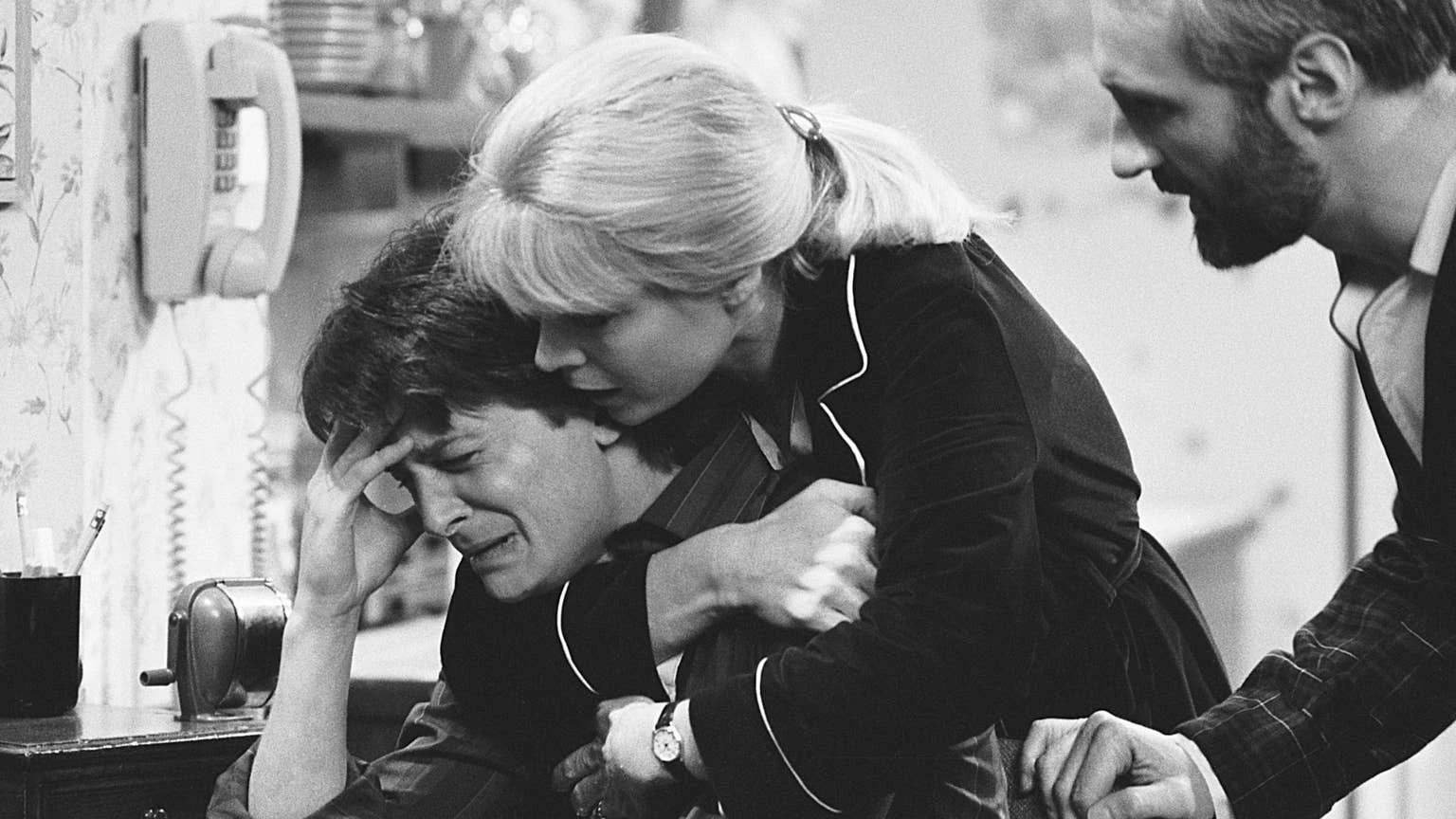
Every long-running family sitcom eventually had an episode where somebody turned down the laugh track and announced that things were about to get serious. Family Ties had a few of those. But A, My Name Is Alex, first broadcast in March 1987, was something else. The show didn’t just make Alex sad for a week. It took away the familiar room and put him in a place where his usual tricks couldn’t help him.
The story begins with the death of Alex’s friend Greg in a car accident. Alex had been expected to go along, and he couldn’t stop thinking about the fact that he was still alive while his friend wasn’t. That’s a frightening thing for anybody to wrestle with, especially a young man who believes life ought to make sense if you examine the facts carefully enough.
What follows isn’t a normal living-room episode with a lesson tucked between jokes. Fox takes Alex through a strange, stripped-down space, part memory and part confrontation with himself. The usual sitcom furniture gives way to a stage-like setting where people from his life appear, disappear, and force him to face things he’d rather organize neatly and put in a drawer.
You can see why it divided some viewers. It was a big swing, and Family Ties wasn’t pretending otherwise. If you had tuned in expecting Alex to torment Mallory about her boyfriend, you were suddenly watching Fox carry a full hour about grief and survivor’s guilt. That kind of switch can feel a little much when you’ve settled onto the couch with a snack and the expectation of a few laughs.
But the episode worked because the audience already knew Alex. We knew the fast talk, the ambition, the way he tried to stay ahead of every uncomfortable feeling. Seeing him unable to find a smart answer was painful in a way it wouldn’t have been with a brand-new character. Greg’s death didn’t make Alex magically wiser. It made him scared, confused, and desperate to understand why somebody else’s life had ended.
The hour earned recognition for its writing, and Fox proved he could handle more than comedy without abandoning the personality that made Alex familiar. He was still the same young man. He just couldn’t hide behind a confident smile. His family was there, but they couldn’t turn the situation into something with a tidy explanation.
That’s what stayed with me about the episode’s idea, even more than the unusual staging: sometimes the guy who always has an answer simply doesn’t. And sometimes the best thing his family can do is stick around while he figures out how to live without one.
Thursday nights supplied an audience; the Keatons gave it a reason to stay
If you remember Family Ties as an enormous hit, you’re remembering correctly. Just don’t picture it arriving on NBC in 1982 as an instant ratings monster. The early seasons had to find their footing, and it took a major schedule move—and one particularly powerful neighbor—to put the Keatons in front of the audience they eventually earned.
That neighbor was The Cosby Show. When NBC placed Family Ties behind it on Thursday nights, the network essentially opened a door and invited millions of viewers to keep sitting on the couch. A strong lead-in can do wonders. Of course, those viewers still had the power to change channels, and by the middle of the decade they were choosing to stay with Alex and company.
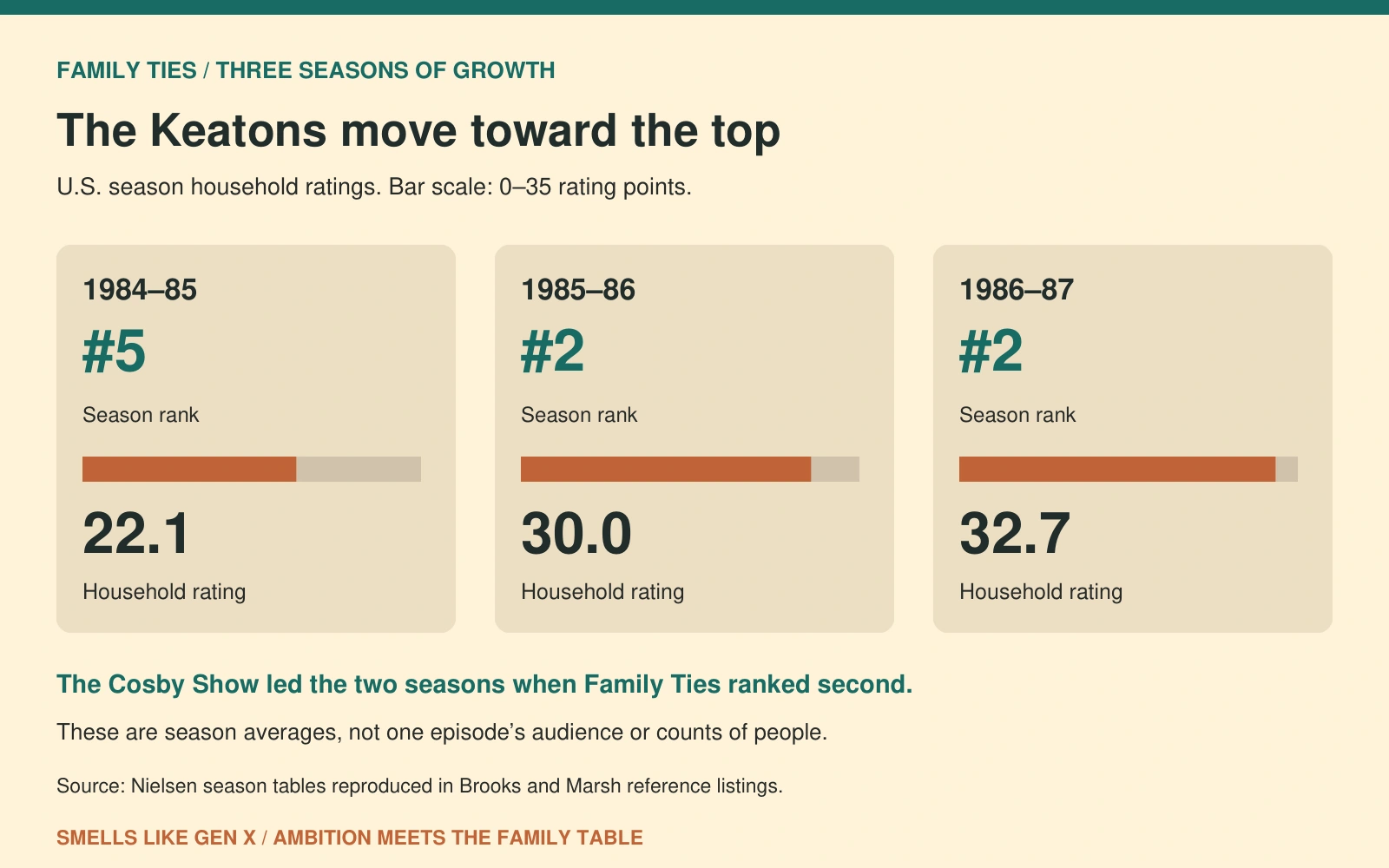
The numbers tell the story without needing to become a statistics seminar. In the 1984–85 season, Family Ties ranked fifth. In 1985–86 it climbed to second, and it finished second again the following season. Those were huge results for a show that had started much more modestly. For a stretch, the Keatons weren’t merely part of NBC’s schedule. They were part of the national Thursday-night routine.
Think about that lineup for a second. Families were watching the Huxtables, then the Keatons, and later Cheers brought viewers into a Boston bar full of adults with their own spectacular problems. It was a great night for people who wanted sitcoms that felt like different places rather than copies of the same living room. If you were a kid, Alex was somebody you might recognize from school. If you were a parent, Steven and Elyse’s exhausted expressions probably felt a little closer to home.
Then came Back to the Future in 1985. All of a sudden, a television actor people already knew was starring in one of the biggest movies of the decade. It certainly didn’t hurt the sitcom. You could watch Fox race around as Marty McFly at the theater and then see him show up at home as the ambitious Keaton son. Same quick comic instincts, two completely different kids with very different reasons to worry about their futures.
Eventually the Thursday arrangement changed, and the show moved to Sunday. Ratings softened as the series aged and the schedule shifted. That’s the reality of network television, not evidence that somebody suddenly forgot how to make the show funny. Even the biggest hits don’t remain in exactly the same place forever.
The remarkable thing is how thoroughly Family Ties became associated with that era of network television. You can almost hear the Thursday-night promos. You know the theme before the faces appear. And you remember that there was a time when a whole lot of America made an appointment with the Keatons every week.
The baby grew quickly, and Alex found a willing student
Every time a family sitcom ran long enough for the kids to grow up, the writers faced the same problem: what do you do when the adorable children start becoming adults? Sometimes the answer was to bring in another adorable child and hope nobody noticed the machinery. Family Ties added Andrew Keaton, better known as Andy, and eventually gave Alex a new little brother who seemed remarkably interested in everything he had to say.
Andy was born during the run, and later Brian Bonsall played him as a young boy. The time jump was obvious if you stopped to think about it too hard. Television families have always had a flexible relationship with the speed of childhood. One week somebody’s a baby; before long he’s old enough to deliver a punch line. Most viewers accepted the arrangement and got on with the show.
The fun was watching Alex discover an audience that had not yet learned to challenge him. Steven and Elyse had years of experience dealing with their oldest son’s theories. Mallory had learned to tune him out. Jennifer could shut him down with a single look. Andy, on the other hand, thought his big brother was pretty impressive. At last, Alex had found the perfect student for the Keaton School of Business.
Naturally, he went to work. If you’ve ever watched an older sibling teach a younger one something, you know how that can go. Sometimes the lesson is useful. Sometimes it’s a thinly disguised attempt to create a miniature version of the teacher. Alex would have been thrilled to see Andy wearing a tiny tie and explaining interest rates to the other children on the playground.
But Fox also brought real affection to the relationship. Alex could be pushy about everything else in his life and still melt around his little brother. The show gave him a chance to be protective, proud, and occasionally less interested in winning an argument than in spending time with someone he loved. Those moments mattered. They reminded you that underneath the polished ambition was an older brother who cared.
Andy didn’t solve every late-season problem, and the show sometimes leaned a little hard on the cute-kid material. Still, he brought a new rhythm to the family. The older kids were thinking about college, work, and relationships. Steven and Elyse were back in the world of raising a little one. Alex had one more person to love, one more person to influence, and one more opportunity to give advice absolutely nobody had requested.
Some things never changed in that house.
Lauren, Skippy and the people who saw past the performance
By the later seasons, Alex’s world had expanded well beyond his parents’ living room. College, romance, and the threat of actual adulthood were creeping closer. That gave the writers new people to bounce him off, including Courteney Cox as Lauren Miller, a psychology student who had the nerve to look at Alex not simply as a remarkable young man but as somebody worth figuring out.
You can imagine how that went over. Alex spent most of his life presenting himself as the completed product. Lauren seemed curious about what was going on under the packaging. It made for a different sort of romance than the Ellen years. Tracy Pollan’s character had thrown him off balance by being somebody he loved. Lauren could throw him off balance just by asking the right question.
Cox gave Lauren enough poise to keep the role from feeling like an excuse to diagnose Alex every week, although the show sometimes got close to doing exactly that. It was refreshing to see somebody who didn’t take his grand declarations entirely at face value. Alex could be charming. He could also be exhausting. Lauren noticed both.
And then there was Skippy Handleman. Marc Price had been hanging around the Keatons for years, and Skippy had one of those hopeless crushes on Mallory that the eighties sitcom universe could stretch almost indefinitely. He was awkward, eager, and generally one step behind everybody else in the room. Sometimes you felt sorry for him. Sometimes you wanted to tell him to go find another girl and give Mallory a break.
Looking at those old jokes now, it’s worth admitting that devotion doesn’t entitle somebody to a relationship. Mallory didn’t owe Skippy a date just because he kept showing up. The show occasionally acted as though persistence itself was supposed to be charming. But Price gave the character enough genuine vulnerability to make him more than a running gag. Skippy wanted to be included, and the Keaton house was a place where he felt he belonged.
That was also part of what made him useful to Alex. They didn’t always see eye to eye, but Skippy knew him long enough to recognize when the impressive act wasn’t holding up. Some of their better moments came when Alex had to drop the superior routine and simply be a friend, which was something no college application could teach him.
A good sitcom needs people outside the immediate family who can walk in and change the mood. Nick did it by irritating Alex. Ellen did it by making him nervous. Lauren did it by noticing too much. Skippy did it by being Skippy. Their entrances helped keep the Keaton living room alive after years of the same four walls.
Heartstrings changed the way the father looked
One of the strange things about watching a family sitcom when you’re young is that the parents seem permanently available. They’re the people standing in the kitchen when somebody needs advice. They’re there to worry, to complain, to make the rules, and to reassure everyone that things will somehow be all right. You don’t spend much time thinking about what happens when one of them needs taking care of.
That’s why the seventh-season Heartstrings story hit differently. Steven suffered a heart attack, and suddenly the man who had spent years trying to keep his family calm was the one everybody was afraid for. The Keatons weren’t arguing about whether Alex should chase his next big opportunity. They were waiting to see whether Steven would come through a medical crisis.
Michael Gross was especially good once the immediate danger had passed. Surviving something frightening doesn’t mean you walk back through the front door feeling like the same person. Steven had to live with uncertainty, with a family hovering over him, and with the uncomfortable knowledge that his body had forced him to stop making plans for a while.
Meredith Baxter’s Elyse had her own difficult job. She couldn’t simply become the eternally reassuring television wife. She was frightened too, and still expected to hold things together while everybody else worried. That mixture of tenderness, impatience, and fear made the household feel more real than another neatly delivered speech about the importance of family ever could.
The episodes leaned hard on emotion in places. Late-eighties sitcoms didn’t exactly believe in leaving the audience unsure when it was time to cry. But there was a genuine change in perspective. Steven wasn’t just Alex’s father or the man making sure the bills got paid. He was somebody with his own future to worry about, and for once everyone else had to recognize it.
Watch the story as a kid and you probably remember hoping he would be all right. Watch it years later and you might notice how frightened he looks after coming home. Age has a way of rearranging which character you’re paying attention to. The guy who once seemed like a permanent fixture of the living room starts looking like a human being who has been doing his best all along.
That was a side of Family Ties worth seeing. It didn’t need to teach us that parents have feelings. It just needed to stop treating the parents as invincible for a little while.
The politics made the joke sharper and the compromises easier
It’s impossible to talk about Family Ties without talking about politics, because Alex P. Keaton would never allow it. The kid was an unapologetic Reagan enthusiast, and he could find a reason to bring the conversation back to capitalism before most people finished pouring their coffee. That was the hook: a young conservative arguing with parents who still carried the ideals of the sixties.
But the show was never as simple as one side winning and the other losing. Alex could make a smart point and immediately ruin it by acting like a little tyrant. Steven could deliver a heartfelt argument about compassion while quietly discovering that his patience had limits. Elyse could defend independence until one of her children made a choice she hated. The comedy lived in those contradictions, not in the idea that a single family dinner would settle the country’s future.
It also mattered that Fox made Alex lovable without making him right. We could enjoy watching the kid fire off one-liners while recognizing that he was a tremendous pain. It was possible to laugh at the confidence and still want somebody to take the microphone away. That’s a difficult line to walk with a character whose opinions were part of the joke, and the show usually managed it.
There were limits, too. The Keatons lived in a comfortable house, with educated parents and a good deal of stability. Their arguments about money took place in a home where the lights stayed on and there was dinner on the table. Alex could talk about being entirely self-made while sitting in a kitchen his parents provided. It’s one of the funniest contradictions in the whole series, whether or not the writers always made a point of it.
And sometimes Family Ties played things very safe. A serious disagreement could end with a hug and the comforting suggestion that everybody had learned something useful. Real families don’t usually resolve every difference before the next commercial. But maybe that was part of why so many people watched. The Keatons could disagree loudly without making affection conditional on somebody surrendering every opinion.
In that way, the show belonged to a long line of television families, from All in the Family onward, that let viewers recognize their own arguments from a comfortable distance. The Keatons were less explosive than the Bunkers. They were more likely to finish the night with a nice conversation. But the generation gap at the heart of their stories was real enough to keep the jokes working.
The funny part is that Alex spent seven seasons announcing his independence while his family kept feeding him, listening to him, and loving him. Somebody should have sent him an invoice for services rendered.
Alex finally had to leave the room
For seven years, Alex P. Keaton talked about the future as if he’d already signed the contract. He knew the kind of job he wanted, the kind of life he planned to build, and probably the exact color of the folders he’d keep in his office. Then, in the May 14, 1989 finale, Alex Doesn’t Live Here Anymore, the future finally arrived. He was leaving the Keaton house for a job in New York.
It was the obvious ending in one sense. This was a kid who had spent his entire adolescence preparing to become a successful adult. Of course he’d leave home. The surprise was how difficult it was for everybody once leaving stopped being an exciting idea and became a packed suitcase by the door.
Meredith Baxter gave Elyse the emotional weight of the goodbye. She was proud of her son, and she was going to miss him terribly. Those feelings don’t cancel each other out. If anything, being proud makes the leaving harder. She’d spent years helping Alex become somebody who could stand on his own, and now she had to watch that plan work a little sooner than she wanted.
Alex had a harder time than he’d care to admit, too. New York sounded wonderful when it was part of the grand career speech. It was something else when he had to walk away from the people who knew exactly how to bring him down to earth. You can impress a room full of strangers with your confidence. Your mother remembers the time you couldn’t find your shoes before school.
After so many episodes, the Keaton house had become familiar to the audience as well. We’d watched people storm into those rooms, fall in love, fight, make up, and occasionally sit quietly when there was nothing useful to say. A sitcom set becomes more than furniture after seven seasons. You can almost feel the missing person when the family starts saying goodbye.
The series didn’t need some giant last-minute plot twist. Alex had the job he’d always wanted. Steven and Elyse had done their best. Mallory, Jennifer, and Andy were still part of his life. The family wasn’t ending; it was changing shape. That’s more than enough for a finale.
There is a nice little joke buried in the whole thing. Alex had been preaching independence since he was old enough to wear a tie. And when the time came to leave, it turned out the people he’d been arguing with were the ones he would miss most.
Why the Keatons still feel like people rather than a premise
Go back to Family Ties now and the thing that surprises you might not be Michael J. Fox. Everybody remembers how good he was. It might be how much you enjoy watching Michael Gross and Meredith Baxter deal with him. Or how satisfying it is when Mallory calls him out. Or the little smile Jennifer gives when she realizes that somebody else is finally about to say what she’s been thinking.
That’s what made the show last beyond its original political joke. The Keatons had rhythms. You knew who would start an argument, who would try to keep it civil, and who would finally decide the entire conversation was ridiculous. Those habits made them feel like a family rather than five people gathered to illustrate a sitcom concept.
There are dated bits. Mallory got too many dumb-girl jokes. Some of the bigger emotional episodes could make a simple moment feel like a televised graduation speech. Andy’s arrival did the usual sitcom time-warp trick, and a few late-season plots suggested the writers were looking through every drawer for another situation Alex hadn’t already managed to complicate. You don’t have to pretend those weaknesses aren’t there to love the show.
But remember what television felt like when this was new. A family sitcom could get millions of people arguing about Alex’s opinions one moment, then have them laughing when he couldn’t cope with his sister’s boyfriend the next. A romance could revive a Billy Vera ballad. Tom Hanks could walk into the kitchen and turn an ordinary guest appearance into something frightening. And a young actor who was becoming a movie star still showed up every week to play the boy his television family knew too well.
The series sits comfortably among the eighties’ best family sitcoms, but it doesn’t feel exactly like Growing Pains or any of the other shows that gave us familiar couches and parents trying to keep up with their kids. Its central character was so determined to be a grown-up that childhood kept sneaking up and embarrassing him. Whenever Alex thought he had the world figured out, somebody at home reminded him that being loved wasn’t the same thing as being in charge.
Watching from the other side of adulthood changes the experience. Alex is still funny, but Steven’s patience becomes heroic. Elyse’s ability to recognize nonsense sounds increasingly useful. Mallory’s desire to be taken seriously makes perfect sense. Jennifer seems like the smartest person in the house simply because she knows when not to join the argument.
And maybe that’s the real secret. Family Ties let its characters disagree without asking viewers to pick the one they were allowed to love. The show could get sentimental about that idea, sure. But the feeling underneath was genuine. Families know one another’s worst habits, and they still pull up another chair at the table.
Alex would probably give you a complicated explanation of why the arrangement benefited everyone economically. Elyse would tell him to sit down. Steven would start a conversation about respecting different points of view. Mallory would be talking to Nick. Jennifer would be wondering how long this was going to take.
And somehow, after all these years, you’d be happy to spend another half hour with them.
You can trace that warm, argumentative domestic style from seventies television into plenty of 1990s shows. But the Keatons still sound like their own family, not a rehearsal for somebody else’s sitcom.
Family Ties questions viewers still ask
When did Family Ties originally air?
Family Ties premiered on NBC on September 22, 1982, and ended on May 14, 1989. It ran for seven seasons. Episode counts sometimes vary depending on how guides divide longer broadcasts, but its place in the eighties’ sitcom lineup is hard to miss.
Who created the program?
Gary David Goldberg created the series, with Ubu Productions and Paramount involved in production. The original idea gave Steven and Elyse a major share of the attention; Michael J. Fox’s success as Alex gradually changed the balance.
Who sang the theme song?
The best-known version of Without Us was sung by Johnny Mathis and Deniece Williams. Jeff Barry and Tom Scott wrote it. Dennis Tufano and Mindi Sterling performed the earlier version heard during part of the first season.
Why did At This Moment become associated with the series?
The song became tied to Alex and Ellen’s romance. It had been released in 1981, but the series brought it a huge new audience starting in 1985. After more exposure and a reissue, it reached number one in January 1987.
What is A, My Name Is Alex about?
Alex loses his friend Greg in a car accident and struggles with survivor’s guilt. The March 1987 episode takes a more theatrical approach than the show’s normal living-room comedy, giving Michael J. Fox one of his strongest dramatic stories.
Where does Alex go at the end?
He left for a job in New York. The real point of the May 1989 finale wasn’t the job title; it was seeing Alex and his family face a goodbye they’d spent years preparing for without realizing how hard it would be.
Sources and further reading
- Gary David Goldberg’s Television Academy interview archive — origins, casting, writing and the shift in the show’s focus.
- Television Academy: Family Ties — participant interview index and retrospective program history.
- Paley Center: The Real Thing, Part 2 — October 3, 1985 broadcast and production credits.
- Paley Center: A, My Name Is Alex — March 12, 1987 hour-long broadcast record and cast.
- Television Academy: Michael J. Fox and Family Ties awards — acting and writing recognition.
- Billy Vera’s official biography and band history — the original record, television exposure, reissue and January 1987 chart success.
- Tom Scott interview, originally published October 2013 — composition and recordings of Without Us.
- December 1985 newspaper coverage reprinted by Click Americana — contemporary discussion of the schedule, Fox and the developing family comedy.
- Paramount episode guides: season one, season two, season six and season seven — character and episode premises.
- Broadcast episode chronology — dates, multipart presentation and the separate vacation movie.
- 1984–85, 1985–86 and 1986–87 season tables — Nielsen household ratings and ranks, reproduced from television reference listings.