Matlock in the 80s: The Courtroom Comfort Show That Wouldn’t Quit
Ben Matlock, the first NBC cases, the changing office company, and the considerable pleasure of watching a confident witness reconsider an answer.
NBC, beginning in 1986. Andy Griffith brings a familiar manner, a formidable defense, and a gray suit to the witness stand.

Ben Matlock could make a perfectly ordinary question sound like something you should have discussed with your own lawyer first. He would take his time, consider the answer, and then ask about the little detail everybody had apparently agreed wasn’t important. Somewhere near the witness stand, an exceptionally confident person began having a worse afternoon.
The gray suit helped. So did Andy Griffith’s voice, the patient expression, and the suggestion that Ben was a little more interested in lunch than in being impressed by whoever currently occupied the chair. A person could mistake that manner for a lack of preparation. Television was very pleased to let them make the mistake.
Matlock arrived on NBC in 1986 and settled into the decade’s supply of reassuring mysteries. The clients could be frightened, the killers well connected, and the evidence apparently disastrous. Ben would examine the arrangement, send somebody out to ask more questions, and return with a reason the story everybody accepted no longer held together.
For Gen X viewers, the show could be a family-room compromise, an adult favorite overheard from another chair, or the first place they met Griffith before a rerun introduced them to Mayberry. It wasn’t necessary to understand every courtroom exchange to recognize the main attraction. The older man everyone underestimated had noticed something, and we were going to be there when he explained it.
The early NBC years have a company and character of their own: Charlene, Tyler, Michelle, Julie, Cassie, a very familiar neighbor, and, just before the eighties ended, Conrad. The later ABC years belong farther down the road. Start with the first cases, while the suit was becoming a television uniform and the people receiving Ben’s questions were still finding out what the job involved.
Inside This Article
- Matlock arrived twice in 1986
- Andy Griffith brought a familiar face and a different job
- The suit, the appetite, and the business underneath
- A client with a terrible story is still a client
- The witness stand is where confidence meets a second question
- Charlene knows the lawyer behind the performance
- Tyler Hudson does the work outside the courtroom
- The first weekly case puts Dick Van Dyke behind the bench
- Defending the Don is an awkward way to discuss the family business
- Julie March doesn’t have to agree with him to know him
- Then Ben has to answer an accusation himself
- An old teacher needs the student to ask better questions
- A ring is a fee, a clue, and somebody else’s accusation
- A cooking show serves a murder in public
- The rock star would prefer not to be managed by her lawyer
- Michelle Thomas joins the practice, not the family tree
- Cassie Phillips takes an invitation seriously
- Atlanta sends its lawyer to London
- Television supplies Ben with a murder of its own
- Ben meets a musical hero who has become difficult company
- Don Knotts moves into the neighborhood
- A blues singer brings another kind of history into the case
- Conrad McMasters arrives before the decade runs out
- A Christmas client doesn’t have to be full of seasonal goodwill
- The formula leaves room for more than one kind of mystery
- Ben had company in the decade’s mystery business
- A family room didn’t have to watch at one level of attention
- The people behind the suit knew their mystery business
- The suit had more years of work ahead
- A few questions before the next witness
Matlock arrived twice in 1986
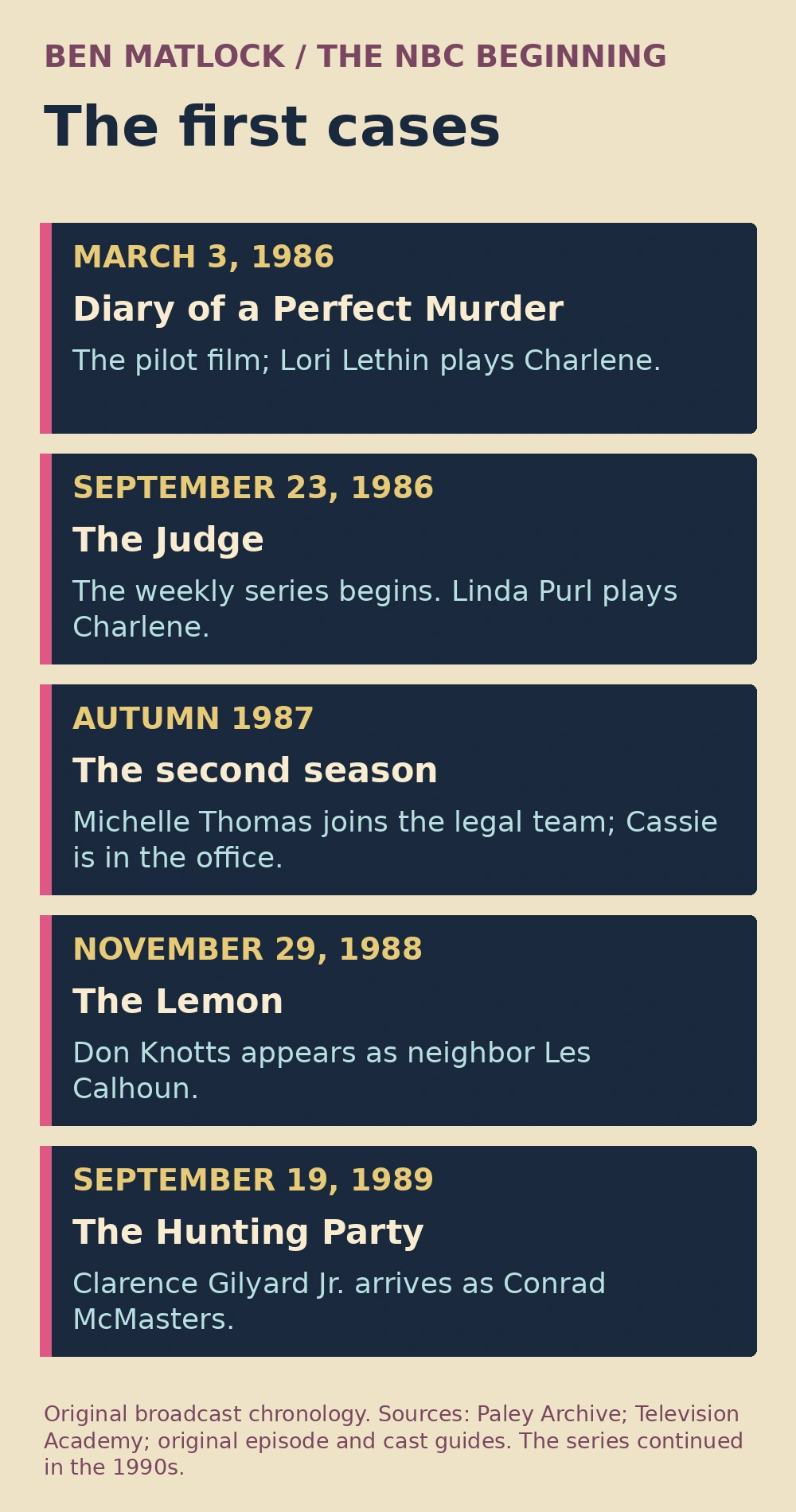
The pilot film Diary of a Perfect Murder aired on NBC on March 3, 1986. The regular series began that fall, with The Judge on September 23. Those are separate beginnings: the television movie introduces the lawyer, while the September launch starts the weekly routine most viewers associate with the program.
Dean Hargrove created the series, with Fred Silverman among the key producers. Griffith played Ben Matlock, a criminal-defense attorney based in Atlanta. The lawyer’s approachable manner and expensive professional reputation gave the show a useful combination. People might take him for a simple fellow; the clients hiring him generally hoped he was considerably more formidable.
The pilot’s case involves a television journalist accused of killing his former wife. Ben works with his daughter, Charlene, whose casting changes between the film and the series. Lori Lethin plays her in the pilot; Linda Purl takes the role in the first regular season. A rerun viewer noticing a different face hasn’t invented the discrepancy.
The weekly first season belongs to the television season ending in 1987. NBC was building an exceptionally visible identity in the middle of the decade, but its schedule had room for more than the young people and busy households of its comedies. An established performer could anchor a mystery that gave the family a different sort of evening.
The show didn’t need to spend months explaining why Ben deserved attention. Griffith brought familiarity; the opening cases had to turn it into suspense. Could the friendly man notice the flaw? Could he make the person with the better public story admit it? The first season supplied a new answer each week, usually with someone discovering that friendliness had not included an agreement to stop asking.
Andy Griffith brought a familiar face and a different job
A television audience had known Griffith as Sheriff Andy Taylor long before Ben Matlock acquired his first client. That history was useful, but it could also become a very large thing for a new character to carry. Ben needed to be recognizable as a Griffith role without simply looking like the sheriff had taken a correspondence course.
The connection lies partly in the way Griffith could let another person reveal themselves. A pause and a listening face encouraged someone to continue. The audience could watch him gather an impression before he announced what he thought. That ability works in a comedy scene and in a murder investigation, though the person talking may have very different reasons to regret the silence.
Ben was more openly concerned with a fee, more prickly about his preferences, and employed in an adversarial business. He wasn’t responsible for helping a whole town get along. A client needed defending, and the defense could require showing that someone with a respectable position was lying.
The performance also had room for irritation. Griffith could give Ben a warm smile, then let it fade when a person wasted his time or failed to do something he had plainly asked. The charm was stronger because it wasn’t an automatic service extended equally to every inconvenience.
The Television Academy’s account of the series traces the idea back to Griffith’s work as a prosecutor in Fatal Vision, before Matlock put him on the defense side. That path is a useful reminder that he brought dramatic work to the role as well as a famous comic past. NBC wasn’t asking him merely to stand in a courtroom and remind people of a nicer television town.
For younger viewers, the order of discovery could run backward. Ben might be the familiar man on the current schedule, with the black-and-white sheriff encountered later. Either way, the lawyer had enough personality to survive the comparison. He had work to do, strong opinions about how to do it, and very little need to hurry his explanation for somebody else’s comfort.
The suit, the appetite, and the business underneath
The light gray suit became as useful a piece of television identification as a detective’s car. You could catch a glimpse from the doorway and have a fairly good idea who was about to ask the question. Ben didn’t need a succession of fashionable reinventions to look like himself.
His fondness for hot dogs added another familiar detail. It gave the expensive lawyer an ordinary appetite, one that could sit comfortably beside his reluctance to spend money casually. The combination made him approachable without pretending he had no professional value or interest in getting paid.
A familiar hero benefits from those little preferences. A murder case can introduce a new group of people every week; the audience still has someone whose habits it recognizes. The suit, the food, the domestic complaints, and the manner of answering a colleague help bridge one case to the next.
They also make his seriousness more effective. Ben doesn’t have to announce that he is entering a specially dramatic mode. The same man who has been considering lunch can turn his full attention to an answer that doesn’t fit. The change in concentration tells you enough.
The comfort comes from knowing the person who will handle the problem, rather than from the problem itself being pleasant. People are dead, clients are frightened, and witnesses have reasons to mislead. The familiar suit gives the viewer a guide through that territory. Ben may complain about what the day is costing him, but he hasn’t forgotten why somebody hired him.
A client with a terrible story is still a client
The usual Matlock predicament starts with somebody looking very difficult to defend. There is a body, a motive, an unfortunate sequence of events, or a witness who seems quite pleased to identify the accused. A straightforward account has formed, and Ben’s task is to find the part it has left out.
His clients are not required to be delightful. They can conceal something, behave foolishly, become angry, or fail to appreciate what their own conduct looks like to the people deciding whether to believe them. That gives Griffith more to do than reassure an innocent stranger at regular intervals.
A client who will not listen can make the lawyer’s patience seem less like a comfortable trait and more like work. Ben has to keep returning to the defense while dealing with someone actively complicating it. His irritation can be funny because the stakes prevent him from simply walking out of the room and leaving the person to improve their manners.
The series can also test his first impressions. A person he likes may have a reason to lie. A person he finds unpleasant may still need his help. The mystery improves whenever those reactions have to be put aside long enough to ask what actually happened.
For the viewer, that provides a satisfying promise. The obvious story is going to be examined, including the parts supported by people with better clothes, better standing, or a more confident delivery. Ben’s ability to remain unimpressed becomes a practical skill. You don’t have to like the person beside him to want the account against them to be true before their life is decided by it.
The witness stand is where confidence meets a second question
Ben’s courtroom manner gives a mystery its destination. An investigator may find the fact elsewhere, but the series saves a special pleasure for the moment he can put it in front of the person who has been relying on it staying hidden.
Griffith can begin modestly. Ben wants to establish a detail, clear up a point, or hear an explanation again. The witness may assume the question is manageable. Then the answer creates another problem. The sequence lets the audience feel the trap becoming visible at nearly the same time the person in the chair begins to feel it closing.
The performance doesn’t require every exchange to be a thunderous denunciation. A mild repetition can be more irritating to a confident liar than a shout. Ben can look interested rather than furious, leaving the witness to supply the emotional escalation.
The courtroom also makes the discovery public. A lie that worked privately has to survive in front of a judge, a jury, opposing counsel, and the defendant whose life it has helped endanger. The series turns understanding into a scene people have to sit through together.
This is television’s carefully arranged version of a defense, with the investigation and final confrontation shaped for an evening’s story. The pleasure comes from the construction: a detail planted, an explanation tested, an apparently secure account losing its support. Ben’s final questions aren’t a substitute for all the work that preceded them. They are the point where the audience gets to see why the work mattered.
Charlene knows the lawyer behind the performance

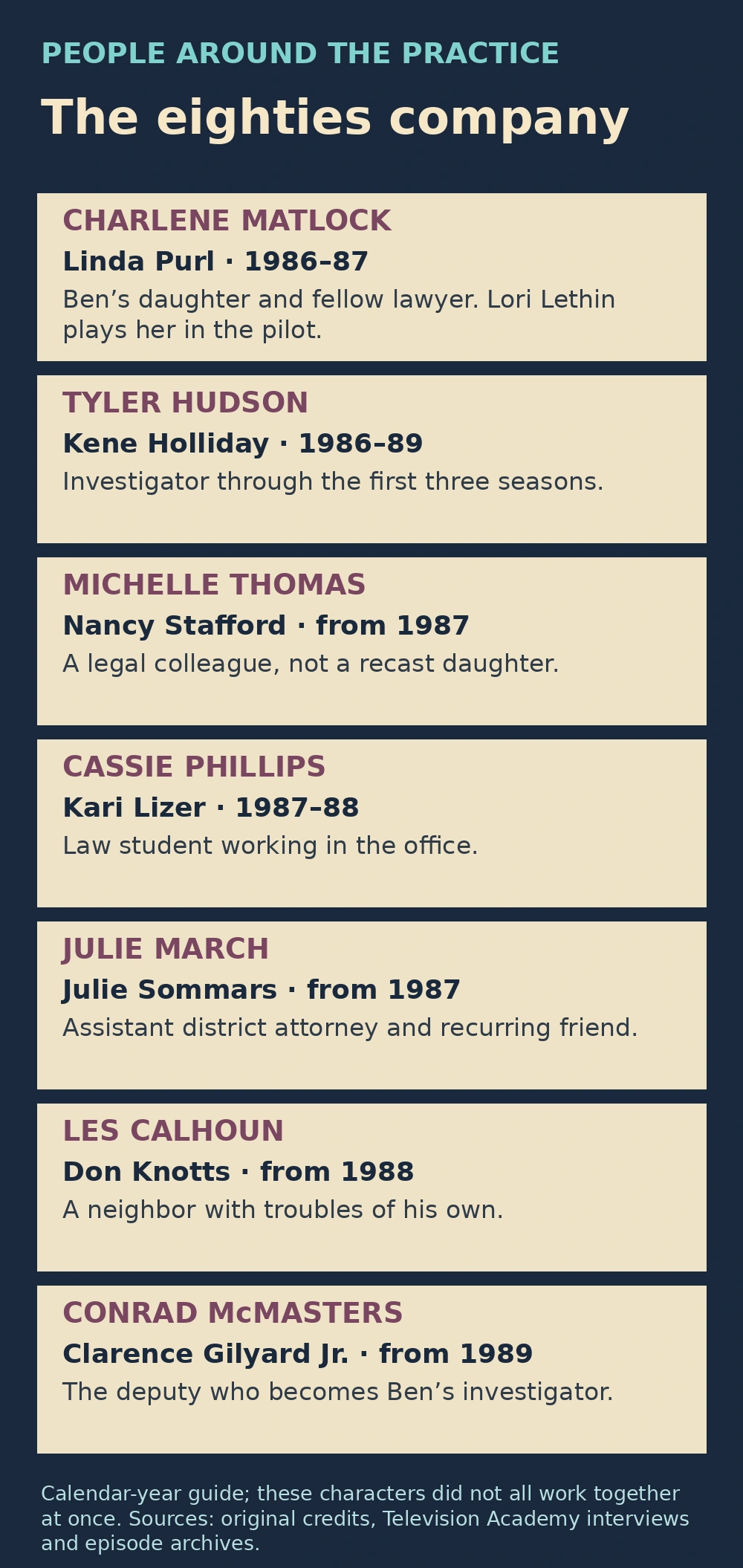
Linda Purl’s Charlene Matlock gives the first regular season a family relationship inside the law practice. She is Ben’s daughter and a lawyer, which means she knows both the professional skill and the more ordinary habits that clients may never encounter.
That familiarity is useful. Ben can be an impressive man in court and a demanding father in the office. Charlene doesn’t have to receive every instruction as though it were the first time she has heard him explain how something ought to be done.
The character also gives the early series a way to connect the cases to personal judgment. In The Don, her response to a man associated with the accused’s family brings the gap between a public reputation and a private person into the working day. The matter isn’t only whether Ben can defend the father. Charlene has to decide what the family connection means for someone she might otherwise want to know.
Purl brings a steadier contemporary presence beside Griffith. The partnership doesn’t depend on pretending they have the same experience or manner. Charlene can be closer to the client’s world while Ben carries the authority of a long practice and the confidence that comes with it.
Her regular place belongs to that first NBC season. Later reruns introduce different women working with Ben, including Michelle, who is a colleague rather than a recast daughter. Keeping the distinction clear makes the early episodes more rewarding. Charlene isn’t simply the first version of a permanent assistant slot; she brings a specific family history to the desk beside his.
Tyler Hudson does the work outside the courtroom

Kene Holliday’s Tyler Hudson is Ben’s investigator through the first three seasons. His part in the cases keeps the show from becoming an hour in which the attorney simply thinks harder than everybody else and then walks straight to the answer.
Someone has to find the person, check the account, make the approach, or discover what the witness didn’t volunteer. Tyler can move through places where Ben’s recognizable face and manner would change the conversation before it began. The partnership gives the lawyer a working life beyond his own appearances.
Holliday supplies a different energy. Tyler can be mobile, observant, and direct, with room for a dry response to the man sending him out. Ben’s authority does not require the investigator to behave as though every request is a revelation. The audience can enjoy their familiarity as well as the progress of the case.
It also gives the mystery more ways to move. A courtroom scene can be followed by a discovery elsewhere. The person telling Ben one thing may be seen doing something less convenient. Evidence becomes something gathered by people who have to enter rooms, take risks, and deal with resistance.
Tyler’s place matters when remembering the early program. Conrad’s later arrival can occupy a great deal of rerun memory, but he doesn’t replace the work Holliday did in establishing how Ben’s cases could unfold. The gray suit is the easiest image to recall. Quite a few of the facts that make it effective have been brought back by the man doing the investigating.
The first weekly case puts Dick Van Dyke behind the bench

The Judge gives the September 1986 launch a particularly satisfying opponent: Dick Van Dyke as Judge Carter Addison. The audience’s familiarity with another beloved performer becomes part of the setup. The man occupying a position of authority has a secret that Ben will have to uncover, and his respectable appearance is doing useful work for him.
The story lets viewers know that the judge has killed his mistress and framed a younger man. Ben takes the accused’s defense. The central question is therefore less about guessing which guest did it than about watching the lawyer discover what the audience already understands and then find a way to prove it.
That arrangement puts pressure on an old friendship. Ben has known the judge for years. Recognizing the truth means abandoning a comfortable account of someone whose position is supposed to make him trustworthy. The show begins its weekly life by making authority itself part of the obstruction.
Van Dyke is a good choice because the familiar face can encourage exactly the assumption the case needs to challenge. He doesn’t have to transform into a wildly unfamiliar villain. The position, the composure, and the history with Ben make the deception plausible within the room.
Griffith has to play discovery as a personal difficulty as well as a professional one. The lawyer’s usual confidence can’t protect him from what knowing the answer will cost. A friendship is not evidence of innocence, however pleasant it would be if it were.
The episode states a durable part of the series’ appeal. A reassuring hero doesn’t require a world full of reassuring people. Ben can be the familiar guide precisely because he is prepared to ask an uncomfortable question of someone the room has already decided to respect.
Defending the Don is an awkward way to discuss the family business

The first season’s two-part The Don gives Ben a client with an especially difficult reputation. Nicholas Baron is a mob figure accused of murdering a rival. Ben initially resists the case, then has to examine whether the man committed this particular crime rather than allow the reputation to finish the argument.
The distinction supplies good mystery material. A client can have a history that makes innocence seem unlikely without being responsible for the body currently at issue. The defense requires Ben to separate a broad account of what a person is from the specific account of what the prosecution says he did.
The family surrounding Baron makes that separation less comfortable. Loyalties, fears, and private motives can sit underneath an apparently united front. Ben has to listen to people who may be protecting the accused, themselves, or an arrangement they would prefer not to describe.
Charlene’s involvement adds a personal complication. The people connected to a notorious name still have individual personalities and desires. Her difficulty in separating the man she meets from the family’s reputation echoes the question Ben faces professionally, without giving either of them an effortless answer.
The longer form gives the series time to turn the situation around. A witness can be lost, a family explanation can weaken, and Ben can continue asking after the sensible social response would have been to stop. The suit is still familiar. The company has become considerably more dangerous than the neighbors at an ordinary Atlanta gathering.
Julie March doesn’t have to agree with him to know him

Julie Sommars’s assistant district attorney Julie March gives Ben an opposing professional with a continuing place in his life. She can challenge his argument, understand his habits, and still recognize when a situation has crossed beyond the usual contest between their sides.
The recurring relationship is valuable because the defense doesn’t have to begin every case opposite a complete stranger. Julie has reasons to take her own work seriously. Familiarity with Ben doesn’t make her obliged to concede that his latest suspicion is the correct one.
Sommars and Griffith can let personal warmth sit beside professional disagreement. The audience gets the pleasure of two people who know how the other approaches a room. An objection can carry a little history without requiring the episode to stop and explain the history every time.
The first-season episode The Nurse puts her in a case involving an accused private nurse, an engagement ring, and a household whose account of events doesn’t comfortably hold together. The evidence can seem simple when described by somebody with a convincing claim to respectability. Ben has to keep looking at what the description assumes.
Julie belongs to the workings of that world rather than a separate romantic program attached to it. The show can enjoy their connection while still allowing her to be a lawyer doing a different job. Ben’s charm may make the conversation more pleasant; it isn’t, by itself, a reason she should stop making him support what he says.
Then Ben has to answer an accusation himself

The People vs. Matlock, in the first season, turns the machinery toward the lawyer. A juror claims Ben paid him to influence a verdict. The man usually examining somebody else’s explanation now has to deal with a story aimed at destroying his own standing.
The setup works because the audience knows the character. We have watched Ben’s stubbornness, professional pride, and insistence on finding what happened. The accusation asks other people to believe a version of him that conflicts with the man we have been following.
Julie becomes particularly important in that reversal. Knowing Ben helps her recognize that something is wrong. Her role gives the episode a relationship to build on while he tries to uncover how the accusation connects with the case he was already defending.
It is also an efficient way to expose the vulnerability beneath a successful reputation. Ben’s name has helped him command attention and charge for his skill. Now the name itself is being used against him. Respectability doesn’t make a person immune to an allegation arranged convincingly enough.
The pleasure comes from watching the familiar method reassert itself under pressure. Ben can’t simply announce that the audience likes him and expect the courtroom to accept the reference. Something has been done, someone benefits, and the account has parts that can be examined. The investigator and the questions are still useful when the man asking them has much more than a fee at stake.
An old teacher needs the student to ask better questions

The Professor, from the first season, gives Ben a different kind of familiar authority to examine. His former law professor is accused after a fatal incident involving his car. The man cannot provide a clear account of the circumstances, leaving Ben with affection, respect, and a story whose missing pieces matter a great deal.
The relationship changes the emotional balance. A teacher is somebody who once occupied the knowledgeable end of the room. Now the student is the person expected to understand what happened and find a way through it. Ben’s long experience has become something he can return to a man associated with the beginning of it.
The case also offers a particularly uncomfortable absence: the accused doesn’t remember enough to give his lawyer a confident alternative. A defense can’t simply substitute an appealing story for an ugly one. Ben has to find facts that survive beyond what the client hopes is true.
That keeps the personal connection from solving the mystery. Wanting the professor to be innocent gives Ben a reason to care, but it doesn’t tell him who else had access, a motive, or an opportunity. The case still needs the work.
It is a recurring pleasure in the series to watch the confident older attorney encounter someone who knew him in an earlier role. For a moment, Ben isn’t simply the man everyone has come to consult. He has a past, and somebody from that past needs him to have become as good at the job as his reputation says.
A ring is a fee, a clue, and somebody else’s accusation
In The Nurse, Kathy Warren has been working privately for the St. John household when a death leads to a murder charge. She offers an engagement ring to pay Ben. Then another account of the ring arrives: it has supposedly been stolen from the house.
That little object does several kinds of work. It gives the client a way to ask for expensive help. It suggests a private relationship somebody may not want examined. And it allows another person to turn the same piece of jewelry into a reason to doubt her.
The episode makes good use of the distance between possession and explanation. The ring is visible. What it means depends on who is speaking. A confident accusation from a household with money can arrive sounding more authoritative than the story of the person employed there.
Ben’s task is to stop that social authority from becoming a shortcut through the case. Someone can have an excellent manner and still need to explain why the account changes when the questions get specific. The house contains relationships as well as a murder scene.
It also gives the recurring interest in Ben’s fees a human application. The client isn’t simply choosing among impressive lawyers with an unlimited account. She is bringing him something valuable because she needs help. The decision to accept connects his professional skill to a person whose resources are much less comfortable than his reputation.
A cooking show serves a murder in public
The first season’s The Chef puts a poisoning inside a television cooking program. A former husband appears as a guest, tastes the dish being prepared, and dies. The woman making the food becomes the obvious person to accuse.
A public setting is no protection when the public action seems to supply the explanation. Everybody can agree on the visible sequence and still miss the important part. A cooking segment offers ingredients, preparation, people handling objects, and an audience encouraged to watch the finished dish.
The former marriage gives the accusation a motive ready to attach to the picture. Ex-spouses have history; a person describing that history can make the result sound inevitable. Ben has to examine whether the explanation is persuasive because it fits the facts or because it is the easiest story to tell about them.
The case also fits the program’s appetite for moving through a different little world each week. A courtroom can lead to a studio kitchen, a household, a workplace rivalry, or a profession with its own habits. The regular company stays familiar while the guest world supplies a new arrangement of opportunities.
Ben’s enjoyment of food adds an appropriately ordinary pleasure to the case. The man still has tastes and an appetite while considering a murder. A detective doesn’t have to become a solemn instrument whenever someone dies. Griffith can let lunch exist in the same day as professional concentration without making either one seem especially difficult to believe.
The rock star would prefer not to be managed by her lawyer

The Angel gives Ben a client whose public performance and private behavior make the defense harder to organize. Angel is a rock performer accused of killing her manager. A blackout leaves her unable to provide the reassuring account her lawyer would very much like to hear.
Ben’s difficulty isn’t limited to the evidence. He wants the client to listen to practical advice about how she is presenting herself. She has a life built around a very different set of expectations, and being instructed by a disapproving older attorney doesn’t automatically improve her willingness to cooperate.
That pairing lets the series use Griffith’s irritation without making him a simple spokesman for the respectable people. Angel’s manner may annoy him, but it doesn’t answer the question of whether she committed the murder. He has to keep the two judgments separate while trying to stop her behavior from making the wrong impression easier.
Tyler’s investigating gives the case another route through the performer’s world. Ben doesn’t have to understand every social signal to recognize that the accusation has facts worth checking. The younger colleague can gather information while the lawyer deals with the client who has already become a full-time concern.
It is also a useful glimpse of the show’s casting habits. Kari Lizer plays Angel before returning in the separate role of Cassie Phillips. The familiar face doesn’t mean the rock singer has quietly joined the law office under a new name. Matlock, like plenty of long-running television, could find another job for an actor it wanted to use again.
Michelle Thomas joins the practice, not the family tree

Nancy Stafford’s Michelle Thomas becomes Ben’s legal colleague in the second season. She isn’t Charlene with a different name or another daughter introduced to keep the same relationship going. The change gives the office a new kind of partnership.
A colleague can know Ben’s habits without having grown up with them. Michelle has to work alongside his preferences and professional confidence as a lawyer in her own right. She can be useful in rooms where a different approach helps, and she doesn’t need to treat every instruction as a family negotiation.
Stafford brings an alert, contemporary presence beside Griffith’s deliberate pace. The contrast gives an office scene movement. Ben may want time to consider something; Michelle may already be dealing with the practical consequences of what the case requires next.
Her arrival belongs to the season ending in 1988, beginning with the London case The Billionaire. The familiar attorney has crossed into another setting, and the series is also adjusting the familiar company around him.
The distinction matters to a rerun viewer. Episodes from different years can arrive close together, making the office seem to change every time you finish another bowl of cereal. Michelle’s place is substantial and specific. The series hasn’t merely exchanged the woman standing beside Ben; it has changed what that person knows about him before the conversation starts.
She also helps the program avoid leaving all the active work to the central man. Ben remains the draw, but a case can require more than his own presence. The partnership gives him people who can carry information, confront somebody, disagree about a course of action, or keep the office functioning while he is elsewhere making a witness increasingly uncomfortable.
Cassie Phillips takes an invitation seriously
Cassie Phillips enters as a young law student who has remembered Ben suggesting that she look him up about work. He may have regarded the remark as an easy piece of encouragement. She has regarded it as an opening.
Kari Lizer gives the role an assertive energy that can make Ben regret the conversational generosity. Cassie wants to get into the world she has been studying, and she doesn’t necessarily share his view of how patiently she should wait outside the important parts of it.
The early appearance in The Therapist brings that ambition into a case already full of difficult people. Ben has a client to defend and an additional person whose understanding of the proposed job doesn’t always match the work he would like done.
The character remains part of the second-season office, separate from both Charlene’s family relationship and Michelle’s legal partnership. Those different positions give the recurring scenes more than one route to disagreement. Ben can be surrounded by capable people and still find that nobody has accepted his preferred account of how the day should run.
It is a modest but useful part of the show’s texture. A famous attorney’s practice needs routine tasks and people trying to advance. Cassie supplies the impatience of someone who doesn’t yet intend to spend the rest of her life merely filing the famous attorney’s work.
Atlanta sends its lawyer to London
The Billionaire opens the second season with a family murder case in London. An American businessman’s son has been convicted of killing his father, and his sister brings Ben into the effort to show he was framed.
The trip lets the series change the scenery without abandoning the central attraction. Ben is still dealing with a family whose grief, money, and private relationships have produced more than one possible account of the death. A grander setting doesn’t make a motive less personal.
It also gives Griffith’s familiar manner a different room to work in. A lawyer who looks entirely at home moving through Atlanta can become more conspicuous somewhere else. Ben doesn’t need to stop being recognizably himself in order to observe that a confident explanation has left something out.
The story offers a larger canvas for the second-season arrival of Michelle. A new professional relationship can begin inside the work, allowing the audience to learn who she is through what the case asks of her. She isn’t required to arrive at the office carrying a carefully prepared speech about why she belongs in the show.
Travel episodes can become an excuse to admire the destination while the mystery takes the evening off. This one still has a family case to untangle. The money creates an impressive surface; the lawyer’s questions remain interested in the less impressive things people have done behind it.
Television supplies Ben with a murder of its own

The second season’s The Network sends Ben into the business making the program we are watching. A network programming executive has been killed, and a television producer is accused. The lawyer finds an unusually well-supplied field of people with reasons to dislike the victim.
The appeal is partly the change of workplace. Television presents confident public faces, while the business behind them runs on decisions about money, attention, careers, and who gets another opportunity. A person with control over those decisions can collect a remarkable number of resentments.
Ben’s manner is well suited to the setting. He doesn’t have to be dazzled by the people who know how to make an impression. The useful part of an account may be the detail the practiced speaker has tried to move past while establishing how important the rest of the story is.
The episode can also have a little fun with the institution. A network drama examining an unpopular programmer has an obvious comic opportunity, even while it has to keep the murder and the defense moving. The show doesn’t need to pretend every powerful television executive is universally admired to get through the hour.
It is one of the ways Matlock remains more varied than the image of a man standing in the same courtroom suggests. The courtroom is the destination. The case may begin in an industry with a different wardrobe, different ambitions, and a whole new set of people insisting they couldn’t possibly have done something so inconvenient.
Ben meets a musical hero who has become difficult company
In The Country Boy, Ben gets the chance to defend a favorite country singer accused in a hit-and-run case. The professional opportunity comes with a fan’s pleasure attached. He can help someone whose work he has enjoyed and even have the performer stay at his home.
Then the person proves harder to enjoy than the music. The singer’s drinking and behavior make the visit uncomfortable, putting Ben in the familiar but unpleasant position of discovering that admiration doesn’t automatically improve the person receiving it.
That is fertile ground for Griffith because Ben’s tastes are already part of his character. The enthusiasm isn’t pasted onto him merely to set up a disappointment. He likes the music, wants the encounter to mean something, and has to work through the discouraging evidence that the man may not match the experience the songs have supplied.
The defense still needs doing. Being unpleasant company doesn’t establish responsibility for the crime. Ben has to keep his new disappointment from becoming as misleading as the earlier affection might have been.
The episode also catches a little hazard of television’s parade of guest worlds. We can know a performer through a body of work and feel as though we know the person. Ben’s case gives that feeling an awkward houseguest. His professional skill is useful partly because he has to keep going after the fun of meeting the singer has worn off.
Don Knotts moves into the neighborhood

The Lemon, broadcast in November 1988, introduces Don Knotts as Les Calhoun, Ben’s neighbor. A dispute over a defective used car ends with Les suspected of killing the salesman. The new neighbor has arrived with a problem large enough to require considerably more than a borrowed tool.
Griffith and Knotts carried a television history no script had to manufacture. Viewers who knew Andy and Barney could enjoy seeing the performers in the same room again. The characters, however, were Ben and Les, and the murder case needed them to function inside this show’s world.
Knotts could bring nervousness to an everyday encounter so efficiently that an explanation began to sound like a difficult athletic event. A man who has been accused needs to make himself understood. Les has the additional problem of being the sort of person whose worry can become another thing the room is watching.
That gives Griffith a familiar comic partner without requiring Ben to abandon the case. He can hear the complaint, recognize the anxiety, and continue toward the practical question underneath it. The older double act can fit inside a mystery as a pleasure rather than a replacement for the plot.
The arrival belongs to the 1988–89 season. By then, Matlock had enough identity for the reunion to be a visit within an established program. The audience could bring its Mayberry memories, then stay for the attorney’s new neighborhood.
Les also gives the domestic side of the series another source of interruption. Ben’s work can follow him home; a neighbor can bring a different sort of request straight to the door. Familiarity is comfortable for the viewer partly because somebody else’s arrival is so often inconvenient for the man we are visiting.
A blues singer brings another kind of history into the case

The Blues Singer aired in May 1989. A singer-composer takes an older blues musician into his home after finding him living on the streets. When the younger man is killed, the older musician is accused, and Ben takes the defense.
The story gives the series a guest world built around music, admiration, and unequal circumstances. A person can have made something valuable and still be living precariously. An act of help can create gratitude while also upsetting the people who regard the household as theirs to manage.
Ben’s own interest in the music gives him a personal response to the accused without making the response proof. As with the country singer, affection can open the door to a case. The defense still has to establish what happened after he has walked through it.
The older performer also complicates the easy social account. The person with the least secure place in the room can become the convenient suspect. The people with more comfortable standing may have motives that need examining just as closely, however respectable their account of the household sounds.
The series doesn’t need to become an extended musical biography to let that history matter. A face, a performance, an account of an earlier life, and Ben’s attention can bring more into the case than another name on a suspect list. The victim and the accused had a relationship before the opening credits made it a murder.
It is part of the late-eighties program’s range. The same attorney who can make a used-car dispute into a neighborly headache can enter a story about a musician whose work has outlasted his good fortune. The reassuring method travels between them, but the people receiving the questions need not all be versions of the same client.
Conrad McMasters arrives before the decade runs out
The fourth season begins in September 1989 with The Hunting Party, taking Ben to North Carolina for a case involving deaths connected with an alleged hunting accident. There he meets deputy sheriff Conrad McMasters, played by Clarence Gilyard Jr.
The circumstances give Conrad more than a desk introduction. Ben is away from his ordinary base, the accused is difficult to manage, and the inquiry develops a dangerous effort to discredit the lawyer himself. A helpful local officer can make a practical difference before anybody discusses a longer arrangement.
Conrad becomes Ben’s new investigator. His arrival changes the company after Tyler’s place through the first three seasons. The transition belongs to the original NBC series and happens within the calendar eighties, even though most of Conrad’s subsequent work extends beyond the end of the decade.
Gilyard brings an alert physical presence and a different relationship to Ben. Conrad’s background in law enforcement can help him enter the practical side of a case, while the partnership gives the attorney another person to send toward the questions that can’t be answered from the witness stand.
The change is worth keeping clear because television memory can flatten a long run. Tyler and Conrad are separate investigators, with different performers and different stretches of the series. Enjoying one doesn’t require moving him backward into the other’s first cases.
By the time the new partnership is in place, the program has carried Ben through several working arrangements without making him unrecognizable. The office changes, but the central habit remains: somebody has supplied a convenient account, and the man in the suit would like to know a little more about it.
A Christmas client doesn’t have to be full of seasonal goodwill
December 1989’s The Scrooge makes the holiday case depend on a disagreeable toy-store owner. He is accused of killing a partner whose generosity he had criticized. Even the business supposed to be spreading happiness has found a way to become a murder scene.
The arrangement makes a cheerful seasonal moral less automatic. The accused isn’t presented as somebody everyone would naturally want to help. His attitude has supplied reasons for people to dislike him, and the dead partner’s generosity gives those reasons a sympathetic comparison.
Ben still has a job to do. A person’s unpleasantness can explain why the room is ready to believe the accusation without making the accusation correct. The defense has to work in that gap, where a bad reputation can make a poorly examined story feel like a satisfactory ending.
Holiday episodes often ask familiar characters to become a little kinder for the evening. This case gives kindness a more demanding form than approving of somebody already generous. The lawyer has to listen to a client whose company may not improve the festive mood.
That is a fitting late-eighties example of the show’s comfort. We aren’t being promised that every person will turn out lovely. We are being promised that the man handling the case will keep asking what happened, including when the person who needs the answer is somebody he might rather not invite to dinner.
The formula leaves room for more than one kind of mystery
The most recognizable Matlock sequence is the final courtroom explanation, but the program can reach it through different kinds of suspense. Sometimes viewers know the killer early, as in The Judge. At other times, the guest world supplies a field of suspects whose relationships have to be sorted out alongside Ben’s investigation.
The first arrangement gives the audience the pleasure of watching a trap develop. We know the respectable person is lying. The questions are when Ben will see the lie, what fact will expose it, and how the person will behave once concealment gets difficult.
The second gives us a more traditional guessing game. An apparent motive can be persuasive, then become less useful when another relationship is uncovered. A guest with a small amount of screen time may have a much larger part in what happened than the initial account admits.
The recurring team makes both approaches easier to follow. We know who will carry the questions, who may find the information, and who is likely to object when Ben’s theory reaches court. Each new household or workplace can introduce complication without requiring the viewer to learn the whole program again.
There are limits to that reliability. A case can become too convenient, a witness can supply precisely the explanation needed, or the final scene can tidy a complicated world more neatly than feels earned. A fond memory doesn’t require pretending every construction is equally persuasive.
The best episodes make the familiar destination part of the attraction. We want the explanation, and we enjoy the way Griffith gets there. A small change in his attention, a repeated question, or the witness’s attempt to stop talking can make the expected scene satisfying without making its details identical to last week’s.
Ben had company in the decade’s mystery business
Jessica Fletcher and Ben Matlock could both enter a room full of people who had underestimated an older visitor and begin by listening. Murder, She Wrote built its own audience around that pleasure, with a novelist’s curiosity rather than a defense attorney’s professional obligation.
The difference matters. Ben has a client, a case, and an argument he has to support in a formal setting. His attention isn’t merely an interesting habit he carries into a social visit. Someone has hired him because the obvious account is about to cost them much more than embarrassment.
Other mysteries offered more physical movement. Magnum, P.I. could move through Hawaii with a very different wardrobe and temperament. The brothers on Simon & Simon brought sibling disagreement to the business of finding an answer. Ben’s most important performance might involve remaining nearly still while the witness began doing the emotional running.
Those distinctions gave a household real choices within a familiar kind of television. You could want a puzzle, a recurring hero, and some reassurance at the end without wanting every show to approach the evening at the same speed.
Within the eighties mystery landscape, Matlock offered a particularly legible bargain. The central man looked ordinary, had habits you could recognize, and knew how to take a confident story apart. The new guest cast might bring a frightening amount of trouble. We already knew whose questions we wanted to hear.
A family room didn’t have to watch at one level of attention
A network mystery could accommodate different people in the same room doing slightly different amounts of watching. One person followed the alibi carefully. Another recognized a guest actor. A younger viewer might miss part of the conversation and return when Ben’s tone suggested that the pleasant questioning had reached an important point.
The recurring structure helped that shared viewing. A commercial break didn’t require a new lesson in who the main people were. The office, the courtroom, and Griffith’s face provided familiar places to come back to after somebody answered the telephone or checked what was happening in the kitchen.
That doesn’t mean the show was designed to reward ignoring it. The clues still needed attention. It means the program had a clear shape an audience could rejoin, a useful quality in homes where television was part of an evening rather than an activity arranged in complete silence around a personal screen.
There was also pleasure in sharing recognition across ages. An adult might know Griffith or Knotts through years of earlier television. A child could enjoy Les’s nervous explanation without carrying that whole history. The older viewer heard a reunion; the younger one saw an immediately funny person with a problem.
That is part of why a courtroom show can live in a generation’s memory even when it wasn’t the program every kid would have selected alone. It occupied real rooms with other people in them. Ben’s voice could become one of the sounds of an ordinary evening, right up to the moment everyone needed to stop discussing dinner because he was finally asking the question.
The people behind the suit knew their mystery business
The pilot’s credits put Dean Hargrove’s name on the writing as well as the executive production, alongside executive producer Fred Silverman. Robert Day directed, and Dick DeBenedictis supplied the music. Griffith was the face that brought people to the television, but a murder needed considerably more arranging than finding him an appropriate jacket.
Hargrove’s earlier work included Columbo, and his eighties work with Silverman also included the Perry Mason television movies. These were people accustomed to building an evening around a recognizable investigator or attorney. They understood the useful tension between knowing the central character extremely well and knowing almost nothing about the guests who had just begun lying to him.
That balance is easy to overlook when a familiar series becomes a household habit. The new client has to become a person quickly. A suspect needs a reason to be interesting before the final scene identifies how important that reason was. An apparently incidental conversation may need to carry a clue without stopping the episode to point at it with both hands.
A dependable star makes those jobs easier, but he doesn’t do them automatically. If every visitor explains too much, Ben has nothing to discover. If the visitors explain too little, the conclusion feels as though the lawyer has been watching a different episode from the rest of us. The satisfaction depends on giving his questions a trail the viewer can recognize afterward.
The music and the move between scenes help keep that trail moving. A change from the office to a guest’s private world can make the account we just heard look less secure. A reaction can end a conversation before the person has volunteered the thought their face has already supplied. A television mystery is built from those decisions as well as the final accusation.
Watch the credits occasionally, even if somebody else is already reaching for the remote. That very familiar evening has been written, staged, photographed, edited, and scored. The gray suit gives us a welcome point of recognition. Quite a few people have spent the hour making sure its owner still has something worth finding.
The suit had more years of work ahead
Matlock continued into 1995, with its later move from NBC to ABC, further cast changes, and additional stories beyond the decade. Those years shouldn’t be folded into the early NBC company as though Charlene, Tyler, Michelle, Conrad, and every later colleague had all occupied the office at once.
The eighties alone provide a substantial beginning: a pilot, a weekly series with a famous guest judge, family and professional partnerships, an investigator doing the legwork, travel cases, a familiar neighbor, and the start of a new working relationship in 1989.
Griffith’s performance holds that changing company together. Ben can be warm, thrifty, vain about his skill, irritated by a client, delighted by music, or suspicious of the person everyone else has accepted. The consistency lies in the man, with enough variation to give the next case something to provoke.
Go back to an early episode and watch how little he sometimes needs to do. The room is giving him information. Somebody believes they have supplied an adequate explanation. He considers it, takes another beat, and finds the part he would like to hear again.
That is the pleasure the title kept promising. We weren’t returning because the people around Ben had become more honest since last week. We were returning because somebody still had to ask them a second question, and he appeared to have the afternoon available.
A few questions before the next witness
Did Matlock begin in March or September 1986?
The pilot film, Diary of a Perfect Murder, aired on NBC on March 3, 1986. The regular weekly series began on September 23, 1986, with The Judge. Both dates belong to the original launch, but they describe different broadcasts.
Was Michelle Thomas Ben’s daughter?
No. Linda Purl played his daughter Charlene in the first regular season, after Lori Lethin played her in the pilot. Nancy Stafford’s Michelle Thomas joined as a legal colleague in the second season. She is a separate character with a different relationship to Ben.
Who investigated Ben’s cases in the eighties?
Kene Holliday played Tyler Hudson through the first three seasons. Clarence Gilyard Jr. arrived as Conrad McMasters at the beginning of season four in September 1989. The change belongs to the original series; much of Conrad’s continuing work lies in the nineties.
Does this cover the newer Matlock with Kathy Bates?
This feature follows Andy Griffith’s original series and its eighties television years. The later series with Kathy Bates has its own characters and premise. Sharing a title doesn’t make its story the same practice or a new chapter of Ben’s original NBC cases.
Sources & Further Reading
- Series history and original production interviews
- Dean Hargrove discusses the making of his mysteries
- Original pilot credits and broadcast date
- Original episode chronology and image catalogue
- Matlock episode guide