Night Court in the 80s: The Weirdest Hit Sitcom on NBC
A magician on the bench, a prosecutor in need of supervision, and a court staff trying to finish a shift the city refused to make normal.
By Gizmo
THE GRIFT.
THE GRAVEYARD SHIFT.
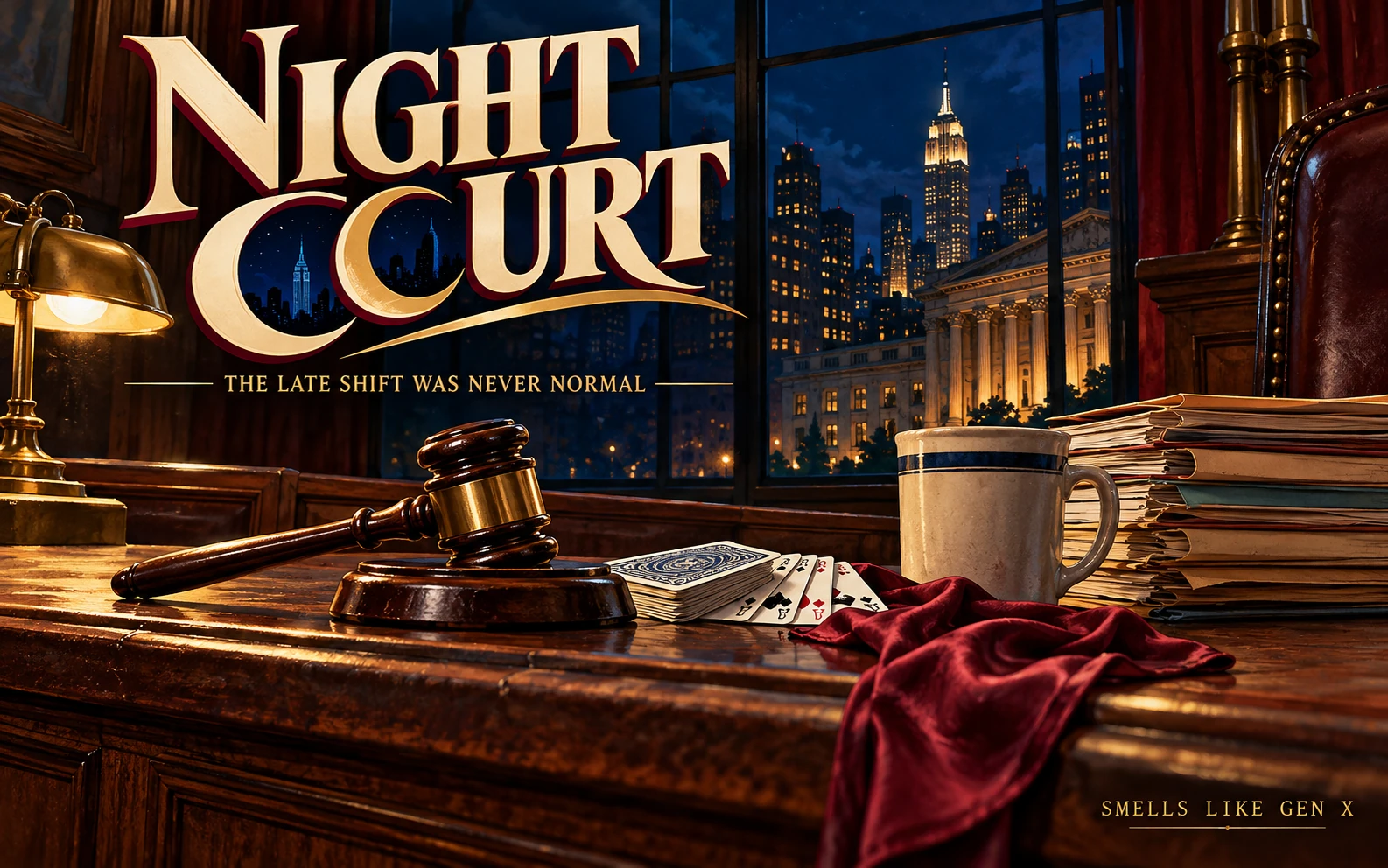
Inside This Article
- The sensible people had already gone home
- January 1984, before the court found its groove
- Harry was a magician who happened to have jurisdiction
- Dan Fielding had ambitions. Most needed supervision
- Christine was allowed to be funny about caring
- Bull could see over everyone and still miss the point
- Mac was trying to get an actual working day finished
- Selma and Florence left very different silences
- Roz did not need to raise her voice
- That bass line knew which city it was in
- The witness had a habit Harry hadn’t expected
- Two hundred cases before midnight. What could go wrong?
- The operation exposed something Dan preferred to hide
- Harry couldn’t make Leon’s life simple with a trick
- Mac’s old debt didn’t fit neatly in the file
- Buddy Ryan brought a family resemblance and a new problem
- The Wheelers were having a worse week than you
- Mel Tormé was a very specific kind of hero
- NBC found room for the courthouse after Cheers
- The room learned to move faster
- Some laughs come with a louder objection now
- A city of guest actors passed through the doors
- The late shift still has its people
- Questions Readers Ask
The sensible people had already gone home
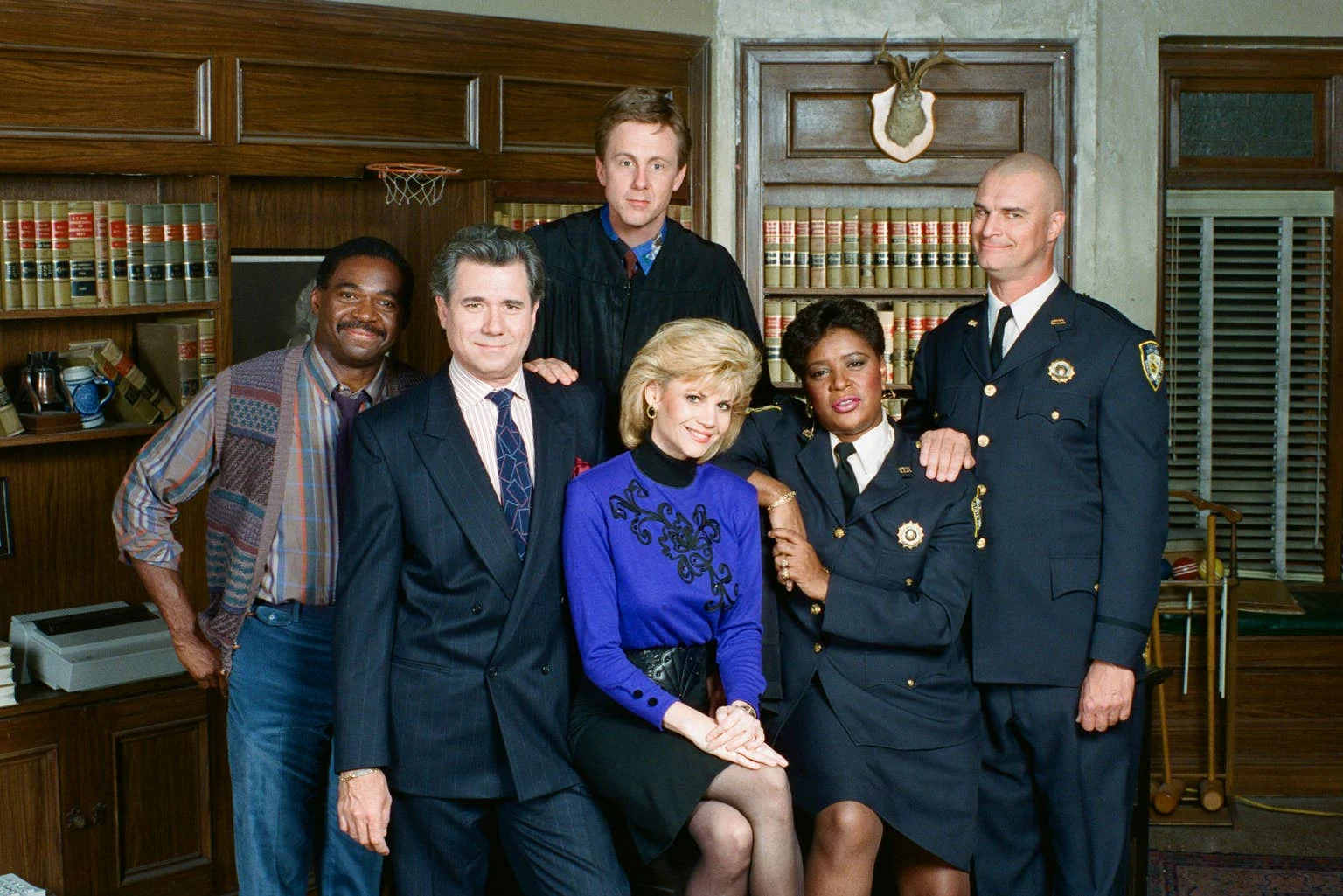
The bass line starts, Manhattan lights up, and somewhere in a courthouse Dan Fielding is about to say something that would require three meetings with human resources today. Harry Stone has a gavel, a deck of cards, and an optimistic belief that the evening can still turn out well. Bull is taking an instruction much too literally. Roz has already decided how impressed she intends to be. The answer is not very.
Night Court understood the appeal of a place that operated after respectable daytime expectations had expired. The people arriving before the bench might be unlucky, confused, dishonest, lonely, or wearing something that suggested an unusually complicated journey to the building. The people working there weren’t exactly a stabilizing influence. Somehow the shift had to finish.
That was the invitation: spend half an hour with a workplace whose staff had learned to recognize absurdity without being especially alarmed by it. NBC had warmer families and a very welcoming Boston bar elsewhere in its schedule. Here was the institution you reached after the family evening or the bar visit had taken an unfortunate turn.
The show began in January 1984 with a more restrained court than the one many viewers remember. Over the decade, its cast changed, the jokes grew broader, and John Larroquette’s Dan became one of television’s great exercises in making a thoroughly objectionable man entertaining. The series acquired a taste for impossible deadlines, unlikely visitors, and physical comedy that sometimes seemed determined to test the building’s insurance.
Yet the affection underneath mattered. Harry believed people deserved another look. Christine believed the system should be fair. Mac kept the paperwork moving. The bailiffs understood that somebody had to remain practical while the lawyers performed. In the crowded world of 1980s television, this was a surprisingly durable group of people to trust with the late shift. Trust with your case, perhaps less automatically.
January 1984, before the court found its groove
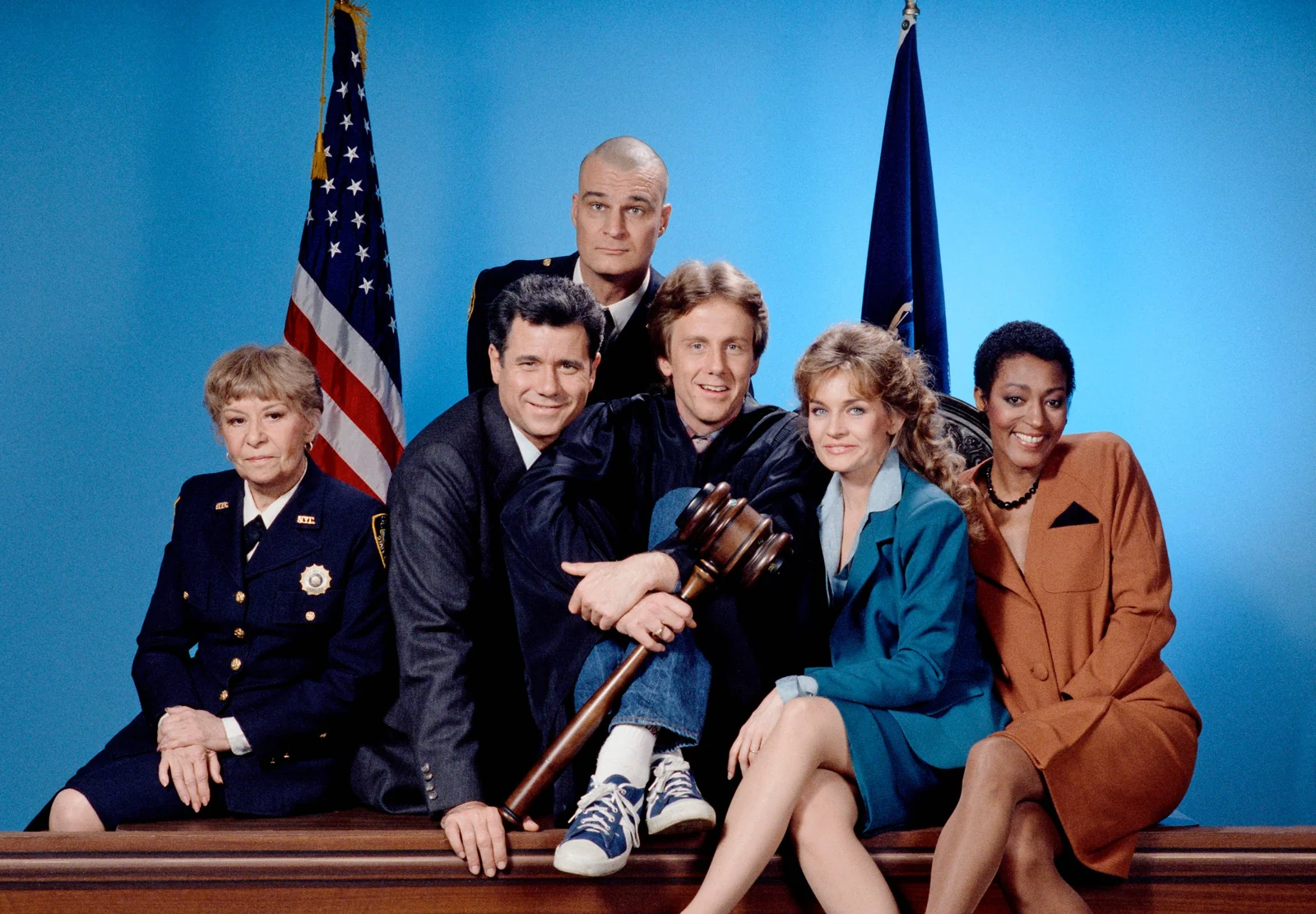
Night Court premiered on NBC on January 4, 1984, with “All You Need Is Love.” Reinhold Weege created the series, bringing experience from Barney Miller; James Burrows directed the pilot. The setting gave a workplace comedy a steady supply of new faces. Every case was a potential entrance, and every entrance might introduce someone capable of making the regular staff look nearly normal.
Harry Anderson’s Judge Harry Stone is conspicuously young for the authority he has acquired. He isn’t interested in looking like a monument to judicial solemnity. The robe contains a man with an appetite for magic, jokes, music, and the possibility that the person everyone else has dismissed may still be worth hearing.
The original regulars include Larroquette as prosecutor Dan Fielding, Richard Moll as bailiff Bull Shannon, Selma Diamond as fellow bailiff Selma Hacker, Karen Austin as clerk Lana Wagner, and Paula Kelly as public defender Liz Williams. That lineup is a useful surprise if your mental picture begins with Markie Post and Marsha Warfield. The familiar ensemble wasn’t waiting fully assembled on the first night.
The early episodes have more of the dry, grubby workplace flavor associated with Barney Miller. People with jobs deal with people whose behavior has interrupted those jobs. The cases can be peculiar without requiring the entire universe to abandon its rules. There is room for a strange exchange, an awkward silence, and a character who simply refuses to explain himself any better.
The premiere didn’t arrive to universal critical applause. The Washington Post’s opening review liked Anderson more than the vehicle built around him. That’s useful context for a show now remembered as a settled favorite. Its appeal was still being worked out; the name and setting didn’t automatically supply the finished rhythm.
Weege’s court had an excellent practical advantage, though. A weak visitor could leave and another could arrive. The regulars had reasons to argue and reasons to remain in the same room. Give the group time to develop, and the workplace could become more entertaining than any individual case. That’s the version the decade gradually produced.
Harry was a magician who happened to have jurisdiction
Harry Anderson’s magic wasn’t a decorative hobby pasted onto an otherwise conventional sitcom lead. His timing, curiosity, and pleasure in misdirection shape Harry Stone’s whole presence. A trick asks someone to look twice at what seemed obvious. That is also a useful habit for this judge, even when the district attorney would prefer everyone to stop looking and record a conviction.
Anderson had already appeared on Saturday Night Live and as Harry the Hat on Cheers. He brought the ease of a performer accustomed to holding attention without a large dramatic apparatus. A small object, an unexpected move, or the suggestion that he is enjoying a private joke can make a scene tilt toward him.
Stone’s gentleness is therefore active rather than vague. He isn’t simply the nice man assigned to balance Dan. He likes finding another angle, making a tense room briefly less tense, and seeing whether someone responds when approached as a person instead of a file. The magic belongs to that temperament. It also gives him opportunities to behave like an overgrown boy in a job that is supposed to discourage the tendency.
That mixture makes the authority interesting. Harry may be compassionate, but he still has power. His jokes can delay other people’s work; his enthusiasm can become an inconvenience; his confidence in a good outcome can look impractical to people who have to manage the details. The show is stronger when his kindness doesn’t automatically settle every argument.
Anderson is especially effective when the levity falls away. A defendant, a child, or a colleague may need something the trick can’t supply. You see the expression change without the character becoming a different man. The person who likes entertaining the room is also capable of recognizing when entertaining it is no longer the useful response.
There are moments when the scripts lean too heavily on Harry’s goodness, making the rest of the court briefly foolish so he can be wise. His best scenes don’t require that advantage. They let him be curious, disappointed, amused, or uncertain. The gavel establishes his job. Anderson’s ability to move between those feelings establishes why the audience wants him to keep it.
Dan Fielding had ambitions. Most needed supervision

Dan wants money, status, sex, and the satisfying certainty that someone less important is available to inconvenience. He can turn a conversation into a calculation before the other person has finished saying hello. John Larroquette makes the calculation visible: the eyes register an opportunity, the posture adjusts, and a new version of Dan arrives wearing exactly the same suit.
The performance is far more precise than the character’s reputation for leering might suggest. Larroquette can make a reaction travel through several stages—interest, contempt, alarm, recovery—in the space another actor might use to prepare a line. His height becomes part of the comedy, too. Dan stretches toward an advantage, folds around a humiliation, or tries to preserve dignity while the room steadily removes it.
Early Dan is less extravagantly voracious than the later version. As the show discovers what Larroquette can do, it gives him more appetite and more room to fail. That growth is a large part of Night Court‘s change in temperature. The prosecutor becomes an engine of trouble rather than merely a person objecting to the judge’s eccentricity.
There is an important comic bargain here. The audience may enjoy Dan’s speed without endorsing his behavior. He is frequently exposed, rejected, frightened, or made ridiculous. Larroquette doesn’t require him to be secretly admirable in every scene. A scoundrel loses some of his interest if the show keeps rushing in to assure everyone that he is actually the nicest person present.
At the same time, the character has enough loneliness and insecurity to support something beyond a procession of dirty jokes. His status chasing isn’t always victorious. The appetite can look compulsive rather than enviable. When the performance allows that emptiness to show, the court’s tolerance of him becomes more complicated than an agreement to laugh off another offense.
The industry noticed the craft. Larroquette won the supporting-actor comedy Emmy in 1985, 1986, 1987, and 1988. Four consecutive awards are a substantial acknowledgment of work that makes a very broad character feel freshly reactive. Dan may deliver a joke the audience sees approaching, but Larroquette can still surprise them with the route he takes to the landing.
Not all the material deserves equal admiration. Some scenes rely on harassment being treated as a minor workplace nuisance, and the laugh doesn’t magically excuse it. The strongest defense of Dan is the performance’s intelligence, not a demand that viewers suspend theirs. He is a superbly played problem. The court would have a quieter evening without him and a less entertaining one to watch.
Christine was allowed to be funny about caring
Markie Post’s Christine Sullivan brings idealism into a room that has developed several ways to avoid it. She wants defendants treated fairly, takes her responsibilities seriously, and can become passionately committed to a position before discovering that the people involved are making her job much more difficult than the principle sounded.
Post first appeared as Christine in 1984, before joining the regular cast in 1985. The intervening lineup included Ellen Foley’s public defender Billie Young; Paula Kelly had played Liz in the first season. Each performer gives Harry and Dan a different sort of opposition in those early episodes.
Christine’s earnestness is funny because Post gives it momentum. She doesn’t merely stand still and represent decency. She argues, reacts, worries, and sometimes commits so completely to an emotion that the room has to catch up. The show can make her naive without requiring her to be dim.
Her scenes with Dan are especially valuable when she refuses the role he would like her to occupy. He may treat the conversation as a pursuit; she treats him as an interruption, an opponent, or an occasionally useful colleague who needs correcting. Post’s reaction makes the joke a contest instead of a one-sided exhibition of his personality.
With Harry, the attraction has a different quality. Their shared capacity to care gives the relationship warmth, but it doesn’t make their methods identical. He is comfortable improvising. She is more likely to believe a correct procedure ought to help. Watching those instincts collide can be more interesting than another attempt to make the romantic question do all the work.
The writers sometimes punish her sincerity too automatically. A character who believes in things becomes an easy target if every belief is merely preparation for an embarrassing reversal. Post keeps Christine human enough to resist that reduction. You can laugh at the excess and still recognize why the effort matters.
By the later eighties, she is essential to the show’s balance. Without her, Harry’s compassion and Dan’s self-interest risk becoming an overly simple pair of opposites. Christine brings a more energetic moral impatience: yes, this is an absurd place, but somebody might still do the right thing before the building closes.
Bull could see over everyone and still miss the point
Richard Moll’s Bull Shannon has one of television comedy’s most instantly legible silhouettes: very tall, bald, and physically imposing enough to suggest that a sensible defendant should reconsider becoming difficult. Then he speaks, and the expectation changes. The intimidating man is often the most innocent person in the building.
The contrast is easy to explain and harder to sustain. Moll makes it work through an extraordinary commitment to Bull’s internal logic. A literal interpretation isn’t offered as a wink to the audience. Bull appears to have considered the situation and reached what, to him, is an entirely reasonable conclusion. The expression arrives after the thought, which makes the thought funny.
His gentleness is as important as his confusion. Bull cares about people with an openness the more articulate characters sometimes lack. He can be wounded, loyal, or delighted without pausing to make the feeling socially sophisticated. In a court full of professionals skilled at presenting themselves, that directness supplies another kind of honesty.
The physical comedy depends on more than height. Moll understands stillness. Let everyone else react quickly and Bull’s delayed response can become the funniest movement in the shot. Alternatively, a sudden enthusiastic gesture from someone of his size changes the room’s geometry immediately. Other actors have to share space with the joke.
There’s a risk that the scripts make him childlike so often that they erase the competent adult who is supposed to be working as a bailiff. The better scenes preserve both. Bull may misunderstand a social situation, but he knows the people he cares about and can respond decisively when the problem is clear.
He is also particularly good with the women beside him on bailiff duty. Selma’s rasp, Florence’s mischief, and Roz’s immovable composure give his reactions different surfaces to bounce against. The show doesn’t need to keep inventing a new kind of giant joke. It needs someone who understands exactly how much patience Bull’s next explanation is going to require.
Mac was trying to get an actual working day finished
Charles Robinson’s Mac Robinson joins the court in its second season, giving the ensemble a clerk whose practical instincts make the surrounding chaos more visible. Mac has forms, cases, arrangements, and a reasonable expectation that people will occasionally cooperate. It is an optimistic expectation for this workplace.
Robinson’s understatement is a necessary part of the rhythm. Dan can stretch a reaction to extravagant proportions; Harry can turn the conversation into an impromptu performance; Bull can wander into a literal misunderstanding. Mac is often the person who has already understood the problem and is waiting for everyone else to stop decorating it.
That doesn’t make him a blank straight man. His patience has texture. A small look can suggest that he has reached the end of one tolerable explanation and does not intend to accept another. The comedy comes from restraint, which lets him occupy the same scene without having to compete for the largest gesture.
His life outside the desk also matters. His marriage to Quon Le, played by Denice Kumagai, and his history as a Vietnam veteran give the show material that isn’t simply another variation on the judge’s eccentricity or the prosecutor’s appetite. Mac has loyalties and responsibilities that continue when the case list ends.
When a story puts him under pressure, Robinson has already established enough steadiness for the disturbance to register. A usually sensible person facing a bad choice is inherently interesting. The audience knows what Mac ordinarily values, so a departure from it means more than a character suddenly behaving unpredictably because the plot has requested drama.
Among the show’s louder memories, it’s easy to overlook how much he contributes by keeping a scene grounded. That was a familiar strength of the best 1970s workplace comedies, too: someone had to treat the job as a job so that everybody else’s behavior had something solid to disturb. Mac doesn’t make the court normal. He makes its abnormality easier to measure.
Selma and Florence left very different silences
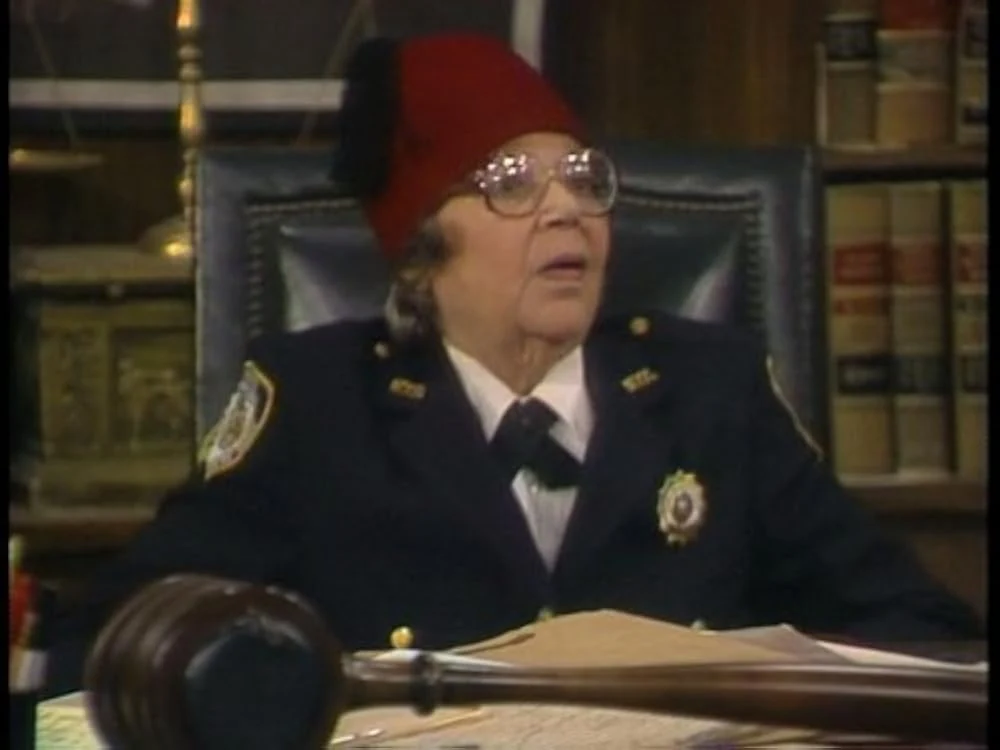
Selma Diamond’s Selma Hacker sounds as if she has already heard the explanation, rejected it, and smoked through the appeal. The voice is instantly distinctive, but Diamond’s timing is the real pleasure. She can cut through the room’s excitement with a response dry enough to make enthusiasm seem like an avoidable administrative error.
Her partnership with Bull has a wonderful visual imbalance. He is enormous and open-faced; she is small and unsentimental. Neither quality tells the whole story. Selma’s impatience doesn’t cancel her affection, and Bull’s size doesn’t prevent him from depending on her presence. The joke has a relationship behind it.
Diamond died in 1985, after the second season. The series acknowledged Selma’s death in the following season’s opening, with Bull struggling to cope. That is a different kind of cast change from a performer simply disappearing between years. The person missing from the workplace is allowed to have been important to the people still there.
Florence Halop joined as bailiff Florence Kleiner. Her Flo shares the useful capacity to puncture nonsense, but Halop brings a different spark: mischievous, lively, and less interested in behaving as if age should make a person decorous. The court already has enough rules. Flo sees no need to supply extra ones for herself.
Halop died in 1986, after the third season. The two losses in consecutive years are a sad part of the series’ early life, and they deserve acknowledgment without turning the actors into a morbid piece of sitcom trivia. Both women had made the courtroom more particular. Each voice changed the way the people around it sounded.
The show eventually found another strong combination with Marsha Warfield, but that success doesn’t make the earlier contributions interchangeable. Rewatch the first seasons and Selma’s rasp is part of the air. Watch the third and Florence has her own way of enjoying the court’s absurdities.
Television ensembles are sometimes described as if their final familiar lineup were the inevitable destination. Here, history was less tidy. There were talented people, real losses, and a production that had to keep finding its way. The comedy’s durability includes that difficult process, not just the polished memory of everyone who remained.
Roz did not need to raise her voice
Marsha Warfield’s Roz Russell arrives in 1986 and brings a form of control the court badly needs: the ability to look completely unimpressed while everyone else is working very hard to become impressive. Roz doesn’t have to announce that the latest performance has failed. Her face has already issued the ruling.
Warfield’s stand-up experience shows in the economy. A line lands without being hurried, and a pause can suggest that the speaker has decided to let the fool hear himself. Put that composure beside Dan’s need for approval or Bull’s earnest confusion, and the scene acquires a rhythm no one else supplies.
Roz is often described as tough, which is accurate but incomplete. Toughness alone would make her a convenient obstacle. Warfield also gives her wit, pride, embarrassment, and a capacity for affection she isn’t inclined to display on demand. The court can count on her without being entitled to a sentimental speech about it.
Her working relationship with Bull is particularly appealing because their differences don’t erase their loyalty. He may need an explanation she would prefer not to give. She may react with a bluntness that doesn’t flatter his feelings. Underneath, the partnership feels dependable. In this building, dependable is a serious achievement.
The character’s restraint helps protect the series from exhausting its own energy. Once a comedy becomes comfortable with broad farce, everybody can be tempted to play toward the ceiling. Roz gives the noise somewhere to stop. A reaction that refuses to join the hysteria can be more effective than another escalation.
She is also funny without the show having to make her agreeable at every moment. That freedom is part of the performance’s strength. Roz may care about her colleagues and still find them irritating. She may help and still reserve the right to explain how foolish the situation has become. Warmth doesn’t require a smile permanently attached to the uniform.
That bass line knew which city it was in
Jack Elliott’s theme gives Night Court an entrance with movement in it. The bass pushes forward, the city images arrive, and the sound suggests a New York evening that hasn’t finished deciding what kind of trouble to produce. It’s a remarkably efficient invitation to a show set largely inside a few rooms.
The music doesn’t offer the family reassurance of a song about staying together or the heroic announcement of an action series. It has a groove, a little swagger, and the sense that people are still awake because something may happen. The courtroom belongs to a city continuing after other people’s working days have ended.
That atmosphere matters. A studio set can begin to feel sealed off from the world if the program gives it no connection beyond the next entrance. The opening’s New York landmarks and evening energy supply an outside. Whatever absurd person appears before Harry has come from somewhere beyond the doors.
The theme also creates a useful expectation of adulthood. This is not a household waiting for a child to learn a lesson. The employees have already had years to acquire their habits, many of them regrettable. The music sounds comfortable with the possibility that nobody will be entirely improved by the end of the shift.
Among the memorable eighties television themes, it stands out for not needing a lyric to explain the premise. A few seconds of sound establish the hour and the attitude. Then the show can get on with the business of demonstrating how badly the attitude fits an official institution.
It’s tempting to treat such music as a nostalgic accessory. Here it does more than decorate the memory. It prepares the viewer for a pace: brisk, slightly loose, ready for an unexpected turn. Before Harry has shown a card or Dan has spotted an opportunity, the evening already feels occupied.
The witness had a habit Harry hadn’t expected
The second season opens in September 1984 with “The Nun,” and an excellent complication for Harry’s easy charm. A nun who has appeared in court becomes attracted to him and decides to leave her order. The judge’s ability to make someone feel seen has produced a situation no card trick is likely to simplify.
Dinah Manoff plays the visitor with enough life to make the premise more than a joke about an outfit. Harry hasn’t gone looking for this particular romance. He has to respond to another person’s feelings without treating them as an amusing consequence of his appeal. For a character so comfortable offering warmth, the boundary is an interesting one.
The setup also shows how much the early court relies on conversation. The complication enters through a case, but the real story moves into what two people think their encounter means. One has experienced something transformative. The other is discovering the difference between being kind and becoming responsible for a stranger’s imagined future.
Anderson can be funny about Harry’s unease without making him callous. The judge who enjoys being unconventional still has to recognize when another person’s decision isn’t his to celebrate automatically. His usual ease becomes less useful, which gives the performance somewhere fresh to go.
The episode is broad, as its title more or less promises, and the religious-romantic dilemma belongs to a familiar cupboard of television possibilities. What makes it worth recalling is the particular test it gives the lead. Harry’s charm isn’t only a positive force that makes everyone else’s day better. It can create expectations he doesn’t know how to answer.
That is a more interesting version of a lovable judge than one permanently protected by his own likability. The show hasn’t yet reached its later scale of visual chaos. A visitor, an attraction, and an uncomfortable conversation are enough to disturb the shift. For Harry, the evening has become unusually difficult precisely because somebody thinks he’s wonderful.
Two hundred cases before midnight. What could go wrong?
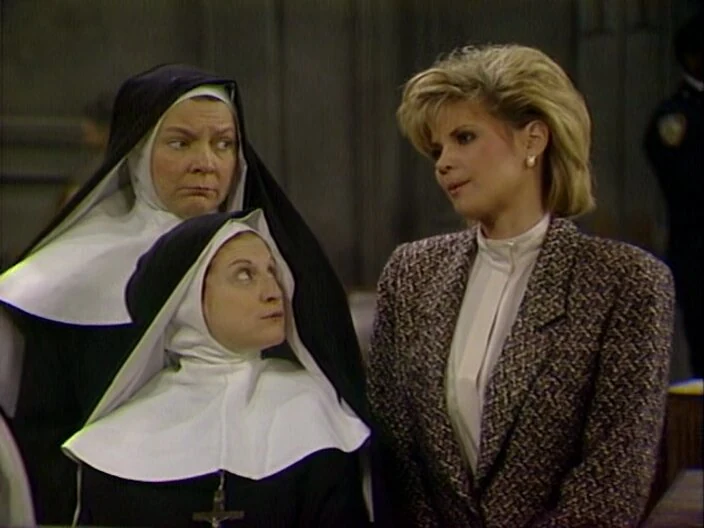
“A Day in the Life,” broadcast in February 1987, gives the court a magnificent bad idea: finish an enormous docket before midnight. The clock turns the workplace into a machine, and the machine has been assembled from people who are rarely efficient at the same moment. The faster they try to move, the more entertaining the interference becomes.
The setup is almost a declaration of what the mature series does best. Visitors arrive with immediate, peculiar problems. Regulars respond according to their own temperaments. One joke barely clears the doorway before another is waiting behind it. The court doesn’t need to leave the building to produce the feeling of a whole city pressing against the desk.
The following year’s “Another Day in the Life” raises the load to 207 cases and ties success to a promised donation for an orphanage. Dan also has an office-pool incentive, because apparently charitable urgency needed a small supplement of self-interest. Those motives place Harry’s concern and Dan’s calculation inside the same frantic effort.
The format rewards quick supporting performances. Someone can establish an entire comic identity in a few seconds, provided the entrance, posture, and first response are precise. The regular cast then has something new to react to without spending half the episode arranging the meeting. A courtroom is an excellent excuse for introducing people who have no sensible reason to share a sitcom apartment.
These episodes also make the staff’s dependence on one another visible. Harry’s imagination doesn’t process the paperwork. Mac’s organization doesn’t supply the legal argument. The bailiffs can’t move every case forward if the attorneys are busy pursuing a private grievance. Under the nonsense, the workplace has an actual set of connected jobs.
That gives the farce shape. The court isn’t simply throwing unrelated oddities at the viewer; it has a task that keeps being interrupted. The difference is why an avalanche of cases can feel exhilarating rather than merely noisy. Every fresh complication lands against the same approaching midnight. Somewhere inside the rush, Dan would still like everyone to remember his personal stake. The orphanage can wait half a second while he checks the standings.
The operation exposed something Dan preferred to hide
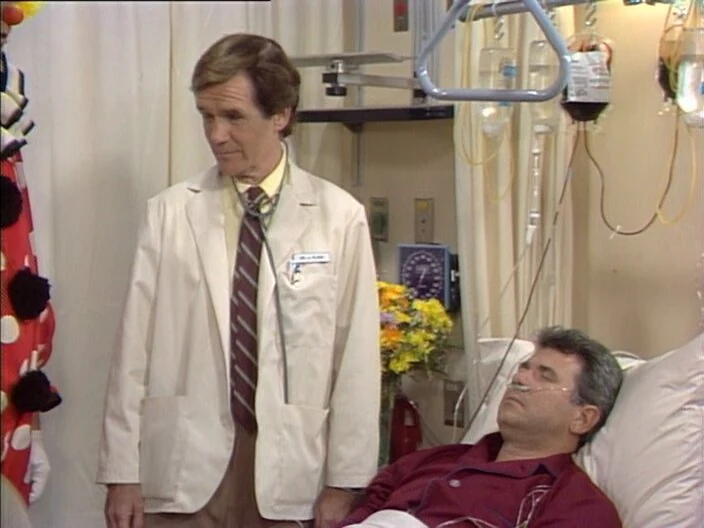
The two-part “Dan’s Operation,” from November 1986, moves Fielding out of his usual arena and into a hospital. His colleagues visit a man whose ordinary defenses depend on being able to talk, pursue, bargain, or make somebody else uncomfortable. Serious illness removes much of that equipment.
The story doesn’t begin by replacing him with a saint. Dan remains Dan, including his tendency to turn an inappropriate opportunity into a plan. That continuity matters. A character doesn’t become more moving because an episode briefly erases everything difficult about him. The concern has to include the man the audience actually knows.
When his condition becomes dangerous and he slips into a coma, the court’s reactions have more weight than an automatic declaration that everyone secretly loves everyone else. These people spend a great deal of time being irritated by him. Now they have to sit with the possibility that the irritation might disappear for a reason they don’t want.
Anderson’s Harry is especially useful in such a story. His compassion is established, but his relationship with Dan isn’t merely professional courtesy. He can recognize the loneliness beneath the performance and still be angry about the behavior that performance produces. Concern doesn’t require him to pretend the prosecutor has been easy company.
Larroquette has room to show the character without his usual command of the scene. The audience is accustomed to Dan reaching outward toward an advantage. A hospital bed changes that geometry. Other people come toward him, and he has less control over what their presence means.
The comedy and seriousness don’t always sit perfectly together. A medical crisis built partly around Dan’s sexual appetite carries the broadness of the format into a setting that asks for another kind of attention. Viewers who prefer the courthouse’s fast absurdity may find the emotional turn heavy-handed; viewers invested in the people may find it revealing.
Its strongest quality is the refusal to make his worst habits the whole person. Fielding is entertaining partly because he is a problem, but a problem can still belong to a group. The episode tests how much that belonging means when the usual joke no longer ends the conversation. If the result is more openly sentimental than a normal court session, Larroquette and Anderson supply enough history between them to give the feeling somewhere to live.
Harry couldn’t make Leon’s life simple with a trick
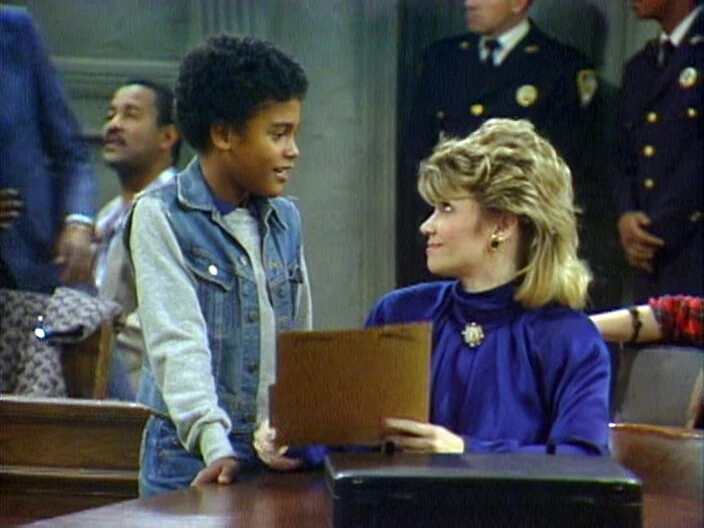
Bumper Robinson’s Leon brings a child’s needs into a workplace more accustomed to handling adults who have made a mess. In “Harry and Leon,” from January 1986, Harry becomes a foster father to the courthouse shoeshine boy. The connection takes his instinct to help beyond the relatively contained business of hearing a case.
Anderson’s fondness for play makes the bond easy to believe. Harry can meet a child through curiosity and humor rather than assuming the formal voice of an official. That is an advantage in winning trust. It doesn’t automatically prepare him for every responsibility that follows once the child has trusted him.
The story gives Harry something he can’t settle solely through good intentions. Leon has a history, feelings, and uncertainty that don’t reorganize themselves around the judge’s availability. A man who enjoys improving a room has to consider what it means to remain responsible after the enjoyable part is over.
Christine’s presence adds another adult perspective, and Robinson gives Leon a mixture of resourcefulness and vulnerability. The boy isn’t merely an emblem of innocence installed to prove Harry is kind. He can be guarded, attached, suspicious, or unexpectedly direct. His responses prevent the story from becoming entirely about an adult’s wish to feel useful.
In February’s “Leon, We Hardly Knew Ye,” plans for another family force Harry to acknowledge how attached he has become. The conflict isn’t simply that he cares and officials don’t. It’s the more uncomfortable question of whether caring gives him a right to make himself the answer. The comedy’s familiar affection has acquired a limit it can’t easily joke away.
The episode also includes a visit from Mel Tormé, giving the show a characteristically odd contrast between Harry’s private dream and his immediate worry. A normal star-struck Harry ought to be delighted. This Harry is distracted by a child whose future matters more than the encounter he has imagined for years.
It’s a good example of how the series uses its eccentricities to establish priorities. The music obsession is funny because it is particular. Missing the object of that obsession becomes moving because the audience knows how particular it is. Harry’s goodness doesn’t arrive as a label. It emerges from what he is unable to stop thinking about, even when the court has finally delivered a guest he desperately wanted.
Mac’s old debt didn’t fit neatly in the file
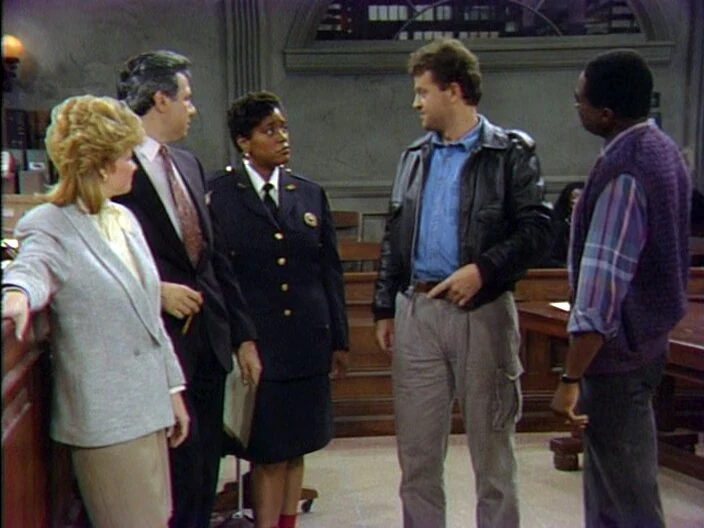
November 1987’s “Mac’s Dilemma” centers on a man who saved Mac’s life in Vietnam and now wants an improper favor involving his record. It’s a particularly effective problem for the court’s steady clerk. Gratitude has acquired a request, and refusing the request feels nothing like refusing an ordinary stranger.
The history gives the situation weight without requiring Mac to become a different person. A debt of that magnitude isn’t something he can dismiss because the procedure is clear. He knows what he owes emotionally. He also knows his access to information isn’t supposed to become a private repayment system.
Robinson’s restraint helps the episode. Mac doesn’t need to announce every part of the conflict for the viewer to recognize it. The familiar man trying to get the working day finished has been confronted by someone from a life the rest of the court can’t fully share. His composure is still there, but the work of maintaining it becomes visible.
The premise also uses the institution in a more grounded way than the case-marathon farces. Files and records aren’t merely props waiting to be dropped or misread. Access has consequences. A person who ordinarily seems to handle routine administration suddenly has the means to do something significant and wrong.
That is a useful expansion of the ensemble. A show dominated only by Harry’s humane improvisation and Dan’s selfish pursuit would eventually have a limited set of moral positions. Mac’s loyalties make the problem less tidy. He doesn’t want a personal reward; he wants to honor someone who once did something extraordinary for him.
The episode’s title is modestly accurate. It isn’t an excuse to turn the clerk into a criminal mastermind or reveal that his sensible manner has always been a fraud. It gives him a choice painful enough to expose a little more of the man behind the desk. The court may be a machine for producing comic absurdity, but the people operating it have histories that don’t always arrive in a form a joke can organize.
Stories like this are one reason the smaller performances matter. Robinson has spent ordinary scenes making Mac recognizable. When a difficult visitor appears, the audience isn’t being asked to care from scratch. It already knows the clerk, and can see when the familiar working day has become something else.
Buddy Ryan brought a family resemblance and a new problem
John Astin’s Buddy Ryan enters Harry’s life in 1986’s “The Next Voice You Hear…” as the man Harry knows as his stepfather. Astin arrives with the delighted expression of someone who sees no reason an unusual history should prevent an enjoyable conversation. Harry’s past becomes less abstract and rather more talkative.
For viewers who knew Astin as Gomez Addams, the casting carries an extra pleasure. He has a gift for making an unconventional man seem entirely at ease with himself. Buddy can be disconcerting to the people around him without sharing their view that disconcerting is an obvious disadvantage.
The character’s history of psychiatric treatment supplies jokes that reflect the period’s uneven handling of mental health. Some are affectionate, some depend on the easy assumption that a person associated with an institution will behave strangely. A return visit doesn’t require pretending every version of that joke has improved with age.
Astin’s warmth is the reason Buddy is more than the premise. He doesn’t merely enter to be labeled eccentric. He wants a connection, enjoys the company, and makes Harry negotiate a family relationship that isn’t as straightforward as the judge might prefer. The smile has an invitation inside it, not only a punch line.
Buddy also changes the way Harry’s own oddness reads. The judge’s magic and musical enthusiasms are familiar by this point. Place him beside a relative who is even less concerned with conventional appearances, and he can become the cautious person in the exchange. It’s an enjoyable shift in perspective for a man usually defending his own unconventional methods.
The eighties appearances work best when they allow that relationship to be awkward as well as funny. Harry may be compassionate with strangers and still unsure how to respond to someone making a personal claim on him. Family isn’t a defendant he can hear, help, and send out of the courtroom before the next case.
Later revelations would add to Buddy’s story, but his initial appeal is already clear. Astin can make a room feel less orderly simply by being pleased to have arrived. Harry may possess legal authority. Buddy has the more intimate ability to make him look briefly like a son wondering what the next visit will involve.
The Wheelers were having a worse week than you
Brent Spiner’s Bob Wheeler and Annie O’Donnell’s June make recurring bad luck into a comic art. Their lives seem capable of producing a fresh catastrophe between one answer and the next. Just as the court thinks it has understood the situation, another detail appears and makes the earlier version look like a manageable afternoon.
Spiner’s delivery is a large part of the appeal. Bob doesn’t need to perform outrage at the universe. He presents the latest misfortune with a weary matter-of-factness that makes the scale of it funnier. The actor lets the audience discover the absurdity without insisting on it through volume.
O’Donnell gives June a matching place in the catastrophe. This isn’t simply one man telling a funny story while his wife stands beside him as evidence. They feel like people who have acquired a shared rhythm for surviving disappointments that have become almost administratively routine.
The family is drawn broadly, and the rustic stereotypes deserve some skepticism. The joke can become cheap if it asks only for laughter at people who lack the staff’s education or polish. The stronger appearances turn the emphasis toward an escalating universe of misfortune and the court’s increasingly inadequate responses.
The Wheelers are especially useful as returning visitors because their arrival creates an expectation. You recognize the faces and understand that the first explanation is unlikely to be the last. A recurring guest can establish that anticipation more quickly than a new defendant. The audience begins leaning toward the next bad detail before it arrives.
For viewers who later knew Spiner as Data on Star Trek: The Next Generation, Bob offers an excellent reminder of a different comic precision. Both performances depend on control, but their surfaces are far apart. A man associated with extraordinary futuristic competence had also helped make an inability to catch a break feel painfully ordinary.
The court can offer procedures, sympathy, or a temporary solution. The Wheelers have already discovered that the world is capable of producing another difficulty. That imbalance gives their visits a peculiar comfort: whatever kind of week you’re having, Bob appears prepared to explain why his requires a longer form.
Mel Tormé was a very specific kind of hero
Harry’s devotion to Mel Tormé is one of the show’s best character details because it refuses to be generic. A young television judge could have been given whatever musical preference seemed most current. Instead, he admires a singer associated with an earlier tradition of vocal sophistication and swinging ease.
That preference tells you something about him before a writer explains it. Harry doesn’t choose every enthusiasm to impress the people immediately around him. He likes what he likes, and is prepared to enjoy it with the intensity of a fan rather than the tasteful restraint of a professional adult.
Tormé’s appearances let the series turn that enthusiasm into a physical situation. An admired voice belongs to an actual man who can walk into the courthouse and encounter Dan, the case list, and whatever else has gone wrong that evening. The distance between Harry’s imagined meeting and the working environment supplies the joke.
The performer helps by seeming comfortable inside the absurdity. A celebrity guest needn’t become an excellent fictional defendant to work here. He needs enough ease to let the regulars’ reactions remain interesting. The show can enjoy the event without demanding that every actor stand still and applaud its significance.
The 1986 Leon story makes especially good use of the obsession by interrupting its expected payoff. Harry has a child on his mind. The audience knows what he ordinarily wants from the encounter, so his distraction becomes a way of seeing what matters more at that moment.
It is also a pleasingly odd piece of Gen X television memory. A comedy watched by younger viewers gave an earlier singer a continuing presence in their cultural world. Some may have known Tormé already; others encountered his name through Harry’s enthusiasm before seeking out the music. The show doesn’t require everybody to share the same route.
That is how a detail acquires an afterlife. It isn’t a random reference thrown into a scene to prove the writer has heard of someone. It belongs to a character, returns with variations, and becomes part of the audience’s knowledge of him. Harry’s court may have inconsistent procedures, but its judge has absolutely settled opinions about the record collection.
NBC found room for the courthouse after Cheers
The series began on Wednesdays, but its place after Cheers on NBC’s Thursday schedule gave it a particularly valuable neighborhood. In the fall of 1984, the night assembled The Cosby Show, Family Ties, Cheers, Night Court, and Hill Street Blues. The people arriving at Harry’s bench were in unexpectedly prosperous company.
The progression made emotional sense as well as commercial sense. Viewers moved from family households to a bar and then to a courtroom whose behavior suggested somebody should perhaps have supervised the bar more carefully. The tone grew more adult across the comedy block, while each show offered a different group worth revisiting.
The connection with Cheers also carried Anderson’s earlier Harry the Hat appearances into a new context. He wasn’t playing the same character, but viewers familiar with his timing had a reason to notice the next program. NBC had the useful advantage of introducing a new lead through an audience that had already enjoyed him.
Night Court finished seventh in the 1986–87 Nielsen season rankings and seventh again in 1987–88. Those are full-season series positions, not claims about every weekly broadcast. The 1987 rankings and 1988 rankings place its strange workplace firmly among television’s biggest attractions.
That success is worth remembering when the show is described as an eccentric cult favorite. It was eccentric, certainly. It was also watched on a scale that reached far beyond a small group congratulating itself on unusual taste. Broad comedy, a strong ensemble, and NBC’s night of hits made a formidable combination.
Scheduling helped, but it can’t explain every pleasure people retained. A valuable lead-in gets someone to the door. It doesn’t make Larroquette’s reaction funny or Warfield’s pause land correctly. The court had to give viewers a reason not to treat it as the interval before the next drama.
The wider story of 1980s workplace sitcoms includes glamorous offices, bars, stations, and shops. Harry’s court had a more flexible rule for choosing company: if the city had produced a problem, somebody might bring it through these doors. An efficient way to keep a workplace supplied, provided no one expected the employees to stay sane about it indefinitely.
The room learned to move faster
The later eighties show is physically broader than the early one. A case may still begin with a recognizable complaint, but the response is more likely to become an elaborate visual disaster. Costumes, props, misunderstandings, and the movement of bodies start doing more of the work.
That development suits the cast’s unusually varied equipment. Moll supplies scale and literal-minded timing. Larroquette supplies elastic dignity. Anderson supplies sleight of hand and an ability to look as if an accident might still be turned into a trick. Post can propel earnestness into physical agitation. Warfield can refuse to move at all and make that refusal the answer.
The best farce respects those differences. A character doesn’t have to become interchangeable with the others simply because the scene has grown loud. Dan should still pursue an advantage, Christine should still have a reason to care, and Mac should still notice how much practical work the commotion is preventing.
The courtroom set supports the movement. The bench creates height, the desks create positions, and the doors allow another complication to arrive before the previous one has been processed. Hallways and chambers offer temporary escape without taking the characters out of one another’s orbit. It is a workplace designed to make privacy possible in theory and difficult in practice.
There are times when the show enjoys escalation more than shape. An unlikely event follows another until the scene seems less like a story than a demonstration of how much can be squeezed into a studio. A laugh is still a laugh, but too many unconnected surprises can make the people briefly disappear inside their own machinery.
What keeps the stronger episodes buoyant is returning to a reaction that belongs to someone. The event may be absurd; the irritation is recognizable. Roz has had enough. Mac wants a form signed. Christine realizes a conversation has become indefensible. The characters bring the scene back within reach just before it floats away entirely.
That is a different pleasure from the more tightly observed workplace comedy of Taxi or Barney Miller. It doesn’t need to defeat those shows at their own game. Night Court grows into a place where the rules of ordinary life are negotiable, provided the actors continue to make the human responses feel familiar.
Some laughs come with a louder objection now
Dan’s conduct is the most obvious challenge on a return visit, but it isn’t the only one. The series sometimes treats a defendant’s identity, a woman’s appearance, or a person’s mental health as enough preparation for a joke. A strong cast can make a weak premise land, which is not the same thing as improving the premise.
The distinction is easiest to see in who gets to answer. When Christine or Roz reacts, the joke may expose the man behaving badly. When a visitor exists only to be ogled, labeled, or dismissed, the scene has fewer places for its sympathy to go. Some material remains lively; some looks lazy in a way the original audience’s laughter can’t repair.
Recognizing that doesn’t require turning the series into an annual ethics examination. It means watching with the same judgment the better episodes encourage. Harry’s whole appeal depends on looking past a convenient first impression. The show deserves to be measured against that instinct when its jokes take the convenient shortcut.
The treatment of poverty can be similarly uneven. The court is full of people who lack power or stability. At its best, the comedy recognizes their resourcefulness and the absurdity of the institution facing them. At its worst, misfortune itself becomes the attraction, with too little interest in the person expected to wear it.
There is enough generosity in the series to make those weaknesses visible rather than inevitable. Harry listens. Mac remembers an obligation. Bull grieves. Christine tries harder than the room finds fashionable. These moments establish a humane center that survives even when a particular gag has failed to consult it.
The fairest affection leaves room for both responses. You can enjoy Larroquette’s astonishing timing while finding the line he has been handed less impressive. You can love Buddy’s warmth while noticing a dated assumption in the setup. A favorite comedy doesn’t need every joke defended as if its reputation depended on unanimous approval.
Part of growing older with a show is discovering that the laugh and the objection can occupy the same viewing. The performance still works. The writing sometimes doesn’t. That isn’t a reason to erase the pleasure; it’s a reason to be specific about where the pleasure actually comes from.
A city of guest actors passed through the doors
A courtroom gives a television comedy an enviable casting invitation. A guest can arrive with a complete problem, stay long enough to reveal an unexpected personality, and leave without the series having to explain why another cousin has moved into the household. The regulars have a job to do, and the visitor has a reason to interrupt it.
The strongest small performances understand how little time is available. A posture, a pause, or a stubbornly sincere answer can establish a person before the scene has used many words. The staff’s reaction then supplies the scale. Harry may be intrigued; Dan may see a nuisance; Roz may see an excuse that doesn’t deserve its own sentence.
This is part of the connection to Weege’s earlier workplace experience. A parade of visitors doesn’t have to produce a string of unrelated sketches if the people receiving them are consistent. The court’s habits turn a new face into a new variation on something the audience already knows.
Returning guests deepen that pleasure. The Wheelers bring anticipation. Buddy brings family complications. Mel Tormé brings a very specific celebrity event. Each arrives with an established relationship to the room, allowing the writers to begin a little farther along than they would with a stranger.
The studio audience is part of the energy, too. A live response can encourage a physical pause or let a reaction breathe before the next line. The cast has to remain aware of one another and the room watching them. That rhythm is different from a comedy assembled from rapid cuts, where a reaction can be chosen later from another take.
None of that guarantees quality. A visitor can still be a collection of broad traits rather than a person, and an enthusiastic audience can reward an obvious joke. But the format gives good character actors a practical opportunity: enter, make a choice, and give the regulars something worth answering.
It also helps explain why the show can remain enjoyable after the plot is familiar. You may remember the deadline or the case’s outcome. The small encounter still has its own timing. A defendant refuses to understand a question, a clerk realizes the answer will take longer, and a routine working night acquires another person the court wasn’t adequately prepared to receive.
The late shift still has its people
Night Court continued into 1990s television, finishing its original run after nine seasons and 193 episodes. Later developments and the eventual revival have their own stories. The eighties are where the original program discovers the cast, tempo, and degree of absurdity that make it recognizably itself.
A return visit changes the balance of attention. As a younger viewer, Bull’s size or Dan’s outrageousness may have supplied the immediate laugh. Later, Mac’s weary competence can look more valuable, and Roz’s refusal to indulge another performance can feel less like a comic attitude than a sound working philosophy.
Christine’s sincerity benefits from the same shift. Wanting an institution to treat people decently is less amusingly naive once you’ve spent more time dealing with institutions. The excess in her response can still be funny. The thing she is responding to may look rather less trivial.
Harry remains the center because his curiosity keeps the courtroom from becoming only a place to mock the people who arrive. He can be foolish, sentimental, or impractical, but the willingness to see someone differently gives the comedy a direction. A judge who enjoys a trick is less surprising than a judge who occasionally refuses the easy explanation everyone else has accepted.
The show belongs to the 1980s in its clothes, music, ambitions, prejudices, and willingness to let a network comedy become gloriously ridiculous. It also preserves something less tied to a date: the company formed by people who are stuck working together long enough to recognize one another’s worst habits.
They won’t all become better before morning. Dan has an incentive to calculate, Bull has an explanation to offer, and somebody in the hallway has apparently misunderstood the purpose of a courthouse. Mac would like to know whether the paperwork is ready. Roz already knows it isn’t.
Then Harry looks up, interested despite everything. Another case has arrived. The institution may not deserve this much patience, but the people sometimes do. That’s the warmth beneath the slapstick, and the reason this particular late shift still feels worth visiting. Just don’t assume the man wearing the robe is going to put down the cards immediately.
Questions Readers Ask
When did Night Court premiere?
NBC premiered Night Court in January 1984, turning a Manhattan night-shift courtroom into a place for strange cases and even stranger regulars.
Who played Judge Harry Stone?
Harry Anderson played the young judge, bringing magic tricks, affection for oddballs, and a surprisingly gentle side to the bench.
Who played Dan Fielding?
John Larroquette played the prosecutor Dan Fielding, a character remembered for his outrageous ego and comic timing.