Dallas in the 80s: How J.R. Ewing Ruled Prime Time

Dallas in the 80s: How J.R. Ewing Ruled Prime Time
Larry Hagman’s grin, Linda Gray’s emotional force and a family that could turn breakfast into a battlefield: why Dallas became an appointment the whole country discussed.
By Gizmo
AN EXCELLENT MOTIVE.
INSIDE THIS ARTICLE19 sections • Jump to your favorite Ewing disaster
J.R. Ewing smiled as if the unpleasant part of the conversation had already been settled in his favor. You might not know the details yet. He usually did. Larry Hagman made that smile an instrument: welcoming enough to keep someone in the room, amused enough to suggest the room belonged to him, and just faintly sympathetic toward the person about to discover what had happened.
That was the great pleasure and the moral inconvenience of Dallas. Its most entertaining man was frequently its worst. He lied, manipulated, humiliated and treated other people’s vulnerabilities as useful business information. Then Hagman would give a line that little extra curl, and viewers found themselves enjoying an encounter they would have crossed the street to avoid in real life.
During the eighties, Dallas turned a wealthy Texas family’s problems into unusually public property. Southfork looked spacious. Somehow nobody had enough room to escape one another. A marriage was also a business alliance, a family dinner was an opportunity for reconnaissance, and a phone call might be more dangerous than the gun everybody was currently discussing.
The 1980 shooting cliffhanger supplied the most famous question, but the show wasn’t built from one question alone. Bobby and Pam gave it an emotional center. Sue Ellen made the cost of living with J.R. impossible to dismiss completely. Miss Ellie, Jock, Cliff, Ray and the wider family supplied competing versions of what loyalty meant. Without those people, J.R. would have been a magnificent act with no sufficiently interesting room to perform in.
The scale was real. Dallas finished first in the American season household rankings three times during the eighties. Its November 1980 resolution of “Who shot J.R.?” reached an audience contemporary reporting estimated at 83 million American viewers. Those figures deserve care, but they don’t require inflation. This was appointment television on a scale a collection of affectionate clips can’t fully reproduce.
It was also capable of getting carried away. The dream-season reversal remains an astonishing example of a successful show asking viewers to accept a very large withdrawal from the bank of trust. Some plots were irresistible; some were ridiculous; some managed both without changing clothes. The best Dallas writing recognized that appetite wasn’t the same as innocence.
This feature follows the eighties run: the characters, the waiting, the ratings, the rivalries and the way an entire television culture learned to enjoy a man it had excellent reasons to distrust. The wider 1980s television guide follows the decade around it; the prime-time soap guide places the Ewings among the families their success helped encourage. Dallas itself begins with a marriage that brought the wrong families much too close together.
It took about three seconds to recognize J.R. Ewing. The cowboy hat helped. So did that grin—the one Larry Hagman wore whenever J.R. had just done something rotten and was waiting to see how long it would take everybody else to figure it out. He could ruin a business deal, wreck a marriage or make somebody look like a complete fool, then behave as though he had merely offered a helpful suggestion. You almost had to admire the nerve. Almost.
If you were anywhere near a television in the early eighties, you knew Dallas. Maybe you followed every Friday-night disaster at Southfork. Maybe your parents watched while you were supposed to be doing homework. Maybe all you knew was that somebody had shot J.R. and the adults had suddenly become amateur detectives. Either way, the Ewings were difficult to escape. Their family arguments reached well beyond the living room, usually accompanied by that unmistakable theme music and the certainty that somebody was about to lie through beautifully maintained teeth.
Here was a family with oil money, a spectacular ranch, nice cars and enough bedrooms for everyone to get a little peace. Naturally, nobody ever seemed interested in using any of those advantages to stay away from one another. At Southfork, breakfast could turn into a board meeting, dinner could become a hostage negotiation, and a marriage was apparently an invitation for the entire family to take sides. Rich people, it turned out, were capable of being just as miserable as everyone else. They simply had more impressive places to do it.
And J.R. wasn’t the whole show, even if he frequently behaved as though he owned it. Sue Ellen had more fight in her than people sometimes remember. Bobby and Pam gave the story a couple worth rooting for. Miss Ellie could make a grown Ewing boy feel about six years old with one look. Cliff Barnes kept coming back for another round even when common sense suggested finding a new hobby. Those relationships turned Dallas from a collection of oil-company schemes into a weekly habit.
Of course, the show eventually did something so outrageous that people still bring it up forty years later: it erased an entire season with a shower. We’ll get to that. First, let’s remember why millions of people were willing to spend their Friday nights with this spectacularly difficult family in the first place.
If Southfork puts you in the mood for more TV from the era, there’s the wider 1980s TV collection, our 1980s decade guide, and plenty of other families in the prime-time soap roundup. Just don’t expect any of them to settle a disagreement quietly.
Before the shooting: a marriage walks into Southfork
Long before the whole country was asking who shot J.R., Dallas began with a considerably simpler problem: Bobby Ewing brought home a bride. Normally this would be cause for congratulations, a reception and perhaps a polite argument over the guest list. Unfortunately, his bride was Pamela Barnes, and the names Ewing and Barnes had been making each other miserable for years. Bringing a Barnes to Southfork was rather like inviting a lifelong rival to move into the guest room and then asking everyone to keep things civil.
CBS introduced the series in April 1978 with a five-part spring run. David Jacobs created it, and the original story revolved around Bobby and Pam trying to build a marriage while two wealthy, stubborn families continued an argument nobody was particularly interested in settling. Jock Ewing and Digger Barnes had history involving oil, pride and old accusations. The younger couple inherited the consequences without signing up for any of it. Pam could walk into a room and be judged before she finished saying hello.
At first, this wasn’t quite the giant Friday-night obsession it would become. The early episodes had more individual stories and a somewhat different balance among the characters. But the ingredients were sitting right there. Bobby wanted to believe his family could behave decently. Pam wanted to be accepted without pretending she wasn’t a Barnes. And J.R. seemed to regard their optimism as a personal challenge.
Larry Hagman made J.R. impossible to ignore. He didn’t need to storm into every scene shouting threats. A pleasant remark could do more damage. He knew which relative wanted approval, which business rival wanted a deal, and which family secret might be useful after lunch. As the series moved into longer-running stories, the audience began coming back not only for what had happened, but for what J.R. was secretly arranging next.
Leonard Katzman became one of the people shaping the show’s continuing stories. There was no magical moment when the entire format appeared perfectly formed. It developed as the writers learned which relationships could keep generating trouble. By the time somebody finally decided to put a bullet in J.R., the show had already spent years making the idea seem less like a mystery and more like a reasonable response from a disturbingly large suspect list.
J.R. Ewing: charm with a knife behind it
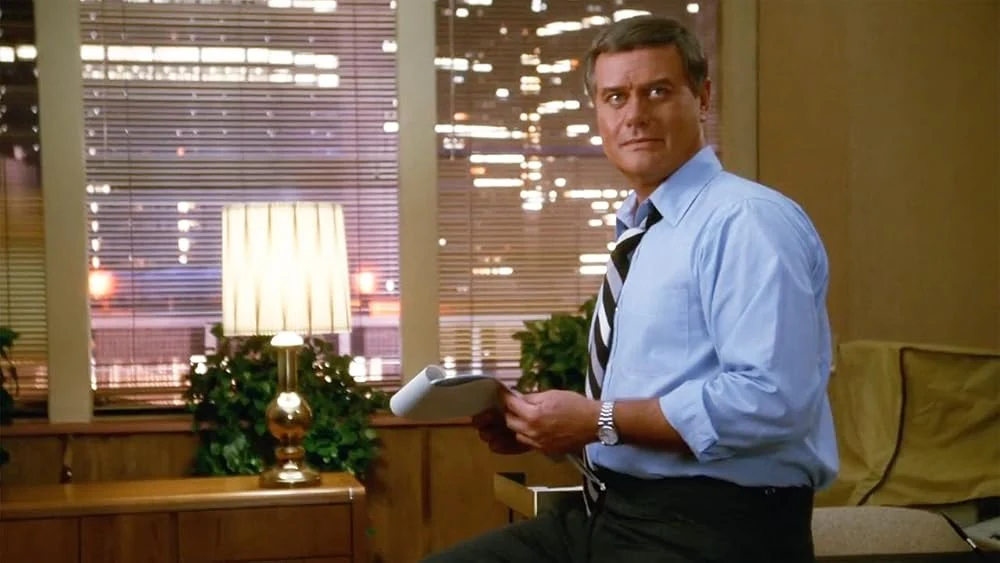
Larry Hagman had the kind of grin that should have come with a warning from the Better Business Bureau. J.R. could tell a man he was delighted to see him while quietly setting up the deal that would ruin his week. He didn’t usually look angry. Anger might suggest things weren’t going according to plan. J.R. preferred to look amused, especially when the other fellow had just discovered how badly he’d been played.
There was something brilliant about making a character this awful so much fun to watch. In real life, you’d avoid him at every opportunity. On television, you waited for him to appear. He could twist a compliment, fake a friendship or turn a relative’s weakness into a business advantage. Then Hagman would lean back, let a tiny smile creep across his face and make the whole maneuver look as effortless as ordering another drink.
But the real secret was that J.R. wasn’t the same man with everybody. Around Jock, he could become a son desperate for Dad’s approval. With Bobby, competition sat right next to genuine affection. With Miss Ellie, even J.R. understood there were limits to how much nonsense the room would tolerate. With Sue Ellen, the manipulation became much more personal and much harder to laugh off. Hagman could shift between those versions without seeming to change characters.
Anyone who remembered him from I Dream of Jeannie already knew Hagman understood comic timing. The surprise was how perfectly that timing worked when applied to a villain. He didn’t have to tell a joke. Sometimes the joke was watching him pretend to be innocent while everyone else struggled not to explode. J.R.’s hat and expensive suits supplied the silhouette, but the voice and the timing made him unforgettable.
The writers sometimes made life a little too easy for him. Cliff would fall into another trap. A businessman would believe another extraordinary story. Somebody would reveal information to the one person on earth least likely to handle it responsibly. Eventually you wanted to shake the other characters and ask whether they had watched even one episode of their own show. J.R. was smart, certainly, but sometimes his opponents helped with an enthusiasm that bordered on community service.
Still, Hagman never needed us to think J.R. was a good man. He only needed us to wonder what he would try next. That’s a much more interesting trick. The longer you watched, the more you recognized the terrible bargain at the heart of Dallas: you might be rooting for somebody to stop J.R., but you definitely didn’t want him to disappear from the screen.
One of the pleasures of a long-running serial was seeing how a good actor could change the meaning of a familiar expression. A J.R. smile in a company office might promise a delightful comeuppance for an arrogant rival. The same smile at home could tell Sue Ellen he was about to deny something she already knew. Hagman didn’t need two completely different personalities. He gave the character one set of instincts and let the situation decide whether we laughed or winced. That is harder to pull off than merely being the villain with the best one-liners.
Sue Ellen: the woman the jokes should not erase
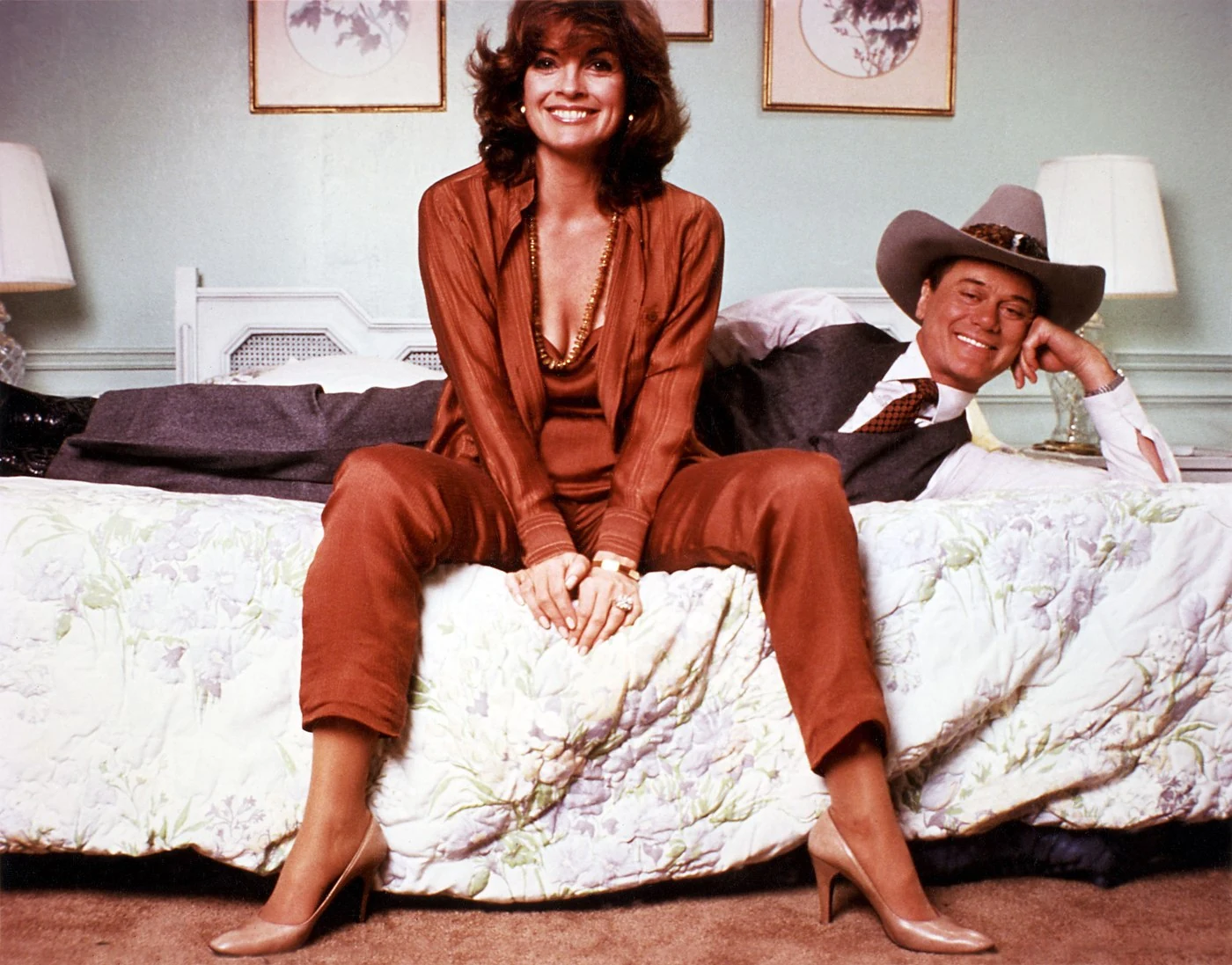
Sue Ellen Ewing deserves better than being remembered as the woman constantly reaching for another drink. Yes, alcohol became part of her story, sometimes painfully so. But Linda Gray gave Sue Ellen anger, intelligence, pride and a surprisingly stubborn will to survive a marriage that might have broken somebody with fewer resources. If J.R. was the show’s most entertaining problem, Sue Ellen was one of the people who had to live with the consequences after the cameras stopped admiring his grin.
Watch Gray in an argument with Hagman. J.R. can deliver a remark that sounds almost affectionate until you realize the insult is already on its way. Sue Ellen hears every bit of it. Sometimes she fires back. Sometimes she holds herself together just long enough to leave the room. Sometimes the effort shows all over her face. Gray made you understand how humiliating it could be to remain married to a man who treated winning as a more important activity than being kind.
And she wasn’t always blameless or sensible herself. That’s part of what made the character worth following. She wanted security and affection, occasionally revenge, and eventually something resembling a life she controlled herself. Her relationship with John Ross complicated everything. She was a mother trying to protect her child in a family where that child could also become ammunition in the next marital war. Whatever J.R. claimed to be doing for the family, it usually seemed to involve making one of its members miserable first.
The show occasionally pushed Sue Ellen through too many versions of the same suffering. There are stretches when you wish the writers would let her walk out of Southfork, change the locks behind her and spend a nice quiet month away from these people. Yet Gray kept finding things to play that were more substantial than another fall from grace. She gave the character a point of view and, as the years went by, a sharper sense of what J.R. could no longer get away with.
That’s why the chemistry works so well and why it’s worth making a distinction. Hagman and Gray were terrific together. J.R. and Sue Ellen were terrible together. Those are not competing opinions. It’s possible to love a television confrontation and know that nobody should have to endure it over breakfast. The best of Dallas made that difference clear without turning the performances into a lecture.
Bobby and Pam: the marriage worth saving
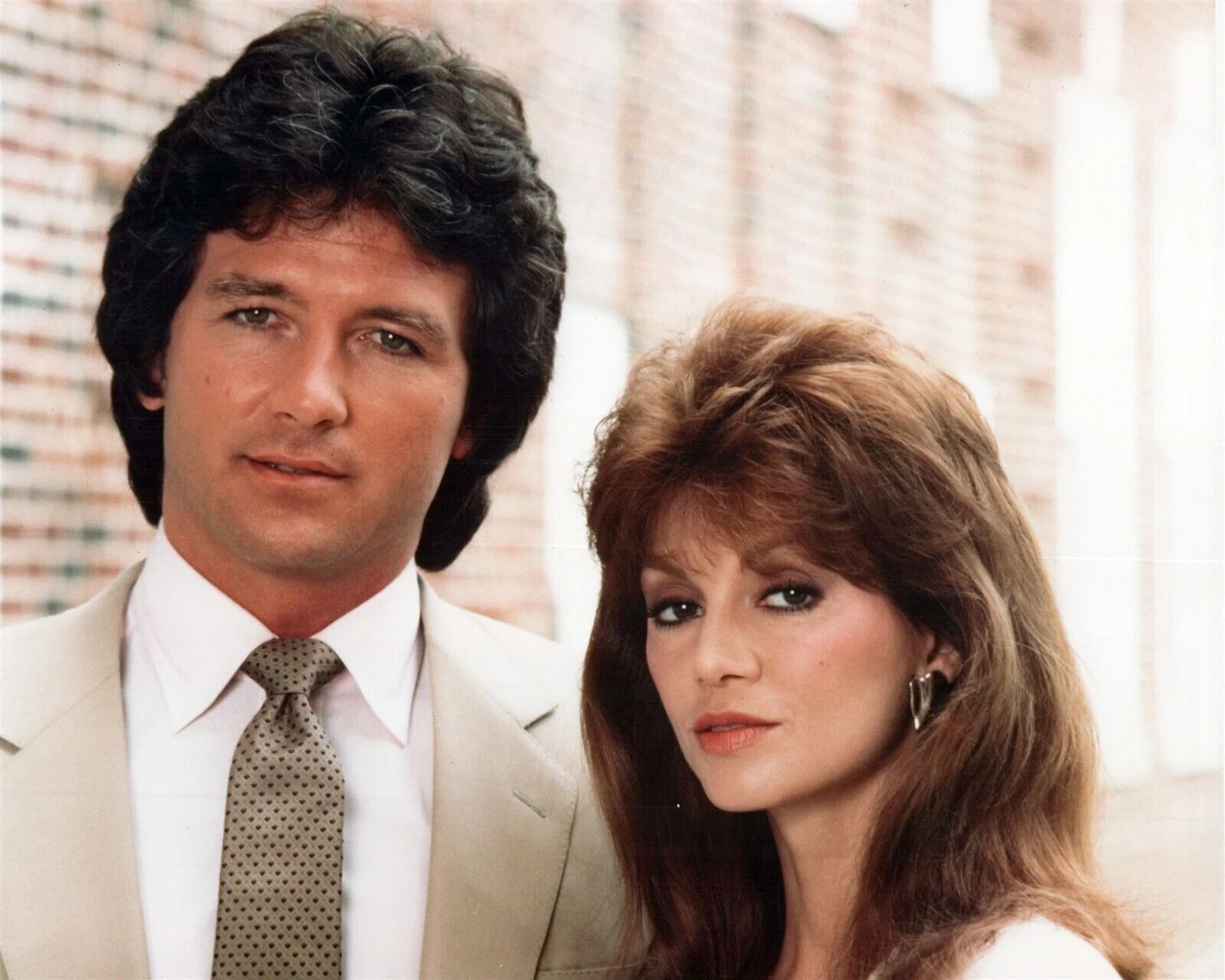
While J.R. was busy making enemies, Bobby Ewing was trying to prove that being an Ewing didn’t automatically require behaving like one. Patrick Duffy gave him a relaxed, open quality that made a useful contrast with his older brother. Bobby could disagree, get angry and occasionally make spectacularly bad decisions, but he generally seemed interested in reaching the end of a conversation without having destroyed the other person’s life.
Pam, played by Victoria Principal, entered the picture with the worst possible family credentials. She was a Barnes. That meant she could love Bobby with all her heart and still be suspected of working for the other side. Her brother Cliff had an ongoing feud with the Ewings, so an ordinary visit or family conversation could acquire the tension of an international summit. It’s difficult enough to figure out where to spend the holidays when your in-laws get along. Imagine doing it when both families have spent years accusing each other of betrayal.
Duffy and Principal gave the series something it badly needed: people you wanted to see get a break. J.R.’s latest successful swindle could be fun to watch, but you didn’t necessarily want to celebrate it. Bobby and Pam offered the possibility that somebody at Southfork might actually be happy for more than fifteen consecutive minutes. Naturally, the show regarded that possibility as a problem in need of immediate correction.
Their marriage went through separations, misunderstandings and more outside interference than any reasonable couple would tolerate. Sometimes the emotional stakes were strong. Other times, all you could do was wonder why two adults couldn’t spend five minutes talking before another crisis arrived. That’s the occupational hazard of a long-running soap: you need the couple together enough for viewers to care, and apart enough to keep them coming back.
The importance of Bobby became unmistakable when Duffy left in 1985. Without him, the balance shifted. J.R. had plenty of people to fight, but one of the few relatives who could challenge him without simply trying to be another J.R. was missing. When Bobby returned in 1986, the producers solved that problem with perhaps the most outrageous plumbing-related decision in television history. More on the shower shortly.
Principal left the regular cast in 1987, and losing Pam changed the show again. The marriage that started everything was no longer present in the same way. Dallas could invent new oil deals and romantic disasters all day long, but replacing that original pull between the Barnes and Ewing families was another matter entirely.
Southfork: the house where nobody could mind their business
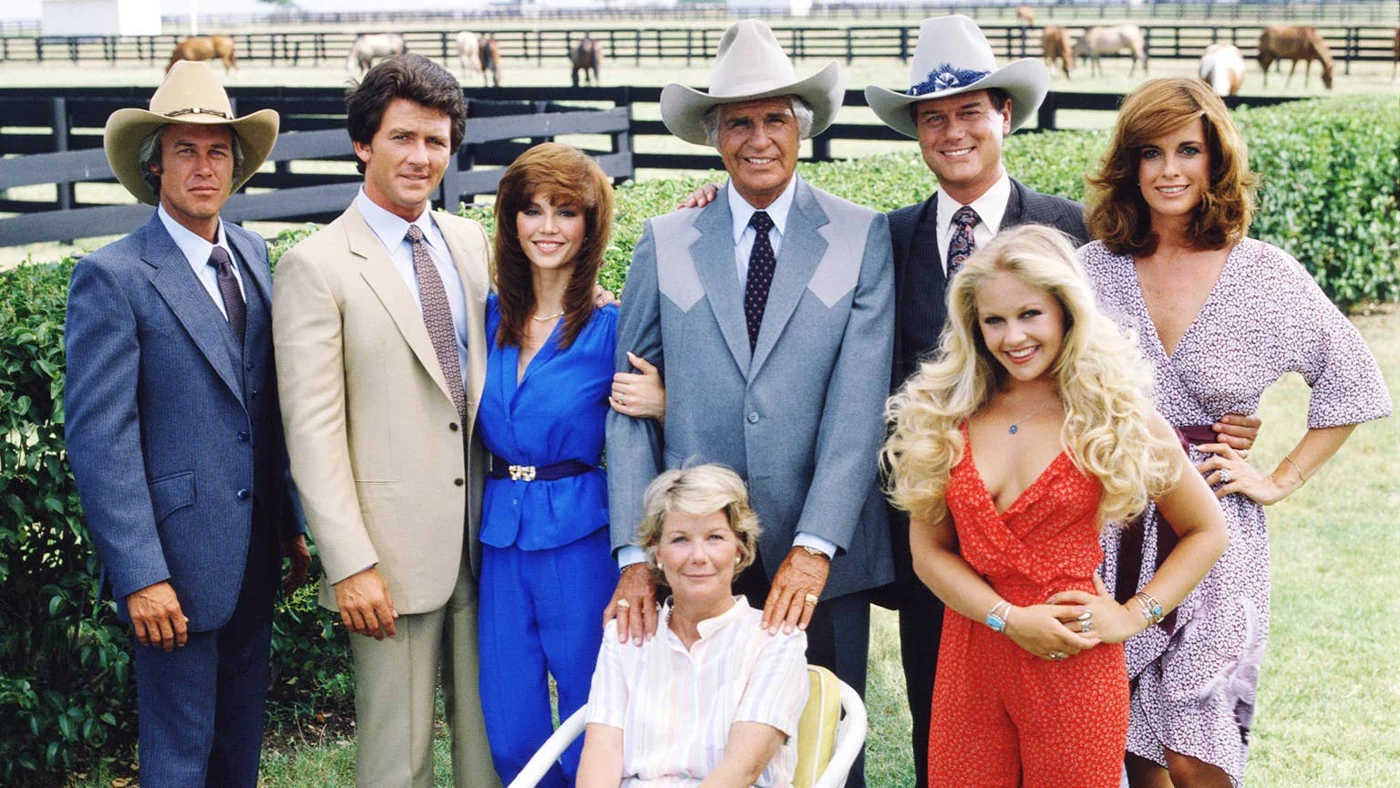
Southfork was beautiful. It was also a terrible place to have a private conversation. You could be standing in a room larger than most ordinary houses, and within minutes a family member would appear to demand an explanation for something that was none of their business. It’s one of the great mysteries of Dallas that a family with this much money never seemed to discover separate housing as a way of avoiding conflict.
The ranch did a lot of work for the show. It gave the Ewings an identity beyond office buildings and oil wells. This was the family home, the place Miss Ellie loved and the place everyone seemed determined to protect while simultaneously making life there intolerable. People left, returned, married, separated and threatened one another. Southfork stayed put, waiting for the next disaster to pull into the driveway.
The breakfast scenes are worth another look. Everybody is dressed, somebody has poured coffee, and you’re reasonably certain J.R. has already been awake long enough to arrange a small betrayal. An innocent question could become an argument about the company. A guest could arrive with news that ruined the meal. By the time the opening conversation ended, a peaceful morning often seemed about as likely as a week without a cliffhanger.
Miss Ellie saw the land differently from her sons. To her, it represented family and continuity, not simply property to be traded when the books needed improving. That made Southfork more than a glamorous background. It was the thing she could defend when the boys started treating every problem as a business opportunity. Of course, it was also the place that kept everyone so closely involved in everyone else’s problems.
The real Southfork became famous in its own right. The series used Texas locations for the ranch exteriors while much of its interior work was shot in California. On the television screen, nobody needed to think about the distance. The front of the house and the rooms inside belonged to one instantly recognizable world. For a lot of viewers, simply seeing that driveway was enough to know the evening would not end quietly.
Miss Ellie and Jock: the parents who started it all
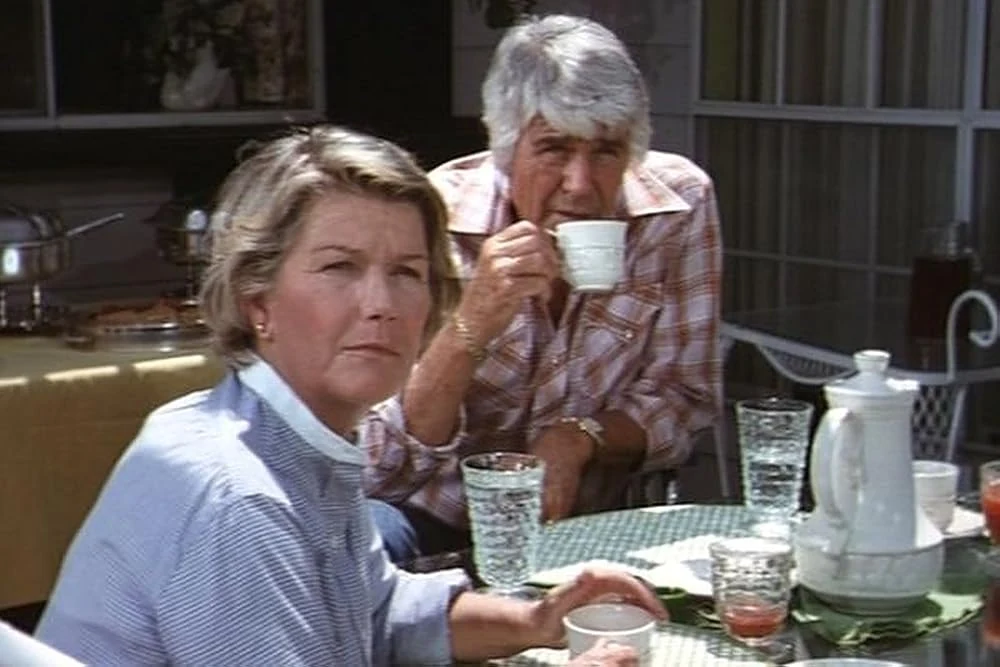
For all his confidence in the oil business, J.R. could still look like a kid trying to impress Dad. Jim Davis played Jock Ewing with the authority of a man who didn’t feel any need to explain that the ranch was his. An approving word from Jock could matter more to his sons than another profitable deal. Unfortunately, that made his approval something they competed over, sometimes with all the maturity of children fighting for the front seat.
Barbara Bel Geddes gave Miss Ellie a different kind of power. She rarely needed to outshout anyone. One look across the room could tell an Ewing that his explanation wasn’t going to be accepted, no matter how carefully he’d rehearsed it. She knew her family, which was a useful but exhausting qualification. Watching her sit through another disagreement, you sometimes wanted to suggest she take a vacation somewhere with no telephone service and absolutely no oil industry.
Bel Geddes won an Emmy for the role in 1980, and it’s easy to see why. She made the family feel as though it had roots, a past and someone still trying to hold it together. Jock could command respect through force of personality. Miss Ellie could make someone ashamed of himself without raising her voice. In a show fascinated by wealth and power, that quiet influence was every bit as important as the company’s checkbook.
Neither parent was beyond criticism. Jock helped raise sons who treated approval like a championship trophy. Miss Ellie sometimes wanted peace badly enough to overlook the very reasons someone ought to leave the room. Loving a family and managing one are different jobs, and Dallas regularly demonstrated what happened when nobody could agree on the rules.
Davis died in 1981, and the series eventually wrote Jock’s death into its world. The empty place didn’t make the rivalry vanish; it gave everybody fresh reasons to argue about what he would have wanted. Howard Keel later arrived as Clayton Farlow, bringing a new chapter to Miss Ellie’s life. And when Donna Reed played Miss Ellie during the 1984–85 season before Bel Geddes returned, viewers had to adjust to seeing a familiar character through a very different performance. On a series built around people knowing one another for years, a changed face was no small thing.
Cliff Barnes: a man who never learned to leave well enough alone
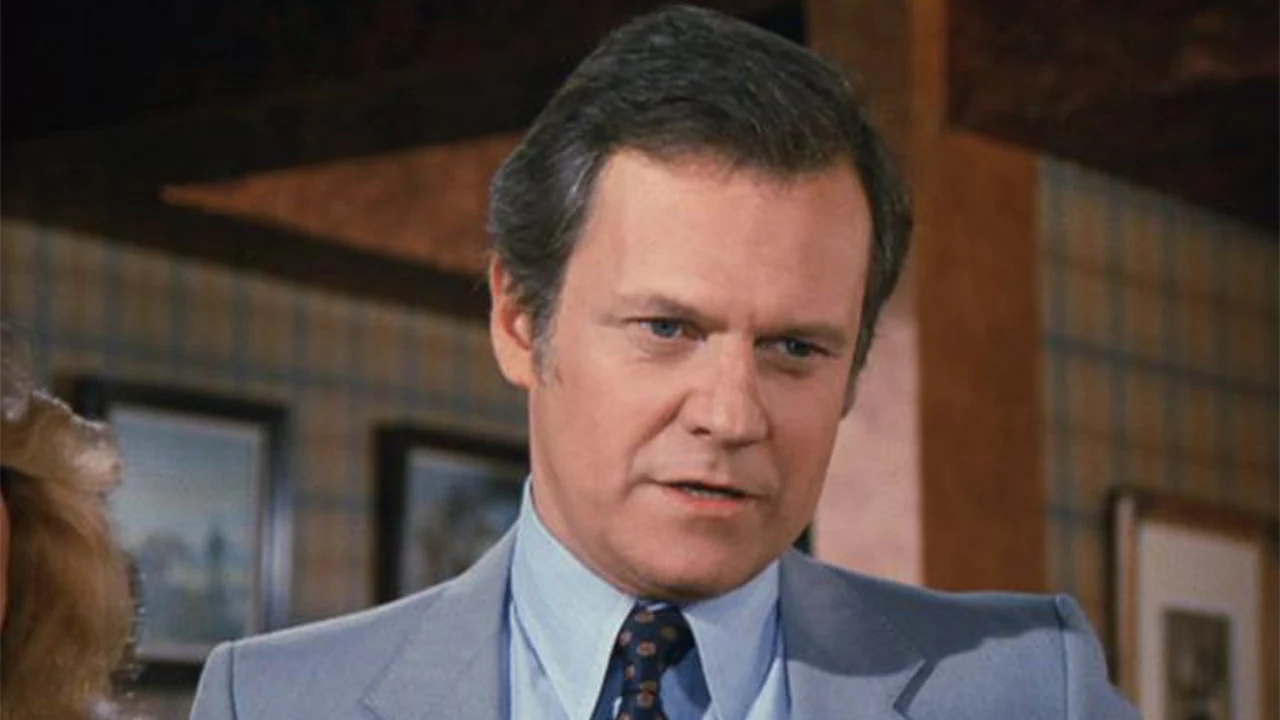
If J.R. needed somebody to outmaneuver, Cliff Barnes practically volunteered. Ken Kercheval made Cliff a complicated mix of ambition, old resentment, wounded pride and the sort of optimism that should have been extinguished by experience. He could lose a round to J.R., get furious, promise never to be fooled again and show up the following week with another plan that looked suspiciously easy to sabotage.
To be fair, Cliff had reasons to hate the Ewings. The Barnes–Ewing fight went back long before either man was running around Dallas in a business suit. Cliff had grown up with a version of the family history in which the Ewings had taken what belonged to his side. You didn’t have to agree with his every decision to understand why another successful J.R. maneuver drove him up the wall.
What made the rivalry fun was the contrast. J.R. could remain smooth and amused while Cliff looked ready to bite through a telephone cord. Hagman knew that the more frustrated Kercheval became, the less J.R. had to do to look like he was winning. Cliff’s determination was admirable right up to the moment it became another part of his opponent’s strategy.
The writers sometimes overplayed it. A feud is more entertaining when both people stand a chance. If Cliff’s only purpose was to walk into the same trap again, the joke began to wear thin. Kercheval was capable of far more than losing gracefully—or, more accurately, losing without anything resembling grace. His best material gave him intelligence, affection and enough self-awareness to recognize the cost of spending his whole life trying to beat J.R.
Cliff also made Pam’s position at Southfork harder. Her brother’s war didn’t stay at the office. It followed her into the house, the marriage and all the places she’d hoped to keep separate. That’s why Cliff mattered even when the latest oil scheme became impossible to follow: this was never simply about business. It was about two families refusing to let yesterday’s argument die. And business cards, unfortunately, were much easier to print than peace treaties.
Lucy, Ray and Donna: the people outside J.R.’s spotlight
Southfork had more going on than J.R. and Bobby shouting about the company. Charlene Tilton’s Lucy brought the frustrations of growing up in a family that had opinions about everything, including what she should do with her own life. As Gary and Val’s daughter, she belonged to the Ewing clan, but belonging wasn’t the same as having much control. Sometimes the adults seemed to forget she’d eventually want something other than permission to remain seated at the table.
Lucy could be rebellious, impulsive and determined to make an unwise choice just because it was hers to make. That’s a recognizable teenager, although most teenagers don’t get to rebel with Southfork as the backdrop. Tilton helped make her more than the young person assigned to create a problem while the adults handled important matters. Her place in the house reminded us that inherited money doesn’t automatically come with the right to make your own decisions.
Ray Krebbs, played by Steve Kanaly, had a different relationship with the ranch. He knew the land and the work. Later, the revelation that he was Jock’s son made him part of the family in a more formal way, but it didn’t erase the life he’d already built. He was never just another J.R. with a different wardrobe. That’s what made him interesting: he could belong to the Ewings without wanting to play exactly the same game.
Susan Howard’s Donna gave Ray a partner with her own judgment, convictions and stubborn streak. Their conflicts didn’t always involve somebody sneaking an oil contract across a desk. Occasionally they behaved like people whose lives had genuine disagreements that couldn’t be solved by discovering a previously unknown millionaire relative. Those stories could seem quieter next to J.R.’s fireworks, but they helped make the larger world believable.
The series didn’t always give these characters enough attention. Sometimes it dragged them into the current family crisis merely to add another familiar face. But the best episodes remembered that every Ewing had a different idea of what the family meant. That made Southfork feel inhabited rather than staffed entirely by people waiting for Larry Hagman to arrive.
Who shot J.R.? The question that took over television
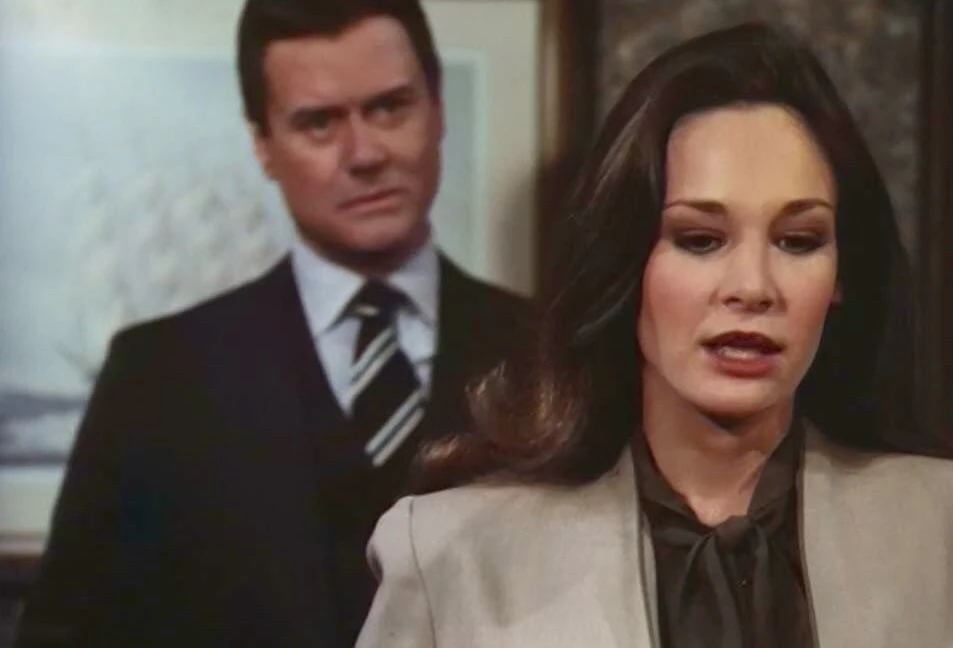
On March 21, 1980, J.R. Ewing got shot in his office. By ordinary television standards, that would have been a pretty dramatic way to end the evening. Dallas went one better: it refused to tell anybody who did it. The credits rolled, the season was over, and suddenly millions of Americans were stuck with the same irritating question. Who shot J.R.?
The beauty of the setup was that practically everybody had a motive. J.R. had spent enough time mistreating relatives, business partners and assorted women that the suspect list wasn’t so much a list as a directory. You didn’t have to invent an elaborate backstory for a random stranger. All you had to do was remember what he’d done recently. If you’d watched the show faithfully, you probably had a preferred suspect and at least three reasons somebody else should have done it instead.
Then came the wait. Not the modern kind where you finish a season and the next one starts automatically while you’re still looking for the remote. This was old-fashioned television waiting: months of speculation, magazine covers, conversations at work, and people trying to extract secrets from anyone who might have known the answer. The 1980 actors’ strike stretched the wait even longer. What began as an ending became a nationwide guessing game.
The show didn’t reveal the answer the moment the new season began, either. It let everyone stew while the investigation continued. Finally, on November 21, 1980, Who Done It? revealed Kristin Shepard, Sue Ellen’s sister, as the shooter. Mary Crosby played Kristin, whose involvement with J.R. gave the solution exactly the kind of intimate, messy history Dallas did best. He’d made so many enemies that the danger didn’t have to come from outside the family circle. Naturally.
The American broadcast was enormous. Contemporary reports gave it a 53.3 household rating, a 76 share and a CBS estimate of approximately 83 million viewers. Those are different measures, but every one tells the same practical story: this was an astonishing number of people watching one episode on one night. For a while, Dallas wasn’t merely a show you followed. It was the subject you could bring up with someone who hadn’t even been following it.
For Gen X kids, the experience depended on age. Some teenagers were old enough to understand every suspect and follow the story themselves. Younger kids may have learned the phrase simply because the grown-ups wouldn’t stop saying it. Either way, the question became part of the culture. You could find people wearing buttons proclaiming their dislike of J.R., which had to be one of the few times being widely hated counted as a publicity triumph.
The trick only worked because the characters already mattered. Knowing that Kristin pulled the trigger is trivia now. Remembering a television season that ended without an answer, and a whole summer in which that answer belonged to nobody outside the production, is something else. Dallas turned waiting into entertainment. It didn’t invent the cliffhanger, but it certainly reminded network television how much mileage a really good one could get.
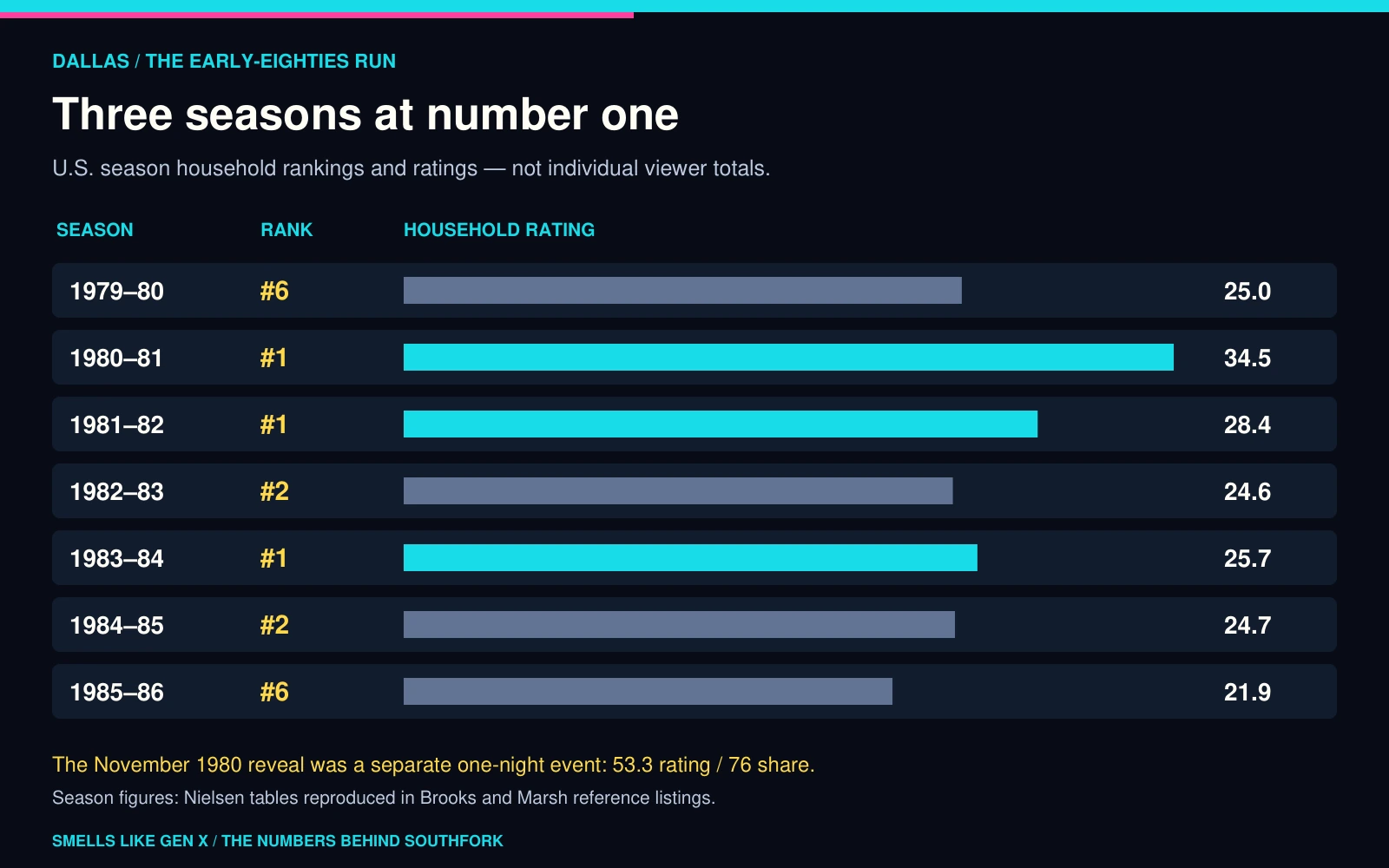
The ratings: three seasons at number one
There’s a temptation to talk about Dallas as if it spent the entire decade sitting unchallenged on top of the Nielsen charts. The real numbers are better than that simple legend, because they show an actual rise, a real peak and a very recognizable change in what America was watching.
The show was already a major hit before the shooting. It finished sixth in the season ending in 1980. Then, in 1980–81, came the jump to first place with a 34.5 household rating. The huge November reveal helped make that season unforgettable, but the weekly ranking proves people were returning for more than one spectacular Friday. Once the question was answered, they still wanted to know what J.R. would do next.
Dallas held first place in 1981–82, this time with a 28.4 rating. In 1982–83 it slipped all the way to second—hardly cause for a national emergency—behind 60 Minutes, with a 24.6. Then the Ewings climbed back to first in 1983–84 at 25.7. Those three number-one seasons are why J.R. can claim a legitimate reign over eighties prime time without anyone having to invent extra trophies.
Things changed again in 1984–85. Dynasty took the top spot, and Dallas finished second with a 24.7. Imagine being considered yesterday’s news while you’re still attracting one of the largest audiences on American television. That’s the danger of becoming such an enormous hit: people start judging your performance by whether you’re still the biggest thing in the country, rather than whether you’re doing extraordinarily well.
By 1985–86, Dallas ranked sixth with a 21.9. NBC’s sitcom lineup was making serious trouble for everyone else, and the Ewings were working through the famous season without Bobby. The chart doesn’t tell us exactly why any one viewer changed the channel, but it does remind us that the audience had choices. The family had spent years battling Cliff Barnes; now it also had to compete with a nation that was becoming interested in very different kinds of Thursday and Friday entertainment.
A Nielsen household rating isn’t a count of individual viewers, and a season average isn’t the same thing as the audience for the night Kristin was revealed. The distinction matters, even if nobody was holding a seminar on it around the family television in 1981. What matters for the story is that Dallas wasn’t just famous. It was genuinely, repeatedly, massively watched.
The year-by-year rankings show how unusual that was. You can follow the series through the 1980 season, 1981, 1982, 1983, 1984, 1985 and 1986. The names around it change. The comedies rise, newsmagazines stay formidable, new dramas have their moment. For several years, though, a crooked oilman and his relatives remained among the surest reasons to stay home with CBS.
That theme song meant trouble was coming
Jerrold Immel’s Dallas theme did not ease its way into your living room. It announced itself with the confidence of a family whose name was on practically everything. The brass came in, the title appeared, and there was Texas: oil fields, city skylines, cattle and the sort of scenery that suggested large sums of money were about to be argued over. Even if you weren’t allowed to stay up for the entire episode, you knew that music.
The split-screen credits made the cast instantly recognizable. You didn’t need to understand who currently controlled which company to recognize J.R., Bobby, Pam, Sue Ellen or Miss Ellie. The opening offered a quick reminder of who was involved in the latest disaster, accompanied by music that seemed to consider modesty a character flaw. It was television announcing that a weekly visit with these people was an occasion.
The visuals were a little different from the flashier look of later eighties television. Miami Vice eventually made music and atmosphere feel like an event all their own. Dallas could get an enormous amount of mileage from somebody sitting behind a desk, lifting a telephone and saying very little. The suspense came from knowing the person on the other end of the call was about to have an unpleasant afternoon.
Clothes and interiors helped. J.R. looked comfortable in expensive offices because he believed the offices—and quite possibly the people in them—were his to manage. Sue Ellen could be perfectly dressed while barely holding her emotions together. Southfork’s rooms were beautiful, but the camera kept filling them with people who couldn’t agree on much beyond the need to stay impressively well groomed.
The production’s music and costumes earned recognition of their own, including Bruce Broughton’s later music awards and a costume Emmy for Travilla. But you didn’t need the awards list to understand the craftsmanship. Put on the opening, listen to those first notes and try not to picture somebody driving toward a family confrontation. A very expensive argument is already on its way.
And that opening was part of a shared weekly routine. You heard the theme from another room and knew which family had moved in for the night. Someone might call during the episode; somebody else would ask them to ring back. If you came in halfway through, the split screens had already introduced everybody and the latest quarrel was waiting for you. There was no episode thumbnail to remind you which season you were on. You had the cast, the music and the rather alarming number of people who still lived at Southfork.
Why the ordinary episodes kept people coming back
Here’s something a collection of famous Dallas clips can’t really explain: there were a lot of ordinary Fridays between the shooting and the shower. Weeks when nobody set a national ratings record or returned from the dead. People talked in offices. J.R. lied about a deal. Pam tried to work out where she stood. Cliff announced that things were finally going to change. And somehow, you wanted to see the following week anyway.
That was the actual engine of the show. The grand surprises worked because the smaller confrontations had established what everybody wanted. J.R. needed to stay on top. Bobby wanted to believe he could be both a loyal Ewing and a decent husband. Sue Ellen wanted a little room to breathe. Cliff wanted to win once, just once, in a way J.R. couldn’t spoil. Miss Ellie wanted the ranch and the family to survive the week without another catastrophe.
The business plots could be difficult to follow if you missed an episode or two. Someone had an interest in a company, someone else knew something about a contract, and somebody was invariably about to discover the price of having trusted J.R. The beauty was that you didn’t always need to understand every share and signature. You understood the looks people gave each other. That was usually enough to know who was in trouble.
The performances did the rest. Hagman could take a pause and make you suspect he’d already won. Kercheval could look like a man trying not to explode. Gray could turn a polite exchange into a warning about how much hurt a person was willing to take. Duffy could look genuinely disappointed in his own family. These were skills that didn’t require a gunshot at the end of every episode.
Of course, a continuing soap can run the same problem through the wringer too many times. There are episodes where you want to climb into the television and explain a basic fact everyone has somehow overlooked. There are negotiations nobody with half a working brain should accept. Cliff occasionally approaches a fresh J.R. scheme with the same trusting expression a cartoon character might wear under a suspended piano. But that’s part of the larger truth: Dallas could be addictive, ridiculous and genuinely well acted in the same hour.
The best way to appreciate the famous cliffhangers is to spend time with the smaller stories around them. Without those dinners, phone calls and uncomfortable silences, the enormous events would have been nothing more than television tricks. The characters made the tricks matter. And when the writers forgot that, the trick was suddenly all you could see.
The shower that made a whole season disappear
There are TV surprises, and then there is Patrick Duffy standing in a shower after the audience had spent an entire year believing his character was dead. If you were watching Dallas in May 1986, it’s difficult to imagine a more effective way to make people stare at the screen and wonder whether somebody at CBS had completely lost their mind.
Bobby died in Swan Song on May 17, 1985. The following season moved forward without him. The remaining characters grieved, argued, made decisions and built new storylines around his absence. Then the May 16, 1986 finale, Blast from the Past, ended with Pam opening the bathroom door and finding Bobby very much alive. Duffy smiled. Viewers blinked. And somewhere, an entire season began looking nervously at the exit.
The explanation didn’t arrive until September 26, 1986, in Return to Camelot. The season without Bobby had been Pam’s dream. All of it. An extraordinary amount of television that people had watched, discussed and invested in was now being treated as something that hadn’t happened within the story. The writers hadn’t simply reversed a death. They’d reached backward and hit the undo button on a year of consequences.
You can understand why they wanted him back. Bobby was the decent counterweight to J.R., and Duffy and Hagman had an easy brotherly chemistry. A show built around family conflict needed someone who could stand up to J.R. without becoming another version of him. Duffy’s return brought that balance back. The trouble was the price. Viewers had done the work of caring about everyone else’s year, and now the show was asking them to pretend much of it had been an extremely elaborate night’s sleep.
The move also created an awkward situation for Knots Landing, whose characters had reacted to Bobby’s death. Shared television universes are a wonderful idea right up until one series decides another year’s worth of grief no longer counts. David Jacobs, who created both shows, questioned the dream explanation at the time. He wasn’t alone. Some viewers were delighted to see Bobby again. Others wanted a refund on the previous season’s emotional investment.
Was it worth it? As a stunt, absolutely. People still remember it. As storytelling, the answer is a lot less comfortable. The return gave Dallas back an actor it needed and threw away a chunk of its own credibility to get him. You can love the image of Bobby in the shower and still think the solution was outrageous. That’s the Dallas experience in miniature: the pleasure and the nonsense arriving at exactly the same time.
The critics knew it was ridiculous—and watched anyway
Not everybody greeted Dallas as a television masterpiece. Some critics considered the story contrived, the people unpleasant and the whole business a rather extravagant demonstration of what could happen when a network discovered that wealthy families made good trouble. Fair enough. A lot of the plotting probably wouldn’t survive ten minutes of straightforward questioning in the real world.
But the interesting critics also recognized the performance at the center. Michael J. Arlen, writing about the series in The New Yorker in 1980, found plenty to examine in Hagman’s villainy and the peculiar rules of the Ewing universe. That’s a more useful response than pretending there was nothing to enjoy simply because J.R. was a horrible person. Some of the best television characters are people you’d never want to meet.
The show worked because its actors committed to the situation, no matter how improbable it became. Hagman could treat an absurdly convenient business reversal as the most natural thing in Texas. Gray could make Sue Ellen’s latest heartbreak genuinely painful even when the surrounding plot had taken a couple of suspicious shortcuts. Bel Geddes could make you believe a family argument mattered in a room so large that anyone sensible might simply have moved to the other end of it.
That doesn’t mean every ridiculous twist was secretly genius. Sometimes the writing was lazy. Sometimes the same familiar conflict returned with a new name on the paperwork. Sometimes characters behaved as though they had learned nothing from the previous seven years. You could enjoy the cast and still roll your eyes hard enough to risk injury.
The useful thing is to stop treating affection and criticism as opposites. If you remember an episode fondly because J.R. was in fine form, say so. If the same episode makes no sense when you stop laughing, say that too. Most of us watched the eighties without a notebook in hand. The point wasn’t to deliver a verdict. It was to be entertained enough to come back next week, even when you knew perfectly well that Southfork was headed for another disaster.
Dynasty, Knots Landing and the other rich people behaving badly
Once Dallas proved that a wealthy, argumentative family could become an enormous weekly attraction, other networks naturally took an interest. You could almost hear executives around America saying, “Fine, but what if the next family had even more money and considerably larger shoulder pads?” The answer, of course, was Dynasty.
ABC’s Carringtons offered a different kind of grand-scale trouble. Dynasty made the clothes, the entrances and the showdown between Alexis and Krystle into attractions of their own. J.R. generally preferred to make a deal before anyone realized a deal had happened. Alexis liked people to know she had arrived and that their evening would now be considerably worse. Both approaches were spectacular television. And in 1984–85, Dynasty actually finished ahead of Dallas in the ratings.
Knots Landing was a closer relative, quite literally. Gary and Val Ewing carried the family connection into a California neighborhood. The problems there could feel more recognizable than another massive oil-company takeover. Your neighbor might be carrying an explosive secret even when nobody had a private jet available to make its discovery glamorous. The series gradually developed enough of its own life that it didn’t need to remain a permanent side room at Southfork.
Then there was Falcon Crest, with Jane Wyman’s Angela Channing finding endless ways to make wine country look less relaxing than the travel advertisements suggested. CBS had good reason to pair different prime-time soaps on Friday nights. If you liked watching families turn inheritance into warfare, there were plenty of people willing to keep you company.
For a deeper look at those differences, we’ve got the individual stories of Dynasty, Knots Landing and Falcon Crest, along with our look at the decade’s prime-time soaps and TV dramas. The point isn’t that the shows were copies of one another. Each offered its own version of an irresistible premise: the people with everything still couldn’t manage a decent evening together.
Dallas was especially good at making business feel personal and family feel like business. Other shows pushed the glamour further or brought the melodrama closer to ordinary life. But the Ewings remained the original Friday-night crowd you didn’t have to like to enjoy watching. J.R. would probably have claimed credit for every other success, and sent the networks a bill.
The contrast is particularly clear when you watch one of J.R.’s confrontations beside the Carringtons’ theatrical showdown. Larry Hagman could do immense damage from a chair. Joan Collins could make walking into a room feel like the beginning of an international incident. Neither performer needed us to believe their characters were admirable. They understood that the audience wanted someone interesting enough to keep making trouble. That was the lesson other soaps borrowed most successfully, more than the oil wells or the expensive furniture.
The later eighties: Southfork wasn’t quite the same place
Nothing stays the biggest thing on television forever, although J.R. Ewing would certainly have enjoyed testing the proposition. By the later eighties, Dallas was an established institution. The name was famous, the characters were instantly recognizable and the Ewing family’s business was still none of anybody’s actual business. But the feeling around the show had changed.
Some of that was simple age. A series that has been running for years eventually uses up a surprising number of believable ways for its characters to betray, marry, divorce, blackmail and forgive one another. The writers can introduce another secret or turn an old grievance inside out, but the audience begins to notice the familiar machinery. J.R. was still entertaining. The surrounding people didn’t always have enough fresh life to keep him interesting in new ways.
The departures mattered. Victoria Principal left in 1987, taking Pam away from the regular cast. Linda Gray’s Sue Ellen exited in 1989. Losing either woman meant losing a particular relationship with J.R.; losing both took away some of the show’s strongest emotional history. You can add new people to a soap, but you can’t give them seven or eight seasons of accumulated meaning merely by placing them next to Larry Hagman.
The rest of television hadn’t been waiting patiently, either. NBC’s huge comedies were drawing different audiences. Other dramas were offering their own ongoing characters and stories. Dallas was no longer quite the forbidden-looking grown-up event it had once seemed. It was familiar, and familiarity can be both a strength and a problem. The house still looked wonderful, but viewers could guess which sort of trouble would arrive before the driveway filled up.
The original CBS series carried on until 1991. Later movies and revivals extended the family’s story, but the eighties contained the giant breakthrough, the enormous ratings years and the most notorious reset. You don’t have to track every later marriage or corporate transaction to understand what Dallas meant to the decade. Its most important contribution had already happened: a country learned to arrange its evening around what a fictional oil family might do next.
Why Gen X remembers J.R. even if we didn’t watch every Friday
Here’s the thing about Dallas: you didn’t actually have to be a devoted fan to know who J.R. Ewing was. For some Gen Xers, it was essential Friday-night viewing. For others, it was the show their parents watched while the kids wandered through the living room looking for something to eat. Even if you missed the plots, you picked up the names, the arguments and that grin.
The words “Who shot J.R.?” travelled far beyond the people who knew who Cliff Barnes was. Adults discussed suspects. News stories covered the wait. Merchandise turned hatred of a television villain into something you could announce on your clothing. For a kid growing up with three major networks and a set that didn’t always belong to you, it was a reminder that one program could briefly dominate everybody’s conversation.
That doesn’t mean every member of the generation experienced it the same way. A teenager in 1980 might have followed the mystery as it unfolded. A younger kid might remember the theme music or the adults insisting everyone be quiet during the reveal. Later reruns created still another version of the show, without months to speculate between episodes. Those different memories are part of the story, not evidence that anyone watched it incorrectly.
The experience also looks a little different when you return as an adult. J.R.’s schemes are still funny, but Sue Ellen’s struggle can feel far more painful. Pam’s attempt to build a marriage inside a hostile family makes more sense. Miss Ellie begins to look like the only person on the ranch who knows the real cost of everyone else’s need to win. The things that seemed glamorous to a kid—big houses, fancy offices, unlimited money—start looking suspiciously like expensive places in which nobody can ever relax.
And the comedy is still there. Hagman was too good for it to disappear. No matter how many bad things J.R. did, he always found a way to appear shocked that somebody might question his motives. You could see the next lie coming and still look forward to hearing how he would deliver it. That is why the character stayed recognizable long after the season rankings stopped putting Dallas first.
From the 1970s television world that introduced the Ewings to the changing 1990s TV landscape, Dallas occupies a special place. It didn’t invent soap-opera storytelling or television villains. It made a continuing family drama into an event enormous enough that even people who didn’t watch knew what to talk about on Monday.
The best way to watch Dallas again
If you’ve only seen the famous clips, do yourself a favor and start earlier. The shooting, Kristin’s confession and Bobby’s shower return all work better when you’ve spent enough time around Southfork to know why the characters react the way they do. Begin with Bobby bringing Pam home and the family’s immediate inability to behave. Then watch J.R. discover how much fun it is to turn everybody’s ordinary problems into opportunities.
The early episodes can feel different from the high-powered eighties years. That’s part of the pleasure. You’re watching a series discover its best combination of people. Once the larger stories take hold, see how often the quiet scenes do the heavy lifting. A breakfast argument or a conversation in J.R.’s office may tell you more about a relationship than the enormous disaster that happens three episodes later.
Take the 1980 cliffhanger in order. Watch the events leading up to the shooting, then the episodes after the series returns. You can’t reproduce the months Americans spent waiting for the answer, but you can at least see how well the show had prepared the suspects. Kristin’s identity means more when you remember the world J.R. created around himself.
When you reach the dream year, watch it knowing the producers eventually wiped it away. That’s a strange experience, but the performances and stories don’t simply vanish because the later fictional timeline says they didn’t happen. Real viewers still spent the hours watching them. And if you decide you love seeing Bobby again but hate the way they brought him back, welcome to a club that’s been open since 1986.
Most of all, let the show be what it was. Some weeks were gripping. Some were ridiculous. The cast could be brilliant even when a story was running on fumes. You don’t have to pretend every oil deal makes sense or defend every marriage twist as high art. Sit back, listen to the theme and wait for somebody to make a very bad decision in extremely expensive clothes. Southfork always did know how to make an entrance.
One final thing that can surprise a returning viewer is how much of the show belongs to its supporting cast. A rerun advertised with J.R.’s face might spend its best minutes with Sue Ellen trying to regain her footing, Miss Ellie setting down a boundary, or Cliff almost—but not quite—understanding the latest disaster. That’s what separates a good TV villain from an entire TV series. J.R. supplied the headline; the people around him gave you reasons to stay after the headline had been answered.
Questions about Dallas in the eighties
Who actually shot J.R. Ewing?
Kristin Shepard, played by Mary Crosby, was revealed as the shooter in Who Done It? on November 21, 1980. The shooting itself happened in A House Divided on March 21, leaving viewers waiting through the summer and into the fall for the answer. Considering J.R.’s record of making enemies, Kristin was hardly the only person with a reason to be furious.
How many times did Dallas finish number one?
Three times in the U.S. season household rankings: 1980–81, 1981–82 and 1983–84. It was also second in 1982–83 and 1984–85. The famous November 1980 reveal drew a much larger one-night audience than the average episode, so the season rankings and the individual broadcast record shouldn’t be confused.
Did Bobby really die, or was it all a dream?
Bobby died in the 1985 story Swan Song. Patrick Duffy appeared alive in the shower at the end of Blast from the Past on May 16, 1986, and the following September’s Return to Camelot explained that the previous season had been Pam’s dream. The twist remains one of the most audacious ways television has ever brought a character back.
Was Knots Landing a Dallas spinoff?
Yes. Gary and Val Ewing connected Knots Landing to Dallas, although the California-based series grew into a very different kind of continuing drama. Dynasty and Falcon Crest were separate programs that appealed to overlapping audiences, not direct spinoffs. Our guide to 1980s television spinoffs covers the differences.
Sources and further reading
- Television Academy: Dallas production history and creator/cast interviews.
- Television Academy: Larry Hagman’s career and Emmy nominations.
- Television Academy: The Big D, cast-and-crew retrospective, July 2018.
- Television Academy: Dallas award records, including Barbara Bel Geddes, Bruce Broughton and Travilla.
- UPI, November 20, 1980: anticipation before the shooter reveal.
- UPI, November 25, 1980: contemporary rating, share and CBS viewer estimate.
- Michael J. Arlen, The New Yorker: Smooth Pebbles at Southfork, March 1980.
- TIME, August 1980: TV’s Dallas: Whodunit?.
- Washington Post, September 1986: Rites of Resurrection.
- Patrick Duffy interview, Television Academy, May 2026, for his recollections of returning to the series.
- Dallas episode and cast chronology, including the separate shooting, reveal, death, shower and dream-explanation broadcasts.
- Season household-ratings reference tables, citing Brooks and Marsh: 1979–80, 1980–81, 1981–82, 1982–83, 1983–84, 1984–85 and 1985–86.