Falcon Crest in the 80s: Wine Country, Power & Prime-Time Soap
Return to Falcon Crest in the 80s: Jane Wyman’s Angela, Chase and Maggie, Richard and Melissa, the vineyard battles, cliffhangers, and CBS glory years.
The shows, the moments, and the nights we were there for it.
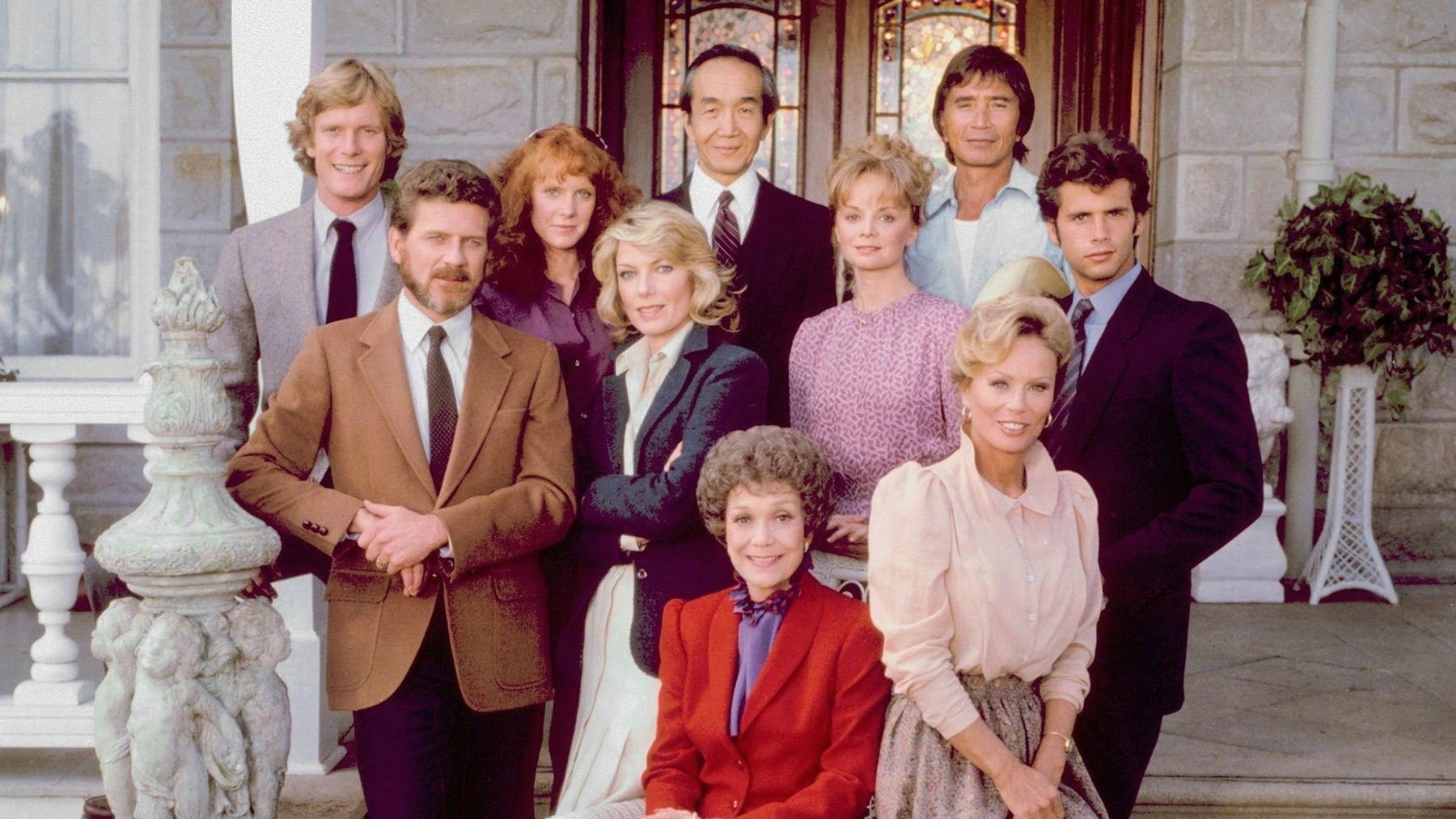
Angela Channing could make a conversation about grapes feel like a threat. Jane Wyman did not need to throw a vase or shout across the room. She could stand in that handsome house, listen to a relative explain a perfectly reasonable ambition, and make it clear that the ambition had just become a problem. The scenery said wine-country weekend. Angela said read the fine print.
That was the delicious arrangement at the center of Falcon Crest: beautiful land, attractive people, and a family capable of turning both into a hostage situation. The vineyard was a business, an inheritance, a home, and the thing nobody could bear to let somebody else control. People fell in love around it, married for reasons they might later regret, and discovered family connections that made the seating arrangements considerably more difficult.
Beginning on CBS in December 1981, as the 1981–82 television season unfolded, the series built a substantial audience behind Dallas. It spent three consecutive seasons in the Top 10, reached seventh place at its peak, and made Tuscany Valley a fine place to visit from the safety of the sofa. You would admire the view. You would be very careful about accepting an invitation to dinner.
Inside This Article
- Jane Wyman made Angela the person everybody had to get past
- The first episode puts a body underneath the family business
- Chase Gioberti had the nerve to think he could stay
- The early money squeeze was almost painfully ordinary
- Maggie was never just the nice person standing beside Chase
- The vineyard was gorgeous, useful, and almost never relaxing
- The man behind The Waltons planted a very different family tree
- Friday after Dallas was an excellent place to start trouble
- Lance Cumson was an heir Angela could not quite house-train
- Melissa Agretti did not come to Tuscany Valley to be agreeable
- Cole and Vickie made the move a family decision with consequences
- Julia’s place in the family was much darker than it first looked
- Emma could see things the confident people preferred to miss
- Richard Channing arrived with money, a newspaper, and very bad news
- The family tree was another place to hide a weapon
- Lana Turner made the family past arrive in person
- Phillip knew the paperwork; Chao-Li knew the house
- The 1984 plane crash made the family trip a terrible idea
- Tuscany Valley kept attracting very impressive trouble
- Richard’s house was no place to look for a quiet evening
- The earthquake shook a valley that was already unstable
- The sixth-season finale put the family in the water
- Terry, ambition, and the danger of treating money as an escape
- Losing Melissa removed a very useful source of trouble
- By 1989, the familiar vineyard had become a different show
- The clothes were expensive; the humor could be wonderfully dry
- Falcon Crest, Dallas, Dynasty, and the quieter street nearby
- Why the view from Falcon Crest still holds up
- Questions about Falcon Crest in the 80s
Jane Wyman made Angela the person everybody had to get past
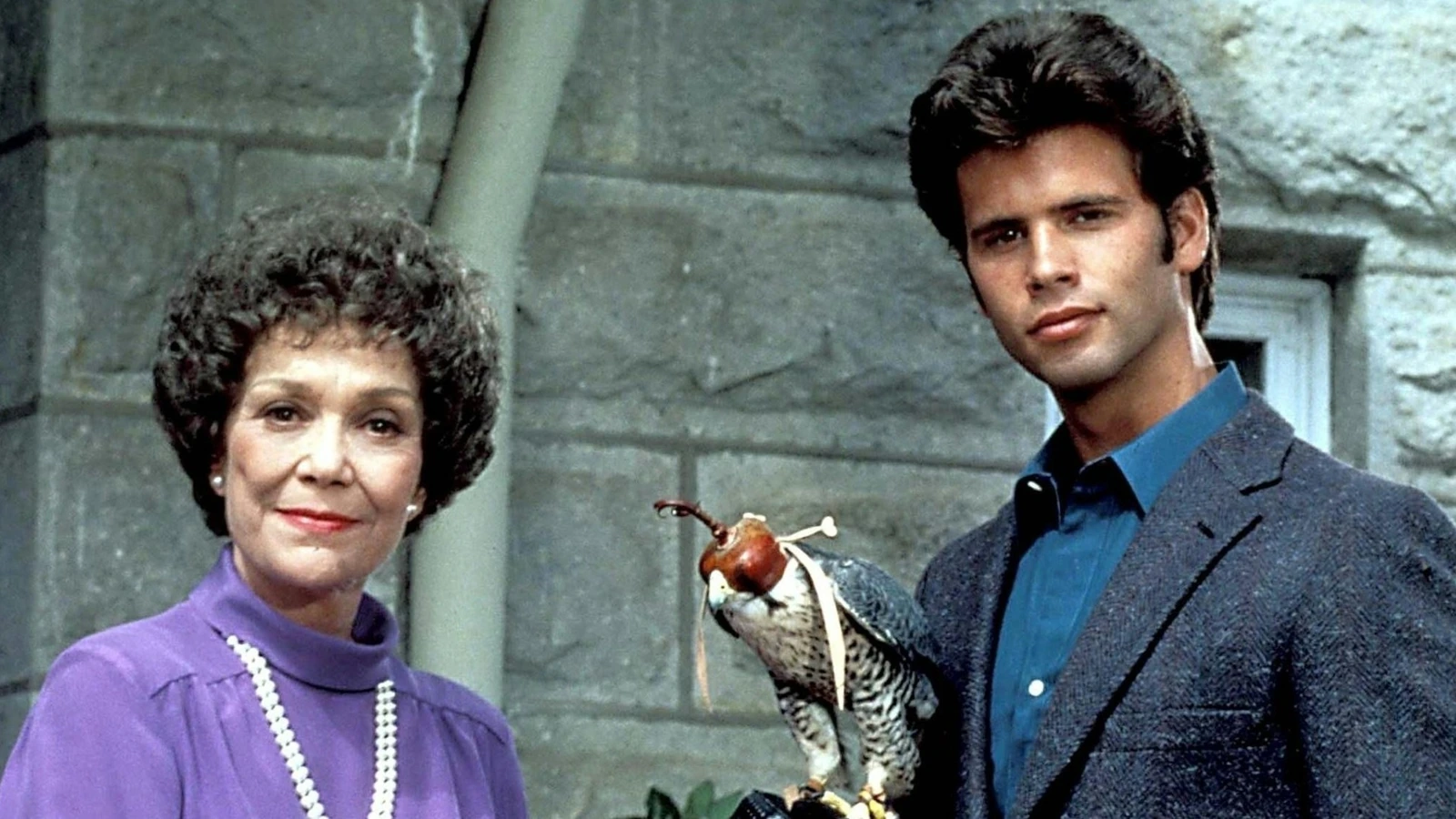
Wyman arrived with the authority of an established film star, including an Academy Award for Johnny Belinda. Falcon Crest made excellent use of that authority. Angela did not look as though she was auditioning to belong in her own house. Other people might be anxious about their standing. She regarded standing as something she could grant, withhold, or make very uncomfortable.
The performance was especially effective when Angela was being agreeable. A greeting could be gracious and territorial at the same time. Wyman gave her a dry intelligence that made it plausible she had already thought of the disadvantage somebody else was only beginning to discover. Even when the plot got large, Angela’s composure could bring the scene back to a personal contest.
She was not merely a rich grandmother who disliked change. Falcon Crest’s ownership and continuity mattered to her so much that affection could become inseparable from management. A grandson was a loved member of the family and a possible instrument in a property strategy. A daughter was somebody to protect, but protection might mean keeping control. A nephew with a legitimate interest in the land was still an intrusion.
That made her compelling company without making her a person to trust. You could enjoy the speed of her calculation and still want Chase to refuse the deal. The series gave viewers permission to appreciate the formidable character while recognizing the damage she did. It was a much better engine than making every opponent foolish enough to deserve whatever she arranged.
Among the great prime-time soap families of the 1980s, the Channings had a particularly effective center of gravity. Angela did not need every scene to revolve around her. She only needed everybody else to know that, sooner or later, their plans would have to travel through her living room.
The first episode puts a body underneath the family business
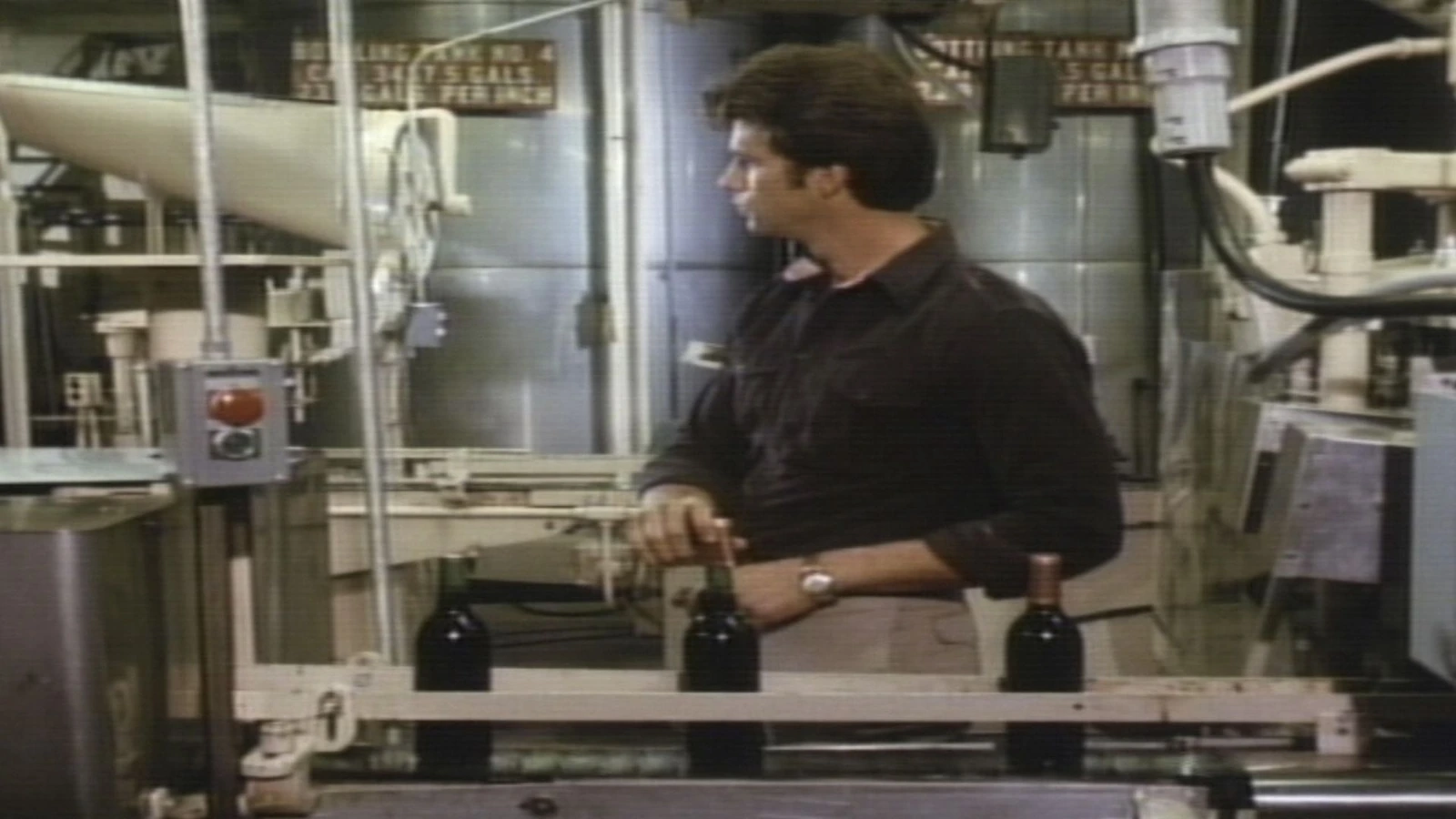
“In His Father’s House” premiered on December 4, 1981. It did not begin with an innocent family simply preparing for harvest. Angela’s brother Jason Gioberti dies after interrupting an encounter between her daughter Emma and Turner Bates at the winery. Angela moves to control the account of what happened, because the circumstances threaten the estate’s future.
That opening announces the show’s priorities with impressive economy. The land is beautiful, the family is complicated, and a death is immediately also a question of property. Angela can respond to a disaster as a sister and as the person determined to preserve control. The difficulty is that the second response has a habit of taking over.
Jason’s son Chase returns from New York for the funeral with his wife Maggie. What could have been a brief family obligation becomes the beginning of a different life when Chase decides to remain and work the vineyard he has inherited. Angela would prefer a simpler arrangement, specifically one in which he takes the money and leaves.
The conflict therefore begins with a recognizable difference in what an inheritance means. To Chase, it offers a connection to his father and a chance to build something. To Angela, his portion of the property is a piece of a whole she intends to keep together under her direction. Both people can say the land matters. Agreement on that sentence does not bring them any closer to peace.
The episode’s title makes the homecoming sound reassuring. By the end, the reassurance has acquired several conditions. Chase is back in his father’s world, but he has also entered Angela’s. The viewers get a vineyard. Chase gets a relative who would rather he had stayed on the other side of the country.
Chase Gioberti had the nerve to think he could stay
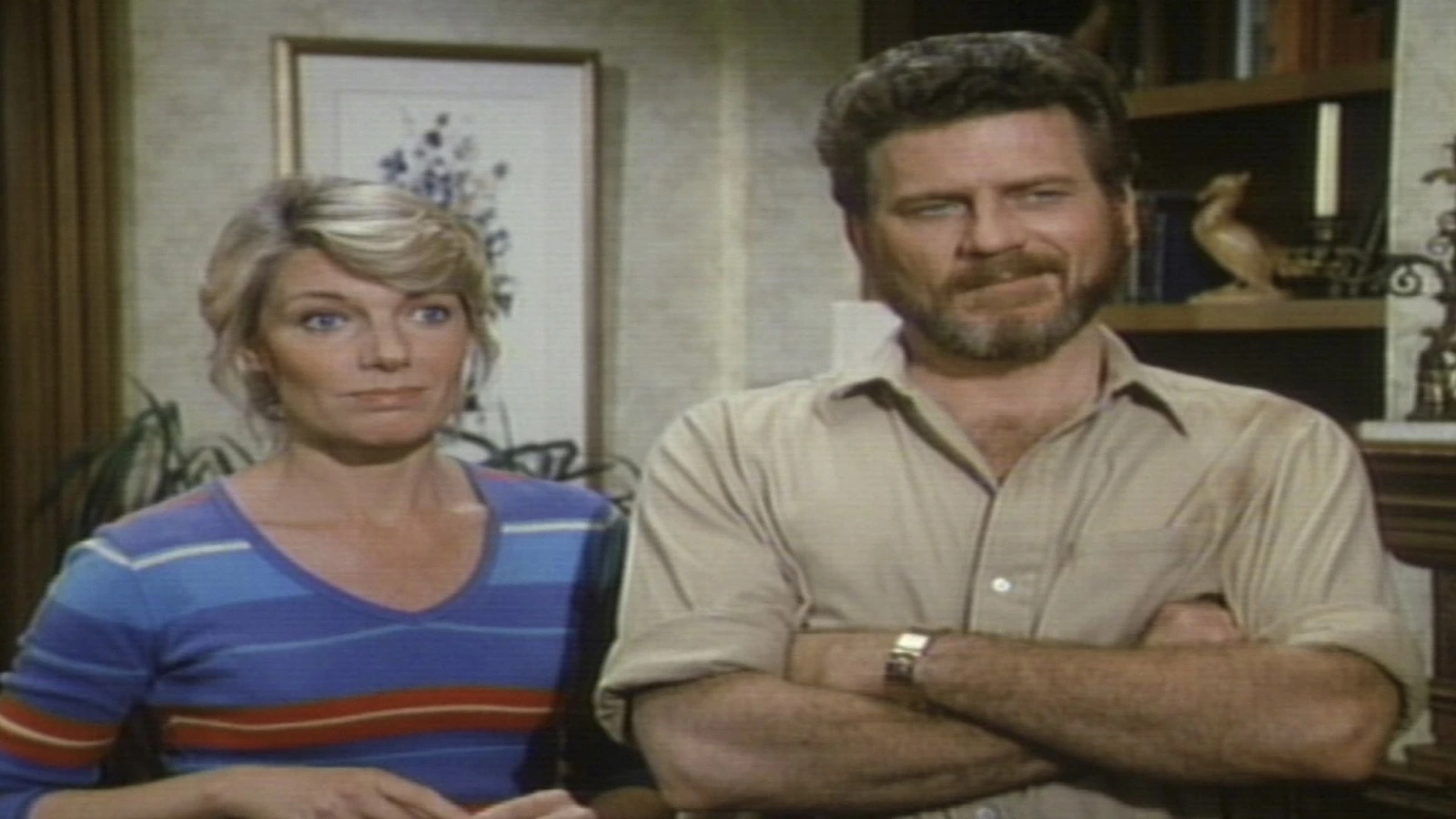
Robert Foxworth’s Chase was an effective rival because he did not approach Tuscany Valley as a visitor hoping for Angela’s approval. He had a claim, a family, and an increasing willingness to work the ground. Angela could be dismissive about his prospects. She could not make the inheritance disappear simply by finding him inconvenient.
Chase’s background as a pilot gave him a life before the vineyard. He was not born into the role of Angela’s weekly opponent. The decision to remain in California changed his family’s future as well as his own, which meant the fight could not be reduced to two adults enjoying an endless argument over acreage.
Foxworth gave the resistance some heat. Chase could be principled and stubborn, and the stubbornness did not always improve the lives of the people standing beside him. A man who believes he is refusing manipulation can still be capable of making a difficult situation harder. The character works better for having more than one setting on the dial.
Early stories make Angela’s tactics painfully practical. Money, taxes, access to buyers, and the ability to get credit can become weapons. Chase does not need to be defeated in an enormous public confrontation if his crop cannot find a buyer or his bank suddenly loses interest. Wine country looks less restful when every business relationship might include a call from your aunt.
That gave Falcon Crest a useful physical basis for its feuds. The land had to produce, the work had to get done, and refusing Angela could cost more than the pleasure of a triumphant final sentence. Chase’s determination mattered because staying was something he had to keep paying for.
The early money squeeze was almost painfully ordinary
“The Tangled Vines,” early in the first season, puts Chase under pressure over property taxes and the need to sell his harvest. Angela can interfere with buyers and credit, turning an ordinary business problem into a test of whether he can afford to refuse her. No plane needs to fall out of the sky. The bank can make the week sufficiently unpleasant.
That scale of trouble is part of what makes the beginning worth revisiting. Chase has chosen the vineyard, but choosing it does not pay the bill. He and Maggie still have practical decisions to make about the life they left behind. The family feud reaches into their finances before it becomes another grand catastrophe. Angela’s advantage is not merely that she wants something more fiercely. She has relationships, leverage, and the patience to make somebody else’s everyday difficulties work for her. Chase can reject the offer; he still has to find another buyer.
Maggie was never just the nice person standing beside Chase
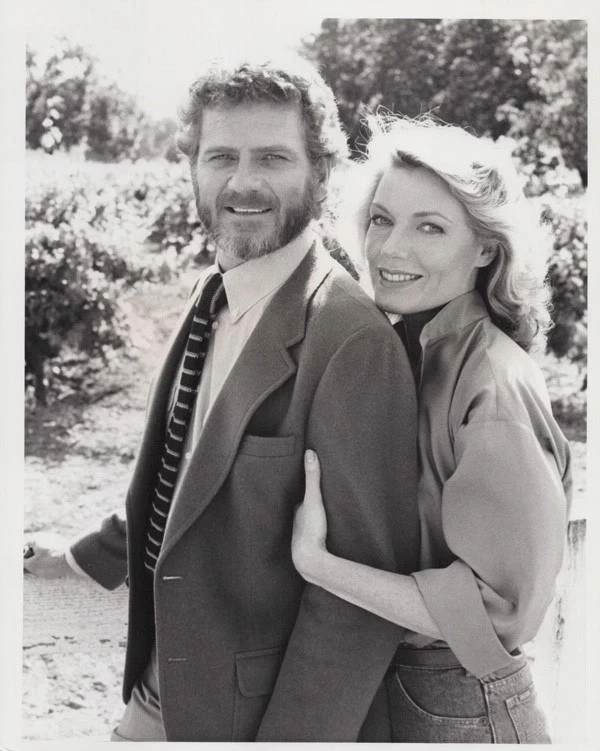
Susan Sullivan’s Maggie gave the Gioberti household intelligence, warmth, and a point of view that did not automatically become Chase’s point of view. She had a writing career and ambitions of her own. Moving into the valley did not erase those things, even when the vineyard’s problems tried to occupy every available hour.
That made her valuable in a series full of people who treated others as extensions of their plans. Maggie could love Chase without being delighted by every confrontation he pursued. She could oppose Angela without making opposition her entire personality. Sullivan brought enough wit to the role that decency did not mean fading politely into the background.
The family also had children old enough to complicate their parents’ decisions. Cole and Vickie had relationships, desires, and reactions to the new life. Maggie could not manage all of that simply by reminding everybody that they were a good family. The household had to absorb real changes, and the program could use those changes for more than a contrast with the Channings.
As the years went on, Maggie became involved in much more turbulent stories, including a relationship with Richard Channing. The attraction was not just the surprise of pairing two people from opposite sides of a feud. Sullivan and David Selby gave the series two adults whose connection could be tender and difficult at the same time. Richard’s money and methods did not turn him into an uncomplicated romantic rescue.
Maggie was one of the people who made the valley worth caring about instead of merely watching for the next ambush. Her presence let the show register the cost of the games. Somebody had to live in the household after the schemers finished congratulating themselves.
The vineyard was gorgeous, useful, and almost never relaxing
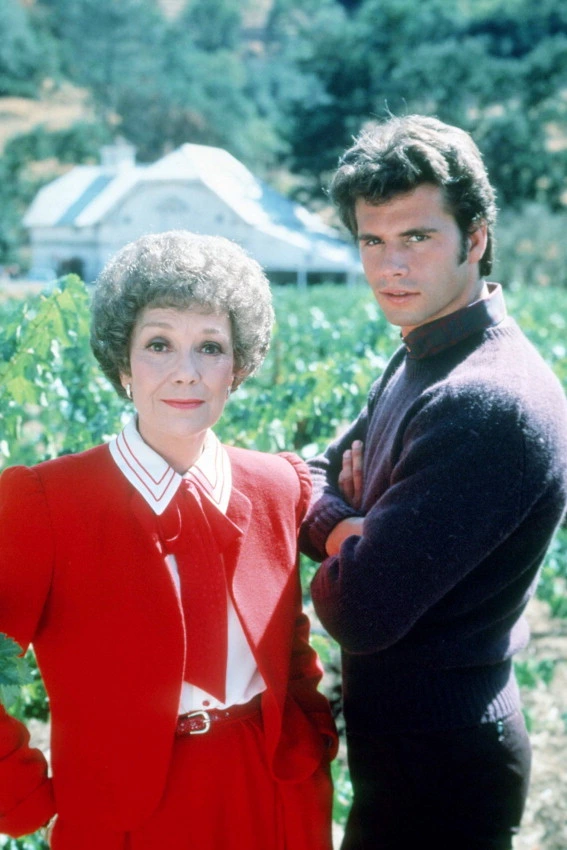
The fictional Tuscany Valley gave Falcon Crest a distinctive address. The production’s use of California wine-country locations supplied a visual identity that could not be mistaken for the Ewing ranch or a Denver mansion. The rows of vines, the winery, and the Victorian house made the wealth tangible before anybody discussed a contract.
Spring Mountain Vineyard’s Villa Miravalle became the famous exterior associated with Angela’s mansion. Seeing the house against the landscape is enough to understand why the program kept returning to it. It looked established, valuable, and entirely capable of containing a family grievance that had been maturing for years.
The vineyard also kept the fortunes from floating away into a vague pool of television money. Grapes had to be grown and sold. Land could be divided, inherited, mortgaged, or used to squeeze somebody else’s operation. The product was glamorous enough for an expensive dinner and agricultural enough to make a damaged harvest a serious problem.
The title therefore did more than identify an estate. It named the thing the characters kept trying to possess, defend, or escape without quite being able to leave it alone. People could change alliances faster than the vines changed, but the property gave the arguments a continuing object. Angela could win a conversation and still face another challenge to the same ground.
The view was part of the pleasure, and the show knew it. A beautiful exterior can make the next unpleasant encounter even more satisfying. Nothing in the scenery warns a visitor that a polite exchange about the family might soon become a dispute about who is entitled to remain on the premises.
The man behind The Waltons planted a very different family tree
Earl Hamner Jr. created Falcon Crest after the enormous success of The Waltons. That connection can sound like a television trivia question, but the common interest is visible: family, place, inheritance, and the way one generation shapes the next. The results are considerably less comforting in Tuscany Valley.
Hamner had his own experience with owning a vineyard, an investment he later described as financially disappointing. It helped draw him toward the setting. Television could do something useful with the expense and frustration, even if the original grapes had not made their owner especially happy. The fictional vineyard became much more profitable entertainment than a quiet lesson in agricultural management.
An earlier pilot, The Vintage Years, preceded the familiar series. Clu Gulager and Samantha Eggar played the versions of Chase and Maggie in that unaired production. The final weekly series brought in Foxworth and Sullivan, and Angela’s presentation changed as the production moved toward the show CBS would broadcast.
The early pilot is interesting as a different arrangement of recognizable materials, rather than a lost first episode that viewers need to insert into the story. It belongs to the development history. The familiar Falcon Crest begins with the cast and relationships introduced on CBS in December 1981.
Anyone coming from the family television of the 1970s could recognize Hamner’s concern with a household rooted in a place. The difference was what happened when rootedness became possession. A family might love its land. Angela had an additional interest in making sure nobody else’s interpretation of that love interfered with her authority.
Friday after Dallas was an excellent place to start trouble
CBS placed Falcon Crest at 10 p.m. on Friday after Dallas. The pairing made immediate sense: viewers already in the mood for a wealthy family behaving badly did not have to go looking for another channel. They could move from oil and ranch land to vineyards and discover a matriarch who had no interest in letting J.R. corner the market on manipulation.
Being a compatible neighbor did not mean having no identity of its own. Dallas had the Ewing family and its particular brand of power. Falcon Crest offered a different landscape, a different family arrangement, and Wyman’s controlled authority at its center. The invitation was familiar enough to be easy and distinct enough to sustain a separate series.
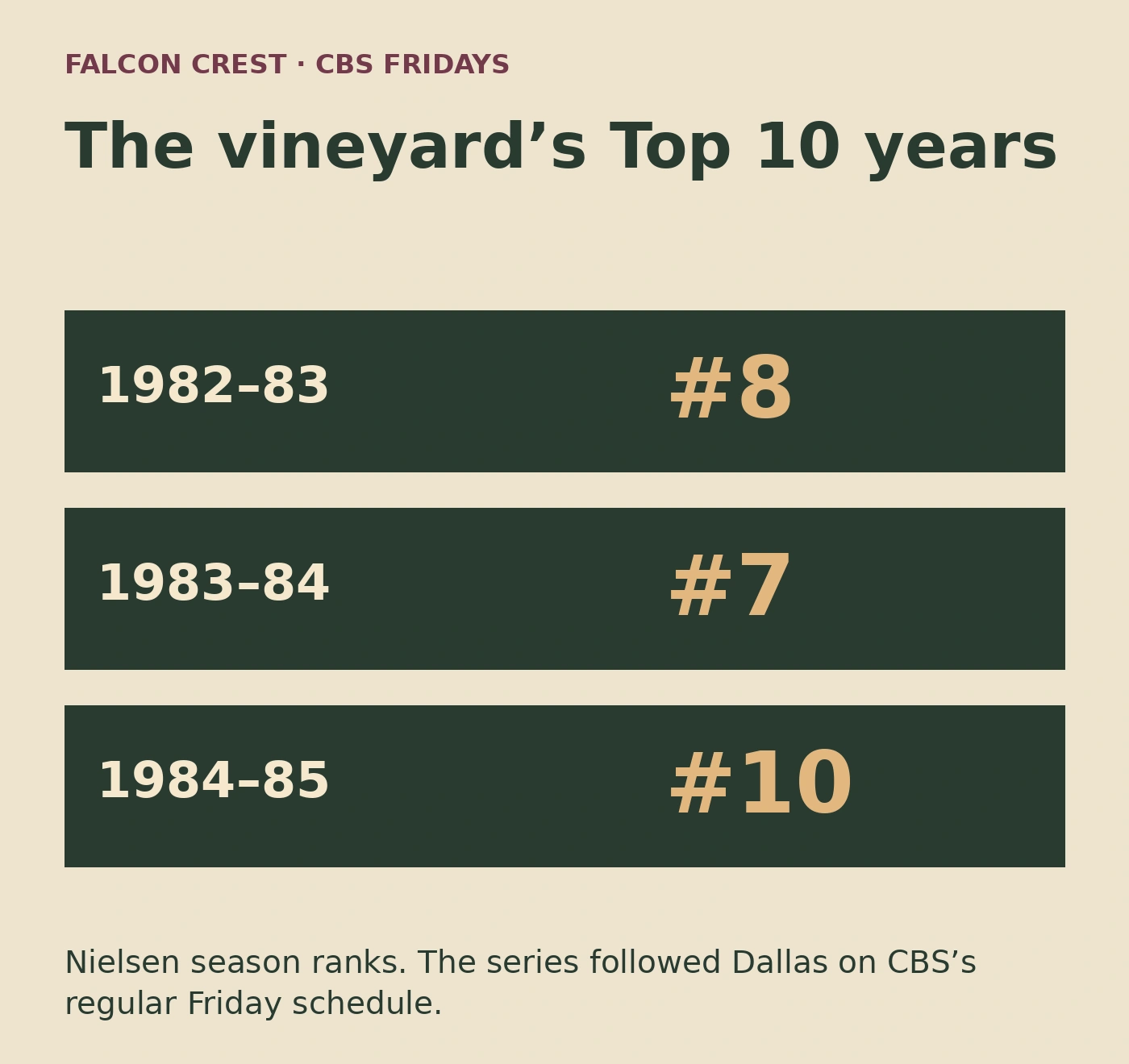
The ratings became substantial. The season ending in 1983 finished eighth; 1983–84 reached seventh; 1984–85 finished tenth. Those are three consecutive Top 10 finishes. The 1983 television rankings show the series already established among the major hits rather than merely surviving behind a larger one.
It peaked the following year. In the season ending in 1984, Angela’s family was part of a remarkably strong CBS showing. By the 1985 season rankings, the program was still in the Top 10, even as the competition and the balance of television hits kept changing.
That is worth remembering when the series is treated as an extra item on a list of 1980s soaps. At its peak it was a major weekly attraction. The vineyard was not just getting by on the overflow from Southfork. It had its own audience willing to return for the next round of family hospitality.
Lance Cumson was an heir Angela could not quite house-train

Lorenzo Lamas played Lance Cumson, Angela’s grandson and Julia’s son. Handsome, impulsive, and not always interested in the future his grandmother had selected, Lance was both an asset and an ongoing management headache. Angela could imagine the estate continuing through him. Lance could imagine quite a few other uses for his afternoon.
That conflict gave the younger generation a strong connection to the business story. He was not simply having a separate romance while older people discussed the property. His conduct affected Angela’s plans, and her plans affected whom he was expected to marry, trust, or disappoint. Being the favored heir was less like receiving a gift than agreeing to a very intrusive form of supervision.
Early episodes let his recklessness have real consequences. In “The Harvest,” his actions against Chase’s operation are part of a family contest that spills into work, relationships, and violence. Angela’s use of Cole as an alternative prospect makes inheritance another means of discipline. If the grandson will not behave, the future can be waved in front of somebody else.
Lamas also gave the show an immediately recognizable romantic presence. Lance’s relationships were entangled with property and loyalty often enough that a wedding could be both an emotional event and a strategic transaction. The attractive young man did not get to live outside the machinery of the family simply because the camera liked looking at him.
What makes him more than a decorative heir is the mixture of dependence and resistance. Angela can protect him, direct him, and infuriate him, sometimes within the same stretch of story. His efforts to assert himself keep running into the fact that she helped build the world in which he expects to be important.
Melissa Agretti did not come to Tuscany Valley to be agreeable
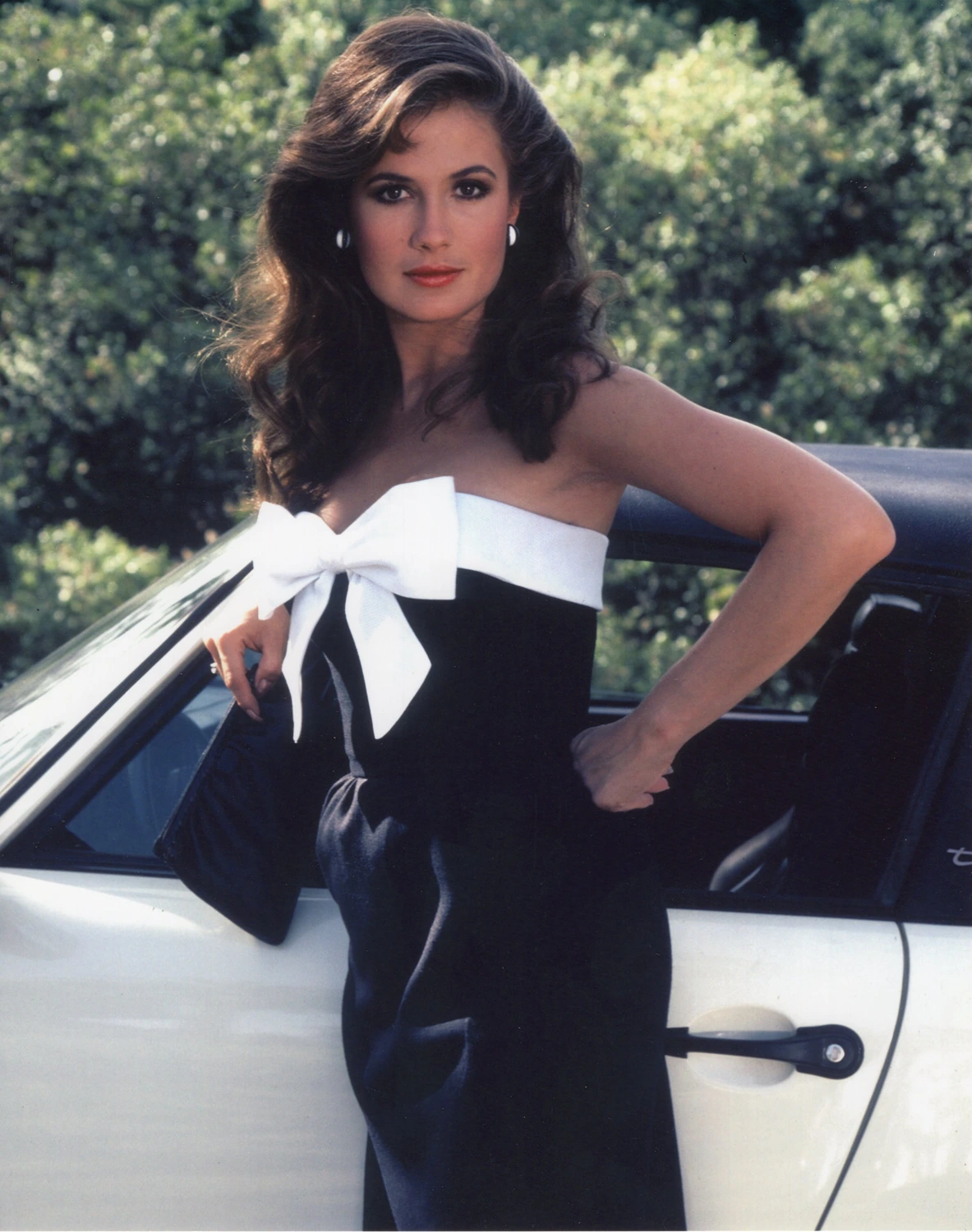
Ana Alicia’s Melissa Agretti was one of the show’s most effective sources of combustible energy. She had a family name, property interests, romantic ambitions, and a capacity for self-interest that could keep a quiet room from staying quiet. Angela was formidable, but she was not the only person in the valley willing to treat a relationship as a route to something else.
The Lance–Melissa–Cole triangle tied the younger characters directly into the larger fight. William R. Moses’s Cole came from Chase and Maggie’s side of the family, while Lance stood inside Angela’s plans. Melissa’s relationships with them made affection and paternity part of the same world as vineyards and inheritance. There was no useful way to draw a line through the episode and label one side romance and the other business.
Ana Alicia could make Melissa exasperating without making her dull. The character might be pursuing a scheme you wanted to fail, but you could still want to see how far she would push it. That is a valuable quality in a long serial. A pleasant person who accepts the sensible outcome can save everybody a great deal of trouble and leave the writers with very little to do next week.
Her rivalry with Angela was especially satisfying because the two women did not possess identical forms of power. Angela had years of authority and the established house. Melissa had youth, determination, her own claims, and less interest in honoring the older woman’s preferred order. Their battles could feel like a contest over who was entitled to define the future.
Melissa eventually gained control of Falcon Crest, which made the property struggle more than a permanent promise that nothing would ever change. Winning did not make her safe, or happy, or suddenly sensible. In this valley, success could be the point at which your problems became large enough to require a much better lawyer.
Cole and Vickie made the move a family decision with consequences
Chase and Maggie’s children had to live inside their parents’ choice to remain in the valley. Cole and Vickie did not arrive as miniature versions of the adults, already prepared to defend every Gioberti principle. They had relationships and impulses that could make the family division more complicated than a neat contest between the good household and the difficult aunt.
Cole’s involvement with Melissa gave him a place in the main inheritance story and a continuing connection to Lance. Competing for affection is uncomfortable enough. Competing while your relatives are also fighting over property adds an impressive number of ways for a bad conversation to get worse. Moses could give Cole a straightforwardness that made those tangles feel more painful than a purely strategic exercise.
Vickie, first played by Jamie Rose and later by Dana Sparks, brought another set of choices into the household. Her relationships, including the early connection with Mario Nunouz, placed family expectations against the life she actually wanted. The vineyard was not only a dream Chase had inherited. It was somewhere the younger generation had been brought to live.
The early presence of Gus Nunouz and his family also helped establish that the valley was not populated solely by people arguing from comfortable rooms. The business depended on work. Decisions made by the owners could land on people with less money and fewer alternatives. Those connections gave the family maneuvering a wider setting, even when the series concentrated increasingly on its wealthiest combatants.
The Gioberti children therefore mattered for more than the number of potential romances they added. They made Chase and Maggie answer for what staying meant. A parent can call a move a fresh start; the people unpacking their belongings are still entitled to have their own opinion of the destination.
Julia’s place in the family was much darker than it first looked

Abby Dalton played Julia Cumson, Angela’s daughter and Lance’s mother. Julia worked within the winery and within a family dominated by Angela’s expectations. Her difficulties were not just a subplot happening somewhere beyond the important property disputes. They were connected to the same household that presented itself as something worth preserving at almost any cost.
The second season’s Carlo Agretti murder story brought that pressure into the center of the serial. The mystery ran through the season and ended with Julia exposed as the killer. “Climax,” broadcast in March 1983, turned a revelation into a fresh emergency when Julia produced a gun and shots were fired.
The memorable final uncertainty was not simply who had committed the earlier murder. The audience was left facing a funeral and the question of who had died in the new violence. It was a particularly efficient soap maneuver: answer the question viewers have been following, then make the answer dangerous enough to create the next question.
Dalton’s character became far more than the daughter standing in Angela’s shadow. The third season followed the aftermath through imprisonment, family reactions, and further instability. Angela’s power could influence a great many circumstances, but it could not turn Julia’s life back into a manageable problem that stayed politely behind the winery door.
That is one reason the early years have more bite than a simple account of greedy people fighting over a fortune suggests. The people expected to preserve the family can be damaged by the conditions of belonging to it. The murder revelation is sensational. Its emotional force comes from discovering that the danger was already inside the household.
Emma could see things the confident people preferred to miss
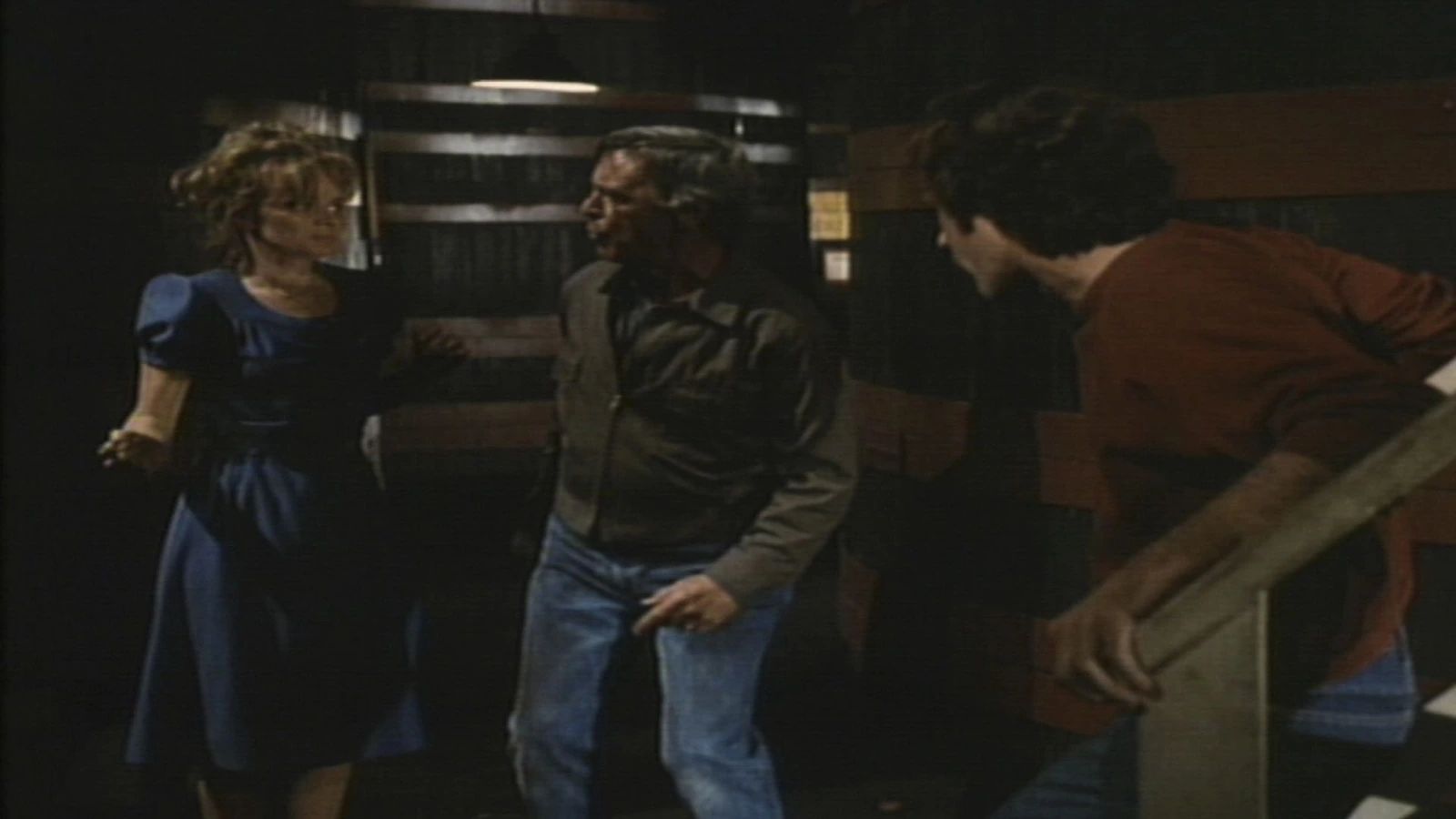
Margaret Ladd’s Emma Channing occupied an unusual place in the ensemble. She could be vulnerable, eccentric, and unexpectedly direct. Other characters might underestimate her, especially when she did not fit their idea of a person who could be useful in a negotiation. That left room for her to notice the human absurdity of arrangements everybody else was treating as perfectly practical.
Emma was present at the catastrophe that begins the series, which gives her relationship with Angela an immediate complication. Protection and control are entangled before the first family homecoming is finished. Angela can insist she is acting for her daughter’s good while also managing the facts that threaten her own plans.
Ladd gave Emma a vulnerability that did not simply cancel her personality. She could be funny without being nothing but a joke. A romantic longing or an awkward observation might puncture the self-importance of the room around her, and the other characters’ reactions could tell us as much about them as about her.
The series sometimes took her into storylines that were broad even by Tuscany Valley standards, particularly as the later years pursued new complications. Yet Emma’s continuing presence remained part of the house’s identity. She belonged to a family that was always explaining what was best for her, which made an independent preference carry more weight than it might have elsewhere.
In a program full of polished statements concealing another intention, Emma could change the atmosphere by being less polished. Her scenes offered a different sort of unease from Angela’s calculations. Somebody might say something inconvenient because she was not playing the same game, and suddenly the game would look a little less dignified.
Richard Channing arrived with money, a newspaper, and very bad news
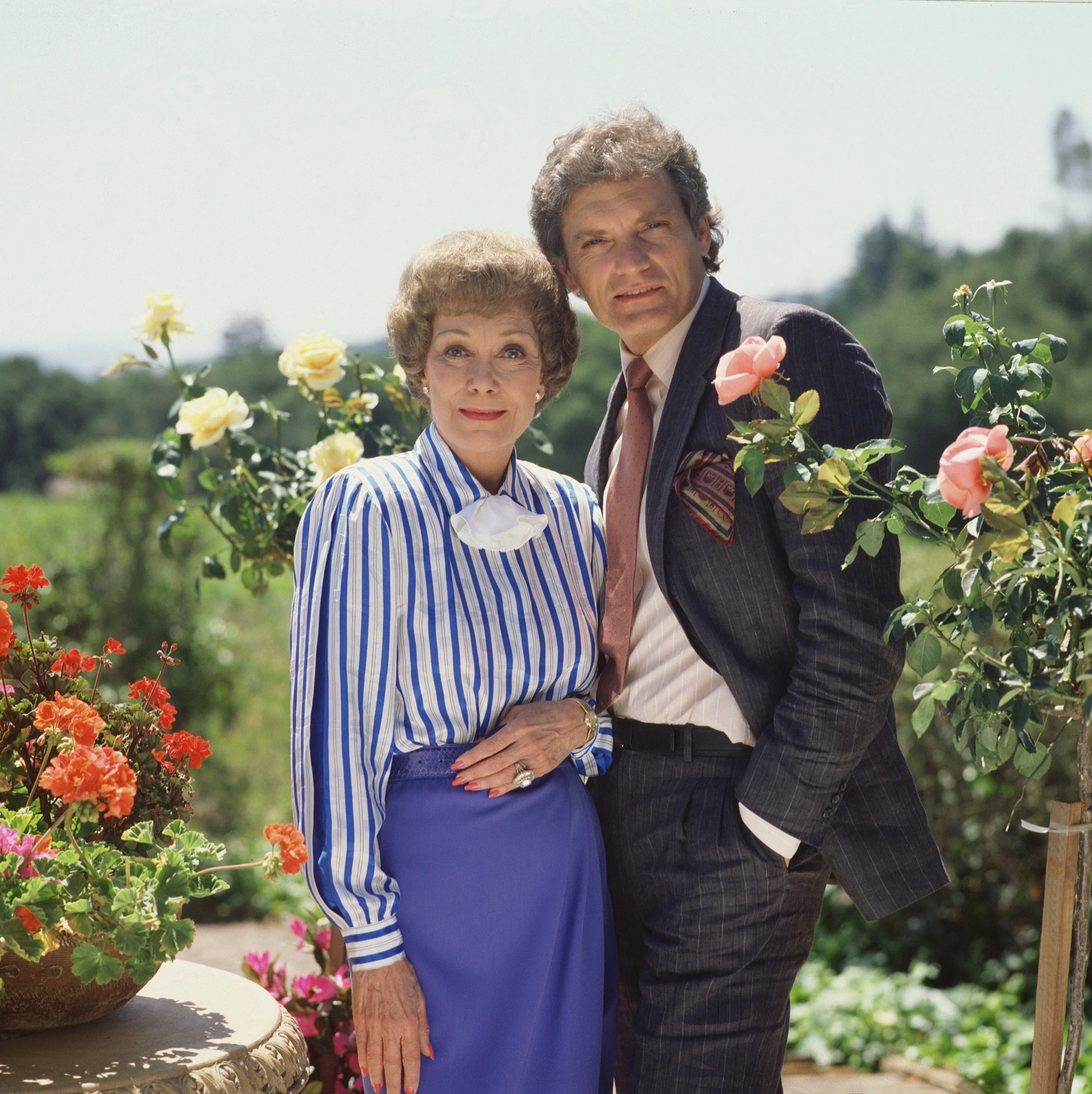
David Selby’s Richard entered in the second season and quickly became central to the series. He came connected to the late Douglas Channing and the New Globe, putting another powerful adult inside the valley’s already crowded struggle. Angela could deal with a nephew trying to work a vineyard. A man with substantial resources and his own appetite for control was a different order of inconvenience.
Selby gave Richard a combination of charm, severity, and emotional hunger. He could be an opponent without becoming a flat obstacle. The character’s money and business methods made him dangerous, but his need for attachment made him harder to dismiss as simply the next person seeking a larger piece of the map.
The newspaper widened the show’s means of attack. Land and banks were not the only ways to influence the valley. Publicity could do damage too. A headline could make a private humiliation travel, and a story could become another tool in a personal battle. Richard brought an institution with him, which meant his hostility did not have to remain confined to a room.
His relationship with Maggie also changed the program’s emotional arrangement. The romance had to coexist with everything viewers already knew about him. Sullivan’s warmth did not magically clear his record; Selby’s vulnerability did not mean the methods disappeared. That friction gave the pairing a different charge from an uncomplicated escape from the Channing feud.
And then the family history changed again. The revelation that Richard was Angela’s son gave their hostility a new, deeply inconvenient meaning. A lesser opponent could leave the valley. A son makes the inheritance discussion considerably harder to close.
The family tree was another place to hide a weapon
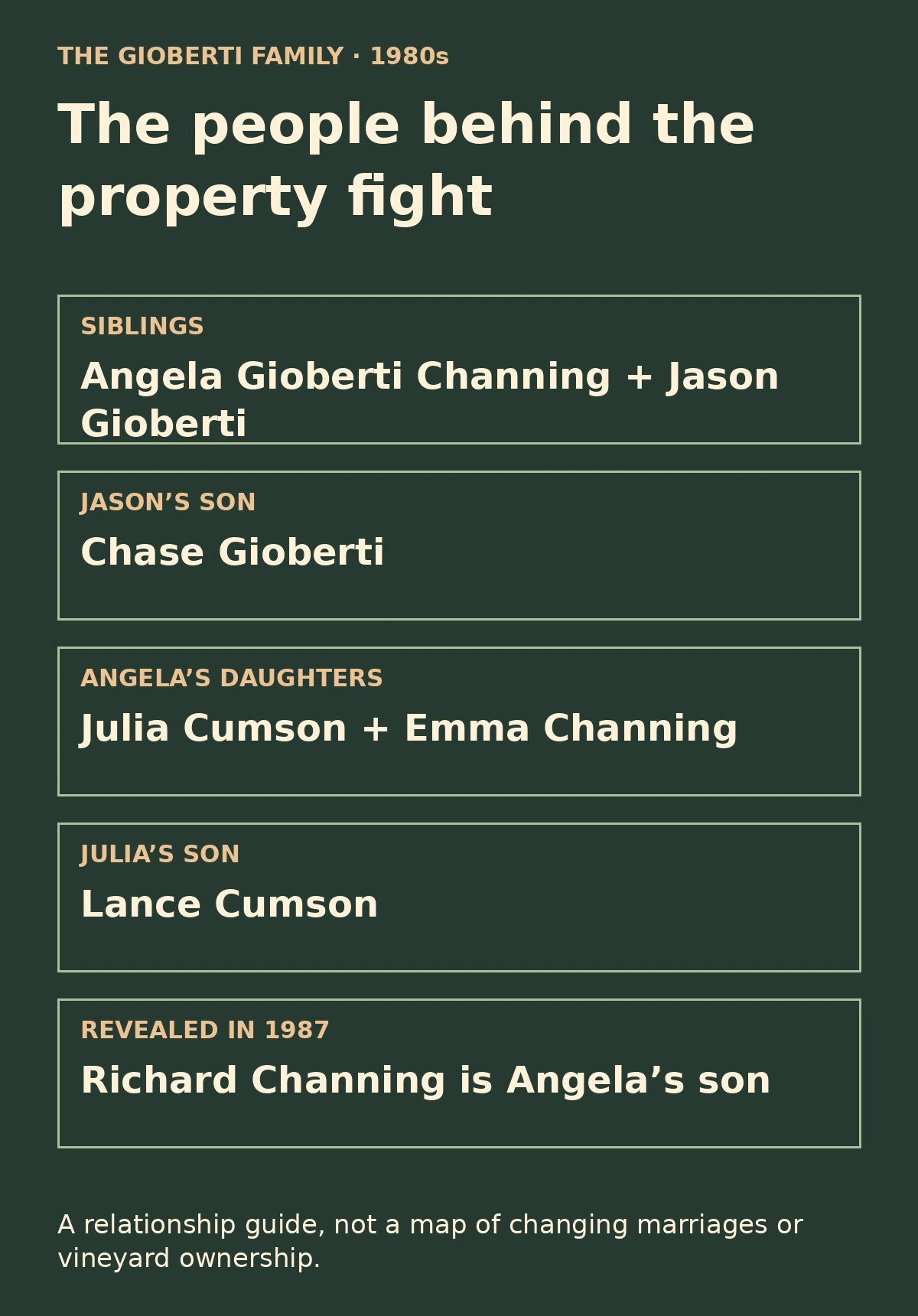
At the beginning, the central branches are manageable. Angela and Jason Gioberti are siblings. Chase is Jason’s son. Julia and Emma are Angela’s daughters, and Lance is Julia’s son. The series then spends years making the consequences of those relationships less manageable than the diagram suggests.
The Richard revelation is particularly effective because it does not arrive before his rivalry with Angela has acquired a history. By the end of the sixth season, the information that he is the son she believed had died changes what their shared scenes mean. The audience does not have to forget the conflict. It now has another reason to care about it.
That is the useful difference between a family secret and a random surprise. The secret reaches backward. It changes the weight of earlier behavior and forces people to reconsider what they thought they were protecting. Angela’s attachment to family continuity has to accommodate a person she has already treated as a threat.
The younger generation creates a different sort of tangle. Lance, Cole, and Melissa have romantic and parental connections that cannot be detached from the property disputes around them. A child can carry love, obligation, leverage, and an inheritance claim into the same conversation. None of those meanings is likely to remain stable if the adults keep revising their loyalties.
Keeping track is part of the fun, but the names matter most when the actors make the relationships feel inhabited. A chart can tell you where Richard belongs. Wyman and Selby have to make it interesting that Angela and Richard cannot simply agree to behave as the chart suggests.
Lana Turner made the family past arrive in person
Lana Turner’s Jacqueline Perrault brought another major Hollywood presence into the early series. As Chase’s mother, she was connected to the Gioberti family before she entered Angela’s immediate orbit. Her appearance made the past feel less like information waiting in a file and more like a visitor who might say something the hostess would prefer remained unsaid.
Turner and Wyman did not need to resemble one another to make the pairing interesting. The show could put two stars with substantial screen histories into the same wealthy-family environment and let their different styles register. Jacqueline’s arrival expanded the set of people who had known the family before the current argument began.
Her role in the Richard story added another complication. Parentage in this series was not a reliable means of identifying a safe ally. A person’s history could contain information useful to somebody who was currently behaving like an enemy, and a family gathering could become the place where the information stopped remaining private.
Jacqueline’s death in the aftermath of the second-season gunfire gave the next season an emotional and strategic problem to absorb. A murder mystery had produced an answer, but it had also damaged the larger family structure. That is how the show kept its serial engine running: the consequences of one dramatic solution became the material of the next set of episodes.
It also showed the advantage of using a guest star as a character with connections rather than as an isolated attraction. Turner was not simply visiting a vineyard for the novelty of seeing her there. Jacqueline belonged to the history people were fighting over, and her presence could make the present much more dangerous.
Phillip knew the paperwork; Chao-Li knew the house
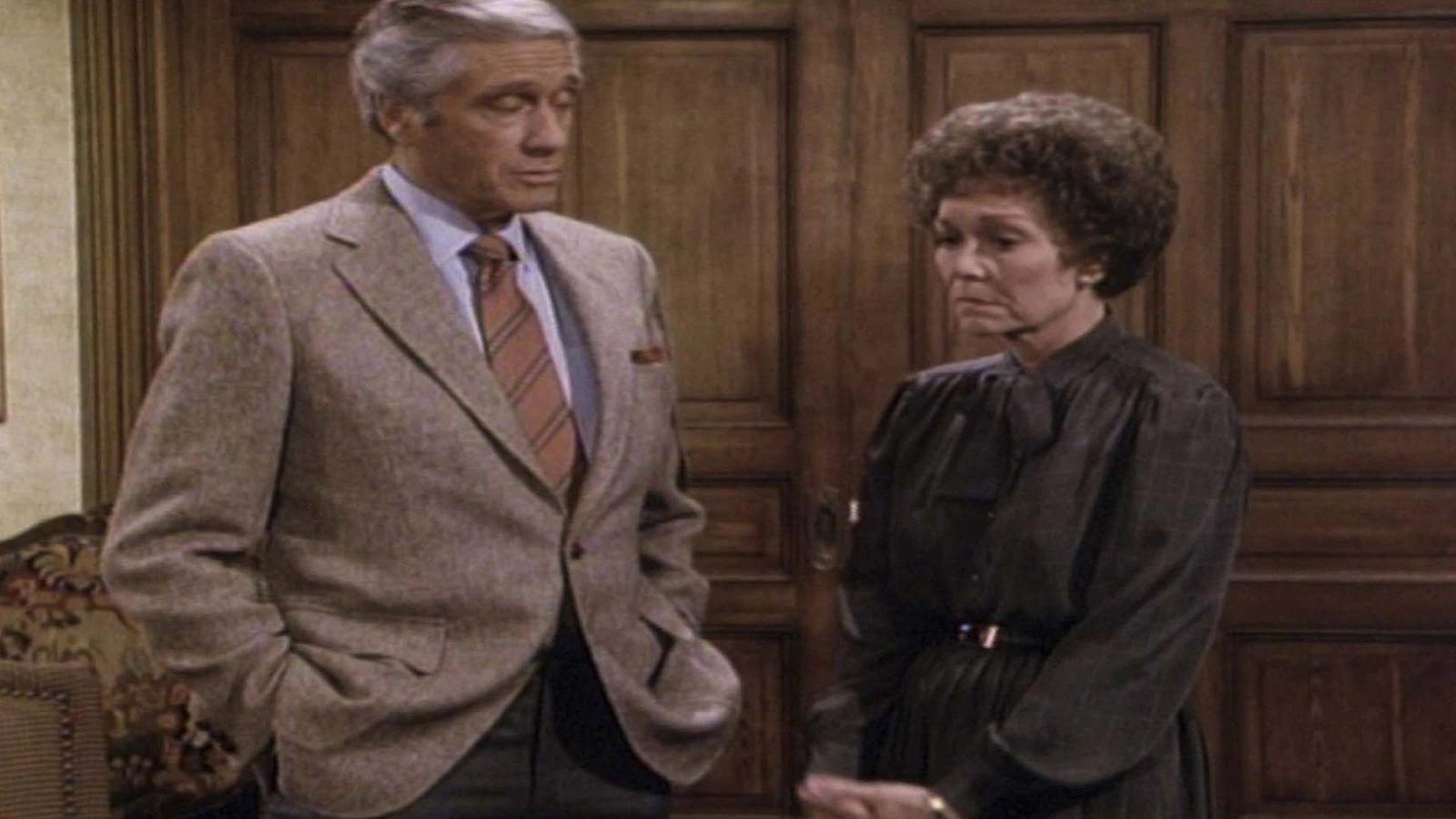
Mel Ferrer’s Phillip Erickson occupied the professional side of Angela’s power. As her attorney, and eventually her husband, he could make an intention sound respectable enough to sign. That was an important skill in a place where a carefully arranged transaction might accomplish more than an open declaration of war.
Ferrer gave Phillip a cultivated assurance that suited the role. The character did not have to be physically imposing to be troublesome. He could bring the legal instrument, explain the disadvantage, and make the whole thing seem as though it was simply the natural operation of business. Angela’s methods looked even more formidable when they came with competent paperwork.
Chao-Li Chi’s Chao-Li belonged to a different kind of authority. As a long-serving member of the household, he was part of the daily continuity of the mansion. The family might be generating a fresh emergency, but somebody still knew the house, its routines, and the people moving through it.
His presence mattered visually as well as practically. A familiar member of staff could make the estate feel inhabited across years of cast changes and plot convulsions. He was not another owner announcing a claim. He was somebody whose familiarity with the place made the owners’ constant uncertainty more noticeable.
These supporting relationships helped Angela’s world feel larger than a single commanding performance. Power needs people who carry it into action, and a house needs people who keep it functioning after the family has finished making a mess. Phillip and Chao-Li occupied very different positions, but each made the estate more convincing as an ongoing institution.
The 1984 plane crash made the family trip a terrible idea
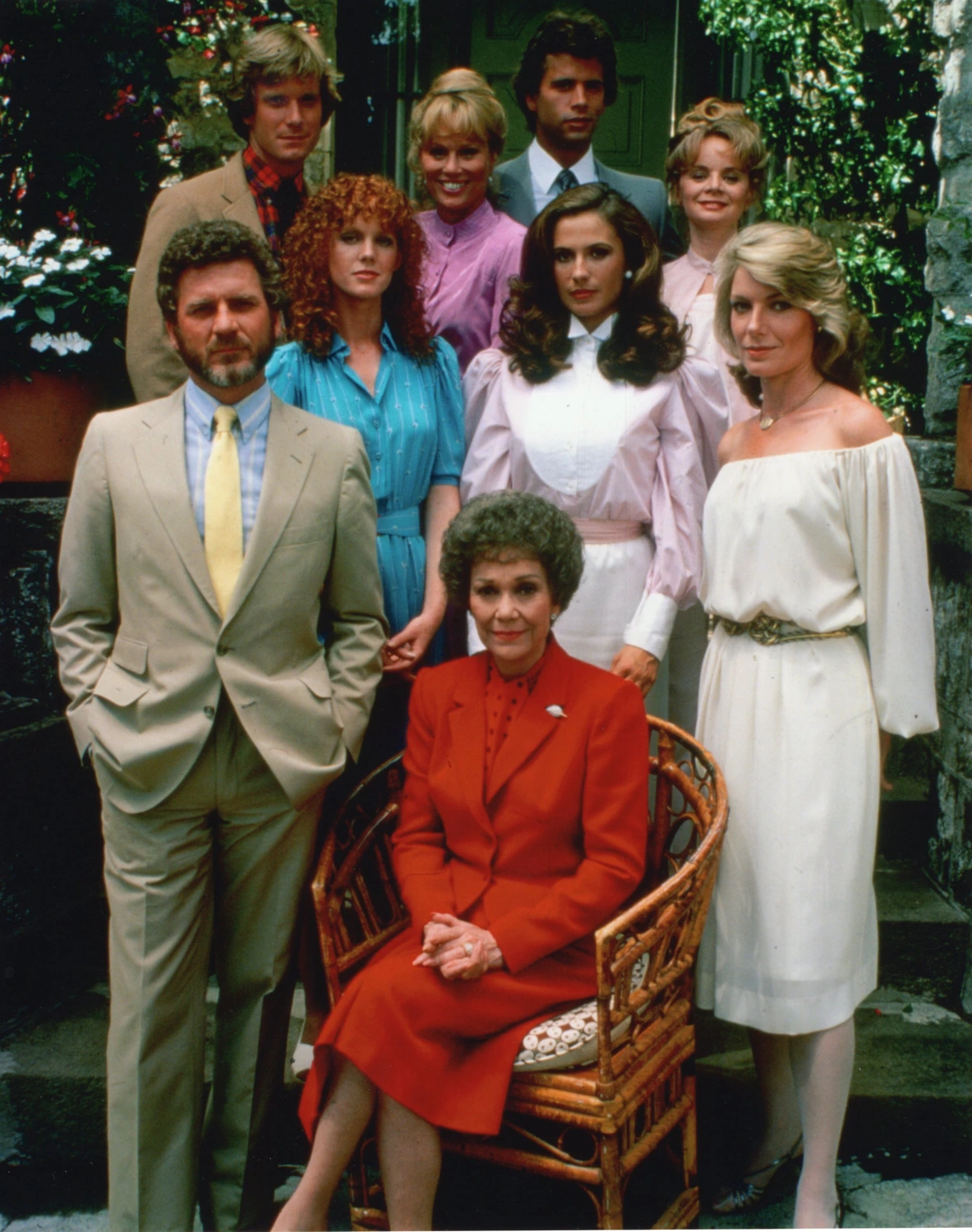
The third-season finale, “Ashes to Ashes,” ended with a plane crash involving much of the principal cast. For a family already struggling to get through ordinary gatherings, putting so many important people into one aircraft was an impressively efficient way to create a summer of uncertainty.
The setup grew out of family obligations and the handling of a death, rather than a random group holiday. That gave the journey a reason to gather people whose relationships were already loaded. Once the flight was in danger, the question was not only whether a favorite character would survive. It was which parts of the ensemble would still exist when the series returned.
The fourth-season premiere, “Requiem,” dealt with the survivors, the dead, and the investigation into what had happened. Phillip Erickson, Michael Ranson, and Linda Gioberti were among the casualties. Those losses reached into different branches of the show: Angela’s household, the extended family, and the younger generation.
A stunt this large can become a substitute for story if the next season simply carries on as though the only purpose was to sell a promotional announcement. Falcon Crest had the advantage of relationships that made the absences matter. Removing a spouse or a close relative changes who remains in the room and what the remaining people can expect from one another.
The crash also became part of the series’ public memory, one of the events people recall even when they no longer remember every arrangement of vineyard ownership. That is the strange economy of a soap cliffhanger. Months of negotiations can prepare the conflict, but a few minutes of catastrophe become the picture that stays.
Tuscany Valley kept attracting very impressive trouble
The series had a gift for giving established performers a reason to enter its world. Lana Turner and Mel Ferrer were part of the early prestige. Cliff Robertson played Dr. Michael Ranson. Gina Lollobrigida arrived as Francesca Gioberti, Angela’s half-sister, and Celeste Holm played Anna Rossini. Tuscany Valley was becoming a place where a surprisingly large number of famous faces had unfinished business.
Francesca’s appearance raised questions of family claims and entitlement, a natural way to introduce a visitor into this particular serial. Angela’s notion of an orderly future had little room for another person arriving with a reason to be included. The new character could make a conversation about kinship sound very much like the beginning of a property dispute.
Anna Rossini’s story brought another kind of grudge into the valley. Celeste Holm’s presence suited a program that could enjoy a formidable adult woman without needing her to become a copy of Angela. Old grievances, expensive surroundings, and performers who knew how to hold a scene were a very workable combination.
Cesar Romero’s Peter Stavros added romance and another substantial history to Angela’s later life. Rod Taylor’s Frank Agretti expanded Melissa’s family connections. The guests could change the texture of the series, moving it toward older Hollywood glamour or a different style of confrontation without requiring a new setting.
The risk was always that a procession of arrivals could make the original family harder to see. The successful additions had something specific to disturb. A visitor did not become interesting merely by being famous; the character needed a claim, an attachment, or an appetite that somebody already in the valley had reason to resist.
Richard’s house was no place to look for a quiet evening
The fourth-season finale, “The Avenging Angel,” closed in May 1985 with Maggie and Richard inside his house when an explosion tore through it. After the previous year’s plane disaster, the series found another way to make an apparently comfortable interior a very bad place to be.
The episode had already been busy with the consequences of schemes that had failed to go according to plan. Angela expected a financial victory; the ownership struggle refused to resolve itself in the manner she preferred. Lance was grieving Lorraine. The valley did not need another emergency, which was never much of an argument against having one.
Sarah Douglas’s Pamela Lynch was part of Richard’s dangerous professional world. She had been his assistant, and their relationship carried more than routine office friction. The later revelation that Pamela had planted the bomb made the destruction a consequence of a personal and business conflict, rather than a natural disaster arriving from outside the plot.
Douglas brought an especially controlled kind of menace to the role. Pamela could belong in an expensive office without seeming remotely reassured by its furniture. She was another reminder that Richard’s resources did not make the people around him safe. Being near the man with money could mean being near the enemies, the concealed arrangements, and the bill when a partnership ended badly.
Maggie’s presence put the emotional stakes beside the business danger. Sullivan’s character could be looking for comfort and still end up inside the physical consequences of someone else’s secret history. That is a harsh arrangement for a woman already trying to navigate her own changing marriage, and an effective one for a serial determined to keep private feelings and public schemes colliding.
The next season had to deal with injuries, damaged relationships, and the question of who was responsible. A house can be rebuilt much more easily than trust. Richard’s power remained formidable, but the explosion gave the audience a spectacular answer to the idea that his wealth might provide a secure place to hide from the valley’s troubles.
The earthquake shook a valley that was already unstable
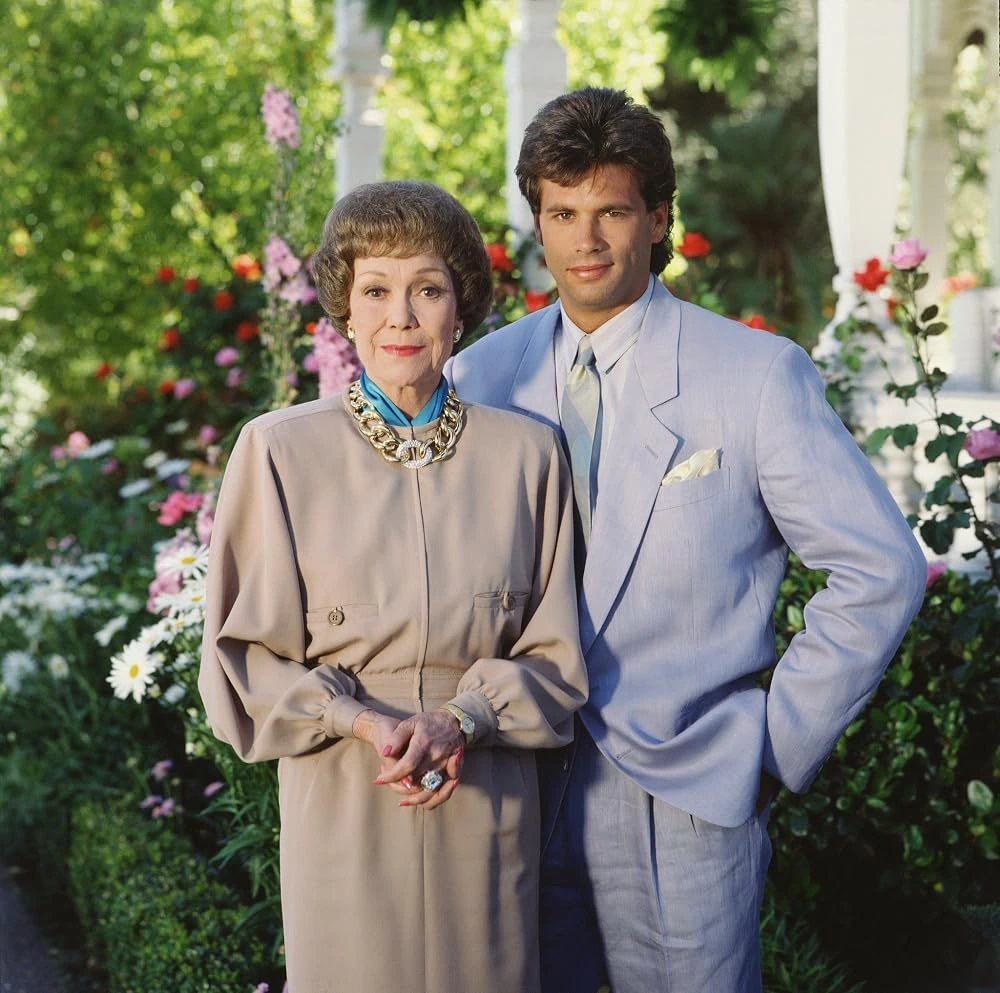
The fifth season ended with “The Cataclysm” in May 1986, bringing an earthquake into a community that had been doing a perfectly adequate job of damaging itself without geological assistance. It was a large physical event that could put several strands of story in danger at once.
The disaster arrived after a season of romantic and business trouble, including the Agretti and Stavros connections and the continuing conflicts around Richard. The earthquake did not choose a side. Expensive rooms, carefully defended property, and people accustomed to making the next move all became vulnerable to something that would not listen to a proposal.
The following season opened with “Aftershocks,” an appropriately direct title for the practical and emotional aftermath. In a serial, surviving the event is only one part of the business. Who helped whom, who lost somebody, and which relationship had been under strain before the floor moved can all become material for the next chapter.
The broadcast date also deserves a small correction to the show’s usual Friday identity: the fifth-season finale aired on Thursday, May 22, 1986. The familiar Friday slot was the normal arrangement, not a guarantee that every important episode followed it. The television season ending in 1986 gives the event its proper broadcast-year setting.
The earthquake is easy to remember as another example of the genre escalating its cliffhangers. That is true, but the pleasure lies in whose world is shaking. Angela had spent years behaving as though the estate’s future could be secured by sufficient determination. The ground was taking a rather unhelpful position on the subject.
The sixth-season finale put the family in the water
“Desperation,” the sixth-season finale in May 1987, moved the danger to San Francisco Bay. Melissa, Chase, Richard, Dan Fixx, and Maggie’s baby became part of a crisis involving a car going into the water and attempts at rescue. For viewers following the family’s personal disasters, this was no longer simply a question of who controlled a winery.
The episode also carried the Richard-parentage revelation. That combination shows how much business a prime-time soap could pack into a finale: a family secret with the power to rewrite relationships, plus a physical emergency that might remove one of the people needed to argue about it afterward.
Robert Foxworth’s departure meant that Chase did not return as the continuing opponent Angela had faced since the first episode. The change was enormous for the series. He had brought the Gioberti family back to the valley; his decision to stay had launched the central dispute. Without him, the show had to redistribute both its resistance to Angela and its emotional connections.
Maggie’s relationship with Richard became even more important in the evolving arrangement. It could not simply fill Chase’s space without changing the kind of story being told. Selby’s character came with different resources, motives, and vulnerabilities. The series was moving from one balance of power toward another, and viewers had reasons to feel both curiosity and loss.
A long-running soap survives by changing, but the most important changes should feel important. Chase’s disappearance affected the meaning of the valley as well as the cast list. The man who once arrived for his father’s funeral had helped turn Falcon Crest into a weekly battleground. His absence left a different family to fight over it.
Terry, ambition, and the danger of treating money as an escape
Laura Johnson’s Terry Hartford, Maggie’s sister, offered another angle on the valley’s wealth. She did not arrive with Angela’s position or Maggie’s settled family identity. Her relationships with men and money were entangled with the desire to secure a place for herself, and she could be both opportunistic and vulnerable.
Terry’s presence also complicated the idea that Maggie’s family occupied a morally separate part of the program. A sibling does not necessarily share your habits, your sense of obligation, or your preferred account of the past. The connection put another personal history into a show where personal history had an unfortunate tendency to become public leverage.
Johnson could make the character’s appetite visible without making every scene a declaration of greed. In the world of Falcon Crest, wanting a more secure life was understandable. The difficult questions concerned what a person would accept, conceal, or do to somebody else in the process of getting it.
That made Terry useful alongside characters who treated inherited power as normal. Angela could describe a choice as protecting the family estate. Somebody without an estate might call a similar choice finding an opportunity. The behavior could be equally damaging, while the language used to excuse it changed with the size of the house.
Her years also belong to the period when the series could add a disruptive person without losing sight of the original households. Maggie’s sister was not an unrelated visitor passing through on a promotional tour. She brought an existing connection, which meant the consequences of her decisions had somewhere familiar to land.
Losing Melissa removed a very useful source of trouble
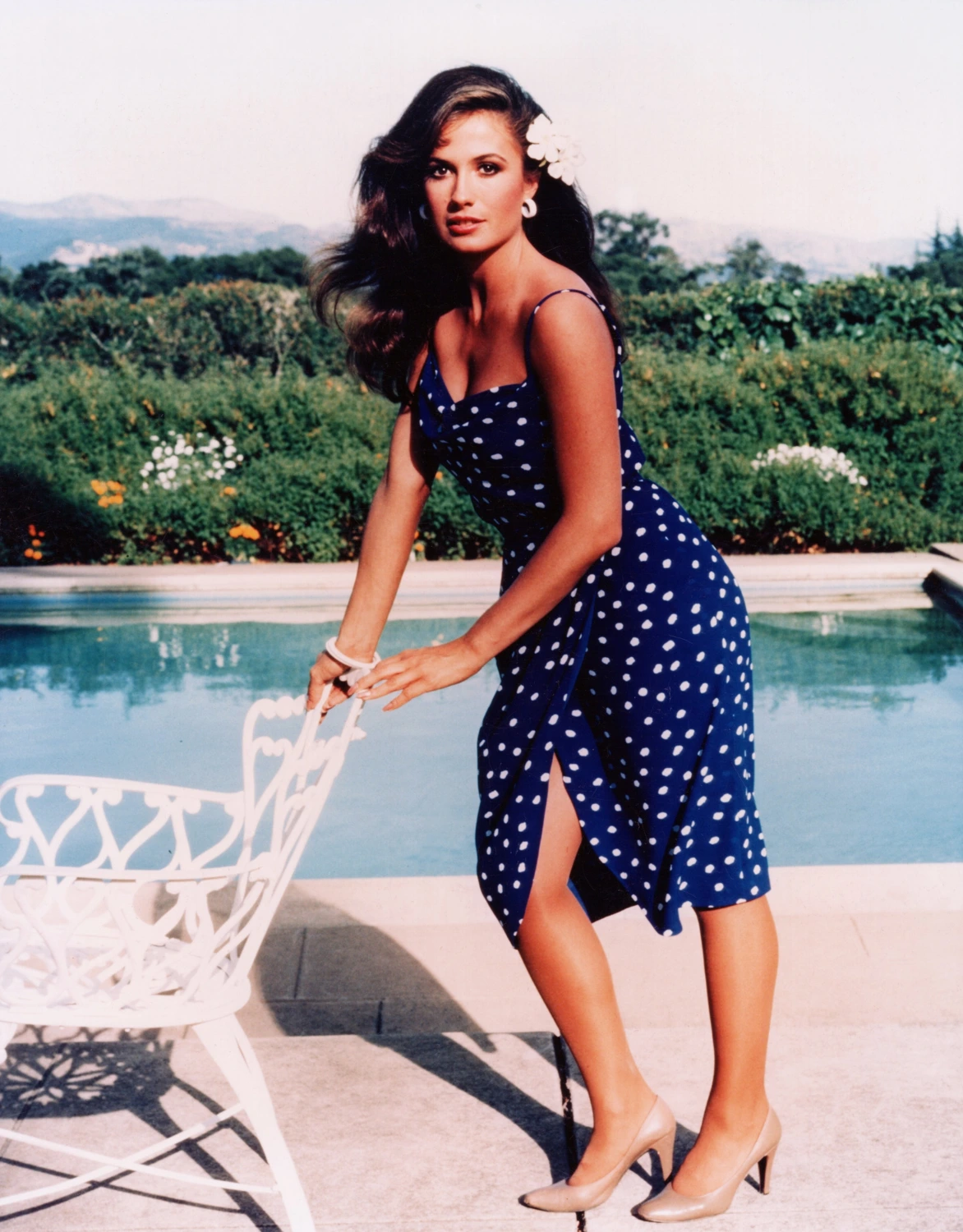
The eighth season began in fall 1988 with the series already changing. Melissa’s control of Falcon Crest had overturned Angela’s expectations. Then the story moved toward the mansion fire and Melissa’s death, removing Ana Alicia’s central character from a program that had spent years using her ambition to keep the family struggle hot.
The loss mattered because Melissa was more than one half of whichever romantic pairing occupied her at the moment. She connected the Agretti land, the younger men’s rivalry, Angela’s authority, and the desire to seize the estate outright. Taking her away meant losing a person who could cause trouble across several parts of the show at once.
Ana Alicia returned later as Samantha Ross, a different character who resembled Melissa. The resemblance could make a story, but it could not supply the accumulated history viewers had with Melissa herself. The audience knew the performer. The relationships had to start from a different position.
This is one of the risks of late-run serial change. A character can be infuriating enough that everybody in the fictional town seems likely to enjoy a quieter life without her. The television program may then discover that the quiet is less entertaining. A person who keeps making things difficult can also be the person connecting the most useful conflicts.
The eighth season therefore feels different for a reason that cannot be reduced to a new hairstyle or a change in the opening credits. An important engine was gone. The show still had formidable people, beautiful surroundings, and unfinished business. It had lost somebody who had made a great deal of that business impossible to conduct calmly.
By 1989, the familiar vineyard had become a different show
Later additions such as Pilar Ortega, played by Kristian Alfonso, and Nick Agretti, played by David Beecroft, brought new relationships and ambitions into the valley. Lance remained, but the people around him and the pressures shaping his life were changing. A long-time viewer could recognize the landscape while feeling that the household had been rearranged.
The ninth season began in September 1989 and continued into 1990. It belongs partly to the decade this article covers and partly to what followed. Maggie’s death early in that final season was another major break with the original series, and Angela’s absence through much of the year changed the balance still further.
The details of the final 1990 resolution are not needed to pretend the entire run was an eighties event. What matters here is the direction visible as the decade ended. The original contest between Angela and the returning Giobertis had given way to a different configuration of business warfare, new characters, and fewer of the familiar people who had made the estate feel like one continuous family problem.
The ratings had fallen from the Top 10 years. That happened within a broader retreat for the giant prime-time soap cycle, but it also reflected the series’ own changes. Not every new complication deepened the existing investment. Sometimes it replaced an old reason to care with a fresh reason to keep track.
There is no need to make the late years carry the whole verdict. A series can have a striking peak, make uneven choices, and still deserve the affection attached to its strongest version. For Falcon Crest, that version includes a house full of people who know Angela very well and still underestimate how quickly she can make their plans unpleasant.
The clothes were expensive; the humor could be wonderfully dry
Falcon Crest had the clothes, attractive cast, and handsome interiors expected of a wealthy-family serial. Yet some of its best entertainment came from a reaction that did not need any of those things. Wyman could let Angela register a visitor’s confidence with the expression of somebody noticing a stain on an otherwise acceptable carpet.
The dry humor helped distinguish the show from a competition to stage the largest possible confrontation. A room could remain orderly while the conversation became vicious. The contrast made the setting more enjoyable: beautiful things arranged around people who were doing their best to ruin one another’s afternoon.
That did not make every episode restrained. The series embraced gunfire, disasters, kidnappings, and revelations that would make an ordinary family’s reunion impossible to schedule. The smaller comic beats gave those large plots somewhere to land. If everybody performed at catastrophe volume all the time, an actual catastrophe would have had to work much harder to get noticed.
The music contributed its own part of the promise. Bill Conti’s theme made the estate sound grand, urgent, and worth a dramatic entrance. The opening could sell the scenery and the scale, while the scenes that followed supplied the deliciously petty ways powerful people used their time.
That mixture was part of the show’s appeal among 1980s television’s familiar weekly appointments. You could enjoy the spectacle without requiring every pleasure to be enormous. Sometimes the most satisfying moment was simply somebody discovering that Angela had understood the proposal perfectly and intended to make the answer no.
Falcon Crest, Dallas, Dynasty, and the quieter street nearby
Putting the era’s major soaps beside one another makes the individual attractions clearer. Dallas had its Texas family empire. Dynasty turned glamour and rivalry into an especially extravagant spectacle. Falcon Crest occupied its vineyard with a matriarch whose power could be both intimidating and dryly funny.
Knots Landing built more of its identity around a neighborhood and the emotional consequences that kept following people home. Tuscany Valley had a larger estate to fight over, but it still needed recognizable attachments underneath the money. Angela’s daughter, Maggie’s sister, Lance’s grandmother: those relationships gave the property disputes personal teeth.
The comparisons are useful until they become a demand to declare one show the only worthwhile version. Viewers could have room for more than one set of troublesome wealthy people. CBS certainly hoped they did on Friday. The interesting question is what made each household feel different when the opening music ended.
For Falcon Crest, the answer includes Wyman’s authority, Selby’s complicated charm, Sullivan’s warmth, and Ana Alicia’s appetite for disruption. It includes a vineyard that looks inviting enough to make the conduct inside it even less defensible. It includes a family that can identify preservation as its highest value while doing an extraordinary amount of damage in the name of preserving things.
That is its own flavor of 1980s excess. The show did not need every person to arrive in a new luxury car or end every conversation by breaking glass. The land itself was desirable, and Angela was quite prepared to explain why somebody else’s desire for it was the real problem.
Why the view from Falcon Crest still holds up
A return to the strongest years offers more than a collection of outrageous plot summaries. The pleasure is in watching a large, experienced cast make the relationships legible while the ownership arrangements become less so. You may need a reminder about a contract. You do not need much explanation for the expression on Angela’s face when another relative decides to become independent.
Wyman is the essential attraction, but the people around her give that authority something to work against. Foxworth’s stubbornness, Sullivan’s intelligence, Dalton’s distress, Ladd’s vulnerability, Selby’s hunger, and Ana Alicia’s refusal to settle make the valley feel like a community of conflicting needs instead of one star surrounded by convenient victims.
The real locations help too. The estate has enough physical beauty to make possession understandable even when the methods become absurd. If the family were ruining one another over a featureless office block, the central obsession would lose something. Those vines and that house make the attachment visible.
The series eventually changed beyond the form that made it a major hit. That does not diminish the force of the early and middle years. For a run of Friday nights, Falcon Crest offered a particularly satisfying combination: a desirable place, a dangerous family, and a woman who could make hospitality feel like the first move in a takeover.
Pour the wine, enjoy the view, and let Angela handle the toast. Just do not assume that being invited to the house gives you any say in what happens to it.
Questions about Falcon Crest in the 80s
When did Falcon Crest premiere?
The series premiered on CBS on December 4, 1981. Its regular Friday slot followed Dallas. The complete nine-season run continued through May 1990, so its final season crossed the decade boundary.
Who played Angela Channing?
Jane Wyman played Angela Channing. The principal early cast also included Robert Foxworth as Chase, Susan Sullivan as Maggie, Abby Dalton as Julia, Margaret Ladd as Emma, and Lorenzo Lamas as Lance. David Selby joined as Richard in season two.
Was Tuscany Valley a real place?
Tuscany Valley was fictional. California wine-country locations helped establish it, including Spring Mountain Vineyard’s Villa Miravalle, the exterior associated with Angela’s mansion.
How high did Falcon Crest get in the ratings?
It reached seventh place for the 1983–84 season. Its three consecutive Top 10 finishes were eighth in 1982–83, seventh in 1983–84, and tenth in 1984–85.
Was Falcon Crest created by the same person as The Waltons?
Yes. Earl Hamner Jr. created both shows. Falcon Crest used another family attached to a place, with a much sharper emphasis on wealth, inheritance, manipulation, and the battles to control an estate.