Safety School Bus
Removable ball-headed riders establish the basic idea that small figures can travel, switch seats and become characters.
Smells Like Gen X • The Town Was Open Until Cleanup
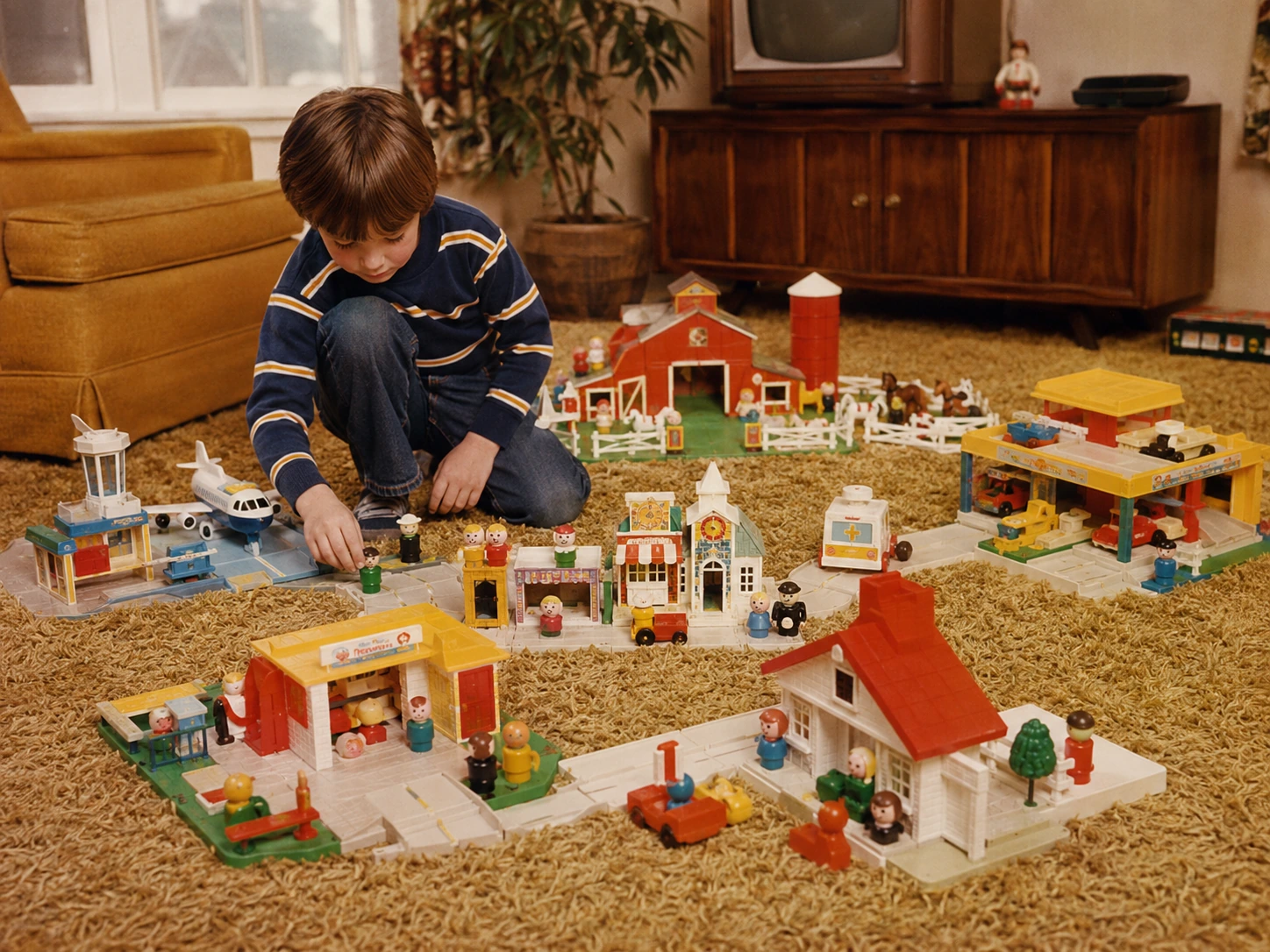
I’m Gen X, and I remember this world from the floor: the barn mooing, the Garage bell ringing, the airport runway crossing the carpet and one wooden kid from the school somehow living at the Farm. Fisher-Price gave us ordinary places. We built a complete civilization and staffed it with whoever had not vanished under the couch.
Fisher-Price Little People were small peg-shaped figures and compatible preschool playsets marketed mainly as the Play Family line during the 1970s. Farms, houses, garages, schools, airports, boats, towns and licensed Sesame Street sets created a durable open-ended world built for small hands and long floor-time stories.
I lived this one. Little People were not toys you finished. You opened the buildings, moved the population around and kept the town operating until an adult needed the floor back. By then, the farmer was flying the plane and the pilot lived in the barn.
They were simple enough for a toddler, detailed enough to hold attention and sturdy enough to survive being inherited by the next kid.
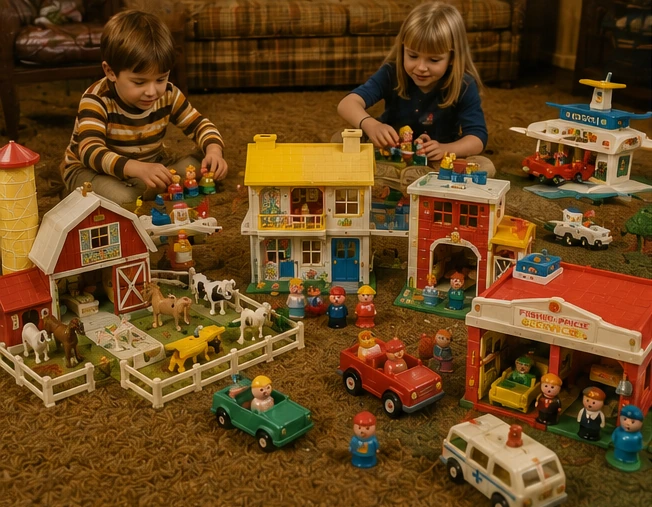
I’m Gen X, and Little People are one of those memories that starts below eye level. The farm sat open on the carpet. The garage elevator was halfway up. A yellow car was missing one passenger, and somebody from the house had apparently taken a job at the airport. Nobody needed to explain why.
A round head, a simple face and a chunky peg body gave us just enough information to decide who somebody was. The rest came from the room, the vehicle, the color and whatever story was happening that afternoon.
A garage, farm, school, house and airport do not sound dramatic until they are all operating at once. Little People turned the everyday world adults moved through into something kids could control from the carpet.
The same figure could eat breakfast at the house, ride a car into the garage, fly from the airport and spend the evening on the houseboat. Compatibility made every new set feel larger than the box it came in.
Doors opened, bells rang, elevators moved, cars rolled and the barn mooed. Those features rewarded a child without taking over the story.
Little People play was not about completing a mission. It was about running the town again tomorrow. That open-ended quality is why they rank so high among the most iconic toys of the 70s.
If one set was open, every other set in the room was part of the same town whether Fisher-Price approved the zoning or not.
The 1970s empire began with removable riders inside a wooden pull toy more than a decade earlier.
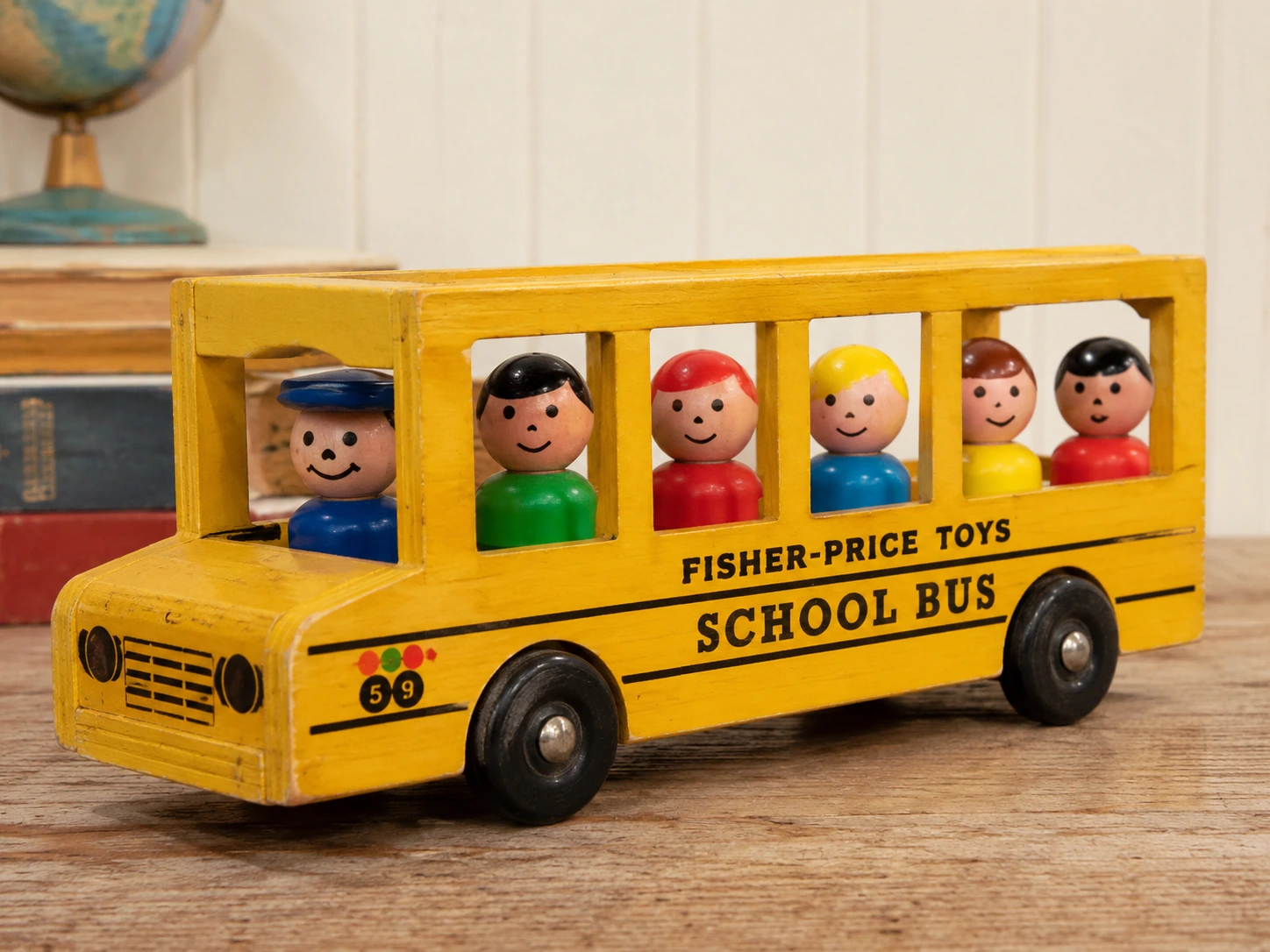
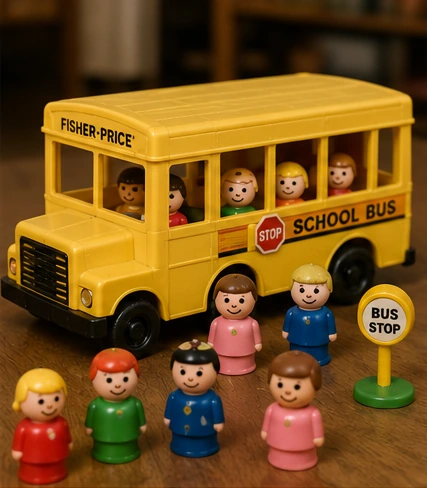
The Strong National Museum of Play traces Fisher-Price Little People to the 1959 Safety School Bus. Earlier Fisher-Price toys had used character shapes, but the bus made the riders removable. That simple decision changed the play pattern. A figure was no longer decoration attached to a vehicle. It could get off, move somewhere else and become part of another story.
A child could decide who drove, who rode and who stayed behind. The characters became actors rather than scenery.
The first bus riders used wood, paper lithography and simple ball-shaped heads. They looked more like pegs with faces than miniature dolls, which made them durable and easy to recognize.
Seats, doors and figure size were designed together. That shared scale eventually let cars, buses, airplanes, boats and entire buildings connect naturally.
Fisher-Price did not need a fantasy vehicle. A school bus was already important to a young child because it represented independence, older kids and the world outside home.
Recognizable place, simple movement, removable figures and a sound or mechanical reward would become the Little People formula for decades.
Families supplied the name everybody remembers long before Fisher-Price put it on the line.
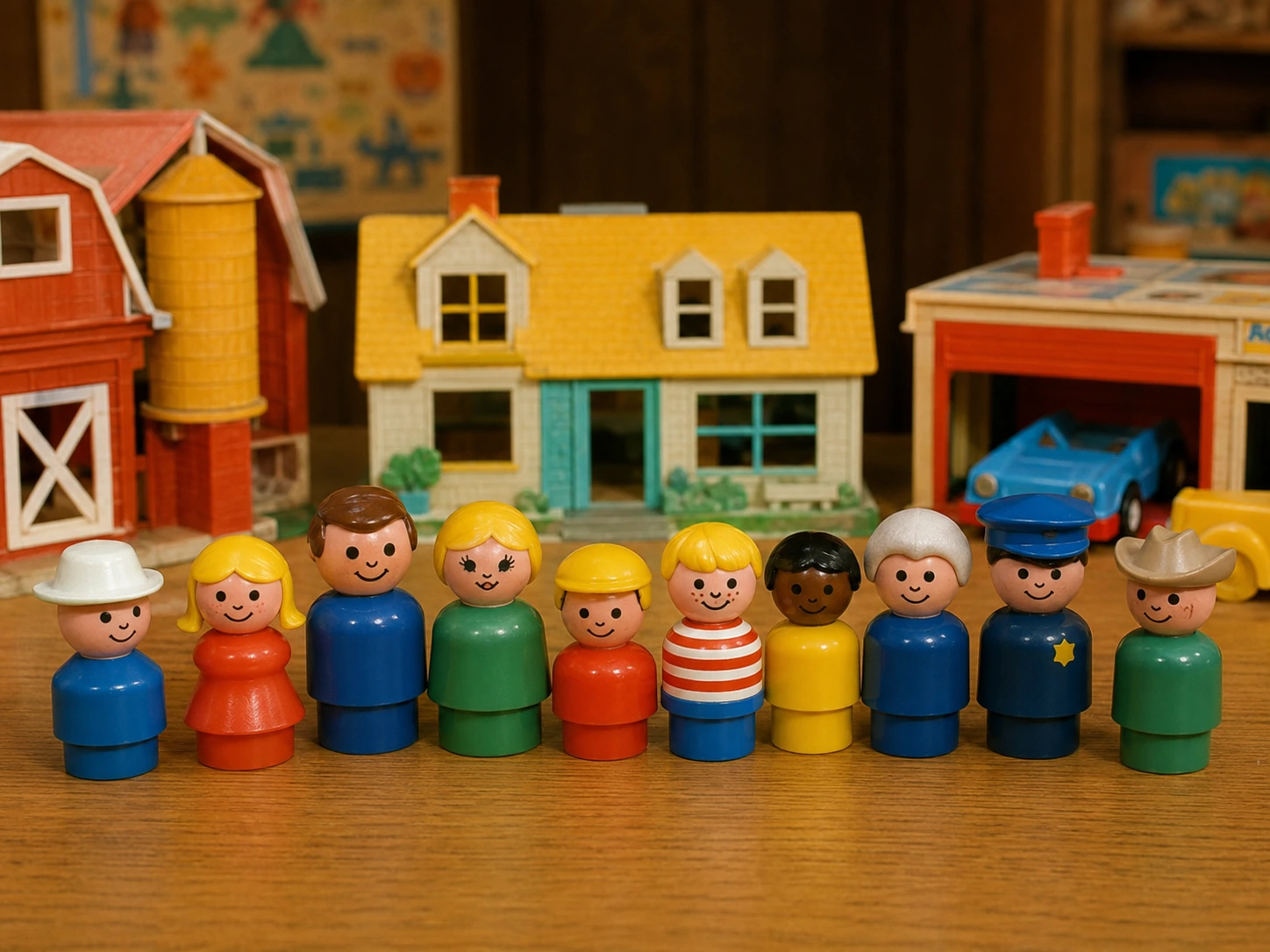
The Strong’s history notes that Fisher-Price began selling the connected figures and playsets as the Play Family line in 1965. That is the name found on many classic boxes from the 1970s: Play Family Farm, Play Family House, Play Family Airport and Play Family Village.
“Play Family” told parents that the sets encouraged familiar social roles. Moms, dads, children, workers, drivers, farmers and community helpers populated a world a preschooler already understood.
To us, they were the little people. The name was obvious, literal and easier to remember than a product-line label.
By 1985, Fisher-Price formally adopted Little People, recognizing the name consumers had already used for years.
Collectors search for Original Little People, Play Family figures, vintage Fisher-Price people and specific set numbers. All describe overlapping parts of the same classic era.
Gen X did not need the package to confirm what the figures were called. We had been crawling around the floor with them long enough to name the population ourselves.
They had no elbows, knees or detailed costumes, yet we somehow assigned every one of them a full life.
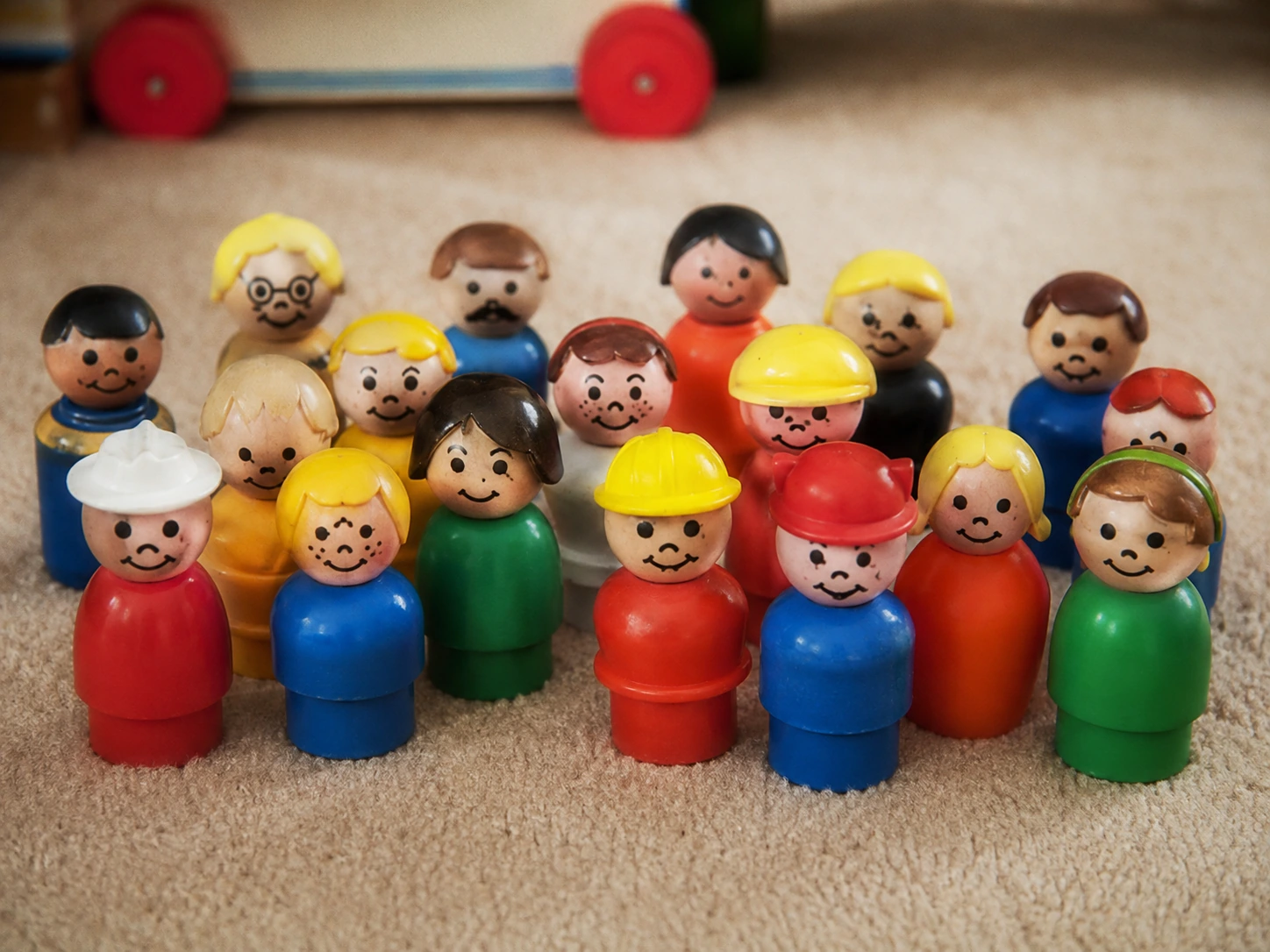
Hair color, hats, printed faces and simple features separated children, adults and workers without making the figures fragile.
The lower body dropped into holes in cars, planes, furniture and playset bases. A figure stayed upright without clips, complicated joints or tiny feet.
A firefighter could become a mechanic. A child from the school could move into the house. A farmer could pilot the airplane because nobody on the carpet checked credentials.
Many classic figures combined wooden bodies with plastic heads, while later versions used more plastic. The mixture made the figures feel substantial and created variations collectors study now.
Little People did not need to bend. The playsets supplied the action through vehicles, doors, elevators and the child’s hand.
The figures were easy to grasp, place and move repeatedly. Their size also explains why vintage examples require caution around very young children today.
A mustache, braid, cap or helmet could establish a job faster than a paragraph of backstory.
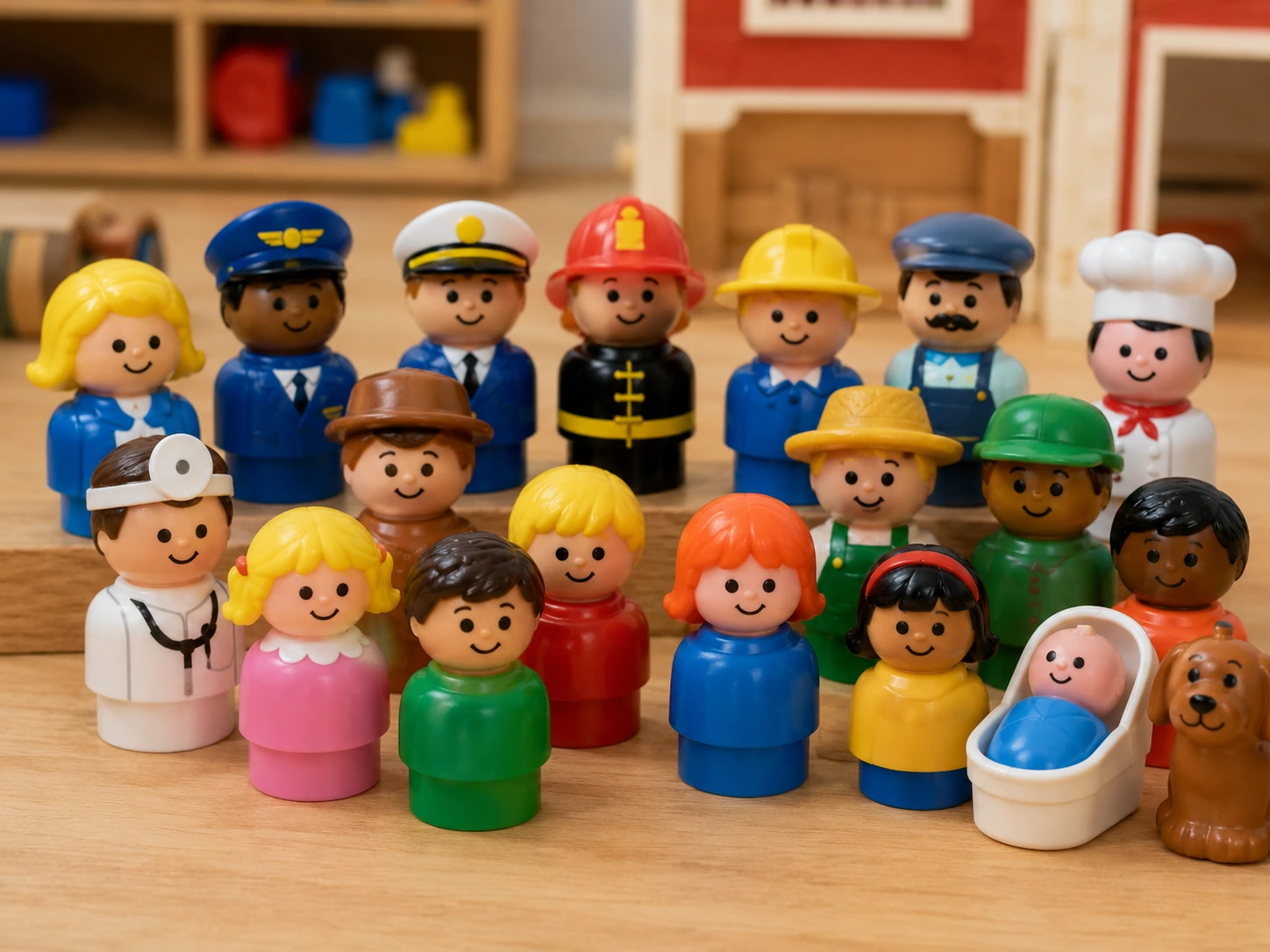
Police officers, firefighters, pilots, doctors, farmers and mail carriers were recognizable through hats, hair and body color.
Mom, Dad, Boy and Girl were less like named characters and more like reusable roles. A child could map a real family onto them or invent a different household.
Dogs, cows, horses, sheep, pigs and zoo animals moved through the same world. A dog could ride in a car, sleep in the house or supervise the airport.
Kids grouped families, workers, children and animals, then immediately broke the system when the story needed somebody else.
Classic sets included figures with different skin tones, jobs and family roles, though the range reflected the limitations and assumptions of its era. Variations across years and markets are part of collector research now.
Little People rarely looked angry or dramatic. That calm expression let the child decide whether the day involved breakfast, a fire call or an airport crisis.
Open the barn door and the cow noise came out. Close it, open it again and somehow it was still funny.
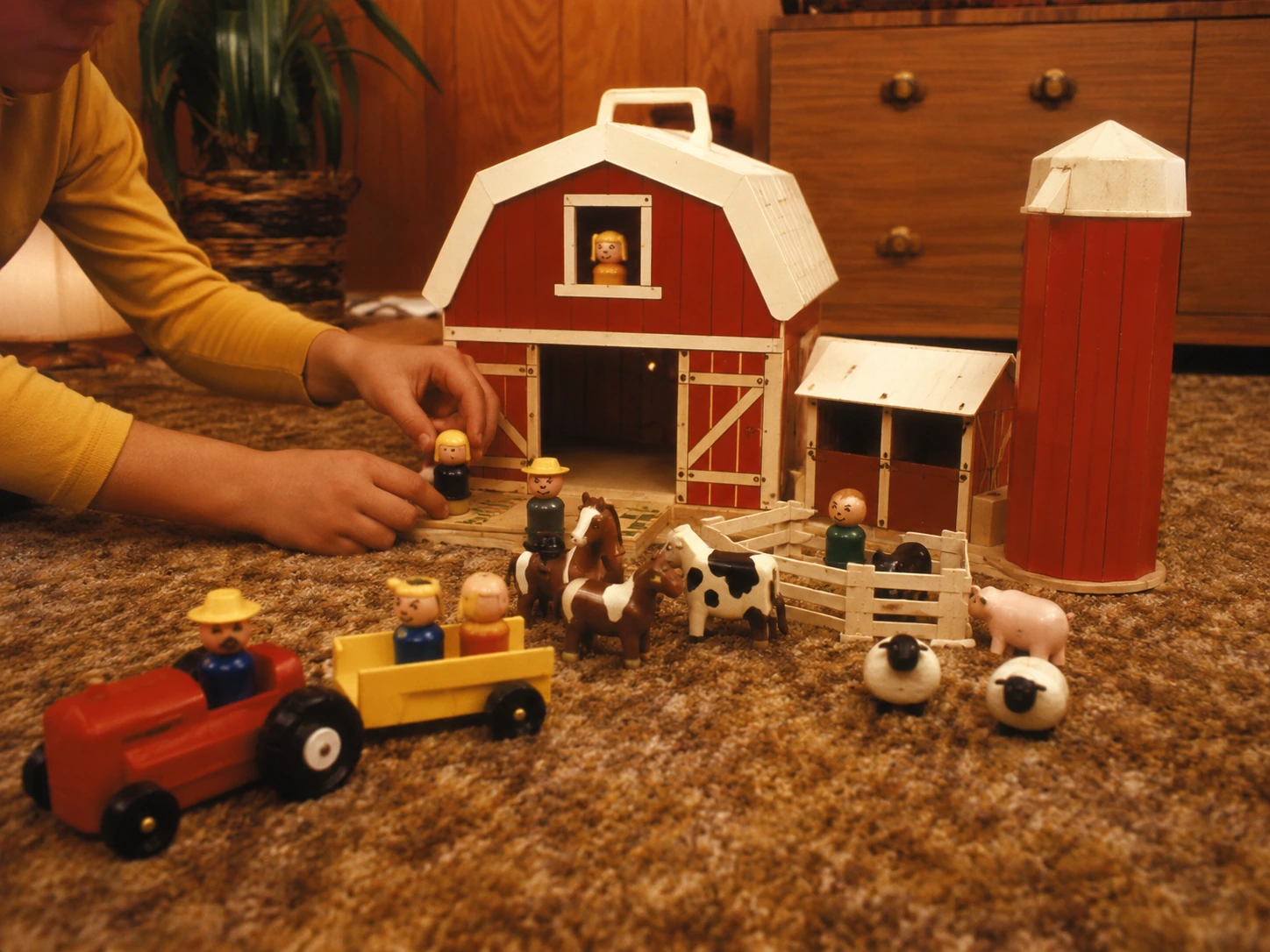
The Play Family Farm #915 arrived in 1968 and became a defining 1970s preschool toy. The Henry Ford notes that the set entered production in 1968, while The Strong describes the farm as one of the places where Little People let children explore a world beyond home.
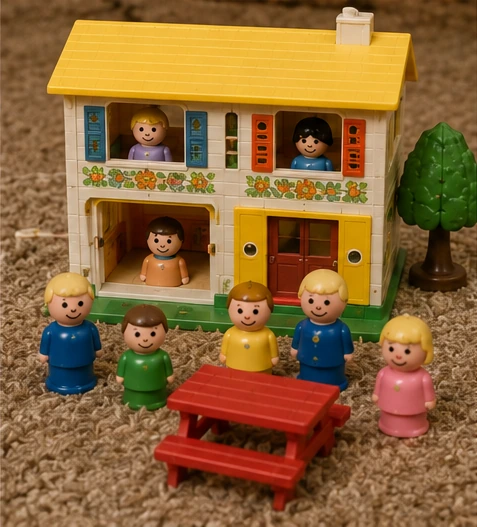
The folding building stored animals and figures inside, then opened into a farm with stalls, doors, loft areas and illustrated details.
Opening the barn door triggered the famous sound. It was not realistic enough to fool anybody, but it made the building feel responsive.
Cows, horses, pigs, sheep and chickens created sorting, feeding and barnyard stories that did not require a television character.
Cars from the garage arrived. Children from the house visited. The airport pilot occasionally took a shift feeding livestock.
Wood, Masonite, plastic and durable hinges helped the farm outlast many owners. A working sound mechanism and complete animal group matter to collectors today.
Little People could build both city and country. That range made the line broader than a dollhouse or vehicle set alone.
The farm’s everyday-world approach also connects naturally with the larger 70s houses and domestic-play story.
The house opened like a suitcase and revealed a complete family routine waiting behind the walls.
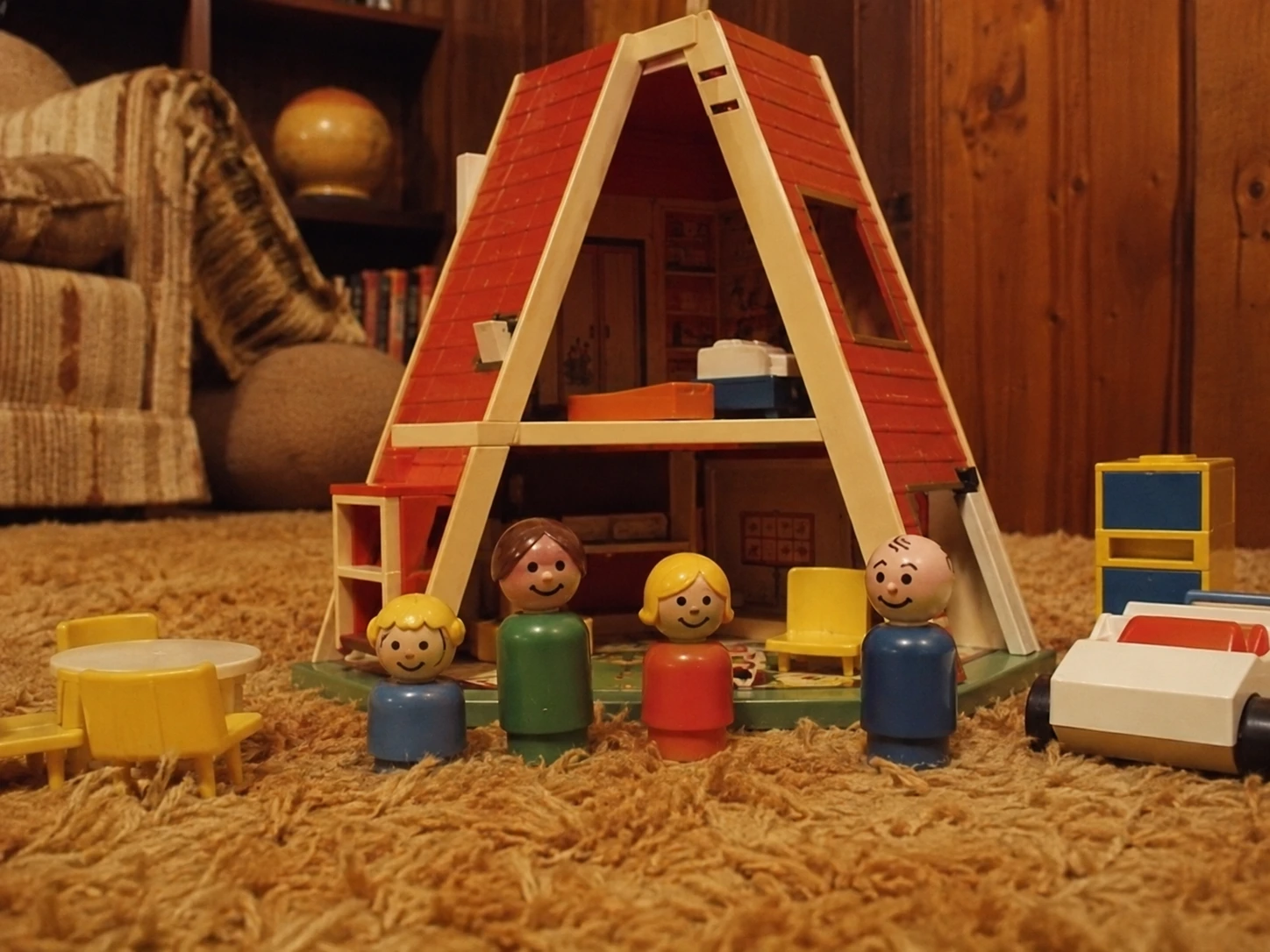
The Smithsonian’s National Museum of American History documents the Play Family House #952 as a 1969 release. The blue-and-yellow structure included a carry handle, attached garage, four illustrated rooms, furniture and a family of five figures including the dog.
Closed, the house became a compact object with a handle. Open, it doubled the visible world and turned the floor into a neighborhood.
Printed kitchens, bedrooms and living spaces created walls full of household clues while keeping the building sturdy.
Beds, chairs, tables and other pieces supported meals, bedtime, visitors and arguments only the child could hear.
A car could leave the house and head directly into the larger Action Garage, joining the domestic world with the carpet-road system.
They could represent the child’s family, television neighbors or a completely invented household.
Its peg figures and vehicle compatibility let it operate across gendered toy-aisle boundaries. The same building could host dolls, cars, animals or action figures.
The elevator went up, the bell rang, the car rolled down and we did it again until an adult could hear that bell in another room.
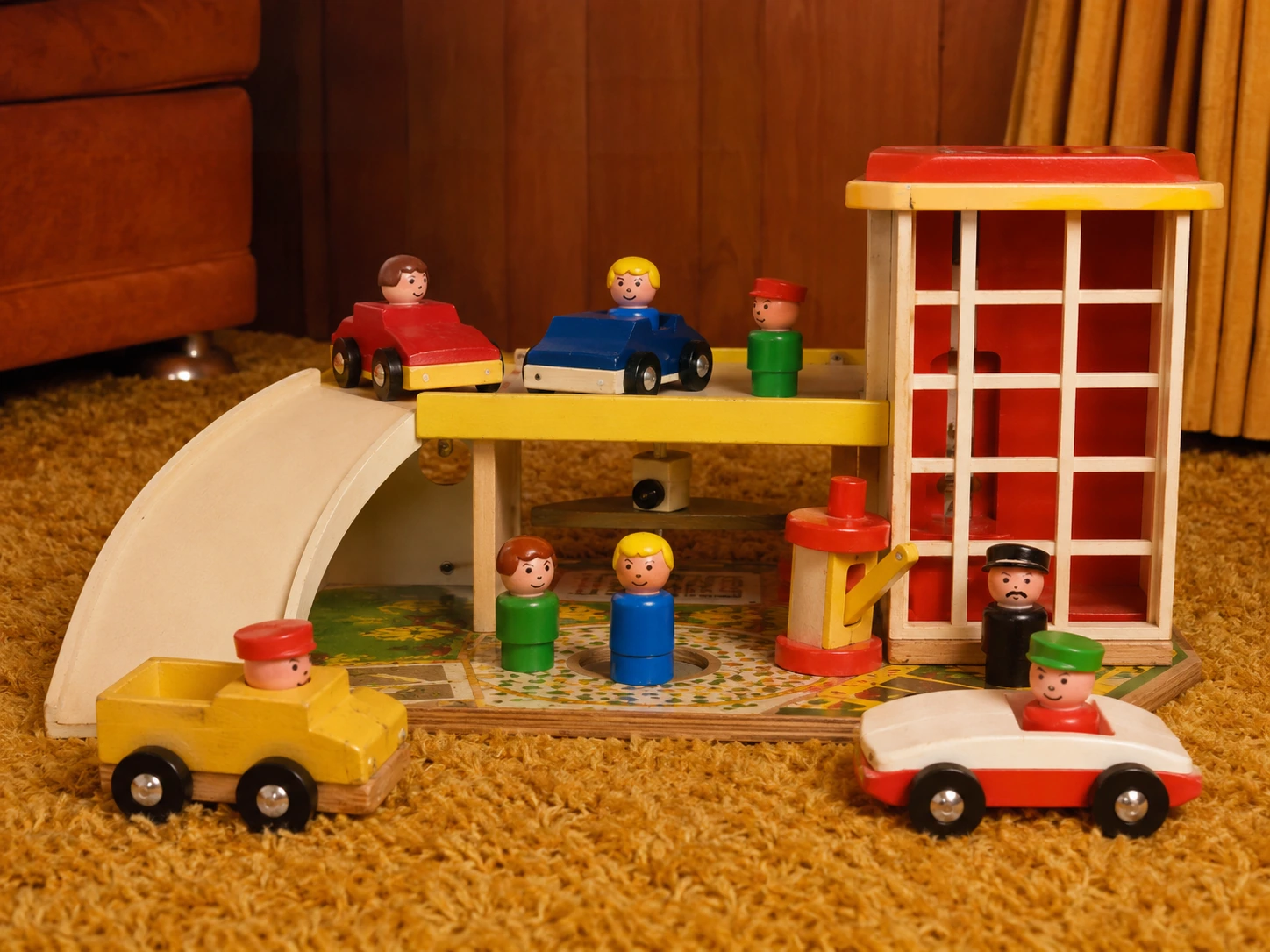
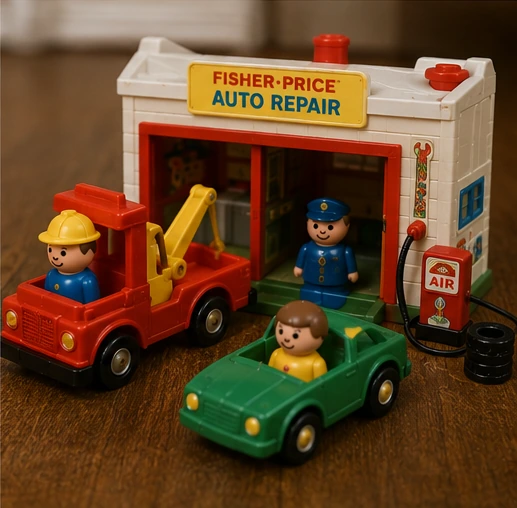
The Play Family Action Garage #930 appeared in 1970. A contemporary New Yorker holiday guide described its levels, elevator, ramps, gas pump, adjustable service rack, cars and knob-headed drivers. That description still explains why the set is remembered so vividly.
Turn the crank, raise the platform and hear the bell. At the top, the car could enter a ramp and race downward.
Cars did not only park. They needed gas, repairs and inspection, giving the mechanic figures something to do.
A car released at the top moved through the building without being pushed the whole way. Cause and effect became satisfying enough to repeat endlessly.
Official cars fit best, but the building lived beside Matchbox and Hot Wheels carpet traffic. Scale disagreements were ignored when the ramp was good.
Some toy sounds become memories because they were heard hundreds of times. The garage bell belongs in that category.
Cars, figures, gas pumps and small accessories migrated across toy boxes. A garage with working mechanisms and correct pieces is much harder to assemble than an empty structure.
The complete vehicle lane continues through Carpet Cities and Tiny Roads.
Before we had much control at actual school, Fisher-Price handed us the building, the teacher and the entire student body.
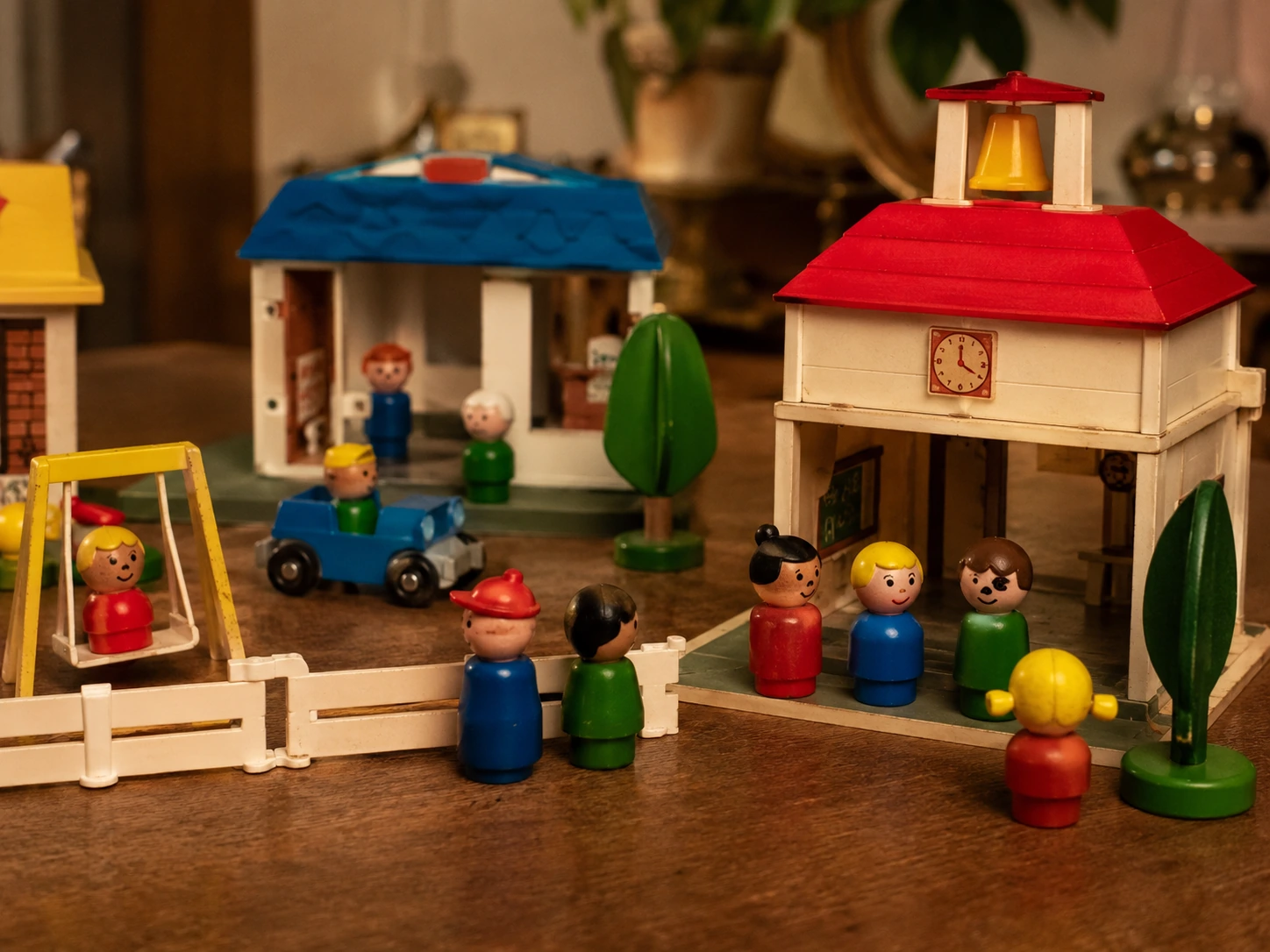
The Play Family School #923 was introduced in 1971. The set brought desks, figures, schoolroom graphics and classroom routines into the same compatible world as the house and garage.
The child decided who taught, who listened and who spent the entire day riding around in the bus.
Desks, boards, clocks, books and printed scenes created recognizable structure without requiring delicate miniature construction.
The line’s earliest vehicle idea found a destination. Students could leave the house, ride the bus and arrive at school in a complete daily loop.
Children placed students in seats, matched figures, organized groups and repeated routines that quietly practiced spatial and social skills.
Small desks, letters, numbers and chalk-related items were exactly the kind of accessories that slipped under furniture or moved into another set.
The school belongs beside the broader lineup on our top toys of 1971 page.
A plastic airplane and a small terminal were enough to turn the far side of the living room into another country.
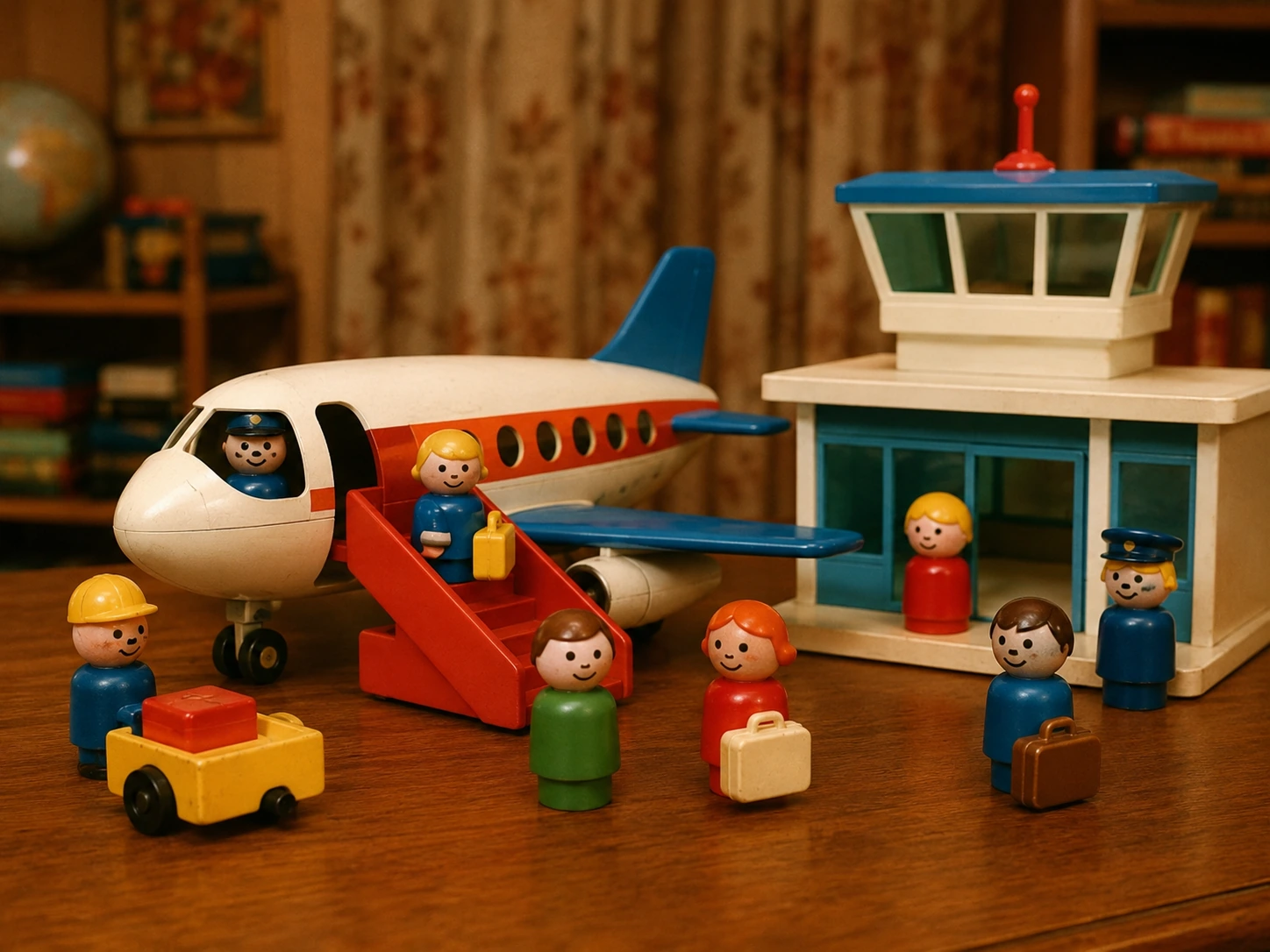
The Play Family Airport #996 arrived in 1972. Collector documentation identifies the early airport as a short-lived but highly memorable set built around a terminal, airplane and the routines of departure and arrival.
A car connected nearby buildings. The plane made the house, farm and Village feel like places separated by an entire journey.
Passengers checked in, waited, boarded and arrived. Kids reproduced the parts of travel they understood and invented the rest.
Uniform details helped establish who flew and who rode, though role assignments changed whenever the child needed another pilot.
Unlike electronic toys, the airport remained mostly quiet until the child supplied engines, announcements and radio chatter.
It flew over the garage, landed near the farm and occasionally crashed into a building with no insurance investigation.
The Airport and Houseboat expanded Little People beyond home and community buildings. See the wider toy year on our 1972 countdown.
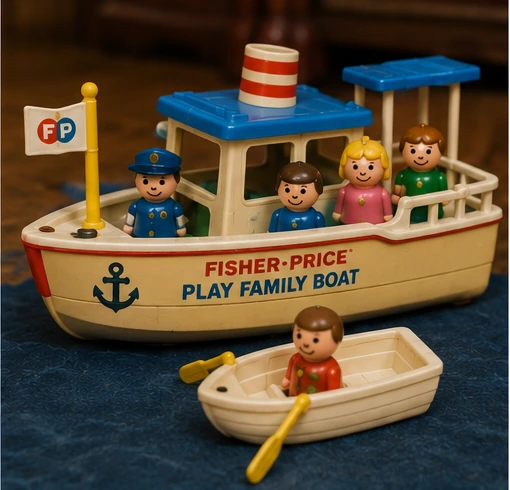
The carpet town already had roads and an airport. The Houseboat added water and created an entirely new way to lose accessories.
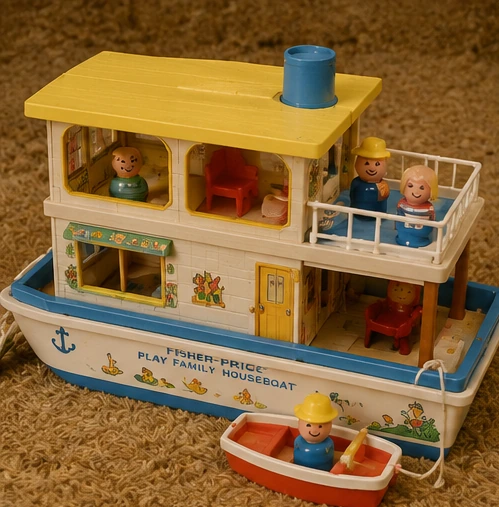
A period New Yorker holiday guide described the Play Family Houseboat as a pull-along toy that could also float, complete with removable residents, deck chairs, grill, diving board, speedboat and life preservers.
That versatility made the boat feel like more than a building. It could travel across carpet, then become the center of bathtub play.
Little People were usually working, driving, farming or attending school. The Houseboat let them relax, swim and experience the 1970s dream of recreational freedom.
A removable speedboat created travel inside the travel set, because one vehicle was never enough once the world started expanding.
Vintage examples may show staining, peeling or damage from the exact play the toy encouraged.
Bath animals, boats and figures joined the crew. Official scale stopped mattering as soon as the water started moving.
By 1972, Fisher-Price could turn nearly any familiar place or activity into a Little People world.
Once the family had a house, car, airport and boat, the next logical step was taking the whole population on vacation.
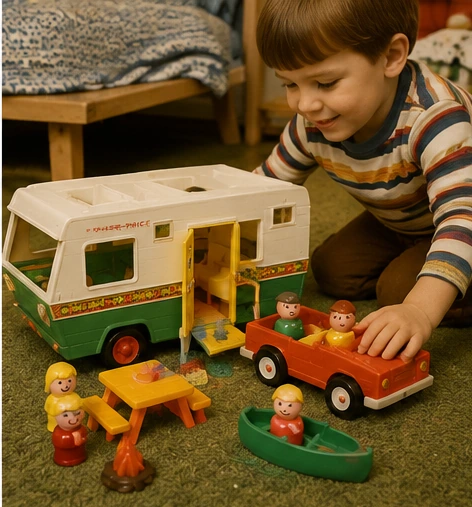
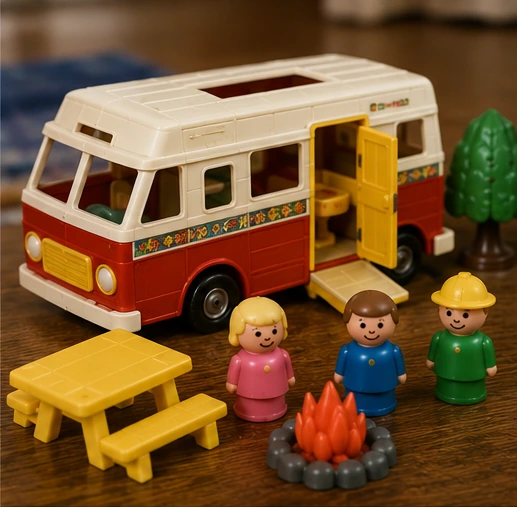
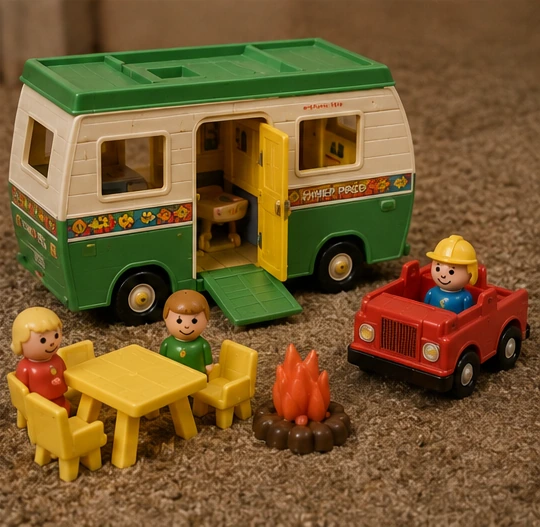
Sleeping, eating and driving happened inside one portable vehicle. The playset could leave the carpet town without leaving the room.
Little People vehicles were not only accessories. They explained how characters moved between sets and gave children a reason to spread the world farther apart.
A child could stage packing, departure, arrival and recreation. The story happened before the family reached anywhere.
The peg system made moving characters simple. A figure dropped into a seat and stayed upright through enthusiastic floor travel.
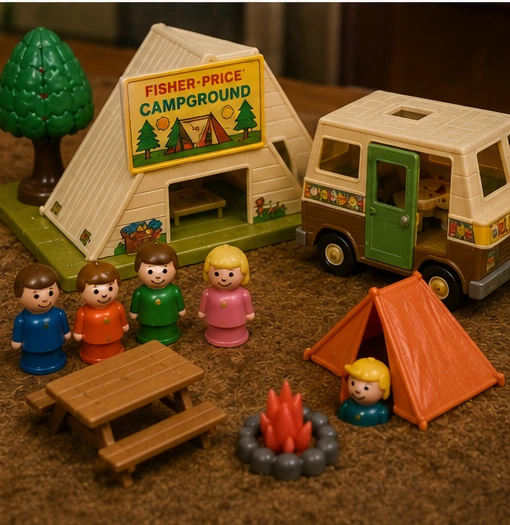
Camping, boating and flying were experiences many children knew through family trips, television or catalogs. Little People made them manageable.
Chairs, grills, flags and tiny boats were highly portable in ways the original buyer never intended.
Open the two halves, connect the town and suddenly one child was responsible for public safety, mail delivery, dentistry and apartment management.
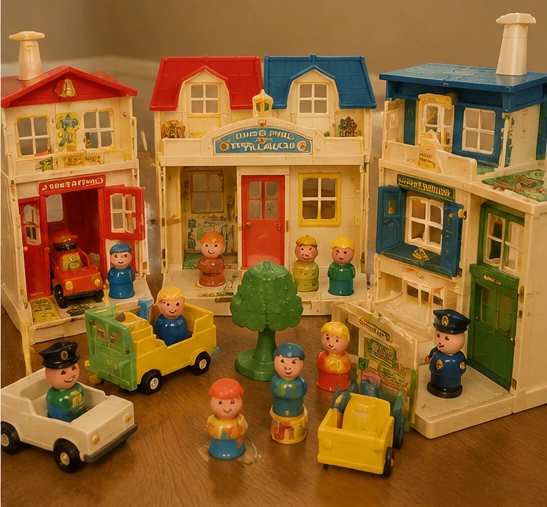
The Play Family Village #997 debuted in 1973 and was promoted as an enormous play center. A contemporary New Yorker description listed its police station, jail, firehouse, garage, barber shop, dentist office, apartment, telephone booth, theater, post office, mail truck and coded letters.
Instead of representing one location, it created an entire community with services, jobs and homes.
Sirens, vehicles and emergencies gave the quiet town a reason to move.
Letters matched addresses, turning delivery into sorting, memory and route planning disguised as play.
Workers did not vanish after their shifts. They had furniture, rooms and a place inside the larger community.
Little People excelled at turning ordinary adult routines into child-sized events.
Its strength was the quantity of details. That also meant more furniture, vehicles, figures, mail and specialty pieces to lose.
The Village belongs in our top toys of 1973 and the larger history of 70s Christmas wish-list battles.
The classic line grew from one bus into a complete world of homes, work, travel, education and community life.
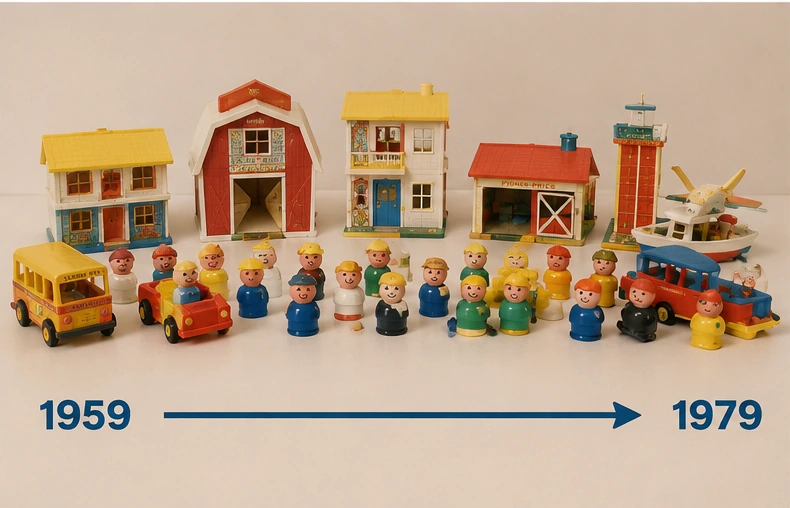
Removable ball-headed riders establish the basic idea that small figures can travel, switch seats and become characters.
Fisher-Price begins treating the figures and connected sets as a recognizable family-based play line.
The barn, animals and unforgettable door-triggered moo turn everyday farm life into a preschool landmark.
A folding home with rooms, furniture, garage and family figures makes domestic life portable.
An elevator, bell, ramps, lift and cars give the Little People town a mechanical center.
Classrooms, desks, chalkboard play and students bring the neighborhood into the school day.
The line expands into travel, airplanes, vacations, boats and bathtub-adjacent adventure.
The biggest community set combines work, services, transportation and apartments into a full town.
Recognizable television characters enter the sturdy Little People format and connect the carpet town to public television.
Community-role play expands into doctors, patients, beds, ambulances and the practical routines of care.
The playsets moved, but they never performed the story for us.
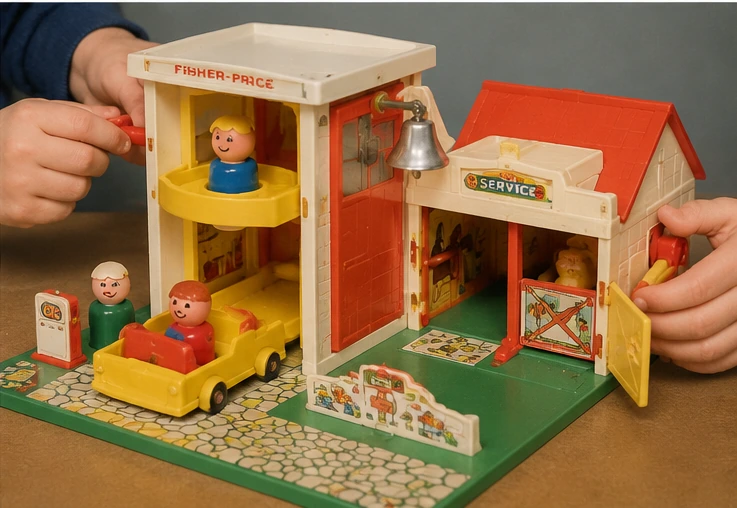
Turn a crank and an elevator rose. Open a door and a sound played. Push a vehicle and it rolled. The cause was visible and understandable.
A child could ring the garage bell fifty times without completing anything. The action itself was satisfying.
The farm moo and garage bell are remembered almost like theme songs because they belonged to specific places.
Most classic Little People playsets relied on springs, gears, cranks, gravity and the child’s voice.
The elevator moved cars because a garage needed levels. The barn sound happened because the door opened. Features felt connected to place rather than added randomly.
A silent barn or stuck elevator could still function as a building. Imagination continued even when the mechanical reward failed.
A complete-looking set with a broken crank or bell is not the same as one that still behaves as designed.
The official box showed one building. Our floor plan used every building, road and unrelated toy we could reach.
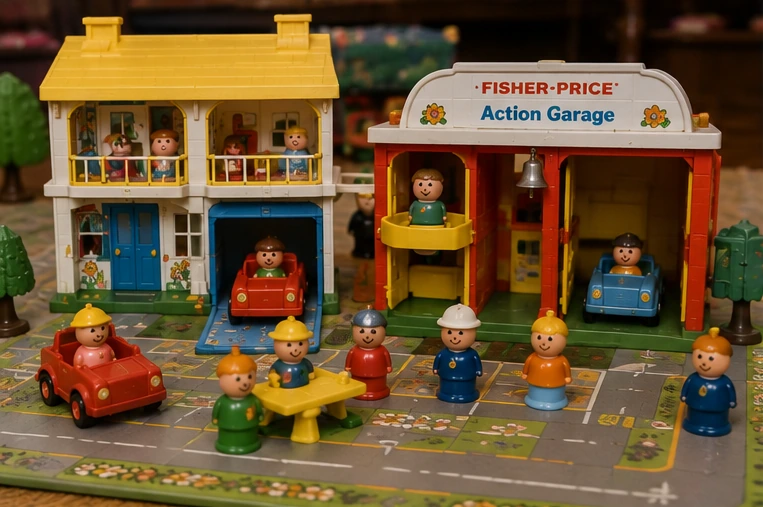
It usually became the starting point because characters woke up, ate and left through the garage.
Cars stopped for service, climbed the elevator and rolled into the rest of the room.
Rural zoning meant placing the barn near a wall, under a chair or wherever the shag carpet looked most agricultural.
A clear strip of floor became a landing area until somebody walked through it.
Emergency services, shops and apartments gave the carpet city a center.
Hardcover books became bridges. Wooden blocks became stores. Couch cushions became hills and property boundaries.
Matchbox and Hot Wheels traffic used Fisher-Price roads whenever scale allowed. Explore that larger floor system in Carpet Cities and Tiny Roads.
Unlike a board game, the world did not end. It was dismantled because somebody needed the floor back.
The playsets supplied places and tools. We supplied the problem, the voices and the ending.
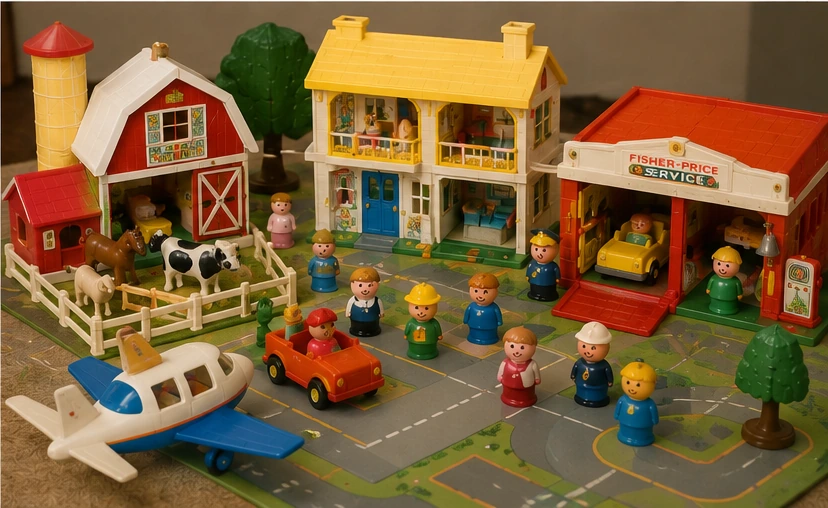
A normal day could remain normal. Trouble appeared only when a child decided the barn was on fire or the airport had closed.
The same figure could hold different jobs from one story to the next because identity was not locked to detailed costumes or media history.
Parents drove, doctors helped, teachers organized, mechanics repaired and mail carriers delivered. Kids repeated routines they had seen without needing to understand every detail.
Not every play session needed a rescue. Setting a table, putting figures to bed or parking cars was enough.
The cow could fly the plane. The dog could attend school. A superhero could live in the barn because open-ended play has no zoning board.
Younger kids practiced placing figures and moving parts. Older children built longer stories, community systems and cross-brand adventures.
Nobody sat beside the Farm explaining developmental goals. We just ran the town and learned things because the town needed running.
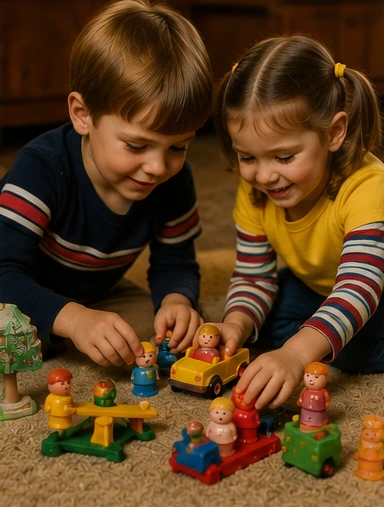
Dropping a peg figure into a car seat, desk or airplane hole required aim and repetition. Younger children practiced gripping, placing and removing pieces without a worksheet announcing the exercise.
Animals went to the Farm, students went to School and drivers went into cars—until the story needed something else. Children grouped by color, role, size and location before happily breaking the categories.
Turn the Garage crank and the elevator moved. Open the barn door and the sound played. Release the car and gravity handled the ramp. The relationship between action and result was visible.
The mail carrier needed addresses. The mechanic needed cars. The fire department needed roads. Little People made a town feel connected rather than a collection of isolated buildings.
Kids supplied voices, directions, emergencies and explanations. A quiet toy line created a remarkable amount of talking.
Wake up, eat, drive, work, return home. Check in, wait, board, fly, arrive. The playsets helped children arrange events in an understandable order.
Patients needed care, animals needed feeding and passengers needed help. The figures were simple enough for a child to project feelings onto them without the toy dictating an emotional script.
That was the strength. Fisher-Price created toys adults could view as constructive while children experienced them as a functioning world they controlled.
For once, the figures came with names we already knew before the box opened.
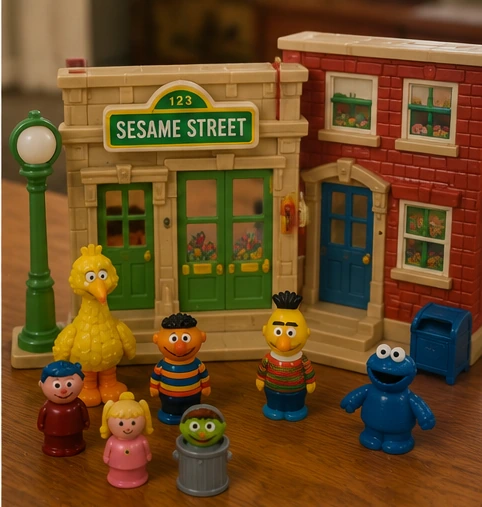
The Fisher-Price Sesame Street playset #938 appeared in 1975, combining the sturdy Play Family format with characters and places connected to the television program.
Generic families could become anyone. Sesame Street figures arrived with established personalities, voices and relationships.
Doors, street scenes and apartment-style spaces translated the show’s community feeling into floor play.
Children could move from watching the program to creating their own scenes without needing the television to remain on.
Additional figures made the neighborhood larger and created some of the most desirable small pieces for collectors.
Sesame Street characters could visit the Farm, ride in the Garage cars or move into the Village because the peg system remained compatible.
The 1970s were moving toward stronger media licensing. Little People adapted without abandoning open-ended play.
That transition sits beside the later franchise explosion covered in Kenner Star Wars toys of the 70s.
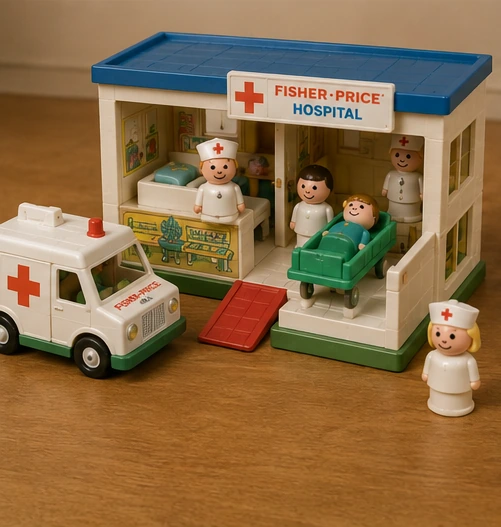
Doctors, patients, beds and vehicles gave kids a way to rehearse a place that could otherwise feel intimidating.
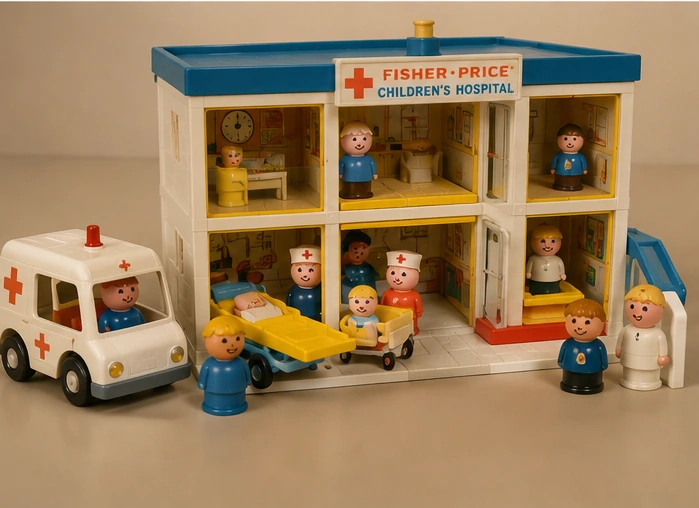
Children could decide what happened, who helped and when the patient went home.
Doctors, nurses, patients and ambulance drivers joined farmers, teachers, pilots and mechanics.
Beds, equipment and rooms supported checkups, recovery and visiting routines.
A child who had visited a doctor or hospital could replay the experience with control over the outcome.
Medical accessories were easy to separate from the building and difficult to identify once mixed into a large toy box.
By the middle of the decade, Little People had homes, transportation, school, jobs, emergency services and health care. The town could handle nearly every routine a child recognized.
They were domestic enough for houses and furniture, mechanical enough for garages and vehicles, and simple enough to ignore aisle labels.
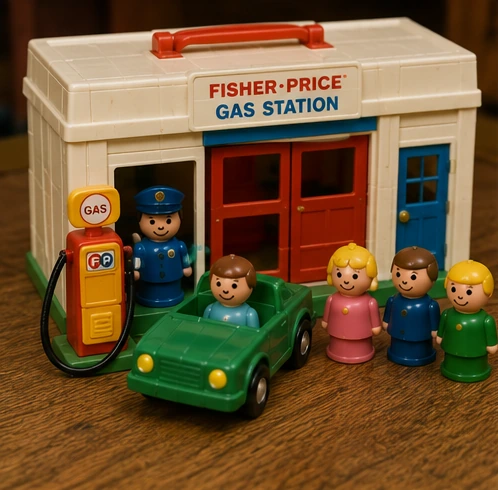
Meals, bedtime, visitors and family routines connected Little People with classic dollhouse play.
Ramps, elevators and cars connected the same figures with vehicle-centered play.
Little People were not realistic dolls, so they could mix with blocks, animals, cars and figures without looking completely wrong.
Fisher-Price marketed broad preschool play rather than forcing the line into a narrow character or fashion identity.
House, school, farm, garage and hospital were understandable to almost any child.
Other toys visited Little People buildings because the sets were sturdy, open and already arranged on the floor.
The domestic side continues through Dolls, Houses and Domestic Drama, while the vehicle side lives in Carpet Cities and Tiny Roads.
The sets were too useful to remain exclusive.
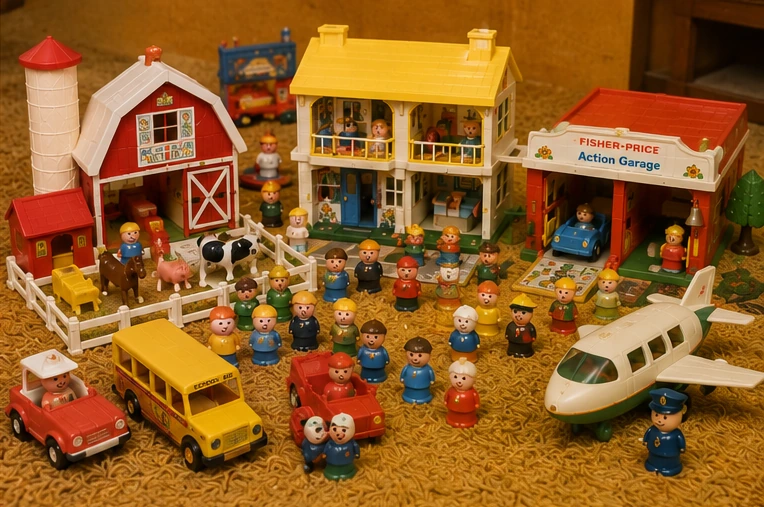
The cars were not always the right size, but the ramp was available and the bell still worked.
Small figures from the broader 70s action-figure world used the Village as headquarters, while larger figures stood outside like giants. The buildings were too useful to remain exclusive.
A long rubber arm could cross several properties at once. Our full Stretch Armstrong story explains why no toy town was safe.
The Village and Garage made excellent obstacles for the Evel Knievel Stunt Cycle, at least until a parent noticed.
The carpet city ended at the door, where the Big Wheel owned the driveway.
By the late 1970s, Kenner figures brought a different scale and a licensed universe into the same play space.
Even after figures disappeared, the Farm, House and Garage remained useful scenery. That adaptability kept the sets in play long after completeness was gone.
These were not display pieces pretending to be preschool toys. They were built for floors, handles, siblings and hard landings.
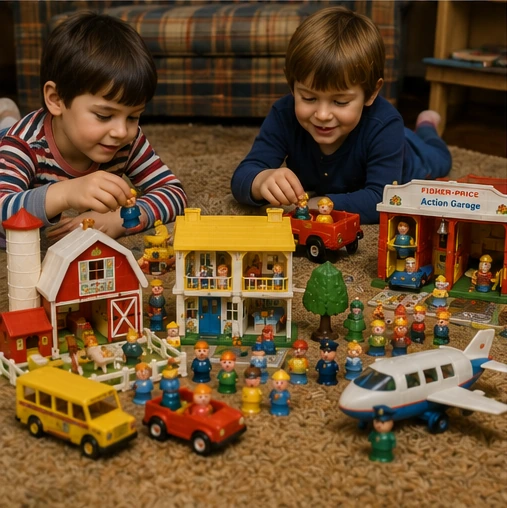
Many classic buildings used dense board and wooden components beneath printed surfaces, giving them weight and stability.
Roofs, doors, ramps, figures and vehicles were designed for repeated handling rather than delicate realism.
Foldable sets could close around pieces and move from room to room as one object.
A crank could wear out, but the structure still functioned as a play environment.
Edges rubbed, paper lifted and colors faded while the building underneath remained usable.
The large structure might last fifty years while the dog, chairs and gas pump disappeared in 1976.
Many Gen X children played with sets first owned by siblings, cousins or neighborhood families. Durability became advertising no commercial could match.
Every set began as a complete community and slowly became a population study.
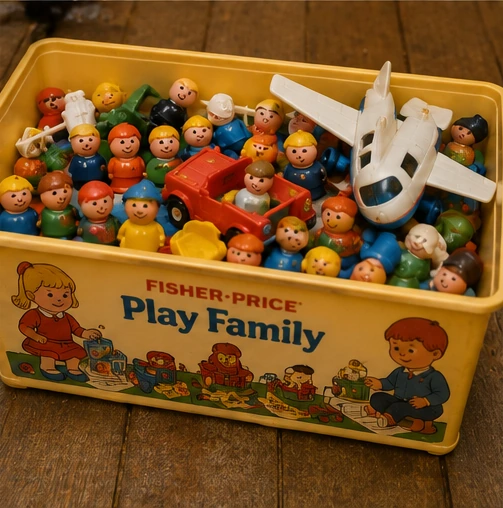
The pilot ended up in the Farm. The farmer lived at Sesame Street. Nobody knew which child originally belonged to the House.
Chairs and beds worked with dollhouses, block buildings and homemade forts, so they rarely stayed in one container.
The dog and farm animals traveled everywhere because they did not need a building to make sense.
Mail, flags, phones, pumps, ladders and medical accessories were small, movable and fascinating enough to carry away.
A figure could disappear for months and return during furniture cleaning with no explanation.
Once pieces entered one large toy bin, original set boundaries were gone.
Completing a vintage set often means identifying dozens of pieces that spent childhood belonging to whichever story needed them.
If the building closed and did not rattle too much, we called it complete.
Not every Little People town belonged to us. Some of the strongest memories came from the one collection that waited in a relative’s closet for every visiting kid.
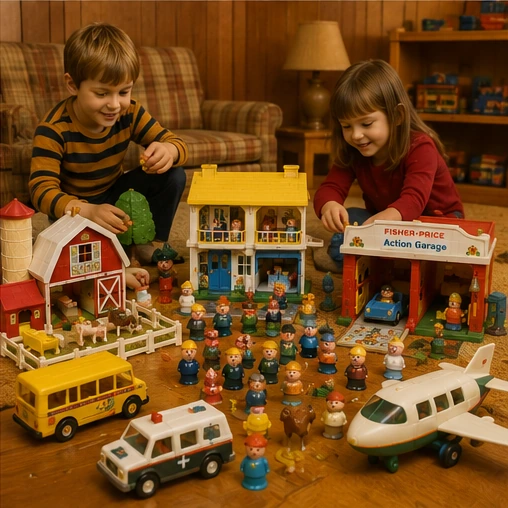
A Farm or Garage might have started with the oldest grandchild and remained available for every younger visitor. By the time we arrived, the population had already been mixed beyond reconstruction.
Visiting relatives could feel formal or quiet. Opening the folding house or hearing the barn moo created an immediate place to settle in.
A set at home might disappear during a cleanup. The one in a spare room or basement cabinet could survive because it was brought out only during visits.
Nobody remembered the original dog. The Garage had two farmers and no mechanic. One car had been missing longer than the youngest cousin had been alive.
A kid who had outgrown Little People at home might still help a younger cousin operate the elevator, rebuild the Village and explain how the mail worked.
Little People created an understood zone where touching, moving and inventing were allowed.
Decades later, people remember not only the toy but the carpet, the room, the relative who stored it and the sound of adults talking nearby.
Seeing the same Farm again can bring back an entire house. That is a kind of nostalgia few disposable toys ever earn.
The ads showed children moving through familiar places because the playsets already contained the story engine.
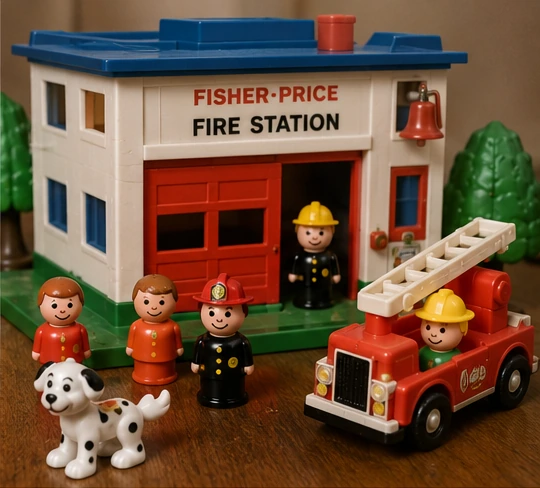
The Farm mooed, the Garage moved cars and the Village opened into several locations.
Hands moved figures, vehicles and doors while the narrator explained what each place could do.
Every figure and accessory was present, creating a version of ownership that rarely survived the first year.
A single playset looked satisfying while the larger line remained visible as the next possibility.
Engines, bells, animal noises and voices created television energy around mostly analog products.
Period footage shows original colors, figure groupings and included accessories.
See more of that television-era salesmanship in our 70s toy commercial archive.
A catalog page could make one folding building look like the beginning of an entire municipal budget.
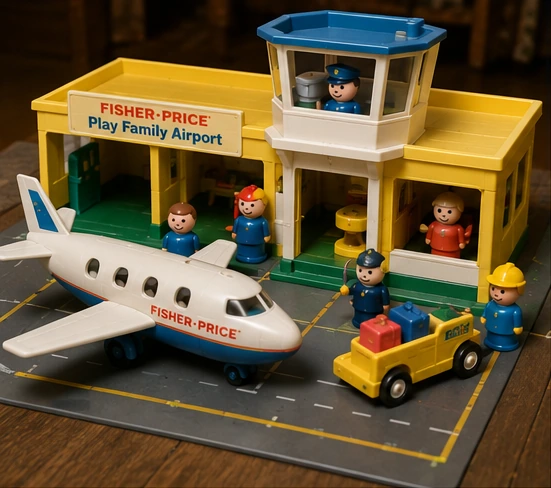
Bright roofs, printed interiors, cars, animals and figures created busy scenes that rewarded staring.
Every piece appeared in its correct location, making the real set at home look suspiciously under-staffed.
Numbers such as #915 Farm, #930 Garage, #952 House, #996 Airport and #997 Village help distinguish similar versions.
Figure construction, roof colors, lithographs, vehicles and accessory counts could change while the set name remained familiar.
A large Village or Garage competed with several smaller toys. The page made the argument that one big playset contained many activities.
Collectors use period pages to identify what originally belonged inside and which replacement piece comes from another year.
That ritual of studying every detail continues in our 70s toy catalogs and Sears Wish Books history.
The box looked enormous, the world opened immediately and every relative on the floor could be assigned a job.
A Farm, Garage or Village looked substantial under the tree and offered enough pieces to feel like several gifts.
Most play could begin as soon as the building opened and the pieces came out.
Grandparents recognized farms, schools and houses. Older siblings understood the moving parts. Younger children could place figures without instruction.
One ran the garage, another moved animals and somebody else handled emergency services.
A birthday vehicle or second playset connected with what was already owned, making the original Christmas purchase feel larger over time.
Wrapping paper, open boxes and visiting cousins created ideal conditions for the first accessory to disappear.
Little People belong naturally in our year-by-year look at the hottest Christmas toys of the 70s.
The line stayed relevant because Fisher-Price kept adding places rather than replacing the basic idea.
By 1970, Little People sets remained part of the durable preschool foundation while the wider toy aisle changed around them. Explore the full year through the top toys of 1970.
By 1971, Little People sets remained part of the durable preschool foundation while the wider toy aisle changed around them. Explore the full year through the top toys of 1971.
By 1972, Little People sets remained part of the durable preschool foundation while the wider toy aisle changed around them. Explore the full year through the top toys of 1972.
By 1973, Little People sets remained part of the durable preschool foundation while the wider toy aisle changed around them. Explore the full year through the top toys of 1973.
By 1974, Little People sets remained part of the durable preschool foundation while the wider toy aisle changed around them. Explore the full year through the top toys of 1974.
By 1975, Little People sets remained part of the durable preschool foundation while the wider toy aisle changed around them. Explore the full year through the top toys of 1975.
By 1976, Little People sets remained part of the durable preschool foundation while the wider toy aisle changed around them. Explore the full year through the top toys of 1976.
By 1977, Little People sets remained part of the durable preschool foundation while the wider toy aisle changed around them. Explore the full year through the top toys of 1977.
By 1978, Little People sets remained part of the durable preschool foundation while the wider toy aisle changed around them. Explore the full year through the top toys of 1978.
By 1979, Little People sets remained part of the durable preschool foundation while the wider toy aisle changed around them. Explore the full year through the top toys of 1979.
Classic Little People sets feel different because they were built from a mix of materials rather than molded as one large plastic shell.
Wooden bodies and structural components made the toys feel solid in a small child’s hand.
Dense board supported large printed surfaces without making sets excessively heavy.
Rooms, signs, windows, shelves and neighborhood scenes appeared through printed artwork attached to the structure.
Roofs, doors, cranks, ramps, furniture, vehicles and later figure bodies used plastic where durability and shape mattered.
Plastic can fade or crack while paper lifts and wood remains strong. A set’s condition must be judged component by component.
Water and strong cleaners can damage old lithographs, inks and adhesives even when the plastic appears washable.
A tiny picture of a refrigerator, barber mirror or airport sign could define an entire room.
Printed cabinets, windows, shelves and equipment suggested details the physical structure did not need to reproduce.
People and activity printed on walls made the location feel occupied beyond the removable figures.
Designers placed signs, posters and small scenes where children could discover them during repeated play.
A fold-out structure became a hospital, school or apartment partly through what the walls showed.
Rubbed floors, peeling door edges and faded exteriors mark the areas children touched most.
Bright, attached lithographs can matter as much as working mechanisms because they preserve the set’s original visual world.
The tiny peg design was brilliant for play and increasingly difficult to defend as preschool safety expectations evolved.
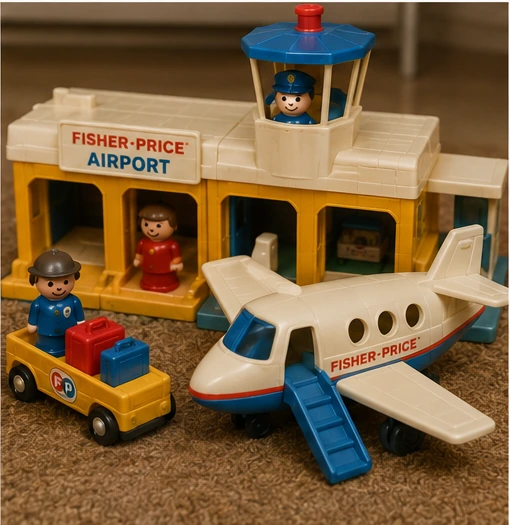
They were designed for young children during an era with different standards and assumptions about small parts.
As safety rules and consumer expectations became stricter, companies enlarged parts and reconsidered shapes intended for toddlers.
The newer Little People became larger and more sculpted, reducing the risks connected to the classic peg form.
Larger figures did not fit every old vehicle hole or seat, creating a clear break between classic and modern systems.
A vintage set can be historically important without being appropriate for unsupervised preschool play today.
Figures, furniture, animals and damaged mechanisms should be treated as collectibles around children still likely to mouth toys.
Fisher-Price eventually adopted the name families had been using all along.
The Strong notes that the line officially became Little People in 1985. By then, the nickname had become more recognizable than Play Family.
Not every figure belonged to one family. Pilots, workers, Sesame Street characters and animals had expanded the population far beyond the original label.
School buses, farms, garages and modern playsets could all live under one recognizable brand.
Collectors use Original Little People to separate the older peg figures from later redesigned bodies.
Classic-style figures and sets continued into the later 1980s before the major early-1990s redesign.
Some people remember Play Family boxes. Most remember Little People because that is what the household called them.
A round head and peg body are the beginning, not the end, of identification.
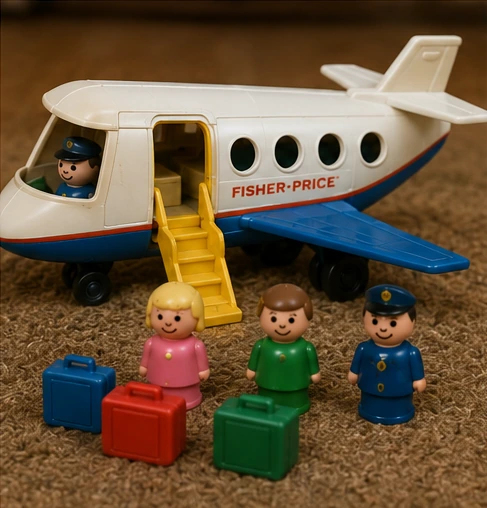
Wooden bodies, plastic bodies and mixed constructions can point toward different periods and sets.
Hair color, molded hats, printed features, facial style and skin tone help distinguish roles and variations.
Classic body shapes changed over time, and small molded details can separate similar figures.
Body color often represented clothing. The same head style may appear on several colored bodies.
Fisher-Price, East Aurora and product markings help confirm origin, though not every piece is marked identically.
A pilot, firefighter or family member may have appeared in several releases. Catalog and collector references help narrow the correct version.
Decades of play, replacement and collector repair can create combinations that never left the factory.
The product number, base construction and tiny visual differences matter more than a seller calling everything “1970s.”
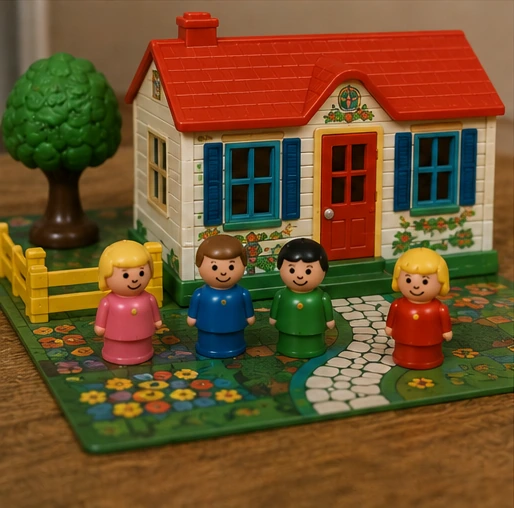
Numbers such as #915, #930, #952, #996 and #997 identify the major classic sets and make research much easier.
Wood, Masonite, plastic, metal hardware and hinge style can reveal production changes.
Long-running sets changed plastic colors and details while keeping the same general architecture.
Artwork versions, copyright lines and printed room details help date a structure.
A barn sound, elevator, bell or crank should move without forcing brittle parts.
Correct figures, vehicles, animals and furniture matter. A visually complete set may contain replacements from several decades.
Families mixed everything. Original documentation is more reliable than remembering which chair came with the House.
The buildings survived, but fifty years left evidence on every material.
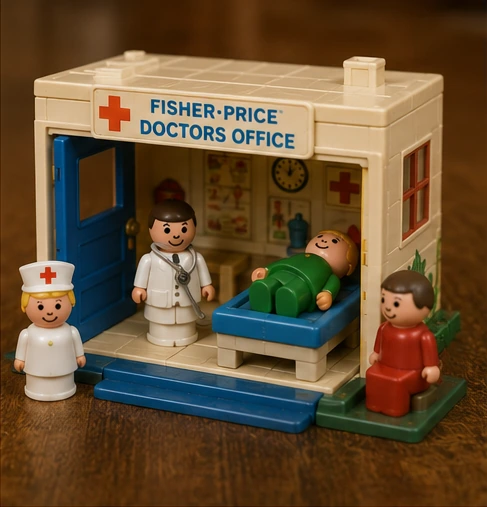
Moisture, sunlight and aggressive cleaning damage the printed scenes that give classic sets their character.
White pieces yellow, colored roofs fade and stressed hinges crack.
Water exposure can distort bases and bodies even when the surface later dries.
Axles, hinges, bells and internal mechanisms may corrode in damp storage.
Dirt, broken gears and forced operation can stop the Garage or other mechanical features.
Printed features rub away after years of handling, washing and travel through toy bins.
Basement dampness, smoke and mildew enter porous board, paper and wood. Strong smells are difficult to remove safely.
Before calling a set complete, count more than the building and three random citizens.
Confirm the correct number, roles, body colors, head styles and animals.
Cars, buses, airplanes, boats, fire engines, police cars, mail trucks and ambulances are commonly separated.
Beds, chairs, tables, sofas, desks and specialty seats may be mixed with dollhouse pieces.
Gas pumps, lifts, flags, ramps, ladders and cranks matter to function and identification.
Village mail, hospital equipment, classroom pieces and Sesame Street accessories are often the hardest items to replace.
Instructions, decals, chalk, letters and inserts rarely survive active childhood intact.
Boxes and internal trays add collector interest but should match the exact production version.
The temptation is to scrub everything until it looks new. The lithographs would like a word.
Use a soft brush or low-suction vacuum through a screen to remove loose dust before adding moisture.
Inks, paper, decals, wood and plastic react differently. Try an inconspicuous area first.
A barely damp cloth is safer than soaking, spraying or submerging a structure.
Alcohol, bleach and household degreasers can remove print, cloud plastic and weaken adhesive.
Dirt may not be the only reason an elevator or crank is stuck. Brittle gears can fail under pressure.
Moisture trapped between paper, board and plastic encourages swelling, corrosion and mildew.
A clean set with age marks is often more attractive and trustworthy than one polished past its original finish.
The old carry handles were good for play. Long-term preservation needs a little more planning.
Avoid attics, garages and basements with major temperature or humidity swings.
Do not let heavy items press against roofs, handles, hinges or open panels.
Archival bags or boxes prevent another generation of accessory migration.
Unknown vinyl, rubber and foam can transfer color or chemicals during long storage.
Direct sunlight fades printed rooms and exteriors.
Photograph each set and inventory figures, vehicles and furniture before storage.
Address moisture and odor problems before enclosing a set where deterioration can continue unseen.
A famous set name helps, but completeness and condition decide whether it is a childhood survivor or a collector-grade example.
Large, short-run or licensed sets can attract different demand than common long-running releases.
A mooing Farm and functioning Garage elevator are more desirable than silent or jammed examples.
Bright, attached artwork preserves the original environment and is difficult to restore invisibly.
A complete set with the proper cast is worth more than a building filled with unrelated replacements.
Packaging identifies production details and adds visual context, especially for major playsets.
Replaced hinges, touched-up artwork and reproduced pieces should be disclosed.
Compare the same product number, variation and condition using actual sold examples rather than hopeful asking prices.
For current prices, compare completed sales for the same product number, variation and condition. A complete working Village and an empty shell are not comparable collectibles.
The figures became larger and more detailed, but the best modern sets still understand that a place plus people equals a story.
Modern designs improved toddler safety and made faces, clothing and character identity more detailed.
Current Little People include entertainment, sports and music figures alongside traditional community play.
Modern buildings may use songs, phrases and lights where classic sets relied on bells, cranks and child-supplied voices.
Children still move figures through vehicles, rooms and familiar situations.
Mattel’s Little People Collector line uses the chunky format for pop-culture display sets aimed at nostalgic buyers.
Even modern figures preserve the round-headed, compact silhouette that began with the early line.
A toy does not remain relevant for six decades by relying on one Christmas commercial.
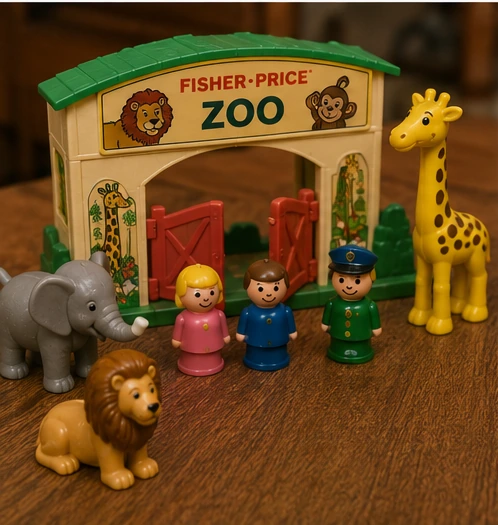
Fisher-Price Little People entered The Strong’s National Toy Hall of Fame in 2016, recognizing a line that combined broad popularity, long life and creative play.
Wooden riders, classic peg figures and larger modern characters all served the same central idea.
Parents introduced children to sets they remembered, while durable originals became actual hand-me-downs.
Homes, farms, schools, airports, garages and community services made ordinary life worthy of imagination.
They could represent the child’s family, neighbors or invented characters without detailed scripts.
Roads connected buildings, workers served communities and vehicles moved people between places.
Sesame Street and later licenses helped, but the core line remained strong because everyday play was renewable.
Most of the line did not talk. The room still had a soundtrack.
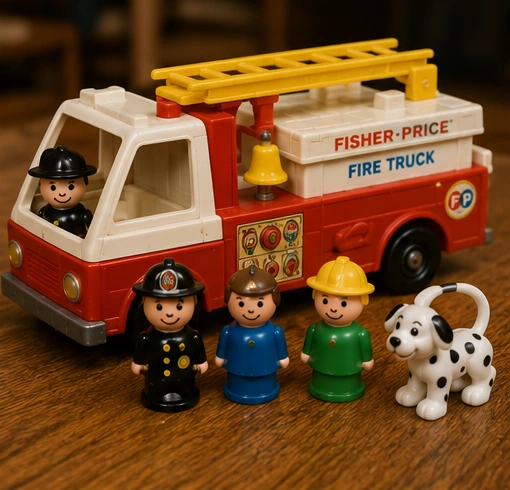
It was mechanical, brief and instantly tied to one movement. Opening the door without hearing it now feels wrong to anyone who remembers the original.
Every elevator trip announced itself. A child could run the same car up and down until the bell became part of the household background.
Cars sounded different on linoleum, wood and carpet. Moving the town from one room to another changed the traffic noise.
Wood and plastic made a small solid knock when a person entered a vehicle or building hole.
Opening a large folding set had its own creak, clack and thump as the world reached the floor.
Airplanes roared, sirens wailed, teachers spoke and animals argued because we made the sounds ourselves.
The toy offered a few memorable cues rather than constant programmed speech. The soundscape changed with the story.
One garage bell or barn moo can bring back the exact position you sat on the floor, even when the rest of the afternoon is gone.
The memory is not only visual. It is the sound of the bell, the rough printed floor and the weight of a wooden figure dropping into a car.
A Village or Garage changed the room. You crawled around it rather than holding the whole experience in one hand.
The Farm moo and Garage bell became household noises heard long after the commercial disappeared.
Wood, board and thick plastic made the sets feel like equipment rather than temporary novelty.
One might have teeth marks from a younger sibling, another a faded face and another no known origin.
No two collections remained complete in exactly the same way. The mix of sets and missing pieces made each town personal.
Adults did not need to manage levels, recharge anything or explain rules. Once the town opened, kids handled the government.
Problems happened because we invented them, and every figure could be put back in the house when the story ended.
Fisher-Price gave us ordinary places, durable figures and just enough movement. We turned that into a civilization.
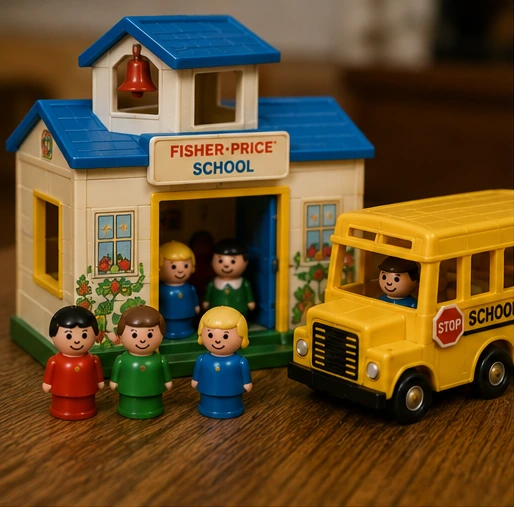
A garage elevator, school desk or barn door became important because the child controlled it.
Every set strengthened the ones already on the floor.
Little People could change jobs, families and stories without contradicting a franchise bible.
Many classic structures survived long enough to be played with by children and grandchildren.
Completeness mattered less to us than whether the elevator still moved and somebody could fit in the car.
Cars, houses, animals, jobs, travel and television characters all shared one scale.
That is why Little People belong beside the other foundational pages in the 70s Toys hub. The line was not one toy. It was the place where the rest of the toys could live.
What stays with me most is how little instruction the town needed. The Farm could sit beside the Garage, the airport runway could cross the hallway, and one figure could spend the morning teaching school before driving a fire engine after lunch. We did not think of that as creative world building. We were simply on the floor, making the neighborhood work with whatever pieces had survived. The buildings gave us structure, but the mismatched population made the place ours.
That is why the Little People town still belongs beside Hot Wheels racing through carpet cities, Big Wheels owning the driveway, Evel Knievel launching into the furniture, Stretch Armstrong becoming a household experiment and Kenner Star Wars figures changing the late-70s population. Gen X toys rarely stayed in their own lanes once the whole floor was in play.
The figures were simple. Fifty years of names, materials, set numbers and missing parts are not.
The figures trace back to Fisher-Price’s 1959 Safety School Bus. The company began marketing the connected characters and playsets as the Play Family line in the mid-1960s. The name Little People became official in 1985 after families had already used it for years.
Fisher-Price generally marketed the classic figures and sets as Play Family toys during the 1970s. Kids and parents commonly called the peg-shaped characters little people long before Fisher-Price formally adopted the name.
The Play Family Farm, House, Action Garage, School, Airport, Village, Houseboat, Camper, Children’s Hospital and Sesame Street sets are among the most remembered. Vehicles, furniture packs and smaller sets connected them into one larger play world.
The classic Play Family Farm #915 was introduced in 1968 and became a major 1970s preschool toy. Its opening barn door produced the famous mooing sound that many Gen X kids still remember immediately.
The Play Family Action Garage #930 was introduced in 1970. Its elevator, bell, ramps, service lift and cars made it one of the defining Little People playsets of the decade.
The large Play Family Village #997 appeared in 1973. It combined community locations such as a firehouse, police station, post office, apartment, theater, barber shop and dentist office into a foldable town.
Classic figures appeared in several constructions. Many 1960s and 1970s examples used wooden bodies with plastic heads, while other versions used more plastic. Materials, body shape, face style and markings help collectors identify dates and variations.
The peg-shaped bodies were designed to sit securely in molded holes, vehicle seats and playset positions. That simple system made figures interchangeable across houses, cars, airplanes, boats, schools and towns.
The company enlarged and redesigned the figures in the early 1990s as preschool safety expectations and small-parts concerns changed. The larger modern figures reduced the choking risk associated with the smaller classic shape.
Check the product number, Fisher-Price and East Aurora markings, base materials, lithographed scenes, roof and door colors, figure construction, vehicle style and included accessories. Dealer catalogs and collector archives are useful because many sets changed during long production runs.
Exact set, production variation, working mechanisms, clean lithographs, unbroken plastic, original figures, animals, vehicles, furniture, instructions and box condition all matter. A complete Village or Garage is different from an empty shell with replacement pieces.
Classic figures and small accessories were made under older standards and can present choking risks for young children. Vintage sets are best treated as collectibles unless a responsible adult has assessed every piece and the child is well beyond the mouthing stage.