The action figure establishes the toy-sized daredevil
Ideal’s Evel Knievel figure translated the white jumpsuit, patriotic graphics and celebrity attitude into a poseable character before the Stunt Cycle made him move.
Smells Like Gen X • Household Stunt Show Since 1973
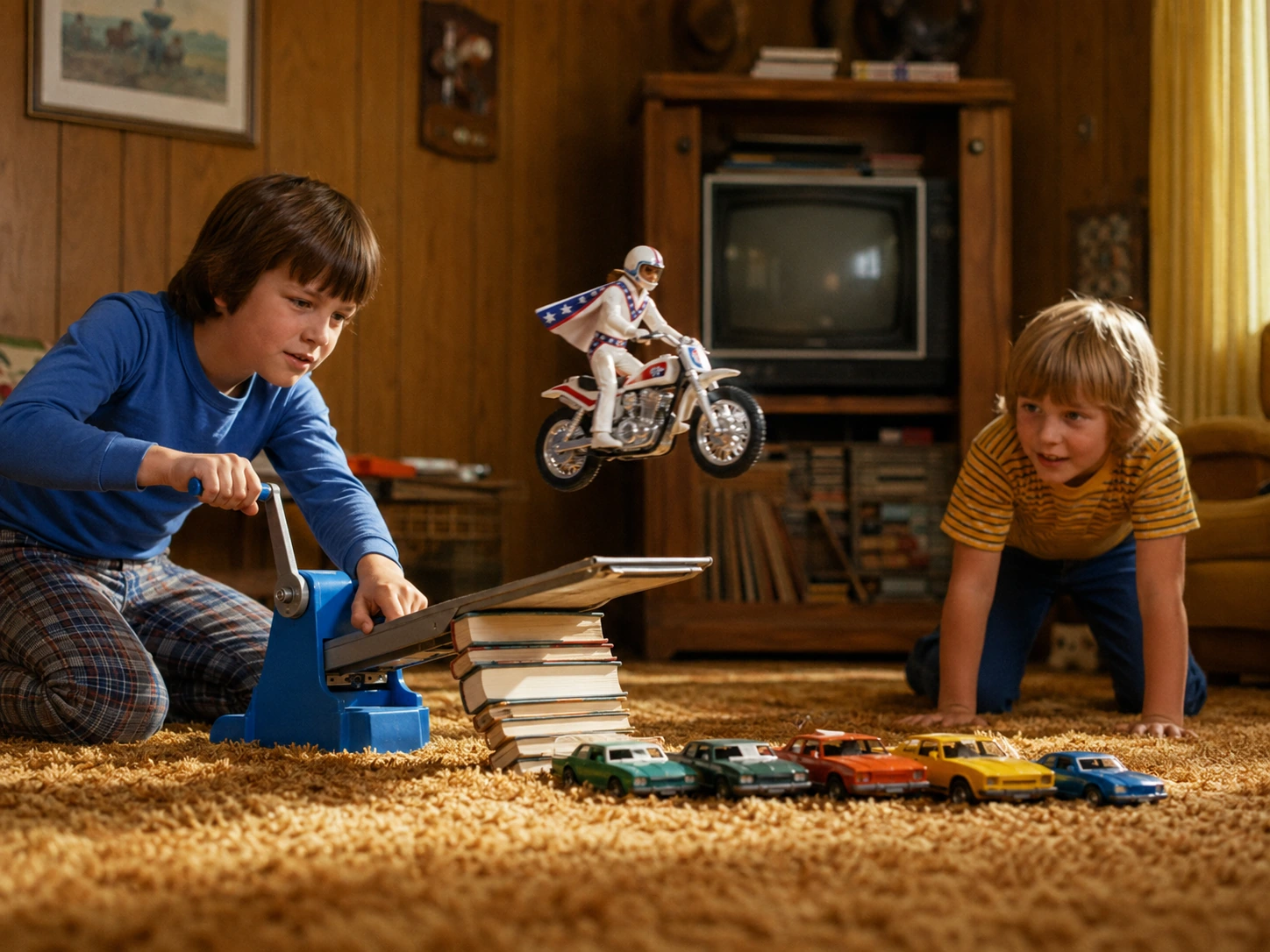
You cranked the launcher until the rear wheel screamed, aimed Evel toward a ramp built from schoolbooks and released him into a room that had not approved the course. A clean landing was great. A spectacular crash was usually better.
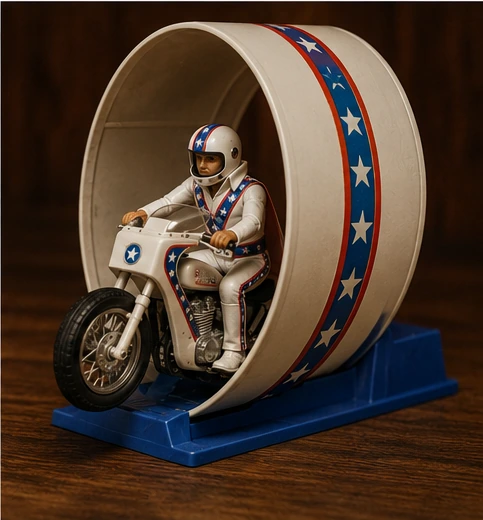
The Evel Knievel Stunt Cycle was an Ideal toy released in 1973. A poseable Evel figure rode a motorcycle powered by a hand-cranked energizer that spun the rear wheel to high speed. Once released, the cycle raced across the floor, climbed ramps, jumped obstacles and crashed with enough personality to make failure part of the fun.
He was not a cartoon character pretending to risk everything. He was a real man appearing on television, making promises no sensible person would make and occasionally landing them.
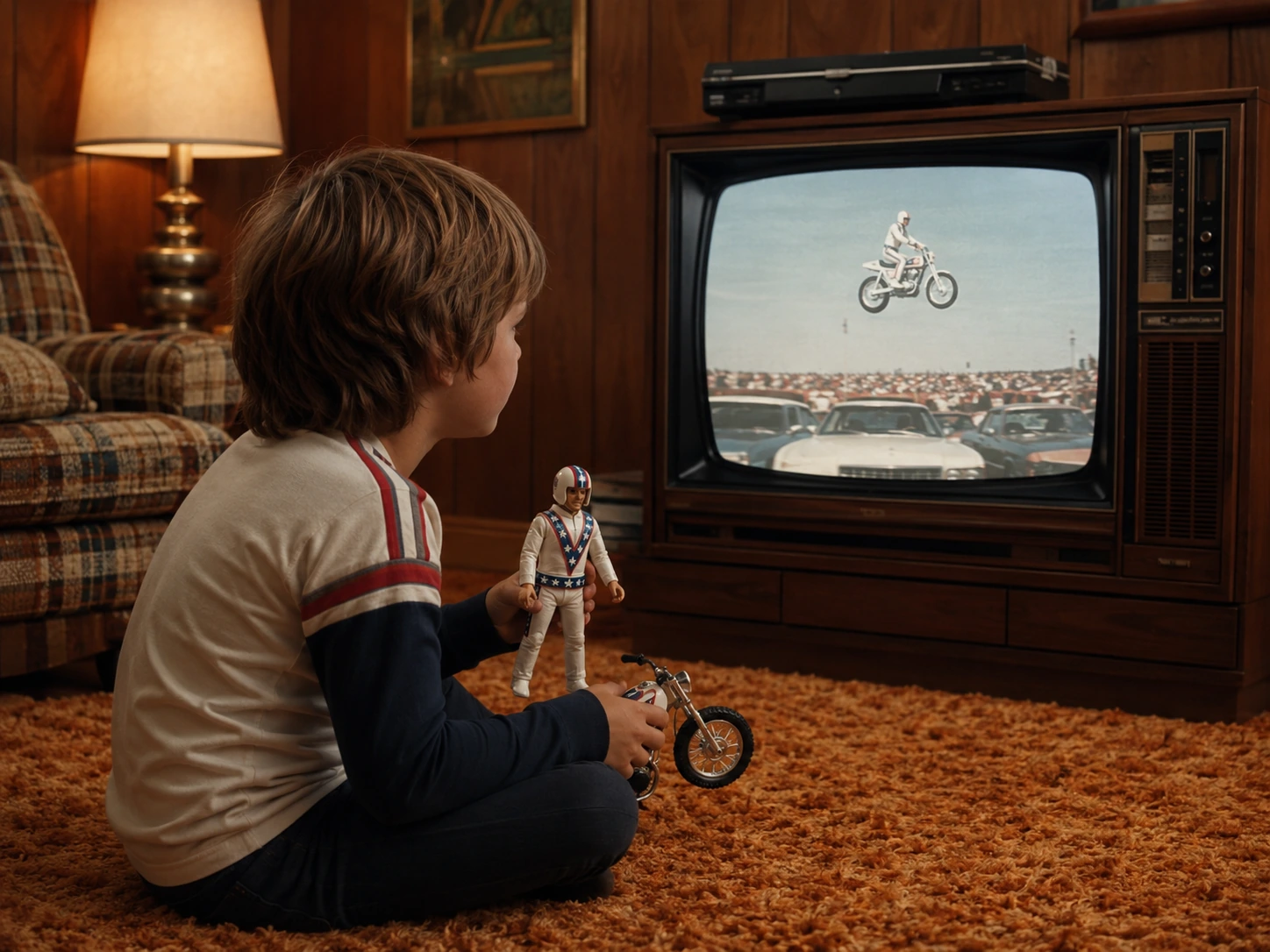
For a child in the early 1970s, Evel Knievel arrived as a ready-made action figure before Ideal ever molded one. He wore white leather, patriotic stars, red stripes and a cape. He spoke in absolute declarations. He appeared on television beside lines of buses, rows of cars and ramps that looked too short even before the jump began.
The attraction was not only success. Knievel made suspense visible. The motorcycle accelerated, the ramp approached and the audience understood that the next few seconds could produce a landing, a wreck or both. Failure did not erase the event. It became the event.
Comic-book heroes came with fictional powers. Knievel came with a motorcycle, a jumpsuit and a willingness to attempt something television viewers already suspected was a terrible idea. His costume gave him the visual clarity of a superhero, but his crashes made him feel real.
That combination fit the decade’s expanding world of 70s action figures and character toys. Children wanted recognizable personalities, removable outfits, vehicles and equipment. Evel supplied all of that while bringing a mechanical stunt system with him.
Knievel understood anticipation. The interviews, measurements, camera angles and repeated descriptions of danger created a complete show before the motorcycle moved. Ideal’s toy captured the same rhythm in miniature.
You attached the rider. You placed the motorcycle in the energizer. You cranked the handle. The rear wheel screamed louder. Everybody backed away. The release became a household television special with a production budget of three books and a piece of cardboard.
The real jumps required planning, skill and professional equipment. Children absorbed the swagger instead. Every new ramp was described as if a stadium had sold out. A successful six-inch jump over a plastic dinosaur received the same prelaunch seriousness as a row of buses.
“This time he’s going over the truck, the shoebox and the lamp. Nobody touch anything.”
Television supplied the danger and personality. Ideal removed the hospital stay, kept the jumps and made the whole thing repeatable before dinner.
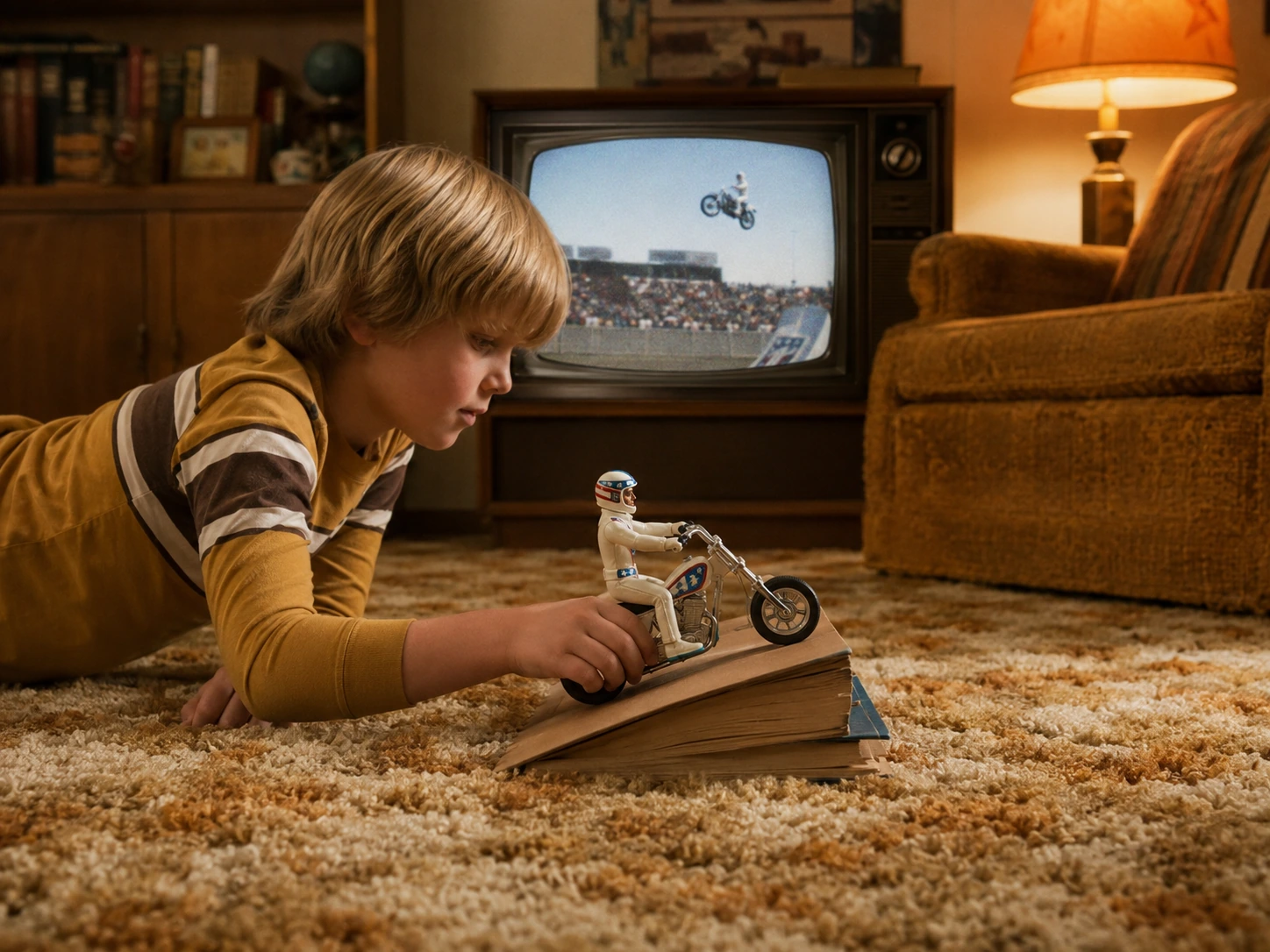
The real Evel Knievel performed with consequences no toy could reproduce. He accelerated toward rows of vehicles, stadium ramps and publicity promises while television cameras waited for a landing or wreck. The possibility of serious injury gave the events their tension.
The toy translated that tension into a form children could control. Evel still faced a ramp. The motorcycle still built speed. The audience still watched. The consequences were a loose helmet, a twisted fabric suit and another mark on the baseboard.
Ideal understood that the jump alone was not enough. The hand crank created the mechanical equivalent of the television countdown. Children heard power building and knew the release was approaching.
That anticipation made a six-foot floor run feel larger than it was. A child could pause, announce the obstacle count, adjust the rider’s arms and ask everybody to move back. The performance had already begun.
Knievel sold events with confidence. Children copied the style. Each launch came with a claim about distance, height or danger. Nobody simply said the motorcycle was going over three books. It was going farther than it had ever gone before.
A televised jump happened once. The Stunt Cycle could retry the same setup until the result matched the story. If Evel landed short, the crank turned again. If the cycle veered left, the ramp moved right. If the jump succeeded, the obstacle count increased immediately.
Television specials appeared on schedules. The figure lived in the toy box. A child could stage an event on a rainy morning, after school or in the middle of a family gathering that had not requested entertainment.
The real man’s life and behavior were complicated. The toy figure remained frozen in the confident white-suited image children knew from the peak years: helmet on, cape straight, motorcycle ready and no publicist advising caution.
That separation helps explain why the toy remains beloved even when adults view the celebrity with more context than they had at age eight.
Before the motorcycle became the star, Ideal had already turned the daredevil into a poseable celebrity figure with a fabric jumpsuit and accessories.
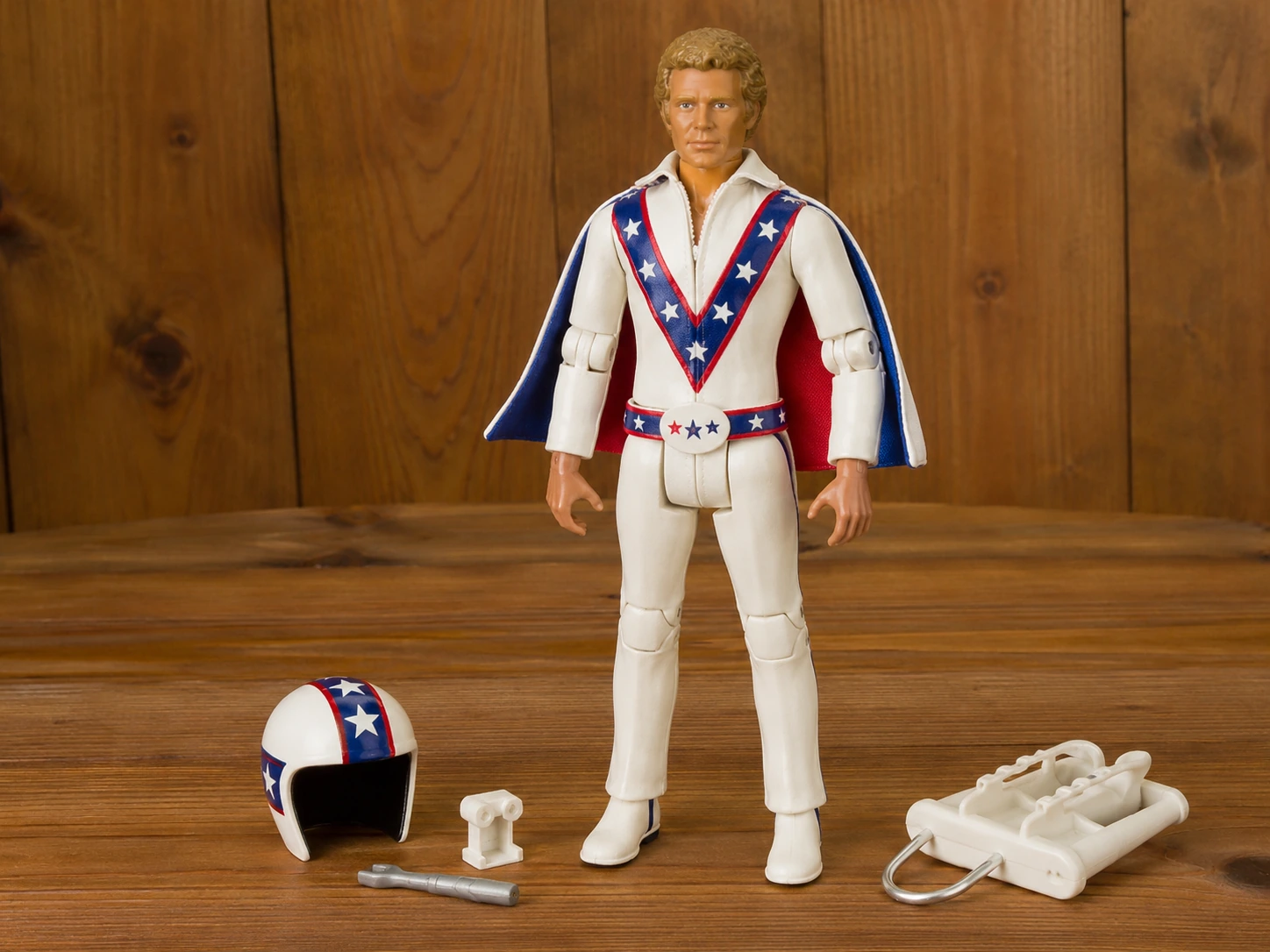
The Strong National Museum of Play dates an Ideal Evel Knievel action figure in its collection to 1972. The figure used vinyl, fabric, molded plastic and cardboard, placing it firmly inside the hybrid world between action figure and celebrity doll.
That distinction mattered less to kids than the fact that Evel could stand, bend, change clothes and hold equipment. He was not permanently molded onto one vehicle. He could walk into the setup, inspect the ramp, ride the motorcycle, crash and recover in time for the next attempt.
Red, white and blue graphics were not subtle. The costume connected the toy directly to the television personality and helped a relatively simple figure carry enormous identity. Even when the helmet or belt disappeared, the outfit still announced who had arrived.
Cloth outfits wrinkled, stretched and collected evidence. A figure used hard might develop stained fabric, worn trim or loose fasteners. That physical aging now helps collectors understand how much play a surviving example endured.
A rigid rider could only remain attached or break away. An articulated figure could twist, tumble and land in positions that made every failure look dramatic. Children immediately became emergency crews, announcers and mechanics.
Ideal could sell wardrobes, vehicles and playsets because Evel existed as a character independent of the cycle. That made the line more expandable than a one-purpose stunt machine.
The broader Evel section in our 70s action-figure history places him beside the decade’s other licensed heroes. This page follows the toy that made him move.
Ideal took a celebrity figure, added a motorcycle and created one of the rare licensed toys that was more exciting after it left the box.
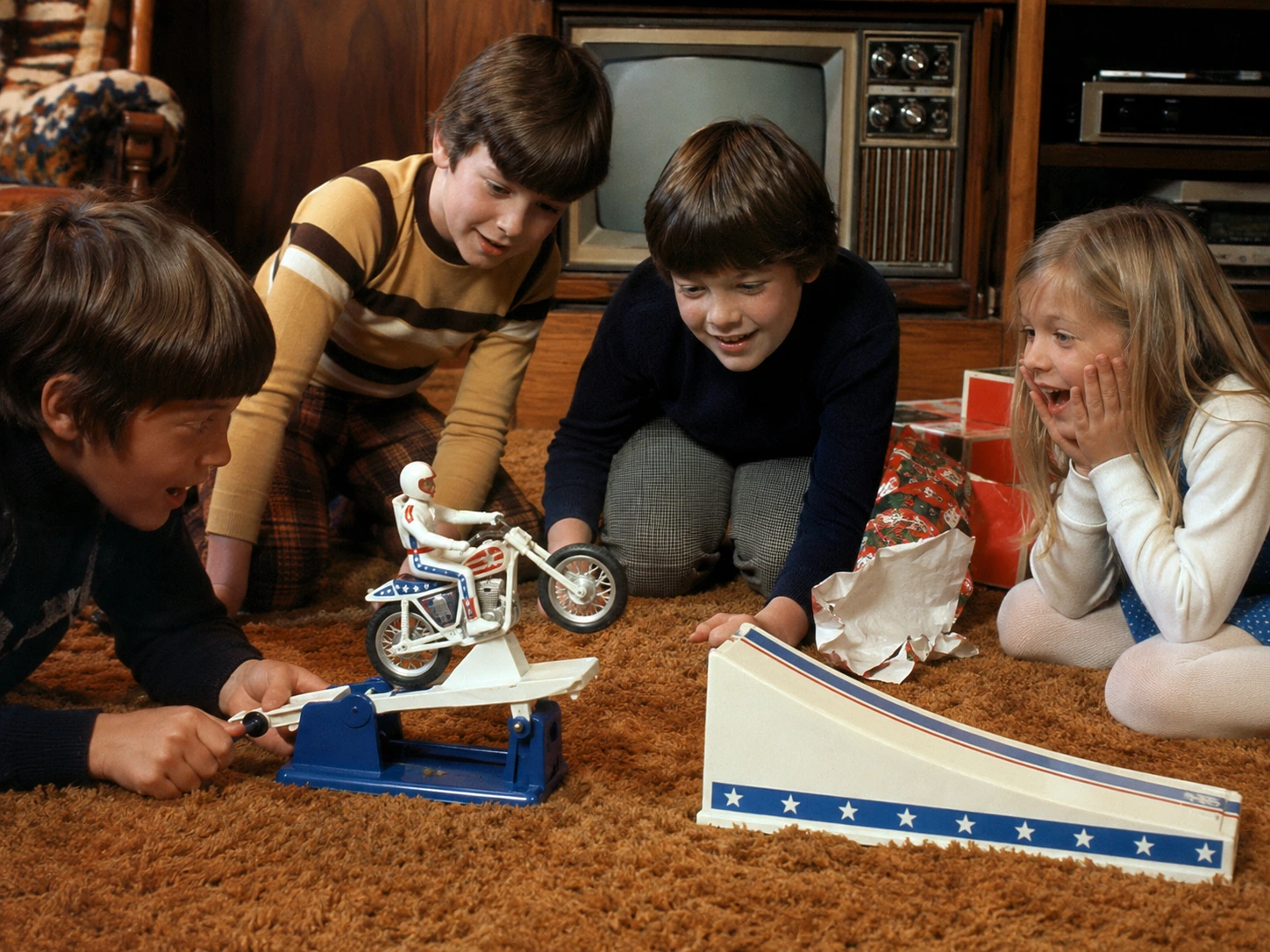
The Evel Knievel Stunt Cycle arrived in 1973 and quickly became one of the defining toys of that Christmas season. Contemporary and later accounts commonly identify it as the best-selling boys’ toy of Christmas 1973. That level of demand made sense because the product demonstrated itself in seconds.
A child did not need to imagine that the motorcycle could move. It moved. It accelerated across the floor, hit ramps and crashed into whatever had not been moved. The toy commercial’s central promise could be tested immediately at home.
The package brought together an articulated Evel figure, stunt motorcycle and hand-cranked energizer. Depending on version and set, ramps and related pieces completed the performance. Each part had a purpose, and losing one changed the experience.
Pushing a toy motorcycle by hand produced a short, crooked roll. A battery motor would have increased cost and required a power source. Ideal’s hand-cranked system let a child build speed manually and release it all at once.
Many toys supported solitary play. The Stunt Cycle became better when someone watched. The rising sound of the wheel announced that a launch was coming. Siblings moved closer. Parents looked up. Somebody predicted failure.
The Stunt Cycle belongs near the front of any serious look at the hottest Christmas toys of the 70s. It had celebrity recognition, television advertising, mechanical action and a demonstration that looked excellent in a toy aisle.
It also helped define the toy year of 1973, when licensed characters and feature-driven play were becoming much harder to ignore.
The launcher did not merely hold the motorcycle. It built noise, speed and suspense one crank at a time.
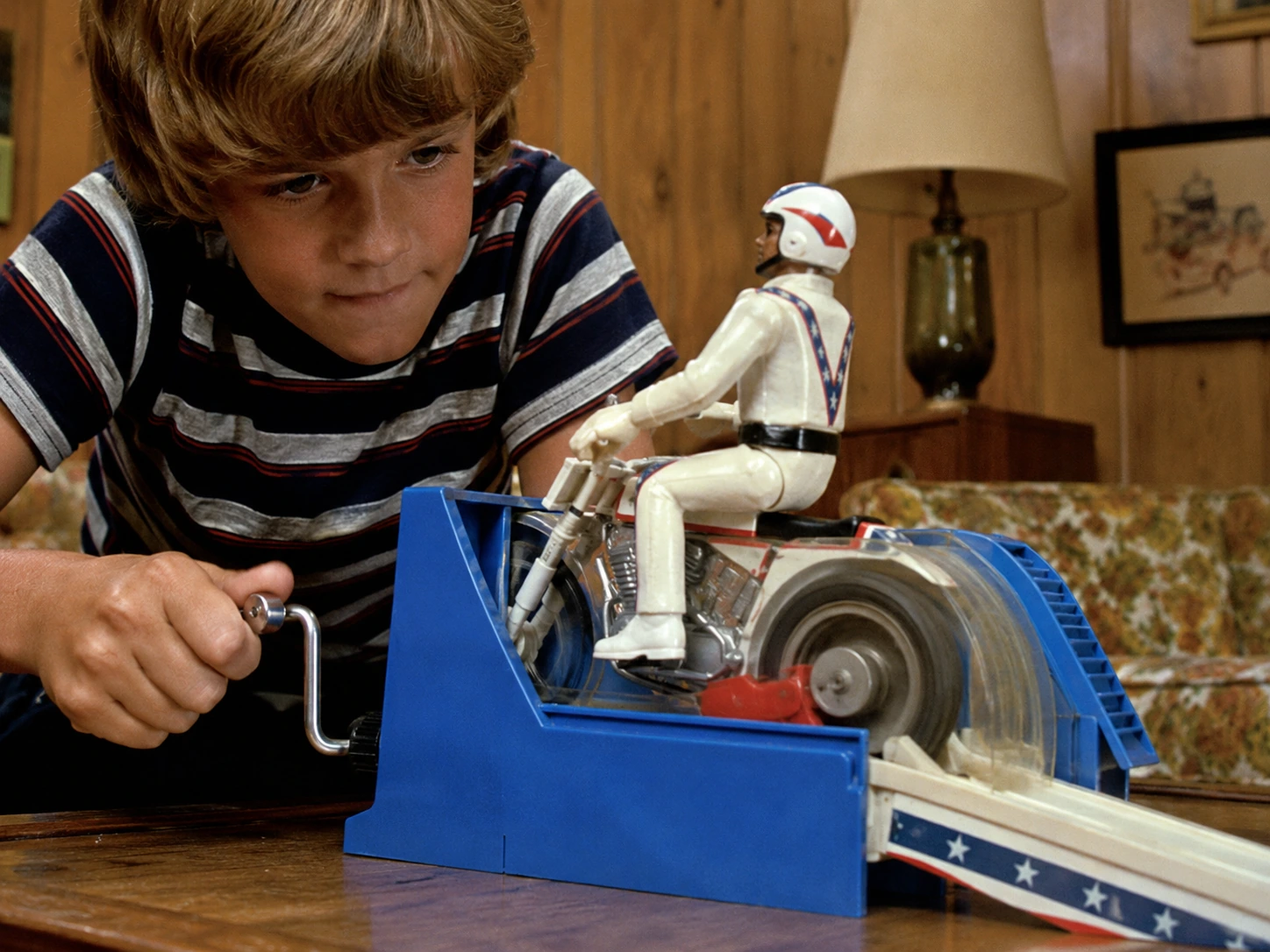
The motorcycle fit into a plastic energizer that positioned the rear wheel against an internal drive system. Turning the hand crank spun the wheel faster and faster. Once released, the motorcycle carried that rotational energy forward across the floor.
The spinning mass stored energy. The faster the wheel turned, the more force the motorcycle carried into the launch. A child could hear the difference between a cautious wind-up and a full commitment.
The toy’s power source was the rider’s arm. There were no dead cells, corroded compartments or arguments about stealing batteries from the television remote. The energizer worked whenever the mechanism and crank still worked.
The rising mechanical whine created anticipation. Everybody knew when Evel was nearly ready. The operator could pause for dramatic effect, issue final warnings and then release the cycle with the solemnity of mission control.
A fast-spinning wheel resists changes in orientation. That effect helped the motorcycle travel upright once it left the energizer. It was not magic, and it did not guarantee a successful jump, but it gave a two-wheeled toy enough stability to perform.
Smooth floors allowed speed. Thick carpet absorbed it. Shag carpet was practically a stunt cancellation. Children therefore moved the operation toward linoleum, hardwood, basement concrete, sidewalks or any surface adults had recently protected.
The crank encouraged escalation. A weak launch suggested more winding. A strong launch suggested a higher ramp. The mechanism turned failure into instructions for the next attempt.
The Stunt Cycle looked detailed enough to feel authentic and rugged enough to survive the kind of landing children considered normal.
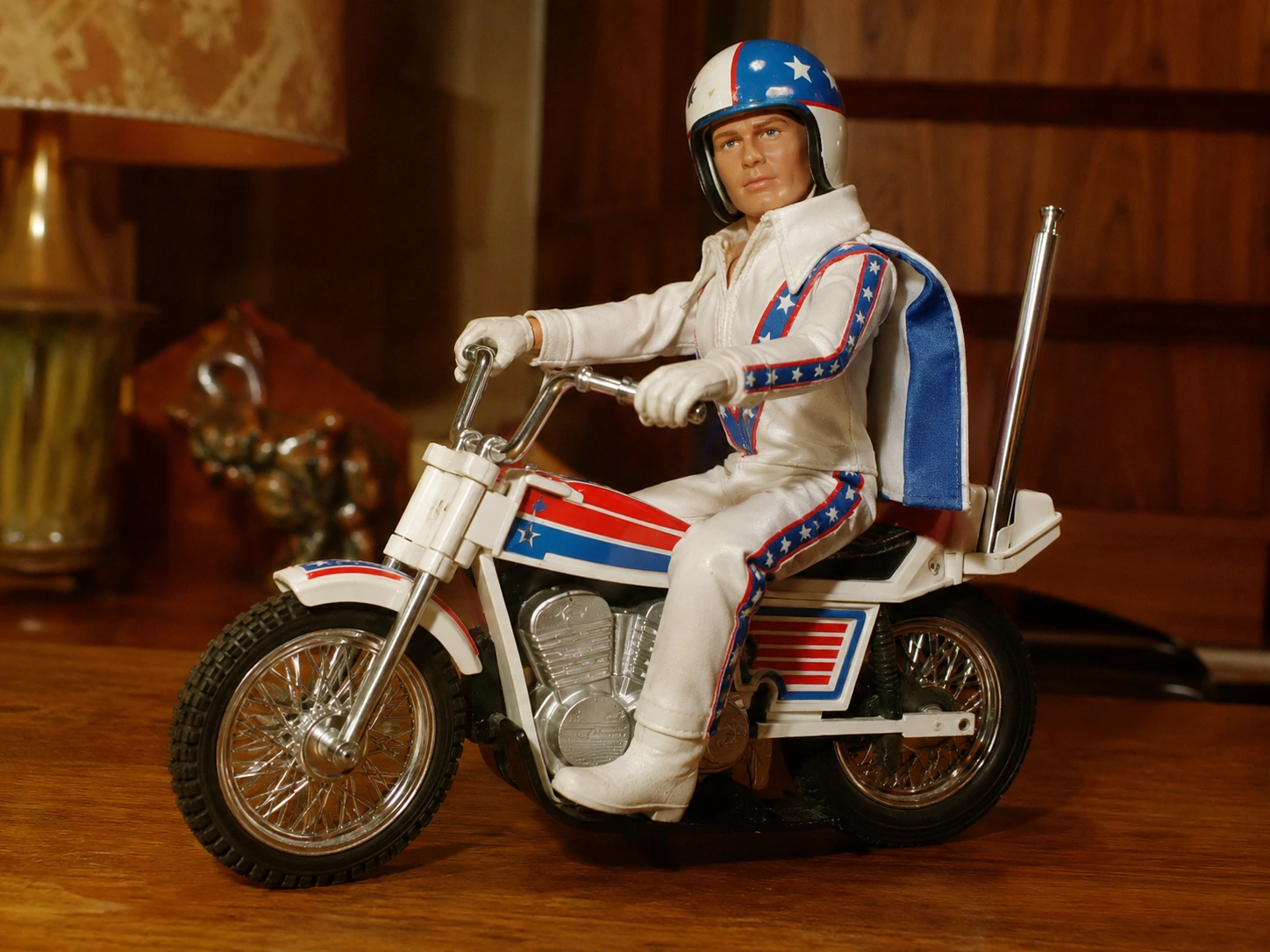
The body carried racing graphics, molded engine detail, handlebars, wheels and attachment points for the figure. It needed to look like Evel’s machine without becoming so delicate that the first bookshelf landing ended the show.
The figure’s hands and body could be positioned on the cycle. A good setup kept him aboard during the run. A bad landing separated rider and machine in a way that made the crash more convincing.
Collectors now understand what children learned immediately: removable accessories disappear. The helmet completed Evel’s look and became one of the pieces most likely to end up beneath furniture, inside another toy box or in a vacuum cleaner’s path.
The patriotic jumpsuit remained visible during flips and crashes. A generic rider would have made a moving motorcycle. Evel made it an event with a celebrity attached.
Every ramp edge, wall impact and rough landing marked the motorcycle. To a child, the wear proved that the toy had performed. To a collector, it helps separate a lightly used display example from a veteran of the living-room circuit.
After a crash, children inspected the rider, repositioned his limbs and created a recovery scene. The action figure made the reset part of play rather than dead time between launches.
The actual run lasted seconds. Preparing it correctly—or at least confidently—could occupy the entire room.
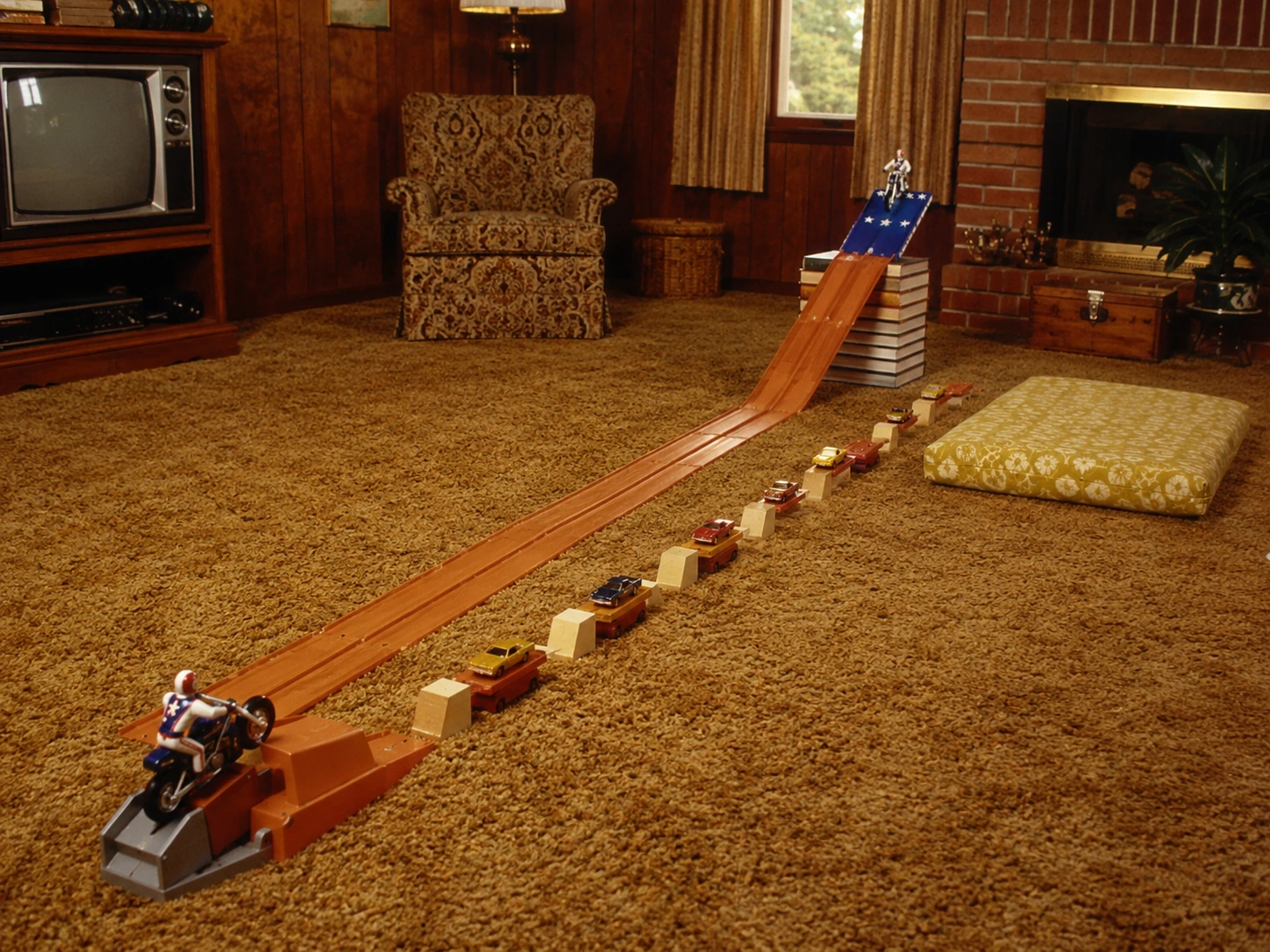
The operator looked down the runway for obstacles that were supposed to be there and obstacles that were not. Toy cars remained. Shoes moved. The dog received a warning with no legal force.
The base had to remain stable while the motorcycle climbed it. Books supplied weight, cardboard supplied angle and tape supplied confidence. A ramp that collapsed under finger pressure was sometimes approved anyway.
The number mattered because the announcer needed something to count. Small toy cars created the classic look. Action figures added emotional stakes. Breakable objects were officially banned and unofficially nearby.
A smooth surface allowed the cycle to continue after landing. A blanket reduced impact but stopped the motorcycle. A second ramp promised elegance and usually created another collision point.
Hands went toward the handlebars, boots aligned and helmet pressed into place. The figure had to look ready even if one arm had developed a permanent bend from previous service.
The rear wheel needed proper contact with the drive mechanism. A loose fit produced noise without useful speed. A correct fit made the wheel come alive immediately.
Early turns sounded mechanical. Full speed sounded urgent. Children learned the point where another turn seemed powerful and the point where another turn seemed personally necessary.
The room received final instructions. Spectators moved back. The operator described a record that had not been independently verified.
The cycle left the launcher, corrected itself, crossed the floor and reached the ramp. Everything after that depended on angle, speed and the quality of household construction.
A landing counted if both wheels touched first. It also counted if the rider stayed aboard. It sometimes counted if the motorcycle crossed the obstacles at any altitude and stopped somewhere visible.
The motorcycle and figure were retrieved. Missing accessories triggered a search. Furniture was moved only when necessary and returned approximately.
A successful setup did not remain successful for long. Another obstacle appeared, the ramp rose or the landing zone moved farther away. The Stunt Cycle’s real finish line was the moment an adult ended operations.
Opening the box was exciting. Hearing the rear wheel reach full speed for the first time was when the toy became real.

The initial setup usually began on the safest available floor, which meant the location was chosen by an adult. The first meaningful launch happened after that adult left the room.
The energizer gave the operator control over the event. Cranking felt like powering the motorcycle directly. Children argued about who had wound it enough, who had released too early and who had damaged the mechanism by being enthusiastic.
Before ramps appeared, the cycle needed a test. It crossed the floor, leaned, corrected and eventually encountered an object. That run answered the important question: how much room did the toy actually require?
Even if the set included a ramp, children soon tried alternatives. Books created height. Cardboard changed the angle. Blocks widened the base. A board from the garage introduced a scale the living room had not authorized.
Blankets and pillows looked useful until the motorcycle hit their soft surface and stopped instantly. Hard floors preserved momentum but offered less forgiveness. Every household developed its own compromise.
A clean landing was impressive. A huge crash was also impressive. The Stunt Cycle had the rare advantage of producing entertainment at both ends of the performance scale.
If the motorcycle hit the couch, the ramp was not too high. The couch was too close.
The motorcycle supplied motion. The rest of the production came from siblings, toy cars, cardboard signs and an announcer who also operated the crank.
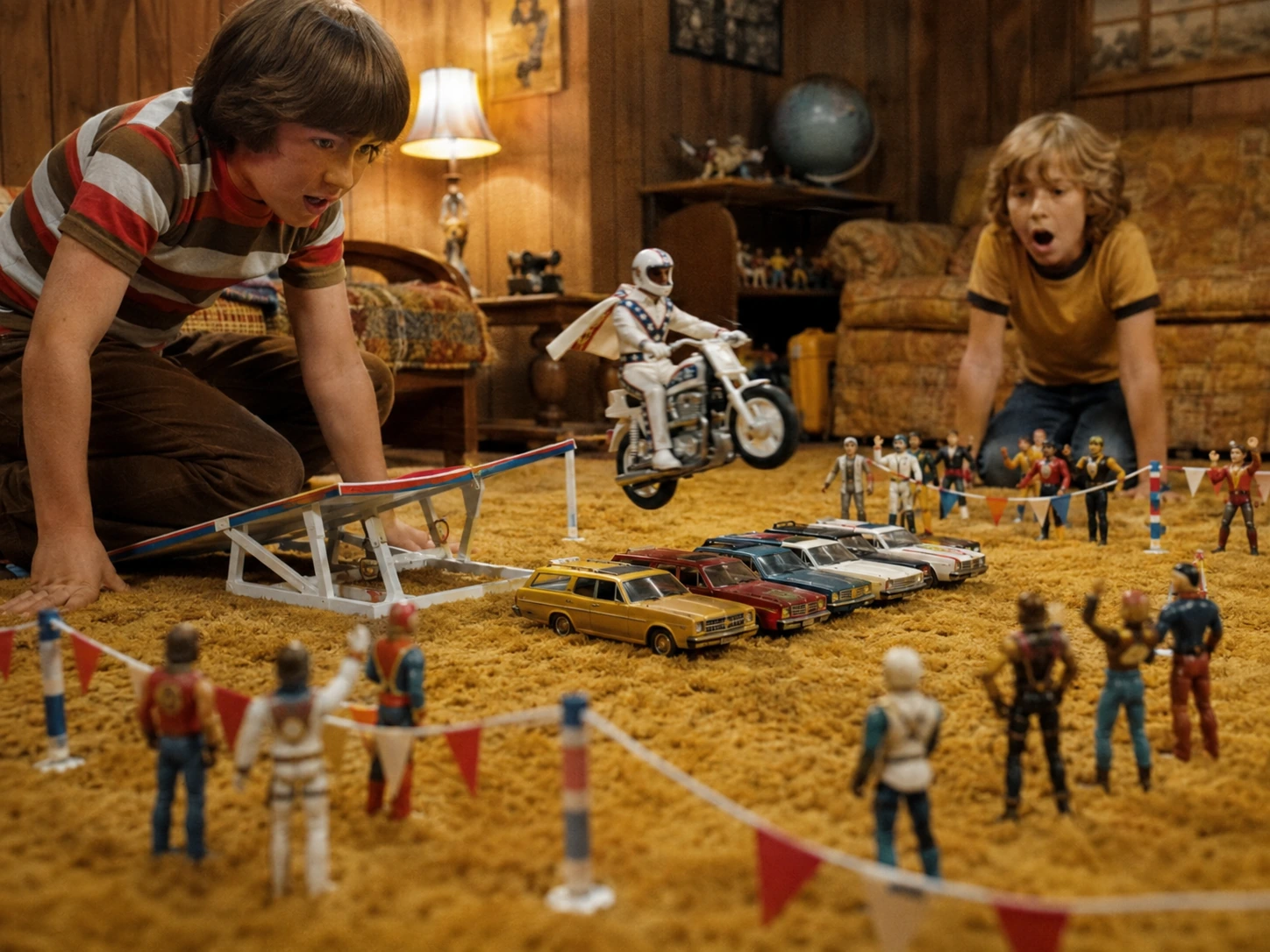
Kenner Star Wars figures, toy soldiers, dolls and stuffed animals lined the route. Their scale did not matter. They were the audience, rescue crew and potential obstacles.
Somebody described the event in a voice borrowed from television sports. The number of cars increased in the telling. The previous record became official even when nobody remembered it.
A living-room course became a stadium. The hallway became a canyon. The gap between two chairs became a danger zone with a title invented five seconds earlier.
Evel’s helmet was pressed down, hands positioned and legs adjusted. The motorcycle entered the energizer. The ramp was checked by pushing on it once and deciding that counted as engineering.
Children learned the likely launch direction and the possible launch directions were not always the same. Everyone moved behind the crank operator or climbed onto furniture for safety and a better view.
If the figure separated from the motorcycle, other toys arrived as ambulance crews and mechanics. The rider received a short examination, recovered fully and returned to the launcher before the emergency vehicles had left.
A successful jump created no conclusion. It proved that the ramp could support another book, car or inch of distance. The show continued until the mechanism slowed, an accessory disappeared or an adult reclaimed the room.
No audience ever left because the jump was too successful. They left because somebody’s mother needed the books back.
The toy arrived with a stunt idea. Children supplied the civil engineering.
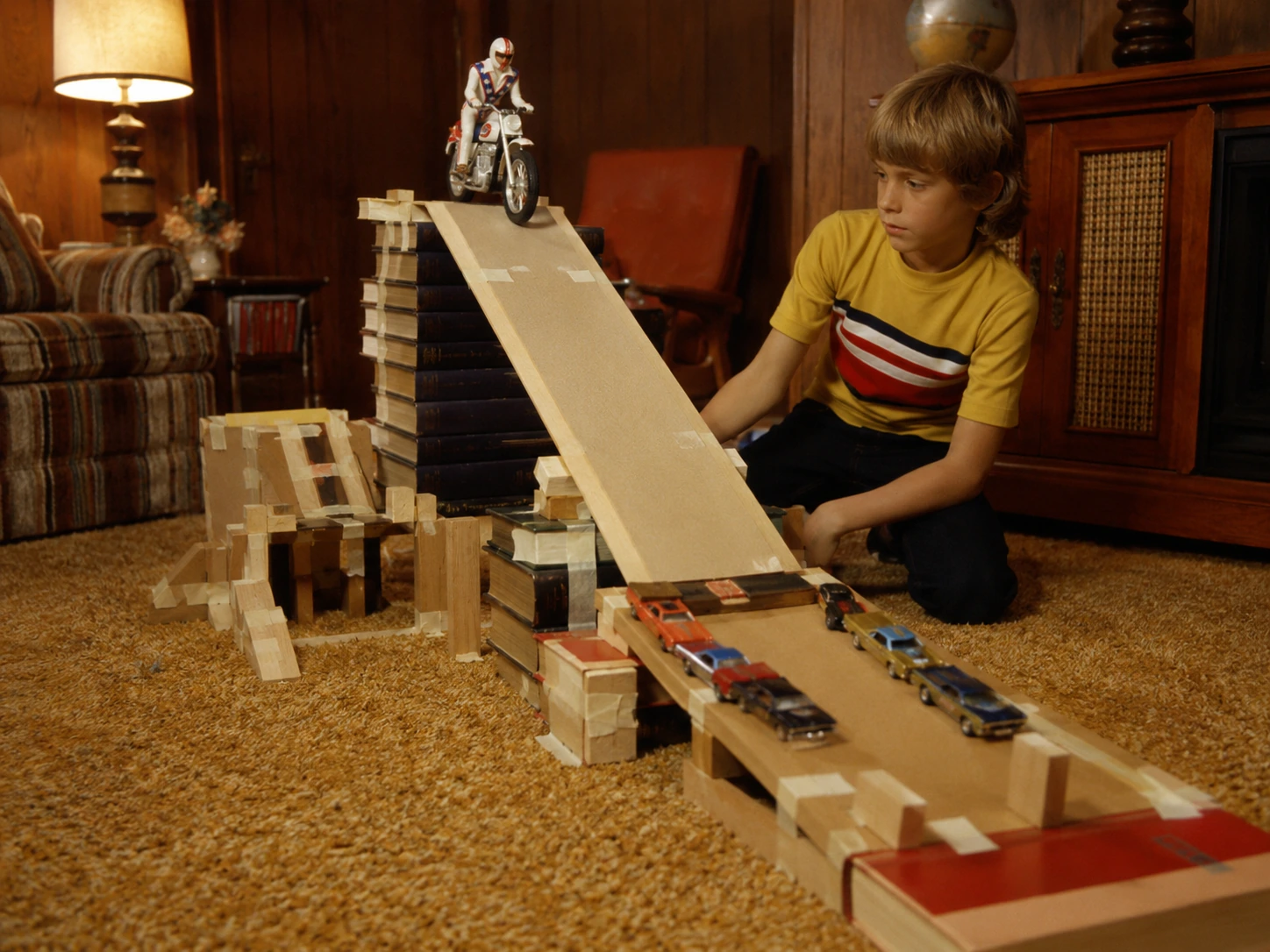
Hardcovers stacked cleanly, stayed where they were placed and came in several useful heights. Encyclopedias became premium infrastructure. Schoolbooks entered service without permission.
A cereal box, packaging flap or piece of poster board could bridge the support and create a smooth takeoff. Too flexible and it collapsed. Too steep and the motorcycle climbed vertically before reconsidering the entire plan.
One object was a demonstration. Three objects became a stunt. Children lined up toy cars, action figures, blocks and household items beneath the jump, then counted them afterward as proof of distance.
When flat-floor landings failed, children added a second ramp. Matching the angles required a level of precision rarely present in the room. The landing ramp usually waited in the correct general area while Evel arrived elsewhere.
The cycle landed short, so the crank needed more turns. It jumped nose-high, so the ramp needed a gentler angle. It struck the wall, so the entire operation needed to rotate five degrees.
The toy taught experimentation because every attempt was brief and repeatable. Adjustments happened in seconds, and the next result was visible immediately.
Couch cushions created barriers. Coffee tables created tunnels. Chair legs became gates. The room’s intended purpose gradually disappeared beneath the event.
That improvised physical play connects naturally to the larger story of 70s backyard toys, ramps and scraped-knee confidence. The Stunt Cycle worked indoors, but its spirit belonged to the same decade that believed almost any surface could host a stunt.
The box showed controlled jumps. The house supplied table legs, heating vents, baseboards and one lamp nobody remembers placing there.
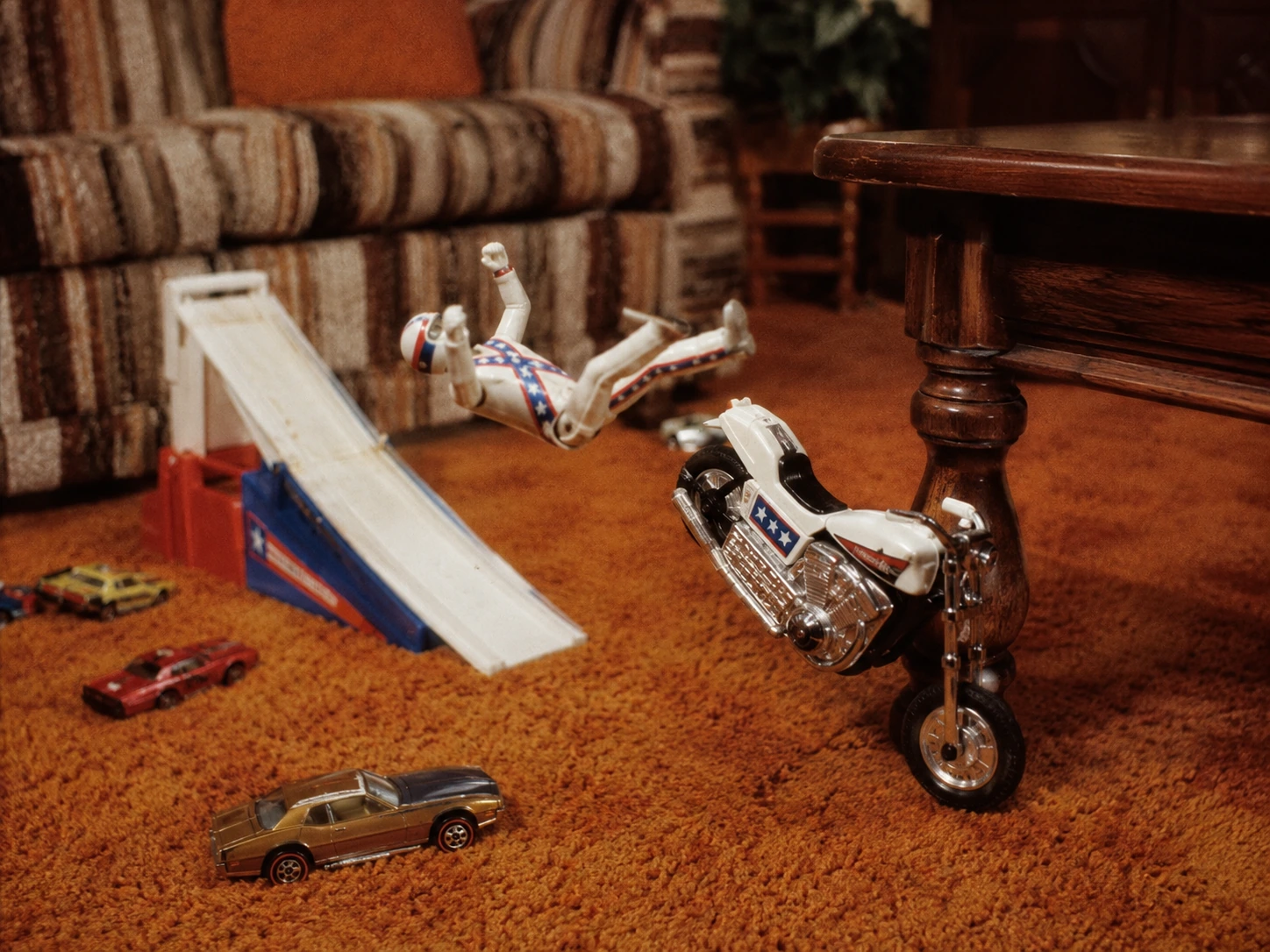
The Stunt Cycle’s most honest feature was its refusal to stop neatly. Once released, the motorcycle carried momentum until friction, gravity or household property intervened.
A child aimed for the gap between cushions and discovered that soft upholstery stopped the motorcycle instantly. The rider continued forward. This was considered a successful dismount if nobody was watching closely.
A small steering error turned a jump into a direct collision. The motorcycle survived many impacts because the toy was built with repeat play in mind. The furniture retained no emotional investment in the outcome.
Helmets, belts, canes and small pieces migrated toward floor registers. Recovering them required tools, patience and an adult willing to hear the full explanation.
Children learned that a long straight run needed an ending. A wall provided one. Baseboards collected tire marks and parents collected evidence.
Everybody learned to stand behind the energizer or far beyond the landing zone. The area beside the ramp was not safe because a crooked launch could send Evel laterally with impressive confidence.
Every household remembers a different target: a lamp, stereo cabinet, Christmas decoration, television stand or visiting relative’s ankle. The exact story changes. The phrase “we told you not to do that in here” does not.
The Stunt Cycle worked almost anywhere the rear wheel could keep its speed and the adults had not noticed yet.
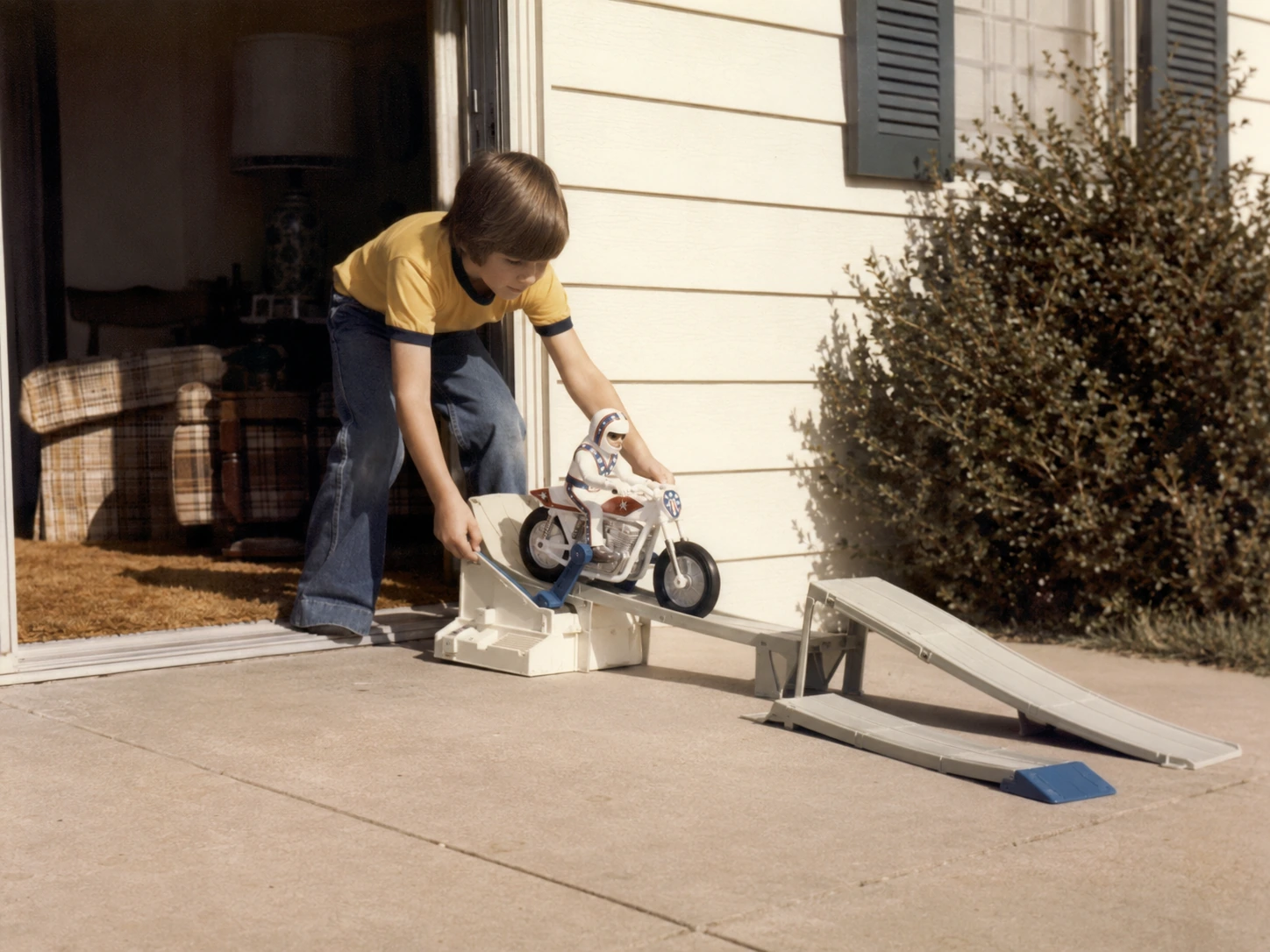
Linoleum, tile, hardwood and basement concrete gave the cycle a smooth launch. They also amplified the sound and made impacts more obvious.
Low-pile carpet could support shorter runs. Shag swallowed momentum, caught small parts and reminded children that the 1970s had made several questionable flooring decisions.
Outside, the motorcycle had room. Concrete seams created bumps, but long straight sections allowed higher speed and more ambitious ramps.
Boards, blocks and cardboard could create longer setups. Toy cars lined the course. Neighborhood children became spectators. The event gained the same public energy that made 70s outdoor toys feel like a local sports league. The same pavement also belonged to Big Wheel races and driveway spinouts, because the 1970s never believed one outdoor hazard was enough.
Light cardboard ramps moved. Paper signs fell over. The motorcycle still launched, because postponing the show for weather was not considered.
Outdoor surfaces scratched plastic, wore tires and introduced dirt into the mechanism. The toy looked more authentic and worked less perfectly with every season.
The Stunt Cycle was easy to share in theory. The person holding the launcher developed a different interpretation.
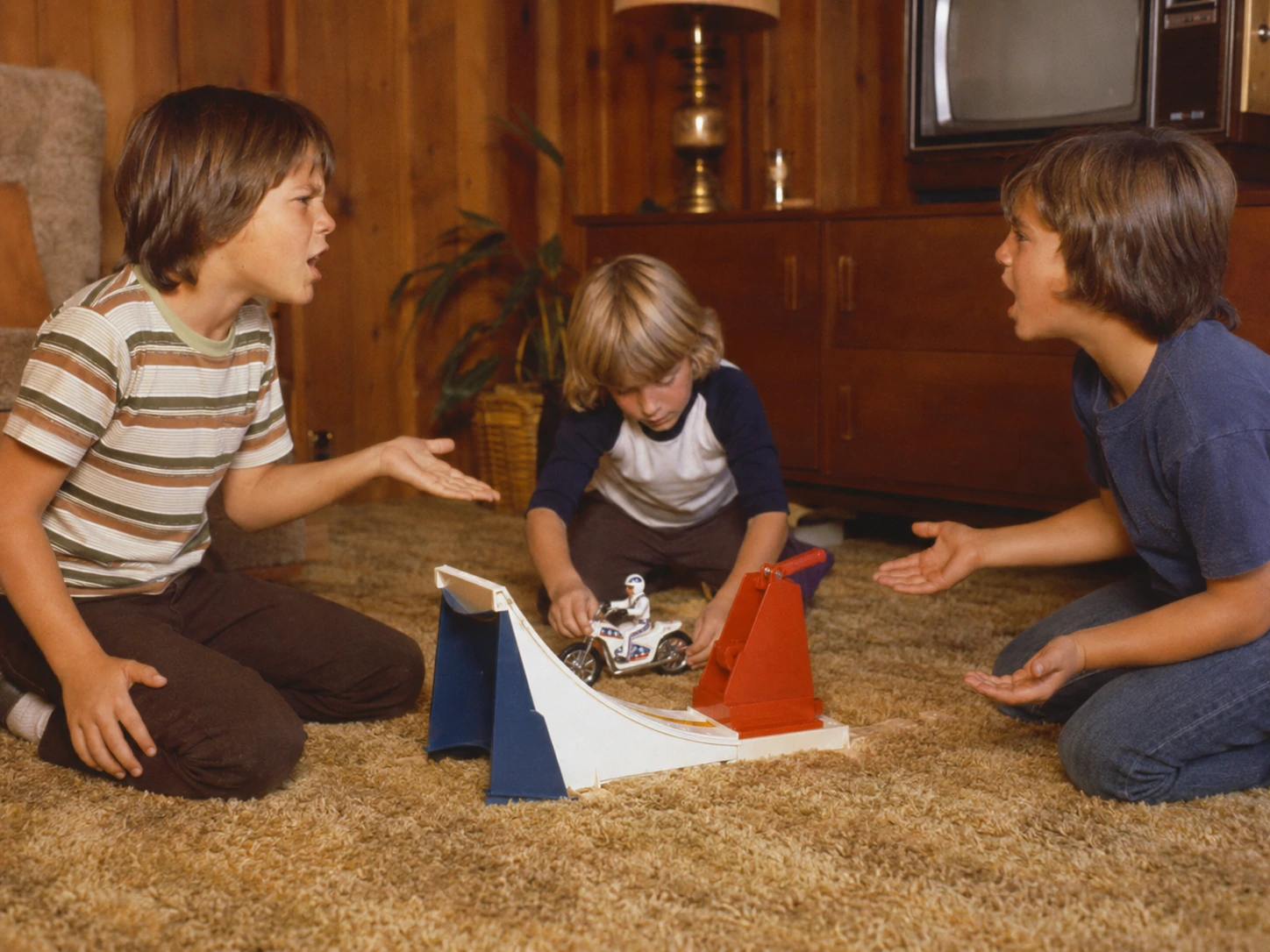
The crank operator controlled speed, timing and release. That made the role more desirable than setting up toy cars beneath the ramp.
Ownership supposedly meant knowing how many turns were safe, how the motorcycle fit and why the last crash was the other person’s fault.
Adults encouraged equal turns. Older children reduced the younger rider’s ramp height, crank count and access to the good helmet while insisting the experience remained equal.
A visiting child arrived with no respect for established limits. The ramp became steeper, the crank turned harder and the motorcycle encountered rooms it had never entered.
Toy cars, blocks and figures came from several collections. After the jump, sorting ownership took longer than rebuilding the course.
Children established turn counts, distance records and whether a landing counted if the rider fell off afterward. Rules changed according to who had just performed.
Adults remember the cycle. Siblings remember who received it, who lost the helmet and who broke the launcher. Those arguments became part of the object’s history.
It had a famous name, a loud demonstration and the rare ability to turn torn wrapping paper into a stadium within minutes.
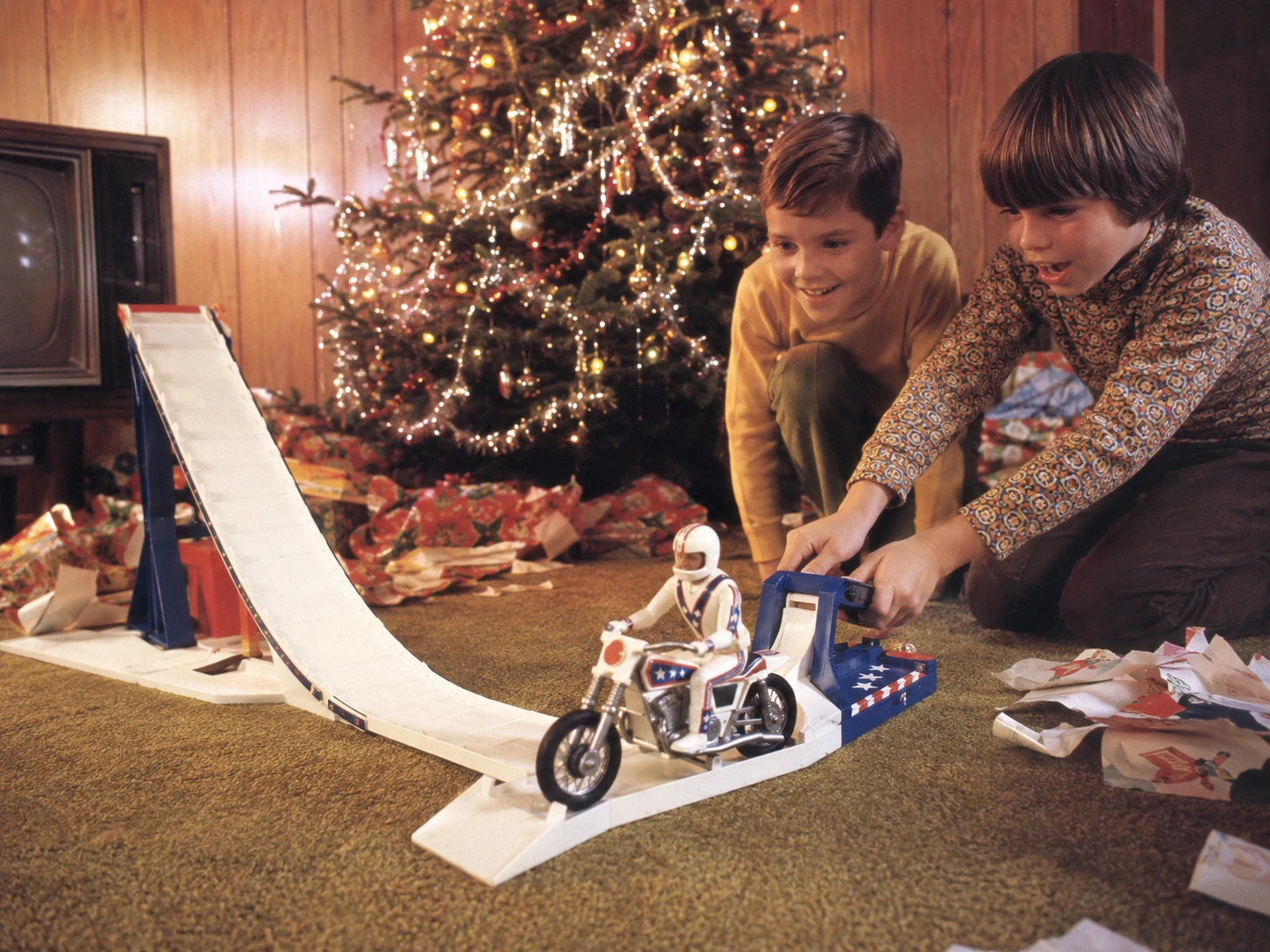
The Stunt Cycle was built for holiday desire. Children had already seen Evel on television. Commercials showed the motorcycle moving at full speed. The package contained a large, understandable promise: wind it up and launch the daredevil.
A department-store display or television commercial did not need much explanation. The wheel spun, the cycle raced and the figure jumped. Parents could see the mechanism. Children could imagine the living room losing control.
Celebrity graphics, motorcycle imagery and stunt action gave the package scale. It was not merely a figure or vehicle. It looked like equipment for a show.
Boxes, wrapping paper, books and visiting relatives created an instant course. The child did not need to wait for summer or assembly of a large outdoor toy. Evel could begin working before breakfast.
One child cranked. Another placed obstacles. Adults watched the first run and then started moving fragile objects. The toy created a shared event even when only one person technically owned it.
Once a toy became the thing children were discussing, every commercial and catalog appearance increased urgency. The Stunt Cycle’s 1973 success helped Ideal build an entire line over the next several years.
Our year-by-year look at 70s Christmas toy crazes shows how feature-driven toys became holiday emergencies. Few demonstrated that better than Evel building speed beside the tree.
Thirty seconds of television could remove every crooked ramp, stalled wheel and collision with the stereo cabinet.
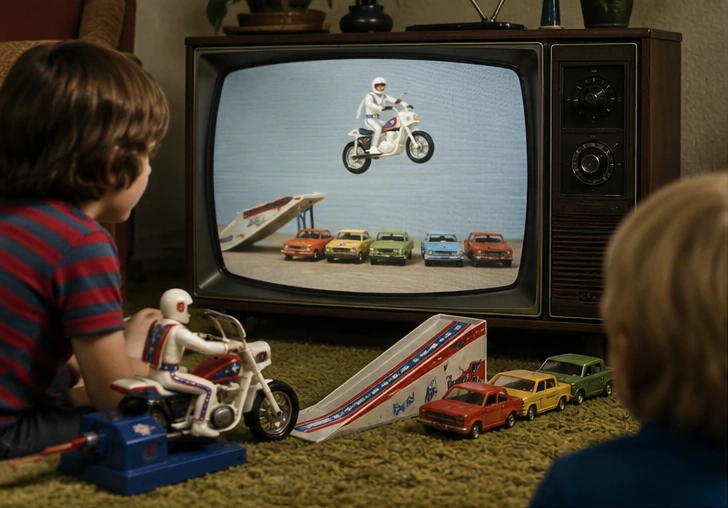
Ideal’s commercials presented the Stunt Cycle as a controlled spectacle. Children cranked the energizer, released the motorcycle and watched Evel clear obstacles with the timing of a professional touring show.
The energizer’s rising whine became an audio hook. Viewers understood that power was building before the announcer explained anything.
Commercials could select the best attempts, cut around resets and present several stunts in quick succession. Home play included the full production process: positioning the figure, rebuilding the ramp and searching beneath furniture.
Product names, vehicle names and features were repeated until kids could deliver the pitch at home. The request became more specific than “an Evel toy.” It became the Stunt Cycle, Scramble Van or Stunt Stadium.
As Ideal added products, commercials connected them. The van carried equipment. New cycles offered different terrain. Larger sets created complete arenas. One successful toy became a system.
The site’s 70s toy-commercial archive shows why the line felt unavoidable. The commercials had speed, celebrity and action before many action-figure ads had figured out what to do besides show children holding figures near a playset.
The core experience stayed recognizable while packaging, graphics, figures, motorcycles and included equipment changed across the line.
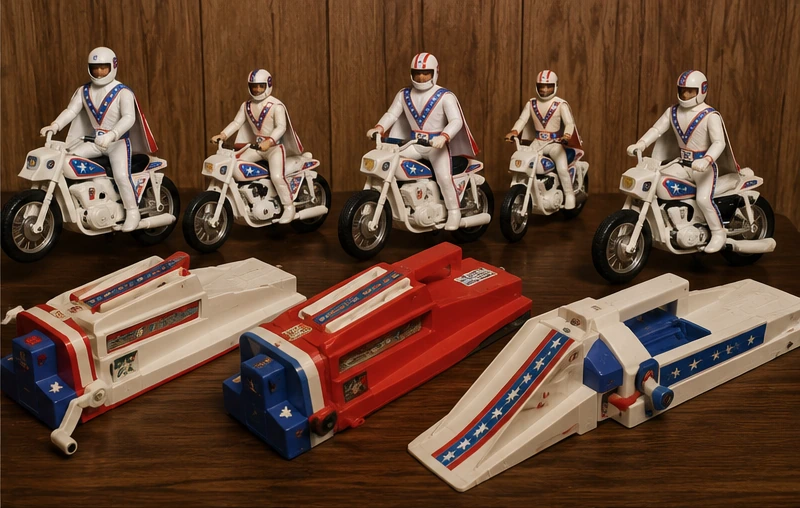
Collectors often talk about “the” Stunt Cycle as though every set were identical. Ideal kept the concept alive through multiple years, and changes appeared in the box art, cycle styling, figure details, energizer colors and included stunt pieces.
The earliest releases connect most directly to the 1973 launch and Christmas craze. Identifying them requires comparison with period packaging, instructions and documented examples rather than relying on a seller’s date.
As Knievel’s costumes, vehicles and public stunts changed, Ideal updated graphics and product combinations. A later motorcycle can be genuine to the line without matching an early box.
Sets sold outside the United States can carry different printed information, logos, language or component combinations. Those differences do not automatically indicate reproduction.
Outfits can vary, and children mixed clothing across figures. A real Ideal garment may not be original to the exact set where it appears today.
The launcher and motorcycle were often separated during storage. A seller may reunite genuine parts that did not begin together. Mechanical compatibility is not the same as version accuracy.
Box art shows the intended contents, but boxes can be married to incomplete sets. Instructions, molded marks, color combinations and catalog images should agree.
Newer official editions preserve the classic concept and may resemble vintage pieces closely. Collectors should inspect markings, materials, packaging and provenance before calling a piece original 1970s production.
The safest approach is version-first collecting: identify the release, list the correct contents and then judge condition. Starting with a dramatic asking price and working backward usually ends badly.
The Stunt Cycle created the event. The Scramble Van gave Evel somewhere to store the operation and arrive like a professional.
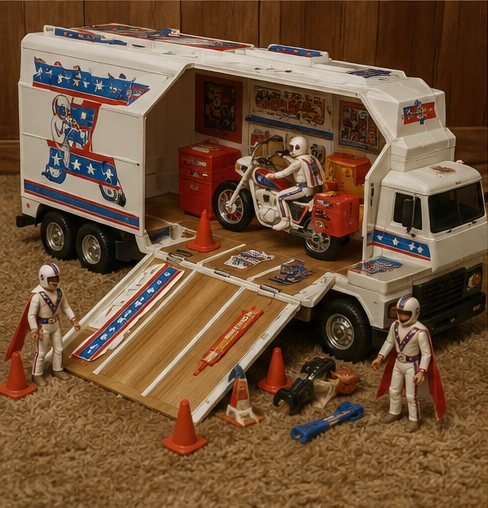
The Scramble Van expanded the fantasy beyond a single launch. It functioned as transport, storage and play environment, echoing the support vehicles associated with real stunt tours.
Figures, motorcycles and accessories needed a home. A large vehicle could carry them while becoming another toy rather than a plastic box adults supplied.
Evel could drive into the scene, unload equipment and prepare the jump. The performance gained a before and after instead of beginning at the energizer.
A child with the van, cycle and accessories could build a full operation. That visual completeness was powerful in catalogs and commercials even when most households owned only one or two pieces.
Doors, clips, ramps, panels and interior pieces could break or disappear. Complete surviving vans are harder to assemble today because the vehicle had more components than the original Stunt Cycle set.
It displays the whole line well, carries strong graphics and represents Ideal’s confidence at the toy line’s peak. It also occupies enough shelf space to remind collectors why their parents did not keep the box.
Ideal learned that children did not only want Evel to jump. They wanted him to arrive on every vehicle the decade could turn into a stunt.
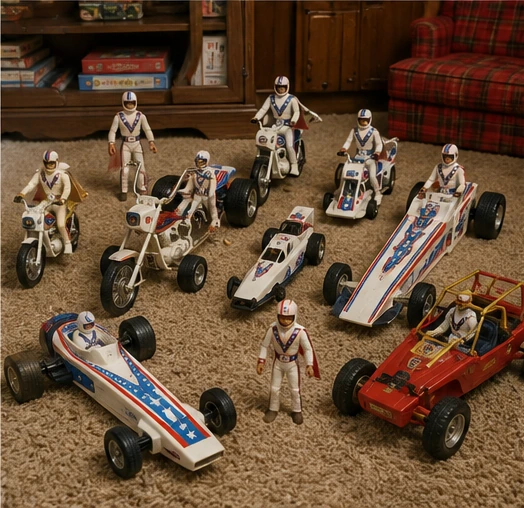
A longer, styled motorcycle shifted the visual language from competition bike toward custom road machine. It gave the figure another identity without changing the basic celebrity.
Off-road styling suggested dirt, rough terrain and outdoor routes. Whether the toy performed perfectly on those surfaces mattered less than the new story it created.
A drag vehicle fit Evel’s obsession with acceleration and spectacle. It also gave Ideal another mechanical toy that could race beside the motorcycles.
Four wheels changed the balance, landing and type of course. Children could build jumps without requiring the same gyroscopic stability as the motorcycle.
Each new release made the earlier pieces feel like part of a larger system. The figure could move between machines, the van could carry them and the playsets could host them.
Ideal borrowed the visual language of ramps, support vehicles, patriotic graphics and specialized machines. The toys felt connected to a real operation rather than a random assortment of licensed products.
Children had already built arenas from books and boxes. Ideal eventually sold them one with proper branding.
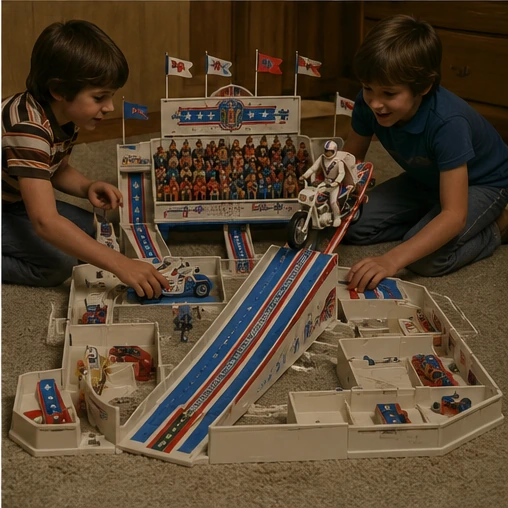
A dedicated stunt environment gave the toy line structure. Ramps, barriers, signs and viewing areas made the event look planned even when the motorcycle still left the course.
Improvised ramps offered freedom. A stadium offered repeatability. The takeoff and landing points could remain in place long enough to compare attempts.
Patriotic signs and branded pieces extended Evel’s visual identity across the setup. A child no longer needed to explain what the books represented.
Other figures, toy cars and accessories filled the arena. The jump became the center of a larger toy population.
Small signs, clips, supports and barriers rarely survived together. A vintage stadium may look complete until compared with the instruction sheet.
Ideal had turned the original mechanism into a complete world. The cycle could remain the star while the surrounding environment offered more reasons to reset and perform again.
The real 1974 canyon attempt was not a motorcycle jump, but it gave Ideal one of the decade’s most irresistible toy ideas: Evel in a rocket.
Knievel’s attempt to cross Idaho’s Snake River Canyon used a steam-powered Skycycle rather than a conventional motorcycle. The real event ended after the parachute deployed early and the craft drifted into the canyon, but the image of Evel inside a patriotic rocket became inseparable from his legend.
The stunt showed that his brand was not tied to one machine. If the obstacle became too large for a motorcycle, the solution could be a rocket.
Children could stage canyon launches repeatedly and decide the outcome themselves. The toy did not carry the legal, engineering or weather problems of the real event.
Space-age shapes, patriotic graphics and celebrity spectacle joined the toy aisle at a moment when rockets still carried futuristic authority.
Our 1974 toy rewind sits inside a year when televised spectacle and licensed play were becoming more connected. Evel’s toys benefited every time his name returned to the screen.
It represents one specific, famous event and usually includes specialized parts that are difficult to replace. Completeness matters because a rocket without its launch equipment tells only half the story.
Ideal understood that a toy world grows faster when the hero has partners, rivals and another rider waiting for a turn.
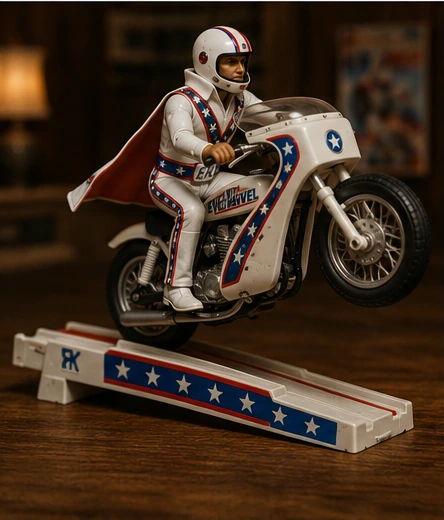
A figure based on Evel’s son allowed children to create a second rider and echoed the real family connection to stunt performance.
Derry Daring gave the line another stunt character rather than limiting girls to watching the main event. She belonged to the same world of vehicles, jumps and action.
With more than one rider, the setup could support races, rival jumps and rescue scenes. The toy no longer depended on one figure surviving every launch.
Costume pieces, helmets and gear created variety while increasing the number of small items likely to disappear. Collector completeness became childhood inconvenience in advance.
Fabric clothing and removable accessories came from doll traditions. Vehicles and playsets came from action-figure systems. The energizer supplied a mechanical performance. Ideal combined all three.
The figure arrived first, the Stunt Cycle created the breakthrough and the next several years turned one daredevil into a complete toy aisle.
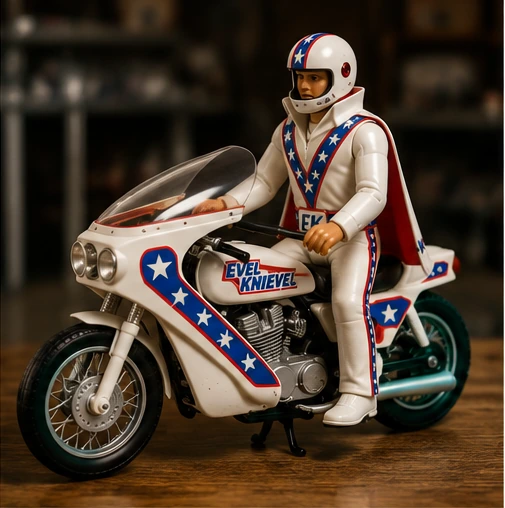
Ideal’s Evel Knievel figure translated the white jumpsuit, patriotic graphics and celebrity attitude into a poseable character before the Stunt Cycle made him move.
The hand-cranked energizer and motorcycle arrive, giving children a repeatable stunt machine that can race, jump and crash without batteries.
The real Knievel’s rocket-powered canyon attempt dominates attention, while toy ramps and improvised household canyons become more ambitious.
Vehicles, accessories and larger play ideas turn one motorcycle into a complete traveling stunt operation.
Commercials push the Scramble Van, cycles and related equipment as a connected world of stunt play. Contemporary reporting later described the line as Ideal’s best seller that year.
Later vehicles and film-connected ideas appear as Knievel’s public image changes and Ideal prepares to leave the line behind.
Patriotic colors, airborne motorcycles and a famous white jumpsuit made the package look louder than the rest of the shelf.
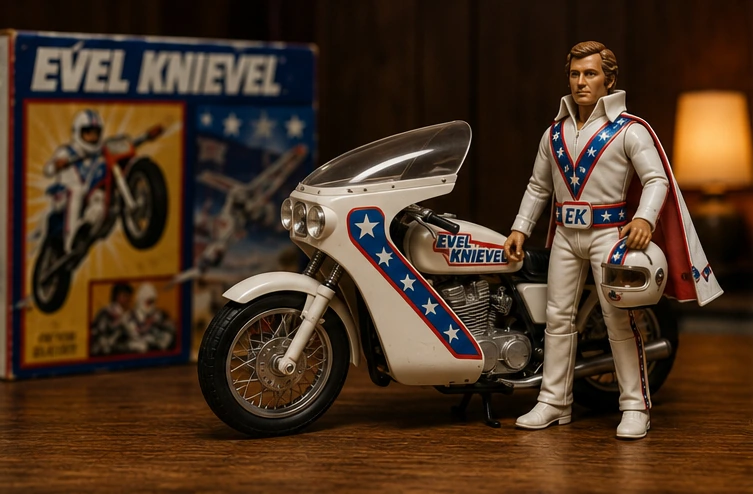
Packaging artists showed the cycle airborne, the rider committed and the obstacle already beneath him. The image captured the moment every child wanted to create.
Knievel’s graphics were instantly recognizable. Stars, stripes and bold lettering connected the product to television appearances before a shopper read the details.
A launcher could resemble a plastic maintenance stand unless the box showed the result. Artwork linked the crank directly to speed and jumping.
Packages showed features, setups and other products in the line. A child opening one toy could discover several additional necessities before reaching the contents.
Large toy packaging rarely survived untouched. It could support a course, store unrelated pieces or collapse in the closet. That makes clean original boxes valuable today.
The catalog showed the entire line together. The box focused on one event. Both presented a version of play where the ramp was aligned, the motorcycle was complete and nobody had lost the helmet.
Decades later, a box can settle whether the childhood toy was the basic Stunt Cycle, a later edition, a special vehicle or a set remembered under the wrong name.
One catalog page could show the cycle, van, playset and vehicles together, making a child’s current collection look suddenly incomplete.
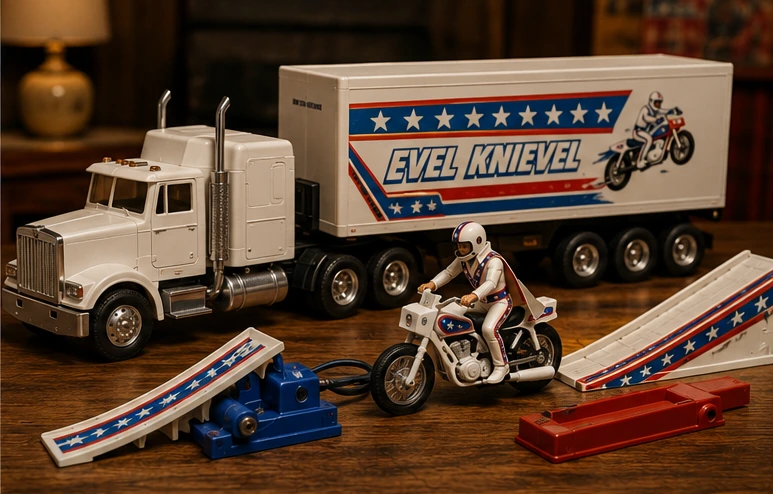
Department-store catalogs were ideal for the Knievel line because the products looked better as a group. The Stunt Cycle sat beside larger vehicles and playsets, each one making the others easier to understand.
Television showed motion. Print showed a motorcycle suspended above obstacles forever, with every piece visible and nothing broken.
Children circled exact items and repeated them until adults recognized the difference between the basic cycle, van and later vehicles.
A child who already owned the Stunt Cycle could move toward the van, stadium or specialized vehicle. The line turned one Christmas success into several future requests.
Collectors now use period pages to compare graphics, packaging, included parts and release timing. The same printed spread that created childhood desire can help identify a set fifty years later.
Our look at 70s toy catalogs and Sears Wish Books follows the annual ritual that made every Evel setup look one accessory short of complete.
A motorcycle, figure and launcher may look complete from across the room. The missing pieces usually reveal themselves when the crank turns.
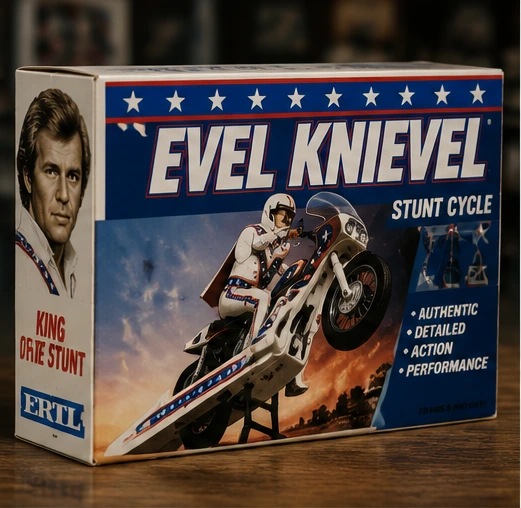
Original 1970s sets were produced by Ideal. Molded marks, packaging, instruction sheets, graphics and construction details help separate vintage pieces from later reproductions and modern revivals.
The launcher is the mechanical heart of the set. Check the crank, internal drive, motorcycle fit and release action. A clean exterior does not guarantee that the mechanism still transfers power smoothly.
The wheel must spin freely and hold speed. Dirt, wear, age and damaged internal parts can reduce performance even when the cycle displays well.
The figure’s head, body, clothing and accessories should match the version. Replacement riders, mixed outfits and incomplete figures are common because the parts were designed for play across the line.
Small removable pieces affect completeness. Helmets, belts, capes, canes, gloves and other accessories vary by release and are frequently missing.
Sellers may assemble pieces from different sets. Period instructions and catalog images help determine what originally belonged together.
Original graphics can be fragile. Aggressive cleaning may remove the very details that establish authenticity.
Boxes are often faded, torn or repaired. Confirm that artwork, inserts and contents belong to the same version rather than assuming any Evel box completes any Evel set.
The motorcycle usually survived because it was large. The accessories disappeared because the 1970s had carpets, heating vents and siblings.
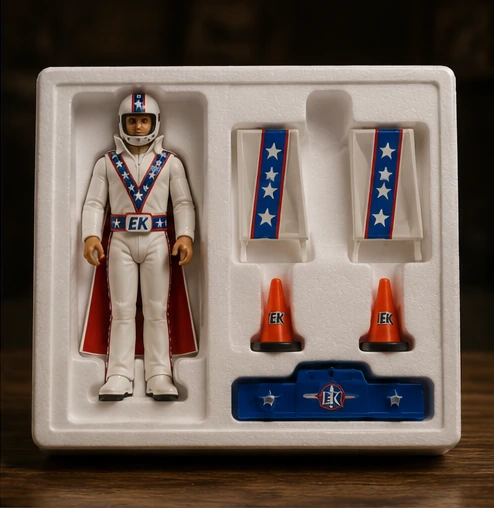
It completed the figure’s look and separated from the head at exactly the wrong moment. A loose original helmet can become disproportionately important to a restoration.
An energizer without its crank may display correctly but cannot perform. Improvised replacements can work while reducing originality.
Small structural pieces disappeared when children moved from the included setup to books and cardboard. The improvised ramp made the official parts seem optional until decades later.
Belts, capes, gloves and related pieces wore, tore and migrated between figures. Original fabric can be harder to replace accurately than molded plastic.
Families discarded paper after assembly. Instructions now provide valuable evidence about contents, setup and version differences.
Cardboard supports protected the toy in transit and looked disposable after opening. Complete packaging requires more than the outer box.
Ideal released several cycles and vehicles. A set may include an Evel motorcycle that is genuine but not original to that launcher or package.
The mechanism can be complete externally while worn internally. Collector descriptions should separate “present” from “working.”
A good restoration preserves the mechanical event and the original material instead of turning every scuff into a crime scene.
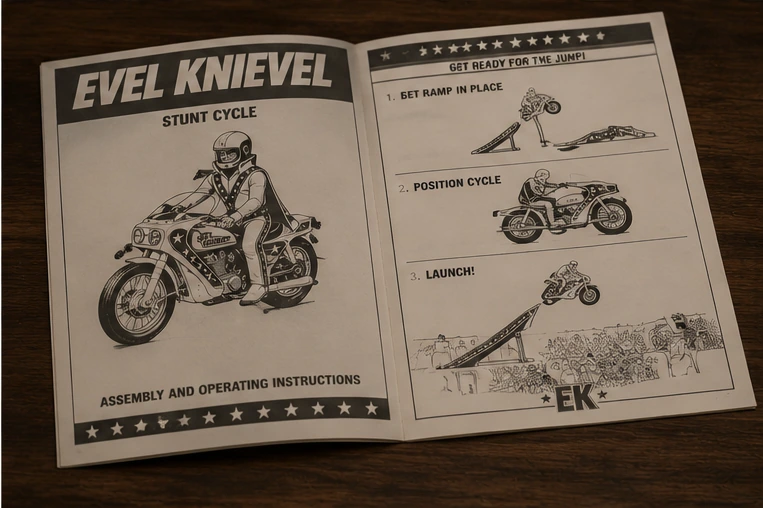
Photograph graphics, hardware, figure clothing and component order. Old toy mechanisms are easier to disassemble than to remember.
Test any cleaner on an inconspicuous area. Water, solvents and friction can damage decals, painted details and aged fabric.
Resistance may indicate hardened lubricant, misalignment or damaged gears. Full childhood enthusiasm is not a restoration technique.
Hand washing can shrink, fade or distort old outfits. Surface cleaning and specialist advice may be safer for rare clothing.
A display set can remain mechanically inactive. A working set needs stable plastic, a safe crank and a motorcycle that will not shed parts at speed.
Replacement decals, helmets, ramps and costume parts can complete the look. Clear disclosure preserves trust and helps future owners understand what is original.
The Stunt Cycle was designed to crash. Light scuffs, worn tires and fabric creases may be more historically appropriate than a glossy finish that never existed.
Children remember the jump. Parents remember the crank noise, the missing helmet and why the coffee table was suddenly six inches from the wall.
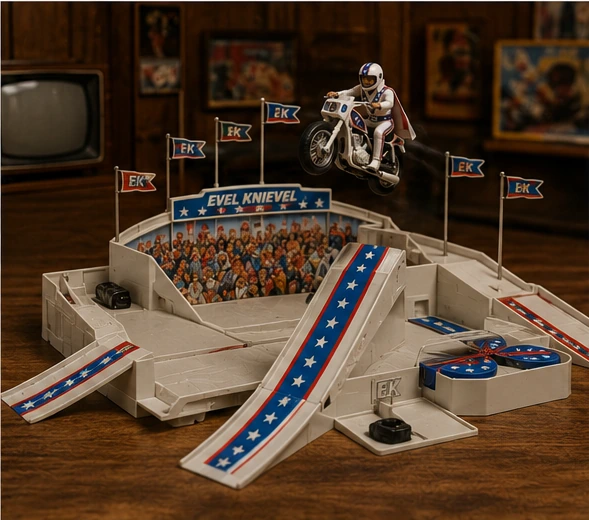
The energizer’s rising whine traveled through the house. An adult did not need to see the setup to know that a launch was approaching. The sound was followed by a roll, impact and immediate argument about whether anything had broken.
The launcher, runway, ramp, obstacles and landing area spread across the room. A toy that fit neatly in a box could occupy the distance between two pieces of furniture and every walking path between them.
Books, boxes, boards and cushions entered service. Parents found household objects supporting structures that appeared unsafe even at toy scale.
The helmet vanished, reappeared and vanished again. The crank was left somewhere separate from the launcher. Instructions disappeared once everybody believed they understood the toy.
Chair legs redirected the cycle. Baseboards stopped it. Sofas caught the rider. Lamps moved higher. The room adapted to the toy because the toy showed no interest in adapting to the room.
The motorcycle, figure, launcher, ramps and accessories did not remain together naturally. A cardboard box helped until the box became course material or storage for something else.
For all the noise and furniture risk, the Stunt Cycle offered long play from a simple mechanism. Children built, tested, adjusted and tried again without asking for replacement batteries.
A good jump pulled everyone’s attention toward the ramp. Parents who had complained about the setup still waited for the release and reacted when Evel cleared the cars.
Decades later, parents and children tell the same story from opposite sides. One remembers a legendary jump. The other remembers the lamp.
The name attracts attention, but the market still cares about version, condition, completeness and whether the toy can perform.
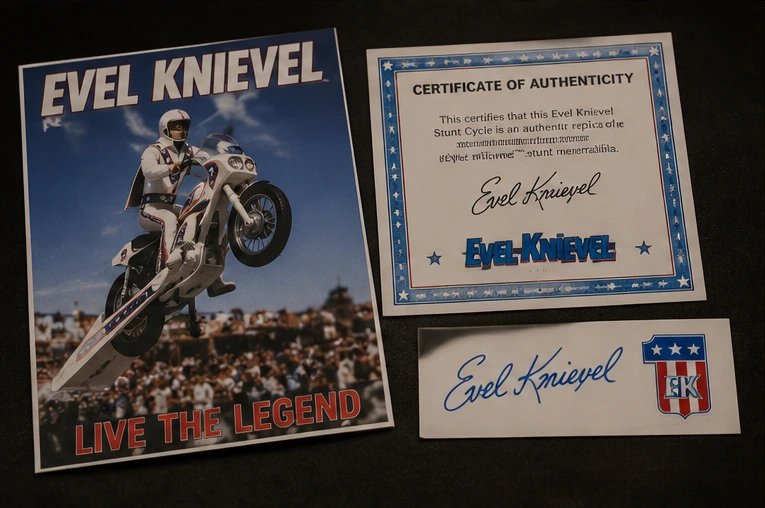
Different releases, packaging changes and vehicle variations do not trade equally. Identify the set before comparing prices.
A common motorcycle with a scarce helmet, launcher piece or insert can become a difficult project. Buying a complete set may cost less than collecting missing parts individually.
Some collectors want display pieces. Others want the energizer to launch. A functioning mechanism can add appeal if the toy remains original and safe.
Decals connect the toy to Evel’s visual identity. Heavy wear reduces display quality, while perfect replacement graphics should not be confused with untouched originals.
Large colorful boxes were discarded, crushed or used for storage. Strong packaging with inserts and instructions can significantly change desirability.
A family story adds meaning. It does not automatically establish rarity or market value without matching evidence.
Ambitious listings can remain online indefinitely. Completed sales for comparable versions provide a more realistic picture.
This page keeps the focus on identification and condition rather than pretending one number fits every Stunt Cycle in every state of survival.
The toy sent a plastic motorcycle over books. The television daredevil also inspired children to look at their bicycles and neighborhood ramps with new confidence.
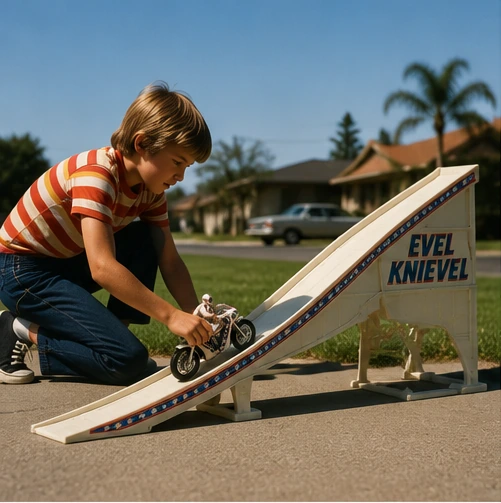
Knievel’s popularity did not remain inside the toy box. Children copied the visual language of his stunts with bicycles, boards and improvised ramps. The real-world imitation became common enough that physicians wrote about injuries associated with children trying to perform Knievel-style feats.
A child could build an outrageous jump for the Stunt Cycle without putting a human rider on the motorcycle. The figure absorbed the crash and returned immediately.
Repeated miniature jumps taught children how angle and speed changed distance. That knowledge could stay on the floor or migrate to the driveway.
Many Gen X memories come from neighborhoods where children had larger boundaries and fewer adults watching every minute. That freedom created independence and risk at the same time.
Children saw polished toy jumps and televised professional events. They did not always see the practice, safety crews and engineering behind the real setup.
The Stunt Cycle can be celebrated as a brilliant toy without treating dangerous bicycle imitation as harmless. The childhood memory belongs to its era; modern play can keep the ramps under the toy motorcycle.
Experiment, observe the result, adjust and try again. The toy rewarded that process without requiring a child to become the crash-test figure.
The line rose with Knievel’s television fame and fell when the real celebrity became harder for a family toy company to sell as a hero.
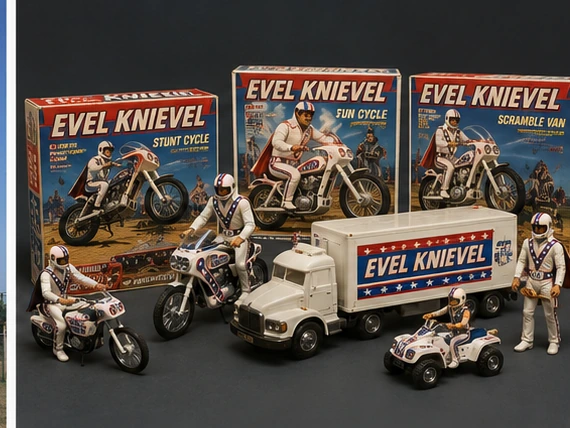
By 1976, contemporary reporting described Evel Knievel products as Ideal’s best-selling line. The company had built figures, motorcycles, vehicles, games and playsets around one of the decade’s most visible personalities.
That success depended on the public image attached to the name. In 1977, Knievel assaulted author Sheldon Saltman and later pleaded guilty to battery. The legal case and publicity damaged endorsements and made the superhero marketing increasingly difficult to defend.
A fictional hero behaves according to scripts owned by a studio or publisher. A celebrity can create news that no toy company approved. That risk became visible at the end of the line.
Children still owned the toys. Motorcycles continued launching after the commercials disappeared. The household experience outlived the corporate relationship.
The line remains tightly connected to the mid-1970s because it did not evolve gradually through later decades. The graphics, mechanisms and product names stayed sealed inside one cultural moment.
Modern revivals and collector interest focus on the mechanical brilliance of the Stunt Cycle and the unforgettable look of the original line. The toy can be admired without simplifying the real person into a flawless hero.
A great mechanical toy does not need an app, screen or software update. It needs the rear wheel spinning and enough open floor.
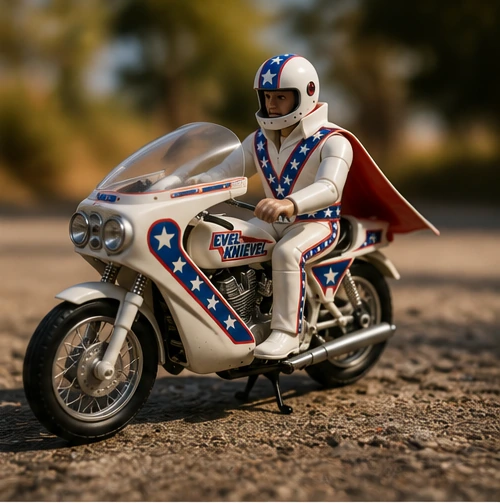
Modern versions have brought the Stunt Cycle back for collectors and new riders, with official sellers emphasizing the original 1970s concept and, in some cases, production connected to surviving molds.
Turn the crank, hear the wheel accelerate and release the motorcycle. The complete product explanation takes seconds.
Collectors now have more space, better materials and less parental opposition. This has not necessarily improved judgment.
A reproduction can perform while an original remains on display. That separation protects brittle parts and preserves the experience.
The launch is physical, loud and immediate. Watching a motorcycle cross the room still produces a reaction that a static collectible cannot.
Celebrity nostalgia matters, but the Stunt Cycle survives because the energizer creates a real event. The mechanism delivers the promise without digital assistance.
A clean jump proved the setup worked. A spectacular wreck gave everybody something to discuss.
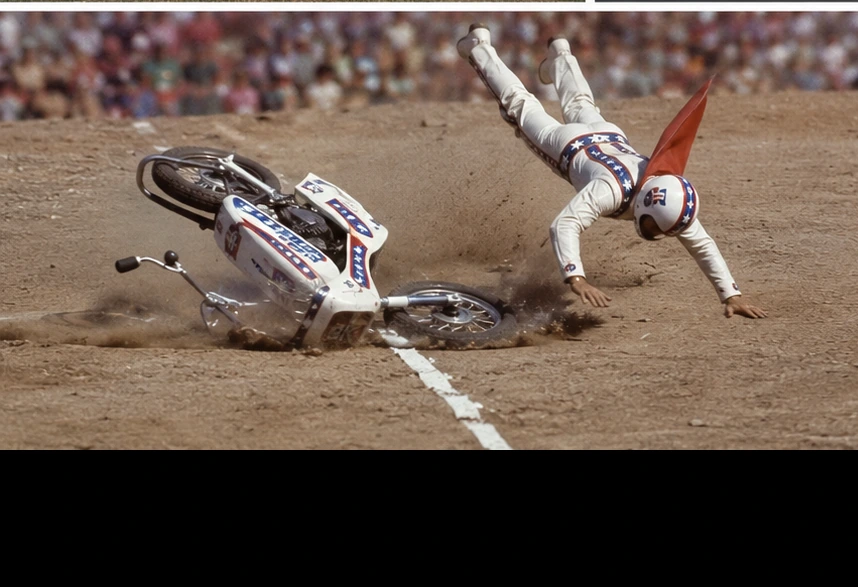
A successful landing followed the plan. A wreck could send the motorcycle, rider and obstacles in several directions, creating a result nobody had seen before.
Evel could separate from the bike, twist in the air and land beneath furniture. The articulated body turned a mechanical stop into a story.
The rider recovered. The ramp rebuilt. The show continued. That made failure emotionally inexpensive and entertaining.
The motorcycle landed short, so more speed was needed. It flipped backward, so the angle changed. It hit the wall, so the course moved farther from the wall in theory.
Children appreciated precision, but a collision produced shouting, laughter and an emergency search for the helmet. The audience rewarded chaos.
Viewers admired his successful jumps and remembered the crashes. The toy captured that uncomfortable truth without the real injuries.
The Stunt Cycle did not punish a failed attempt by ending play. It turned the failure into the reason for one more launch.
It combined a real celebrity, a brilliant mechanism, household engineering and the permanent possibility that the crash would be better than the jump.
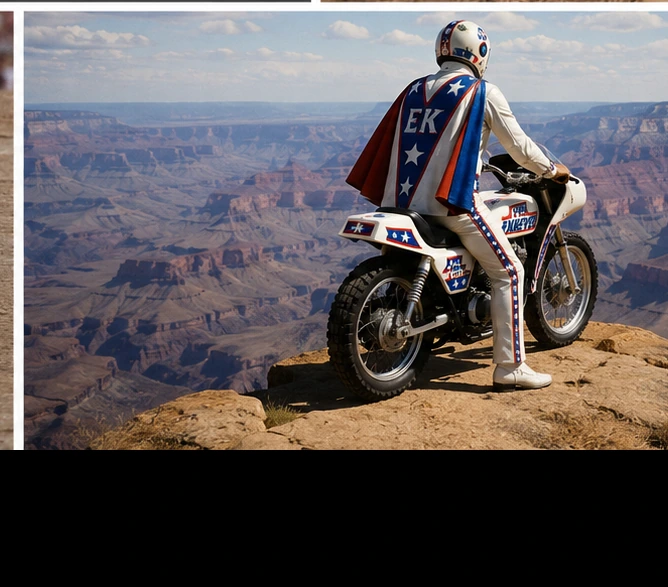
Knievel’s real jumps were rare television events. The toy allowed another attempt every few minutes.
A crash did not end the session. It created a reset, repair, explanation and improved plan.
The mechanism supplied speed. Children supplied the course, obstacles, commentary and history.
Evel was a poseable figure and the motorcycle was a working stunt machine. Neither part felt decorative.
Furniture moved, books stacked and family members became spectators. The toy changed the environment around it.
Patriotic graphics, celebrity bravado, plastic engineering and television-fueled desire made the line unmistakably 1970s.
That is why the Stunt Cycle ranks among the most iconic toys of the 70s. It did not simply represent the decade. It launched across it at full speed and hit the coffee table.
Inside the wider 70s toy box, Evel sits between the action-figure aisle and the physical stunt toys that made every floor, sidewalk and driveway feel temporarily available.
And somewhere in a basement, attic or box marked with somebody else’s name, there is still a scuffed motorcycle waiting for one more book to be added beneath the ramp.
The launcher was simple to use. Fifty years of versions, missing parts and family stories are slightly more complicated.
Ideal released the Stunt Cycle in 1973, after introducing an Evel Knievel action figure in 1972. The cycle became one of the defining boys’ toys of the 1973 Christmas season.
The motorcycle sat in a hand-cranked energizer. Turning the crank spun the rear wheel to high speed. Releasing the cycle sent it racing forward under the stored momentum of the spinning wheel.
No. The classic 1973 toy used a manual hand-cranked energizer. The rider supplied the power, which was part of the suspense because everybody could hear the wheel building speed.
Yes. The articulated figure could be removed from the motorcycle, posed and used with other Ideal accessories. Complete vintage sets are often missing the figure, helmet or small costume pieces.
The fast-spinning rear wheel provided gyroscopic stability while the motorcycle was moving. It still crashed frequently because ramps, launch angles and furniture were less cooperative.
Contemporary and later accounts commonly identify it as the best-selling boys’ toy of the 1973 Christmas season. It became a major success for Ideal and led to a much larger Evel Knievel toy line.
The line expanded into vehicles and playsets including the Scramble Van, chopper, trail bike, dragster, stunt car, Stunt Stadium, Canyon Sky Cycle and other later variations.
The Scramble Van was a larger support vehicle and playset that carried figures, motorcycles and stunt equipment. It brought the touring-show fantasy into one portable vehicle.
His stage name was Evel, without the second i. The pronunciation and his daredevil image made the misspelling extremely common in childhood memories and modern searches.
Yes. Value depends on the exact version, working condition, completeness, original figure and helmet, decals, launcher, ramps, instructions and packaging. Sold examples are more useful than optimistic asking prices.
Common missing pieces include the figure, helmet, belt, cane or accessories, launcher crank, ramp sections, clips, decals and packaging inserts. The energizer may also be present but no longer work smoothly.
Some can, but old plastic, rubber and internal parts may be brittle. A collector should inspect the motorcycle, launcher, wheel, crank and figure before applying full force.