The Toy Fair debut
Marx introduces the low-riding plastic trike in New York. The basic idea is already clear: a child sits inches off the ground and handles corners more like a tiny race driver than a traditional tricycle rider.
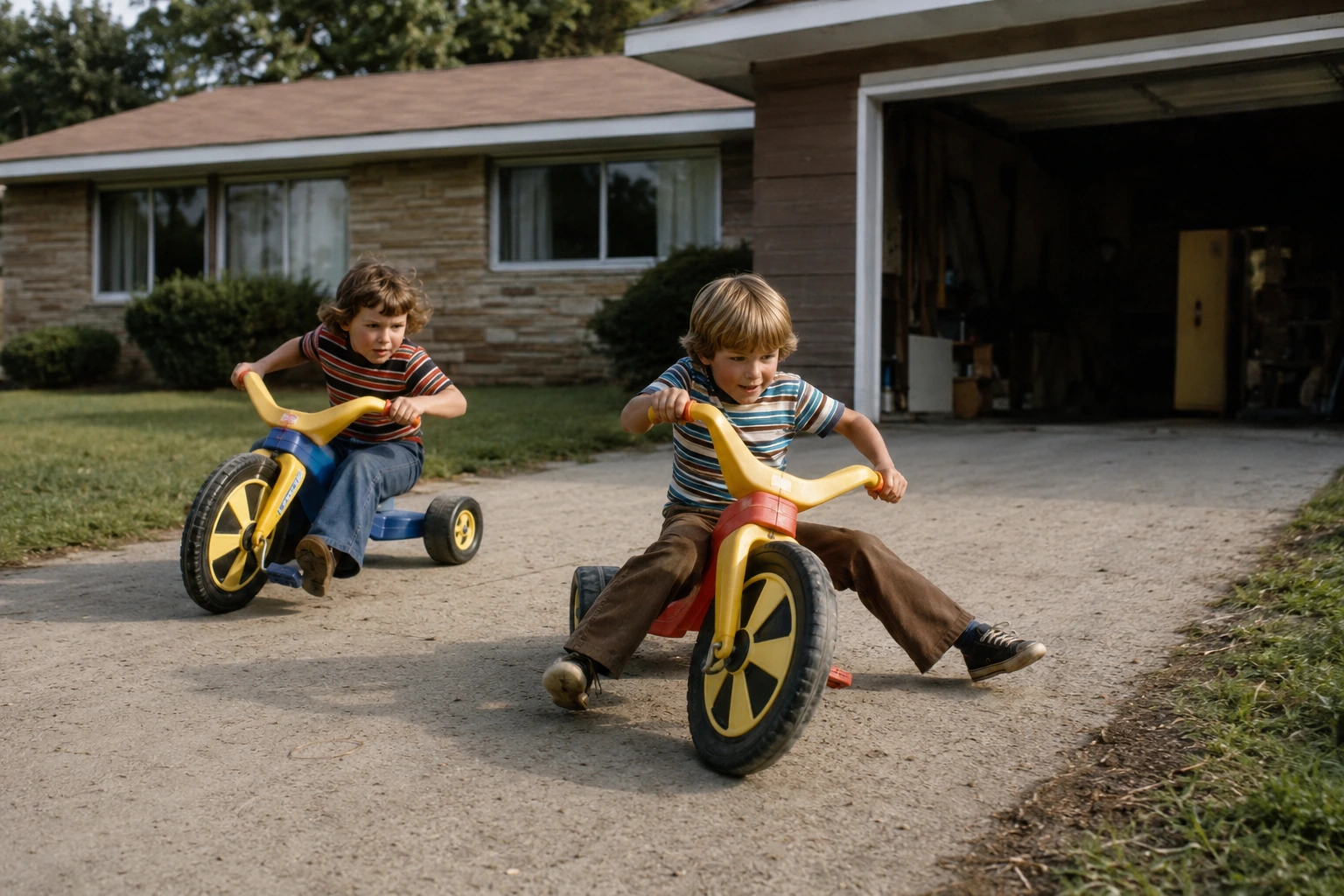
Smells Like Gen X • Driveway Racing Since 1969
It sat inches above the pavement, rattled across every sidewalk seam, wore flat spots into its rear wheels and gave kids the confidence of a race driver before they could reach a bicycle seat. The Big Wheel turned a short driveway into transportation, competition and a neighborhood sound nobody could ignore.
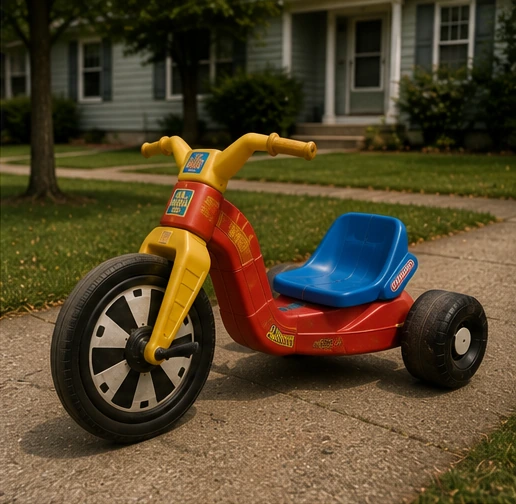
The Big Wheel was a low-riding molded-plastic tricycle introduced by Louis Marx & Company at the 1969 New York Toy Fair. Its oversized driven front wheel, shallow adjustable seat and two small rear wheels gave children a stable, race-car-like ride built for tight turns, skid-outs and ordinary neighborhood pavement.
The design looked obvious after it existed. Before that, children’s tricycles still expected riders to sit high and behave themselves.
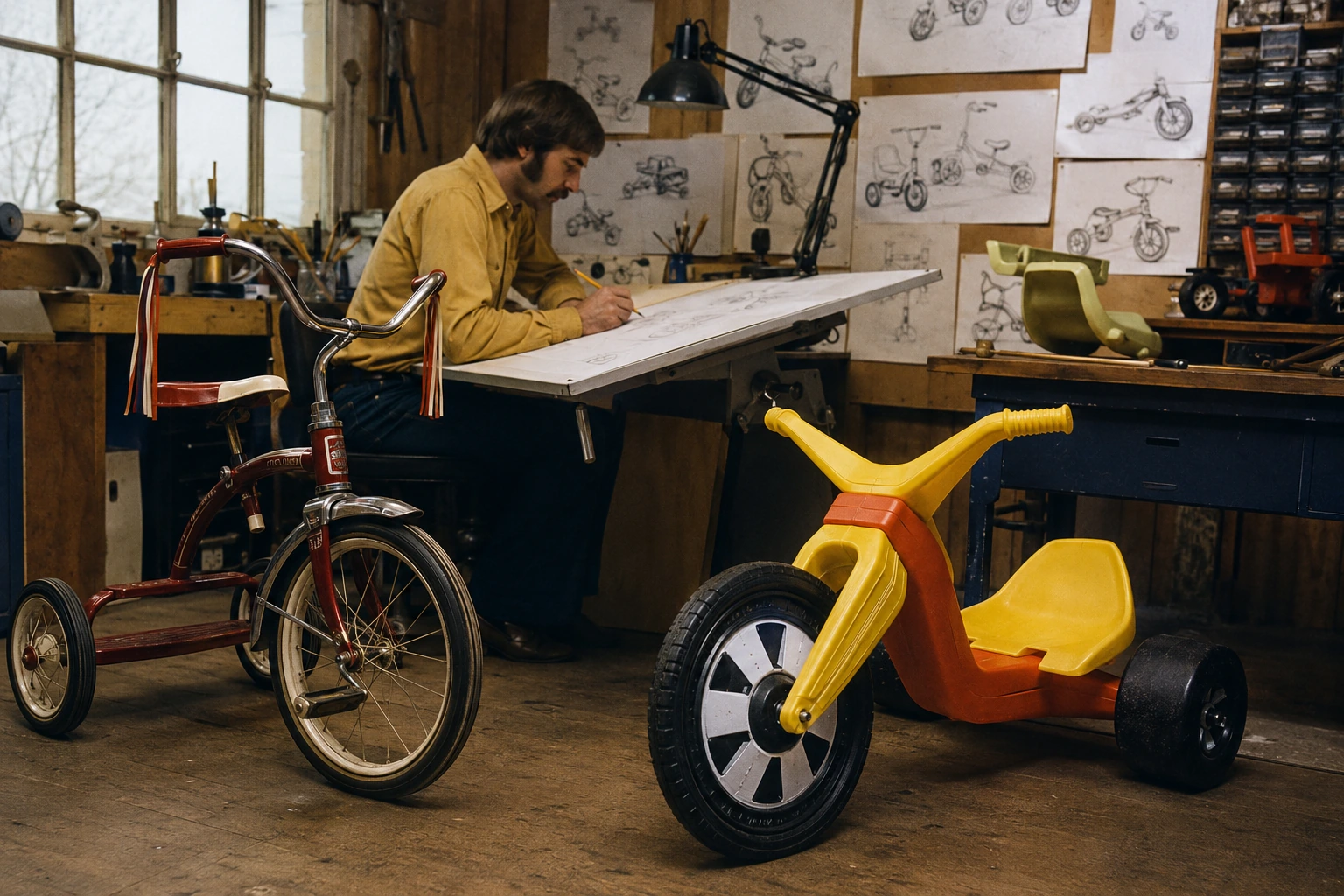
The Big Wheel was born from a mechanical insult to the normal tricycle. Designers at Louis Marx & Company took the familiar upright arrangement—seat above the rear axle, smaller front wheel, metal frame—and reorganized the basic idea around a huge driven front wheel and a seat barely above the pavement. The Strong National Museum of Play describes the result as an upside-down trike that handled more like a race car.
The museum credits Marx designer Ray Lohr with building an early version from rearranged tricycle parts. That origin explains why the finished product felt both instantly understandable and completely different. A child still pedaled the front wheel and steered with handlebars. Nothing about the controls required explanation. The experience, however, had changed.
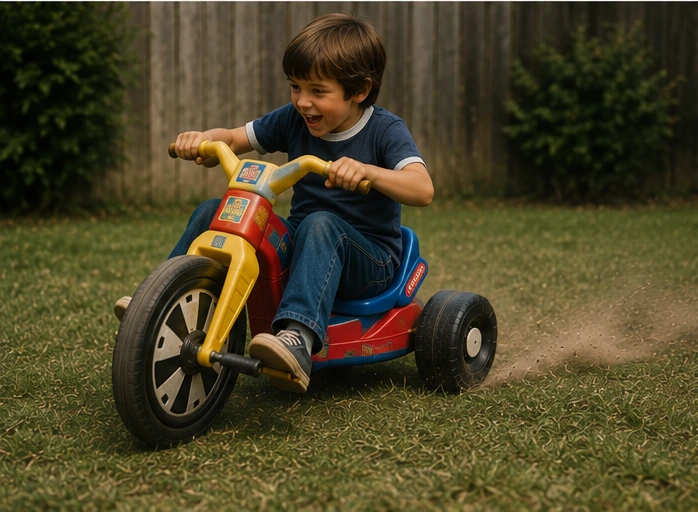
Traditional steel tricycles placed the rider high enough that a sharp turn could become a small physics lesson. The Big Wheel put the child only a few inches above the ground. The rider’s legs stretched toward the oversized front wheel while the body rested in a molded plastic seat between two small rear wheels.
That low position made modest speed feel much faster. Pavement rushed past at eye level. Curbs looked taller. Driveway cracks felt like terrain. A child was not perched above the machine so much as folded into it.
A low center of gravity made tight turns and uneven surfaces less likely to produce the same kind of forward pitch as an upright tricycle. Children immediately used that stability to attempt faster turns, longer skids and questionable hills. The design did not merely tolerate aggressive riding. It suggested it.
That is why the Big Wheel became a 70s icon instead of just another preschool trike. It looked like a child-sized hot rod and rewarded the exact kind of driveway behavior that made an ordinary afternoon feel dangerous enough to remember.
Sit low. Pedal hard. Turn late. Deny everything when the rear wheel leaves a black mark.
The toy entered the 1970s with its basic identity already complete: molded plastic, low seat, giant front wheel and zero interest in quiet transportation.
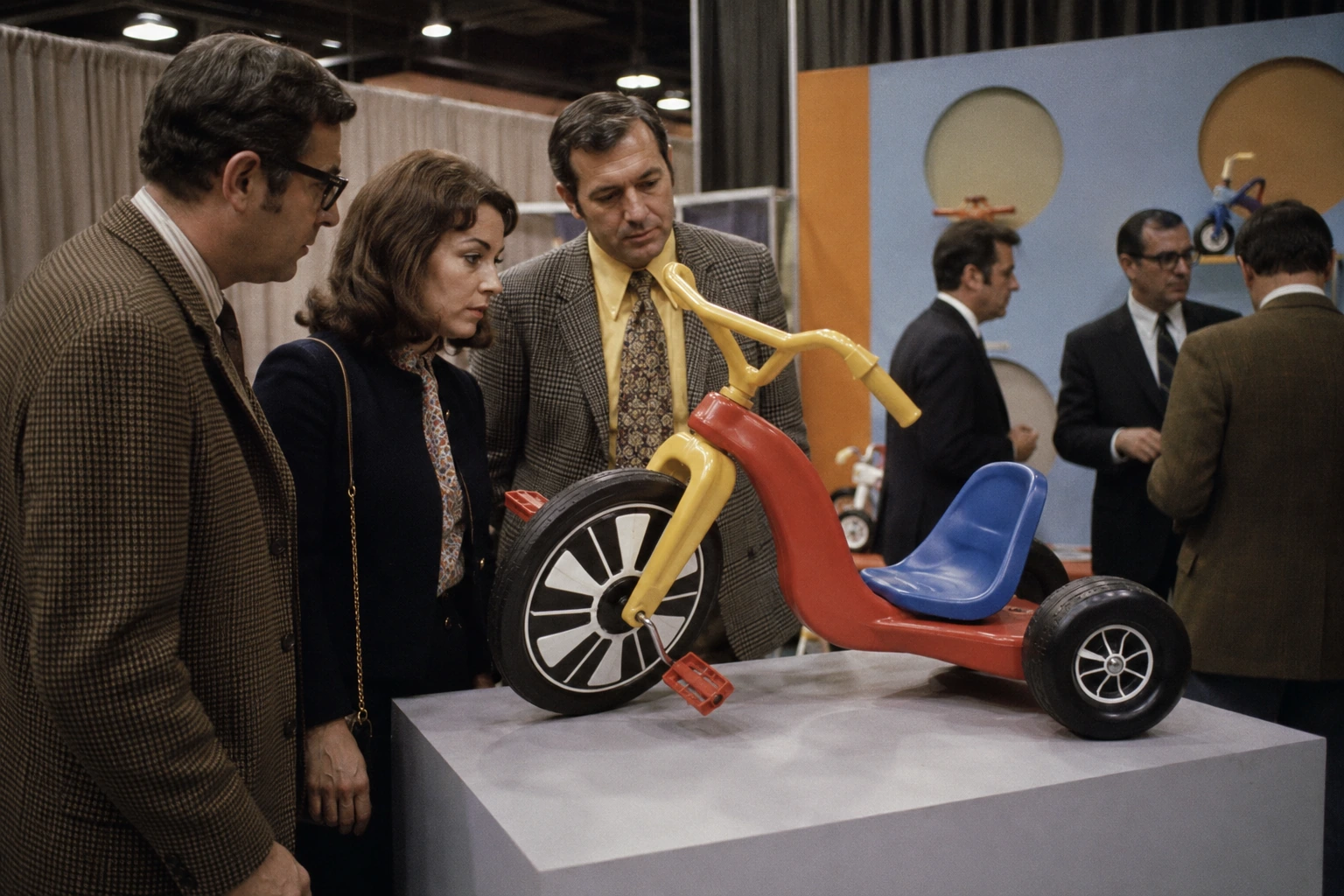
Marx introduced the Big Wheel at the 1969 Toy Fair in New York City. By the following Christmas, the toy had moved from trade-show novelty to a national childhood object. The Strong’s collection record describes a price of about $15 and notes that the Big Wheel remained a major Marx seller for roughly a decade.
That price mattered. Pedal cars and metal ride-ons could feel substantial, but they also carried weight, manufacturing cost and storage demands. The Big Wheel was large enough to dominate Christmas morning while remaining simple enough to become a mass-market toy.
Large molded pieces made the Big Wheel look impressive before it was fully assembled. Adults still had to interpret instructions, align the frame, attach the wheels, position the seat and discover which part had been placed backward. Christmas-morning riders were famous for offering constant technical supervision from three feet away.
Once assembled, the toy required almost no learning curve. A child already understood pedals and handlebars. The first trip across the room or garage was enough to reveal the rest.
The original red, blue and yellow combination did not imitate an adult vehicle. It announced itself as molded plastic. The huge front wheel, broad low seat and simple color blocks made the Big Wheel recognizable from the end of a driveway.
The toy looked modern because it rejected metal-tricycle tradition. There were no thin tubes, chrome fenders or wire spokes pretending to be a miniature bicycle. The body was chunky, bright and unapologetically plastic—the material language that would dominate the 70s toy aisle.
The Big Wheel became memorable outdoors, but many first rides began inside. Children pedaled across basement floors, kitchens and family rooms until weather or parental patience moved the vehicle outside. The hard plastic wheels made every indoor surface sound like the building was being renovated.
Once the toy reached the driveway, the gift stopped being an object and became territory.
The Big Wheel felt huge to a child without requiring the metal, rubber, chain drive or manufacturing complexity of a miniature bicycle.
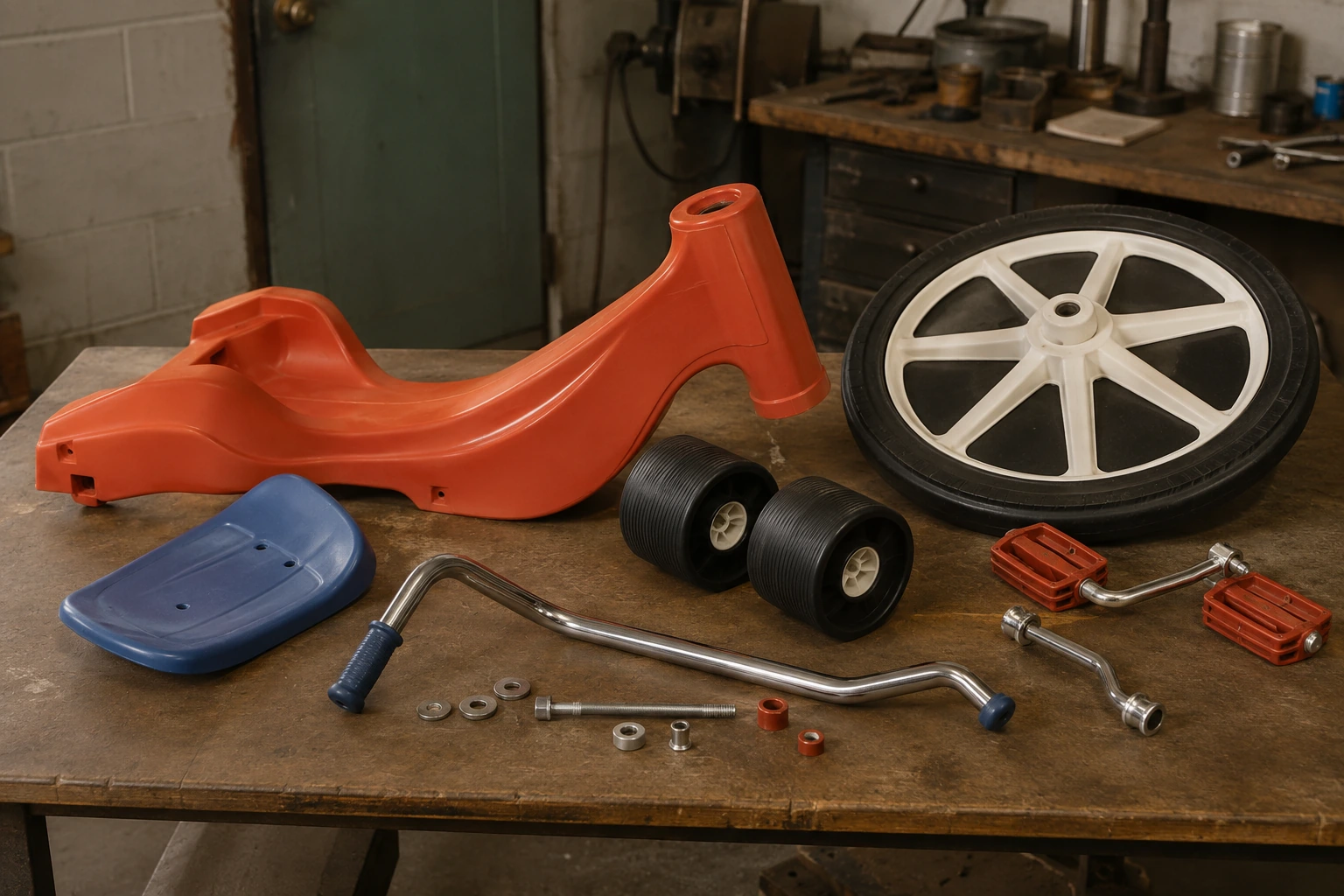
The Strong’s collection record places the Big Wheel at about $15 in its early era. That still represented a real family purchase, especially once inflation and holiday budgets entered the discussion, but it positioned the toy below many elaborate pedal cars and bicycles.
A Big Wheel occupied serious space under the tree. The oversized front wheel, broad frame and long seat made the gift look substantial. Molded plastic allowed the toy to be physically large without carrying the same material cost and weight as an all-metal ride-on.
Children evaluated size immediately. Adults evaluated price, storage and whether the box would fit in the car. The Big Wheel made both sides of the transaction possible.
The frame did not need to be assembled from many welded tubes. Large forms could combine body structure, foot areas, seat supports and styling into a few recognizable pieces. The toy looked integrated rather than constructed from bicycle parts.
That integration also created the low-riding silhouette. A steel tricycle frame naturally lifted the rider. Molded plastic could surround the rider and place the seat where the design wanted it.
Parents did not need to inflate tires, patch tubes or oil a chain. The Big Wheel could be taken from the garage and ridden immediately, assuming the wheels still turned and nobody had parked a lawn mower on it.
The maintenance tradeoff appeared later as worn plastic, flat spots and cracked components. The toy eliminated routine upkeep and concentrated failure into visible parts.
Once Marx had the basic manufacturing system, new colors, graphics, brake features, storage parts and styled versions could refresh the line without abandoning the recognizable architecture. The Cobra Cycle did not need a new theory of motion. It needed a different attitude.
A toy becomes a racing culture when more than one child owns something compatible. The Big Wheel’s mass-market price increased the chance that several vehicles would exist on the same block, apartment complex or extended family.
That density produced races, sharing, hand-me-downs and the expectation that every outdoor gathering would eventually involve somebody’s ride-on toy.
The Big Wheel did not make the tricycle disappear. It made the traditional version look as though it had been designed for a much more responsible child.
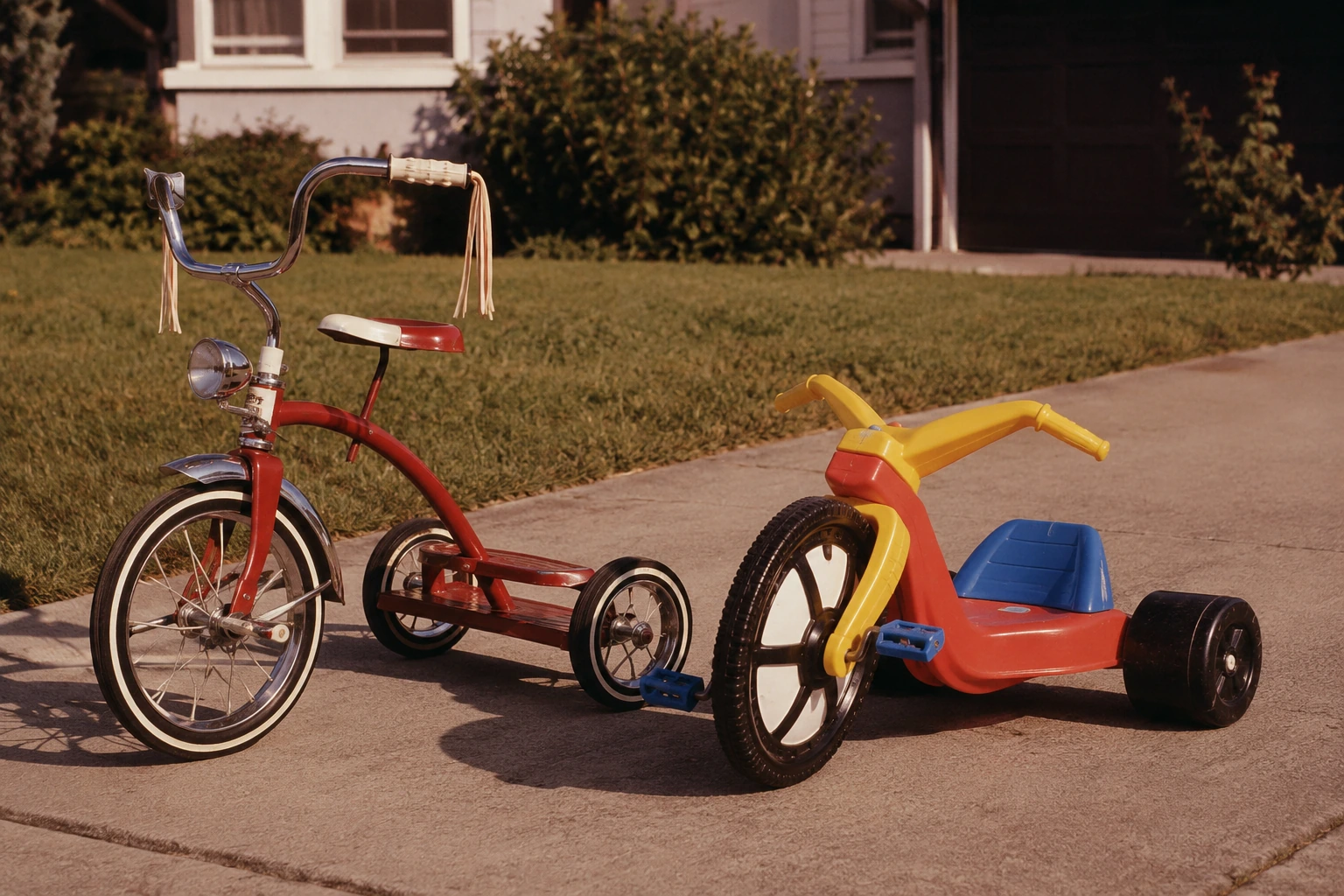
A classic steel tricycle looked like a small bicycle with a third wheel added for balance. The rider sat high, handlebars rose in front, pedals turned the front wheel and metal tubes gave the machine a miniature transportation seriousness. The Big Wheel kept the same direct-pedal principle and rejected almost everything else.
On a traditional tricycle, the rider sat on a raised saddle with the body positioned over the rear axle and front wheel. That posture made getting on and off easy and gave the child an upright view. It also placed more body weight higher above the ground.
Sharp turns at speed could shift that weight outward. Museum histories of the Big Wheel emphasize that older trikes were more likely to pitch or tip during aggressive cornering. A cautious rider could avoid the problem. The Big Wheel was designed for children who considered caution an adult hobby.
The molded seat lowered the rider into the frame. Knees rose around the handlebars, legs stretched forward and the child’s body became part of the low silhouette. It looked less like riding a bicycle and more like sitting inside a tiny dragster.
That seating position changed confidence. A rider inches from the pavement felt protected from a long fall even while traveling faster. The machine encouraged children to lean, turn and skid because the ground never seemed far away.
Older tricycles used metal structures and often rubber tires. They could roll more quietly, grip better and survive in ways plastic did not. The Big Wheel traded some of that refinement for low cost, bright color, shock absorption and a wheel surface that could slide.
The Big Wheel’s plastic wheels were not trying to imitate pneumatic bicycle tires. They were part of the toy’s personality. Their noise and limited traction made the ride feel mechanical without adding mechanical complexity.
A steel trike could have belonged to a child in the 1940s or 1950s. The Big Wheel looked unmistakably late 60s and 70s. Large molded shapes, primary colors and integrated plastic construction placed it beside other toys that celebrated the material rather than hiding it.
For a child, the comparison was not about manufacturing history. The old trike was transportation. The Big Wheel was transportation with an attitude problem.
The Big Wheel was simple, but every major choice changed the ride: the seat height, front-wheel size, rear-wheel width, molded frame and direct pedals.
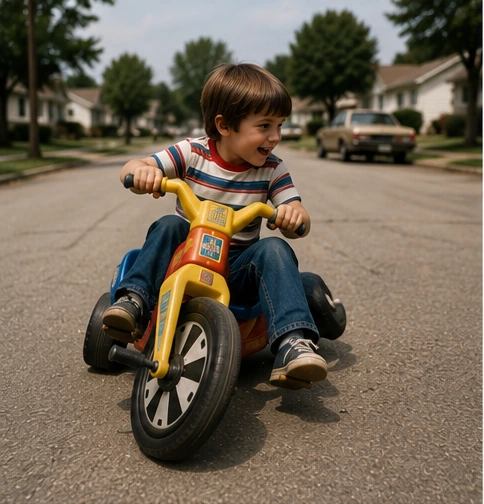
The child’s pedals connected directly to the front wheel. There was no chain, gear system or freewheel. When the rider pedaled, the wheel turned. When the front wheel lost traction, the feet could continue moving while the vehicle contributed little besides noise.
The large diameter gave each pedal rotation more travel than a small tricycle wheel. It also made the Big Wheel visually front-heavy, like the entire machine had been designed around one exaggerated component.
Two wide plastic wheels supported the back of the frame. They kept the low seat stable and created the sliding surface that made spinouts possible. The same hard plastic that reduced maintenance also provided limited grip on smooth pavement.
That limited grip was not a flaw once children discovered it. It was the feature that allowed the back end to swing outward during a sharp turn or brake-assisted skid.
The seat could be repositioned to accommodate growing legs. Moving it backward gave an older child more room, although every Big Wheel eventually reached the point where the rider’s knees rose above the handlebars and dignity became optional.
Seat adjustment also turned ownership into negotiation. A shared Big Wheel was rarely configured correctly for everybody. Changing the seat required stopping, which children considered an unacceptable delay during active racing.
The frame could flex and absorb bumps that would rattle a steel trike. Plastic did not rust, but it scratched, faded, cracked and wore through. Outdoor storage bleached colors. Cold weather made old material less forgiving. Repeated impacts stressed connection points.
The Big Wheel was durable in the way many 70s toys were durable: it survived extraordinary use while gradually looking like it had.
No pneumatic tires meant no air pressure. No chain meant no grease. No complex brakes meant few adjustments. Most maintenance involved tightening, reattaching or accepting.
When a wheel developed a flat spot or a pedal cracked, the entire neighborhood heard the problem before anyone diagnosed it.
The Big Wheel was simple once built. Reaching that point could turn Christmas morning into a small manufacturing shift.
Large ride-on toys rarely emerged from the box ready to use. The packaging had to remain manageable, which meant wheels, handlebars, seat parts, pedals, axles, decals and hardware arrived as a promise of transportation rather than transportation itself.
An adult spread parts across the floor and read the instructions. The child watched every step while asking whether it was done. A missing washer became a crisis. A fastener that needed force became evidence that the toy company had made a mistake.
The completed Big Wheel might look simple, but the sequence mattered. Pedals had to align. The front wheel needed to turn. The seat had to face forward, a standard occasionally violated during holiday fatigue.
Applying decals sounds easy until one edge touches plastic in the wrong place. Adults tried to align stripes and logos while children offered encouragement at close range. Air bubbles, wrinkles and crooked placement became permanent design decisions.
Decals also made one Big Wheel look newer than another. Once graphics peeled or faded, the vehicle lost some showroom identity while keeping every bit of riding ability.
The molded seat could move through several positions. Younger riders sat closer to the pedals. Older riders moved backward until the final setting admitted that growth had become a problem.
Seat changes were practical but not always convenient. Hardware needed to be moved, pegs aligned and parts tightened. Families sharing one Big Wheel often settled on a compromise that fit nobody perfectly.
Some later and deluxe versions added a compartment or saddlebag-style storage area. Advertising suggested useful cargo. Children transported rocks, toy cars, action figures, snacks, leaves and mysterious objects collected from the edge of the driveway.
The storage space gave the Big Wheel another role. It could become a delivery vehicle, police cruiser, repair truck or expedition machine without changing anything about the frame.
When hardware loosened, families used what was available. Replacement bolts, improvised washers, tape and garage ingenuity kept vehicles moving. A repair only needed to survive another afternoon.
Collectors now notice those substitutions. Kids noticed whether the Big Wheel rolled.
Before the rider came into view, the block heard plastic tires crossing every seam in the pavement.
A Big Wheel did not roll quietly. The hollow plastic wheels translated surface texture into percussion. Smooth pavement produced a hard rushing hum. Sidewalk joints created a repeating clack. Rough concrete turned the ride into an appliance moving down a staircase.
The sound announced speed more effectively than actual speed did. A child traveling at a modest pace sounded as though industrial equipment was approaching.
Repeated skids wore one section of a rear wheel more than the rest. Once the wheel stopped being round, every rotation produced a thump. The rider felt it through the seat. Neighbors heard it from inside.
A flat-spotted wheel did not necessarily end the Big Wheel’s career. It changed the soundtrack and reduced the possibility of pretending the toy was still in excellent condition.
Children knew the exact sound of each surface transition: garage to driveway, driveway to sidewalk, sidewalk to street. A familiar route could be recognized with eyes closed.
That memory is one reason the Big Wheel remains so specific. We do not only remember how it looked. We remember the plastic rumble echoing between houses on a summer afternoon.
Basement floors were ideal. Kitchens were not. Hardwood floors magnified every wheel sound and gave adults immediate evidence that the rider had ignored instructions.
The Big Wheel’s volume helped establish the natural border between indoor and outdoor play. The toy itself made the argument.
A driveway was short, sloped, cracked and shared with an actual car. Children saw a complete racing facility.
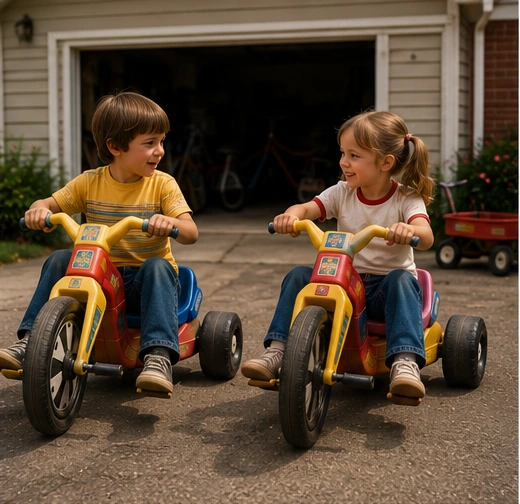
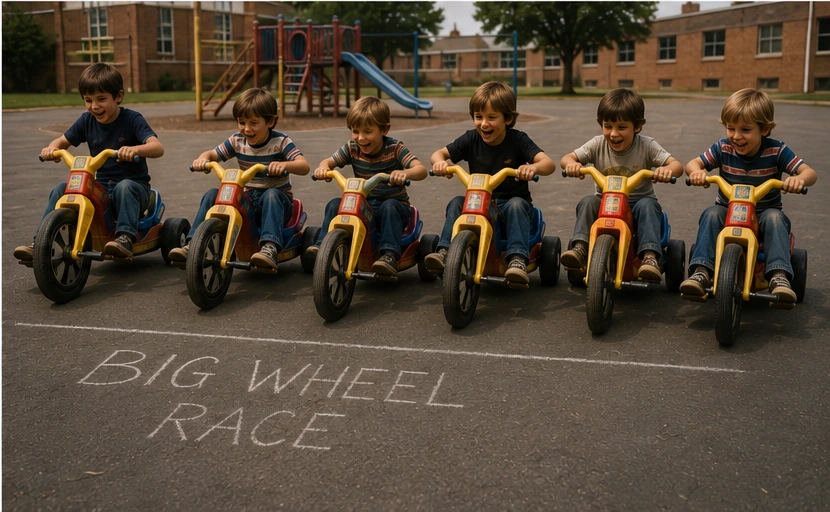
The Big Wheel turned ordinary pavement into a repeatable course. The starting line might be the garage door. The turnaround point might be the sidewalk. The finish line could be a chalk mark, a trash can or a younger sibling told to move at the last second.
Because the vehicle sat so low, the driveway felt larger. A gentle slope produced acceleration. A tight turn near the curb felt dramatic. A parked family car became an obstacle with consequences.
Big Wheels lived near bicycles, lawn tools, wagons and cardboard boxes. The garage supplied storage and a sheltered starting point. It also supplied oil spots, gravel and objects that should not have been part of a children’s racecourse.
Riders lined up at the threshold, pedaled into daylight and returned through the same opening with less control than the architecture deserved.
Sidewalk chalk created lanes, stop signs, gas stations, parking spaces and start lines. The Big Wheel gave those drawings motion. A child could follow the route correctly once and ignore every traffic rule on the second lap.
Chalk courses connected the ride-on toy to the broader world of 70s backyard and driveway toys. Big Wheel owns the exact vehicle story; the outdoor-toy page owns the whole noisy ecosystem around it.
Children parked beside adult cars, pretended to refuel and occasionally disappeared from a driver’s sightline. The Big Wheel felt like transportation because it shared the same space as transportation.
That overlap was exciting and required adult boundaries that children treated as flexible suggestions.
The rider was not going somewhere. The rider was operating a route. Twenty laps around the same rectangle could feel like a long-distance journey because speed, rivals and imagined destinations changed each pass.
Independence did not require leaving the property. It required control of the vehicle and temporary control of the pavement.
The toy was associated with summer, but its real life included cold garages, wet pavement, fallen leaves and the first warm day everybody had been waiting for.
The Big Wheel emerged from winter storage with dust, flat spots and questions. Wheels were spun. The seat was tested. Spiders were evicted. A child who had grown since fall discovered whether the seat had one more position available.
The first ride revealed every problem immediately. Loose hardware rattled. A cracked pedal flexed. The driveway felt new because months had passed since the last full-speed lap.
Long daylight hours turned the Big Wheel into daily equipment. It stayed near the garage opening, porch or side of the house because putting it away carefully would only delay the next ride.
Hot pavement softened the atmosphere if not the plastic. Bare legs stuck to the seat. Riders carried drinks, toys and gravel in storage compartments. The vehicle accumulated dust and sun fade one afternoon at a time.
Dry leaves made excellent visual effects and unpredictable surfaces. A Big Wheel could push through a pile, scatter it across the driveway and receive credit for yard work no adult had requested.
Cooler weather improved comfort while reducing available daylight. The final laps happened earlier, often under porch lights and parental reminders.
Snow and ice made direct-drive plastic wheels nearly useless, which did not prevent testing. Garages and basements became temporary tracks. Families in warmer climates continued riding and quietly invalidated the seasonal drama.
A Christmas Big Wheel might spend weeks indoors before pavement became available. The waiting increased the importance of the first outdoor run.
Sun faded colors. Rain damaged decals and encouraged grime. Cold aged plastic. Indoor storage preserved the toy but consumed family space.
Every surviving Big Wheel carries evidence of climate and storage along with evidence of riding.
The Big Wheel adapted to suburban sidewalks, apartment courtyards, basement floors, school blacktop and any surface adults had not blocked yet.
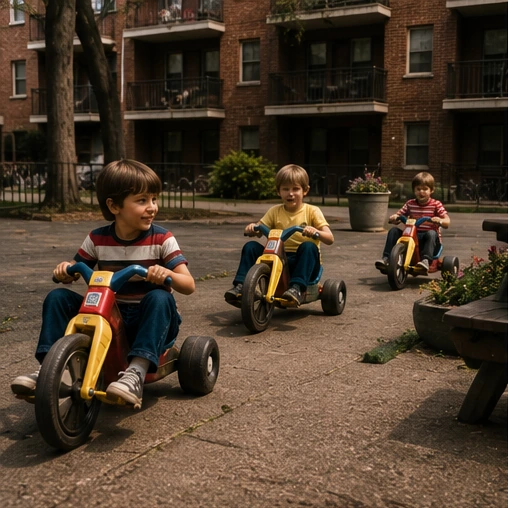
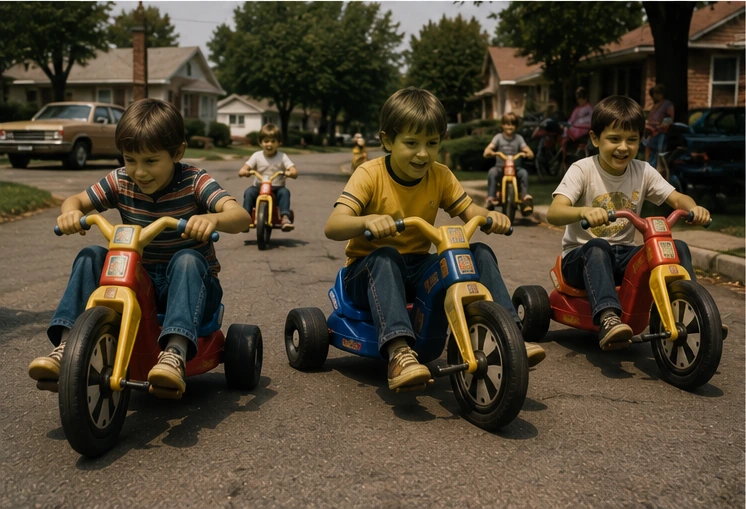
Children without private driveways used common pavement. Courtyards, parking areas and walkways created natural loops around buildings. The sound bounced off brick and concrete, ensuring every resident knew the race schedule.
Shared spaces created more riders, more spectators and more conflict. A Big Wheel left unattended could become community property in under a minute.
Finished basements provided smooth floors, support columns and furniture that could define a course. Unfinished basements offered concrete, storage obstacles and adults who believed indoor riding had been prohibited clearly enough.
Basement racing reduced weather problems and increased echo. One Big Wheel could make the entire foundation sound occupied by machinery.
Empty weekend pavement gave riders more distance than a driveway. Chalk courses grew larger. Straightaway speeds increased. Adults could supervise from a folding chair while children interpreted supervision as permission.
Large open surfaces also removed the visual impression of speed. The Big Wheel sounded fast and felt fast, but a long parking lot revealed how much pedaling was required to cross actual distance.
A child could ride from one house to another, cross driveways and negotiate sidewalk joints. The Big Wheel became social transportation. It carried the rider to wherever other children were already outside.
The low seat placed the child below hedges, parked cars and adult sightlines. That made boundaries and supervision important even in neighborhoods remembered as more relaxed.
The direct-drive front wheel and smooth plastic tires did not enjoy lawns. Grass increased resistance, reduced traction and turned the vehicle into an exercise machine. A rider leaving pavement usually returned quickly or received help.
A fresh Christmas Big Wheel and a snowy driveway created a challenge children felt obligated to test. Plastic wheels spun. The rear slid. Forward progress became theoretical.
The attempt still counted as the first ride.
Every block created its own classes, courses, starting signals and explanations for why the obvious winner did not count.
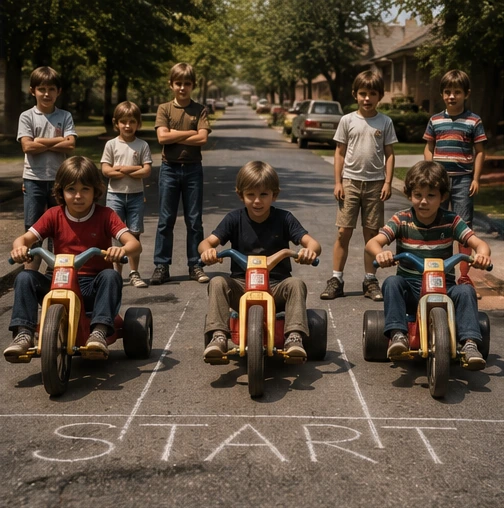
Big Wheel racing was wonderfully unfair. Riders differed in age, leg length, vehicle condition and willingness to cut the corner. One Big Wheel had smooth wheels. Another had a cracked seat and a rear tire shaped like a stop sign. Competition happened anyway.
On flat pavement, the start mattered. Riders pushed hard against the seat and spun the pedals as fast as possible. A front wheel slipping under hard acceleration produced frantic leg movement with very little forward progress.
The race might cover one driveway or half a block. The distance was chosen to favor whoever suggested it.
Cones, chalk lines, trash cans and bicycles created turns. The ideal racing line was rarely discussed in those words, but children learned quickly that entering a corner too fast caused a slide and entering too slowly allowed somebody to pass.
A handbrake could help rotate the rear of the Big Wheel, assuming the rider had enough momentum and no concern about wheel wear.
When several children shared one or two Big Wheels, teams formed. One rider completed the course, jumped off and handed the vehicle to the next. Seat adjustment was ignored. Crashes during driver change were considered part of the spectacle.
Every Big Wheel had a recommended rider size and a real-world rider size determined by whether the child could still physically fit. Older children leaned back, spread their knees and used raw force to keep participating.
The resulting speed could improve. The structural outlook did not.
Some Big Wheels were known to be faster. Maybe the front wheel had better grip. Maybe the pedals turned more freely. Maybe the rider was simply older. The vehicle still received the credit.
A strong racing reputation could make a battered Big Wheel more desirable than a newer one. Performance outranked appearance until adult collecting reversed the priorities.
Somebody yelled “go,” somebody left early, and the race was rerun until the correct person won.
The machine had no screen character or official mission, which meant it could change identity between laps.
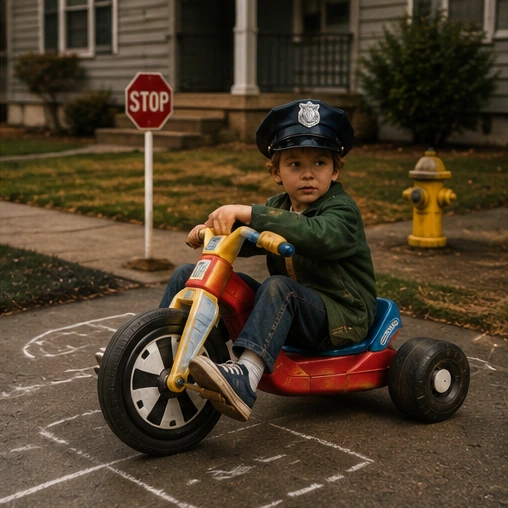
This was the natural role. The giant front wheel, low seat and skid potential supplied the fantasy before the child added engine noise. Chalk numbers and improvised flags completed the transformation.
The rider patrolled sidewalks, investigated imaginary violations and pursued bicycles that had not agreed to participate. A toy badge or flashing vocal siren was enough.
Storage areas carried toys, notes, leaves and objects between houses. The distance might be one driveway, but the delivery required transportation and a serious expression.
Children ignored the third wheel and treated the handlebars, low posture and road noise as motorcycle evidence. A playing card clipped to a wheel worked better on a bicycle, but imagination supplied the engine.
Crashes created immediate rescue scenes. The same Big Wheel that caused the accident could return as the ambulance, tow truck or fire response unit after a quick change in sound effects.
Driveway cracks became canyons. The lawn edge became wilderness. A storage compartment held expedition supplies that consisted mostly of rocks.
Character-branded ride-ons could be exciting, but the standard Big Wheel belonged to the rider. No movie plot defined the mission. The child’s route and current obsession did.
That flexibility helped the toy survive repeated play. The plastic never changed. The vehicle did.
The box may have carried one child’s name. Neighborhood law recognized a more complicated ownership structure.
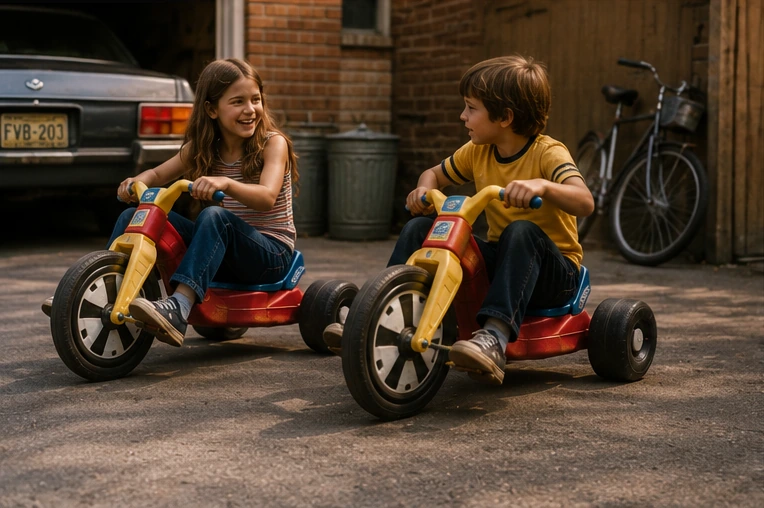
The oldest or original recipient received bright plastic, intact decals, round wheels and a seat with all adjustment positions available. Younger siblings inherited a vehicle with documented history.
By the second or third rider, the Big Wheel might have faded colors, a permanent thump and a brake that worked according to mood. The new owner still considered it transportation.
Families used time limits, lap counts or parental commands. Children used delay, route extension and the claim that one final race had already started.
A rider could slow down near the handoff point to stretch possession. Waiting siblings counted every second and reported violations immediately.
A Big Wheel in the driveway attracted children who did not own one. The host child gained status and lost uninterrupted riding time. Guests tested the brake, changed the route and occasionally returned the vehicle with a new sound.
A younger child might struggle to reach the pedals. An older child could overpower the front wheel and bend the seating arrangement around growing knees. The same Big Wheel performed differently under every rider.
Manufacturers offered different colors and styled variants to appeal to specific children. On the driveway, those distinctions weakened. Kids raced whatever vehicle was available, and the fastest rider claimed the strongest identity.
A black Cobra Cycle might look tougher in a commercial. It still had to beat the faded standard Big Wheel with one good rear wheel.
Parents remembered who received the toy. Siblings remembered who damaged it. Nobody agreed on when the flat spot appeared.
The Big Wheel survived because ownership was transferred before the plastic received a vote.
Once the rear wheels could be locked or dragged, stopping became less interesting than arriving sideways.
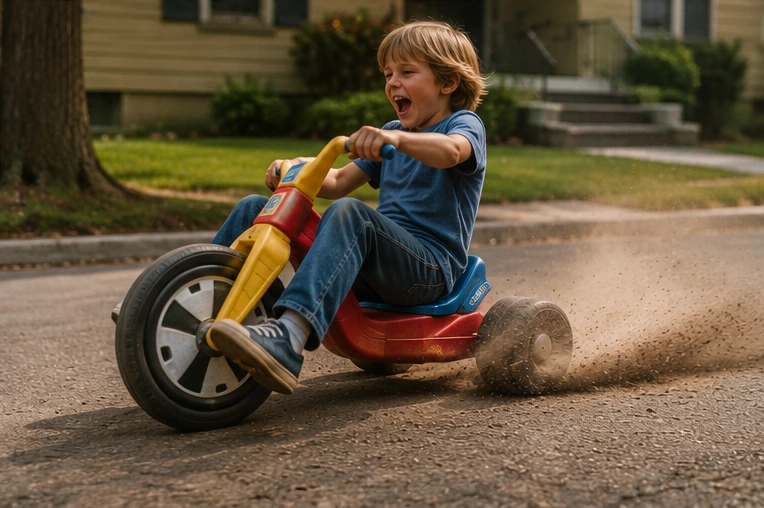
Later Big Wheel versions added a handbrake positioned near a rear wheel. Pulling the lever increased drag and encouraged the back of the vehicle to swing during a turn. The feature transformed a practical action—slowing down—into a performance.
Children did not use the brake sparingly. A successful spinout produced the combination Big Wheel riders wanted most: noise, movement, pavement marks and an audience.
Pull too early and the Big Wheel stopped without drama. Pull too late and the rider reached the obstacle before the slide developed. The ideal sequence involved acceleration, a sharp steering input and enough brake pressure to break rear-wheel traction.
Children practiced until the maneuver looked intentional even when it was not.
Dragging a plastic wheel across pavement removed material. Repeating the trick in the same direction concentrated the wear. The spinout feature and the flat-spot problem were not separate parts of Big Wheel history. They were cause and effect.
A worn rear wheel made future rides rougher, which made the toy sound more dramatic, which encouraged continued use. The cycle was mechanically unwise and emotionally perfect.
Children noticed who had the brake. A standard Big Wheel could still slide through hard steering, but the lever made the rider look equipped for advanced work.
The brake also became something to pull while stationary, because every moving part on a toy had to be tested constantly whether or not testing accomplished anything.
Black marks, scraped plastic and worn pavement recorded past runs. Parents saw damage. Riders saw proof of technique.
The Big Wheel converted the driveway into a surface where childhood left visible evidence.
The Big Wheel was pedal-powered on the way up and gravity-powered on the way down.
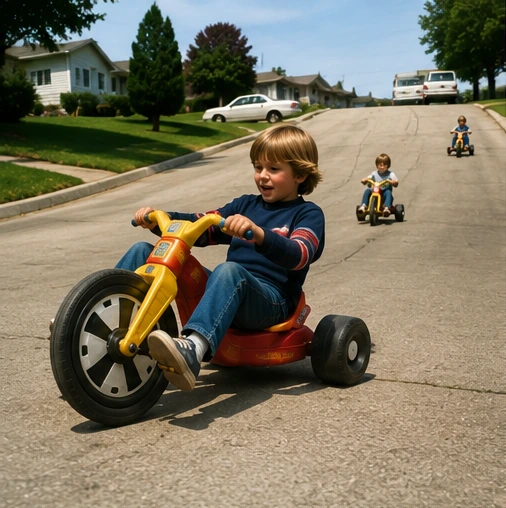
A flat driveway made the Big Wheel fun. A hill made it serious. The child who had spent ten minutes pedaling uphill could recover the investment in one fast descent.
The low center of gravity helped the vehicle feel stable, but stability was not the same thing as unlimited control. Plastic wheels, direct steering and limited braking created a point where the rider became a passenger with responsibilities.
The rider’s viewpoint amplified slope and speed. A neighborhood grade that barely registered from an adult car felt like a launch ramp. Wind noise increased. Pedals spun. The finish area approached with suspicious urgency.
When steering and handbrake confidence failed, shoes entered the braking system. Soles dragged across pavement, saving the rider while sacrificing footwear.
Parents later inspected the damaged shoes and heard an explanation involving normal walking.
A driveway lip or low curb could stop a run, redirect it or become something to attempt deliberately. The Big Wheel’s low frame was not designed for elegant curb drops, but childhood design review happened after impact.
Every seam produced a hit. At speed, the repeated impacts traveled through the molded frame and seat. Plastic absorbed some of the jolt, as museum histories note, but the rider still experienced the road directly.
Many children rode only on driveways and sidewalks. Others treated quiet residential streets as extensions of the course. That freedom is part of the memory and part of why adult supervision mattered.
The page celebrates the toy without turning unsafe behavior into a recommendation. The nostalgia belongs to a particular era of outdoor independence, not a modern instruction sheet.
The original shape remained recognizable while Marx changed colors, added features and tried to keep older riders interested.
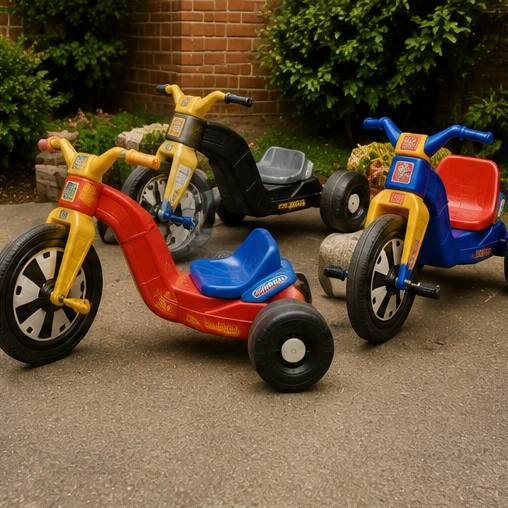
This is the version most people picture first: red molded body, blue seat or frame elements, yellow details and the giant front wheel visually dominating everything. The exact color arrangement varied across production and memory, but the primary-color identity became inseparable from the name.
As the decade progressed, Big Wheel packages emphasized added features such as a racing brake and storage. These versions did not replace the basic formula. They gave children another reason to compare machines and gave catalog photographers more hardware to point at.
The handbrake mattered because it changed how the vehicle was advertised and used. Spinouts moved from improvised technique toward an acknowledged feature.
The late-70s Cobra Cycle took the familiar Big Wheel platform in a darker direction. A 1979 commercial presented a sleek black version with cobra graphics and a customizable license plate. The styling aimed at children who had outgrown bright preschool colors but had not outgrown sitting inches above the pavement.
The Cobra Cycle demonstrates how long the core design remained marketable. Marx did not need to reinvent the drivetrain. It changed the attitude.
Period Big Wheel catalogs and collector references show versions aimed at younger riders and different visual preferences. Some softened the racing look. Others added character, color or accessory differences. The platform was flexible because the recognizable part was the silhouette: one huge front wheel, two small rear wheels and a seat nearly touching the ground.
The Strong notes that other companies produced similar low-riding vehicles. Over time, “Big Wheel” became common shorthand for the whole style even when the actual toy came from another manufacturer.
That generic use is evidence of cultural dominance. Children often remembered owning “a Big Wheel” even when collectors later identified a different brand.
Marx released the Green Machine as original Big Wheel riders aged upward. It used a low seat, pedal power and hot-rod styling, but steering came from levers controlling the rear wheels. The design allowed dramatic turns and drifting without copying the Big Wheel exactly.
The Strong dates its museum example to about 1975 and describes it as the next stage for riders who wanted more control and more danger-looking machinery. Big Wheel was the first license. Green Machine was the advanced course.
The ads did not show transportation. They showed competition, sliding and kid-sized automotive swagger.
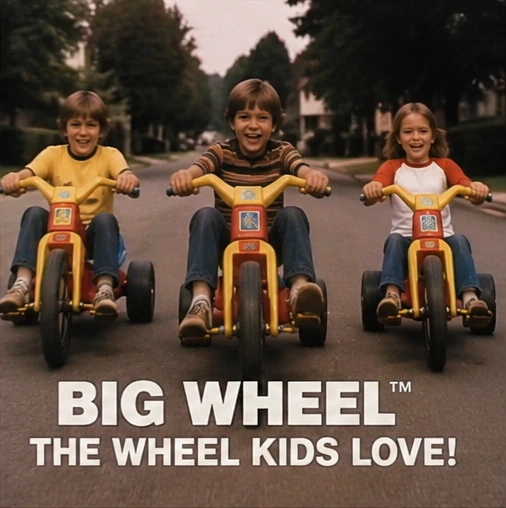
Television commercials understood the Big Wheel’s appeal immediately. Children pedaled hard, leaned into turns and raced through camera angles that made the ride-on look faster and lower than it did from adult height.
The announcer language emphasized action: racing, braking, winning, spinning. The driveway was presented as a legitimate motorsport environment. The rider did not look like a preschooler learning to pedal. The rider looked like the driver of a plastic muscle car.
Photographing near pavement level placed the giant front wheel in the foreground. The child appeared integrated into the machine, with knees pumping and handlebars moving against a blur of driveway.
A handbrake sitting on a showroom toy was just a lever. A commercial could show a rider pulling it and sliding sideways. The feature became understandable in one shot.
Commercials often treated the Big Wheel as a social vehicle. One child riding alone looked happy. Several children racing looked like a neighborhood event happening without you.
The Cobra Cycle commercial used black styling, aggressive graphics and the promise of a personalized plate to make the platform feel less juvenile. The toy remained pedal-powered plastic, but the presentation moved closer to hot-rod identity.
The site’s 70s toy-commercial archive is the natural place for the broader video rewind. Here, the commercials explain why an ordinary driveway suddenly felt like a televised competition.
The design stayed recognizable while ownership, features, styling and the surrounding toy aisle changed.
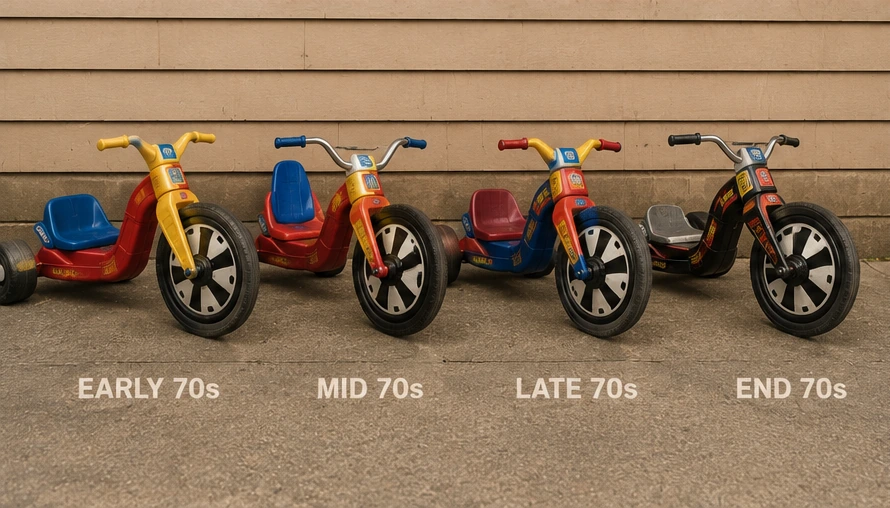
Marx introduces the low-riding plastic trike in New York. The basic idea is already clear: a child sits inches off the ground and handles corners more like a tiny race driver than a traditional tricycle rider.
Christmas momentum carries the Big Wheel into the new decade. Suburban pavement, sidewalks and apartment courtyards become natural racecourses.
Plastic wheels, rapid pedaling and repeated laps make the Big Wheel less a single toy than a recurring background noise of warm-weather childhood.
Louis Marx & Company is sold to Quaker Oats, but the Big Wheel remains one of the company’s defining products and a fixture in outdoor-toy sections.
Later configurations emphasize braking, sliding and the kind of controlled loss of traction kids immediately turn into a competitive event.
Competitors and imitators spread the low-riding plastic-trike idea, while Big Wheel increasingly functions as both a brand name and a generic childhood description.
Marx extends the low-riding hot-rod idea with the Green Machine, giving older kids rear-steering levers and a more dramatic drifting experience.
Big Wheels, bicycles, wagons and pedal toys share the same blocks, forcing children to invent traffic rules no adult had approved.
Electronic toys and movie franchises begin dominating indoor attention, but the Big Wheel remains immediate: sit down, pedal hard and turn the driveway into a performance space.
The Big Wheel look becomes darker, sportier and more personalized as late-70s models compete for children who want something beyond the standard red, blue and yellow trike.
A late-70s Cobra Cycle commercial presents a sleek black version with cobra graphics and a customizable plate—proof that the basic platform could still be made to feel new.
It came in a large box, used bright colors and promised months of outdoor freedom after somebody finished assembling it.
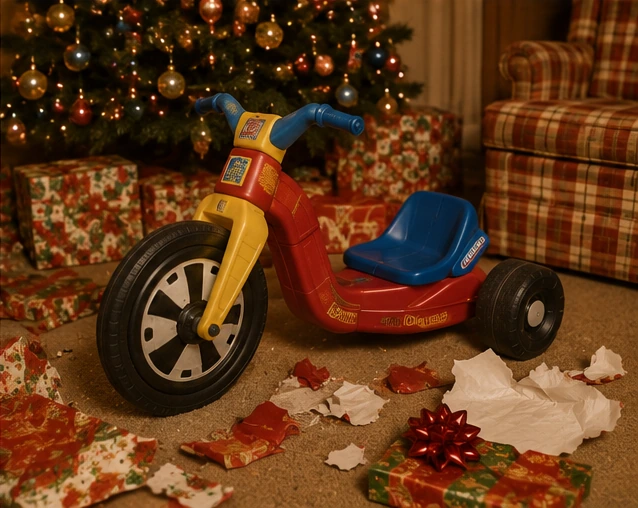
The Big Wheel had excellent Christmas geometry. The box was large enough to create excitement without containing delicate electronics or dozens of tiny pieces. The finished toy looked substantial beside the tree. It also pointed toward spring and summer, which mattered during a cold December morning.
Big Wheel belongs in the larger story of the hottest Christmas toys of the 70s because it offered something no action figure or board game could: personal mobility.
Parents worked with molded pieces, axles, fasteners and decals while the rider waited nearby wearing pajamas and issuing updates. A correctly assembled Big Wheel was expected immediately, regardless of when the box had been opened.
The first ride often crossed carpet, linoleum or basement concrete. The plastic wheels announced the trip. Furniture narrowed the course. Wrapping paper became traction loss.
Children in colder climates could own the Big Wheel before they truly used it. Garages and basements provided temporary routes. The first dry day became a second Christmas.
Department-store spreads showed children racing under perfect conditions while real families considered price, storage and weather. Our feature on 70s toy catalogs and Sears Wish Books follows the annual ritual that turned a plastic trike into a circled demand.
A Big Wheel purchased early in the 70s might be handed down, shared or replaced by a later version. The design did not depend on one movie, character or electronic technology. It remained understandable every Christmas.
Children remember speed and freedom. Adults remember assembly, storage, shoes, noise and moving the thing every time the garage door opened.
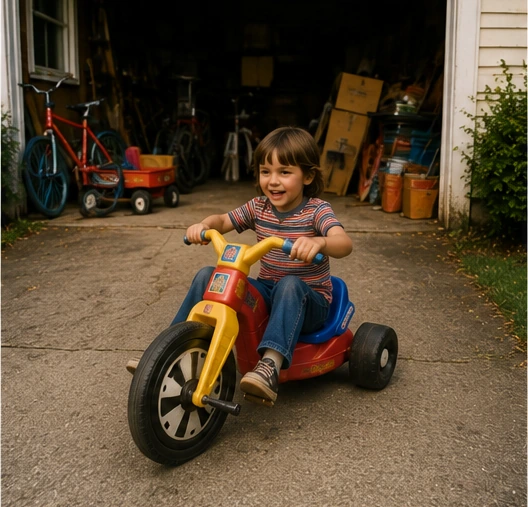
The Big Wheel was relatively affordable for a large toy, but it remained a large toy. Garages, porches, sheds and basements had to absorb it. The low shape made stacking difficult and encouraged people to place things on the seat.
Children finished riding and abandoned the vehicle at the exact point where attention had shifted elsewhere. Adults discovered it near tires, garage doors, walkways and lawn equipment.
Parents could identify which child was riding by the rhythm of the wheels. A smooth Big Wheel produced one sound. A flat-spotted veteran produced another. Sudden silence often required investigation.
Children dragged toes and heels during fast stops. The resulting wear was discovered later and attributed to normal use. Parents recognized a braking pattern because the damage appeared in places ordinary walking did not reach.
Leaving the Big Wheel outside was easy and bad for decals, color and long-term plastic condition. Bringing it inside preserved the toy and introduced dirt, water and storage problems.
Families established boundaries around streets, slopes and driveways. Children remembered the parts of the rule that allowed riding and treated the rest as negotiable geography.
The Big Wheel was active, simple and independent. It burned energy without batteries and created hours of play from the same small patch of pavement.
The adult complaints were real. So was the reason the toy stayed outside all summer.
The toy survived hard use, but it kept a detailed record of every summer.
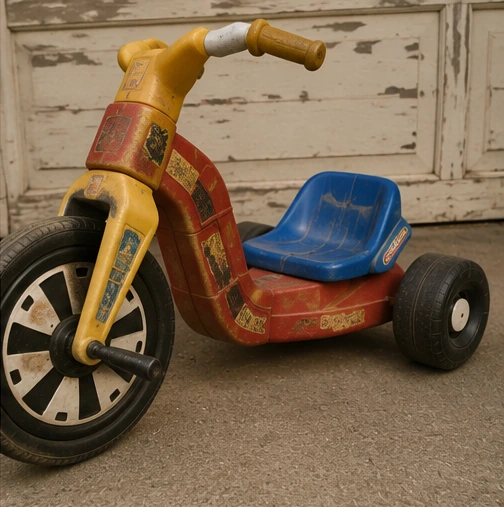
Skidding concentrated wear on the same sections of plastic. A round wheel slowly became a wheel with a preferred side. The ride developed vibration and noise long before the toy became unusable.
The pedaled front wheel carried the rider’s power to the pavement. Wear, dust and smooth surfaces reduced grip. The rider’s legs could spin faster than the Big Wheel moved, producing effort without dignity.
Outdoor storage faded red, blue and yellow plastic. Decals dried and peeled. A garage-kept Big Wheel aged differently from one left beside the house through multiple seasons.
The adjustable seat encouraged longer use, but older and heavier riders stressed plastic that had already absorbed years of vibration. Cracks often began near mounting points or edges.
Pedals struck curbs, scraped pavement and carried every acceleration attempt. Missing or damaged pedals could turn a ride-on toy into a rolling object pushed with feet.
Anything designed to rub against a wheel was going to wear when children treated every stop as a stunt. A damaged brake could drag constantly, stop working or become a lever with no remaining authority.
Later models and deluxe configurations sometimes included storage areas. Children filled them with rocks, action figures, toy tools or objects no adult wanted transported. Lids and small components had their own survival rate.
A worn Big Wheel was not interchangeable with another. The flat spot, faded decal and cracked edge made it the neighborhood machine everyone recognized.
The product became successful enough that the brand name began describing an entire kind of childhood vehicle.
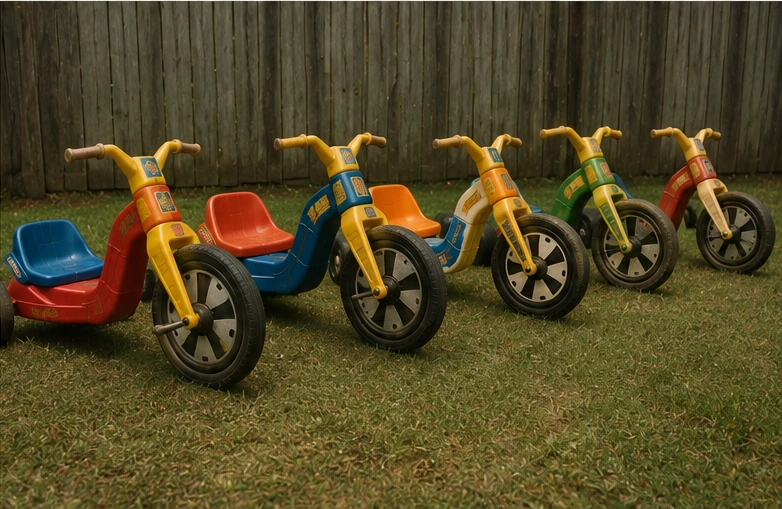
The Strong’s history notes that several manufacturers produced similar vehicles after the original Marx success. Different companies changed the body shape, wheel design, graphics and features while preserving the basic low-riding arrangement.
One huge front wheel, two small rear wheels, direct pedals and a seat near the pavement were enough. The exact logo mattered less than whether the vehicle could race and skid.
Families therefore used “Big Wheel” the way they used other famous brand names that became casual category words. The child might have owned a competitor’s plastic trike and remembered it honestly as a Big Wheel.
Manufacturers tried storage boxes, character graphics, different colors, brake systems and longer frames. Some aimed at younger children. Others tried to keep older children riding by making the toy look more like a motorcycle or hot rod.
Imitators could match the wheel arrangement, but the original name had already entered commercials, catalogs and playground vocabulary. A competing product still had to explain how it differed from the Big Wheel.
A vintage ride-on found in an attic or garage should be identified through molded marks, frame design, period catalogs and surviving graphics. Childhood recollection can establish family history but not always the manufacturer.
Correcting the brand does not erase the experience. The noise, low seat, flat spots and driveway races belonged to the whole style because the original Big Wheel had changed what a tricycle could be.
A surviving Big Wheel is large, incomplete more often than not, and full of condition questions that do not apply to a shelf toy.
Vintage Big Wheel collecting sits between toy collecting and vehicle restoration. The object is made from large molded plastic parts, moving wheels, a seat, hardware and decals. Condition must be evaluated as a system.
Because “Big Wheel” became common shorthand for similar trikes, not every low-riding plastic ride-on is a Marx Big Wheel. Molded marks, frame shape, wheel design, seat hardware and period graphics help establish identity.
Cracks around the seat, axle points, frame joints and steering assembly matter more than faded color. A beautiful decal cannot make brittle plastic safe to ride.
Flat spots are common and part of the nostalgia, but they affect display and movement. Rear wheels may be deeply worn from spinouts. Front wheels may have pedal or hub damage.
Replacement seats, improvised fasteners and missing adjustment parts alter both originality and function. Period photos and trusted collector references can help distinguish variations.
Brake levers, mounting pieces and contact parts could be damaged or removed. A complete brake-equipped example is more difficult to find than a vehicle with only the visible lever remaining.
Sun, water, abrasion and cleaning damage original graphics. Reproduction decals can improve a restoration while reducing originality if they are not disclosed.
Families did not store ride-on toy boxes casually. Original cartons, inserts and assembly paperwork take up space and were often discarded immediately.
A display restoration can use reproduced graphics and carefully cleaned plastic. A rideable restoration requires structural confidence and safe hardware. Those goals are not the same.
Large vintage toys attract dramatic listings. Real value depends on exact version, completeness, originality, condition, packaging, location and the difficulty of shipping. Sold evidence matters more than optimism.
Treat this as an identification and restoration guide rather than a live price sheet. Sold examples change, shipping costs distort the market, and a complete working ride-on is a very different object from a sun-faded frame with missing parts.
The toy is remembered so vividly that family stories, brand names and model years often blend together.
The Big Wheel is inseparable from the 1970s, but the launch occurred at the 1969 New York Toy Fair. The following Christmas placed it in children’s hands before the decade officially began.
The brake became one of the most remembered features, but the design evolved. Basic and later versions differed, and many surviving toys are incomplete. Some children learned spinouts through hard steering without a dedicated brake.
Plastic wheels could wear, but repeated skid turns were a major contributor. The feature children loved helped create the condition adults later complained about.
They shared a manufacturer, low seating and hot-rod attitude, but the steering system was fundamentally different. The Green Machine used rear-wheel steering levers and targeted older riders.
It became common speech, but Big Wheel was a specific brand and product line. Similar ride-ons came from multiple manufacturers.
Age and nostalgia do not guarantee high value. Condition, exact model, originality, completeness, graphics and packaging matter. Large ride-ons are also difficult and expensive to ship.
The low viewpoint, loud wheels and neighborhood scale exaggerated the sense of speed. The experience was real even when the actual velocity would not impress a traffic officer.
The Big Wheel made ordinary pavement feel enormous. It gave children control, competition and a vehicle identity. Exact model details may blur. The freedom does not.
The toy became bigger than the corporate history that produced it.
Louis Marx & Company was one of the most important American toy makers of the twentieth century. The Big Wheel arrived near the end of the company’s independent era and became one of its most durable cultural achievements.
Marx was sold to Quaker Oats in 1972. Museum records note that the Big Wheel remained a major seller through the decade even as the company changed ownership and the broader toy industry consolidated.
The Strong notes that other manufacturers carried the Big Wheel idea forward after Marx. Rights, tooling and production passed through later companies, and similar low-riding plastic trikes appeared under multiple names.
The object had become too useful to disappear with one corporate structure.
Parents and children called many low-slung plastic trikes “Big Wheels” whether or not the manufacturer agreed. The brand name became a category in everyday speech.
The National Toy Hall of Fame inducted the Big Wheel in 2009, recognizing the way its design changed outdoor play. The honor formalized what several generations already knew: the toy had become an American childhood symbol.
Current owner Schylling promotes modern versions with the familiar 16-inch front wheel, adjustable seat, low-riding form and spinout action. Materials and safety language evolve. The silhouette remains recognizable.
That continuity proves the strength of the original concept. The Big Wheel did not need electronics, a movie license or an app. It needed pavement and a rider willing to pedal.
Few toys combine the decade’s love of plastic, speed, independence and casual driveway risk so completely.
The Big Wheel arrived at exactly the right cultural moment. Suburban driveways and sidewalks provided space. Molded plastic allowed bold shapes and lower prices. Television commercials could turn neighborhood riding into motorsport. Children had enough outdoor freedom to use the toy as transportation instead of a supervised demonstration.
The primary colors and exaggerated wheel announced childhood. The steering, pedals and movement supplied genuine control. That combination made the toy emotionally larger than its speed.
The same driveway remained fun because the rider could race, skid, patrol, tow imaginary cargo, follow chalk roads or attempt a better turn. No new accessory was required.
Even people who did not own one remember hearing them. The rattle became part of the neighborhood environment.
The rider controlled the machine without needing the balance or size required for a bicycle. The Big Wheel became a first personal vehicle for millions of children.
The toy did not need a storyline. The rider was the storyline. The next turn, skid or race created the reason to continue.
Inside the broader 70s toy box, the Big Wheel stood beside Hot Wheels racing across orange track and Kenner Star Wars figures taking over the carpet because it changed where childhood happened. It moved play out of the room and onto the pavement, where the noise carried until dinner.
The launch year, handbrake, worn wheels and brand history can get surprisingly complicated for a toy built around three plastic wheels.
Louis Marx & Company introduced the Big Wheel at the 1969 New York Toy Fair, and it reached children by the following Christmas.
The Strong National Museum of Play credits Marx designer Ray Lohr with creating an early version by rearranging tricycle parts into a low-riding, race-car-like configuration.
The low seat lowered the rider’s center of gravity, making the trike less likely to tip during fast turns and skid-outs than a traditional upright steel tricycle.
The classic model used molded plastic for its frame and wheels. That made it lighter, lower-cost and more forgiving over bumps than many older metal tricycles.
The Strong’s museum record notes a price of about $15 during the original era, which helped make it a major seller throughout the decade.
No. The basic design evolved during the 1970s, and later versions added a handbrake that pressed against a rear wheel to encourage intentional spinouts.
Repeated skids and handbrake turns wore the hollow plastic rear wheels unevenly. Once a flat spot formed, every rotation produced the familiar thump-thump-thump ride.
The Cobra Cycle was a late-1970s black-styled Big Wheel variation promoted with cobra graphics and a customizable license plate.
It was a separate Marx ride-on created for older children. It used rear steering levers instead of handlebars and extended the low-riding hot-rod idea beyond the original Big Wheel.
It was affordable, stable, easy to understand and exciting on ordinary pavement. A driveway, sidewalk or gentle hill instantly became a racecourse.
Yes, but value depends on originality, condition, decals, wheels, seat, handbrake, storage parts and packaging. Complete examples are difficult to find because the toys were used hard and stored outdoors.
The Big Wheel entered the National Toy Hall of Fame at The Strong in 2009.
Big Wheel Freedom Before the First Bicycle
You were not going far, but you were going under your own power and choosing the route.
The Strong describes the Big Wheel as giving children mobility along with a measure of independence. That independence was geographically small and emotionally huge. A child could leave the garage, circle the property, visit the next driveway and return without being pushed.
The Rider Controlled Speed and Direction
Adults might set boundaries, but the child operated the machine. Pedaling harder changed the result immediately. Steering choices had consequences. The toy provided a direct relationship between effort, judgment and movement.
Neighborhood Visibility Mattered
A Big Wheel was hard to hide and impossible to ride quietly. Friends knew when it was outside. Ownership could create a gathering before the rider completed the first lap.
Sharing Created Social Order
Children waiting for a turn counted laps, set time limits and accused the current rider of slowing down near the finish. Older kids took longer turns because they could claim advanced testing responsibilities.
The Vehicle Extended the Play Area
A child on foot might remain near the porch. A child on a Big Wheel explored the full driveway, sidewalk and permitted edge of the block. The physical range was modest. The psychological range felt much larger.
The Big Wheel Bridged Toddler Toy and Real Transportation
It was not a bicycle, but it taught movement, steering, spatial judgment and the pleasure of having a machine. For many children, it became the first vehicle they remembered as personally theirs.
That is why the Big Wheel ranks so high among the most iconic toys of the 70s. The memory is attached to place, sound, weather and freedom—not only to plastic.