Hot Wheels in the 1970s: Orange Track, Redlines and Carpet-City Speed

Hot Wheels in the 1970s: Orange Track, Redlines and Carpet-City Speed

Smells Like Gen X • The Carpet Transportation Department

Hot Wheels in the 1970s Orange Track, Redlines and Carpet-City Speed

They were small enough for a pocket, fast enough to disappear under furniture, and expandable enough to take over a hallway. Hot Wheels gave Gen X candy-colored Redlines, bright orange track, loops, Super-Chargers, rechargeable Sizzlers, Snake and Mongoose drag races, Flying Colors and the belief that another six feet of track would solve everything.

Hot Wheels in the 1970s: What Made the Cars and Track Different?

Hot Wheels combined fast-rolling die-cast cars with bright modular track, custom-car styling and an expandable racing system. The wider world of 70s toy cars and tracks included garages, realistic miniatures and mixed-brand floor play; Hot Wheels owned the exact speed fantasy with Redlines, Spectraflame paint, orange track, Super-Chargers and Sizzlers.

Brand launch1968, entering its first full decade in 1970
Classic eraRedline wheels, Spectraflame colors and custom-car designs
Track identityBright orange modular racing track
Powered branchRechargeable Sizzlers introduced in 1970

The 1970s Hot Wheels Story Actually Starts in 1968

The decade opened with the line already moving fast. What happened next was expansion, experimentation and total carpet occupation.

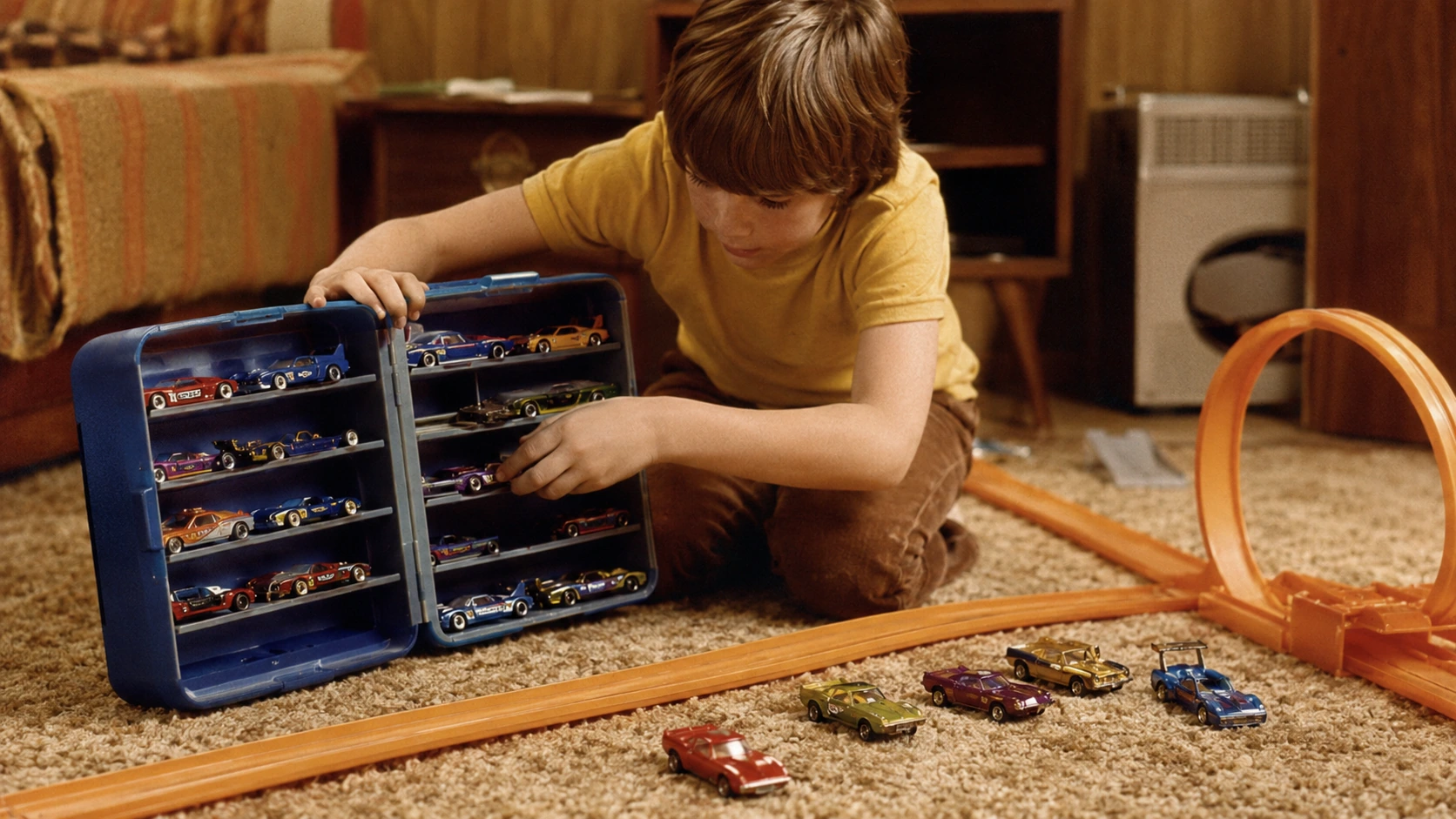
A child opening a blue carrying case filled with early custom-style Hot Wheels cars beside orange track in a 1970s playroom
The line entered the 70s with fast cars, bright track and enough empty case spaces to keep the wish list growing.

Hot Wheels did not arrive politely. Mattel introduced the line in 1968 with cars designed to look more aggressive and roll faster than the die-cast competition already sitting in toy boxes. The proportions were exaggerated, the paint looked like candy poured over polished metal, and the wheel system was engineered for motion rather than shelf realism. By the time the calendar reached 1970, Hot Wheels had already created a new expectation: a toy car should not merely resemble an automobile. It should perform.

That distinction matters because the 1970s Hot Wheels story is not simply a history of castings. The cars were one part of a larger play system. Orange track, connectors, curves, loops, clamps, launchers, boosters, carrying cases and later motorized cars all pushed the brand beyond the old pattern of rolling a vehicle across the floor by hand. Hot Wheels invited kids to build a machine around the car.

Mattel describes the original concept as an effort to make die-cast cars look cooler and perform better than the competition. That combination—design plus speed—explains why the brand survived every toy-aisle shift that followed. A good-looking car could be collected. A fast car could be raced. A Hot Wheels car was expected to do both.

The Original 16 Created the Visual Language

The first-year group included customized American cars, show-car fantasies and designs that looked as though they belonged at a Southern California car show rather than in a dealership parking lot. The Deora, Custom Camaro, Custom Mustang, Custom Corvette, Custom Barracuda, Custom Volkswagen, Silhouette, Beatnik Bandit and the other first castings established a line where realism could be bent in the direction of speed.

Those cars rolled directly into the next decade. A child receiving Hot Wheels in 1970 was not entering a brand-new line. He was entering a system already loaded with early models, track parts, advertisements and older siblings who knew which car ran best through the loop.

The Name Promised More Than Accuracy

Matchbox had built a world around recognizable vehicles and detailed miniatures. Hot Wheels leaned into the hot-rod fantasy. The cars sat lower, looked wider and wore colors that real family sedans rarely carried. Even when a casting began with a production car, Mattel often treated it like something customized in a dream garage.

That difference helped Hot Wheels own a specific kind of childhood. The cars were not only traffic. They were competitors. The carpet was not only a road. It was a timed course, drag strip, stunt arena and municipal planning problem.

GEN X ENGINEERING RULE #1

If the car failed to clear the loop, raise the starting point with another encyclopedia.

The Original 16 Cars That Entered the 1970s With Momentum

The first lineup launched in 1968, but these cars shaped what children expected when Hot Wheels entered its first full decade.

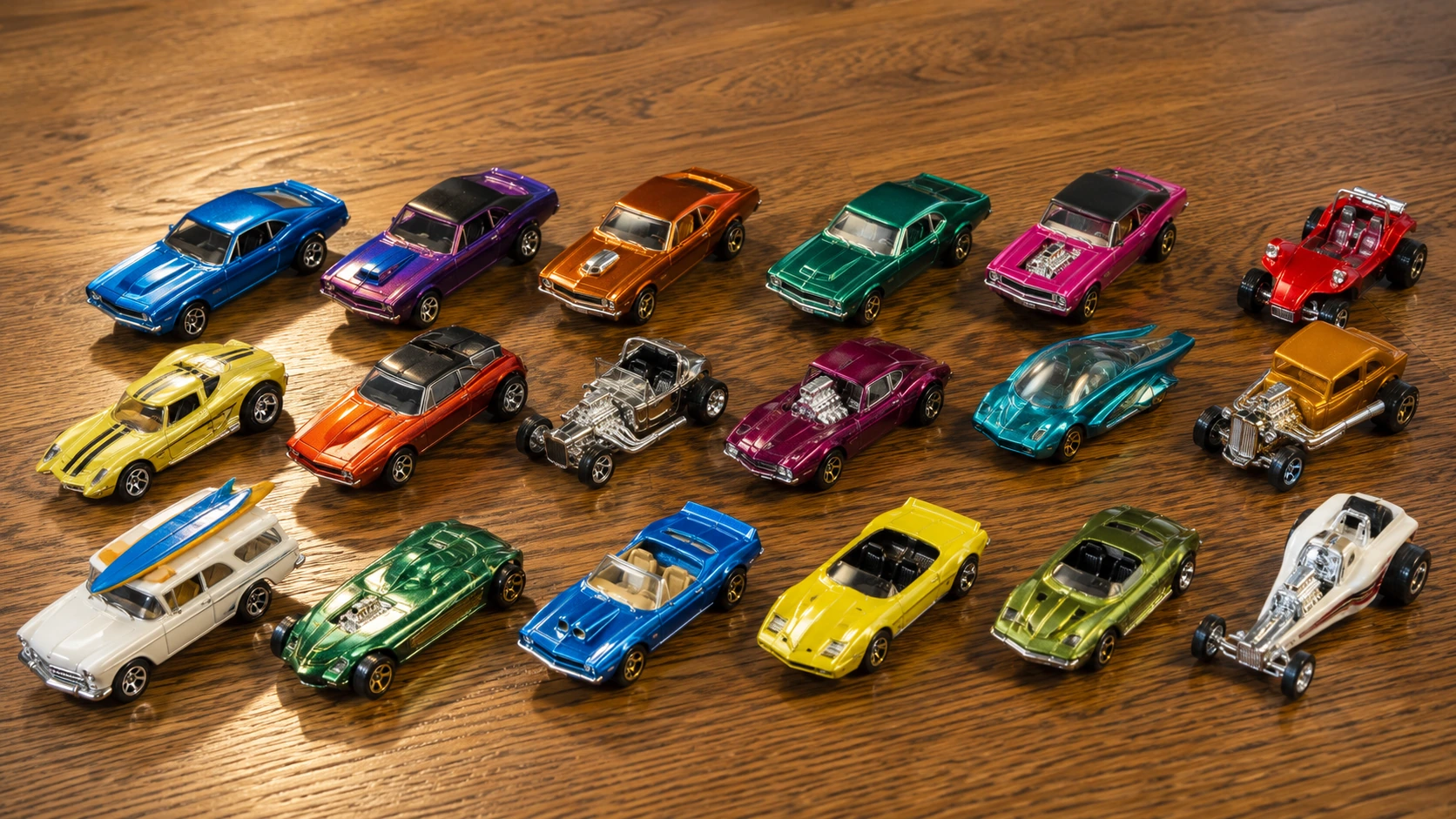
Sixteen colorful early Hot Wheels-style custom cars arranged on a wooden tabletop
The first lineup mixed muscle cars, show customs, hot rods and automotive fantasy into one unmistakable collection.
1

Custom Camaro

The Camaro established the line’s basic promise immediately: take a car children recognized and push it lower, wider and louder. The casting looked like a street machine already modified by somebody with more imagination than restraint. On track, the compact shape made it a natural racer. In a toy box, it became the kind of car a kid could identify even after the paint had been chipped off the roof.

2

Custom Mustang

The Mustang connected Hot Wheels to the muscle-car world visible on roads, magazine covers and television. Mattel’s custom treatment made the familiar name feel more aggressive. A Mustang could race because it was a Hot Wheels car, then leave the track and become the important car in the carpet city. That double life—recognizable real model and exaggerated toy performer—helped define the whole line.

3

Custom T-Bird

The Thunderbird gave the Original 16 a large American shape that still carried the custom-car attitude. It looked less like a tiny family vehicle and more like something built for a show. The long body and bright finish made it stand out in a row, while the wheels kept it connected to the same performance system as the smaller coupes.

4

Custom Corvette

The Corvette was already a childhood dream car, so the Hot Wheels version did not need much explanation. It brought real sports-car credibility to the line while the custom stance and candy color pushed it into fantasy. For many kids, the toy version was the Corvette they could actually own, race into a wall and carry in a pocket.

5

Custom Cougar

The Cougar occupied the space between recognizable production car and full Hot Wheels attitude. The casting gave another muscle-era name to the first lineup and reinforced the idea that Mattel was building a miniature custom-car show. Different colors made the same casting feel like a different personality, which mattered when two kids arrived with Cougars.

6

Custom Firebird

The Firebird added another Pontiac performance shape to the early group. Low, bright and ready for the orange track, it represented the way Hot Wheels borrowed the cultural heat of real muscle cars and returned it in exaggerated toy form. A child did not need to know engine options or trim levels. The name and shape already sounded fast.

7

Custom Barracuda

The Barracuda became one of the cars most closely associated with early Hot Wheels and later gained even more cultural weight through the Snake drag-racing connection. The casting worked as both a customized street machine and a race car. That flexibility let it move between imaginary traffic, drag strips and stunt layouts without changing roles.

8

Custom El Dorado

The El Dorado proved the line did not need every car to be small or obviously race-bred. A long luxury coupe could still receive the Hot Wheels treatment. The result was excessive in exactly the right way: bright finish, dramatic proportions and wheels that made the large body move with more urgency than a real boulevard cruiser.

9

Custom Fleetside

The Fleetside brought a customized pickup into the first group and expanded what counted as a performance vehicle. It could haul, race or serve as the work truck in a carpet city. The low stance made it look less like a farm truck and more like a custom shop project, which fit the Southern California flavor behind the brand.

10

Custom Volkswagen

The Volkswagen was familiar, friendly and transformed by the Hot Wheels finish and wheel system. Its rounded body looked completely different from the long muscle cars around it, giving the lineup visual variety. On the floor, the Beetle could be comic relief, underdog racer or city traffic—until it unexpectedly won.

11

Deora

The Deora looked like a concept car from a future surf shop: cab-forward body, custom pickup proportions and a shape no ordinary dealership carried. It helped establish that Hot Wheels could build icons from real custom-car culture instead of only shrinking production vehicles. The Deora was strange, functional-looking and immediately at home beside orange track.

12

Ford J-Car

The Ford J-Car brought prototype-racing energy to the first lineup. Its low body and competition shape looked built for the track system rather than the carpet street. It gave kids a car that felt connected to serious racing even if they knew nothing about the real program behind the name. The silhouette did the work.

13

Hot Heap

Hot Heap represented the hot-rod side in its most direct form: exposed mechanical attitude, compact body and a name that sounded like something an adult would not approve of. It looked homemade and fast, which made it perfect for a line built around customized fantasy. The casting also stood apart from the smoother production-car shapes.

14

Python

Originally associated with the Cheetah name before becoming known as Python, the sleek show-car shape looked more like a design exercise than traffic. It was the kind of toy that made the Original 16 feel curated rather than predictable. Even children who could not name it knew the low, flowing body belonged near the front of the race lineup.

15

Silhouette

Silhouette was another custom-show creation that looked designed around aerodynamics and spectacle. The bubble-like cabin and low body gave it a futuristic identity without needing science-fiction branding. It demonstrated that Hot Wheels could make a real-world custom design feel as important as a Mustang or Corvette.

16

Beatnik Bandit

Beatnik Bandit brought Ed Roth-style custom-car weirdness into the toy box with a bubble canopy and body that looked more imagined than manufactured. It was not trying to resemble the car in the family driveway. It was trying to look like the wildest machine at the show, and that made it a perfect statement of the early Hot Wheels attitude.

Why the First Group Still Matters

The Original 16 were not sixteen random vehicles. Together they explained the brand. Customized production cars connected the line to muscle-car culture. Show cars such as Silhouette and Beatnik Bandit supplied visual fantasy. Deora and Custom Fleetside expanded the idea into pickups. Ford J-Car supplied road-racing purpose. Every casting used the same track-compatible speed system, which made wildly different shapes feel like one team.

The group also taught collectors the habits that would define Hot Wheels for decades: compare colors, study variations, remember which car was fastest and keep looking because another casting existed. The first checklist was small enough to imagine completing and varied enough that every child could choose a favorite.

Redline Hot Wheels: The Wheels That Named an Era

A thin red stripe became one of the clearest dividing lines in vintage toy-car history.

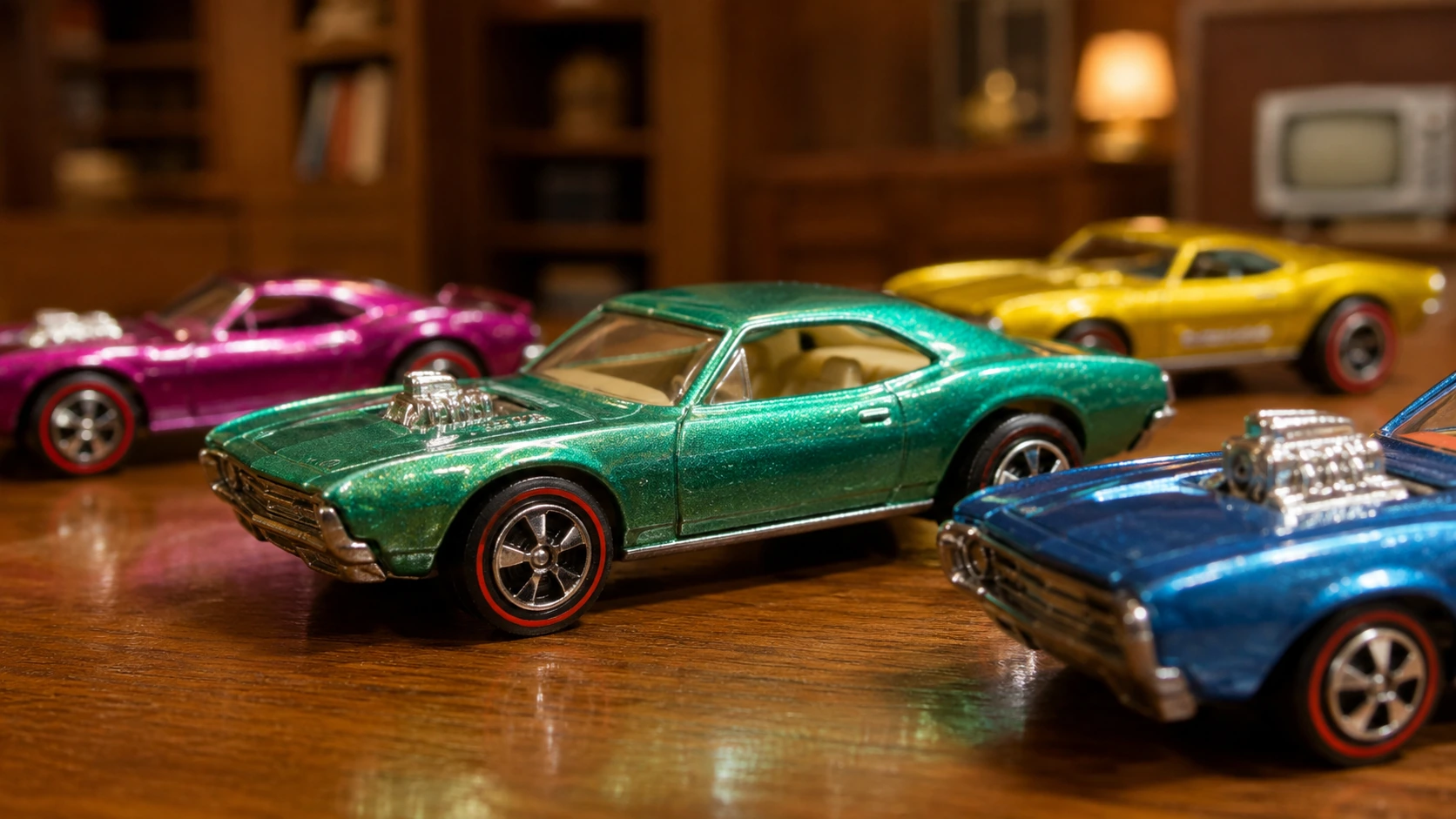
Close-up of metallic green, blue, pink and yellow vintage-style cars showing thin red stripes around the wheels
The red stripe was a small wheel detail that eventually named an entire collector era.

“Redline” began as a visible wheel detail and became the shorthand for the earliest Hot Wheels era. The narrow red stripe circling the tire echoed performance tires seen on real muscle cars. On the toy, it made the wheel look finished, sporty and instantly different from the ordinary black tires on many other miniatures.

Collectors generally use the Redline era for Hot Wheels produced from 1968 through 1977. That does not mean every car in that span is identical, or that every wheel construction stayed the same. The decade included different hubs, axles, production locations, paint systems and packaging changes. The red stripe is the easy visual clue; the actual history underneath it is more complicated.

The Stripe Looked Fast While the Car Was Standing Still

That is a recurring Hot Wheels trick. The toy communicated motion before it moved. A low roof, exaggerated rear tire, exposed engine, bright finish and red-striped wheel combined to suggest speed on the peg. The track then proved the promise.

Children did not call them “Redlines” with the same catalog precision adult collectors use now. They were simply Hot Wheels. The stripe mattered because it was part of the look, not because a kid was documenting wheel variations in a notebook. Decades later, the stripe became a timestamp.

Redline Does Not Automatically Mean Rare

Millions of early cars were produced and many castings appeared in multiple years. Rarity depends on the specific combination of model, color, wheel, interior, base, production origin and condition. A common early car with heavy paint loss may be emotionally priceless and financially ordinary. A rare color variation in strong condition can sit in a completely different category.

This is why a broad “old Hot Wheels value” answer is usually useless. Two cars with the same name can differ because one was made in a different year, factory or color. The details matter more than the age alone.

The Redline Era Ended Gradually, Not With a Sudden Funeral

By the second half of the decade, the original visual formula was changing. The red stripe was phased out, blackwall-style wheels became standard, and the line moved toward a wider mix of realistic cars, trucks and decorated models. Kids continued racing them. Adult collectors later used the wheel change as a clean historical boundary.

For Gen X, the transition meant a toy box could contain both worlds. A hand-me-down Spectraflame Redline might sit beside a newer Flying Colors car with bold side graphics and black tires. Nobody stopped the race to explain the manufacturing era.

Spectraflame Hot Wheels: Candy-Colored Custom Metal

The earliest colors were not ordinary enamel. They were part of the performance fantasy.

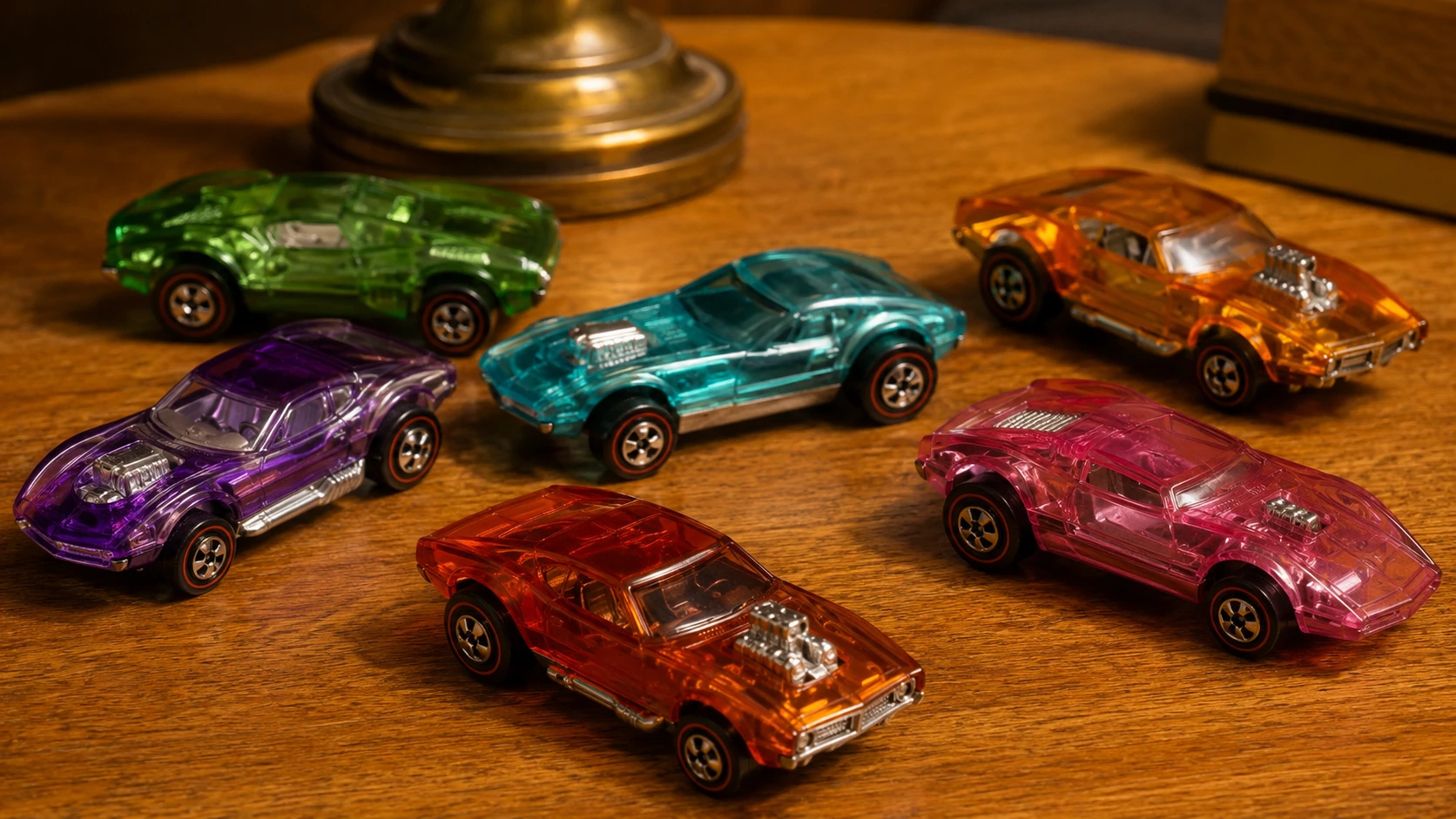
Translucent candy-colored toy cars in purple, aqua, orange, green, pink and red on a warm wooden table
Spectraflame-style finishes caught the light like custom paint scaled down for the toy box.

Many early Hot Wheels used a translucent color finish over a bright metal surface. The effect produced deep, reflective colors that collectors call Spectraflame. Pink, purple, aqua, green, blue, orange and red looked richer than flat paint because light seemed to come back through the finish.

On a store peg, the cars caught the fluorescent light. On the floor, the color changed as the car moved. Chips and scratches revealed the metal underneath, which meant hard play created its own visual history. A heavily raced car could lose the finish on the roof edges, fenders and corners while still looking fast.

Color Became Part of the Hunt

A casting did not exist in only one color. That meant two children could own the same model and still feel they had different cars. The purple one was not simply another version of the green one. It might be faster because childhood logic had no obligation to remain scientific.

Color variation also gave the line repeat-purchase energy without requiring a completely new mold. A child who already owned a Custom Camaro could still want another if the finish looked different enough. The package image, wheel style and interior color added more reasons to compare.

Wear Could Improve the Story and Hurt the Collector Grade

Paint loss did not stop a car from racing. In fact, the scratches often proved that the car had survived real competition. Roof wear came from crashes and carrying cases. Nose chips came from walls, baseboards and track exits nobody had padded. Bent axles told the story of jumps attempted without adequate landing zones.

Adult collectors evaluate that wear carefully. Children treated it as mileage.

Why Hot Wheels Cars Rolled So Fast

The brand’s most important feature was not printed on the side. It was underneath.

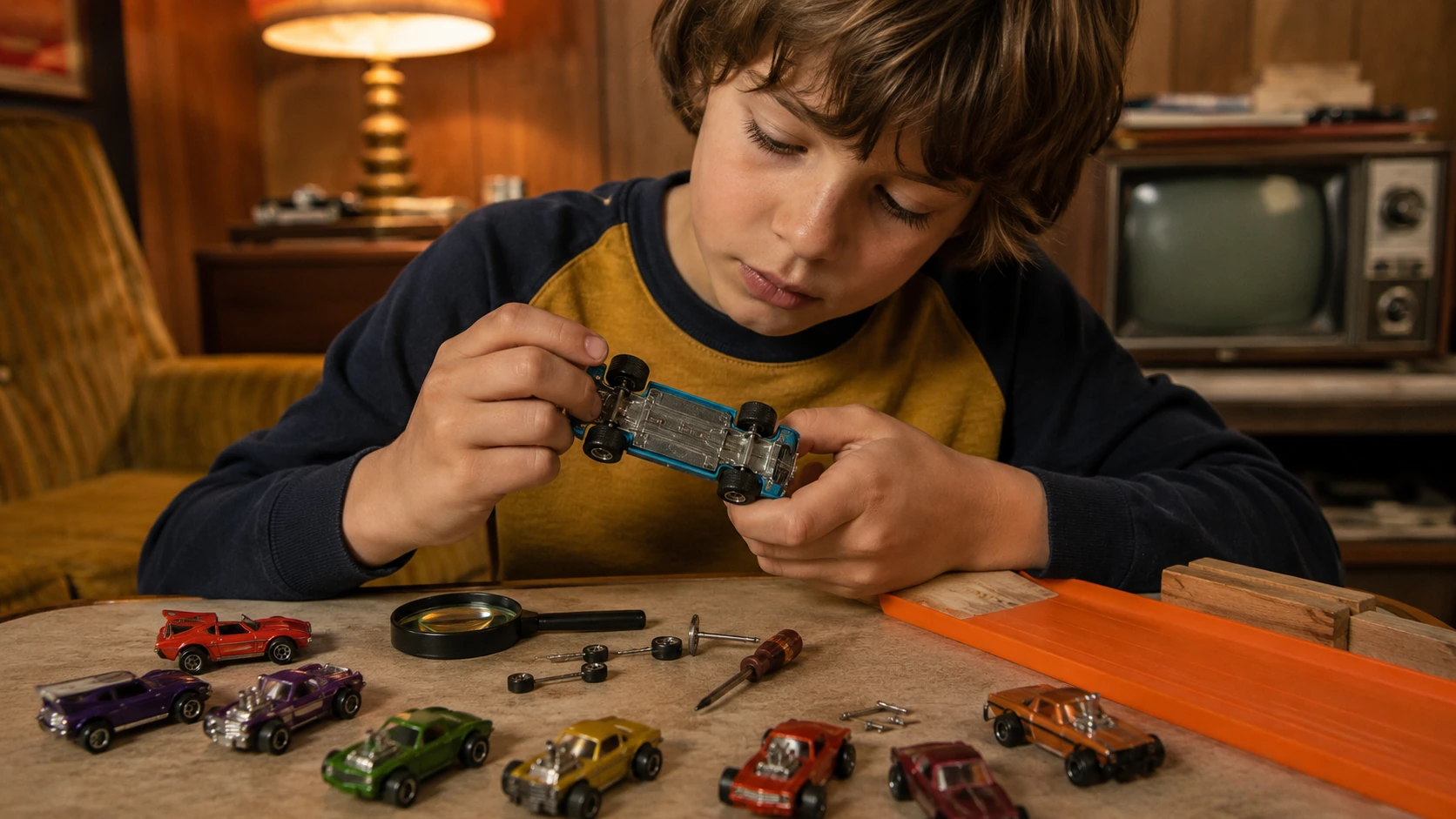
A child inspecting the underside, wheels and axles of a small die-cast racing car with tools and a magnifying glass
Before the next race, bent axles and dragging wheels received the full kitchen-table engineering treatment.

The basic magic was reduced friction. Hot Wheels used wheel and axle arrangements designed to spin freely, paired with hard plastic tires that rolled efficiently on smooth track. The cars carried speed farther than many older toy vehicles, which made gravity runs, drag races and loops practical instead of purely decorative.

The track mattered just as much as the car. A fast car on shag carpet becomes a very small plow. The orange plastic created a controlled surface. Each section gave the wheels a smooth lane, and each connector extended the run. Mattel was not only selling cars. It was selling roads engineered for those cars.

Not Every Car Was Equally Fast

Children learned quickly that two Hot Wheels from the same package price could behave very differently. Weight distribution, axle alignment, wheel rub and body shape affected performance. A favorite-looking car might be terrible through the loop. An ugly casting might dominate every straight track in the house.

This produced primitive testing programs. Cars were raced repeatedly. Winners moved into a champion pile. Slow cars became traffic, tow vehicles or crash obstacles. No adult needed to explain brackets, qualifying or performance ranking. The track created the system naturally.

Axles Became a Household Maintenance Issue

A slightly bent axle could turn a champion into a wobbling disappointment. Kids tried to straighten wheels with fingers, pliers or confidence unsupported by skill. Sometimes the repair worked. Sometimes the car left surgery worse than it entered.

Dust, hair and carpet fibers could also wrap around the axle. The repair involved pulling at the obstruction with a pin or fingernail while trying not to bend anything. Hot Wheels taught basic mechanical sympathy through consequences.

Speed Made Crashes Feel Earned

A pushed toy car could be smashed into another car. A Hot Wheels car launched down a long orange track arrived with real momentum. The crash sounded different. Cars scattered. Track separated. The result felt less like pretend damage and more like a small transportation investigation.

THE OFFICIAL SOUND OF SUCCESS

A car clearing the loop, rattling through the connector and hitting the baseboard hard enough to make an adult yell from another room.

Hot Wheels Orange Track Turned the House Into a Racing Facility

The car was collectible. The track made it an event.

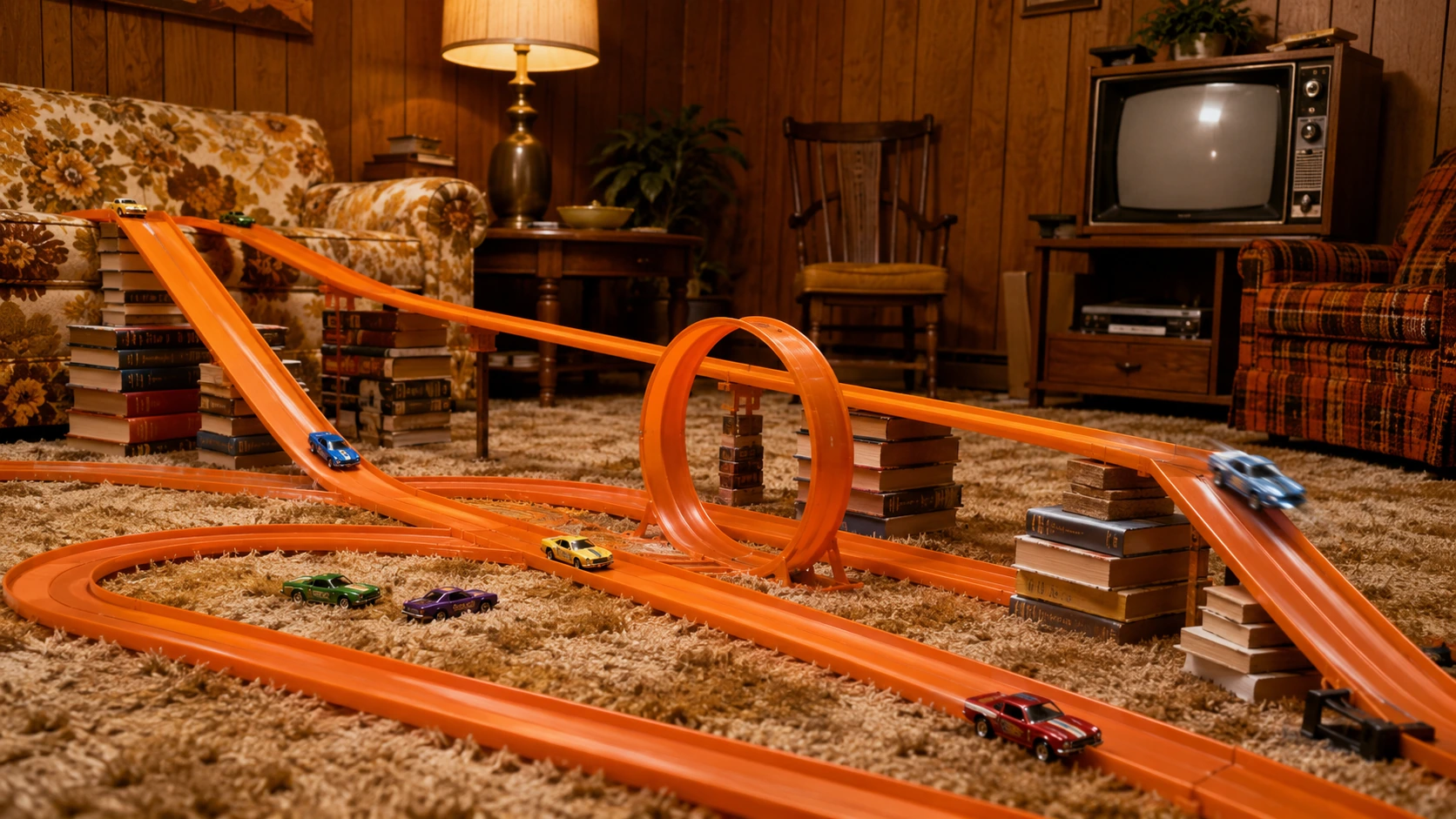
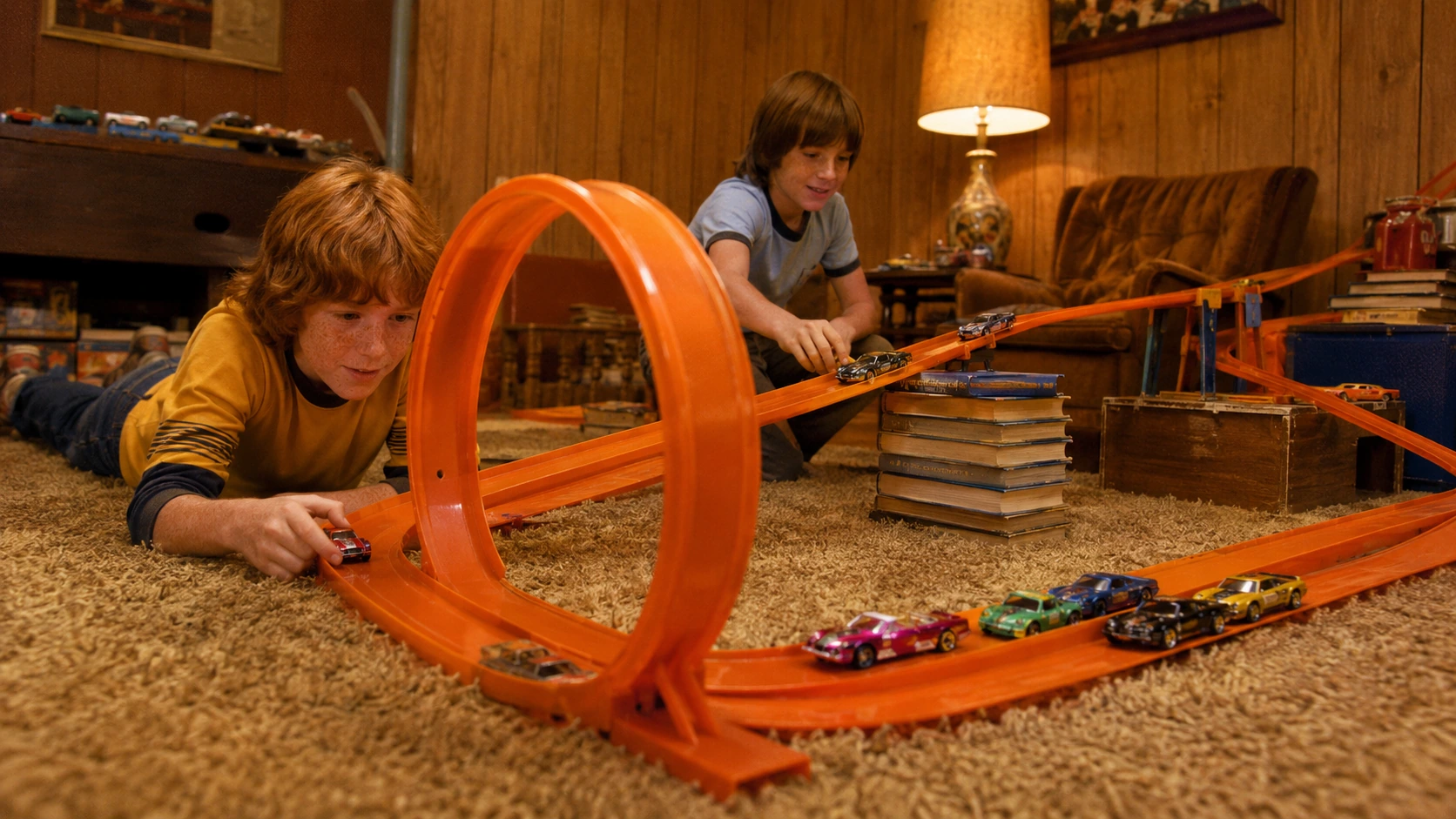
An enormous orange toy-car track crossing a shag-carpeted 1970s living room with loops, slopes and books used as supports
The official track came in the box. The furniture and encyclopedias completed the highway department.

The orange track is one of the most recognizable toy components ever made because it could appear anywhere. It ran from tables, beds, bookshelves and stairs. It crossed doorways. It passed under chairs. It occupied hallways until an adult stepped on a connector and ordered the highway department to shut down.

Track sections joined into longer runs, but the connection was never invisible. Every joint introduced a possible bump. A clean connection preserved speed. A poor one launched the car sideways. The layout builder became responsible for alignment, slope and structural support.

Gravity Was Free and Usually Available

The simplest setup began high and ended low. A clamp attached track to a table, shelf or chair. The car was released and gravity handled the acceleration. The longer and steeper the drop, the greater the chance that the run would become spectacular or completely unstable.

Books became bridge piers. Couch cushions became landing barriers. Cardboard boxes became tunnels. The track was modular, but the room supplied most of the civil engineering.

The Loop Was a Test of Momentum and Faith

Loops looked impossible the first time a child assembled one. The car had to enter with enough speed to remain against the track at the top. Too little speed produced a sad fall. Too much instability produced a launch in an unexpected direction.

Once a car cleared the loop consistently, it became a trusted performer. Other cars were tested against it. The loop separated display favorites from race cars.

Curves Punished Bad Planning

A long straight run allowed almost any decent car to look fast. Curves exposed the flaws. Enter too quickly and the car left the track. Enter too slowly and the race died. Banked pieces, side walls and careful placement helped, but improvised layouts always contained one corner where physics waited to embarrass the builder.

Jumps Created More Landing Problems Than Launch Problems

Sending a car into the air was easy. Landing it on another section of track was the advanced work. Most jumps ended on carpet, in a pile of cars or under furniture. The gap kept growing because successful landings encouraged unreasonable confidence.

The launch ramp was rarely the final design. Kids changed the height, distance and angle until the car flew farther than the available room. This was not failure. It was research.

Track Became a Shared Construction Project

One child could build a run. Several children built a transportation authority. Somebody held a weak support. Somebody released the cars. Somebody judged the winner. Somebody stood at the end to retrieve vehicles before they disappeared behind the stereo.

The system rewarded cooperation until two people wanted the same car.

The Orange-Track Parts That Turned Play Into Engineering

Every component solved one problem and introduced another.

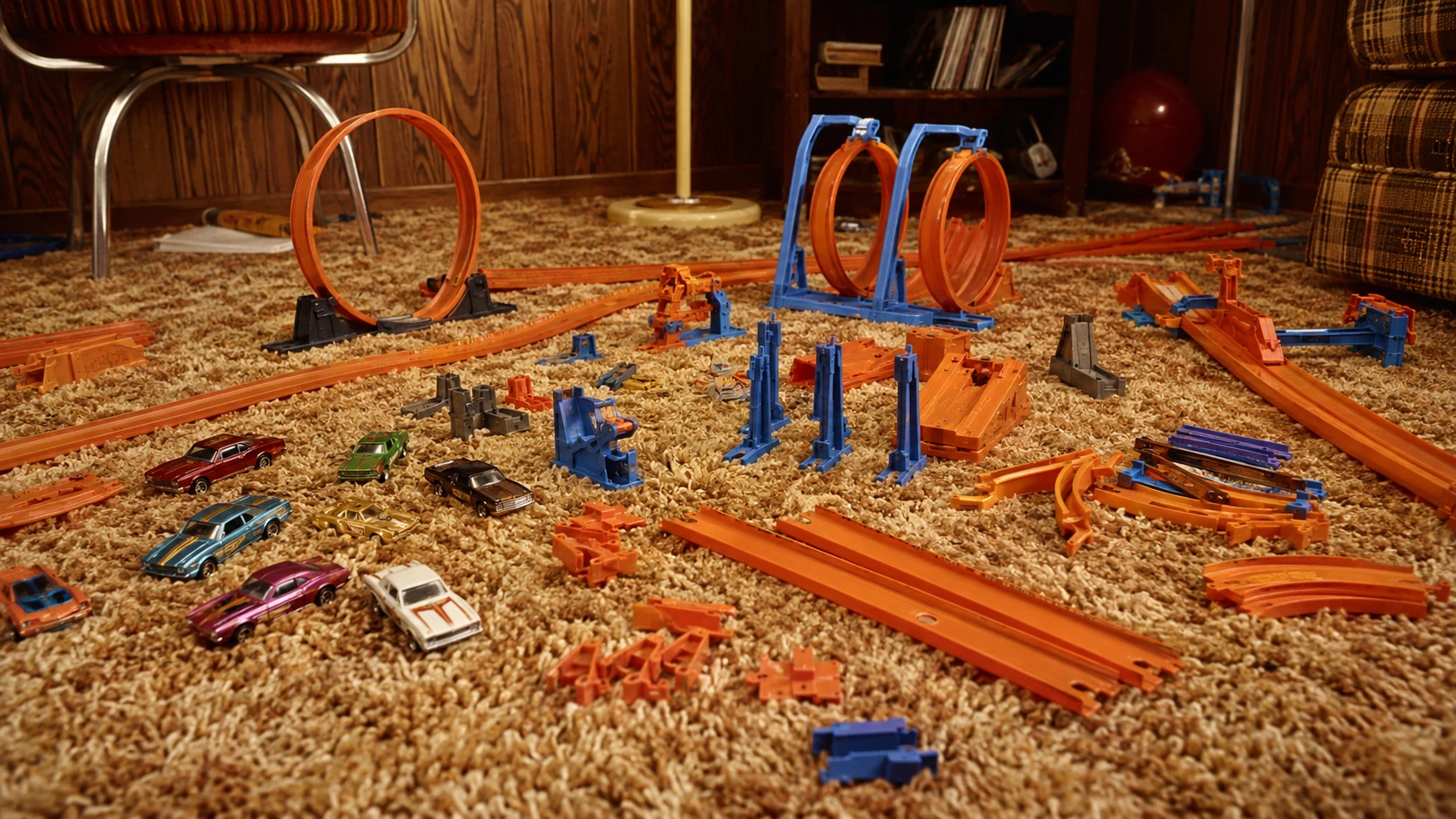
Orange track sections, connectors, loops, curves, ramps and blue supports spread across a 1970s shag carpet
A track set spent almost as much time under construction as it did carrying cars.

Straight Track

The basic orange strip was the road, runway and measuring unit. Add one section and the car ran slightly longer. Add ten and the family lost access to a hallway. Straight track revealed every bad connector and rewarded the car with the cleanest wheels.

Track Joiners

The small connector was easy to overlook until one disappeared. A loose join created a ridge that could slow a car, lift its nose or send it sideways. Kids learned to press the sections together and run a finger across the joint like a highway inspector.

Table Clamp

The clamp created instant elevation by attaching the starting track to a table, shelf or chair. It also created negotiations about furniture scratches. A strong high start produced speed; a weak grip produced the entire beginning of the track falling at once.

Loop Pieces

Curved sections formed the full loop and converted speed into a visible physics demonstration. The loop needed a stable base and enough entry momentum. When the car cleared the top, the track seemed impossible and perfectly logical at the same time.

Banked Curves

Curves tried to keep fast cars from leaving the course. The banking helped, but the approach still mattered. A car entering at the wrong angle climbed the wall, rolled or launched. Curves made a track layout feel like a course rather than a drop.

Jump Ramps

The ramp made departure reliable and landing optional. Children adjusted height and distance with books, boxes and optimism. A successful landing on another track section was rare enough to become a remembered event.

Finish Gates

A finish gate settled close races until somebody argued the mechanism had favored one lane. It gave two-lane racing an official endpoint and made the shortest track feel like organized competition.

Super-Charger

Spinning internal wheels grabbed the passing car and threw it forward. The booster allowed closed circuits and long layouts but also magnified every alignment problem downstream.

Lap Counters and Timers

Race accessories turned free play into administration. Laps could be counted, starts organized and records announced. The rules became more complicated than the toy required because children enjoy bureaucracy when they control it.

Carrying Cases

Cases stored cars in divided spaces, advertised how many more cars could fit and made the collection portable. The empty slots were a shopping list disguised as organization.

The Best Layouts Used Official Parts and Household Contraband

Mattel supplied the moving surface. Children supplied the structural system. Books created grades, boxes created tunnels, masking tape reinforced weak points and pillows caught cars that ignored the planned landing zone. The official instructions showed one possible setup. The room suggested twenty others.

Track ownership also created a parts economy. One household had extra straights. Another had the loop. Somebody had the Super-Charger but no batteries. Combining collections produced a better course and a more complicated cleanup.

The Hot Wheels Super-Charger and the Dream of a Race That Never Stopped

Gravity gave the car one run. Powered track promised continuous motion.

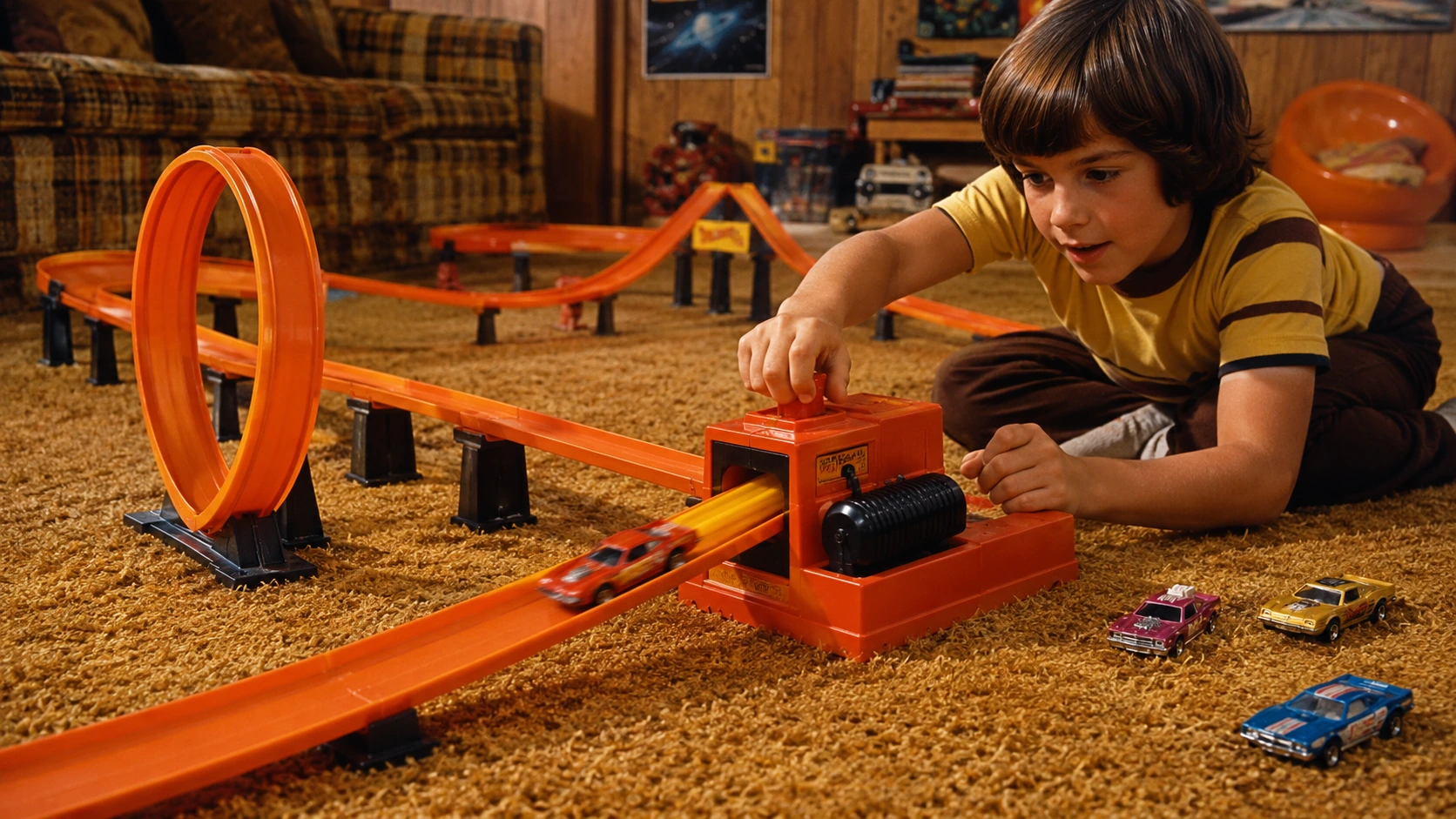
A child operating a red powered track booster that launches a car toward an orange loop
The Super-Charger promised continuous racing and delivered continuous tuning.

One of the great limitations of a downhill track is that every race ends with retrieval. The car reaches the bottom, and somebody has to carry it back to the start. Powered accessories changed the rhythm by grabbing a passing car and firing it forward again.

The Super-Charger became the mechanical heart of many layouts. Spinning wheels inside the unit contacted the car and propelled it onto the next section. In theory, a closed circuit could keep running. In practice, every imperfect joint, curve and passing car was waiting to interrupt the dream.

The Booster Made Track Design More Complicated

A powered launcher could restore speed, but it also increased the chance of derailment. The section after the booster had to be aligned. Curves needed enough support. Cars had to enter cleanly. The machine converted a simple gravity course into a system with timing.

Kids learned that more power did not automatically create a better race. Too much speed could turn a loop into an ejection device.

Noise Made the Layout Feel Alive

The whirring booster added mechanical sound to the race. It continued running even when no car was present, which made adults aware that the batteries were being converted into noise. When the car entered and shot out, the sound justified itself.

Weak batteries produced a slower, less convincing push. Like every electronic toy of the era, the unit announced battery decline through performance before anyone found a tester.

Continuous Racing Was an Ideal, Not a Guarantee

A perfect oval with a booster could keep a car circulating. Add a second car and the system became much more interesting. Cars caught each other, collided or entered the booster together badly. The track promised continuous racing and delivered continuous troubleshooting.

That troubleshooting was part of the attraction. The layout was never merely assembled. It was tuned.

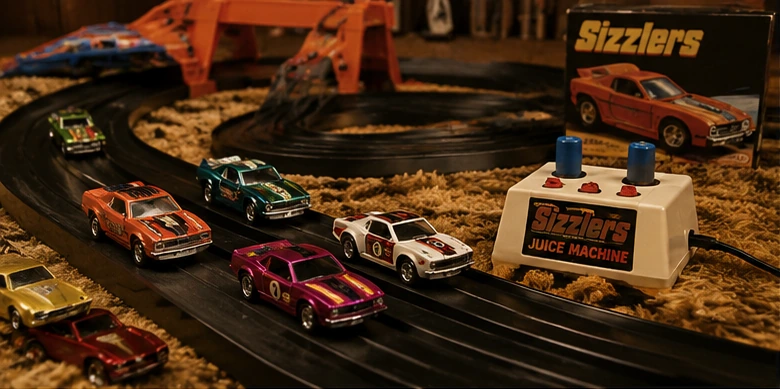
Hot Wheels Sizzlers Put a Rechargeable Motor Inside the Car

At the start of the 70s, Hot Wheels stopped waiting for gravity.

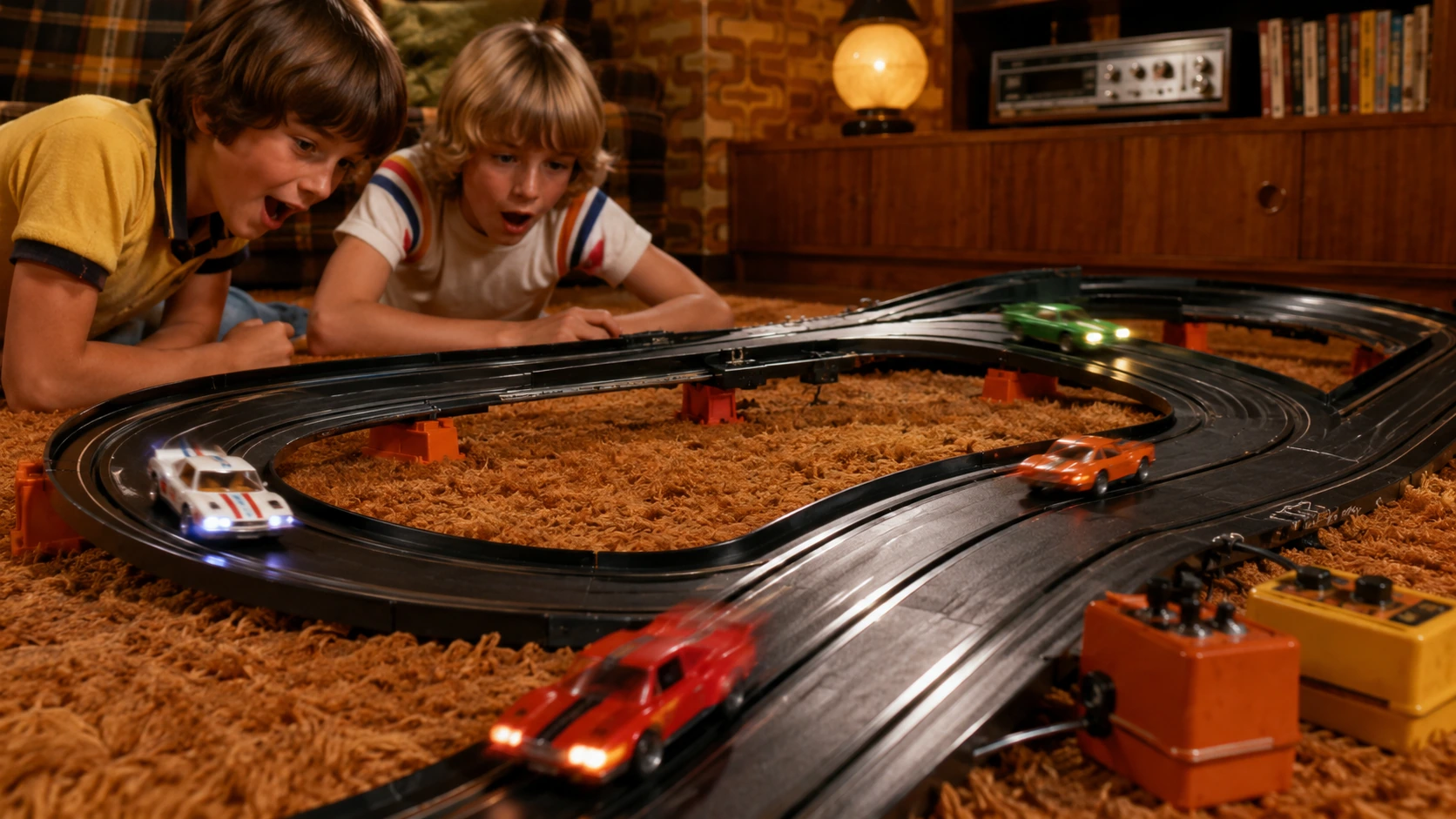
Two children watching rechargeable motorized toy cars race around wide black track in a 1970s family room
Sizzlers moved under their own power, which made the track feel less like a chute and more like a real circuit.

Sizzlers were one of the boldest branches of the 1970s Hot Wheels family. Introduced in 1970, the cars carried a small motor and rechargeable battery. Charge the car, switch it on and it moved under its own power. The hand that usually pushed or released the vehicle could step away.

This made Sizzlers feel different from ordinary die-cast cars even before the race began. They were lighter, mechanically more complex and built around an energy ritual. The car had to be charged. The wait mattered. The switch had to be found. The track had to contain a vehicle that was not planning to stop on its own.

The Juice Machine Turned Charging Into Pretend Pit Work

The Juice Machine looked like equipment rather than a battery holder. A child connected the car and waited while the internal battery received its charge. The process was short by adult standards and extremely long when the track was ready.

Charging made the car feel maintained. It was not only selected from a case and placed on a track. It had to be prepared. The toy introduced a version of pit-lane procedure into the family room.

Powered Cars Changed the Meaning of the Track

A gravity car uses the track as a path downward. A Sizzler could climb gentle grades, continue around circuits and return to where it started. The layout became a course rather than a one-way chute.

Early Sizzlers could use orange track, but powered cars exposed the limitations of narrow lanes. They caught one another, bounced in curves and needed room to pass. Mattel answered with wider racing systems.

Fat Track Let the Cars Choose Their Own Trouble

Fat Track used wide black lanes and banked curves, giving multiple Sizzlers room to move around one another. The cars did not follow fixed slots. They wandered within the lane, bumped, passed and created the appearance of independent drivers making bad decisions.

This passing action was unpredictable enough to feel alive. A faster car could approach, move around another car and then crash in the next turn. No two races unfolded exactly the same way.

The Big O Made Continuous Racing the Main Event

Wide oval layouts emphasized endurance. Cars circled until the charge faded, a collision occurred or one left the racing surface. A race could be judged by laps, survival or whichever car remained moving after the others had stopped.

Accessories such as starting gates, lap-counting ideas and timing equipment pushed Sizzlers toward organized competition. The bedroom became a speedway with officials whose rules changed between races.

Sizzlers Were Hot Wheels With Their Own Pulse

Rechargeable cars were not some unrelated side experiment. They extended the same Hot Wheels promise: make a tiny vehicle move faster, longer and with less help from the child.

Regular cars, orange track, boosters, Sizzlers and Fat Track all belonged to the same 70s racing world. The biggest difference was that a Sizzler could keep moving after gravity had finished its shift.
The Sizzlers Racing System Was a Toy Line Inside the Toy Line

Rechargeable cars required chargers, tracks, starting systems and a different kind of patience.

Rechargeable 1970s toy cars racing on wide black track beside a Juice Machine-style charger
Charging the car was part pit stop, part science experiment and entirely too slow when the track was ready.

The First Cars Felt Like Pocket-Sized Machines

Ordinary Hot Wheels cars stored energy only through height, a launcher or a booster. A Sizzler stored energy inside the body. That difference changed the relationship with the toy. The car could sit quietly on the floor, then switch on and begin moving without a visible push. In 1970, that felt remarkably close to a robot car.

The motor, gears, battery and rear tires also made maintenance more important. A weak charge, dirty contact or worn internal component changed performance. Kids could not see everything happening inside, which made a slow car feel mysterious and occasionally personal.

The Charge Created a Race-Day Rhythm

The Juice Machine made the waiting visible. Cars were charged one at a time, which meant a group of racers had to be prepared in sequence. One child handled the charger. Another arranged the start. Somebody switched on too early and used half the charge before the field was ready.

The short charging period stretched because the track invited immediate use. The longer the car sat connected, the more the child imagined the speed building inside it.

Fat Track Made Passing Possible and Crashes Inevitable

Narrow track forces the car to follow the lane. Fat Track allowed lateral movement. The powered cars wandered, blocked one another, passed and entered curves at changing angles. It created a race that could not be fully controlled after the start.

That uncertainty was the feature. A slower car might block the leader. Two cars could collide and allow a third through. A car with fading charge might become moving traffic. The track generated stories without requiring the child to move the cars by hand.

Later Sizzlers Kept Reinventing the Same Promise

The line changed through the decade, including revised cars and later versions with new styling and features. The essential appeal remained the same: charge a small car and release something that seemed to have its own intention.

Why Sizzlers Were Harder to Preserve

A regular die-cast car can survive decades with chipped paint and bent wheels. A Sizzler also depends on an internal battery, motor, gears and electrical contacts. Aging components make working examples more complicated. Chargers are often separated from cars, and track systems require large groups of parts to recreate.

That mechanical vulnerability makes the line fascinating to collectors and risky for anyone assuming an old car will run simply because it looks complete.

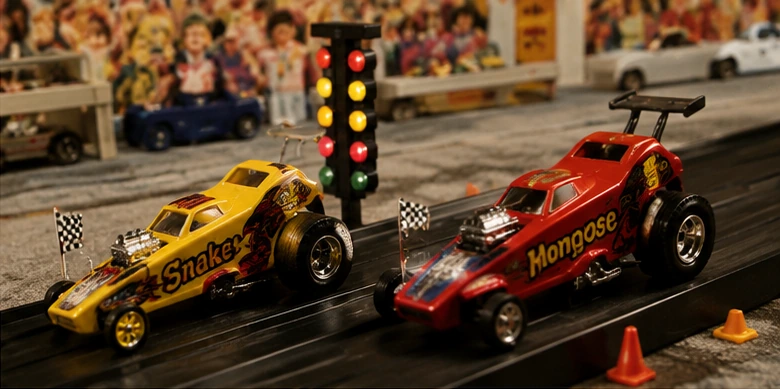
Snake and Mongoose Hot Wheels Brought Real Drag Racing Home

In 1970 toy aisle, two drivers, two nicknames and one toy-company sponsorship erased the line between track set and motorsport.

Yellow and red 1970s dragster toys racing side by side beneath a starting light
Snake and Mongoose turned a two-lane toy race into a rivalry kids already understood.

Don “the Snake” Prudhomme and Tom “the Mongoose” McEwen became permanently linked to Hot Wheels through one of the most influential sponsorship programs in drag-racing history. McEwen helped bring Mattel into the partnership, and the company backed cars, toys, commercials and promotional appearances that reached children far beyond the usual racing audience.

The genius was simple: the real cars advertised the toys, and the toys made kids care about the real drivers. A child racing the yellow Snake car against the red Mongoose car was not using generic dragsters. He was reenacting a rivalry with names, colors and personalities.

The Set Supplied Both Sides of the Story

Many toys ask the child to choose a hero. Snake and Mongoose supplied the competition. One driver needed the other. A two-lane drag set created a complete event immediately, including the argument over who controlled which car.

The cars and track also introduced children to drag-racing structure: two lanes, straight-line acceleration, a finish and repeated matchups. The race was short enough to run again before the loser accepted the result.

The Commercials Made the Real Cars Look Like Giant Toys

Television advertising used footage and staging that connected full-size racing to the toy setup. The colors matched. The names matched. The miniature version seemed to carry the same aggression as the real machine.

For many children, Hot Wheels became the first route into drag racing. They knew the nicknames before they understood classes, engines or sanctioning bodies. The toy aisle translated the sport.

The Partnership Changed Racing Sponsorship

NHRA histories describe the 1970 Mattel deal as a major step in bringing a non-racing company into national drag-racing promotion. The sponsorship helped broaden the sport’s audience and turned the drivers into characters children could recognize in magazines, commercials and toy stores.

That connection is why Snake and Mongoose remain more than two collectible cars. They represent the moment a toy brand helped package real motorsport as childhood culture.

The 70s Hot Wheels Cars We Remember Even When the Names Get Fuzzy

Some castings became collector icons. Others became the car under the couch that still won every race.

A wide lineup of colorful 1970s-style muscle cars, fantasy customs, dragsters, trucks and service vehicles
The decade ranged from recognizable muscle cars to vehicles that could only have existed in the Hot Wheels imagination.

Deora

The Deora already looked like a Hot Wheels vehicle before the brand existed: a futuristic custom pickup with a cab-forward shape and surf-culture attitude. As one of the Original 16, it carried the first-year design language into the 70s and remained a symbol of the line’s willingness to make fantasy feel drivable.

Custom Camaro, Mustang, Corvette and Barracuda

The customized production cars gave children recognizable names with exaggerated attitude. They connected the toy line to real muscle-car culture while allowing Mattel to lower roofs, widen stances and apply colors that looked more like custom paint than dealership inventory.

Twin Mill

Twin Mill pushed the fantasy side forward with two exposed engines and a shape that seemed designed around the word “excess.” It became one of the clearest examples of a Hot Wheels original that did not need a real-world manufacturer to feel legitimate.

Beach Bomb

The Volkswagen-based Beach Bomb became famous both as a playful surf vehicle and, in its early rear-loading prototype form, as one of the most discussed rarities in the hobby. The production design moved the boards to the sides and widened the body so the vehicle worked better with the track system.

Heavyweights and Working Vehicles

Hot Wheels also explored trucks, construction equipment and service vehicles. These models expanded carpet-city play beyond racing. A dump truck, tow vehicle or hauler could build the roads, clear the crash and transport the race cars.

Funny Cars and Dragsters

Long bodies, exposed engines and dramatic liveries made drag-racing castings ideal for the track. They looked as if the orange plastic had been invented specifically for them. Snake and Mongoose gave the category names children already knew.

Flying Colors

By the middle of the decade, bold printed graphics replaced some of the earliest candy-metal simplicity. Flying Colors cars wore stripes, numbers and side decoration that looked fast in a different way. The graphics created a stronger identity on the shelf and helped refresh castings for a new part of the decade.

Blackwalls

As the red stripe disappeared, blackwall wheels marked the move into the late 70s. The cars remained Hot Wheels, but the visual break became obvious in mixed collections. Older cars looked like custom-show survivors. Newer cars often looked closer to contemporary streets, racing teams and utility vehicles.

The Fastest Car Was Often Not the Most Famous One

Every household developed local champions. A casting with perfect axles and free-spinning wheels could dominate regardless of how important it looked in a guidebook. Kids remembered the car that won, even if they forgot the official model name.

This is why Hot Wheels nostalgia cannot be reduced to a collector rarity list. The emotional hierarchy was built by races.

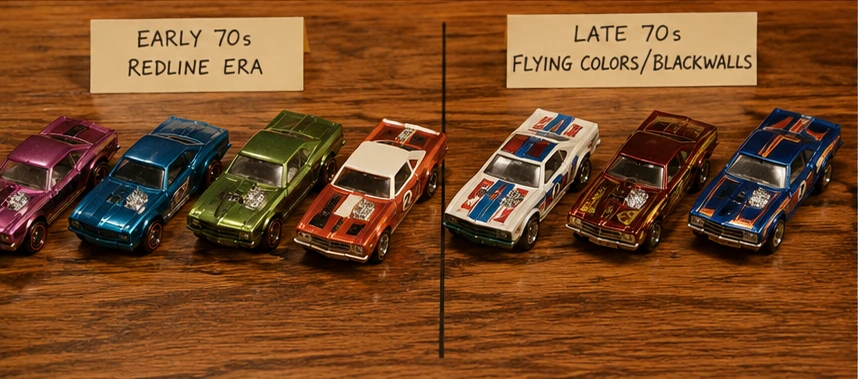
Flying Colors and Blackwall Hot Wheels Changed the Late-70s Look

Hot Wheels did not spend the entire decade looking like 1968. The brand changed its paint, graphics and wheels to stay visible in a crowded aisle.

Early metallic Redline-style cars displayed beside later graphic-covered blackwall toy cars
Flying Colors and blackwall wheels made the late-70s cars look different without changing the urge to race them.

The Spectraflame Formula Could Not Remain the Only Formula

The early translucent finishes and polished metal created a powerful first identity, but manufacturing, fashion and competition kept moving. By the early 70s, some cars appeared in more conventional enamel colors, and the line’s visual energy became less uniform. Collectors now find this transitional period fascinating because it reveals a brand trying to decide how much of the first-year magic could be carried forward.

Children experienced the change without the production context. Some cars looked jewel-like. Others looked solid and practical. In a mixed carrying case, the differences made the collection feel older and newer at the same time.

Flying Colors Put Graphics Where the Paint Had Been Doing the Work

The Flying Colors era emphasized stripes, numbers, flames and side decoration applied directly to the body. Instead of relying only on a deep single color, the car could communicate speed through printed graphics. The treatment looked closer to race-team liveries, custom vans and the bold visual language taking over the 1974 toy aisle.

Graphics also allowed an existing casting to return with a noticeably different identity. A child who already owned the model could still see the new version as a separate car. The decoration did not merely refresh the shelf. It refreshed the imagination attached to the casting.

Tampo Printing Changed Toy Cars Beyond Hot Wheels

Directly printed decoration became an industry expectation because it was durable, repeatable and visually strong. Stickers could peel, shift or be applied badly. Printed graphics arrived finished. They made tiny sponsor-like marks, stripes and numbers possible without asking the child to perform precision work at the kitchen table.

Hard play still wore the graphics away, especially on roof edges and door panels. The remaining fragments can now help identify a childhood car whose original design is otherwise difficult to remember.

Blackwall Wheels Marked the Late-70s Collection

When the red stripe disappeared, the wheel looked simpler and more contemporary. The change also reflected a toy line moving beyond the specific muscle-car tire cue that had helped define its beginning. Late-70s blackwall cars can look less exotic beside a bright early Redline, but they belong to the same continuous story.

For many Gen X kids, there was no clean boundary. Older cars came from siblings, garage sales and hand-me-down boxes. New blackwalls arrived from current store pegs. The race lineup became a decade-spanning fleet without anyone sorting it by era.

Realism and Fantasy Kept Trading Places

The later decade brought more realistic cars, trucks and service vehicles while Hot Wheels originals continued to protect the fantasy side. The brand could move toward everyday roads without becoming another miniature traffic line. A police car, van or pickup could share a case with Twin Mill and still make sense.

That balance became one of Hot Wheels’ long-term strengths. The line could follow automotive trends without surrendering the right to invent something impossible.

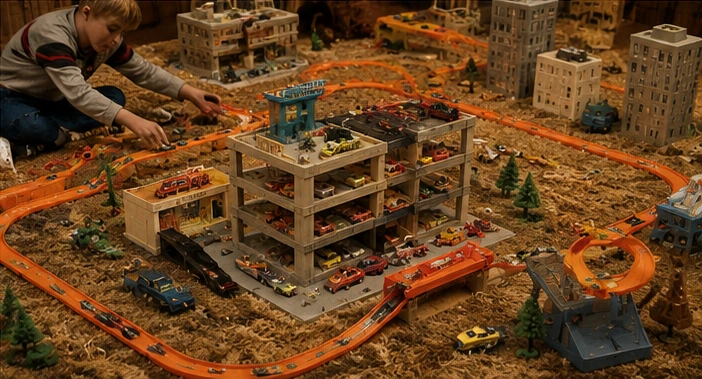
Carpet Cities, Tiny Roads and the Hot Wheels Transportation Department

Not every car stayed on official track. Most of them also had jobs.

A child building a sprawling carpet city with orange track, parking garages, buildings, service vehicles and race cars
Hot Wheels handled the racing while blocks, garages and mixed-brand vehicles handled the rest of the city.

Hot Wheels belonged inside the larger world of 70s toy cars, tracks and carpet-city play. The orange track handled formal racing, but the floor handled everything else: traffic, parking, crashes, towing, construction, police chases and municipal expansion.

Roads were created by carpet seams, rug patterns, masking tape, blocks and imagination. Furniture became geography. The couch was a mountain range. The coffee table was an elevated expressway. The gap beneath a chair was a tunnel with poor safety standards.

Mixed Brands Shared the Same City

Hot Wheels cars did not remain separated from Matchbox, Corgi, Tootsietoy or whatever else was in the bin. Scale differences were ignored unless they interfered with a garage door or track lane. A realistic Matchbox truck could tow a wild Hot Wheels fantasy car without anyone holding a zoning hearing.

That wider mixed-brand world is explored in our guide to 70s toy cars, tracks and carpet cities. Hot Wheels brought its own specialty to that traffic jam: speed, custom styling and a track system that could cross the entire room.

Garages Created Permanent Real Estate

Plastic service stations and parking garages gave cars somewhere to exist between races. Elevators, ramps, pumps and repair bays turned the collection into a city rather than a pile. Hot Wheels cars could be parked carefully by color or abandoned in a multi-level traffic disaster.

Carrying Cases Became Mobile Parking Structures

Wheel-shaped cases and divided trays promised organization. Each car had a space. The case could travel to a friend’s house, where the collection was compared, raced and occasionally returned with ownership questions.

Cases also preserved cars unevenly. A favorite racer might stay on the floor while the less-used models remained protected in individual compartments. Decades later, the “boring” stored car could be in better condition than the champion.

Hot Wheels Made Collecting Active

A stamp collection is viewed. A Hot Wheels collection was launched. The cars were visually satisfying in rows but difficult to leave there. The track always offered another test.

That balance explains the brand’s longevity. A child who liked organizing could sort by color, model or speed. A child who liked destruction could build a jump over a pile of vehicles. Both children needed more cars.

Allowance Money, Peg Hunting and the One-Car Decision

The collection usually grew one small blister package at a time.

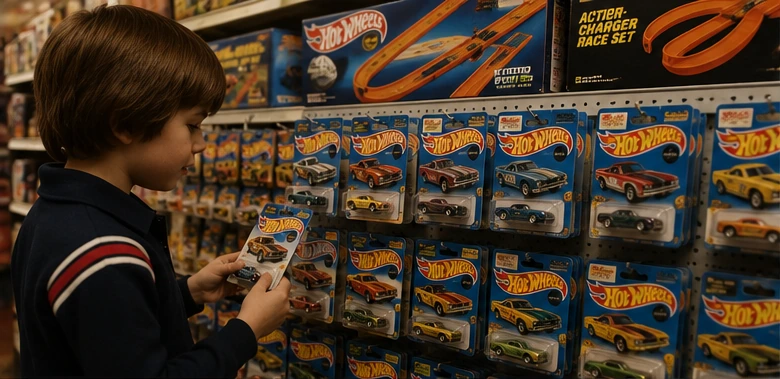
A child choosing among rows of carded toy cars in a 1970s department-store aisle
The difficult part was never finding a car worth buying. It was leaving the rest of the peg behind.

The Peg Display Made Comparison Immediate

Hot Wheels cars hung in rows where color and shape could be compared without opening anything. A child scanned for a new casting, a favorite model or the color nobody else owned. The decision was visual until memory joined in: Did this car clear the loop at a friend’s house? Was it already in the case? Had the commercial made it look unbeatable?

One Car Was Affordable Enough to Be Possible

The genius of the individual car was that it did not require a holiday. It could be purchased with saved allowance, included in an ordinary shopping trip or used as a reward. The large track set remained a birthday or Christmas event, but the collection could grow between those occasions.

Choosing One Meant Rejecting Several

A full peg created pressure. The wild fantasy car looked exciting. The familiar Camaro seemed safe. The strange color might never appear again. Children developed selection systems based on speed, appearance, rarity, ownership gaps and whatever another kid had claimed five minutes earlier.

Empty Pegs Created Rumors

If a particular casting disappeared, children assumed it was important. Store availability produced local rarity long before anyone had national production information. A car common elsewhere could become legendary in one neighborhood because nobody had seen it.

Trading Moved Cars Outside Retail

Once purchased, cars entered a secondary economy based on childhood value. A proven track winner could be worth two slow cars. A rare-looking color could overcome heavy paint wear. A car inherited from an older brother might be untouchable even if the wheels barely moved.

The Case Advertised Its Empty Spaces

A divided carrying case organized the collection and exposed the gaps. Each open compartment suggested another purchase. Filling the case created satisfaction until a larger case appeared.

Parents Saw Small Cars; Kids Saw a System

Adults could reasonably ask why another car was necessary. Children understood that the new model might be the fastest, complete a color group, fill the case, serve as the police car or finally beat the neighborhood champion. The explanation was detailed because the need felt real.

Hot Wheels vs. Matchbox in the 1970s: Speed Fantasy Meets Realism

The rivalry mattered because the brands asked children to notice different things.

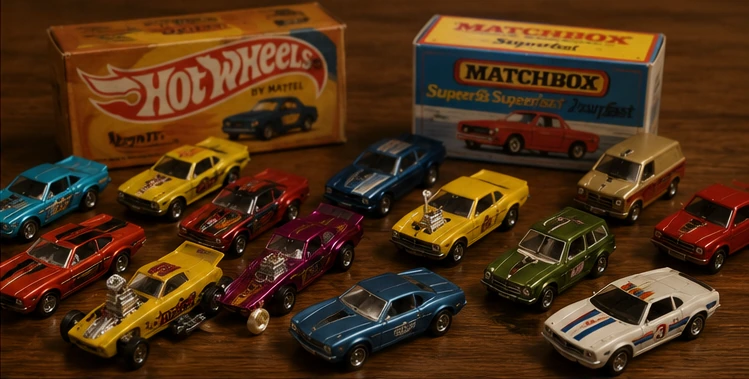
Bright custom racing cars displayed beside more realistic 1970s die-cast sedans and service vehicles
One side chased fantasy speed. The other side looked ready to report for work in the carpet city.

Matchbox Made the Street Recognizable

Matchbox built much of its reputation around detailed versions of vehicles children could see in the real world: delivery trucks, buses, construction equipment, family cars and emergency vehicles. The appeal often came from recognition and miniature realism. A child could recreate traffic, work sites and town life.

Hot Wheels Made the Street Faster Than Reality

Hot Wheels arrived with lower friction, custom styling, bright colors and dedicated racing track. Even its real-car castings looked modified for competition. The brand invited the child to ask which car would win, not only what job it performed.

The Toy Box Needed Both

In actual floor play, the rivalry was less strict than the marketing. A Matchbox fire engine could respond to a Hot Wheels crash. A realistic truck could tow a fantasy racer. Children mixed scale, brand and design because the city needed vehicles and the race needed obstacles.

During actual play, the rivalry was much less strict. A realistic fire engine could respond to a Hot Wheels crash, and a delivery truck could tow a fantasy racer. Kids mixed scale, brand and design because the city needed vehicles and the race needed obstacles.

Track Compatibility Created a Practical Difference

A car could look excellent and still perform badly on orange track. Width, wheel placement, weight and ground clearance determined whether a non-Hot Wheels vehicle fit the lane or survived a loop. Kids tested everything anyway.

The official Hot Wheels cars had been designed around the system, which gave the brand a home-field advantage. A competing car that won on Hot Wheels track earned unusual respect.

The Rivalry Taught Children to Evaluate Design

Without using adult vocabulary, kids compared realism, speed, detail, paint, wheel quality and role. One car was better for racing. Another was better for the construction site. Another looked best lined up on a shelf. The brands helped create miniature automotive critics before most children could identify the full-size models in a parking lot.

Hot Wheels Did Not Have to Win Every Category

The brand’s victory was not that every vehicle was more realistic or useful. It was that “fast toy car” became a category Hot Wheels visibly owned. The orange track made that claim measurable. Put the cars at the top, release them and settle the argument.

The Commercials Sold Speed, Noise and a House With Unlimited Track

Television made every set look larger, faster and more stable than the version in the family room.

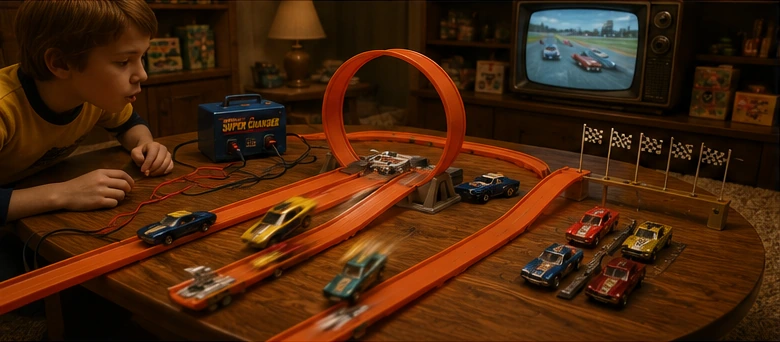
A child operating a dramatic orange-track race with a powered booster, loop and several moving cars beside a television
Television removed the bad connectors, weak batteries and retrieval time. The living room restored all three.

Hot Wheels commercials understood that a stationary product shot could not explain the appeal. The cars had to move. Track had to climb, loop and cross the frame. Launchers had to fire. Children had to react as if a national championship were unfolding between the couch and the television.

Camera angles placed the viewer near track level, making the cars look larger and faster. Editing removed retrieval, adjustment and the five minutes spent fixing one bad connector. The commercial showed the ideal run.

The Hand Was Part of the Action

Unlike action-figure commercials that tried to hide the operator, Hot Wheels ads could celebrate the hand launching the car or slamming the power control. The child was the race director and engineer.

Sound Made Plastic Feel Mechanical

Announcer voices, engine effects and collision noises gave the track more power than it produced in the room. At home, the booster whirred and the car rattled. The child supplied the rest.

Snake and Mongoose Added Real Footage

The drag-racing partnership allowed commercials to move between full-size cars and miniatures. That visual bridge made the toy feel connected to an adult world of professional speed. A track set could become the home version of something seen at a real strip.

The site’s 70s toy-commercial archive is the right place for the broader video collection. This product page uses the commercials as history without turning into a second video archive.

WHAT THE COMMERCIAL LEFT OUT

The connector that separated every third lap and the car that disappeared behind the refrigerator.

Catalog Pages and Christmas Lists Turned One Car Into an Entire System

The small package was affordable. The catalog showed everything required to make it feel incomplete.

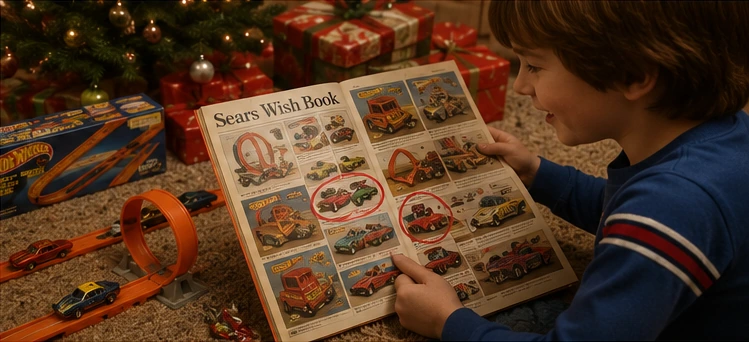
A child studying a Christmas Wish Book page filled with toy-car sets beside orange track and wrapped presents
The catalog showed one clean layout. Christmas morning supplied the real version with wrapping paper in every lane.

A single Hot Wheels car could become a small gift, allowance purchase or reward. Track sets, boosters, garages, cases and Sizzlers belonged to the larger boxes. The catalog placed all of them together, revealing how a pocket-sized car connected to a room-sized plan.

Children studying 70s toy catalogs and Sears Wish Books could compare set size, track length and apparent chaos. The photograph usually showed a clean layout with every piece supported and no furniture blocking the route. The house at home would have to adapt.

Christmas Supplied the Infrastructure

One or two cars could appear throughout the year. Christmas delivered the loop, race set, carrying case or powered accessory that changed what those cars could do. A large track box under the tree activated every vehicle already in the collection.

This made Hot Wheels a recurring presence among the hottest Christmas toys of the 70s. The brand did not depend on a single one-season craze. Mattel could sell new cars, new track configurations and new ways to create speed.

The Box Art Promised Architectural Stability

Catalog and package layouts showed loops standing, bridges aligned and cars remaining on the track. The child saw possibility. The parent saw floor coverage and batteries.

Once opened, the set became a household negotiation. Could the track remain across the doorway? Could the clamp stay attached to the table? Could the Super-Charger continue making that noise? These were not toy questions. They were zoning disputes.

Small Cars Made Easy Stocking Gifts

The individual package was part of the brilliance. A relative who could not buy the large set could add one car. That car still fit the existing track and collection. Every price point supported the same system.

The result was a toy line that grew by accumulation. One Christmas did not replace the previous Christmas. It expanded it.

Hot Wheels Through the 1970s: The Full Timeline

Ten years of changing wheels, paint, graphics, powered experiments and toy-aisle competition.

1970

Redline speed meets drag-racing theater

Snake and Mongoose sponsorship, early-decade Redlines and the arrival of rechargeable Sizzlers make Hot Wheels feel bigger than a toy-car line.

See 1970 toys
1971

The track system gets more ambitious

Sizzlers expand, Fat Track racing turns self-powered cars loose, and the regular orange track keeps climbing furniture.

See 1971 toys
1972

A quieter casting year becomes collector territory

Fewer new models and changing finishes make the early-70s transition more noticeable in hindsight.

See 1972 toys
1973

Hot Wheels experiments through the slowdown

The line shifts away from the first bright Spectraflame identity while motorized and oversized ideas keep the brand moving.

See 1973 toys
1974

Flying Colors brings the graphics back

Bold side decoration and tampo-style graphics give the cars a new shelf identity and help define the middle of the decade.

See 1974 toys
1975

Cars, motorcycles and track still share the aisle

Hot Wheels keeps broadening what can race while the decade’s vehicle obsession remains fully analog and floor-based.

See 1975 toys
1976

Sizzlers return for another charge

Sizzlers II keeps the battery-powered side of the brand alive while regular cars continue moving toward a new wheel era.

See 1976 toys
1977

The Redline look begins to leave

The classic red stripe disappears from the mainline wheels as the toy aisle itself starts changing around Hot Wheels.

See 1977 toys
1978

Blackwalls and late-70s realism take over

The cars still race, but the visual language shifts away from the earliest custom-car fantasy toward a broader vehicle mix.

See 1978 toys
1979

Hot Wheels survives the franchise and electronic rush

Even as action figures and electronic toys seize attention, die-cast cars and orange track remain permanent floor infrastructure.

See 1979 toys

Hot Wheels Through the 1970s: A Year-by-Year Rewind

The line did not stay frozen in its 1968 form. Wheels, paint, graphics, motors and the surrounding toy aisle all changed.

A chronological tabletop display of early Redline cars, Sizzlers, dragsters, Flying Colors and late-1970s blackwall vehicles
Across the decade, the wheels, graphics and power systems changed while the racing system kept expanding.

Each year placed Hot Wheels beside a different mix of Christmas hits, outdoor toys, action figures and electronics. The timeline below shows how the cars, wheels, graphics and powered racing systems changed from 1970 through 1979.

How Gen X Actually Played With Hot Wheels

We did not preserve the track geometry, original wheel alignment or investment potential.

The cars went into pockets, lunch boxes, carrying cases and outdoor dirt. They raced across concrete. They fell down stairs. They were launched beneath appliances and recovered months later covered in a type of household dust nobody wanted identified.

The Floor Was Never Level

Carpet slowed cars and created uneven support for track. Hardwood offered speed but allowed track sections to slide. Linoleum was excellent until the route crossed the kitchen and adults became involved.

Furniture Was Track Equipment

A dining chair provided height. A table edge accepted the clamp. Encyclopedias created slopes. Couch cushions softened landings until the jump began clearing the cushions entirely.

Cars Developed Personalities Through Performance

The fast car became the favorite even if its paint was damaged. The car that always left the loop became unreliable. The heavy truck became a blocker. The bent-wheel car became traffic.

No printed biography was required. Performance wrote the character.

Crashes Were Not Accidents

Track layouts often ended in a pile of parked cars because collision was the desired conclusion. The race car entered at full speed and the pile scattered. Cleanup became another run.

Outdoor Play Changed the Condition Permanently

Concrete scratched paint and damaged wheels. Dirt entered axles. Sand created resistance. Water added no useful feature and still appeared. A car that went outside returned with evidence.

Trading Created Local Value Systems

One child valued rarity. Another valued color. Another wanted the proven fastest car. Trades were negotiated without a price guide and remembered with regret.

The Collection Was Never Really Finished

Even a large case had empty slots. New colors appeared. A friend owned a casting nobody else had seen. A commercial revealed another track set. Hot Wheels made expansion feel normal.

Collecting Vintage 1970s Hot Wheels Without Turning Every Scratch Into a Crisis

The collector sees production details. The Gen X kid sees the car that beat everything else on the block.

Vintage Hot Wheels collecting can become extremely detailed because small differences matter. A model name alone is not enough. The casting, paint color, interior, glass, wheels, base, production country, package and condition can all affect identification and demand.

Start With the Base

The underside often provides the model name, copyright information, production origin and construction clues. It is the best first step when childhood memory supplies only “the purple one with the engine.”

Check the Wheels and Axles

Wheel style helps place a car within an era. Redline wheels, transitional designs and later blackwalls can separate versions that look similar from above. Bent axles, wheel rub and replaced wheels affect both performance and collector interest.

Study the Paint, Not Just the Color Name

Early translucent finishes can vary because of production and aging. Lighting changes the appearance. Repainted cars may look unusually perfect or show paint where factory assembly would not have placed it.

Look for Original Parts

Openings, hoods, surfboards, engines, caps and other removable or vulnerable pieces are frequently missing. Reproduction components can make a display look complete but should not be represented as original.

Packaging Is a Separate Condition Universe

A sealed blister card includes questions about cardback version, bubble clarity, cracks, edge wear, punched tabs and authenticity. Most children destroyed the package immediately, which is why surviving packaging carries its own premium.

Do Not Assume Every Pink Car Is the Jackpot

Some colors are rarer on specific castings, but internet folklore turns every unusual shade into a fortune. Exact identification and comparable verified sales matter. A dramatic asking price is not evidence of value.

Restoration Has a Place When It Is Disclosed

A damaged childhood car can be restored for display or personal enjoyment. The problem begins when restored paint, replacement wheels or reproduction parts are presented as factory original.

Play Wear Is Not a Moral Failure

A chipped car may have little collector-grade value and enormous personal value. The damage proves the toy completed its first job.

Broad “old toys worth money” lists tend to flatten the details that actually matter. A useful valuation starts with the exact casting, color, wheels, base, condition and verified sold examples—not a dramatic asking price attached to a similar car.

What Hot Wheels Changed About Toy Cars

The brand made performance, customization and expandable track feel like basic requirements.

Hot Wheels did not invent the die-cast toy car. It changed what children expected the car to do. Speed became part of the product identity. Track became part of the collecting system. Fantasy designs could sit beside production models without weakening the brand.

That impact is why Hot Wheels ranks among the most iconic toys of the 70s. It served multiple kinds of play at once: collecting, racing, engineering, crashing, sorting, trading and city building.

The Car and Track Sold Each Other

A new car gave the track another competitor. A new track set gave every old car another purpose. This reciprocal system created repeat purchases without making earlier purchases obsolete.

Fantasy Became an Automotive Category

Hot Wheels originals such as Twin Mill proved a toy-car brand could invent its own automotive mythology. The line did not have to depend entirely on licensed real vehicles.

Performance Became Collectible

Children did not only collect appearance. They collected behavior. The fast car, loop car and jump car could be different models. A collection became a team with specialized roles.

The Orange Track Became a Brand Without Needing a Logo

A single strip across a room was enough to identify the toy system. That visual ownership is rare. The track was infrastructure and advertising at the same time.

Hot Wheels Survived the Late-70s Toy-Aisle Shift

By the end of the 1970s, action figures, movie franchises and electronic toys were changing childhood. Hot Wheels did not disappear because the core play was still immediate. A car, a slope and a target required no screen, story license or instruction manual.

The 70s Toys hub shows the full decade transition, but Hot Wheels remains one of its clearest constants. The exact models changed. The urge to build a longer track did not.

Frequently Asked Questions About 1970s Hot Wheels

The wheels, paint names, track pieces and powered sub-lines can get complicated. Here are the direct answers.

When did Hot Wheels first come out?

Mattel launched Hot Wheels in 1968 with a group now commonly called the Original 16. The 1970s were the first full decade in which the cars, orange track and expanding sub-lines became a permanent part of childhood.

What are Redline Hot Wheels?

Collectors use Redline for the early cars whose wheels carried a thin red stripe around the tire. The classic Redline era generally runs from 1968 through 1977, although wheel and casting details changed during that span.

Why were early Hot Wheels faster than other toy cars?

The cars combined free-rolling wheel assemblies, hard low-friction tires and track designed around speed. The result was a car that could carry momentum through long downhill runs, launchers and loops.

Why was Hot Wheels track orange?

The bright orange plastic made the track instantly recognizable and highly visible across floors and furniture. It also unified separate track pieces, curves, loops and launchers into one system.

What was the Hot Wheels Super-Charger?

The Super-Charger used spinning wheels to grab a passing car and fire it back onto the track. It allowed a layout to keep cars moving instead of depending only on gravity.

What were Hot Wheels Sizzlers?

Sizzlers were rechargeable, motorized Hot Wheels cars introduced at the beginning of the 1970s. They carried a small internal battery, were charged with accessories such as the Juice Machine, and could drive around track under their own power.

Did Sizzlers use regular orange track?

Early Sizzlers could run on orange track, while later race systems such as Fat Track gave the powered cars wider lanes, banked turns and room to pass one another.

What were Snake and Mongoose Hot Wheels?

They were cars and track sets tied to drag racers Don “the Snake” Prudhomme and Tom “the Mongoose” McEwen. Mattel’s 1970 sponsorship connected the toy line to real drag racing and helped turn both drivers into household names among children.

What does Spectraflame mean on vintage Hot Wheels?

Spectraflame refers to the bright translucent finish used over polished metal on many early Hot Wheels. It created deep candy-like colors that looked especially dramatic under store lights.

What was Hot Wheels Flying Colors?

Flying Colors was a mid-1970s line that emphasized bold printed graphics and side decoration. It helped refresh the visual identity after the earliest Spectraflame period.

Are all old Hot Wheels valuable?

No. Value depends on the exact casting, color, production variation, condition, wheel type, base, country of manufacture and packaging. A well-played common car is not equivalent to a rare color or documented early variation.

Were Sizzlers part of the main Hot Wheels line?

Yes. Sizzlers were Mattel’s rechargeable, motorized branch of Hot Wheels. They used charging accessories and specialized race systems such as Fat Track, but they extended the same speed-and-track idea as the regular cars.

Get the Weekly Gen X Drop

New videos, rewinds, and savage nostalgia — first.

SUBSCRIBE WATCH VIDEOS

MORE REWINDS