Kenner Star Wars Toys of the 70s: The Figures That Changed the Toy Aisle

Kenner Star Wars Toys of the 70s: The Figures That Changed the Toy Aisle

Smells Like Gen X • A Galaxy Arrives on the Carpet

Kenner Star Wars Toys of the 70s The Figures That Changed the Toy Aisle

It started with an empty box, four promised figures and a mailbox we checked like national security depended on it. Two years later, Kenner had given us the Original 12, X-wings, TIE Fighters, a Death Star, the Millennium Falcon, cantina aliens, droid parts and a bounty hunter whose rocket never fired. The toy aisle was never the same.

Kenner Star Wars Toys of the 1970s: The Quick Answer

Kenner Star Wars toys were the 3¾-inch action figures, vehicles and playsets that carried the 1977 movie out of theaters and onto Gen X carpet. The Early Bird Certificate Package launched at Christmas 1977; the Original 12 arrived in 1978; and by 1979 the line included the Millennium Falcon, Death Star playsets, cantina aliens, droids and Boba Fett. They became one of the most iconic toy lines of the 70s.

ManufacturerKenner Products, Cincinnati
First saleEarly Bird package, Christmas 1977
Figure scaleApproximately 3¾ inches
1970s arcPromise → figures → full galaxy

Kenner Bet on a Movie Nobody Knew How to Merchandise

The toy line looks inevitable now. In 1976 and early 1977, it was a licensing gamble attached to a strange space movie full of used machinery, masked villains and robots that did not look like friendly robots.

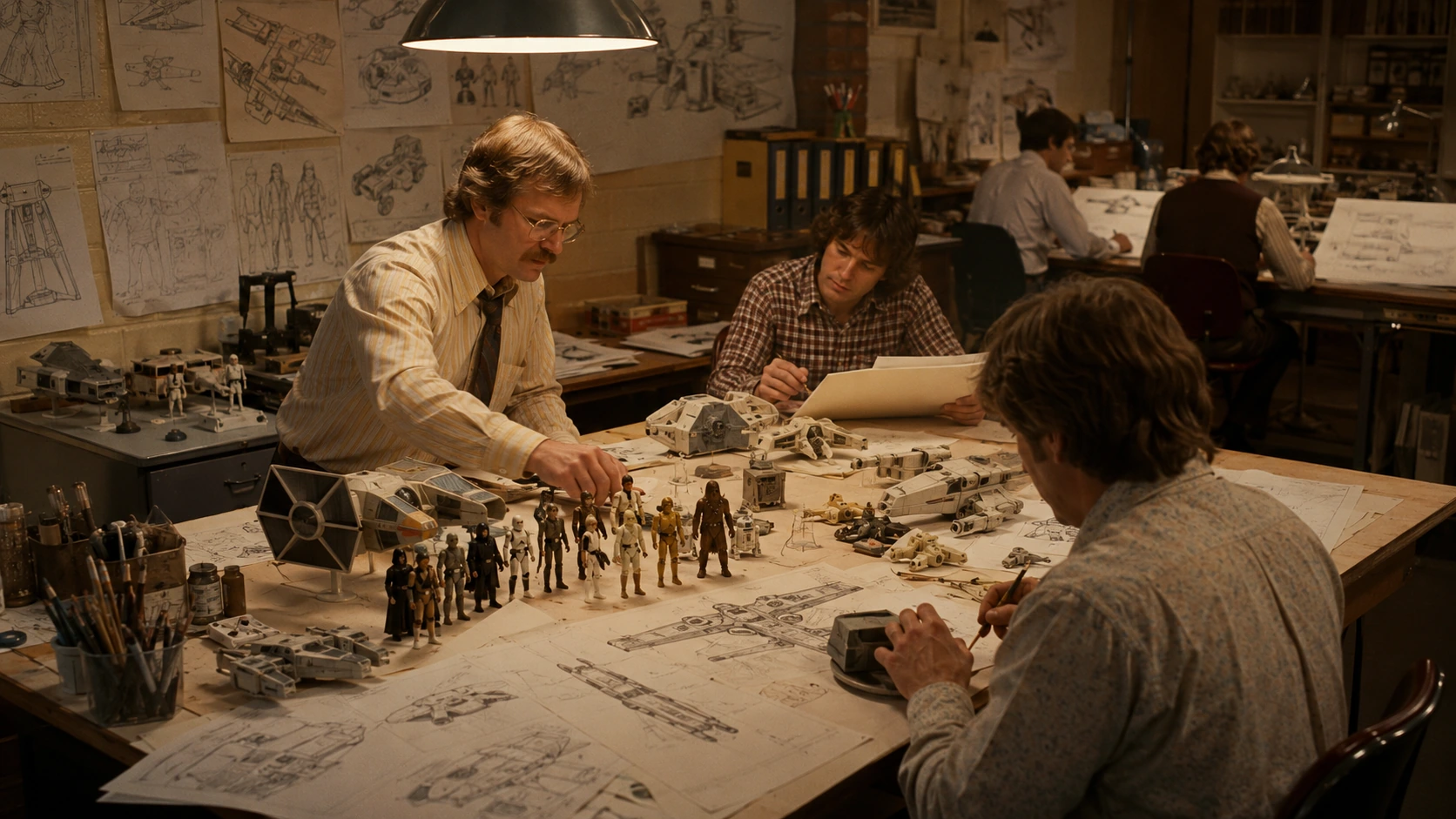
Late-1970s toy designers working around small action-figure prototypes, spacecraft models and hand-drawn engineering plans
The small figure scale only worked because characters, cockpits, ships and playsets were designed as one connected system.

Kenner was a Cincinnati toy company known for products that usually had a clear action feature or a simple reason to exist. Star Wars was not simple. It had dozens of characters, unfamiliar vehicles, alien locations and a story that moved between desert farms, space battles, prison corridors and a bar full of creatures. The obvious toy was not one item. The obvious toy was the whole movie, and nobody had a practical way to put that under a Christmas tree in 1977.

The movie also did not resemble the polished science-fiction future adults expected. The ships were dirty. The droids were dented. The heroes wore plain clothes. The villain looked like a black machine. That visual world turned out to be perfect for toys because every object had a silhouette a kid could recognize. The X-wing, TIE Fighter, landspeeder, Falcon, R2-D2, Vader and Stormtrooper could be identified from across the room.

Kenner’s key decision was not merely to make figures. It was to choose a scale that allowed the figures to live inside the machinery. Larger cloth-costumed figures could have looked impressive on a shelf, but they would have made the X-wing enormous and the Falcon impossible. The smaller scale let the company approach Star Wars as a system instead of a souvenir.

The Movie Supplied More Characters Than Any Kid Could Own at Once

That was a feature, not a problem. Older action lines often offered one hero with uniforms and equipment or a manageable group of famous characters. Star Wars offered a crowd. A kid could start with Luke and Vader, then realize the droids were needed, then discover the cantina aliens, then decide the Stormtrooper needed backup. The movie kept revealing gaps in the collection.

Kenner did not need every character to speak. A distinctive helmet, head or costume could carry a figure. That helped turn the background of the film into merchandise and made the line feel larger than the story most kids could remember from one theater viewing. We did not have home video. The figures became memory aids. Greedo, Hammerhead and the droids helped reconstruct scenes we could not replay on demand.

The Delay Forced Kenner to Invent a Better Launch Story

If the figures had been ready in summer 1977, the Early Bird package would never have existed. The manufacturing delay created one of the most memorable toy launches of the decade. Kenner turned absence into anticipation, and anticipation made the eventual arrival of those first four figures feel personal. They did not simply appear on a peg. They arrived because a child had mailed a certificate and waited.

That history matters because the line did not enter childhood as a normal retail rollout. It entered as a promise connected directly to the movie’s surprise success. The toys always carried a little of that feeling: the sense that the galaxy was expanding faster than the shelves could hold it.

Christmas 1977: The Star Wars Toy That Was Mostly a Promise

The most important Star Wars toy of 1977 was not a figure. It was the right to wait for one.

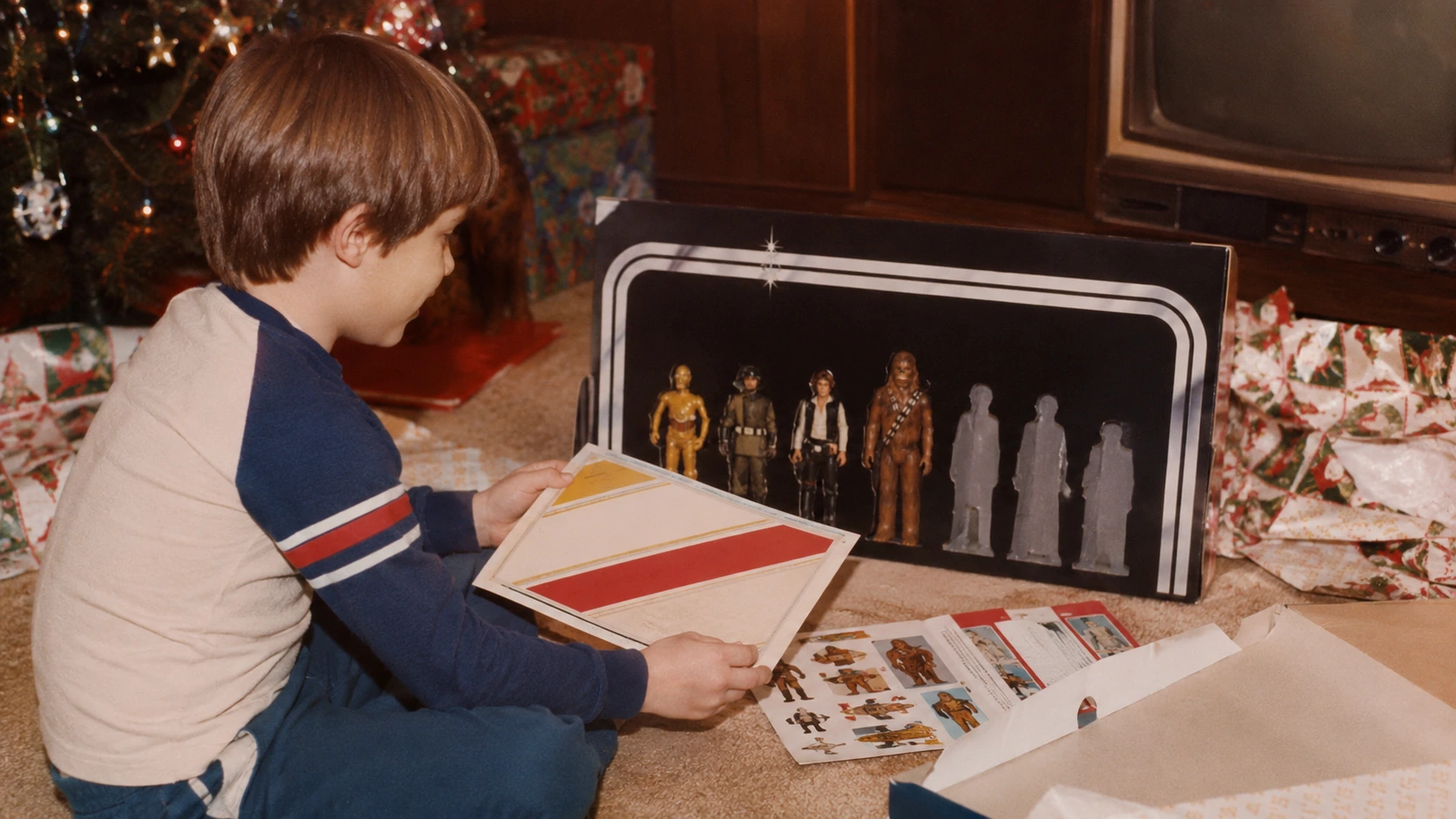
A child on Christmas morning examining an Early Bird-style display stand, paperwork and the first promised space figures
Christmas 1977 delivered cardboard, paperwork and a promise that the figures were coming.
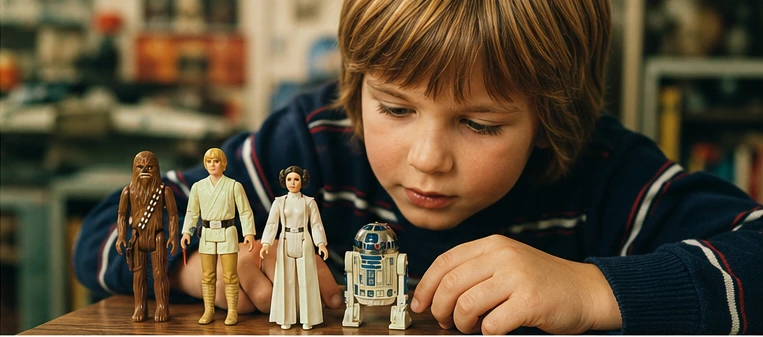
A child arranging the four Early Bird figures—Luke, Leia, Chewbacca and R2-D2—on a tabletop
The first four figures were enough to make the cardboard display stand feel like the beginning of something enormous.
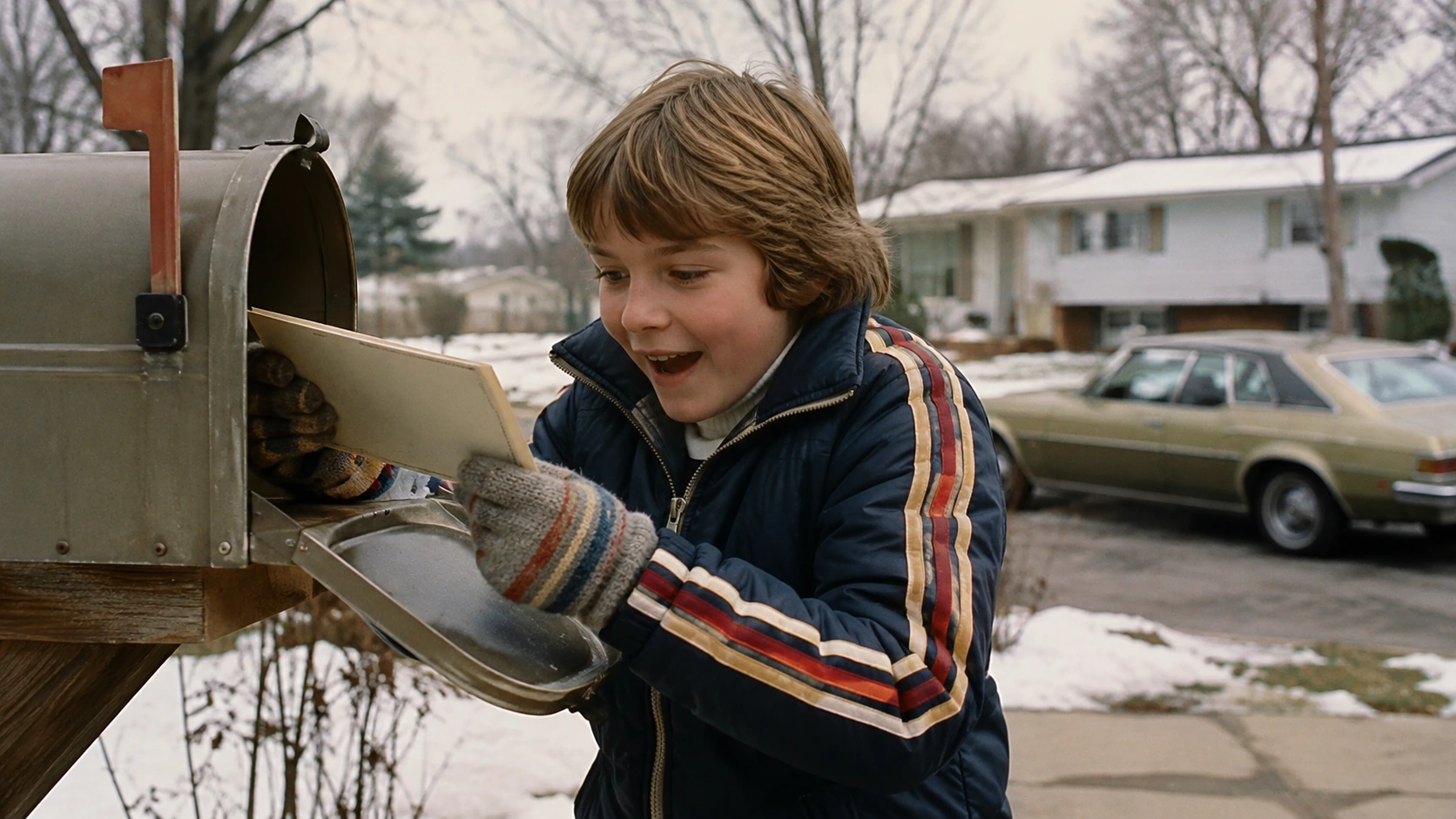
Excited child checking a suburban mailbox in winter while waiting for mail-away action figures
There was no tracking page—just the mailbox, cold fingers and the certainty that today might finally be the day.

The strangest thing about the toy line that changed everything is that it began with almost nothing in the box. Star Wars arrived in theaters in May 1977 and moved faster than the toy industry could. Kids came out of the movie wanting Luke, Leia, Vader, droids, stormtroopers, X-wings and the Millennium Falcon immediately. Kenner had the license, but tooling figures, sculpting heads, designing accessories, building molds and manufacturing inventory did not happen at hyperspace speed.

That left Kenner staring at Christmas with enormous demand and no finished action figures to put under the tree. The answer was the Early Bird Certificate Package, a retail product that was part pre-order, part fan-club kit and part beautifully decorated promise. Families bought the package in stores. Inside were a cardboard display stand with spaces for the coming figures, stickers, a club card and the certificate that had to be mailed to Kenner. The actual figures—Luke Skywalker, Princess Leia, Chewbacca and R2-D2—would arrive later.

To an adult, it looked suspiciously like paying for an empty box. To a kid caught in the Star Wars blast radius, it was proof that the galaxy was coming. The wait became part of the story. You mailed the certificate, trusted the process and watched the mailbox. There was no tracking number, no delivery update and no online complaint form. There was only hope, patience and a parent telling you the package would get there when it got there.

THE GEN X VERSION OF A PRE-ORDER

You got cardboard, stickers and a promise. Then you waited long enough to memorize the display stand.

The Early Bird package also solved a problem bigger than Christmas inventory. It gave Kenner time while turning the delay into an event. Instead of allowing another holiday season to pass with no action figures, the company made anticipation a product. That trick would become normal decades later. In 1977, it felt completely strange—and somehow completely right for a movie about a galaxy nobody had seen before.

The Figures Barely Looked Like the Actors—and We Knew Exactly Who They Were

Kenner did not need modern face scanning. A hairstyle, costume, color and one good silhouette carried the character.

The human likenesses were approximate. Han Solo looked like a plastic cousin of Harrison Ford. Luke’s yellow hair could overpower the face. Leia’s features were tiny beneath the sculpted hairstyle. Obi-Wan looked old in the broadest possible sense. None of this caused identity confusion because the movie had already taught us what to see.

The costumes did most of the work. Luke had the light tunic and boots. Han had the vest and dark pants. Leia wore white. Obi-Wan had gray hair and a cape. Color blocking mattered more than facial accuracy, especially when the figure was moving through a room at the end of a child’s arm.

Masks and Droids Were Easier to Translate

Darth Vader, Stormtroopers, C-3PO and R2-D2 benefited from designs already built around strong shapes. Vader’s helmet and cape made the figure recognizable in shadow. The Stormtrooper armor became a crisp white outline. C-3PO’s gold plastic advertised him from across the aisle, while R2-D2’s dome and cylindrical body looked like a toy design before Kenner changed anything.

Those characters also aged well as toys because there was no human face to compare. A simple mechanical body could remain “right” even when the details were reduced. The droids proved that a figure did not need traditional arms, legs or clothing to belong in the same action line.

Aliens Sold Through One Memorable Feature

Hammerhead needed the long sideways head. Greedo needed the green insect-like face. Walrus Man needed the tusks. Snaggletooth needed the red suit and strange mouth. Kenner could simplify the bodies because the head carried the sale.

This created one of the line’s great strengths: visual variety. A row of Star Wars figures did not look like the same body wearing different costumes. Heights, heads, robes, droid shapes and creature features made the collection look like a crowd from another world.

Five Points of Movement Were Enough Because the Vehicle Did the Rest

The basic figures could turn their heads, raise their arms and move at the hips. They could stand, hold a weapon and sit with both legs straight out. They could not kneel, crouch, aim naturally or cross their arms. Vehicle interiors and playset stations were designed around those limitations.

That stiffness made the hands more important. A kid tilted the figure to suggest running, leaned it behind a wall for cover and bounced it across the floor to simulate walking. The body was not performing the action. It was giving the imagination a solid object to move through the action.

Paint Differences Turned Ordinary Figures Into Individuals

Small production changes, factory differences and paint applications created variations collectors would later document carefully. As children, we noticed simpler things: one Luke had lighter hair, one Stormtrooper’s helmet looked sharper, or a friend’s Han seemed different from ours. A replacement figure never felt completely identical once a child had memorized the old one.

The modest detail also invited projection. The face was specific enough to name and plain enough to carry whatever emotion the scene required. Han could look annoyed, brave or terrified because the kid supplied the expression.

The Original 12 Kenner Star Wars Figures

These were the first complete cast Kenner put in front of kids in 1978. Some were obvious stars. Others became important because the back of the card told us they belonged.

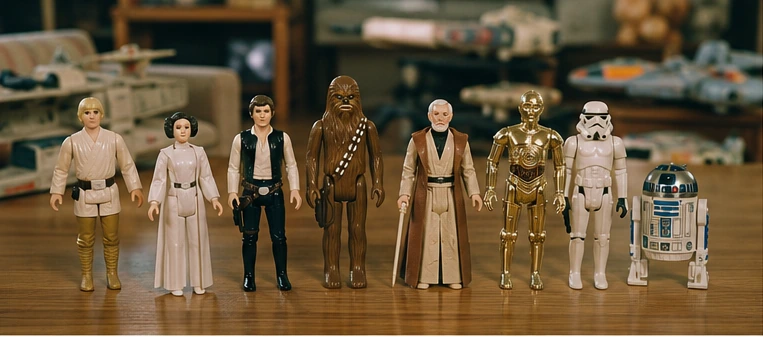
The original group of twelve late-1970s space action figures arranged together on a wood table
The Original 12 turned the movie’s heroes, villains, droids and desert creatures into a collection with a visible finish line.
1

Luke Skywalker

The farm boy with the yellow hair and the telescoping lightsaber became the figure most likely to be shoved into every cockpit, landspeeder and cardboard base in the house. Luke was the kid’s entry point because he was still figuring the galaxy out, just like we were. Even when the saber tip bent, disappeared or refused to slide the way the commercial suggested, Luke remained the figure who had to be there. Without him, the story felt like a pile of parts waiting for a main character.

2

Princess Leia Organa

Leia was small, stiff and far tougher than the delicate white gown suggested. She held the blaster, issued the orders and usually ended up running the rescue operation after the boys made a mess of it. The vinyl cape and narrow stance did not give her much room for dramatic posing, but kids supplied the missing movement. She fit the cockpit, the Death Star and the homemade rebel base, and she gave the line a hero who was never waiting around to be saved.

3

Han Solo

Han arrived with a blaster, a vest and the permanent look of somebody who had already heard your plan and did not like it. He was the figure for kids who wanted the cool job: pilot, smuggler, wise guy and reluctant hero all at once. Put him near the Falcon and he belonged there. Put him in the cantina and the argument had already started. His early figure did not look exactly like Harrison Ford, but that hardly mattered once the ship noises began.

4

Chewbacca

Chewbacca felt substantial compared with the human figures, and that alone made him useful. He could be co-pilot, bodyguard, monster, prisoner or the force that knocked an Imperial figure off the coffee-table edge. The bowcaster was small enough to disappear into carpet forever, but the molded bandolier meant Chewie still looked ready without it. He was one of the four Early Bird figures, which made him part of the line before most kids had ever seen a Star Wars toy on a peg.

5

Obi-Wan Kenobi

Obi-Wan had the vinyl cape, the gray hair and the same telescoping-saber trick that made Luke and Vader feel more advanced than the average little plastic figure. To a kid, he was not just the old mentor. He was the figure who could explain anything the story needed explained and then vanish behind the couch because the plot demanded it—or because nobody could remember where he had been set down. His cape usually outlasted his lightsaber tip, though neither was guaranteed.

6

C-3PO

C-3PO looked like he had been cast from a gold Christmas ornament and then told to stand perfectly still. His limited pose was almost a feature because he looked nervous no matter where you placed him. He complained in the movie, so a kid could make him complain about everything: the Falcon’s landing, the droid factory, the sandbox, the dog, or being packed into a vehicle with six figures that did not belong there. He was bright, strange and instantly recognizable.

7

R2-D2

R2-D2 was one of the cleverest little toys in the original group because the click in his rotating dome felt like machinery, not just a head turning. The sticker around his body did most of the visual work, and once it began peeling or yellowing, the droid looked like he had survived a real rebellion. R2 fit almost anywhere, and kids treated him like a key that unlocked the whole line. He belonged in the X-wing, the Death Star, the droid sale and every improvised mission.

8

Darth Vader

Vader had presence even at three and three-quarter inches. The black cape spread wider than the body, the helmet silhouette did the rest, and the red telescoping lightsaber gave him a built-in threat before he moved an inch. Every collection needed a villain, and Vader could command one Stormtrooper or an army made from every white figure in the neighborhood. The cape tore, the saber bent, and the helmet shape was simple, but the figure still owned the room.

9

Stormtrooper

One Stormtrooper was a character. Two were a patrol. Four were an Imperial force, which is why duplicates suddenly made sense in a way they had not with most older action figures. The figure’s white plastic showed every scuff, and the tiny black blaster was practically designed to disappear, but a Stormtrooper without a weapon was still useful. He could guard the hallway, fall from a couch cushion, miss every shot and return five minutes later as somebody else.

10

Death Squad Commander

The black-uniformed commander was one of those figures that kids did not always name correctly but used constantly. He could be a Death Star officer, a starship captain, a prison guard or the serious Imperial adult left to clean up Vader’s latest mess. The helmet and compact blaster made him feel more specialized than the average bad guy. Later naming changes would turn him into the Star Destroyer Commander, but on the carpet he was simply the officer in charge.

11

Sand People

The Sand People figure looked dangerous because nearly every detail was molded into the head and robes. The gaffi stick gave it a silhouette no other toy in the first wave had. Kids called the character a Tusken Raider, a Sand Person or just the desert guy, depending on what the package, comic or older sibling had said. It could ambush Luke, stalk the Jawas or wander into an entirely unrelated playset and immediately make the scene more threatening.

12

Jawa

The Jawa was tiny, mysterious and expensive-looking despite using less plastic than almost anything else on the peg. The earliest vinyl-cape version would later become a collector obsession, but most kids knew the cloth-cape figure—the little hooded scavenger who belonged near droids, the sandcrawler and whatever loose electronic-looking parts were lying around. Jawas made losing pieces part of the story. If R2’s accessory vanished, clearly the Jawas had taken it.

The Next Eight Figures Made the Galaxy Feel Crowded

The jump from 12 to 20 figures mattered because Kenner started turning pilots, droids and cantina oddballs into must-haves. The line was no longer just the poster cast.

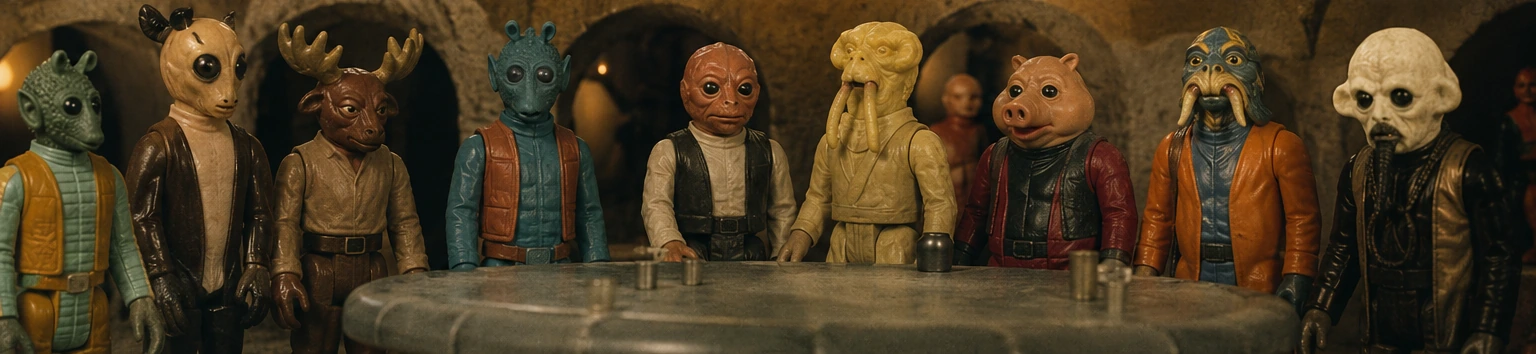
A lineup of strange late-1970s cantina alien action figures posed inside a dim toy bar environment
Once the cantina aliens arrived, background characters stopped being background.

Luke Skywalker in X-Wing gear

The orange flight suit made the figure feel tied to a vehicle even when the X-wing was nowhere nearby.

Greedo

Green head, orange jumpsuit and a blaster: the cantina suddenly had a recognizable troublemaker.

Hammerhead

A bizarre head and plain blue outfit proved Kenner did not need a speaking role to sell a memorable alien.

Walrus Man

The name on the card was not the name kids use now, but the orange suit and tusked face made him impossible to ignore.

Snaggletooth

The red version was common; the taller blue version from the Sears cantina set became one of the line’s great variations.

Death Star Droid

Shiny, stiff and strange, it looked like a droid built for a place where nothing friendly happened.

Power Droid

The walking box with feet may not have been glamorous, but it made the background of the galaxy feel collectible.

R5-D4

The red-and-white droid lasted only a moment on screen and still earned a place beside R2 in thousands of toy rooms.

Background Characters Became Main Events

Greedo had a short scene and still became essential. Hammerhead barely needed a name because the head sold the figure. Power Droid looked like a walking appliance, which somehow made it more convincing as a piece of the galaxy. Kenner taught kids that the background was collectible.

This expansion also improved the cantina. The first 12 could recreate the escape, the droid sale and Death Star battles. The next eight supplied the weird crowd. Once those aliens arrived, the Creature Cantina was not just a cardboard environment. It was a reason to own figures that would have been ignored in almost any earlier movie line.

Why 3¾ Inches Changed the Entire Toy Aisle

The figure was small enough to make the ships possible—and big enough to carry the whole movie.

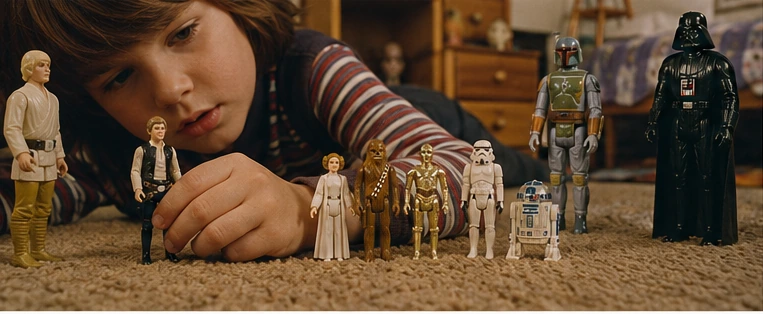
A child comparing small three-and-three-quarter-inch space figures during floor play
The smaller scale did not shrink the story—it made the vehicles, armies and entire world possible.

Before Kenner’s Star Wars line, the action-figure aisle was dominated by larger bodies: 12-inch adventurers, eight-inch cloth-costumed heroes, dolls, stunt figures and muscular characters with enough plastic to feel substantial in both hands. Kenner went smaller. The figures were roughly three and three-quarter inches tall, commonly built with five basic points of movement: neck, shoulders and hips.

At first glance, smaller could look cheaper. On the floor, it became freedom. A small Luke fit inside an X-wing. Han and Chewie could sit in the Falcon. Several Stormtroopers could crowd a Death Star corridor. A kid could carry a squad in a pocket or line the whole collection along a windowsill. The size did not reduce the world. It made the world affordable enough to grow.

The scale also changed the balance between character and environment. A 12-inch figure demanded attention. A 3¾-inch figure demanded a vehicle, an enemy and somewhere to go. Kenner could sell the cast, then sell the ship, then sell the place where the ship landed. That was the real breakthrough. The figure was no longer the whole toy. It was the key that unlocked the rest of the shelf.

Smaller figures also made duplicates useful. Nobody needed three identical six-million-dollar men. Three Stormtroopers were an army beginning to happen. Two Jawas were a scavenger crew. Multiple pilots filled a rebel hangar. The movies supplied a populated galaxy, and the scale made collecting that population seem possible one blister card at a time.

12-Back, 20-Back and 21-Back: The Package Kept Moving the Finish Line

Collectors use the cardback numbers as categories now. Kids experienced them as evidence that the collection was suddenly incomplete again.

The earliest retail cards showed the Original 12 on the back. That grid looked finite. You could count the figures, compare the pictures with what you owned and imagine reaching the end. The package made the toy line feel like a set instead of a random assortment.

Then the back changed. New figures appeared, the grid grew and the phrase “collect them all” became less like a suggestion and more like a recurring condition. The 20-back cards introduced the next wave of pilots, aliens and droids. The 21-back added Boba Fett and attached the mystery of the mail-away promotion to the ordinary act of buying another figure.

The cardbacks also helped children learn names the movie did not clearly provide. “Walrus Man” and “Hammerhead” were toy-aisle names designed to make instantly recognizable creatures sellable. The labels were blunt, memorable and good enough for the carpet. Decades later, fans would use different character names, but Gen X still remembers the names printed on the cards.

Opening the Package Was the Point

Most children did not preserve cardbacks. The bubble was pulled away, the cardboard bent, the figure came out and the package went into the trash. The weapon might be taped beside the figure or tucked into the bubble, and the first job was getting everything free without losing the smallest piece before play even began.

That destructive opening is why surviving carded examples feel almost unnatural to anyone who lived through the period. The package was a barrier between the kid and the character. Nobody stood in the toy aisle thinking about archival storage. The figure had a mission scheduled for that afternoon.

The Artwork Did Half the Storytelling

The large movie photograph on the front made the simple figure feel connected to a richer screen world. The sculpt might only vaguely resemble the actor, but the package supplied the correct face, costume, lighting and emotion. Once the figure was removed, the child carried that association forward.

The packaging also created visual unity. A Jawa, droid, princess and masked villain looked like pieces of the same line because the black card, logo, photo and bubble framed them consistently. Kenner could sell wildly different body shapes without making the shelf look disorganized. The brand did the grouping before the toy box mixed everything together again.

The Cardback Quietly Taught Us to Collect Them All

The checklist on the back may have done more long-term damage to our allowances than the commercial.

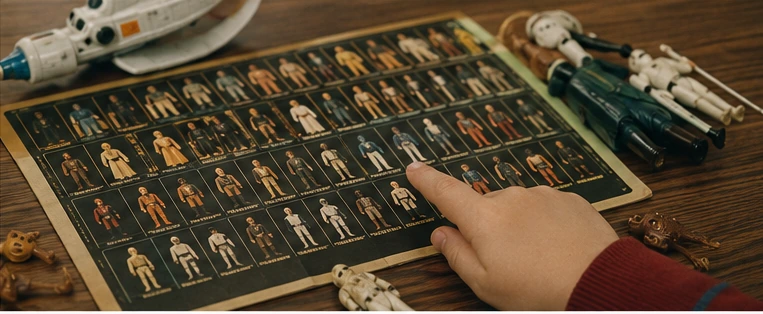
A child pointing at a large action-figure checklist while loose figures and spacecraft sit around the table
The front sold one figure. The back showed every empty space still waiting in the collection.

The front of the package sold the figure in your hand. The back sold every figure you did not have yet. That cardback gallery may have been one of the most powerful pieces of toy marketing ever placed in a grocery-store checkout bag. There they were: the heroes, villains, droids and aliens in a tidy grid, each one making the empty spot in your collection painfully obvious.

Kids studied those pictures like evidence. You learned which figures existed, which ones your store never seemed to have and which character somebody at school claimed to own. The cardback gave the line a visible boundary—first 12, then 20, then 21—and that boundary made completion feel achievable. Of course, the boundary kept moving. That was the trick.

Older toy lines offered outfits, vehicles or accessories. Kenner offered a cast. The cardback transformed background characters into objectives. A droid that crossed the screen for seconds became something you recognized by name because its picture was printed beside Darth Vader. The checklist turned the movie’s visual density into a shopping mission, and the carrying cases with labeled spaces carried the idea even further: every figure had a home, which meant every empty home needed filling.

The Blasters, Capes and Tiny Pieces Everybody Lost

A loose vintage figure tells two stories: the character Kenner sold and the pieces childhood removed.

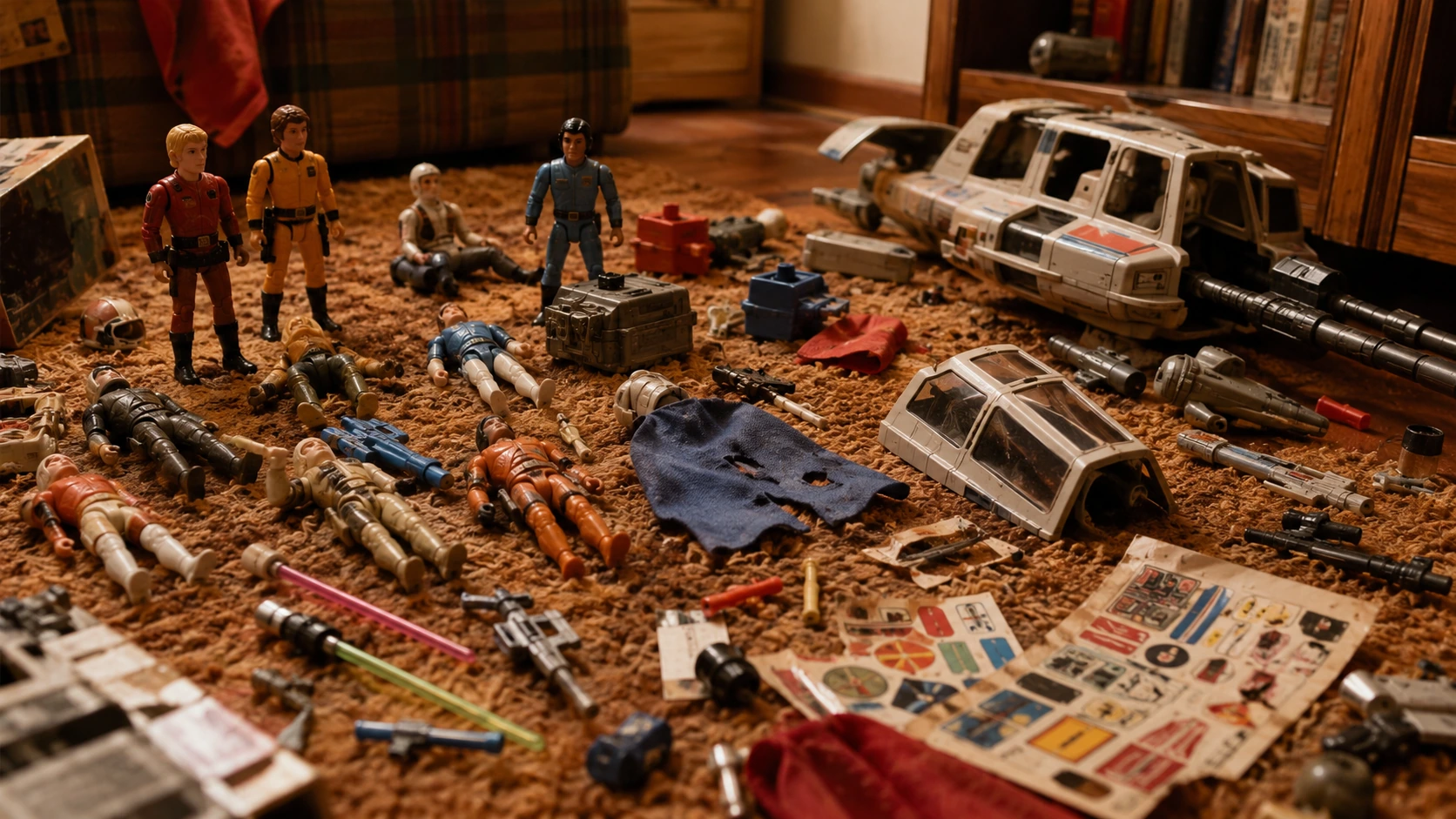
Well-played vintage action figures surrounded by tiny blasters, capes, lightsabers, decals and loose vehicle parts on shag carpet
The figure survived. The blaster, cape, cockpit piece and one important sticker usually had other plans.

The weapons were small because the figures were small. That was logical in the design room and reckless in a house with brown shag carpet. Black blasters disappeared into dark fibers. Blue and gray weapons migrated between figures. A Stormtrooper might end up with Han’s pistol while Han carried nothing and still acted confident.

Vinyl capes had their own life cycle. Vader and Obi-Wan’s capes creased, tore at the arm holes or vanished during outfit changes nobody was supposed to attempt. Leia’s white cape picked up marks that made the rebel leader look as if she had spent more time in the Death Star trash compactor than the movie admitted. Cloth capes survived differently: they frayed, stretched and collected dust, but they moved with the figure in a way stiff vinyl never could.

Telescoping Lightsabers Were Better in Theory

Luke, Vader and Obi-Wan carried sabers that slid out through the arm. The mechanism was clever, compact and closely tied to the character. It was also vulnerable. The thin outer tip could bend or snap, and once the tip was gone the saber looked permanently shortened. Early double-telescoping versions, where a thinner section extended from the main blade, became rare because the design was quickly simplified and the tiny parts did not survive ordinary handling.

As children, we were not comparing saber variations. We were trying to get the blade out without breaking it and wondering why the figure’s arm had to be held at an awkward angle. The action feature was less important than the fact that the weapon was built into the body. Luke could not lose the entire saber unless something had gone seriously wrong.

Vehicle Parts Expanded the Search Area

Figures lost hand weapons. Vehicles lost cannons, hatches, training balls, ramps, landing gear, cockpit covers and cardboard inserts. The Falcon’s removable pieces could turn a complete ship into a mystery with one cleaning session. X-wing wing cannons protruded far enough to catch furniture and younger siblings. TIE Fighter wings were designed to pop off, which meant a dramatic feature and a frequent reconstruction job were the same thing.

Decals were another dividing line between the commercial and the house. The box showed perfect placement. Real children applied stickers crooked, trapped air bubbles, touched the adhesive too often and occasionally committed one decal to the wrong panel forever. A badly applied sticker did not stop the mission, but it could bother a particular kind of kid for years.

The Missing Pieces Became Part of the Figure’s Identity

A childhood collection developed its own condition language. The cape-less Vader was still Vader. The weaponless Stormtrooper was a guard. The Jawa with no blaster was carrying stolen parts. The R2-D2 with a peeling sticker had battle damage. The toys adapted because the story adapted.

Adult collectors reconstruct completeness. Children reconstructed purpose. That is why a battered figure can trigger a stronger memory than a perfect one. The wear is evidence of what happened after the package opened.

One Figure at a Time: How the Galaxy Took Over the Allowance

The figures were small enough to be an ordinary purchase, which is how an ordinary purchase became a collection.

A large vehicle belonged to birthdays, Christmas or a rare moment when an adult had stopped resisting. A single figure could enter the house on a normal weekend. That difference made the figure line grow steadily instead of depending entirely on holidays.

Kids saved allowance, returned bottles, negotiated chores and looked for coins in couch cushions. The goal was not always the most important character. Sometimes the goal was whichever figure the store finally had. Availability shaped collections as much as preference.

The Purchase Included a Decision Nobody Wanted to Make

Standing in front of several pegs meant choosing one figure and leaving the others behind. Luke might be useful, but Greedo was harder to find. A Stormtrooper could build the army, but R2-D2 belonged in the X-wing. The cardback turned every choice into evidence of what would still be missing after the purchase.

Parents saw several small plastic people that looked roughly interchangeable. Kids saw a roster with specific jobs. The wrong droid could not perform the right scene. The wrong pilot did not belong in the cockpit, even if he fit.

Duplicates Became Logical for the First Time

Star Wars normalized buying the same figure more than once. The Imperial army needed Stormtroopers. A cantina needed multiple Jawas nearby. Rebel pilots could fill the hangar. The movie’s crowds made duplication feel like accuracy rather than waste.

Of course, most households did not have enough duplicates to recreate an army. One Stormtrooper changed sides, returned from the dead and guarded three different locations within the same hour. The desire for multiples was real even when the budget said no.

Birthdays and Christmas Supplied the Infrastructure

Regular purchases built the cast. Holidays supplied the world around them. A Falcon under the tree made the figures collected all year suddenly feel organized. A Death Star playset turned the characters into a scene. The large toy justified the small purchases, and the small purchases made the large toy feel necessary.

This connection is why Star Wars became such a powerful Christmas line. The gift did not stand alone. It activated everything the child already owned and created reasons to ask for more. Our feature on the hottest Christmas toys of the 70s follows that escalation from the Early Bird promise to the late-decade Falcon era.

Trading Solved Problems Money Could Not

Schoolyard and neighborhood trades moved figures, weapons and rumors between collections. A child with two Stormtroopers might trade one for an alien. A missing blaster could be replaced with another weapon that looked close enough. Fairness depended on local mythology, not a price guide.

Trades also created regret. The figure given away became rare in memory the moment it left the house. Somebody always claimed the deal had included a weapon that was never delivered. These were early lessons in negotiation conducted with plastic evidence.

The Vehicles Made the Scale Make Sense

Once the figures fit inside the machines, the bedroom stopped being a bedroom.

Vintage late-1970s X-wing starfighter toy with opening wings and cockpit
The X-wing made the three-and-three-quarter-inch figure scale feel like an engineering breakthrough.
Vintage TIE-style starfighter toy with tall removable wing panels and pilot figure
The pop-off wings turned every crash into both a battle feature and a repair job.
Vintage landspeeder toy photographed with a small pilot figure
Hidden wheels made the landspeeder look as though it floated—at least until the shag carpet got involved.

The small figures were impressive. The vehicles were the proof of concept. Once Luke fit in an X-wing and Han sat in the Millennium Falcon, the line stopped feeling like a group of characters and started feeling like transportation into the movie.

The X-Wing Fighter

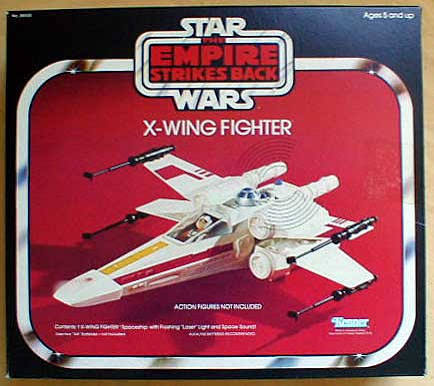
The X-wing had the profile every kid recognized, opening wings, a cockpit for a pilot and a place for R2-D2. The electronic light and battle sound were primitive by modern standards, but in a 1978 bedroom they felt like classified technology. The ship was large enough to dominate the floor without becoming impossible to carry from room to room. A kid supplied the diving, banking and engine noise; Kenner supplied just enough machinery to make the performance official.

The Imperial TIE Fighter

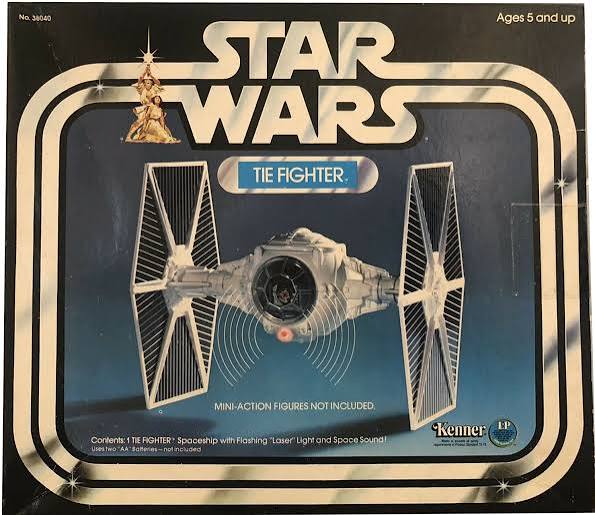
The TIE Fighter looked like nothing else in the toy box. Its tall wing panels made it awkward, delicate-looking and instantly Imperial. The spring-loaded battle-damage feature let the wings pop away, which meant the ship could be destroyed dramatically and then reassembled for the next attack. One TIE Fighter could chase an X-wing. Two made the bedroom feel like a movie sequence.

Luke’s Land Speeder

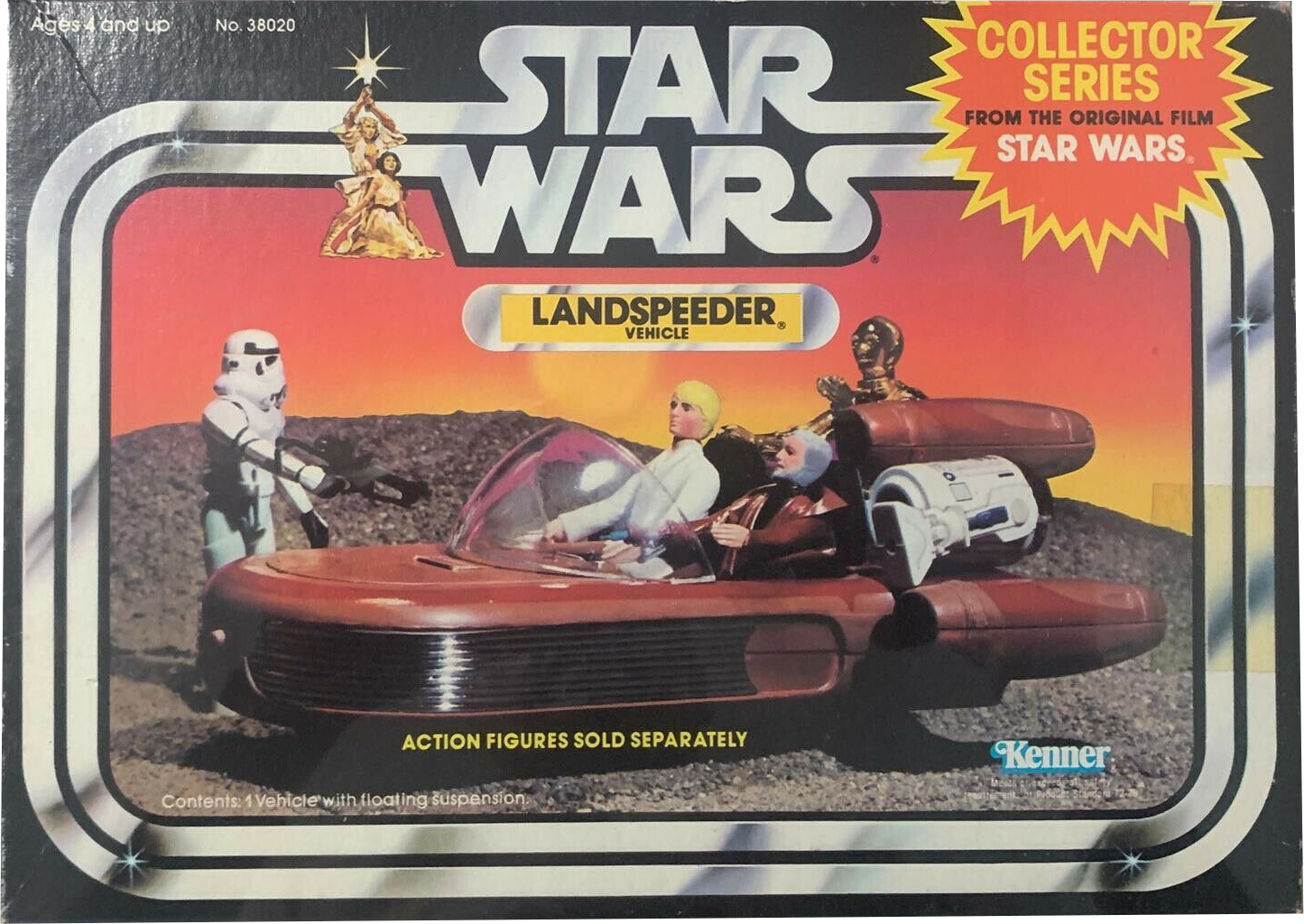
The Land Speeder rolled on hidden wheels that created the illusion of floating if the floor was smooth and the carpet did not fight back. It carried several figures, looked like a recognizable piece of the movie and was cheaper and easier to fit under a bed than the larger ships. It was the kind of vehicle that crossed into ordinary play because it did not require space combat. Luke could drive it to the cantina, the droid sale or the kitchen.

The Millennium Falcon

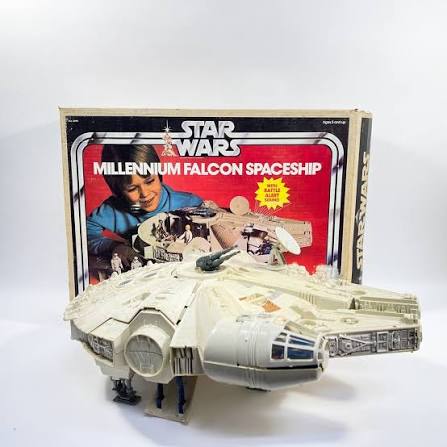
The Falcon was the line’s late-70s summit. It arrived as a 1979 product, after the first 1978 vehicle wave of X-wing, TIE Fighter and Land Speeder had already proved kids would buy ships built around the small figures. The Falcon had cockpit seats, a chess table, a training area, hidden compartments, movable parts and electronic sound. It was not remotely in scale with the movie ship, but it was enormous in a child’s room.

The Falcon turned figure collecting into crew building. Han and Chewie were obvious. Luke, Leia, Obi-Wan, the droids and half the rebel alliance could be crowded aboard if you ignored seating regulations. The ship became base, vehicle, prison, command center and storage case. Its size announced that Star Wars had moved beyond the blister-card peg and claimed serious territory in the toy aisle.

Why the Millennium Falcon Became More Than a Vehicle

The Falcon flew through the room, but most of its greatest work happened while it sat open on the floor.

Open vintage Millennium Falcon toy showing its cockpit and interior play areas
The Falcon was part vehicle, part headquarters and part storage container for whichever figures were still aboard.

The 1979 Kenner Millennium Falcon was not remotely large enough to hold the movie’s interior. Kenner compressed the idea of the ship into a group of recognizable stations: cockpit, chess table, training area, smuggling compartment, gun position and ramp. The floor plan did not have to make architectural sense. Each feature only had to trigger a scene.

The Cockpit Established Ownership

Han and Chewie belonged in front. Other figures could be forced into the seats, but the cockpit made character roles feel official. Closing the canopy around the pilots transformed the loose figures into a crew and gave the child a natural place to grip the ship during flight.

The cockpit also created the familiar argument over who got to be Han. Operating the vehicle and directing the story were often the same privilege. The child holding the Falcon controlled where everybody went next.

The Chess Table Made Quiet Play Possible

Not every Star Wars scene needed an explosion. The molded game table gave figures a place to gather, plan and argue. It made the Falcon feel inhabited and allowed the story to pause without ending.

That mattered during long floor sessions. Vehicles built only around motion could become props when parked. The Falcon remained a setting. Figures could be arranged inside while the next attack was being invented.

The Smuggling Compartment Was a Feature Kids Understood Immediately

A hidden compartment is almost unfairly effective in a toy. It creates a secret, a capture and an escape before the child has written any plot. The compartment could conceal figures from Stormtroopers, store weapons or simply hold whichever tiny piece needed to stop disappearing.

Because it was hidden within the ship, the feature also made the Falcon feel clever. The vehicle was not only large. It had tricks.

The Training Ball Was Destined to Vanish

The remote training ball and arm suggested Luke’s lightsaber practice. It also introduced another small detachable part into a house already losing blasters. Complete Falcons retain details most childhood examples surrendered quickly.

Even without the ball, the training area still worked because the movie scene supplied the meaning. A kid could position Luke with the saber and make the remote noise from memory.

Electronic Sound Made the Plastic Feel Mechanical

The motor-like sound effect did not reproduce the Falcon perfectly, but it gave the vehicle a response. Pressing the control and hearing the ship answer made launch feel different from simply lifting a silent object.

Like most electronic features of the decade, the sound became less impressive as batteries weakened. That fading mechanical groan could still be interpreted as battle damage, engine trouble or one more reason Han needed to repair the ship.

The Falcon Stored a Collection Without Admitting It

Figures, weapons and accessories accumulated inside the ship because it was large, hollow and already part of the game. That made the Falcon a practical headquarters even when nobody was actively playing. Open it weeks later and half the cast might still be waiting inside.

The Falcon succeeded because it supported motion, display, storage, role assignment and storytelling. It was a vehicle that became a room, and a room that could be flown away when the vacuum cleaner arrived.
The Playsets Turned Furniture Into a Galaxy

Plastic bases and cardboard walls were enough. The movie was already running in our heads.

Vintage late-1970s space playset filled with small figures and multiple action areas
Plastic floors, cardboard scenery and a recognizable location were enough to keep a story running for hours.

Vehicles moved the figures. Playsets gave them somewhere to argue, escape, fall, hide and get captured again. Kenner did not reproduce movie locations with model-kit accuracy. It translated the important action into plastic, cardboard, levers, elevators, trapdoors and backdrops a kid could understand immediately.

The Death Star Space Station

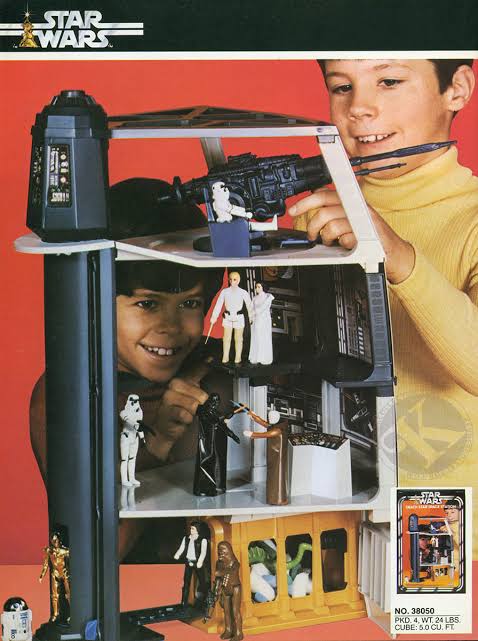
The Death Star playset was a vertical tower of scenes rather than a round space station. That was exactly why it worked. Each level offered a different kind of trouble: a trash compactor, a rope swing, an elevator, a gun position, corridors and the endless opportunity to knock an Imperial officer from one floor to another. It made the movie’s biggest location fit beside the bed by choosing play over scale.

Land of the Jawas

The 1979 Land of the Jawas set used a plastic base, cardboard scenery and a small escape-pod feature to create Tatooine with the same thrift and confidence that defined many 70s playsets. The backdrop did not need to survive close inspection. Once the Jawas, Luke and the droids were standing there, the printed world became real enough.

Creature Cantina

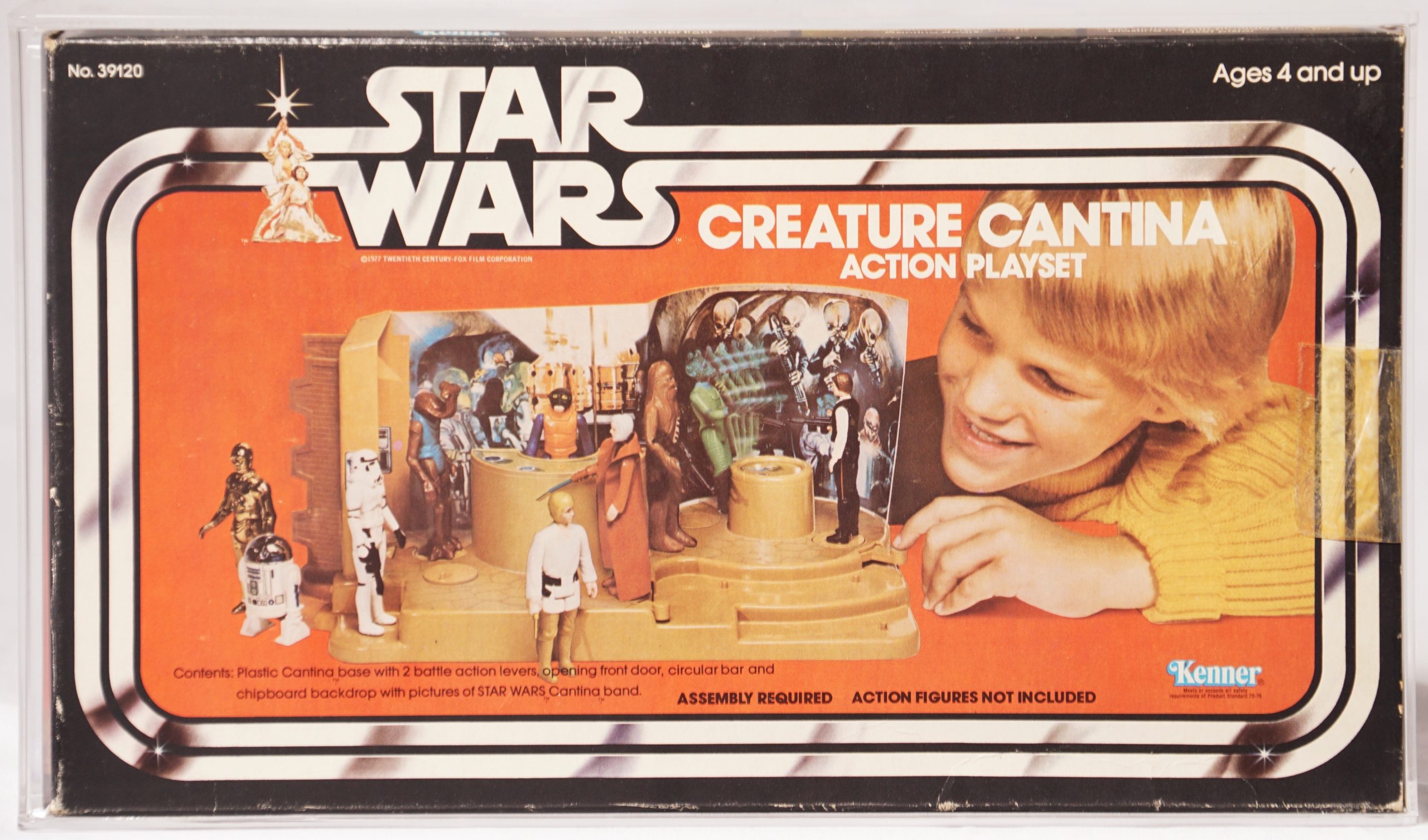
The Creature Cantina brought the bar to the floor with a molded base and cardboard environment. The great thing about the cantina was that almost every odd figure suddenly had a reason to be present. Greedo, Hammerhead, Walrus Man, Snaggletooth, Han, Luke, Obi-Wan and any unrelated alien-looking toy could crowd the room. It turned the growing figure roster into a social disaster waiting to happen.

The Droid Factory

The Droid Factory may have been the most Gen X playset of the bunch because it treated loose parts as the whole point. Kids could mix bodies, legs, heads and components to build new droids, then send those creations into the regular action-figure world. The little three-legged droid that collectors later associated with the set was only one possibility. The real feature was permission to take the galaxy apart and rebuild it wrong.

These playsets also proved that cardboard was not a disappointment if the idea was good. We were used to printed walls, fold-out scenery and plastic bases doing most of the structural work. The kid supplied depth, lighting, extras, explosions and continuity. A couch cushion could extend the Death Star. A shoebox became the next room. The toy was not finished because the box said it was.

Sears Exclusives, Blue Snaggletooth and the Toys That Did Not Follow the Rules

Some of the line’s most famous collector stories began as ordinary retail shortcuts, catalog exclusives or production misunderstandings.

Department-store exclusives made the Star Wars line feel different depending on where a family shopped. Sears offered figure sets and play environments that did not appear the same way on every toy-store shelf. A catalog could contain a product combination the neighborhood store never carried, which made the Wish Book more than a price list. It was access to another version of the galaxy.

Blue Snaggletooth Was an Accident Kids Could Play With

The tall blue Snaggletooth included in a Sears cantina adventure set became famous because the toy did not match the short red creature seen in the movie. Kenner’s designers had limited visual information and produced a figure with blue clothing, silver boots and a taller body. Once better reference material became available, the regular red Snaggletooth figure matched the screen character more closely.

To a child, both were aliens. The tall blue version did not feel like a production error. It felt like another cantina customer. The collector significance came later, when the exclusive distribution and obvious visual difference turned the figure into a variation people could identify from across a convention hall.

The Vinyl-Cape Jawa Became a Test of Authenticity

The earliest Jawa used a brown vinyl cape similar in concept to the capes on Vader and Obi-Wan. Kenner replaced it with a stitched cloth robe, which looked more substantial on such a small figure. Because the vinyl version had a short production window and the cape could be removed, authentic examples became scarce.

That scarcity created a reproduction problem. A small piece of brown vinyl can be copied more easily than a whole figure, and collectors developed detailed ways to examine texture, fit, color and origin. The toy is a perfect example of how a minor production change that meant nothing to most children became a major adult collecting category.

Double-Telescoping Sabers Were Engineering That Did Not Last

Early Luke, Vader and Obi-Wan figures could have a thinner saber tip extending from the thicker main blade. The design created a longer weapon from the compact arm mechanism but was fragile and soon simplified. Surviving double-telescoping examples became valuable because the feature was early, short-lived and easy to damage.

The adult collector sees a production variation. The kid who owned one may only remember the tip breaking. That difference between factory history and childhood memory runs through the entire vintage line.

Special Offers Made the Box Feel Like a Deal

Kenner also bundled figures with vehicles and playsets. An X-wing packaged with Luke and Han or a TIE Fighter paired with Darth Vader made the large purchase feel more complete. The included figures were not always the exact crew logic demanded, but the offer reduced the risk of opening a ship with nobody ready to pilot it.

These bundles trained families to think of the line in combinations. A vehicle was not isolated. It belonged with certain characters, and the package could supply a head start. The same thinking drove the larger franchise model: every product pointed toward another product that made it feel finished.

Why Kenner’s Death Star Did Not Need to Be Round

Movie accuracy would have produced a giant gray ball. Kenner built a vertical stack of things kids could actually do.

Vintage multi-level Death Star space-station playset with figures, elevator, platforms and action features
Kenner ignored the round exterior and built the parts kids actually wanted to play with.

The Death Star Space Station looked like a tall plastic-and-cardboard tower divided into floors. It did not reproduce the exterior of the movie station, and it did not try. The design treated the Death Star as a collection of memorable action scenes placed one above another.

The Elevator Connected the Story

An elevator let figures move between levels without forcing the child to pretend the floors were unrelated. It was a simple mechanical feature, but it made the structure feel like one place. It also created opportunities for ambushes, escapes and figures getting stuck halfway because the elevator was being operated too aggressively.

The Trash Compactor Was the Scene Everybody Wanted

Foam “trash” pieces and moving walls turned one of the movie’s strangest sequences into a repeatable toy feature. The figures could be crowded inside, the walls could close and R2-D2 could be blamed for taking too long. The foam pieces scattered, attracted dirt and disappeared, which made a complete vintage trash compactor its own small miracle.

The Rope Swing Recreated a Moment With No Room for It

Luke and Leia’s swing across the chasm became a rope feature attached to the playset. The scale and distance were symbolic, but the action was recognizable. A figure could swing, collide with the structure, fall to a lower level and continue the escape without any concern for movie continuity.

The Gun Position Put the Battle on Top

The upper gun emplacement gave the playset an external defense and a reason to place an Imperial figure above the corridors. The rotating weapon widened the play beyond the interior and let the Death Star interact with ships flying around the room.

The Cardboard Walls Did More Than Plastic Could Affordably Do

Printed cardboard supplied corridors, machinery and visual detail without making the set heavier or dramatically more expensive. The tradeoff was durability. Tabs bent, edges wore and moisture could end a wall permanently.

Kids accepted cardboard because the images created atmosphere. The plastic parts handled action. The cardboard handled location. Once figures were arranged across the levels, the combination was convincing enough.

Vertical Design Saved the Bedroom

A horizontal Death Star environment would have consumed most of the floor. The stacked design created multiple scenes in a smaller footprint and made the playset look tall and important beside the figures.

The result was one of Kenner’s clearest examples of smart translation. The company did not shrink the movie object. It identified the scenes children remembered and built a machine for repeating them.

Boba Fett and the Mail-Away That Made Waiting Feel Dangerous

The figure was promoted before the next movie and arrived missing the feature everybody had discussed.

A vintage mail-away bounty-hunter figure with its plain shipping mailer and paperwork
A small white mailer could carry more playground mythology than a brightly printed toy box.
Close view of an early armored bounty-hunter action figure and its rocket-backpack feature
The rocket that did not launch became more famous than most toy features that worked exactly as promised.

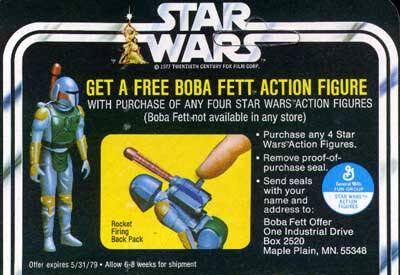
Boba Fett entered the toy line before most children knew exactly what he was going to do in the next movie. He appeared in animated form in the 1978 Star Wars Holiday Special, and Kenner offered the figure by mail in 1979 as a preview of what was coming. The cardback promotion promised a rocket-firing backpack, which was the kind of phrase that could take over an entire school lunch table.

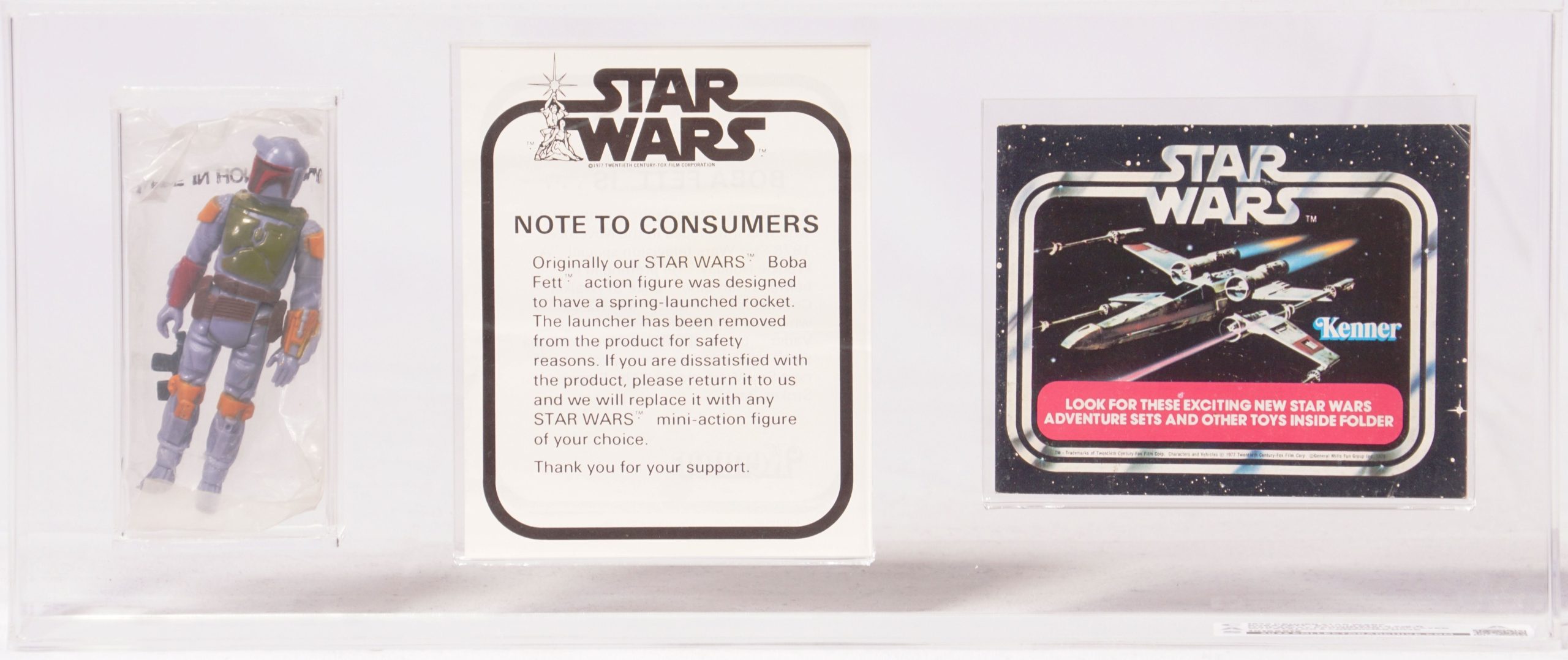
Kids clipped proofs of purchase, filled out the form, found an envelope, added postage and waited. Again, the mailbox became part of the toy experience. The figure that arrived did not fire its rocket. The launching feature had been removed before the toy reached children, and a note explained the change. The disappointment was real, but it did not make Boba Fett less mysterious. If anything, the missing feature made the story bigger.

The rocket-firing prototypes that survived became legendary collector pieces, but that is adult history. The kid history was simpler: Boba Fett showed up in a small white mailer and immediately outranked characters who had been in the movie for two hours. He had a helmet, a cape, armor, a backpack and an occupation adults had to explain. He looked like a complete backstory before the backstory existed.

THE WAITING WAS PART OF IT

Proofs of purchase, an envelope, postage and several weeks of checking the mailbox. Instant delivery would have ruined half the suspense.

The Commercials Sold Movement the Figures Barely Had

The figures barely bent. The commercials made them look like stunt performers.

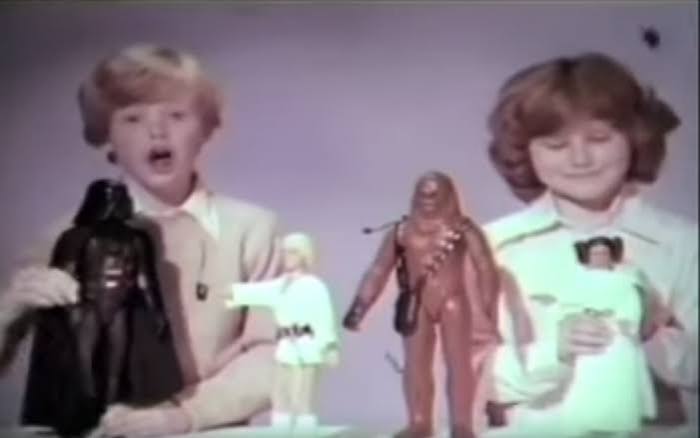
A late-1970s toy-commercial scene featuring children operating action figures and spacecraft
Television supplied the smoke, camera angles and impossible movement. At home, our hands stayed in the shot.

Kenner’s figures usually moved at the neck, shoulders and hips. The television commercials made them look capable of everything. Quick cuts, dramatic voice-over, smoke, lights, hand-operated flight and a living-room floor filmed from a heroic angle turned rigid little figures into a moving galaxy.

The commercials taught us how to play. They showed the X-wing banking, the TIE Fighter exploding, the Death Star filling with heroes and the Falcon launching into another mission. Every hand was carefully framed so the child operator became invisible. At home, our hands were visible, the dog walked through the battle and somebody yelled that dinner was ready. The fantasy survived anyway.

Those ads mattered because the toys were often difficult to understand on a peg. A cardboard photo could show the vehicle. A commercial showed the feature. If you want to see the pitch the way we saw it between cartoons, the 70s toy-commercial archive is where the launchers, lights, battle damage and breathless announcers make sense again.

Beyond the Figures: Die-Cast Ships, Blasters, Lightsabers and Droids

The 3¾-inch line became the center of the galaxy, but Kenner also sold other ways to carry Star Wars around the house.

Die-Cast Vehicles Put the Ships in a Hand

Kenner’s die-cast ships served a different kind of play. The larger plastic vehicles were environments built around figures. The smaller metal ships were for collecting fleets, flying through rooms and crashing into couch cushions without worrying about whether a pilot remained seated.

Die-cast X-wings, TIE Fighters, the Falcon and other craft let kids own vehicles that might have been too expensive or too large in action-figure scale. They also crossed easily into toy-car collections. A kid who already had a row of metal vehicles understood how to store and rank them.

The Inflatable Lightsaber Was Ridiculous and Wonderful

Kenner’s early lightsaber used a plastic handle with an inflatable vinyl blade. It did not glow like the movie. It did not hum. It bent, wobbled and could lose air. None of that prevented kids from swinging it through the house while supplying the sound effect.

The softness was probably the only reason indoor duels survived as long as they did. Two children could hit the blades together without immediately breaking furniture, though the lamps were never completely safe. The toy proved again that movie accuracy mattered less than giving the child the correct role.

Blasters Let the Kid Enter the Scene

Role-play blasters moved Star Wars off the carpet. A child was no longer directing Han or a Stormtrooper. The child became the character running through the yard, hallway or basement. The toy’s shape and sound feature were enough to turn an ordinary doorway into a Death Star corridor.

These toys also created the familiar Gen X experience of explaining to an adult that the weapon was obviously from Star Wars even if it looked like plastic machinery with a sticker. The movie reference was in the silhouette and the imagination, not the level of replica detail.

Radio-Controlled R2-D2 Felt Like the Future Had Arrived

An R2-D2 that moved under remote control made the line’s most mechanical character behave differently from a figure. It could roll across the floor as if it had a mission, which was close enough to robotics to feel astonishing in the late 70s. The controls and movement were limited, but the emotional effect was not.

The toy connected Star Wars to the decade’s growing fascination with electronics. Simon, handheld games, programmable vehicles and television consoles were already changing what “toy” meant. R2-D2 made that future look like a familiar character.

The Larger Line Made Star Wars Feel Inescapable

Figures, ships, playsets, die-cast vehicles, role-play weapons, radios, games and novelty items filled different price points and different parts of childhood. A family that could not buy the Falcon might buy one figure. A child who had no figures might still own a die-cast ship or inflatable saber.

That reach turned Star Wars from a movie toy line into a cultural environment. The action figures were the strongest center, but the shelves around them reinforced the same message: the galaxy could follow you home in almost any form.

Kenner Star Wars Toys: 1977–1979 Timeline

Three years were enough to move from a certificate package to a toy galaxy with characters, ships, playsets and a mail-order future.

1977

The Promise

The movie becomes a phenomenon. Kenner sells the Early Bird Certificate Package for Christmas, promising Luke, Leia, Chewbacca and R2-D2 after the holidays.

See 1977 toys
1978

The Arrival

The Original 12 reach stores, the roster expands toward 20, and the X-wing, TIE Fighter, Land Speeder and Death Star make the figure scale feel like a complete system.

See 1978 toys
1979

The Expansion

The Millennium Falcon, Boba Fett promotion, new aliens, droids and playsets turn a hit figure line into the model for a long-running franchise aisle.

See 1979 toys

1978 and 1979: When the Pegs Could Not Stay Full

The line moved from promised figures to a retail presence that made every store visit feel like a possible discovery.

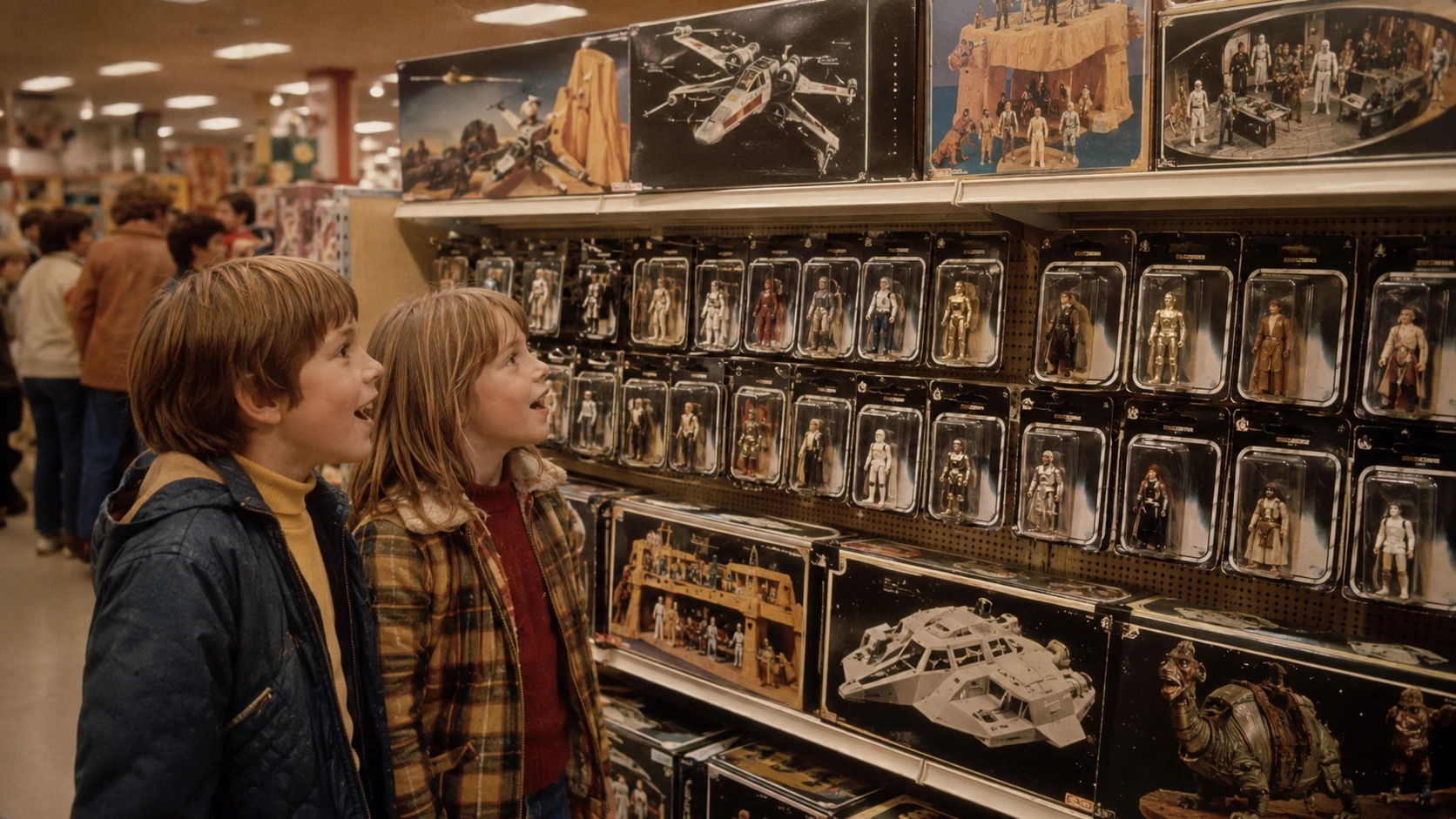
Children studying rows of late-1970s carded space action figures and large vehicle boxes in a department-store toy aisle
The figure pegs were only the beginning. The boxes above them showed how large the galaxy could become.
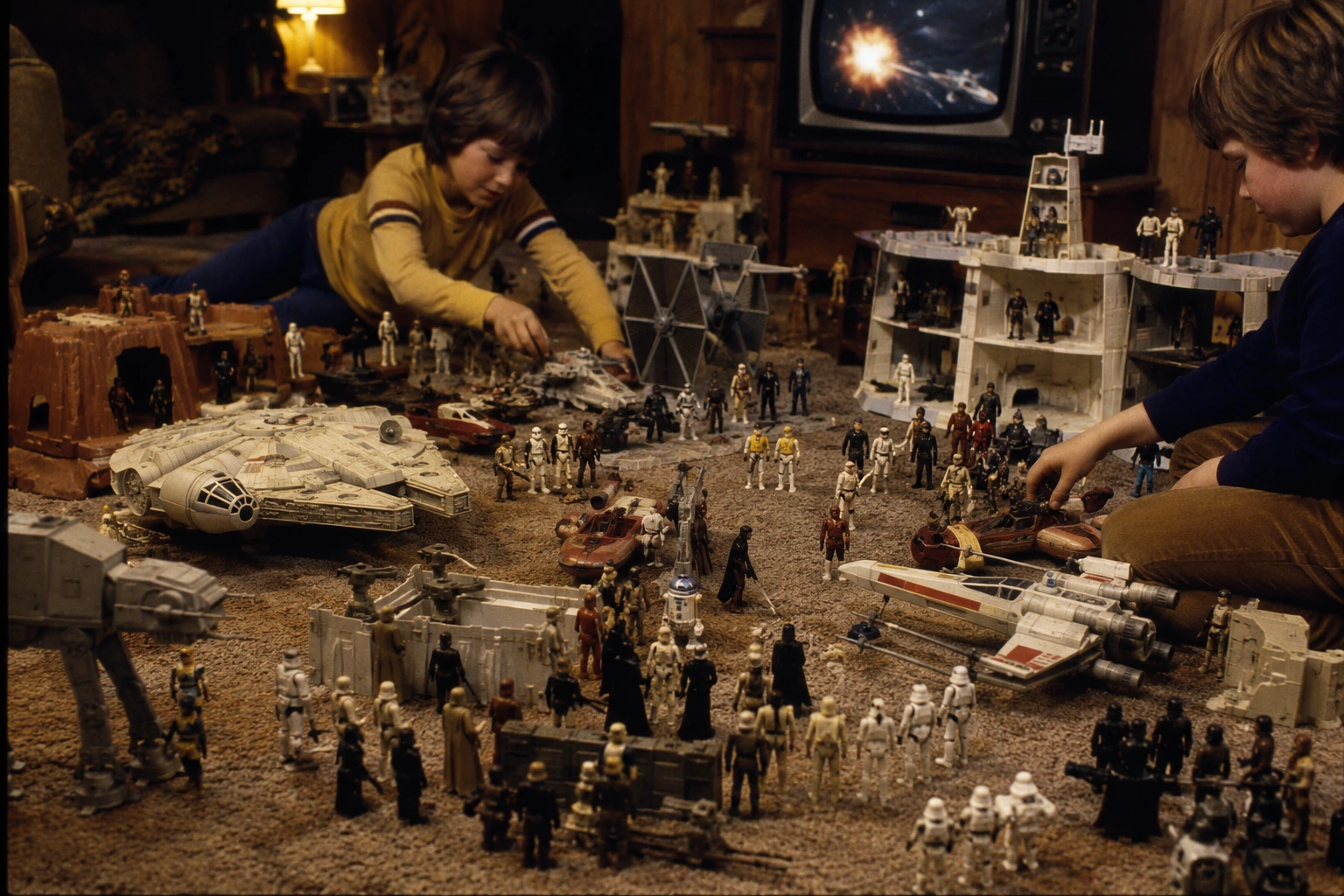
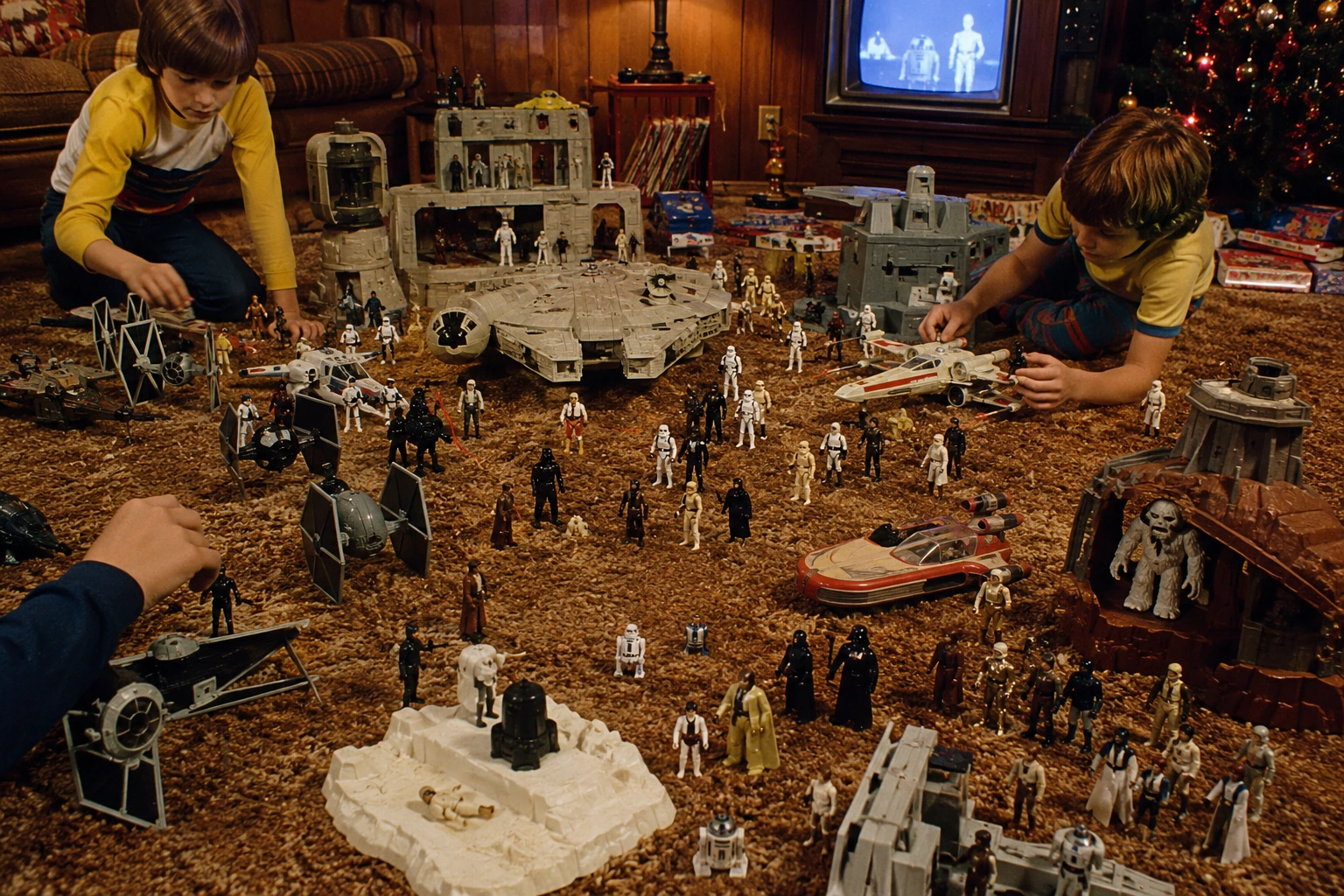
A large late-1970s space-toy collection spread across a family-room carpet with children actively moving figures and ships
By 1979, buying one figure felt less like a purchase and more like joining an expanding system.

Finding a Star Wars figure was not always a matter of choosing from the full cardback. Stores received assortments. Popular characters vanished. A row of pegs could contain several Death Squad Commanders, one damaged card and none of the figure you had gone in hoping to find. That unpredictability made ordinary shopping trips feel like hunts.

Parents learned the names because children repeated them. They were sent to look for a Jawa, Greedo or R5-D4 with instructions precise enough to sound ridiculous outside the toy aisle. Adults who had not seen the movie could still distinguish the gold robot from the short blue-and-white robot because getting the wrong one created consequences.

Department Stores and Drugstores Shared the Galaxy

Star Wars figures turned up in toy departments, discount stores, catalog counters and smaller retailers. A child did not need a dedicated toy store to encounter the line. That broad availability helped make the cardback checklist useful. Every errand carried the possibility that a missing figure might be hanging near the bicycles, housewares or pharmacy.

The large boxes created a different ritual. Vehicles and playsets were often placed higher, stacked on shelves or featured in holiday displays. The Falcon’s box did not whisper. It announced itself across the aisle and made every smaller purchase feel like a step toward something larger.

Store Displays Turned the Shelf Into a Movie Poster

Kenner supplied mobiles, headers, shelf pieces and displays that gathered the products under a single visual identity. The figures were small, but the store presentation was not. A hanging display could make the line visible from another department and tell a kid that the Star Wars section had grown since the last visit.

This mattered in the late 70s because the line expanded faster than memory. New aliens and vehicles appeared without a trailer, website or social-media announcement. The store itself delivered the news. You walked around a corner and learned that a Power Droid existed.

The Empty Peg Became Advertising

Scarcity did not weaken the line. It made the missing figures seem even more important. If Luke or Vader was gone, somebody else had found him first. If a child at school claimed to know where Jawas were in stock, that information traveled faster than anything adults were discussing.

The toy aisle became a live map of demand. The figures left behind gained reputations, fair or not. The figures that disappeared became legends until the next shipment. Collecting was not only about money or completeness. It was about timing.

The Catalog Pages Made the Whole Galaxy Look Obtainable

One spread could turn three reasonable figure requests into an entire Christmas strategy.

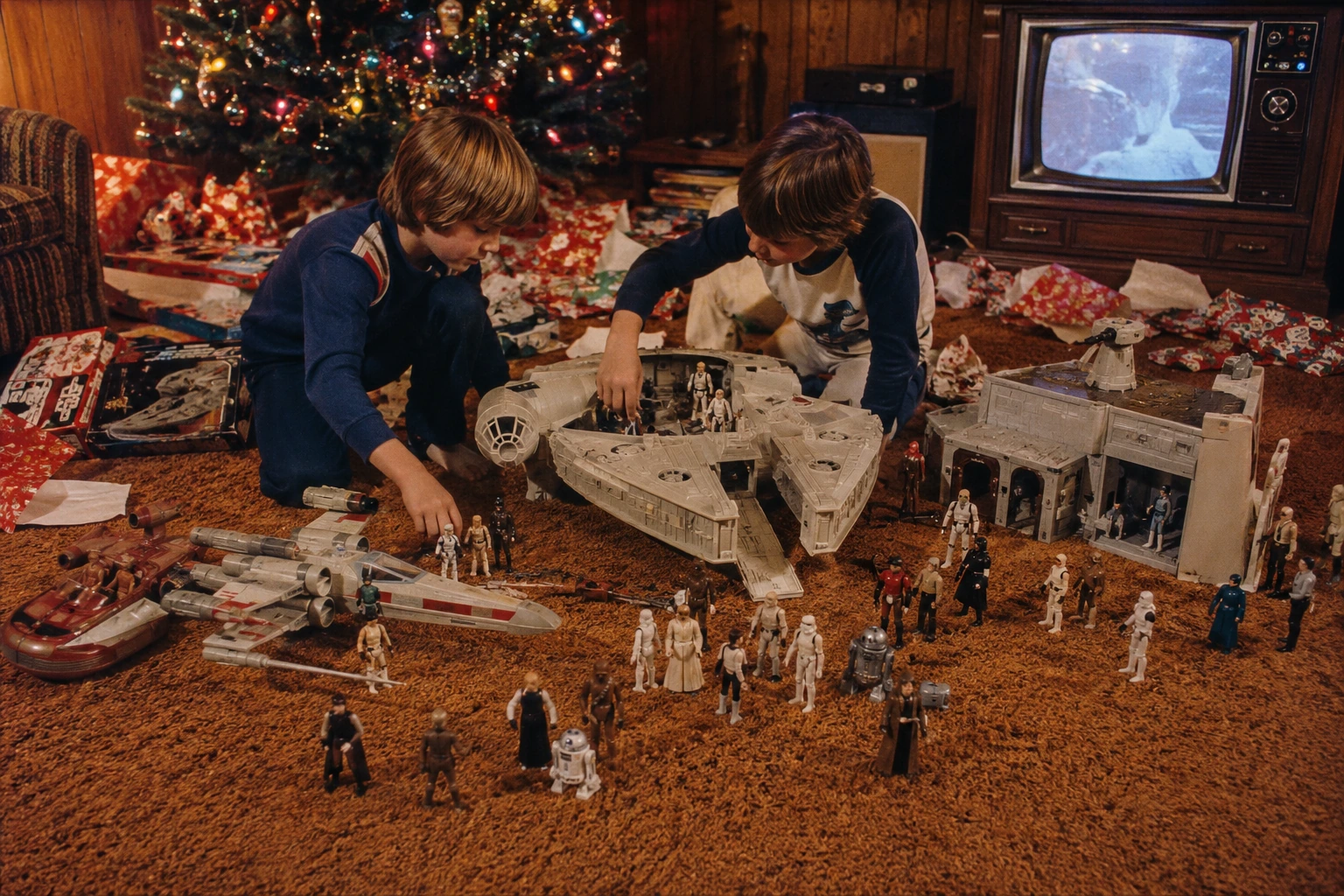
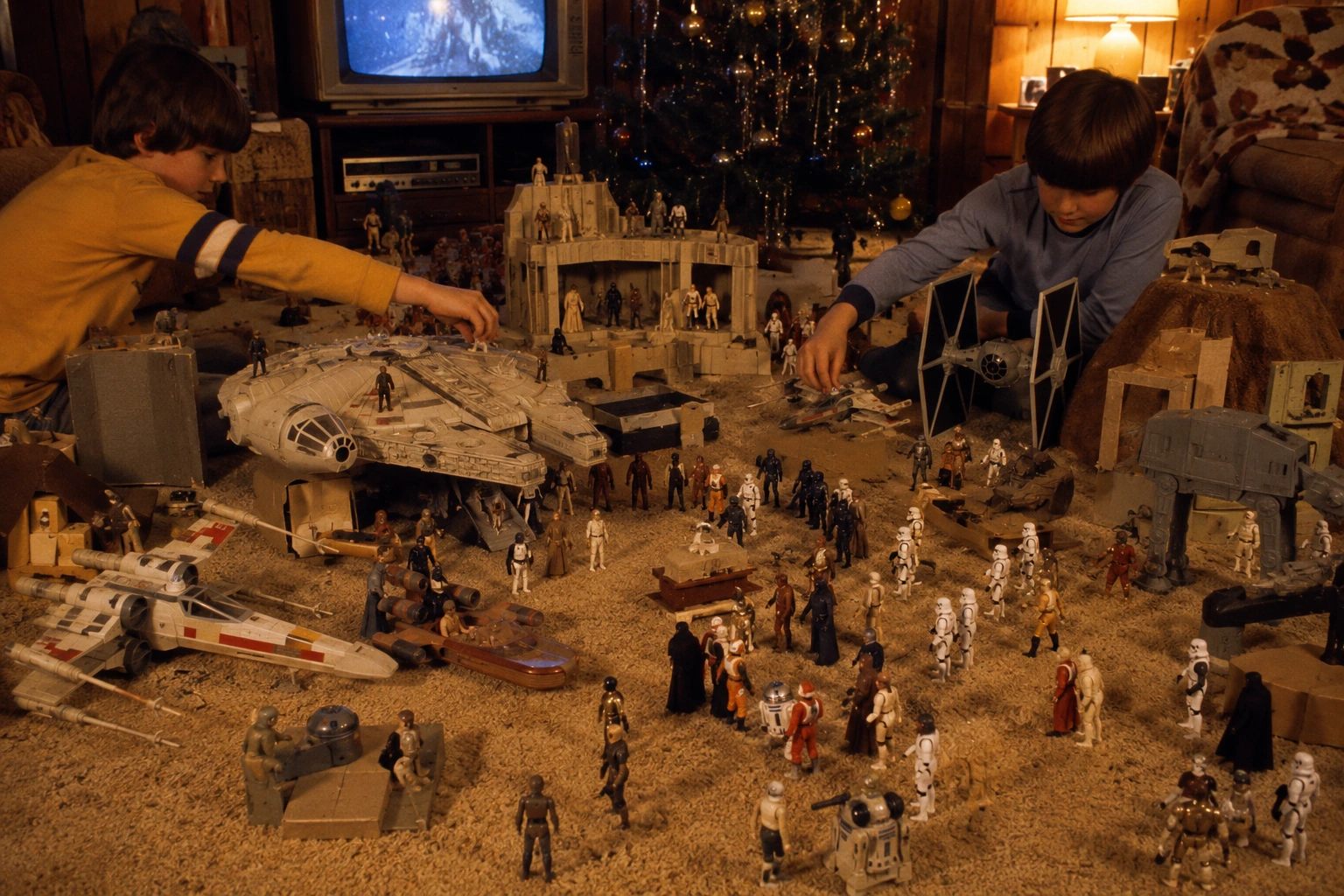
Children playing among large late-1970s spacecraft, figures and playsets in front of a Christmas tree and television
The catalog made the whole collection look obtainable. Christmas morning revealed how much floor space that dream required.

The toy store showed what was in stock. The catalog showed the complete dream. A department-store spread could place the figures, ships, playsets and accessories together in one photographed world, which made the line look less like separate products and more like a master plan for your bedroom.

We circled the Falcon even when the price made it obviously impossible. We folded the corner at the Death Star. We marked figures that cost little enough to sound reasonable and then added a vehicle in case the adults were feeling unusually generous. The catalog let a kid compare scale and decide which box would create the most play per square inch of Christmas morning.

The Star Wars pages also changed as the line grew. In 1977, the promise itself was the product. In 1978, the Original 12, first vehicles and large playsets appeared. In 1979, the Falcon, cantina aliens, droid-building and mail-away promotions made the line look like it might never stop expanding. The larger story of those dog-eared pages lives in our feature on 70s toy catalogs and Sears Wish Books.

What Star Wars Did to Christmas Morning

The little packages and the huge boxes were designed to make each other necessary.

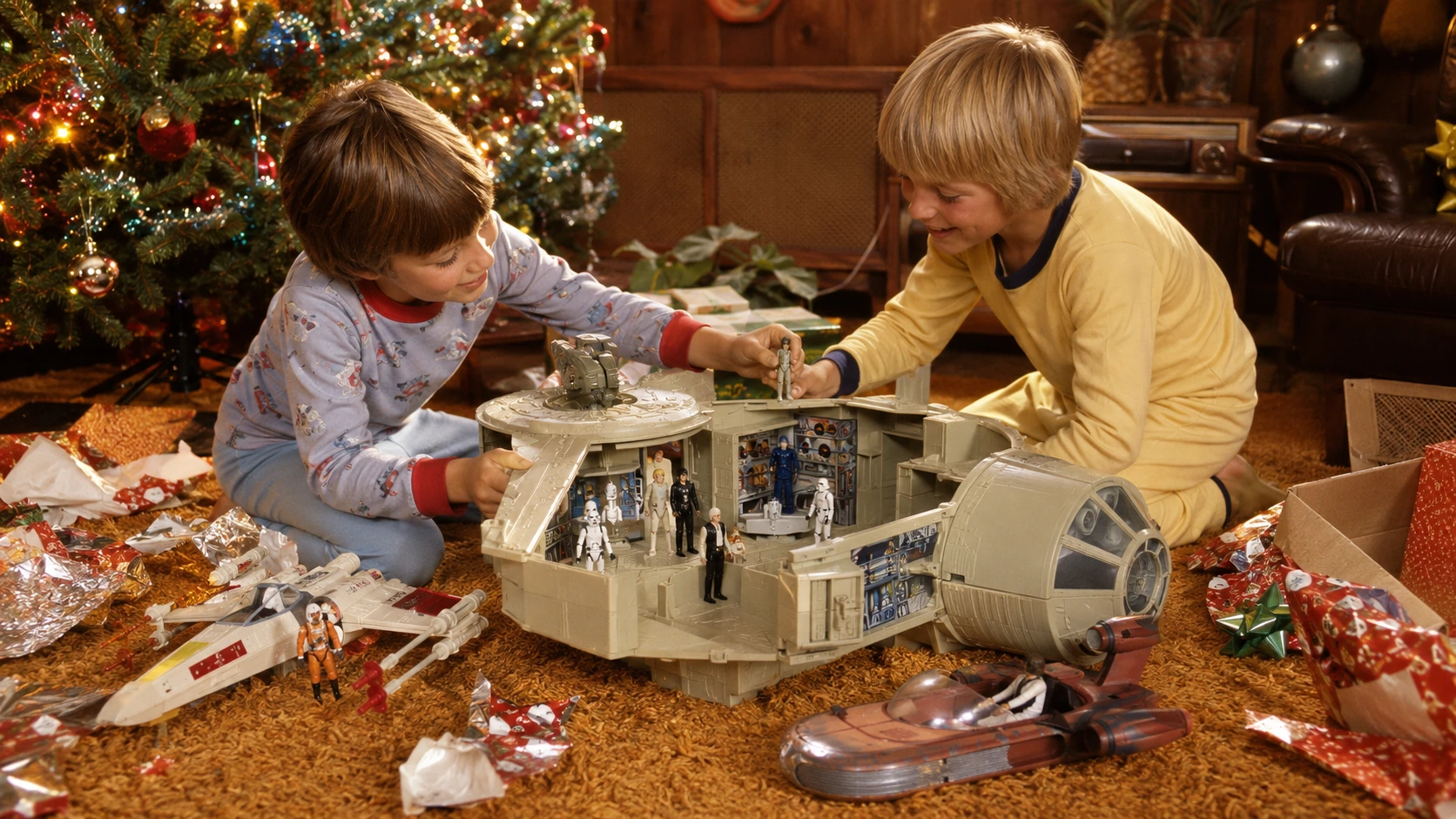
Two children playing with a large open space freighter, figures and starfighters beside a Christmas tree in 1979
The large box under the tree made every smaller figure collected during the year suddenly feel connected.

Before Star Wars, a big toy Christmas might have one obvious centerpiece. Kenner created a system where the small gifts and the giant gift belonged together. A stocking-sized Jawa could connect to a Land of the Jawas playset. Han and Chewie could point toward the Falcon. Luke in flight gear made the X-wing feel incomplete without him, and the X-wing made Luke feel like more than another figure.

That made wish lists longer and gift opening more dramatic. A figure could be a clue. A large box under the tree might explain the smaller package opened five minutes earlier. Siblings could receive different parts of the same galaxy and spend the rest of the day arguing about ownership while technically playing together.

The line’s Christmas story began with an empty-box promise in 1977 and became a full toy-aisle takeover by 1979. Our year-by-year look at the hottest Christmas toys of the 70s shows how quickly that shift happened around Star Wars and the other toys competing for space under the tree.

How Gen X Actually Played With Kenner Star Wars Toys

Nobody kept the weapons organized. Nobody cared until decades later.

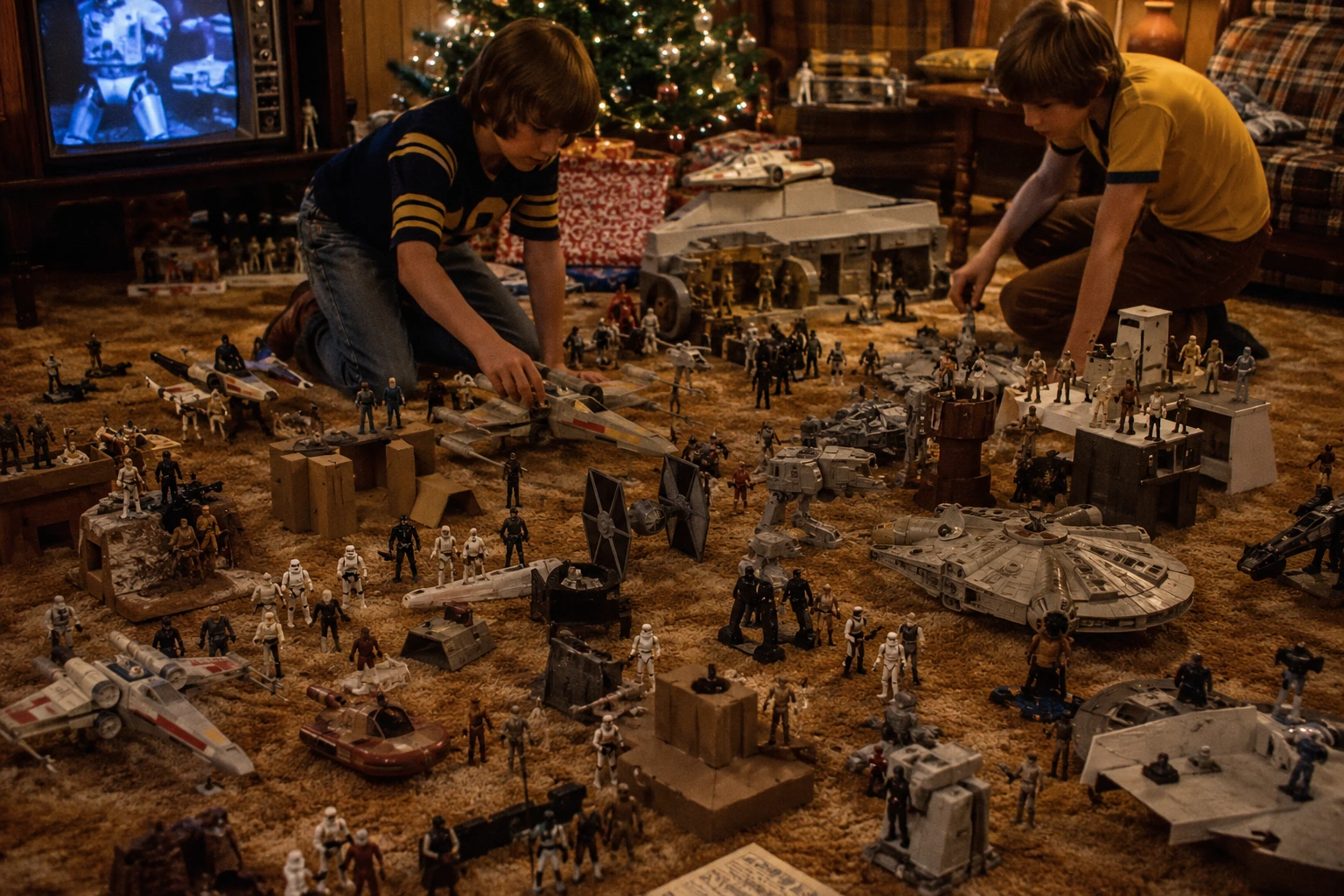
Two children directing a huge late-1970s floor battle with small figures, spacecraft, playsets and homemade terrain
The official galaxy supplied the cast. Blocks, cardboard and couch cushions supplied everything Kenner had not built yet.

We did not preserve the figures. We deployed them. Weapons disappeared first because the blasters were small, dark and perfectly suited to sinking into shag carpet. Capes tore or vanished. R2’s sticker peeled. The Death Star’s cardboard wore at the folds. X-wing cannons broke. TIE wings popped off so often that battle damage became ordinary maintenance.

The limited movement did not limit the story. Figures stood, sat badly, raised one arm and fell over. The hands did most of the acting. We made them walk by rocking their feet, fly by holding them around the waist and fight by smashing their weapons together while supplying every sound. The movie’s audio lived in our heads, and a kid with a convincing TIE Fighter scream could make a silent vehicle sound expensive.

Star Wars figures also crossed into other toy lines immediately. Micronauts became droids or aliens. Adventure People drove ground vehicles on distant planets. Mego heroes looked absurdly tall but could still appear as visiting giants. Fisher-Price buildings became settlements. Blocks became rebel bases. The line was powerful enough to absorb almost anything nearby.

That crossover play is part of why the toys remain so vivid. The official galaxy gave us characters and machinery. The unofficial galaxy included the family room, backyard, sandbox and every object that could pass for a bunker. Star Wars was not merely reenacted. It was continued without permission.

From Well-Played Toys to Vintage Star Wars Collectibles

The toys survived because we loved them, and their condition often proves it.

Two children playing with a heavily used late-1970s space-toy collection across worn shag carpet
The toys that mattered most rarely stayed complete, clean or organized.

Most of us did not grow up thinking of these toys as investments. We thought of them as ours, which meant they were marked by ownership. Initials appeared on feet. Weapons got mixed together. Cardbacks were torn open and thrown away. Vehicles were stored in garages and attics. Playsets lost their cardboard. The very behavior that made the toys important to children made complete examples harder to find later.

Collectors now pay close attention to details that barely registered during play: cardback versions, cape material, saber construction, paint differences, country-of-origin markings, accessories, decals, boxes, inserts and mail-away paperwork. The famous vinyl-cape Jawa, double-telescoping lightsaber figures, blue Snaggletooth and rocket-firing Boba Fett prototypes sit at the extreme end of the conversation, but rarity alone does not make every old figure valuable.

What Usually Matters Most

  • Completeness: Original weapons, capes, removable parts and vehicle components matter because those were the pieces kids lost.
  • Condition: Paint wear, loose joints, yellowed plastic, sticker damage and cracked vinyl can separate similar-looking examples.
  • Packaging: Sealed carded figures and boxed vehicles are a different collecting category from loose toys.
  • Authenticity: Reproduction weapons, capes, decals and cardbacks can look convincing, so expensive purchases require careful verification.
  • Provenance: Prototypes, employee pieces and documented production items need evidence, not just a dramatic story.

The safest way to enjoy the line is still the oldest way: know what you are looking at, buy what means something to you and do not treat a random attic figure like a guaranteed retirement plan. Current values change. The history does not.

How Kenner Star Wars Toys Changed What Came Next

After Kenner, a hit movie without a full toy world started to feel unfinished.

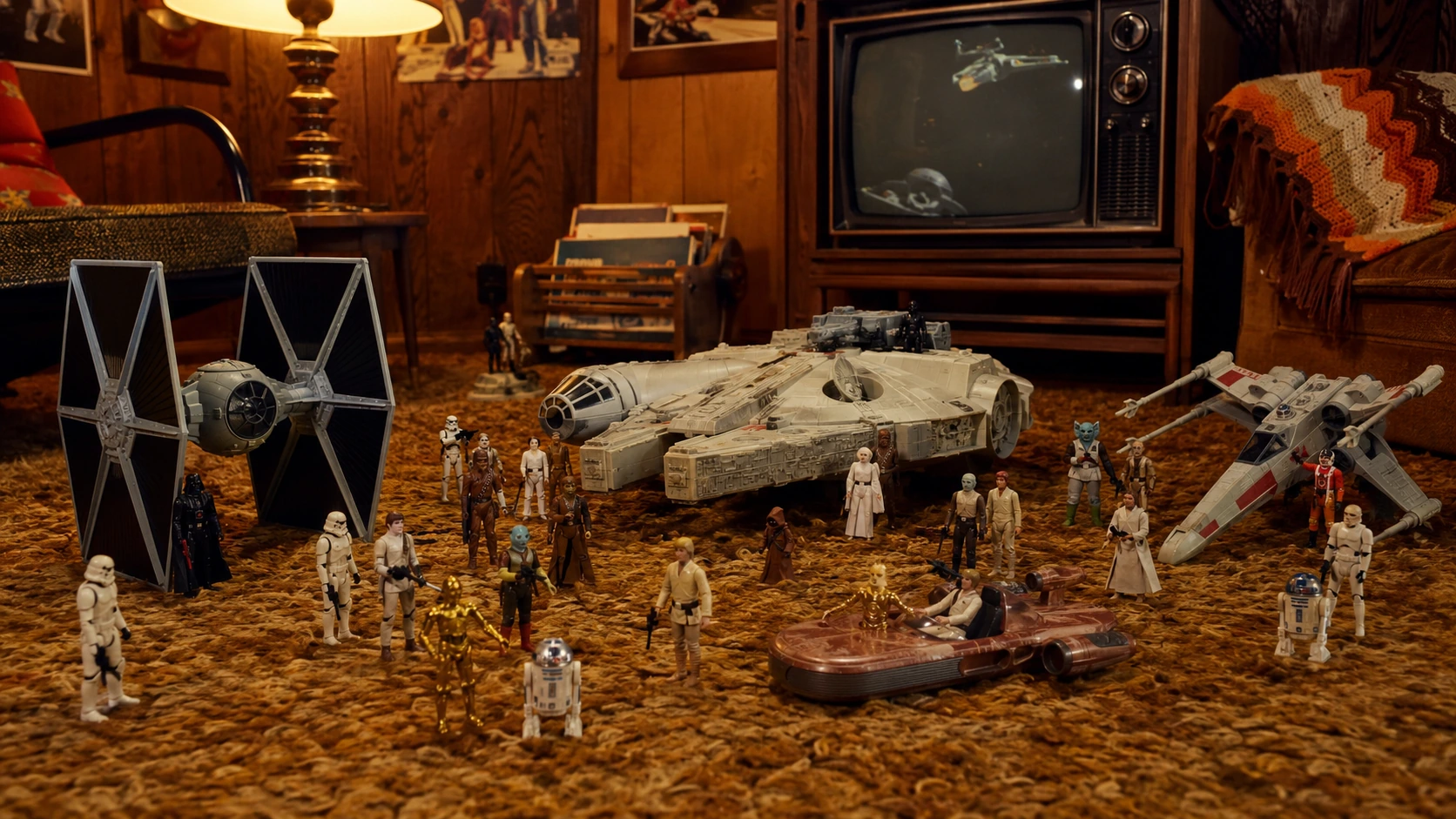
A sprawling late-1970s toy galaxy filling a wood-paneled living room with figures, ships, bases and homemade scenery
Kenner’s real legacy was not one figure or ship. It was the expectation that a screen world should keep growing on the floor.

Across the broader 70s toy box, the line did not invent licensed toys, action figures, vehicles or playsets. It changed how completely those things could work together. A movie could provide the characters. The figure scale could make vehicles practical. The cardback could turn the cast into a checklist. The catalog could reveal the larger world. The commercial could demonstrate the feature. The next film could refresh the entire system.

After Star Wars, the idea of a toy line as a connected universe became harder to ignore. The 1980s would take that structure and run with it through military teams, transforming robots, barbarian fantasy worlds, cartoon vehicles and shelves built around named characters with specific enemies. The formula was not copied piece for piece, but the expectation changed. Kids began to assume that a successful screen world should be available in plastic.

Kenner also showed that background detail could sell. The line was not limited to the three or four people on the poster. Droids, aliens, officers, pilots and creatures mattered because kids wanted the scene, not just the star. That widened the meaning of “character” in the toy aisle and rewarded movies that looked densely populated.

The broader decade story belongs in our guide to 70s action figures and character toys, where Mego, G.I. Joe, Evel Knievel, bionic heroes, Micronauts and Shogun Warriors lead into the late-70s franchise shift. Kenner’s Star Wars line is the moment that shift became impossible to miss.

Where the 70s Story Ends

The 1980s expansion is another story. The 70s are where the system was invented.

This article stops at the end of 1979 on purpose. The Empire Strikes Back had not yet reached theaters, although Boba Fett and rumors of the next chapter were already pulling the line forward. The 1980s would bring snow gear, Hoth creatures, AT-ATs, Bespin playsets, new cardbacks and an even larger figure roster.

The 70s line is the origin story: the empty box, the Original 12, the first alien expansion, the first ships, the Death Star, the Falcon, the mail-away Fett and the realization that the galaxy could keep growing. It is the part Gen X experienced before the system felt normal.

You can see that acceleration in the site’s year pages for the top toys of 1977, the top toys of 1978 and the top toys of 1979. The first page captures the promise. The second captures the arrival. The third captures the expanding empire.

Frequently Asked Questions About Kenner Star Wars Toys

The names, years and variations can get confusing fast. Here are the answers without turning the toy box into an accounting department.

When did Kenner Star Wars figures first come out?

The Early Bird Certificate Package was sold for Christmas 1977, but the first four actual figures were mailed to buyers in early 1978. The Original 12 reached retail shelves during 1978.

What came in the Star Wars Early Bird Certificate Package?

It included a cardboard display stand, stickers, a Star Wars club membership card and a certificate that buyers mailed to Kenner for Luke Skywalker, Princess Leia, Chewbacca and R2-D2.

Who were the Original 12 Kenner Star Wars figures?

Luke Skywalker, Princess Leia, Han Solo, Chewbacca, Obi-Wan Kenobi, C-3PO, R2-D2, Darth Vader, Stormtrooper, Death Squad Commander, Sand People and Jawa.

Why were Kenner Star Wars figures so small?

The roughly 3¾-inch scale reduced the amount of plastic used and, more importantly for play, made vehicles and large playsets practical. Kids could build a cast and still fit the ships in a bedroom.

What were the first Kenner Star Wars vehicles?

The first full 1978 action-figure vehicle lineup centered on the X-Wing Fighter, Imperial TIE Fighter and Land Speeder. The large Millennium Falcon followed as a 1979 product.

Was the Kenner Millennium Falcon released in 1978 or 1979?

The vintage Kenner Millennium Falcon was a 1979 release. The X-wing, TIE Fighter and Land Speeder made up the principal 1978 vehicle wave.

Did the original Boba Fett figure fire a rocket?

The version mailed to children did not. Kenner promoted a rocket-firing feature, but the launching mechanism was removed before release. Surviving rocket-firing prototypes became famous collector pieces.

What is the rare vinyl-cape Jawa?

The earliest Jawa used a small brown vinyl cape. Kenner soon replaced it with a cloth robe. Authentic vinyl-cape examples are scarce, and reproductions are common, so careful verification matters.

What was the first Kenner Star Wars playset?

The Death Star Space Station was the defining early large playset. Its multi-level design translated the movie location into an elevator, trash compactor, rope swing and gun platform built for action.

Are original Kenner Star Wars toys valuable?

Some are, but value depends on the exact item, authenticity, condition, completeness, packaging and current demand. A common loose figure without its weapon is not the same market as a sealed carded figure or documented prototype.

How many figures were available by the end of the 1970s?

The line grew from the Original 12 to 20 figures and then added Boba Fett as the twenty-first figure by 1979, before the Empire Strikes Back expansion began.

Why did Kenner Star Wars toys matter so much?

They made characters, vehicles, playsets, catalogs, commercials and collecting work as one connected system. That model helped define the large franchise toy lines that dominated the 1980s.

Get the Weekly Gen X Drop

New videos, rewinds, and savage nostalgia — first.

SUBSCRIBE WATCH VIDEOS

MORE REWINDS