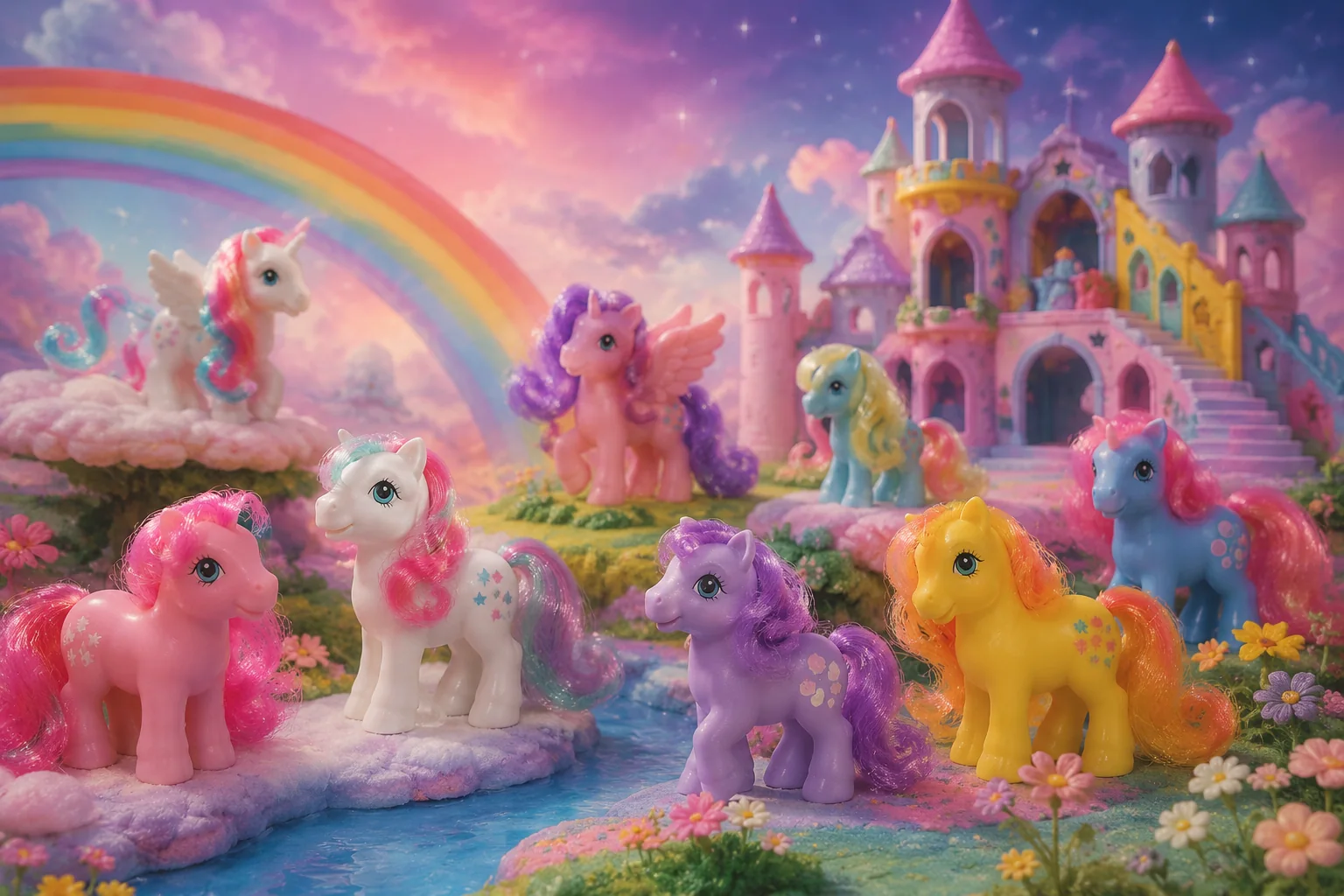
My Little Pony Toys in the 80s: The Original Ponies We Collected
They came in colors no actual horse had ever considered, with names, symbols, glitter, wings, castles, combs, ribbons, and enough hair to keep a child occupied through an entire Saturday morning. Then the Sea Ponies hit the bathtub, the Dream Castle took over the floor, and “just one more pony” became a completely reasonable household position.
The toy aisle had a softer side, but it was every bit as strategic.
My Little Pony toys in the 80s did not ask children to defeat anybody. They asked us to notice differences. One pony had a lavender body and flower symbols. Another had blue hair and candy marks. One had wings. One had a horn. One came with a comb. One came with a castle. Those 80s pony toys were built around the dangerous idea that every new color, pose, symbol, and hair combination counted as a completely different necessity.
The original My Little Pony toys became a defining part of the larger 80s toys universe. They shared the decade with Cabbage Patch Kids and the 1983 toy-store frenzy, Care Bears, Barbie, Strawberry Shortcake, He-Man, G.I. Joe, and Transformers—enough licensed characters to make a toy-store aisle feel like a crowded television schedule.
The line also belonged to the wonderfully overloaded world of 80s dolls, plush toys and pet-toy chaos. A vintage 1980s My Little Pony blended doll play, pet care, collecting, fantasy, fashion, grooming, household playsets, and color-coded organization into one small vinyl horse. A pony could be brushed like a doll, cared for like a pet, displayed like a collectible, and assigned a complicated family history five minutes after leaving the package.
The first small ponies appeared in 1982, although Hasbro’s official anniversary language and many collector catalogs often frame 1983 as the brand’s formal introduction or first full retail year. That minor date argument is exactly the kind of thing adult collectors can discuss for forty minutes while every child from the era simply remembers the same truth: by the middle of the decade, the ponies were everywhere.
What made the original My Little Pony toys special was not one gimmick. It was the cumulative effect of body colors, hair, symbols, poses, pony types, accessories, playsets, cartoons, mail-away offers, and constant new assortments. The line made collecting feel gentle. It was still collecting. Gentle did not mean cheap.
Before the little ponies, there was one very large horse with mechanical ambition
From My Pretty Pony to the Original G1 My Little Pony Toys
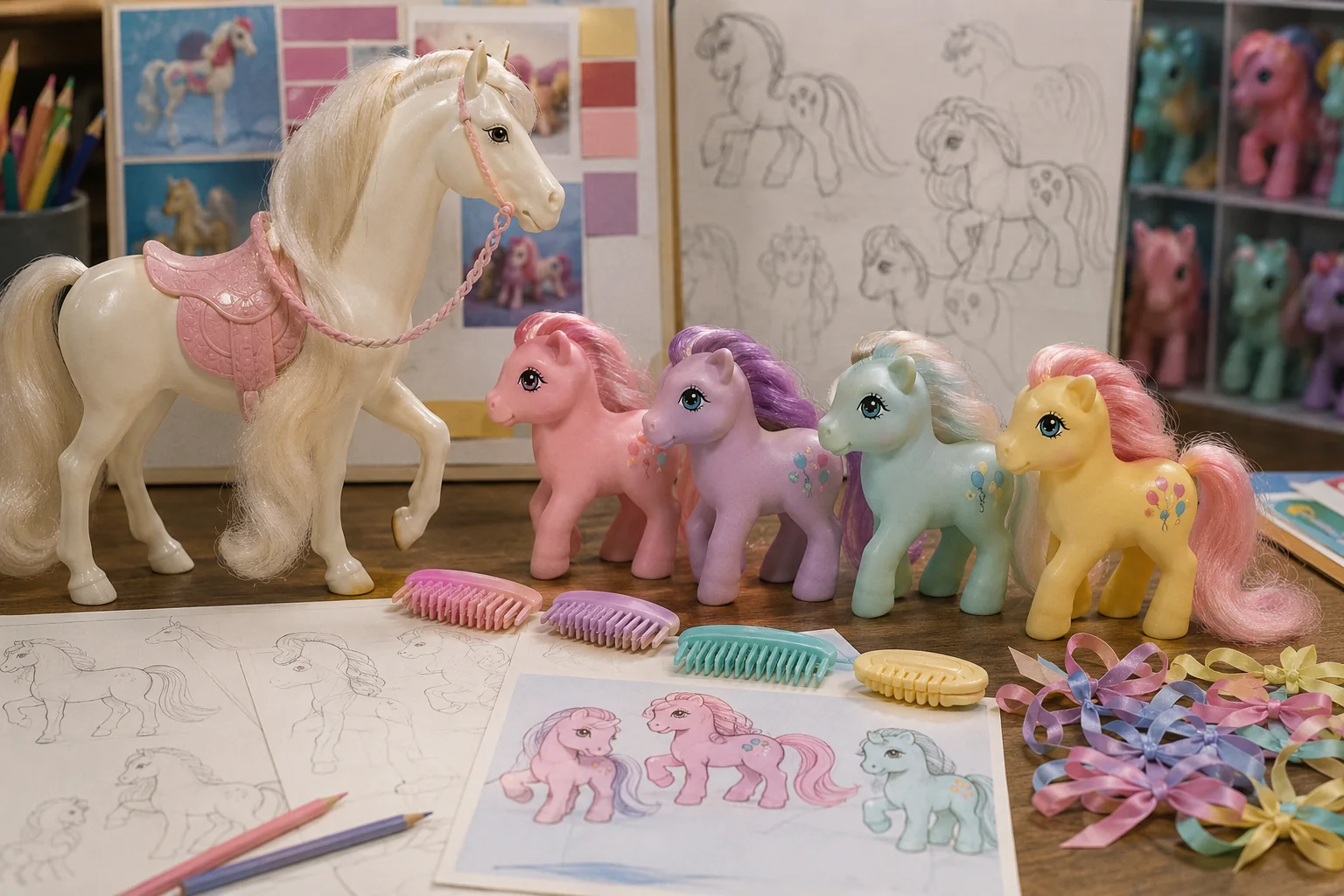
Before My Little Pony became a herd of pastel vinyl horses, Hasbro released My Pretty Pony. The large hard-plastic toy was closer to a traditional horse figure than the smaller ponies most Gen X kids remember. It had a brushable mane and tail and mechanical features that could move the ears, swish the tail, or make an eye wink.
Bonnie Zacherle started with the horse she wanted as a child
The original concept grew from designer Bonnie Zacherle’s long-standing love of horses. The basic insight was simple: children who could not own a real horse might still want the care, grooming, fantasy, and emotional attachment connected to one.
My Pretty Pony was much larger than the later line
The size made it feel substantial, but it also limited what a child could collect. One large horse occupied the space of several smaller toys. Large playsets, stables, and complete herds would have become expensive and physically ridiculous.
The brushable hair was the idea worth keeping
The mechanical gimmicks were interesting, but the mane and tail created the lasting play pattern. Brushing, braiding, ribboning, trimming—sometimes without permission—and trying to repair knots gave the toy a daily ritual.
Smaller ponies made collecting possible
Once the design became compact, Hasbro could vary colors, poses, symbols, hair, species, and accessories. A child could own six ponies, then twelve, then a storage case that somehow proved the collection was still not finished.
The large pony became the bridge between doll and pet play
My Pretty Pony was not a doll, but it invited the same grooming and nurturing behavior. It was not a stuffed animal, but it functioned as a pet. The smaller line preserved that mix while making fantasy and collecting easier.
The 1982–1983 launch date confusion comes from catalog conventions
Collectors often describe the first small ponies as the 1982 line, while American catalog-year references frequently identify them as Year 1 in 1983. Hasbro anniversary material has also used 1983 as the formal introduction. The practical answer is that the toys emerged across the 1982–83 retail window and quickly became a major brand.
The first six were simple enough to understand and different enough to need all of them
The Original Six G1 My Little Pony Toys
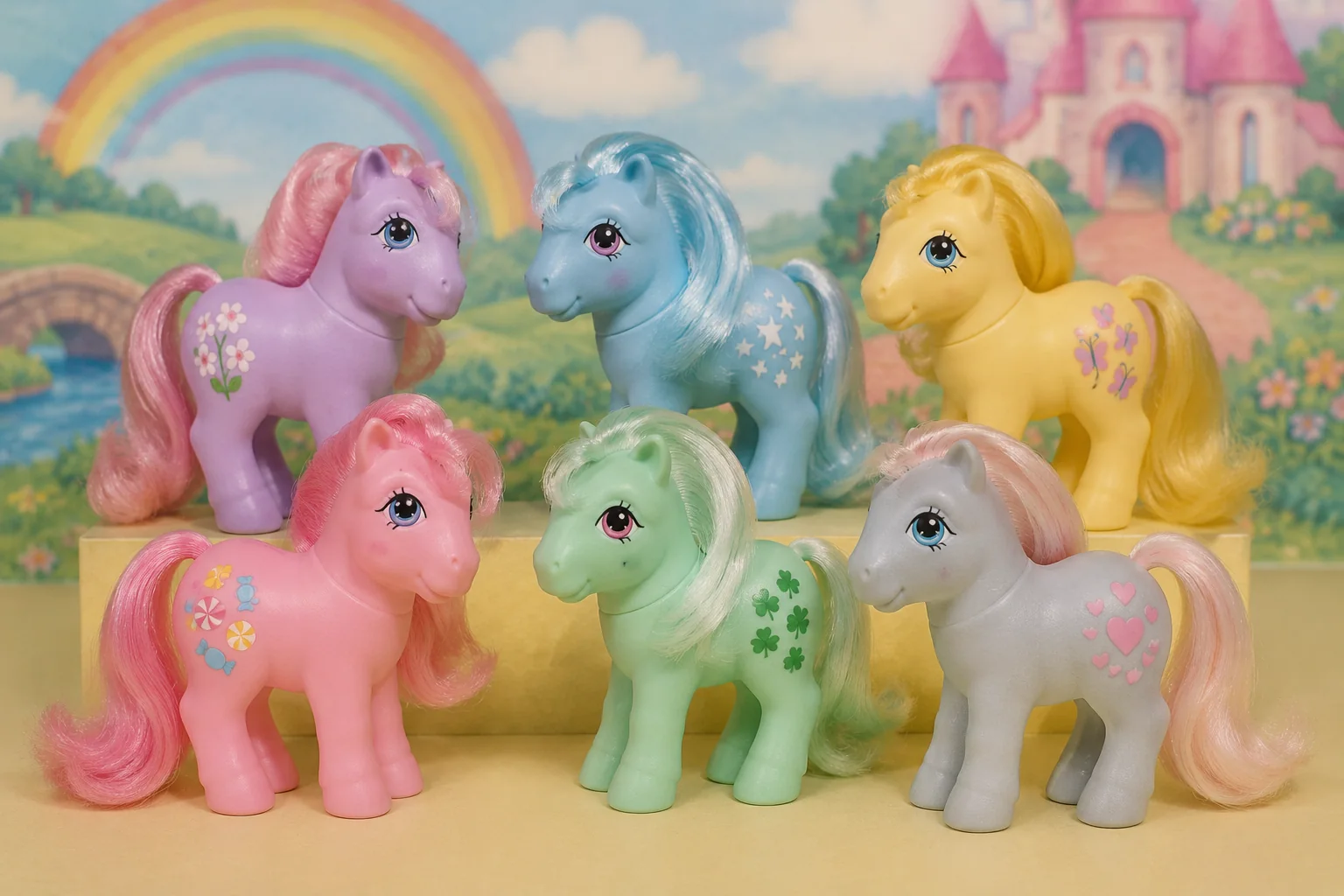
The original six Earth Ponies established the entire formula: compact vinyl bodies, long brushable hair, soft colors, painted eyes, and a small picture symbol on each side. They shared the same basic idea, but each pony had enough visual identity to become a favorite.
Blossom
Lavender body, purple hair, and flower symbols. Blossom looked calm, unmistakably floral, and prepared to become the sensible one in any pony family.
Blue Belle
A blue pony with star symbols and purple hair. The combination looked nighttime-adjacent without requiring the toy to explain astronomy.
Butterscotch
Yellow body, orange hair, and butterfly symbols. Butterscotch had the warm, unmistakably 80s palette of a kitchen appliance designed by optimists.
Cotton Candy
Pink body, pink hair, and candy symbols. Cotton Candy delivered exactly what the name promised and became one of the easiest ponies to recognize.
Minty
A green pony with white hair and clover symbols. Minty was the one that proved pastel green could carry an entire personality.
Snuzzle
Gray body, pink hair, and heart symbols. Snuzzle’s more neutral body color made the pink mane and hearts stand out even more.
Flat-Foot vs. Concave-Foot G1 Ponies
The earliest versions are known for flat feet. Later versions used concave feet. Children saw ponies. Adult collectors saw a production distinction that could affect identification, rarity, and the length of an online conversation.
Why G1 Pony Symbols Made Every Character Easy to Remember
A flower, star, butterfly, candy, clover, or heart made the pony identifiable from across the room. The symbol was small, but it carried the name, theme, and emotional tone.
The original poses were sturdy and calm
The first ponies stood with a solid, traditional shape. Later years introduced more varied body poses, but the original six looked like dependable horses rather than creatures in the middle of a musical number.
The simple lineup made the collecting logic obvious
Six names. Six colors. Six symbols. The set was small enough to imagine completing and varied enough to make one pony feel lonely. This was excellent toy design and terrible financial planning.
The first wave connected naturally to the top toys of 1982
The early-80s toy market was discovering how powerful character-based collecting could be. My Little Pony arrived with none of the aggression of the action aisle but all of the same expansion potential.
No batteries, no complicated rules, and somehow still an endless amount to do
Why My Little Pony Toys Became an 80s Collecting Phenomenon
The line offered several kinds of play at once. Children could groom the ponies, assign personalities, build families, organize collections, create stories, dress them, place them in homes, take them into the bathtub, and compare them with friends.
The toys felt personal without requiring a fixed personality
A pony had a name and symbol, but early packaging did not lock every character into one exact personality. Children could decide who was brave, shy, bossy, funny, magical, or in charge of the stable.
Hair created repeat play
A figure could sit on a shelf. A pony with a brushable mane invited handling. Hair became the activity that restarted every time the toy came out.
The colors were cheerful without being identical
Pink mattered, but the line was not only pink. Lavender, yellow, blue, green, white, peach, gray, aqua, and deeper colors created a shelf that looked coordinated without becoming a single pastel blur.
Collecting remained visible
A row of ponies looked like a herd. Different colors and hair made the collection readable. A child could see progress, gaps, duplicates, and the pony that still needed a proper ribbon.
The Toys Worked for Quiet Play and Shared Collections
One child could spend an hour grooming and arranging. Two children could combine collections and create a larger world. Three children could spend fifteen minutes deciding whose pony owned the castle before any actual story began.
The Vinyl Bodies Survived More Childhood Than the Hair Did
Vinyl bodies tolerated drops, travel, baths, backyards, toy boxes, and accidental encounters with furniture. Hair tangled. Symbols rubbed. Bodies discolored. But many ponies survived well enough to reappear decades later.
There was always another category to discover
Earth Pony. Unicorn. Pegasus. Rainbow Pony. Sea Pony. Baby Pony. So Soft. Flutter Pony. Twinkle Eye. Twice As Fancy. The line kept changing the reason a child needed another one.
Before anyone called them cutie marks, we just knew the picture belonged to that pony
G1 My Little Pony Symbols, Colors, Hair, and Poses
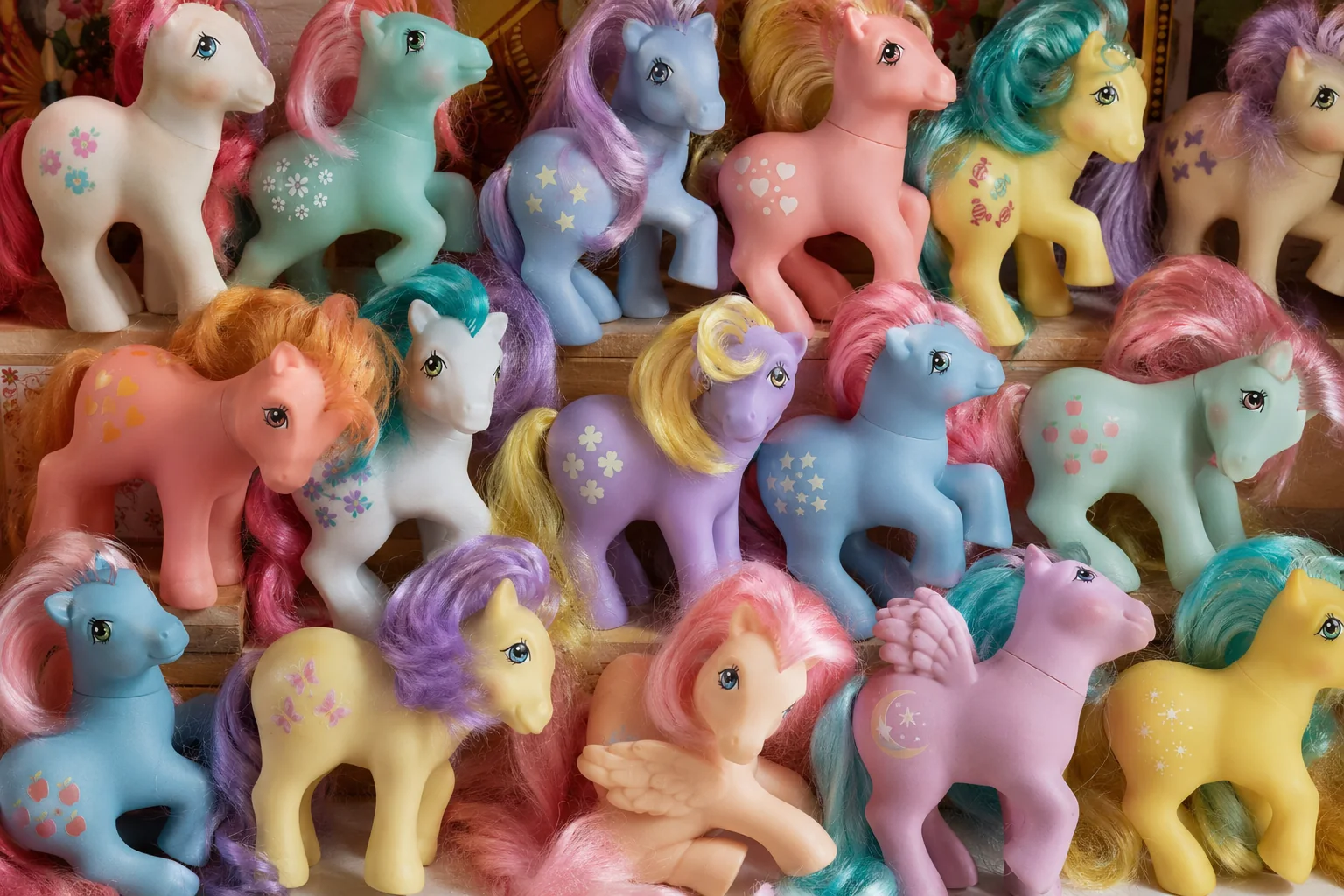
The visual system of the original My Little Pony toys was deceptively sophisticated. Body color, mane color, tail color, eye color, symbol, pose, finish, and pony type could all change. Two toys built from related molds could still feel like entirely different characters.
Symbols connected names to pictures
Applejack had apples. Bow Tie had bows. Cherries Jubilee had cherries. Lickety-Split had ice cream. The connection was immediate, memorable, and readable before a child could spell the name.
Some symbols were literal and others were mood
A pony named Firefly could have lightning-bolt imagery. Moonstone could carry celestial symbols. Cotton Candy used candy. Symbols created themes without requiring biographies.
Glitter made a small mark feel like a premium feature
Glittery symbols caught light and made Unicorn, Pegasus, and Rainbow assortments feel more magical than the original flat-painted designs. Glitter also migrated into carpet, clothing, and places no scientist has fully explained.
Hair colors created strong contrast
White bodies with blue hair, yellow bodies with pink hair, lavender bodies with purple hair, and aqua bodies with rainbow hair made the line visually loud without using neon.
Hair texture changed with play
Fresh hair was smooth and bright. Played-with hair became wavy, frizzy, braided, trimmed, knotted, or mysteriously shorter on one side. Each pony slowly recorded the decisions of its owner.
Body poses gave the herd movement
Later ponies looked sideways, lifted a hoof, reared, stood more delicately, or carried different head angles. A shelf of varied poses looked less like identical toys and more like a gathering.
Eye paint added expression
Eye shape, lashes, iris color, and head angle made some ponies look calm, alert, dreamy, or mildly concerned about what the child was doing with those scissors.
Color variation became part of collector identification
Age, sun exposure, manufacturing differences, country of origin, and rereleases can shift color. Adult collectors now compare shades that children would have described as “the purple one.”
The herd grew horns, wings, magic, weather control, and a much more complicated shelf arrangement
Original G1 Pony Types: Earth Ponies, Unicorns, and Pegasus Ponies
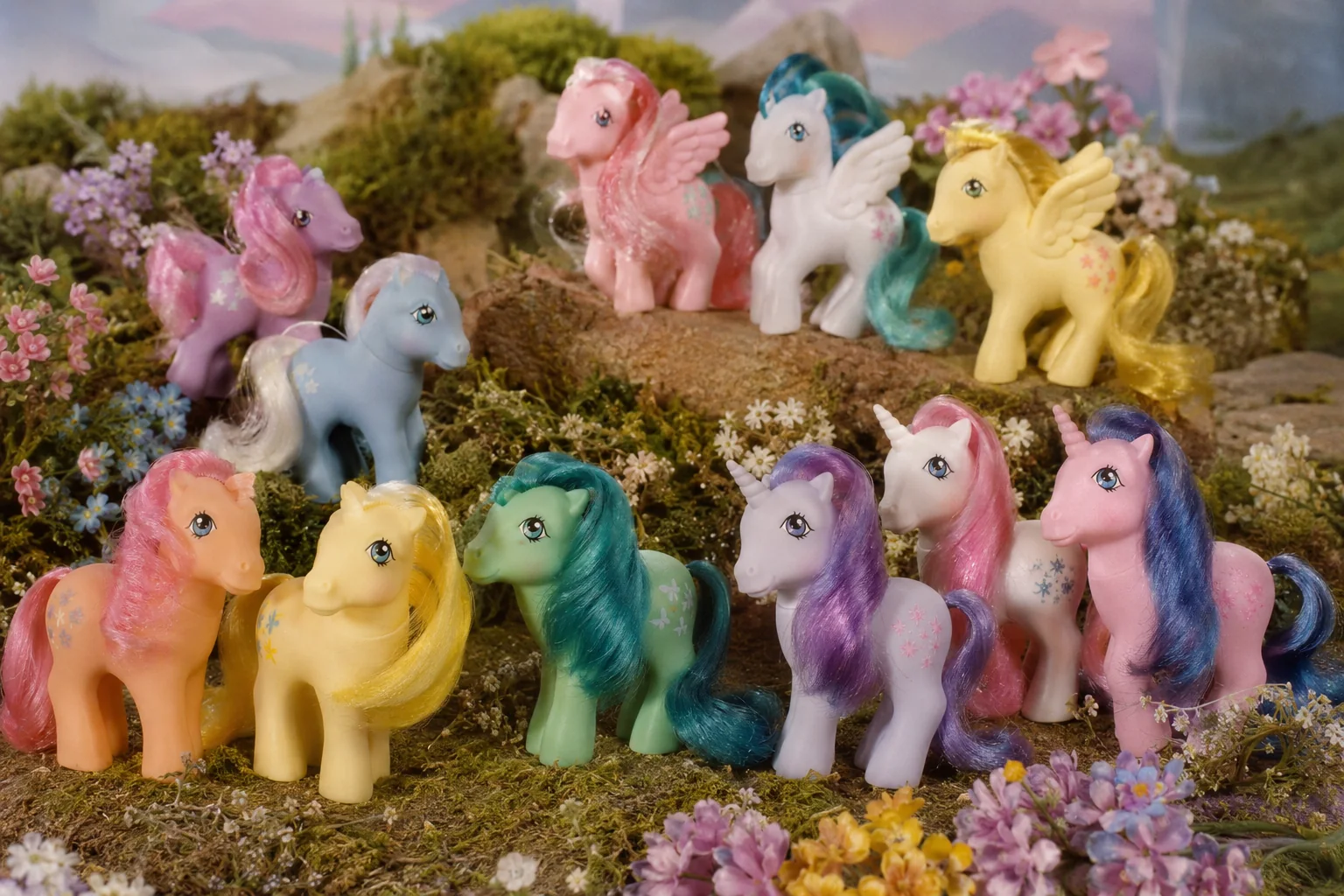
The expansion beyond the original Earth Ponies gave the line a fantasy structure. Unicorns and Pegasus Ponies did not merely add a horn or wings. They changed the way children imagined the world around the toys.
Earth Ponies remained the everyday center
Earth Ponies felt domestic, dependable, and easy to place in stables, homes, gardens, and family stories. Their normal horse shape made the fantasy world feel grounded.
Unicorn Ponies introduced direct magic
A horn immediately suggested powers. Moondancer, Glory, Sunbeam, Twilight, Gusty, Powder, and Sparkler could teleport, cast spells, create light, control weather, or do whatever the afternoon required.
Pegasus Ponies brought flight into the playroom
Firefly, Medley, Surprise, Heart Throb, and others could rescue, race, scout, deliver messages, or simply avoid every problem by flying over it.
Wings and horns created easy sorting
Children organized by type, color, family, or story role. Unicorns might live in the castle. Pegasus Ponies might sleep near the top. Earth Ponies handled everything practical because fantasy worlds still need somebody to run the stable.
Firefly became one of the defining early characters
Firefly’s bright color, wings, lightning symbols, and media role made the toy feel like an action hero disguised as a pastel pony.
Applejack became memorable before later generations reused the name
The original Applejack had a straightforward Earth Pony design and apple symbols. Later versions changed the character dramatically, but Gen X collectors remember the earlier shape and colors first.
Fantasy types expanded the stories without requiring enemies
Flight, magic, weather, rainbows, and rescue gave the ponies adventure. A child could create danger, but the line did not need every package to arrive with somebody to defeat.
The mane stopped choosing one color and committed to the entire decade
G1 Rainbow Ponies and the First Major My Little Pony Expansion
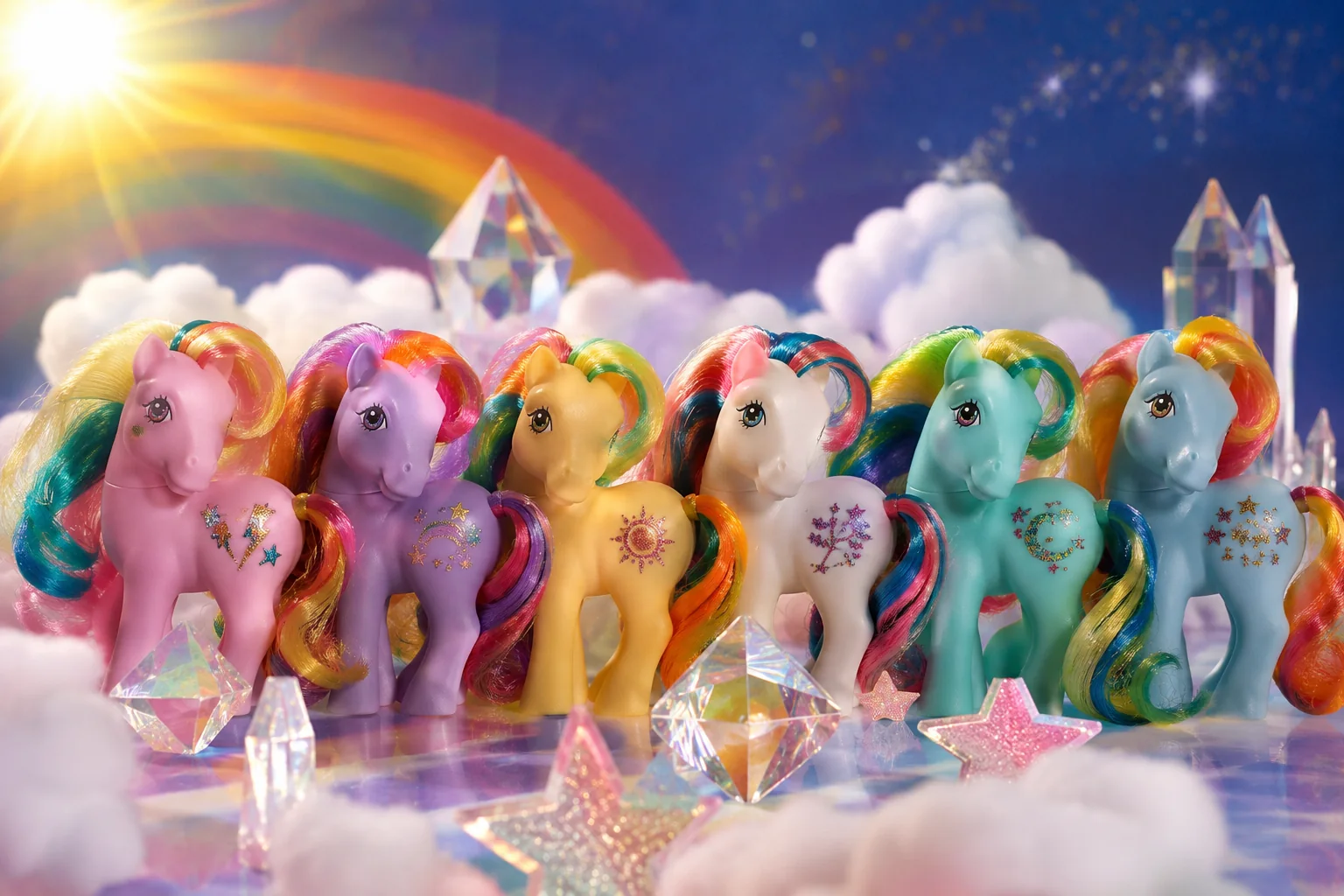
Rainbow Ponies pushed the line from colorful into unmistakably magical. Moonstone, Parasol, Skydancer, Starshine, Sunlight, and Windy used multi-colored hair and glittery symbols to look more elaborate than the first wave.
Rainbow hair created immediate shelf presence
A multi-colored mane was not subtle. It made the pony look premium, fantastical, and difficult to brush into one perfectly aligned sheet.
The names sounded like weather and light
Moonstone, Sunlight, Starshine, Windy, and Skydancer created a sky-and-rainbow theme. Parasol brought the same visual world down to Earth with a symbol every child understood.
Glittery symbols reinforced the upgrade
The line used shine strategically. Rainbow hair plus glitter symbols made the assortment feel like a genuine new category rather than six old ponies with different colors.
The expansion fit the top toys of 1983
By 1983, My Little Pony was moving from an interesting launch into a full collectible system. New types, playsets, and stronger visual themes made the brand harder to dismiss as a one-season novelty.
Rereleases created early version confusion
Some Rainbow Ponies returned in later assortments or through mail-away offers. That helped children who missed them and gave future collectors more opportunities to debate packaging, foot style, and exact release year.
Rainbow Hair Became Part of the My Little Pony Identity
Later cartoons, packaging, logos, and playsets leaned heavily into rainbows. The feature was not only hair decoration. It became a symbol of the entire world.
The bathtub finally received an official population
G1 Sea Ponies and Baby Sea Ponies
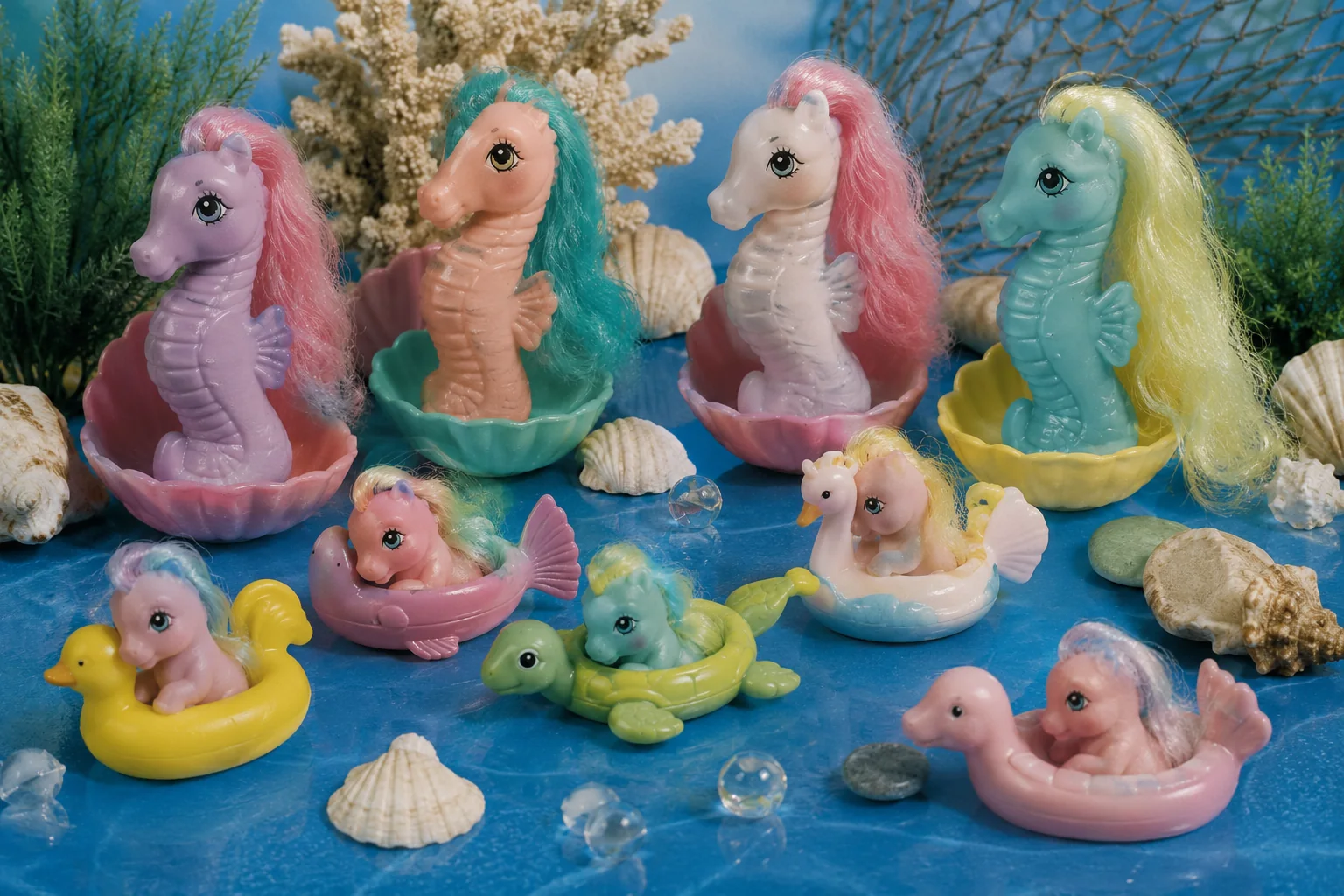
Sea Ponies were among the most unusual original My Little Pony toys. They replaced ordinary legs with curled seahorse-style tails and often came with shell stands or floating accessories. They belonged in water, which gave the line an entirely new environment.
Sea Ponies changed the silhouette completely
Sealight, Seawinkle, and Wavedancer did not look like ordinary ponies with one added feature. They looked like creatures from another part of the world.
Shell stands made display part of the design
Adult Sea Ponies could sit inside colorful shells. The stand helped the unusual body shape remain upright and gave each toy an environmental accessory.
Baby Sea Ponies came with floats
Duck, fish, turtle, and other animal-shaped floats turned the bathtub into a full playset. Tiny Bubbles, Splasher, Backstroke, Sea Shimmer, and others could join bath time without pretending the sink was an ocean.
Water play created its own maintenance problems
Water could enter bodies, hair could stay damp, and bath toys could develop problems no child noticed until adulthood. Drying the pony completely was less exciting than calling upon the Sea Ponies.
The animated special made them unforgettable
The “Call Upon the Sea Ponies” sequence gave the toys a song, a rescue function, and a shared identity. It also placed a melody in Gen X memory that can reappear without warning.
The toys expanded the world beyond castles and meadows
Once the line had an ocean population, every bath, pool, sink, and blue blanket could become part of Ponyland.
The adult ponies became parents, which meant the collection now needed a nursery
G1 Baby Ponies, Pony Families, and the Lullabye Nursery
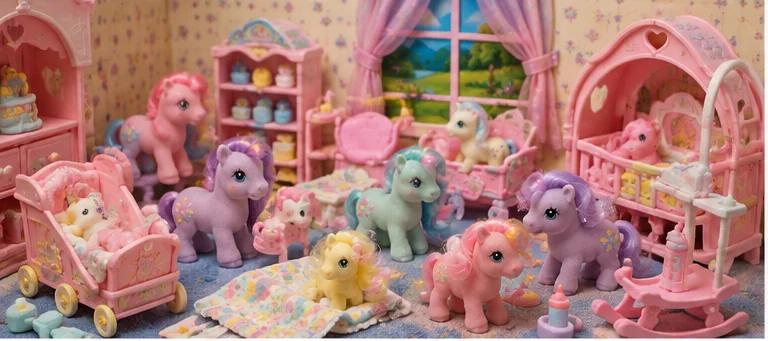
Baby Ponies expanded the line through family play. Smaller versions of familiar characters could become daughters, younger sisters, cousins, or completely unrelated children depending on how much attention the owner paid to official naming.
Baby versions made familiar ponies feel new
Baby Blossom, Baby Cotton Candy, Baby Firefly, Baby Glory, Baby Moondancer, and Baby Surprise echoed adult characters while creating a different scale and emotional role.
Smaller bodies invited nurturing play
Babies needed beds, bottles, baths, blankets, strollers, and supervision. The child became caretaker, parent, teacher, and emergency hairdresser.
The Lullabye Nursery Turned Baby Ponies Into a Household
A nursery transformed loose baby ponies into an organized household. Beds, furniture, changing areas, and small accessories made the scene feel domestic.
The Baby Buggy created travel
A stroller-sized vehicle gave baby ponies somewhere to ride and gave children another object with tiny pieces capable of disappearing under furniture.
Beddy-Bye Eyes became memorable and divisive
Some baby ponies had eyes that opened and closed. The gimmick made them feel more doll-like. It also created an expression that could look sweet, sleepy, or slightly haunted depending on whether both eyes closed at the same speed.
Family play encouraged duplicate themes
An adult and baby with related colors or symbols looked like a set. Completing a family felt different from merely buying another pony, even when the receipt disagreed.
Somebody looked at smooth vinyl and said, “What if we covered the entire horse in fuzz?”
So Soft Ponies and the Flocked G1 My Little Pony Era
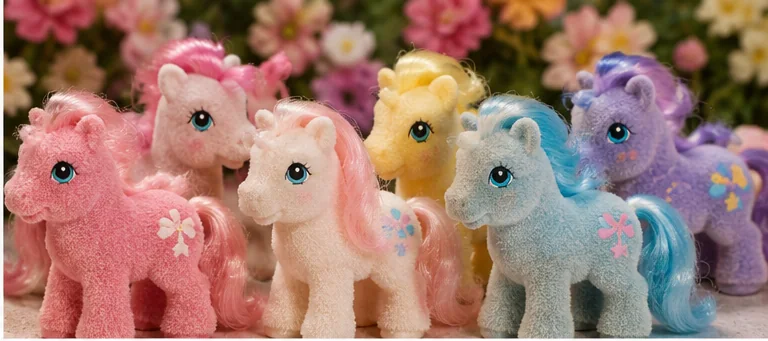
So Soft Ponies were coated in short fuzzy flocking that changed both the look and feel of the toy. The line already invited touching and grooming. Flocking made the body itself part of the sensory experience.
The texture felt premium in the package
A fuzzy pony stood out beside smooth vinyl figures. The finish looked soft, delicate, and slightly more sophisticated than a standard release.
The flocking created a maintenance challenge
Dirt, wear, rubbing, water, and heavy play could thin or damage the surface. High-contact areas such as noses, ears, hooves, and raised body points often show loss.
Popular characters returned in flocked form
Gusty, Cherries Jubilee, Heart Throb, Surprise, and others appeared in So Soft assortments, giving familiar names a new finish.
Deflocking became an adult restoration choice
Collectors sometimes remove damaged flocking to reveal the vinyl body underneath. A deflocked pony can look clean and attractive, but it is no longer in its original finish.
The finish made hair care more complicated
Water, conditioner, and aggressive cleaning that might help a smooth pony could damage flocking. The toy required the kind of specialized grooming instructions no child had requested.
So Soft Ponies arrived during the top toys of 1985 era
By the middle of the decade, My Little Pony needed new reasons to stand out in a crowded toy aisle. Texture became one of the line’s smartest answers.
Beautiful wings, delicate hinges, and one childhood afternoon away from being missing
G1 Flutter Ponies and Their Fragile Butterfly Wings
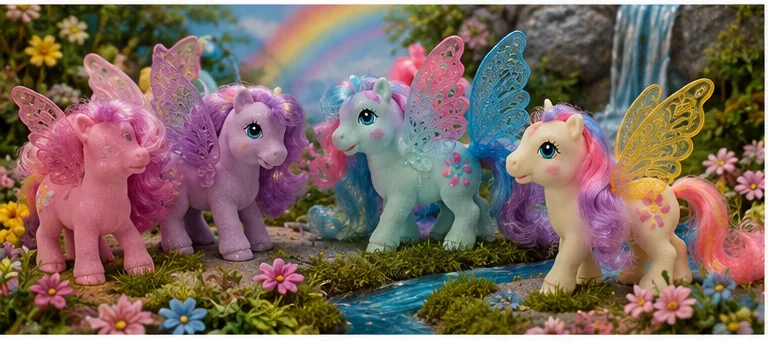
Flutter Ponies had smaller, slimmer bodies and large translucent butterfly-style wings. The wings could move through a mechanism, creating a visual effect unlike ordinary Pegasus Ponies.
The body shape looked lighter
Flutter Ponies appeared more delicate than the sturdy early Earth Ponies. Their proportions matched the winged-fairy theme.
The wings created movement and danger
A child could make the wings flutter, which was wonderful. The wings were also removable, thin, and much less likely to survive decades than the vinyl body.
Complete examples are harder to find
Many vintage Flutter Ponies survive without wings. The pony itself may look fine while the defining feature disappeared sometime between a birthday party and a family move.
The transparent wings changed the display
Light passed through them, making the figures look bright and magical on a shelf. They also looked excellent for approximately three minutes before somebody tried to fly one off a dresser.
Flutter Valley strengthened the media connection
Animated stories built a home and mythology around the winged ponies. The toys no longer looked like an isolated gimmick. They belonged to a place.
The wings became a collector warning label
When buying a vintage Flutter Pony, collectors examine tabs, hinges, cracks, discoloration, replacements, and whether the wings are original. Childhood saw fairy wings. Adulthood sees a parts audit.
Once color and hair were not enough, the line added jewels, glitter, scent, growing hair, and symbols everywhere
Twinkle Eye, Twice As Fancy, Sparkle, and Other G1 Pony Gimmicks
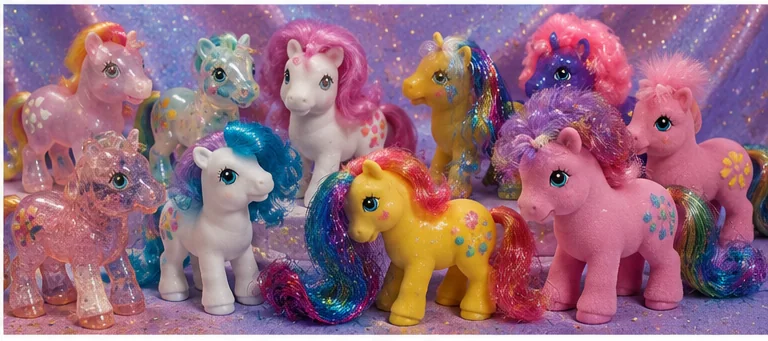
The longer My Little Pony remained successful, the more inventive the assortments became. Hasbro repeatedly changed texture, eyes, hair, scent, transparency, symbols, or movement while keeping the basic pony format recognizable.
Twinkle Eye Ponies
Faceted jewel-like eyes replaced ordinary painted eyes. They sparkled, looked glamorous, and occasionally stared into the middle distance with tremendous commitment.
Twice As Fancy Ponies
Symbols spread beyond the flank and across more of the body. The pony looked fully decorated instead of politely labeled.
Sparkle Ponies
Translucent bodies with glitter created a crystal-like effect that looked especially dramatic in window light.
Brush ’n Grow Ponies
Extra-long hair could be pulled from inside the body, giving grooming-focused children an amount of mane no ordinary comb was emotionally prepared to handle.
Perfume Puff Ponies
Soft, fluffy hair and scent turned the pony into something halfway between a toy, a beauty product, and a pom-pom with hooves.
Happy Tails Ponies
A mechanism moved the tail when the body was pressed. It was simple, visible, and the kind of feature children repeated until an adult asked whether the pony needed a break.
Merry Go Round Ponies
Decorative saddle-blanket designs turned the figures into carousel horses without needing an actual carousel.
Pony Friends
Giraffes, zebras, lions, llamas, elephants, dinosaurs, and other animals stretched the visual language beyond ponies while still looking like they belonged in the same world.
Princess Ponies
Regal themes, elaborate symbols, accessories, and jewel-like details pushed the collection toward fantasy royalty.
Every gimmick created a new collecting category
A child who owned several Earth Ponies did not necessarily own a Twinkle Eye Pony. The categories prevented the collection from ever feeling complete for long.
The basic shape remained recognizable
Even the strangest variations still looked like My Little Pony. That continuity allowed the brand to experiment without losing its identity.
The pony was five inches long. The world around it kept demanding more furniture.
Vintage My Little Pony Playsets and Accessories
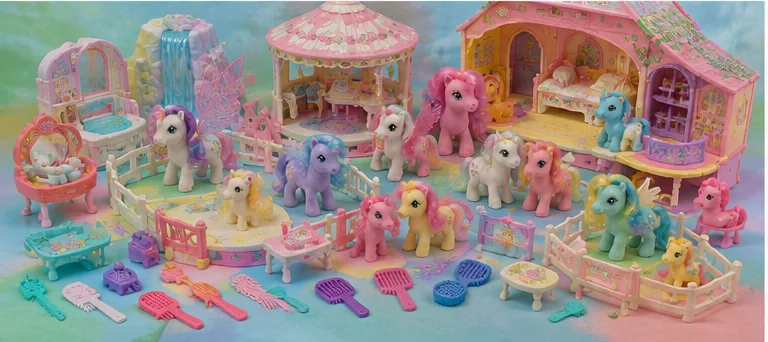
Playsets turned the collection into a place. Stables, parlors, waterfalls, nurseries, castles, estates, and carrying cases gave the ponies jobs, rooms, routines, and social geography.
Pretty Parlor made grooming official
The parlor connected directly to the line’s strongest play pattern. A pony could be brushed, styled, accessorized, and displayed in a setting built for the activity.
Show Stable made the ponies feel like horses again
Stalls, fences, grooming equipment, and animal companions brought the fantasy closer to real stable play. The ponies could be magical and still need somewhere to stand.
Waterfall made scenery part of the toy
Sprinkles and the Waterfall playset created a bright fantasy environment. Water-themed play always looked magnificent in catalogs and slightly more complicated on household flooring.
The Lullabye Nursery supported the baby boom
Baby Ponies needed furniture, care equipment, and a home designed around them. The nursery transformed family play from an improvised blanket into a complete environment.
Small accessories made the world convincing
Combs, brushes, ribbons, saddles, baskets, cups, bottles, furniture, clothing, fences, and animal companions created scale. They also created the future collector phrase “complete except for three tiny pink pieces.”
Playset ponies made the purchase feel exclusive
Majesty belonged to Dream Castle. Peachy came with Pretty Parlor. Lemon Drop came with Show Stable. Sprinkles came with Waterfall. The included pony gave the structure a resident and made the set difficult to separate mentally.
The packaging showed a world no actual playroom maintained
Catalog scenes displayed every pony groomed, every accessory upright, every room organized, and no unrelated toy lying across the entrance. Real playrooms took a more improvisational approach.
Majesty had a castle, Spike had a dragon-sized job, and the rest of the herd had somewhere to visit
My Little Pony Dream Castle: The Original G1 Castle Playset
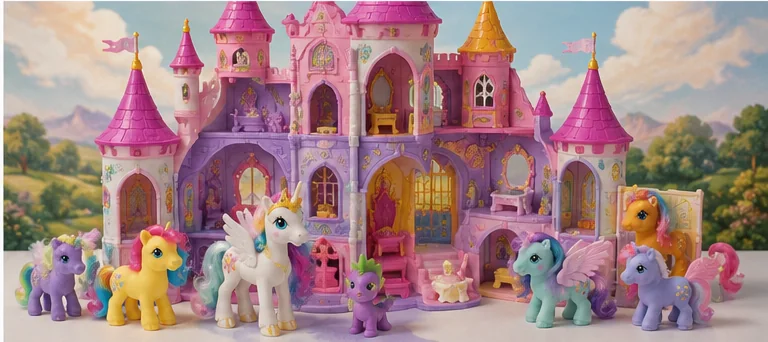
The My Little Pony Dream Castle toy became one of the defining G1 playsets. It gave the line towers, doors, rooms, royal accessories, Majesty, Spike, and a permanent place where the rest of the herd could arrive for a visit and somehow remain through dinner.
Majesty made the castle feel inhabited
The included white unicorn was not simply another pony. Her name and setting implied authority. If the other ponies had questions, Majesty probably had a meeting scheduled.
Spike connected the toy line to fantasy creatures
The small dragon gave the castle a companion character and added something beyond the herd. Spike could be pet, friend, guard, or the only creature expected to clean up after everybody.
The castle created vertical play
Towers, elevated spaces, doors, and rooms gave ponies places to move through rather than simply stand around. Height made the structure look larger than the floor space alone.
Royal stories came naturally
Coronations, parties, rescues, visitors, weddings, disagreements, and elaborate household politics all made sense inside a castle.
The set became a visual centerpiece
A row of ponies could be put away. Dream Castle announced itself. It looked like the collection had headquarters.
Completeness now depends on small pieces
Flags, doors, furniture, accessories, Spike, Majesty, and structural parts can be lost or replaced. A castle shell may survive long after its tiny royal household scattered.
Dream Castle was magical. Paradise Estate looked like the ponies had moved to a very successful subdivision.
My Little Pony Paradise Estate: The Giant Mid-80s Playset
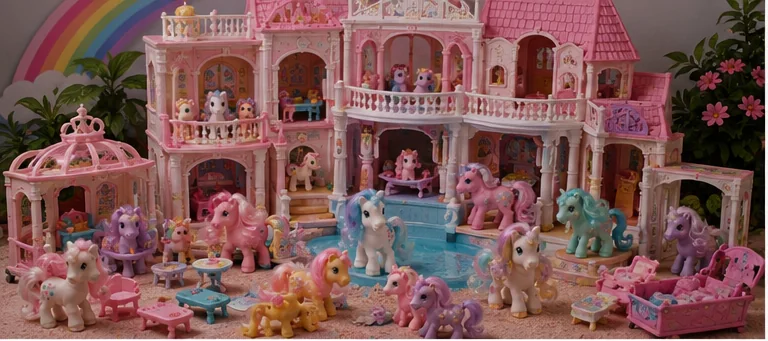
The My Little Pony Paradise Estate playset expanded domestic play on a much larger scale. The sprawling pink-and-white home included multiple rooms and outdoor areas, giving ponies a kitchen, bedroom, living area, nursery, patio, and pool—basically a better housing market than most adults eventually received.
The estate looked enormous when opened
Multiple sections spread across the floor, creating a mansion-like environment. A child could arrange several stories at once without making every pony wait in the hallway.
Rooms gave the collection everyday life
Dream Castle suggested royalty. Paradise Estate suggested breakfast, bedtime, visitors, parties, babies, and somebody leaving every chair in the wrong room.
The pool made luxury visible
A pool and patio turned the playset into a vacation property. Sea Ponies could visit. Baby Ponies could create a safety concern. Adults could wonder why the toy needed water anywhere near carpet.
The set supported large collections
A small herd looked comfortable. A large herd looked at home. The playset rewarded children who had been collecting for several years.
Furniture became essential and vulnerable
Tables, chairs, beds, nursery pieces, kitchen items, and outdoor accessories made the estate convincing. Missing furniture made the surviving shell look like the ponies had recently moved.
Paradise Estate represented peak middle-decade ambition
By 1985–86, My Little Pony had enough characters and demand to support a mansion. The line had traveled a long way from six ponies on simple cardbacks.
Every pony came with hair. Every household had one comb that immediately disappeared.
Brushing, Braiding, Washing, and the My Little Pony Grooming Ritual
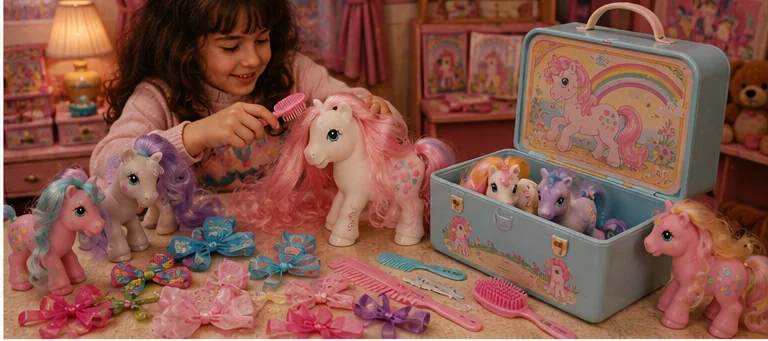
Grooming was not a side feature. It was the line’s daily engine. A child could finish a story, then brush the herd, restyle the manes, sort ribbons, or attempt a hairstyle seen in a commercial and produce something closer to a weather event.
Brushing created quiet, repetitive play
The motion was calming and easy to repeat. It required no rules, partner, or setup. One pony and one brush could fill time.
Braiding felt like skill
Simple braids became double braids, ribbon braids, twisted tails, and elaborate arrangements held together by bands that were definitely not designed for toy hair.
Water reset the hairstyle and created new trouble
Washing could smooth hair, remove dirt, or prepare for styling. It could also trap water inside the body, loosen glue, fade flocking, damage mechanisms, and leave a pony damp long after bath time.
Haircuts became irreversible creativity
Some children trimmed damaged ends. Others gave one pony bangs, a bob, or a punk haircut inspired by no known stable. Adult collectors call this “cut hair.” Children called it improvement.
Ribbons and clips personalized the collection
Official accessories mixed with household ribbons, barrettes, rubber bands, yarn, and pieces borrowed from dolls. The pony became a canvas for whatever was available.
Tangles recorded years of play
Knots, frizz, dryness, and broken strands are not random defects. They are evidence that the pony was handled, loved, packed away, found, brushed again, and possibly transported in a plastic grocery bag.
The horse was already pink with rainbow hair. Naturally, it needed formalwear.
Pony Wear, Saddles, Costumes, and Tiny Fashion Accessories
My Little Pony expanded into clothing and themed outfits that pushed the toys closer to fashion-doll play. Saddles, capes, dresses, veils, hats, leg warmers, performance outfits, and jewelry gave the ponies occasions.
Outfits created events
A wedding set created a wedding. A party outfit created a party. A performance costume created a show. The accessory did not only decorate the pony. It generated the next story.
Fabric added texture to the vinyl world
Soft clothes, ribbons, elastic, lace, and trim made the toy feel different in the hand. The contrast between solid body and fabric outfit increased the doll-play connection.
Saddles connected fantasy and real-horse play
Children could imagine riding, shows, races, ceremonies, or travel. Human figures such as Megan strengthened that scale relationship.
Tiny clothing disappeared efficiently
Small shoes, hats, clips, jewelry, and fabric pieces did not survive storage as well as the ponies. A complete outfit today often represents somebody’s parent doing an extraordinary job in 1986.
Mixing outfits ignored official sets
A pony could wear a veil, leg warmers, a cape, and a saddle at the same time. Fashion rules were flexible in Ponyland and completely absent in the bedroom.
The collection needed storage, transportation, and proof that it was still contained
My Little Pony Carrying Cases, Storage, and Display
Carrying cases turned the herd into a portable collection. Molded compartments, handles, illustrated exteriors, and rows of pony-sized spaces suggested that ownership could remain organized.
The case created a visual inventory
Empty spaces looked like missing ponies. Filled spaces looked like progress. The case was storage and a checklist at the same time.
Hair refused to cooperate with compartments
Long manes and tails slipped across dividers, caught under bodies, and emerged with new bends. A perfectly groomed pony could enter storage and leave looking like it had slept in a helmet.
Portable collections encouraged visits and trades
A child could bring several ponies to a friend’s house without carrying the entire playset system. The case turned a bedroom collection into a social one.
Cases protected symbols and bodies from the toy box
Hard plastic toys, metal parts, crayons, markers, and unrelated action figures could rub or stain vinyl. Separate storage improved survival.
The illustrated exterior advertised the contents
Nobody mistook a pony case for luggage. Bright art made the object part of the collection even when closed.
Adult storage became more complicated
Collectors now avoid tight spaces, heat, sunlight, dampness, dye transfer, and hair pressure. The original case remains nostalgic, but archival storage tends to be less photogenic.
Perfect hair, perfect castles, perfect songs, and not one comb lost under the couch
Why 80s My Little Pony Toy Commercials Worked
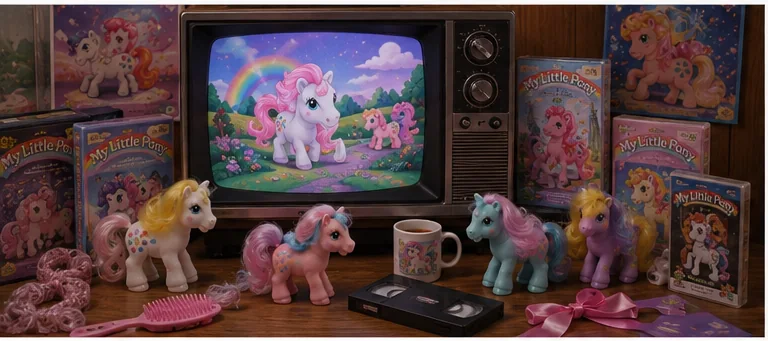
The commercials presented My Little Pony as a colorful, musical world of friendship, grooming, fantasy, and endless discovery. New assortments appeared in quick succession, each with a song, a visual hook, and a reason the existing herd suddenly needed reinforcements.
The jingle made the name impossible to forget
The brand name repeated through cheerful music until it became part of the toy itself. Children could recognize the commercial before seeing the product.
Hands demonstrated the play
Children brushed hair, opened playsets, moved wings, placed Sea Ponies in water, dressed ponies, and arranged families. The ad showed exactly what ownership looked like.
Every assortment received a clear visual gimmick
Rainbow hair, fuzzy bodies, jewel eyes, butterfly wings, baby floats, and giant houses could be understood in seconds.
The world looked completely coordinated
Commercials matched hair, outfits, playsets, accessories, backgrounds, and music. Real collections included three ponies, one Barbie brush, and a shoebox labeled “stable.”
The ads made collecting feel friendly
The message was not “defeat the enemy.” It was “meet more friends.” The result at the cash register was not especially different.
The line belonged to the era of 80s cartoon toy commercials
Animation and toys reinforced each other. The commercial gave the product a tune and movement. The cartoon gave the characters a world. The catalog gave the parent a price.
The archive still captures the decade
Watching 80s toy commercials and videos reveals how quickly the line evolved. A few seconds can move from one pony and a comb to an entire estate with a pool.
The toys entered television and discovered villains were much darker than the packaging suggested
My Little Pony Cartoons, Animated Specials, and the 1986 Movie
Animation gave the ponies voices, homes, friendships, conflicts, songs, and adventures. The television world was often stranger and more dangerous than the soft toy aisle implied.
Rescue at Midnight Castle arrived in 1984
The first animated special introduced Megan, Firefly, Applejack, Twilight, Bow Tie, Sea Ponies, Spike, and the dark threat of Tirac. It established that Ponyland contained genuine danger, not only grooming appointments.
Firefly became the action pony
Her speed, courage, and role in finding Megan made her one of the strongest early characters. The toy already looked dynamic. The special gave the design a mission.
The Sea Pony song became immortal
“Call Upon the Sea Ponies” connected the water toys to a rescue function. It also proved a twenty-second melody could remain hidden in the brain for decades.
Escape from Catrina followed in 1985
The second special expanded the animated world with another villain and more magical conflict. By then the toys had enough characters and locations to support continuing stories.
My Little Pony: The Movie reached theaters in 1986
The theatrical film brought a larger cast, original songs, celebrity voices, and the Smooze. It also gave the middle of the decade a definitive media event connected to the toy line.
The Smooze was not what the catalog had prepared us for
A spreading purple force that swallowed Ponyland was darker and messier than ordinary toy advertising. The movie understood that even pastel fantasy needs a threat large enough to justify an entire herd.
My Little Pony ’n Friends turned the world into a series
The syndicated show continued the adventures and shared the half-hour with other Hasbro properties. More episodes meant more characters could appear, and more toys could feel familiar.
The media era grew during the top toys of 1986
By 1986, My Little Pony was no longer only a toy line. It had a movie, television presence, music, stories, villains, homes, and a backlog of characters large enough to require introductions.
The cartoon and toy versions did not always match perfectly
Colors, personalities, roles, and appearances could shift. Children rarely cared. If the character on television was close enough to the pony on the floor, the mission continued.
Save the points, find the form, persuade an adult, mail the envelope, and begin the longest six weeks of your life
Mail-Away My Little Pony Toys and Horseshoe Points
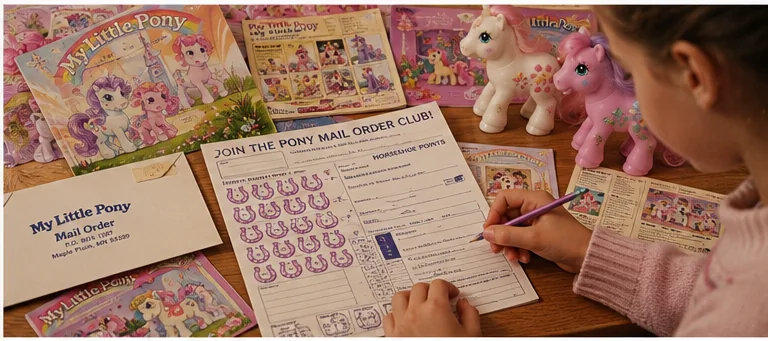
Mail-away offers turned packaging into currency. Children saved points, clipped forms, chose an offer, added payment, and waited for a pony that could not simply be picked up at the store.
Points made empty packaging feel valuable
A cardback or box contained more than art and instructions. It contained future purchasing power. Throwing it away could feel like discarding part of the collection.
Waiting increased the emotional value
A store purchase was immediate. A mail-away pony required weeks. The delay gave the arrival the weight of a federal delivery.
Some mail-away ponies were exclusive
Special colors, Birthflower Ponies, Ember versions, Sparkle Ponies, and promotional releases created items that could not be found through ordinary shelf hunting.
Other offers brought back missed ponies
Previously released ponies sometimes returned through mail order. This gave children another chance to fill gaps and adults another version to identify later.
Forms and packaging rarely survived together
The point of the program was to cut, mail, and use the materials. Complete unused forms now exist because somebody resisted a system designed to be irresistible.
Mail-away collecting felt secret
The pony did not sit in the aisle for everyone. It arrived in plain packaging after a process. That made the toy feel like proof that the owner knew the deeper rules of the brand.
Names were remembered, families were invented, duplicates were negotiated, and every shelf developed a social structure
Trading, Naming, Organizing, and Trying to Complete My Little Pony Sets
The original My Little Pony toys encouraged children to behave like collectors before they knew the word. The herd could be sorted by color, type, family, year, symbol, favorite, or whatever system made sense that afternoon.
Names mattered because the ponies looked similar from a distance
Remembering Bow Tie, Tootsie, Posey, Applejack, Gusty, Medley, and Moonstone became part of ownership. The name connected the visual details into one character.
Children renamed ponies anyway
Official names did not prevent a child from calling one “Princess Rainbow,” “Baby Purple,” or “The Mom.” Toy companies supplied identity. Playrooms edited it.
Families ignored release logic
Matching colors, symbols, hair, or body types could create parent-child relationships. Two unrelated ponies might become sisters because their manes looked good together.
Duplicates could be useful
One duplicate became a twin, cousin, school friend, or trade. A haircut disaster could transform the second pony into a completely different character.
Trading required condition judgment
Hair length, missing accessories, faded symbols, ink marks, and body condition affected playground value even when nobody used those formal terms.
Set completion created pressure
Owning five of six Rainbow Ponies made the missing one more visible. A nearly complete set did not feel nearly complete. It felt one pony short.
Organization never lasted
The herd could be arranged perfectly by color, size, and type. Then a story began, Sea Ponies invaded the nursery, and the entire system collapsed by dinner.
The catalog showed the complete herd. The budget showed two ponies and maybe a brush.
My Little Pony at Christmas: Catalogs, Playsets, and Wish-List Logic
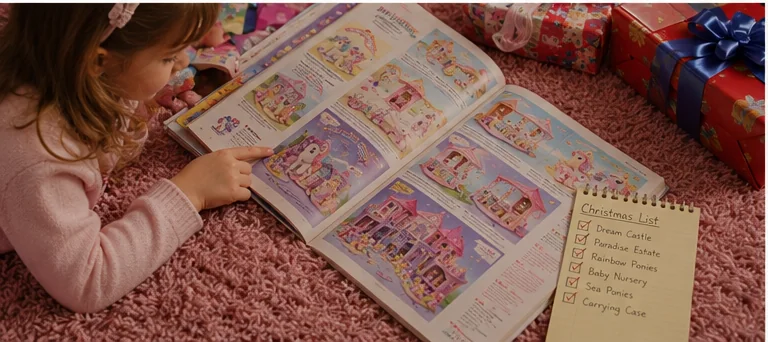
My Little Pony was built for holiday shopping because the line covered several price levels. A single pony made a manageable gift. A playset became the main event. A carrying case, clothing pack, baby set, or mail-away offer could fill the spaces between.
A single pony worked as an affordable gift
The package looked colorful and complete. A child could open it and begin brushing immediately without assembly, batteries, or an adult searching for a screwdriver.
Playsets created the large box under the tree
Dream Castle, Lullabye Nursery, Waterfall, Show Stable, and Paradise Estate carried more visual weight. They also required setup, stickers, small accessories, and somebody to understand the instructions before breakfast.
Catalog photography created impossible standards
Every pony stood upright. Every mane was smooth. Every piece of furniture had a room. No one had mixed the Sea Ponies into the kitchen.
The line belonged among the hottest Christmas toys of the 80s
My Little Pony did not depend on one shortage-driven year. It remained giftable through waves of characters, playsets, baby assortments, media releases, and new gimmicks.
The top toys of 1984 era brought stronger fantasy
Unicorns, Pegasus Ponies, Rainbow Ponies, Sea Ponies, playsets, and the first animated special made the brand feel much larger than the original six.
Parents could scale the purchase
A family could buy one pony, a small accessory set, or an entire household. The brand remained visible at several budget levels, which helped it stay in gift rotation.
The collection made future gifts easy
Once a child owned ponies, relatives knew what to buy. They did not need to understand the difference between Moondancer and Moonstone. They only needed to avoid buying the exact same one, which was harder than it sounded.
Five years from six simple ponies to castles, babies, fuzz, movies, and an estate with a pool
My Little Pony Toys by Year: The 1982–1986 G1 Expansion
The small-pony idea arrives
The first compact ponies establish the body shape, brushable hair, names, symbols, and collecting logic. Retail and collector-year labels overlap into 1983, but the basic G1 formula is in place.
The original six gain a larger world
The first full retail expansion adds more visibility, stronger packaging identity, and the beginning of the category growth that will make the line a decade fixture.
Unicorns, Pegasus Ponies, Rainbow Ponies, Sea Ponies, and major playsets
Fantasy types and environmental playsets expand the herd. Rescue at Midnight Castle gives the toys an animated world and memorable characters.
Baby Ponies, larger families, more media, and deeper collecting
The line becomes a social system of parents, babies, homes, nurseries, accessories, mail-away offers, and increasingly specialized assortments.
So Soft Ponies, Flutter Ponies, Paradise Estate, the movie, and television
The middle of the decade represents peak expansion. Texture, fragile wings, giant domestic playsets, theatrical animation, and a syndicated series make My Little Pony a complete media-and-toy world.
1982 created the collectible shape
The smaller pony solved the scale problem. Children could own more than one, and Hasbro could produce variation without reinventing the toy.
1983 proved the herd could grow
The line moved beyond a test into a recognizable brand. Color and symbols became a durable visual system.
1984 added magic, water, castles, and television
The world gained unicorns, wings, rainbows, Sea Ponies, playsets, and animation. The pony became a fantasy character rather than only a groomable toy.
1985 made family and collecting central
Baby Ponies, nurseries, mail-away offers, larger rosters, and repeat assortments encouraged children to think in sets and relationships.
1986 delivered the full ecosystem
Movie, television, giant playsets, fuzzy bodies, Flutter wings, and specialized categories showed how far the brand could stretch while remaining recognizable.
The herd kept expanding after the movie, and the gimmicks became gloriously specific
Late-80s G1 My Little Pony Toys and Specialty Sets
My Little Pony continued through the late 80s with increasingly specialized sets, new body styles, more elaborate symbols, changing hair, new finishes, and subcategories built around one clear feature.
The line leaned further into visual gimmicks
Twice As Fancy, Twinkle Eye, Sparkle, Brush ’n Grow, Perfume Puff, Merry Go Round, and other groups gave the shelf stronger differences than the earliest waves.
New poses made the herd look less uniform
Rearing, turning, stepping, and slimmer bodies created more movement. A late-80s lineup looked far more varied than the original six.
Bright packaging kept pace with the decade
As the 80s became louder, packaging and assortment concepts became more elaborate. The line remained pastel, but it was no longer visually quiet.
Pony Friends stretched the species limit
Lions, giraffes, zebras, llamas, elephants, dinosaurs, and other animals joined the world. The category remained “My Little Pony” while quietly becoming “My Little Almost Anything.”
Among the top toys of 1989, My Little Pony represented one of the decade’s most established collectible worlds. The simple six-pony beginning had become a sprawling stable of babies, friends, royalty, glitter, scent, long hair, unusual animals, and enough accessories to make storage a separate hobby.
The Top Toys of 1989 Closed the Decade With a Huge Herd
The top toys of 1988 arrived as Nintendo and electronic toys claimed more of the room. G1 My Little Pony stayed relevant by becoming even more visually specific, offering sets that looked different before a child ever read the name.
The Top Toys of 1988 Faced a Louder Electronic Toy Aisle
By the time the top toys of 1987 were filling catalogs, My Little Pony already had years of characters, babies, homes, media stories, and specialty assortments behind it. New releases did not need to explain the basic idea. They needed a new texture, symbol pattern, body shape, or hair trick.
The Top Toys of 1987 Met a Fully Built Pony World
Shorter-lived releases became collector targets
Later assortments sometimes had less cultural visibility than the peak years. Complete examples with accessories can therefore be surprisingly difficult to find.
The original simplicity became harder to see
By the end of the decade, a child entering the line faced years of types, poses, babies, gimmicks, homes, outfits, and creatures. The original six looked almost minimalist.
The name survived, the designs changed, and every generation became somebody’s correct one
How Original G1 My Little Pony Differs From Later Generations
My Little Pony has returned in multiple redesigned generations. Later versions changed body proportions, faces, personalities, animation styles, world-building, and the balance between toy-first and character-first storytelling.
G1 bodies looked more horse-like
The original ponies had thicker bodies, shorter legs, larger muzzles, and solid stances. Later designs often became slimmer, more expressive, and more cartoon-shaped.
G1 identity began with the toy
Names and symbols existed, but children had room to invent personalities. Later generations increasingly used established casts with detailed personalities, friendships, and ongoing television stories.
The symbols changed terminology
Gen X collectors usually called them symbols. Later storytelling popularized the term “cutie marks” and built more mythology around what they meant.
Hair remained important but became less central in some versions
G1 play heavily emphasized brushing, styling, and large collections of individual toys. Later media success sometimes made character recognition more important than grooming.
Friendship Is Magic created a different kind of fandom
The 2010 series developed a strong central cast, deep lore, comedy, continuity, and a much broader adult fan community. It was enormously successful, but it was not the same experience as opening a 1984 Rainbow Pony with no homework about personality.
Modern retro releases brought the original look back
Anniversary reproductions and collector editions revived G1 shapes and colors for adults who remembered the originals and children who had no idea why their parent suddenly knew six pony names.
Every generation inherited the same core idea
Colorful ponies, symbols, friendship, fantasy, individuality, and collecting remained. The proportions changed. The emotional hook did not.
The pony survived the toy box. The hair, flocking, wings, symbols, scent, and tiny comb each filed separate reports.
Collecting and Restoring Vintage G1 My Little Pony Toys
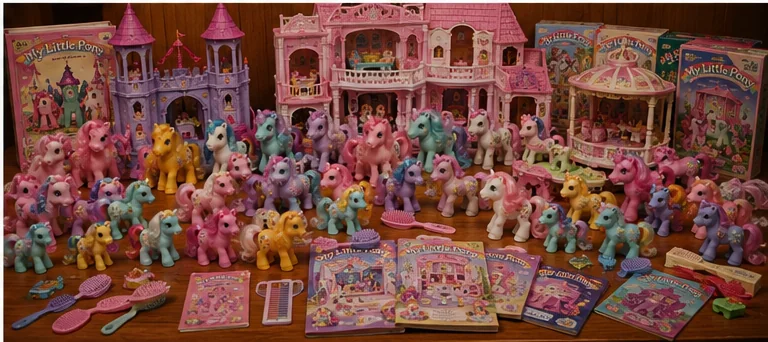
Collecting vintage 1980s My Little Pony toys depends on exact identity, condition, country of manufacture, pose, hair, symbols, accessories, packaging, and whether the pony still has the feature that made the assortment special.
How to Identify an Original G1 My Little Pony
A name may be reused across generations. Collectors compare body shape, foot style, head mold, eye color, hair color, symbol placement, and manufacturing marks.
Original Mane and Tail Condition Matter
Cut hair, dry hair, frizz, missing plugs, faded color, and replacement hair affect originality and appearance. Some ponies are famous for hair colors that fade under sunlight.
Body discoloration can come from several sources
Sun, age, storage, plastic breakdown, ink transfer, mildew, rust, and contact with other materials can change vinyl. Not every mark responds safely to cleaning.
Rust can develop around internal metal parts
Water entering the body may reach washers or tail hardware. Rust can stain the body and hair. A pony that spent years in the bathtub may contain more history than expected.
Flocking requires specialized care
So Soft Ponies should not be treated like ordinary smooth vinyl. Aggressive washing can remove flocking, flatten texture, or spread damage.
Flutter wings are a major completeness issue
Original wings, unbroken tabs, working mechanisms, and correct pairs matter. Reproduction wings can improve display but should be disclosed.
Sea Pony shells and baby floats matter
The unusual accessories complete the design. A Sea Pony without its shell or a Baby Sea Pony without its float is still recognizable but incomplete.
Playset accessories create long checklists
Furniture, combs, ribbons, fences, animals, flags, doors, cups, bottles, beds, and small decorations can matter. A large playset shell may represent only the beginning of the search.
Country variants deepen the hobby
International releases can differ in color, hair, symbols, pose, materials, packaging, and availability. The same character name may lead to several visually distinct toys.
Restoration should be reversible when possible
Gentle cleaning, careful detangling, controlled conditioning, and documented replacement parts are safer than aggressive chemicals, permanent paint, or untested brightening methods.
Sold prices matter more than hopeful listings
The separate guide to valuable vintage My Little Pony toys belongs to the pricing question. Exact version, condition, completeness, and verified sales determine market value.
Emotional value does not require mint condition
A pony with a faded symbol and uneven haircut may be worthless to a perfectionist and priceless to the person who remembers brushing it on the living-room floor.
The mane tangled, the symbol faded, and the brand still became immortal
Why Original My Little Pony Toys Still Matter
The original My Little Pony toys lasted because the line understood that children did not need conflict to create deep play. Care, identity, color, organization, family, home, friendship, grooming, and collecting were enough. That quieter style of play became an essential part of the larger 80s nostalgia landscape.
The line made variation emotionally meaningful
A different color was not merely a repaint. Combined with a name, symbol, pose, and hair, it became another character.
Grooming created attachment through repetition
Children handled the toys constantly. Brushing and styling made the relationship physical and routine. The pony became familiar in a way a static figure often did not.
The world grew without abandoning the basic toy
Castles, babies, Sea Ponies, fuzzy bodies, butterfly wings, movies, and mansions all expanded the concept while leaving the original brushable pony recognizable.
The line respected quiet play
There was no score, timer, battery, or correct ending. The child could organize for an hour and call that the story.
My Little Pony earned a place among the most iconic toys of the 80s
The brand did not merely sell through the decade. It became a visual language: pastel vinyl, bright hair, side symbols, rainbows, tiny combs, and shelves that looked like a candy-colored stable.
The toys crossed generations without becoming identical
Parents introduced children to later versions. Adult collectors restored originals. Retro releases revived the first designs. New shows created new fans without erasing the older herd.
The National Toy Hall of Fame recognition fit the legacy
More than forty years after the original line, My Little Pony remained recognizable enough to stand beside the most enduring toys in American childhood.
Gen X still remembers the physical details
The smell of the vinyl. The feel of the hair. The stiff new tail. The tiny brush. The faded symbol. The one pony whose mane never lay flat. Those details survive more clearly than half the things adults told us were important.
The questions that arrive whenever a plastic storage bin reveals a pastel mane
My Little Pony Toys in the 80s FAQ
When did the original My Little Pony toys come out?
The first small G1 My Little Pony toys were produced in the early 1980s. Collectors commonly date the launch to 1982, while many American catalog references and Hasbro anniversary materials use 1983 as the formal first year.
What were the names of the original six My Little Ponies?
The original six were Blossom, Blue Belle, Butterscotch, Cotton Candy, Minty, and Snuzzle.
What does G1 My Little Pony mean?
G1 means Generation 1, the original My Little Pony toy era that began in the early 1980s. Later redesigns are grouped into later generations.
What was My Pretty Pony?
My Pretty Pony was the large hard-plastic brushable horse that preceded the smaller collectible My Little Pony line. It included mechanical movement features and helped establish the grooming concept.
What were the pictures on the ponies called in the 80s?
Gen X children and original packaging generally referred to them as symbols. Later generations popularized the term cutie marks.
What is the difference between an Earth Pony, Unicorn Pony, and Pegasus Pony?
Earth Ponies have no horn or wings. Unicorn Ponies have a horn. Pegasus Ponies have feathered wings. Flutter Ponies are a separate smaller type with translucent butterfly-style wings.
What were Rainbow Ponies?
Rainbow Ponies had multi-colored manes and tails, often paired with glittery symbols. Early examples included Moonstone, Parasol, Skydancer, Starshine, Sunlight, and Windy.
Could Sea Ponies go in the bathtub?
Sea Ponies and Baby Sea Ponies were designed for water-themed play, but vintage examples should now be kept dry because water can become trapped inside and cause rust, mildew, or hair damage.
What are So Soft Ponies?
So Soft Ponies are G1 ponies covered in fuzzy flocking. The surface feels soft but can wear, stain, or come off with aggressive cleaning.
Why are Flutter Pony wings often missing?
The translucent wings were thin, removable, and more fragile than the vinyl body. Many ponies survived childhood after the wings broke or disappeared.
Which pony came with Dream Castle?
Dream Castle came with Majesty, a white unicorn, and Spike, a small dragon companion.
What was Paradise Estate?
Paradise Estate was a large mid-80s home playset with multiple rooms, furniture, a patio, and a pool. It supported larger collections and domestic family play.
What were Pony Points or Horseshoe Points?
They were points printed on packaging that children could save and use with mail-order forms to obtain exclusive or rereleased ponies and accessories.
What was the first My Little Pony cartoon?
The first major animated special was Rescue at Midnight Castle in 1984. Escape from Catrina followed in 1985, and My Little Pony: The Movie and My Little Pony ’n Friends arrived in 1986.
Are original My Little Pony toys from the 80s valuable?
Some are valuable, but price depends on the exact pony, country version, condition, hair, symbols, accessories, packaging, and verified sold results. Common loose ponies are not automatically rare.
Can vintage My Little Pony hair be replaced?
Yes. Collectors can reroot damaged or missing hair, but replacement hair is restoration rather than original condition and should be disclosed when selling.
How should vintage My Little Pony toys be stored?
Store them dry, clean, and away from direct sunlight, heat, dampness, and dark plastics or fabrics that may transfer dye. Avoid tightly crushing the hair.
What is the best G1 My Little Pony to start collecting?
Start with the pony you remember. A common childhood favorite in good condition usually provides more satisfaction than an expensive rarity with no personal connection.
How can you tell whether a My Little Pony is an original G1 toy?
Check the thicker horse-like body, pose, foot shape, manufacturing marks, eye style, hair colors, and side symbol. Later generations often use different proportions, faces, materials, and symbol placement. Exact identification usually requires comparing all of those details rather than relying on the name alone.
Did original My Little Pony toys come with combs, brushes, and ribbons?
Many G1 ponies came with grooming accessories such as combs, brushes, ribbons, or small decorative pieces. The exact accessory depended on the assortment and release, which is why a loose pony may be easy to find while the correct tiny comb or ribbon is not.