The Year the Mid-90s Took Over the Shelf
Top 10 Toys of 1994: Power Rangers, Talkboy & Mid-90s Mania
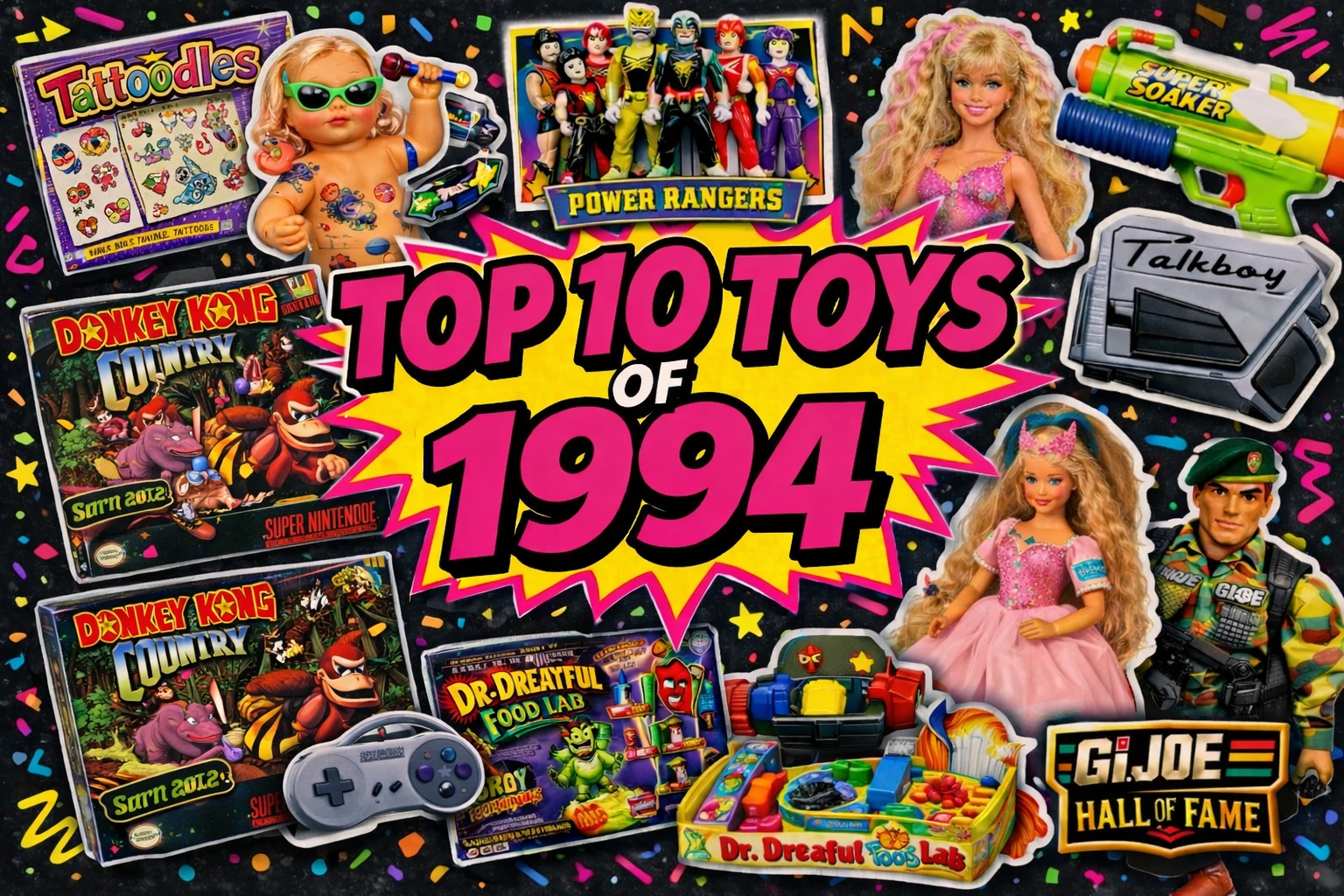
The top toys of 1994 were Mighty Morphin Power Rangers, Deluxe Talkboy, My Size Barbie, Super Nintendo Entertainment System, Dr. Dreadful Food Lab, X-Men action figures, Batman toys, My Pretty Topsy Tail, G.I. Joe Hall of Fame and Tattoodles.
This was the year the toy aisle stopped politely warming up and started screaming in primary colors. Television created instant identity brands, movie gadgets stayed hot beyond one season, Barbie became literally larger, and gross-out kits turned the kitchen table into a small food-safety hearing.
The Short Answer
What Were the Most Popular Toys of 1994?
The most popular toys of 1994 included Mighty Morphin Power Rangers, Deluxe Talkboy, My Size Barbie, Super Nintendo Entertainment System, Dr. Dreadful Food Lab, X-Men action figures, Batman toys, My Pretty Topsy Tail, G.I. Joe Hall of Fame and Tattoodles.
Power Rangers rank first because 1994 was the year the television phenomenon became a complete toy-market emergency. Talkboy remained unusually hot for a second season, while My Size Barbie, Super Nintendo and the established superhero lines proved that older brands and platforms still had enormous strength.
The Fast Rewind
Top 10 Toys of 1994 at a Glance
Start with the complete ranking, then jump directly to any toy for the full explanation.
- #1Mighty Morphin Power RangersAfter-school television becomes a nationwide action-toy emergency
- #2Deluxe TalkboyThe movie gadget remains hot because the behavior is still irresistible
- #3My Size BarbieBarbie turns literal scale into an impossible-to-ignore feature
- #4Super Nintendo Entertainment SystemThe mature 16-bit platform remains a premium room-changing gift
- #5Dr. Dreadful Food LabEdible grossness becomes a repeatable kitchen-table performance
- #6X-Men Action FiguresMutant variety keeps team collecting commercially powerful
- #7Batman ToysThe evergreen superhero absorbs another year of gadgets and variants
- #8My Pretty Topsy TailHair styling gives a doll an active demonstration hook
- #9G.I. Joe Hall of FameHeritage branding keeps old-school action muscle on the shelf
- #10TattoodlesA louder visual identity pushes baby dolls into mid-90s territory
How the List Came Together
How the Top Toys of 1994 Were Ranked
This is a transparent editorial ranking. No single complete public chart cleanly compares action figures, electronic gadgets, dolls, consoles, gross-out kits and heritage brands across the entire year.
Holiday demand and shortage pressure
The ranking considers Christmas-list urgency, retail availability, commercial repetition, exact-name demand and whether adults were forced into a real search rather than an ordinary shopping trip.
Media-to-toy conversion
Power Rangers and Talkboy rank near the top because television and movies completed much of the sales pitch before the products reached the shelf.
How clearly each toy defines 1994
The strongest entries capture the year’s specific mix of color-coded identity, second-season gadget heat, oversized Barbie scale, premium 16-bit gaming, gross-out food theater and team-based superhero collecting.
Category strength versus one-season heat
A Power Ranger, a Barbie, a Talkboy and a console do not sell through identical routes. The order weighs year-specific intensity without confusing one hot season with lifetime importance.
The Mid-90s Take Control
Why 1994 Changed Toy Culture
The year matters because the shelf becomes more television-native, more visually aggressive and more dependent on exact brand identity than the early 90s.
Television could control the shopping list.
Power Rangers gave children colors, favorites, villains, role-play gear and giant robots before adults reached the store. The television show trained the customer first.
A gadget could survive beyond one hot Christmas.
Talkboy remained desirable because the recording and voice-changing loop created real behavior rather than one brief moment of recognition.
Scale became a shortcut to spectacle.
My Size Barbie and Hall of Fame G.I. Joe used physical size to communicate importance instantly. A larger package looked more gift-worthy before anyone explained the details.
Gross-out play became a household performance.
Dr. Dreadful Food Lab combined process, minor rebellion and edible results. The toy was something children performed for the room, not something they quietly owned.
Five Power Centers in One Loud Aisle
What Actually Drove the 1994 Toy Market?
The year becomes clearer when the toys are grouped by the type of demand they created. Each force gets a full-width horizontal card instead of another cramped column.
The Ranger Takeover
Mighty Morphin Power Rangers combined color-coded identity, martial arts, villains, role-play gear, vehicles and Megazord escalation inside one highly repeatable television ritual.
The brand did not sell one toy. It sold a ladder of participation, from an individual Ranger to the whole team and the larger robot fantasy.
The Gadget Holdover
Deluxe Talkboy showed that a media gadget could remain hot after the first shortage season when the function still created jokes, imitation and social play.
The product survived because children wanted to use it, not merely own the recognizable object from a movie.
The Oversized Doll Aisle
My Size Barbie, My Pretty Topsy Tail and Tattoodles offered three different ways to refresh doll play: dramatic scale, active styling and louder personality.
The category remained powerful because it could support fashion, grooming, nurturing, transformation and character without relying on one universal formula.
The Action-Team Ecosystem
Power Rangers, X-Men, Batman and G.I. Joe occupied different fandoms, but all benefited from expandable teams, villains, accessories and variations.
The larger 90s action figure wars were now less about one dominant theme and more about several identity systems competing at once.
The Demonstration Toy
Dr. Dreadful, Talkboy and styling dolls succeeded because commercials could show the feature immediately. Record this. Eat that. Style the hair. The behavior was built into the pitch.
This gave toys with no huge fictional universe enough spectacle to compete against television giants and premium consoles.
From #10 to #1
The Top 10 Toys of 1994 Countdown
Ten products and one year when the shelf became brighter, more identity-driven and more obviously shaped by after-school television.
Baby-Doll Weirdness With Attitude
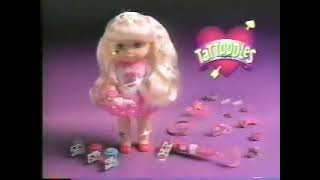
Tattoodles
Tattoodles open the 1994 countdown because they show how much the mid-90s toy aisle was learning to sell personality as aggressively as play. A baby doll was no longer enough by itself. A baby doll now needed a twist, a visual gimmick, a slightly louder identity, and some built-in “look at this” factor that made the toy feel more current than a traditional nursery-line doll.
That is why Tattoodles fit 1994 so well. This is a year where products increasingly need immediate visual identity to stand out. You can see that all over the market, from Power Rangers colors to giant Barbie scale to the pure gadget look of Talkboy. Tattoodles belong in that ecosystem because they take a familiar category and make it just strange enough to feel new.
They also help explain the generational shift happening around this point. Younger Gen X kids and older millennials were growing up in a retail environment where brands were expected to be more expressive, more stylized, and more obviously different from one another. Tattoodles are not subtle, and that is exactly why they make sense here.
For younger Gen X and millennial kids, Tattoodles feel like the kind of toy that could get attention instantly because it looked like it came with its own built-in attitude.
The brand also reflects a packaging environment where character had to be visible instantly. A conventional baby-doll silhouette was no longer enough when the shelf was full of louder colors, stronger names and products built for quick television recognition.
Old-School Muscle in a New-School Aisle
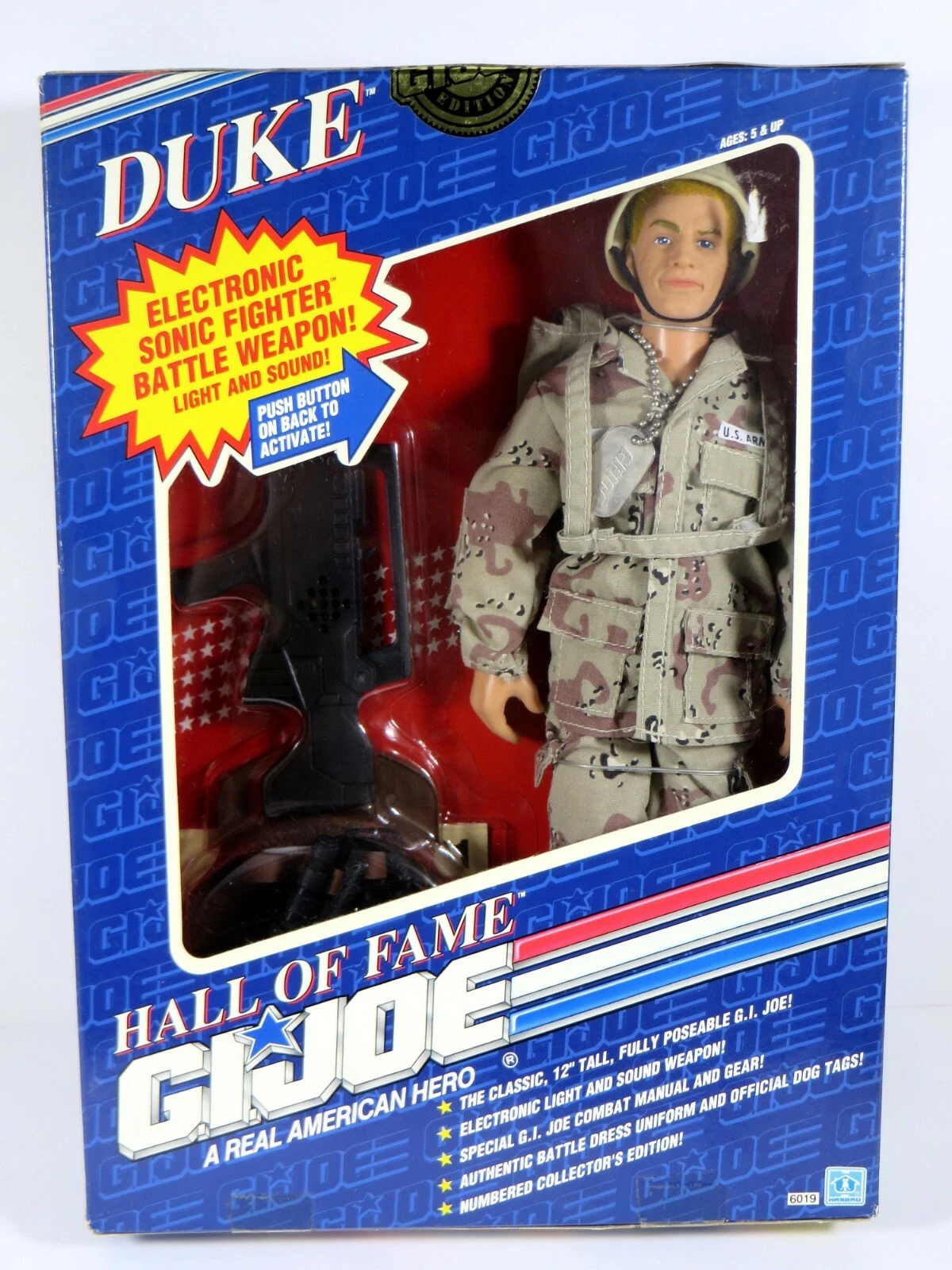
G.I. Joe Hall of Fame
G.I. Joe Hall of Fame hangs on in 1994 because nostalgia was not a side effect anymore. It was a legitimate sales strategy. This line represents one of the clearest examples of a toy company realizing that old brands could be revived not just for sentimental reasons, but as part of the wider 90s action figure wars, but because heritage itself could function as premium value.
The bigger figure scale matters too. It gives the line heft in a market that is increasingly full of quick-hit visual gimmicks and television-driven toys. Hall of Fame G.I. Joe feels more substantial, more deliberate, and more like a “real gift” in the eyes of the adults buying it. That kind of physical presence can matter a lot in a crowded aisle.
At the same time, 1994 is clearly moving toward younger kids and more hyperactive properties, so Hall of Fame G.I. Joe does not dominate the conversation the way Power Rangers do. Instead, it survives as one of the year’s more respectable holdouts: a brand with history still managing to look relevant in a faster, louder environment.
For younger Gen X kids, G.I. Joe Hall of Fame may have felt slightly older-school. For older millennials, it could read like a big, serious action figure from the era just before everything went full cartoon panic.
The line’s survival also demonstrates how adult recognition could support a child-focused purchase. The product carried years of brand meaning into a market where many newer lines still had to establish who their heroes were.
Hair Play Still Sells
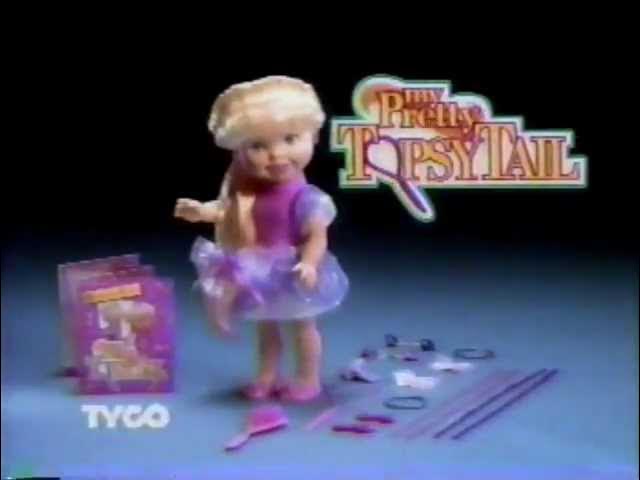
My Pretty Topsy Tail
My Pretty Topsy Tail ranks here because 1994 still understands one of the simplest truths in the doll business: if a doll gives kids something obvious to do with it, the product becomes much stronger. Hair play is tactile, visible, repeatable, easy to demonstrate, and one of the clearest recurring hooks in the 90s dolls and plush toy lane. That gives a doll an active hook instead of leaving it as a purely decorative object.
This is especially important in a year where younger Gen X and older millennial kids are consuming products in a more performance-oriented way. Toys increasingly need to show what they do. My Pretty Topsy Tail fits because the play pattern is built into the styling itself. Kids are not merely owning the doll. They are continually using the feature that makes the doll distinct.
It also lives comfortably beside bigger Barbie successes without feeling redundant. Barbie remains the empire, but the mid-90s aisle is large enough to support other styling and grooming-based doll concepts that target the same appetite for transformation, personalization, and show-and-tell play.
For younger Gen X and millennial kids, My Pretty Topsy Tail feels like the kind of toy that made a basic beauty-play promise and then tried very hard to overdeliver on the hair.
The appeal was repeatable rather than one-and-done. Styling could be changed, shown, undone and attempted again, giving the doll a cycle of active use that a purely decorative feature could not match.
Still Reliable, Still Toyetic
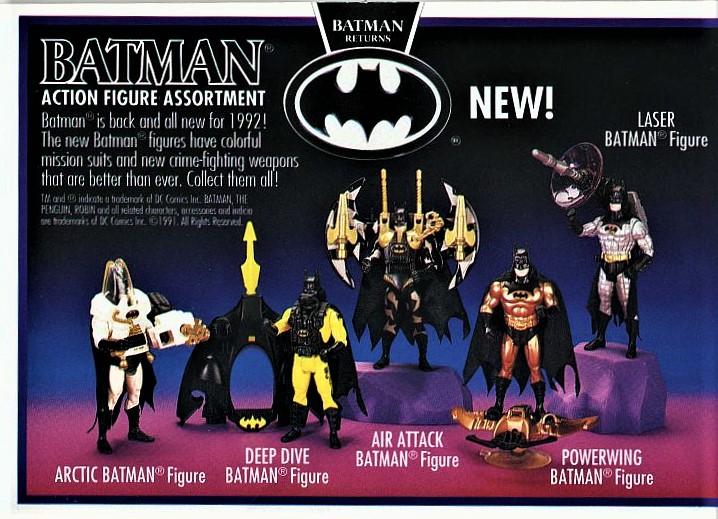
Batman Toys
Batman remains on the list because by 1994 the character is one of the safest action bets in the entire business. Batman is endlessly flexible. He can absorb a movie cycle, a comic aesthetic, weird accessories, oversized vehicles, armor gimmicks, and toy-only nonsense without breaking the fantasy. That is a huge commercial advantage.
In a year where Power Rangers are sucking all the oxygen out of the action aisle, Batman’s continued presence matters because it shows the difference between a phenomenon and an institution. Power Rangers are the eruption. Batman is the structure still standing next door. Even when he is not the central panic-buy story, he remains dependable.
He also bridges generations surprisingly well. Older Gen X kids already knew Batman from earlier cycles. Younger Gen X and older millennial kids could come in through newer media, toy shelves, or simple visual coolness. That broad recognizability helps explain why the brand keeps working.
For younger Gen X and millennial kids, Batman toys in 1994 still felt like one of the clearest ways to enter superhero play without needing an explanation.
Animated television support helped the brand operate beyond one theatrical window. Batman could serve cartoon viewers, comic readers and general superhero play while each format supplied new costumes, villains and visual reasons for another figure.
Mutant Variety Still Wins
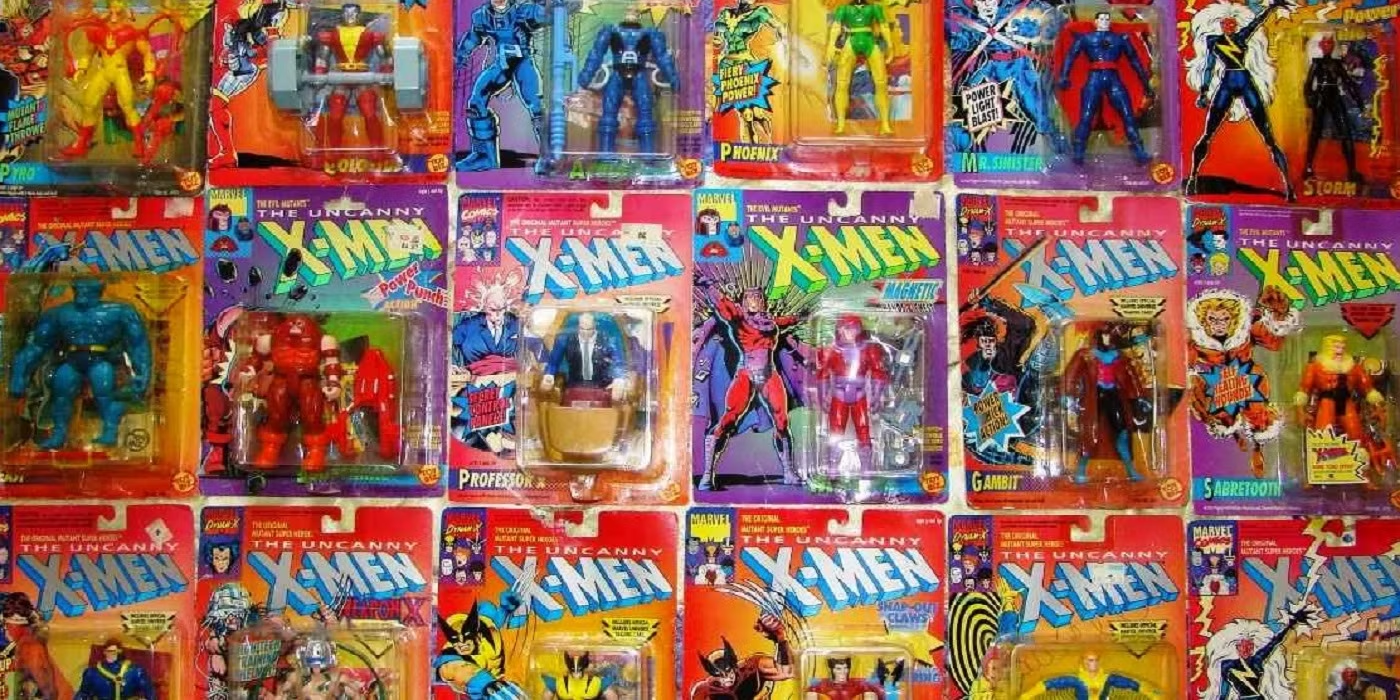
X-Men Action Figures
X-Men action figures stay high because the line’s core advantage never goes away: variety is the business model. Different characters, different powers, different looks, different favorites, different team combinations. That structure makes the line almost impossible to finish, which is exactly what a toy company wants.
By 1994, that collectability matters even more because kids are increasingly being taught to think in brands, rosters, and favorite identities. This is a younger Gen X / older millennial style of toy culture where asking “which one are you?” becomes part of the experience. X-Men fit that perfectly.
They also hold ground because the action aisle is getting more fragmented. It is no longer just one big hero lane. Batman is there. Power Rangers are there. G.I. Joe is still hanging around. X-Men survive that competition because their diversity of character design is itself a hook.
For younger Gen X and millennial kids, X-Men figures feel like the kind of line that rewarded not just having one cool figure, but building a whole unstable little universe of favorites.
Television visibility made the roster easier to understand and gave children weekly reminders of which characters were still missing. Different powers and personalities made favorite-character choices feel personal rather than interchangeable.
Gross-Out Edible Chaos
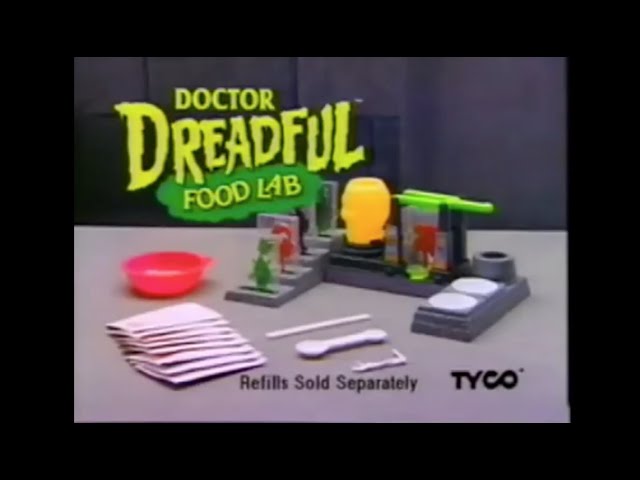
Dr. Dreadful Food Lab
Dr. Dreadful Food Lab lands in the top five because 1994 still rewards toys that feel like miniature home events. You do not just own Dr. Dreadful. You perform Dr. Dreadful. The kit turns weird edible output into its own tiny spectacle, and spectacle is one of the central currencies of the mid-90s toy aisle.
It also benefits from the same logic that helped Creepy Crawlers and other 90s gross-out science toys a couple years earlier: kids love products that let them make something gross on purpose. There is something deeply durable about toy concepts that combine minor transgression, visible process, and a finished object you can immediately show to someone else. Dr. Dreadful simply pushes that logic into food-horror territory.
For younger Gen X and older millennial kids, this kind of toy makes perfect sense. By 1994, products are increasingly expected to have an easy pitch, a loud visual identity, and a strong “watch this” component. Dr. Dreadful checks all three boxes.
For younger Gen X and millennial nostalgia specifically, Dr. Dreadful feels like one of those toys that now sounds fake until you remember the 90s absolutely would sell children a mini lab to make edible worms.
Refill ingredients and repeated recipes also helped the lab feel like a system rather than one short demonstration. The product created anticipation before the result, reaction during the reveal and another round whenever supplies remained.
Still Premium in a Crowded Year
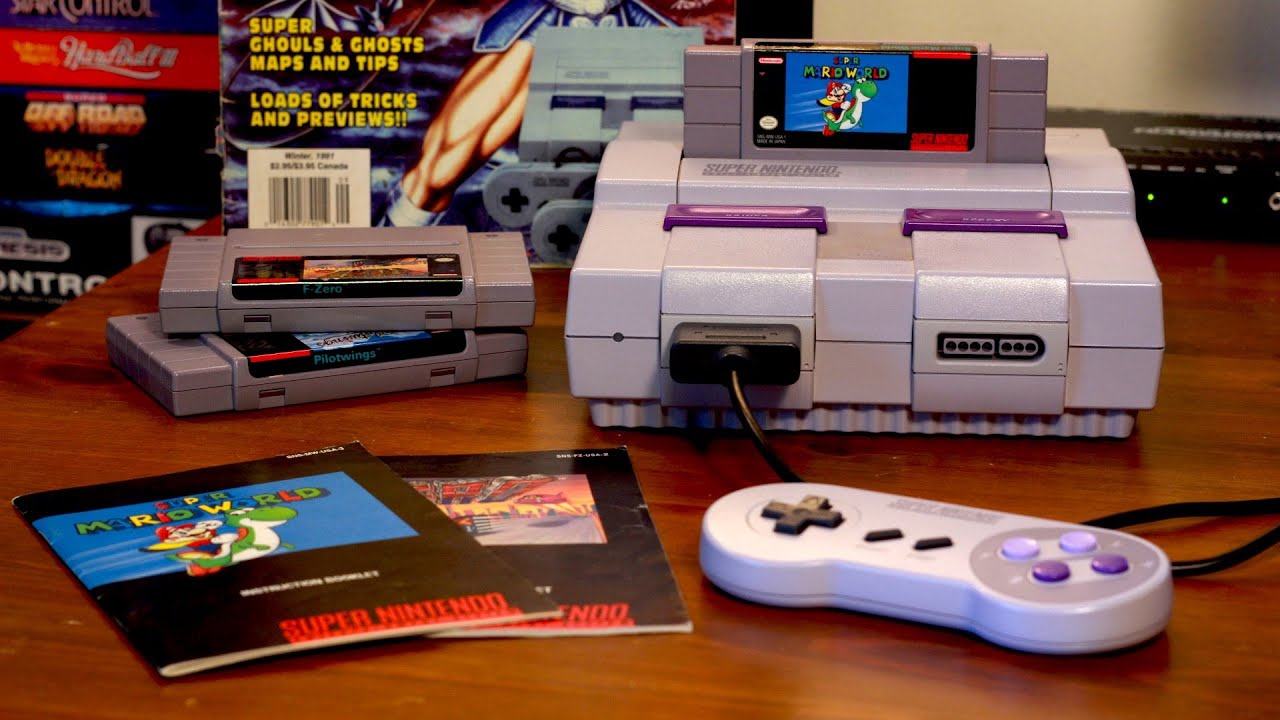
Super Nintendo Entertainment System
Super Nintendo ranks fourth because even as traditional toys gained ground in 1994, gaming was still too culturally important to disappear. The difference is that the category no longer gets to act like it owns the entire room. It has to share the spotlight with Power Rangers hysteria, Barbie strength, novelty electronics, and all the other products fighting for attention.
That actually makes the SNES more interesting this year, not less. It proves the system is resilient enough to remain premium even without being the only story. A kid who wanted Super Nintendo in 1994 was not simply asking for “a video game system.” They were asking for a specific ecosystem, specific titles, and the social status that came with having the machine everybody respected.
This is also one of the points where younger Gen X and older millennials really overlap. Both groups could still map major childhood identity onto gaming, but by 1994 games are increasingly one category among many rather than the single organizing principle of the whole season.
For younger Gen X and millennial kids, Super Nintendo in 1994 still feels like one of the most meaningful room-changing gifts you could get — even if it now had more competition from the rest of the shelf.
The system’s mature software library made the platform increasingly valuable even when the hardware itself was no longer new. Strong games kept the console culturally current and turned one earlier purchase into continuing holiday demand.
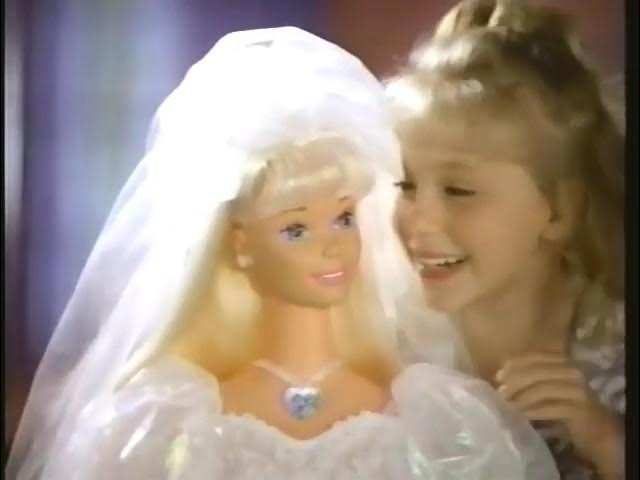
Barbie Goes Bigger Than the Room
My Size Barbie
My Size Barbie takes number three because 1994 shows Mattel doing what Mattel does best in the 90s dolls and plush toy lane: taking an already dominant brand and finding a way to make it feel freshly oversized, newly dramatic, and impossible to ignore. A giant Barbie is not subtle innovation. It is escalation, and escalation was one of the defining retail languages of the mid-90s.
What makes My Size Barbie especially important is that it does not abandon the core Barbie fantasy. It enlarges it. That matters because the doll feels like an event object without becoming unrecognizable. Kids still know exactly what it is. Adults still understand why it matters. It simply occupies more physical and emotional space.
There is also something very 1994 about the size gimmick itself. This is a moment when products are increasingly expected to have a strong visual punch and an easy explanation. My Size Barbie is the kind of idea that can be grasped across a room. In that sense, it is not just a Barbie. It is a retail statement.
For younger Gen X and older millennial kids, My Size Barbie feels like the kind of toy that crossed the line from ordinary wish-list item into “that thing everybody remembered seeing in the store.”
The larger body also blurred the boundary between doll play and dress-up. A child-sized Barbie could feel more like a companion, display object and wardrobe fantasy than a conventional fashion doll held in one hand.
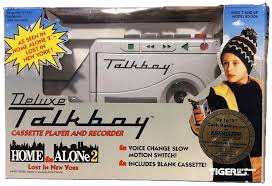
The Gadget Hit That Wouldn’t Cool Off
Deluxe Talkboy
Deluxe Talkboy stays near the top because the toy had the rare ability to feel hot beyond one season. That is harder than it looks. Plenty of gadget toys flash, sell, and disappear. Talkboy had enough cultural memory, enough movie identity, and enough immediate social behavior built into it that the demand carried forward. That alone makes it one of the most interesting products of the mid-90s.
The appeal is simple and powerful: it lets kids sound different, act clever, and create instant chaos. Good hot toys often create behavior the second they are touched. Talkboy absolutely does. You record something, distort it, play it back, laugh, repeat, hand it off, escalate. That loop is why the product works as more than a mere novelty.
It also feels like one of the clearest signals that the younger Gen X / older millennial toy era is arriving fast. This is no longer just about figures and dolls. It is about gadgets with media DNA, sitting right between 90s electronic toys and movie toy tie-ins, products that feel like props from a larger entertainment universe. The toy lets kids imitate power, which is always a winning trick.
For younger Gen X and millennial kids, Talkboy feels like the exact kind of device that made you believe for a minute that a toy might actually improve your strategic position in the world.
Its second-year strength also proved the licensed-gadget concept could outlive the original movie moment when the function created enough independent play. Talkboy became useful for imitation and jokes even after the child stopped thinking about the exact scene that introduced it.
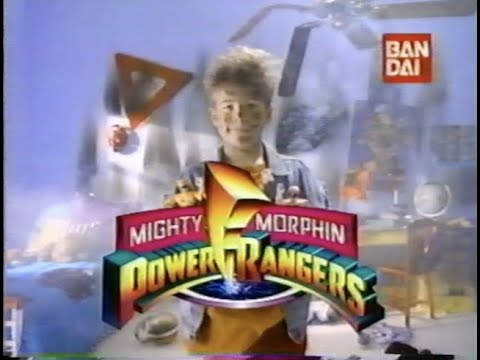
The Full-Blown Mid-90s Toy Takeover
Mighty Morphin Power Rangers
Mighty Morphin Power Rangers take the number one slot because 1994 is the year the line stops feeling like a sudden breakout and starts looking like a full consumer event. This is not merely a popular toy. It is the product that reorients the conversation. When a brand is selling out almost immediately, pulling attention across the aisle, and forcing adults into the kind of frantic search behavior usually reserved for legendary hot-toy seasons, that is number-one energy.
What makes the Rangers especially powerful is that they are built for identity. Kids can choose colors, argue favorites, collect teams, add villains, chase role-play gear, and move outward into a whole expanding brand universe. The property does not simply offer toys. It offers affiliations, which is one of the strongest hooks a youth brand can ever have.
This is also where the younger Gen X and older millennial shift becomes impossible to ignore. Power Rangers feel faster, brighter, louder, and more television-native than many earlier action brands. They are pure after-school energy turned into retail form. If earlier Gen X toy culture often centered on broader categories, 1994 increasingly centers on sudden media-specific obsession.
For younger Gen X and millennial kids, 1994 Power Rangers feel like the exact moment the toy aisle stops pretending to be calm and just starts screaming back.
Megazord products expanded the brand beyond favorite-character purchases and gave the line a premium destination. Individual Rangers created identity, while combining robots and vehicles created a larger system adults could recognize as the major gift.
The Cultural Handoff
1994 Was the Younger Gen X and Elder-Millennial Crossover Year
The shelf still carried brands older Gen X recognized, but the loudest new energy was arriving from television-native properties, visual gimmicks and exact-name demand.
What Stayed Familiar
Barbie, Nintendo, Batman and G.I. Joe Still Had Infrastructure
Mature brands survived because children could add a new product without learning an entirely new world.
Brand Trust
Adults understood the category and children already recognized the fantasy.
Expandable Systems
Games, outfits, figures, villains and accessories made another purchase feel useful.
Cross-Generation Recognition
Older siblings and parents often knew enough about the brand to support the gift.
The familiar-brand argument: this is new enough to want and established enough to trust.
The Toy Box Afterlife
Collecting Toys From 1994 Today
Exact version, condition, completeness, working electronics, packaging and real buyer demand matter much more than age alone.
Power Rangers pieces depend on exact release.
Figures, weapons, flip-head mechanisms, role-play items and Megazord components should be checked for complete parts, stickers, working functions, packaging and whether every piece belongs to the same version.
Talkboy requires full electronic testing.
Check recording, playback, speed controls, microphone, speaker, buttons, battery corrosion, model identification, instructions and original packaging.
Dolls need clothing, hair and scale-specific parts.
My Size Barbie, My Pretty Topsy Tail and Tattoodles should be evaluated for original clothing, accessories, hair condition, markings, working features and packaging appropriate to the exact release.
Activity sets need complete equipment.
Dr. Dreadful sets may depend on molds, dispensers, tools, recipe materials and instructions. Compare completed sales and use the guides to 90s collectible crazes and forgotten 90s toys for broader context.
What the Wish List Felt Like
Christmas Morning 1994 Was a Brand-Recognition Test
The season’s biggest gifts were specific enough that children could tell immediately whether adults had located the exact product.
Finding the correct figure or Megazord product carried the emotional force of completing a retail mission.
The gadget still triggered instant recording, fake voices and family evidence nobody had requested.
My Size Barbie occupied enough physical space to become the room’s visual center before assembly ended.
Super Nintendo still generated long-term status and an immediate list of games not included.
Dr. Dreadful turned a holiday morning into a future kitchen cleanup with ingredients.
X-Men, Batman and Power Rangers all made one figure look suspiciously like the beginning of another purchase.
The memory: somebody got the exact Ranger, somebody got a substitute, and the first school day back became a brutally honest audit of every household’s shopping competence.
Under Fluorescent Lights
What the 1994 Toy Store Looked Like
The store looked increasingly divided between television identity, premium electronics, oversized dolls and activity sets built around demonstrations.
The empty Ranger peg
Missing stock and handwritten limits could advertise the craze more effectively than a full display.
The electronics counter
Talkboy and Super Nintendo attracted higher prices, more adult questions and stronger arguments about batteries or included games.
The oversized doll display
My Size Barbie used physical scale as retail theater, while styling dolls demonstrated active hair play nearby.
The gross-out box
Dr. Dreadful packaging sold the process, the result and the reaction before the kit left the shelf.
The full 90s Toy Store Culture guide follows the aisle layouts, glass cases, catalogs, mall trips, shortages and holiday rituals that made finding the toy part of the memory.
Commercial-Break Pressure
Watch the 1994 Toy Commercial Energy
Power Rangers sold identity and urgency. Talkboy sold movie imitation. Barbie sold scale. Dr. Dreadful sold edible disgust, and Super Nintendo sold an entire future library from one box.
The best 1994 toy ads did not merely show products. They taught children the exact phrase to repeat until the adult responsible for shopping surrendered.
The 90s Toy Commercials & Videos archive is the direct next stop for the advertising behind Power Rangers, Talkboy, Barbie, Super Nintendo, superhero figures and gross-out kits.
The Rest of the Year
Keep Rewinding 1994
The toy aisle was only one part of a year packed with giant hooks, slick R&B, network television, family comedy, thrillers and VHS destiny.
The 1994 Toy Aisle Verdict
Why These Toys Define 1994
The top 10 toys of 1994 capture a genuine transition point. The shelf still carries Barbie, Nintendo, Batman and G.I. Joe, but the loudest new energy comes from Power Rangers, a television-native identity system that can create demand faster than stores can respond.
Talkboy proves a movie gadget can become independent play. My Size Barbie turns scale into spectacle. Dr. Dreadful turns grossness into performance. X-Men turns roster variety into repeat collecting. Every major entry offers a behavior or identity children can explain immediately.
For Gen X, 1994 feels like the year the decade’s younger commercial language becomes impossible to ignore: brighter, faster, more brand-specific and fully prepared to let after-school television reorganize Christmas.
Questions From the Toy Aisle
Top Toys of 1994: Frequently Asked Questions
What were the most popular toys of 1994?
Popular toys of 1994 included Mighty Morphin Power Rangers, Deluxe Talkboy, My Size Barbie, Super Nintendo, Dr. Dreadful Food Lab, X-Men action figures, Batman toys, My Pretty Topsy Tail, G.I. Joe Hall of Fame and Tattoodles.
What was the biggest toy of 1994?
Mighty Morphin Power Rangers take the number-one spot because 1994 was the line’s full toy-market takeover year, with television demand and limited availability driving intense holiday pressure.
Why were Power Rangers so huge in 1994?
The brand combined after-school television, color-coded identity, martial arts, villains, role-play gear, action figures, vehicles and Megazord products inside one highly collectible system.
What Power Rangers toys were hardest to find?
Individual Rangers, role-play items and Megazord-related products attracted major demand because they represented both favorite-character identity and the premium combining-robot fantasy.
Why is Deluxe Talkboy still ranked number two?
Talkboy retained unusual second-season strength because recording, playback and voice changing created repeatable social play beyond the original movie connection.
Was My Size Barbie popular in 1994?
Yes. My Size Barbie used dramatic scale to refresh an established brand and blur the line between fashion-doll play, dress-up and companion-sized display.
Were video games still popular toys in 1994?
Yes. Super Nintendo remained one of the year’s premium gifts, supported by a mature game library and strong platform loyalty.
Why is Dr. Dreadful Food Lab ranked so high?
Dr. Dreadful had a strong visible hook: children made edible gross-out creations through a repeatable process that worked especially well in commercials and demonstrations.
Why are X-Men figures included?
X-Men figures benefited from team collecting, distinct powers, television visibility and a roster that encouraged repeat buying inside the 90s action figure wars.
Why were Batman toys still popular?
Batman remained commercially flexible enough to support movie, cartoon and general superhero play through gadgets, vehicles, villains, armor and costume variations.
What was My Pretty Topsy Tail?
My Pretty Topsy Tail was a styling doll built around active hair play, one of the clearest recurring hooks inside the 90s doll aisle.
What were Tattoodles?
Tattoodles were personality-forward baby dolls that used a louder visual identity to stand out from more traditional nursery-style products.
Why was G.I. Joe Hall of Fame still relevant?
The larger-scale line used brand heritage, recognizable characters and premium physical presence to keep an older action property visible in a faster, younger market.
What makes 1994 different from 1993 in toy culture?
1993 introduces exact-name gadget and television demand. In 1994, that system becomes stronger and more identity-driven, with Power Rangers dominating while mature brands adopt bigger or louder features.
What were the hottest Christmas toys of 1994?
Hot Christmas toys included Power Rangers, Deluxe Talkboy, My Size Barbie, Super Nintendo, Dr. Dreadful Food Lab, X-Men, Batman, My Pretty Topsy Tail, G.I. Joe Hall of Fame and Tattoodles.
Are toys from 1994 valuable today?
Some can be, but value depends on exact version, condition, completeness, working electronics, original accessories, packaging and current demand. The guides to 90s collectible crazes and forgotten 90s toys provide wider context.
Was there one official top-10 toy chart for all of 1994?
No single complete public list cleanly compares every toy category across the full year. This page uses a transparent editorial method based on holiday heat, scarcity, media visibility, category strength and year-specific relevance.
Where can I watch commercials for 1994 toys?
The 90s Toy Commercials and Videos archive connects Power Rangers, Talkboy, Barbie, Super Nintendo, superhero figures and gross-out kits with the advertising that sold them.
Move Through the Decade
Explore the Top Toys From Every Year of the 90s
Follow the toy aisle from Turtle Power, Troll comebacks and Power Rangers panic into electronic pets, collectible bubbles, schoolyard crazes and late-90s shortages.