Murder, She Wrote in the 80s: The Sunday-Night Ratings Machine
A typewriter, an observant widow, and the Sunday-night mystery that made Angela Lansbury one of television’s biggest draws.
By Gizmo
THE LOOK.
THE LAST QUESTION.

Inside This Article
- Jessica has one more question
- The new bestseller was 58
- The pilot gives her a wand, then a murder
- Lansbury knew exactly how to hold a room
- A widow with a career, not a vacancy
- Grady means well. That is usually the problem
- Amos Tupper wasn’t just there to be wrong
- Seth Hazlitt brought the grumbling
- Cabot Cove: lovely views, complicated neighbors
- The ratings weren’t a quaint little success
- Sunday’s most dependable invitation
- A typewriter, a bicycle, and John Addison’s theme
- The bus trip that deserves its reputation
- Jury duty is different when Jessica gets the summons
- First class doesn’t improve the passenger list
- Cabot Cove was not entirely innocent
- When Jessica met Thomas Magnum
- Hollywood gets hold of the book. Naturally, disaster follows
- The guest cast was its own television reunion
- A house full of things, and a town full of claims
- A ski holiday with a distinctly poor safety record
- A new sheriff discovered the town’s problem
- Beloved doesn’t mean every script was brilliant
- Even Jessica needed a little time off
- The pleasure changes when you’re old enough to know better
- Questions Readers Ask
Jessica has one more question
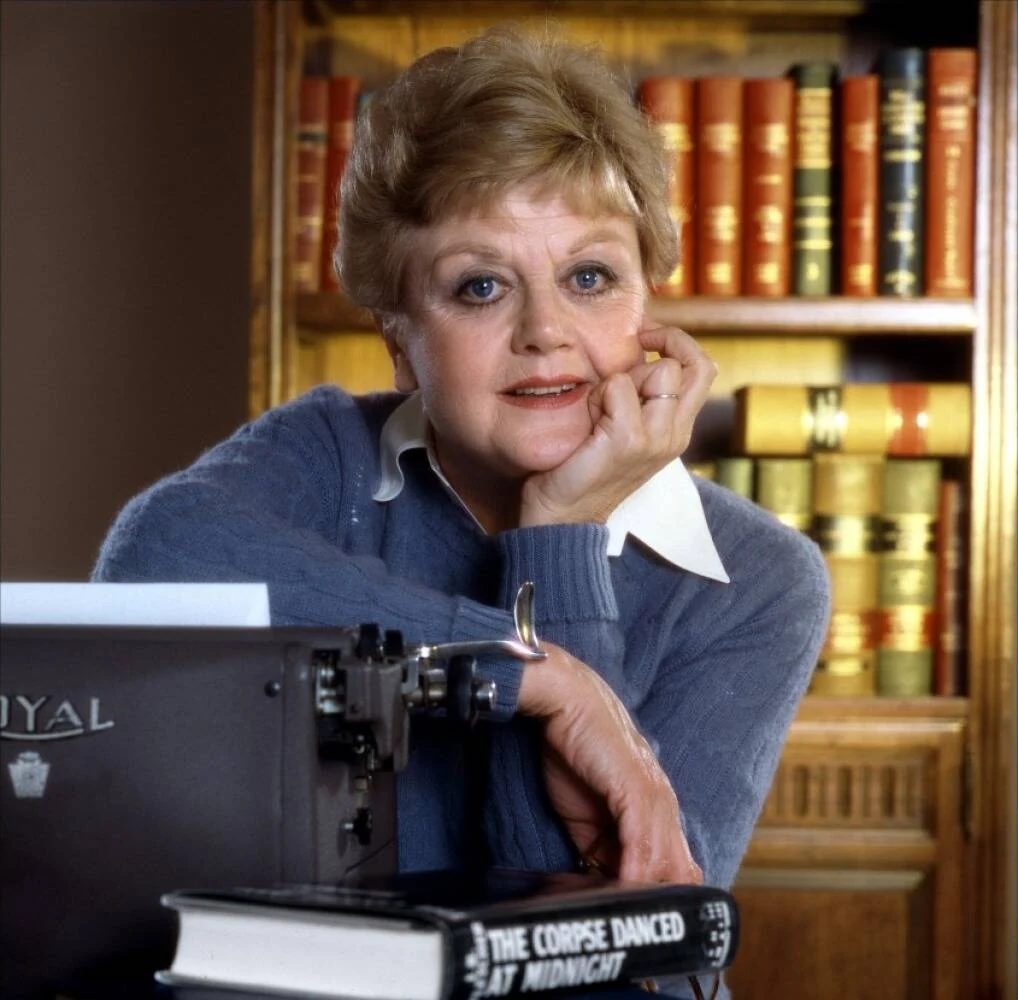
The dangerous moment in Murder, She Wrote usually arrives after someone thinks the conversation is over. Jessica Fletcher pauses. Her expression changes by perhaps half an inch. An insignificant remark has just become a very significant problem for somebody who was hoping to get through Sunday without an arrest. There is no need to reach for a gun. Angela Lansbury has already loaded the look.
That was the pleasure of this show in the 1980s: watching an apparently harmless woman become the most formidable person in the room. Jessica listened while businessmen blustered, sheriffs settled on convenient suspects, relatives explained their latest disastrous decisions, and guest stars attempted to look innocent beneath extremely incriminating lighting. Then she noticed what everyone else had missed. It was television built around the enormous satisfaction of seeing somebody pay attention.
The theme bounced along, the typewriter clattered, and an hour with Jessica offered a peculiar kind of reassurance. Someone was probably going to die, certainly. But the person sorting out the mess would be intelligent, decent, and unlikely to mistake cruelty for sophistication. In the sprawling landscape of 1980s television, where undercover cops wore expensive jackets and oil families treated betrayal as a household chore, that counted as a distinctive proposition.
It also counted as a huge hit. After its September 1984 arrival, the CBS mystery spent the rest of the decade comfortably among the country’s most popular series. Jessica became Sunday-night company: familiar enough for people who watched every week, inviting enough for someone who wandered in halfway through a season. The plot changed; the judgment behind those eyes remained dependable.
The easy joke is that Cabot Cove needed a better tourism department. The more interesting story is how Lansbury made a crime novelist from a fictional Maine town compete with television’s biggest stars. She did it without a sidekick taking over, without the character becoming a grandmotherly mascot, and without apologizing for being the smartest adult present. Jessica Fletcher had work to do. Fortunately, America kept making time for it.
The new bestseller was 58
Murder, She Wrote premiered on CBS on September 30, 1984, with the feature-length “The Murder of Sherlock Holmes.” Angela Lansbury was 58. The number sounds less startling now than it did in a television business that often treated an older actress as supporting furniture: somebody’s mother, somebody’s patient, somebody’s formidable aunt dropping by to deliver advice before the younger leads resumed having the actual show.
Jessica was the actual show. Her curiosity supplied the movement, her friendships opened doors, and her reasoning delivered the finish. Other performers had excellent scenes, but nobody needed to explain why this woman belonged at the center. Lansbury made that obvious before a network executive had time to request a younger detective and a convertible.
Creators Peter S. Fischer, Richard Levinson, and William Link knew their way around television mysteries. Their collective experience included Columbo and Ellery Queen, programs that understood the appeal of an investigator whose manner concealed a serious intelligence. Jessica brought a different social advantage. People talked to her because she was friendly, because she asked nicely, because they assumed a woman who wrote books was a less immediate threat than a police interview. These assumptions were generally poor investments.
The premise gave her two lives worth watching. In Cabot Cove, she was a widowed former teacher with old friends, routines, and a house full of accumulated life. Beyond it, she was J. B. Fletcher, a successful novelist whose work led to hotels, publishing offices, film sets, and invitations from people who really should have checked the guest list for potential murderers. Neither life required her to abandon the other.
That combination kept the series from being merely a quaint village puzzle. Jessica had a hometown, but the show had a passport. Her career let a modest woman enter glamorous spaces without transforming her into a fantasy socialite. It also made her a late-blooming professional success in a decade particularly fond of displaying success. She didn’t need a boardroom, shoulder pads large enough to shelter wildlife, or a family war over an oil company. A manuscript got her through the door.
The pilot gives her a wand, then a murder
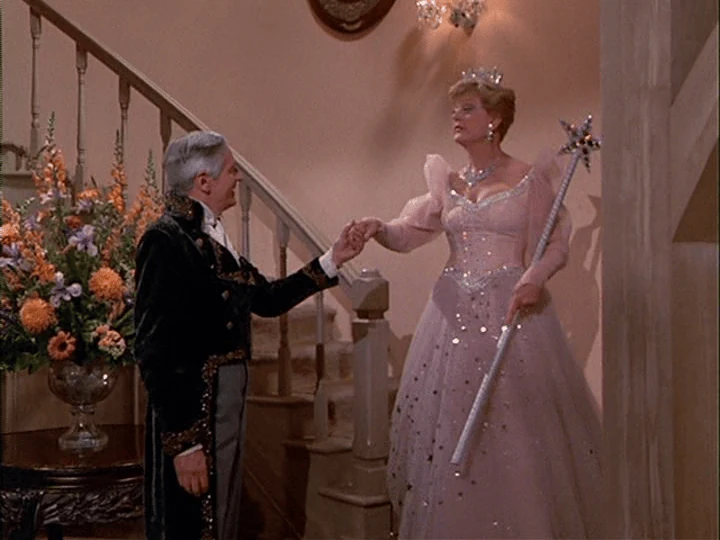
The premiere has the good sense to show Jessica’s talent before making a big announcement about it. She sees through a mystery play’s construction, much to the discomfiture of people who have invested considerably more confidence in the production. Her intelligence is already in working order. Fame is the new development, not the ability that earns it.
Her nephew Grady sends her manuscript to a publisher, setting her writing career in motion. The book is The Corpse Danced at Midnight, a title that understands its assignment. Nobody picking it up is expecting twelve chapters about municipal parking policy. Jessica’s sudden entrance into the publishing world places her among people with practiced manners, polished homes, and secrets that have been allowed to age badly.
Arthur Hill plays Preston Giles, the publisher whose interest in Jessica carries a suggestion of romance. That matters. The pilot allows her to be flattered, attracted, and uncertain while remaining perceptive. Widowhood hasn’t abolished her emotional life. A new career hasn’t made her invulnerable. Lansbury keeps both facts alive beneath the increasingly elaborate mystery.
Then comes the costume party. Jessica wears a fairy-godmother outfit, complete with wand, while somebody else attends as Sherlock Holmes. It is an agreeably cheeky way to launch a detective series: surround the new sleuth with fictional identities, then make the famous detective’s costume part of the trouble. Corey Allen’s direction gives the longer story room to mingle, misdirect, and establish Jessica’s response to people rather than simply racing her toward a body.
Ned Beatty’s Chief Roy Gunderson supplies the local police presence. He isn’t Amos Tupper; the pilot’s case takes Jessica beyond her own town. The distinction is easy to blur after years of familiar Cabot Cove faces, but the first adventure is already showing how portable she will be. Put Jessica in unfamiliar company and give her enough time to listen: the machinery works.
The premiere is more expansive than the weekly episodes, and its early Jessica is sometimes more folksy than the poised traveler of later seasons. That’s part of its interest. The character isn’t delivered fully varnished. You can see Lansbury finding the balance between a woman startled by her new circumstances and a woman nobody should underestimate. The wand is amusing. The mind is the real special effect.
Lansbury knew exactly how to hold a room
Jessica’s serenity came from a performer with an exceptionally broad range. Before CBS handed her a weekly mystery, Lansbury had already built a major film and theater career, including Gaslight, The Manchurian Candidate, Mame, and Sweeney Todd. Audiences weren’t watching an actress discover how to command attention. They were watching one decide how little effort she needed to show.
That restraint is especially striking if your introduction to Lansbury was Jessica. Her warmth here isn’t evidence that warmth was all she had available. The unnerving mother in The Manchurian Candidate and the practical, macabre Mrs. Lovett of Sweeney Todd are useful reminders that this was an artistic choice. Jessica’s moral steadiness comes from the performance, not from an inability to suggest anything darker.
Look at how she listens. In a lesser mystery series, the lead waits politely for the guest star to finish delivering a clue. Lansbury makes the listening itself active. A slight narrowing of the eyes registers doubt. A courteous smile leaves room for a second meaning. An ordinary question lands with just enough extra attention to tell the viewer that the answer may matter. She helps you watch the scene without waving a little flag marked IMPORTANT EVIDENCE.
She also understands when a conversation needs air. Jessica can be amused by a ridiculous explanation, irritated by an official, or genuinely hurt by someone she trusted. These changes don’t require the series to stop and announce a special dramatic moment. They pass across her face and remain in the room. That is particularly useful in a format that keeps introducing people and resolving their problems in less than an hour.
The workload of a star-centered drama was substantial, but the finished performance rarely feels like somebody merely protecting her energy until the final scene. Lansbury supplies interest to the passages between discoveries: crossing a lobby, receiving an unwelcome invitation, making a guest comfortable. The mystery gives Jessica a reason to be there. Lansbury gives the viewer a reason to enjoy the time before the answer arrives.
A widow with a career, not a vacancy
Frank Fletcher is an important absence. Jessica’s husband is already dead when the series begins, yet her marriage remains part of how she understands home and loyalty. The show doesn’t treat him as an obstacle that must be forgotten so the new adventures can proceed. It allows an affectionate past and an active present to occupy the same life.
That is one reason Jessica feels more substantial than a collection of detective habits. The house isn’t merely a convenient set containing a telephone and a typewriter. It is the home she shared with someone. Her routines have history behind them. When she returns from a trip, she isn’t retreating into a blank space until the next script turns up.
At the same time, she isn’t waiting to be restored to completeness by a new man. Friendship, travel, writing, and intellectual curiosity are enough to sustain a television heroine. Romantic possibilities can appear without becoming the emergency repair around which her existence revolves. In network drama, that freedom was refreshing; in the weekly experience of the show, it simply felt like Jessica.
Her books also give her a kind of authority separate from crime solving. She’s a professional with deadlines, readers, and a public identity. The series takes liberties with how effortlessly those obligations accommodate another investigation, but the underlying picture is attractive: a woman has acquired a successful second career without losing her first self. She can enjoy a good hotel and still prefer home. She can accept recognition without spending every conversation rehearsing her importance.
There are limits to this ideal. Jessica is unusually fortunate, unusually capable, and surrounded by an extraordinary number of grateful acquaintances. Most writing careers contain more revision and fewer complimentary trips. Still, the fantasy is kinder and more interesting than the usual proposition that growing older means becoming somebody else’s background character. Jessica’s life has expanded. The series lets that expansion be pleasurable rather than miraculous.
For a younger viewer, she might first register as the reassuring grown-up with the answers. Revisited later, the independence becomes more visible. Having work you care about, keeping your own house, choosing your company, and refusing to be patronized: those aren’t minor character details. That’s a rather enviable arrangement, even before the royalties.
Grady means well. That is usually the problem
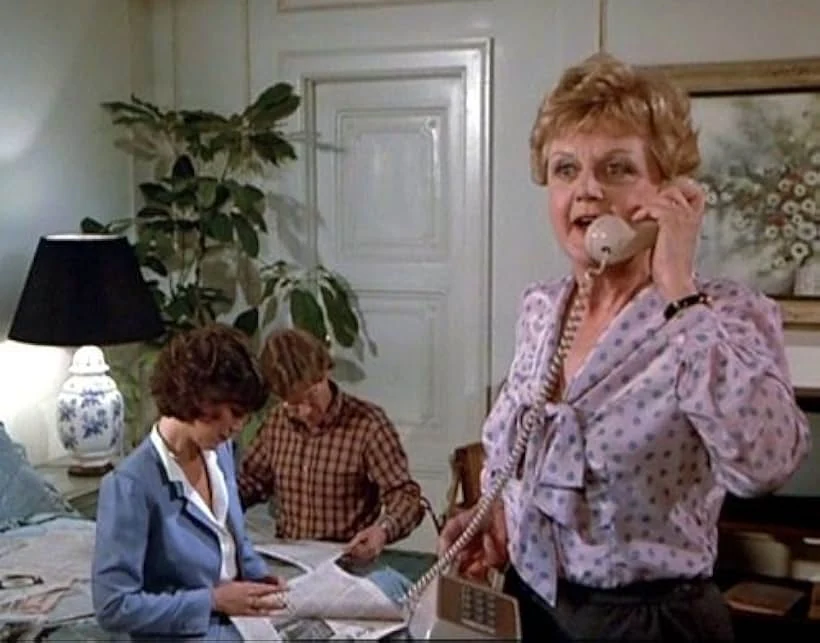
Michael Horton’s Grady Fletcher has the affectionate, slightly flustered energy of a nephew who sincerely wants everything to work out and has underestimated the number of ways it won’t. His crucial early achievement is getting Jessica’s manuscript into the publishing world. After that, the series repeatedly finds ways to make his enthusiasm a source of additional complications.
Grady gives Jessica someone to protect without reducing her to a full-time parent. Their affection is settled; his circumstances are less reliable. A job, a relationship, or a promising new opportunity may bring him into an episode, and very quickly Jessica has reason to put down her work and ask what, precisely, has happened this time. He is a useful antidote to the succession of suspicious strangers: somebody whose company she actually wants, even when it arrives with paperwork for the local authorities.
The performance works because Horton doesn’t play him as a secret mastermind of incompetence. Grady is decent. He has enough adulthood to be out in the world and enough vulnerability to need his aunt’s judgment. The humor comes from that gap. Jessica can be exasperated without being contemptuous, and he can accept her help without the relationship becoming a contest over who is really in charge.
By January 1989, “Something Borrowed, Someone Blue” brings Grady’s wedding to Donna into the line of fire. A wedding is practically a custom-built Murder, She Wrote delivery system: relatives, servants, money, private grievances, and a reason everyone must remain together while pretending the day is going beautifully. Michael Horton and Debbie Zipp supply a couple worth rooting for amid the disruption.
Jessica’s expanding family tree is one of the show’s least plausible conveniences. A newly mentioned niece or old family friend can open a door almost anywhere. Grady is the version that earns its place. You recognize the bond, recognize the worry, and understand why she gets involved. The world contains plenty of relatives who ask for a small favor. Jessica’s happen to arrive with an exceptionally high risk of a homicide investigation.
Amos Tupper wasn’t just there to be wrong
Tom Bosley brought a reassuring familiarity to Sheriff Amos Tupper. For viewers who had known him as Howard Cunningham on Happy Days, the face already suggested a decent adult who would prefer everyone to behave sensibly. Cabot Cove offered limited opportunities to enjoy that preference.
Amos is often outpaced by Jessica, and the scripts sometimes make the difference too easy. He fastens onto an explanation; she notices the inconvenient detail. Let that happen often enough and the sheriff starts looking less like a working official than a man hired to keep the wrong chair warm. Bosley supplies the humanity that protects the character from becoming only a recurring punch line.
His Amos has appetites, grievances, and an understandable desire for a manageable day. He also knows Jessica. Their conversations don’t begin from zero, with a stranger demanding to know why this novelist is interfering. They begin with the exasperated familiarity of people who have done this before. She knows when to push. He knows that ignoring her entirely is unlikely to improve his afternoon.
That familiarity gives the series room for comedy without requiring a separate comic-relief character to barge into the investigation. Amos worrying about food or the inconvenience of a journey can sit beside the clues. His everyday priorities make the extraordinary situation feel rooted in a town where people normally have other things to do. A murder is serious; so, to Amos, is missing a meal he had reasonably expected to enjoy.
“Murder Takes the Bus” is a particularly good outing for him because it lets Bosley participate in the mystery rather than merely obstruct it. The confined setting puts Jessica and Amos alongside each other, away from the sheriff’s office, with a crowd neither one can simply dismiss. Their differences become a source of movement and amusement.
Bosley remained with the series through its first four seasons. When Amos leaves the regular picture, something changes beyond the uniform. An old friendship has supplied much of Cabot Cove’s texture. The replacement can handle cases, but replacing the particular way Bosley sounds when Jessica complicates his day is another matter.
Seth Hazlitt brought the grumbling
William Windom’s Dr. Seth Hazlitt joined Jessica’s circle in 1985, giving Cabot Cove a doctor whose concern often arrived wrapped in an objection. Seth is excellent company precisely because he isn’t eager to be universally delightful. He has opinions, he expects them to be heard, and he does not approach every interruption as an exciting opportunity for personal growth.
Jessica doesn’t require a flatterer. Seth offers a friendship with enough history and friction to feel lived in. They can disagree about what she is doing, what he is assuming, or how much sense either of them is displaying, without making the audience worry that the relationship will collapse before the next commercial. The quarrel belongs to the friendship rather than threatening it.
Windom makes the gruffness flexible. Beneath it you can see concern for Jessica and a genuine investment in the town. When Seth complains, it usually feels like the complaint of somebody who intends to stay and help. That’s a more useful quality in a mystery companion than effortless charm. Charm can leave when the conversation becomes inconvenient. Seth is likely to remain and explain why the conversation is inconvenient.
He also widens Jessica’s daily world. Amos has official reasons to be near a case. Seth has medical reasons, but his value extends beyond explaining the condition of a body. He is someone to eat with, discuss a neighbor with, or return to after the week’s out-of-town adventure. His presence makes Cabot Cove a place Jessica lives rather than a picturesque address attached to her résumé.
The series occasionally invites viewers to read more into their closeness. Its wiser instinct is to let companionship stand on its own. A man and a woman with independent lives can care about each other, bicker comfortably, and enjoy dinner without every exchange needing to advance a romance. Their company is the reward.
There is a casting wrinkle for anyone watching from the beginning: Windom appears in the first season’s “Funeral at Fifty-Mile” as a different character, Sam Breen. The show was perfectly willing to reuse a good actor. Once he became Seth, though, that voice and expression belonged so securely to Jessica’s hometown that imagining Cabot Cove without him became difficult.
Cabot Cove: lovely views, complicated neighbors
The water, the houses, the familiar faces: Cabot Cove looks like a place where a visitor might extend a weekend. Then the visitor attends a committee meeting, somebody mentions a disputed property, and the odds of a peaceful departure begin to deteriorate. The joke about the town’s murder rate has survived because the contrast is impossible to resist. Such a pleasant little place. Such an alarming number of motives.
But the town isn’t interesting only as an implausible concentration of bodies. Its best stories draw on the small frictions of community life. People know who inherited what, who has been married before, who is pretending not to know a neighbor, and who suddenly has money. Privacy survives mostly as an ambition. Jessica’s ability to remember people becomes as useful as her ability to remember a clue.
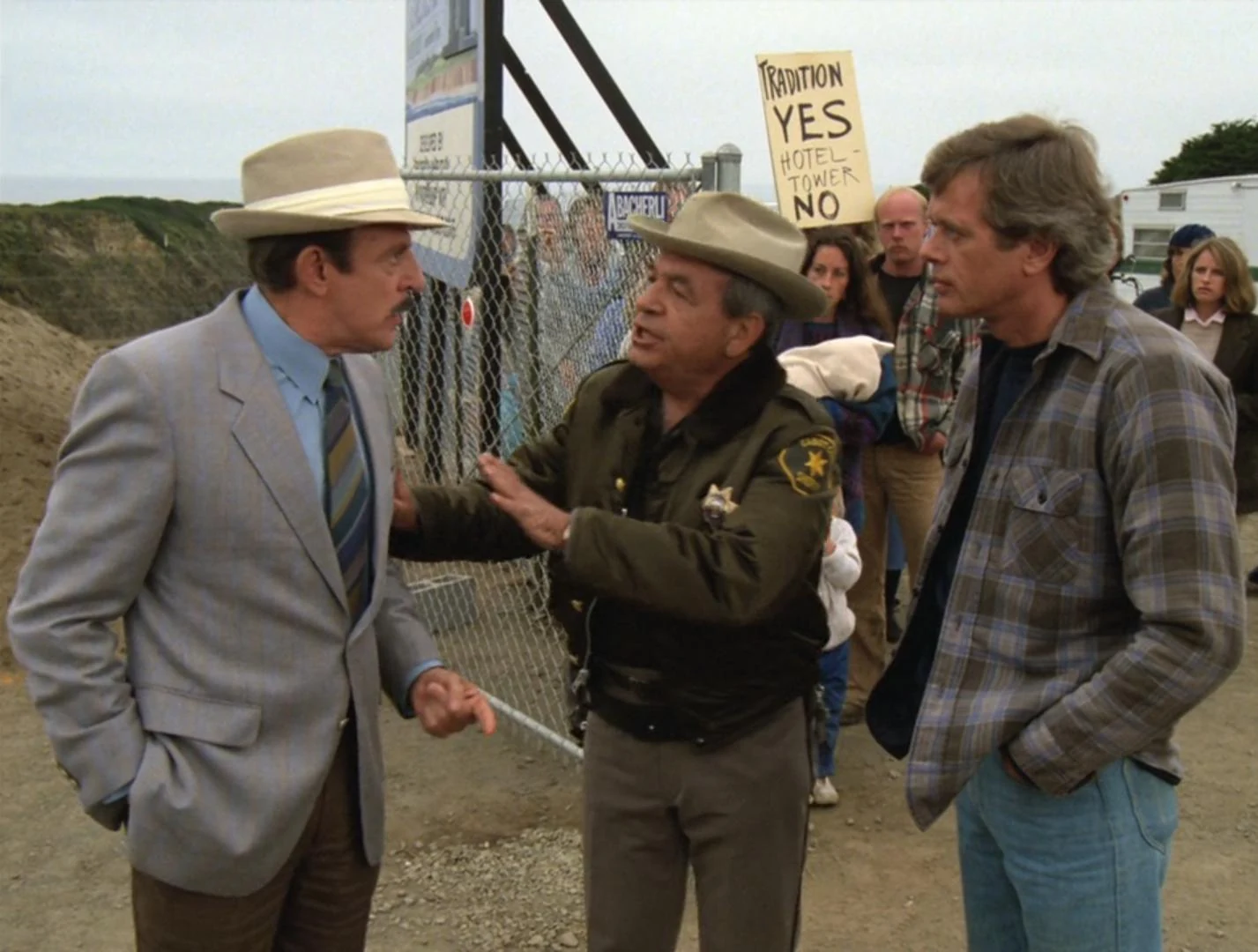
“Joshua Peabody Died Here… Possibly,” from 1985, turns a construction dispute and a discovered skeleton into a collision between local history and current interests. The title supplies the proper amount of skepticism. A town’s cherished story may be less solid than its residents would like, especially when a development project gives everyone a financial or emotional reason to take a position.
The coastal location supplies fresh air and a recognizable community without locking the series into naturalistic geography. Cabot Cove is fictional Maine; Mendocino, California, provided famous exterior locations. The screen town is a combination of places, sets, and an audience’s willingness to accept that Jessica can walk into another room and find another familiar face. Its consistency comes more from behavior than from a map.
That behavior isn’t always wholesome. Neighbors can be greedy, judgmental, secretive, and impressively willing to jump to conclusions. Jessica likes people without sharing every local assumption. She can defend the town against an outsider and defend an outsider against the town. This is an important distinction if the series is going to ask us to admire her judgment.
Elsewhere in 1980s pop culture, small-town life was often packaged as an escape from modern trouble. Cabot Cove makes a cheekier offer: the scenery is restorative, but people remain people. Bring a sweater, enjoy the harbor, and perhaps don’t discuss the will until after lunch.
The ratings weren’t a quaint little success
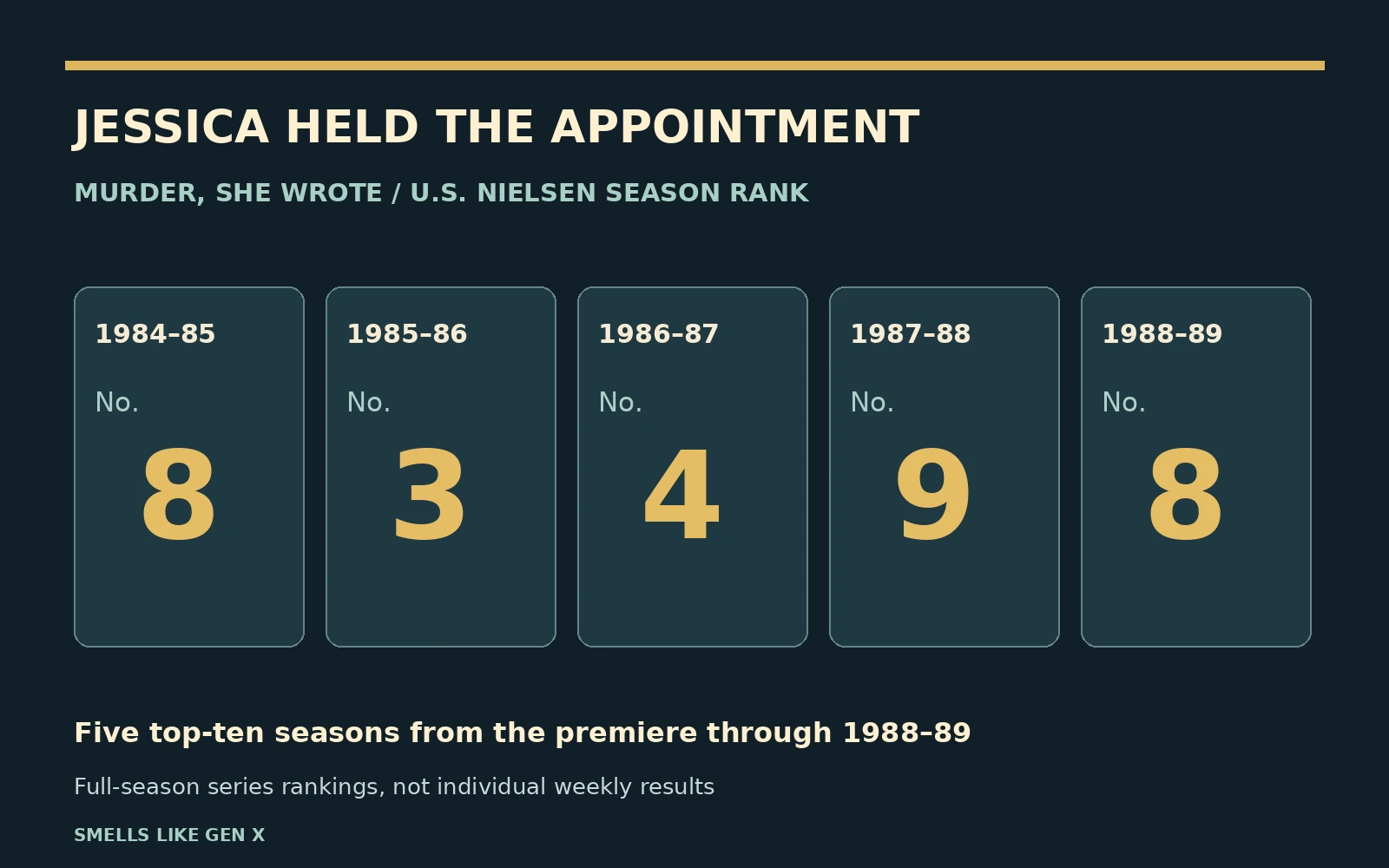
It’s easy to remember Murder, She Wrote as television’s comfortable older relative and overlook how aggressively successful it was. In its first full season, 1984–85, the series finished eighth in the Nielsen rankings. By 1985–86, it was third. Jessica wasn’t tucked away in a minor corner of the schedule, appreciated by a small loyal audience. She was competing near the top of the business.
That second-season leap is especially striking against NBC’s revival. The Cosby Show and Family Ties occupied the first two places, with CBS’s mystery immediately behind them. The Huxtables might have owned the family-comedy conversation, but Lansbury was delivering a formidable answer on another night. The full picture in the 1986 television rankings makes the scale plain.
The pattern continued. The show ranked fourth in 1986–87, ninth in 1987–88, and eighth in 1988–89. Those are season rankings, not claims that it held exactly the same position every Sunday. Individual weeks moved around, as they do. The larger story is five consecutive top-ten seasons from the premiere through the end of the decade’s last complete television season.
The 1985 list captures the debut beside the era’s soaps and action hits. The 1987 rankings show Jessica still near the front while NBC’s comedy machine gathers strength. In 1988 and 1989, she remains one of CBS’s clearest strengths even as the balance among the networks changes.
These numbers don’t tell us that every teenager was secretly obsessed with clues over dinner. They tell us that a great many households regularly chose this show. Younger viewers might have arrived through a parent’s choice, stayed for the mystery, or dismissed it and discovered it later. The program’s importance doesn’t depend on inventing a single experience for an entire generation.
It does depend on remembering the scale correctly. A 58-year-old actress began a drama built around her intelligence and became one of television’s biggest draws. That achievement is sometimes softened into a story about a beloved comfort show. Comfort was part of the product. The audience was anything but small.
Sunday’s most dependable invitation
CBS generally scheduled Murder, She Wrote at 8 p.m. Eastern on Sundays, after 60 Minutes. News magazine, mystery, then the network’s movie: it was a lineup with an adult center of gravity. Jessica didn’t need to make the same noise as a Tuesday sitcom or a Friday action series. She needed to make the next hour look worth spending at home.
The lead-in was valuable. So was the clarity of the invitation. A viewer knew what sort of evening the series offered without knowing this week’s location or guest cast. You could join a new case, enjoy Lansbury, and reach an answer before bedtime. There was no requirement to reconstruct six weeks of intercepted messages or remember which Ewing had betrayed which other Ewing. The show respected a different appetite.
That didn’t mean it had no competition. NBC introduced Steven Spielberg’s Amazing Stories in 1985, part of a Sunday hour that also included Alfred Hitchcock Presents. The Spielberg name promised an event; Jessica had already become a habit. UPI’s report on the opening week noted that Amazing Stories lost its time period to Murder, She Wrote. A familiar novelist had held her own against a very expensive calling card.
For households watching together, the mystery also offered a useful compromise. It had danger without demanding an appetite for graphic violence, jokes without becoming a comedy, and adult motives that a younger viewer could gradually begin to understand. An argument over an inheritance looks different at twelve than at forty-five. The episode doesn’t have to change for your understanding of the argument to become considerably less innocent.
The rhythm belongs beside the broader history of CBS’s Sunday-night identity, although that later decade has its own complications. In the eighties, the arrangement was still gathering its familiar shape. Before streaming turned an evening’s viewing into a negotiation with several menus, Jessica simply turned up at the appointed time. The suspect wasn’t the only one expected to be available.
A typewriter, a bicycle, and John Addison’s theme
John Addison’s opening music is one of the series’ finest pieces of persuasion. It moves briskly, with a buoyancy that promises an alert mind at work rather than an ordeal. The melody doesn’t sound like a warning that the next hour will permanently damage your faith in humanity. It sounds like an invitation to follow someone who knows her way around a puzzle.
The images make a matching introduction. Jessica writes, moves through her coastal surroundings, and gets on with a physically active life. The manual typewriter is instantly legible: this is a woman who produces things, thinks things through, and isn’t waiting for permission. The exercise matters, too. The opening doesn’t frame her as fragile. She is out in the world, apparently in better condition than several people who will soon attempt to outmaneuver her.
The contrast with more aggressive 1980s television themes is part of the charm. Other shows need helicopter shots, cars, saxophones, or declarations of exceptional toughness. Jessica can establish herself with a tune and a typewriter. It’s practically indecent how little equipment she requires.
Addison won the 1985 Emmy for the series’ dramatic underscore. That award wasn’t a separate trophy for the main-title tune, although the theme is the music many viewers can summon immediately. His contribution helps explain why the series’ world feels welcoming even as the weekly business turns unpleasant. Music can tell an audience how to enter a story before anybody says a word.
The credits also preserve a pleasure that disappears if you think of a series only as its plot. The opening itself is part of returning. Hearing those first phrases can restore the character’s tempo before a case has begun. Jessica may be about to board a plane, visit a relative, or find herself among people with extraordinarily poor impulse control. The theme assures you that she remains Jessica. On a Sunday night, that was an efficient piece of hospitality.
The bus trip that deserves its reputation
A storm, a bus, a roadside diner, and a passenger who won’t be completing the journey: “Murder Takes the Bus,” first broadcast in March 1985, needs very little explanation to establish a good evening’s entertainment. Jessica and Amos are traveling to a sheriffs’ gathering when the trip takes a turn that no sensible transportation company would feature in its advertising.
The episode gathers its suspects in a limited space and lets the weather do some of the work. A downpour turns an inconvenience into confinement. People who would ordinarily pass through one another’s lives must remain together long enough for their stories to become suspicious. The diner is shelter, but shelter doesn’t make the company safe.
There’s a useful change of pace in seeing Jessica and Amos share the disruption. At home, the sheriff has an office and a familiar chain of authority. Here he is another traveler whose plans have been ruined, with professional obligations arriving in the worst possible form. Bosley gets to be funny without surrendering the character’s entire claim to competence. The affection between him and Lansbury makes the journey enjoyable even before the mystery tightens.
The guest cast includes Rue McClanahan, Linda Blair, Larry Linville, and Michael Constantine. That is a wonderfully distracting collection of familiar faces. Somebody recognizable enters a shot, and part of the audience’s brain begins consulting an informal television address book while the other part tries to keep track of the case. The series knows that recognition is a pleasure, not an embarrassment to be disguised.
This is also an example of how comfortably the show can use old-fashioned suspense. Nobody has to invent a bizarre new criminal psychology to make being stranded with a killer alarming. Rain beyond the windows and uncertainty inside are enough. The installment has atmosphere, a strong enclosure, and two regular characters worth spending time with.
It’s an excellent early episode to revisit because it doesn’t require years of affection to excuse its mechanics. The construction is part of the fun. The bus has stopped, the storm has settled in, and Jessica is beginning to look interested. You may as well get comfortable; the timetable is no longer the main concern.
Jury duty is different when Jessica gets the summons
In January 1986’s “Trial by Error,” Jessica serves as a jury foreperson in a case involving a claim of self-defense. The setting changes her job. She can’t simply visit the suspect, make a few calls, and present the solution to a grateful sheriff. She has to deal with the evidence and the people who are supposed to judge it.
The obvious family resemblance is to 12 Angry Men: a roomful of citizens, conflicting temperaments, and the uneasy question of whether a confident group has actually thought carefully enough. But Lansbury brings Jessica’s particular social skill to the situation. She is used to reading a room without accepting its first answer. A jury room gives that habit a practical test.
Brock Peters and Vicki Lawrence are among the guest players, helping turn deliberation into more than a row of people waiting for Jessica’s next speech. The room contains personalities, impatience, and assumptions. People want to be reasonable; they also want to be finished. The distance between those two desires is fertile ground for a mystery.
What makes the episode satisfying is the way it moves Jessica’s persistence away from her usual personal loyalties. She isn’t simply rescuing a nephew or trusting an old friend. She’s worrying at the story put in front of her because parts of it don’t sit properly. Lansbury’s expression can carry the irritating business of being the person who won’t agree merely because agreement would be convenient.
That’s a particularly adult pleasure in the show. A clue isn’t always a secret passage or a conveniently dropped object. Sometimes the trouble lies in a story everyone has grown comfortable telling. Jessica is prepared to be inconvenient until it makes sense. Anyone who has sat through a meeting where a bad conclusion acquired momentum simply because lunch was approaching may appreciate the trait.
The episode also earns a place among the stronger 1980s television mysteries by changing the pressure around its familiar heroine. The series hasn’t abandoned its appeal. It has found a new room in which Jessica’s refusal to stop thinking becomes the most useful quality available.
First class doesn’t improve the passenger list
“The Corpse Flew First Class,” broadcast in January 1987, takes another familiar enclosure and adds expensive service. Jessica is on a flight to London when a wealthy woman’s bodyguard dies and a valuable necklace becomes part of the mystery. First class has better seats. Apparently it does not have better human behavior.
Kate Mulgrew plays the wealthy passenger, giving the episode a strong personality to place opposite Lansbury’s composure. The setting allows status to become visible immediately: who expects attention, who supplies it, who appears to belong, and who may be performing a role. An airplane cabin is unusually good at arranging people by what they’ve paid and then forcing them to remain within speaking distance.
For Jessica, the attraction is the same as the challenge. The suspect pool is close, the journey has boundaries, and explanations must fit a space the viewer can understand. The camera doesn’t need a city of possible locations. A face across the aisle or an account of who moved where can acquire importance because everyone is traveling inside the same problem.
The episode is also a useful reminder that Jessica’s success has changed the scale of her life. She isn’t forever the small-town visitor staring at a grand hotel in astonishment. She travels, deals with public attention, and occupies these settings with increasing ease. Lansbury lets the sophistication grow without making Jessica chilly. Courtesy travels well; so does skepticism.
There is a deliciously absurd pleasure in watching an expensive travel experience fail to protect anybody from the essentials of a whodunit. Money buys comfort, privacy, and the expectation that somebody else will handle an inconvenience. It doesn’t purchase an alibi. The story gets to enjoy the surfaces while quietly dismantling the confidence underneath them.
Fans of enclosed mysteries can place this beside the bus trip and see how flexible the same basic attraction is. One episode has rain and a diner; another has champagne-class surroundings above the Atlantic. The difference in company changes the flavor. Jessica’s attentive presence makes both feel like proper destinations rather than a budget-saving excuse to stay in one place.
Cabot Cove was not entirely innocent
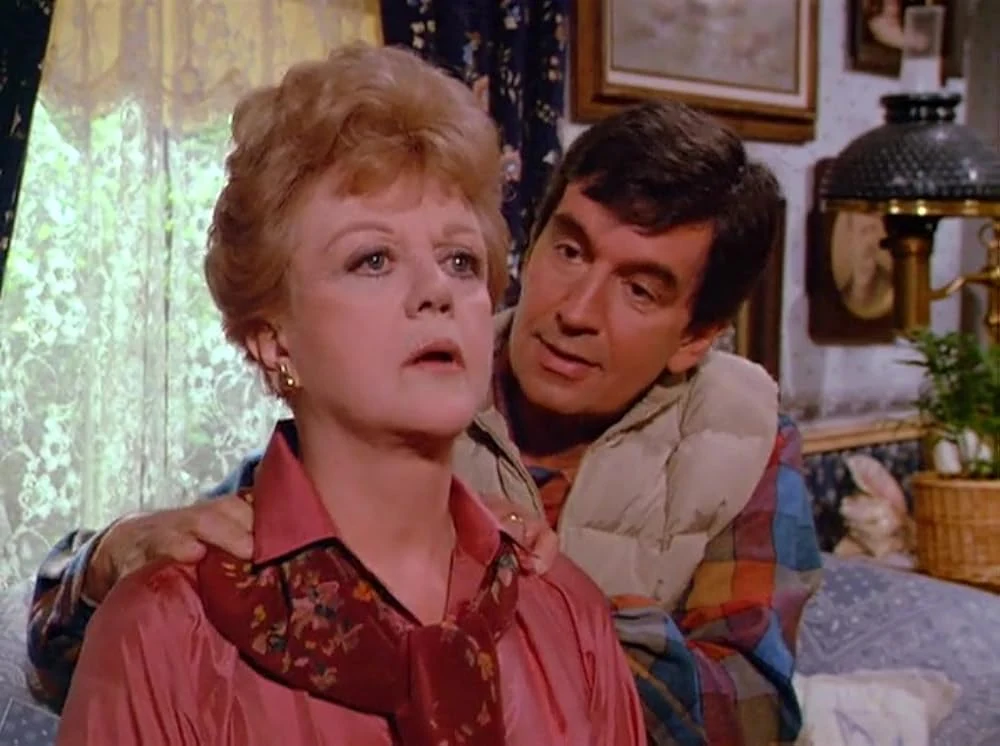
The title “If It’s Thursday, It Must Be Beverly” announces that this November 1987 episode has a particularly mischievous streak. A local deputy’s wife dies, and the investigation uncovers more than one reason for Cabot Cove residents to prefer discretion. The town’s respectable appearance turns out to have a rather crowded underside.
This is where the cozy label can conceal how funny the series sometimes was about adult behavior. Jessica might be proper, but the writers weren’t obliged to make everyone around her celibate, honest, or especially dignified. Desire and embarrassment could generate an investigation as effectively as an inheritance. A seaside community contains the same appetites as a city; it merely offers fewer places to pretend nobody knows you.
Lansbury is very good at the small delay between hearing a surprising explanation and deciding how politely to respond. Jessica doesn’t need to become prudish to register the absurdity of a situation. Her expression can acknowledge that people have made an extraordinary tangle of their lives while leaving her free to concentrate on what actually happened.
That is a welcome quality in a detective. A less generous heroine might divide the room into respectable people and obvious wrongdoers before beginning. Jessica is more interested in evidence. An embarrassing secret may be relevant, or it may merely be embarrassing. The comedy comes from people desperately wishing she would stop asking long enough for them to establish the difference.
The installment also uses Cabot Cove’s familiarity as fuel. Gossip travels rapidly where people share shops, offices, and social connections. One person’s private arrangement may be somebody else’s half-understood observation. Jessica’s questions move through that web, making the town feel socially busy rather than simply decorated.
Not every joke has aged with equal grace, and the show’s occasional tendency to make sexual embarrassment do too much comic work is visible here. Still, it’s a useful corrective to the idea that Murder, She Wrote offered only squeaky-clean tea parties interrupted by a corpse. Cabot Cove residents had arrangements. Some of those arrangements apparently required a calendar. Jessica, mercifully, remained interested in the murder.
When Jessica met Thomas Magnum

There are crossovers that feel like a marketing department has pushed two casts into an elevator, and there are crossovers with an immediately enjoyable collision of personalities. Jessica Fletcher and Thomas Magnum belong in the second category. He has the mustache, the physical confidence, and a habit of acquiring trouble. She has a handbag and the ability to make an official’s explanation fall apart.
The 1986 story begins on Magnum, P.I. with “Novel Connection,” broadcast November 19, and concludes four days later in Murder, She Wrote‘s “Magnum on Ice.” Jessica helps Magnum when a killing places him in serious difficulty. The arrangement lets the two series cooperate without pretending their heroes are interchangeable.
Tom Selleck’s Magnum is accustomed to moving, reacting, and doing things that look hazardous in a television promo. Lansbury’s Jessica changes a scene by listening to it. Put them together and the difference becomes the entertainment. She doesn’t have to become an action heroine to belong in Hawaii; he doesn’t have to become foolish to need her help.
There is also a satisfying reversal in seeing a male television star of Magnum’s stature benefit from Jessica’s authority. This isn’t an elderly guest character dispensing a useful morsel before the hero takes over. It’s Jessica’s series at the finish, and her intelligence carries weight. Selleck’s openness to her makes the encounter more appealing than a competition over whose show has the bigger entrance.
The setting supplies a change of light and scenery, but the core pleasure is conversational. Two familiar stars share the frame, and neither seems required to surrender the quality that made the audience want to see them. It is a good advertisement for the range of eighties detective television: different methods, different temperaments, enough room for both.
The story also rewards viewers who remember television as a schedule. Following the crossover meant crossing nights as well as titles. The suspense traveled from Wednesday to Sunday, with Jessica waiting at the other end. That is a much more agreeable use of a network’s interconnected programming than discovering you’ve missed the one episode necessary to understand why everybody has suddenly changed jobs.
Hollywood gets hold of the book. Naturally, disaster follows
Jessica’s writing career isn’t just a device for getting her on airplanes. It occasionally gives the show a chance to poke at the entertainment business that employs it. In October 1984’s “Hooray for Homicide,” she goes to Hollywood after discovering that an adaptation of her novel is becoming a tawdry horror movie. Then the producer is murdered, leaving her with a considerably worse problem than an unhappy meeting about the screenplay.
The joke works because Jessica takes her work seriously while the people adapting it have their own priorities. A book is something she made. A movie is something other people intend to sell. Those aren’t automatically incompatible ambitions, but the distance between them is ample room for wounded pride, insulting explanations, and a very bad afternoon.
Lansbury’s presence makes the industry satire especially enjoyable. Here is an actress with decades of screen experience playing a novelist confronted by Hollywood’s confidence that it knows what an audience wants. Jessica isn’t required to understand every technical detail to recognize that the result has traveled an alarming distance from her intentions. Her disapproval lands because it is precise rather than merely provincial.
It also gives her an immediate motive in the eyes of people who prefer obvious answers. The mystery turns professional outrage into suspicion, forcing the woman who wants the picture stopped to establish that she hasn’t stopped its producer by force. That’s a neat early variation on the innocent-friend formula: this time Jessica occupies an uncomfortable part of the suspect list herself.
The episode’s view of show business is broad, but broadness suits a case built around a lurid adaptation. Nobody needs the subplot to become an exhaustive account of rights contracts or studio finance. The entertaining question is what happens when a serious, observant woman meets people who assume enthusiasm and a sales pitch will settle everything.
It’s an early sign that the series can laugh at the systems surrounding its heroine. Publishers, producers, professionals, and respectable institutions aren’t automatically wise because they have an office. Jessica’s book may have attracted commercial attention, but her judgment remains her own. Hollywood is welcome to discuss the project. It may find the author unexpectedly difficult to steamroll.
The guest cast was its own television reunion
Part of the fun of Murder, She Wrote is looking at a suspect and recognizing another show altogether. Tom Bosley already brings Happy Days into Cabot Cove. Elsewhere, an old film star, a sitcom favorite, or a familiar character actor appears with a new name and an explanation that may or may not survive Jessica’s next question.
The second-season premiere, “Widow, Weep for Me,” is a particularly rich example. Its cast includes Cyd Charisse, Mel Ferrer, Howard Hesseman, Mary Wickes, and Len Cariou. That isn’t a random collection of interchangeable visitors. Each performer arrives with a different texture: elegance, authority, irritation, comic timing, or an ability to suggest that a friendly conversation contains another conversation underneath.
Cariou plays Michael Haggerty, a British intelligence figure whose encounters with Jessica add a more slippery variety of company. Hesseman’s presence invites recognition from viewers who know his comic work without obliging the episode to become that other series. The pleasure is partly in seeing what an actor does when the familiar role is taken away.
This was a strength of weekly television that doesn’t fit neatly into a discussion of fashionable storytelling. A durable guest role gave a performer room to create a person quickly. A grievance, a mannerism, a little vanity, a suspicious pause: these were practical tools. When the casting worked, the episode acquired a small population rather than a row of possible killers.
The habit of bringing actors back in different parts asks the audience to be cooperative. Cabot Cove and Jessica’s travels occupy a world in which a recognizable face may eventually turn up with another identity. It’s a repertory pleasure, closer to watching good players return than maintaining a perfect fictional census. The new performance is the invitation.
For Gen X viewers, that casting now has an extra layer. People first encountered through a mystery rerun may later become recognizable from the films and 1970s television that preceded it. The direction of discovery changes. Jessica’s guest list remains an excellent place to find someone worth watching again.
A house full of things, and a town full of claims
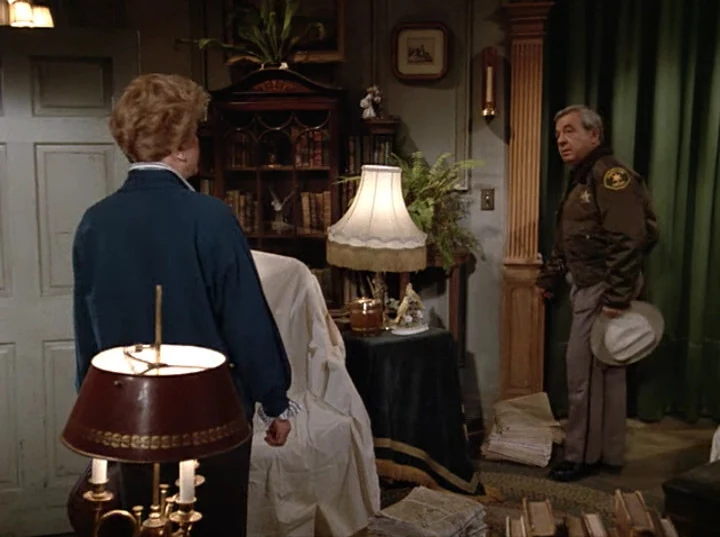
“Benedict Arnold Slipped Here,” from 1988, begins with the death of a reclusive resident and Jessica’s involvement with her estate. The house is cluttered with possessions; the surrounding community is rather less cluttered with pure intentions. Once objects might be valuable, people discover impressive depths of interest in a neighbor they were not necessarily eager to help.
It’s a particularly good Cabot Cove setup because it gives the mystery a physical place to rummage. A room full of things offers memories, junk, possible treasure, and opportunities for somebody to insist an item belongs to them. The title adds the possibility of historical significance, which is the sort of phrase that makes an ordinary object suddenly acquire admirers.
Jessica’s response keeps the deceased woman from being merely the owner of a convenient pile of clues. An estate represents a life, even when its contents appear chaotic to an outsider. The contrast between responsibility and opportunism gives the episode a sharper edge than its jaunty title might suggest. Somebody has to do the useful work while everybody else considers what might be in it for them.
That makes Amos a good companion for the story. His official position and Jessica’s personal involvement place them at different angles to the same town. A sheriff can ask what happened and who was present; Jessica may also remember how people treated one another before there was anything to gain. The history of a relationship can matter as much as the history attached to an antique.
The episode’s pleasures are modest but specific: household clutter, local behavior, competing claims, and the possibility that an apparently dull obligation has become dangerous. It doesn’t need a giant conspiracy. A few people who want the same thing can produce a perfectly adequate disaster.
That is where the home stories often beat the travel episodes. A glamorous destination offers instant novelty, but Cabot Cove supplies accumulated familiarity. Jessica belongs in this house because she belongs in the town. Her curiosity has a social weight that a hotel booking can’t provide, and Lansbury gives the investigation an appropriate mixture of duty, sympathy, and increasing suspicion.
A ski holiday with a distinctly poor safety record
By November 1988, “Snow White, Blood Red” demonstrated how far the show could move from the expected cozy evening without abandoning Jessica. A ski resort, a storm, and a killer create a more threatening enclosure than the town’s familiar rooms. The outdoor activity is supposed to be the risky part of a ski trip. The lodge makes a persuasive counterargument.
The episode leans harder into physical menace than many installments. Snow limits movement, isolation narrows the options, and the sporting setting supplies attractive surfaces that don’t stay reassuring. Jessica’s presence doesn’t cancel the danger. It gives the viewer somebody steady to follow while the environment becomes less forgiving.
It’s a useful episode for anyone who has reduced the series to tea, typewriters, and a body discovered at a socially convenient distance. The eighties run had room for a nastier atmosphere. A closed setting needn’t be charming simply because the investigator is courteous. When the people inside realize they cannot easily leave, even a pleasant resort begins to feel badly designed.
The limitation is that a higher body count doesn’t automatically produce a better mystery. The episode is memorable partly because its mood and methods are unusual for the show. A viewer seeking the conversational pleasure of Jessica and Seth at home may find the change less appealing than someone enjoying the tension. Both responses are reasonable; variety is useful without making every variation a masterpiece.
What holds it together is Lansbury’s refusal to overplay being the stable center. Jessica adjusts to the place and the people rather than becoming a different heroine for a snowbound thriller. She observes, asks, and keeps going. The episode can borrow a colder atmosphere because its lead doesn’t lose her temperature altogether.
Placed beside the bus and airplane stories, it shows how well the series understands enclosure. Remove the easy exit and people must keep explaining themselves. Change the weather, the class of accommodation, and the temperaments, and a familiar puzzle takes on another personality. Jessica has no need to complain that her vacations are repetitive. Restful, however, may be asking too much.
A new sheriff discovered the town’s problem
After Bosley’s departure, Ron Masak’s Sheriff Mort Metzger brought a different tone to local police work. Mort came from New York and expected a more manageable assignment. Arriving in Cabot Cove on that assumption is one of television’s finer examples of not reading the local news before accepting a job.
Masak gives Mort a brisker, more metropolitan impatience than Amos. The contrast matters because the series doesn’t need another actor reproducing Bosley’s manner. Jessica already knows how to deal with a sheriff. The interest lies in how this particular sheriff deals with her and with a town whose calm exterior is spectacularly unreliable.
The replacement also changes the balance of familiarity. Amos belongs to the world Jessica has long known. Mort is learning it, and his outsider’s expectations give the audience a fresh angle on its absurdities. He can be surprised by local behavior that Jessica has learned to interpret. A newcomer sees the strangeness; an established resident knows which family has been doing it for years.
By the end of the decade, Seth and Mort help give the home episodes a renewed rhythm. The show hasn’t replaced Jessica’s central relationships wholesale, but it has adjusted the company around her. That is a practical way to keep a durable format from becoming inert. The audience still recognizes the room; somebody different is now objecting to what happens in it.
It’s worth appreciating the scale of the adjustment without inventing a revolution. Murder, She Wrote remains a Jessica Fletcher series. A new sheriff changes the flavor of a conversation, not the identity of the program. Masak’s contribution is to make those conversations lively enough that the absence of Amos doesn’t leave every local scene feeling like an empty place setting.
The official badge may have passed to another man, but the most effective intelligence operation in town still runs through Jessica’s attention. Mort has jurisdiction. She has noticed something odd about a remark made ten minutes earlier. The two will have to come to an understanding.
Beloved doesn’t mean every script was brilliant
The series’ greatest strength also gives its weaker episodes a place to hide. Lansbury is so appealing that a thin mystery can remain watchable long after its clues have stopped being persuasive. A guest behaves suspiciously because the plot needs a suspicious guest; a secret emerges at the required minute; a confession clears away objections that deserved another scene. Jessica smiles, and the hour is over.
The dependence on coincidence can be comical. A novelist with an enormous circle of acquaintances keeps arriving just when someone needs defending. Trips become investigations; dinners become witness interviews; a relative’s good news acquires ominous lighting. There is a point at which a rational friend might stop inviting her. The series asks you to accept the arrangement, and generally rewards the courtesy.
Police competence is a more variable bargain. Jessica needs room to investigate, but that doesn’t require every officer to dismiss evidence with the certainty of a man personally offended by thought. The better episodes give officials understandable limits or competing responsibilities. The weaker ones make them wrong simply because a final scene is approaching.
Reviews at launch recognized Lansbury as the main attraction even when they found the mysteries ordinary. That remains a fair assessment. The show wasn’t secretly a flawless puzzle anthology overlooked by people with unfortunate taste. Its achievement was the combination of a magnetic lead, a hospitable world, reliable pleasures, and enough strong stories to keep returning worthwhile.
Awards underline the gap between esteem and a particular kind of validation. Lansbury received an Emmy nomination for Jessica in every season of the series without winning the competitive acting award. She did win four Golden Globes for the role across its full run. Those later totals shouldn’t obscure how firmly she had established the character during the eighties.
The fairest way to watch is with affection and functioning judgment. Some episodes are excellent. Some are amiable. A few are held together by casting, scenery, and Lansbury’s ability to make a dubious line sound like a reasonable thing to say. You don’t have to pretend they’re equal to understand why people kept the appointment.
Even Jessica needed a little time off
Keeping a successful hour-long drama going requires more than finding another guest star with a motive. It requires scripts, schedules, locations or convincing substitutes, and a lead who is present for an extraordinary amount of it. The very quality that makes Murder, She Wrote feel effortless—Jessica’s steady attention—depends on Lansbury repeatedly doing the work.
As the 1989–90 season began, the program made room for stories in which Jessica introduced another investigation rather than carrying the entire hour herself. These often called bookend episodes offered a practical answer to the demands of a show centered so heavily on one performer. Other sleuths could occupy the case while her presence still framed the evening.
It was an understandable solution and an imperfect bargain. If your main reason for watching was Lansbury responding to people, a brief introduction wasn’t the same thing as an episode. The series had trained the audience to enjoy how Jessica moved through a mystery, not merely the existence of a mystery somewhere in her acquaintance.
That reaction is revealing. By the end of the eighties, she wasn’t simply a useful presenter for an adaptable detective format. She was the attraction that made its variations cohere. You could change the location, the suspect, the police officer, and much of the supporting cast. Reduce Jessica too far and the space around the puzzle became obvious.
The series would continue into 1990s television, eventually completing twelve seasons and 264 series episodes before later television movies. The weekly finale aired May 19, 1996. Those developments belong to another stretch of its life. Here, at the decade’s edge, the important point is simpler: a program that had looked reassuringly familiar was still negotiating the very real effort required to keep that familiarity on the air.
The pleasure changes when you’re old enough to know better
A younger viewer can watch Jessica as the grown-up who has everything under control. Return years later and different pleasures come forward. Her ability to remain polite while refusing a bad explanation becomes more impressive. So does her willingness to leave a conversation, make a call, and come back when the facts are better. She doesn’t confuse being loud with being useful.
The money stories become sharper, too. An inheritance isn’t merely a convenient motive on a suspect list; it’s a collision of family history, disappointment, and somebody’s belief that they have waited long enough. Professional jealousy isn’t a mysterious adult condition. A person takes credit, breaks a promise, or decides that humiliation is someone else’s problem. The series’ motives are broad, but many of the feelings behind them are depressingly recognizable.
Jessica’s teaching background also acquires more charm. She has the patience to let someone explain, the confidence to ask a precise follow-up, and the clear impression that she has heard an imaginative excuse before. Her interrogations often feel less like an assault than the moment a student realizes the teacher actually read the assignment. The suspect may have rehearsed. Jessica has prepared.
There’s an appealing connection to the earlier detectives in Columbo’s seventies cases and the more battered world of Jim Rockford. All three use personality as an investigative instrument. Jessica’s particular advantage is the gap between the courtesy people see and the persistence they haven’t yet accounted for. A villain expects an easy conversation and receives a difficult future.
Reruns make those performances visible in another way. Once you know the solution, the question changes from who did it to how Lansbury keeps the company enjoyable. Watch a second time and the small choices become the entertainment: a delayed reply, a look toward a nervous guest, the instant friendliness becomes resolve. The plot has surrendered its secret. The acting hasn’t run out.
That is why the show belongs among the memorable dramas of the 1980s without needing to resemble its noisier contemporaries. Jessica didn’t have to be fashionable to be modern, or grim to take people seriously. Sunday after Sunday, she made attention look powerful. Somebody underestimated her, offered one explanation too many, and watched that familiar expression change. An excellent way to end a weekend—unless you were the one explaining.
Questions Readers Ask
Who played Jessica Fletcher?
Angela Lansbury played the mystery writer and amateur detective Jessica Fletcher, whose pleasant manner rarely meant she had stopped noticing the clues.
When did Murder, She Wrote debut?
CBS launched the series in 1984. Its long run made Jessica Fletcher one of television’s most familiar detectives.
Was Cabot Cove a real place?
Cabot Cove is fictional. The show used various filming locations to create Jessica’s Maine hometown and its improbably busy criminal life.