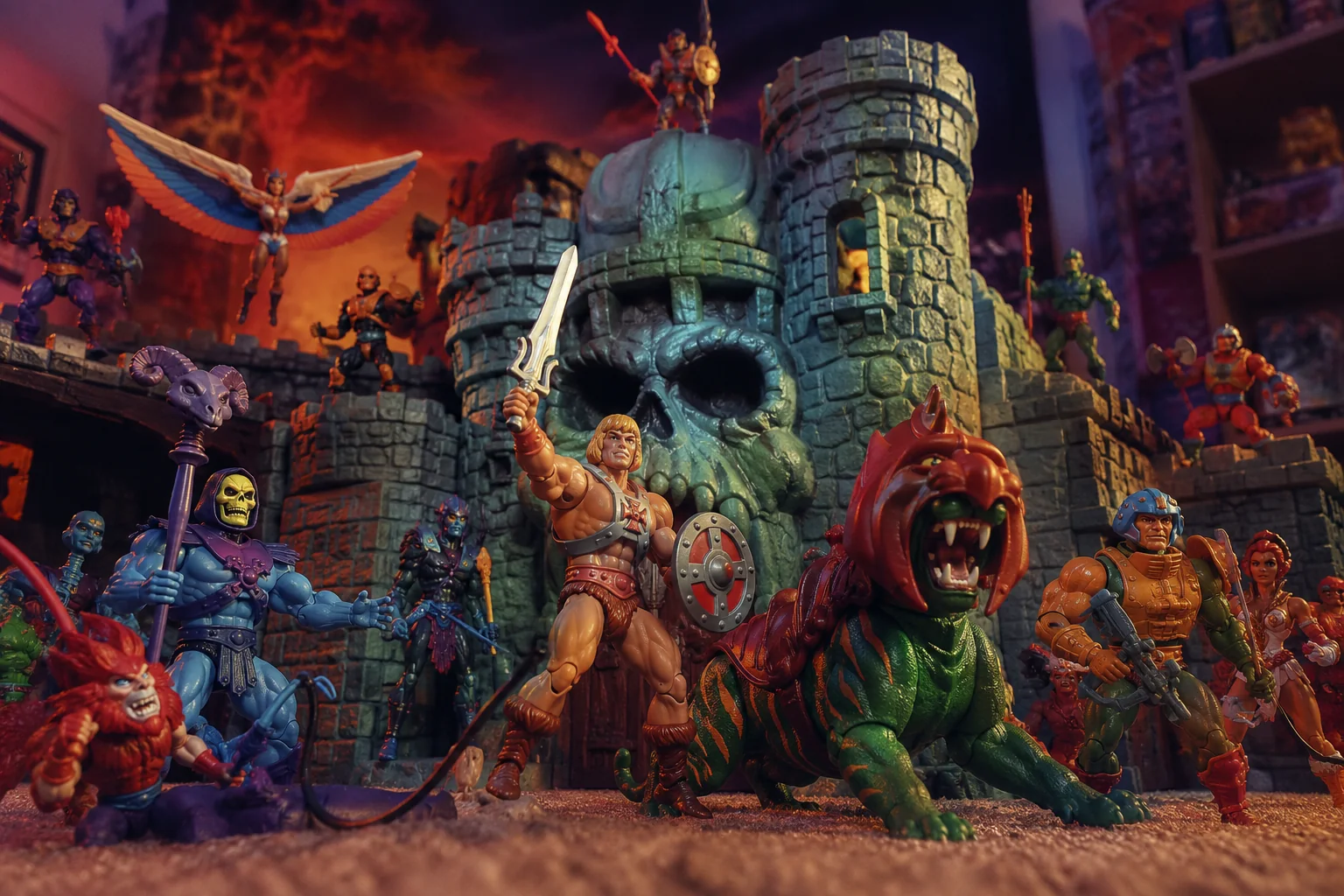
He-Man and Masters of the Universe Toys: How Eternia Took Over the 80s
The figures were short, muscular, weird, and armed like every argument had already failed. Then Castle Grayskull showed up, the cartoon started yelling from the TV, and suddenly every living-room carpet became Eternia.
The toy aisle had action figures. Then Eternia crashed through the wall.
He-Man toys did not look like they came from a quiet little product meeting. They looked like someone mixed Conan, Star Wars, comic books, monster movies, pro wrestling, laser blasters, bodybuilding magazines, and a garage-sale bin of medieval weapons, then told the design team to make it all safe enough for children who still ate cereal out of plastic bowls.
The result was Masters of the Universe, one of the biggest 80s toys stories and a permanent fixture among the most iconic toys of the 80s. These were not delicate figures you posed and admired from across the room. They were toys meant to collide, twist, punch, fall off furniture, conquer couch cushions, and lose one tiny sword half under the radiator until 1996.
Masters of the Universe toys worked because they gave kids an entire battle system before they even watched the show. Heroes versus villains. Muscle versus monster. Castle versus mountain. Sword versus staff. Beast versus vehicle. Every figure looked like it had a grudge, and every accessory looked like it would violate at least two safety policies if enlarged to real size.
The line also became the center of the 80s action figure wars, where toy companies battled for bedrooms, backpacks, Saturday morning attention, and the precious floor space directly in front of the television.
Before Eternia, the action aisle was changing shape
Before He-Man Toys: Why the Early 80s Were Ready for Masters of the Universe
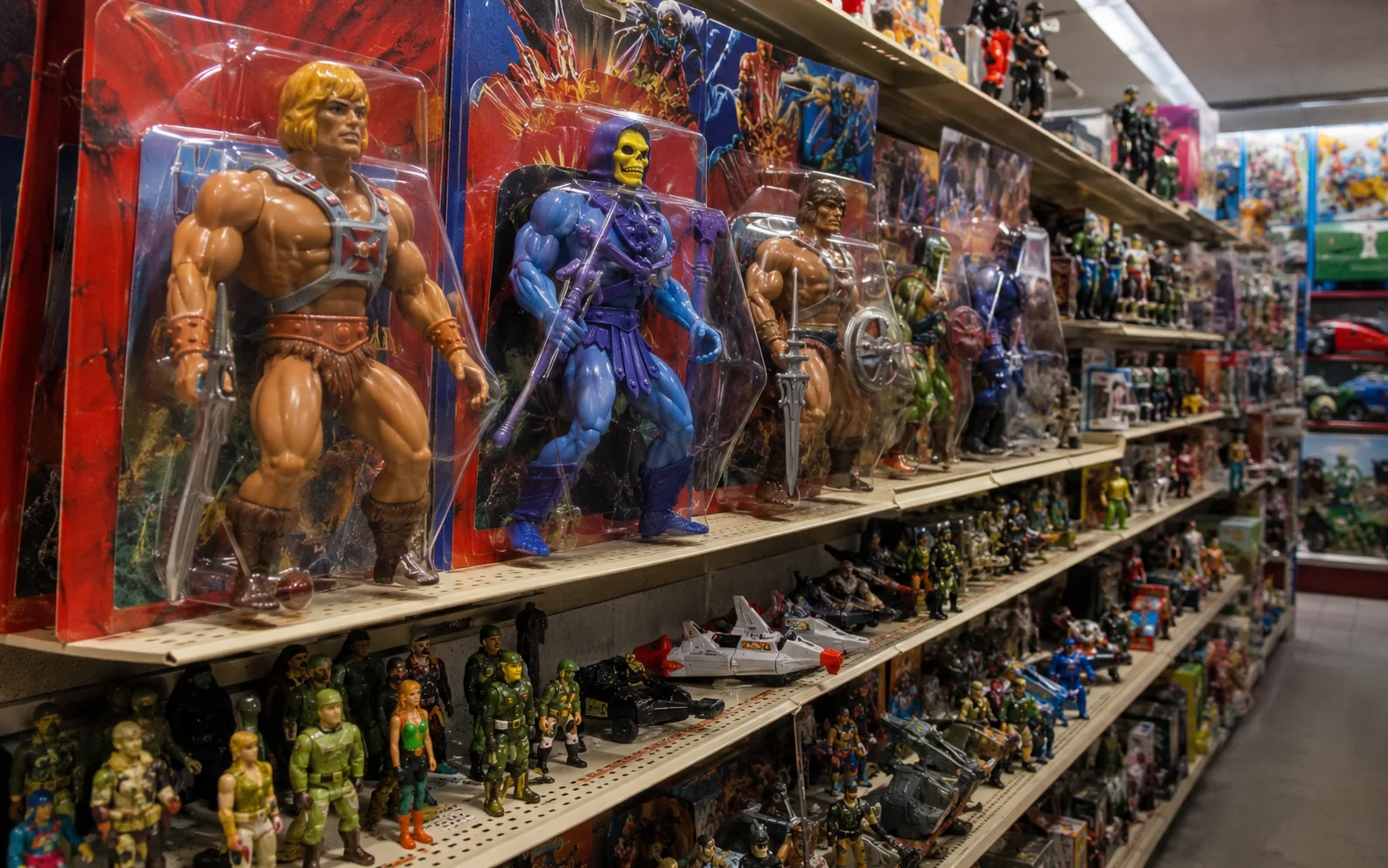
The early 80s toy aisle was not waiting politely for one more action figure line. It was already a war zone. Star Wars had proven that small figures, vehicles, and playsets could turn a movie into years of bedroom commerce. G.I. Joe had shrunk from large military dolls into a smaller, more collectible action-figure format. Fantasy movies, arcade games, comic books, monster toys, and Saturday morning cartoons were all fighting for the same kid attention span.
Mattel needed a line that could live without depending on one movie studio, one actor, or one outside license. The company wanted something it could own, expand, advertise, and control. Masters of the Universe answered that problem with a fantasy world broad enough to swallow almost anything.
The toy market had learned the power of worlds
A single figure could sell. A world could keep selling. Once children owned a hero, they needed a villain. Once they owned a villain, they needed a vehicle. Once they had vehicles, they needed a place to fight. A toy line that created a world created an argument for every birthday, report-card reward, and Christmas list.
He-Man entered that moment with an unusually clear play promise. The line did not ask children to understand complicated politics, military structure, or a movie plot they might not have seen. It said: here is the strongest hero, here is a skull-faced villain, here is a castle, here are weapons, go settle it on the carpet.
Fantasy was moving into kid culture
Sword-and-sorcery imagery had been growing in movies, paperback art, comics, games, and pop culture. Muscled heroes, sorcerers, monsters, barbarians, dark castles, and magic weapons were everywhere around the edges of children’s entertainment. Masters of the Universe sanded off the adult grit and repackaged the shapes as bright, chunky toys.
That combination made the line feel older and cooler than ordinary child-directed toys. It looked dangerous without actually being dangerous. It looked like something borrowed from an older brother’s poster and made safe enough to smash against a beanbag chair.
Mattel did not need realism
Realism would have trapped the line. A realistic medieval line would need knights, horses, castles, and historical logic. A realistic science-fiction line would need spaceships, lasers, robots, and future rules. Masters of the Universe refused to choose. He-Man could carry a sword while riding a robotic horse into a skull castle against a blue skeleton man with a techno-staff. Nobody asked for a congressional hearing because kids understood the only rule that mattered: it looked awesome.
The timing lined up with the Christmas machine
The early 80s were becoming increasingly defined by annual toy winners. The top toys of 1981 and top toys of 1982 show how quickly brands could dominate a holiday season. Masters of the Universe arrived with exactly the kind of visual punch a parent could recognize from a catalog page and a kid could spot from the far end of a store aisle.
The line looked simple from the shelf. Underneath, it was a very smart toy-company machine.
How the Original Masters of the Universe Toy Line Began
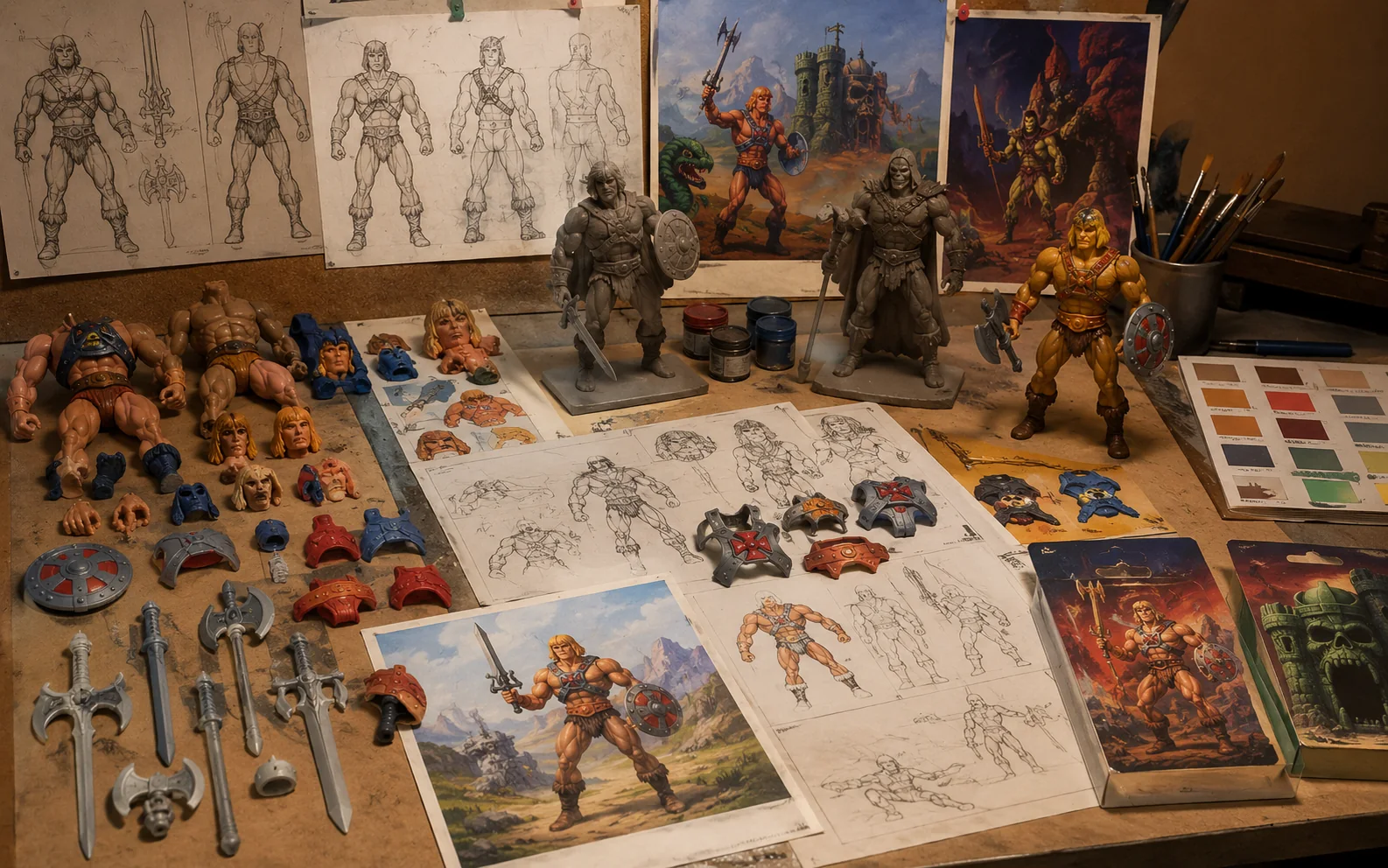
Masters of the Universe was a toy-driven universe. That distinction matters. Many later franchises began with entertainment and then moved into merchandise. He-Man began with a toy idea and built enough story around it to make the figures feel necessary.
That gave Mattel enormous control. Characters could be designed with action features, color contrast, cost efficiency, packaging impact, and future reuse in mind. The story could then be shaped around the toys instead of forcing toys to imitate an already fixed movie or show.
The figures were designed to look powerful instantly
On a shelf packed with smaller, slimmer figures, He-Man looked ridiculous in the best way. The broad chest, tiny waist, huge arms, and crouched stance made each figure feel ready to attack before a child even touched it. The proportions were not subtle. Subtle was not invited to Eternia.
Kids did not need a commercial to know these figures were strong. Parents did not need a backstory to know they were buying an action toy. The design communicated the category, the fantasy, and the play pattern in one glance.
A lot of bodies were reused, and kids barely cared
Masters of the Universe reused body molds, limbs, armor shapes, weapons, and engineering across multiple figures. That helped Mattel expand the line quickly while keeping costs manageable. The trick was making each figure look distinct enough that children did not feel they were buying the same body with a new head.
Color, armor, head sculpts, weapons, creature features, and gimmicks did the heavy lifting. Man-At-Arms looked armored and mechanical. Beast Man looked furry and savage. Mer-Man looked aquatic and weird. Skeletor looked like the villain your parents would have disapproved of if he had not already been on your birthday list.
The package art sold a larger world
Early Masters of the Universe packaging looked intense. The figures appeared in action scenes, not polite product photography. Backgrounds suggested cliffs, castles, monsters, beams, weapons, and danger. The art made the line feel bigger than the plastic inside the bubble.
That mattered because the child often saw the package before owning the character. The cardback was not trash yet. It was advertising, instruction, and fantasy fuel.
The name did a lot of work
“Masters of the Universe” is not a small promise. It does not suggest a mild regional dispute. It sounds cosmic, powerful, and completely overconfident. Perfect. The title allowed the line to include barbarians, robots, monsters, vehicles, sorcery, royalty, warriors, and whatever else looked good in a meeting.
He-Man’s own name was even more blunt. He was not Adam the Brave or Prince Laserblade. He was He-Man. It sounded like something invented by a child who had no patience for nuance and had already decided the hero was the strongest guy around.
One figure was never going to be enough
The line launched with heroes, villains, weapons, a central playset, and storytelling material. Children could begin playing immediately and expand naturally. Every new figure made the world larger. Every playset changed the geography. Every vehicle added a new way to attack the coffee table.
Short, wide, angry, and basically impossible to ignore
Masters of the Universe Figures: Why 80s He-Man Action Figures Looked So Different
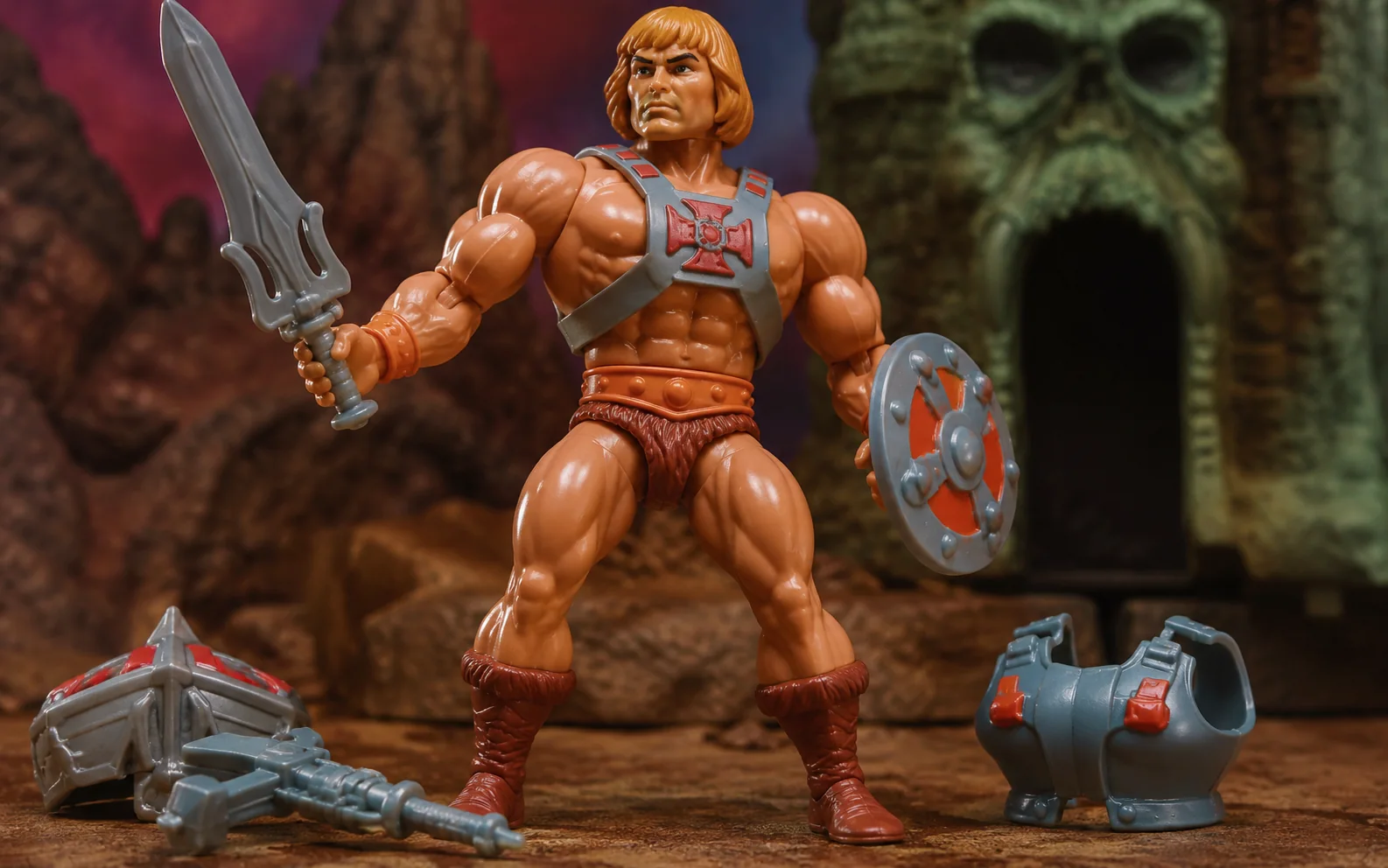
The classic Masters of the Universe body was one of the most recognizable toy designs of the decade. The figures were roughly five-and-a-half inches tall, but they felt bigger because of the exaggerated build. Their shoulders were wide, their torsos thick, their legs bent into a permanent ready stance, and their arms looked like they had never once skipped arm day.
They were not elegant. They were not realistic. They were not designed for delicate posing. They were designed to look powerful in a child’s hand and survive the kind of play that ended with several figures face-down near a heat vent.
The Power Punch Waist
The spring-loaded twist waist allowed figures to swing their upper bodies back into battle. It was simple, satisfying, and perfect for hitting another figure hard enough to knock both of them over.
The Shared Muscle Body
Many characters used the same heroic or villainous build, which made the line feel unified and helped Mattel release new figures quickly.
The Stance
The legs were always ready. Nobody in Eternia stood like they were waiting for a bus. Everyone looked like the next sentence would involve a weapon.
The Armor
Chest harnesses, capes, belts, and removable armor turned reused bodies into instantly recognizable characters.
The Weapons
Swords, axes, clubs, staffs, shields, blasters, and hooks gave each character a fighting identity and gave vacuums a future meal.
The Heads
Head sculpts carried personality. Skeletor, Beast Man, Mer-Man, Trap Jaw, and Man-E-Faces all proved a new head could make a familiar body feel completely different.
The figures were built for hand-to-hand play
Some action figures encouraged posing, vehicles, or display. He-Man figures encouraged collision. The twisting waist, thick limbs, and bold weapons made them ideal for direct conflict. A child could stage a battle with almost no setup: put He-Man here, put Skeletor there, twist, release, repeat until somebody’s parent asked what that banging sound was.
The chunkiness helped younger kids
Masters of the Universe figures were easy to grip. Small hands could hold the torso, swing the arm, and stand the figure upright. The simplicity widened the audience. You did not need to understand a complex transformation sequence or attach twelve tiny pieces in the correct order. You needed a figure, an enemy, and possibly a couch cushion pretending to be a mountain.
The figures looked good loose
That was a huge advantage. Many toys lost their magic once removed from the package. MOTU figures still looked alive in a pile. The colors, silhouettes, armor, and weapons made them readable even when scattered across a bedroom floor like the aftermath of a plastic war crime.
They were collectible without acting precious
Children wanted more figures because each one added a new ability, face, weapon, or allegiance. Parents could see the difference between characters. The toys were sturdy enough to justify buying another one because the first few had not disintegrated after one afternoon.
The good guys had muscles, metal mustaches, bird armor, and no concept of overpacking
The Masters of the Universe Heroes: He-Man, Man-At-Arms, Teela, Stratos, and the Good Guys
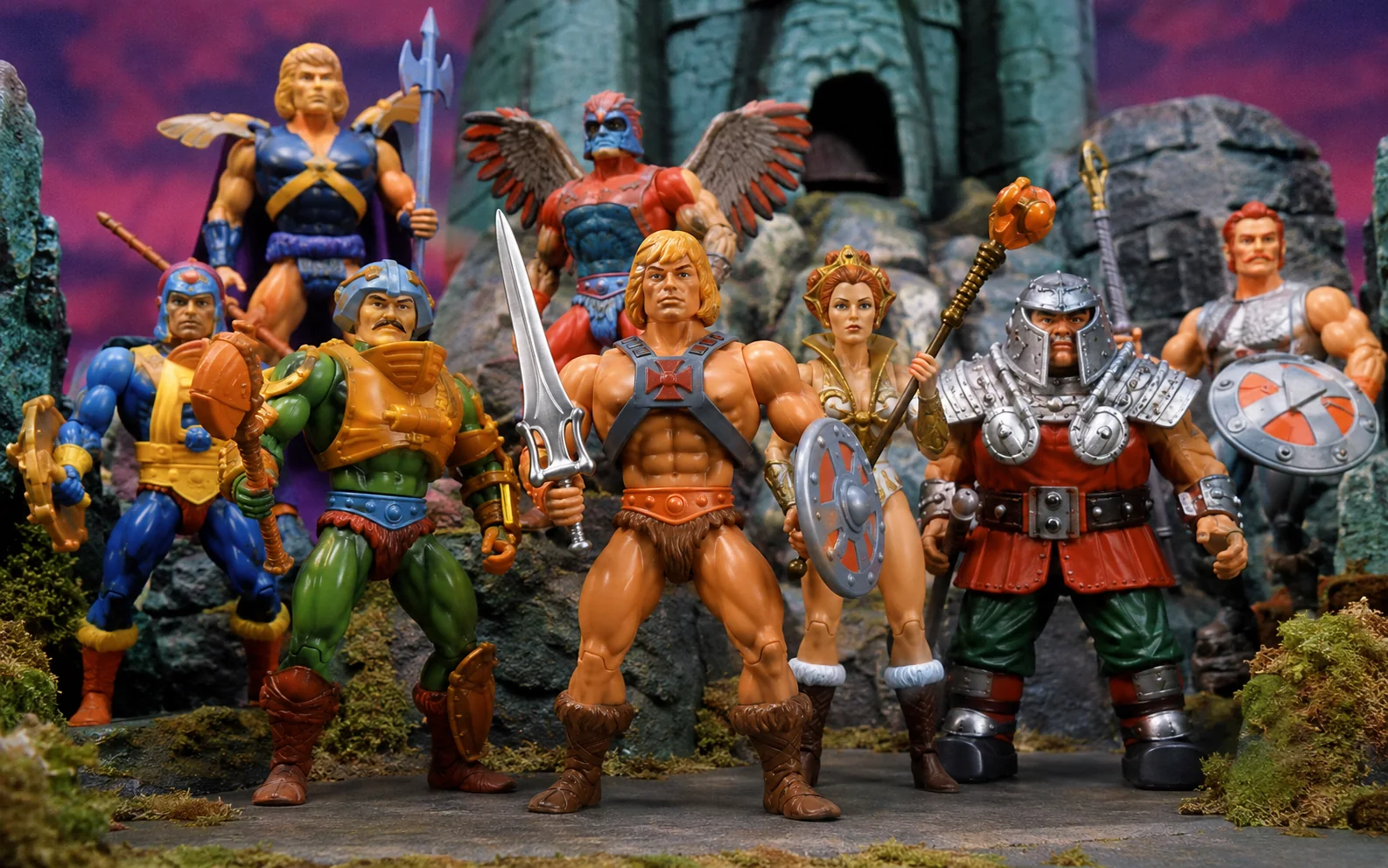
The heroic warriors gave children a team immediately. He-Man was the center, but the line worked because he was not alone. Eternia needed specialists: the warrior woman, the armored weapons expert, the flying guy, the magician, the tiger mount, and a rotating cast of allies who looked like they had been recruited from several different genres and told not to ask questions.
He-Man: the obvious center of the shelf
He-Man’s design was gloriously direct. Blond hair, huge chest, furry trunks, harness, sword, and a look that said he could solve most diplomatic issues by lifting a boulder. He did not need complicated armor because the entire point was that the body itself was the weapon.
The toy’s power sword became central to the fantasy. Early versions paired with Skeletor’s sword half, creating a connection between hero and villain. Later storytelling made the sword more mythic, but even without the full lore, kids understood that He-Man needed the sword because the sword looked important.
Man-At-Arms: the armored dad of Eternia
Man-At-Arms brought technology, armor, and authority. He looked like the guy who knew where the weapons were stored and had opinions about proper maintenance. The toy’s armor, helmet, and weapon gave him a tactical feel, especially next to He-Man’s barbarian simplicity.
He was also useful in play because he could explain things. Every kid battle needs one character who sounds like he knows what is going on. Man-At-Arms could invent devices, warn about danger, guard the castle, and immediately get knocked into a laundry basket by Beast Man.
Teela: more than the token warrior
Teela stood out because she was not a helpless princess figure waiting near the castle. She had armor, a staff, a snake motif, and a warrior identity. Her figure brought different proportions and a different energy to the line.
For kids mixing toy lines, Teela often became one of the few female figures who could believably stand in the middle of a massive battle without being treated like a prop. She belonged in the fight.
Stratos: wings, weirdness, and instant air support
Stratos was one of those figures that made perfect kid logic. He had wings, clawed feet, and a face that suggested either noble bird warrior or gym teacher from a mountain planet. Either way, he gave the heroes flight.
Flight changed play. A flying figure could attack Castle Grayskull from above, scout Snake Mountain, carry messages, or be thrown across the room with the explanation that he was “flying.” Parents had different terminology for that last part.
Ram Man: the human battering ram
Ram Man was not subtle. He was a spring-loaded armored bruiser whose entire personality could be summarized as “headfirst.” The toy was larger and more mechanical than many figures, making him feel special immediately.
He also changed the physical play pattern. You did not just twist him and swing. You launched him. He was a siege weapon with legs, which is exactly the kind of design decision that makes children nod as if this is a normal profession.
Fisto, Mekaneck, Buzz-Off, and the expansion of heroic gimmicks
As the line grew, heroes became more specialized. Fisto had a giant metal fist because apparently Eternia had labor unions but no workplace safety board. Mekaneck’s extending neck allowed him to spy over walls. Buzz-Off added insect wings and a beelike design that made him look ready to fight or ruin a picnic.
Each gimmick gave a child a reason to add another hero. The line did not rely only on new colors. It sold new functions.
Battle Cat turned He-Man into a cavalry charge
Battle Cat was essential because he transformed He-Man from strong guy with a sword into mounted fantasy warrior. The green tiger with orange stripes and red armor looked incredible next to the figures. The fact that the base animal was reused from another Mattel mold only proves that sometimes recycling creates greatness.
Kids used Battle Cat as transportation, weapon, bodyguard, and general living-room intimidation device. A hero riding a giant armored tiger does not need to explain himself.
The bad guys were where the line got gloriously unhinged
Skeletor and the Masters of the Universe Villains
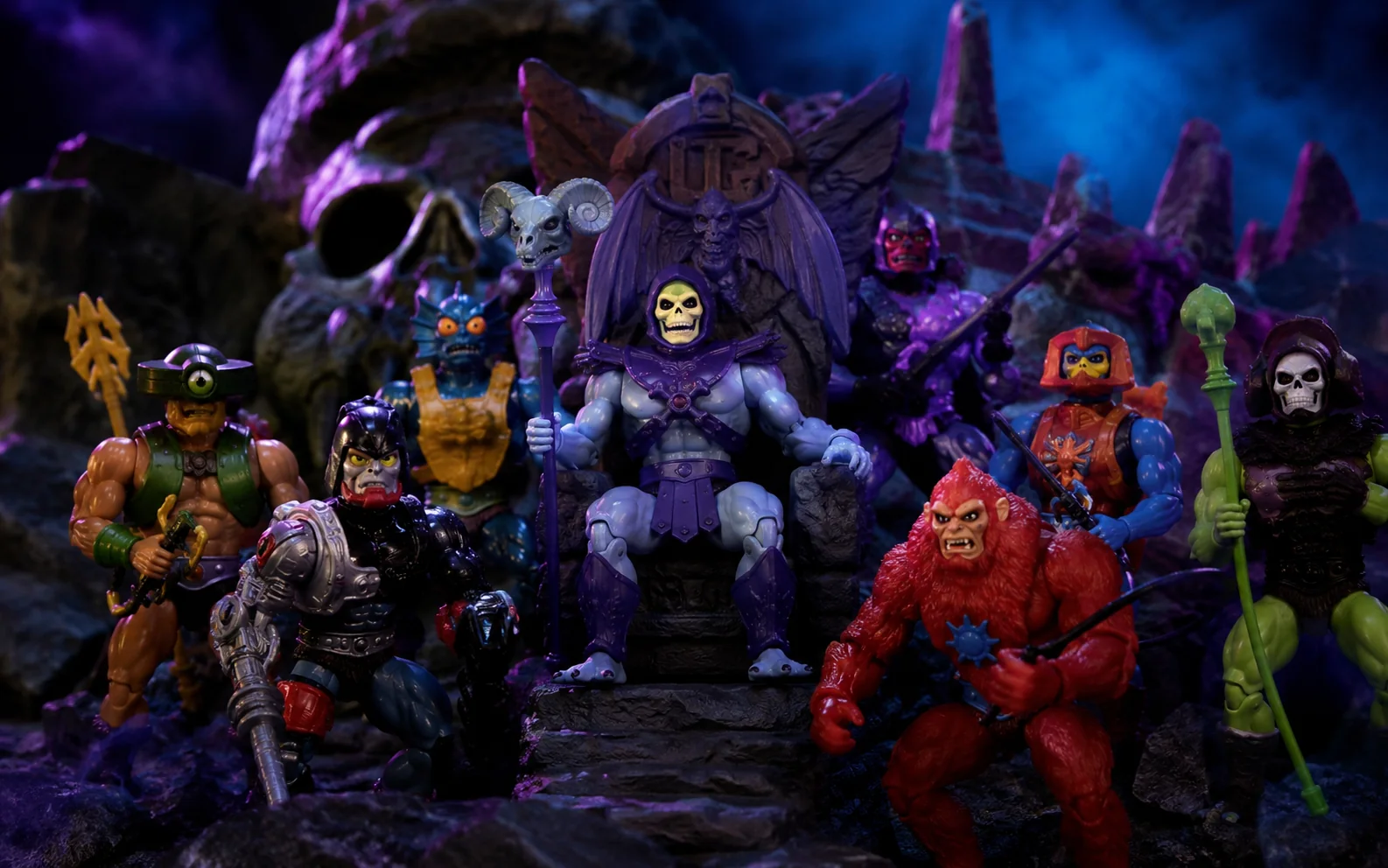
Every great toy line needs villains children actually want to own. Masters of the Universe understood this perfectly. Skeletor and his crew were not dull obstacles. They were often the best-looking figures in the line. Monsters, cyborgs, sea creatures, bone faces, claws, jaws, traps, and weird colors made the villains irresistible.
Skeletor: the skull-faced legend
Skeletor might be one of the most perfect villain designs in 80s toy history. Blue body. Purple hood. Yellow skull. Havoc Staff. Evil confidence. He looked scary enough to matter but colorful enough to live in a child’s bedroom without requiring therapy.
The toy gave He-Man a villain who was visually opposite but physically matched. Skeletor had the same basic power-body language, but his skull face made him supernatural. He looked like a sorcerer, warrior, monster, and Halloween decoration all at once.
Beast Man: fur, claws, and shelf impact
Beast Man’s bright orange body and beastly face made him impossible to miss. He looked primitive, wild, and aggressive. He also looked like he could start a fight over a juice box and enjoy the paperwork.
As a toy, he gave Skeletor muscle. In play, he could command animals, attack heroes, guard the villain base, or simply be the first bad guy to get knocked off the coffee table because he was easy to grab.
Mer-Man: aquatic nightmare with commitment to weirdness
Mer-Man was strange, and the line was better for it. His fishy face, armor, and sword expanded Eternia beyond land battles. He suggested oceans, swamps, hidden lairs, and underwater danger—even if the actual play environment was a beige carpet.
He also showed how flexible the world was. Masters of the Universe could include a sea villain without building an entire separate line around him. Eternia had room.
Trap Jaw: the cyborg pirate monster who understood accessories
Trap Jaw was a toy-design feast. Metal jaw, mechanical arm, interchangeable attachments, sinister colors, and a body that screamed “bad decision factory.” He gave kids multiple ways to play because the arm changed his threat.
That modularity mattered. A figure with swappable parts invited experimentation. It also invited losing one attachment and then insisting the missing hook was absolutely somewhere under the bed.
Tri-Klops: rotating eyes before everyone had a gimmick
Tri-Klops looked like the villainous answer to surveillance technology. His rotating visor gave him multiple vision powers and made his head fun to manipulate. He was simple but memorable.
He worked because the gimmick was visible and playable. A child could actually change what the figure was doing, which made him more than another sword guy.
Webstor, Kobra Khan, Clawful, and the monster parade
As the villain side expanded, the designs leaned hard into creature features. Webstor brought spider energy and a grappling hook. Kobra Khan sprayed mist, because apparently someone looked at action figures and thought, “This needs more dampness.” Clawful had a giant claw that made him dangerous and ridiculous in exactly the right ratio.
The villains stayed exciting because they were less predictable than the heroes. Each one looked like a boss fight from a game that did not exist yet.
Why kids loved the bad guys
The villains had better silhouettes, stranger faces, and more variety. Owning them did not mean rooting against He-Man. It meant the battle became worth having. A hero without a good villain is just a guy standing around holding a sword.
Skeletor’s crew gave every play session conflict, comedy, danger, and a reason to open Castle Grayskull again.
The playset that looked like a haunted gym for barbarians
Castle Grayskull Toy and Snake Mountain: The Playsets That Made Eternia Feel Huge
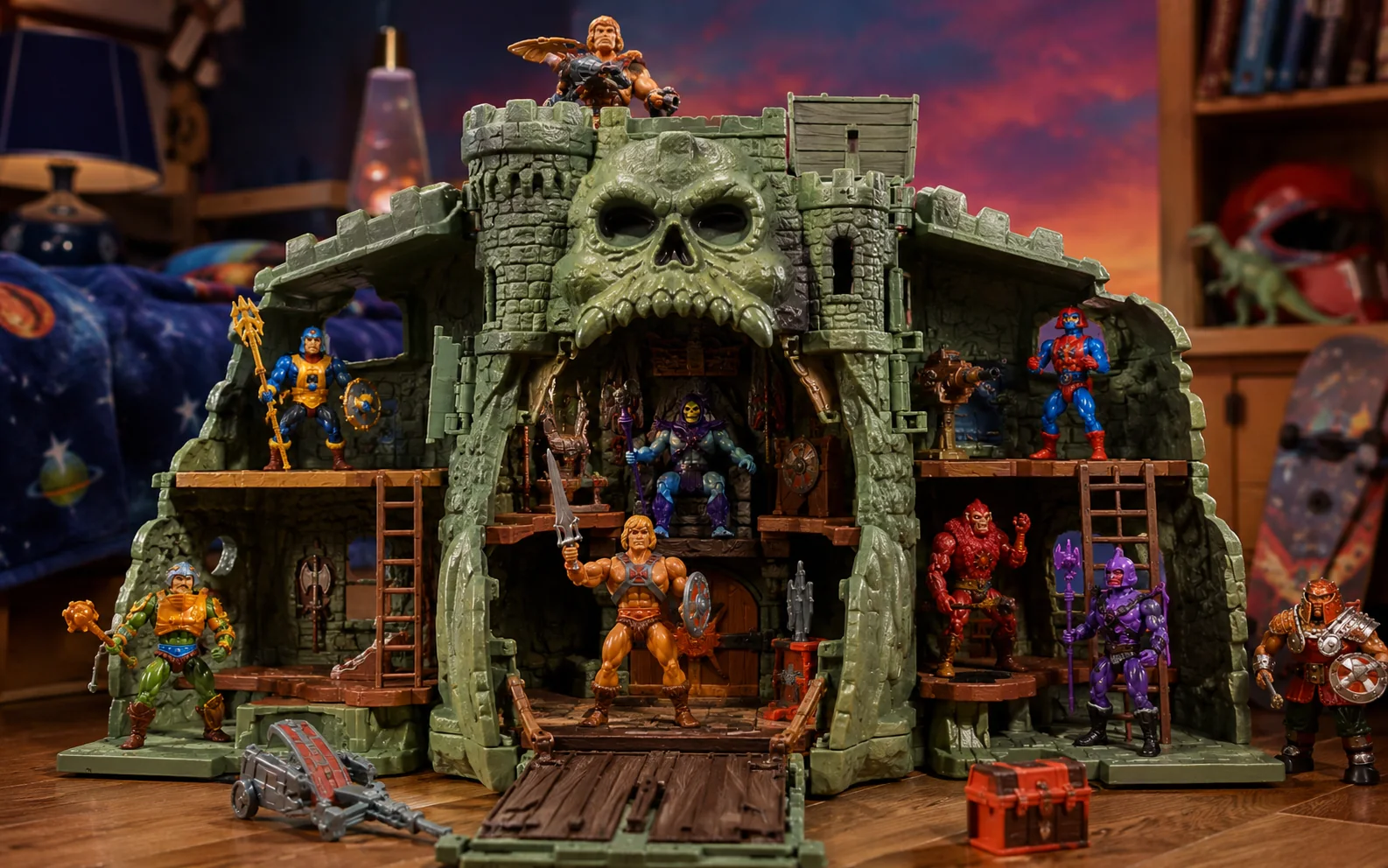
Castle Grayskull was the playset that made Masters of the Universe feel enormous. A figure line can survive on characters, but a playset creates geography. Castle Grayskull gave children a place to defend, attack, open, close, invade, and dramatically misunderstand.
It looked fantastic. The giant skull face, green stone texture, jawbridge, turrets, interior platforms, trapdoor, throne, elevator, weapons rack, and secret spaces made it feel part fortress, part dungeon, part haunted house, and part toy-company masterpiece.
The outside sold the myth
The skull face was everything. A castle could have been generic. A skull castle demanded attention. It looked ancient, dangerous, and important. It suggested that power lived inside and that no responsible adult should leave it unsupervised near a carpet full of warriors.
The jawbridge changed the way kids entered the world
The jawbridge was simple but brilliant. Opening the mouth-like entrance felt dramatic every time. It made the castle interactive before any figure stepped inside. A child could stage attacks, defenses, betrayals, rescues, and the timeless plot where someone forgot how to open the door.
The interior gave battles structure
Inside, Castle Grayskull offered levels, platforms, a throne, trapdoor play, and weapon storage. That made it more than a backdrop. It was a machine for battles. Figures could stand above one another, fall through traps, guard stations, and fight for control of the interior.
The playset was both hero base and mystery
Depending on the story source and the child, Castle Grayskull could be He-Man’s base, a neutral fortress, a source of power, or the object everyone wanted. That ambiguity helped. A child did not have to follow one correct version. The castle could belong to whoever won that afternoon.
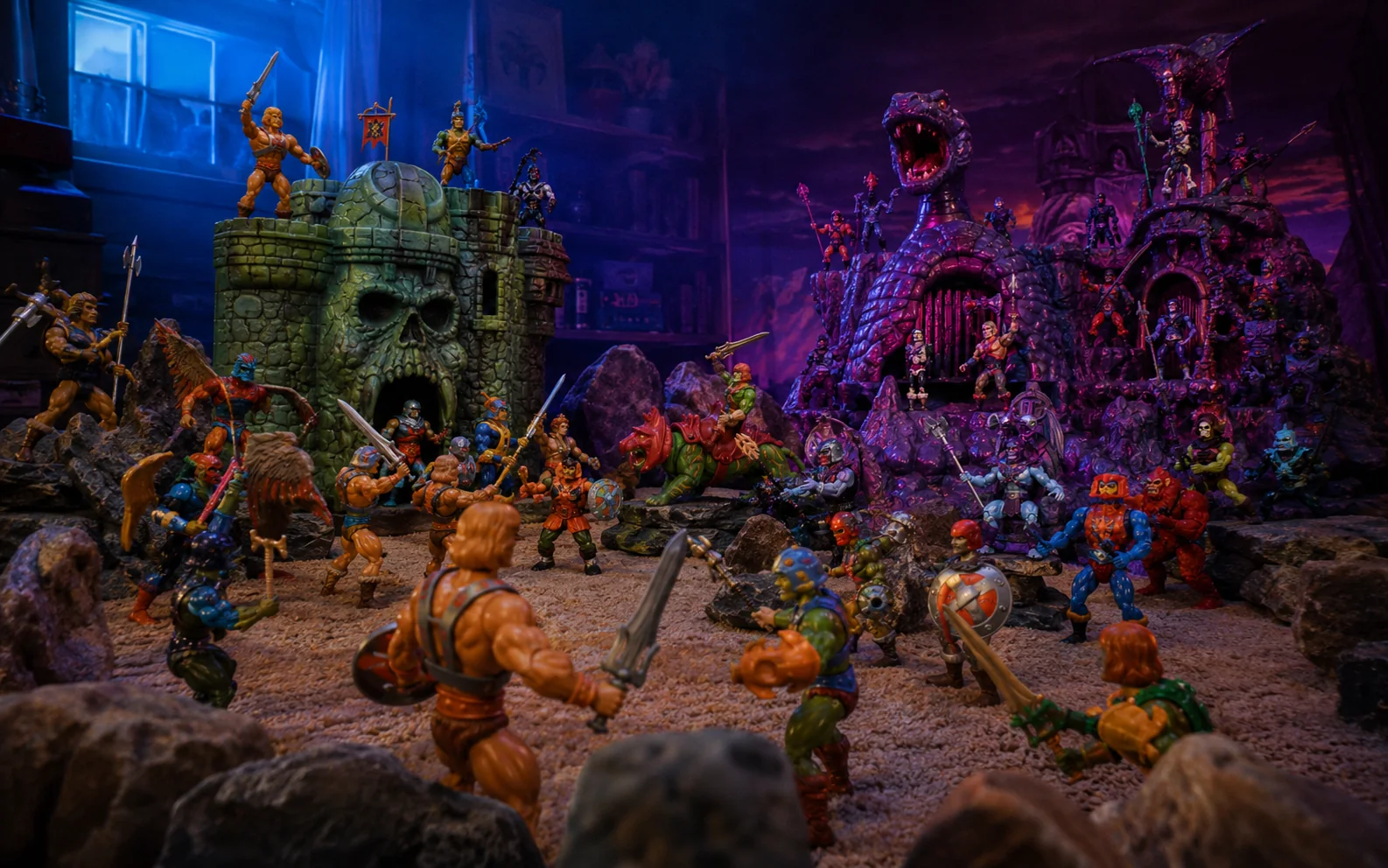
Snake Mountain finally gave Skeletor a headquarters of his own
Castle Grayskull was the icon, but Snake Mountain made the war feel balanced. The purple, serpent-covered playset gave Skeletor and the Evil Warriors a home base that looked louder, stranger, and less concerned with building codes. It added another destination to the bedroom floor and let kids stage a real fortress-versus-fortress siege instead of making the villains meet behind the couch.
The original Snake Mountain toy leaned hard into color, molded monster details, bridges, ledges, and the kind of fantasy architecture that made perfect sense only in Eternia. It was not as universally recognized as the Castle Grayskull toy, but it gave the bad guys territory—and every proper toy war needs somewhere for Skeletor to retreat while insisting the loss was temporary.
It made the line feel worth collecting
Once you owned Castle Grayskull, every figure had a reason to exist. He-Man could defend it. Skeletor could attack it. Beast Man could climb it. Man-At-Arms could repair it. Teela could guard it. Trap Jaw could fall through something. The castle made older figures new again by giving them somewhere to be.
It became a Christmas morning centerpiece
Castle Grayskull was a box parents remembered because it was big, dramatic, and not exactly cheap. It belonged in the same mental category as the decade’s other large gift requests, which is why it fits naturally into the story of the hottest Christmas toys of the 80s.
The playset survived because the silhouette is perfect
Even people who cannot name every MOTU character recognize Castle Grayskull. That skull face is toy design at full volume. It looks like a logo, a fortress, a threat, and a dare.
No world with this many muscles was going to walk everywhere
He-Man Vehicles and Beasts: Battle Cat, Panthor, Wind Raider, and More
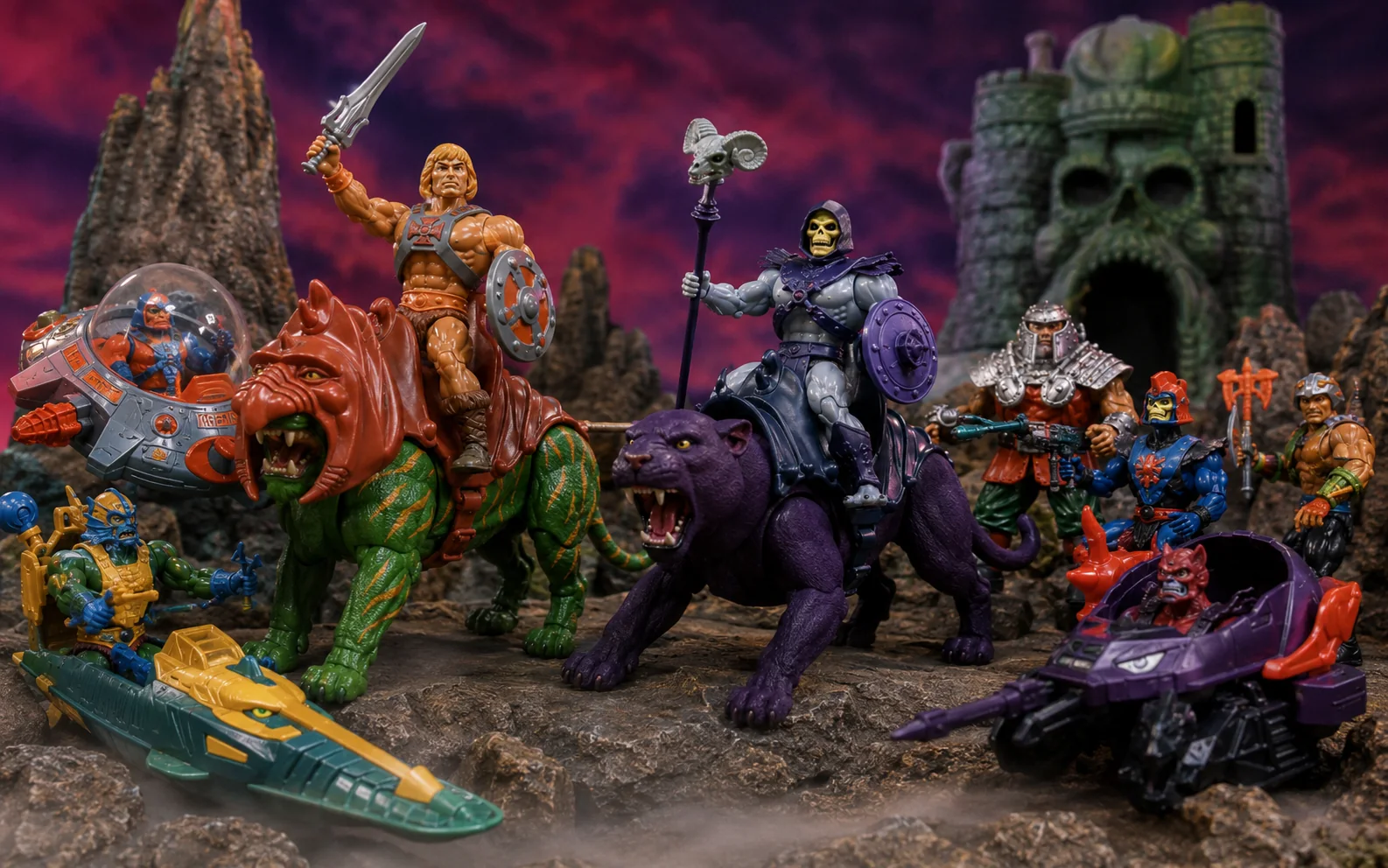
The vehicles and beasts expanded Eternia beyond figure-versus-figure combat. They gave kids transportation, new attack patterns, and larger objects to crash into walls. Some were mechanical. Some were animals. Some were so strange that explaining them to an adult felt like losing an argument before it began.
Battle Cat
The armored green tiger turned He-Man into a mounted warrior and instantly made the hero side look more powerful.
Panthor
Skeletor needed his own beast, and Panthor gave him a darker, sleeker mount. Some versions had flocking, because villains apparently understood texture.
Wind Raider
A flying attack vehicle with fantasy-meets-technology energy. It let heroes take the fight above the floor without actually flying across the room, though kids did that anyway.
Attack Trak
A rugged vehicle with tank-like movement that made it feel like Eternia had defense contractors.
Road Ripper
A fast vehicle that looked built for reckless charges and carpet-based speeding violations.
Land Shark
Exactly what it sounds like: a shark-themed vehicle with jaws. This is why the 80s toy aisle deserves respect.
Vehicles gave battles movement
Without vehicles, battles happened wherever figures were placed. With vehicles, figures could charge, escape, ram, crash, patrol, invade, and stage rescues. A vehicle made the bedroom floor feel larger.
Beasts added personality
Battle Cat and Panthor were not just transportation. They were characters. Children treated them like loyal companions, fierce monsters, or occasionally as unwilling furniture for figures from other toy lines who clearly did not belong in Eternia but showed up anyway.
The larger items changed gift hierarchy
Small figures were everyday wants. Larger vehicles and beasts were bigger asks. They appeared on birthday lists, Christmas lists, and “I promise I will clean my room forever” negotiations that lasted roughly twelve minutes after the box opened.
They made the shelf look more impressive
A line of figures looks fun. A line of figures with a castle, beasts, and vehicles looks like a world. Mattel understood that expansion objects turned Masters of the Universe from a collection into an environment.
Before every kid knew the cartoon version, the package came with its own weird little mythology
Masters of the Universe Mini-Comics and the Early He-Man Story
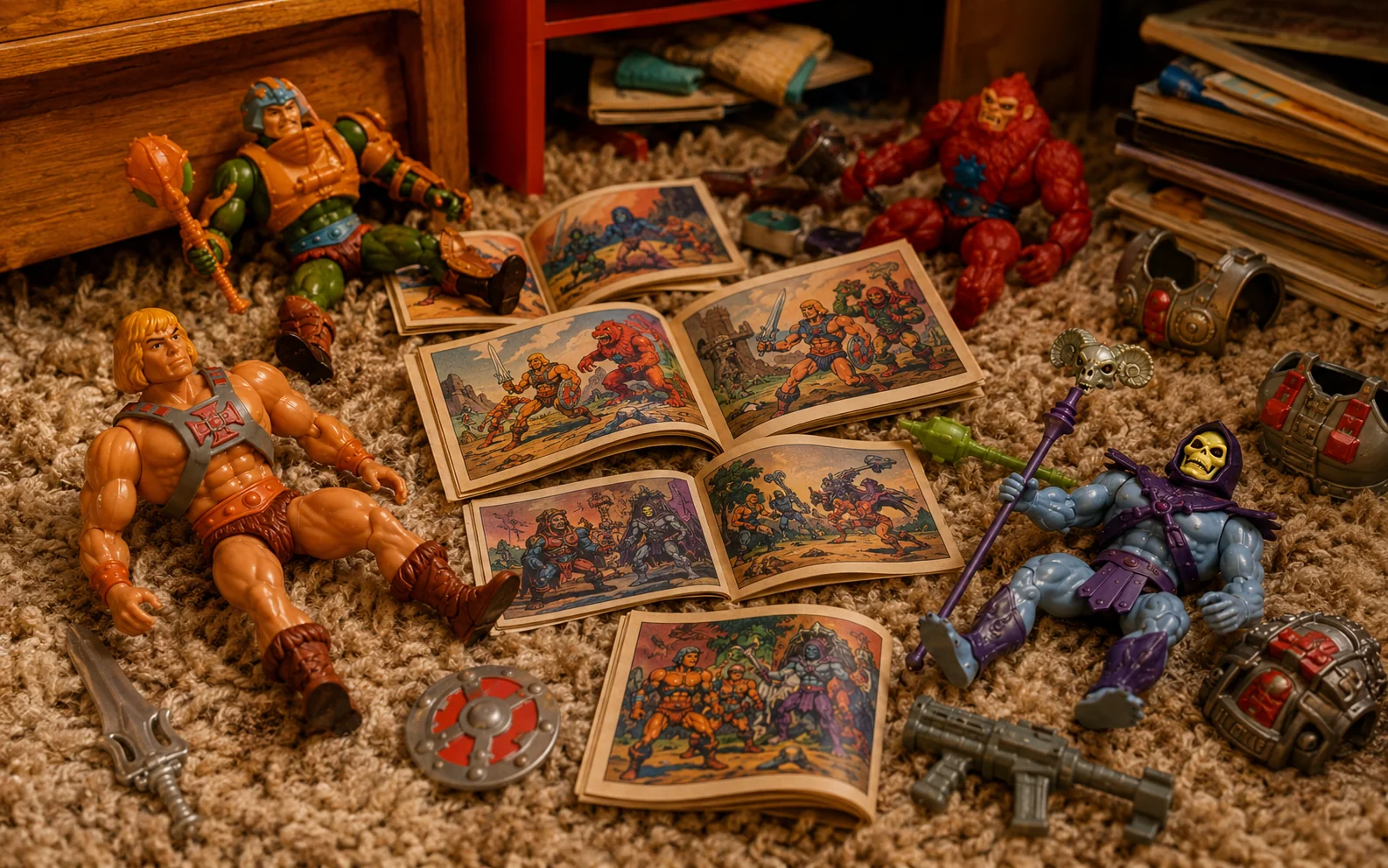
The mini-comics included with the toys were one of the smartest pieces of the early Masters of the Universe experience. They gave children story without requiring a show, movie, or parent explanation. Open a figure, pull out the comic, and suddenly the toy had context.
The earliest mini-comic world was rougher and stranger than the later cartoon version. He-Man was not always presented exactly the way television would define him. The tone felt more barbarian fantasy, with a mysterious world, ancient powers, and a hero who seemed closer to a wandering warrior than a secret prince with a magical transformation sequence.
The comics made each purchase feel bigger
A child did not just get a figure. The child got a piece of the story. That made the package feel generous and gave the toy immediate play value. The comic could be read, reread, argued over, left under a bed, folded into a pocket, and eventually rediscovered with the cover bent beyond recognition.
The early stories left room for imagination
The mini-comics suggested the world without locking every detail. That helped children create their own version of Eternia. The rules were flexible. The characters had enough identity to matter but enough blank space for kid logic to take over.
The artwork made the line feel dangerous
The comic art leaned into dramatic poses, monsters, battles, strange landscapes, and fantasy menace. It looked more intense than the average toy insert. Even when the plots were simple, the tone told kids that this world mattered.
The comics supported collecting
Different figures came with different story pieces. That encouraged children to see the line as connected. A new character was not random. He belonged to a larger conflict. The comic made the purchase feel like an episode before the cartoon made episodes unavoidable.
The shift to cartoon continuity changed the feel
Once the animated series defined Prince Adam, the transformation, Orko, moral lessons, and a more approachable tone, many children treated the cartoon as the “real” version. The mini-comics still mattered, but the television story became the shared language.
The best part was that kids did not care about continuity errors
Adults can spend decades sorting versions of lore. Children solved the issue faster. If the comic, cartoon, package, and playground argument disagreed, the child picked whichever version made the battle better.
The commercials did not explain calmly. They attacked.
He-Man Toy Commercials: How the Ads Turned Every Figure Into an Emergency
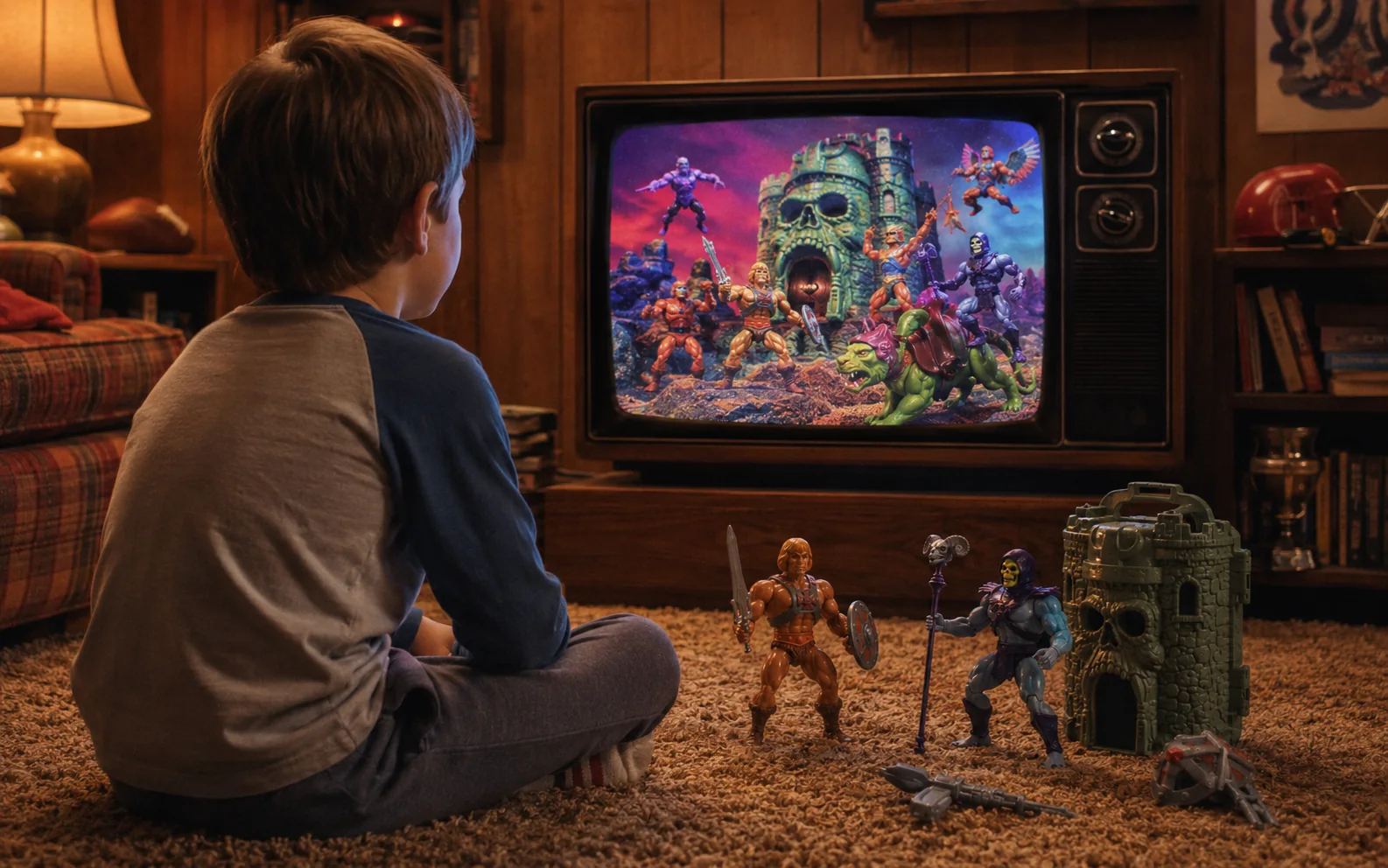
He-Man commercials understood the assignment: show the toy, show the conflict, show the action, show the playset, shout the names, and leave children convinced that their current figure collection was dangerously incomplete. The ads moved fast because they did not need to build an emotional argument. The figures already looked like they were mid-battle.
They showed kids controlling the chaos
The commercials often put children’s hands right into the action. That was crucial. A commercial that only showed animation might entertain. A commercial showing a child making He-Man punch Skeletor taught the viewer exactly what ownership felt like.
They made Castle Grayskull feel enormous
On television, Castle Grayskull looked like a major destination. The camera angle, dramatic lighting, and action staging made the playset feel bigger than it actually was. This was standard 80s toy-commercial sorcery, and it worked. The living-room version might be smaller than the TV version, but the idea had already landed.
They emphasized conflict immediately
Heroes fought villains. Vehicles attacked. Beasts charged. Doors opened. Trapdoors dropped. Nobody in a He-Man commercial spent thirty seconds discussing friendship while adjusting a cardigan. The toy line promised action, and the commercials delivered action.
They used names like battle chants
The ads repeated names until they stuck. Skeletor. Battle Cat. Castle Grayskull. Wind Raider. Panthor. Even strange names became familiar because the commercials treated them like important announcements from a fantasy battlefield.
Every new figure looked like it did something the others could not
A child watching the ad could understand why another figure mattered. This one flies. This one has a jaw. This one rams things. This one rides a beast. This one owns the skull castle. A good commercial made variety feel like necessity.
They worked with the cartoon without being identical to it
The cartoon gave familiarity and routine. The commercials delivered the plastic punch. Together they made the toy line feel constantly present. A kid could watch the show, see the ad, and then stare at the shelf in a store as if the universe had arranged a meeting. The wider collection of 80s toy commercials and videos shows just how aggressively those thirty-second sales pitches came after the family wallet.
Commercial breaks sold the toys. The show made the toys feel inevitable.
He-Man Cartoon and Toy Commercials: The Machine That Sold Eternia
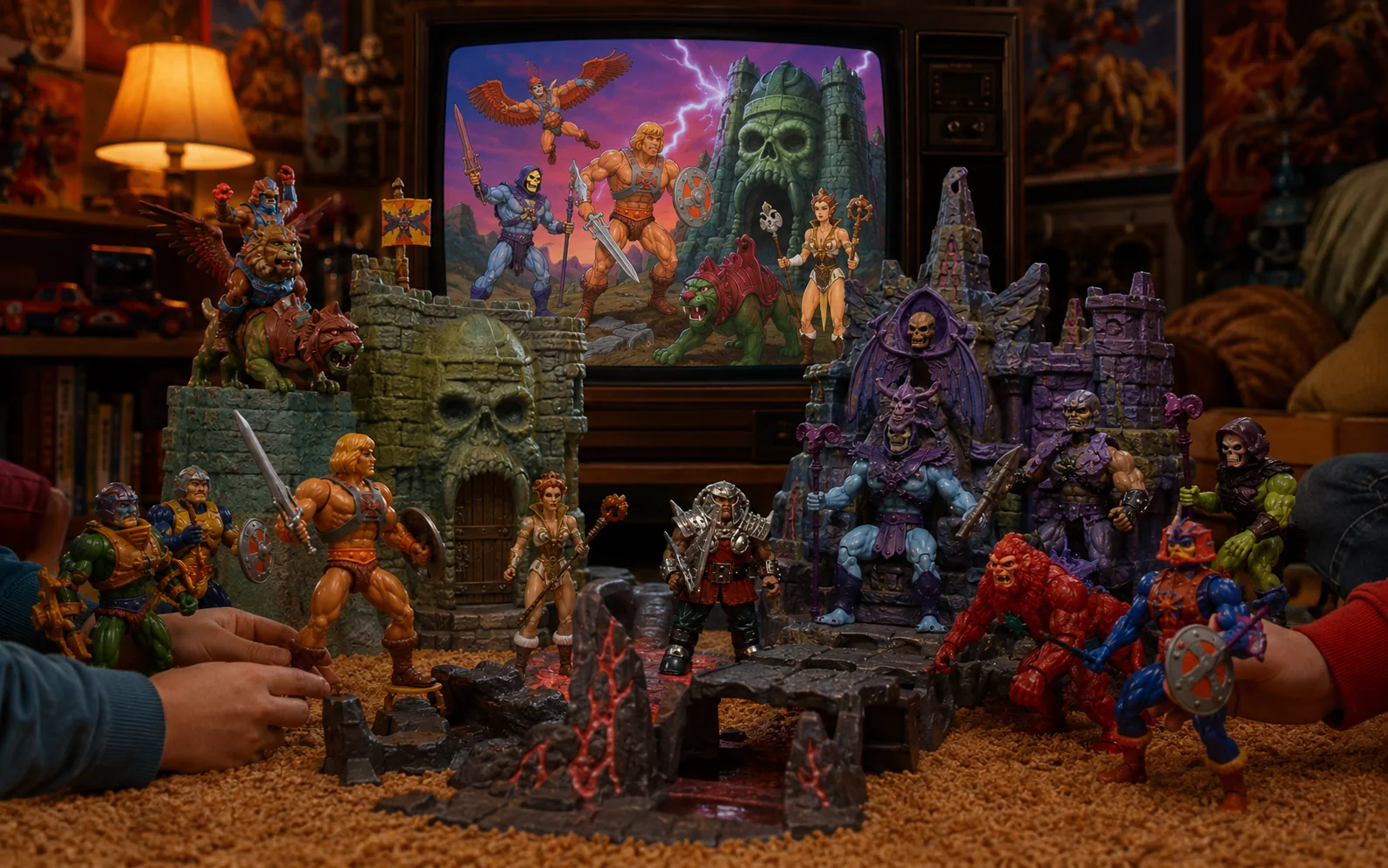
The animated series transformed Masters of the Universe from a striking toy line into a daily world. The show gave children voices, personalities, catchphrases, transformations, locations, and moral lessons. The toys already looked cool. The cartoon made them familiar.
This was the great 80s machine: a child watched characters on television, saw related ads, walked into a store, spotted the figure, and suddenly the toy felt like something missing from home. The loop was relentless, and Masters of the Universe used it beautifully.
The cartoon softened the fantasy without weakening the toys
The early toy art could feel intense. The cartoon made the world friendlier, funnier, and more accessible. Prince Adam, Cringer, Orko, Teela, Man-At-Arms, and the royal family gave the show a regular cast and familiar rhythm. Skeletor became menacing, yes, but also weirdly theatrical and occasionally hilarious.
That balance worked. The show reassured parents while the toys still looked fierce. Kids got the fantasy battles without the brand feeling too dark for afternoon television.
The transformation sequence made He-Man mythic
“By the power of Grayskull” turned a toy into a ritual. Children could repeat it while holding the figure, swinging the sword, or standing on a couch they had been told not to stand on. The line became play language.
The cartoon made secondary characters matter
A figure seen on a shelf might be interesting. A figure that appeared in the show became desirable. Children wanted the characters they recognized. The cartoon turned odd designs into personalities and gave parents an easier time understanding which name belonged to which plastic muscular weirdo.
Commercials kept the product front and center
The ads were direct, loud, and effective. They showed figures battling, vehicles moving, Castle Grayskull opening, and kids participating in the chaos. Revisiting 80s toy commercials and videos shows how much they depended on quick demonstrations and shouted excitement.
The whole decade was doing the same thing
Masters of the Universe was one of the defining examples of the 80s cartoons that sold us the toys era, when animation, advertising, and toy design moved together. The show did not merely entertain. It made the toy aisle feel like a continuation of the episode.
The moral at the end did not stop the violence on the carpet
Episodes often closed with little lessons. Children absorbed some of that, sure. Then they immediately made Ram Man headbutt Skeletor off a chair. This is not a contradiction. It is childhood efficiency.
The show gave parents vocabulary
A parent might not understand every character, but the cartoon made names familiar through repetition. That helped during shopping. “He wants Skeletor” is easier than “He wants the blue skeleton man with the purple hood and the staff that looks like a goat skull had a terrible day.”
The figure was the toy. The cardback was the spellbook.
Masters of the Universe Toy Packaging, Cardbacks, and Toy-Aisle Shelf Power
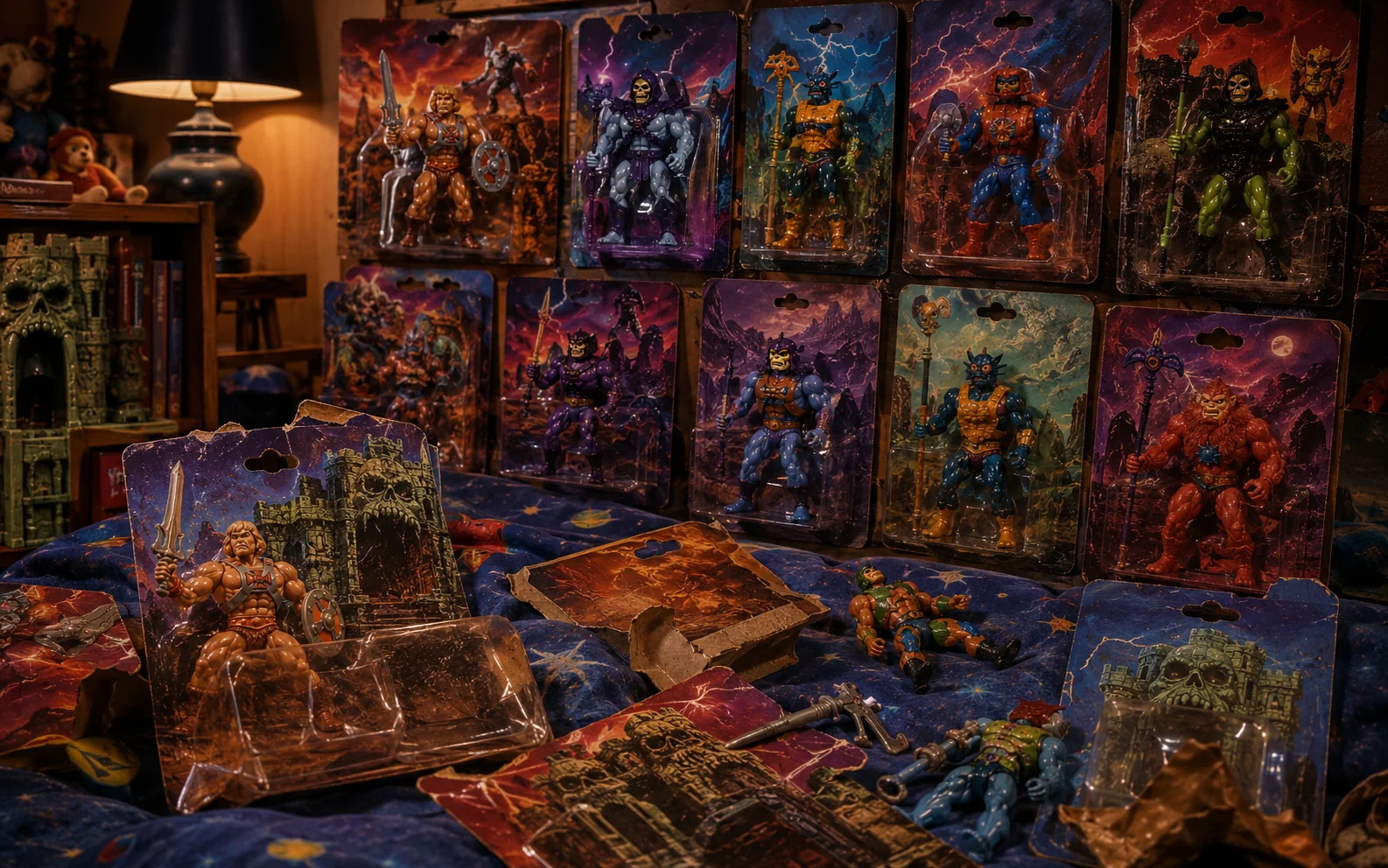
The classic Masters of the Universe card did a ridiculous amount of work. It had to stop a kid in the aisle, explain the character, show the line, promise battles, and make the figure inside the bubble feel like part of something bigger. It did all of that with color, art, names, logos, and pure 80s confidence.
The logo looked like it belonged on a battle flag
The Masters of the Universe logo had weight. It did not whisper “collectible fantasy adventure.” It looked like a metal plate from a fortress door. That mattered because the logo unified a line full of strange characters. He-Man, Skeletor, Stratos, Mer-Man, Trap Jaw, and Castle Grayskull could all live under the same brand because the logo made the whole mess feel official.
The card art made each figure feel dangerous
Packaging art showed characters in action, not politely waiting to be purchased. The world behind the toy looked stormy, rocky, ancient, and full of bad decisions. Even before a child knew the full story, the card said this figure belonged in a battle.
The cross-sell grid was a wish-list weapon
The back of the card introduced the rest of the line. That little lineup of characters was not decoration. It was a shopping list. A child could point to it and explain that He-Man needed Man-At-Arms, Skeletor needed Beast Man, and technically this entire grid was required for peace in the household.
Package names were blunt and memorable
He-Man. Skeletor. Beast Man. Mer-Man. Trap Jaw. Ram Man. Man-E-Faces. These names were not trying to win poetry awards. They told you the gimmick immediately. A kid could remember them after one commercial. A parent could remember them after being corrected only four or five times in the aisle.
The bubbles made the figures look collectible before kids knew collecting was a thing
The clear bubble presented the figure like proof. You could see the character, weapon, armor, color, and size. The toy looked trapped and ready to be released. For collectors today, intact bubbles and cardbacks matter. For kids then, the bubble was mostly a temporary prison standing between the figure and a carpet battle.
The packaging sold a world, not a single purchase
A He-Man card was never only about He-Man. It said there were enemies, allies, beasts, vehicles, playsets, and mysteries. It turned one figure into the beginning of a system. That is why the packaging worked so well: every purchase made the next one feel more necessary.
Parents saw durability; kids saw destiny
Adults saw a sturdy action figure in bright packaging. Children saw a warrior from a universe that apparently needed immediate intervention. Both groups were right enough for the register.
Every house had its own Eternia, and most of them violated basic architecture
How Kids Actually Played With He-Man Toys
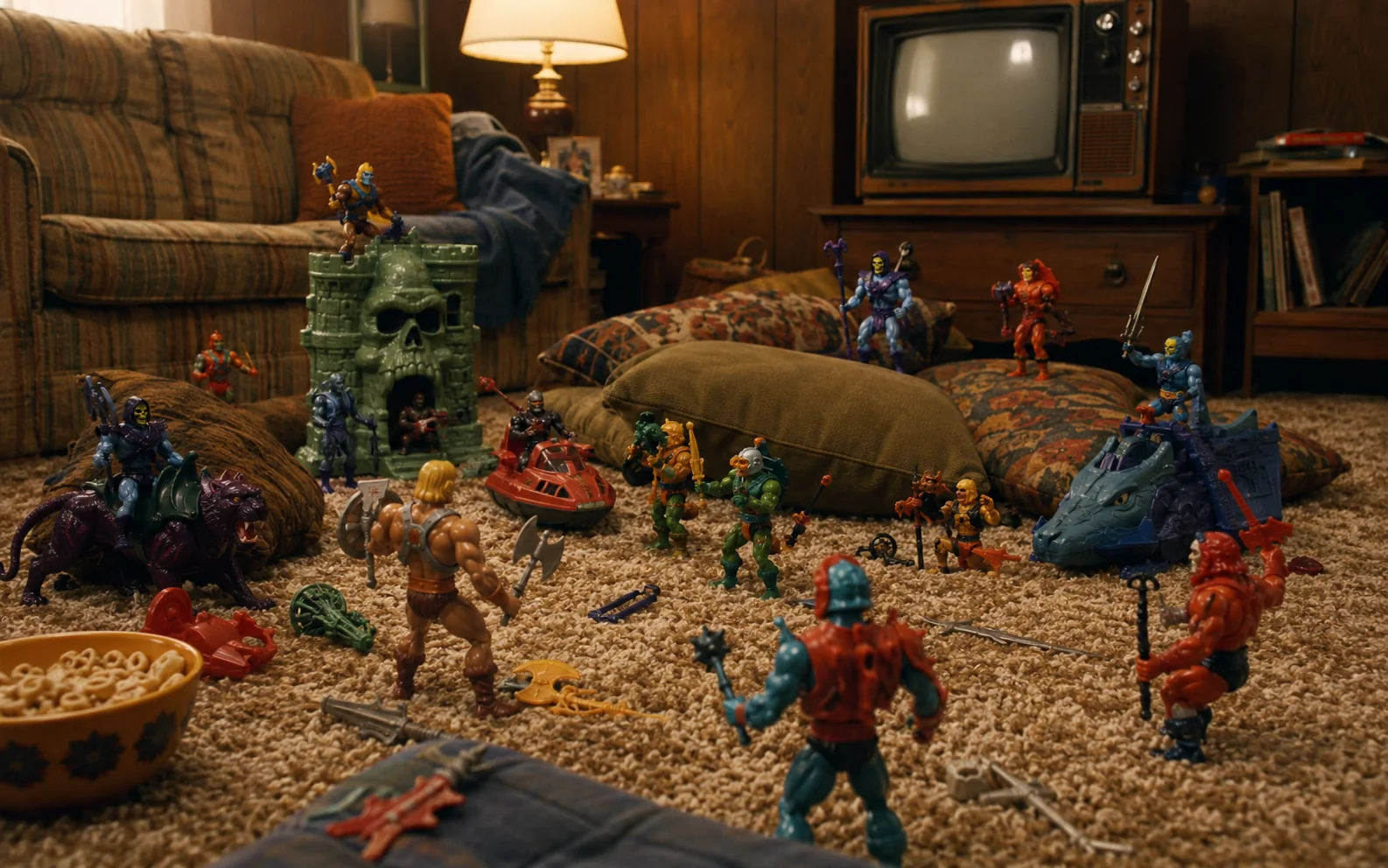
The official story was only the beginning. Children took the characters, weapons, castles, vehicles, and beasts and built their own version of Eternia out of furniture, blankets, stairs, laundry baskets, couch cushions, and whatever other toys were foolish enough to be nearby.
The carpet became the battlefield
Masters of the Universe figures were perfect floor toys. They stood well enough, grabbed easily, and could be arranged into armies. Battles spread across carpet, hardwood, linoleum, and shag thick enough to hide three accessories and possibly a small mammal.
Castle Grayskull was never just Castle Grayskull
The castle could be a fortress, prison, mountain, portal, monster, headquarters, treasure room, or final boss level. Children did not care whether the plot matched the cartoon. If Skeletor controlled the castle today, then Skeletor controlled the castle today.
Toys from other lines invaded constantly
Star Wars figures, G.I. Joe, robots, dinosaurs, plastic soldiers, stuffed animals, and random fast-food toys all wandered into Eternia. Scale did not matter. If the figure was available and looked useful, it entered the war. A smaller figure could be a spy. A larger toy could be a giant. A stuffed dog could be a mountain creature. Problem solved.
Weapons were currency
Original accessories mattered even to kids who could not have explained collectibility. The right sword, staff, shield, axe, or gun completed the character. A figure missing its weapon could still play, but it had been demoted. Sometimes it received a substitute from another toy line and nobody discussed it.
Sibling rules were unstable
One child owned He-Man. Another owned Skeletor. A cousin brought Trap Jaw. Somebody else wanted Battle Cat. Suddenly the entire afternoon required negotiations that made international diplomacy look tidy. Ownership, character death, castle control, and “you cheated” were recurring issues.
He-Man battles were physical
These figures were meant to clash. Kids twisted waists, swung arms, knocked figures down, crashed vehicles, dropped villains from castle heights, and created battle sounds that probably concerned the adults downstairs.
The play could be surprisingly narrative
Under the chaos, kids built stories. Betrayals, rescues, kidnappings, secret identities, castle sieges, forbidden powers, cursed weapons, and last-second victories appeared constantly. The line gave children enough symbols to improvise their own episodes.
The toys made even downtime dramatic
Figures lined up on a dresser looked like armies. Vehicles parked beside the bed looked ready to deploy. Castle Grayskull sitting in the corner made the room feel occupied. Masters of the Universe did not vanish when play stopped. It stayed there, waiting to restart the war.
The kid saw power. The parent saw a price tag and several sharp-looking accessories.
What Parents Saw When Kids Asked for He-Man Toys
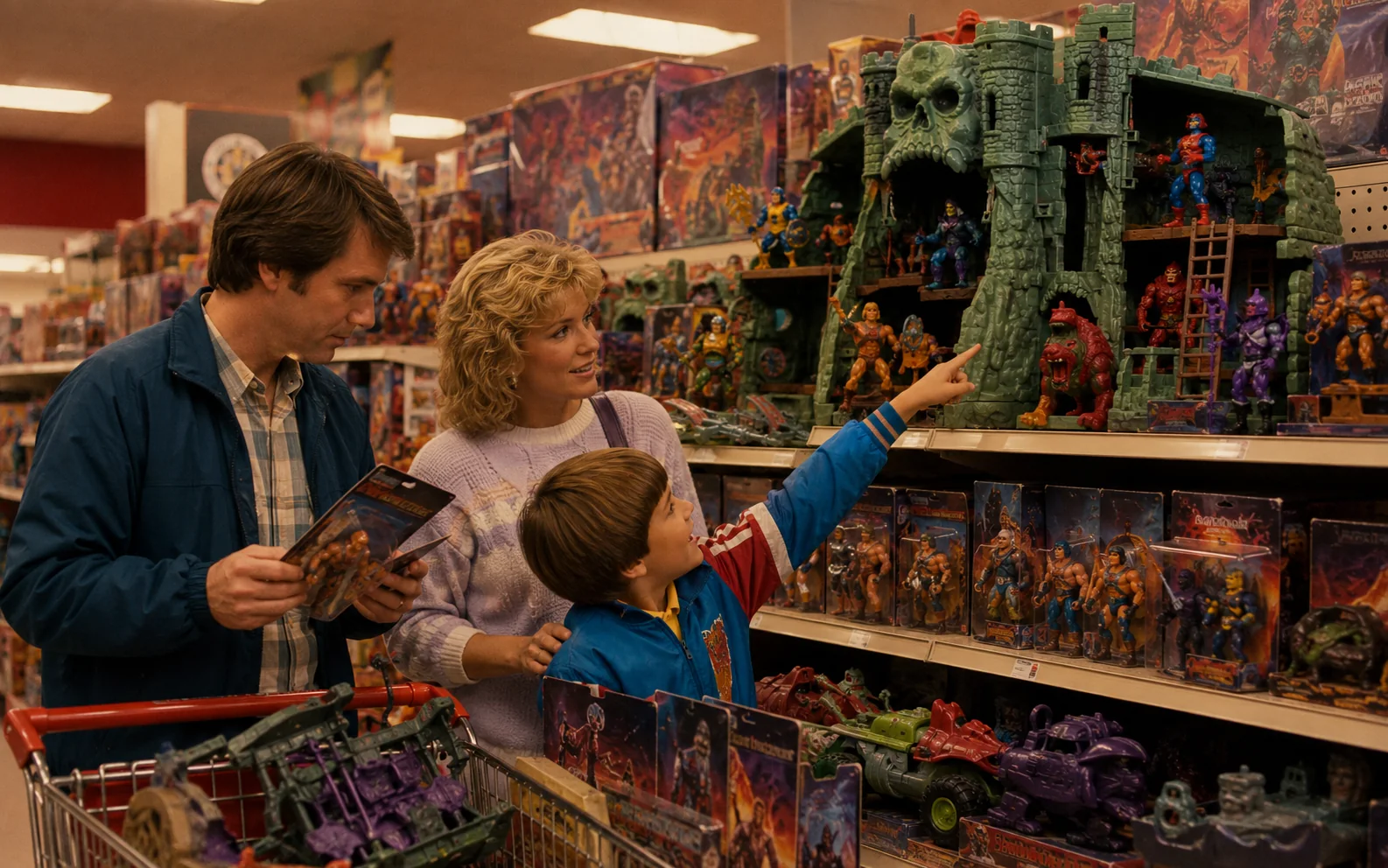
Parents did not experience Masters of the Universe the same way kids did. Children saw heroes, villains, powers, castles, and battles. Parents saw another line of figures with names they were expected to remember, weapons they would step on, and a growing sense that one toy was never going to be enough.
There was always a more expensive next step
Small figures were reachable gifts. Vehicles and beasts were bigger asks. Castle Grayskull was an event. That structure allowed the line to appear in many shopping moments. A figure could be a reward. A vehicle could be a birthday request. A playset could be the Christmas morning centerpiece.
Parents could understand the appeal quickly
Even if they did not follow the story, adults understood the basic conflict. Strong hero. Skull villain. Castle. Sword. Beast. That clarity helped. Some toy lines required an explanation long enough to make an adult regret asking. He-Man could be summarized while pushing a cart.
The figures looked durable
Compared with fragile toys full of tiny moving parts, MOTU figures looked like they could survive a child who played the way weather happens. The thick bodies and simple action made them feel like a reasonable purchase, even if the accessories were determined to vanish.
The names caused household translation errors
Parents mixed up Man-At-Arms, Man-E-Faces, Ram Man, Beast Man, and whatever other men were currently on the list. Children corrected them with the exhausted patience of a tiny franchise manager. This was part of the experience.
Gift-buying required reconnaissance
Relatives needed guidance. A grandparent might buy a figure already owned, the wrong villain, or a vehicle that did not match the child’s current obsession. Cardbacks, catalogs, commercials, and handwritten lists became survival tools.
Adults underestimated the importance of accessories
To a parent, a sword was a sword. To a child, the wrong sword was a moral injury. He-Man needed his sword. Skeletor needed his staff. Trap Jaw needed the correct arm attachments. The figure without the right piece could still play, but everyone knew something was off.
The catalog was not reading material. It was evidence.
He-Man Toys in Christmas Catalogs and Birthday Wish Lists
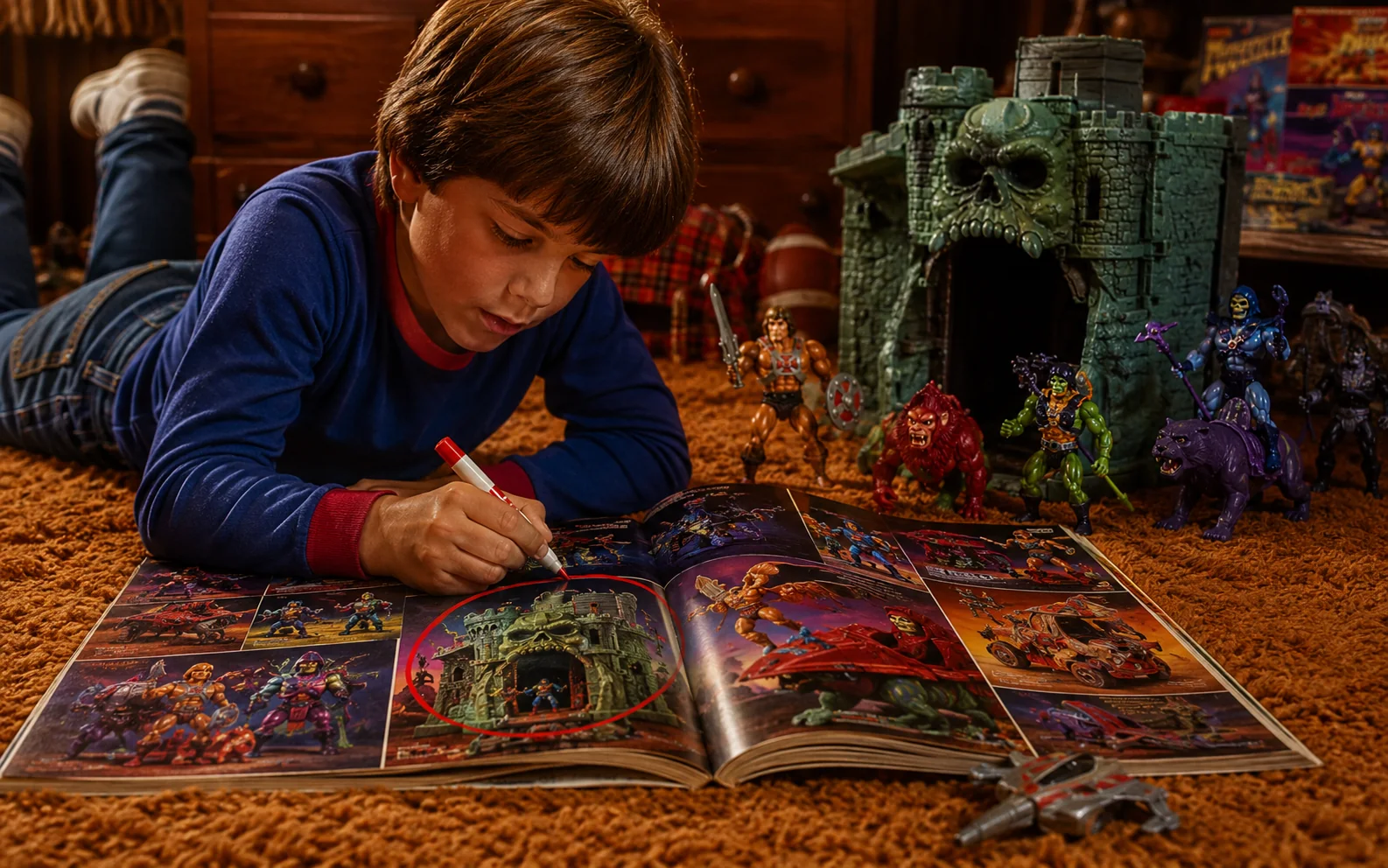
Before online shopping, children studied catalogs with a seriousness usually reserved for legal documents and treasure maps. Masters of the Universe was built for that environment. The figures looked bold in small photos, the playsets looked enormous, and the names were easy to circle.
Catalog pages made the line feel complete
Seeing figures, vehicles, and playsets together gave children a sense of the whole world. A single store shelf might be missing several items, but the catalog page showed the dream version: the lineup as it was meant to exist, unbothered by local inventory.
Circling was an act of strategy
Kids circled the must-haves, starred the emergencies, dog-eared pages, and left catalogs open in locations where adults might “accidentally” notice them. This was not subtle. Subtlety did not get you Castle Grayskull.
Catalog photography shaped expectations
Playsets looked larger, battles looked cleaner, and every accessory seemed available. The real bedroom version included mismatched figures, missing parts, and one villain lying under a dresser. The catalog version was Eternia before gravity and siblings got involved.
Wish lists created toy hierarchy
A child might want ten figures but need one playset. The list revealed which items carried emotional weight. He-Man was essential. Skeletor was essential. Castle Grayskull was the dream. Everything else became bargaining material.
Birthday lists kept the line alive outside Christmas
Masters of the Universe was not only a holiday brand. The steady release of figures made it perfect for birthdays, visits from grandparents, report-card rewards, and the occasional “please stop asking in the store” purchase.
The catalog helped parents identify the right thing
A written list saying “Trap Jaw” was helpful. A catalog picture was better. It reduced the chance of bringing home a figure that was close enough for an adult and absolutely not close enough for a child with standards.
The years when Eternia kept showing up on Christmas lists
He-Man Toys by Year: How Masters of the Universe Peaked from 1982 to 1987
Masters of the Universe did not peak in a single moment. It built across several years, expanding from core figures into a full toy universe. Each year added new characters, playsets, vehicles, gimmicks, and reasons for children to keep the line alive on wish lists.
The line breaks through
The top toys of 1982 helped establish Masters of the Universe as a serious force. Core figures, Castle Grayskull, and early story material gave kids the bones of Eternia.
The toy aisle gets crowded, and He-Man still holds ground
The top toys of 1983 included the Cabbage Patch Kids explosion, but He-Man remained a major action-figure presence with expanding characters and stronger recognition.
Expansion becomes the game
The top toys of 1984 show a toy aisle packed with Transformers, G.I. Joe, Cabbage Patch Kids, and other heavyweights. Masters of the Universe competed by getting bigger, weirder, and more complete.
The universe widens
By the top toys of 1985, Masters of the Universe had to fight for attention against Nintendo, Teddy Ruxpin, She-Ra, and more. The brand responded with more characters, more gimmicks, and more shelf space.
The line stretches into factions and deeper cuts
The top toys of 1986 era belonged to big brand worlds. Masters of the Universe pushed into more specialized characters, larger story ideas, and the She-Ra connection.
The original magic starts to thin
By the top toys of 1987, the line was still recognizable, but the center of kid culture was shifting. Video games, new cartoons, and other toy worlds were pulling attention elsewhere.
He-Man belonged to the Christmas-list era
Small figures could be everyday purchases, but Castle Grayskull, beasts, vehicles, and larger sets were Christmas-list material. They belonged beside the other hottest Christmas toys of the 80s, the gifts that felt too big for a random Tuesday and perfect for the tree.
Eternia got a sister franchise, and the toy aisle got more complicated
She-Ra, Princess of Power, and the Masters of the Universe Expansion
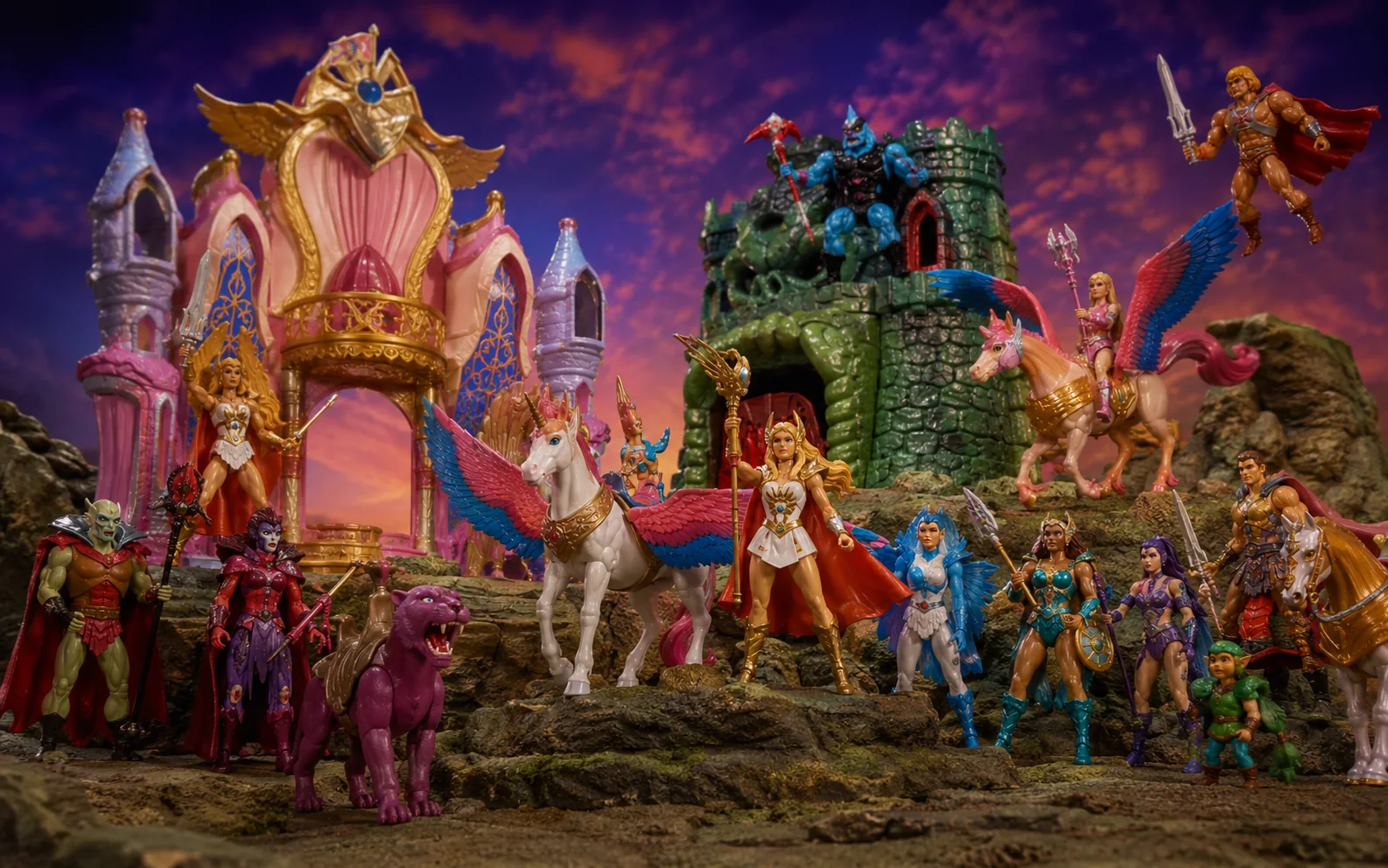
She-Ra expanded the world while targeting a different part of the toy aisle. Princess of Power connected to He-Man through story while offering a line with different proportions, different packaging, different fashion elements, and a stronger appeal to children who wanted fantasy adventure without the same hulking body style.
She-Ra was not just “He-Man for girls”
That phrase gets tossed around because it is easy, but the actual toy strategy was more nuanced. The line included adventure, transformation, villains, magical worlds, horses, capes, hair, clothing, and a different kind of fantasy play. It pulled from fashion-doll language while still belonging to the broader action-fantasy universe.
The connection helped both brands
He-Man gave She-Ra an existing mythic framework. She-Ra gave the Masters universe a wider emotional and visual range. Siblings could cross the lines. Children could mix characters. The story connection made the toy aisle feel larger without forcing every figure to share the same body type.
Swift Wind and horses changed the play texture
He-Man had Battle Cat and mechanical vehicles. She-Ra had fantasy horses, wings, sparkle, and royal adventure. Those elements created a different kind of movement. The play could still involve battles, but it also leaned into rescue, travel, transformation, and palace drama.
The line showed how flexible the Masters idea had become
By the mid-80s, the Masters universe could hold barbarian heroes, skull villains, bird warriors, cyborgs, snake men, princesses, horses, magical castles, and moral lessons. That is either brand flexibility or evidence that nobody was allowed to say no in meetings. Possibly both.
She-Ra also revealed the limits of expansion
Every extension asks children to keep caring. Some did. Some moved to newer toys. Some mixed She-Ra and He-Man freely. Others treated the lines as separate. The broader the universe became, the harder it was to maintain the focused impact of He-Man, Skeletor, and Castle Grayskull.
Eternia did not fight alone. The whole aisle was throwing elbows.
He-Man vs G.I. Joe, Transformers, Thundercats, and the 80s Action Figure Wars
Masters of the Universe dominated by looking different. G.I. Joe had military detail, articulation, vehicles, file cards, and a massive team structure. Transformers had the transformation trick and robot mythology. Thundercats brought a television-forward fantasy-animal warrior vibe. Star Wars still had a long shadow. He-Man had brute shelf impact and one of the strongest playsets of the decade.
He-Man figures won on size and visual power
Compared with smaller action figures, MOTU characters looked huge. A He-Man figure could stand beside many competitors and look like he had eaten a different breakfast. That mattered to children comparing toys physically, not intellectually.
G.I. Joe won on articulation and vehicle depth
G.I. Joe toys in the 80s moved better and came with military world-building, file cards, and enough vehicles to occupy half a basement. He-Man figures hit harder visually. Which was better depended on the child. Some wanted realism and squads. Others wanted a skeleton wizard fighting a guy on a tiger.
Transformers won on engineering magic
G1 Transformers toys from the 80s had the irresistible advantage of becoming something else. Masters of the Universe answered with character design, playsets, beasts, and immediate battle clarity. One line asked kids to transform. The other asked kids to attack.
Thundercats overlapped in fantasy energy
Thundercats offered sword fantasy, animal warriors, and television-driven mythology. It felt like a cousin to MOTU, but the figure style and brand rhythm were different. Masters of the Universe had already trained kids to accept muscular fantasy warriors as toy-aisle royalty.
The competition made all the lines sharper
Every major brand had to create more characters, bigger vehicles, better commercials, stronger cartoons, and deeper worlds. The full 80s action figure wars were not polite. They were a decade-long battle for allowance money and living-room territory.
Once the basics were covered, Eternia got wonderfully strange
The Weird Later Masters of the Universe Figures and Gimmicks
A successful toy line eventually faces a problem: the obvious ideas are gone. The hero exists. The villain exists. The castle exists. The animal mounts exist. The line needs novelty. Masters of the Universe solved this problem by becoming increasingly gimmick-driven, faction-heavy, and gloriously weird.
Man-E-Faces made identity into the gimmick
Man-E-Faces had rotating faces, giving kids a human, monster, and robot identity in one figure. It was simple, playable, and strange in exactly the right way. He could be hero, monster, actor, spy, or whatever the child needed before dinner.
Roboto added mechanical texture
Roboto’s visible gears and robotic design pushed the line further into sci-fi. He looked different from the muscle-body standard and gave the heroes a technological presence beyond Man-At-Arms.
Stinkor weaponized smell
Stinkor remains one of the most memorable examples of 80s toy nerve. A skunk-themed villain with a smell gimmick feels like something that should not have passed a serious meeting. It did, and children remembered it forever. Parents also remembered it, but for legal reasons we will call that a mixed outcome.
Moss Man had flocking and nature energy
Moss Man reused concepts in a way that created something new through texture, color, and scent. The flocked surface made him feel different in the hand, and the nature theme expanded Eternia into wild, forested territory.
Hordak and the Evil Horde changed the villain structure
Adding Hordak gave the universe another major villain beyond Skeletor. That helped expand the story and connect with She-Ra, but it also made the world more crowded. Children could now stage conflicts among villain factions, which was excellent because sometimes Skeletor needed to be yelled at by somebody worse.
The Snake Men added another layer
Later factions like the Snake Men gave the line new enemies, new body concepts, and another visual theme. The more factions arrived, the more Eternia became less a simple hero-versus-villain setup and more a toy-aisle arms race.
Gimmicks kept the line alive and signaled fatigue
The new features were fun, but they also revealed that the line needed stronger hooks to maintain attention. Early MOTU figures could sell on pure identity. Later figures often needed action features, textures, smells, transformations, or faction connections to stand out.
Even Eternia eventually ran out of shelf oxygen
Why Masters of the Universe Toys Declined in the Late 80s
Masters of the Universe did not disappear because kids suddenly decided muscles, monsters, and skull castles were bad. The decline came from a mix of saturation, shifting tastes, stronger competition, changing media, franchise fatigue, and the natural difficulty of keeping any toy line at peak heat for too many years.
The line became crowded
Expansion is necessary, but too much expansion can blur the center. Early Masters of the Universe was easy: He-Man, Skeletor, Castle Grayskull, heroes, villains, battle. Later years added more factions, more gimmicks, more characters, and more mythology. For dedicated kids, that was great. For casual shoppers, it became harder to know where to start.
Competition intensified
Transformers, G.I. Joe, Thundercats, Teenage Mutant Ninja Turtles, Nintendo, and other brands fought for attention. The late 80s toy shelf moved fast. Kids who had spent several years in Eternia were ready for new worlds.
The original body style began to feel familiar
What looked shocking in 1982 felt normal by 1986. Reuse helped the line grow, but it also made some later figures feel less surprising unless they came with strong gimmicks.
The cartoon cycle changed
Television helped build the line, but animated attention moved on. New shows created new toy demands. Children who aged out were replaced by younger children facing a much more crowded toy universe.
The live-action movie did not save the original line
The 1987 live-action film gave the brand a different kind of visibility, but it did not recreate the early toy-line magic. The movie version felt separate from the classic bedroom battles many kids already knew.
Video games were pulling the center of gravity
By the late 80s, Nintendo and home gaming were changing play habits. The top toys of 1987 show a market increasingly shaped by games, electronics, and newer character brands. He-Man still mattered, but the kingdom was no longer uncontested.
The decline did not erase the impact
Most toy lines would kill for a run like Masters of the Universe. The decline simply proves that even the strongest brands belong to a moment. He-Man owned his moment so completely that decades later, people still remember the smell of the plastic and the sound of Castle Grayskull’s jawbridge.
The battles happened at home, but the negotiations happened at school
He-Man Toys at School: Trading, Bragging, and Playground Eternia
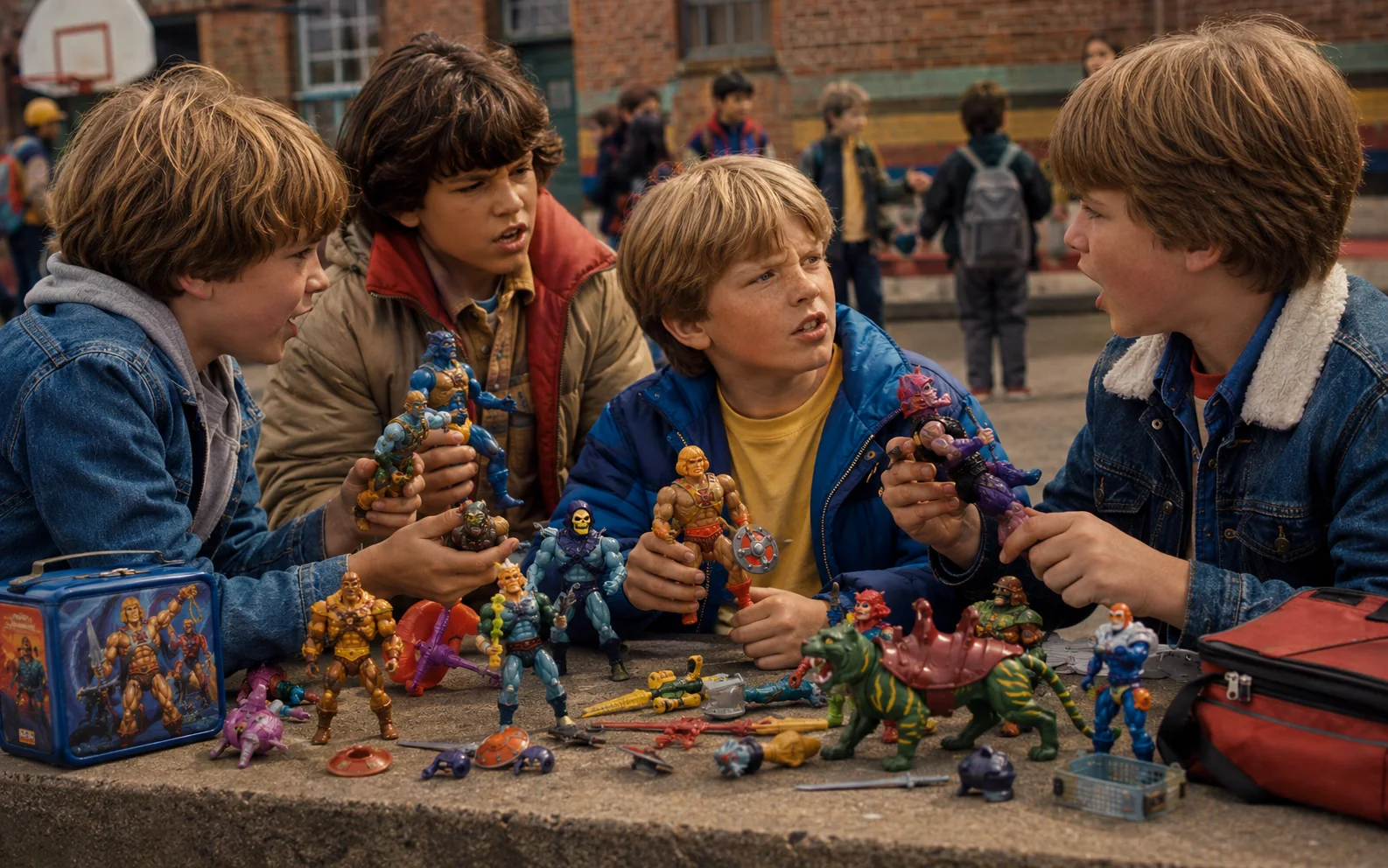
Masters of the Universe lived in bedrooms, but it traveled through school. Kids did not usually bring Castle Grayskull to class unless they had a backpack the size of a luggage claim, but the characters, arguments, and wish lists moved through the hallway every day. Recess was where children compared who had what, who needed what, and whose cousin supposedly had every figure, which was usually a lie but still deeply annoying.
The figure roster became social knowledge
Knowing the names mattered. A kid who could identify Trap Jaw, Tri-Klops, Man-E-Faces, Buzz-Off, Mekaneck, and Ram Man had status. The toy line created its own vocabulary, and children used that vocabulary like proof of membership. If you called Beast Man “the orange guy,” you had revealed yourself as not fully trained.
Ownership created playground credibility
Having He-Man was good. Having Skeletor made the battles possible. Having Castle Grayskull was serious business. Having both Castle Grayskull and Snake Mountain, if your neighborhood had reached that point, created a level of authority that probably should have come with a clipboard.
Kids compared collections constantly. Not always politely. The child who owned a rare or new figure could describe it in painful detail while everyone else pretended not to care and absolutely cared.
Trading was dangerous diplomacy
Weapons, armor, mini-comics, duplicate figures, and random parts entered informal trade networks. The problem was that He-Man accessories were not generic to the children who owned them. The wrong deal could leave a figure permanently incomplete, and regret arrived faster than a teacher could say, “Put that away.”
Some trades were fair. Some were criminal in spirit if not technically covered by school policy. A child might give up an important accessory for something shiny, then discover at home that Skeletor without a staff looked like he was just making threats with bad posture.
Rumors fueled demand
Playground information was not always accurate, but it was powerful. Someone heard a new figure was coming. Someone saw a vehicle at another store. Someone’s older brother claimed there was a special version with secret powers. Kids carried these rumors home, where parents had to decide whether to engage or suddenly become very interested in changing the subject.
Character debates were part of the fun
Who was stronger? Could Skeletor beat Hordak? Was Battle Cat better than Panthor? Could Ram Man knock down Castle Grayskull? Was Man-E-Faces a hero, a monster, or just someone having a complicated week? These arguments mattered because they shaped the afternoon’s battles.
School amplified the cartoon
Children who watched the previous day’s episode brought that story into school. They repeated lines, corrected details, and invented new plots. The show gave everyone shared material. The toys gave them something to act out later.
The lunchroom was market research with pudding cups
Toy companies paid for surveys. Kids conducted them for free by talking nonstop. What figure was cool? What playset mattered? What commercial looked awesome? What toy was impossible to find? The answers moved from lunchroom to living room quickly.
He-Man became part of kid identity
Some children were Star Wars kids. Some were G.I. Joe kids. Some were Transformers kids. Many were all of them at once because loyalty was flexible when birthdays were involved. But being a He-Man kid meant liking the big, weird, fantasy-action chaos. It meant understanding that a skull castle was not excessive. It was basic infrastructure.
The toy you threw down the stairs may now be missing exactly the part collectors want
Vintage He-Man Toys Today: Value, Condition, and Missing Accessories
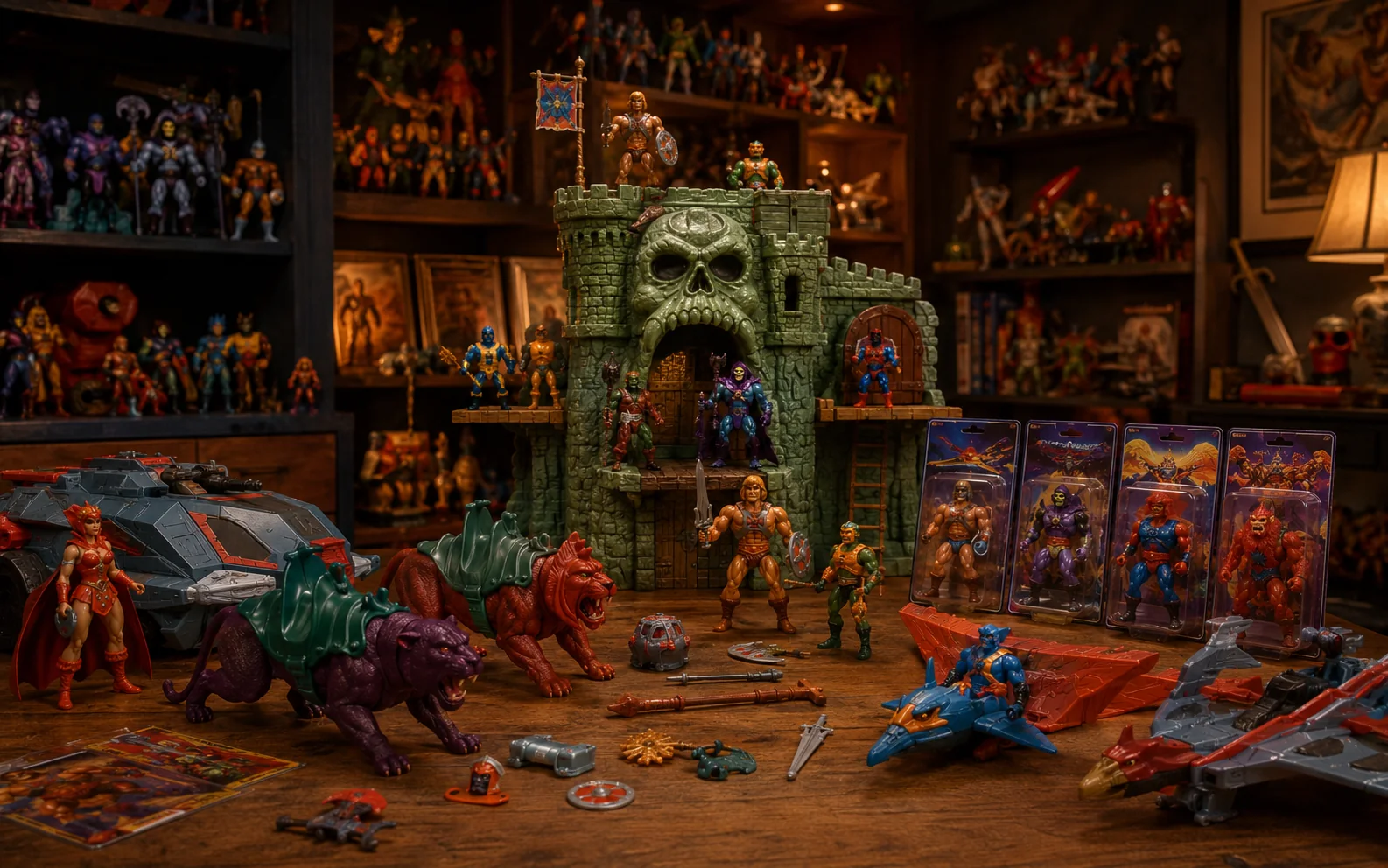
Vintage He-Man toys remain collectible because the line has character recognition, strong nostalgia, bold designs, and a huge variety of figures, vehicles, beasts, accessories, playsets, packaging, and variants. But nostalgia and value are not the same thing. The figure you loved may be priceless emotionally and extremely ordinary financially.
Accessories matter more than casual sellers expect
A loose He-Man figure without his sword, armor, axe, or shield is not the same as a complete example. Skeletor without his Havoc Staff loses impact. Trap Jaw without attachments is still cool, but collectors notice. Tiny pieces are often the difference between “nice childhood figure” and “complete collector example.”
Elastic and waist action can fail
Classic MOTU figures used internal construction that can loosen or fail over time. Wobbly legs, broken waist action, cracked parts, paint rub, chewed hands, and loose heads all affect desirability. These toys were built for play, and kids accepted the challenge aggressively.
Castle Grayskull completeness is its own beast
Castle Grayskull can be missing weapons, the elevator, the flag, the trapdoor, the throne, clips, cardboard pieces, instructions, or packaging. A shell is not the same as a complete playset. Collectors know the difference immediately.
Packaging changes everything
Carded figures, boxed vehicles, and boxed playsets belong to a different collector conversation than loose childhood examples. Card condition, bubble clarity, unpunched cards, price stickers, creases, tears, and resealing questions all matter.
Variants and international releases complicate the market
Different factories, releases, markings, cardbacks, and regional packaging can affect interest. Serious collectors study details. Casual sellers often misidentify versions because the line looks familiar until the small differences start multiplying.
Do not confuse asking prices with sold prices
The separate collector framework in valuable 80s toys worth money today explains how to compare real completed sales, condition, accessories, packaging, and authenticity. A wild listing is not a retirement plan. It is sometimes just somebody testing the limits of optimism and keyboard access.
Childhood wear is part of the story
A figure with paint rub, loose legs, and a replacement sword may not excite a high-end collector, but it still carries the reason the line mattered. These toys were used. Hard. They were not purchased to sit calmly under museum lighting. They were purchased to win the Battle of Couch Mountain before dinner.
The line ended, rebooted, returned, and still somehow looked like it could bench-press the shelf
Why Masters of the Universe Toy Design Still Works
Masters of the Universe left a design legacy because it solved a hard toy problem with brute clarity. It created figures that were readable from across an aisle, fun in the hand, expandable through reuse, and connected to a world children could understand instantly. That combination influenced how later toy lines thought about silhouettes, factions, gimmicks, playsets, and media support.
Silhouette became everything
A good MOTU character could be recognized in outline. He-Man had the sword and harness. Skeletor had the hood and skull. Beast Man had the furry bulk. Trap Jaw had the mechanical arm and jaw. Ram Man had the armored head and spring-loaded shape. Strong silhouettes helped kids identify characters quickly and made the toy line feel visually loud.
Color did not apologize
Masters of the Universe used intense color without worrying about realism. Blue bodies, orange fur, green tigers, purple armor, red vehicles, yellow skull faces, and bright weapons all lived together. The color choices helped characters stand apart and made the line pop on shelves.
Reuse became a feature when disguised well
The line reused parts constantly, but the best figures hid that reuse through head sculpts, armor, paint, weapons, and gimmicks. Later toy lines would continue using the same logic: share engineering where possible, but make each character feel distinct where children actually look.
Playsets became brand anchors
Castle Grayskull proved that one great playset can become the symbol of an entire franchise. It was not just a product. It was the place where the story lived. Later action lines understood the value of headquarters, bases, vehicles, and recognizable landmarks because a world needs somewhere to happen.
Gimmicks had to be visible
The best MOTU gimmicks were obvious. Ram Man rammed. Mekaneck stretched. Man-E-Faces changed faces. Trap Jaw swapped tools. Kobra Khan sprayed. Stinkor smelled. Nobody needed a manual the size of a microwave warranty. The toy told you what it did.
The line blended genres before kids cared about genre
Masters of the Universe was fantasy, sci-fi, superhero, monster, sword-and-sorcery, comedy, adventure, and toy-commercial spectacle at the same time. Children accepted that instantly. Adults often try to sort things into categories. Kids sort them into “cool” and “not cool.” He-Man landed in the correct pile.
The franchise proved nostalgia can be muscular
Decades later, the line still returns because the designs remain strong. They are not remembered only because people were young. They are remembered because the core toy language was effective. A skull villain, a power sword, a green tiger, and a castle shaped like a monster face still work—and they are why He-Man still belongs among the most iconic toys of the 80s.
The best lesson is commitment
Masters of the Universe never acted embarrassed by itself. That is why it holds up. It committed to the muscles, the names, the castles, the monsters, the moral lessons, the bizarre vehicles, and the idea that a blond barbarian prince could be the center of a universe. Half-commitment would have killed it. Full commitment made it legendary.
Because the whole thing was louder, stranger, and better than it needed to be
Why He-Man Toys Still Hit So Hard for Gen X
He-Man toys remain powerful because they carry the texture of a very specific childhood. The figures were heavy in the hand. The weapons disappeared constantly. The cartoons were on after school. The commercials made the playsets look enormous. The packaging art felt dangerous. Castle Grayskull looked like forbidden architecture. Skeletor was scary and funny. Battle Cat was absurd and perfect.
The toys felt older than the kids playing with them
Masters of the Universe looked like a doorway into something just beyond ordinary childhood. It had swords, skulls, monsters, sorcery, muscles, and danger. It felt grown-up without actually requiring grown-up content. That made it irresistible.
The line invited total imagination
Children could follow the cartoon, read the mini-comics, or ignore everything and build their own war. The toys were flexible enough to survive contradiction. He-Man could fight Skeletor, team up with G.I. Joe, rescue a stuffed bear, or battle a dinosaur from a completely unrelated playset. Eternia did not check IDs.
The designs were instantly readable
A skull villain is a skull villain. A guy with a giant fist is a guy with a giant fist. A green tiger in armor is a green tiger in armor. The line understood silhouette, color, and function. Kids did not need a database to start playing.
Castle Grayskull became a memory anchor
Many toys were loved. Fewer became a place. Castle Grayskull became a room within a room, a landmark in the geography of childhood. If you had it, you remember where it sat. If you wanted it and never got it, you may remember that even more clearly.
The line was ridiculous in the best possible way
That is the secret. Masters of the Universe was sincere and ridiculous at the same time. It believed fully in its own skull castles, tiger mounts, cyborg pirates, extending necks, skunk villains, bee warriors, and moral lessons. Kids believed because the toys committed first.
Questions from the jawbridge, the toy chest, and the parent trying to identify a tiny orange weapon
He-Man Toys FAQ: Masters of the Universe Questions Answered
When did He-Man toys come out?
Mattel introduced the original Masters of the Universe toys in 1982. The figures quickly became one of the decade’s dominant action-figure lines as Castle Grayskull, the animated series, toy commercials, vehicles, beasts, and a rapidly expanding character roster turned He-Man into a household name.
Why were He-Man toys so popular?
They combined chunky action figures, monsters, weapons, vehicles, Castle Grayskull, fantasy world-building, mini-comics, commercials, and a cartoon that gave kids a shared version of Eternia.
What was the first He-Man toy line called?
The original line was Masters of the Universe, with He-Man as the central hero and Skeletor as the main villain.
What does MOTU stand for?
MOTU is the common abbreviation for Masters of the Universe. Collectors and longtime fans use it as shorthand for the He-Man figures, villains, vehicles, beasts, playsets, mini-comics, cartoons, and the wider world of Eternia.
Are He-Man toys and Masters of the Universe toys the same thing?
He-Man toys is the everyday shorthand many people use, but Masters of the Universe was the name of the full toy line. He-Man was the central hero; Skeletor, Teela, Man-At-Arms, Battle Cat, Castle Grayskull, and the rest were all part of the larger Masters of the Universe lineup.
Why was Castle Grayskull so important?
Castle Grayskull gave the line a central playset, fortress, battlefield, mystery location, and visual icon. It made the toys feel like they belonged to a larger world.
Who were the main He-Man villains?
Skeletor was the main villain, supported by characters such as Beast Man, Mer-Man, Trap Jaw, Tri-Klops, Evil-Lyn, Webstor, Clawful, Kobra Khan, Hordak, and others as the line expanded.
What made Masters of the Universe figures different?
They were larger and bulkier than many action figures, with exaggerated muscles, twist-waist battle action, bold weapons, bright colors, and strong silhouettes.
Did the toys or cartoon come first?
The toy line came first, supported by early mini-comics. The animated series then made the characters and world much more familiar to children.
How did She-Ra connect to He-Man?
She-Ra expanded the broader Masters universe with Princess of Power, connecting through story while offering different figures, fantasy elements, horses, and adventure play.
Are vintage He-Man toys worth money?
Some vintage He-Man toys can be valuable, especially complete figures, rare variants, boxed vehicles, sealed carded figures, and complete Castle Grayskull sets. Condition, original accessories, and verified sold prices matter far more than a random asking price; the valuable 80s toys guide explains how to check them without hallucinating a retirement fund.
What He-Man accessories are commonly missing?
Swords, armor, shields, staffs, axes, guns, vehicle parts, Castle Grayskull weapons, flags, cardboard pieces, and small attachments are commonly missing from childhood collections.
Why did Masters of the Universe decline?
The line declined as the market became crowded, the original format grew familiar, kids aged out, television attention shifted, and newer brands and video games pulled focus.
Why do Gen X fans still remember He-Man so strongly?
The toys were physical, colorful, strange, durable, and tied to cartoons, commercials, Christmas lists, and carpet battles. They felt like an entire fantasy world inside a bedroom.