The Toy Felt Free
Kids understood that the meal cost money, but emotionally the toy arrived as a bonus. That made it easier to collect several than a toy-store product with a visible price tag.
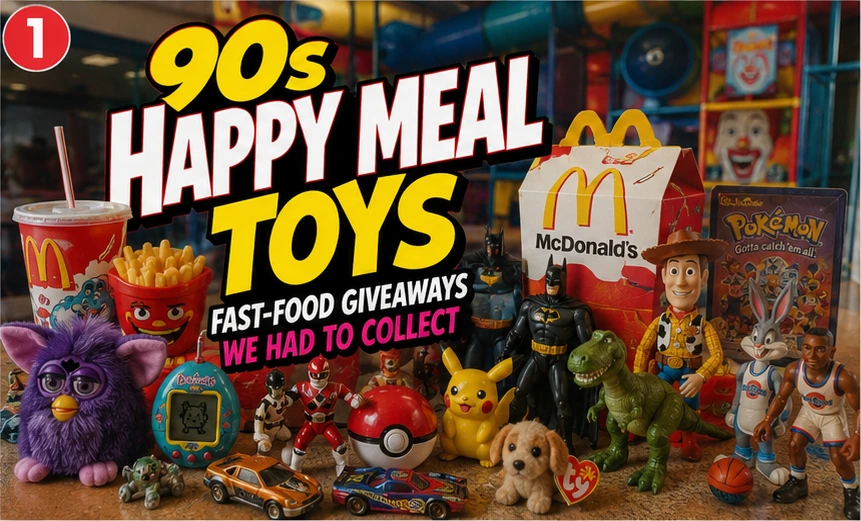
The Fries Were Fine. We Were Here for the Plastic.
McDonald’s Happy Meal toys, Burger King Kids Club prizes, Taco Bell oddities, Pizza Hut promotions and every tiny piece of plastic that turned a five-minute food stop into a full-scale collecting emergency.
The 90s fast-food toy was cheap enough to feel free, limited enough to feel urgent and attached to enough movies, cartoons and toy crazes to make ordinary lunch feel like a national release event.
The most memorable 90s Happy Meal toys and kids-meal promotions included McDonald’s Changeables, Hot Wheels, McDonaldland characters, Space Jam figures, Teenie Beanie Babies, Tamagotchi and Furby toys; Burger King Disney and Toy Story promotions, the Kids Club Gang and the late-90s Pokémon rush; plus Taco Bell, Pizza Hut, Wendy’s and other chains pushing movie, cartoon, cup, puppet, game and collectible giveaways.
What made these fast-food toys from the 90s different from ordinary toy-store purchases was the ritual. The old Happy Meal toys, Burger King Kids Club prizes and Taco Bell giveaways arrived with lunch, a mystery bag and the immediate fear that everyone else had received the better character.
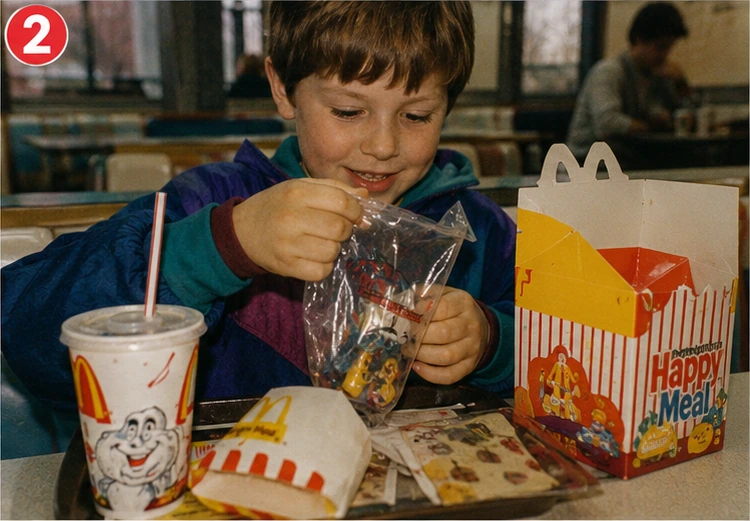
Open the Bag. Check the Prize.
The real story was bigger than one restaurant or one famous set. It was the meal, the bag, the short window, the duplicate pile and the family logistics required to collect every last piece before the promotion vanished.
The Four-Part Formula
The best promotions did more than place a cheap toy beside fries. They turned the entire restaurant visit into part of a larger entertainment system.
Kids understood that the meal cost money, but emotionally the toy arrived as a bonus. That made it easier to collect several than a toy-store product with a visible price tag.
One character was rarely enough. A promotion with four, six, eight or more pieces transformed lunch into a deadline. The clock ran until the restaurant changed promotions or ran out.
Movies, cartoons and toy brands arrived with built-in recognition. Kids already knew the characters. The restaurant only had to offer a smaller version in a bag.
The toy attached itself to the booth, the tray, the car ride, the smell of fries and the argument over who got which character. The promotion became lived experience.
Everybody Wanted a Piece of the Kids’ Meal
McDonald’s had the category-defining name, but Burger King, Taco Bell, Pizza Hut, Wendy’s and regional chains all competed for family traffic with their own toys, cups, bags and movie deals.
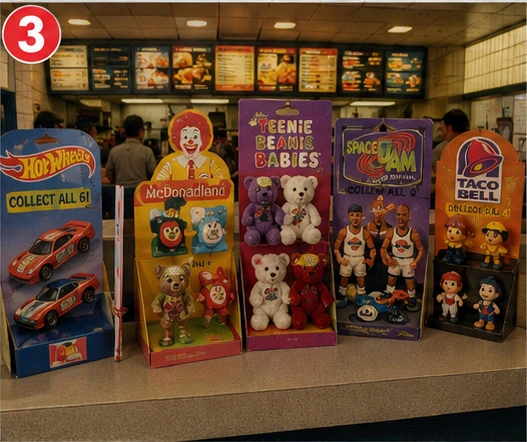
McDonald’s did not invent the idea of giving children a prize with food, but it made the practice feel permanent. The Happy Meal became less like an occasional promotion and more like an ongoing programming block. One set disappeared, another arrived and the restaurant always seemed to have a new reason for kids to look at the counter display before looking at the menu.
The consistency mattered as much as the individual toys. Families learned the ritual. The child asked what the current toy was. The parent checked the sign or asked the cashier. The employee reached into a box behind the counter. The bag arrived with food in one compartment and emotional stakes in another.
McDonaldland characters gave the chain a built-in cast long before every promotion depended on a movie studio. Ronald, Grimace, Hamburglar, Birdie and the other characters appeared in commercials, packaging, play areas and toys. That continuity gave the restaurant its own mythology. A child did not need to see a new movie to understand why a Grimace figure mattered.
Changeables pushed that logic even further by turning the restaurant’s food and packaging into the toy. Burgers, fries and drink containers transformed into robots or creatures. The meal was not simply paired with merchandise; the menu itself became the source material.
A McDonald’s promotion could appear almost everywhere at once. Television commercials introduced the toys. Window graphics announced the set. Tray liners showed every piece. The drive-thru sign reminded parents that this was “for a limited time,” which translated into “prepare to return before Thursday.”
Because of the chain’s size, a toy could become part of national childhood conversation very quickly. Kids in different towns might bring the same figure to school on the same morning. The promotion created a shared reference point without requiring anyone to shop at a specialty store.
The box or bag helped. Food, packaging and prize arrived as one designed experience. The toy did not feel like an item purchased from a peg. It felt discovered. Even when the child knew exactly what was coming, opening the bag still created suspense because the specific character might be wrong.
McDonald’s strongest 90s promotions balanced three things: immediate play, recognizable design and a reason to return. Hot Wheels rolled. Changeables transformed. Teenie Beanie Babies collected. Tamagotchi and Furby items echoed larger toy crazes. The format kept changing while the ritual stayed the same.
The memory: spotting the display from the parking lot and beginning negotiations before the car was fully parked.
Burger King approached the 90s kids-meal battle with the energy of a chain that knew it had to give families a reason to choose a different drive-thru. The Kids Club identity helped create continuity, while movie and character partnerships gave the chain moments when it could compete directly with McDonald’s cultural volume.
The Kids Club framing mattered because it suggested membership. The meal was not just smaller food for children. It belonged to a branded group with characters, graphics and its own tone. That made the promotion feel like part of a club rather than a random prize dropped beside a burger.
Burger King often became most visible when it connected to a major entertainment property. Disney and Pixar characters, family movies and late-decade Pokémon promotions gave the chain access to audiences already primed by television, theaters, games and toy aisles.
A strong license reduced the explanation required at the counter. Kids already knew the characters and understood the need for a set. Burger King only had to provide a compact, collectible version and enough variation to justify repeat visits.
Part of the appeal came from not being McDonald’s. The toy assortment could feel like an alternate universe running beside the dominant Happy Meal timeline. A child might collect one chain’s movie characters while a friend collected another’s. That difference created comparison and sometimes forced parents to visit both.
Burger King promotions could also feel more tied to the specific release moment. When the chain landed a major property, the restaurant changed around it. Cups, bags, signs and toys worked together to make the promotion feel larger than one plastic piece.
By 1999, Pokémon gave Burger King one of the decade’s most intense promotional environments. The franchise already lived across Game Boy systems, trading cards, television and school conversation. The restaurant added another collecting layer and another location where families had to check availability.
The demand demonstrated how far kids-meal toys had evolved. These were no longer small bonuses that happened to feature characters. They were nationally discussed consumer products tied to a multimedia event.
The memory: the family choosing Burger King instead of the usual place because somebody at school said the location near the mall had the missing character.
Taco Bell never dominated the kids-meal category the way McDonald’s did, which is exactly why its 90s promotions can feel so memorable now. The toys often seemed less predictable: puppets, puzzles, cups, movie items, small games, unusual character pieces and plastic objects that no adult can identify without several minutes of concentrated memory.
The chain’s weaker association with children’s meals gave each promotion the feeling of a surprise. A McDonald’s toy was expected. A Taco Bell toy could feel discovered, especially when the family visited for dinner and the child did not realize a promotion was running.
Taco Bell promotions often leaned into novelty formats rather than one endless line of small figures. A giveaway might become a puppet, puzzle, noisemaker, stamp, vehicle or tabletop activity. These products did not always become major playground currencies, but they added variety to the decade’s promotional landscape.
The oddness helped them survive in memory. Major movie characters remain easy to identify. The stranger Taco Bell item creates a different kind of nostalgia: recognition without context. You know it came from somewhere. You remember holding it in a booth. You may need another Gen Xer to explain what it did.
Like other chains, Taco Bell used movie and character tie-ins to attract families. But because the chain did not run the same uninterrupted toy machine, its licensed promotions could feel more isolated and specific to the release.
The toy might be accompanied by a cup or packaging design that did as much memory work as the item itself. For many adults, the strongest Taco Bell toy memories are connected to the color scheme of the restaurant, the booth pattern, the tray and the specific look of the packaging.
Availability and consistency could vary. Some families encountered Taco Bell kids meals frequently; others remember only one or two promotions. That unevenness makes the chain harder to summarize but more interesting as cultural evidence.
Taco Bell represents the broader truth that 90s fast-food toy culture was not one uniform national timeline. It was a patchwork shaped by family habits, local restaurants and whichever chain happened to have the movie everyone cared about that month.
The memory: finding a weird toy in a bag, having no idea whether it belonged to a movie and playing with it anyway because the instructions were already covered in sauce.
The 90s kids-meal story extends far beyond the two biggest burger chains. Pizza Hut, Wendy’s, Hardee’s, Carl’s Jr., Dairy Queen and regional restaurants all used books, cups, puppets, games, character figures and movie promotions to compete for family attention.
The format changed with the restaurant. A burger chain could hand over a compact bag at the counter. A pizza restaurant had more time. Families sat at a table, waited for food and stayed longer. That opened the door for activity books, tabletop games, reading promotions and objects designed to occupy children during the meal.
Pizza Hut’s dine-in culture created a different emotional setting. The red cups, dark booths, tabletop arcade cabinets and longer wait turned a promotion into part of an evening rather than a quick stop. Books, puppets, cups and character items had time to become activities before the food even arrived.
Reading promotions were especially effective because they connected school achievement to a restaurant reward. The prize was not always a toy, but the ritual still combined childhood accomplishment, family outing and branded experience.
Wendy’s promotions could offer licensed figures, games and house-brand items while giving families another option in the same weekly decision. For kids, the chain difference mattered less than the toy. A strong promotion could temporarily change where everyone wanted to eat.
Because these chains received less national nostalgia coverage, their toys often survive as forgotten objects. One image can trigger a flood of recognition among people who had not thought about the promotion for thirty years.
Regional restaurants complicate any definitive list. A promotion that meant nothing in one state could define childhood in another. Local chains used mascots, sports tie-ins and community partnerships that never reached national television.
This regional layer is important because nostalgia tends to flatten history into the biggest brands. Actual family life was more local. The restaurant down the road, the one near the mall or the one beside the highway may have mattered more than whichever chain had the famous national campaign.
The memory: a toy nobody else online seems to remember because the chain existed in only three states and one of them was yours.
The Promotions We Still Remember
These promotions capture the decade’s movement from restaurant characters and simple vehicles toward movie universes, collectible plush, electronic-toy imitations and full multimedia events.
A burger container turning into a robot was exactly the kind of logic the 90s rewarded.
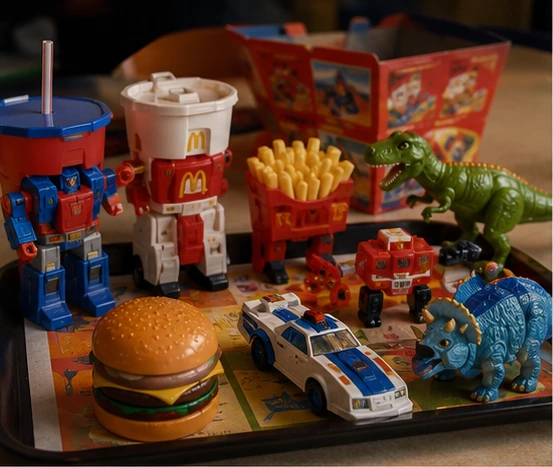
McDonald’s Changeables stand out because they did not need a movie, television show or toy company to supply the characters. The restaurant looked at its own menu—burgers, fries, drinks and meal boxes—and turned those familiar objects into transforming toys. The promotion borrowed the excitement of the decade’s robot craze while keeping every visual tied directly to McDonald’s.
That made the toys feel unusually specific to the meal. A hamburger-shaped object opened into a robot. A carton or container became a creature. The food imagery was not printed on the package and forgotten; it was built into the play feature.
Transforming toys give children a simple before-and-after payoff. The object looks ordinary, then a few folds reveal something hidden. Changeables delivered that surprise in a small format without needing batteries, accessories or a complicated instruction sheet.
The action also made them satisfying at the restaurant table. A child could test the transformation repeatedly while waiting for everyone else to finish eating. The toy could sit in disguised form beside the real food, which made the joke better.
The dinosaur versions pushed the same idea toward another safe childhood obsession. A meal box changing into a dinosaur combined packaging, creature play and transformation in one object. Dinosaurs were already moving toward a major 90s peak, so the promotion felt both familiar and new.
The box-based design also blurred the boundary between package and toy. Children were trained to see the container as disposable. Changeables suggested that the shape itself could become something worth keeping.
Changeables rarely remained isolated as restaurant toys. They entered existing robot, vehicle and monster collections. A burger robot could battle a store-bought action figure without anyone caring that the brands had never met.
The transformations also created comparison. Some models were easier to convert. Some stood better. Some looked more convincing in food form. A child could develop a favorite based on the mechanism rather than the character.
Licensed toys can blur together because the same movie appeared at several chains and stores. Changeables belong to one place and one ritual. Seeing the shape brings back the restaurant, the packaging and the meal simultaneously.
They also represent a period when a fast-food chain could treat its own visual world as enough. The promotion did not need to borrow cultural relevance. McDonald’s assumed its fries and burgers were already characters, and children basically agreed.
The memory: folding the toy back into food form, placing it beside the real carton and acting like nobody could tell the difference.
Why it mattered: Changeables made the meal itself the source material and gave McDonald’s one of the decade’s most original house-brand toy concepts.
Before every meal needed a movie license, the restaurant already had its own weird little universe.
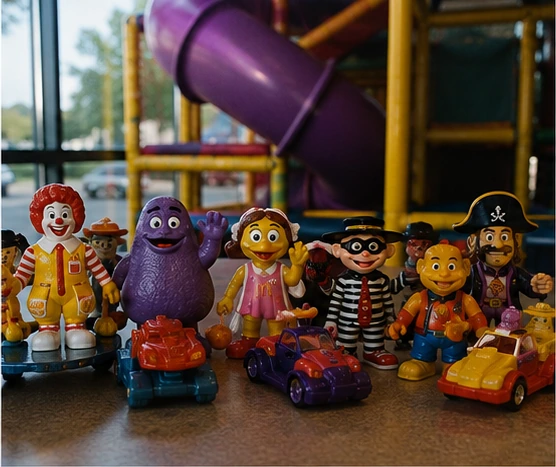
McDonaldland gave the chain recurring characters who could appear whenever no outside movie license occupied the calendar. Ronald, Grimace, Hamburglar, Birdie and the other figures already lived in commercials and restaurant décor, so turning them into toys felt natural.
The characters represented different parts of the McDonald’s world. Hamburglar revolved around burgers. Birdie connected to breakfast. Grimace was simply Grimace, which was apparently enough.
Licensed promotions borrowed excitement from movies and television. McDonaldland promotions generated excitement from the restaurant itself. That strengthened brand memory in a more direct way.
A child did not leave with only a toy. The figure reminded the family of McDonald’s after the visit. The character became a portable restaurant sign that children willingly carried into the home.
McDonaldland toys appeared in different forms: figures, vehicles, clips, sports themes and small action features. The cast could be reconfigured repeatedly because the characters were not trapped inside one movie plot.
Grimace could drive something. Hamburglar could become a moving figure. Ronald could appear in sports gear. The same personalities returned with new gimmicks.
Television advertising made the characters feel familiar before children encountered the toy. Commercials showed them interacting inside a larger fantasy world, giving even a simple figure a story.
The toy then extended that commercial world into ordinary play. Kids could invent episodes that had nothing to do with food, because once the characters entered the toy box they belonged to childhood more than the restaurant.
Modern fast-food promotions often center on outside entertainment brands. McDonaldland toys recall a period when restaurant mascots carried enormous cultural weight.
They also preserve the look of the restaurants themselves: bold colors, character murals, plastic play areas and packaging designed to feel like an amusement space rather than a neutral dining room.
The memory: recognizing a character from television before knowing exactly what the character was supposed to be.
Why it mattered: McDonaldland made the restaurant its own cartoon franchise and gave Happy Meals recurring characters between blockbuster licenses.
A small car required no explanation, no batteries and no mercy once it reached the kitchen floor.
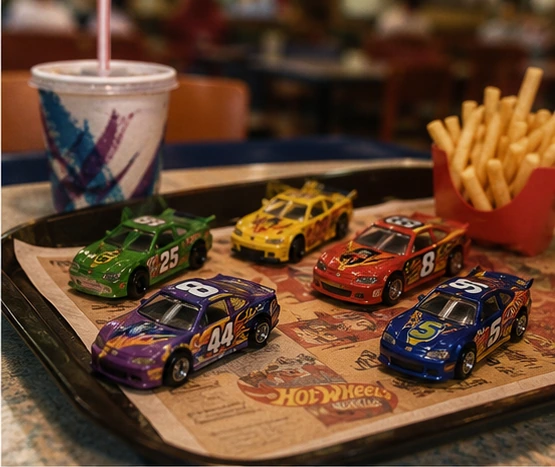
Small cars are nearly ideal promotional products. They are durable, familiar and playable the second they leave the bag. A child does not need to understand a movie plot or read instructions. Put the car on a table, push it forward and the toy has explained itself.
Hot Wheels already had a strong collecting language: different models, colors, graphics and vehicle types. That meant McDonald’s did not need to teach children why owning more than one mattered. The brand arrived with an existing toy-bin ecosystem.
Restaurant surfaces gave the car immediate terrain. Trays became launch platforms. Booth seams became obstacles. The edge of the table became a cliff that adults repeatedly warned about and children repeatedly tested.
The toy also worked in the car on the way home, although any vehicle small enough to fit in a Happy Meal bag was also small enough to disappear beneath a seat. Many promotional cars spent years traveling inside family vehicles after one bad turn.
Many fast-food premiums were tied to one gimmick. Once the gimmick stopped being surprising, the toy became clutter. A small car could join hundreds of other games: races, traffic jams, crashes, garages, city layouts and action-figure chases.
The difference between promotional and store-bought cars mattered less during play. Children mixed them freely. A McDonald’s vehicle could race a premium Hot Wheels model, lose a wheel and continue operating as post-apocalyptic scenery.
The set structure encouraged repeat visits, but the emotional stakes were often lower than character promotions. A child might want a specific model, but any new car still had obvious use.
That made duplicates easier to tolerate. Two similar cars could race. A repeated character figure felt redundant. A repeated car simply became another lane.
The promotion acted as a sample of a much larger retail universe. A child who liked the meal car already knew where to find more. The restaurant toy did not replace store purchases; it opened another door into the brand.
This is the same screen-to-shelf and counter-to-toy-box logic that powered many 90s collectible toy crazes. The promotional object was small, but the collection could expand indefinitely.
The memory: pushing the car across the tray before the food wrappers had been cleared and watching it launch directly into somebody’s drink.
Why it mattered: Hot Wheels gave the kids’ meal genuine long-term play value and proved that a simple, durable toy could outlast a giant licensing campaign.
Every animated movie arrived with songs, characters, VHS anticipation and a plastic side quest at a restaurant.
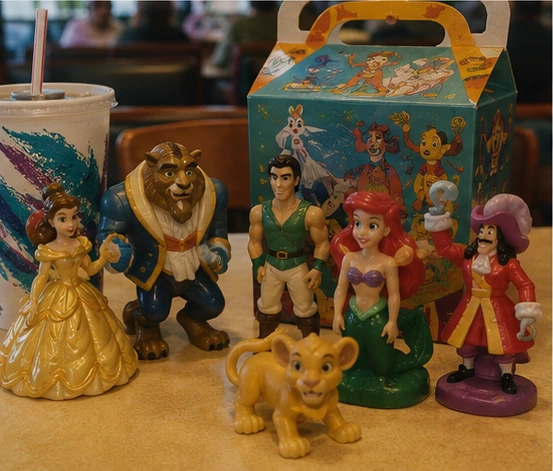
The Disney Renaissance created ideal fast-food promotions because animated movies arrived with recognizable ensembles. A princess, hero, villain, sidekick and comic-relief animal could each become a separate kids-meal toy. The full cast naturally became a set.
Character silhouettes were also easy to recognize at small scale. A tiny figure did not need premium detail if the colors, pose and shape communicated who it was. That made animation well suited to mass-produced promotional plastic.
Fast-food promotions became part of the way families experienced a Disney release. The movie opened in theaters. Commercials played constantly. Restaurants changed their windows and bags. Kids collected the characters. Months later, the VHS arrived and restarted the entire obsession.
The restaurant visit could happen before or after seeing the movie. Beforehand, the toys introduced characters and built anticipation. Afterward, they became props for replaying scenes.
Retail toy aisles often concentrated on lead characters and larger products. Kids-meal sets could make room for sidekicks and secondary characters. A small comic-relief animal was perfectly suited to a promotional figure even if it would never support a full toy-store line.
That made some restaurant sets feel unusually complete. The figures represented the cast rather than only the most marketable hero.
Disney kids-meal figures entered existing dollhouses, action-figure worlds and bath-time adventures. Scale differences did not matter. A tiny lion could live beside a fashion doll. A villain could attack a toy truck. Children had no obligation to respect studio continuity.
The toys also became shelf decorations because their poses and colors made them recognizable without active play. A complete row of characters could preserve the memory of a movie long after the restaurant promotion ended.
Different chains held different entertainment partnerships across the decade, which meant families sometimes had to follow the movie rather than the restaurant. The destination changed depending on who had the license.
That movement gave children an accidental education in corporate alliances. Nobody used that phrase, but everyone understood that a character could appear at one burger chain this year and another later.
The toys document the moment when animated movies became full cultural seasons. The film occupied songs, clothing, school supplies, cereal boxes, toy aisles and restaurants. The kids-meal figure was inexpensive, but it belonged to a much larger emotional event.
The broader Disney Renaissance toy story follows the dolls, plush, figures and retail lines that surrounded those movies beyond the counter.
The memory: lining up the characters on a windowsill and realizing the one missing sidekick had somehow become the most important object in the house.
Why it mattered: Disney made fast food part of the movie-release ritual and turned every animated ensemble into a ready-made collectible set.
Basketball, Looney Tunes, Michael Jordan, a giant soundtrack and fast-food toys all arrived in one beautifully excessive package.
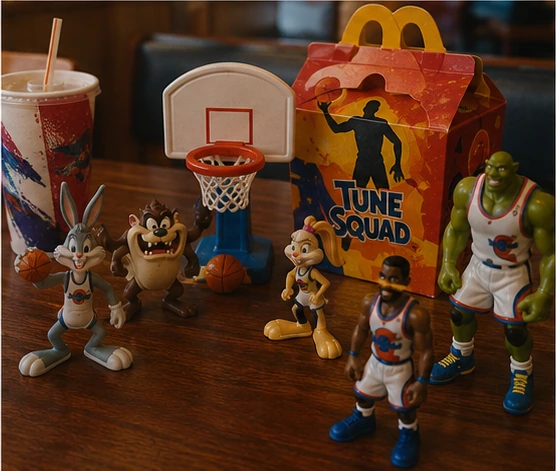
Space Jam already blended categories before the kids-meal toys appeared. It combined a global basketball star, classic cartoon characters, a theatrical movie, a massive soundtrack and enough merchandise to fill every type of store. The restaurant promotion did not feel bolted on. It felt inevitable.
The movie’s visual world translated easily into small toys. Basketball poses, cartoon expressions and recognizable uniforms made the characters readable at promotional scale.
Cartoon fans knew Bugs Bunny and the Looney Tunes cast. Sports fans cared about Michael Jordan. Younger children responded to the bright characters. Older kids could claim the appeal was athletic rather than childish.
That crossover gave the promotion unusual reach. The toys could sit beside basketball cards, action figures and cartoon merchandise without looking out of place.
Window displays, commercials and packaging reinforced the film’s color palette and basketball imagery. A visit during the promotion felt like stepping into one more section of the Space Jam merchandising world.
The toy made the movie portable. A child could leave the theater experience behind, then continue carrying the character into the car, school and bedroom.
Basketball-themed toys encouraged improvised games. A tray edge became a court. A cup rim became a hoop. Characters were launched, rolled or positioned in ways the designers never planned.
The Looney Tunes cast also blended easily with unrelated toys. Bugs could drive a Hot Wheels car. A Monstar could attack a dollhouse. Jordan could become the tallest action figure in a completely unlicensed bedroom league.
Space Jam arrived when media, sports and consumer products were becoming more tightly connected. The campaign did not ask children to care about one object. It surrounded them with the same property in different forms.
The kids-meal toy was the cheapest entry into that world, which made it one of the most widely shared pieces of the campaign.
The memory: a character toy standing beside a basketball card while the soundtrack played in another room and the movie logo appeared on half the clothes at school.
Why it mattered: Space Jam showed how a fast-food promotion could connect sports, animation, music, movies and toys into one cultural blast.
The adult collectible bubble reached the kids’ meal, and suddenly lunch came with market speculation.
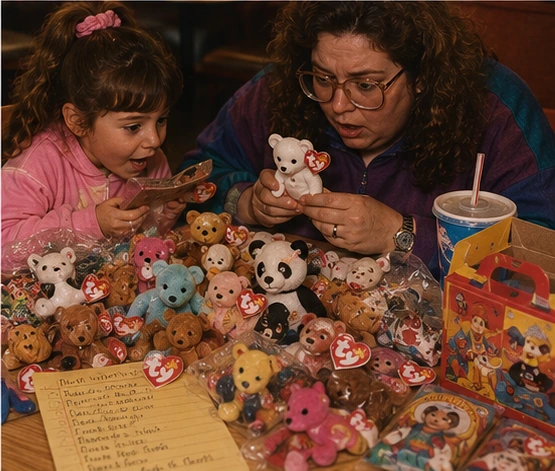
Teenie Beanie Babies did not create the Beanie Baby craze. They landed inside it. By 1997, the larger plush line already carried retirement rumors, scarcity stories, tag obsession and resale fantasies. McDonald’s introduced a smaller promotional version just as public attention reached a fever pitch.
The toys were instantly understandable. They looked like the full-size collectibles, carried individual identities and fit naturally into the existing idea of building a set.
Most kids-meal promotions targeted children while parents managed the logistics. Teenie Beanie Babies changed the emotional balance because some adults believed the toys might become valuable.
That meant calling locations, protecting unopened bags and treating character availability like market information. The promotion could turn an ordinary drive-thru into a small speculative exchange.
Children generally wanted to open the toy, touch it and add it to existing plush collections. Collector logic argued for leaving it sealed. The disagreement captured the entire Beanie Baby era in miniature.
A toy designed to be cuddled became an object some families handled like a stock certificate. The child received the meal, but the adult sometimes controlled the asset.
The small plush size felt substantial compared with a flat piece of plastic. The animals had faces, names and personalities. They looked like miniature versions of something already considered desirable.
Different characters created immediate completion pressure. One meal delivered one animal. The display showed the whole group. The distance between ownership and completion became visible in the restaurant.
Families compared locations and shipment timing. Certain characters seemed harder to find. Staff members were asked about unopened cases, future deliveries and whether toys could be purchased separately.
The promotion demonstrated how a fast-food chain could temporarily become a toy distributor at enormous scale. Restaurants designed to move meals were suddenly managing collector demand.
Teenie Beanies entered backpacks and classroom conversations, though many were kept at home to protect condition. Kids compared animals and tags while repeating value rumors learned from adults.
The promotion brought the language of collecting into school in a particularly intense way: sealed, rare, retired, valuable, mint. Children learned financial vocabulary from tiny plush animals and mostly learned it incorrectly.
Most Teenie Beanie Babies did not become life-changing investments. They remained mass-produced promotional toys connected to an unforgettable cultural moment.
Their real value is historical and emotional. They capture the exact point when kids-meal collecting stopped being only a child’s obsession and became a family project with spreadsheets in spirit, if not always on paper.
The memory: being told not to open the toy because it might be worth something someday, then watching “someday” arrive with a disappointing resale listing.
Why it mattered: Teenie Beanie Babies turned the Happy Meal into a national collectible hunt and pulled adults directly into the chaos.
Once digital pets and talking creatures took over toy stores, the Happy Meal produced smaller, simpler versions for the rest of us.
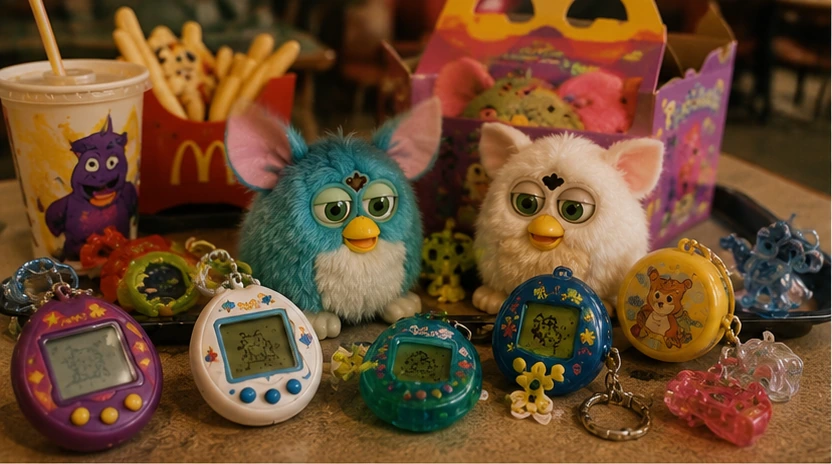
Not every restaurant toy needed to reproduce the full function of the retail product. Sometimes recognition was enough. Tamagotchi and Furby had shapes so distinctive that a small promotional version immediately connected to the larger craze.
The egg-shaped digital pet suggested buttons, care and pocket electronics even when the promotional item offered a simpler action. Furby’s ears, eyes and rounded body communicated the character before it made a sound.
Digital pets were already designed to travel. They clipped to backpacks and entered classrooms, which made them especially compatible with the small scale of a Happy Meal promotion.
A restaurant version allowed children without the full electronic device to participate in the visual culture. It could hang from a bag, join a collection or function as a recognizable token of the craze.
Furby was more than a successful product. It became a holiday shortage story, a television-news topic and a symbol of late-90s interactive toys. A Happy Meal version benefited from all that cultural noise.
By the time the promotional toy arrived, the audience did not need an explanation. Children knew what Furby was, parents knew it was difficult or expensive to find and the restaurant could offer a smaller form of the experience.
McDonald’s later described the Furby promotion as its first electronic Happy Meal toy. That detail marks an important shift. Kids-meal premiums were beginning to borrow not only the look of toy-store products but some of their behavior.
Electronics raised excitement and complications. Batteries could fail. Sounds could become annoying. The toy felt more advanced, but it also carried more ways to stop working inside a drawer.
The late 90s were moving toward toys that remembered, reacted, spoke or represented digital progress. Even simplified promotional versions reflected that change.
The kids’ meal was no longer limited to a static molded figure. It could participate in the same interactive fantasy driving the retail aisle.
Tamagotchi-shaped toys and small Furby items traveled easily. They joined the same ecosystem as keychains, cards and miniature collectibles. A child could bring the promotional object to school even when the expensive full-size toy stayed home.
That visibility turned the promotion into another layer of the 90s schoolyard craze machine.
The memory: carrying the restaurant version because the real electronic toy was too expensive, too fragile or currently being kept alive by a parent at home.
Why it mattered: Tamagotchi and Furby showed that fast-food toys could respond almost immediately to the biggest interactive products in the toy aisle.
By 1999, Pokémon did not enter a promotion. It swallowed the building.
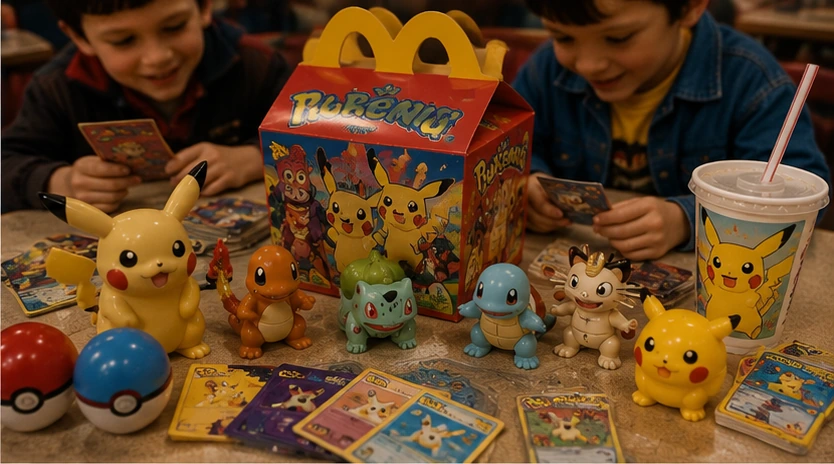
Pokémon arrived with the perfect language for a kids-meal campaign: catch, collect, trade and complete. The games encouraged finding many creatures. The cards created rarity. The television show gave every character a personality. A restaurant set could plug directly into behavior children already understood.
No one had to explain why one toy was not enough. The franchise had made incompleteness part of its appeal.
By 1999, a child could play Pokémon on Game Boy, watch the cartoon, trade cards at school, see the movie and visit Burger King for another promotional object. Each format reinforced the others.
The restaurant did not compete with the cards or games. It added another collecting channel and another reason for the family to participate.
Pokémon had already become a schoolyard language. Children recognized names, evolution lines and relative popularity. A promotional item entered an active culture rather than creating one from scratch.
The toy was evaluated immediately: favorite character or not, common or desirable, worth trading or worth protecting. The restaurant bag opened into an existing social market.
The late-90s Burger King Pokémon campaign became a highly visible example of the scale and risk of kids-meal promotions. Demand overwhelmed locations, while safety concerns involving promotional packaging led to a major recall.
The episode showed that a kids-meal premium could no longer be treated as a trivial extra. Millions of products moved through restaurants into homes, creating responsibilities closer to a national toy launch.
Parents dealt with character requests, location differences and the possibility that the promotion would end before the set was complete. Families who had already survived the card craze now found the same urgency attached to dinner.
The restaurant hunt could merge with movie trips, mall visits and card shopping. Pokémon was not one errand. It was an ecosystem.
Promotional items reached school quickly because Pokémon already lived there. A toy could become a backpack decoration, trade object or proof that a child had visited the right location.
The promotion also created conversations among kids who did not care about the meal itself. The object carried the franchise into another setting, which was the entire point.
Pokémon demonstrated the future of children’s marketing: connected media, constant collecting and multiple products feeding the same universe. The fast-food toy was only one piece, but it helped make the franchise feel unavoidable.
The broader Pokémon Panic in the 90s story follows the cards, games, television and schoolyard culture beyond the restaurant.
The memory: a family dinner decision being dictated by a creature that existed on a Game Boy cartridge, a card, a television screen and now a restaurant sign.
Why it mattered: Pokémon turned the fast-food promotion into one piece of a connected entertainment empire and showed how intense kids-meal demand could become.
It was the perfect marketing loop: watch a movie about toys, receive a toy, then ask for the better toy at the store.
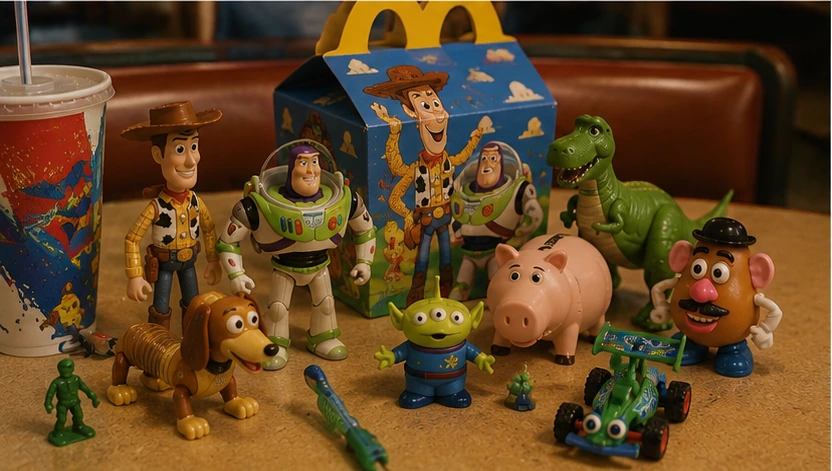
Toy Story had an advantage almost no other movie could match: the characters were already toys inside the story. Buzz Lightyear, Woody, Rex, Hamm, Slinky Dog and the rest looked like products because the film’s emotional world depended on ownership, play and the toy box.
Turning those characters into promotional figures required almost no conceptual leap. A child could watch the movie and immediately understand what it meant to bring the cast home.
Full-size store toys delivered the fantasy of owning the character as seen on screen. Kids-meal toys offered a smaller and cheaper entry. They could include side characters or stylized versions that did not justify a major retail product.
The two levels supported one another. The meal figure made the character familiar and available. The store version became the larger object to request for a birthday or Christmas.
Toy Story figures fit naturally into action-figure collections because the movie itself encouraged cross-toy interaction. A Woody figure could meet superheroes, dinosaurs and fast-food robots without violating the spirit of the story.
The characters also worked at different scales. A tiny Rex could become a pet. A miniature Buzz could ride inside an unrelated vehicle. Kids were already trained by the movie to imagine toys communicating across brands.
Toy Story 2 expanded the cast and revived interest in the original characters near the end of the decade. New promotions could use Jessie, Bullseye and other additions while bringing back the central toys.
The sequel showed how a successful franchise could restart a promotional cycle. The first movie’s toys were no longer old. They were part of a continuing story.
Pixar’s computer animation made the characters look polished and dimensional in a way that matched plastic merchandise. Surfaces, seams and toy mechanisms were part of the visual design.
That detail gave promotional figures a built-in reference. Even a simplified version could evoke the movie because the original character had been designed as an object.
Toy Story also made children think about the inner lives of their own toys. A restaurant figure could become emotionally important because the film had suggested that every object might be watching, waiting and caring about whether it was played with.
That gave the merchandise more than brand recognition. It gave ordinary plastic a story about belonging.
The memory: adding a tiny restaurant figure to the toy box and briefly wondering what it would say after the bedroom door closed.
Why it mattered: Toy Story made the boundary between movie character, retail product and kids-meal toy almost disappear.
Not every promotion needed a blockbuster movie. Sometimes the toy was a plastic object that made sense for exactly six weeks.
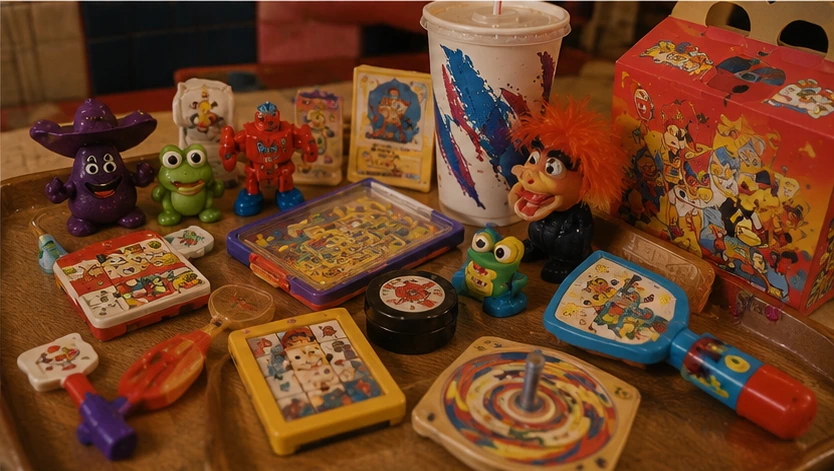
Restaurants could not secure a major movie license every month, but the kids-meal system still needed fresh prizes. That created space for house-brand games, generic animals, sports items, puzzles, tops, stamps, puppets and objects that existed only because the calendar had an empty square.
These promotions rarely became national crazes. They became personal memories attached to one visit, one restaurant and one strange piece of plastic.
Character cups, molded drink containers and reusable buckets blurred the line between packaging and premium. Families kept them because they had practical use, which meant the promotion remained visible in the kitchen for years.
A cup might outlast the toy line because it continued holding juice long after anyone remembered the movie release.
Finger puppets, hand puppets, masks, clips and bracelets turned the child into part of the promotion. These items offered more interaction than a static figure, even when the materials were simple.
Wearable toys also advertised themselves outside the restaurant. A child carried the chain logo and character into school without being asked.
Some giveaways tried to occupy time rather than become characters. Sliding puzzles, mini board games, mazes and tabletop challenges made sense during a sit-down meal.
The problem was longevity. Small pieces vanished. Cardboard wore out. Instructions disappeared. Years later, the surviving object can look like evidence from a civilization with unclear customs.
Whistles, clickers, sound toys and other audio experiments probably seemed exciting during product development. In a minivan, they became proof that adults had not been consulted.
The noise sometimes guaranteed the toy would be remembered, confiscated or quietly disappear after bedtime.
The weird promotions give the decade texture. Famous licenses tell the big story. Anonymous cups, puppets and plastic gadgets tell the ordinary one.
These are often the toys that trigger the strongest social nostalgia because identification requires group effort. One person posts a photo, ten people say they had it and nobody remembers what it was called.
The memory: finding an object in a drawer that clearly came from a restaurant, clearly did something and now appears to belong to no known franchise.
Why it mattered: the strange giveaways prove that fast-food toy culture was bigger than blockbuster licenses and far weirder than the polished nostalgia lists suggest.
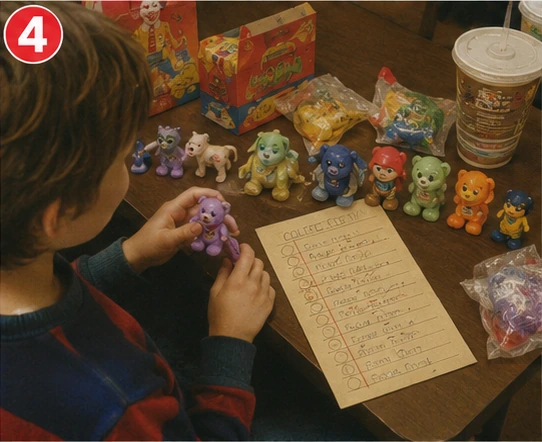
Four Toys. Five Meals. Six Duplicates.
Fast-food promotions were built around incomplete ownership. One toy could be fun, but the full set looked like accomplishment. The display in the restaurant showed every character together, silently informing children that their current collection was inadequate.
The sequence created uncertainty. Restaurants did not always receive every toy at once. Different locations could be on different boxes. Employees might know what was available or might hand over whichever item sat nearest the register. A family could visit twice in one week and receive the same character both times.
Duplicates were not useless. They became trade material at school, between siblings and among cousins. A child with three copies of one sidekick could negotiate for the hero that vanished from every restaurant in town.
Parents sometimes asked to purchase the toy separately or requested a specific character. Results depended on location, stock and the mood of the person working the counter during dinner rush. Childhood collecting became customer-service roulette.
Screen, Counter, Toy Box
By the 90s, fast-food promotions became one of the most visible stops in the entertainment-release machine. A movie did not simply open. It occupied restaurants.
Windows, counter displays, tray liners, bags and cups carried character art. Commercials combined food footage with movie clips. A family could encounter the promotion before seeing the film, then return after the movie to continue collecting.
The toy gave studios a physical reminder inside the home. A figure remained on a dresser after the advertising campaign ended. It kept the characters visible during the gap between theater release and home video.
The larger 90s movie and cartoon toy pipeline covers what happened in toy stores. Fast-food promotions were the small, mass-distributed end of the same machine.
Main toy lines focused on heroes, vehicles and expensive playsets. Kids-meal promotions could use sidekicks, background characters and comic-relief figures that might never receive a full retail product.
That gave restaurant sets charm. A collection could feel broader than the toy-store line because it included the odd characters. For animated movies especially, the entire cast could become a sequence of small figures.
The format rewarded ensemble movies. Disney animation, Space Jam, Pokémon and Toy Story all offered enough recognizable characters to turn one promotion into a multi-week mission.
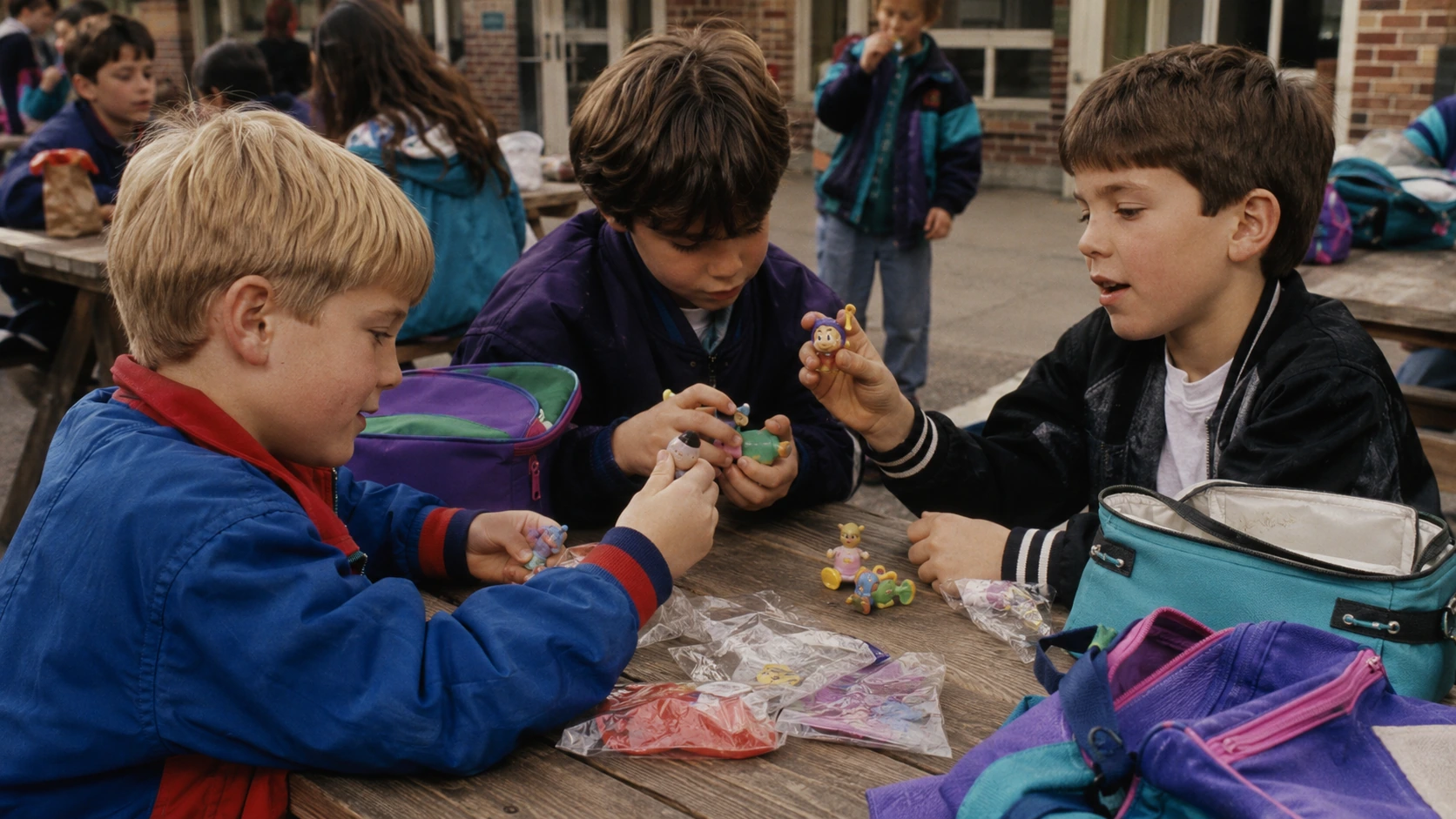
Lunch Became Advertising
A kids-meal toy rarely stayed in the restaurant. It clipped to a backpack, entered a pencil box, appeared at show-and-tell or arrived at the lunch table the next morning. Every child who brought one to school became an unpaid product demonstrator.
Sets created trading. Duplicates moved between friends. A child who had not visited the restaurant could see the toy, learn the promotion and begin lobbying for dinner plans before the final bell.
Small size helped. Restaurant toys fit naturally into the same pockets as Pogs, cards, digital pets and Crazy Bones. The 90s schoolyard toy economy did not care whether the object came from Toys “R” Us or a bag of fries. It cared whether other kids wanted it.
The Monday-Morning Reveal
One child brought the hero. Another had the villain. Someone else had a vehicle or a color variation nobody had seen. The comparison created the collection in public.
This was especially effective when commercials showed the entire set together. Kids already knew what was missing. School simply revealed which families had found which pieces.
The toy’s low cost also made trading feel less dangerous than exchanging an expensive action figure. That did not prevent arguments. Childhood can build a property dispute around anything with eyes and moving arms.
The Adults Were Driving, Paying and Negotiating
Fast-food toy collecting looked inexpensive from a distance. Then a child wanted the complete set, the nearest location had duplicates and the family schedule became a regional inventory search.
Parents learned to ask which toy was available before ordering. This sounded simple until the employee had to search three boxes during a dinner rush.
Two children receiving different toys could trade peacefully or begin a conflict that outlasted the meal. Receiving identical toys could somehow cause the same conflict.
A grandparent, aunt or coworker became a supply-chain partner. The hunt expanded across neighborhoods because one restaurant allegedly had the missing character.
Even children eventually tired of the meal before tiring of the toys. Parents became deeply familiar with the phrase “Can we just get the toy?”
Small toys multiplied. They filled drawers, cups, boxes and the floor beneath car seats. Sets stayed organized for approximately fourteen minutes.
Some adults crossed from helper to participant, especially during Teenie Beanie Babies and other scarcity-driven promotions. The child was no longer the most intense person in the car.
The Bag Was Part of the Promotion
Kids-meal packaging carried puzzles, character art, instructions and scenes that extended the promotion. A plain toy in a themed box felt more important because the entire meal had been transformed.
Some children cut panels from boxes, saved bags or used the packaging as a backdrop for the figures. Adults saw trash. Kids saw the rest of the set.
The packaging also explained unfamiliar characters and demonstrated play features. Before online videos and product pages, the bag often served as instruction manual, checklist and advertisement.
The Other Collectibles
Not every promotion centered on a toy. Character cups, Halloween buckets, molded containers and drink toppers gave restaurants larger objects with practical excuses.
These pieces often survived longer because families reused them. A cup remained in the cabinet. A bucket held crayons or Halloween candy. A container entered the toy box and became part of another game.
That reuse attached the promotion to daily life. The restaurant branding faded into the background while the object stayed in circulation for years.
Before the Toy Reached the Toy Box
The toy was only one object, but the promotion occupied the entire visit—from the commercial that started the begging to the car ride where the package was torn open before anyone found a napkin.
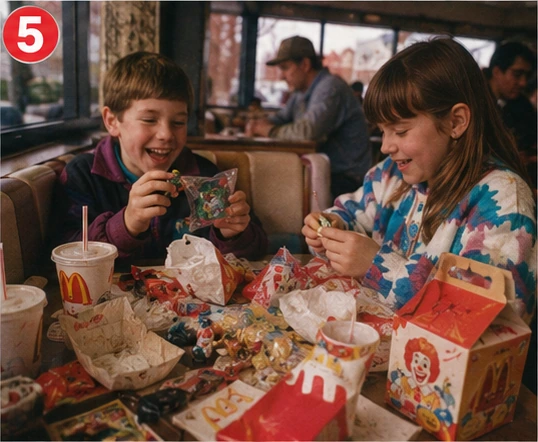
A voice announced a limited-time set while every toy moved perfectly under studio lighting. Kids memorized the characters before seeing the display in person.
Restaurants used hanging signs, cardboard standees and giant character art to make the promotion visible from the parking lot. The building itself confirmed that the toy was real and available now.
The child tried to identify the current figure without appearing desperate. The parent asked whether another character was available. The employee looked toward a box behind the counter and held the fate of the collection.
The food could wait. The bag was searched immediately. A familiar shape meant victory, disappointment or the fifth duplicate of a character nobody had requested.
Moving pieces were tested on the table. Wheels rolled through spilled salt. Stickers were applied badly. Tiny accessories disappeared beneath the seat before the meal ended.
Some toys survived the restaurant unopened but rarely survived the ride home. Plastic bags crinkled in the back seat while parents asked everyone to stop dropping pieces between the seats.
The next day, the toy entered school and became advertising. Other kids learned which chain had it, which character existed and which piece seemed hardest to find.
The promotion ended, but the toy joined action figures, cars, dolls and random parts from unrelated brands. Fast-food toys rarely respected franchise boundaries once play began.
Years later, one scratched figure emerged from a drawer and produced an instant memory more powerful than the expensive toys stored beside it.
Ten Years at the Counter
This is a cultural snapshot rather than an exhaustive national inventory. Promotions varied by chain, region and restaurant stock, but each year shows where the kids-meal toy machine was heading.
McDonald’s Changeables carried late-80s transforming-toy logic into the new decade, while McDonaldland figures kept the chain’s own characters visible. The toy still felt closely tied to the restaurant instead of acting only as an advertisement for a movie.
The early-90s prize was often mechanical and obvious. A toy rolled, transformed, opened or spun. The action had to make sense before the family left the table.
McDonald’s used transforming dinosaurs and small cars while also proving that a giveaway did not have to be plastic. Its 1991 “Let’s Get Growing America” event distributed millions of tree seedlings, creating one of the decade’s strangest and most memorable restaurant take-homes.
The year showed the wide range of the category: toy vehicles, transforming boxes and a living plant could all travel home from the same restaurant system.
By 1992, film tie-ins and character promotions were becoming more central to the kids-meal experience. Restaurants offered a lower-cost piece of the same screen culture filling toy stores, cereal boxes and television commercials.
The decade’s promotional system was learning that the meal did not need to invent desire. A movie had already done that work.
Hot Wheels and character promotions fit the year’s mix of vehicles, superheroes and cartoon energy. Other chains experimented with puppets, stamps, puzzles and toys that now feel like artifacts from a forgotten children’s television block.
The restaurant calendar was becoming faster and more licensed. A promotion needed to arrive with the movie, show or retail craze—not six months later.
Disney’s animated momentum and the broader cartoon-toy boom made ensemble promotions especially effective. A movie with five memorable characters could produce five meal visits without inventing any additional reason to return.
The set became a miniature cast rather than a group of unrelated prizes. Kids could recreate scenes on the table while the full retail line remained waiting at the toy store.
Toy Story made the merchandising loop almost comically perfect: the movie characters were toys, the toy-store versions were characters and the kids-meal versions made the promotion accessible almost anywhere.
Power Rangers, Disney animation and other movie properties also showed how quickly screen hits could spread across food packaging, toy aisles and school conversation.
Space Jam captured the full 90s mixture of animation, sports celebrity, music, merchandise and fast food. The promotion did not feel like a side campaign. It felt like part of the movie’s environment.
The best kids-meal toys now benefited from cultural volume. A child encountered the same characters in theaters, commercials, stores, restaurants and school supplies.
The Teenie Beanie promotion pulled adult collecting behavior into the kids-meal system. Scarcity rumors and resale dreams made restaurant inventory feel like market information.
The toy still came with lunch, but the promotion behaved like a national collectible launch. Parents called locations, tracked characters and sometimes protected unopened bags from the children supposedly receiving them.
Tamagotchi-themed Happy Meal toys and other late-90s promotions borrowed the recognizable forms of major toy crazes. The restaurant version did not always need the full technology. The silhouette alone connected kids to the trend.
My Little Pony, movie characters and miniature licensed items showed that the category could shift between nostalgia, current crazes and entertainment releases without slowing down.
Pokémon and Furby arrived with enormous recognition already built through games, television, cards, retail shortages and news coverage. Fast-food promotions became another portal into toy worlds that never stopped expanding.
By the end of the decade, a restaurant toy could be electronic, collectible, linked to a movie, connected to a game and discussed at school the next morning. The modern franchise ecosystem was already here.
Not Everything Was a Figure
The category stretched far beyond molded characters. A kids-meal premium could be a car, puppet, puzzle, spinner, mini game, whistle, keychain, book, cassette, cup, bucket, ornament, inflatable ball, wearable item or sheet of stickers.
That flexibility kept the promotions fresh. A restaurant could support a movie without producing eight nearly identical figures. One character might become a vehicle, another a stamp and another a clip.
The best premiums matched the property. A car brand needed something that rolled. A monster property benefited from a creature feature. A musical movie could support a noisemaker that parents regretted before leaving the parking lot.
Why They Looked Different From Store Toys
Fast-food toys had to be compact, inexpensive to manufacture, quick to package and simple enough for huge distribution. They usually used fewer parts and less detail than retail versions.
That limitation created a recognizable design language: bright plastic, exaggerated shapes, obvious action features and character poses that could survive a bag, tray and car floor.
The toys were not necessarily failed retail products. They served a different purpose. A store figure asked for a purchase decision. A meal toy had to create delight inside an existing transaction and advertise the next visit.
From Restaurant Mascots to Franchise Universes
The decade began with house characters, transforming toys and simple play value. It ended with global entertainment systems, collector pressure and electronics.
Changeables, McDonaldland characters, vehicles, puzzles and simple branded toys carried much of the early-decade energy. Outside licenses mattered, but the restaurant’s own identity remained strong.
The objects were often built around one obvious action: transform, roll, spin, stamp or assemble. Kids understood them before leaving the parking lot.
Animated movies, superheroes and family releases increasingly occupied kids-meal calendars. Restaurants became temporary extensions of theaters and toy aisles.
The set format became more important because casts offered heroes, villains and sidekicks. Completing the group became part of the experience.
Space Jam connected movies, basketball and music. Teenie Beanie Babies brought scarcity and adult collecting into the drive-thru. The promotion itself could become national news.
The toys were no longer merely extras. They could be the main reason for the visit and the part everyone discussed afterward.
Tamagotchi, Furby, Pokémon and Toy Story represented toy worlds that crossed screens, games, retail and restaurants. A kids-meal promotion became one node in a much larger system.
By the end of the decade, the toy often arrived with existing fandom, rarity language and a complete marketing ecosystem already in motion.
The Toy Looked Better on Television
The advertisement rarely sold only the meal. It sold a perfect family visit, a complete set and toys that moved with the confidence of professional stunt performers.
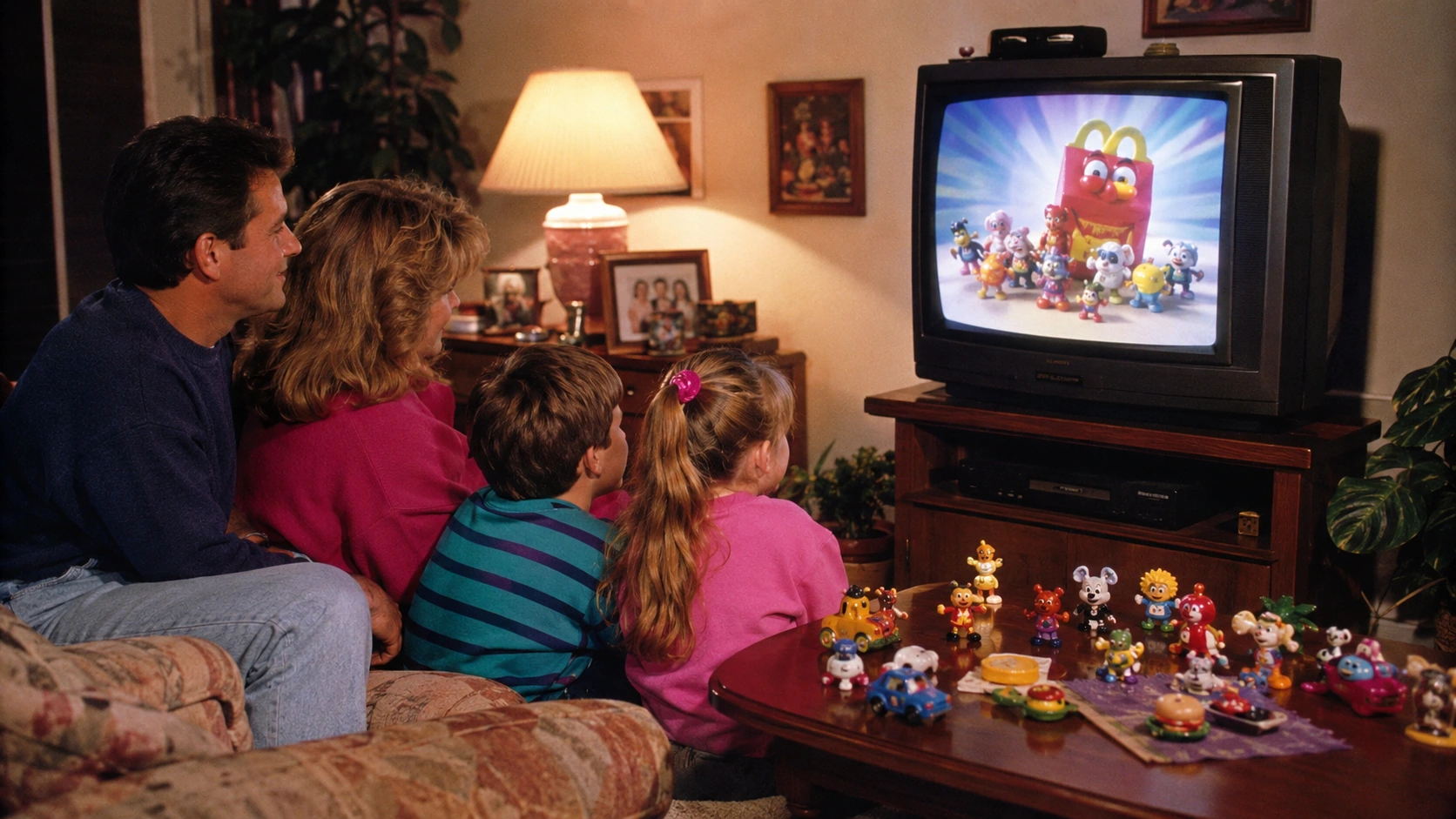
Commercials showed every character lined up together, even though an actual visit delivered one random piece. That visual planted the completion goal before the child owned anything.
The display made a single toy feel incomplete by design. The advertisement had already shown what the collection should look like.
Cars rolled straight, transforming toys snapped cleanly and electronic pieces responded instantly. No toy became stuck, tipped over or required an adult to examine the tiny instruction panel.
Professional lighting also gave cheap plastic a premium glow that disappeared somewhere between the counter and the sticky table.
The kids in commercials celebrated without fighting over characters, dropping accessories or discovering a duplicate. Their parents smiled as though visiting three locations for one missing toy sounded delightful.
Actual families introduced more negotiation, ketchup and fatigue.
Promotions emphasized urgency because food itself was always available. The toy created the deadline. Wait too long and the set vanished.
Children heard “while supplies last” as a direct challenge to family scheduling.
Licensed ads could combine clips from a theatrical release with shots of the toys. The emotional energy of the movie transferred directly to the meal.
The commercial made the restaurant feel like part of the film campaign rather than a separate advertiser.
Music and repeated taglines embedded promotions in memory. Many adults can recall the rhythm of an ad more clearly than the exact action feature of the toy.
The 90s Toy Commercials & Videos page preserves the broader world where every product looked life-changing for thirty seconds.
Designed to Survive a Bag of Fries
Promotional toys had to balance cost, safety, character recognition, packaging size and immediate play. That pressure created a design language all its own.
The simplest format used a recognizable pose and bright colors. It worked best for animated characters whose silhouette carried the identity.
Wheels created instant movement and long-term compatibility with existing toy cars. The vehicle format also worked for characters who had no obvious action feature.
Hinges and folding parts created a reveal without electronics. These toys felt more substantial because the child had to manipulate them.
Portable designs turned backpacks into display space. The toy advertised the promotion at school and reduced the chance it would remain forgotten at home.
Small plush toys felt softer and more gift-like than molded plastic. They also encouraged collecting through names, characters and perceived rarity.
Puzzles, sliders, launchers and tabletop challenges used the restaurant table as part of play, though missing pieces often shortened their lives.
Lights and sounds signaled technological progress but introduced battery problems, extra cost and the possibility of instant parent regret.
Reusable objects justified their size through function. Families kept them longer because they remained useful after the promotion.
Characters connected, formed scenes or combined into a larger display. Completion pressure was built directly into the physical design.
Birthday Parties, Mall Stops and Saturday Errands
Fast-food toys were attached to places: the restaurant near the mall, the drive-thru after practice, the booth used for birthday parties and the highway exit where the family always stopped during road trips.
A promotion could reshape those routines. The family that usually chose one chain suddenly drove across town because another had Disney figures. A routine mall trip gained a second objective. A road-trip stop became a chance to check regional inventory.
Birthday parties intensified the toy experience because several children opened the same promotion at once. Characters were compared immediately. Trades began before cake. The restaurant became a temporary distribution event.
Play areas added another layer. The toy arrived in a building already designed to feel like entertainment. Slides, ball pits and themed décor made the meal feel less like eating and more like visiting a low-budget amusement park.
The Back-Seat Economy
Road trips gave kids-meal toys an immediate job: reduce boredom between exits. A new car, puzzle or figure could occupy part of the drive while the packaging accumulated on the floor.
Regional differences created surprise. A restaurant in another town might still have last week’s toy or already carry the next one. Vacation accidentally became inventory research.
The car also became the first place toys were lost. Small accessories fell between seats. Plastic bags became crumpled storage. Years later, cleaning the vehicle could reveal a forgotten character from a promotion nobody remembered completing.
The Display Lied. The Box Was Empty.
Fast-food toy history is difficult to reconstruct perfectly because promotions did not always appear identically at every location. Family memory is shaped by local inventory as much as national advertising.
One location might have three boxes of the same character while another had already moved to the next figure. The national commercial promised a set; the local stock created the actual experience.
Some promotions distributed toys in waves. A restaurant could begin with one group, switch mid-campaign or mix remaining stock when supplies ran low.
Franchise locations, regional markets and international restaurants could use different schedules or products. A childhood memory from one city may not match a checklist built from another.
When a new promotion ran short, restaurants sometimes reached for leftover items. A child expecting the current movie character could receive a mystery toy from several months earlier.
Some locations allowed specific requests. Others handed out the next item in the box. Some sold toys separately. Others refused. The policy could change by manager or dinner rush.
Adults often remember toys in clusters rather than exact release order. A figure may be associated with the year the movie reached home video instead of the restaurant campaign.
The practical rule: treat year lists as documented cultural guides, not proof that every restaurant carried every toy nationwide on the same date.
Millions of Tiny Products, Millions of Chances for Trouble
Kids-meal toys moved at enormous scale, often into homes with very young children. That made size, detachable pieces, cords, batteries and packaging serious concerns.
Most promotions passed without a major problem, but high-volume distribution meant one design issue could affect millions of units. The late-90s Pokémon recall became the most visible example of the responsibility attached to promotional products.
Safety concerns also changed toy design. Larger shapes, vent holes, softer materials and fewer detachable pieces reflected the need to create something inexpensive without creating an obvious hazard.
Parents performed their own risk assessment, often by removing packaging, checking small parts and deciding whether the toy belonged with the child who received it or an older sibling.
The Packaging Problem
Plastic wrappers protected the premium and kept food separate, but packaging introduced its own hazards. Warnings appeared because the toy entered households with children across a wide age range.
Collectors later preserved sealed bags as proof of originality, creating an odd reversal: packaging designed for immediate disposal became part of the item’s value.
The safety story is not the nostalgic part, but it belongs in the history. These were not imaginary trinkets. They were real consumer products distributed through one of the largest family retail systems in the country.
After the Promotion Ended
The campaign disappeared from television, but the plastic remained in homes for years. Most toys entered one of several predictable afterlives.
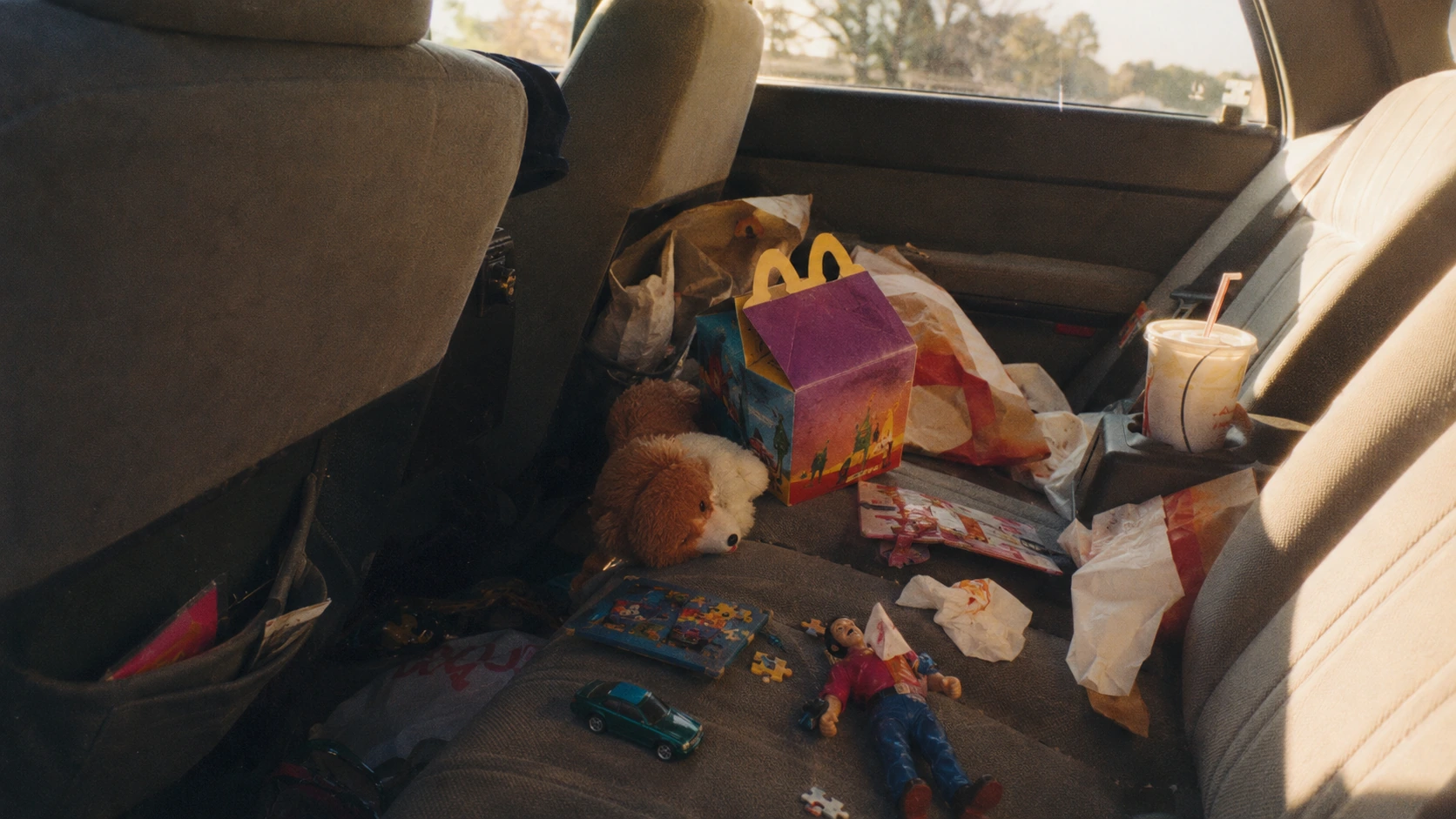
Figures and cars joined retail toys without ceremony. Brand, scale and movie continuity stopped mattering once the battle began.
Small toys vanished beneath seats and returned during cleaning with dust, fries and no remaining accessories.
Odd gadgets, keychains and incomplete games lived beside batteries, coupons and mystery keys.
Promotional toys moved down through the family because they were small, durable and not considered important enough to protect.
Entire collections left the house in plastic bags for almost nothing, which is why finding a complete set later feels miraculous.
A few promotions were saved intentionally, especially plush sets, major movie casts and unopened items tied to larger crazes.
Fast-food toys circulated through classrooms, churches, waiting rooms and charity shops, extending their lives far beyond the original meal.
One sealed bag can trigger a search spiral, a pricing reality check and a sudden urge to complete the set thirty years late.
Many toys broke, lost pieces or simply disappeared. Nostalgia remembers the survivors and politely ignores the millions that met ordinary plastic endings.
Before You Finance Retirement With a Plastic Sidekick
Nostalgia makes these toys emotionally valuable. Financial value is a different question and depends on condition, completeness, demand and actual sold results—not optimistic listings written by someone who found a bag in an attic.
A complete promotional run is usually easier to understand and display than one loose common figure. Original bags, checklists or packaging can add context.
Paint wear, missing pieces, dead electronics, damaged tags and sticky residue all matter. “Played with in a minivan” is a condition category even if collectors do not print it on labels.
Many toys were produced in huge numbers. A rumor that one character was rare does not automatically make it valuable decades later.
An unopened bag can be desirable, but the toy inside may still have aging plastic, battery damage or manufacturing issues.
Asking prices show what sellers hope to receive. Completed sales show what buyers actually paid. Those are not the same universe.
The most satisfying collection may be the set you remember, not the set somebody online calls an investment. Nostalgia does not require a spreadsheet.
Keep the Drive-Thru Rewind Going
Because Memory Gets Fuzzy After Thirty Years
The restaurant memories are ours. The dated details were checked against McDonald’s official Happy Meal toy history, its account of the wonderfully strange 1991 tree-seedling giveaway, and the U.S. Consumer Product Safety Commission’s Pokémon Ball recall notice. Restaurant schedules still varied by location, shipment and region—because even history cannot make the drive-thru inventory system behave.
Frequently Ordered Questions
Changeables, McDonaldland characters, Hot Wheels, Space Jam toys, Teenie Beanie Babies, Tamagotchi and Furby promotions are among the most remembered McDonald’s Happy Meal toys from the decade.
Teenie Beanie Babies were smaller promotional versions of Ty’s plush collectibles distributed through McDonald’s in 1997. Their release collided with the larger Beanie Baby craze and became one of the decade’s biggest kids-meal collecting events.
Yes. Burger King’s Kids Club meals featured restaurant characters, Disney and movie promotions, Toy Story items, Pokémon collectibles and other licensed giveaways throughout the decade.
Yes. Taco Bell ran kids-meal and promotional giveaways that included puzzles, puppets, movie items, character toys, cups and unusual novelty products, although the program never reached the consistency or scale of McDonald’s Happy Meals.
Promotions used multiple characters, short availability windows and movie or toy licenses that children already recognized. Completing a set usually required repeat visits, trades or help from relatives checking other locations.
McDonald’s offered Teenie Beanie Babies in 1997. The small plush toys arrived during peak Beanie Baby enthusiasm and became a major collecting rush for both children and adults.
McDonald’s included Tamagotchi-themed toys in 1998, when digital pets were a major toy trend. The promotion used the recognizable egg-shaped design and keychain look of the electronic pets.
Yes. McDonald’s ran a Furby promotion in 1999. The company later described Furby as its first electronic Happy Meal toy.
Burger King ran a major Pokémon promotion in 1999 during the franchise’s explosive rise across games, television, cards and movies.
Some complete sets, sealed items and high-demand promotions can attract collectors, but most common loose toys were produced in large numbers. Value should be judged from condition and completed sales rather than online asking prices.
Movie characters gave restaurants instant recognition and enough heroes, villains and sidekicks to build collectible sets. Studios gained mass exposure while restaurants gained repeat family visits.
The 90s Toys page connects the decade’s annual rankings, major toy categories and individual craze stories.
The best-known 1997 McDonald’s promotion was Teenie Beanie Babies, which arrived during peak Beanie Baby collecting. Exact restaurant schedules and available characters could vary.
McDonald’s offered Tamagotchi-themed toys and My Little Pony items among its remembered 1998 promotions, while other chains continued movie and cartoon tie-ins.
Furby was a major McDonald’s Happy Meal promotion in 1999, while Burger King’s Pokémon campaign became one of the year’s defining fast-food toy events.
Yes. Availability could vary by country, region, participating restaurant, shipment timing and the order in which toys were distributed. One location could move to the next toy before another.
Policies varied by chain, location, promotion and inventory. Some restaurants sold toys separately, while others required the meal or limited separate purchases during high-demand promotions.
Locations could receive different shipments, distribute toys in different sequences, run out at different speeds or use leftover stock. Regional and franchise differences also affected availability.
Promotions could overlap years, vary by location and remain in circulation after the official campaign. People may also associate a toy with a movie’s VHS release, school year or family trip rather than the national start date.
Chains distributed cars, puppets, cups, buckets, keychains, puzzles, books, stickers, mini games, electronic toys, inflatables, wearables and activity items.
They had to be inexpensive, compact, safe, quick to package and manufacturable in very large quantities. Designers relied on bright colors, recognizable shapes and one clear play feature.
Most entered toy bins, junk drawers, car floors, donation boxes and yard sales. A smaller number were kept as complete sets or preserved unopened by collectors.
The Toy Was Open Before the Ketchup Packet
Most 90s fast-food toys were not designed to become artifacts. They were supposed to entertain a child, advertise a movie and survive long enough to justify another family visit. Somehow, decades later, one tiny figure can bring back the booth, the paper bag, the car ride and the exact feeling of checking which character you got.
That is why these giveaways matter. They sat at the intersection of food, movies, cartoons, collecting and family routine. They were cheap plastic, but they arrived wrapped in an entire afternoon.