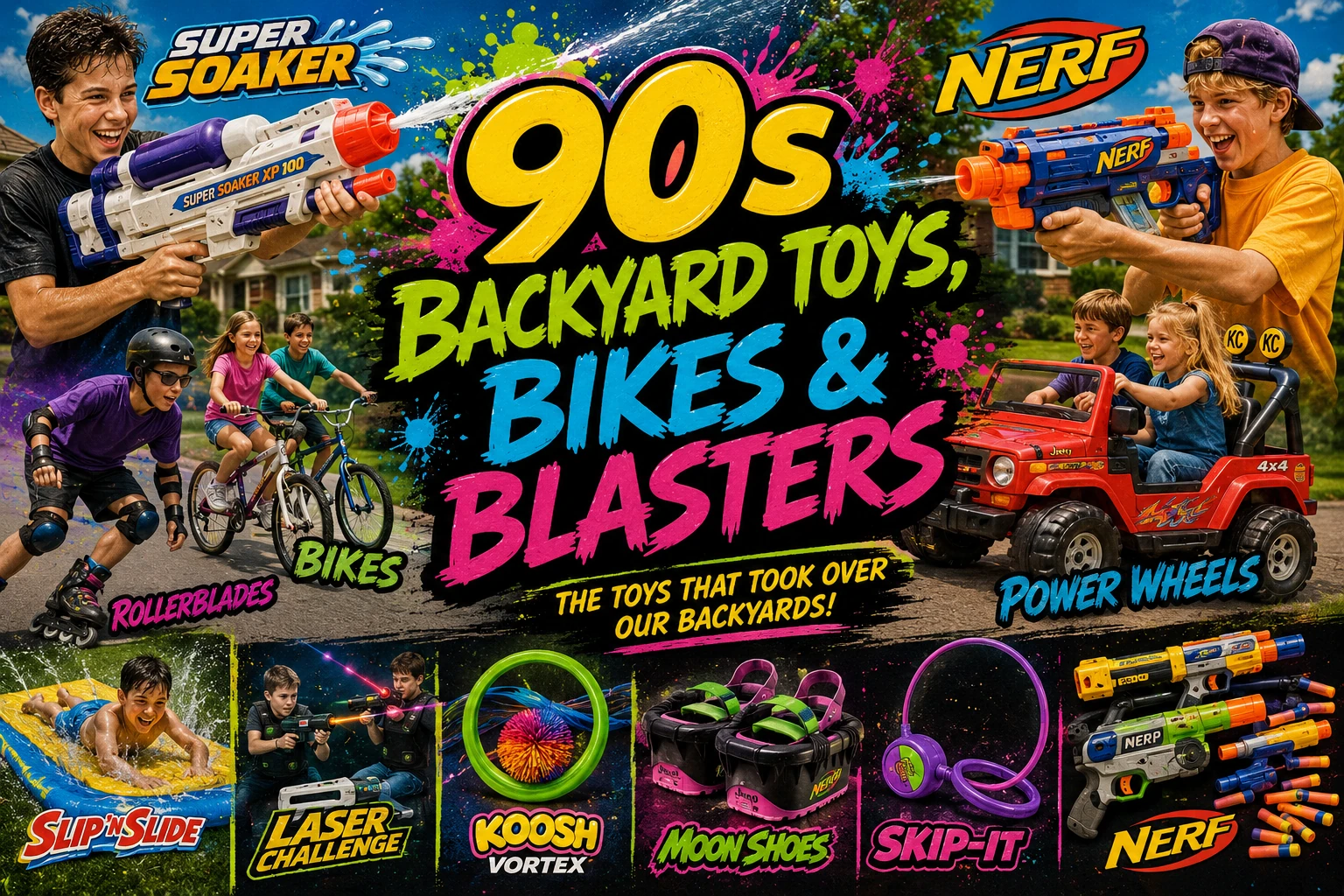
90s Backyard Toys, Bikes & Blasters: The Cul-De-Sac Went Full Chaos
The 90s did not need a loading screen to start a multiplayer game. It needed a driveway, a sprinkler, a few bikes dumped on the grass, a Super Soaker someone had over-pumped, a Nerf football stuck on the roof, rollerblades that smelled like hot pavement, and at least one kid yelling “time out” only after getting completely soaked.
This is the rewind for 90s backyard toys, bikes, blasters, and outdoor fads: Super Soaker, Nerf, Koosh Vortex, rollerblades, bikes, Power Wheels, Skip-It, Moon Shoes, Laser Challenge, Slip ’N Slide, sidewalk chalk, backyard sports gear, and the outdoor toy culture that turned cul-de-sacs, lawns, garages, and sidewalks into kid-run territory until the streetlights came on.
90s Toys
Head back to the full 90s Toys hub for action figures, collectibles, electronic pets, handheld games, dolls, plush, board games, commercials, and the rest of the decade’s plastic chaos.
Indoor Backup PlanBoard Games & Family-Room Toys
Mall Madness, Dream Phone, Guess Who?, Don’t Wake Daddy, Grape Escape, Bop It, Jenga, Crocodile Dentist, and carpet-floor arguments.
Backseat & Bedroom ModeVideo Game Toys & Handhelds
Game Boy, Game Boy Color, Tiger LCD games, Game Gear, Nintendo 64, PlayStation, link cables, cartridges, rentals, and screen-based toy chaos.
So What Were the Big 90s Backyard Toys, Bikes, and Blasters?
The big 90s backyard toys and outdoor toys were the ones that made kids disappear outside for hours: Super Soaker, Nerf, Koosh Vortex, rollerblades and inline skates, bikes and BMX-style rides, Power Wheels, Skip-It, Moon Shoes, Laser Challenge, Slip ’N Slide, sidewalk chalk, pogo-style toys, backyard sports gear, foam rockets, water balloons, sprinklers, ramps, and anything that could turn a driveway into a competition.
What made this category different was movement. These toys were not meant to sit on a bedroom shelf. They needed space, weather, pavement, grass, garage storage, and the kind of kid confidence that ignored every warning printed on a box. Some were about speed. Some were about water. Some were about foam. Some were about pretending a suburban lawn was an arena. All of them made outside feel like the best part of the day.
90s outdoor toys also had their own social rules. You did not need everyone to own the same thing. One kid had the best Super Soaker. One kid had the ramp. One kid had the Power Wheels. One kid had the good basketball hoop. One kid’s garage had all the balls. The neighborhood was basically a shared inventory system with worse labeling.
Why the 90s Were Built for Backyard Toys
The 90s were perfect for backyard toys because kids still had unstructured outside time. You could walk out the front door and become unavailable. Not fully unreachable, because someone’s mom could still yell your name across three lawns, but close enough. The neighborhood itself was the play space: driveways, sidewalks, lawns, garages, cul-de-sacs, basketball hoops, sprinkler lines, and the stretch of street where everyone agreed cars were deeply inconvenient.
Outdoor toys worked because they turned open space into a game. A Super Soaker needed teams. A bike needed a route. Rollerblades needed smooth pavement and poor judgment. Nerf toys needed distance. Skip-It needed rhythm. Moon Shoes needed optimism. Power Wheels needed a driveway and an owner willing to let other kids take a turn, which was apparently a major character test.
This was also the decade where toy companies made outdoor play feel bigger, louder, and more extreme. Everything had neon colors, huge packaging, action words, pressure pumps, foam launches, wheels, springs, straps, or commercials showing kids doing things that real parents would immediately shut down in the driveway.
The 90s outdoor-toy formula
- Movement: bikes, skates, scooters, Skip-It, Moon Shoes, and anything that made kids move fast enough to regret it.
- Launch power: Nerf, Koosh Vortex, foam rockets, flying discs, and toys designed to go farther than expected.
- Water warfare: Super Soaker, water balloons, sprinklers, Slip ’N Slide, and the sacred summer rule of no dry clothing.
- Neighborhood status: having the best ride, biggest blaster, coolest hoop, or most dangerous ramp mattered.
- Garage storage: the garage was the armory, bike shop, sports closet, and lost-ball graveyard.
The result was a decade where outside play felt physical, social, and slightly unsupervised. You did not always need a plan. You needed a toy, a driveway, and one friend willing to yell, “Do it again.”
90s Backyard Toys, Bikes, and Blasters Timeline
A fast visual map of how outside got louder
The 90s outdoor-toy wave had a clear arc: Super Soaker changed water battles, bikes stayed the neighborhood freedom machine, Nerf and Koosh Vortex made foam and rubbery projectiles backyard staples, rollerblades turned sidewalks into speed zones, Skip-It and Moon Shoes kept movement toys weird, Power Wheels made driveways feel cinematic, Laser Challenge brought tag into the dark, and Slip ’N Slide/sprinkler culture kept summer simple.
Super Soaker changes summer
Water fights stop being squirt-gun drizzle and become pressure-pumped driveway warfare.
Bikes stay the main transport
Huffy, Mongoose, GT, Dyno, hand-me-down rides, pegs, ramps, and driveway routes rule the block.
Nerf becomes outdoor equipment
Foam footballs, darts, rockets, and blasters make lawns safer but not quieter.
Rollerblades hit the sidewalk
Inline skates make every driveway feel athletic and every stop sign feel optimistic.
Koosh Vortex gets launched
A football-shaped rocket with a tail makes every throw look cooler than your arm deserved.
Skip-It and Moon Shoes keep it weird
Kids count spins, bounce badly, and turn coordination into a public performance.
Power Wheels stay aspirational
Battery-powered kid cars turn the driveway into the slowest flex on the block.
Laser Challenge makes tag glow
Backyard tag gets sensors, lights, plastic gear, and late-90s futuristic swagger.
Sprinklers, Slip ’N Slide, and sidewalk chalk hang on
Even at the edge of Y2K, basic summer toys still own the lawn.
The 90s Backyard Toys, Bikes, and Blasters We Actually Remember
Water pressure, foam launches, driveway freedom, and questionable knee protection
These toys were not all from the same aisle, and that is exactly why the 90s outdoor setup worked. A backyard day could start with a water fight, turn into bike races, shift into Nerf football, pause for a popsicle, become sidewalk chalk, and end with everyone trying to squeeze in one more round of tag before the adults started yelling from porches.
The common thread was space. These toys needed outside. They needed room to run, throw, coast, skid, splash, bounce, and wipe out dramatically in front of friends. They turned ordinary suburban surfaces into play zones: grass was a field, pavement was a track, the driveway was a launch pad, and the garage was the inventory screen.
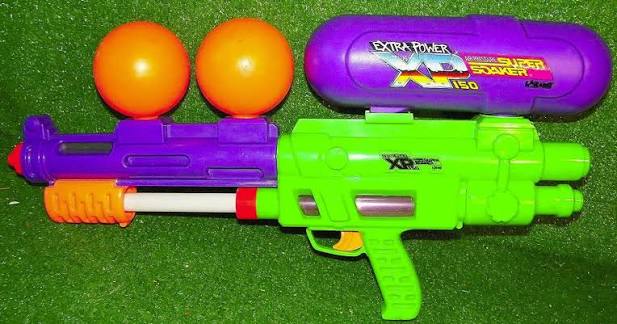
Super Soaker: The Water Blaster That Changed Summer Rules
Super Soaker did not feel like a normal water toy. It felt like a technology upgrade. Before it, a lot of water fights involved sad little squirt pistols that worked for about twelve seconds and had the range of a sneeze. Then Super Soaker showed up with pressure pumping, big tanks, loud colors, and the ability to soak someone from far enough away to feel unfair.
The pump was half the experience. You filled the tank, screwed it shut, pumped until your arm started questioning the mission, then waited for the perfect shot. The toy had anticipation built into it. A kid walking across the lawn with a fully pressurized Super Soaker was not just holding a toy. They were carrying neighborhood leverage.
Why it changed the backyard
Super Soaker made water fights more strategic. Range mattered. Refilling mattered. Tank size mattered. Who had the bigger model mattered. Kids formed teams, guarded hoses, ambushed from behind cars, and treated front yards like tactical maps even though everyone was wearing swim trunks and eating Fla-Vor-Ice.
It also created an arms race. One kid got a bigger Super Soaker, then everyone else suddenly needed an upgrade. Smaller water toys were still fun, but once the big blasters entered the neighborhood, there was no going back. The kid with the best one had temporary social power until they ran out of water and got swarmed.
The commercial made summer look like an action movie
The ads understood the fantasy: kids running, diving, blasting, laughing, and absolutely not getting yelled at for soaking the patio furniture. The toy looked powerful, bright, and active. It did not sell a quiet afternoon. It sold summer chaos with a handle.
In real life, the battles were messier. Someone cried foul. Someone used the hose directly, which was cheating unless you were the one doing it. Someone got hit in the face. Someone’s mom said not near the screen door. These are the details that make it 90s.
- Core appeal: water power, range, pumping, bright designs, team battles, and summer status.
- Kid behavior: guarding the refill spot, over-pumping, ambushing siblings, and claiming headshots did not count.
- Most 90s detail: treating a plastic water blaster like serious tactical equipment while barefoot on hot pavement.
Super Soaker mattered because it made outdoor water play feel bigger, more competitive, and more cinematic. It was the rare toy that actually changed the rules of a classic childhood activity.
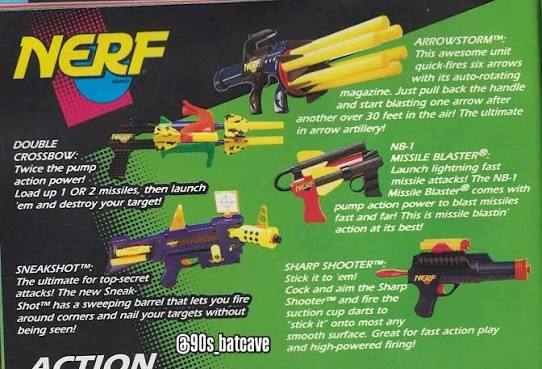
Nerf in the 90s: Foam Footballs, Blasters, Rockets, and Indoor-Outdoor Permission
Nerf was the great compromise. Kids wanted to throw things. Parents did not want lamps destroyed. Foam solved enough of that problem to let chaos continue under a safer brand name. In the 90s, Nerf covered foam footballs, basketball sets, rockets, dart toys, blasters, and anything that could be launched across a room with plausible deniability.
Nerf toys lived between indoor and outdoor play. They could be used in the yard, driveway, hallway, bedroom, basement, or family room until someone crossed a line. That flexibility mattered. When the weather was good, the toy went outside. When it rained, it became a house hazard with branding.
Why foam worked
Foam changed the social contract of play. A hard ball meant you needed space and caution. A foam ball meant “it’s fine” right up until it was not. Nerf gave kids permission to throw harder, aim worse, and invent games in places where traditional sports gear would have been banned.
It also made every kid feel more athletic than they were. Spiral footballs, rockets, and foam launches traveled in satisfying ways. A good throw looked great. A bad throw still usually bounced harmlessly off something, unless that something was someone’s face.
Nerf as backyard equipment
In the backyard, Nerf became casual competition. You did not need full teams or official rules. You needed two or three kids, an object to throw, and an argument about boundaries. Touch football, target practice, catch, trick shots, and improvised games all worked because Nerf was forgiving.
The 90s version of outdoor play often lived in these half-games. Not organized sports, not complete chaos, but something in between. Nerf fit that perfectly. It was structured enough to feel like a toy line and loose enough to become whatever the group needed that afternoon.
- Core appeal: foam safety, throwing, launching, bright colors, backyard games, and indoor permission.
- Kid behavior: making up rules, aiming at siblings, losing darts, throwing over fences, and blaming the wind.
- Most 90s detail: a foam football getting stuck on the roof and becoming neighborhood history.
Nerf mattered because it made action play portable. It could be sport, blaster play, target practice, or living-room trouble depending on where the adults were standing.
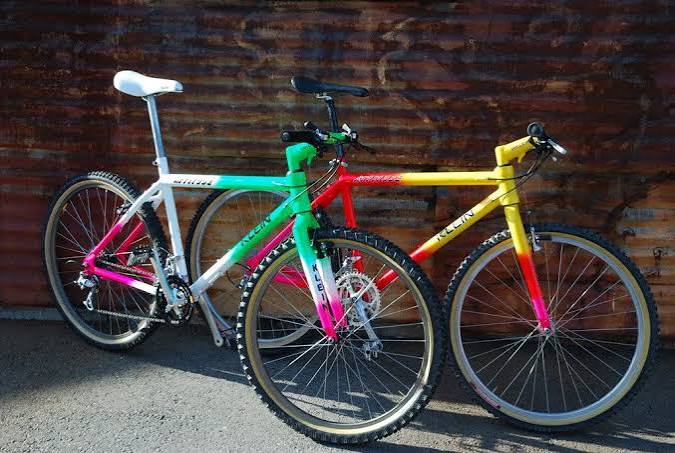
90s Bikes: Huffy, Mongoose, GT, Dyno, Hand-Me-Downs, and the Freedom Machine
90s bikes were not just toys. They were freedom with handlebars. Whether it was a shiny new Huffy, a Mongoose, a GT, a Dyno, a BMX-style ride, a mountain bike, or a hand-me-down with questionable brakes, the bike was how kids moved through the neighborhood without needing a ride, a plan, or permission beyond “stay where I can find you.”
Bikes turned the neighborhood into a map. Certain houses were stops. Certain driveways had better ramps. Certain streets were faster. Certain hills were legendary. Certain corners were where everyone gathered before deciding what the day was going to become. You did not text anyone. You rode past their house and looked for bikes in the yard.
Why bikes felt like status
The details mattered. Pegs mattered. Color mattered. Pads mattered. Tires mattered. Whether your bike looked fast mattered even if you mostly rode in circles. A good bike gave a kid presence. A bad bike still got you there, but it did not have the same driveway confidence.
Customization was part of the culture too. Stickers, handlebar grips, number plates, spoke beads, reflectors, kickstands, water bottles, and whatever had been bolted or taped on made each bike feel personal. Some bikes were clean. Some were absolute Frankenstein machines assembled from sibling leftovers and garage optimism.
The ramp and skid era
The 90s bike scene was full of improvised stunts. A board over a brick became a ramp. A driveway became a speed test. A patch of dirt became a track. A skid mark became evidence of skill. Kids learned physics through bad ideas and scraped elbows.
Helmets existed, but helmet culture varied wildly by house, neighborhood, and parental attention span. Knee pads were optional until they suddenly seemed like a good idea five seconds after you needed them.
- Core appeal: independence, speed, routes, status, ramps, pegs, and neighborhood mobility.
- Kid behavior: riding loops, checking friends’ driveways, building terrible ramps, skidding, and leaving bikes in the grass.
- Most 90s detail: knowing the whole neighborhood by driveway incline and sprinkler schedule.
Bikes mattered because they made the 90s neighborhood feel bigger. They were the bridge between toy and transportation, and for many kids, the first real taste of independence.
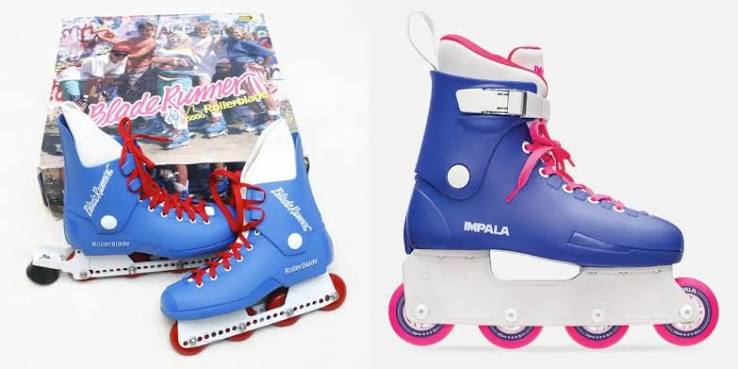
Rollerblades and Inline Skates: Sidewalk Speed With a Learning Curve Made of Pavement
Rollerblades made the sidewalk feel like a sport. Inline skates had a completely different energy from old-school roller skates. They looked faster. They felt more athletic. They came with the promise that any kid could glide through the neighborhood like a commercial, even if the first fifteen minutes involved gripping a mailbox for emotional support.
The appeal was speed. Bikes were faster overall, but rollerblades felt more personal. Your whole body was involved. Balance mattered. Stopping mattered. Turning mattered. Pavement quality mattered more than anyone realized until a tiny pebble tried to ruin your life.
Why they felt extreme
The 90s loved “extreme” everything. Inline skating fit the vibe: ramps, pads, aggressive graphics, street hockey, skate parks, sports drinks, and commercials where kids looked impossibly coordinated. Rollerblades made ordinary sidewalks feel like they belonged to a bigger, cooler world.
They also had gear culture. Wrist guards, knee pads, elbow pads, helmets, buckles, wheels, brakes, and bags all made inline skating feel more serious than just playing outside. Even putting them on felt like preparing for an event.
The driveway learning curve
Nobody forgets learning to stop. Rolling forward was easy. Stopping gracefully was where childhood confidence went to be tested. Some kids used the heel brake. Some grabbed fences. Some aimed for grass. Some just accepted impact as a stopping method.
That awkward phase is part of the nostalgia. Rollerblades promised sleek movement and delivered a mix of speed, fear, and scraped palms until you figured it out.
- Core appeal: speed, style, movement, ramps, street hockey, and extreme-sports energy.
- Kid behavior: learning to stop badly, racing friends, trying ramps too early, and wearing pads only after a lesson.
- Most 90s detail: believing you looked like an X Games athlete while wobbling past a minivan.
Rollerblades mattered because they turned outdoor play into motion culture. They made ordinary neighborhoods feel like training grounds for a cooler version of childhood.
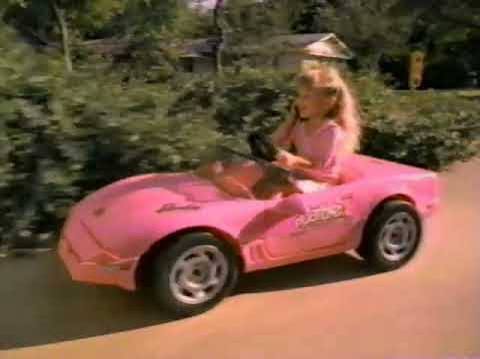
Power Wheels: Driveway Luxury for Kids Who Could Not Reach Pedals
Power Wheels were driveway royalty. Not every kid had one, which was part of the power. If a Power Wheels vehicle appeared in a neighborhood, it immediately became a magnet. Kids gathered. Turns were negotiated. Passenger rights were debated. Battery life became a crisis.
The toy worked because it gave kids the fantasy of driving before they could even ride a real bike properly. A steering wheel, a pedal, a little motor, a plastic body, and suddenly the driveway felt cinematic. It was not fast, but speed was not the point. Control was the point.
Why Power Wheels felt like status
Power Wheels were big, expensive-looking, and impossible to ignore. They took up garage space. They needed charging. They looked like tiny versions of adult vehicles. That made them feel more serious than most backyard toys.
They also created social gravity. Owning one meant other kids wanted to come over. Riding in one meant you had access. Being allowed to drive meant you were temporarily important. In the hierarchy of outdoor toys, Power Wheels sat near the top because it looked like a machine, not just a toy.
The reality was slower but still magical
The commercials made Power Wheels look like adventure vehicles. Real life was usually a kid rolling down a driveway at lawnmower speed while an adult said, “Not into the street.” But the fantasy survived because it felt like independence.
The battery eventually faded. The steering was not exactly precision engineering. The vehicle sometimes got stuck on grass. None of that mattered. For a few minutes, a kid was driving.
- Core appeal: driving fantasy, battery power, steering, passenger play, and driveway status.
- Kid behavior: negotiating turns, honking imaginary horns, getting stuck in grass, and draining the battery immediately.
- Most 90s detail: a garage charger becoming the most important adult-controlled object in the house.
Power Wheels mattered because they made outdoor ride-on play aspirational. They were too slow to be dangerous in the way kids imagined, but fast enough to make childhood feel upgraded.

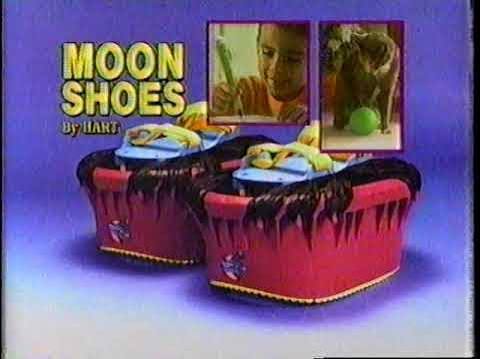
Skip-It and Moon Shoes: Movement Toys That Turned Coordination Into Public Drama
Skip-It and Moon Shoes were perfect examples of 90s movement toys: simple idea, bright packaging, physical challenge, and a strong chance of looking foolish in front of other kids. They were not about stories or characters. They were about whether your body could cooperate long enough to beat a number or survive a bounce session.
Skip-It had the better rhythm. Strap it around one ankle, swing it around, hop over it with the other foot, and try to keep the count going. When it clicked, it felt great. When it did not, it attacked your ankle like a plastic meteor.
Why Skip-It worked
Skip-It was addictive because it measured progress. Every spin could count. Every round could be a personal best. Kids did not need a full group or a big yard. One strip of pavement was enough. That made it perfect for driveways, sidewalks, garages, and any place with just enough room to injure your own shin.
It also had playground challenge energy. You could compare scores, take turns, and watch someone else mess up. The toy turned coordination into a contest, which is basically childhood in one sentence.
Why Moon Shoes were pure 90s optimism
Moon Shoes promised bouncy, anti-gravity fun. The reality was more like strapping plastic platforms to your feet and negotiating with balance. But that was part of the charm. The toy looked futuristic and goofy at the same time.
Moon Shoes worked because the idea was better than the elegance. Kids wanted to bounce. They wanted to feel different from normal walking. They wanted the commercial version of the experience, even if the driveway version involved a lot of awkward stomping.
- Core appeal: counting, bouncing, movement, challenge, physical skill, and driveway competition.
- Kid behavior: chasing high scores, trying again immediately, blaming shoes, and pretending ankle pain was fine.
- Most 90s detail: toys that made kids exercise by disguising it as a challenge nobody asked for.
Skip-It and Moon Shoes mattered because they were outdoor fads built around bodies, not screens. They were simple, physical, silly, and easy to remember because the toy was basically the feeling.
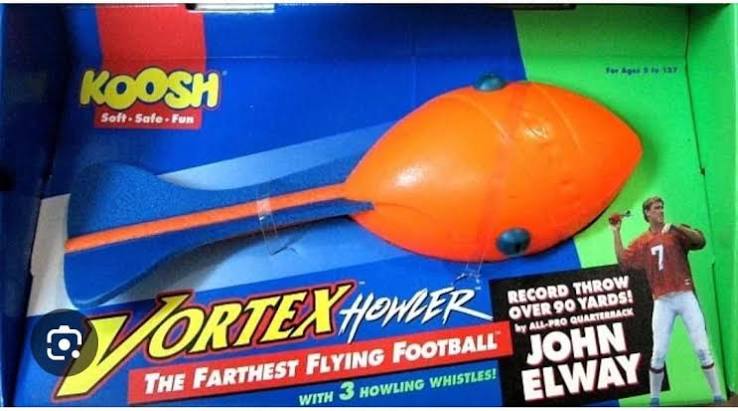
Koosh Vortex: The Weird Rocket Football That Made Every Throw Look Cooler
Koosh Vortex looked like someone took a football, a rocket, and a weird 90s desk toy and made them solve a problem together. It was designed to fly, and when thrown right, it made even a basic backyard pass feel dramatic. The tail gave it motion. The shape gave it distance. The colors made it look like a toy commercial had escaped into the lawn.
It worked because it changed the feel of catch. A regular football was normal. A Koosh Vortex felt like a launch. Kids could throw it across yards, fields, beaches, and driveways with more spectacle than accuracy deserved.
Why it belonged to the 90s
The 90s loved toys that made common play patterns look more extreme. Catch became rocket catch. Water fights became pressure battles. Skating became inline speed culture. Koosh Vortex fit right into that upgrade mindset.
The toy also had that perfect novelty factor. It was not a whole sport and did not need one. You picked it up, threw it, watched it fly, and threw it again. Simple, satisfying, and very backyard-friendly.
The joy of distance
Some toys are fun because they do a thing visibly well. Koosh Vortex flew. That was the appeal. When it traveled farther than expected, the whole yard noticed. When someone overthrew it into a neighbor’s yard, the game became a retrieval mission.
It also made weak throws feel better. The design did some of the work, which meant kids could get big results without being great athletes. That is a very underrated toy feature.
- Core appeal: long flight, weird design, bright colors, backyard catch, and launch energy.
- Kid behavior: throwing too hard, chasing it into bushes, arguing over distance, and trying trick throws.
- Most 90s detail: making a football weird enough to look futuristic.
Koosh Vortex mattered because it was pure 90s outdoor novelty: easy to use, fun to watch, and just strange enough to feel special.
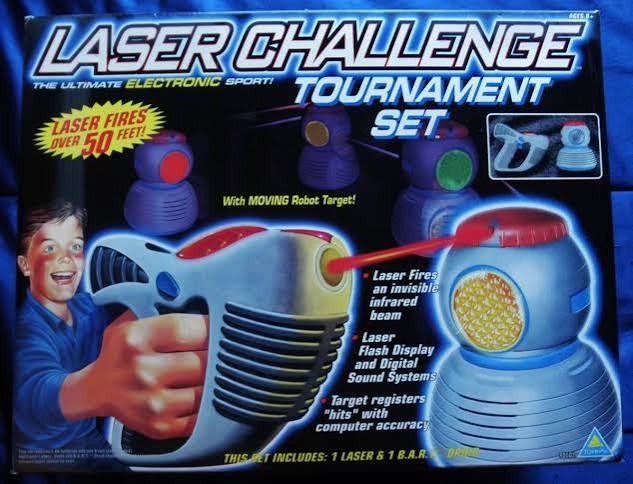
Laser Challenge and Backyard Tag: When Night Games Got Plastic Sensors
Laser Challenge and home laser-tag toys gave the backyard a late-90s sci-fi upgrade. Tag was already one of the oldest kid games on earth. Add plastic sensors, lights, sounds, and pretend futuristic gear, and suddenly running around the yard felt like a mission.
The toy worked best when the sun went down, or at least when kids convinced themselves it was dark enough. Shadows mattered. Hiding mattered. Teams mattered. The gear made the game feel official even when the playing field was just a yard, basement, or hallway with furniture everyone was told not to knock into.
Why it felt futuristic
The late 90s were obsessed with electronic add-ons. Toys beeped, blinked, tracked, counted, and reacted. Laser Challenge fit that mood perfectly because it turned a physical playground game into something that felt vaguely digital.
It also gave kids a home version of arcade laser tag. You did not need a party place, a vest room, or blacklights. You could run around with plastic gear and feel like the neighborhood had temporarily become a futuristic arena.
The backyard version was messy
Real home laser tag was never as clean as the commercial. Sensors got blocked. Kids argued whether a hit counted. Someone hid too well. Someone ran into a chair. Someone’s batteries were weak. But those imperfections made it feel like classic neighborhood play wearing a 90s electronic costume.
The best part was that it extended outdoor play into evening. A lot of toys belonged to daylight. Laser-tag-style toys belonged to that magic window when the air cooled down, the porch lights came on, and everyone wanted one more round before being called inside.
- Core appeal: sensors, lights, team play, hiding, running, and sci-fi backyard energy.
- Kid behavior: arguing over hits, hiding behind trash cans, playing until batteries faded, and begging for one more round.
- Most 90s detail: making a suburban backyard feel like a laser-tag arena because two plastic sensors blinked.
Laser Challenge mattered because it showed how 90s outdoor play was absorbing electronics without losing the physical running-around part.
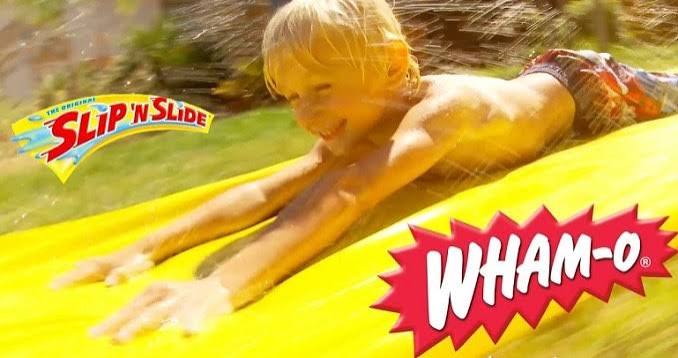
Slip ’N Slide, Sprinklers, Sidewalk Chalk, and Classic Summer Toys
Not every 90s outdoor toy needed a new gimmick. Some of the biggest backyard memories came from classics: Slip ’N Slide, sprinklers, sidewalk chalk, jump ropes, water balloons, plastic bats, Wiffle balls, flying discs, lawn games, and whatever was already in the garage from last summer.
These toys mattered because they turned ordinary days into activity. A sprinkler made the yard an event. Sidewalk chalk made the driveway a canvas. A Slip ’N Slide turned a lawn into a questionable speed experiment. Water balloons turned everyone into a target. Wiffle ball turned a patch of grass into a stadium with bad umpiring.
Why simple summer toys lasted
Classic outdoor toys worked because they were flexible. Kids could invent rules, change games, combine toys, and use whatever space was available. A driveway could become four square, chalk town, bike lane, or baseball diamond depending on who showed up.
They also did not depend on batteries or trends. A sprinkler worked every year. Chalk worked until it rained. A ball worked until it went over the fence. These toys were the backbone of outside play because they were always ready.
The Slip ’N Slide reality
The commercial version looked like a perfect backyard water park. Real life involved lumpy grass, questionable aim, and the sudden realization that a thin sheet of plastic could be both thrilling and rude to your ribs.
But that was the magic. The imperfections made it memorable. The water pressure was never quite right. Someone slid off the side. Someone complained about grass. Someone got too much speed and overshot the end. Everyone still wanted another turn.
- Core appeal: water, drawing, running, throwing, sliding, easy setup, and open-ended play.
- Kid behavior: drawing roads, running through sprinklers, making up games, losing balls, and ignoring “last turn.”
- Most 90s detail: being entertained by a sprinkler because the internet was not in your pocket yet.
Classic summer toys mattered because they held the outdoor world together. The headline toys got the commercials, but chalk, sprinklers, balls, and slides filled the hours.
Cul-De-Sac Culture: The Real Multiplayer Lobby
The cul-de-sac was the 90s multiplayer lobby before anyone called anything a lobby. It was where kids gathered, negotiated teams, found out who was home, tested new toys, staged races, started water fights, and made up rules that would change ten minutes later after someone started losing.
Outdoor toys worked differently there because they became shared. Not everyone needed to own a Super Soaker if one kid had the big one. Not everyone needed a ramp if one driveway had a board and a parent not paying attention. Not everyone needed a Power Wheels if the owner was generous or easily pressured.
The social structure was simple and brutal. The kid with the good toy had power. The kid with the good yard had location value. The kid with the basketball hoop had leverage. The kid whose parents bought the big water balloon pack was suddenly important. Childhood economics, but with sprinklers.
What made outdoor play feel different
- Drop-in rules: kids could join, leave, switch teams, or change games without scheduling anything.
- Shared gear: one good toy could become the center of the whole block.
- Loose supervision: adults were nearby but not always directly involved, which was the exact amount kids wanted.
- Natural endings: streetlights, dinner calls, rain, dead batteries, or someone getting too mad.
- Physical memory: skinned knees, wet shirts, chalk dust, hot pavement, grass stains, and garage smells.
That is why 90s backyard toys still feel huge. They were not just objects. They were the equipment for an entire neighborhood operating system.
Garage Culture: Where Outdoor Toys Went to Become a Pile
The garage was the real toy chest for outside play. Bikes leaned against walls. Super Soakers dripped in corners. Nerf balls got wedged behind boxes. Rollerblades smelled like pavement and foot sweat. Chalk buckets cracked. Sprinkler attachments disappeared. The basketball was always half-flat. The good pump was never where anyone left it.
That chaos was part of the experience. Outdoor toys were not precious in the same way action figures or collectibles were. They got scraped, soaked, sun-faded, stepped on, loaned out, forgotten, repaired, and put away dirty. They looked used because they were used.
Why 90s Backyard Toys Still Hit
The nostalgia is not just about the toys. It is about the conditions around them: hot pavement, cold hose water, garage smells, porch calls, bikes on lawns, chalk dust on fingers, wet socks, grass stains, wheel marks, scraped knees, and the feeling that the whole afternoon belonged to whoever was outside.
These toys also hit because they were physical in a way that made time feel different. You pumped a water blaster. You pedaled. You threw. You skated. You bounced. You ran. You slid. You fell. You got back up because everyone was watching and you had to act like that did not hurt.
And maybe the biggest reason they still hit is because they were social without being organized. No group chat. No calendar invite. No app. You just went outside and found the game already forming. The toys were the excuse. The neighborhood was the platform.
90s Backyard Toys, Bikes, and Blasters FAQ
What were the most popular 90s backyard toys?
Some of the most remembered 90s backyard toys include Super Soaker, Nerf foam toys, Koosh Vortex, rollerblades, bikes, Power Wheels, Skip-It, Moon Shoes, Laser Challenge, Slip ’N Slide, sidewalk chalk, water balloons, sprinklers, Wiffle ball, and driveway sports gear.
Why was Super Soaker such a big deal in the 90s?
Super Soaker changed water fights because it used pressure-pumped designs with better range and power than traditional squirt guns. It made backyard water battles feel bigger, more competitive, and more like summer events.
Were rollerblades a major 90s fad?
Yes. Inline skating became a major 90s outdoor fad tied to street style, extreme sports energy, hockey culture, ramps, pads, and sidewalk speed. Rollerblades were one of the decade’s most recognizable movement toys.
What made 90s bikes so nostalgic?
Bikes were tied to independence. They let kids roam neighborhoods, visit friends, build ramps, ride loops, and stay outside until called home. Before phones, a bike was often how kids found each other.
Why do 90s outdoor toys feel different from indoor toys?
Outdoor toys were physical, social, weather-based, and tied to neighborhood freedom. They lived in garages, driveways, sidewalks, lawns, cul-de-sacs, and summer routines instead of bedrooms or shelves.