Roseanne’s 1988 TV Debut: The Sitcom That Hit Like a Truck
Revisit Roseanne’s 1988 TV debut: Dan, Jackie, the original Conner kids, Wellman Plastics, first-season episodes, and the comedy that made Lanford feel real.
The shows, the moments, and the nights we were there for it.
Darlene has been barking in class. Her mother has been called to school to discuss it, which means leaving work, negotiating with a boss, and rearranging a day that was already trying to kill her. Roseanne Conner arrives with a limited supply of patience. The teacher would like to discuss the child. Roseanne would also like somebody to notice the adult who had to get there.
That was one way to introduce a television mother.
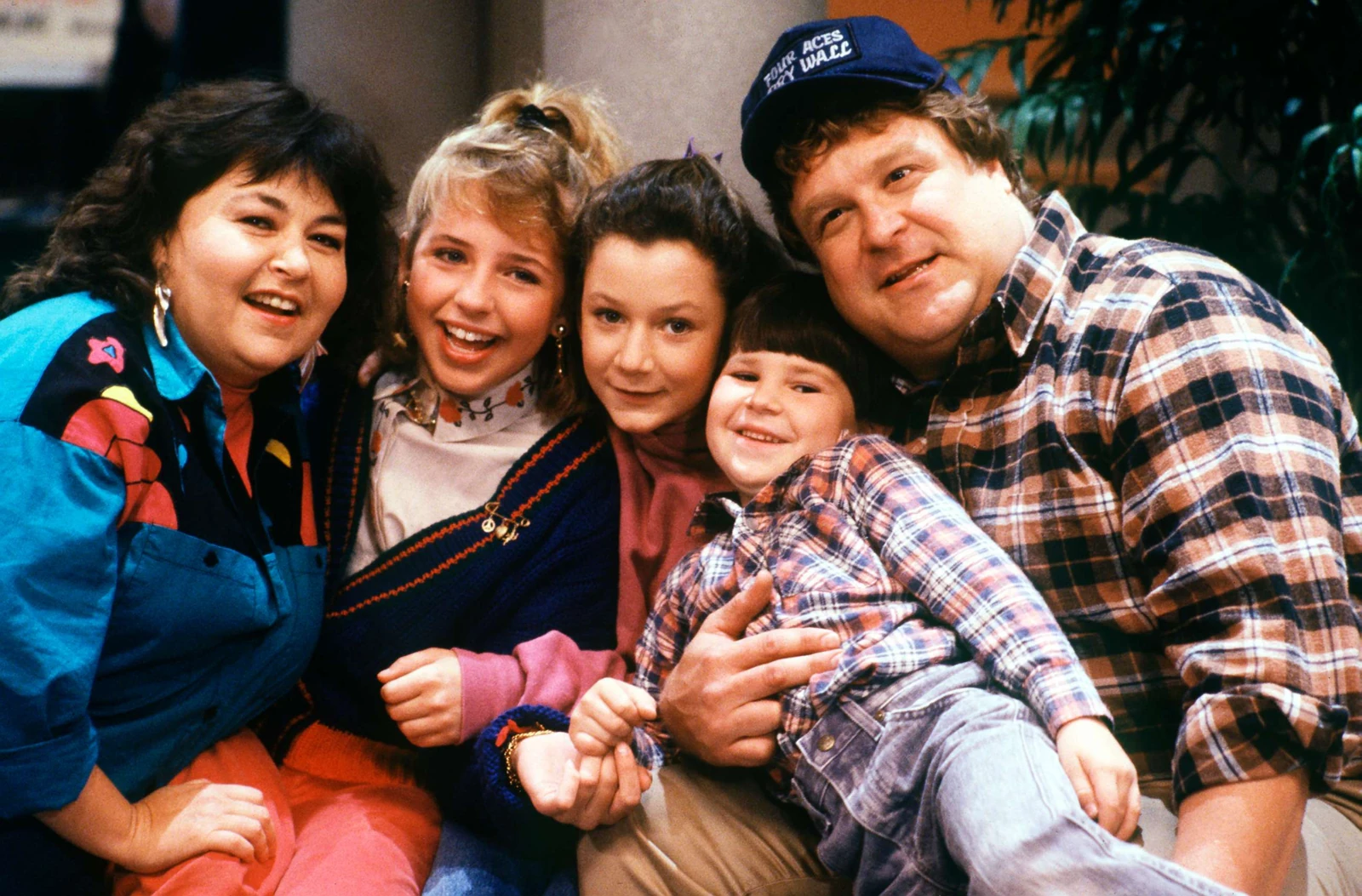
When Roseanne premiered on ABC on October 18, 1988, the Conners didn’t arrive with a spotless kitchen and a reassuring promise that love would take care of the grocery bill. They had three children, jobs, arguments, and an inconvenient amount of affection for people who kept getting on their nerves. Dan could be a delight. He could also be right there in the house while Roseanne remained the person expected to know where everything was.
At the center was Roseanne Barr, turning the exasperation of her stand-up persona into a character who had to get through an actual working day. Beside her, John Goodman made Dan Conner funny, physically imposing, and unexpectedly tender. Laurie Metcalf’s Jackie brought enough nervous energy to suggest that the household’s problems were contagious.
The first season ran for twenty-three episodes and finished second in the ratings. That’s the headline. The reason those episodes still work is down at table level: a mother trying to get a moment alone, a father wanting to buy himself something nice, a daughter convinced her parents exist chiefly to embarrass her. The 1980s were almost over. Here came a family that looked as though it had been doing the laundry all decade and was still behind.
Inside This Article
- “Life and Stuff” starts with a mother who has places to be
- A house that looks as if somebody actually lives there
- Roseanne Conner has heard enough. Unfortunately, everybody is still talking.
- John Goodman makes Dan worth the trouble
- “We’re in the Money,” until the money has somewhere to go
- Wellman Plastics, where a day off requires an argument
- Jackie Harris can make a perfectly normal visit complicated
- Crystal belongs to the neighborhood, not the punch-line furniture
- Becky Conner would prefer a less visible family
- Darlene doesn’t plan to become somebody else just because she’s growing up
- D.J. has access, and his sisters should be worried
- At the bowling alley, the parents are the hazard
- “Mall Story”: a family outing with no winning side
- “Canoga Time” knows the difference between junk and your junk
- Dan has a song in him. Roseanne would like him to enter it.
- Dan’s birthday party acquires an unnecessary fight
- “Workin’ Overtime” gives an exhausted woman a chair and a cup of coffee
- The daughter who was driving you crazy is suddenly in a hospital
- “Dear Mom and Dad”: even Roseanne has parents who know how to get to her
- A tornado is coming. Jackie would like this taken seriously.
- A dead salesman is inconvenient. The Conners still have things to do.
- The first season ends with a clock-out that costs something
- The theme almost sounded too polished for the furniture
- ABC didn’t have to wait for America to notice
- A hit comedy, with a less cheerful backstage argument
- The Conners didn’t invent money trouble. They made it their own.
- The first year leaves the door open
- Questions about Roseanne’s first season
“Life and Stuff” starts with a mother who has places to be
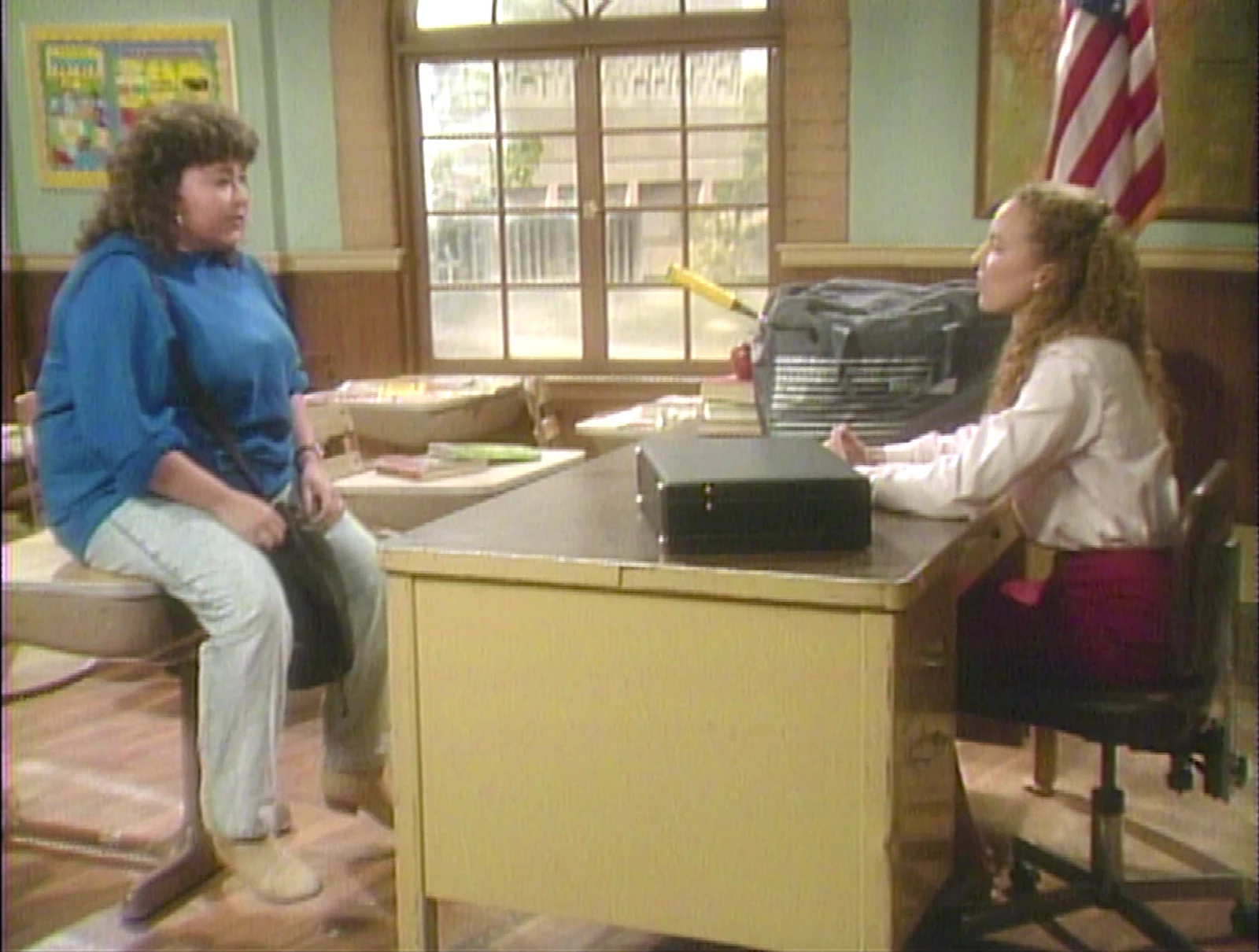
The pilot’s school conference is a wonderful collision between a reasonable professional concern and an unreasonable amount of life. Darlene’s teacher has a problem to discuss. Roseanne has no desire to pretend that attending the discussion has been effortless. The school sees a parent appointment. She sees the hours and arrangements required to make one.
Barr plays the scene with a bristling impatience that immediately distinguishes the character. Roseanne doesn’t arrive hoping to win the Most Agreeable Mother award. She wants to understand what happened and get on with the day. A child behaving strangely at school is one problem. The assumption that her mother has unlimited time to fix it is another.
That tension establishes the show much more effectively than a speech about money would. The family’s circumstances are built into the action. Roseanne works at a plastics factory. Getting away from that job involves somebody else’s permission. The school doesn’t pause because she has a job, and the factory doesn’t stop because she has children. She is the connecting piece, expected to stretch.
The episode also gets the children into focus quickly. Darlene, played by Sara Gilbert, already has the air of somebody who finds the adult world insufficiently entertaining. Becky, played by Lecy Goranson, is moving toward adolescence with a different set of priorities. D.J. is smaller and operates on the assumption that the older people will eventually sort things out around him.
The original pilot has Sal Barone as D.J.; Michael Fishman takes over afterward. It’s a small casting change with a useful reminder attached: the familiar Conner family wasn’t delivered completely finished. The series was assembling a household while viewers were getting to know it.
By the end of “Life and Stuff,” the practical irritation has made room for tenderness. A hurt child brings the parents together. The marriage has a private life beyond the morning rush. The pilot doesn’t ask viewers to believe the Conners are secretly miserable. It asks them to recognize how much noise a functioning family can make.
A house that looks as if somebody actually lives there
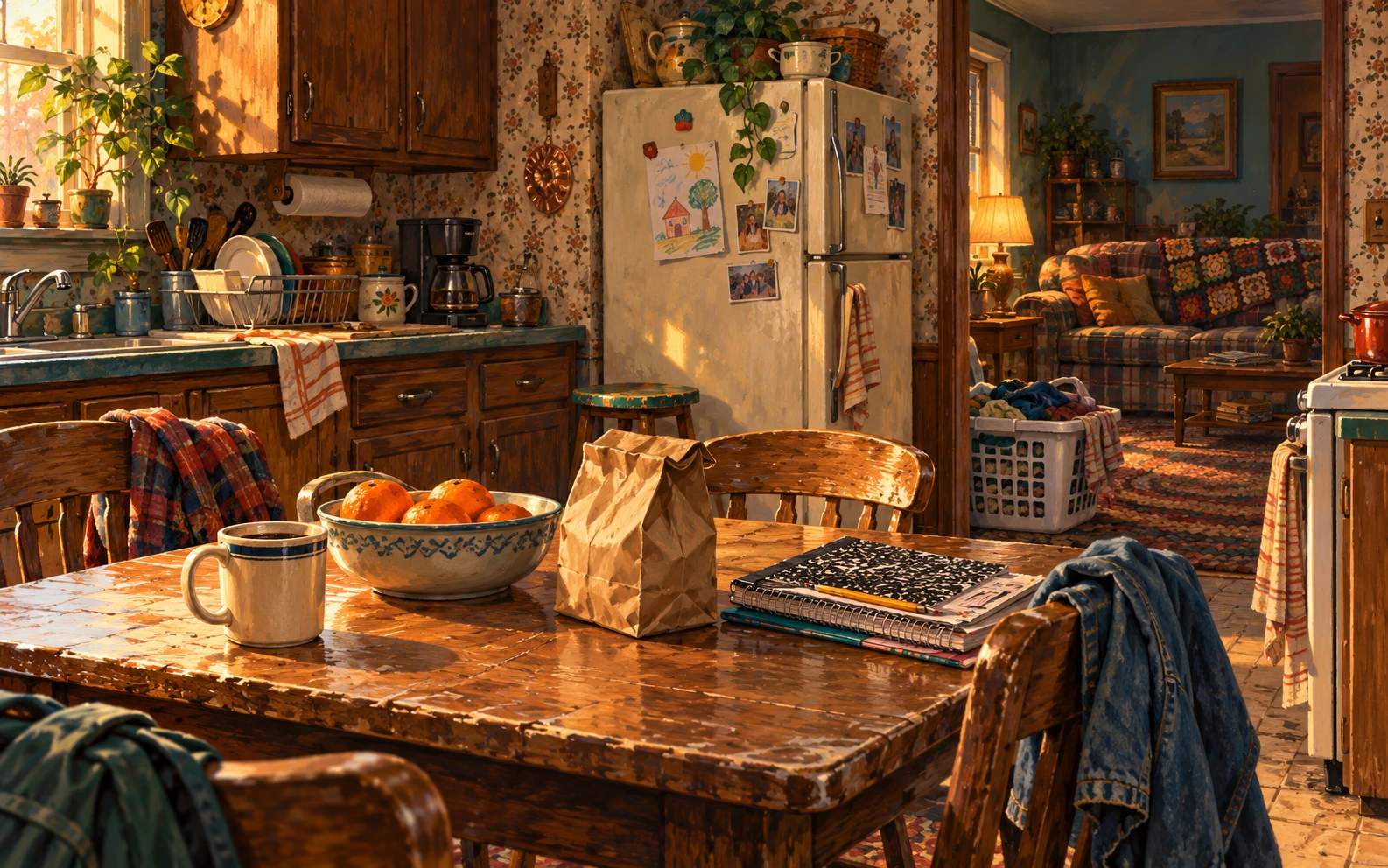
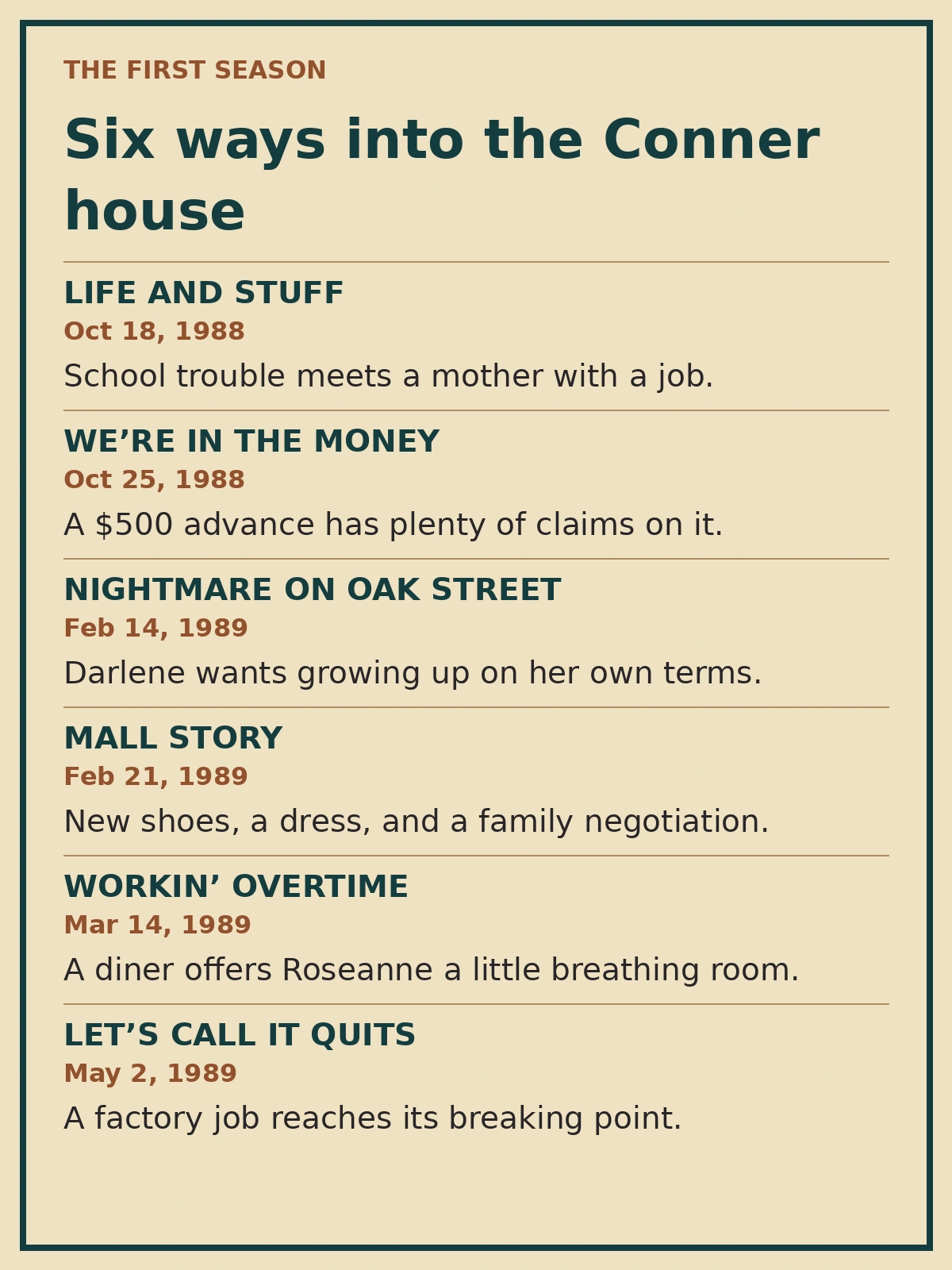
The Conner house has a powerful advantage over many television homes: you can believe somebody had to move something before sitting down. The kitchen holds ordinary life at a slightly inconvenient angle. The living room’s plaid sofa and crocheted blanket suggest things kept because they are useful and familiar, not replaced because a new season requires a fresh design mood.
That setting gives the jokes somewhere to land. When a child wants something, the request enters a room already full of obligations. When Dan and Roseanne argue about a purchase, the house doesn’t quietly contradict them by looking like a showroom for people with generous disposable incomes. The family has possessions. They also have to keep those possessions working.
The kitchen table is especially good television territory. People eat, complain, negotiate, and discover information they would rather have received privately. A conversation can begin with one pair and acquire several additional participants who feel entitled to comment. Privacy in the Conner house is often a temporary clerical error.
The opening credits make a small social event of that table. The camera’s movement around the family and the familiar instrumental theme invite viewers into a noisy circle. The show doesn’t introduce the Conners as a portrait of perfect behavior. It introduces the pleasure of being around them, which is a different and much more persuasive invitation.
It’s a major part of why the series belongs so comfortably among the defining family sitcoms of the 1980s. The surroundings support the people. A cramped conversation feels cramped because too many relatives are participating, not because a script has decided to explain the pressures of family life.
Roseanne Conner has heard enough. Unfortunately, everybody is still talking.
Barr’s early performance has a roughness that suits the character. The voice can grate. The laugh is unmistakable. Her timing often involves an unhurried look at the person who has just volunteered something foolish, followed by a response suggesting that she has been expecting this level of disappointment.
That quality came out of her “domestic goddess” stand-up persona, but the sitcom gives it people to bounce against. A joke aimed at an audience ends when the laugh does. A joke aimed at Dan has to survive in a marriage. A remark aimed at Darlene may come back at her before dinner. The household makes the comedy answerable to relationships.
She is funniest when the sharpness has a practical target. Somebody has assumed she will do the work. Somebody has explained a problem she already understands. Somebody has arrived with a request while behaving as though requests don’t add up. Her sarcasm names the arrangement before the other person can make it sound reasonable.
There is a limit to the trick. A stretch of nothing but caustic replies can make a scene feel like people taking turns approaching a verbal firing squad. The first season is strongest when Barr lets another feeling interrupt the rhythm: worry about a daughter, pleasure in her husband, or fatigue that has passed the point where another joke will improve it.
She doesn’t need to become a more decorous woman to make those feelings convincing. The warmth belongs to the same person who was just complaining. That’s the pleasure of Roseanne Conner. She can be loving without performing gratitude for every task attached to love. She can adore her children and still be very pleased when they finally leave for school.
The character’s authority is also unusually physical. She occupies the room, works through the mess, and refuses to make herself dainty for anybody’s comfort. Her family isn’t waiting for a serene television mother to restore order. It has Roseanne, who may restore enough order to get dinner made while explaining exactly how much she resents the assignment.
John Goodman makes Dan worth the trouble
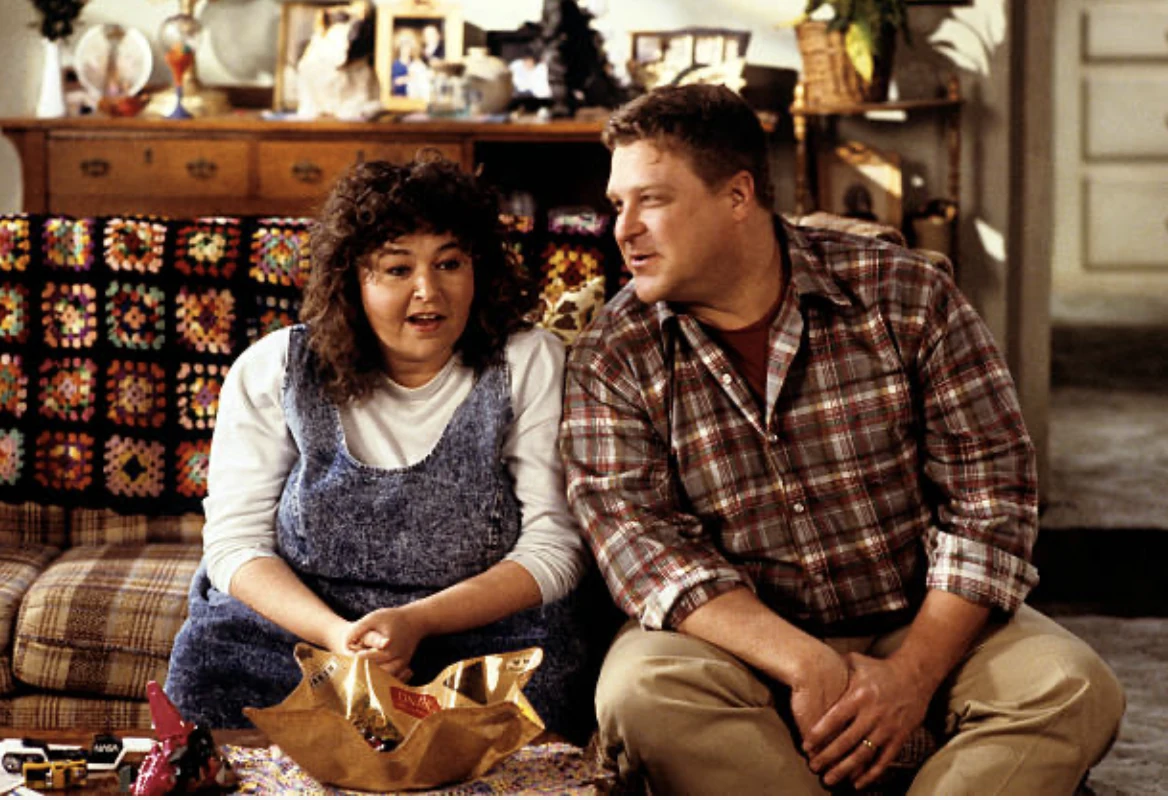
Dan Conner has an excellent laugh and an impressive ability to look as though a plan is going well before it has produced any visible results. Goodman gives him a generous physical presence. Dan fills the doorway, the sofa, the conversation. Then a small shift in his face lets you see the worry under the good humor.
He is charming enough that Roseanne’s affection makes immediate sense. The two enjoy one another. Their teasing has the ease of people who know which response is coming and still want to hear it. Goodman can meet Barr’s attack with a grin, a mock complaint, or a reaction large enough to give the whole scene another comic beat.
He is also capable of making her day harder while considering himself a generally helpful man. That is where the character becomes more interesting than the standard lovable husband. He can point to real work he does and still fail to notice work she is continuously doing. Both facts belong to the marriage.
Goodman doesn’t play affection as a permanent exemption from criticism. Dan has pride. He can get defensive. He can want an evening with his friends while remaining convinced that the household will somehow carry on around his absence. The comedy is much better when the script lets those habits irritate Roseanne for good reasons.
His tenderness keeps the arguments from becoming a weekly inventory of grievances. A frightened child or an unhappy wife can break through his self-justification quickly. The change doesn’t feel like another character taking over. Goodman has kept that man visible all along, even while Dan was making a case for himself that deserved to lose.
And, crucially, he looks at Roseanne as a woman he wants. Their chemistry gives the series a warmth that a tidy speech about family values would never supply. They have bills and children. They also have a marriage that occasionally gets a chance to remember what started it.
“We’re in the Money,” until the money has somewhere to go
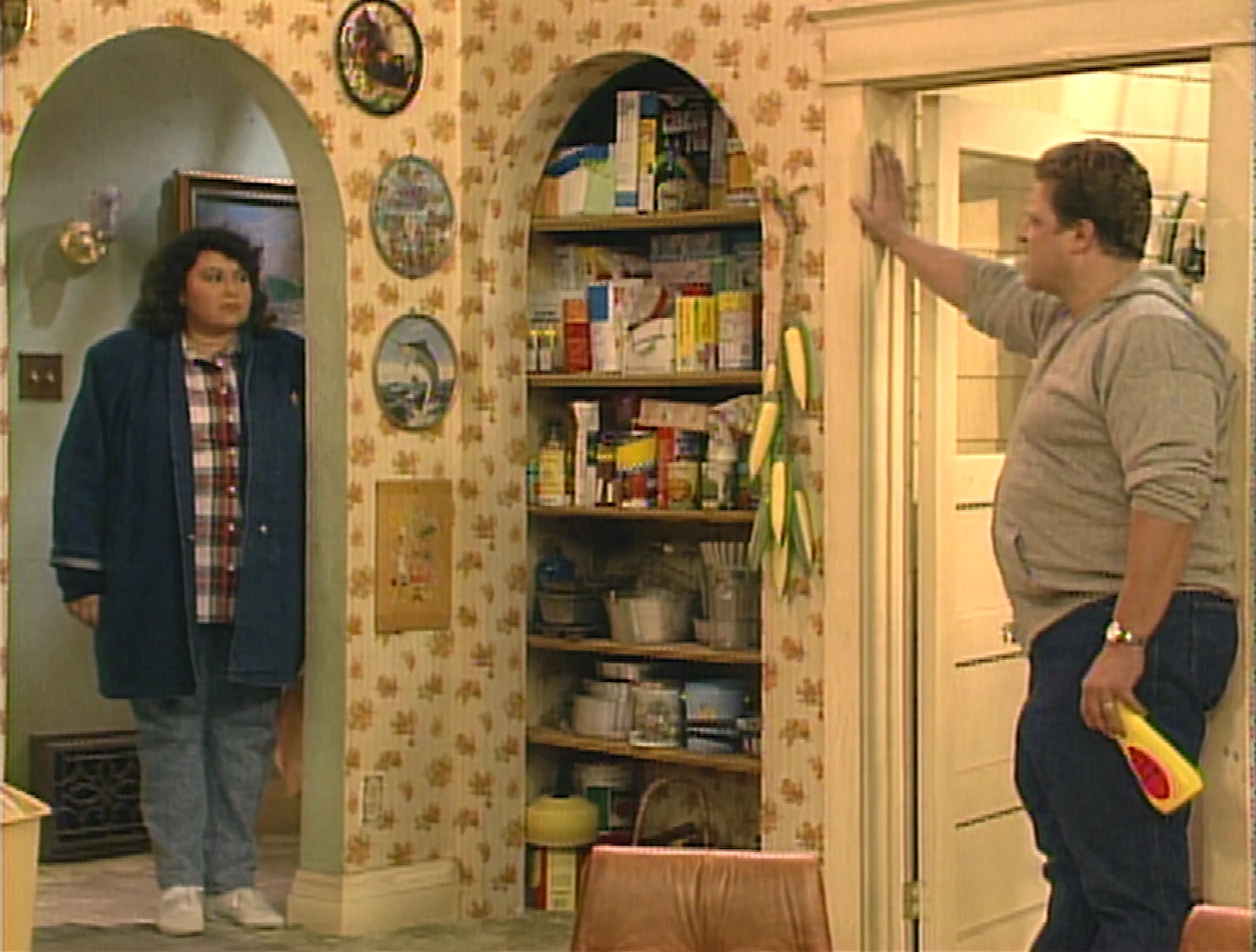
The second episode, “We’re in the Money,” starts with Dan bringing home a $500 advance from a drywall job. For a brief, intoxicating moment, there appears to be enough money for something enjoyable. Then the bills begin exercising their prior claim.
It’s a wonderfully ordinary disappointment. An incoming check feels like freedom until the household starts attaching names to the dollars. The Conners aren’t financially helpless; they are financially crowded. Several perfectly reasonable needs are standing in line, and the line is longer than the check.
Dan and Roseanne agree to be responsible. They also each find a reason to make a private exception. That is the episode’s comic engine, and it keeps the pair pleasantly human. They can understand the budget while wanting relief from being the people who always have to understand the budget.
The purchases matter because they aren’t going to transform anybody’s life. A modest indulgence acquires enormous emotional value when it has been postponed often enough. The argument isn’t simply about waste. It’s about who gets permission to want something, how much permission costs, and whether the other person has been secretly helping himself to some.
Barr and Goodman play the mutual exposure well. Each has arrived prepared to defend a position. Each discovers that the other has evidence. A marriage can survive a financial discussion, but first it may have to survive the satisfaction of catching the other person being exactly as weak as you were.
Nothing in the premise requires a spectacular crisis. The family is trying to get ahead and briefly mistakes an advance for an opening. “We’re in the Money” finds a whole episode in that mistake. It understands why a small treat feels necessary, why the bills still matter, and why two people who know all of this might decide not to mention what they bought.
Wellman Plastics, where a day off requires an argument
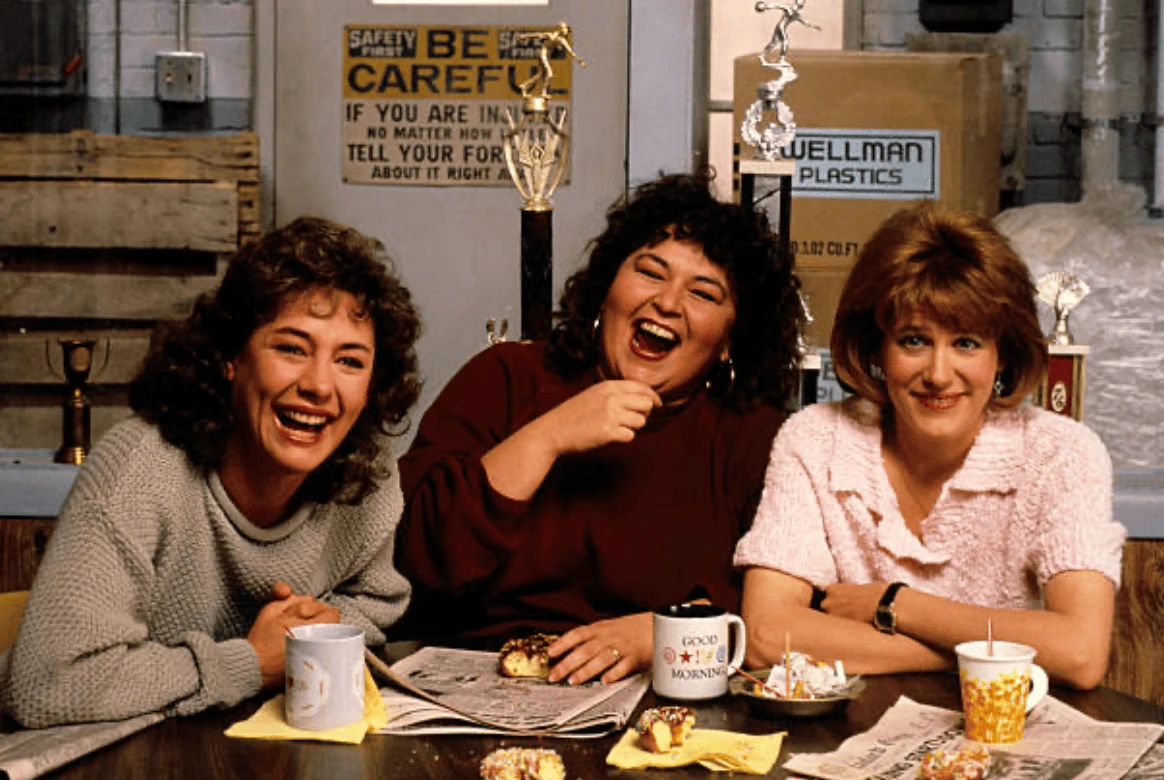
The factory gives the show a world beyond the Conner house without letting Roseanne escape her responsibilities. At Wellman Plastics she has a different set of rules, a different clock, and other people deciding how much she ought to accomplish before she goes home to accomplish more.
Jackie works there too, as does their friend Crystal, played by Natalie West. The women’s conversations make the place feel occupied by people with lives extending past the shift. They trade observations, romantic news, and complaints. A workplace friendship is partly companionship and partly the pleasure of having somebody nearby who knows the exact person you are complaining about.
George Clooney’s Booker Brooks brings a conspicuously handsome complication into the arrangement. He is the foreman, and he is also somebody Jackie finds interesting for reasons that have little to do with production targets. Clooney is still years away from his ER stardom. Here, he is part of a factory comedy in which looking good doesn’t protect a man from the women having opinions about him.
The setting matters most when it limits a choice. Roseanne can’t simply leave whenever a child needs her. An extra shift changes the evening for everyone at home. A supervisor’s demand travels beyond the factory door and turns into dinner trouble, lost sleep, or another fight about who is doing enough.
The show is wise to let the women joke at work. People don’t become solemn illustrations of their economic position as soon as they clock in. They flirt, get distracted, support one another, and make a dull stretch of the day more bearable. That everyday company is what gives the season’s eventual workplace confrontation its force. These aren’t anonymous employees assembled for one important speech. We’ve spent time with them.
Jackie Harris can make a perfectly normal visit complicated
Laurie Metcalf gives Jackie the marvelous energy of somebody who has brought an entire second conversation into the room and may start it at any moment. She can be eager, defensive, sarcastic, romantic, and wounded in quick succession. Watching her think is often as funny as hearing what she says.
The sister relationship is the anchor. Roseanne knows Jackie too well to be dazzled by every new explanation. Jackie knows Roseanne too well to accept every judgment without replying. Their familiarity makes them quick, and their affection means the quickness isn’t always harmless.
Jackie has more freedom than her married sister in some ways and less certainty in others. That creates a useful exchange of envy and irritation. Roseanne might want a piece of Jackie’s unclaimed time. Jackie might look at the Conner household and see a place where somebody is always waiting for you, even if they are waiting chiefly to ask for something.
Metcalf makes Jackie’s attraction to Booker lively without turning her into nothing but a woman chasing a handsome man. Her anticipation has a physical life: the lean toward a conversation, the effort to appear casual, the sudden interest in information she was pretending not to need. Clooney gives her somebody convincingly worth noticing.
The early Jackie is also still developing. The later character’s biggest emotional upheavals aren’t all present at the beginning, and it would flatten the first season to treat her as a preview reel for them. Here, she is a sister, aunt, coworker, and single woman with her own ideas about what the next part of life ought to offer.
Metcalf’s great advantage is that she can let those ideas be both funny and sincere. Jackie may get carried away. She is still allowed to want something. In a house where Roseanne can finish half her sentences, keeping a little independent hope alive is a respectable achievement.
Crystal belongs to the neighborhood, not the punch-line furniture
Natalie West’s Crystal has a different comic temperature from the sisters. She can look worried before anyone has supplied a fresh reason. Her softness gives Roseanne and Jackie something to react to beyond another equally fast retort, and the contrast helps the factory scenes breathe.
The friendship becomes especially useful in “Here’s to Good Friends,” when the women take Crystal out after a romantic disappointment. A night out offers a chance to improve the mood, which isn’t quite the same thing as improving the underlying situation. The advice, the company, and the opportunity to complain are all part of the evening.
West is effective because Crystal’s feelings don’t disappear as soon as the others have a good line. She remains a person who can be hurt, reassured, or caught in another bad arrangement. The show gives its central family a social circle with emotional weather of its own.
That makes Lanford feel larger. The Conners’ problems aren’t taking place in a sealed demonstration home. Friends bring news in. Coworkers know something about the day before Roseanne has had a chance to tell Dan. A private worry can become a group discussion with alarming speed.
There is comfort in that closeness and irritation too. The first season is often funniest when somebody attempts to help and produces more conversation than the person receiving help had budgeted for. Crystal doesn’t always need a solution as much as she needs somebody to sit with her. Fortunately, Roseanne and Jackie are quite willing to sit down and say what they think.
Becky Conner would prefer a less visible family
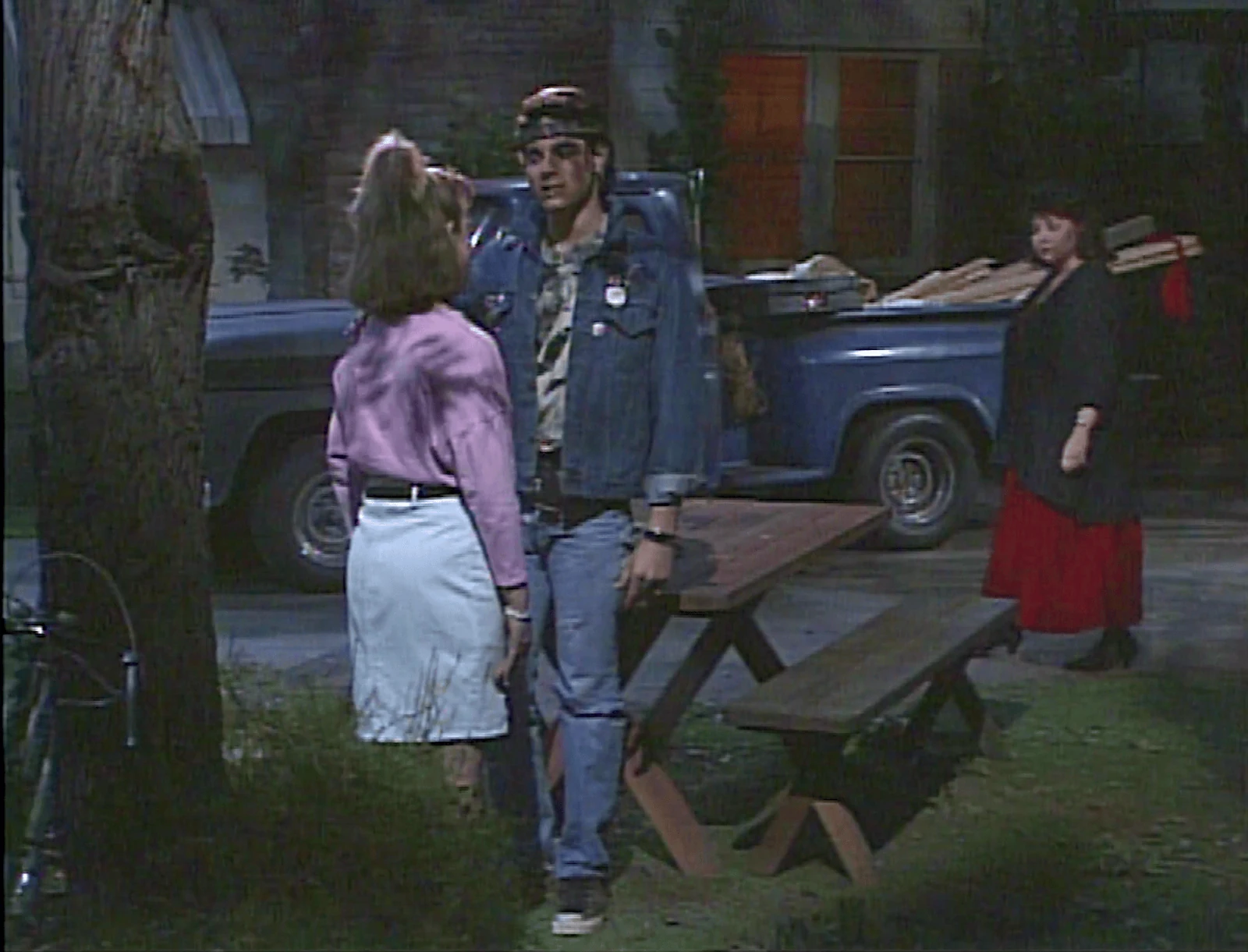
Lecy Goranson gives Becky a recognizable early-teen calculation: how much damage can the people related to me do if they are allowed to speak? Roseanne’s joke may be perfectly funny. From Becky’s position, the problem is that it is happening in public.
She wants some separation from the family identity. That doesn’t make her shallow. It makes her a teenager beginning to discover that the household’s normal behavior can look very different when a boy is watching. The parents are still acting like themselves. Becky considers this an escalation.
“Becky’s Choice,” from February 1989, turns that separation into practical trouble. Roseanne and Dan invite Chip and his parents over while Becky has interests that don’t fit the evening her mother has organized. The adults believe they know what is happening. Becky is operating another schedule.
The episode gives the parents an uncomfortable discovery of their own. They can remember being young and still find their daughter’s choices alarming. A relaxed parental self-image is easier to maintain before the child presents a specific person for inspection. Then the grown-ups begin discovering standards they hadn’t previously needed to announce.
Goranson is particularly good at letting Becky’s irritation feel immediate. She isn’t preparing a broad performance of teenage rebellion for an audience. She is responding to these parents, this embarrassment, this thing she wants. That specificity keeps the character from becoming merely the pretty daughter assigned to complain about clothes.
Becky’s relationship with Roseanne works because the mother often understands more than Becky would like. Understanding doesn’t guarantee permission. It may instead produce a much more accurate objection. Being raised by somebody who recognizes your tricks is a serious tactical disadvantage.
Darlene doesn’t plan to become somebody else just because she’s growing up
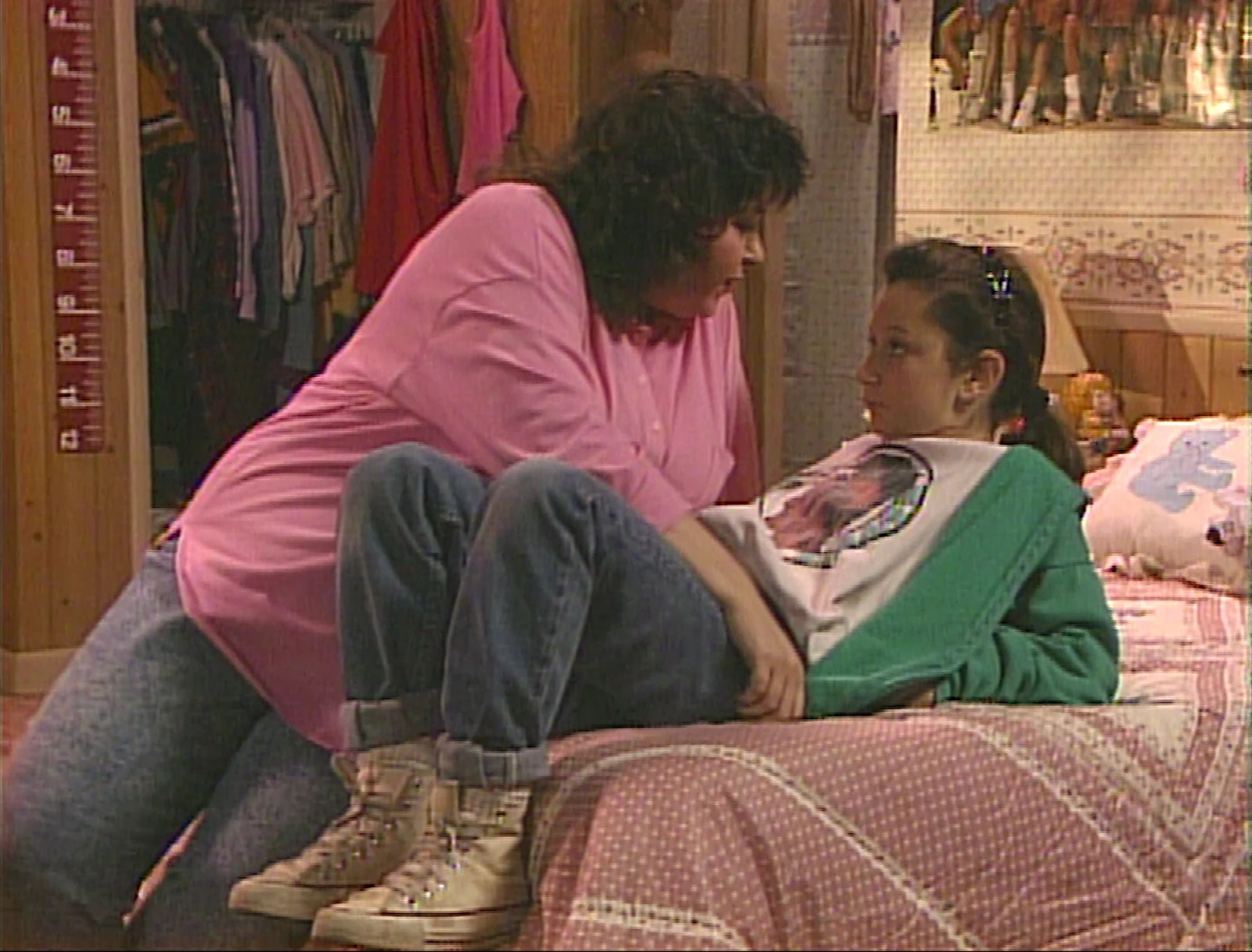
Sara Gilbert arrives with a wonderfully dry presence. Darlene can stand slightly apart from the household’s emotional commotion and comment on it as though she is providing an essential public service. Her interest in sports and her resistance to Becky’s priorities give the sisters more to argue about than shared space.
“Nightmare on Oak Street,” broadcast February 14, 1989, starts with what appears to be a problem caused by a scary movie. Darlene can’t sleep. Roseanne suspects there is more going on, and the episode eventually gets to the fear beneath the excuse: Darlene has had her first period and is worried about what growing up will demand of her.
The concern is specific to this child. Darlene doesn’t want her familiar pleasures reclassified as things she ought to leave behind. Baseball equipment has become evidence in an argument about what a girl is supposed to be. Roseanne’s response makes room for the daughter she already knows.
Gilbert lets the hard surface soften without switching the character off. The girl who barks in class and delivers the sharp remark can also be frightened by a change she didn’t request. There is no contradiction there. Children don’t always announce vulnerability in a form that makes an adult’s job easy.
Barr’s warmth in these scenes is especially persuasive because the show has established her impatience elsewhere. Roseanne knows Darlene’s habits. She can recognize when an explanation doesn’t fit and keep paying attention long enough to hear the real one. The episode earns its tenderness through that attention.
It is also funny. The household doesn’t enter a ceremonial hush because an important subject has appeared. Jokes, misunderstandings, and ordinary family noise remain around the conversation. Darlene gets reassurance without being made to exchange her personality for a more suitable television version of growing up.
D.J. has access, and his sisters should be worried
Being the youngest Conner comes with certain advantages. Adults are busy arguing. Older sisters are busy trying to get away with things. A small boy can collect an impressive amount of information while everybody assumes he is merely somewhere in the house.
Fishman’s D.J. supplies that extra pair of eyes. In “Canoga Time,” while the girls are trying to manage a report-card problem, their brother’s curiosity becomes another obstacle. A secret is much harder to keep when somebody who lives across the hall considers investigating you an enjoyable use of his afternoon.
The show gets good mileage from the uneven family hierarchy. Becky and Darlene can dismiss D.J. as the little kid. They cannot make him unsee something. Roseanne, who is usually looking for an explanation of what the children are up to, has a practical interest in anything he might have noticed.
He also helps the household feel like a family with children of different ages. Not everybody can join the same conversation on the same terms. Sometimes the youngest person interrupts, reports something inconvenient, or needs help while the others are conducting what they consider important business. The Conners’ day doesn’t consist entirely of people waiting for a turn to deliver a joke. Somebody still has to attend to the little boy.
At the bowling alley, the parents are the hazard
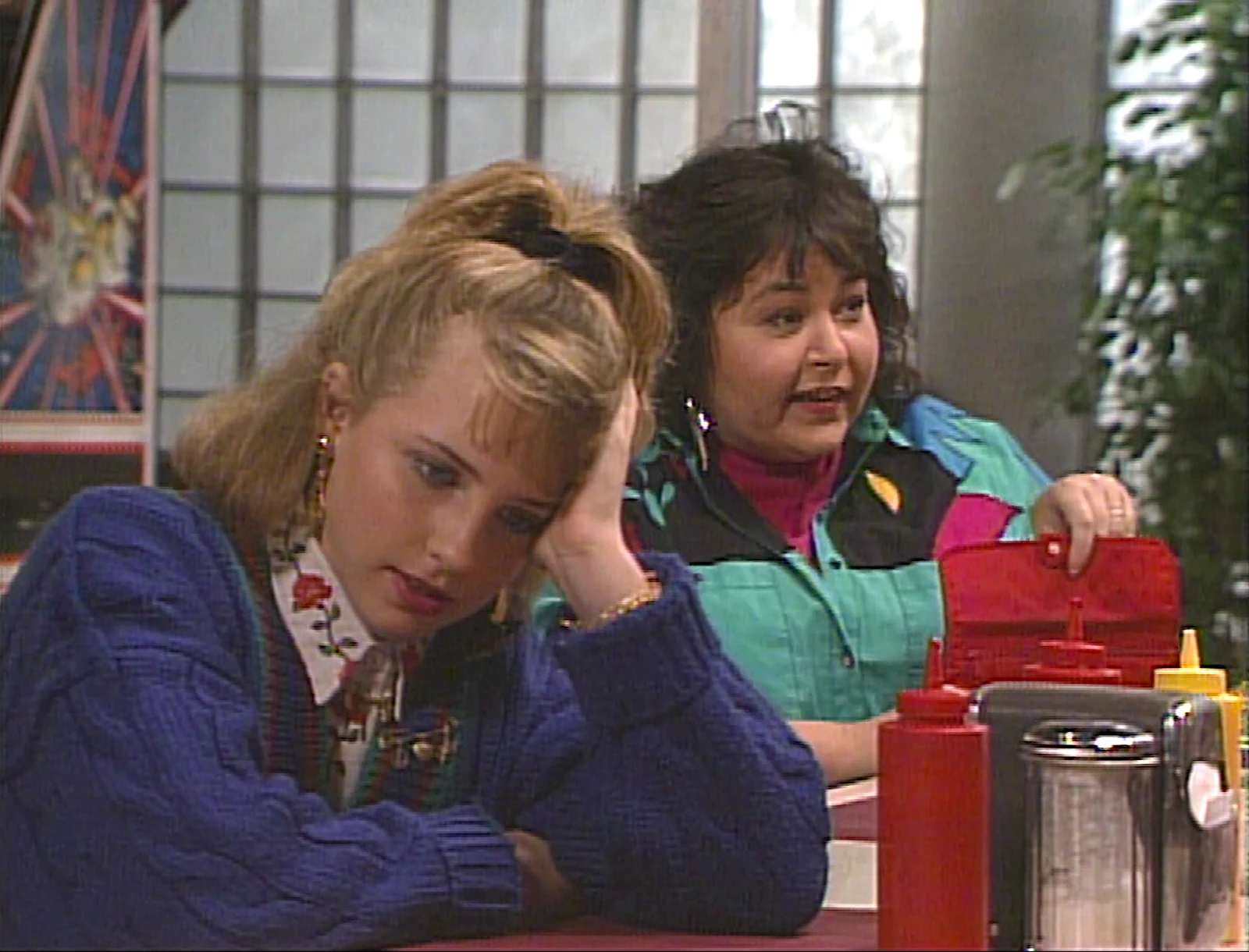
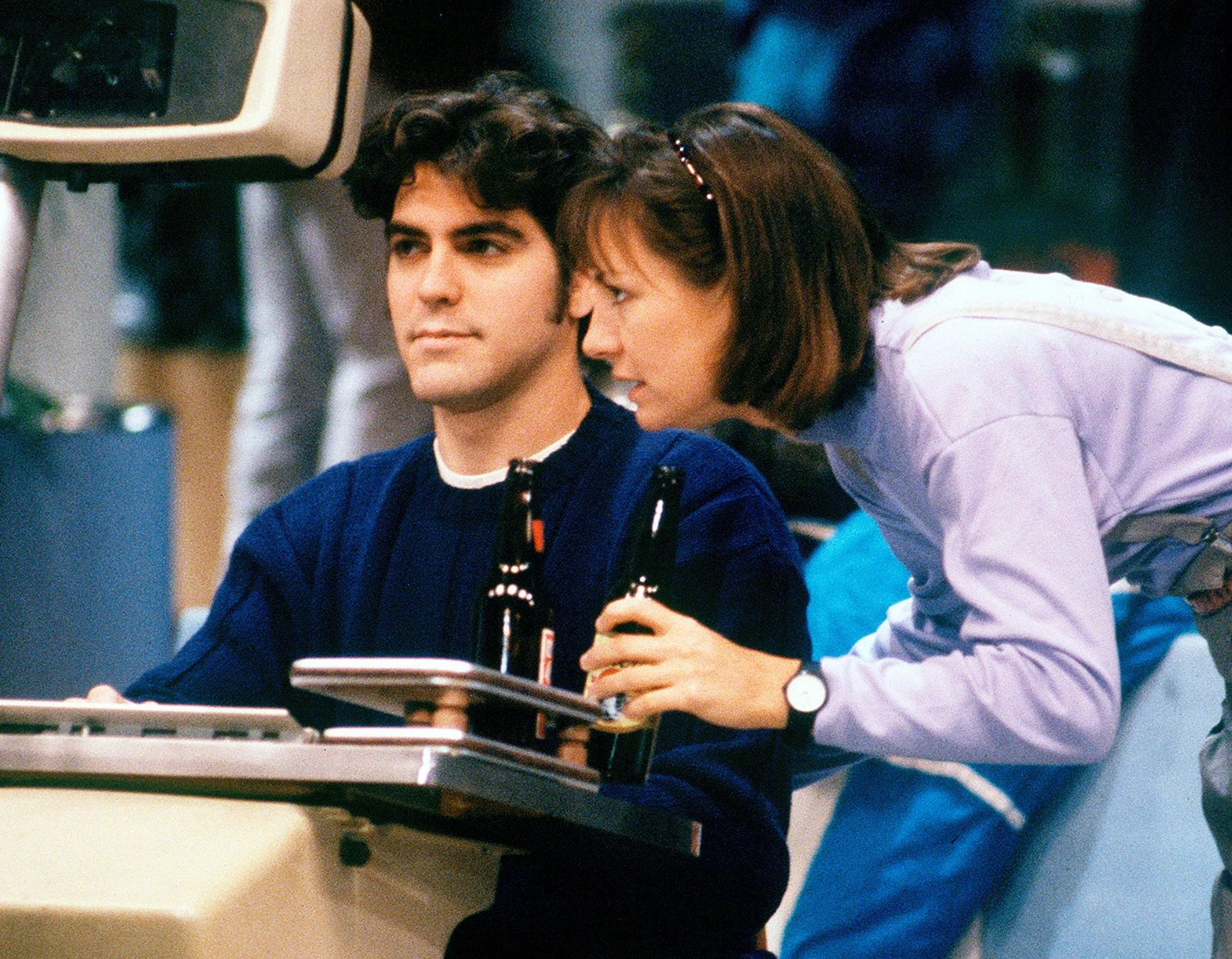
“Lovers’ Lane,” first shown December 6, 1988, takes the family bowling and gives Becky a reason to dread every additional minute. Her crush, Chip, works there. Her family has arrived. The two parts of her life were getting along perfectly well when they occupied different buildings.
A bowling alley is an ideal outing for the Conners. It offers a real social world beyond the sofa without requiring the show to put the family somewhere glamorous. There is a game to play, food nearby, and plenty of opportunity for adults to observe things a teenager would prefer unobserved. Becky can’t make her mother disappear by looking sufficiently appalled. She does try.
The episode gets humor from the different evenings everyone thinks they are having. Becky is negotiating a delicate romantic situation. Roseanne is interested in her daughter and has never signed an agreement to be unobtrusive. Jackie and Booker have their own flirtation to complicate the night. The same place can be a family outing, a date-adjacent experiment, and a tactical disaster without anyone moving very far.
Metcalf and Barr have great comic value in a public setting because their sisterly habits don’t stay politely at home. They talk, notice, and comment. To a younger person hoping for a little mystery, they are a pair of mobile searchlights. The show understands the appeal of both sides: it’s funny watching adults refuse to behave discreetly, and it’s painfully easy to see why the child wishes they would.
The bowling itself supplies the pace of an evening. People have to take turns. They can move away from a conversation, but they are likely to come back. A promising moment has to coexist with everybody else’s shoes, scores, and opinions. Romance is difficult enough without the whole family enjoying a leisure activity in the background.
“Mall Story”: a family outing with no winning side
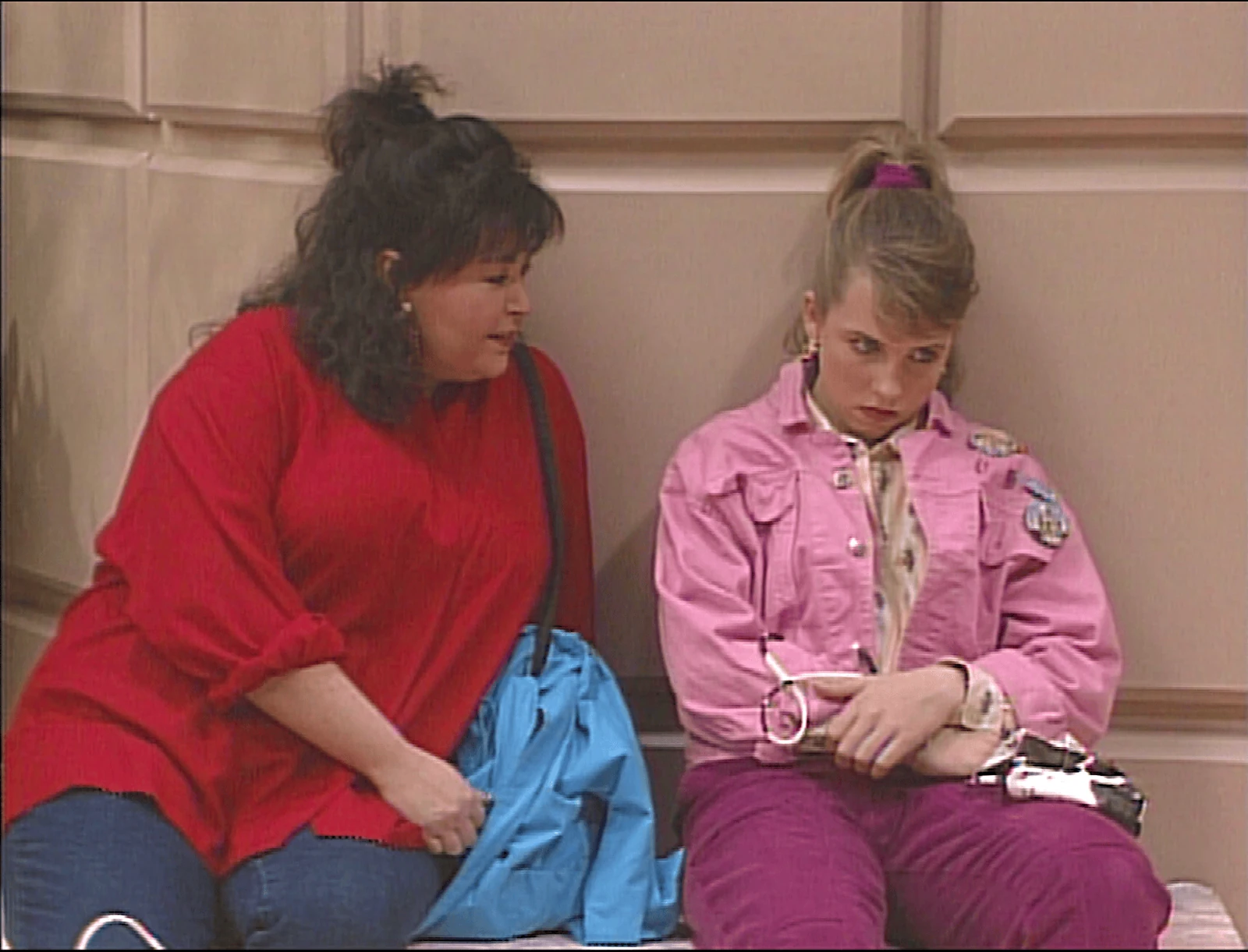
Dan needs shoes. Becky wants a dress. Jackie has questions about her life. Roseanne has somehow acquired responsibility for managing all three situations during a trip to the mall. “Mall Story,” from February 21, 1989, has the good sense to recognize that a shopping center contains several different kinds of dissatisfaction under one roof.
For Becky, a dress is bound up with being seen properly. For Dan, buying shoes is an errand he would prefer to avoid or finish on his own terms. Roseanne can see the practical needs and the emotional ones, which does not magically give her enough money to accommodate them. The family has gone somewhere designed to make people want things. An extremely sound plan for a household trying to watch its spending.
The episode is funny about the machinery of a family expedition. People who arrived together develop separate missions. Somebody waits. Somebody sulks. Somebody thinks the others are making a simple task more complicated. Everybody is correct about at least one part of this.
Its sharper material concerns the cost of keeping the peace. Roseanne understands Becky’s embarrassment, but understanding doesn’t make the purchase painless. Dan’s needs remain real even when a teenager’s wants are louder. The compromise involves giving something up, and the show lets the sacrifice retain its weight.
Metcalf adds another register through Jackie’s restlessness. A mall is full of promises that life might improve if you chose the right thing. That is useful comic scenery for a character wondering what she ought to choose next. The stores can offer plenty of merchandise. Direction is a harder item to find.
Revisited now, the episode’s familiarity comes from the people more than the retail scenery. It catches the peculiar exhaustion of spending a day together while wanting completely different outcomes. The Conners haven’t taken a vacation from their problems. They’ve brought the problems somewhere with more parking.
“Canoga Time” knows the difference between junk and your junk
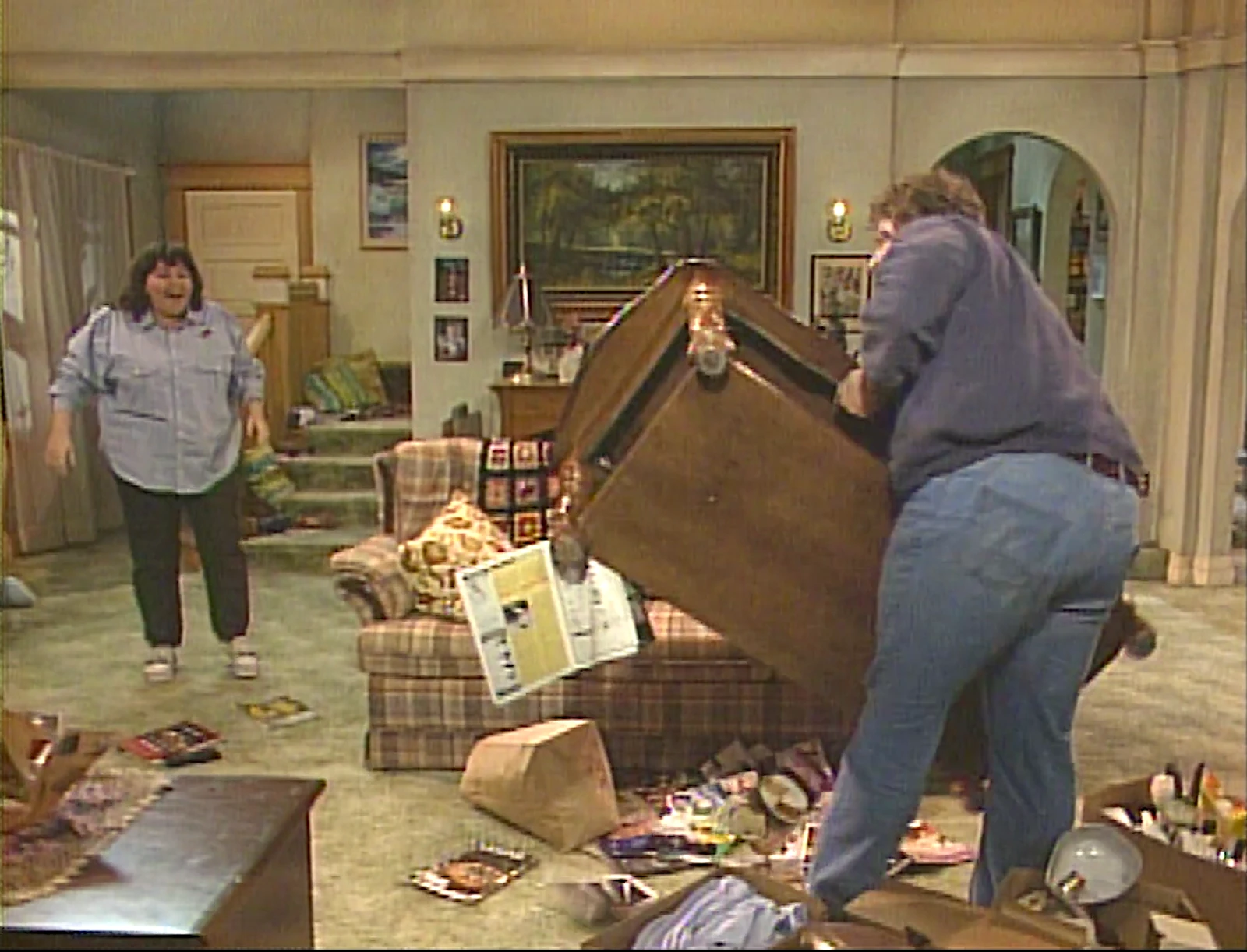
A charity rummage sale gives Roseanne an opportunity to clear things out of the house. Dan sees a more troubling event: somebody has begun discussing his belongings as though their continued existence requires a defense. “Canoga Time,” broadcast January 17, 1989, finds a fine marital argument inside that disagreement.
The object at the center of the title is Dan’s Canoga beer cuckoo clock. From one side, it is clutter. From the other, it is something he likes. Neither position sounds especially unreasonable until the person holding it starts describing the other one’s judgment. Then the room becomes considerably less reasonable.
Goodman is very funny when Dan recognizes a principle just in time for the principle to protect something he wants. Barr gives Roseanne the practical impatience of a woman who would like space in her house and doesn’t believe every object is entitled to a farewell ceremony. The argument works because married people are perfectly capable of valuing entirely different things while believing their own preferences are self-evidently sensible.
The episode also has Darlene trying to alter a report-card result. It’s a smaller domestic scheme unfolding around the bigger one, another reminder that the children aren’t sitting quietly while the adults conduct the week’s plot. They have business of their own, some of it dishonest.
The pleasure is how little the show needs to inflate the situation. A rummage sale has a deadline. The family has objects. The objects have histories, uses, and disputed levels of charm. Everybody is capable of identifying junk when it belongs to somebody else. Roseanne finds a good half hour in the difficulty of applying the same standard at home.
Dan has a song in him. Roseanne would like him to enter it.
“Radio Days,” from November 1988, gives Dan a country-music songwriting contest and gives the marriage a different sound. Roseanne encourages him to enter. There is a possible prize, certainly, but there is also the pleasure of seeing someone you love do something beyond the job that pays the bills.
Goodman’s ease with the material helps. Dan has enough enjoyment in him to make an amateur musical ambition believable. He isn’t suddenly being transformed into a guest star with a special talent. The man who jokes around the kitchen has another way of expressing himself, and his wife is interested in hearing it.
The contest lets the pair be hopeful together. Money usually puts their wishes into competition. Here is a chance to make something, enter it, and imagine an outcome that isn’t another bill. The possibility is modest enough to belong in the Conner world. Nobody has to discover a previously unknown record-company executive in Lanford.
The family still provides interruptions, of course. Becky and Darlene have territorial disputes to conduct. An adult creative project doesn’t suspend sibling conflict, which is unfair but consistent with the general operating principles of the house. Dad can have a dream. The children would appreciate it if the dream didn’t interfere with theirs.
It’s a good early use of Dan because it gives him an ambition that isn’t entirely private. Roseanne’s encouragement makes the song part of their relationship. They can insult each other with impressive fluency, but she still wants him to try something he might enjoy. That warmth gives the sarcasm somewhere to come home to.
Dan’s birthday party acquires an unnecessary fight
In “Dan’s Birthday Bash,” from January 3, 1989, Roseanne plans a celebration at the Lobo Lounge. The evening then develops the sort of complication that makes staying home look like an underrated recreational choice: a barroom bully takes an interest.
Goodman gets a chance to show the pride beneath Dan’s amiability. Dan is a large man who can usually make a situation funny. That doesn’t mean he is free of the urge to prove something when another man tries to humiliate him. Roseanne has a stake in what he does with that urge, particularly because of the promise she expects him to keep about fighting.
The episode’s physical comedy is broad, and its treatment of the confrontation is less subtle than the show’s best domestic exchanges. Still, the disagreement afterward belongs to this marriage. Dan wants his reaction understood. Roseanne wants the consequences understood. They are talking about the same event and assigning importance to different parts of it.
This is where Goodman’s charm becomes useful instead of merely pleasant. The audience can enjoy him and see that Dan’s account of himself isn’t the only valid one. He can be provoked, funny, physically capable, and still someone his wife has a reason to be angry with. The show doesn’t have to drain him of appeal to let her objection stand.
The Lobo is a believable place for their night out: local, familiar, a change from the kitchen without pretending their social life comes with velvet ropes. The celebration gives the series another view of the couple among other adults. They have reputations and habits outside the house. Occasionally those habits walk right up and spoil the party.
“Workin’ Overtime” gives an exhausted woman a chair and a cup of coffee
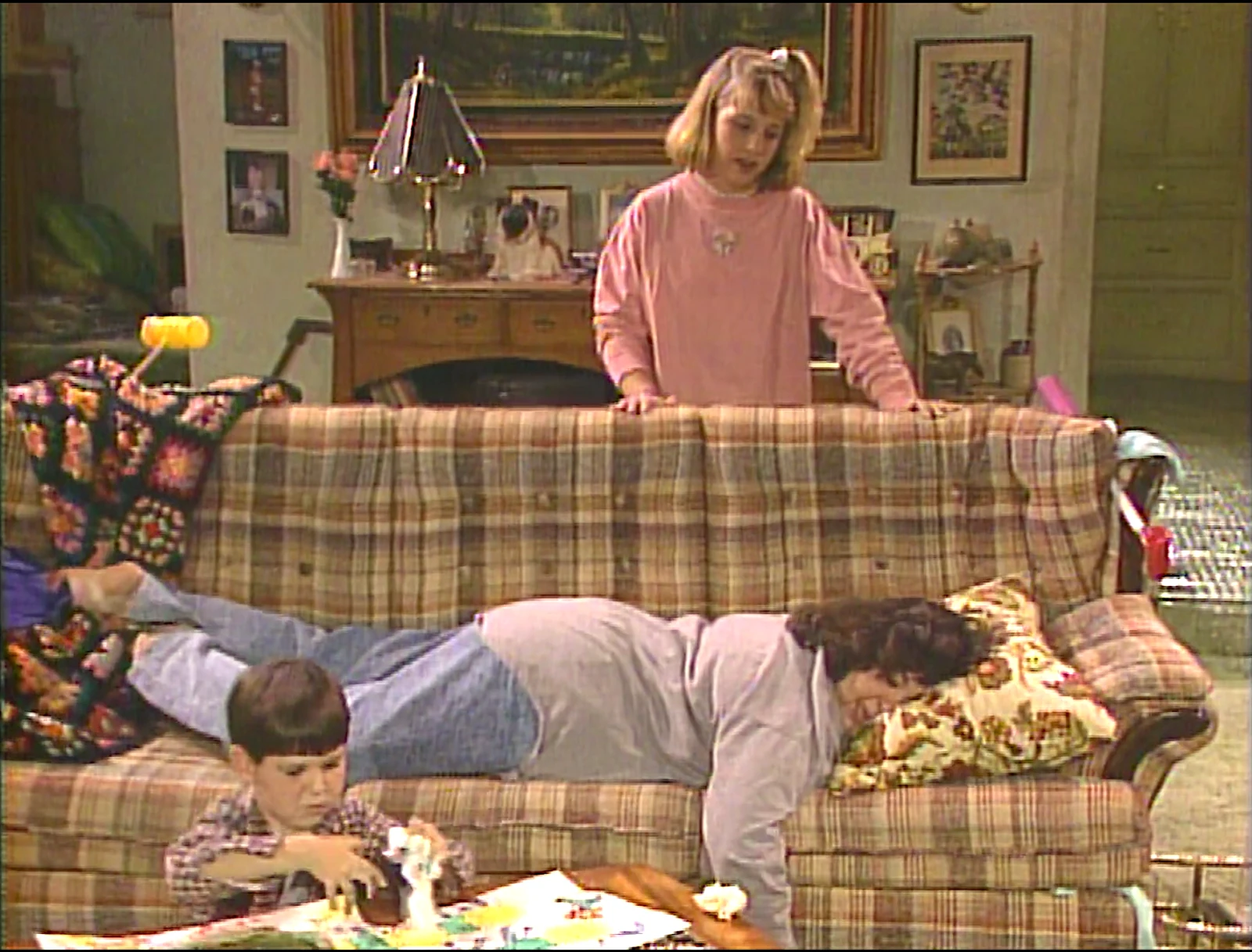
By “Workin’ Overtime,” broadcast March 14, 1989, Roseanne has had enough work at work and enough work at home. Extra shifts bring money into the household and take time and patience out of it. The remaining hours don’t expand politely to make up the difference.
The episode is excellent at the accumulation. One request isn’t outrageous. One mess isn’t a tragedy. Several days of requests and messes can make a woman feel as though the moment she stops moving, the house will begin climbing onto her back. Dan is working too. That fact doesn’t make Roseanne less tired, and pointing it out doesn’t count as clearing anything off the table.
She ends up taking refuge at a diner. The change of setting is almost comically small. She hasn’t left the state, acquired a new identity, or booked a liberating vacation. She has found a place where somebody else is responsible for the coffee. For the moment, that is quite enough distance.
Barr is especially good when the anger starts running out of fuel and leaves fatigue visible underneath. The character can defend herself indefinitely if she has to. The scene allows her to stop doing that for a while. Another woman listens, and Roseanne can speak without every sentence becoming a new assignment.
The conversation introduces loneliness alongside the noise she has fled. That gives the episode an emotional turn, though the device is easier to see than some of the show’s quieter discoveries. A convenient stranger offering perspective is still a convenient stranger offering perspective. What saves it is Barr’s presence and the very believable relief of sitting down.
The return home works best as a resumption of a relationship, not a verdict that she was wrong to need a break. The Conners remain a household with too much to do. Dan’s effort to deal with the mess matters because it is an action, however limited, in the place where she had been asking for help.
The episode catches something family comedies can miss while arranging their next argument: exhaustion changes the way a person hears everything. A harmless comment can arrive as one demand too many. Roseanne doesn’t need to stop loving her family to reach that point. She needs a little room, and for once the show lets her go and find it.
The daughter who was driving you crazy is suddenly in a hospital
“The Slice of Life,” first broadcast March 7, 1989, sends Darlene for an emergency appendectomy after a stretch of conflict with her mother. The change in scale is immediate. The argument that mattered so much a little earlier becomes something Roseanne wishes she could call back and soften.
The episode uses a familiar family-comedy device: a health scare brings affection into focus. It doesn’t become automatically profound because a hospital appears. The worthwhile material is in Barr and Goodman’s reactions, the abrupt loss of their everyday confidence, and the fact that being the parents doesn’t give them control over what happens next.
Roseanne can manage a household crisis by taking charge. At the hospital, taking charge has limits. There are procedures, questions, and waiting. Her impatience still exists, but now fear is moving around inside it. Barr lets the character’s usual equipment remain visible while showing that it isn’t sufficient for this situation.
Goodman is valuable beside her because Dan’s size doesn’t provide an answer either. A man who can fix things and make a frightened child laugh is now waiting for other people to do the work that matters. The couple’s closeness has a different use here. They need company while neither can provide certainty.
Gilbert’s Darlene doesn’t have to become an ideal child to deserve the concern. She remains the daughter who has been difficult, and that is exactly the point of the parental reaction. Love isn’t a prize distributed after several days of good behavior. The family can be furious with someone and frightened for her without pausing to reconcile the feelings.
It’s a more conventional episode than the sharpest school or factory stories. The performances give it value. They bring an established family into the familiar situation, so the worry belongs to people the audience already knows rather than to a lesson the episode has brought along to teach.
“Dear Mom and Dad”: even Roseanne has parents who know how to get to her
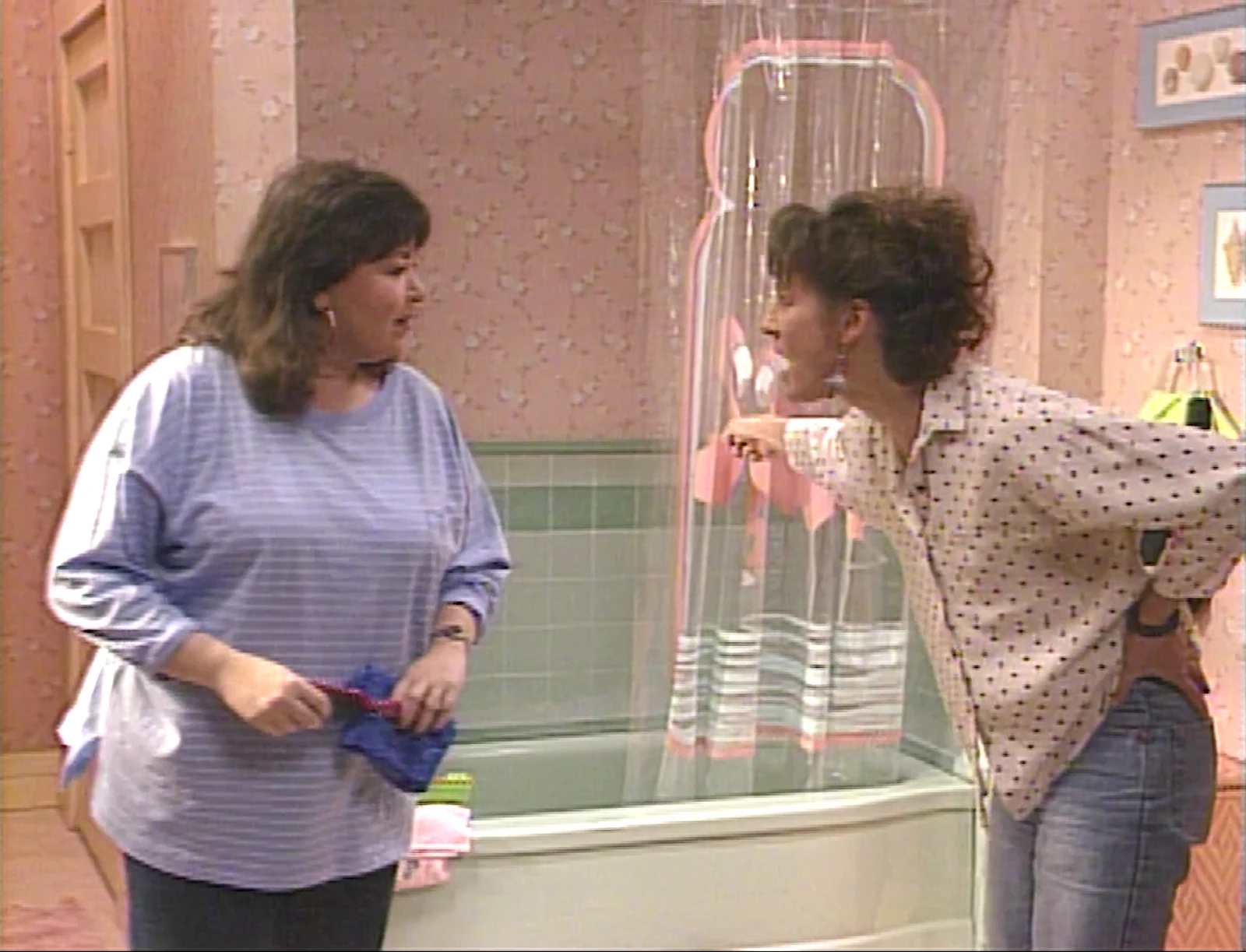
Roseanne and Jackie have spent most of the season demonstrating an impressive command of the cutting reply. Then their parents visit, and the sisters discover that experience has its advantages. “Dear Mom and Dad,” broadcast April 18, 1989, brings Estelle Parsons as Bev and John Randolph as Al into a house that was already fully supplied with opinions.
The arrival rearranges the sisters without requiring a grand explanation. Roseanne can be a wife, mother, employee, and formidable adult, then become somebody’s daughter in the middle of an ordinary conversation. Jackie has her own version of the same problem. The two women recognize the machinery and still find themselves caught in it.
Metcalf is particularly funny when Jackie’s confidence starts changing shape under parental attention. Barr gives Roseanne a different defensive rhythm. Their usual sparring acquires another layer: the person who irritates you at work may also be the only other person in the room who understands precisely why your mother just made you feel twelve.
Parsons has the brightness for that kind of comedy. A remark can sound perfectly cheerful while leaving something bruised behind it. The episode finds humor in the sisters comparing what they have heard and trying to manage the visit without surrendering the whole house.
The story expands the family backward. Roseanne didn’t invent every habit the children now find irritating. She arrived with a history of being irritated herself. That doesn’t excuse everything she does, but it gives the household another generation of comic cause and effect. The Conner children may eventually get their own homes. The show has just demonstrated that a front door won’t necessarily solve the problem.
A tornado is coming. Jackie would like this taken seriously.
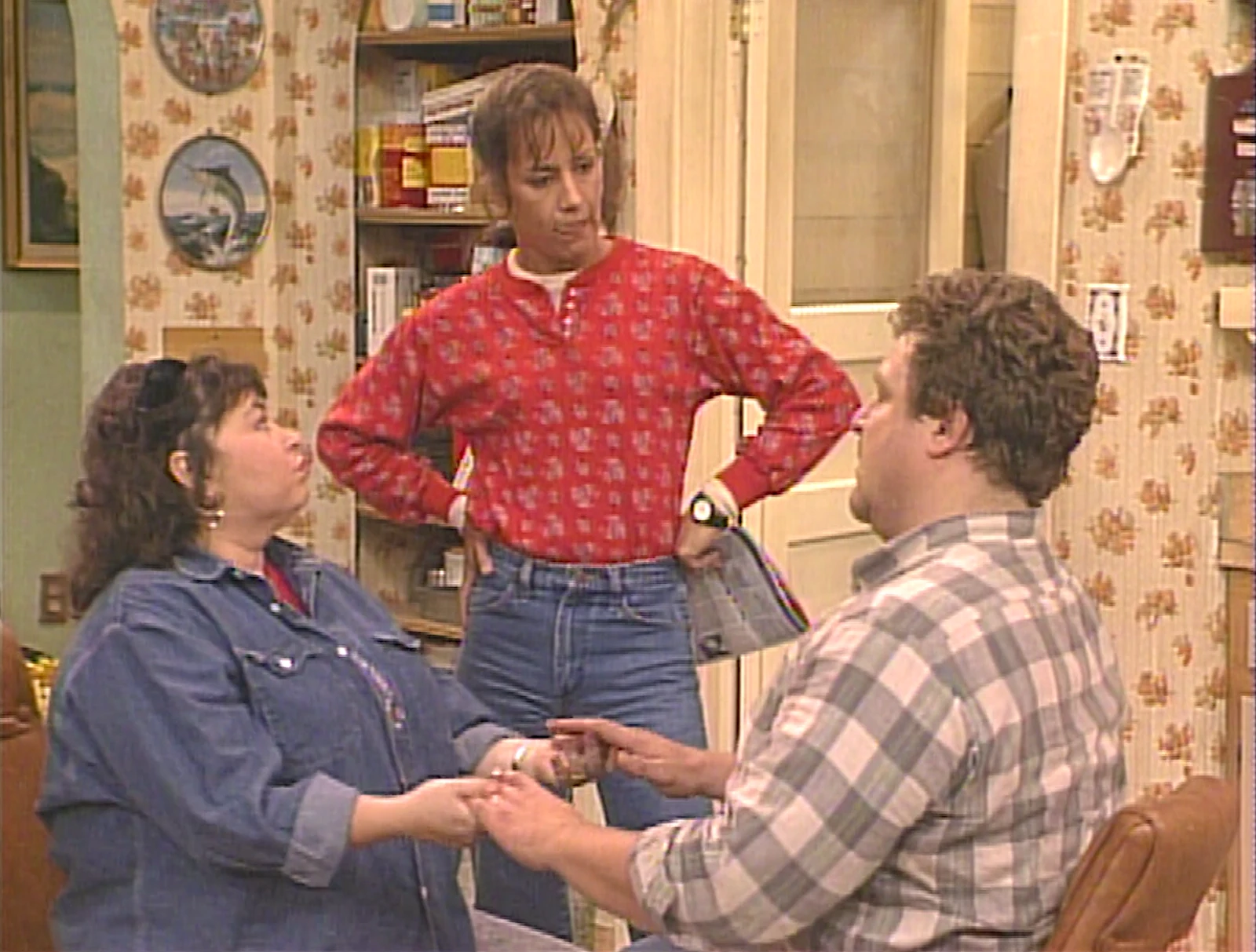
“Toto, We’re Not in Kansas Anymore,” from March 28, 1989, puts dangerous weather outside the house and several incompatible reactions inside it. A tornado threat ought to unite a family around a sensible plan. The Conners do have a plan. They also have personalities, and the personalities insist on participating.
Jackie’s alarm and the couple’s more jocular responses give the episode much of its energy. Metcalf can make worry travel through her whole body. Goodman and Barr have an excellent feel for the infuriating calm of people who think another person’s reaction has become part of the entertainment.
There is a limit to how reassuring that can be. A joke may settle one person and make somebody else feel less heard. The episode makes good use of the difference without turning every exchange into a referendum on the correct emotional response to weather. They’re frightened, amused, impatient, and stuck together.
The house itself helps. This is the familiar place where everybody knows how to annoy everybody else. Now they are using it as shelter. The change gives ordinary family closeness a practical job, even while the old habits continue. Danger hasn’t canceled sibling remarks or the urge to get the last word.
It’s a memorable early episode because the setup is so immediate. The threat is outside. The people are inside. Their responses tell you who they are. No elaborate guest plot is required; the weather has already supplied enough pressure, and the family is more than capable of generating the rest.
A dead salesman is inconvenient. The Conners still have things to do.
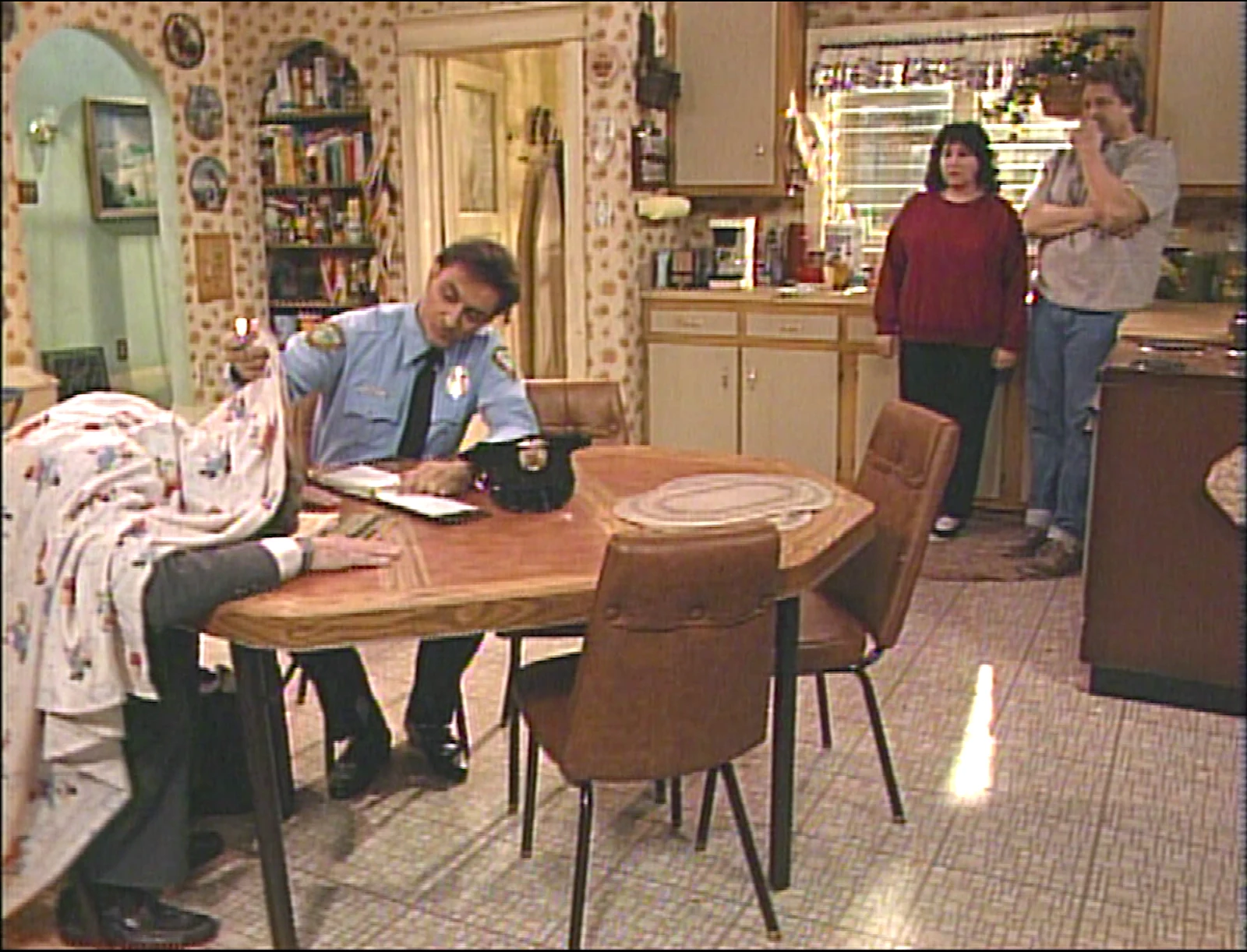
“Death and Stuff,” broadcast April 11, 1989, lets a door-to-door salesman into the kitchen and then has him die there. The family must wait for the body to be collected. It is an extraordinary intrusion into an ordinary day, and the episode has considerable fun with the household’s inability to place ordinary life completely on hold.
This is the first season at its most cheerfully macabre. A dead stranger ought to dominate every thought in the room. Instead, practical problems keep approaching. The refrigerator still needs attention. People still have business. The kitchen has acquired something nobody knows quite how to accommodate, and there is no helpful family routine for this particular situation.
Barr and Goodman are good at the uneasy adjustment between concern and inconvenience. The comedy depends on the characters not being wholly monstrous. They know a person has died. They are also the people who have to remain in the house with the consequences while time passes very slowly.
The episode gets a lot from the familiar set. That table has held arguments, meals, and school trouble. Suddenly the room feels different, though most of its contents haven’t moved. A stranger’s presence makes the Conners’ usual behavior seem indecorous, then the sheer duration of the wait starts making decorum difficult to maintain.
It is broad comedy, and anyone who prefers the show’s gentler family material may find the premise a little much. Fair enough. But the early series benefits from the willingness to be odd. Financial realism doesn’t have to mean a weekly inspection of the checkbook. Sometimes the day is going badly because there is a dead man in the kitchen, and dinner is approaching regardless.
The first season ends with a clock-out that costs something
The season finale, “Let’s Call It Quits,” aired May 2, 1989. At Wellman, a new supervisor named Faber replaces the more familiar Booker and makes the working day harder. Fred Dalton Thompson plays him with an assurance that gives Roseanne very little useful room to maneuver.
The conflict is about the conditions of a job she needs. That keeps the story grounded. Roseanne can be quick with a retort, but a boss controls more than the next exchange. He can demand more work, set the terms, and wait for her to remember what losing a paycheck would mean.
The episode lets her try to manage the situation before making the decisive move. She has practical reasons to stay. So do Jackie, Crystal, and the other women. Knowing a supervisor is being unreasonable doesn’t pay the bills any more effectively than being reasonable yourself.
Barr’s anger works because the series has shown the whole arrangement. We know what the shift takes out of her. We know the family that depends on the wages. Her refusal carries more force than an employee suddenly discovering a perfect speech in the final minutes of a one-off workplace story.
When she quits and the others follow, the action is satisfying without becoming economically weightless. Leaving protects something important and creates another problem. The next stage of life will have to include finding work. The season closes with a woman refusing the terms currently available, not with a new fortune arriving to prove the choice was easy.
It is a strong ending for the first year. The show had made its heroine funny through her refusal to accept nonsense quietly. Now it gives that refusal a consequence. Roseanne’s mouth has been getting her through the week. This time, her feet have to carry her out of the building.
The theme almost sounded too polished for the furniture
Dan Foliart and Howard Pearl’s instrumental theme is one of those 1980s TV openings that announces a place before the episode gets going. The harmonica and saxophone have a loose, earthy confidence. They suit a kitchen where people are going to talk over one another.
Foliart later recalled that their first approach had been an electronic, synthesizer-heavy piece. Matt Williams thought it was too slick. The reworking brought in harmonica and Gary Herbig’s saxophone, putting some grit into the introduction. That is a useful glimpse of a production finding its sound: the right notes also had to belong in the right house.
The result gives the opening energy without making the Conners glamorous. A camera moving around a family table is hardly an action sequence. The music supplies momentum and a little swagger, as if these people are perfectly capable of being interesting before anyone has cleaned up.
The laugh at the end seals the invitation. Barr’s voice isn’t a polite finishing touch; it is the recognizable sound of the star taking pleasure in her own company. Viewers might find it infectious or abrasive. Either way, there is very little chance of confusing the program with the next family on the dial.
ABC didn’t have to wait for America to notice
In the season ending in 1988, NBC’s The Cosby Show was still the family-comedy giant at number one. The Conners were months away from arriving on screen. Their October debut would put them in the following 1988–89 season, where they wasted very little time making themselves comfortable.
By the 1988–89 season’s final standings, Roseanne was second, behind Cosby. ABC had a huge new hit. The Conners hadn’t spent years slowly collecting a loyal audience before the country discovered them. Their first season was already near the top.
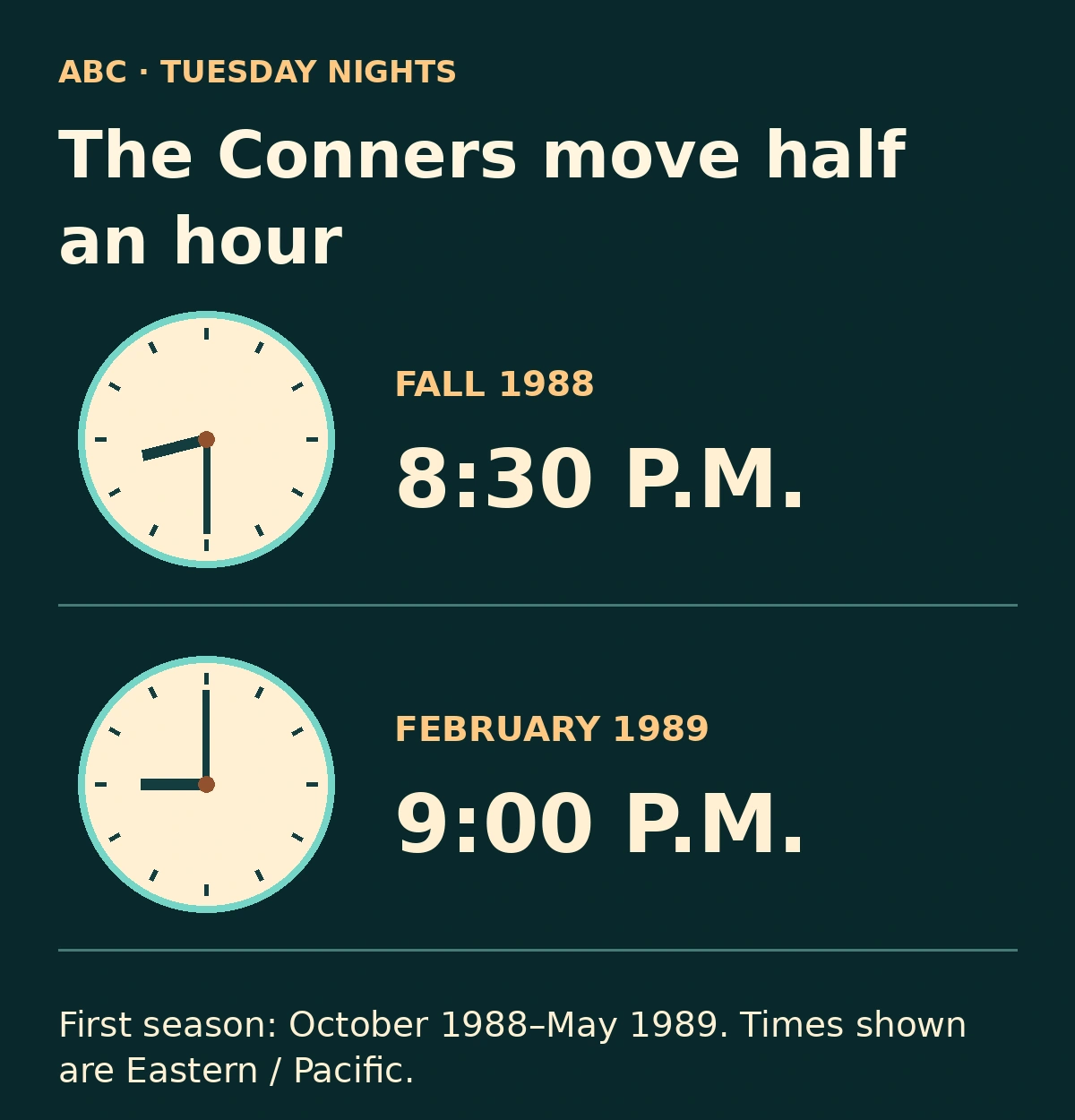
The schedule made the show part of Tuesday-night household viewing. It started at 8:30 p.m., after Who’s the Boss?, then moved to 9 p.m. in February 1989. Half an hour later may sound like a small adjustment now. In a network schedule, it changes what a show follows, what follows it, and the habits viewers build around the evening.
Contemporary enthusiasm wasn’t invented afterward. In his premiere review, Tom Shales welcomed the comedy’s familiar family texture. Viewers were arriving at much the same point by switching on the set.
The first season also earned four Emmy nominations in 1989, including Goodman’s lead-actor nomination. The show didn’t win that year. Awards and ratings were telling different parts of the story, and the audience had already made its preference rather difficult to miss.
Within the larger 1980s television lineup, the success matters because it made room for a household that wasn’t aspirational in the showroom sense. The pleasure was in the people and the recognition. ABC could sell a very large audience an evening with a family who had to think carefully about buying shoes.
A hit comedy, with a less cheerful backstage argument
Matt Williams created the series, with Marcy Carsey and Tom Werner among its executive producers. Barr supplied the central comic presence, and Goodman, Metcalf, the children, and the supporting players turned that presence into relationships. The finished show was a collaboration, however prominent its title made one participant.
The first season also brought a public clash over creative authority. Williams left amid tensions with Barr. The program kept his creator credit. Those two facts belong together: leaving a production doesn’t erase who developed it, and a star’s contribution isn’t measured solely by the wording of a credit.
There is no need to turn the early episodes into a guessing game about which off-screen argument produced which line. The work on screen is available to judge. Some scenes retain the shape of a stand-up routine. Others give the family enough life that the joke feels discovered in conversation.
The cast is what makes that second kind so satisfying. Goodman can give a line a second meaning with a look. Metcalf can complicate a scene by listening. Gilbert can make a short answer feel like a complete position on the matter. Whatever was happening behind the cameras, those performances were building a household with several centers of comic gravity.
The Conners didn’t invent money trouble. They made it their own.
Television had housed families with financial problems well before 1988. Good Times had put bills, work, and family survival directly into its comedy. All in the Family had made a household argument capable of carrying an entire episode. The Conners arrived in an existing neighborhood of television possibilities.
Their freshness came from the particular people occupying the rooms. Roseanne’s practical command, Dan’s warmth and pride, Jackie’s restlessness, and the children’s distinct irritations gave familiar pressures a new rhythm. No family gets interesting merely by having a small bank balance. It gets interesting when the members disagree about how the money should be spent and still want to sit together afterward.
There was room in the same decade for the Seavers of Growing Pains and the Conners. The difference isn’t a contest over which family is permitted to be real. It’s the texture of their days. In Lanford, a supervisor’s demand or an unexpected bill can travel straight into the evening’s plans.
Nor was this the only 1988 arrival finding an audience through family intimacy. The Wonder Years was looking back at an earlier household, with an adult voice giving a boy’s mistakes the shape of memory. Roseanne Conner didn’t have that distance. She was dealing with the mistake right now, and somebody still had to clean it up.
The first year leaves the door open
There is more to the Conners than their initial twenty-three episodes. Their children would grow, the jobs would change, and the household would acquire much more history. The 1990s Roseanne story has its own turns. The 1988–89 debut is worth enjoying before all that later knowledge crowds into the kitchen.
The early series is sometimes broader than its reputation for realism suggests. It has a corpse in the house, a bar fight, and plenty of jokes that announce themselves as jokes. That is part of the appeal. The Conners’ credibility doesn’t depend on behaving as though comedy would be an insult to their circumstances.
The strongest episodes understand what it costs to keep a household moving and how funny the people doing it can be. Dan wants a little pleasure. Jackie wants a future she can recognize as hers. Becky wants her mother to stop looking. Darlene wants growing up to leave the good parts of her life alone. Roseanne would like an uninterrupted cup of coffee.
Nothing there is enormous until it happens in your house. Then a shopping trip can ruin the day, a school appointment can become a battle, and somebody doing one small useful thing can feel unexpectedly loving.
That’s what hit in 1988. The family wasn’t polished, but the affection was convincing. The bills were real enough to spoil a plan, and the jokes were good enough to make the spoiled plan worth watching. The Conners had arrived. They were probably going to need another load of laundry done before bed.
Questions about Roseanne’s first season
When did Roseanne premiere?
The original series premiered on ABC on October 18, 1988. Its first season ran through May 2, 1989, with twenty-three episodes. That fall debut belongs to the 1988–89 television season.
Who played the original Conner children?
Lecy Goranson played Becky and Sara Gilbert played Darlene. Sal Barone played D.J. in the pilot; Michael Fishman took over the role afterward. John Goodman played their father, Dan, opposite Roseanne Barr as Roseanne.
Was Roseanne already number one in its first season?
It finished second in the 1988–89 season rankings, behind The Cosby Show. Its later rise to the top shouldn’t be moved backward into the debut season, which was already an extraordinary success on its own terms.
Where did Roseanne work at the beginning?
She worked at Wellman Plastics with Jackie and Crystal. The first-season finale, “Let’s Call It Quits,” ended that stretch of her working life. Later jobs belong to the family’s continuing story.
Sources & Further Reading
- Original episode dates and first-season guide
- The first-season finale: original broadcast and credits
- 1988–89 season ratings
- Emmy nominations and wins
- Composer Dan Foliart on finding the theme’s sound
- Roseanne theme score: Library of Congress
- Contemporary reporting on the first-year creative dispute