When Fox Became America’s Fourth Network
The stations, the Rivers opening, the first Sunday shows, and the uneven 1986–89 experiment that made a fourth broadcast network real.
A familiar local station, an unfamiliar network, and a few programs that sounded different from the rest of the evening.
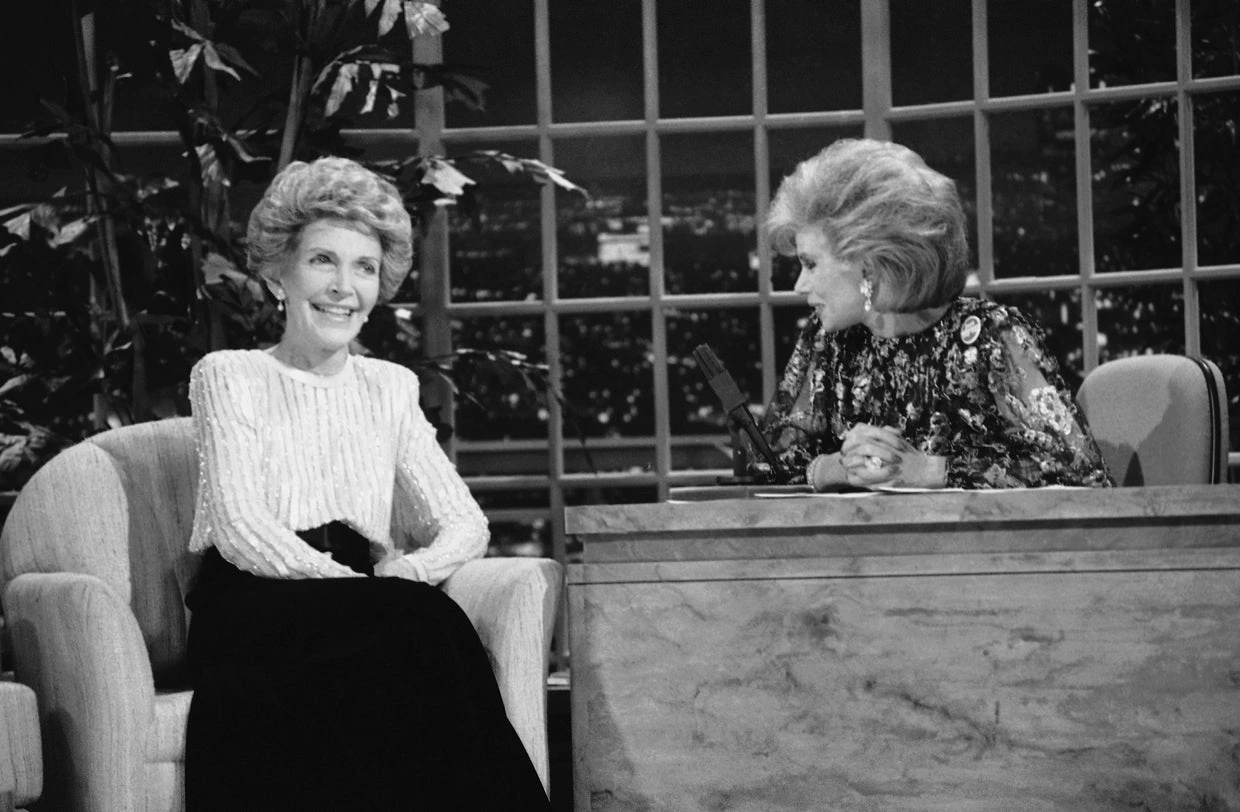
A fourth network sounded like a very large announcement. On the television, it could initially look like a station you already knew doing something unfamiliar for part of the evening. There was no new national dial installed in the living room. A local channel acquired a new promise, and the viewer had to decide whether to believe it.
Fox’s eighties beginning was smaller, stranger, and less inevitable than the later reputation suggests. It started in late night, entered prime time months afterward, and assembled a recognizable personality while the established networks still possessed enormous advantages.
For a Gen X viewer, the result could feel like finding an unofficial room inside ordinary television. The jokes were less reassuring, the lineup was incomplete, and some shows seemed to have arrived from a slightly different broadcasting country.
This part of 1980s TV begins with stations, executives, and a risky late-night launch. It ends in December 1989 with an animated family taking a larger place on the screen. Between those points, Fox had to become something people would actually remember to watch.
Inside This Article
- Three networks had made the map feel permanent
- A studio and a group of stations made the ambition tangible
- Murdoch, Diller, and Kellner did not have interchangeable roles
- The new network arrived through an old local channel
- October 1986 began after the ordinary evening
- A familiar face could open the door without keeping it open
- A network could exist for only part of the week
- April 5, 1987: two programs, more than one chance to sample them
- The Bundys were not there to reassure the household
- Being the alternative meant accepting that some people would object
- Tracey Ullman supplied a different kind of unpredictability
- The first Simpsons were small enough to arrive between other things
- 21 Jump Street gave the young network a young-looking police squad
- Duet complicates the idea that Fox was born with one attitude
- The schedule contained more experiments than the surviving highlights suggest
- Saturday expanded the footprint without completing the week
- A smaller audience could still be an audience worth pursuing
- America’s Most Wanted asked the audience to do something
- Cops brought a camera instead of a fictional detective
- By 1989, another night meant another test
- December 17, 1989: the small yellow family got a full half hour
- Becoming the fourth network did not mean finishing first
- The alternative did not require giving up every old favorite
- The nineties success belongs on the far side of this story
- Getting Fox was not the same transaction as getting cable
- Owned stations and affiliates were two parts of the same reach
- Before a new habit, somebody had to find the listing
- It became a network when people remembered to come back
- Questions from the fourth-network beginning
Three networks had made the map feel permanent
For a long time, the Big Three sounded less like a description of television and more like a rule. ABC, CBS, NBC: three names you heard in the commercials, three logos on the evening news, and three networks adults argued about when the prime-time schedule came out. There were independent stations and plenty of other television choices, but a fourth national broadcast contender still sounded like somebody was trying to add another day to the weekend.
That did not mean they were the only television available. Independent stations, public television, local programming, cable, and recorded video all complicated the picture. A viewer could have many choices without seeing another organization that looked like a direct fourth member of the established broadcast group.
The distinction matters because Fox was not inventing the idea of distributing programs to stations. Syndication already did that, and broadcasting had earlier networks and many previous attempts to challenge the dominant arrangement.
The phrase fourth network describes Fox’s effort to build a durable national alternative to the Big Three in this particular period. It should not be expanded into a claim that no American television network had ever existed before ABC, CBS, and NBC, or that no other company had ever tried.
For a household, the old arrangement could feel almost natural. A favorite comedy belonged to a familiar channel. The local news came from people whose faces were known. The network identity appeared between programs often enough to become part of the room’s background knowledge.
A challenger had to enter that habit. It needed stations to carry its programming, programs to justify carriage, advertisers to support the effort, and viewers willing to discover it. Each piece made the others more plausible, which was awkward when several pieces were still being assembled.
That is why Fox’s story begins before the first show. Announcing a network was an act of ambition. Making the announcement mean something on an ordinary Sunday evening required a much more concrete collection of assets, agreements, and choices.
A studio and a group of stations made the ambition tangible
Rupert Murdoch’s 1985 acquisition of Twentieth Century Fox connected his media business with a major Hollywood studio. The acquisition of six Metromedia television stations supplied another essential piece: a group of outlets in important American markets.
The six markets were New York, Los Angeles, Chicago, Washington, Houston, and Dallas. That footprint mattered because a national television ambition needed actual places where its programs could appear. A studio library and a corporate name were valuable, but they did not themselves put a new network into every household.
The station group also offered a practical base for building relationships beyond the owned outlets. A network could seek affiliates in other markets rather than attempting to buy a station everywhere it wanted viewers.
The combination did not remove the difficulty. The acquired stations had existing schedules, viewers, local identities, and businesses. Other stations had their own reasons to consider or resist the proposed programming. The new organization had to offer something useful rather than merely assume that the word network would settle the question.
It is easy to compress this stage into a corporate origin sentence and rush toward the shows. Yet the stations explain how the idea could become a service. A viewer’s eventual encounter with Joan Rivers or the Bundys depended on a local outlet choosing or being positioned to carry them.
The acquisitions also clarify the relationship between the studio and the broadcaster. They were connected parts of the developing enterprise, not interchangeable words. Producing or owning entertainment and distributing a national network schedule were related activities with different practical demands.
In the eighties, the venture joined Hollywood material, station ownership, executive judgment, and a large appetite for risk. The first television programs would make the enterprise visible, but the less glamorous work of assembling the route to the screen had already begun.
Murdoch, Diller, and Kellner did not have interchangeable roles
Murdoch supplied ownership and the larger corporate ambition. Barry Diller, as Fox’s chairman and chief executive, was central to turning that ambition into a broadcasting operation. Jamie Kellner became the first president and chief operating officer of Fox Broadcasting.
Those titles belong to a story involving many people, rather than to a three-person explanation of every program that appeared. Programming executives, station managers, producers, performers, writers, sales teams, and affiliate staff all had work that could not be accomplished by a dramatic announcement from the top.
The leadership nevertheless mattered because the project required decisions before a reassuring pattern of success existed. A new venture had to choose what kind of television to offer, how quickly to expand, and which risks were worth accepting.
Diller’s Television Academy tribute describes his role in taking Fox from an experiment toward a lasting fourth network. Kellner’s Academy biography identifies his operating role and association with the development of programs that became important to the company. Their later achievements should not be used to make the first decisions look effortless.
A new network had competing needs. It wanted attention, but attention to a failed program could make the whole enterprise look fragile. It wanted a distinct personality, but a personality that repelled every available advertiser would not solve the business problem.
It also needed patience without unlimited time. Stations had schedules to fill and viewers to serve. The venture had to demonstrate progress while learning what its audience might actually be.
For the person holding the remote, this management work was mostly invisible. What appeared was a show, a promotion, or a new network name on a familiar station. The leadership would be judged through those small encounters, one of which could be dismissed in the time it took to change the channel.
The new network arrived through an old local channel

For many households, Fox didn’t arrive with a technician or a shiny new box. It arrived on a station that had already been showing reruns, movies, cartoons, or whatever the local schedule could hold together. Then, at certain hours, the familiar channel began announcing itself as part of something new. The dial hadn’t changed. What the channel was trying to be had.
The network identity therefore arrived inside an existing relationship. A channel that had previously meant one collection of programs could begin offering Fox at particular times without surrendering every other part of its schedule.
That distinction helps explain why the launch could be confusing in memory. A viewer might remember when a station started calling itself Fox, when a particular Fox show appeared, or when the household first noticed the network. Those dates need not be the same.
The affiliates were not identical pieces in a national machine. Local ownership, technical arrangements, existing commitments, and market conditions shaped what the viewer received. A claim about one station’s exact schedule should remain attached to that station and date.
Some outlets were on UHF, where a household’s reception and equipment could affect the experience. The network’s owned stations also included familiar VHF channels. It would be wrong to describe the entire venture as though every viewer had to discover an obscure high-numbered station with a poor picture.
The broader challenge was awareness. A program could be available without becoming a habit. The station and the network needed viewers to know not only that Fox existed, but where to find a particular show at the right time.
That gave local promotion real importance. A station’s audience was a starting point from which the new network could grow. Fox was building national recognition by entering many specific local routines, each with its own channel number, familiar announcers, and existing reasons for viewers to tune in.
October 1986 began after the ordinary evening
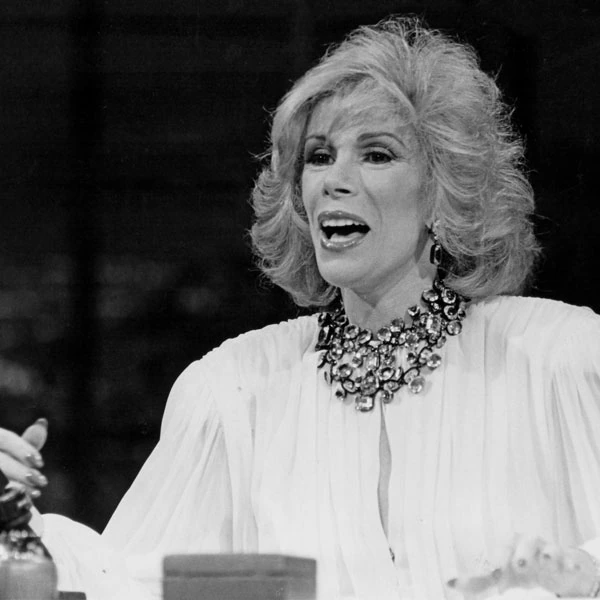
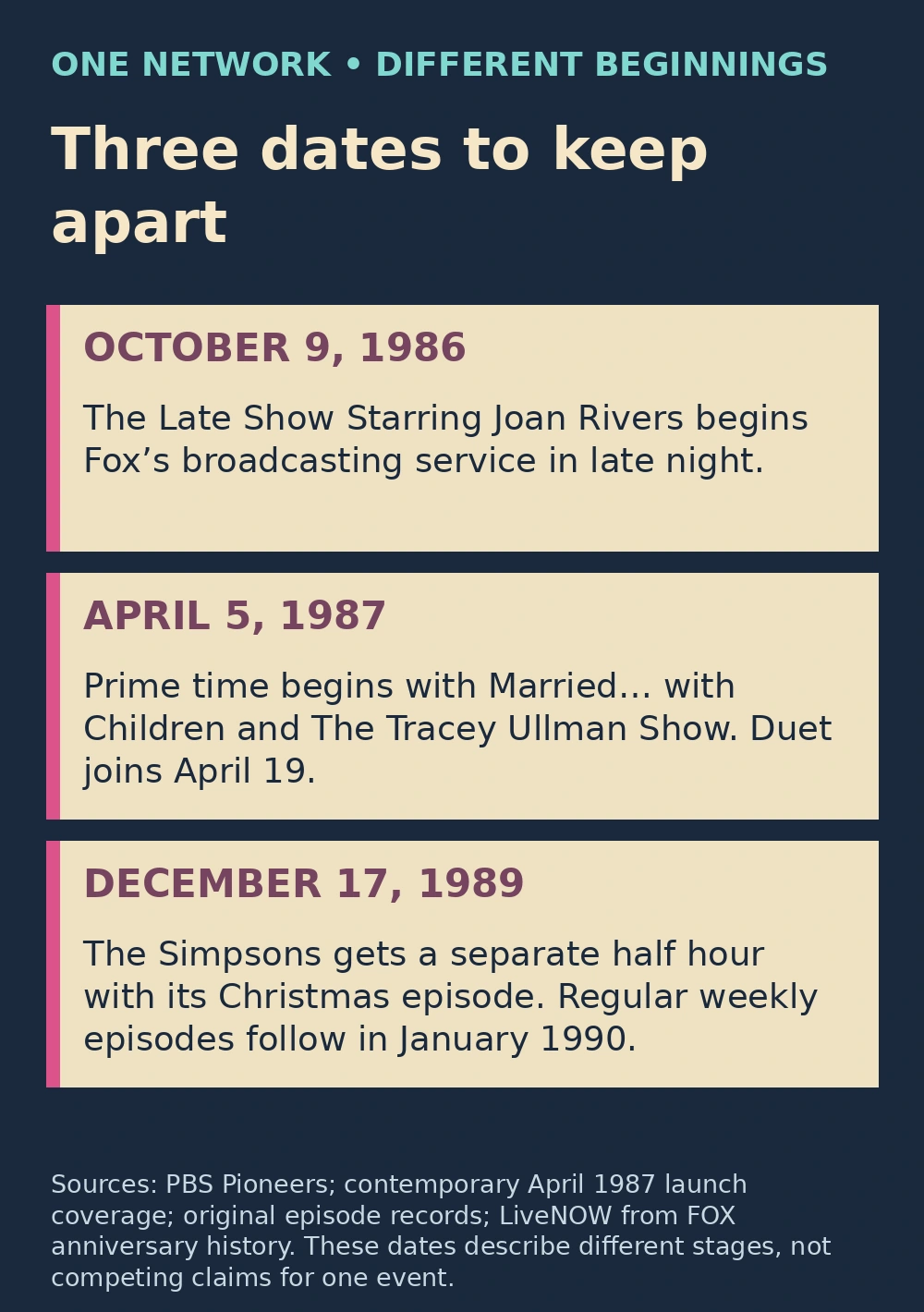
Fox first opened for business in late night. The Late Show Starring Joan Rivers premiered on October 9, 1986, several months before the network’s April 1987 prime-time debut. If you remember Fox arriving with the Bundys, you’re remembering an important second step, not the first one. The new kid on the broadcast block began after a lot of households had already turned out the lights.
The distinction is essential. Calling April 1987 Fox’s first appearance erases the late-night effort. Calling October 1986 the beginning of a complete prime-time schedule gives the launch more programming than it actually possessed.
Rivers was a highly visible choice because audiences knew her as a comedian and as a frequent guest host for Johnny Carson. A familiar performer could attract attention to a new operation faster than an unfamiliar corporate identity could attract attention by itself.
The placement also made strategic sense as a point of entry. Fox could offer a recurring program outside the main prime-time hours rather than immediately fill an entire week of evening entertainment. That limited the initial scope while making the venture unmistakably real.
For viewers, the first encounter carried a mixture of familiarity and disruption. The host was known. The network was new. A form associated with established television was being used to challenge the established television arrangement.
The 1985–86 broadcast season, which had ended earlier that year, provides the competitive background. NBC had just won the prime-time race. Fox entered a world in which the strongest incumbent had recently completed a major recovery, not a world waiting politely for the old networks to leave.
The first program therefore had to carry more symbolic weight than an ordinary new talk show. Its success or trouble could be read as evidence about whether the larger network idea deserved confidence. One host was standing in front of a much bigger question.
A familiar face could open the door without keeping it open
The publicity around Rivers made the new network difficult to ignore. Her move also involved a highly public break with the Tonight Show world that had helped make her such a recognizable television figure.
That personal and professional drama generated attention, but attention was only the first requirement. The program still had to work night after night. A late-night habit is built through repeated encounters, a host’s relationship with guests and viewers, and the sense that returning tomorrow might be worthwhile.
The show’s October 1986 appearance by Nancy Reagan illustrates the scale of attention it could seek. The first lady sitting with Rivers made the program a venue for a nationally recognizable guest, not merely an obscure experiment on unfamiliar stations.
The photograph belongs to that specific Fox program and date. It should not be confused with Rivers’ later syndicated daytime show, which was a separate production and a different stage of her career.
The initial late-night venture did not become the stable foundation Fox had hoped for. Rivers’ tenure ended in 1987, and the program went through changes afterward. The network survived the disappointment, which is important to the larger story.
A new operation had attached itself to a famous performer and still encountered the basic difficulty of television: people have to want the actual program, repeatedly, at its actual hour. The announcement cannot substitute for the habit.
For Fox, the experience supplied an early warning against confusing visibility with durability. It also showed that a failed first approach did not necessarily require abandoning the entire enterprise. The next phase would move into prime time with different kinds of programs and a more obviously unusual personality.
A network could exist for only part of the week
Here was the wonderfully odd part: Fox was a network you couldn’t necessarily watch every night. The local station might carry Fox’s new shows for a few hours, then go back to its usual mix. Anybody raised on the Big Three’s sprawling schedules had to adjust to a smaller idea of a network—one that was trying out its identity while the rest of the week was still somebody else’s business.
That partial presence was not an accidental blank to be concealed. It was part of the way the venture developed. The network could add a limited amount of programming, test the response, and expand instead of attempting to duplicate the Big Three immediately.
For an affiliate, that arrangement meant weighing the offered programs against material the station might otherwise show. The decision was practical. A network name mattered only if the programming and business relationship gave the station reasons to participate.
For a viewer, it meant Fox might seem prominent on a particular evening and absent from the rest of the week. The station did not disappear when the network stopped supplying shows. It simply continued being a television station.
This is also why a count of channels does not explain a count of networks. One local channel could carry syndicated material, movies, local programs, and a limited Fox schedule. The household saw a continuous day of television assembled from several sources.
The arrangement gave the newcomer a route into an already crowded medium. It did not eliminate the need to make its limited hours distinctive. A small schedule can focus attention, but it can also be overlooked if viewers never learn when it exists.
Fox had to teach the audience a new appointment before it could become a broad habit. In the first prime-time phase, that appointment would be Sunday, and the opening night would make remarkably determined use of a very small amount of new television.
April 5, 1987: two programs, more than one chance to sample them
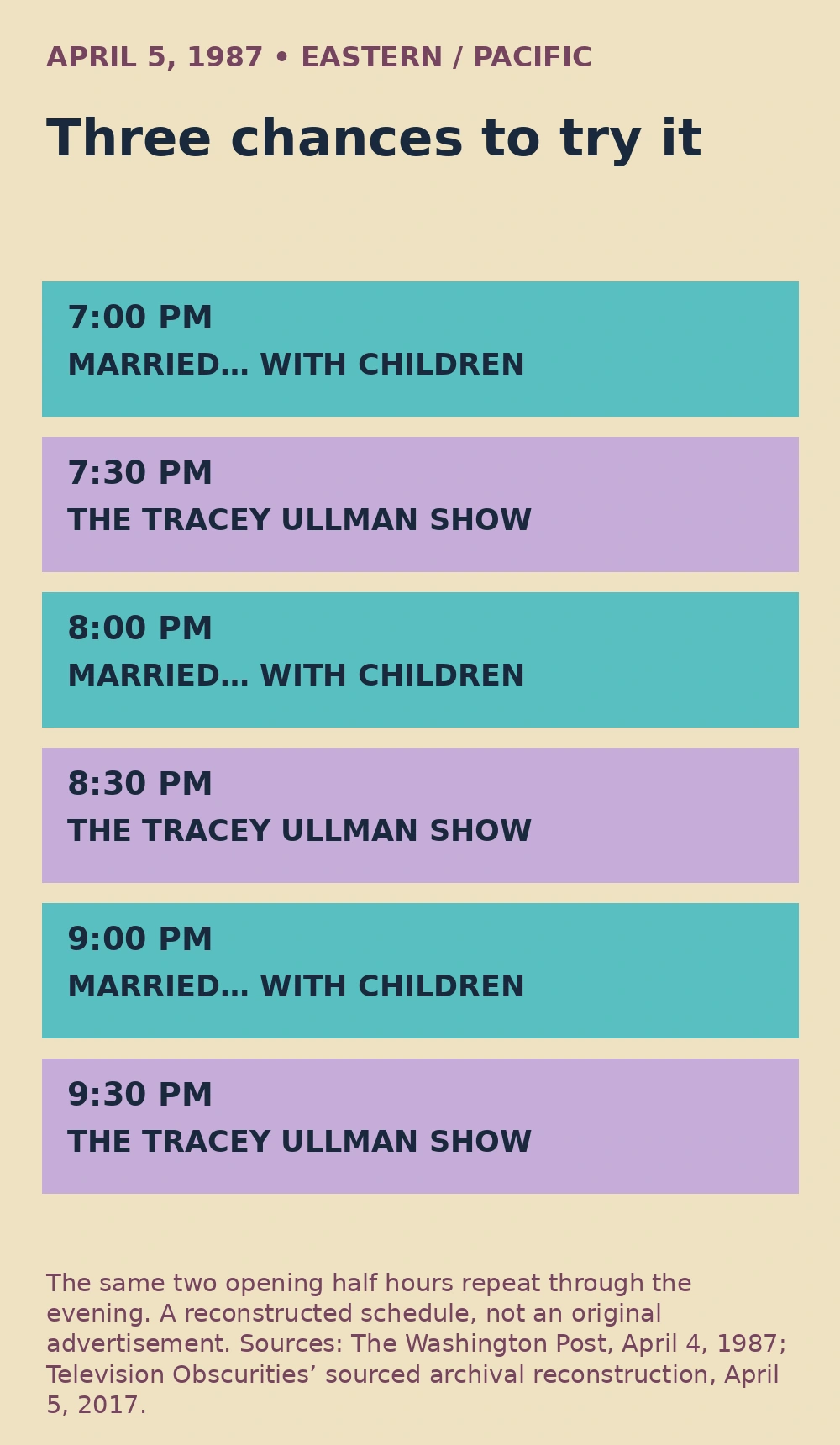
Fox entered prime time on Sunday, April 5, 1987, with Married… with Children and The Tracey Ullman Show. Those were the two opening programs. Duet joined later that month, and 21 Jump Street arrived the following week.
The first evening repeated the two new half hours in successive pairs. A viewer who missed the first showing had another opportunity to sample the same introductions. The strategy made a modest amount of original material occupy a larger stretch of the night.
It was a very different sort of launch from unveiling an entire finished week. Fox was asking people to try a small collection of unfamiliar programs, learn where to find them, and consider returning.
The repetition also made the network’s limitations visible. Someone who had already watched both shows could encounter the same material again. The venture needed sampling more urgently than it needed to pretend it possessed a deep opening library of new prime-time episodes.
That smallness is part of the period’s character. A future major broadcaster was still a new name attached to a few hours, a few titles, and a large amount of confidence. The household had no obligation to respect the confidence.
The 1986–87 season standings describe the broader broadcast competition into which Fox’s prime-time effort arrived. They are context for the established television world, not evidence that Fox’s first programs instantly occupied its top ranks.
The opening night offered a more immediate test. Could the unfamiliar material make somebody stop changing channels? Could it feel different enough to remember? Could a network with so little programming give the audience a reason to recognize its name the next time it appeared?
The Bundys were not there to reassure the household

Married… with Children wasn’t interested in reassuring anybody that a sitcom family would work out its problems over a polite conversation. Al came home disappointed, Peggy had other plans, and the kids supplied fresh reasons to abandon hope. If your parents loved the wholesome family hour on another network, Fox had just handed you a program likely to start a spirited argument about what belonged on television.
That attitude was central to the new network’s identity. Fox could not easily compete by appearing to be a slightly less established version of everything the major networks already offered. A comedy willing to be abrasive supplied a sharper reason to notice the difference.
The contrast with successful family sitcoms was visible without requiring a direct one-to-one parody. A viewer accustomed to the affectionate arguments of Family Ties could recognize that the Bundy house was making a different bargain with its audience.
Its humor could be broad, crude, and deliberately unkind. That was part of the attraction for some viewers and a reason others disliked it. A network trying to become memorable could benefit from strong reactions, even though strong reactions also created business problems.
The series did not need to convince the whole country at once. It needed enough viewers who wanted that particular version of domestic comedy to make returning worthwhile. A smaller broadcaster could build identity through a more pointed appeal.
The living room therefore became a site of another generational negotiation. A teenager might enjoy the refusal to behave. A parent might find the same jokes tiresome or objectionable. The program could make Fox feel like a destination associated with a different set of permissions.
That feeling was a beginning, not proof of immediate dominance. The Bundys became important because the program lasted, developed an audience, and remained identifiable. The first night supplied a premise and an attitude. The subsequent years had to turn those into a network asset.
Being the alternative meant accepting that some people would object

A television brand built partly on irreverence cannot be understood only through the viewers who enjoyed it. The same material that made Fox distinctive could make it controversial, uncomfortable, or simply unwelcome in another household.
Married… with Children’s complaints and insults were not neutral decoration. They helped define the relationship between the show and the respectable family-comedy world around it. The viewer was being invited to laugh at behavior that other programs might soften or resolve more reassuringly.
That distinction could attract an audience tired of television that seemed to know the moral before the first commercial break. It could also alienate viewers who wanted a comedy to provide affection without requiring them to sit through quite so much contempt.
The network had to exist between audience identity and commercial support. A provocative program can generate recognition, but recognition alone does not pay production costs or secure every advertiser. The tension was part of building a viable alternative.
It would be too simple to describe the early Fox audience as all young people or all rebels. Viewers have varied tastes, and a person can enjoy an abrasive sitcom one night and a comforting traditional comedy another.
The useful point is about choice. Fox offered a different tone within broadcast television. A viewer did not need to reject every established network in order to appreciate that another kind of program now had a conspicuous home.
In that sense, the newcomer changed the map before it changed the rankings. Its existence made the range of acceptable prime-time personality feel wider. Whether that personality was welcome remained a perfectly legitimate argument to have in front of the same television.
Tracey Ullman supplied a different kind of unpredictability
The Tracey Ullman Show began on the same April 5 evening as Married… with Children. Its sketch, music, and character work offered a different explanation of what the new network might be.
Where a sitcom returned to a stable household, Ullman’s program could move among people, situations, and performance styles. The star’s transformations were part of the attraction. A viewer might not know exactly what the next piece would look like.
That variety mattered to Fox’s identity. The network’s alternative personality was not confined to one family making rude jokes. It could also include performance-driven comedy that rewarded curiosity about unfamiliar characters and forms.
The program assembled a creative setting in which short animated material could appear among the live-action work. The Simpsons shorts became the most consequential example in retrospect, but they were one part of the program rather than an independent half-hour series at its launch.
For the person watching at the time, the experience did not arrive with a label announcing which element would become a long-running institution. A short could be amusing without looking like the future center of a major television business.
That uncertainty is worth preserving. Ullman’s show had a contemporary identity of its own, not merely the supporting function of introducing another property that would later become more famous.
For Fox, the series contributed creative distinction and another reason to associate the new network with something less predictable than the familiar broadcast routine. The value of that distinction extended beyond a single week’s ratings, even though the business still needed viewers to keep finding and watching the actual show.
The first Simpsons were small enough to arrive between other things
The Simpsons were there before The Simpsons was a half-hour television institution. In 1987 the family turned up in short animated segments on The Tracey Ullman Show—brief, scratchier visits that were easy to miss if you weren’t paying attention between sketches. Nobody sitting there had the benefit of knowing what Homer, Marge, Bart, Lisa, and Maggie would eventually become. They were just another surprising thing Fox had slipped into the schedule.
The shorts gave the family a setting in which an audience could encounter its relationships quickly. Parents, children, irritation, fear, and everyday conflict could be compressed into a brief piece without the demands of sustaining an entire half hour.
That form also created room for experimentation. The characters’ visual presentation and comic rhythms developed over time. A surviving early short is an artifact of that stage, not a faulty version of a later episode that needs to be silently improved.
For Fox, this was another benefit of supporting a program with a broad creative format. The network could acquire something valuable through material that did not begin as the main attraction in its own time slot.
It is easy now to watch those early appearances with all the later knowledge already attached. A viewer in 1987 did not know how long the family would last, how many episodes would follow, or how thoroughly the yellow faces would enter popular culture.
The relevant excitement is smaller and more interesting. Something strange and funny appeared inside a new network’s sketch show. People could notice it, remember it, and eventually want more.
The separate series would not arrive until the very end of the decade. Keeping that delay visible protects both stories: the original program that gave the shorts a home and the later step that asked the animated family to carry an entire broadcast half hour.
21 Jump Street gave the young network a young-looking police squad

21 Jump Street premiered on April 12, 1987. Its premise placed youthful-looking police officers in investigations involving young people, giving Fox a drama whose setting and performers could speak more directly to a younger audience than another variation on a veteran detective’s office.
The central idea was immediately understandable: officers who could pass for students entered situations where ordinary adult authority might not move as easily. The premise created tension between an undercover role and the person carrying it out.
Johnny Depp became one of the series’ most visible performers, alongside an ensemble that included Holly Robinson, Peter DeLuise, and Dustin Nguyen. The network benefited from a program whose people could become recognizable attractions beyond a single episode’s case.
For a teenage viewer, the appeal could be complicated. The show entered schools, friendships, social pressures, and danger through a police framework. It could appear closer to young people’s world while still organizing that world around adult institutions and dramatic consequences.
The result offered Fox another kind of identity. The network was not limited to irreverent comedy. It could supply an accessible drama with young performers and a premise easy to explain to someone who had not yet found the channel.
That ease of explanation was useful in the early years. A viewer could tell a friend what the show was about without first explaining the corporate history of a fourth network. Interest in the program could carry the network name with it.
The series also supplied material from which Fox could later extend its programming. Booker, featuring Richard Grieco, arrived in 1989 as a spinoff. That development belonged to a broadcaster beginning to build connections among its own attractions, rather than merely introducing isolated experiments.
Duet complicates the idea that Fox was born with one attitude
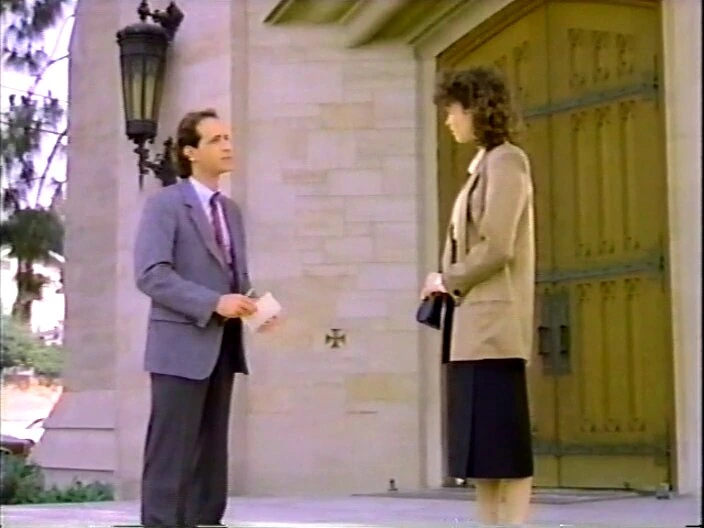
Duet premiered on April 19, 1987, two weeks after the prime-time opening. Its romantic-comedy approach belongs in the story because the new network did not begin with a perfectly unified personality in which every series sounded like Married… with Children.
A developing relationship supplied a different kind of continuity. Viewers could return to see how two people moved through attraction, misunderstandings, and the ordinary negotiations of becoming a couple.
Mary Page Keller and Matthew Laurance were central to that appeal. The show asked for interest in adults and relationships rather than relying entirely on a provocative premise or an unusually loud comic household.
For Fox, that was another test of what the available audience might want. A newcomer had reason to explore several approaches while learning which programs viewers would associate with it.
It is tempting to remove the less durable titles from the history so the brand appears to have known itself from the first evening. Duet is a reminder that identity develops through actual choices, including choices that do not become the most frequently replayed symbols of the network.
The romantic comedy also made the opening lineup less simple. A viewer attracted by one show could encounter another with a different tone. Remaining on the channel did not always mean receiving another version of the same joke.
That range belongs to the venture’s early uncertainty. Fox was not merely executing a finished cultural personality. It was testing programs in front of an audience, discovering which kinds of distinction helped, and gradually learning which of its possible selves people were willing to revisit.
The schedule contained more experiments than the surviving highlights suggest

Fox wasn’t born with a perfect lineup; it had to try things. Werewolf, The New Adventures of Beans Baxter, Mr. President, Women in Prison—those titles sound like someone emptied a very unusual development drawer onto the conference table. Some experiments vanished quickly. A few ideas stuck. That’s what makes the early schedule more interesting than a tidy montage of the hits we still recognize.
Those titles show the range of the search. Horror, youthful adventure, a presidential comedy, and a prison sitcom were not all versions of a single carefully proven formula. The network was trying to locate programs that could attract attention and work within its developing schedule.
Some premises were conspicuous enough to make a promotion memorable even if the series itself did not become a long-running success. A child might remember an image, a title, or the fact that a program once existed without remembering a single complete episode.
That partial memory is an honest part of early Fox. The network could feel unusual because the familiar and the unstable appeared together. A program someone liked might remain; another could vanish before a household had learned when it was on.
The failed and short-lived choices also expose the risk hidden by the eventual success story. Viewers were not obligated to reward the novelty of a new network. A program still had to find an audience willing to return.
Nor did a failed show necessarily invalidate the whole operation. The network could replace a title, revise an evening, or try another approach. Surviving that process was part of becoming durable.
Looking only at the later institutions would turn the launch years into a parade of obvious winners. The actual schedule was more awkward and more interesting: some future fixtures, some plausible experiments, some peculiar ideas, and a broadcaster trying to make enough of them work at the same time.
Saturday expanded the footprint without completing the week
Fox added Saturday prime-time programming in 1987. That expansion gave the network another evening in which to build recognition, while leaving it far short of a complete seven-night prime-time schedule.
The distinction between expansion and completion is easy to lose. A new night can represent substantial progress without making the broadcaster equivalent in scope to an established network supplying a much larger weekly schedule.
For the viewer, Saturday also carried a different household rhythm from Sunday. People were out, home, working, visiting friends, or looking for something that did not require the same kind of attention as a weekday appointment.
A new lineup therefore faced another question beyond whether the individual programs were appealing. Did they fit the way people used that evening? A show that sounded interesting in an advertisement still needed to meet a viewer at a moment when the viewer was available.
The local station continued to matter. Its audience had existing expectations for Saturday, and the new network material entered a schedule that already had a history. Fox could not assume that announcing another night automatically created another habit.
The expansion nevertheless made the brand more substantial. Viewers had additional chances to notice it, promotions could point to more than one evening, and the venture could begin connecting programs across a larger part of the week.
That growth was gradual enough for a household to miss the corporate milestones while noticing the practical result. A station carried another Fox program. A new title joined the list. What began as a limited appointment acquired a second place in the weekend, one successful or unsuccessful evening at a time.
A smaller audience could still be an audience worth pursuing

A newcomer challenging the Big Three did not need to duplicate their entire audience to establish a useful position. It needed programs that attracted viewers and advertising interest strongly enough to support the developing operation.
The distinction helped make a younger or less conventionally served audience attractive. A program could matter because of who watched, how consistently they watched, and whether the network could build on that relationship.
This should not be translated into an invented demographic statistic. The point is strategic: broad national household rank was not the only way to assess whether an early Fox program contributed value.
That helps explain the appeal of sharply identified shows. A comedy with an abrasive household or a drama with young undercover officers could be easier to distinguish than a bland attempt to please everyone who already watched the established networks.
A younger viewer could also help advertise a program informally. Conversation at school, a performer’s picture, or an imitation of a character could make a series seem present beyond the hours it actually occupied on television.
The network name might travel with that interest or lag behind it. Someone could know a character before knowing which station carried the show. Fox still had to convert recognition into practical knowledge about where and when to watch.
That was the less glamorous half of becoming an alternative. It was not enough for a teenager to say a program looked interesting. The teenager needed access to the station, permission or opportunity to use the television, and a reason to remember the next broadcast. The audience was built through all those ordinary conditions, not through a single announcement that young people now had a network.
America’s Most Wanted asked the audience to do something
America’s Most Wanted began in 1988, initially on Fox-owned outlets before its broader network rollout. The early February appearance and the later wider distribution should be kept distinct, just as Fox’s own late-night and prime-time openings are distinct.
John Walsh became the program’s central presenter. Its combination of case information, reconstructions, appeals, and viewer tips offered a form very different from a fictional police drama.
The viewer was not merely following a character through an invented investigation. The program invited members of the audience to supply information about real cases. That invitation made the act of watching part of the show’s stated purpose.
It also created responsibilities that a situation comedy did not have. Allegations, suspects, victims, and law-enforcement accounts involved real people. A televised reconstruction was a presentation of information, not direct access to every aspect of an event.
For Fox, the format supplied a distinctive reason to tune in that did not depend on competing with an established network’s fictional ensemble on exactly the same terms. The new broadcaster could become associated with urgency and participation as well as with irreverent comedy.
The 1987–88 season provides the contemporary broadcast context for that arrival. It does not imply that the program immediately became one of the country’s highest-ranked series in the full-season tables.
The more specific importance is enough. Fox was discovering a form that could become a durable part of its identity. A network still assembling its place in the household had found another answer to the question of why someone should select its station tonight.
Cops brought a camera instead of a fictional detective

When Cops joined Fox’s schedule in March 1989, the picture looked very different from a scripted detective series. Instead of actors exchanging clever lines in a familiar precinct set, cameras followed real officers and the encounters unfolding in front of them. That immediacy became part of the attraction—and it calls for a different kind of scrutiny, because the people on screen weren’t fictional characters written to give everyone a neat ending.
That difference was immediately visible. The locations, encounters, voices, and movement of the camera gave the program a texture unlike a conventional scripted police hour.
Its presentation should still be understood as television made through selection and editing. A camera recording an encounter does not make the resulting broadcast a complete, neutral account of everything that happened. The viewpoint and the decisions about what to show remain part of the program.
For the network, the format broadened the alternative. Fox could offer an experience distinct from the polished investigations and recurring heroes elsewhere on broadcast television. The attraction did not require an expensive-looking fictional world with an established star at its center.
It would be misleading, however, to reduce the decision to an unsupported exact cost comparison. The meaningful distinction here is the format and the kind of attention it asked from viewers, not a made-up budget figure.
The program also helped define a direction that became associated with Fox over time. Crime-related factual television could occupy the same larger brand as a rude family comedy and an animated household. Those genres did different jobs while contributing to a reputation for being less conventional than the incumbents.
In 1989, none of that arrived with a guarantee of decades ahead. A viewer could sample the program because it looked immediate, unsettling, or unlike the usual choices. The network’s long-term identity grew from those first encounters becoming repeated appointments.
By 1989, another night meant another test

Fox expanded into Monday prime time in 1989. The move beyond its weekend base demonstrated progress, but it also exposed more hours to direct comparison with established network programming.
A growing schedule creates a new kind of difficulty. A broadcaster with only a few hours can concentrate its strongest attractions. Adding a night requires more material and more audience attention, while existing programs still need to remain useful.
The developing lineup included extensions of recognizable attractions and new propositions. Booker followed from 21 Jump Street, while Alien Nation brought a different science-fiction and police-story combination to the network’s dramatic offering.
The point is not that every title became equally durable. The expansion shows Fox beginning to behave like an organization with a portfolio of programs, relationships, and scheduling options rather than one isolated opening-night experiment.
For viewers, the extra night could be harder to absorb than the corporate announcement suggested. A household had weekday routines already in place. Homework, work schedules, favorite programs elsewhere, and access to the main set all competed with the new appointment.
Advertising could announce Monday, but repeated interest had to make Monday matter. The same practical problem that faced the first Sunday now appeared in another part of the week.
The 1988–89 broadcast-season standings describe the competitive world at the edge of this expansion. Fox’s fall 1989 changes came afterward, in the next television season. The calendar boundary matters: a program introduced in September 1989 does not belong to the season that had already ended the previous spring.
December 17, 1989: the small yellow family got a full half hour

Simpsons Roasting on an Open Fire aired on Fox on December 17, 1989. The Christmas episode marked The Simpsons’ arrival as a separate half-hour series at the very end of the decade.
The date is a useful boundary. The family’s short segments had appeared on The Tracey Ullman Show since 1987. The independent half hour arrived in 1989. The regular weekly run continued in January 1990. Those stages are connected without being the same debut.
The Christmas story gave the family an ordinary pressure with comic consequences: the desire to make the holiday work despite money trouble, mistakes, and disappointment. An animated household could carry recognizable domestic anxiety without looking like the live-action family comedy around it.
Its appeal also fit the new network’s developing range. Fox already had a household that challenged reassuring sitcom manners. Now it had another family whose arguments and failures could be exaggerated through animation.
The result should not be used to rewrite the entire decade as the Simpsons era. For most of Fox’s eighties existence, the separate series was not yet on the schedule. The work of building the network had been done through other programs, experiments, and organizational decisions.
At the same time, the late arrival was more than a trivial footnote. It showed the venture capable of turning a small piece inside one program into a new attraction of its own. Something that had begun between live-action sketches was now being asked to carry the evening for itself.
A viewer watching that December broadcast did not need to predict the future to enjoy it. The network’s achievement was immediate enough: a strange family had become familiar, and familiar enough to make the audience want a longer visit.
Becoming the fourth network did not mean finishing first
By the end of the eighties, Fox had become a recognizable and increasingly durable broadcaster. That is a substantial achievement. It is different from claiming that Fox had already displaced NBC, CBS, and ABC at the top of the national ratings race.
The established networks retained major programs, established audiences, broad schedules, and strong local relationships. NBC’s own eighties recovery had produced a powerful late-decade lead. Fox was developing beside that success, not waiting in the space left by its disappearance.
The comparison also requires compatible measurements. A weekly rating, a season average, a household share, and success among a particular audience group describe different things. A new network’s strongest result cannot be casually compared with an incumbent’s weakest result and presented as a general victory.
The limited schedule matters too. Fox’s number of hours and nights differed from the incumbents’. A responsible account identifies the comparison rather than pretending the broadcasters were all offering identical weekly products from the start.
None of those qualifications makes the venture insignificant. Survival, recognizable programs, expanding distribution, and a distinct place in the audience’s mind were the necessary steps toward a larger competitive position.
The history is more impressive when those steps remain visible. Fox did not have to be number one in 1987 to matter in 1987. It had to persuade enough viewers and stations that a fourth broadcast identity could become something worth maintaining.
The first years supplied that argument through actual programs. Some disappeared. Some lasted. One animated family arrived almost at the final moment available to an eighties history. Together they made the new name harder to dismiss.
The alternative did not require giving up every old favorite
A household could enjoy Fox without making a declaration of independence from the other networks. The television did not require ideological consistency. A person could laugh at the Bundys and return to an affectionate sitcom the next evening.
That flexibility is essential to the Gen X memory. A network’s promotional identity may suggest a kind of viewer. Actual viewers are more untidy. They like different performers, different moods, and sometimes programs that appear to contradict one another.
The same teenager who wanted something irreverent could appreciate the familiar people at Cheers. The same household that tried a young police drama might still care about the family rivalries of Dallas. Television taste was allowed to change with the hour.
Fox therefore expanded the available vocabulary rather than instantly replacing the whole conversation. It made additional tones conspicuous: sharper domestic comedy, youthful drama, performance-driven sketches, factual crime programming, and eventually a separate animated family.
The wider worlds of eighties sitcoms and prime-time soaps continued around it. The newcomer mattered partly because it entered a television culture that already had strong habits and then found ways to alter the choices within them.
For a child, the expansion could be simpler than any account of brand strategy. There was another show to mention at school. There was another argument about what was appropriate. There was another reason to remember the number of a station previously associated with something else.
The network became real through those small additions. The household did not need to abandon its old television life. It merely had to make enough room for the new one to return next week.
The nineties success belongs on the far side of this story
Fox’s later history includes major dramas, sketch comedy, sports, animation, and other developments that made the company far larger than its first limited schedule. Those achievements can explain why the launch now looks consequential, but they should not be moved backward to make the beginning look more complete.
Beverly Hills, 90210 and In Living Color belong to 1990 onward. The network’s later NFL breakthrough belongs to a subsequent stage as well. They were not the attractions available to a household sampling the first prime-time evening in April 1987.
The same caution applies to the Fox News Channel. It is a separate cable-news service from a later period, not the organization that supplied Married… with Children and The Tracey Ullman Show at the prime-time launch.
Keeping the boundary clear leaves a distinctive eighties story: an ambitious owner, experienced executives, a station base, a famous late-night host, a limited prime-time opening, an uneven collection of programs, and a network gradually acquiring a personality.
The early years deserve attention on their own terms. Their uncertainty is not an embarrassing preface to remove before discussing the famous later company. It is the part that explains how an announcement became a durable institution.
A viewer in 1986 could not look ahead and see the entire future schedule. A station considering the new venture could not rely on successes that had not yet been made. Decisions had to be taken with the evidence available at the time.
The achievement by the end of 1989 was therefore both limited and real. Fox had not become every version of Fox that later viewers would know. It had become a broadcaster with enough identity, programming, and audience recognition to make the fourth-network ambition feel increasingly plausible.
Getting Fox was not the same transaction as getting cable
Getting Fox and getting cable were not the same milestone, even if both happened around the same time in a particular house. Fox was carried by local broadcast stations; a television that received the station over the air might receive Fox without a new cable subscription. Cable sometimes delivered that station too. From the couch, both changes simply meant more places to land on the dial. Behind the set, they were very different arrangements.
Fox was a broadcast-network venture carried by local television stations. If the household could receive the relevant station over the air, finding Fox did not inherently require buying a premium cable subscription. Cable might also carry that local station, giving the household another route to the same program.
That is different from a premium movie channel such as HBO. Its service relationship and distribution belonged to the cable or other pay-television arrangement. The fact that both names represented something new on the family screen did not make their business models identical.
A child could understandably confuse the categories. A new button, an unfamiliar station number, and a network name appearing in an advertisement were all clues that the television had acquired another place to go. The child wanted the program, not a lecture about who owned the transmitter.
The distinction nevertheless answers a practical historical question. A person remembering the Bundys in a house without cable is not describing an impossible childhood. The local station could provide the program through ordinary broadcast reception, subject to the household’s location and equipment.
It also explains why the network’s arrival could feel less dramatic than cable installation. There might be no appointment, no new bill specifically for Fox, and no converter demonstration. The change could happen in the schedule of a station already available.
For the network, that was both an advantage and a challenge. It could reach people through familiar equipment, but it could not rely on the physical ceremony of a new installation to announce that something had changed. The programs and their promotion had to supply the event.
Owned stations and affiliates were two parts of the same reach
The six acquired Metromedia outlets were an important foundation, but they were not the entire national audience. A network seeking broad reach also needed relationships with stations it did not own.
An owned station belonged within the company’s station business. An affiliate was a separately owned outlet agreeing to carry network programming under its particular arrangement. Both could put a Fox program before viewers, although their corporate relationships with the network differed.
That difference is easy to miss from the couch. A program begins, the network identity appears, and the viewer sees a familiar channel number. The business relationship supplying that half hour is not necessarily visible.
For a new broadcaster, however, the distinction was fundamental. Owning stations in major markets supplied a base. Persuading other stations to participate extended the possible audience. A national ambition could not be fulfilled by treating the initial station group as though it already covered every place people watched television.
The relationship also had to work for the station. Its schedule was a business asset with existing obligations and attractions. A proposed network program had to be considered against alternatives rather than accepted simply because the network wanted another dot on a coverage map.
This helps explain the slow accumulation of credibility. A recognizable program could make the affiliation more useful. Better distribution could make the program more valuable. The new venture needed those improvements to reinforce one another while neither was yet as secure as it would later appear.
The viewer supplied the final test. A station could agree to carry a program and still fail to attract enough interest in it. Fox’s national reach therefore involved more than signed arrangements. It depended on turning availability into attention, and attention into a reason to return.
Before a new habit, somebody had to find the listing

A network could announce itself loudly and still be missed by a household that had already planned Sunday evening. The television did not display a modern personalized recommendation explaining that a new broadcaster had something suitable for the family.
Viewers learned through station promotions, newspaper television pages, magazines, advertisements, and other people. Each route had limitations. An advertisement could be ignored. A title could be forgotten. A friend could recommend a show while neglecting to mention which local channel carried it.
The new network name was an additional piece of information to translate. Knowing that a show was on Fox did not automatically tell every viewer the correct local station number. National identity and local access had to become connected in the audience’s mind.
That is where a practical listing could do more work than a grand promotional phrase. It supplied a time, a channel, and a title. A viewer could compare the program with the familiar choices already occupying the evening.
The first decision might be almost casual: try the new comedy, check the young police show, or see what the much-discussed host was doing. The network did not need every initial viewer to understand the larger experiment. It needed the program to be interesting enough that the next episode became easier to remember.
Then the title could move from the printed page into the household’s ordinary knowledge. Somebody knew when it was on. Somebody reminded another person. Somebody complained when the family changed channels too soon.
That is the modest transition hidden inside a large broadcasting milestone. A fourth network became part of everyday television when people stopped having to rediscover it from scratch. The name, the local station, and the program appointment finally belonged to the same mental map.
It became a network when people remembered to come back
The corporate dates explain when Fox began. The household dates explain when it arrived for a particular viewer. Someone noticed Joan Rivers. Someone discovered a police drama. Someone heard about an obnoxious sitcom family and wanted to see what the complaint was about.
A familiar local channel began to mean something additional. Its old movies and reruns did not necessarily vanish. A new network identity appeared beside them, then gradually gathered programs that people could name.
That is why the launch can feel smaller in memory than the phrase fourth network suggests. The change was not always a dramatic new object in the room. It was a program at a particular hour, a different tone in a promotion, or the realization that a Sunday evening had acquired another possibility.
The television landscape widened through repetition. A title became familiar. A performer became recognizable. A new episode became something worth remembering before the weekend ended.
Fox’s eighties beginning did not need to look inevitable to matter. It needed enough people to find the station, like what they saw, and return. The big national idea became real through that much smaller act: somebody in a living room deciding that the new channel was worth another look.
Questions from the fourth-network beginning
Did Fox launch in 1986 or 1987?
Both dates describe important stages. Fox began broadcasting with The Late Show Starring Joan Rivers on October 9, 1986. It entered prime time on April 5, 1987, with Married… with Children and The Tracey Ullman Show. A complete account keeps the late-night opening separate from the later prime-time expansion rather than treating one date as a correction to the other.
Was Duet one of the two opening-night prime-time shows?
No. The April 5 opening paired Married… with Children with The Tracey Ullman Show, repeating the two introductions during the evening. 21 Jump Street premiered on April 12, and Duet followed on April 19. The early schedule expanded quickly enough for retrospective summaries to blur those arrivals, but the different dates matter when reconstructing the launch.
Did The Simpsons start in the eighties or the nineties?
The family appeared in shorts on The Tracey Ullman Show beginning in 1987. The separate half-hour series debuted with the Christmas episode on December 17, 1989, and regular weekly episodes continued in January 1990. The answer depends on which stage is meant. The separate show’s eighties presence was a late arrival, not the engine of Fox’s entire launch period.
Did a Fox affiliate show Fox programs all day?
No. Early Fox supplied a limited schedule. Local stations filled other hours with their existing mixtures of syndicated programs, movies, local material, and other offerings. A familiar station could become associated with Fox at particular times while retaining much of its independent-station character. The network’s growing number of nights should not be mistaken for a complete national schedule from the first day.
Was Fox already beating the Big Three by the end of the eighties?
Fox had established a recognizable identity, durable programs, and a growing presence. That did not mean it had overtaken NBC, CBS, and ABC in the overall prime-time season race. Its schedule and distribution also differed from theirs. Becoming a lasting fourth network was an achievement in its own right, and the launch years do not need an invented first-place finish to make them consequential.
Sources & Further Reading
- Barry Diller: Television Academy Hall of Fame tribute
- Jamie Kellner: Television Academy biography
- Fox Corporation’s Rupert Murdoch timeline
- Contemporary prime-time launch coverage: Los Angeles Times, April 5, 1987
- Archived early Fox schedules
- Sourced reconstruction of the first prime-time evening
- PBS Frontline transcript identifies the October 9, 1986 opening
- Joan Rivers’ 1986 milestone: PBS Pioneers of Television
- Original episode dates and archival frames
- Cops: producer’s program history
- Early FBI association with America’s Most Wanted
- The Simpsons’ December 1989 debut: LiveNOW from FOX
- Dated October 1986 Rivers photograph: AP/CBS News