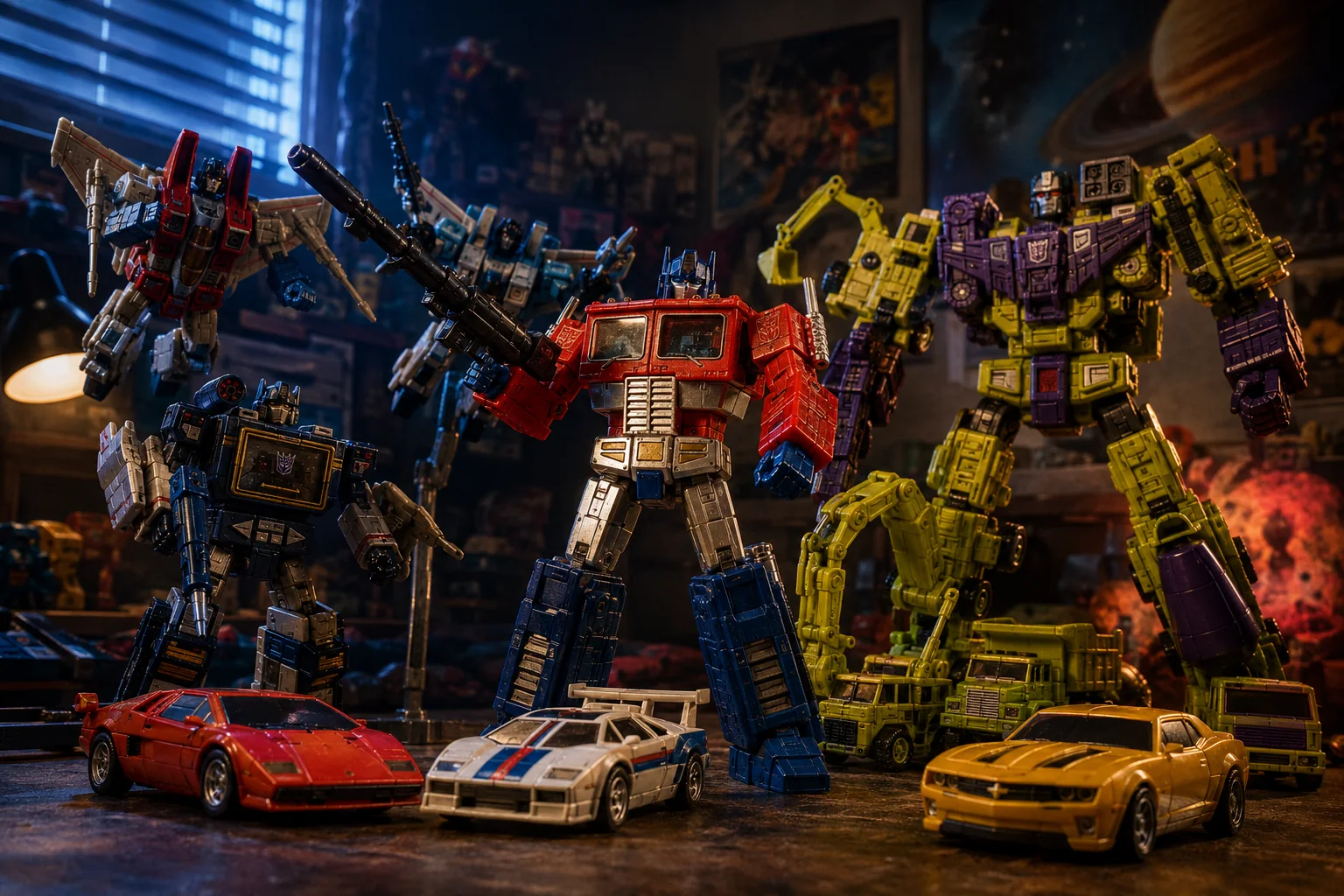
Transformers Toys in the 80s: The G1 Robots That Took Over Childhood
They were cars, jets, cassette players, dinosaurs, guns, construction vehicles, cities, and occasionally a small engineering exam disguised as a birthday present. Then the robots stood up, the factions started fighting, and the 80s toy aisle was never normal again.
One minute it was a truck. The next minute the kitchen table had a robot war.
Transformers toys in the 80s landed with the kind of idea that made every other toy look temporarily unfinished. A car was fine. A robot was fine. A car that unfolded into a robot leader with fists, a rifle, a trailer, a command base, a tiny scout vehicle, and a voice you could hear in your head before the box was even open? That was not playing fair.
The original Transformers sat at the center of the 80s toys explosion and became one of the biggest armies in the 80s action figure wars. They competed with He-Man, G.I. Joe, Star Wars leftovers, Voltron, M.A.S.K., GoBots, and anything else that could occupy floor space or dominate a commercial break. But Transformers had the perfect trick: every toy arrived with a secret.
The box said the vehicle was more than it appeared to be. The child already knew that. The real question was whether the child could get it from one form to the other without snapping a tab, launching a fist under the couch, peeling a sticker sideways, or asking a parent who immediately turned the instruction sheet upside down and pretended that was helping.
The best G1 Transformers toys were not merely figures with moving parts. They were puzzles, machines, characters, status symbols, and tiny lessons in mechanical persistence. Some transformed in five satisfying moves. Others required the patience of an air-traffic controller and the finger strength of a shop teacher. All of them felt important.
That is why Transformers still stand among the most iconic toys of the 80s. The robots were memorable. The vehicles were recognizable. The factions were clear. The packaging looked like classified hardware from outer space. And every kid who owned one became convinced the next box would finally complete the war.
Before the robots arrived, the toy aisle had parts of the idea scattered everywhere
Before Transformers Toys: Why 1984 Was Ready for Robots in Disguise
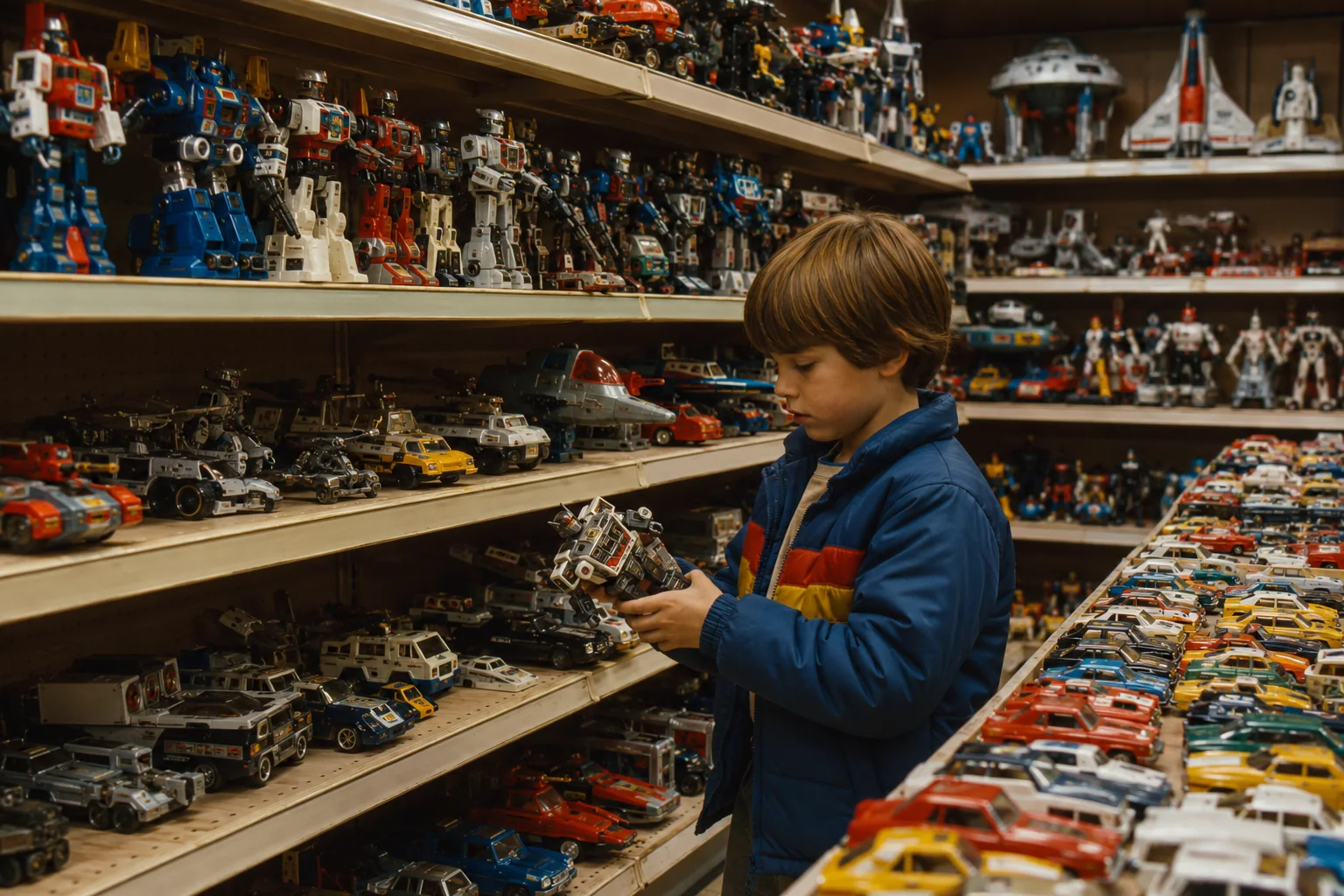
The Transformers idea felt new in 1984, but the toy aisle had been slowly preparing children for it. Star Wars had already taught families that a fictional world could live through figures, vehicles, playsets, packages, and constant expansion. G.I. Joe showed that a strong faction structure could keep an action line growing. Japanese robot shows and imports had made mechanical heroes feel exciting. Die-cast cars, model kits, puzzles, and articulated figures had trained children to enjoy objects with moving parts.
Transformers took those separate pleasures and locked them together. The vehicle was recognizable before the robot even appeared. The robot added personality. The transformation created a moment of discovery. The faction symbol made the toy part of a larger war. The bio on the box gave it a job, a personality, and a reason to be standing on the dresser at 2 a.m. looking like it knew something.
Kids already understood cars as characters
Cars had always carried personality in childhood. A sleek sports car was fast and cool. A truck was strong. A police car meant authority. A fighter jet meant danger. A construction vehicle looked powerful before it moved. Transformers used those assumptions as character shorthand. Before a child read a single word, the vehicle mode already suggested what kind of robot might be hiding inside.
Robots had moved from science fiction into everyday kid culture
By the early 80s, robots were no longer limited to adult science-fiction movies. They were on television, in arcades, in comic books, and in toy stores. Some were cute. Some were giant. Some were remote-controlled. Some looked like household appliances that had finally lost patience. The idea of a robot hero or villain felt natural enough that Transformers did not need to spend long explaining why machines had personalities.
One Figure Was Never Going to Be Enough
A single hero could sell once. A universe could sell for years. Transformers had heroic Autobots, evil Decepticons, leaders, soldiers, spies, medics, scientists, traitors, dinosaurs, cities, and eventually entire armies that combined into larger robots. The line could grow sideways forever because almost anything mechanical could become a character.
GoBots proved transforming vehicles could work in America
Tonka’s GoBots reached American shelves before Transformers and showed that children would buy vehicles that converted into robots. Transformers did not invent the entire category, but Hasbro arrived with stronger character building, larger media support, detailed packaging, and an unusually deep bench of Japanese toy designs. The result felt less like a collection of mechanical tricks and more like a war already in progress.
1984 became a collision year
The top toys of 1984 came from a toy aisle packed with major brands. Cabbage Patch Kids were still creating demand. G.I. Joe was expanding. He-Man was roaring. Video games and electronic toys were changing expectations. Transformers did not enter an empty market. They entered a cage match and brought fighter jets.
The American phenomenon began with Japanese engineering, tiny drivers, and a very smart reassembly job
Takara, Diaclone, Micro Change, and the Japanese Roots of G1 Transformers
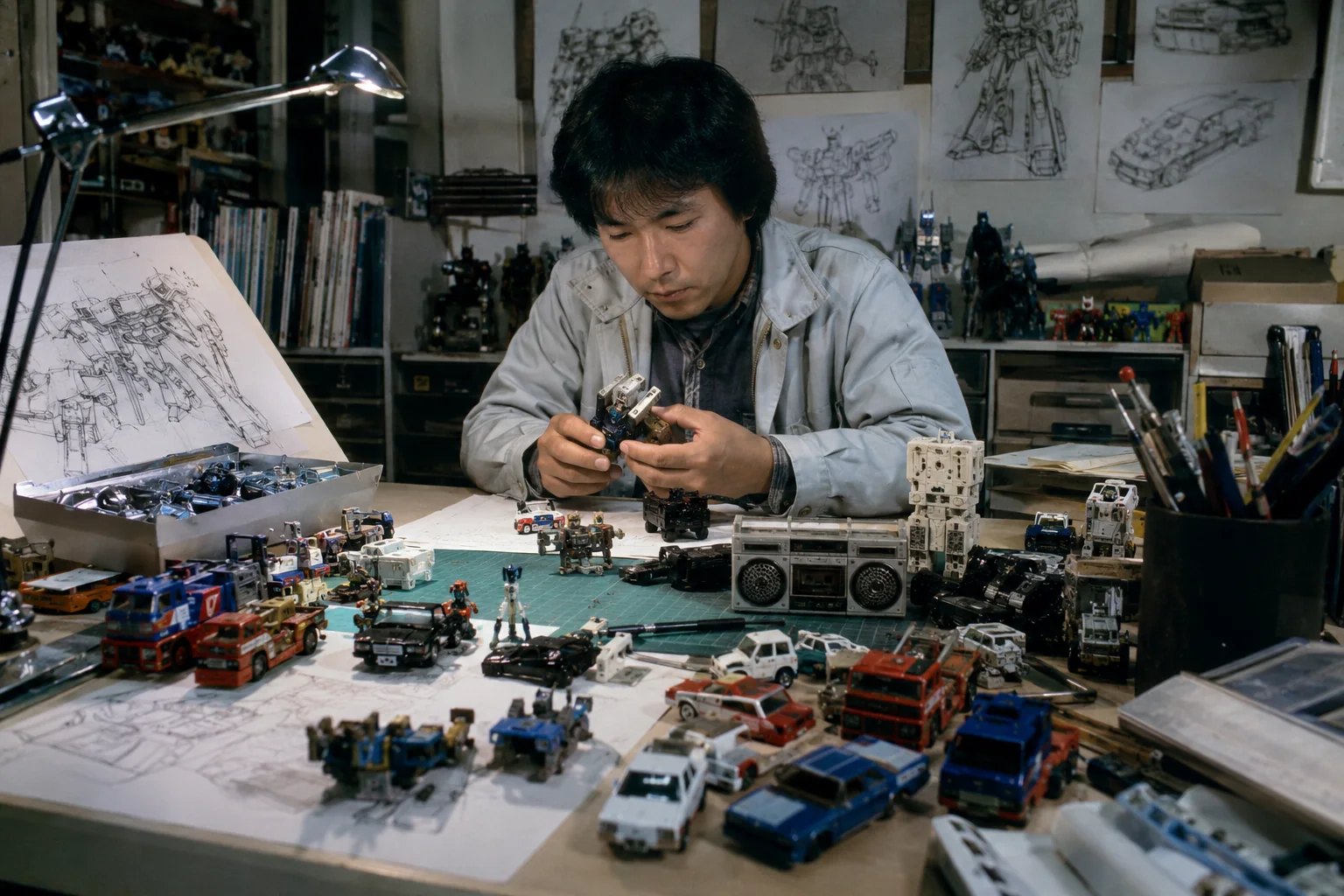
The earliest Transformers were not designed from scratch as one unified American line. Hasbro built the 1984 launch by licensing and adapting transforming toys created by Takara in Japan, especially designs from the Diaclone and Micro Change families. That is one reason the first-year lineup feels so wonderfully strange. The toys came from related but different concepts, scales, and play systems before being gathered into a single war between Autobots and Decepticons.
Diaclone imagined machines operated by tiny pilots
Takara’s Diaclone toys often treated the robots and vehicles as machinery used by small human pilots. Cars, trucks, construction equipment, jets, and larger machines transformed, but the fiction was not originally about fully independent alien robots with distinct personalities. Tiny driver figures could sit inside cockpits, which explains why several early Transformers toys include seats, opening cabins, or scale details that make more sense when you remember a miniature pilot used to belong there.
Optimus Prime’s original toy ancestry came from Diaclone’s Battle Convoy. Several famous Autobot cars began as Diaclone Car Robots. The Constructicons grew from construction-machine designs. The Seeker jets, Dinobots, and other mechanical heavyweights had roots in the same broad Japanese engineering playground.
Micro Change turned ordinary objects into secret robots
Takara’s Micro Change concept played with the idea that familiar objects might secretly be robots. A cassette player, cassette tapes, a camera, a handgun, and miniature cars could transform. That concept became a major part of the Decepticon identity in the United States.
Megatron’s realistic handgun mode, Soundwave’s cassette-player mode, the cassette robots, Reflector’s camera mode, and several Mini Vehicles came through this side of the family tree. It also explains the glorious scale nonsense of the early cartoon. A giant robot could become a handheld object because the original toys were designed around disguising themselves as real things, not around maintaining consistent physical laws.
Hasbro Turned Separate Toys Into One Giant War
The American breakthrough was the decision to combine these different designs under one name and one story. Cars, trucks, jets, weapons, cassettes, cameras, and dinosaurs became members of two alien factions. Instead of asking children to understand several Japanese product lines, Hasbro offered one clean battle: Autobots good, Decepticons bad, Earth caught in the middle.
Marvel helped turn hardware into personalities
Names, character roles, biographies, faction identities, and story concepts transformed anonymous machines into Optimus Prime, Megatron, Starscream, Jazz, Prowl, Soundwave, Bumblebee, Ratchet, and the rest. The toys gained courage, vanity, loyalty, fear, ambition, intelligence, jealousy, and grudges. A red sports car was no longer merely a transforming red sports car. It was a specific robot with statistics, a job, and an attitude problem.
The Mismatched Origins Were Part of the Fun
Scale was inconsistent. Engineering complexity varied wildly. Some toys were chunky and intuitive. Others were delicate machines with tiny metal pins, sliding panels, detachable fists, and instructions that appeared to assume the owner had completed vocational training. The differences made the collection feel broader. Every box offered a new mechanical language.
Takara’s engineering made the transformation believable
The early toys often used real-world vehicle details as structural parts of the robot. Car doors became wings. Hoods became chests. Truck cabs became torsos. Jet noses folded behind heads. Wheels remained visible on legs or shoulders. The alternate mode did not disappear into a smooth cartoon body. It stayed there as proof that the robot had actually been something else five minutes earlier.
Back then, nobody called it G1. We called it the thing we were begging for.
What “Generation 1 Transformers” Actually Means
The phrase Generation 1, usually shortened to G1, is a later label used to identify the original Transformers era and separate it from the many reboots, redesigns, sequels, and new continuities that followed. Children in 1984 did not walk into a store asking for a G1 Optimus Prime. It was simply Optimus Prime, and not owning him was apparently a crisis that required daily updates.
G1 usually refers to the original 1980s foundation
In toy discussions, G1 generally means the original Transformers line that began in 1984 and continued into the early 1990s, with the most culturally dominant American years landing in the mid-to-late 80s. It also covers the connected cartoon, Marvel comics, package biographies, animated movie, and character designs that established the franchise.
The original era was not one perfectly consistent story
The cartoon, Marvel comic, toy packaging, tech specs, advertisements, and international releases did not always agree. Character origins changed. Sizes changed. personalities shifted. Some characters appeared in media before their toys were easily available. Others received dramatic packaging descriptions and then barely showed up on television.
Kids treated continuity the practical way: use whatever version made the battle better. If the cartoon said one thing and the box said another, the box might win that afternoon because the box was sitting right there beside the carpet.
You Can Spot G1 From Across the Room
The term brings to mind blocky robot bodies, visible vehicle parts, chrome, die-cast metal, stickers, faction symbols, painted box art, red-and-purple tech-spec decoders, cassette minions, giant combiners, and toys that were sometimes more mechanical than poseable. That physical identity separates original Transformers toys from later figures designed primarily to resemble animation models or movie CGI.
Generation 1 created the permanent cast
Optimus Prime, Megatron, Bumblebee, Starscream, Soundwave, Grimlock, Jazz, Ironhide, Ratchet, Shockwave, Devastator, and dozens of others became the versions later generations would reinterpret. Even when designs changed radically, creators kept returning to the original personalities and visual signals established during G1.
Two toys in one, plus a small chance of emotional damage
How G1 Transformers Toys Turned Vehicles Into Robots
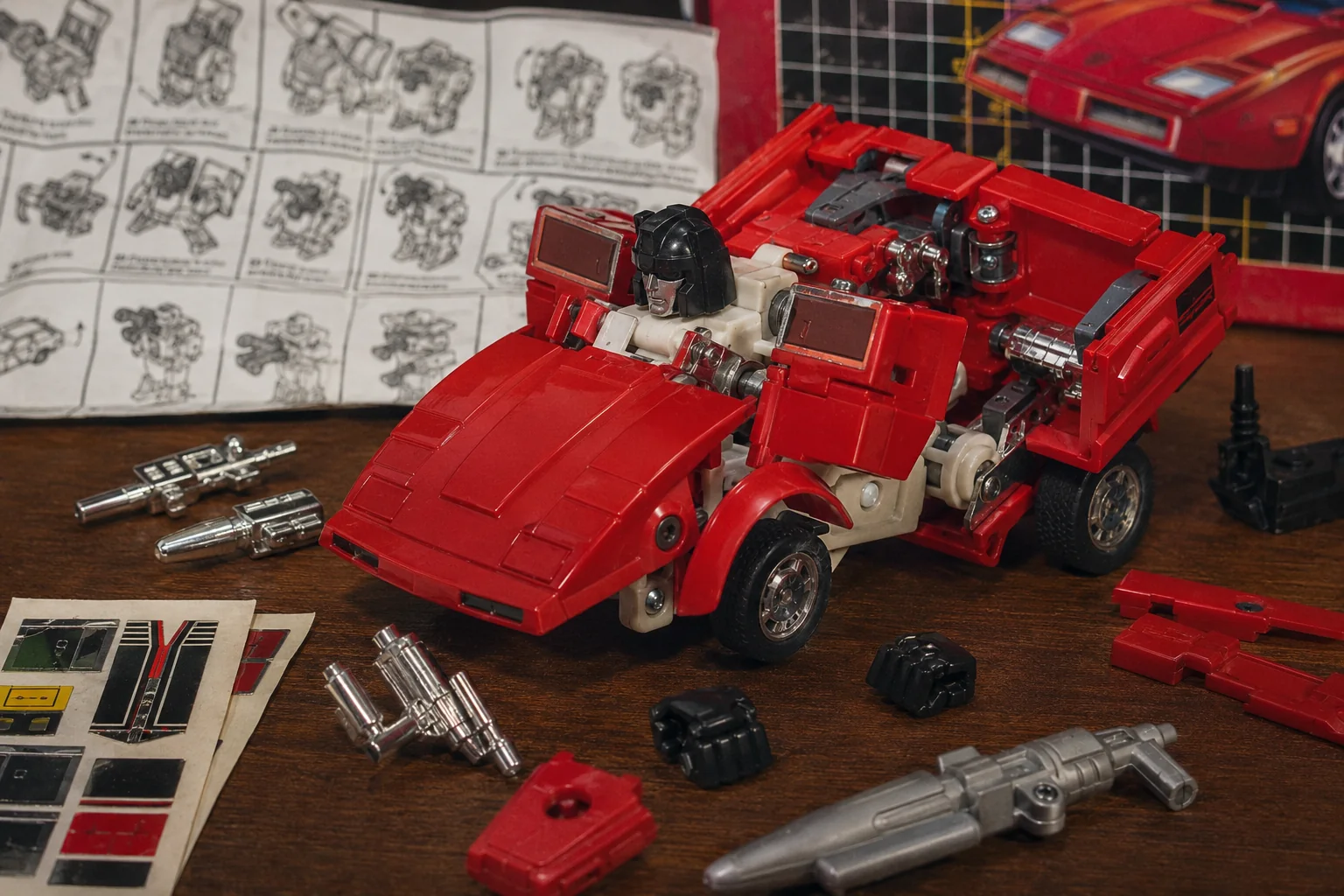
The transformation was not a decorative feature. It was the reason the line existed. Every toy promised a reveal. The box showed two modes, and the child had to create the change with actual hands. That made ownership participatory. You did not press one button and watch the entire process happen. You learned the machine.
The best transformations used recognizable vehicle parts
Optimus Prime’s truck cab became his chest. Car hoods folded into torsos. Doors became wings. Jet wings stayed visible behind the robot. Soundwave’s cassette door remained right in the center of his chest because pretending it was anything else would have been cowardice. These visible clues made the alternate mode feel honest.
Complexity created a sense of mastery
A child who could transform a difficult figure without instructions had achieved something. There was a correct sequence, and getting it wrong could jam a panel or leave a leg pointing in a direction the designers had not approved. Learning the moves turned the toy into a skill.
Simple transformations had their own appeal
Bumblebee and the Mini Vehicles could change quickly, making them perfect for constant play. A simple transformation allowed a battle to move from highway chase to robot fight in seconds. Not every character needed to be a mechanical entrance exam.
Die-cast metal made early toys feel expensive
Many original Transformers included metal parts, rubber tires, chrome, springs, screws, and dense internal mechanisms. The weight mattered. A small toy could feel substantial in the hand. When two early die-cast figures collided, the sound suggested somebody’s furniture was about to lose a corner.
Stickers finished the machine
Sticker sheets added windows, lights, control panels, stripes, symbols, and mechanical details. Applying them was part model kit, part surgical procedure, and part future regret. One crooked sticker could bother a child for years. One missing sticker could become an adult collector’s entire personality.
Detachable parts increased play and loss
Fists, missiles, rifles, shoulder pieces, landing gear, trailers, cassette weapons, and tiny accessories gave the toys more detail. They also created a long-term partnership with couch cushions, heating vents, vacuum cleaners, younger siblings, and the mysterious dimension where all small plastic pieces eventually go.
Transformation made the toy narratively useful
A car could scout without attracting attention. A jet could attack from above. A cassette player could spy. A truck could lead a convoy. The alternate mode was not just a shape; it was a role. Every transformation could begin or end a scene.
Two symbols, one toy box, and absolutely no neutral parties
Autobots vs. Decepticons: The Faction War That Organized the Toy Aisle
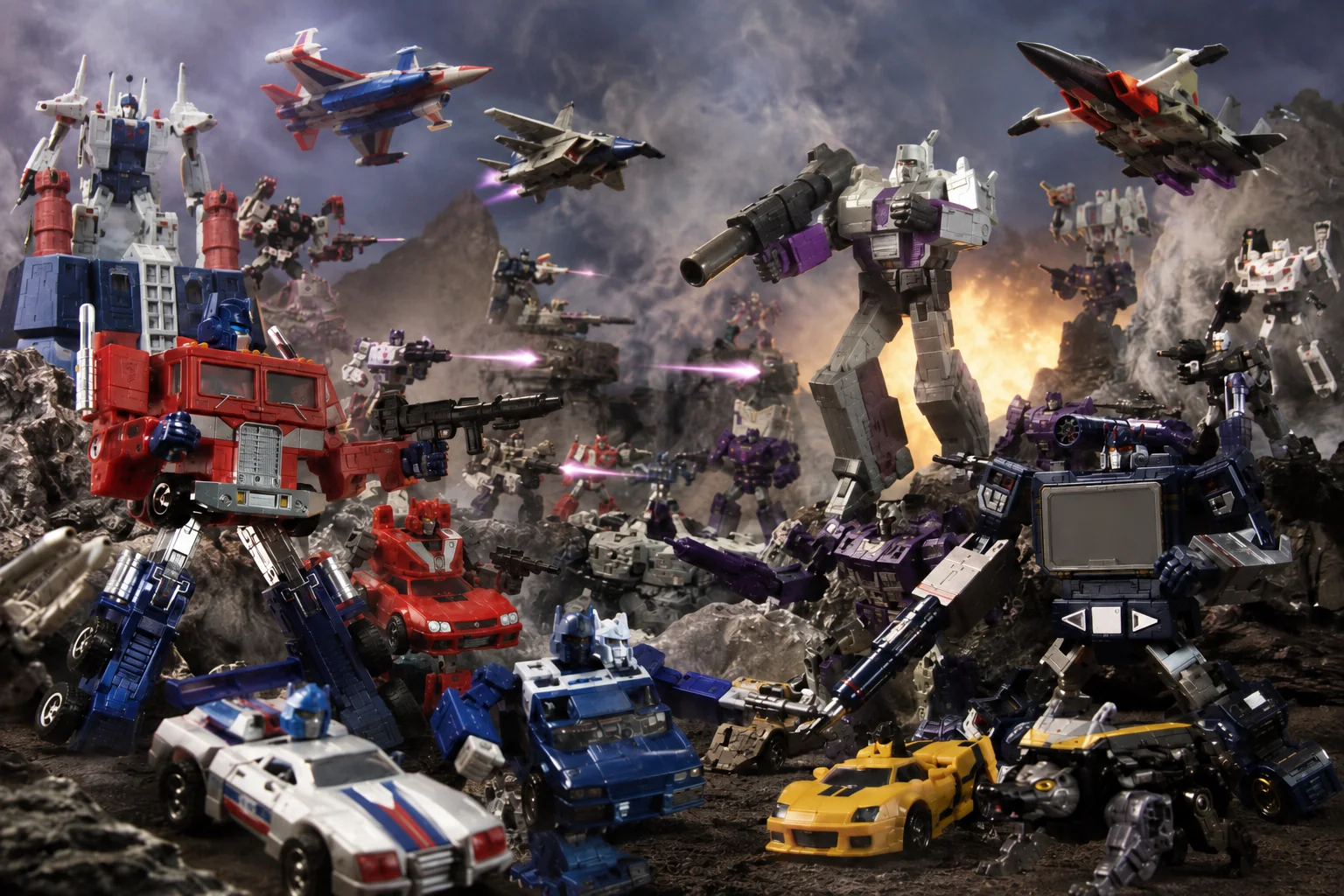
The Autobots and Decepticons gave Transformers immediate structure. A child did not need to memorize every bio before understanding the conflict. The red Autobot symbol meant heroes. The purple Decepticon symbol meant villains. Put one of each on the floor and the afternoon had a plot.
The Autobots were built around recognizable Earth vehicles
Cars, trucks, vans, and utility vehicles gave the Autobots a civilian quality. They looked like machines that might pass unnoticed on a street or parking lot. That fit their role as protectors trying to survive on Earth without turning every gas station into an alien incident.
The Decepticons looked like weapons and military power
Megatron became a handgun. Starscream and the Seekers became fighter jets. Soundwave became surveillance and communication equipment. Shockwave became a futuristic weapon. The Decepticons’ alternate modes looked aggressive before the robots appeared.
The symbols made mixed collections readable
The original toy sources were visually inconsistent, but the faction logos unified them. A sleek Japanese car robot and a tiny cassette animal belonged to the same side because the symbol said so. That tiny badge did enormous storytelling work.
The Decepticons were often more fun to collect
Villains had stranger forms, louder colors, more theatrical personalities, and a higher concentration of betrayal. Starscream wanted Megatron’s job. Soundwave carried an entire staff meeting in his chest. Constructicons combined into a giant. The bad guys brought drama before the cartoon even started talking.
The Autobots had the stronger everyday disguise
A red semi truck, yellow Volkswagen, ambulance, police car, and sports cars fit the “robots in disguise” idea beautifully. Children could see similar vehicles in real life and imagine the transformation. Every parking lot became suspicious.
Faction balance controlled play
Owning six Autobots and one Decepticon created a problem. The villain would be outnumbered, resurrected repeatedly, or reinforced by unrelated toys. That imbalance helped sell more Decepticons. A proper war required enough bad guys to make the good guys nervous.
The truck, the trailer, the voice, the leader, and the Christmas-list emergency
Optimus Prime G1 Toy: Why the Original Autobot Leader Became the One Everybody Wanted
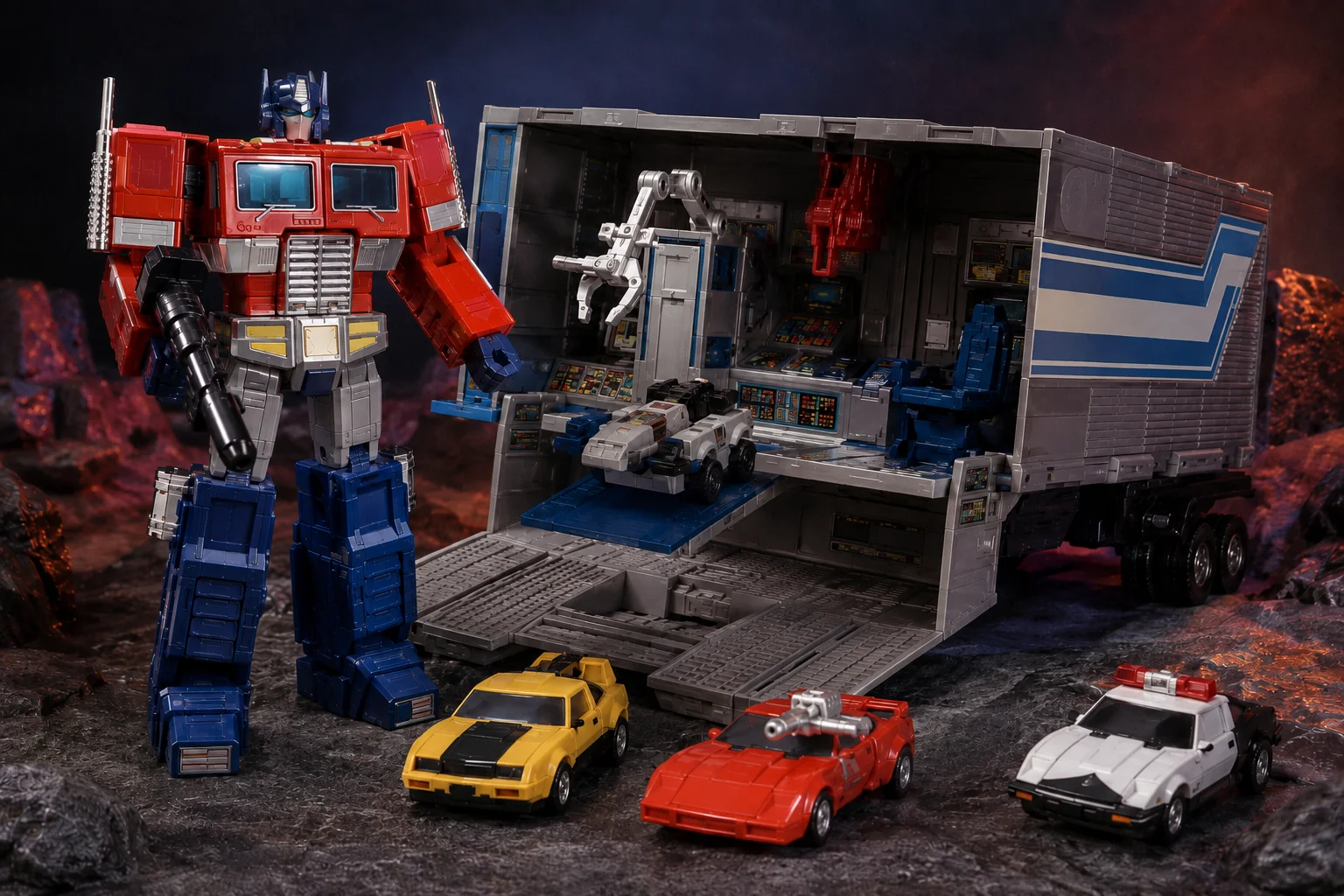
Optimus Prime was the complete Transformers promise in one box. His red-and-blue cab transformed into a powerful robot. The gray trailer opened into a command base. Roller provided a small scout vehicle. The package included fists, a rifle, missiles, stickers, and enough parts to make parents inventory the living room before throwing away the wrapping paper.
The truck mode looked like a real machine
The cab had chrome, windows, wheels, and the solid geometry of an actual semi truck. It did not look like a robot curled into a vague vehicle suggestion. It looked like a truck first, which made the robot reveal more impressive.
The robot silhouette was instantly readable
Window chest. Grille stomach. Blue helmet. Red torso. Smokestack shoulders. Wheels on the legs. Optimus Prime’s design communicated transformation openly. He did not hide where the truck had gone. He wore it like armor.
The trailer made the toy feel enormous
Without the trailer, Optimus was a strong leader figure. With it, he became a playset. The trailer opened into a repair and command station with a mechanical arm, launcher, seating, storage, and Roller. It created a headquarters anywhere the child parked it.
Roller mattered more than adults expected
Roller was small, simple, and easy to lose, which made him important. He could scout, carry figures, move supplies, or become the smallest member of the convoy. A complete Optimus Prime set without Roller felt wrong even when the main robot was standing perfectly on the shelf.
The transformation was satisfying rather than punishing
Optimus offered enough movement to feel mechanical without becoming impossible. Legs extended. Arms folded out. Fists attached. The cab changed cleanly into the leader children recognized from television. The sequence could be learned and repeated without a family intervention.
The character made the toy bigger than the plastic
The cartoon voice and leadership turned Optimus into the moral center of the line. He was calm, powerful, and serious without being humorless. Kids did not merely want the red truck. They wanted command of the Autobots.
Optimus Prime became a major holiday gift
The box, trailer, and price placed him above a basic figure purchase. He belonged among the hottest Christmas toys of the 80s, especially when the first wave made every television commercial feel like a personal accusation against households that did not yet own one.
A complete original remains a collector challenge
Fists, missiles, Roller, the rifle, trailer parts, stickers, smokestacks, and internal mechanisms all affect completeness and condition. A loose cab in a box is common. A clean, complete example with strong chrome and an intact trailer is a different animal entirely.
A villain who turned into a realistic handgun because the 80s had not yet scheduled the safety meeting
G1 Megatron Toy: The Brilliant, Awkward, and Unrepeatable Decepticon Leader
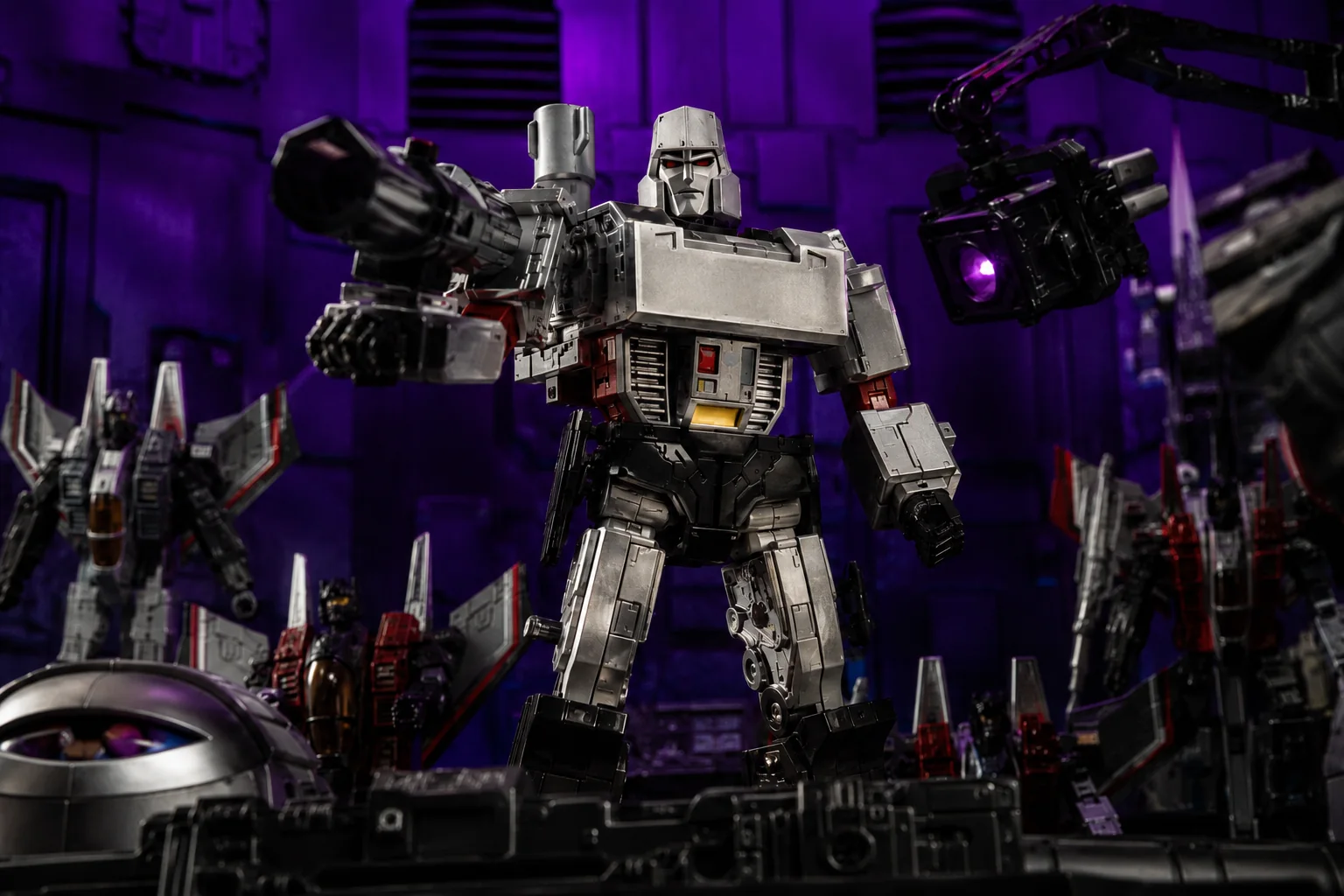
Megatron’s original toy was one of the strangest centerpieces in the entire line. The robot transformed into a realistic Walther P38-style handgun with accessories that could extend the weapon into a larger configuration. As a disguise, it made perfect sense within the Micro Change idea. As a child’s toy sold in American stores, it belongs completely to another era.
The gun mode was the star
The alternate form looked convincing enough to make the transformation startling. Chrome, black grips, trigger details, and the recognizable silhouette made Megatron feel less like a fantasy vehicle and more like an object a parent might immediately discuss in a lower voice.
The robot mode was less elegant
Megatron’s robot body carried the compromises of the handgun design. The proportions were thin and mechanical compared with the broad animated villain. The legs and torso looked like folded weapon parts because that is exactly what they were. Yet the awkwardness gave the toy a severe, dangerous appearance.
The cartoon redesigned the toy into an icon
Animation smoothed the proportions, enlarged the body, simplified the limbs, and turned the scope into the famous arm-mounted fusion cannon. Children often expected the toy to match the television model more closely. The difference was obvious, but the character’s importance kept the toy desirable.
The transformation could test patience
Panels rotated. The chest opened. Legs unfolded from the grip area. Arms moved into place. The process was clever but not as forgiving as Optimus Prime. Megatron felt like a machine designed by somebody who trusted children more than children deserved.
The accessories made the package look serious
The stock, barrel extension, and scope created a larger weapon setup and gave the box a premium feel. They also became major completeness problems. A loose Megatron without the correct accessories is common. A complete one requires the kind of careful accounting children did not practice in 1984.
The realistic form changed how the character could be revisited
Later Megatron toys generally became tanks, jets, spaceships, or fantasy weapons rather than realistic handguns. The original design remains historically important precisely because it is so tied to that moment. It is difficult to imagine the same toy debuting unchanged in a modern mass-market aisle.
Megatron made the villain side feel legitimate
A toy war needed a leader equal to Optimus Prime. Megatron’s strange mechanics, chrome finish, weapon mode, and television personality gave the Decepticons authority. Starscream could scheme. Soundwave could spy. But Megatron was the reason the faction stayed pointed in one direction.
The only cassette player that came with its own surveillance department
Soundwave, Laserbeak, Ravage, and the G1 Cassette Transformers
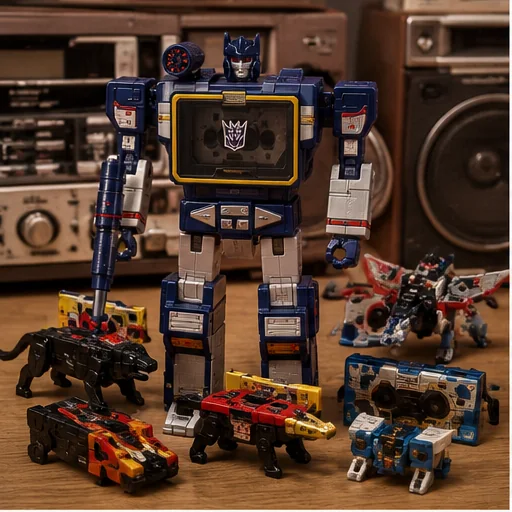
Soundwave turned an ordinary portable cassette player shape into one of the smartest play systems in the line. His chest door opened. A cassette-sized robot fit inside. Press the eject button, release a spy, and suddenly the toy had a built-in cast.
Soundwave’s alternate mode belonged perfectly to the decade
Portable cassette players were everywhere in the 80s. Turning one into a robot made the disguise feel believable. The buttons, door, battery details, and rectangular body translated naturally between object and character.
The chest compartment created physical storytelling
Laserbeak could hide inside, eject, transform, and fly away to spy. Ravage could emerge and stalk Autobots. Rumble and Frenzy could become ground troops. The storage feature made Soundwave a leader, transport, and playset in one body.
Laserbeak became the perfect first cassette
The bird mode was clear, compact, and useful in every story. Wings unfolded. Weapons attached. The cassette shape disappeared just enough for the transformation to feel surprising. Laserbeak could scout, attack, deliver information, or sit on Soundwave’s arm like the most judgmental electronic pet ever made.
Ravage proved a rectangle could become a predator
Ravage’s cassette transformation was a mechanical magic trick. Legs, head, tail, and body folded from a flat shape into a recognizable black animal. The toy was small, thin, easy to misplace, and absolutely essential.
Rumble and Frenzy became a permanent name argument
Packaging, toy colors, animation choices, and fan memory created decades of debate over which cassette robot was Rumble and which was Frenzy. Children in the 80s often solved this by calling them whatever the cartoon seemed to call them and moving on to the part where the ground started shaking.
Buzzsaw, Ratbat, Overkill, Slugfest, and the expanding cassette army
More cassette robots extended the system. Some became birds, beasts, dinosaurs, or humanoid fighters. Blaster eventually gave the Autobots their own cassette operation. Once a child owned the carrier, every new cassette felt like an expansion pack before anybody used that term.
The tiny chrome weapons became collector traps
Cassette accessories were small, shiny, specific, and highly losable. Complete sets are difficult because the toys were designed to be handled constantly. A cassette without its weapons can still transform. A collector will still stare at the empty attachment points like unfinished business.
One excellent jet design, several colors, and enough treachery to power three seasons
Starscream, Thundercracker, Skywarp, and the G1 Decepticon Seekers
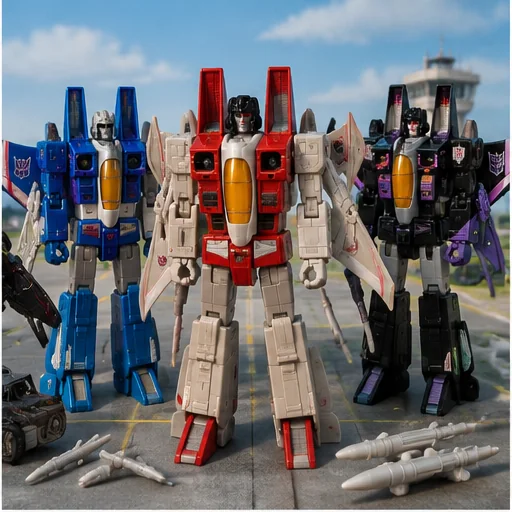
The original Seeker mold became one of the defining shapes of G1. Starscream, Thundercracker, and Skywarp shared the same core jet-and-robot engineering but used different colors and identities. That reuse worked because the toy was strong and the characters felt distinct.
The jet mode looked fast even while sitting still
The F-15-inspired shape had swept wings, pointed nose, landing gear, tail fins, and underwing weapons. It looked like an actual fighter jet instead of a robot lying face-down with optimism.
Starscream’s personality made him more than a repaint
Starscream wanted Megatron’s position and lacked the patience to hide it. The cartoon turned him into the franchise’s permanent traitor: ambitious, cowardly, dangerous, loud, and somehow still employed. That personality made his toy a priority.
Thundercracker and Skywarp gave the Decepticons air superiority
Thundercracker’s blue color and Skywarp’s black-and-purple scheme created a visually strong trio. Even children who owned only one understood the appeal of completing the flight team. Repeated molds became army building before the phrase entered regular toy conversation.
Separate fists and landing gear increased the parts problem
The Seekers needed accessories to look complete in both modes. Fists, missiles, launchers, tail pieces, and landing gear could be removed. Children removed them. The floor accepted them. Decades later, collectors bought replacement parts and tried not to think about where the originals went.
The coneheads expanded the air force
Dirge, Ramjet, and Thrust reused the broad Seeker idea with modified wings, colors, and cone-shaped robot heads. They looked related without feeling identical. The Decepticon shelf became a squadron.
The robot mode wore the jet proudly
Wings remained visible. The cockpit formed the chest. Tail fins and nose sections stayed part of the silhouette. Like the best early Transformers, the toy did not erase its alternate mode. It advertised the transformation.
The parking lot was suspicious, and every sports car had a biography
Bumblebee, Jazz, Prowl, Wheeljack, Ironhide, Ratchet, and the Original Autobot Cars
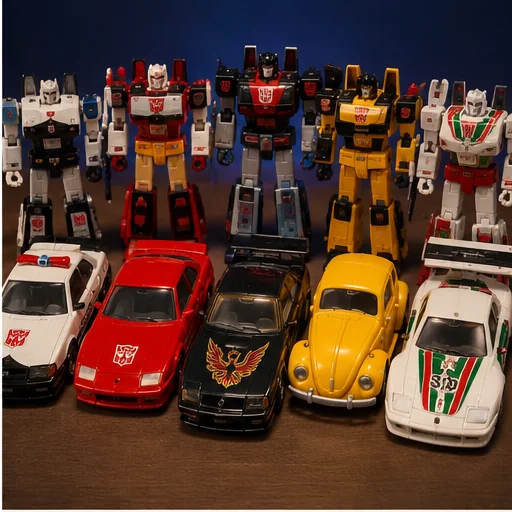
The Autobot cars made the “robots in disguise” promise feel possible. Their alternate modes resembled real cars children could recognize from roads, magazines, television, and older siblings’ dreams. The robot modes then turned those familiar shapes into a team with jobs and personalities.
Bumblebee
The small yellow Volkswagen became the approachable Autobot. The toy was inexpensive, quick to transform, easy to carry, and perfectly sized for a pocket until a teacher noticed.
Jazz
A Porsche-style sports car with racing graphics, door wings, and enough personality to become the Autobot who looked like he already knew where the stereo was.
Prowl
The police-car mode gave him authority. The black-and-white body, door wings, and serious strategist role made him feel like the Autobot who actually read the plan.
Wheeljack
A racing car turned mad inventor, Wheeljack carried bold colors, wing-like panels, and the energy of someone who had built a machine but had not yet tested whether it exploded.
Ironhide
The red van transformed through unusual engineering inherited from the Diaclone design. The toy differed sharply from the cartoon’s bulky warrior, but the character made him beloved.
Ratchet
The ambulance version shared Ironhide’s basic design and became the Autobot medic. In the cartoon he had a recognizable humanoid face; the original toy had a very different cockpit-based head arrangement.
Sideswipe
A red Lamborghini-style car with a clean robot form, strong proportions, and the natural advantage of looking fast in either mode.
Sunstreaker
Yellow, flashy, and appropriately vain, Sunstreaker looked like the Autobot most likely to stop a battle because somebody had scratched the paint.
Mirage
A blue Formula One racer with long limbs and an elegant transformation, Mirage brought speed and espionage to the team.
The cars made adult machines feel like kid property
Children could not drive a Porsche, Lamborghini, race car, police cruiser, or ambulance. They could transform one on the carpet and make it argue with a cassette player. Transformers converted grown-up machinery into childhood territory.
The early car toys often felt premium
Die-cast sections, rubber tires, chrome, clear windows, detailed interiors, opening doors, and complex hinges gave many Autobot cars weight and mechanical credibility. They looked closer to collector model cars than many children’s vehicles did.
The cartoon sometimes improved awkward toy designs
Ironhide and Ratchet are the clearest examples. The animated models added conventional faces and stronger bodies, while the toys preserved the Japanese cockpit-driver concept. Kids accepted both versions because character loyalty could overcome almost any design mismatch.
Mini Vehicles created an affordable entry point
Bumblebee, Cliffjumper, Brawn, Huffer, Gears, Windcharger, and others gave children smaller, cheaper Autobots with quick transformations. They were ideal allowance toys, small gifts, and the figures most likely to travel to school without permission.
Robots were good. Robot dinosaurs were the moment the line stopped pretending to be reasonable.
Grimlock and the G1 Dinobots: When Transformers Became Playground Royalty
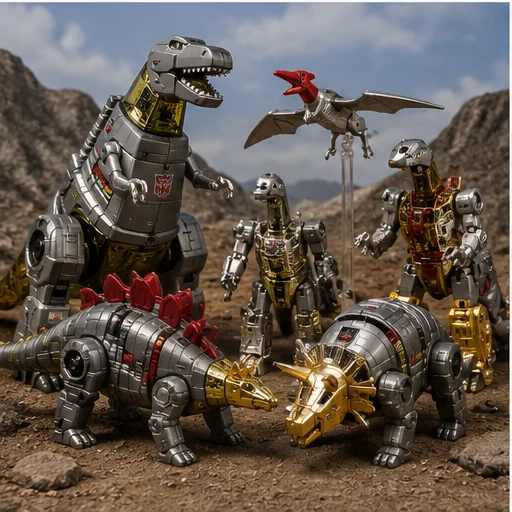
The Dinobots combined two childhood obsessions that had no business being kept apart. Grimlock, Slag, Sludge, Snarl, and Swoop transformed from mechanical dinosaurs into powerful Autobots. The designs were heavy, shiny, prehistoric, and futuristic at the same time.
Grimlock became the leader children wanted on both sides
Grimlock’s Tyrannosaurus mode looked powerful even before the robot emerged. Chrome jaws, thick legs, a tail, and mechanical details gave him enormous shelf presence. His cartoon personality—strong, blunt, proud, and not overly burdened by grammar—made him one of the line’s most recognizable characters.
The Dinobots felt heavier than ordinary figures
Die-cast metal, chrome, clear plastic, and dense mechanisms made the toys feel substantial. Holding one felt different from holding a basic car robot. These were premium monsters.
Each dinosaur created a distinct silhouette
Slag’s Triceratops horns, Sludge’s long-necked Brontosaurus-like body, Snarl’s plated Stegosaurus form, and Swoop’s winged Pteranodon profile made the team easy to recognize. A child did not need a bio card to know which dinosaur had just entered the fight.
The transformations exposed the animal parts
Dinosaur heads became chests or backs. Tails divided into legs. Wings remained visible. The robot forms looked like warriors wearing the dinosaurs they had just been, which made the change feel physical rather than magical.
They broke the disguise rule and improved the line
A robotic dinosaur was not going to blend into 1985 traffic. Nobody cared. By that point, “robots in disguise” had expanded into “robots that turn into whatever looks fantastic.” The line became stronger once it stopped obeying its own slogan too literally.
Dinobots changed carpet battles
They could fight in robot mode, charge in dinosaur mode, act as giant animals, or become a third faction when the child decided the Autobots were being annoying. Grimlock could challenge Optimus, attack Megatron, or simply take over the castle from another toy line.
Complete Dinobots are accessory minefields
Swords, guns, missiles, launchers, chrome wear, loose joints, sticker condition, and broken tabs all matter. Their popularity means many survived. Their style of play means many survived like veterans.
Six construction vehicles entered the job site. One giant green problem walked out.
Constructicons and Devastator: The G1 Combiner That Changed the Rules
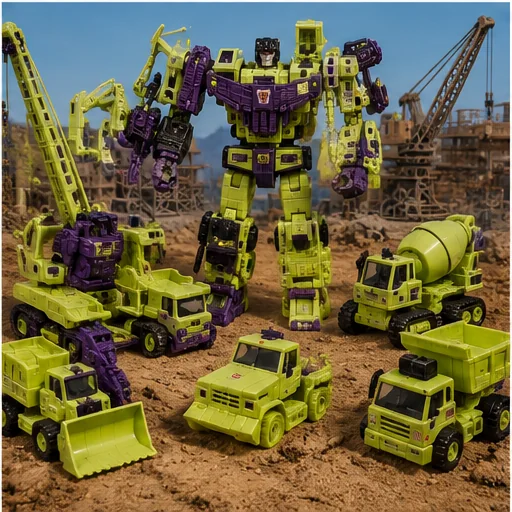
The Constructicons introduced one of the most powerful ideas in the original line: individual robots that transformed into vehicles and then combined into a larger robot. Scrapper, Hook, Bonecrusher, Long Haul, Mixmaster, and Scavenger could operate separately or become Devastator.
The construction theme made immediate sense
Bulldozer, crane, dump truck, cement mixer, excavator, and loader formed a coherent team. Their shared green-and-purple colors made them look connected before combination began.
Devastator made collecting feel like a mission
Owning one Constructicon was owning a useful villain. Owning all six unlocked the real prize. That structure made each missing member visible. A child with five could not stop thinking about the sixth because Devastator was sitting there incomplete in the imagination.
The combination required extra parts
Hands, forearms, chest pieces, waist parts, connectors, and weapons helped create the combined robot. Those accessories improved the final form and guaranteed future collector frustration. Children were not filing combiner parts in labeled archival bags. They were dropping them into the same box as everything else.
Devastator looked enormous even when the engineering was imperfect
The combined form could be awkward and less stable than the commercial suggested. It did not matter. Six vehicles had become six robots and then one giant. The concept overwhelmed the compromises.
The cartoon elevated him into a major threat
Devastator appeared as a force that ordinary Autobots could not handle easily. The size difference on television made the toy feel even bigger in memory. On the carpet, he stood above standard figures and immediately became the center of the battle.
The Constructicons opened the combiner floodgate
Once the idea worked, Transformers could build entire teams around combination. Aerialbots, Stunticons, Protectobots, Combaticons, Technobots, Terrorcons, and others followed. The toy line had found a way to make completing a team mechanically necessary.
Five toys, one giant, several missing fists, and a child doing parts inventory on the carpet
G1 Transformers Combiners: Superion, Menasor, Defensor, Bruticus, and the Team-Building Obsession
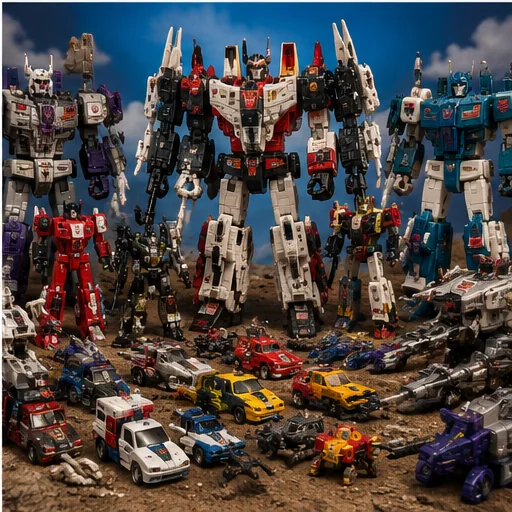
Combiners turned collecting into engineering. Each team member transformed individually, then became an arm, leg, or torso for a larger robot. The system rewarded completion and made every faction feel capable of escalating the war.
Superion and the Aerialbots
Five Autobot aircraft combined into a tall white-and-red warrior. The team gave the Autobots a direct answer to Decepticon air power and proved heroic jets were allowed after all.
Menasor and the Stunticons
Decepticon cars and a truck combined into a brutal road-warrior giant. Menasor looked like the evil reflection of the Autobot vehicle concept.
Defensor and the Protectobots
Emergency and rescue vehicles formed a protective Autobot giant. Fire engines, ambulances, police vehicles, and helicopters became a team children could recognize immediately.
Bruticus and the Combaticons
Military vehicles combined into exactly the kind of giant their name promised. Bruticus had one job, and subtle negotiation was not it.
Computron and the Technobots
Futuristic vehicles formed a highly intelligent Autobot combiner. The designs pushed the line away from ordinary Earth disguises and deeper into science fiction.
Abominus and the Terrorcons
Monstrous creatures became robots and then one larger monster. By this stage, the disguise concept had left the building and sent a postcard from somewhere much weirder.
Scramble City engineering encouraged mixing
Several combiner teams used interchangeable limb connections, allowing children to swap arms and legs across teams. The official combinations were suggestions. A kid with an incomplete set could build something biologically questionable and declare it a new character.
Torso toys became the expensive center
The leader usually formed the main body and carried more of the combination hardware. Missing the torso meant the team could not combine. Missing one limb meant a chair, unrelated robot, or desperate imagination might be asked to fill in.
Combination introduced a second instruction problem
Each figure had its own transformation. Then the team had a larger assembly process. The child had to remember which robot became which limb, which connector faced forward, and where the giant hands had disappeared since the last battle.
The combined forms sacrificed articulation for spectacle
Many G1 combiners were stiff, blocky, and dependent on extra pieces. They were not acrobats. They were monuments. The reward was scale and visual impact, not deep posing.
At some point, the robots became buildings because the floor still had six inches of open space
Omega Supreme, Metroplex, Trypticon, Fortress Maximus, and the Giant G1 Transformers
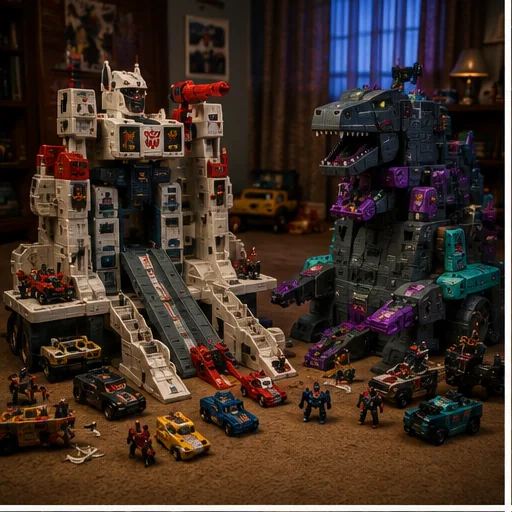
Large Transformers changed the collection from a team of figures into geography. Bases, cities, rockets, tracks, towers, and motorized monsters gave smaller toys somewhere to gather and something enormous to defend.
Omega Supreme felt like a complete installation
Omega Supreme transformed into a rocket base with track sections, a tank component, and multiple structures. His robot mode was huge and imposing. The motorized features made him feel active even when no child was manually slamming figures together.
Metroplex turned into an Autobot city
Metroplex offered robot, city, and battle-station forms. Smaller figures could interact with ramps, towers, platforms, and compartments. The toy acted as headquarters and giant defender, giving the Autobots a home that could stand up and join the fight.
Trypticon made the Decepticon base walk
Trypticon became a motorized dinosaur-like city monster, which is a sentence only an 80s toy company could deliver without apology. He could oppose Metroplex, carry smaller Decepticons, and advance across the floor with the slow confidence of something powered by fresh batteries.
Fortress Maximus became the impossible dream
Fortress Maximus was enormous, expensive, and loaded with compartments, ramps, towers, and smaller transforming components. Many children knew him mainly from catalogs, commercials, another kid’s house, or the rich fantasy life of staring at a box too large to be considered a casual purchase.
Scorponok gave the Decepticons their own giant fortress beast
Scorponok combined robot, scorpion, and base modes with Headmaster play. The design looked dangerous in every form and gave the late-80s line a major villain centerpiece.
Large toys became holiday landmarks
These were not allowance purchases. They were birthday negotiations, Christmas headline gifts, or things children studied in catalogs knowing the answer was probably no. Their size made them memorable even for kids who never owned them.
Completeness becomes brutal at this scale
Ramps, guns, connectors, small vehicles, heads, shields, doors, stickers, electronics, battery covers, and internal mechanisms all matter. Large original Transformers often survive, but not necessarily with every piece that once lived in the box.
Clip the points, fill out the form, and begin checking the mailbox like a federal investigation
Transformers Mail-Aways, Omnibots, Powerdashers, Reflector, and the Parts Around the Main Line
Mail-away offers extended Transformers beyond the store shelf. Children saved package points, completed forms, persuaded adults to write checks, and waited for a robot to arrive through the postal system. The delay made the toy feel secret and earned.
Robot points turned packaging into currency
Boxes and cardbacks carried points that could be clipped and redeemed. Throwing packaging away too quickly became a financial mistake. Parents who had finally cleared the floor discovered the cardboard apparently still had a job.
Omnibots felt like hidden Autobots
Overdrive, Camshaft, and Downshift were not ordinary shelf figures in the United States. Their mail-away status made them feel like bonus characters available only to children who understood forms, patience, and the importance of not losing small rectangles of cardboard.
Powerdashers turned mystery into a selling point
The Powerdashers came in different vehicle forms and were ordered as a somewhat mysterious assortment. That uncertainty added excitement. Mail-order toys did not have to behave like standard retail products.
Reflector finally connected the cartoon spy to a toy
Reflector appeared prominently as a group in the animated series, but the toy was not a normal first-wave shelf purchase in the United States. The mail-away camera set gave collectors and children a way to own a character who had seemed strangely present on television and absent at the store.
Accessories could become characters
Roller, cassettes, drones, partners, and mini-vehicles blurred the line between accessory and figure. A tiny piece might have a name, job, and role in the fiction. That made losing it feel worse than losing an ordinary missile.
Mail-away waiting changed the emotional scale
A store purchase was immediate. A mail-away became a project. Weeks passed. The mailbox was checked. Questions were asked. The package eventually arrived looking far less dramatic than the anticipation but containing exactly the robot the child had been thinking about since the envelope left.
The box gave you a robot, a biography, a math problem, and proof the other twelve were now necessary
G1 Transformers Packaging, Tech Specs, Rubsigns, Box Art, and Instruction Sheets
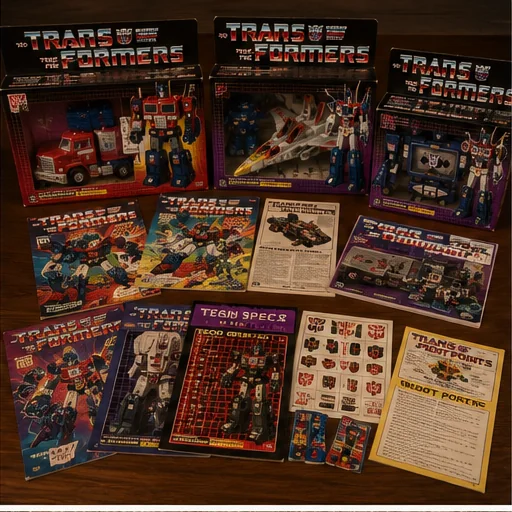
Original Transformers packaging did more than protect the toy. It introduced the character, explained the alternate mode, displayed the faction, showed the transformation, ranked the robot’s abilities, and advertised the rest of the line. The box was a briefing document disguised as retail cardboard.
The painted art made machines feel alive
Box illustrations showed robots firing weapons, charging into battle, flying through space, and standing in landscapes larger than the toy aisle. The art did not apologize for the blocky engineering. It turned every hinge and wheel into heroic machinery.
The grid background became part of the identity
The mechanical grid, faction colors, metallic logo, and bold character art gave Transformers packaging a technological authority. A row of boxes looked like equipment from the same alien system even when the toys inside came from different Japanese lines.
Tech Specs made every character measurable
Strength, intelligence, speed, endurance, rank, courage, firepower, and skill appeared as numerical ratings. A red decoder strip revealed the graph. Children could compare characters, argue over who should win, and ignore the numbers completely when a favorite needed to survive.
The biographies gave personalities to silent toys
A short description could turn a vehicle into a nervous scout, arrogant warrior, loyal medic, reckless inventor, or ambitious traitor. These profiles gave children story prompts before the figure appeared in an episode.
Rubsigns added a small ritual
Heat-sensitive faction symbols appeared on many toys during the line’s run. Rubbing the square revealed whether the robot was an Autobot or Decepticon. The faction was already obvious on most characters, but the reveal felt like a security check.
Instruction sheets were essential and occasionally insulting
The black-and-white diagrams showed arrows, rotations, and positions that seemed clear until the actual toy refused to cooperate. A child might understand step one and step four while step two quietly destroyed the afternoon.
Catalog inserts expanded the wish list
Included catalogs showed waves of toys together. A child opening one robot immediately learned about twenty more. The insert did not congratulate the purchase. It explained the size of the remaining problem.
Packaging condition now changes collector value
Boxes were opened, cut, folded, taped, written on, or converted into storage. Surviving examples with clean art, intact windows, inserts, inner trays, paperwork, and unclipped robot points can matter almost as much as the toy.
The toys had bios. Then television, comics, and one traumatic movie gave them lives and deaths.
How the Transformers Cartoon, Marvel Comics, and 1986 Movie Brought the G1 Toys to Life
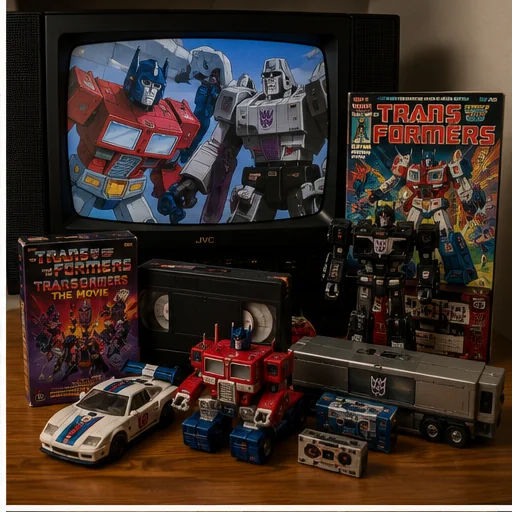
The media surrounding G1 Transformers transformed a mechanical toy line into a permanent cast. The cartoon made the robots familiar voices in American homes. Marvel comics built another version of the war with deeper science-fiction ideas and different character emphasis. The 1986 animated movie expanded the world, changed leaders, and taught children that toy franchises could apparently kill everybody before dinner.
The animated series made the factions easy to love
The cartoon established a clear rhythm: Autobots protected Earth, Decepticons chased energy and power, humans became involved, Starscream tried something disloyal, and Megatron somehow allowed him back next week. The stories made a huge toy cast manageable.
Distinct voices carried the personalities
Optimus Prime sounded calm and commanding. Megatron sounded furious and theatrical. Starscream sounded like betrayal had developed vocal cords. Soundwave’s processed delivery made him seem genuinely mechanical. The voices became inseparable from the toys.
The show made mismatched scales invisible
Megatron could shrink from giant robot to handheld gun. Soundwave could become a cassette player someone could carry. Cars, jets, and cassettes stood together at robot scale. Animation solved the source-line differences by refusing to discuss physics.
Marvel comics built a different kind of war
The comic series could be darker, stranger, and more focused on the consequences of alien machines arriving on Earth. Characters who received limited cartoon attention sometimes gained important comic roles. The existence of multiple versions gave the franchise more depth than one weekly show could provide.
The 1986 movie changed the emotional contract
The Transformers: The Movie introduced new characters and removed old ones with shocking efficiency. Optimus Prime’s death became a defining Gen X childhood memory. Children expected a longer cartoon episode. They received leadership transition, planetary destruction, a metal soundtrack, and grief.
The movie cleared space for new toys
Rodimus Prime, Ultra Magnus, Galvatron, Cyclonus, Scourge, Kup, Blurr, Wreck-Gar, and others moved into the center. The commercial logic was visible: new characters meant new products. The emotional impact was still real because the old characters had become more than products to the audience.
The animation models sometimes fought the toys
Characters designed simultaneously for film, television, and retail did not always match perfectly. The toys could be blockier, differently proportioned, or mechanically compromised. Kids recognized the differences and generally accepted them because the character identity remained strong.
Every Screen and Comic Sent Kids Back to the Toy Aisle
Cartoon episodes created recognition. Comics added story. Commercials demonstrated transformation. Packaging supplied facts. Every format pointed toward ownership. That same machine powered many 80s cartoon toy commercials, but Transformers used it with unusual depth because the toys already contained a visual plot twist.
Fast hands, dramatic voices, glowing grids, and a transformation that always looked easier on television
Why 80s Transformers Toy Commercials Worked So Well
Transformers commercials had a perfect demonstration built into the product. Show the vehicle. Move the parts. Reveal the robot. Put it into battle. Repeat with another character. The advertisement could prove the toy’s central claim in seconds.
The transformation was the sales pitch
Other commercials had to explain why a figure was exciting. Transformers could simply change forms. The visual reveal communicated value immediately. Even a child who knew nothing about the characters understood that one object had become another.
The announcer treated every box like military hardware
Names were delivered with urgency. Factions clashed. Weapons fired. Vehicles rolled. The voice-over did not sound like someone describing a toy. It sounded like Earth had minutes to prepare.
Children’s hands made the play look accessible
The commercials showed kids moving parts and staging battles, which suggested transformation was smooth, quick, and available to anyone. The actual first attempt might involve stopping the tape mentally and wondering why the left arm had locked behind the windshield.
Animation and live-action toy footage reinforced each other
Animated characters established the fantasy. Toy footage proved the fantasy could sit on the floor. Switching between the two made the plastic version feel connected to the television version even when proportions differed.
Large toys looked even larger
Low camera angles, smoke, lighting, sound effects, and crowded battle scenes made combiners and city bots feel monumental. A playset on a carpet became a fortress under attack.
Commercials Announced the Next Robots We Suddenly Needed
New teams, gimmicks, combiners, Headmasters, Targetmasters, and movie characters could be introduced rapidly. The ad told children the war had expanded and their current collection had failed to keep up.
The archive still explains the obsession
Watching old 80s toy commercials and videos makes the formula obvious. The ads were loud, compressed, and unapologetic. They did not ask whether a child wanted Transformers. They announced which Transformers the child had not yet acquired.
The picture on the box showed a robot. Your version currently looked like a wounded sedan.
The Thrill and Frustration of Transforming G1 Transformers Toys
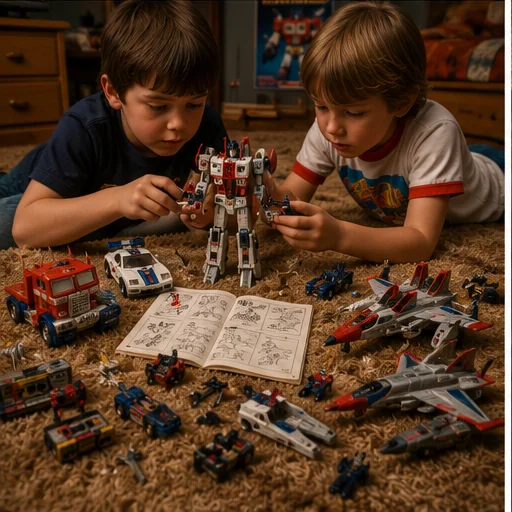
Learning a Transformer was part of owning it. The first change often required the instruction sheet. The second required memory. By the tenth, the child could perform the sequence while talking, watching television, and correcting someone else.
Some toys felt beautifully intuitive
Panels moved where the vehicle design suggested they should. Legs extended. Arms folded out. Heads appeared. The transformation felt like discovering the intended path inside the object.
Others contained one impossible step
Every difficult Transformer had a moment where the diagram and the toy appeared to disagree. A panel needed to rotate past another piece. A hinge required more force than felt safe. A tab had to clear by a fraction of an inch. This was where adults became involved and confidence began to leave the room.
Forcing the wrong part had consequences
Plastic tabs broke. Chrome scratched. stickers lifted. Metal joints loosened. Fists launched. Landing gear bent. G1 engineering could be durable, but it was not immune to a child who had decided the answer was more pressure.
Instructions became communal knowledge
Kids taught one another transformations at school, during sleepovers, or on living-room floors. Someone always knew the trick. Someone else insisted the toy was defective. A third kid had already transformed it incorrectly and was unwilling to admit the chest was backward.
Complexity made certain toys feel older
A difficult Transformer had an age-up quality. It felt closer to a model or mechanical puzzle than a basic action figure. Mastering it created pride because the toy had resisted.
Repeated transformation created wear
Loose joints, worn stickers, chipped chrome, stress marks, cracked hinges, and tired springs are evidence of use. Collectors see condition problems. Gen X sees an object that spent eight years switching forms because leaving it alone would have defeated the entire purpose.
The imperfect robot pose did not matter
Many original figures had limited arm movement and stiff legs. They were better at standing than striking dramatic poses. Children supplied motion with hands, sound effects, and momentum. Articulation was optional when the whole robot could be thrown into the battle.
Every carpet became Cybertron, Earth, a highway, and an airfield before lunch
How Kids Actually Played With Transformers in the 80s
Transformers play moved constantly between forms and scales. A convoy could roll across the floor, become a robot team, defend a base, merge into a combiner, and then return to vehicle mode because somebody decided the scene needed a chase.
Vehicle mode controlled the geography
Cars needed roads. Jets needed airspace. Construction vehicles needed a site. Cassettes needed somewhere to spy. Children used rugs, table edges, hallways, stairs, couch arms, and kitchen linoleum to create environments based on alternate modes.
Robot mode controlled the arguments
Once the figures stood up, strength rankings mattered. Tech Specs, cartoon episodes, movie scenes, and personal loyalty all became evidence. Could Grimlock beat Megatron? Could Devastator beat Omega Supreme? Could Starscream lead the Decepticons? The correct answer depended on who owned which toy.
Scale differences became story tools
A cassette robot could fight a car robot. A city could stand only several times taller than a Mini Vehicle. Megatron’s gun mode could be held by a robot who was already the same size as Megatron’s robot mode. Children did not repair the physics. They kept playing.
Other toy lines crossed into the war
G.I. Joe figures could drive vehicles, investigate giant robots, or become tiny humans beside Transformers. He-Man could challenge Grimlock. Plastic dinosaurs became Dinobot reinforcements. A random calculator might become a Decepticon computer if the afternoon required one.
The line’s competition with He-Man and Masters of the Universe toys and the planned G.I. Joe toys of the 80s did not stop at the store. It continued on the carpet, where scale, licensing, and official continuity had no legal authority.
Transformation created ambushes
A toy could enter the scene as an ordinary vehicle, then reveal itself. That allowed spying, surprise attacks, rescues, and betrayals. The physical gimmick generated story without an adult writing anything.
Combiners turned team completion into an event
The separate robots might play for weeks before the final team member arrived. Completing the combiner changed the entire collection. Suddenly the villains or heroes had a giant, and every earlier battle needed to be replayed under new management.
Bedrooms became displays between battles
Transformers looked good lined up in robot mode, parked in vehicle mode, or grouped by faction. A child could spend an afternoon playing and another hour arranging. The shelf was never final because one new figure changed the balance.
School brought comparison and trading
Mini Vehicles and smaller figures traveled easily. Kids compared transformations, accessories, sticker condition, and character knowledge. Trading could happen, though handing over a favorite Transformer usually required negotiations that outlasted recess.
The catalog showed forty robots. The list said “all.” The parent asked for clarification and regretted it.
Transformers at Christmas: Wish Lists, Shortages, Price Tiers, and the Big-Box Dream Toys
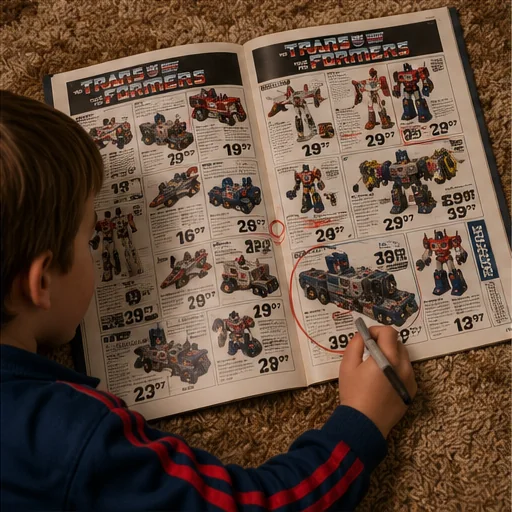
Transformers fit the 80s holiday machine perfectly because the line offered gifts at every level. Mini Vehicles could fill stockings. Standard cars and jets could anchor a birthday or moderate Christmas request. Optimus Prime, combiners, Omega Supreme, Metroplex, Trypticon, and Fortress Maximus could become the gift that dominated the room.
The first Christmas carried launch-year urgency
By late 1984, the cartoon and commercials had taught children the names. Stores had taught them availability was another matter. A child might want Optimus Prime and encounter only a shelf of less important Autobots staring back.
Parents needed exact names and visual evidence
“The red Transformer” was not enough. Optimus Prime was red. Sideswipe was red. Ironhide was red. Several boxes looked related. Catalog circles, newspaper ads, package pictures, and written lists helped adults avoid returning home with a robot that was technically excellent and emotionally incorrect.
There Was a Transformer for Nearly Every Gift Budget
Transformers came in enough sizes and price ranges to show up in almost any gift conversation. A Mini Vehicle could be a stocking stuffer, a standard car or jet could carry a birthday, and Optimus Prime or one of the giant city toys could become the box that swallowed half the space under the tree.
Catalog photography enlarged the fantasy
Entire factions stood together in clean arrangements with every missile attached, every sticker straight, and no robot missing a fist. Children saw the ideal collection. Their own toy box looked like a battlefield recovery operation.
Every New Team Made the Wish List Longer
A new combiner meant five or six new characters. A new cassette carrier meant new cassettes. A Headmaster meant a robot and a partner. The line did not merely release toys. It released systems that implied unfinished business.
The big boxes became childhood landmarks
Even children who never owned Fortress Maximus remember seeing the box. Giant Transformers occupied shelf space like furniture. Their price made them mythical. Seeing one under a tree at somebody else’s house could permanently alter a friendship.
1985 kept the expansion moving
The top toys of 1985 came from an even more competitive market, but Transformers had the advantage of a growing cast. Dinobots, Constructicons, new cars, new jets, and major characters kept the line from feeling like last year’s news.
Four years of expansion, escalation, emotional damage, and increasingly large robots
G1 Transformers Toys by Year: 1984, 1985, 1986, and 1987
The original launch creates the permanent cast
The first American year established Autobots, Decepticons, Optimus Prime, Megatron, Soundwave, Starscream, Bumblebee, the Autobot cars, Mini Vehicles, cassette robots, jets, and the core transformation idea. The top toys of 1984 faced brutal competition, but Transformers arrived with a cartoon, comic, commercials, and one of the clearest hooks in toy history.
Dinobots, Constructicons, bigger characters, and the proof this was not a one-season gimmick
The line expanded aggressively with dinosaurs, construction vehicles, Devastator, Shockwave, Jetfire, Omega Supreme, Perceptor, Blaster, new cassettes, and more Autobots and Decepticons. The toy world became too broad to fit into a simple car-versus-jet summary.
Combiners, city bots, and the movie replace the center of the universe
The top toys of 1986 competed during a year of major Transformers change. The animated movie introduced Rodimus Prime, Galvatron, Ultra Magnus, Cyclonus, Scourge, Kup, Blurr, Wreck-Gar, and others. Metroplex, Trypticon, Superion, Menasor, Defensor, and Bruticus pushed combination and scale.
Headmasters, Targetmasters, six-changing robots, and giant late-G1 ambition
The top toys of 1987 lived in a market moving toward Nintendo and new electronic competition. Transformers answered with partners that became heads or weapons, large bases such as Fortress Maximus and Scorponok, and complex characters such as Sixshot.
1984 established the emotional versions
The first wave remains the visual language most people picture: real cars, fighter jets, a truck leader, a gun villain, a cassette player spy, and package art full of mechanical war.
1985 expanded without abandoning the original idea
Dinosaurs and construction vehicles stretched the disguise premise, but the toys still felt mechanically connected to recognizable objects and machines. This was the year the line proved almost any vehicle could join the war.
1986 used spectacle and story change
Combiners and cities increased scale while the movie changed the cast. The brand felt futuristic, cosmic, and less tied to ordinary Earth vehicles. For some kids, this was thrilling. For others, losing Optimus Prime made the toy aisle feel like management had made a terrible decision.
1987 made the gimmick more complicated
Headmasters and Targetmasters attached smaller partners to the transformation. Sixshot offered six modes. Large toys became more elaborate. The line was searching for new ways to make “transforms” feel new after children had already seen cars, jets, dinosaurs, cassettes, combiners, and cities.
The war kept going, but Nintendo had entered the room and everybody noticed
Late-80s G1 Transformers: Headmasters, Targetmasters, Powermasters, Pretenders, and Micromasters
Transformers did not vanish after 1987, but the American toy market was changing. Video games were taking more attention. The original cartoon era was winding down. Many first-wave characters had been replaced. Hasbro kept the line moving by attaching new gimmicks to the transformation.
Headmasters made the head a partner
A smaller figure transformed into the robot’s head and often revealed stats when connected. The concept created two characters in one package and made a tiny piece absolutely essential. Lose the partner and the large robot became a headless reminder of poor storage practices.
Targetmasters turned partners into weapons
Small figures transformed into guns for larger robots. The gimmick extended the partnership idea and gave the accessory a character identity. The gun was no longer just a gun. It had a name, personality, and legs that could disappear under furniture.
Powermasters connected transformation to an engine partner
Engine figures unlocked or completed transformation features. Powermaster Optimus Prime returned the leader in a larger, more armored form, giving children another chance to own an Optimus while ensuring the new one did not look like a simple repeat.
Pretenders hid robots inside shells
Transformers figures fit inside humanoid or monster outer shells. The concept reversed the usual disguise. Instead of becoming a vehicle, the robot hid inside another character. Some children loved the added figure. Others wondered why a robot needed to dress like a muscular space man wearing shoulder pads.
Micromasters answered the appeal of tiny play systems
Small teams, bases, and vehicles allowed Transformers to compete with miniature play trends and offered more characters at lower sizes. The toys sacrificed some transformation complexity but expanded army building.
By the Late 80s, the Toy Shelf Got a Lot Stranger
Early G1 felt like one war built from recognizable vehicles and a stable cast. Later years introduced multiple systems, futuristic forms, shells, partners, and smaller scales. The variety was creative, but the original simplicity had weakened.
Competition changed the center of childhood
By the time the top toys of 1988 and top toys of 1989 were filling Christmas catalogs, Nintendo was no longer merely another toy competing for shelf space. It was an entire activity system. Action figures still mattered, but a video game could absorb hours without requiring a child to crawl under the couch looking for Starscream’s left fist.
Late-G1 Toys Became the Stuff Collectors Had to Hunt Down
Many later toys had shorter exposure, lower nostalgia recognition, or parts essential to their gimmicks. That can make complete examples surprisingly difficult. The robots that once felt like the line’s decline can become some of the most interesting pieces to collectors who have already found the obvious 1984 favorites.
The robot survived. The left missile, sticker sheet, instruction booklet, and one tiny wheel did not.
Collecting Vintage G1 Transformers Toys Today
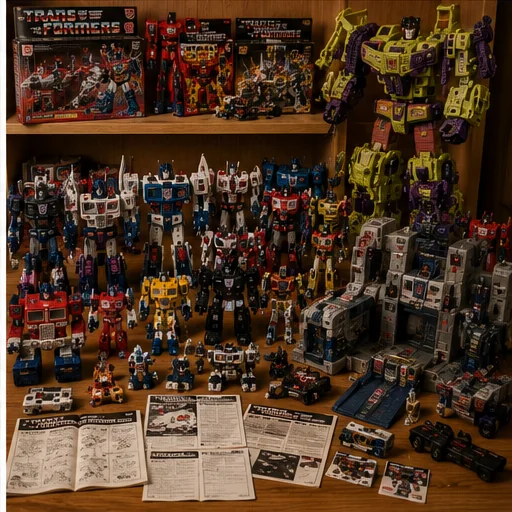
Vintage Transformers collecting is built around completeness, condition, authenticity, edition differences, and mechanical function. A familiar character name does not automatically mean a valuable toy. The exact release, accessories, box, paperwork, sticker condition, chrome, joints, and breakage all matter.
Loose, complete, boxed, and sealed are different categories
A loose Optimus Prime cab is not the same item as a complete Optimus with trailer, Roller, fists, rifle, missiles, hose, pump, stickers, instructions, and box. A sealed example belongs to another market entirely. The same character can occupy several value levels depending on what survived.
Accessories create most of the difficulty
Transformers came with weapons, fists, missiles, launchers, partner figures, cassettes, combiner parts, heads, engines, and paperwork. Many are character-specific. A toy can appear complete to a casual seller while missing the one piece collectors know should be there.
Chrome and stickers reveal play history
Chrome wears from handling. Stickers peel, discolor, crease, or get replaced. Clean surfaces can be attractive, but a suspiciously perfect example may contain reproduction labels or replacement parts. Condition needs inspection, not optimism.
Broken tabs and stress marks hide in transformations
A figure may stand well while containing cracked hinges, repaired joints, glued panels, broken clips, or stress marks. Every mode should be checked. The transformation itself is the inspection.
Rubsigns and faction symbols can be replaced
Reproduction parts and labels help collectors restore display pieces, but they should be disclosed. Originality matters differently to different buyers. The problem is not restoration. The problem is pretending restoration never happened.
Packaging variants and regional releases complicate identification
Hasbro, Takara, European, Canadian, and other releases can differ in boxes, colors, accessories, safety changes, stickers, and construction. A toy that looks slightly wrong may be a legitimate variant—or an incomplete marriage of parts from several releases.
Realistic Megatron requires special caution
The gun mode creates legal, safety, shipping, and display issues that ordinary robot toys do not. Orange plugs, modifications, local rules, and carrier policies can matter. Treat it as an object that may be mistaken for a weapon, not simply as an old action figure.
Sold prices matter more than ambitious listings
An asking price proves only that somebody owns a keyboard. Real research uses completed sales, exact condition, included accessories, date, edition, and comparable examples. The broader guide to valuable G1 Transformers toys and other 80s collectibles explains why one outrageous listing does not turn every childhood bin into a retirement plan.
Childhood wear is not automatically bad
A clean display piece may be the collector goal. A worn figure with original stickers and honest play marks may hold more emotional power. Not every collection needs to look like a store shelf from 1985. Sometimes the point is finding the exact robot that used to live beside the bed.
The original line ended. The designs never left.
Why Original G1 Transformers Toys Still Define Transformers
Transformers has reinvented itself through new cartoons, comics, movies, games, collector lines, and children’s toys. Yet the franchise keeps returning to G1 because the original visual logic remains powerful. It is one of the defining stories in the larger 80s nostalgia universe: Optimus is still recognized by the truck windows and red-blue body, Starscream still carries jet wings, Soundwave still suggests a cassette door, and Bumblebee still carries yellow compact-car energy even when the vehicle changes.
The Original Personalities Never Really Left
Optimus Prime is the noble leader. Megatron is the ruthless conqueror. Starscream is the ambitious traitor. Soundwave is the loyal intelligence officer. Bumblebee is the small, relatable scout. Grimlock is the powerful outsider. Later versions adjust the details but rarely abandon the core.
The boxy designs remain readable
G1 robots have clear shapes. Vehicle parts are visible. Colors separate major areas. Silhouettes can be understood at a glance. Modern designs may add thousands of mechanical details, but the originals often communicate character faster.
Transformation remains the franchise’s unbeatable idea
Characters and stories matter, but the physical promise still separates Transformers from ordinary action figures. A child or collector picks up the object and changes what it is. That interaction survives every continuity reset.
Reissues prove the old engineering still has an audience
Original molds and designs have returned repeatedly through reissues, anniversary products, retro packaging, and updated interpretations. Collectors want accuracy. Parents want to share recognizable characters. New children still understand why a truck becoming a robot is worth stopping to watch.
G1 nostalgia reaches beyond people who owned the toys
Some remember the cartoon more than the figures. Some remember the movie. Some remember staring at catalogs. Some had only Bumblebee. Some had a cousin with every combiner and still carry resentment. The brand occupied enough television, retail, and playground space to become a shared memory.
The line remains a defining chapter of 80s childhood
Transformers earned a permanent place beside the decade’s biggest action lines. It deserves to be read with the full story of the 80s action figure wars, where He-Man, G.I. Joe, Star Wars, Transformers, and other brands fought for attention with cartoons, vehicles, playsets, and increasingly aggressive boxes.
Among the most iconic toys of the 80s, Transformers are unusual because the original gimmick still feels complete. A G1 toy may be stiff, fragile, stickered, and full of detachable parts, but the moment it changes forms, the old magic returns.
The questions that still come up whenever the old robot box gets opened
G1 Transformers Toys FAQ
What year did Transformers toys first come out in the United States?
Hasbro launched the Transformers toy line in the United States in 1984. The first wave established Optimus Prime, Megatron, Bumblebee, Soundwave, Starscream, the Autobot cars, Mini Vehicles, cassette robots, and the Autobot-versus-Decepticon conflict.
What does G1 mean in Transformers?
G1 means Generation 1, the later name used for the original Transformers era that began in 1984. Children in the 80s generally called the toys simply Transformers; the Generation 1 label became useful after later versions and reboots appeared.
Were the original Transformers toys invented in Japan?
Many original Transformers designs came from Takara’s Japanese Diaclone and Micro Change toy lines. Hasbro licensed and combined those designs, then created a unified American brand with Autobots, Decepticons, character names, biographies, comics, animation, and advertising.
Which Transformers were in the original 1984 toy line?
The launch included Optimus Prime, Megatron, Soundwave, Starscream, Thundercracker, Skywarp, Bumblebee, Cliffjumper, Jazz, Prowl, Wheeljack, Sideswipe, Sunstreaker, Ironhide, Ratchet, Hound, Mirage, Trailbreaker, several Mini Vehicles, cassette robots, and other first-wave characters.
Why did G1 Transformers have so many removable parts?
Separate fists, missiles, weapons, landing gear, partner figures, and combiner pieces helped the toys look better in each mode and supported play features. They also reflected the complex Japanese engineering behind many designs. Unfortunately, every removable part became something a child could lose.
Why does the original Megatron turn into a gun?
Megatron came from Takara’s Micro Change line, which featured everyday objects that transformed into robots. His original alternate mode resembled a realistic Walther P38-style handgun. Later versions usually changed him into tanks, aircraft, or futuristic weapons because realistic gun toys create safety and legal problems.
Why did Soundwave turn into a cassette player?
Soundwave also came from the Micro Change concept. His cassette-player mode fit the early-80s world, and his opening chest allowed smaller cassette robots such as Laserbeak and Ravage to be stored and ejected as part of the play pattern.
Which G1 Transformer was the biggest?
Fortress Maximus was among the largest and most famous original G1 toys sold in the United States. His enormous robot and city modes, high price, numerous accessories, and smaller partner components made him a legendary catalog dream toy.
What was the first Transformers combiner?
Devastator, formed by the six Constructicons, was the first major combiner in the American Transformers line. The concept became so successful that later teams included Superion, Menasor, Defensor, Bruticus, Computron, and Abominus.
Why were G1 Transformers difficult to transform?
The original toys used dense mechanical engineering, sliding parts, rotating panels, tabs, detachable components, and transformations inherited from Japanese collector-style designs. Some were simple, but others required exact sequences and more force than children felt comfortable using.
What are Transformers rubsigns?
Rubsigns are heat-sensitive faction symbols found on many Transformers toys. Rubbing the black square with a finger warms it and reveals whether the character is an Autobot or Decepticon.
Are old G1 Transformers toys valuable?
Some are valuable, but value depends on the exact character, edition, condition, completeness, accessories, stickers, chrome, packaging, paperwork, and current sold prices. A common loose figure missing parts is not worth the same as a complete boxed example.
Why did Transformers toys stop looking like real cars later in G1?
As the line expanded, Hasbro and Takara introduced futuristic vehicles, movie characters, combiners, Headmasters, Targetmasters, Pretenders, and other gimmicks. The brand needed new forms and features after using many familiar cars, jets, and objects in the first years.
Did the 1986 Transformers movie exist mainly to sell new toys?
The movie introduced a new cast that supported new products and moved older characters aside, so the merchandising purpose was obvious. That does not make the emotional impact fake. Children had formed real attachments to the original characters, which is why Optimus Prime’s death remains so memorable.
What is the best G1 Transformer to start collecting?
Start with a character you actually remember rather than chasing the most expensive box. Bumblebee, a favorite Autobot car, Soundwave, a Dinobot, or a complete reissue can be more satisfying than buying a rare figure with no personal connection.
Were original G1 Transformers toys made of metal?
Many early G1 Transformers used a mix of die-cast metal and plastic, often with rubber tires, chrome, screws, springs, and stickers. The amount of metal varied by character and release. Later toys generally relied more heavily on plastic.
Why do some G1 Transformers toys look different from the cartoon?
Many toys were designed in Japan before the American cartoon models were finalized. Animation simplified shapes, changed proportions, added recognizable faces, and ignored some mechanical compromises. Ironhide, Ratchet, Megatron, and several others show the difference clearly.
What were Robot Points and Transformers Tech Specs?
Robot Points were printed on packages and could be clipped for mail-away offers. Tech Specs were the character ratings on the box—strength, intelligence, speed, endurance, rank, courage, firepower, and skill—revealed with the red decoder strip.