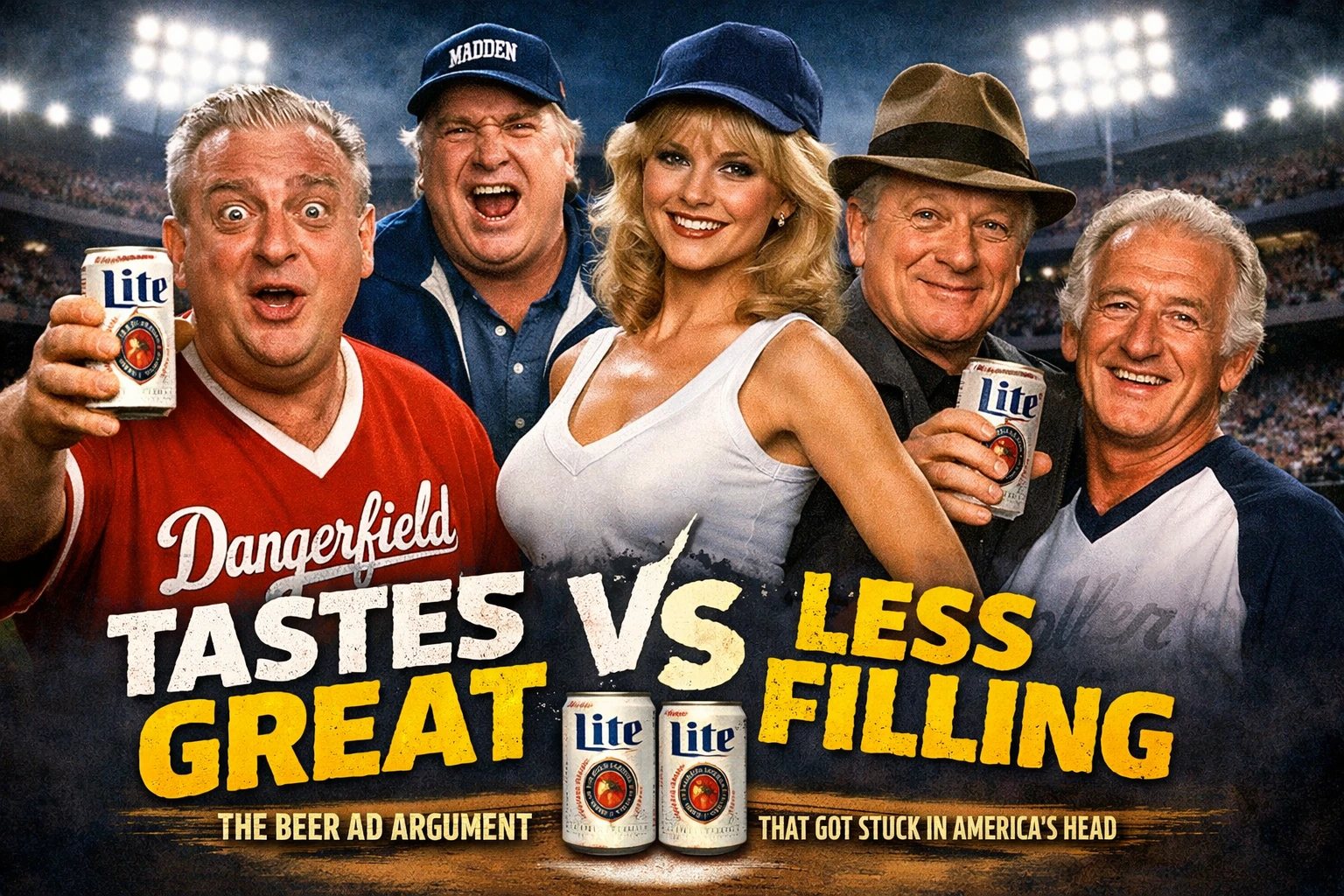
Miller Lite’s “Tastes Great, Less Filling” Commercials How a Beer Ad Became a Stadium Chant
Some commercials leave behind a joke. Some leave behind a slogan. Miller Lite’s “Tastes Great! Less Filling!” commercials left behind an argument that millions of people already knew how to finish.
The campaign filled bars, locker rooms and television sets with retired athletes, coaches, broadcasters, comedians and assorted professional loudmouths debating which half of the same sales pitch mattered more. By the early 1980s, the cast had become familiar enough to stage its own celebrity softball game—and the slogan had escaped the commercial break completely.
Gen X did not merely watch “Tastes Great! Less Filling!” We heard it shouted across stadium sections, repeated at parties and tossed into arguments that had absolutely nothing to do with beer.
The “Tastes Great” and “Less Filling” teams finally settle absolutely nothing. Watch directly on YouTube.
What Were the “Tastes Great, Less Filling” Commercials?
Miller Lite’s “Tastes Great, Less Filling” commercials were a long-running advertising campaign built around famous personalities arguing over the beer’s two selling points: its taste and its lighter, less-filling feel. The campaign began during Miller Lite’s 1970s rollout, became a television institution through the 1980s and produced memorable ensemble ads such as the celebrity-packed 1983 softball game.
How Miller Lite Built the “Tastes Great, Less Filling” Campaign
Miller Lite did not enter a market already waiting for light beer. The category needed to be explained, and the obvious “diet beer” approach risked making the product sound like punishment. Miller and its advertising partners went the other direction. Instead of marketing primarily to people who avoided beer, the brand spoke to people who already liked beer but did not always like feeling full after drinking it.
That distinction shaped everything. The ads had to establish that lighter did not mean weak, joyless or socially awkward. The campaign therefore recruited personalities who looked completely at home in sports bars, broadcast booths and locker rooms. They did not politely list product benefits. They argued.
According to Molson Coors’ company history, McCann Erickson filmed the first Miller Lite commercial with former New York Jets running back Matt Snell in July 1973. Regional testing followed, and the brand expanded nationally in January 1975. As the cast leaned more heavily toward retired athletes, the campaign found the personality that would define it for years.
The result belongs beside the most durable campaigns on the site. The Pepsi Challenge turned a product claim into a public taste test; Miller Lite turned two compatible claims into a fake civil war. Both worked because the audience could understand the game immediately.
Why “Tastes Great! Less Filling!” Was Built to Escape Television
The slogan was effective because it was not really a slogan in the usual sense. It was a script for two people. One side shouted “Tastes Great!” The other answered “Less Filling!” The viewer did not need to memorize a full sentence, understand a complicated joke or even agree with a particular side. The rhythm supplied the participation.
The joke, of course, was that both sides were selling the same bottle. Nobody in the commercial needed to win. The argument itself kept repeating the product strategy. Every shout gave Miller Lite another benefit, and every ridiculous escalation made the words easier to remember.
A catchphrase is stronger when the public can use it
Wendy’s later proved the same point from a different direction. Once “Where’s the Beef?” escaped its Wendy’s commercial, it became a question people could throw at almost anything disappointing. Miller Lite’s line was even more social because it arrived with a built-in reply.
Why the 1983 Miller Lite Softball Commercial Is Peak Campaign Energy
By 1983, Miller Lite no longer needed to introduce the basic joke. The audience knew the factions, recognized many of the campaign regulars and understood that any gathering could collapse into the same argument. The softball commercial used that familiarity to go bigger.
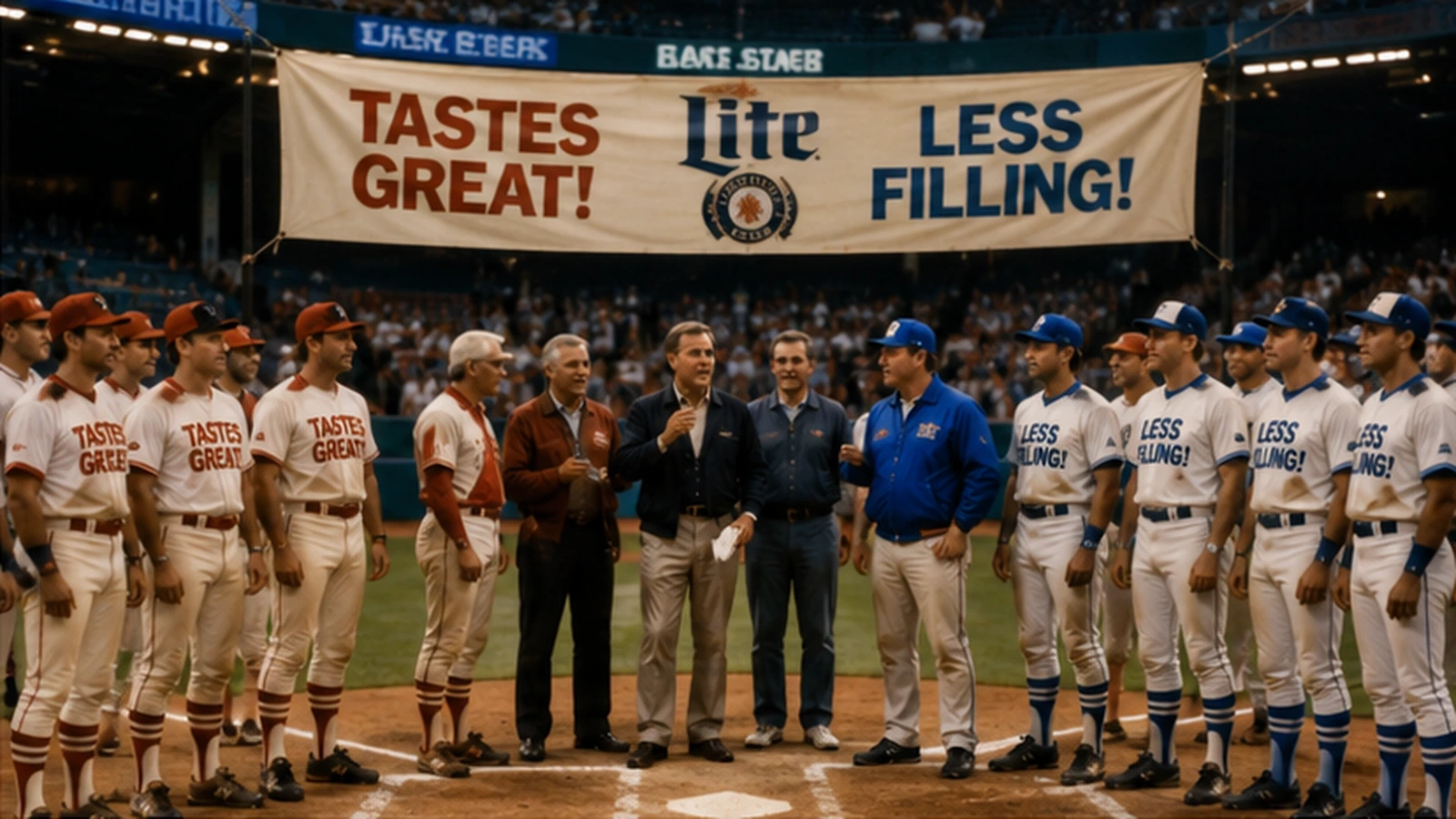
Instead of staging another barroom disagreement, the ad turns “Tastes Great” and “Less Filling” into opposing softball teams. The commercial plays like an all-star broadcast from an alternate universe where retired athletes, coaches, announcers and comedians have been arguing about light beer for so long that a formal sporting event feels like the logical next step.
Rodney Dangerfield
Arrives with the kind of chaotic comic energy the campaign could use as a relief pitcher.
John Madden
Brings instant sports credibility while happily participating in the commercial’s nonsense.
Bob Uecker
Turns self-deprecation and baseball familiarity into one of the campaign’s most durable personalities.
Billy Martin
Adds real baseball history to a game designed entirely around an advertising slogan.
Dick Butkus, Frank Robinson, Red Auerbach, Dick Williams and other familiar sports figures also help make the lineup feel less like a commercial cast and more like somebody emptied the green room of a 1983 sports banquet onto a softball field.
The famous faces did not simply endorse Miller Lite. They created continuity. Viewers could recognize returning personalities, anticipate their comic roles and treat each new ad as another episode in a campaign that had developed its own cast.
The commercial feels like event television
That scale separates the softball spot from a normal celebrity endorsement. It is not one famous person borrowing attention for thirty seconds. It is the campaign cashing in years of accumulated recognition. The pleasure comes partly from seeing who appears next.
Pepsi used celebrity in a more polished pop-music direction with the 1984 Michael Jackson Pepsi commercial. Miller Lite’s version was looser, older, louder and deliberately closer to the atmosphere of a sports broadcast that had gone off the rails.
Why Retired Athletes and Professional Characters Were the Perfect Cast
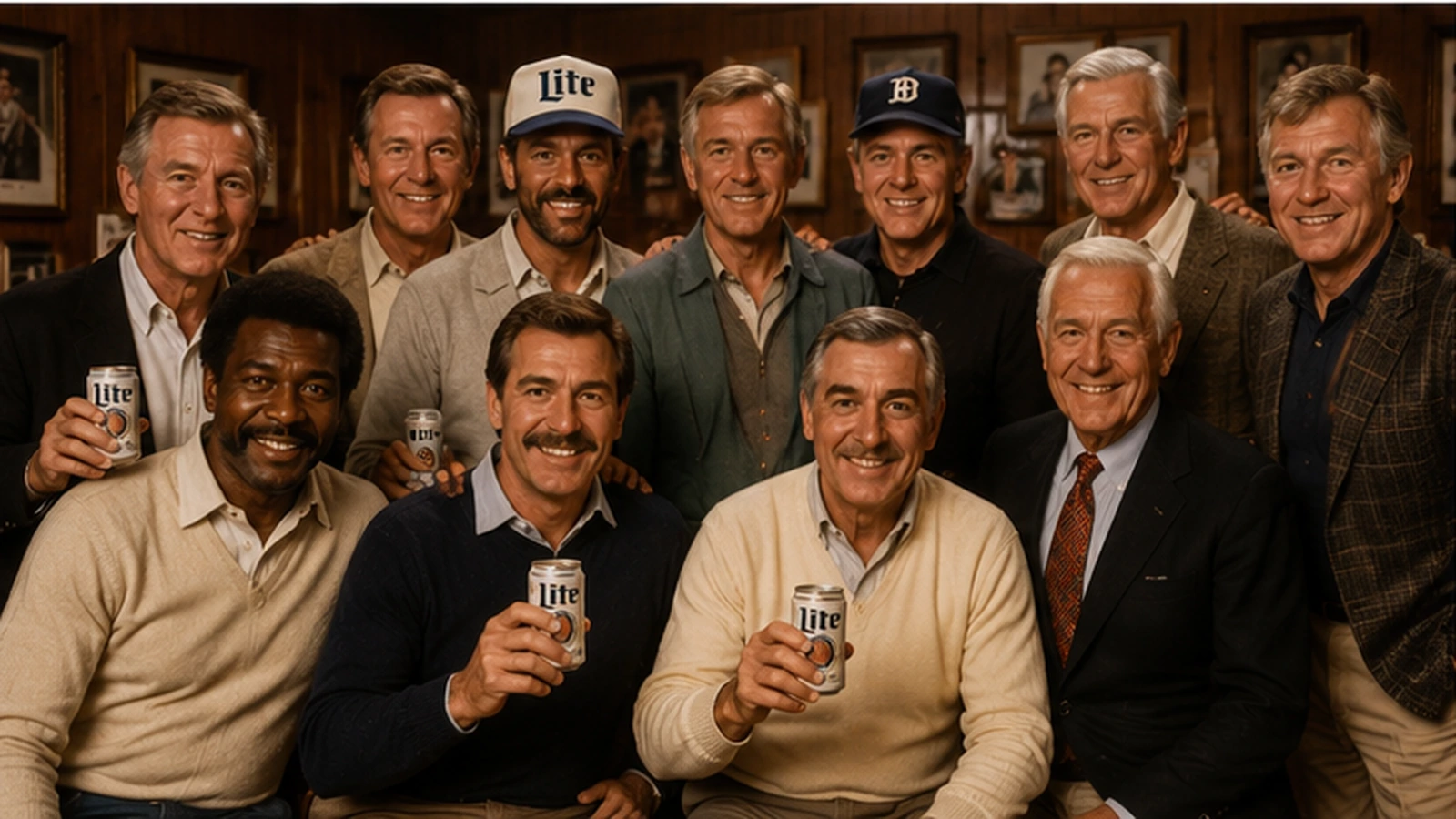
Miller Lite needed people who could sell light beer without making it look delicate. Retired athletes solved that problem. They already carried toughness, sports credibility and familiarity, but they were also free to exaggerate their public personas and play the joke.
The roster expanded beyond players. Coaches, announcers, comedians, actors and writers brought different kinds of recognizable authority. John Madden could sound like a coach even while bursting through a ridiculous setup. Bob Uecker could turn his own modest playing career into a running gag. Rodney Dangerfield could make the entire commercial feel one bad decision away from collapse.
Sports credibility without a lecture
The cast signaled that Miller Lite belonged inside mainstream sports culture before anybody stopped to examine the nutrition claim.
Personalities bigger than the product
Each performer arrived with a recognizable identity, giving the ads character without needing lengthy setup.
A repeatable campaign universe
Returning faces made later commercials feel connected. The audience was not meeting a new spokesperson every week; it was revisiting a familiar gang.
Safe, theatrical conflict
The cast could yell, shove, compete and insult each other while keeping the argument comic rather than genuinely hostile.
The approach also shows how different 80s advertising lanes could be. Some brands built fictional spokescharacters, a whole world explored in the site’s look at 80s commercial mascots. Miller Lite built a mascot-like ensemble out of real people whose personalities were already familiar.
What the Miller Lite Campaign Was Actually Selling
The campaign was funny, but it was not random. “Tastes Great” and “Less Filling” answered the two objections Miller Lite needed to overcome. Consumers had to believe the beer still tasted like beer, and they needed a reason to choose a lighter product in the first place.
“Tastes Great” protected the category
The taste claim reassured established beer drinkers that “light” did not automatically mean thin, medicinal or joyless. It positioned Miller Lite as beer first and a lighter option second.
“Less Filling” created the difference
The second claim gave people a practical explanation for the category. The product was not merely smaller or weaker. It promised a different drinking experience.
Company histories describe the campaign as a response to earlier attempts to sell light beer mainly as a diet product. Miller instead aimed at existing beer drinkers and made the product feel compatible with the loudest corners of American sports culture.
The argument repeated the entire positioning statement
That is why the format could run for years without losing its basic function. Every commercial could change the location, cast or joke while repeating the same two reasons to buy. The campaign had variety on the surface and remarkable discipline underneath.
Apple’s approach in the famous “1984” Macintosh commercial was almost the opposite: cinematic, ominous and intentionally withholding. Miller Lite explained the product every time, but hid the repetition inside a comedy routine.
Why Gen X Remembers “Tastes Great! Less Filling!” So Clearly
The easy answer is repetition. The better answer is that the campaign appeared in exactly the environments where repetition already felt natural. Sports broadcasts repeated themselves. Crowds chanted. Bars argued. Friends shouted across rooms. The commercial did not ask the culture to learn a new behavior. It attached a beer brand to behavior that was already happening.
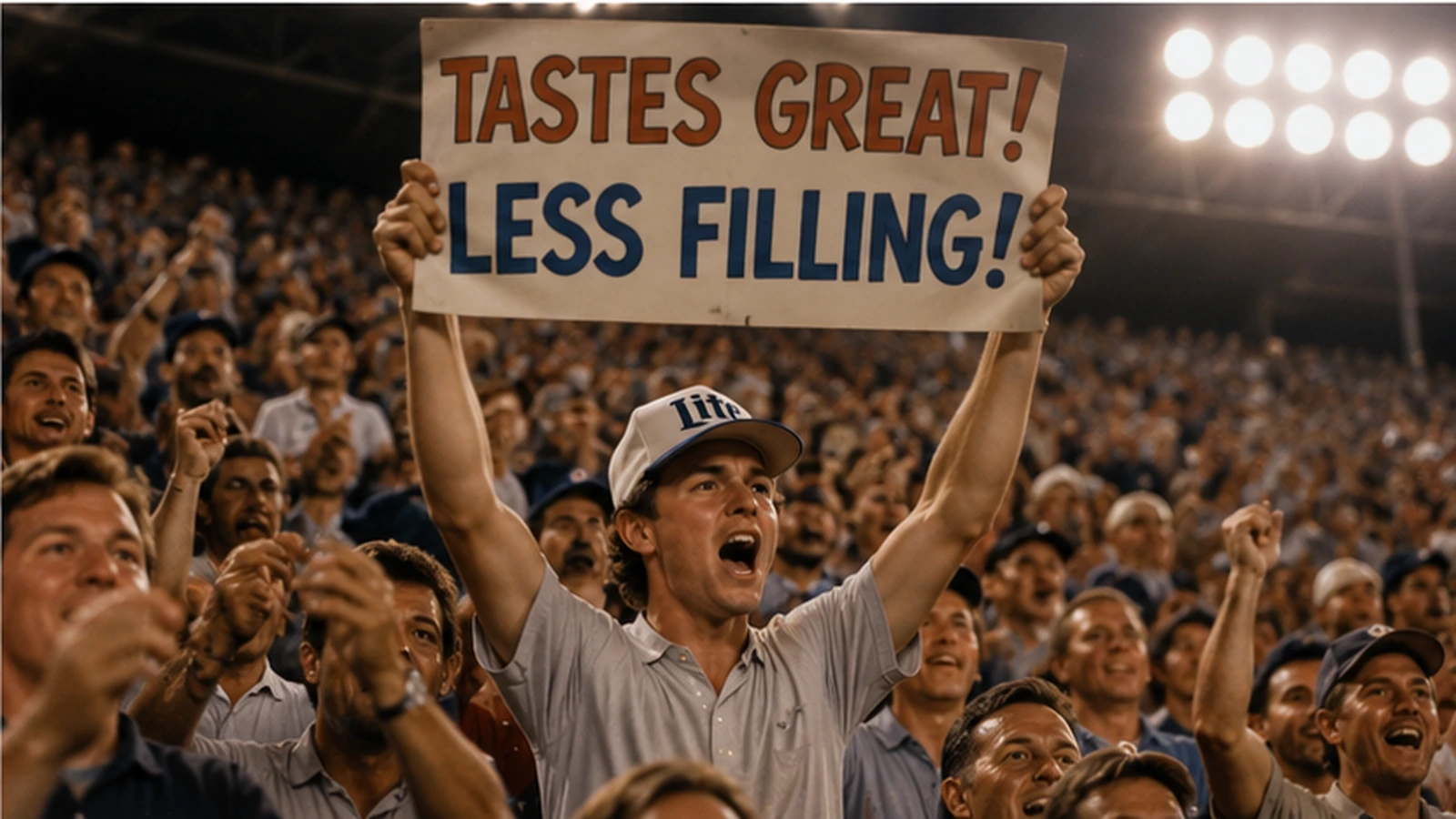
That is why the slogan could surface at professional baseball games when the action slowed down. One section started “Tastes Great!” Another answered “Less Filling!” The crowd did not need a screen, a bottle or an announcer to explain the reference. The exchange belonged to everybody by then.
Fewer channels, larger overlap
A heavily rotated campaign could become common knowledge because millions of viewers repeatedly encountered the same commercials.
Sports made it communal
The ads lived beside games, broadcasters and stadium culture, giving the slogan a natural route into public chanting.
The audience supplied the reruns
Every real-world argument repeated the brand long after the paid commercial had ended.
It became a memory of television’s reach
Today, audiences can avoid almost any advertisement. In the network era, a campaign with enough money, enough airtime and a usable catchphrase could become part of the language. That same cultural force later carried the California Raisins from a commercial into full-scale pop culture and helped make Nike’s “Just Do It” slogan feel larger than a single product.
The Lasting Legacy of the Miller Lite Commercials
Miller Lite’s classic campaign ran from the 1970s into the early 1990s and was later recognized among the major advertising campaigns of the twentieth century. Its influence is easy to see: establish a simple product tension, turn that tension into a recurring format, cast personalities viewers already understand and give the audience language it can use without the commercial.
The slogan has also remained useful to Miller Lite itself. The brand has periodically revived the debate because “Tastes Great, Less Filling” still communicates its basic identity with almost no explanation. That kind of durability is rare. Most campaigns eventually become incompatible with the product. This one still describes the product while carrying decades of memory.
There is a straight line from older advertising songs such as “I’d Like to Buy the World a Coke” to the slogan-driven campaigns that dominated the 1980s. One invited the audience to sing. Miller Lite invited the audience to argue. Both understood that the most valuable part of an advertisement may be the part people carry away and perform themselves.
“Tastes Great! Less Filling!” worked because it compressed the product, the joke and the audience participation into the same two-line exchange. Miller Lite was selling beer, but the campaign also sold everybody a part in the commercial. Gen X remembers it because we kept performing that part long after the television stopped asking.
Keep Rewinding the Year of the Softball Commercial
The Miller Lite softball game arrived during a year crowded with blockbuster entertainment, television favorites, toy-store chaos and pop-culture fads. Keep the dial on 1983:
More Classic 80s Commercials and Advertising Legends
Questions About the “Tastes Great, Less Filling” Commercials
When did Miller Lite’s “Tastes Great, Less Filling” campaign begin?
Miller filmed an early commercial with former New York Jet Matt Snell in 1973, tested the product regionally and introduced Miller Lite nationally in January 1975. The familiar debate format developed during that rollout.
What was the point of “Tastes Great! Less Filling!”?
The two phrases communicated Miller Lite’s central sales argument: it offered recognizable beer taste while feeling lighter and less filling. The fake disagreement repeated both benefits.
Who appeared in the Miller Lite commercials?
The long-running campaign featured retired athletes, coaches, broadcasters, comedians and entertainers. Familiar participants included John Madden, Bob Uecker, Rodney Dangerfield, Billy Martin, Dick Butkus, Mickey Spillane and many others.
What was the 1983 Miller Lite softball commercial?
It was an ensemble spot that staged a celebrity softball game between the “Tastes Greats” and the “Less Fillings,” bringing many established campaign personalities together in one oversized ad.
Why was the slogan so memorable?
It was short, rhythmic and designed as a call-and-response. Two people could recreate the entire advertising idea in seconds, which helped the line spread into bars, stadiums and ordinary conversation.
Did the campaign help make light beer popular?
Yes. Miller Lite’s advertising helped position light beer as a mainstream choice for existing beer drinkers rather than merely a diet product, contributing to the category’s rapid growth.
How long did the classic campaign run?
The core Miller Lite All-Stars and “Tastes Great, Less Filling” campaign ran from the 1970s into the early 1990s, with later revivals returning to the same debate.
Why does Gen X remember the commercials so clearly?
Heavy television rotation, sports-broadcast placement, familiar recurring personalities and a slogan people could shout themselves turned the campaign into a shared cultural memory.
Historical Sources
The editorial history and dates in this feature were checked against company archives and independent sports coverage.