Wendy’s “Where’s the Beef?” Commercial: How Clara Peller’s 1984 Catchphrase Took Over America
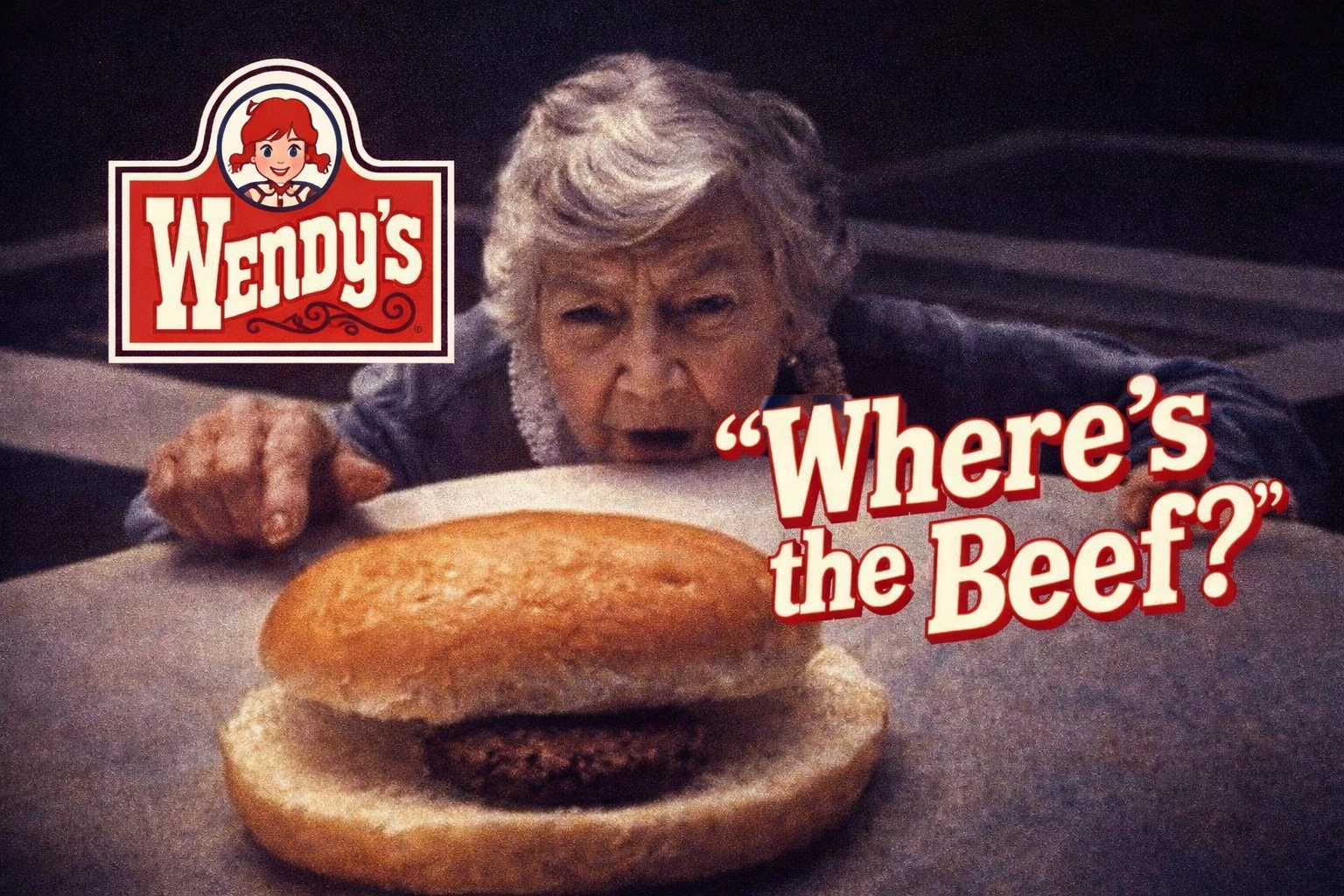
Wendy’s “Where’s the Beef?” Commercial How Clara Peller’s 1984 catchphrase took over America
Some commercials sell lunch and disappear. Wendy’s “Where’s the Beef?” commercial escaped the television set, invaded schoolyards, showed up at dinner tables and somehow ended up inside a presidential campaign. Three words, one microscopic hamburger patty and Clara Peller’s gloriously irritated delivery turned a fast-food comparison ad into shared American language.
For Gen X, the memory is bigger than the burger. We remember the giant fluffy bun, the tiny piece of meat hiding underneath it and the exact gravelly force Peller put behind the question. The joke was immediate. The complaint was reusable. By the time adults and kids were throwing the line at anything that looked impressive but delivered almost nothing, Wendy’s no longer owned only a commercial. It owned the decade’s sharpest quality-control wisecrack.

What was Wendy’s “Where’s the Beef?” commercial?
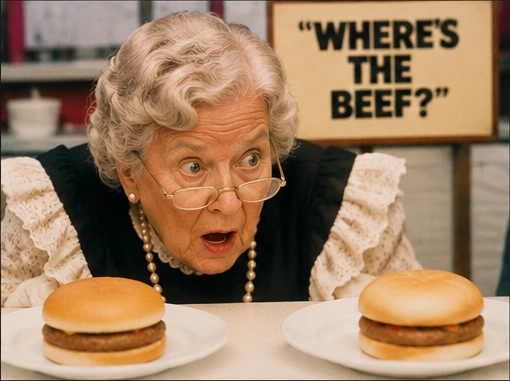
Wendy’s “Where’s the Beef?” was a 1984 television campaign designed to mock rival fast-food chains for serving hamburger patties that looked tiny beneath oversized buns. In the original commercial, three elderly women inspect a sandwich from the fictional “Home of the Big Bun.” Clara Peller looks at the nearly missing patty and demands, “Where’s the beef?”
The slogan spread almost immediately. It became shorthand for asking whether a flashy product, idea or promise had any real substance behind it. Walter Mondale famously used the line against Gary Hart during the 1984 Democratic presidential primary, which confirmed that the campaign had moved far beyond hamburgers.
What actually happens in the original commercial
The setup is almost aggressively simple. Three elderly women stand at a counter, staring at an enormous hamburger bun. They admire its size. They admire its fluffiness. The fictional restaurant clearly wants customers impressed before anybody lifts the lid.
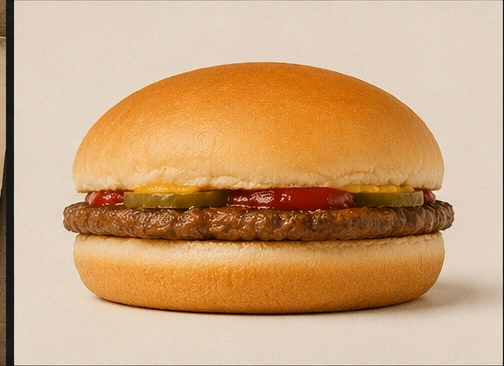
Then the top half of the bun comes off. Underneath sits a patty so small that it looks less like dinner and more like somebody misplaced a poker chip. The visual argument is finished before Peller says a word: the competition is selling scale on the outside and disappointment in the middle.
Peller’s question supplies the release. She does not deliver it like a trained pitchwoman unveiling a slogan. She sounds genuinely annoyed that somebody has wasted her time. That irritation makes the joke feel honest. It also turns the audience into her accomplice. We are not being told that the burger is inadequate. We are all standing there with Clara, looking at the evidence.
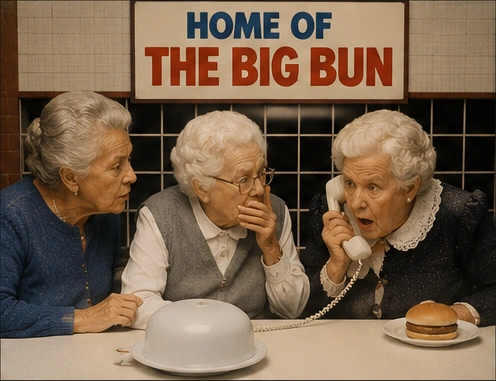
The women are impressed by the bun until it opens. Once the tiny patty appears, the commercial no longer needs a complicated sales pitch. Clara simply says what the audience is already thinking.
A giant bun surrounds a comically undersized patty. The product comparison is understood in one glance.
Peller’s gravelly impatience sounds natural, specific and impossible to confuse with ordinary ad copy.
Three short words can be reused anywhere somebody suspects style is covering up a lack of substance.
That efficiency is what makes the spot hold up. There is no long explanation, no product chart and no announcer desperately repeating a slogan five times. The commercial shows the problem, gives it a voice and gets out of the way.
How the 1984 Wendy’s campaign exploded
Wendy’s launched the campaign on January 9, 1984. Contemporary coverage described an $8 million television push built around Wendy’s claim that its quarter-pound hamburgers offered more actual beef than the smaller-looking patties associated with its larger rivals. The chain was still running behind McDonald’s and Burger King, so a polite comparison was not going to move much air. Wendy’s needed something sharper.
“Where’s the Beef?” gave the smaller chain a challenger’s voice. It did not try to imitate the family warmth of McDonald’s or the custom-order confidence of Burger King. It mocked the physical evidence. Big bun? Fine. Now show us the part we are paying for.
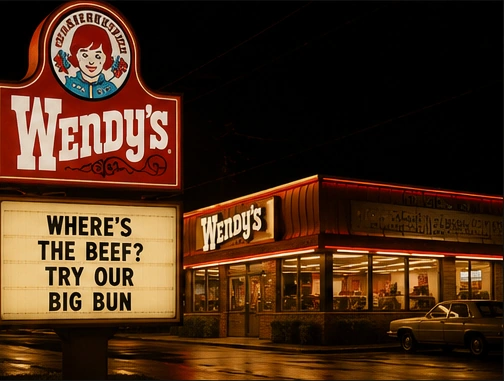
The response was enormous. Contemporary reporting found that the Wendy’s campaign broke recognition records in Advertising Age’s commercial surveys and even outperformed the heavily promoted Michael Jackson and Pepsi campaign in immediate recall. That comparison tells you everything about the size of the moment: an elderly former manicurist asking about a hamburger had managed to out-shout the biggest pop star in America.
Why Clara Peller made the whole campaign work
A weaker version of this campaign would have hired a polished comic performer to make a funny face and hit the slogan with perfect timing. That probably would have died by spring. Clara Peller was effective because she did not look or sound like advertising’s usual idea of a national spokesperson.
Peller had worked for decades in Chicago-area beauty shops before commercial producer Joe Sedelmaier began casting her in advertising. She was short, hard of hearing and possessed a voice that could cut through the noise of a television set from another room. In the Wendy’s spot, that voice supplied authenticity no amount of slick production could fake.
Sedelmaier later explained that the original line was longer, but Peller struggled to finish it in one breath. Dropping the extra word left the phrase everyone remembers. Sometimes advertising history is less a grand strategy than one good creative decision made because the performer needs air.
Peller also represented something unusual for national advertising in 1984. She was not young, glamorous or pretending to be either. The campaign trusted her age, her impatience and her complete lack of spokesperson polish. Viewers did too.
Once the commercial caught fire, Peller became a late-in-life celebrity. Crowds appeared at Wendy’s restaurants for her promotional visits. She received fan mail, inspired merchandise and became a talk-show regular. Gen X watched a person who looked like somebody’s blunt grandmother become one of the loudest media personalities of the year.
Why “Where’s the Beef?” became bigger than fast food
The campaign worked because the slogan did two jobs at once. Inside the commercial, it was a direct comparison between Wendy’s burgers and competitors’ smaller patties. Outside the commercial, it was a universal challenge to anything that appeared overpackaged, overhyped or suspiciously empty.
That second meaning made the phrase travel. People did not need to be discussing hamburgers. They could use it when a school project looked fancy but said nothing, when a television show promised excitement and delivered filler, or when an adult made a big announcement without explaining what was actually going to happen.
The oversized bun and tiny patty made Wendy’s competitive claim understandable before the dialogue began.
The phrase became funnier when ordinary people attempted Peller’s rasp and irritation.
The slogan fit a decade packed with large packaging, corporate confidence and promises built at billboard scale.
The line also arrived during the last great age of television monoculture. A successful network campaign could reach enormous sections of the country at roughly the same time. The next morning, people at work and school had seen the same joke. Repetition did the rest.
That shared-TV effect is why the campaign belongs beside other 80s ads that stopped feeling like interruptions. Apple’s “1984” used cinematic spectacle. The California Raisins built an entire claymation universe. Wendy’s needed only a bun, a voice and one beautifully hostile question.
Walter Mondale turned the slogan into political shorthand
The clearest proof that “Where’s the Beef?” had escaped advertising came on March 11, 1984. During a Democratic presidential debate in Atlanta, former Vice President Walter Mondale challenged Senator Gary Hart’s campaign around “new ideas.” Mondale said Hart’s claims reminded him of the Wendy’s ad and asked where the substance was.
A hamburger slogan becomes a presidential attack line
The audience laughed because Mondale did not need to explain the reference. By that point, the country already understood that “Where’s the beef?” meant: the packaging sounds impressive, but what is actually underneath it?
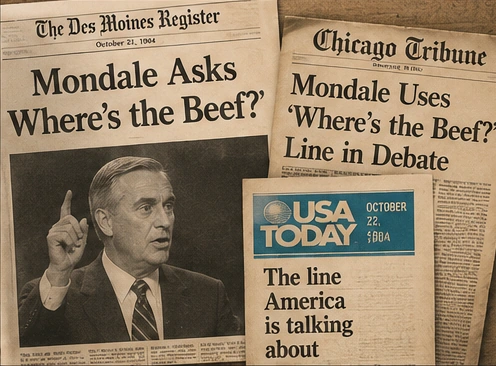
Mondale continued using the line as a criticism of Hart, and coverage repeated it until the slogan became part of the primary’s story. Time magazine noted that Wendy’s had effectively spent millions broadcasting the setup for Mondale’s attack long before he used it.
This political crossover mattered because it permanently separated the phrase from its original product. Once a national candidate could use it as a policy criticism and expect an instant reaction, the slogan had become language rather than copy.
How Clara Peller “found it” and lost the Wendy’s campaign
The Peller-Wendy’s partnership ended in 1985 with a twist so perfectly suited to the story that it almost sounds invented. Peller appeared in a commercial for Prego Plus spaghetti sauce, a product promoted as containing beef. She did not repeat the Wendy’s slogan, but she announced that she had “found it.”
Wendy’s argued that the new commercial weakened the association between Clara and the chain. Negotiations for a new contract ended. A Wendy’s spokesman explained the problem with corporate precision: Clara could only find the beef in one place.
The breakup is funny in hindsight, but it reveals how completely Peller had become the campaign. Her image and voice carried so much of the brand message that finding beef anywhere else—even in spaghetti sauce—was treated as a threat to the entire idea.
Peller continued making appearances afterward, but the original Wendy’s moment could not be recreated. That is often the price of a perfect catchphrase. Once the culture adopts it, every sequel is competing with the first thirty seconds.
The real legacy of Wendy’s “Where’s the Beef?”
The campaign remains a model for how advertising can compress a competitive argument into a piece of language people genuinely want to use. Wendy’s did not win attention by explaining meat weights for thirty seconds. It created a visual accusation and attached the perfect voice to it.
The line is also durable because its meaning never stopped being useful. Products still arrive wrapped in grand promises. Politicians still announce big ideas. Entertainment still promotes spectacle larger than the thing being delivered. “Where’s the beef?” remains available whenever somebody wants proof.
For Gen X, the campaign carries another kind of memory: the sound of one commercial becoming unavoidable. We heard the line in parodies, conversations and other television programs until it felt less like something Wendy’s had invented and more like something the country had always been waiting to say.
That is why the commercial belongs in the same conversation as “Tastes Great, Less Filling”, the mascot-heavy campaigns of the 80s and the decade’s other advertising lines that escaped the commercial break. It did not merely create recognition. It changed the vocabulary.
Keep rewinding the music, movies, TV, toys and fads of 1984
“Where’s the Beef?” landed during one of the decade’s most overloaded years. Prince, Madonna, Van Halen, Ghostbusters, Transformers, cable television, mall culture and the entire fast-food advertising war were all competing for the same national attention span.
Questions about Wendy’s “Where’s the Beef?” commercial
When did Wendy’s “Where’s the Beef?” commercial first air?
The original commercial began airing on January 9, 1984, as part of a major Wendy’s television campaign.
Who was the “Where’s the Beef?” lady?
Clara Peller was a Chicago-area former manicurist and beautician whose gravelly delivery made the slogan famous.
Who created the Wendy’s commercial?
The campaign was created by the advertising agency Dancer Fitzgerald Sample, with Joe Sedelmaier directing and producing the famous spot.
What was the Home of the Big Bun?
It was the fictional rival restaurant in the commercial, built around an enormous fluffy bun hiding a comically small hamburger patty.
Why did “Where’s the Beef?” become so famous?
The phrase was short, funny and reusable. It became a way to challenge anything that looked impressive but lacked real substance.
Did Walter Mondale use “Where’s the Beef?” in a debate?
Yes. Mondale used the slogan against Gary Hart during a Democratic presidential primary debate on March 11, 1984.
Why did Wendy’s stop using Clara Peller?
Wendy’s ended negotiations for a new contract after Peller appeared in a 1985 Prego Plus commercial and announced that she had “found it.”
What was the commercial actually claiming?
Wendy’s was arguing that its hamburgers delivered more visible beef than rival burgers that appeared dominated by large buns and smaller patties.
Campaign history sources
Campaign dates, production credits, political crossover and Clara Peller’s history were checked against Wendy’s corporate material, contemporary reporting and advertising-industry archives.
- Wendy’s — January 1984 “Where’s the Beef?” commercial milestone
- Time, March 26, 1984 — campaign launch, budget and national spread
- The Washington Post — Clara Peller and the campaign’s immediate impact
- Television Academy Interviews — Joe Sedelmaier on the campaign and casting Clara Peller
- The Washington Post — Mondale’s March 1984 debate use of the slogan
- Los Angeles Times — Wendy’s and Clara Peller part ways after the Prego commercial