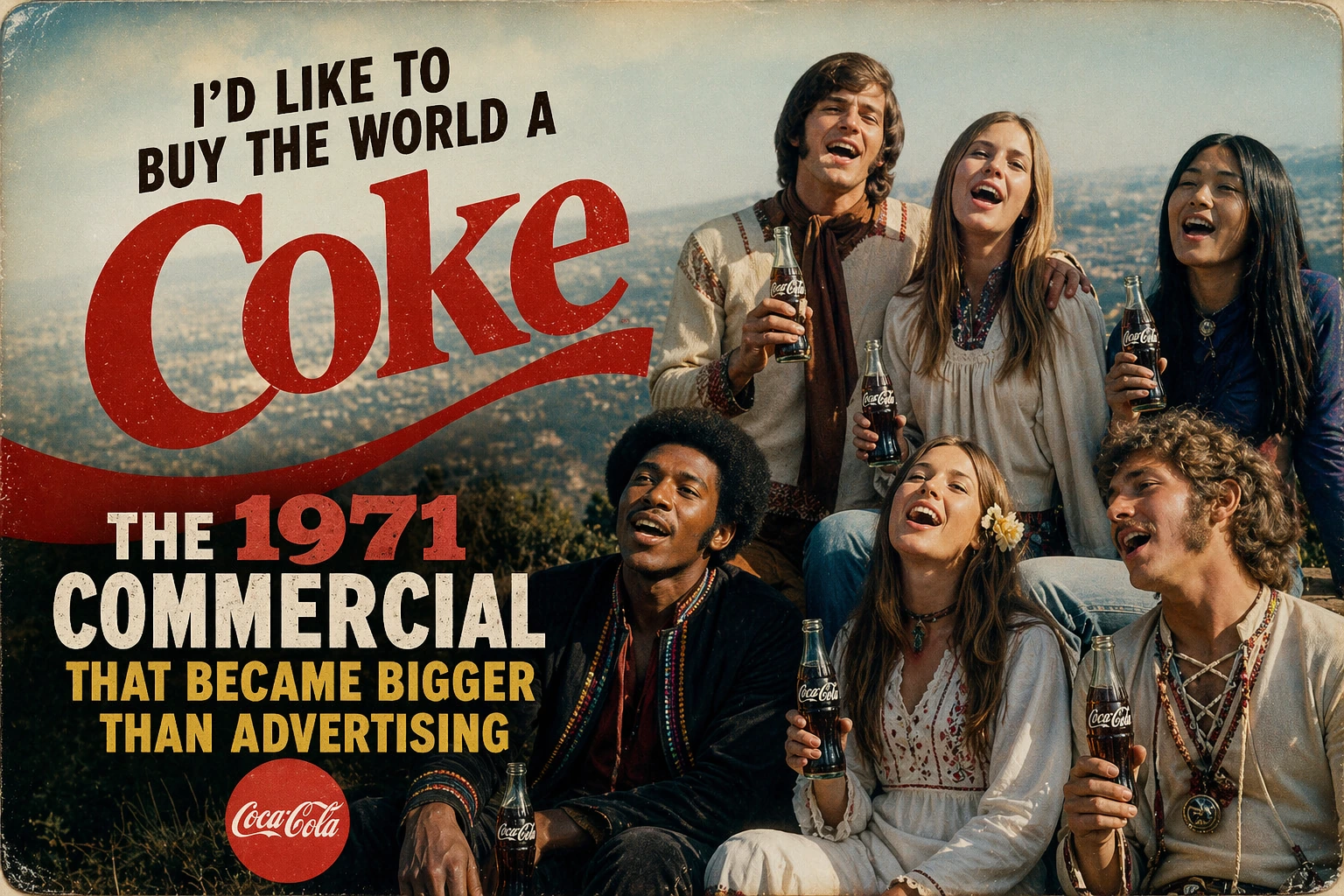
“I’d Like to Buy the World a Coke”: The 1971 Hilltop Commercial That Became Bigger Than Advertising
Some commercials are remembered because the slogan was funny. Some survive because the product became famous. Coca-Cola’s 1971 Hilltop commercial belongs to a much smaller category: the ad became a piece of culture that people remembered with something close to affection.
The young singers, Italian hillside, glass bottles and instantly recognizable melody made “I’d Like to Buy the World a Coke” feel less like a soft-drink pitch and more like a three-minute vacation from the headlines. It was idealistic, carefully engineered and completely committed to its own sincerity.
It sold Coke, obviously. It also tried to sell harmony, and somehow the commercial was confident enough to attempt both without winking.
What Was the 1971 Coca-Cola Hilltop Commercial?
The Coca-Cola Hilltop commercial was a 1971 television ad featuring a multicultural group of young people singing “I’d Like to Buy the World a Coke” on a hillside near Rome. Created for the company’s “It’s the Real Thing” campaign, the commercial connected Coke with companionship, optimism and global harmony instead of focusing on taste or product features.
The idea came from McCann Erickson creative director Bill Backer after a weather delay forced travelers to spend the night near Shannon Airport in Ireland. The production then survived failed weather-plagued filming, a costly reshoot and casting problems before reaching American television in July 1971.
Why the Hilltop Commercial Worked So Well
The Hilltop ad worked because it removed nearly everything people expected from a beverage commercial. There was no demonstration, no taste comparison, no close-up of condensation and no spokesman explaining why the product was superior. Instead, Coca-Cola positioned the bottle as a small shared object inside a much larger emotional scene.
That decision gave the commercial unusual scale. The ad was technically selling one serving of soda, but the message operated at the level of world peace, friendship and common humanity. Most brands would collapse under that much ambition. Hilltop survived because the song, casting and setting made the idea emotionally readable in seconds.
The commercial never breaks character
Modern viewers may see the idealism as soft-focus or calculated, but the ad’s sincerity remains one of its strengths. There is no joke, no self-protective irony and no final gag to make the message safer. Hilltop believes completely in the feeling it is constructing.
The melody does the emotional work immediately
The tune is simple enough to remember after one exposure and broad enough to feel communal. It allows the commercial to communicate optimism before the viewer has processed the words, which is exactly what a strong advertising song is supposed to do.
The image is easy to recall
Young people, bottles, hillside, sky and a growing chorus create one clean mental picture. Decades later, the commercial can be referenced with a few visual pieces and the audience reconstructs the rest.
How a Fog Delay Created “I’d Like to Buy the World a Coke”
The origin story began on January 18, 1971, when Bill Backer was traveling to London to work on Coca-Cola radio material. Heavy fog forced his flight to land at Shannon Airport in Ireland. Passengers were stranded, frustrated and placed in uncomfortable circumstances while waiting for travel to resume.
By the following day, Backer noticed that some of the same people who had been angry were sitting together in the airport café, talking and laughing over food and bottles of Coke. The scene gave him a different way to think about the product: not simply as refreshment, but as a brief invitation to keep someone company.
That observation became the creative center of the campaign. When Backer met music director Billy Davis and songwriters Roger Cook and Roger Greenaway, the group developed the idea into a radio jingle. The concept was large, but the mechanism was small: buy someone a Coke, share a pause and create a moment of connection.
This origin story matters because the best part of the commercial was not invented by beginning with the product. It began with human behavior and then found a believable role for Coke inside that behavior. That is a much stronger creative path than simply attaching a large claim to a bottle and hoping the audience agrees.
The Troubled Production: Dover, Rain and the Costly Rome Reshoot
Hilltop looks effortless on screen, which makes the production story even better. The first plan called for filming on the cliffs of Dover with hundreds of British schoolchildren. Continuous rain destroyed the schedule and forced the production to abandon the location.
The crew moved to Rome, recast the commercial and attempted another shoot. Rain interfered again, and the footage from that effort proved unusable. The budget was gone, the cast had been released and the commercial still did not exist in a form the agency could air.
McCann Erickson secured another budget because the team still believed in the idea. The final cost reportedly exceeded $250,000, a remarkable sum for the period. Hundreds of young people were recruited through schools and embassies in Rome, and a British governess encountered in Piazza Navona became the lead woman seen opening the commercial.
The production difficulties are not visible in the finished film. That is part of the craft. The commercial feels calm, open and inevitable even though it was assembled through rain delays, location changes, budget problems and last-minute casting. Advertising history is full of stories where the cleanest image came from the messiest process.
How the Coca-Cola Jingle Became “I’d Like to Teach the World to Sing”
The commercial’s music was strong enough to create demand outside the ad. Radio stations received requests for the song, and listeners wanted a version that could exist without the Coca-Cola references. That required new lyrics and a new title: “I’d Like to Teach the World to Sing (In Perfect Harmony).”
The Hillside Singers recorded one version, while the New Seekers recorded another. The New Seekers version reached the Top 10, and the Hillside Singers recording reached No. 13. The melody had accomplished something very few advertising songs manage: it moved from campaign device to legitimate pop-market product.
Coca-Cola’s official history also notes that the song was recorded in multiple languages, sold an extraordinary amount of sheet music and generated royalties that included an early donation to UNICEF. Those details show how completely the tune escaped its original thirty-second job.
Why the song could survive without the brand name
The central musical idea was not dependent on soda. The melody supported a general message about harmony, which made it easy to replace the commercial language with broader pop lyrics. The Coke version and the noncommercial version then reinforced each other.
Why Gen X kept hearing it
The song’s second life helped Hilltop remain culturally available. It appeared in retrospectives, choir arrangements, advertising histories and later references, allowing younger viewers to recognize the melody even when they had not watched the original 1971 broadcast.
What Happens in the Hilltop Commercial, Shot by Shot?
The finished ad is visually simple, but the simplicity is carefully staged. It begins with one singer rather than the entire group. That gives the audience a human point of entry before the message expands. The first face feels individual and direct; the later crowd turns the personal invitation into a worldwide chorus.
As the commercial continues, the camera introduces more singers from different backgrounds. The Coke bottles remain visible, but they are not handled like demonstration props. They function almost like visual punctuation, repeating the same shape and brand color while the faces supply variety.
The widening composition is essential. The idea grows in the same direction as the song: one voice becomes several voices, several voices become a crowd, and the crowd becomes a symbolic world. The final helicopter view gives the commercial its scale without adding plot.
This is why Hilltop is remembered as an image rather than a sequence of scenes. The commercial does not ask the viewer to follow a story. It asks the viewer to watch an idea become larger. That makes the spot unusually easy to summarize, parody and recall.
What Hilltop Changed About Emotional Advertising
Hilltop did not invent emotional advertising, but it demonstrated how far a mass-market brand could push emotional association. Coca-Cola was not presented as merely cold, sweet or refreshing. The drink became a symbol inside a story about companionship and worldwide connection.
That approach helped raise the ceiling for brand advertising. A commercial could function as entertainment, music and cultural statement while still performing its sales job. The product remained visible, but the audience was invited to remember the feeling first.
The same emotional-branding logic appears throughout later advertising history. Apple’s 1984 Super Bowl commercial sold rebellion and disruption, Wendy’s “Where’s the Beef?” campaign sold sharp comic attitude, and the Pepsi and Michael Jackson campaign sold pop-star excitement on a massive scale.
Hilltop’s method was softer, but just as ambitious. It asked viewers to attach a worldview to a bottle.
Was the Hilltop Commercial Sincere or Corporate Manipulation?
The honest answer is that it can be both. Hilltop was created to strengthen Coca-Cola’s brand and sell more product. The multicultural casting, hopeful lyrics and emotional setting were strategic choices made by professionals. None of that makes the feeling automatically false.
Advertising becomes interesting when a commercial expresses something people genuinely want while also attaching that desire to a brand. Hilltop did not invent the wish for peace, companionship or relief from conflict. It recognized those feelings and built a remarkably effective commercial around them.
Critics can reasonably argue that the ad reduces complicated global problems to the purchase of a soft drink. Admirers can reasonably answer that a thirty-second commercial was never supposed to solve those problems, and that offering one hopeful image during a difficult period had value of its own.
That tension is also why the ad aged better than many earnest campaigns. Viewers can appreciate the music and craft without surrendering their skepticism. Hilltop supports both reactions, which gives it more depth than a simple piece of brand nostalgia.
Why the Message Felt So Powerful in 1971
The ad arrived during a period marked by the Vietnam War, political conflict, generational tension and public exhaustion. Hilltop did not explain or debate those conditions. It offered an idealized opposite: young people from different backgrounds standing together, singing in the open air and sharing one simple object.
That contrast made the commercial emotionally useful. Viewers were not being asked to solve the world’s problems. They were being offered a brief image of a world where those problems had been suspended. The fantasy was commercially convenient, but it was also precisely tuned to the cultural temperature.
- The hillside suggested openness instead of the crowded, conflict-heavy images dominating news coverage.
- The cast made unity visible without requiring a speech about diversity.
- The song used simple language that could be understood immediately across age groups.
- The bottle gave the idealism a physical center that the brand could own.
The message can be read in more than one way. It is both genuine idealism and extremely skilled corporate symbolism. Those interpretations are not mutually exclusive. The commercial’s power comes partly from how cleanly it combines them.
Why Gen X Remembers a Commercial From 1971
Most Gen X viewers were children, infants or not yet born when Hilltop first aired. The commercial still belongs in Gen X memory because television culture did not erase old advertising as quickly as modern feeds erase yesterday. Classic spots remained available through reruns, retrospectives, anniversary programs, parodies and family memory.
We grew up surrounded by inherited media. Older songs stayed on radio. Older movies returned to television. Commercials became cultural references long after the campaign ended. Hilltop was one of those hand-me-down memories that felt familiar before many people knew exactly where it came from.
There is also a specific Gen X reaction to the ad’s sincerity. We are trained to detect manipulation and usually keep one eyebrow raised around corporate emotion. Hilltop still gets through because the craftsmanship is strong and the sentiment is presented without embarrassment.
You can recognize the strategy and still feel the melody work. That tension is part of the reason the commercial remains interesting instead of becoming a museum piece.
Why the Hilltop Commercial Appeared in the Mad Men Finale
Hilltop returned to the center of pop-culture discussion in 2015 when the commercial appeared in the final moments of Mad Men. The series ends with Don Draper meditating at a California retreat, followed by a cut to the 1971 Coke ad.
The implication is deliberately open but difficult to miss: Don may have transformed his personal search for peace into the commercial idea. The sequence connects spiritual imagery, advertising ambition and the series’ central question about whether authentic feeling can survive after it becomes a campaign.
The choice worked because Hilltop represented the perfect final object for the show. It is beautiful, manipulative, hopeful, commercial and culturally permanent at the same time. The ad can be admired as craft and questioned as corporate appropriation without either reading canceling the other.
Coca-Cola’s own history page notes that the finale sent the commercial back into public conversation more than four decades after its original release. That alone demonstrates how strong the image remained.
The Lasting Legacy of “I’d Like to Buy the World a Coke”
Hilltop lasted because it created several different kinds of memory at once. Viewers remember the tune, the hillside, the bottles, the cast and the emotional claim. Even when one piece fades, another can reconstruct the commercial.
The campaign also became a reference point for advertising professionals. It showed how music and brand meaning could work together at enormous scale, and it proved that a television spot could generate audience response closer to a hit song than a normal commercial.
The campaign’s success did not come from pretending Coca-Cola was unimportant to the scene. The bottle is everywhere. The achievement was making the product feel like a natural participant in a larger emotional idea. That is the trick advertisers have been trying to reproduce ever since.
Keep Rewinding 1971
Hilltop was one unforgettable piece of the year, but 1971 had a complete cultural world around it: singer-songwriters and soul on the radio, changing Hollywood at the box office, network television in transition and a toy aisle still built around hands-on play.
More Commercials That Escaped Advertising
Hilltop belongs to the small group of campaigns that became recognizable beyond the original product category. These companion posts show three different ways advertising broke containment.
Historical Sources
The production chronology, personnel, budget, viewer response and song history were checked against Coca-Cola’s corporate archive and the Library of Congress advertising collection.
Questions About the 1971 Coca-Cola Hilltop Commercial
What year did the “I’d Like to Buy the World a Coke” commercial air?
The famous Hilltop television commercial reached the United States in July 1971.
Where was the Coca-Cola Hilltop commercial filmed?
The final commercial was filmed near Rome, Italy, after weather ruined an earlier plan to shoot on the cliffs of Dover.
Who created the Hilltop commercial?
The campaign was developed at McCann Erickson. Bill Backer shaped the central idea, Billy Davis helped create the music, Roger Cook and Roger Greenaway contributed to the song, and Harvey Gabor developed the visual concept.
What inspired “I’d Like to Buy the World a Coke”?
Bill Backer’s idea grew from watching delayed travelers become friendlier while sharing food and Coca-Cola at Shannon Airport in Ireland.
Was the commercial originally a radio jingle?
Yes. The musical idea began as Coca-Cola radio material before the Hilltop television concept was produced.
Who sang “I’d Like to Teach the World to Sing”?
The best-known noncommercial versions were recorded by the New Seekers and the Hillside Singers.
How successful was the song outside the commercial?
The New Seekers version reached the Top 10, while the Hillside Singers version reached No. 13, proving the melody could succeed beyond the ad.
How much did the Hilltop commercial cost?
Coca-Cola’s history places the final production cost above $250,000 after weather problems and reshoots, an unusually large amount for the period.
Why is the Hilltop commercial considered important?
It demonstrated how a brand could use music, casting and emotion to create cultural meaning instead of relying on product features alone.
Was “I’d Like to Buy the World a Coke” Coca-Cola’s slogan?
The commercial was part of the “It’s the Real Thing” campaign. The song line became so famous that many people remember it as a slogan.
Why did the commercial appear in the Mad Men finale?
The final scene connects Don Draper’s search for peace with the creation of an ad that turns spiritual idealism into powerful brand communication.
Why does the commercial still resonate?
The memorable melody, simple image and complete sincerity allow Hilltop to work as nostalgia, advertising craft and cultural debate at the same time.