Newhart in the 80s: Deadpan Comedy, Small-Town Weirdness & That Ending
Dick and Joanna’s Vermont inn, George’s gentle confusion, Stephanie and Michael’s ambitions, and three brothers who could stop a room cold.
CBS, 1982–90. One Vermont inn, a remarkably patient host, and neighbors with all the time in the world.
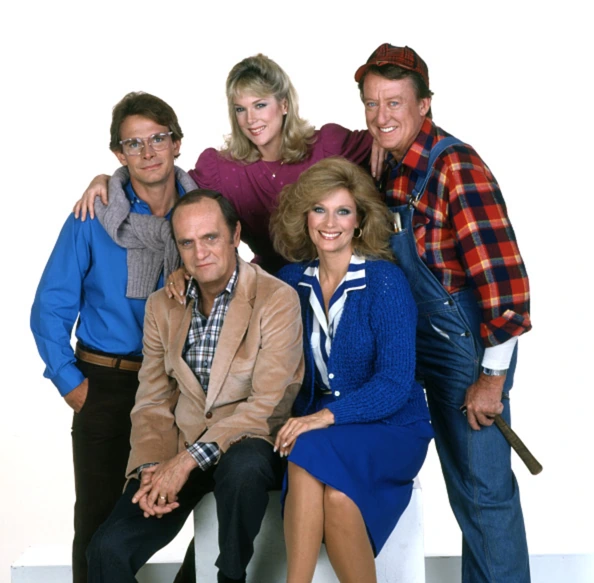
Dick Loudon bought an inn in Vermont and somehow became the only man in town who thought a conversation should get to the point. That was his first mistake. His second was waiting patiently for it to happen. By the time Larry finished introducing his brothers, Dick could have developed a small facial twitch, abandoned his question, and reconsidered the entire real estate transaction.
Newhart looked like a place to relax. The fireplace worked overtime on the atmosphere. There were wooden stairs, a reception desk, a married couple running the place, and enough New England scenery to make a suburban kid briefly consider a career involving maple syrup. Then somebody opened their mouth. Or, in the case of two of the town’s most dependable visitors, conspicuously didn’t.
For viewers finding their way through the eighties, this was an unusually pleasant lesson in comic skepticism. You didn’t need to win the conversation. You could let the other person finish, look at them for another second, and allow the nonsense to identify itself. Bob Newhart made that look easy. Try it in a school cafeteria without his timing and you mostly look as if you haven’t heard the question.
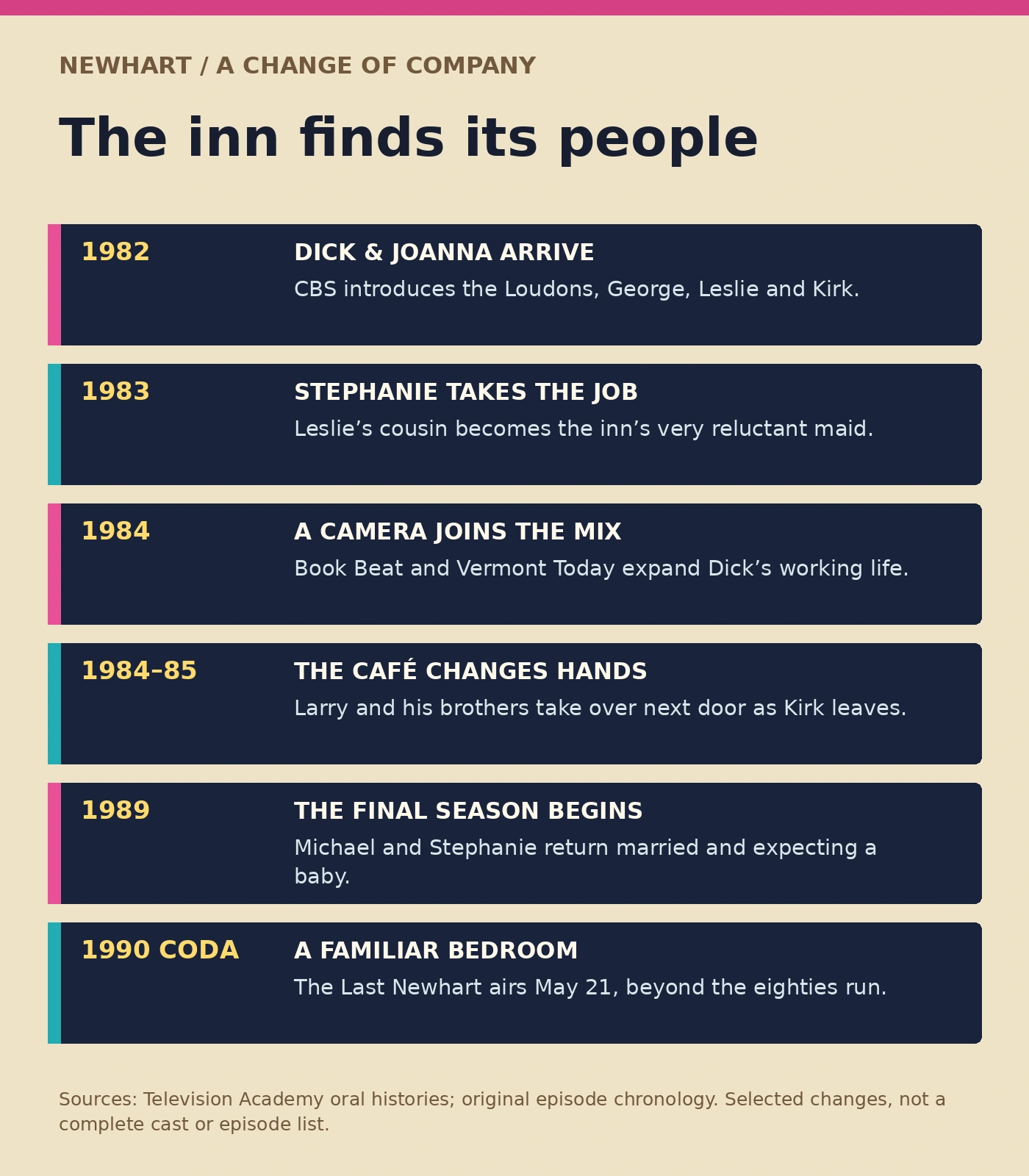
The CBS comedy arrived in 1982, changed some important people around the inn, discovered a television station full of additional trouble, and spent the rest of the decade getting comfortably stranger. Its famous farewell came in May 1990. We’ll get there, with a warning before the big reveal. First, the inn deserves its guests back. So do George, Joanna, Stephanie, Michael, Larry, and the two men who could bring a scene to a complete stop without offering a single opinion.
Inside This Article
- Welcome to Vermont. Your reasonable expectations can stay in the car.
- The inn sold the dream before the neighbors explained the terms
- Dick Loudon, professional explainer in a town that resists explanation
- Joanna lives here too, which Dick occasionally needs to remember
- George Utley will get to it. Eventually. Probably.
- George at the firehouse: promotion brings its own problems
- Before Stephanie and Michael, there were Leslie and Kirk
- Stephanie Vanderkellen has taken a job. Please respect her sacrifice.
- Michael Harris would like to discuss the presentation
- Vermont Today: now Dick can be embarrassed on television
- Larry, Darryl, and Darryl make the introduction everybody knows
- Bob Newhart knew how long you would wait
- The town has procedures. Dick has concerns.
- Joanna objects to the seating arrangement
- Christmas Eve fills the rooms and exhausts the available goodwill
- A snowstorm puts Stephanie outside her preferred social circle
- Kirk finds romance, then discovers it involves another person
- Dick calls Animal Control. Neighborly relations do not improve.
- Pirate Pete discovers the danger of a thoughtful substitute
- Being locally famous can make the lobby feel smaller
- The show got stranger while the room stayed comfortable
- Stephanie and Michael dress for a better world than the one available
- By the late eighties, the inn had become a familiar address
- Why this particular bunch could hold a room
- A short trip into 1990, and the ending everybody wants to mention
- A few Newhart questions before you check out
Welcome to Vermont. Your reasonable expectations can stay in the car.
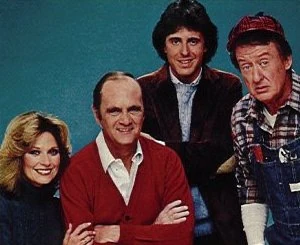
Newhart premiered on CBS on October 25, 1982. Bob Newhart played Dick Loudon, a writer of how-to books who moved from New York with his wife, Joanna, to run the Stratford Inn. Mary Frann played Joanna. Barry Kemp created the series, giving a comedian already famous for maintaining his composure an entire small town in which composure would be tested as a routine business expense.
The premise had the appealing shape of a grown-up escape plan. Leave the city. Buy a place with character. Meet people who have time for conversation. Anyone who had seen a sitcom before could suspect the structural weakness in that last part. The Loudons were getting all the conversation they could possibly want, usually from people whose relationship with ordinary logic was informal.
Dick was an especially good person to put behind the desk. A writer of practical instructions presumably believes that problems can be broken into steps. Running this inn introduced him to problems that wandered away during step one. He could ask a simple question and receive a personal history, a misunderstanding, or a deeply confident answer to an entirely different question. His job was to stay in the room after the sensible exit had become obvious.
The first season belongs with the broadcast season ending in 1983, rather than a whole imaginary television year called 1982. That distinction also puts the show back into a busy CBS world. This was a new comedy with an established star, arriving while viewers still had plenty of long-running favorites competing for the family’s evening. The inn had to earn another visit.
What it offered was familiarity with a slight wobble. Newhart’s presence reassured adults who knew his earlier work. Younger viewers could enter through the employees and neighbors without needing that history. You learned Dick’s situation quickly: he owned the building, but other people appeared to have acquired permanent rights to his attention. There was no security deposit large enough to cover that arrangement.
The inn sold the dream before the neighbors explained the terms
The Stratford Inn was a terrific television workplace because the front door could deliver almost any problem. A guest arrived with luggage and expectations. A neighbor arrived with a favor. An employee arrived with a reason the expected work had not occurred. Dick could be interrupted at home while technically being interrupted at work, a bargain that saved the writers a great deal of commuting.
Its exterior came from the real Waybury Inn in East Middlebury, Vermont. The interiors belonged to the production, rather than a documentary camera following the Loudons through an operating hotel. That little piece of television geography matters when remembering the place. The outdoors supplied the invitation. The rooms inside were built for people to stand together, misunderstand each other, and leave Dick with nowhere discreet to put his expression.
The reception area and sitting room did a lot of the work. A counter established somebody’s supposed authority. The stairs provided entrances that could change a conversation immediately. Chairs encouraged people to settle in when Dick very much wanted them to leave. The rooms suggested a business designed around hospitality and then cheerfully demonstrated the drawbacks of being hospitable.
There was a useful contrast between the show’s postcard surface and its behavior. The inn looked welcoming enough for a vacation brochure. Its inhabitants could make a five-minute errand feel like a deposition conducted by people who had misplaced the question. For a kid watching from a house where adults were always discussing sensible plans, the spectacle was oddly reassuring. Adults could own property and still be outnumbered by foolishness.
The coziness also gave the comedy a forgiving atmosphere. It made room for long pauses and small embarrassments. Nobody had to sprint through a joke because the room felt hostile. You could enjoy the carved wood, the familiar faces, and the dreadful realization that the person beginning another story had no intention of abbreviating it. Somewhere in that combination was the appeal of another half hour at the inn.
Dick Loudon, professional explainer in a town that resists explanation
Dick’s books are a beautiful detail. Plenty of sitcom men had ordinary jobs; this one earned his living by helping strangers understand things. Then he came downstairs and met people who could turn a straightforward instruction into an opportunity for metaphysics. The author of the useful explanation had become the customer of the useless one.
Newhart didn’t play him as an endlessly gracious saint. Dick could be impatient, vain about his work, jealous, or unnecessarily certain that his taste represented the sensible position. That gave the show somewhere to go beyond letting him observe the locals. Sometimes Dick created the mess because he wanted to be liked, wanted to avoid an awkward conversation, or wanted recognition more than he cared to admit.
In the first-season episode Some Are Born Writers…Others Have Writers Thrust Upon Them, he praises an aspiring writer to spare her feelings. The compliment develops consequences when her husband decides she should write full time. There is a lovely trap in that situation. Dick knows what professional encouragement sounds like. He also knows the difference between encouragement and actually believing the work is good. He chooses the easy sentence and gets handed the difficult afternoon.
That is a more interesting flaw than generalized grumpiness. A blunt man might have prevented the problem. Dick’s hesitation allows it to grow. The same comic instrument that makes him charming can make his life worse when he tries to slide past the moment that needs an honest answer. Newhart lets you see the impulse to postpone, followed by the realization that postponement has collected interest.
It keeps Dick within reach. We might not own an inn or publish helpful books, but many of us have given a reassuring answer because the accurate one would complicate dinner. By the time Dick is looking for a way out, you can recognize the transaction. He bought thirty seconds of peace with a promise he cannot afford. The locals don’t hold a monopoly on bad judgment.
Joanna lives here too, which Dick occasionally needs to remember
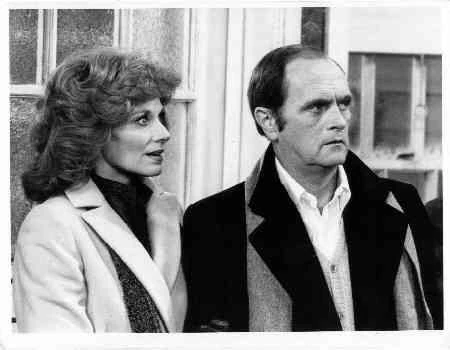
Mary Frann gave Joanna the confidence of someone who had already heard Dick’s objections and still expected him to participate. Their marriage made the inn habitable. Without it, he could have become a tourist permanently trapped among the residents. Joanna gave him a home inside the absurdity, along with a second person perfectly capable of telling him he was being ridiculous.
She had a practical stake in the place. Guests needed feeding, the business needed running, and the people around them needed managing. Dick could retreat into the wounded dignity of an author whose concentration had been disturbed. Joanna often had to deal with the ordinary business still standing there after he had expressed his displeasure. Frann’s briskness helped keep those scenes from becoming another demonstration of how difficult everyone was for Dick.
The first season’s You’re Homebody ’til Somebody Loves You gives that marriage a useful shove. Dick calls Joanna a homebody, and she takes work at a travel agency. It is a small domestic judgment with a great deal tucked into it. He has described her life as though it were settled, then discovers that the person living it may have further opinions.
You don’t need to inflate the incident into a sweeping declaration to enjoy the discomfort. Anyone who has been casually summarized by a spouse, parent, or friend knows the temptation to do the exact thing that description has ruled out. Joanna gets movement. Dick gets an education in how a supposedly innocent observation can land. The inn’s reliable center turns out to have needs of her own.
Frann also faced an audience with memories of Suzanne Pleshette beside Newhart in an earlier bedroom. Joanna was a different woman in a different marriage, and the series worked better when it let her occupy that space. Her warmth could take the edge off Dick’s irritation. Her resistance could put it back where it belonged. The Loudons felt married because each could interrupt the other’s preferred version of events.
George Utley will get to it. Eventually. Probably.
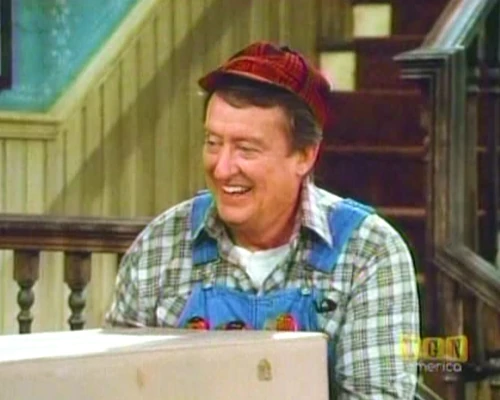
Tom Poston’s George Utley could slow a room down by appearing to think. He wasn’t playing a man proudly displaying his eccentricity. George behaved as if his pace, his concerns, and his way of arriving at an answer were entirely reasonable. Everyone else was welcome to wait. The inn had a handyman; whether a particular task would become handier was a separate question.
Poston and Newhart made a particularly satisfying pair because neither needed to attack a line. Dick waited for George to finish. George looked as though he might require a little more time. The pauses belonged to two different people: one struggling to be patient, the other unaware that patience was being spent. Put them together and the silence acquired a small electrical charge.
George could also be hurt. In But Seriously, Beavers, from the third season, Dick’s jokes at a lodge event humiliate him badly enough that he considers leaving the inn. That story cuts through the comfortable assumption that the slower fellow is simply there to be teased. Dick has an audience, enjoys the laugh, and then has to deal with the person who supplied it.
The problem lands because George belongs to the place. He isn’t a visiting fool Dick can forget after the credits. He will be there in the morning, unless the joke has damaged that relationship. Poston gives the injury weight without making George suddenly speak in a polished speech borrowed from a different character. The comedy has to make room for the man it has been inviting us to laugh at.
Another third-season story, Local Hero, turns the usual balance around when George saves two boys from drowning. Recognition follows the man people often underestimate. It is a good change in the weather. The show can enjoy his confusion and still let him be useful, brave, and wanted. For all the Stratford’s sophisticated reactions to him, there would be a real hole in the building if George stopped coming through it.
George at the firehouse: promotion brings its own problems
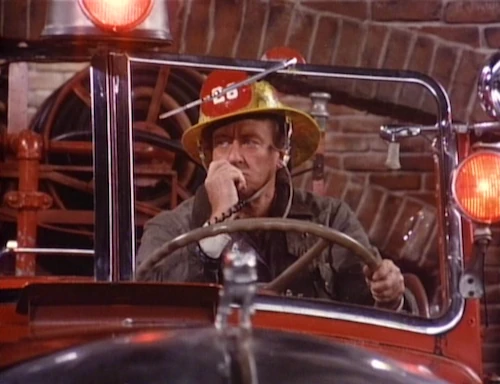
In the second season’s Curious George at the Firehouse, George joins the volunteer fire department in hopes of improving the way people see him. Then he loses the keys to the fire truck. It is an admirably compact demonstration of the gap between taking on a new identity and being ready for the practical obligations that come with it.
Poston makes that kind of predicament work because George’s desire to matter is easy to understand. The uniform and responsibility offer a chance to step beyond his usual place at the inn. Being treated as dependable would feel good. Unfortunately, a fire truck is an inconvenient object to hold up while you work through a problem with the keys.
The comedy doesn’t require George to announce that he wants respect. His decision to join already tells you. The obstacle puts that desire under pressure in public, with other people depending on a task that should be simple. Anyone who has fumbled a small job immediately after being given more responsibility can recognize the particular temperature of the embarrassment.
It is also a useful reminder of how much Poston supplied to the show’s affection. A character who merely fails at things becomes a mechanism. George has hopes, pride, and a place among these people. Watching him try to expand that place gives the mishap a person to happen to. You can laugh at the keys and still want the man who lost them to have a better afternoon.
Before Stephanie and Michael, there were Leslie and Kirk
A rerun could give you a small surprise if it came from the beginning. Jennifer Holmes played Leslie Vanderkellen, the inn’s original maid, and Steven Kampmann played Kirk Devane, who ran the neighboring Minuteman Café. The settled ensemble most people remember wasn’t delivered fully assembled with the first reservation.
Leslie came from money, but she was willing to work. That made her very different from the cousin who would replace her. Early stories gave her skiing ambitions, romantic possibilities, and the experience of trying to get through an ordinary job among people who specialized in making an ordinary day elaborate. Holmes brought a pleasant steadiness. The surrounding comedy would eventually favor somebody with much less interest in being pleasant.
Kirk’s difficulty was credibility. A compulsive liar is a demanding neighbor, especially when you run a business that requires practical cooperation. He could generate trouble without leaving the room, simply by making an account of something less trustworthy than it had been before he began speaking. Dick had to decide how much effort to invest in separating the event from Kirk’s improvement on it.
The Boy Who Cried Goat, in the first season, puts that reputation to work when Kirk’s café is robbed and his insurer doubts him. It is an efficient reversal. The man who has treated belief as something to manipulate suddenly needs it for a real problem. Dick is left near the uncomfortable border between helping a friend and having heard far too much from him already.
Kirk remained through the second season, including a romance and marriage to Cindy, played by Rebecca York. His departure opened room for a different kind of neighbor. The brothers would eventually run the café, giving the show a source of nonsense that was much harder to cross-examine. Kirk could be caught telling a story. Larry could leave Dick wondering whether they had ever agreed on the meaning of the words in the first place.
Stephanie Vanderkellen has taken a job. Please respect her sacrifice.
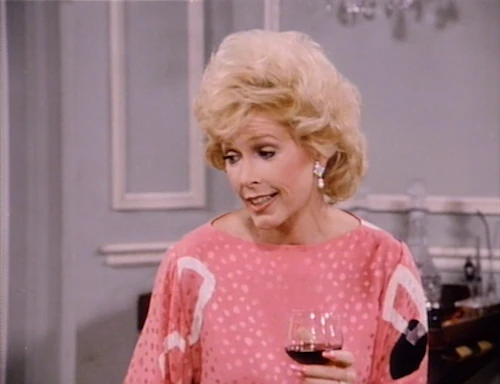
Julia Duffy’s Stephanie had a relationship with labor that might charitably be called theoretical. Leslie’s cousin was an heiress working as a maid, a situation she seemed to regard as evidence that the universe had filed her paperwork incorrectly. Actual cleaning was a deeply inconvenient part of the arrangement.
Stephanie had appeared as a visitor in the first season before becoming the replacement maid in season two. That shift helped transform the show. Dick had already met people who misunderstood him. Now he employed someone who might understand a request perfectly and still find it personally offensive. An instruction could be clear, reasonable, and paid for, yet fail the more important test of whether Stephanie felt like doing it.
Duffy made the entitlement wonderfully specific. Stephanie didn’t have to announce that she thought herself above the job. Her posture, her expression, and her attention to something more important than the work could carry the whole dispute. When a person treats being asked to dust as a violation of the social order, a feather duster becomes a fairly potent prop.
Place the second season against the television season ending in 1984 and you can see a returning sitcom changing its balance while its audience was still getting acquainted. The new maid brought a different kind of friction. She didn’t need a weekly visitor to disrupt the inn. Keeping her on the payroll was already an ongoing source of material.
The character could easily have become exhausting. The trick was that Duffy supplied little flashes of panic and need beneath the high opinion. Stephanie depended on the people she found beneath her. She wanted attention, reassurance, and a level of comfort her current arrangements did not provide. Her snobbery kept colliding with the embarrassing fact that these were the people available to help. Dick might have wished to revise the employment contract. Joanna knew they were dealing with a person as well as a problem.
Michael Harris would like to discuss the presentation
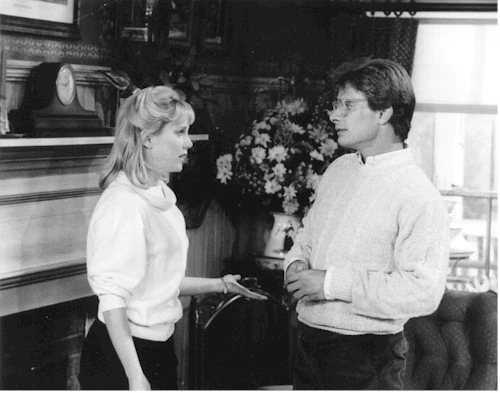
Peter Scolari’s Michael Harris arrived from the world of local television with the confidence of a man who had learned several useful professional phrases and intended to get his money’s worth. If Dick valued a clear sentence, Michael valued how the sentence sounded in a meeting. A small Vermont television operation could occupy an enormous amount of space in his sense of himself.
He was an excellent addition because Dick could no longer quarantine all the trouble at the inn. Work at the station offered fresh people, new pressures, and a producer whose enthusiasm could become a trap. Dick might want to discuss books or have an intelligent conversation on television. Michael had to think about making television, a distinction capable of ruining Dick’s afternoon before anyone switched on a camera.
Scolari also gave Stephanie a partner who could match her commitment to appearances. Their relationship was ridiculous in a very recognizable eighties way. Clothes, professional status, taste, and the reassuring evidence of success could become central emotional questions. They could be extravagantly self-involved together, then discover that two people each expecting continuous reassurance had created a staffing problem.
There was real comic speed in Scolari’s work. His energy could hurry toward an idea while Newhart was still deciding whether the idea deserved a response. Duffy added a third rhythm: the pause of somebody waiting to find out why the proposed development mattered to her. The scene didn’t require three people delivering jokes in the same style. It improved because their internal clocks disagreed.
By the 1986–87 television season, Michael and Stephanie were part of the show’s established identity. An audience surrounded by ambitious young professionals on television could recognize their appetites immediately. Newhart let the aspirational wardrobe into its cozy inn and then watched it encounter George. There were limits to how completely a person could manage their image in a building where the handyman might still be considering the original question.
Vermont Today: now Dick can be embarrassed on television
Giving Dick a local television career was an inspired expansion. The inn made him responsible for people who came through the front door. The station put him before an audience while other people helped decide what should happen next. His discomfort had acquired a broadcast signal.
The second season’s Book Beat brings him into a literary discussion program. Later that season, Vermont Today gives the local show its familiar name and includes a contest involving the world’s smallest horse. The movement from literary aspiration to small-animal spectacle tells you plenty about the distance between the television Dick might imagine and the program he has to host.
That distance kept the premise flexible. Local television required guests, ideas, promotion, and the appearance that everyone involved knew what they were doing. Each of those could fail separately. Dick might know his subject and still lose control of the show because the production around him wanted something more cheerful, more noticeable, or simply more televisual than a sensible conversation.
For viewers who knew their own local stations, there was extra pleasure in the scale. This wasn’t a fantasy of Dick becoming a national celebrity overnight. Regional familiarity carried enough vanity and awkwardness to keep him occupied. Being recognized could flatter a person while also making it harder to escape someone who had formed a very specific impression from a very small amount of screen time.
It widened the comedy without losing the inn. Dick could return home after a difficult day at the station and find another set of people ready to misunderstand it. A different workplace didn’t rescue him from his basic predicament. It gave him more material to explain to Joanna, more reasons to be irritated with Michael, and more opportunities for Larry to arrive just when a quiet room had begun to seem possible.
Larry, Darryl, and Darryl make the introduction everybody knows
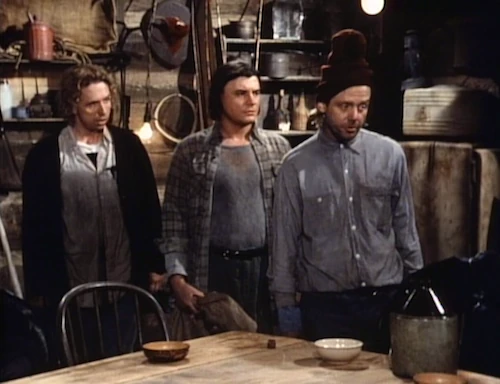
William Sanderson’s Larry introduced himself and his brothers with a thoroughness that suggested Dick might have forgotten since the previous visit. Tony Papenfuss and John Voldstad supplied the two Darryls. The repeated introduction became one of the show’s great pleasures because the audience knew where it was going and still wanted to watch Dick receive it.
Sanderson gave Larry a sincere commitment to his own account of things. He wasn’t winking at the audience about how strange the brothers were. He brought news, proposed arrangements, expressed concerns, and conducted business with the expectation that the other person would try to follow. The difficulty came when Dick attempted to apply his own assumptions to what he was hearing.
The Darryls made silence active. They looked, shifted, carried things, and remained present in the conversation. A speaking part wasn’t necessary for them to complicate Dick’s day. Their stillness also gave Larry’s words somewhere to land. The brothers felt like a unit with a system that worked perfectly well for them, regardless of how long an outsider might need to understand it.
Once they took over the neighboring café after Kirk’s departure, they were part of the business landscape. Dick couldn’t treat them as a passing encounter from which civilization would shortly recover. They were next door. They had transactions to conduct. Their ownership turned the repeated arrival into a neighborhood fact, as dependable as the inn’s stairs.
The joke also grew through restraint. It is tempting to imagine that writing three unusual men means giving each a loud eccentricity and a pocketful of catchphrases. Here, two had almost no dialogue to spend. The small differences in their faces and reactions became more noticeable because Larry did the explaining. You watched closely. By the time Dick had gathered himself to answer, the audience might already have decided that his hope of simplifying the situation was optimistic.
They are a good reason to keep Newhart among the more distinctive sitcoms of the eighties. The series could build an enormous running joke out of three men standing politely in a room. In a decade with plenty of loud entrances, that was a rather satisfying invasion.

Bob Newhart knew how long you would wait
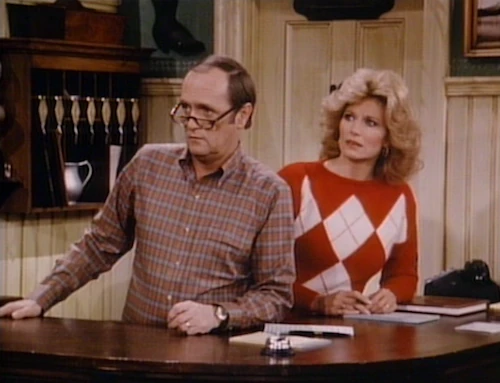
A Newhart pause had several possible occupants. Dick could be searching for a polite response. He could be deciding whether he had heard correctly. He could be hoping the other person would realize the problem and fix it without his assistance. Sometimes you could see all three possibilities cross his face before he selected the least damaging sentence.
That kind of timing depends on listening. A comedian who seems to be waiting only for his next line leaves little room for the other performer. Newhart could make the listening itself the event. The person speaking believed the conversation was moving forward; Dick’s face suggested that progress had become doubtful several words ago.
It was especially useful in an ensemble with so many different speeds. George might take his time. Michael might supply more than enough explanation. Larry could arrive at a conclusion through a route Dick had never encountered. Newhart didn’t have to beat each man at his own style. He could receive the information and let his response reveal how far the room had drifted from what he expected.
For younger viewers, that offered a pleasing alternative to winning by shouting. Dick was frequently the quietest person with an objection. His authority came from the accuracy of the objection and the care with which he chose to express it. When he finally did become openly exasperated, the buildup had already done much of the work.
It also made him funny beside performers who could easily fill a frame. Duffy’s offended expression and Scolari’s eager intensity didn’t diminish him. They gave him something to watch. The show trusted that a man standing there, gradually losing faith in the conversation, could hold the center of a scene. Anyone who has waited for a meeting to end can appreciate the ambition of that experiment.
The town has procedures. Dick has concerns.
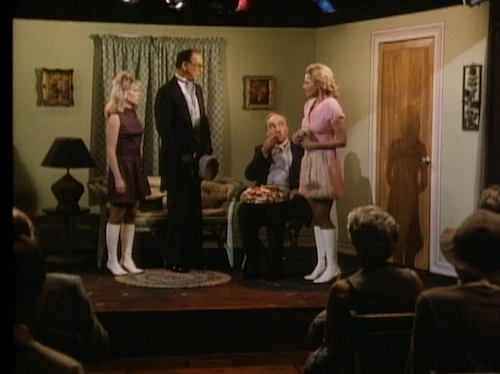
A small town can be a very large organization when everybody knows how things are supposed to be done. Newhart found a steady supply of trouble in that arrangement. Dick arrived with reasonable ideas and discovered that reason was only one of the qualifications a proposal might need. Habit, personal standing, and somebody’s memory of a previous disagreement could also be on the committee.
Chester Wanamaker and Jim Dixon, played by William Lanteau and Thomas Hill, helped give civic life its own comic weather. These weren’t simply people passing through Dick’s lobby. They belonged to a community that had managed without him before he arrived. His fresh eyes could be useful. They could also strike the established residents as an unnecessary complication.
The tension is familiar to anyone who has suggested changing the way a club, office, or neighborhood does something. An outsider sees the obvious shortcut. The insiders see the person proposing to remove a perfectly good ritual. Even a decision about golf or a lodge can become an examination of who gets to feel at home.
Dick didn’t always behave well under that examination. His preference for sensible behavior could become a fairly high opinion of himself. The series was happier when it allowed the townspeople to dent that opinion. They might be peculiar, stubborn, or spectacularly unhelpful, but they were not a roomful of defendants awaiting Dick’s verdict.
That gave the inn a surrounding world. You could believe these people had discussions, loyalties, and small grievances when Dick was upstairs working. He had moved into an existing conversation and expected to improve the agenda. Sometimes the town responded by continuing the conversation exactly as it pleased.
Joanna objects to the seating arrangement
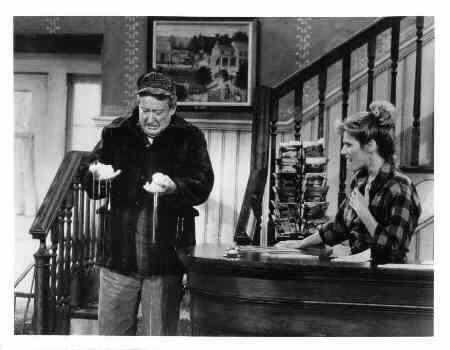
The second-season episode The Stratford Wives gives Joanna a potluck tradition worth challenging: the men eat in the dining room while the women eat in the kitchen. The arrangement has apparently survived long enough to become ordinary. Joanna’s arrival makes its ordinariness considerably harder to defend. An evening organized around everybody bringing something has somehow acquired two very different dining experiences.
It is a sharper situation than a simple clash over etiquette. The custom tells the women where they belong after they have helped provide the meal. Joanna questions an arrangement that other people have learned to navigate. Her objection has to survive the social pressure to get along, preserve the occasion, and stop making the existing division uncomfortable by saying it aloud.
Frann is particularly useful here because Joanna can act on her own judgment. She doesn’t have to wait for Dick to bring home a problem, then supply the affectionate advice that sends him into the next scene. Her own dealings with people expose the conditions attached to belonging. Moving to a friendly town doesn’t mean liking everything friendliness asks you to overlook.
The premise also fits the inn’s larger household. Joanna works, Dick works, and the business depends on what each contributes. Beyond their own front door, a communal meal can still place women in a supporting space while the men occupy the main one. The comedy gets its tension from making that comfortable expectation awkward for the people enjoying it.
A familiar room becomes interesting when somebody asks who gets to sit in it. Newhart could let that question arise among neighbors without transforming Joanna into a visiting lecturer. She has come to eat with people she knows. Wanting the same place at the table is a concrete desire, and the discomfort around it gives Frann something more pointed to play than general bemusement at her husband’s day.
Christmas Eve fills the rooms and exhausts the available goodwill
No Room at the Inn, broadcast on December 20, 1982, gives the new comedy an old seasonal problem: too many people need shelter, and the people providing it have limits. Snow leaves the Stratford crowded at Christmas. Kirk tries to entertain the stranded guests while Dick faces the arrival of a traveler named Joseph with his pregnant wife. The title is not being coy about the comparison.
Holiday episodes can become so eager to be lovely that the characters stop behaving like themselves. The inn’s setting helps avoid that trap. Hospitality is already their business. The question is what happens when the holiday asks for more than the ordinary transaction, while the room contains a collection of people who may not be improving one another’s spirits.
Dick has to turn a generous impulse into an actual arrangement. That is where seasonal sentiment usually meets the problem of beds, space, and people wanting answers. Newhart is well suited to the gap. A man can agree that Christmas should bring out the best in everyone and still be completely unsure where everyone is supposed to sleep.
Kirk’s entertainment efforts supply another form of pressure. Being stranded is bad enough; being stranded with somebody determined to make it enjoyable has its own hazards. An inn full of captive guests gives an eager performer no shortage of people who technically haven’t left. The distinction between an audience and a group waiting for the roads to clear can become very small from his side of the room.
The episode also shows how quickly the building became useful. In its first few months, the series could make a holiday story feel native to the place. The weather closed the circle. The owners, staff, neighbors, and guests had to spend the evening together, whether or not their individual plans called for additional fellowship.
A snowstorm puts Stephanie outside her preferred social circle
Lady & the Tramps, from December 1983, sends Stephanie into a snowstorm and into the brothers’ world. It is a particularly good collision of characters because her judgment normally arrives before the other person finishes the introduction. Larry and the Darryls have a way of making introductions take up a substantial part of the encounter.
At the inn, Stephanie can treat the people around her as inadequate service. In trouble away from it, she needs someone else’s help. Duffy’s comedy thrives on that indignity. The person with very definite standards has to deal with circumstances that have not bothered to consult them.
The brothers’ home changes the balance too. Visitors to the Stratford are entering a space Dick hopes to manage. Here the assumptions belong to Larry and his family. Their habits don’t need to become more understandable because Stephanie has arrived. She is the guest trying to work out the rules, and she has considerably less practice accepting the accommodation than she has criticizing it.
There is pleasure in watching two varieties of certainty meet. Stephanie knows how people of the right sort ought to behave. Larry knows how his own household works. Neither begins with much reason to consider the other’s expectations binding. They have to occupy the same space long enough for the friction to become a scene.
The show could find bigger laughs by sending its people a short distance than by inventing a distant vacation. The woods and the inn existed near each other, yet social geography made the journey enormous for Stephanie. Vermont was still Vermont. Her expectation of what it owed her had encountered a serious local disagreement.
Kirk finds romance, then discovers it involves another person
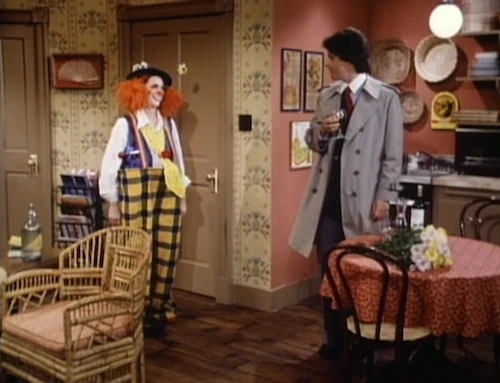
The second season gives Kirk a relationship with Cindy, a professional clown played by Rebecca York. A sitcom had already placed him beside an innkeeper who specialized in the restrained reaction; now it handed him a romantic situation in which the occupation could unsettle him before any personal disagreement even began.
In Kirk Goes for the Juggler, meeting the right woman includes worrying about her profession. It is an appealing embarrassment for a man whose own relationship with dignity has hardly been flawless. Kirk can be unreliable, needy, and extravagant with the truth, yet still find a reason to wonder how somebody else’s job might look.
The romance also lets Kampmann play something beyond the immediate problem of whether Dick believes him. Kirk wants the relationship to work. That desire can expose the insecurity beneath the inventions. Trying to appear impressive is one thing when you’re telling a story next door. It becomes a more demanding occupation when the person you hope to impress expects to know you.
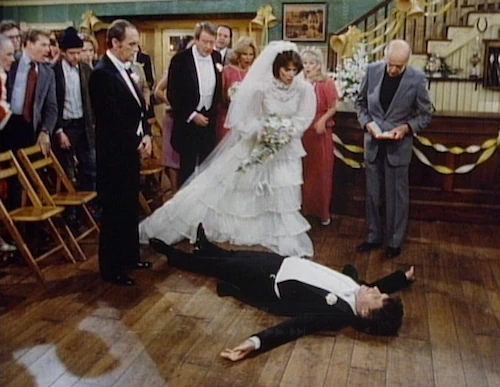
The wedding episode, Kirk Ties One On, makes his nerves physical when he faints during the ceremony. Television weddings were perfectly capable of building an entire evening around preparations and sentiment. Here the bridegroom’s body supplied a more direct objection to the stress of getting through it.
Kirk and Cindy don’t occupy the permanent center of most people’s memory of Newhart, but their second-season stories belong to the show’s process of finding itself. A revisit to those episodes offers a slightly different inn: more concerned with this particular neighbor, still making room for the people who would eventually take over. The familiar comedy had an earlier life, and some of its funniest anxieties were already standing at the altar.
Dick calls Animal Control. Neighborly relations do not improve.
The third season’s Dick Gets Larry’s Goat places Dick and Joanna in a dispute with the brothers after Dick calls Animal Control. It is a beautifully practical way to make the sensible man the active cause of the trouble. He sees a problem, uses the appropriate channel, and discovers that being procedurally reasonable does not guarantee a peaceful neighborhood.
By then the brothers are close enough to be more than occasional visitors. Their habits can intrude on the Loudons’ business and home. Dick’s patience has a property line. The difficulty is communicating where he thinks that line belongs to people whose daily arrangements have developed around other assumptions.
Newhart can get a great deal from the aftermath of a decision like that. The phone call itself is efficient. Living next door afterward is where the comedy waits. Dick has done something he can defend in a paragraph; he must now explain it in person to people who are not reading that paragraph with an open mind.
The show doesn’t need to make Larry a polished opponent for the disagreement to work. Sincerity can be stubborn. The brothers may be strange to Dick, but their own concerns are entirely available to them. His irritation has to share the episode with their feeling that an outsider has interfered.
It also keeps the inn from becoming a sanctuary with a queue of funny visitors. Sometimes the owners are in a quarrel. Sometimes the disturbance is a consequence of Dick’s own action. The front door will reopen next week, and the same neighbors will still be there. Rural peace, it turns out, is a project with recurring maintenance.
Pirate Pete discovers the danger of a thoughtful substitute
The fourth season opened with Pirate Pete on September 30, 1985. Dick fills in for the ailing host of a children’s television program and disapproves of its commercialism. A temporary assignment becomes a problem with somebody else’s livelihood attached. He has entered the studio with an opinion; the consequences prove much harder to carry out of it.
For viewers who had spent Saturday mornings in the company of toy advertisements, the conflict was easy to understand. Children’s television had an educational promise, an entertainment obligation, and people paying for the time. Those purposes did not always sit together comfortably. Dick’s discomfort gives the subject a human scale without requiring the episode to turn into a broadcasting seminar.
He is also a funny choice to substitute for a children’s host. His great skill is letting an adult audience recognize what he is declining to say. A children’s program can ask for a more immediately visible sort of enthusiasm. Putting that reluctant, thinking face in the wrong performance environment supplies trouble before the argument about the show has even developed.
The story refuses him an effortless moral victory. The program gets canceled, and Dick tries to help get Pete reinstated. An objection may be reasonable while its consequences are painful. Newhart’s character can discover that making the correct criticism and improving the situation are different jobs.
That is one of the advantages of the station setting. Dick cannot remain the man at home passing judgment on what is on television. He has become one of the people making it. A badly considered appearance, an awkward guest, or an intervention made with excellent intentions can now leave him responsible for the next day’s work.
Being locally famous can make the lobby feel smaller
In the third-season episode The Fan, an admirer becomes an intrusive presence in Dick’s life. The attraction of being appreciated runs into the problem of having the appreciator right there, making plans around you. For a writer who needs to work and an innkeeper who cannot simply disappear from his own building, recognition can begin to resemble an additional shift.
Dick’s small television celebrity works because the show can change its value from scene to scene. An audience is flattering in the abstract. A specific person with an endless supply of interest may be less convenient. The difference becomes especially sharp when a job already obliges you to be civil to people staying under your roof.
Michael sees television through another set of desires. Success promises advancement, a better professional identity, and something reassuring to tell Stephanie. Dick’s unease can strike him as a failure to appreciate an opportunity. Dick may suspect that Michael’s idea of an opportunity involves another roomful of people he would prefer not to meet.
The station stories also catch the small humiliations of performing seriousness. A host can hope to discuss a worthy subject and find himself occupied with the machinery of an entertaining segment. He may want a good program, then become embarrassingly interested in whether someone is going to recognize it as a good program. In What Makes Dick Run, the prospect of a VITA nomination encourages him to jazz up the show. Even restraint would like an award occasionally.
That streak of vanity keeps the satire fair. Dick is not a pure representative of culture besieged by fools with cameras. He wants some of the rewards. His problem is that receiving them may involve participating in the very behavior he has been watching with such visible concern.
The show got stranger while the room stayed comfortable
The first season was made on videotape; the second moved to film. Watch episodes across that boundary and the inn’s look changes along with some of the people working in it. The early program can feel more immediate and stage-bound. The later visual texture fits the version many viewers carry in memory, with a settled ensemble moving through rooms that seem increasingly familiar.
A change of recording medium doesn’t explain the comedy by itself. Stephanie, Michael, and the brothers gave the writers different collisions to arrange. Dick could be challenged by entitlement, professional ambition, leisurely confusion, or a statement that appeared to come from another civilization. The cast no longer had to produce variations on one kind of difficult neighbor.
The comfortable presentation helped those collisions. The audience could orient itself quickly in the lobby, the dining area, or the television workplace, leaving attention free for a reaction. You knew where someone might enter. You knew who was likely to misunderstand. The surprise came in how far the particular misunderstanding would go.
There was room for broad behavior without forcing Dick to become broad along with it. His stillness anchored the scene. A series full of eccentric people can become tiresome when everyone seems to be auditioning for attention at once. Newhart gave the commotion a person to happen to, along with the possibility that his response would be funnier than the commotion.
That balance sits comfortably beside the ensemble work in the eighties rise of Cheers. Both shows made a recurring place worth returning to because the people inside knew how to disrupt one another. Vermont offered different drinking arrangements and considerably more concern about who was going to do the cleaning.
Stephanie and Michael dress for a better world than the one available

Eighties television supplied plenty of people who wanted to get ahead. Stephanie and Michael gave ambition a particularly fussy domestic life. They cared about the signs of success, the quality of an experience, and how far the current surroundings fell below what they had in mind. The Stratford’s practical problems could seem like a personal insult to their future.
The pairing worked because neither was simply pretending to be self-involved. Each could be vulnerable in ways that required a tremendous amount of attention. Michael’s professional confidence needed reinforcement. Stephanie’s certainty about what she deserved could become alarm when the world failed to deliver it. Together they created a relationship with a very busy customer-service desk.
In Poor Reception, from the third season, Michael hires Stephanie at the station and then struggles with firing her. The premise brings the two principal parts of his life into an arrangement that has almost no chance of remaining professional. Being a producer is supposed to involve decisions. Being Stephanie’s boyfriend makes some decisions dramatically more difficult to communicate.
Stories about work and status could also expose how much affection there was beneath the fuss. Michael might be maddeningly pleased with himself, yet Scolari could make a collapse in his confidence feel suddenly unguarded. Duffy could let Stephanie’s needs become visible without removing her capacity to make an unreasonable demand immediately afterward.
Viewers who enjoyed Alex Keaton’s ambitions on Family Ties encountered a different social experiment here. Michael and Stephanie weren’t children testing their values against parents. They were adults trying to establish a glamorous life in a community that kept handing them George, Larry, and an actual job. The contrast could puncture the pose while leaving the couple sufficiently lovable to invite back.
By the late eighties, the inn had become a familiar address
Long-running comedies acquire a kind of household shorthand. A person appears in the doorway and viewers already anticipate the problem. By the season ending in 1988, Newhart had a whole set of those expectations available: George taking his time, Stephanie taking offense, Michael taking an opportunity too seriously, Larry taking the scenic route through an explanation.
That familiarity is valuable and dangerous. A running joke can reward memory, or it can begin to do the work the scene should be doing. The better episodes gave familiar behavior a fresh inconvenience. Dick’s question mattered, even if you knew Larry would make answering it an adventure. Stephanie’s job mattered, even if you expected her to find the labor personally upsetting.
CBS moved the program through several Monday time periods as the decade progressed. Remembering it as a Monday habit makes sense; assigning it one unchanging hour across eight seasons does not. A viewer’s memory of when the inn appeared may be perfectly accurate for the period they watched most closely and quite wrong for a different season.
The 1988–89 television season finds an established series still using the station, the inn, and Michael’s uncertain fortunes. It is a useful place to set the program alongside the rest of broadcast television without pretending every fondly remembered sitcom led the national standings. Familiarity in your house and the size of the measured audience were related experiences, but they weren’t identical measures.
By the final season’s arrival in the fall of 1989, Stephanie and Michael were married and expecting a baby. Parenthood carried their story into 1990. The inn didn’t freeze at the end of the decade, but the eighties had already supplied the essential company. The address felt permanent, which made the eventual farewell more mischievous than a normal closing of the doors.
Why this particular bunch could hold a room
The cast had more than an assortment of personalities. It had competing relationships with time, responsibility, and embarrassment. Joanna usually wanted something done. George might need to consider it. Stephanie wondered why she had been asked. Michael could explain how the request might be packaged. Larry had information that was going to require a second conversation. Dick was the person hoping this would all take less time than it did.
That arrangement gave the comedy a sturdy center without making the center uniformly correct. Dick could be the sharpest observer and still be vain, impatient, or careless with a friend. The people frustrating him could also be the people who made his life worth watching. The inn’s appeal depended on that mixture.
There was something Gen X viewers could recognize in the spectacle of adult authority repeatedly losing its place. We had enough instructions in real life. Here was a man who wrote them professionally and still couldn’t persuade the world to follow a sensible sequence. His response suggested that irritation could be expressed intelligently, though it offered no guarantee that intelligence would get the job done.
The comparison with Night Court’s after-hours oddballs is useful for the difference in volume. Both assembled a recurring community around an institution. Newhart could let a scene settle into a much quieter disagreement. A pause at the Stratford might have room for the entire thought that Harry Stone’s courtroom had already interrupted twice.
Returning now, you can enjoy the performers before worrying about which episode supplied a favorite line. Watch the person who isn’t speaking. Watch Poston wait, Duffy react, Scolari gather momentum, or Frann decide Dick has carried his complaint far enough. The inn is full of people doing the small work that makes a familiar room funny.
A short trip into 1990, and the ending everybody wants to mention
Finale spoilers follow. The last original episode aired on May 21, 1990, after the decade that built the show’s world. Its setup turns the town into a grotesquely enlarged real estate transaction. Japanese investors buy the surrounding property for a golf development; Dick’s refusal leaves the inn stranded in a new landscape. The joke begins by making the man who escaped New York wish the world around his Vermont home would stop changing.
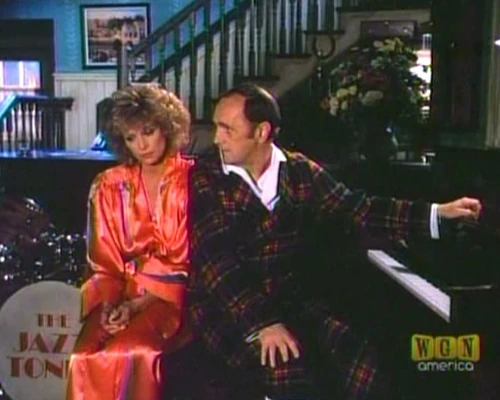
Then a golf ball hits Dick. The scene eventually gives way to another bedroom, another marriage, and Suzanne Pleshette as Emily Hartley beside Newhart’s earlier character, Bob Hartley. Vermont has been a dream. The audience’s recognition supplies a laugh no ordinary explanation of the golf development could possibly match.
The audacity is that the series uses its own star’s history as the final prop. A viewer who knew The Bob Newhart Show recognized the room and the wife. A younger viewer could hear the response and understand that television had just opened a door into a much older joke. The familiar comedian had been the connection all along, hiding in plain sight every week.
The dream device had already become notorious through Dallas and its extravagant reversals. Newhart could borrow the machinery and make the reveal affectionate and absurd rather than ask an audience to reorganize a season of suspense. It didn’t need the dream to make the inn’s plots sensible. It wanted the laughter that came from making this particular man wake up beside this particular woman.
The surprise deserves its reputation, but it can cast a very large shadow backward. Dick’s years in Vermont were worth watching before they became the setup to a bedroom reveal. George’s hurt feelings, Joanna’s impatience, Michael’s presentation, Stephanie’s demands, and Larry’s confidence didn’t require a later explanation to be funny. They had already earned their place in the room.
That may be the nicest way to return to the show. Enjoy the ending when you reach it. Until then, let the inn be an inn. There’s somebody at the desk, somebody who hasn’t finished the work, and three brothers approaching with a question Dick will almost certainly regret asking them to clarify.
A few Newhart questions before you check out
Is Newhart the same series as The Bob Newhart Show?
No. The Bob Newhart Show ran in the seventies and featured psychologist Bob Hartley with Suzanne Pleshette as Emily. Newhart began in 1982, with Newhart playing author and innkeeper Dick Loudon and Mary Frann playing Joanna. The final episode deliberately connects the two, but their ordinary characters and settings are different.
Why are some familiar cast members missing from the earliest episodes?
The ensemble changed. Jennifer Holmes’s Leslie was the first maid, and Steven Kampmann’s Kirk ran the café next door. Julia Duffy’s Stephanie became the maid in season two. Peter Scolari’s Michael arrived with the television stories, and the brothers became increasingly central. Early episodes show the program developing rather than an alternate version of the later cast.
Was the Stratford Inn a real Vermont hotel?
The exterior was the Waybury Inn in East Middlebury, Vermont. The Stratford’s interior scenes were filmed elsewhere for the series. The real building gives the establishing shots their local character; it doesn’t mean the actors were making every lobby conversation inside a working Vermont inn.
Did the series end during the eighties?
Its eight-season run began on October 25, 1982, and ended on May 21, 1990. Most of the show’s life belongs to the eighties television world, while the farewell sits just beyond it. Keeping that date straight leaves room to enjoy the celebrated final scene without moving it backward into 1989.
Sources & Further Reading
- Cast, chronology and production oral histories
- The Last Newhart and the people behind the finale
- The original episode guide
- Episode chronology and synopses
- The Waybury Inn’s Newhart connection
- Second-season DVD review and original program frames