Forgotten 80s TV Shows You Haven’t Thought About in Years
Forgotten 80s TV Shows You Haven’t Thought About in Years
Twenty-two strange, ambitious, clever or wonderfully ridiculous shows that vanished long before we were ready to say goodbye.
By Gizmo
ONE DECADE
LOTS OF MEMORIES
1982—1988
There was an entire second television universe in the 1980s, and most of it has quietly slipped through the cracks. Not the one with Dallas, The Cosby Show, Cheers, and the other network giants. This was the universe you discovered by accident: the show that came on after the program you actually intended to watch, the science-fiction adventure you defended at school even though nobody else seemed to know it existed, the sitcom that disappeared just when you had memorized the opening song. For some of these series, a whole childhood friendship lasted longer than the television run.
You didn’t need streaming recommendations to discover any of them. You needed a television set, a printed schedule, and the confidence to turn a dial without knowing what would be on the other side. One network’s costly experiment could become one kid’s favorite show. The next fall, the network would act as though the experiment had never happened. Some viewers were still waiting to find out what happened next.
These are the programs that prompt a very particular kind of memory: Wait, the guy could turn into a panther? Wasn’t there a time traveler with a pocket watch? Didn’t a computer create a glowing crime fighter and a car that made impossible turns? Yes. You did not dream those programs. They were real, they had casts and crews and opening credits, and in several cases they were considerably stranger than you remember.
The surprise is how varied they were. Beneath the gloriously questionable premises were clever comedies, accomplished actors, ambitious television craftsmanship, and occasionally a show that was genuinely ahead of what its network knew how to sell. Others were exactly as ridiculous as the description suggests. That’s part of the fun. Television in the eighties took chances that would be hard to pitch in a neat little sentence today, then sometimes canceled them before viewers had learned what night they aired.
This isn’t a ranking of the largest hits that later slipped out of the conversation. That belongs in our separate story about huge 80s TV hits nobody talks about anymore. Here we’re opening the other drawer: shows that barely got started, shows that found devoted small audiences, shows that would seem impossible to invent now, and programs that remain tucked away in the memories of people who happened to be home on exactly the right night.
For the bigger picture, explore the 1980s nostalgia collection and our 1980s television hub. The journey also crosses into the 1970s television era, whose adventure-show habits the early eighties inherited, and 1990s TV, where some of these experimental ideas finally found more receptive audiences.
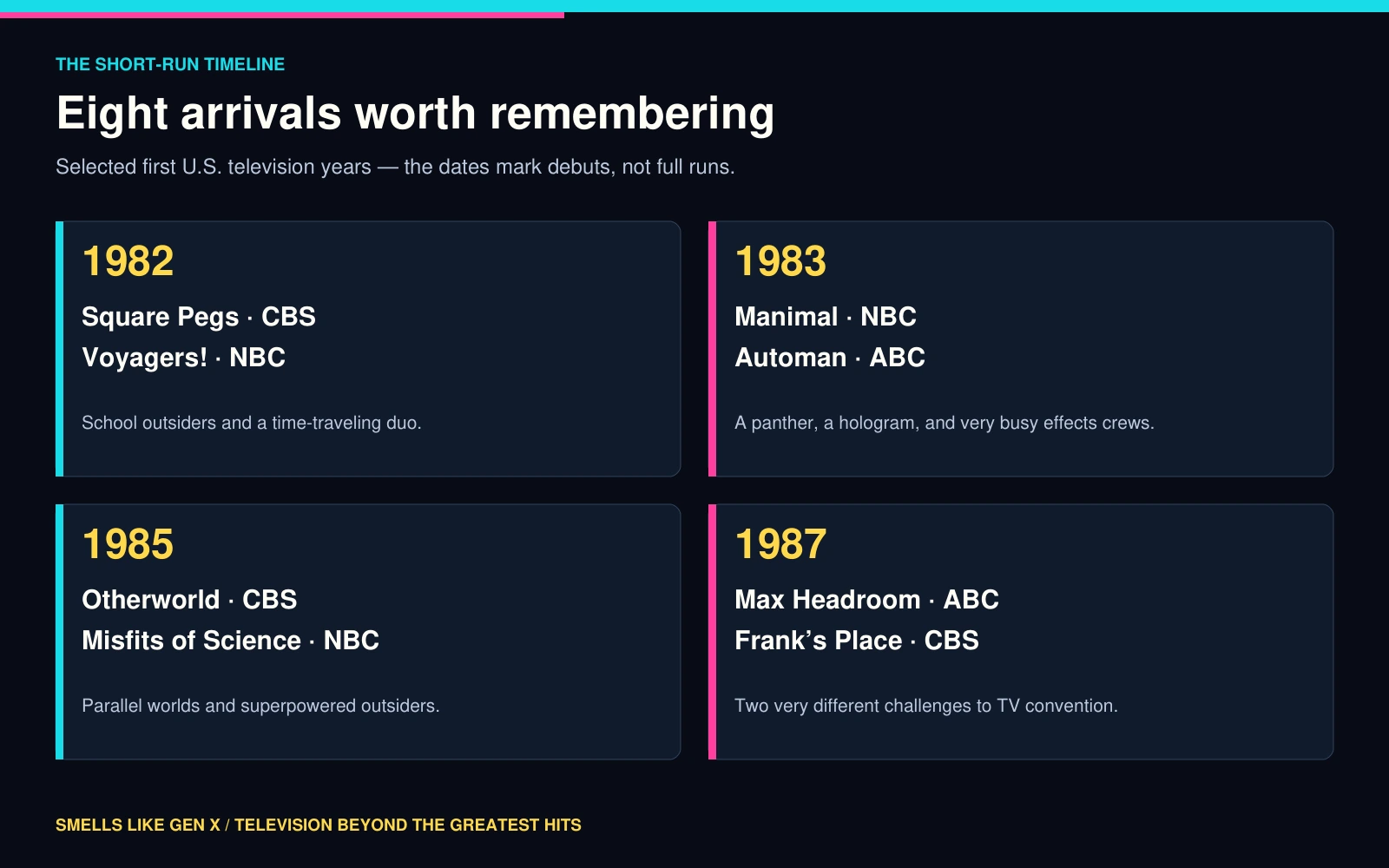
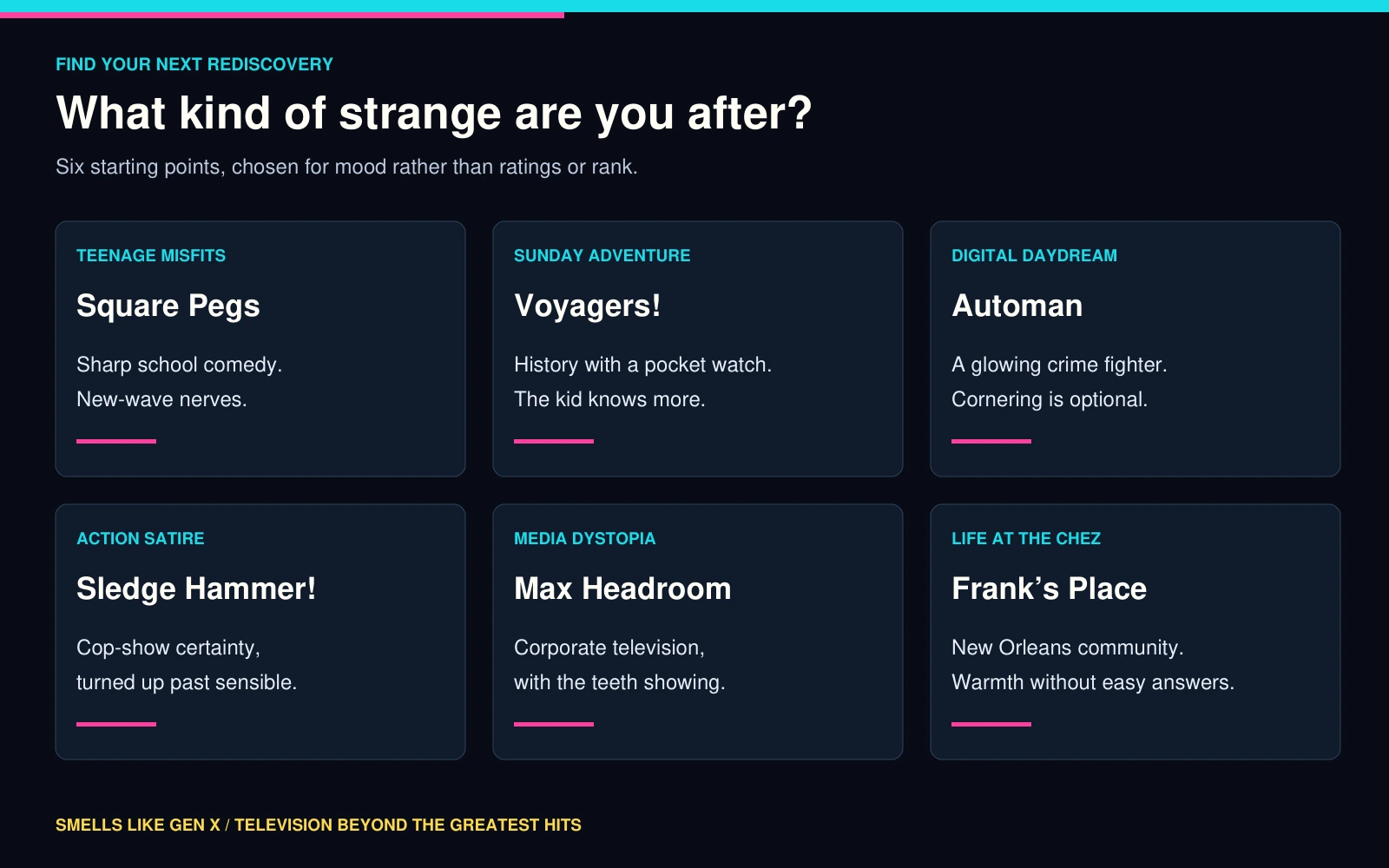
Explore the six viewing suggestions
- Teenage misfits: Square Pegs — school comedy and new-wave nerves.
- Sunday adventure: Voyagers! — history with a pocket watch.
- Digital daydream: Automan — a glowing crime fighter and impossible corners.
- Action satire: Sledge Hammer! — cop-show certainty turned up past sensible.
- Media dystopia: Max Headroom — corporate television with the teeth showing.
- Life at the Chez: Frank’s Place — New Orleans community without easy answers.
22 forgotten TV shows of the 1980s
Square Pegs (CBS, 1982–1983)
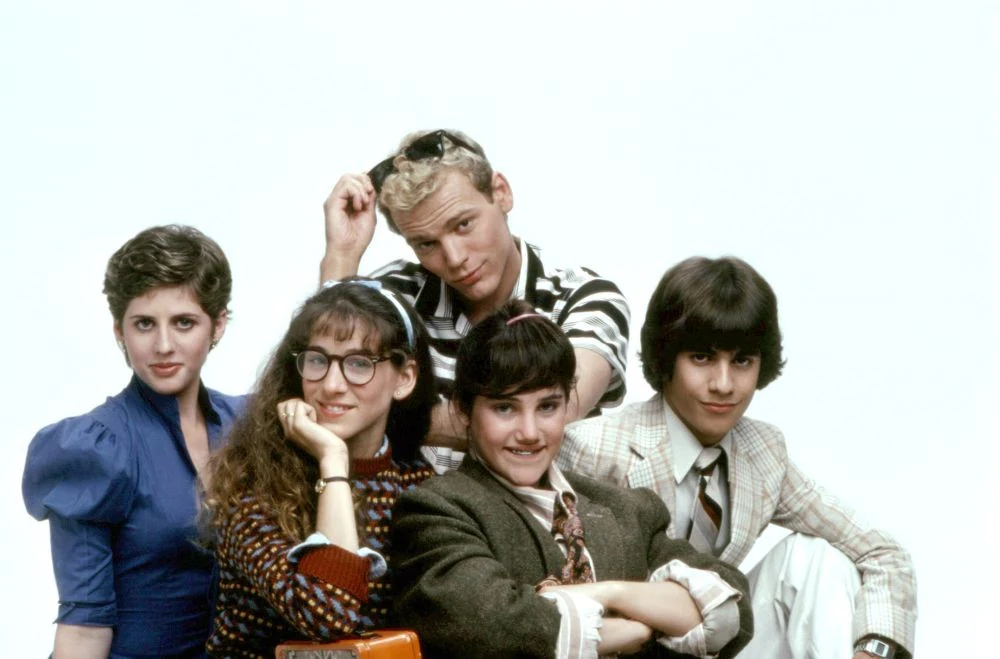
Long before Sarah Jessica Parker became associated with expensive shoes and Manhattan apartments, she was Patty Greene, a teenager trying to survive the social obstacle course at Weemawee High. Her friend Lauren Hutchinson, played by Amy Linker, was just as determined to escape the gravitational pull of the unpopular table. In a television universe where teenagers were often played by people who seemed old enough to refinance a mortgage, Square Pegs was unusually comfortable with awkwardness. The kids didn’t suddenly become poised when the scene required a punch line.
Creator Anne Beatts came from Saturday Night Live, and the show carried an outsider’s sense of humor without treating its outsiders as specimens. The popular crowd had its own anxieties; the supposedly weird kids had lives beyond wanting to sit somewhere better at lunch. Jami Gertz, Tracy Nelson, and Merritt Butrick helped fill out a school environment that felt genuinely populated, not merely arranged around two stars. Even the soundtrack announced that the producers knew there was a world beyond the studio audience: the Waitresses performed the theme, connecting a CBS sitcom to the sharp-edged new-wave atmosphere a lot of teenagers were hearing on the radio.
Look up the episode titled “Pac Man Fever” and you can see how precisely the show located itself in 1982. The arcade obsession isn’t an anonymous youth-trend joke; it’s the sort of fever that could temporarily reorder friendships. Another episode sends Patty and Lauren toward the girls’ football team. These are small, recognizable humiliations and enthusiasms, not the world-saving emergencies most forgotten eighties dramas preferred. And small things can be harder to fake.
Its single CBS season supplied twenty half-hour installments, counting the hour-long story in two parts. That was all. The show didn’t have years to sand down its eccentricities or turn its characters into comfortable sitcom mascots. What survives is a snapshot of early-eighties school life just before the decade’s teen-movie vocabulary hardened into recognizable types. If you remember Patty, Lauren, and that theme song, you remember a series that understood being uncool could also be interesting.
Voyagers! (NBC, 1982–1983)
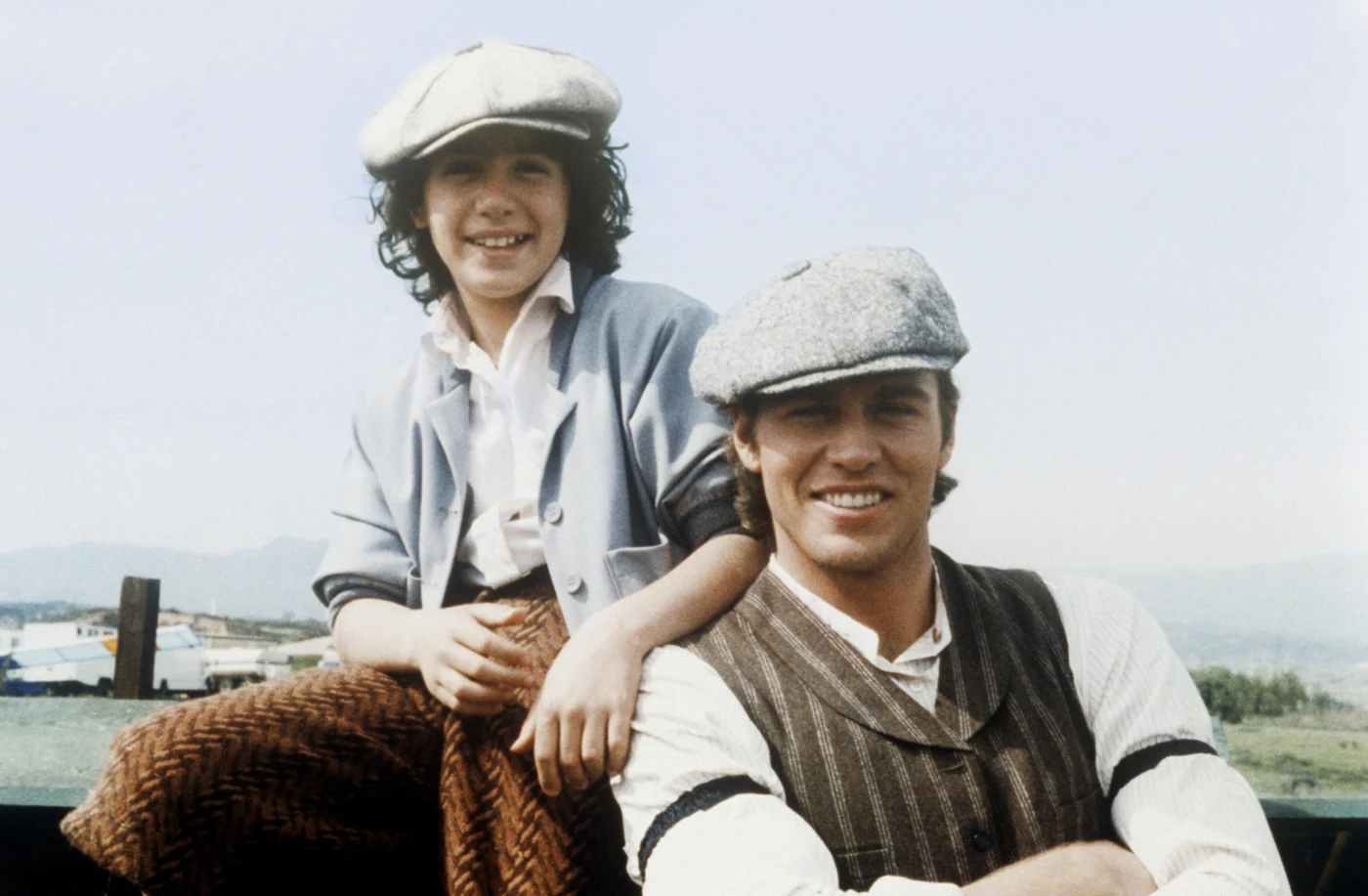
The pocket watch was the hook. Technically it was an Omni, a device that let Phineas Bogg jump through time to set historical events right. The glowing indicator could tell him when something was wrong and when the timeline had been repaired. To a child watching NBC on a Sunday, it looked like an artifact that belonged equally in a magic shop and a science-fiction laboratory. It practically invited a backyard version built from whatever hardware was available.
Jon-Erik Hexum played Bogg, who had the shoulders and confidence of a movie adventurer and a frankly alarming lack of historical knowledge. Meeno Peluce played Jeffrey Jones, the boy who knew the facts Bogg was forever in danger of forgetting. Their partnership was the clever part: the adult could handle adventure, but the kid was the indispensable expert. A school subject usually associated with memorizing dates became the thing that saved everybody. It was wish fulfillment for the child who actually paid attention in history class.
The series was gloriously willing to mix eras, historical figures, disguises, and close calls. One early installment combined ancient Rome with Harriet Tubman and a young Samuel Clemens. Another involved Billy the Kid and Teddy Roosevelt. Strict historians should probably avoid treating it as a textbook, but as a Sunday-evening gateway to curiosity, it was inspired. The past looked less like a museum and more like a backlot full of doors you could accidentally open.
NBC made twenty episodes in the 1982–83 season. Its placement opposite established Sunday programming made the assignment difficult, and a one-season run left plenty of would-be voyages unexplored. Later time-travel series would build more elaborate mythology or bigger budgets, but Voyagers! had a wonderfully simple question underneath its historical chaos: what if a kid who knew things could change everything? A blinking pocket watch was a surprisingly effective reason to want another season.
Tales of the Gold Monkey (ABC, 1982–1983)
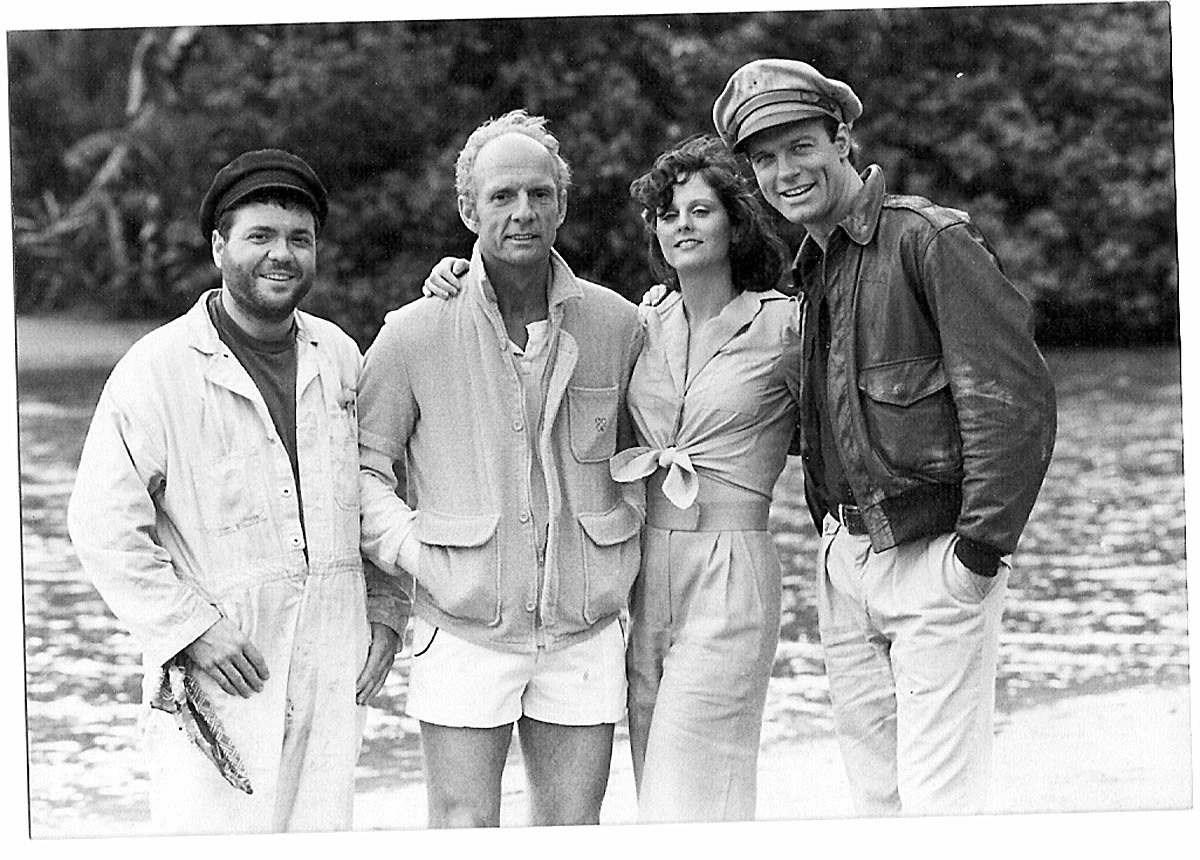
The early eighties briefly convinced television executives that America would watch absolutely anything if it featured a weathered airplane, an exotic port, and somebody in a leather jacket. ABC’s Tales of the Gold Monkey was much better than a cynical description of that trend suggests. Its hero, Jake Cutter, flew a Grumman Goose around a fictional South Pacific world in the late 1930s, taking jobs that invariably tangled him in smugglers, spies, local rulers, and people with complicated loyalties. If you could imagine Raiders of the Lost Ark settling down for weekly residence at a ramshackle island bar, you were in the neighborhood.
Donald P. Bellisario created the series. Stephen Collins played Cutter, Jeff MacKay was his troublesome partner Corky, and Caitlin O’Heaney played Sarah Stickney White, who was more involved with intelligence work than first impressions suggested. Roddy McDowall’s Bon Chance Louie helped make the Monkey Bar feel like a place with an established past. Then there was Jack, the one-eyed dog, who seemed to have wandered in from an entirely different kind of program and consequently belonged there perfectly.
The atmosphere did much of the heavy lifting. You could smell the airplane fuel, hear the propellers and imagine the humidity, even though the weekly action had to fit a network television schedule. The show balanced cheerful pulp adventure with a prewar setting that gave its schemes a certain international urgency. Its world was designed as a place you wanted to revisit, not simply a location where next week’s guest villain could be defeated.
That is why its one-season life still seems surprising. It aired during the 1982–83 season, a period crammed with action-adventure bets, and production of that sort of period fantasy was hardly inexpensive. It never secured another season. What remains is not just a footnote to an Indiana Jones craze; it’s proof that a thoroughly old-fashioned adventure could still have personality when built around characters worth spending time with.
The Powers of Matthew Star (NBC, 1982–1983)
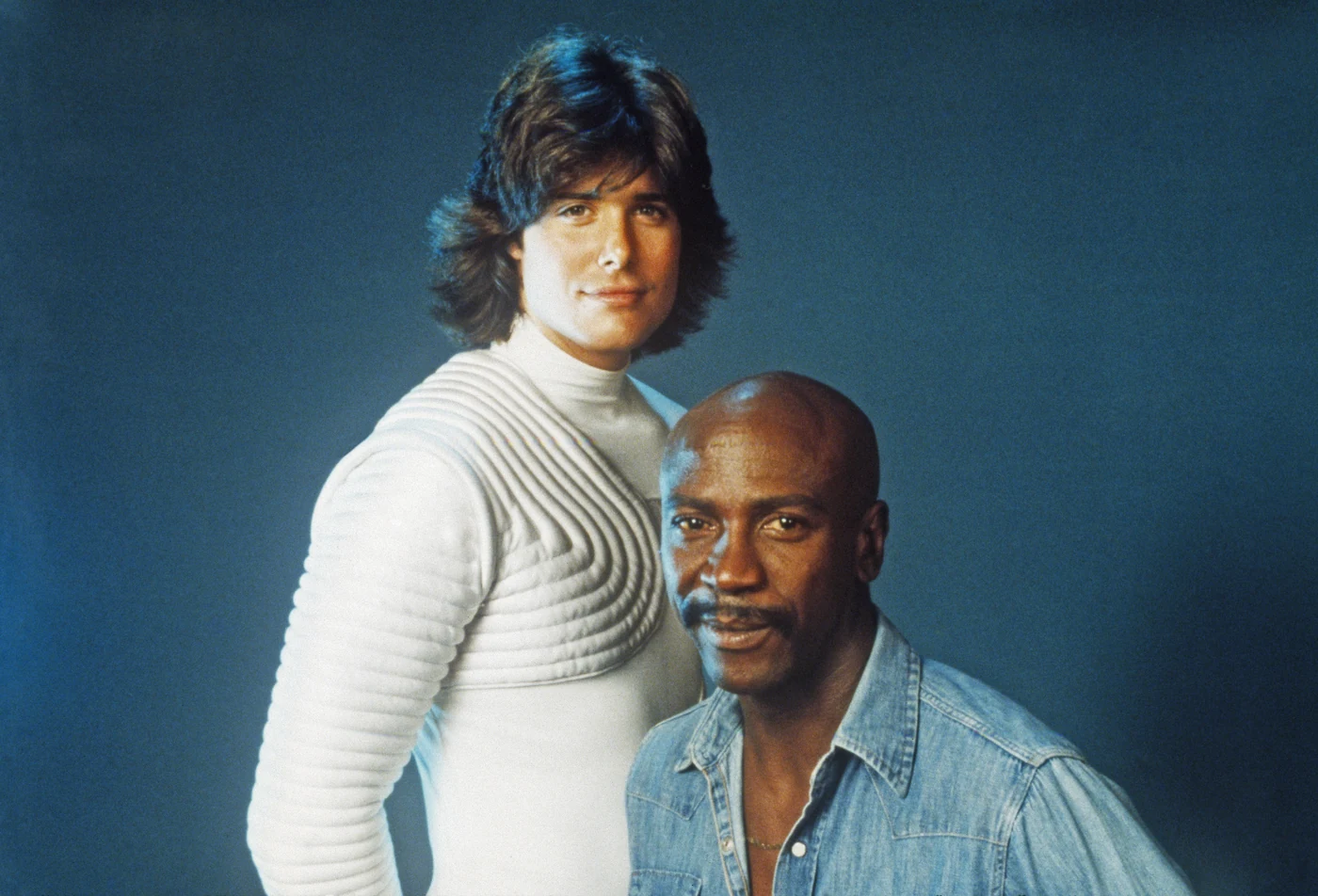
There was a point in television history when a teenage boy could be an alien prince, possess extraordinary mental powers, attend an American high school, and still have homework. The Powers of Matthew Star treated that combination as an entirely reasonable starting point. Peter Barton played Matthew, a young exile from the planet Quadris. Louis Gossett Jr. played Walt Shepherd, his guardian, teacher, and protector. The danger from Matthew’s home world had followed him to Earth, although at any moment the immediate crisis might simply be that he wanted to date a girl.
The first version of the series leaned into high-school life and the uneasy business of hiding powers. Matthew’s attraction to Pam, played by Amy Steel, mattered alongside the interplanetary threats. That approach gave the show an unusually young center for a prime-time science-fiction drama. You didn’t have to wonder how you’d feel if you were an alien prince. You could wonder whether you would reveal that fact before or after the school dance.
A major part of the appeal was Gossett. He brought gravity and authority to material that might otherwise have drifted into Saturday-morning territory. The emotional outline was familiar—an older mentor trying to raise and protect a young hero—but the science-fiction setting let the pair confront questions about identity, secrecy, duty, and growing up at dangerous speed. The series eventually moved closer to government-agent adventures, a sign of how difficult it could be to balance teenage wish fulfillment with network expectations for action.
NBC’s run covered twenty-two episodes. The show never became the enduring alien-on-Earth franchise its premise suggested it might. Looking back, it sits in an intriguing space between superhero fiction, teen drama, and a more serious coming-of-age story. It sometimes tried to be all three within the same hour, which is exactly the sort of gamble that makes forgotten television worth rediscovering.
Manimal (NBC, 1983)
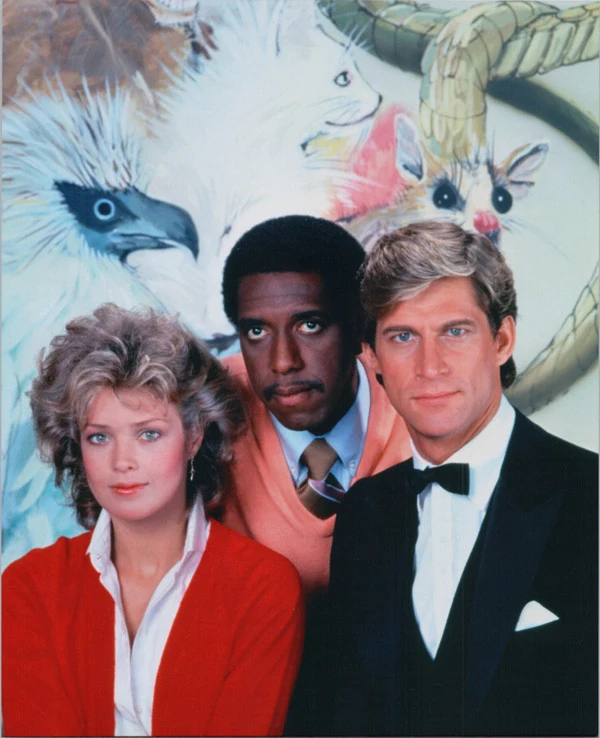
A professor named Jonathan Chase could transform into animals and solve crimes. That’s the pitch. There is no hidden second sentence that suddenly makes Manimal sound normal. The extraordinary thing is that NBC went ahead and made it, presumably after enough adults sat around a conference table and agreed that a shape-shifting criminologist belonged on prime-time television. We owe those people a small debt for giving us one of the decade’s most magnificently peculiar memories.
Simon MacCorkindale played Chase, a cultivated and mysterious man whose skills went well beyond university lectures. Melody Anderson played detective Brooke McKenzie, and Michael D. Roberts played Chase’s friend Tyrone Earl. The show’s storytelling formula asked viewers to accept that a man capable of becoming nearly any animal would routinely use that gift to help investigate ordinary crimes. It’s rather like owning a spaceship and using it to pick up dry cleaning, but the earnestness was part of the charm.
The transformations were the event. Practical effects and elaborate transition shots became the images viewers carried away, especially Chase’s panther form. By modern standards the effects reveal their era, but they were doing real work in a period before digital transformation had become a routine screen trick. A child needed only a few seconds of a morphing face to decide the entire series had been worth an hour. Adults may have had more questions about the plots.
NBC broadcast eight episodes in 1983. The central gimmick could not guarantee lasting audience interest, and its rapid departure created a strange imbalance between how briefly it aired and how vividly people still recall its concept. Manimal is a perfect specimen of forgotten eighties television: a title people laugh at, a premise they never forget, and a series that probably could not have happened in quite the same form in any other decade.
Automan (ABC, 1983–1984)
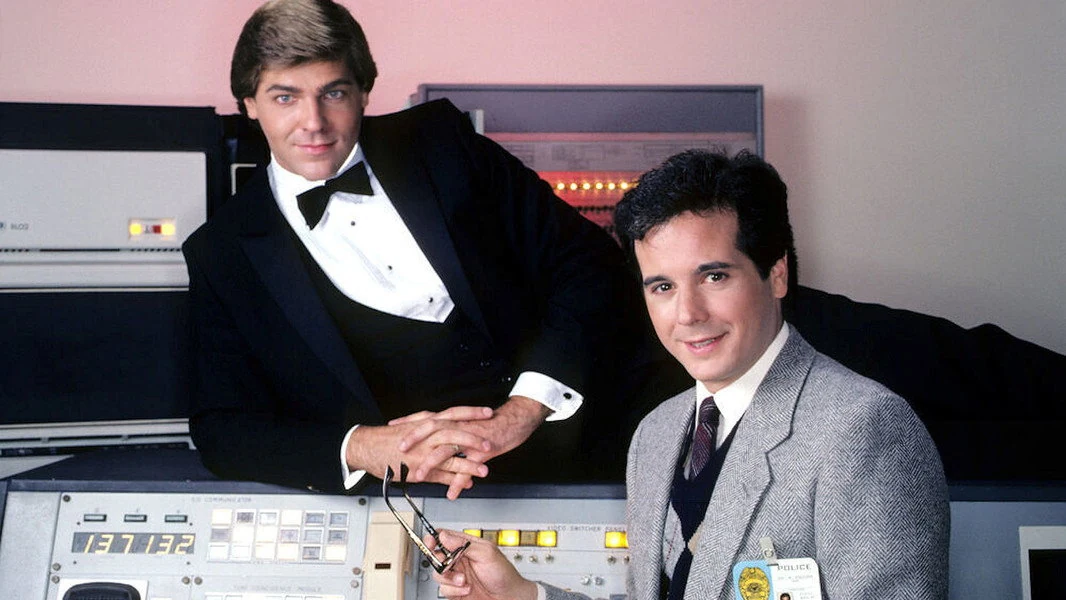
Before computers were sitting in nearly every pocket, ABC produced a program about a computer-generated crime fighter who could step into the physical world. Desi Arnaz Jr. played Walter Nebicher, a police computer specialist who created a luminous alter ego. Chuck Wagner played Automan himself, a perfectly poised digital gentleman who could summon impossible vehicles and bend the city’s traffic rules to his own geometrical requirements. The car could turn at right angles. That’s not a figure of speech: the turn was practically the show’s calling card.
Glen A. Larson developed the series at a time when computers were becoming both a household fascination and a convenient source of television magic. Tron had already made glowing electronic imagery seem like a new visual language, and Automan borrowed the era’s excitement about pixels without worrying too much about whether the machinery would ever function. Walter’s program wasn’t merely useful software; it was a friend who could dress for a nightclub and help him make the police department take his work seriously.
One episode was titled “Murder MTV,” which tells you almost everything about the era’s enthusiasm for blending television genres. Another involved Las Vegas, electronic records, and corruption; the show could move from technology fantasy to standard cop-story business without pausing to explain the tonal shift. Its cursor character and luminous effects supplied a visual signature that was much stronger than the underlying case-of-the-week machinery.
Thirteen episodes were produced; the original ABC run showed twelve, leaving “Club Ten” outside that first U.S. run. What’s clear is that ABC had only one season of this idea, beginning in December 1983. The best way to remember it isn’t as a realistic prediction of artificial intelligence. It’s as a snapshot of the moment when programmers, neon graphics, detective heroes, and an absurdly sharp-turning sports car could all share the same prime-time dream.
Whiz Kids (CBS, 1983–1984)
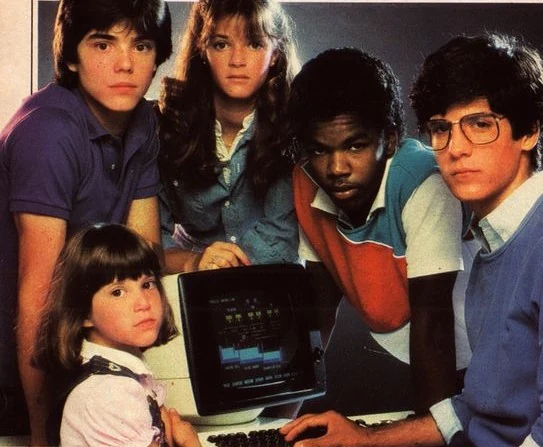
Here’s a series that understood computers were about to become interesting without quite knowing what that would mean. Whiz Kids followed Richie Adler and his friends, young computer enthusiasts who used their technical skills to solve crimes. Matthew Labyorteaux played Richie; Todd Porter, Jeffrey Jacquet, and Andrea Elson rounded out the core teenage crew. They were not yet the sleek movie hackers of later decades. They were kids with equipment, curiosity, and an alarming willingness to investigate people who might prefer not to be investigated.
The writers surrounded the teenagers with adults who could connect their discoveries to the larger world. Max Gail played journalist Llewellen Farley, while A Martinez appeared as Lieutenant Neal Quinn. That arrangement gave the show a practical rhythm: the kids found something strange, the adults brought access or credibility, and before long everyone was in the middle of a murder investigation. The first episode, “Programmed for Murder,” involved a skeleton on valuable property and a development company. Computers could solve puzzles, but they didn’t eliminate the old motives of greed and concealment.
The fun is in the show’s idea of digital expertise. A school computer bulletin board could turn into a path toward a dangerous hacker; a dating service became a suspicious database; a new police dispatch system could be compromised. These details seem quaint until you remember how many adult viewers in 1983 were still getting used to the idea that computers might matter outside a bank, a university, or an arcade. A gang of teenagers understanding those systems better than the people in charge was a small rebellion in its own right.
CBS ran the series for eighteen episodes. The creator also worked on Simon & Simon, another reminder that computer-age mysteries were being built by people who knew the television detective story. Its mixture of child detectives and emerging technological anxieties did not become a long-running brand, although the basic pairing of digital knowledge and amateur sleuthing would only grow more common. Whiz Kids may be one of the purest examples of early personal-computer-era optimism: the assumption that knowing how the machines worked meant you could outsmart the entire adult world. At a certain age, that’s a compelling reason to watch television.
Tucker’s Witch (CBS, 1982–1983)
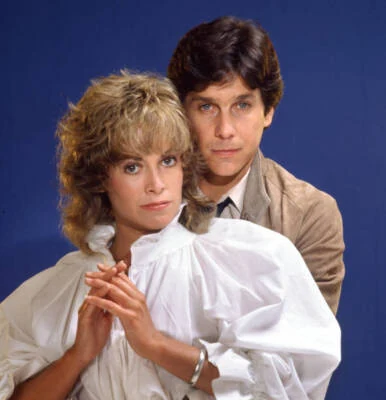
Tim Matheson and Catherine Hicks played a married couple running a detective agency, and one of them happened to possess witchcraft-like abilities. This is the sort of marriage-and-mystery setup a network might pitch as Hart to Hart, but with a supernatural bonus. Tucker’s Witch tried to work both halves: domestic chemistry and crime solving, old-fashioned private-eye adventure and genuinely odd magical assistance. It did not have time to settle completely on one personality before it vanished.
Rick and Amanda Tucker were a handsome pair with more to do than trade affectionate banter. He handled the conventional investigative work; her abilities could tilt a case in directions the police had not considered. The cast included Alfre Woodard and Barbara Barrie, giving the proceedings considerably more talent than a quick description of the concept might suggest. The agency setting provided a useful weekly excuse for new clients, guilty spouses, false identities, and other familiar detective-show furniture. Magic was supposed to make that furniture unexpectedly lively.
The episode titles tell you the show stayed close to conventional mysteries even when a little enchantment crept into the method. “Formula for Revenge” centered on a perfume-company killing; “Living and Presumed Dead” involved a decades-old disappearance. In other words, the questions were often ordinary ones about motive and deception. The unusual element was the tool Amanda could bring to bear. That restraint may have been commercially sensible, although it also meant the show could look like one more couple-solving-crimes series on a crowded schedule.
CBS aired a short run spread across the 1982–83 season, and some later listings used the alternate title The Good Witch of Laurel Canyon. If you remember it only as “that detective show with the witch,” you’re remembering its central predicament too. It was a charming hybrid arriving in a decade full of stronger, louder detective brands. The Tuckers had the potential for a long marriage on television. Their network relationship ended much sooner.
It’s Your Move (NBC, 1984–1985)
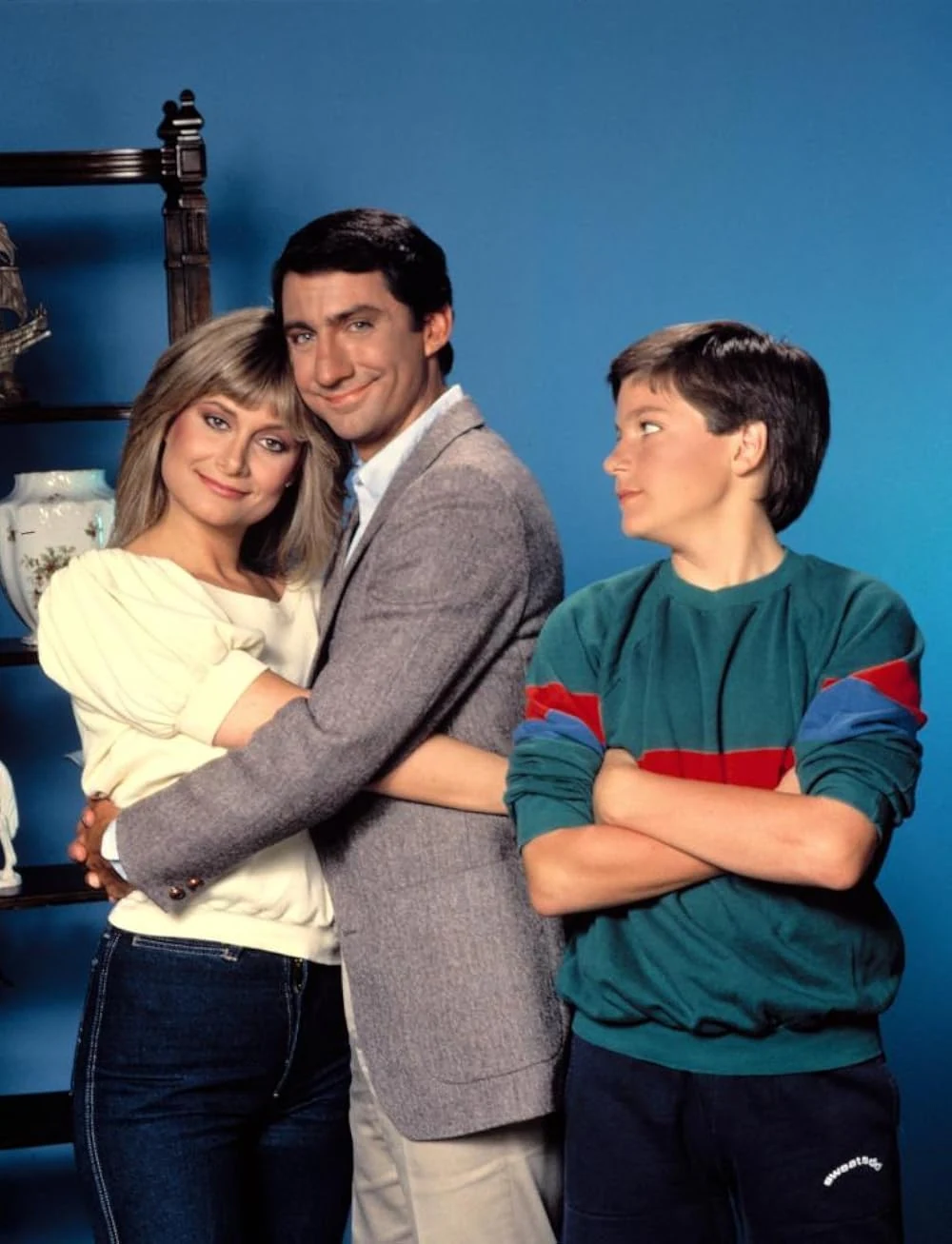
Before Jason Bateman developed a long career playing men whose faces convey disapproval with surgical precision, he played Matthew Burton, a teenage schemer with every intention of getting his own way. It’s Your Move made its young central character smarter than many of the adults and didn’t insist on turning every scheme into a wholesome lesson by the closing credits. That gave the series a slightly wicked edge. The kid wasn’t a precious little angel. He was a practiced operator who happened to be under eighteen.
Matthew’s main adversary was Norman Lamb, the man dating his mother. David Garrison played Norman, often trapped in an argument with a teenager who understood how to manipulate the entire household. Caren Kaye played Matthew’s mother, and Tricia Cast played his sister. Rather than have everybody gather around to solve the week’s misunderstanding, the show leaned into competitive family politics. It was a comedy about people wanting contradictory things, not an instructional film about what families should want.
The series was created by Ron Leavitt and Michael G. Moye. That pairing matters because the two later developed Married… with Children, which pushed the anti-idealized family much further when Fox arrived on the scene. The similarities are not an excuse to pretend the two programs are identical. The earlier show had a teenage con-artist center and a very particular rivalry, while the later one made an entire miserable household the joke. But the willingness to let characters be selfish and unsentimental connects them.
NBC aired eighteen episodes between 1984 and 1985. The Paley Center’s catalog preserves the actual series finale, “Goodbye, Farewell, and Amen,” broadcast in February 1985. The grand farewell title was almost comically outsized for a show that had barely settled in. In truth, the family’s style of comedy was still ahead of much network programming. If you remember Bateman looking impossibly pleased with himself after another successful maneuver, you’ve found one of the roots of a career built on very clever people behaving very badly.
The Duck Factory (NBC, 1984)
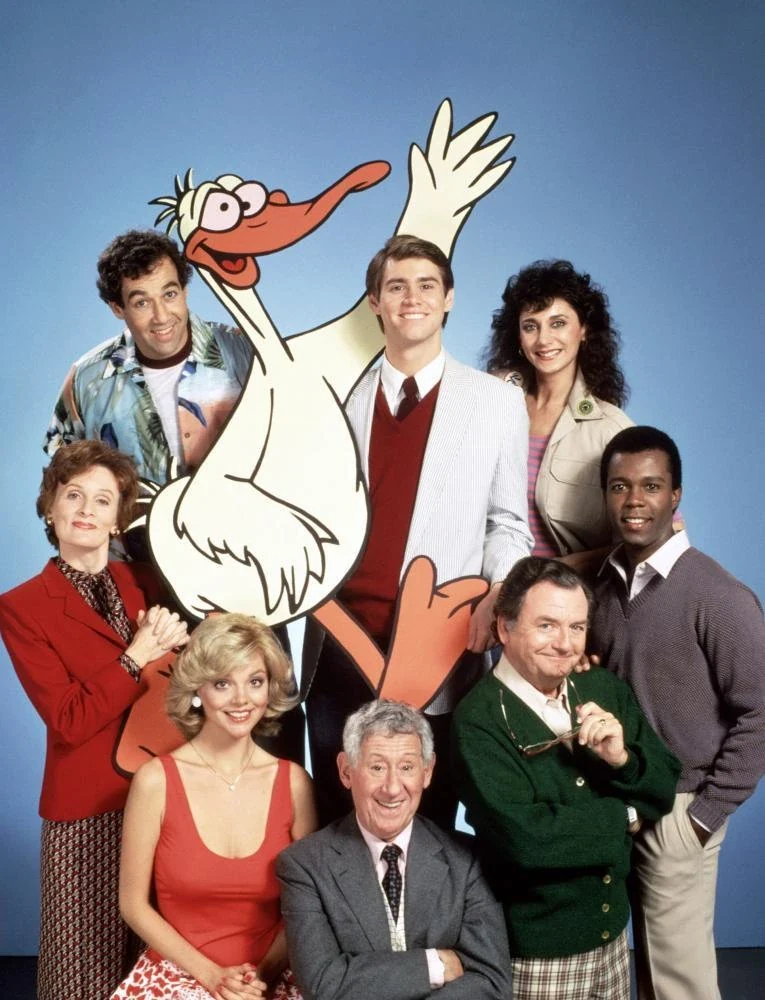
Yes, Jim Carrey starred in a sitcom about making cartoons before he became the physical-comedy phenomenon of the nineties. The Duck Factory cast him as Skip Tarkenton, a young cartoonist joining a struggling animation company. The office created The Dippy Duck Show, a program with a title that sounded entirely plausible as a television cartoon nobody actually wanted to watch. Skip’s workplace was full of insecurity, ego, professional crises, and the sort of exhausted personalities you might expect to find in a building dedicated to manufacturing cheerfulness.
The striking thing about the premise is its industry setting. Instead of using animation merely as colorful decoration, the series placed the workers, artists, producers, and office tensions at its center. The people who drew the fun were often having no fun at all. The show could extract comedy from the gap between what audiences saw and what the workers lived. That puts it in a long line of workplace sitcoms, but the setting was far stranger than another hospital, newsroom, or police station.
Carrey was not yet doing the full battery of astonishing rubber-faced star turns audiences later came to expect. Seeing him as part of an ensemble is fascinating because the show had to make room for an office, not just a single comic force. Meanwhile, the animation work itself earned recognition: the series won 1984 Emmys for art direction and graphic design and title sequences. A failed commercial experiment can still leave behind a talented production team doing distinctive work.
NBC introduced the program in April 1984, and it disappeared after its brief single season. Because the show’s star became so famous, it’s tempting to treat it as merely a pre-fame curiosity. That sells it short. The Duck Factory was also an unusually specific workplace comedy about people trying to make television on a budget. In a decade when the medium adored its glamorous images, this one looked backstage and found something wonderfully frazzled.
Jennifer Slept Here (NBC, 1983–1984)
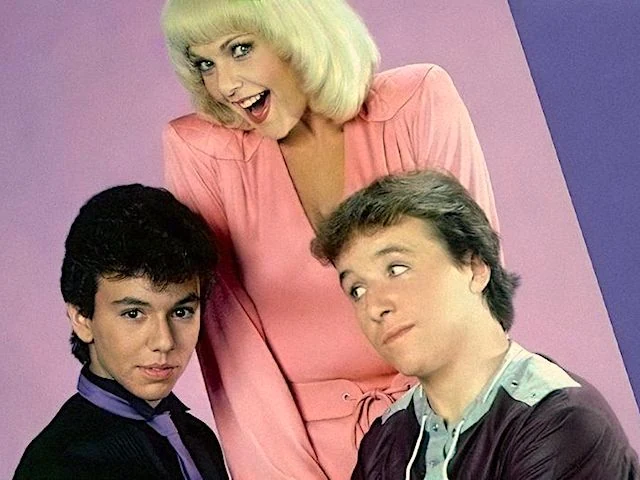
A family moves into the former Beverly Hills home of a dead Hollywood movie star. Her ghost is still living there, but only the family’s teenage son can see her. Network executives could explain Jennifer Slept Here in two sentences, which probably made the original sales meeting a relatively short one. What viewers got was a domestic sitcom with an impossible extra roommate: glamorous, opinionated, and technically deceased.
Ann Jillian played Jennifer Farrell, the spectral film star. John P. Navin Jr. played Joey Elliot, the teenager who became her unwilling confidant. Brandon Maggart and Georgia Engel were among the adults whose household arrangements had become supernatural without their consent. The show found much of its comedy in the asymmetry of the relationship. Joey had knowledge nobody else possessed, yet using it made him seem untrustworthy. Jennifer could influence his life, but her outsider status meant she couldn’t solve problems in the ordinary way.
Some episode ideas embraced Hollywood satire. “Jennifer: The Movie” involved a rival actress being cast in a film about Jennifer’s life. “Trading Faces” had Jennifer discover the possibility of inhabiting another person’s body. Another story brought in her ghostly mother. The possibilities were silly, but the premise was also a small fantasy about being noticed by someone fabulous who had no reason to talk to you. Every teenager who has ever imagined a celebrity turning up in the bedroom probably understands that appeal.
Thirteen episodes aired across the 1983–84 season. The late spring broadcasts gave the show a fragmented life, as though NBC remembered it had a few haunted-house stories left in a closet. There was no time to build a stable comic world, which makes its disappearance oddly appropriate. Jennifer Slept Here arrived, floated through the schedule, and vanished again, leaving behind the persistent memory of Ann Jillian trying to explain modern teenage problems from beyond the grave.
Otherworld (CBS, 1985)
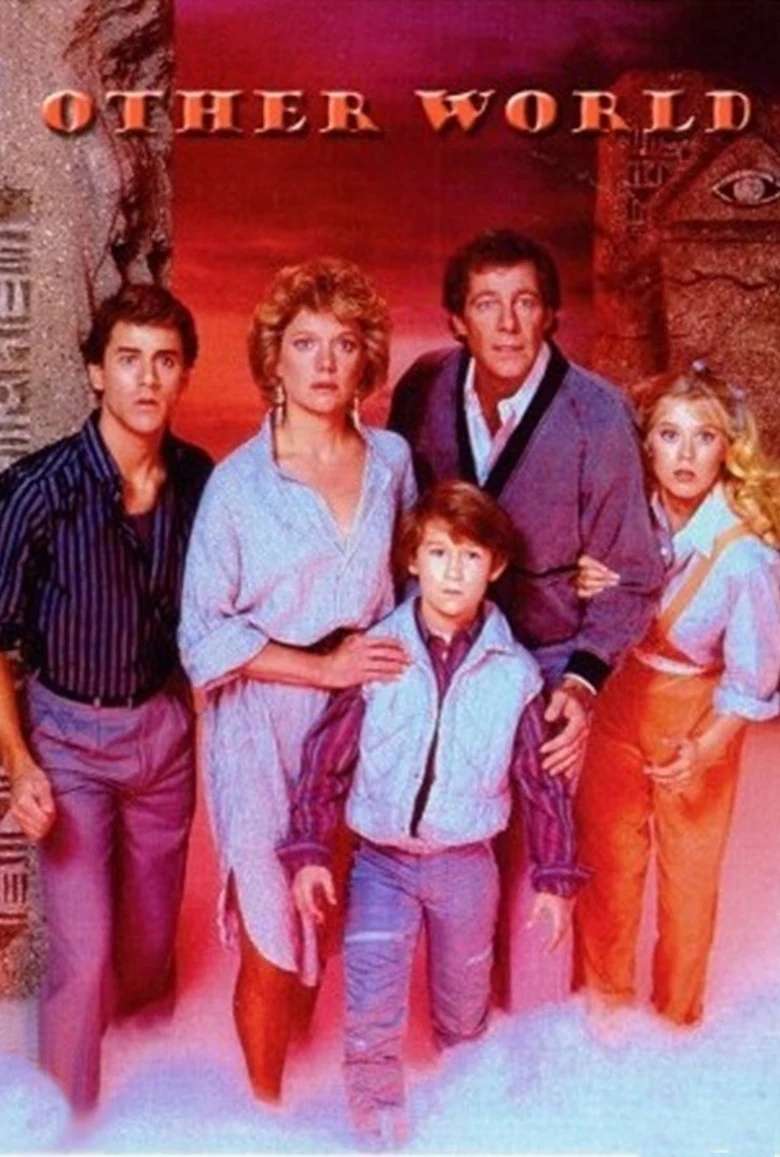
One family vacation went catastrophically wrong. The Sterling family visited Egypt, encountered a mysterious pyramid event, and ended up trapped in a parallel world divided into zones with different laws, cultures, and hazards. Otherworld wasn’t content to give its heroes a single threatening alternate civilization. It made them travel through a collection of societies, some apparently pleasant and some obviously authoritarian. They were ordinary people trying to find their way home while discovering that normal rules had been left behind.
The premise allowed the show to behave like an anthology without abandoning its regular characters. One week the Sterlings could be forced into contact with military authority. Another week the younger family members found fame through rock music, only to discover that being noticed was dangerous. A few settings suggested familiar science-fiction dystopias; others were closer to social satire. A family series could suddenly become a story about political control or media celebrity with very little warning.
The recurring threat came from the world itself and the powerful people who did not want the family moving freely through it. That gave the series a sense of continuity that many early-eighties adventures lacked. The characters weren’t merely defeating guest villains and returning to a comfortable house after an hour. Their entire objective was to find that house again. For a kid watching at home, the idea of parents suddenly knowing no more than their children about how the world worked was unsettling in exactly the right way.
CBS broadcast eight episodes beginning in January 1985. That is a tiny amount of screen time for such a broad premise. A television world divided into unexplored zones ought to have years of storytelling available, but Otherworld received only a handful of chances to show what made it interesting. Its short life makes it especially haunting: an entire imaginary geography exists in the memory, most of it never visited. The show vanished long before the Sterling family could make the journey feel complete.
Misfits of Science (NBC, 1985–1986)
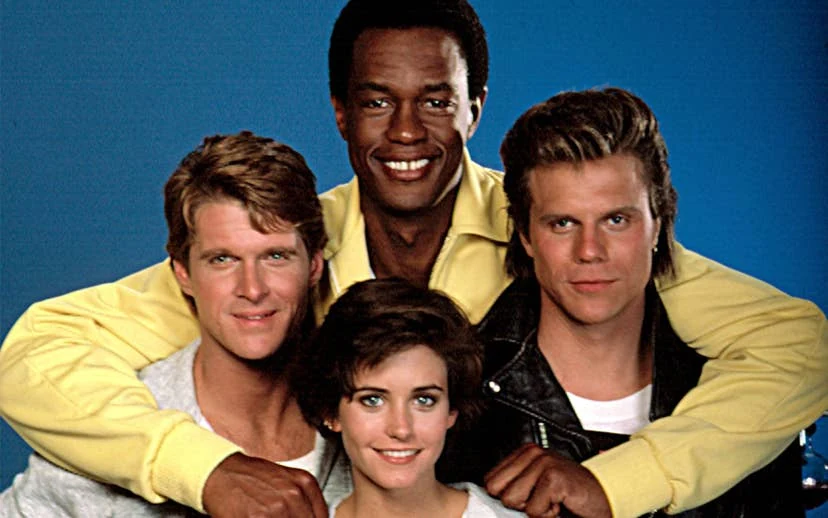
A band of misfit superhumans working with a scientist to stop trouble before it got worse. Sounds perfectly ordinary now, but in 1985 the television superhero group could still feel like something smuggled in from a comic-book store. Misfits of Science cheerfully ignored the idea that extraordinary abilities required operatic seriousness. It assembled a collection of incompatible people, handed them impossible talents, and sent them off to handle threats that ordinary institutions couldn’t manage.
Dean Paul Martin played Dr. Billy Hayes, the scientist who helped bring the group together. Kevin Peter Hall played the extraordinary Elvin Lincoln, who could shrink. Mark Thomas Miller was Johnny B, whose electrically charged hands made him something like a walking power station. Courteney Cox, before her much more familiar television fame, played Gloria Dinallo, a teenager with telekinetic powers. Even the casting is a small nostalgia adventure: familiar performers turn up in an unfamiliar alignment, wearing the clothes and hairstyles of the middle eighties.
The pilot, “Deep Freeze,” involved a man preserved for decades and an organization more interested in exploiting him than protecting him. The heroes’ mission began by challenging that exploitation, which gave the superhero premise a surprisingly sympathetic motor. Instead of simply taking orders from a wise institution, the outsiders had to decide who deserved help. The weekly stories mixed action, banter, and science fiction so freely that the boundary between genres hardly mattered.
NBC produced sixteen stories for its single season, counting the double-length pilot as one; splitting that pilot produces a seventeen-part count. The show had youth, powers, special effects, an offbeat sensibility, and a potentially broad audience, but it arrived when superhero television was still struggling to persuade networks that comic-book strangeness belonged in prime time. Later generations would watch teams of troubled superpowered people as if the idea had always been obvious. Misfits of Science got there with plenty of attitude and nowhere near enough episodes.
Sledge Hammer! (ABC, 1986–1988)
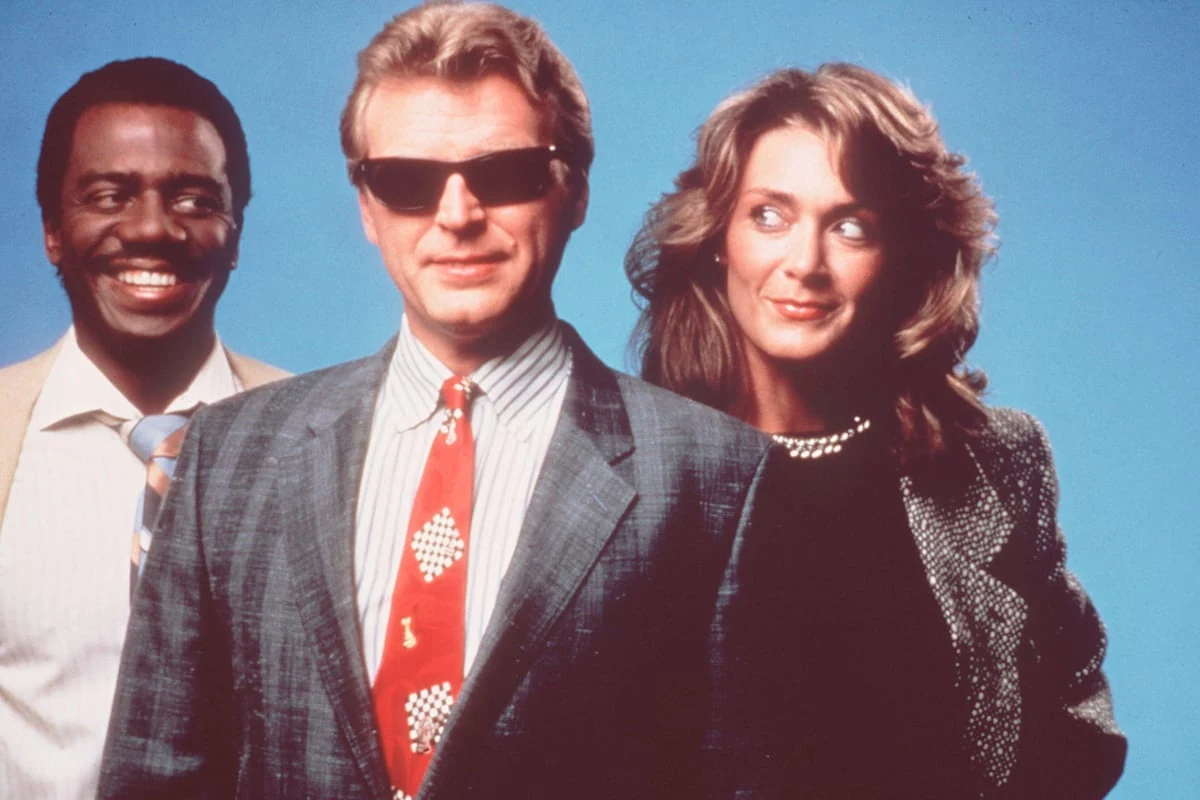
If you encountered Sledge Hammer! halfway through an episode, you might briefly mistake it for a terrible police show. Inspector Sledge Hammer was loud, reckless, armed to the teeth, and utterly convinced that he was the only sane man in a dangerous world. David Rasche played him with absolute confidence. The important difference was that everybody making the series knew exactly how ridiculous he was. This was not a clumsy action drama; it was a savage joke about action dramas.
Alan Spencer created the series as an exaggerated response to television’s tough-guy cop mythology. Anne-Marie Martin played Dori Doreau, the competent detective whose work made Hammer’s disasters survivable. Harrison Page played Captain Trunk, a superior whose patience was permanently near expiration. Their triangle was the real engine: one oblivious disaster, one intelligent colleague, and one authority figure begging the universe for relief. Hammer’s favorite solution was always louder and more dangerous than the problem required.
The show’s first-season ending became notorious for taking its own absurdity to a spectacular extreme. Rather than quietly close the books on a detective who had already exceeded his quota of property damage, it gave the audience a catastrophe big enough to challenge the premise of a second season. When the series returned, its continuation had to negotiate the consequences of its own joke. That is a very different kind of confidence from the careful, repeatable sitcom formulas filling much of the schedule.
ABC broadcast forty-one episodes over two seasons. That is longer than several of the shows in this collection, but still a short life for a comedy so sharply identified with a particular satirical voice. Its small cult following makes sense: the series worked best if you enjoyed the exaggerated traditions it was dismantling. If an earnest television cop could shoot his way through every moral question, Sledge Hammer! asked what would happen if you took that belief completely literally. The answer was very loud, and often hilarious.
The Wizard (CBS, 1986–1987)
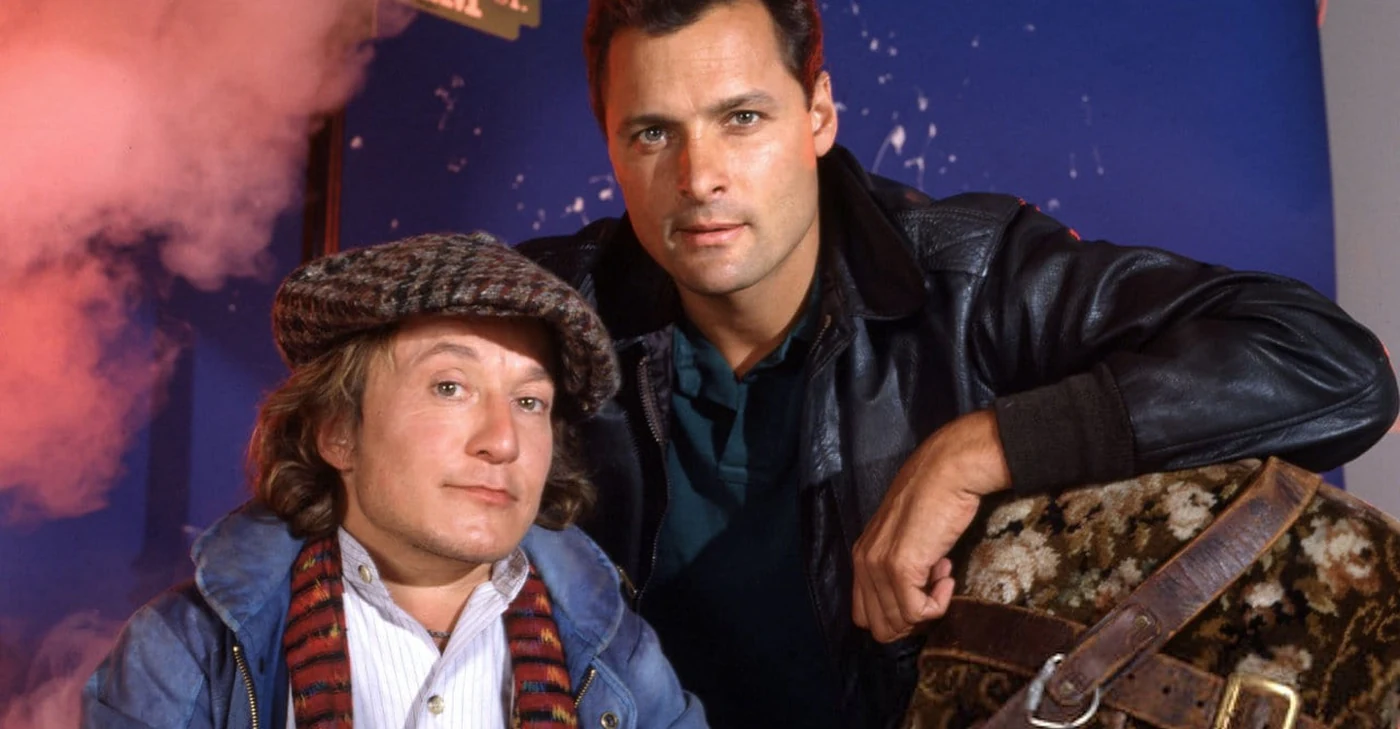
You have to appreciate a show that let a brilliant toy inventor become the key to international adventures. David Rappaport played Simon McKay, a gifted inventor whose imaginative devices had caught the attention of the government. Douglas Barr played Alex Jagger, the agent assigned to protect him. The pairing was a variation on the mismatched-buddy adventure, except the brains of the operation designed ingenious tools and approached problems from angles the tough guy hadn’t considered.
McKay’s inventions were the weekly attraction. Sometimes the gadgets served official missions, and sometimes they helped ordinary people whose needs didn’t fit a government briefing. An early episode centered on a seriously ill child and an endangered organ donor, making clear the show didn’t intend to limit its concerns to high-tech spy theatrics. Simon’s empathy could matter as much as his genius. The best version of the series was never simply “small man makes big gadgets”; it was about someone who thought a little differently and refused to accept that the obvious solution was the only one.
Rappaport had the difficult job of carrying a show that could easily have turned him into a gimmick. Instead, he gave McKay wit, resolve, and a sense that the character’s intelligence was his most important quality. Barr’s protective agent had to learn that his charge was not a passive figure to move out of danger. Simon often drove the action, while Alex supplied a useful physical and procedural counterweight. Their disagreements provided a human scale for plots that could otherwise have been overwhelmed by gadgets.
CBS aired The Wizard for a single 1986–87 season. In an era of spectacularly armed heroes and souped-up vehicles, the idea of an inventive toymaker helping people was an appealing deviation. It didn’t last, but it deserves to be remembered as more than a strange career footnote. Its hero used imagination as a superpower, and that is a kind of television wish fulfillment that never really gets old.
Rags to Riches (NBC, 1987–1988)
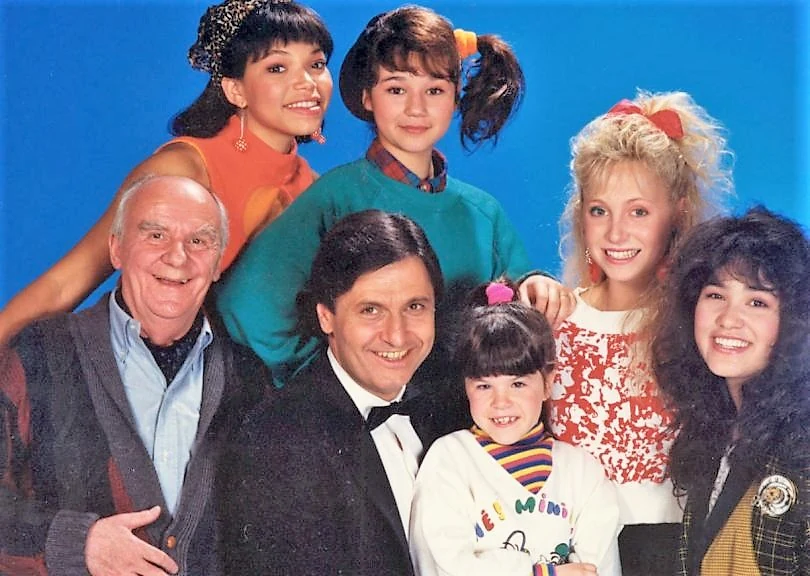
A self-made millionaire adopts a group of orphaned girls in the early 1960s, and the girls keep breaking into musical numbers built around period songs. That sounds like three different shows being made to share one timeslot. Rags to Riches made the combination feel almost natural, mostly because its characters committed to the emotional story beneath the gimmick. Joseph Bologna played Nick Foley, a businessman whose initial relationship with fatherhood was tangled up in appearances. The girls eventually became far more important to him than the favorable image he hoped to acquire.
The show’s music wasn’t just background flavor. It frequently adapted familiar pop material to move the plot or express what characters couldn’t say directly. In an era when network television could seem allergic to musicals between holiday specials, this was a brave weekly demand on the audience. Each episode asked you to accept both domestic trouble and musical theater without a warning label. Somehow, the show’s unabashed artificiality could make its family moments seem more sincere.
Tisha Campbell was among the performers playing the adopted daughters, long before audiences knew her from later sitcom work. The young ensemble had to act, sing, dance, and support stories about friendship, school, identity, and their unusual family arrangement. The setting also gave the series a built-in layer of nostalgia for an earlier decade, viewed through 1980s production values. That makes it an interesting time capsule twice over: a portrait of how 1987 television imagined the early sixties, and of what the networks thought family entertainment could still accomplish.
NBC ran the series across 1987 and 1988. It wasn’t a long-lived hit, but its highly specific formula makes it hard to confuse with anything else. You might forget where you saw the girls or precisely what Nick Foley’s business involved. You’re less likely to forget a family drama unexpectedly turning into a musical performance. Some television is memorable because it’s perfect. Rags to Riches was memorable because it had the nerve to be itself.
The Charmings (ABC, 1987–1988)
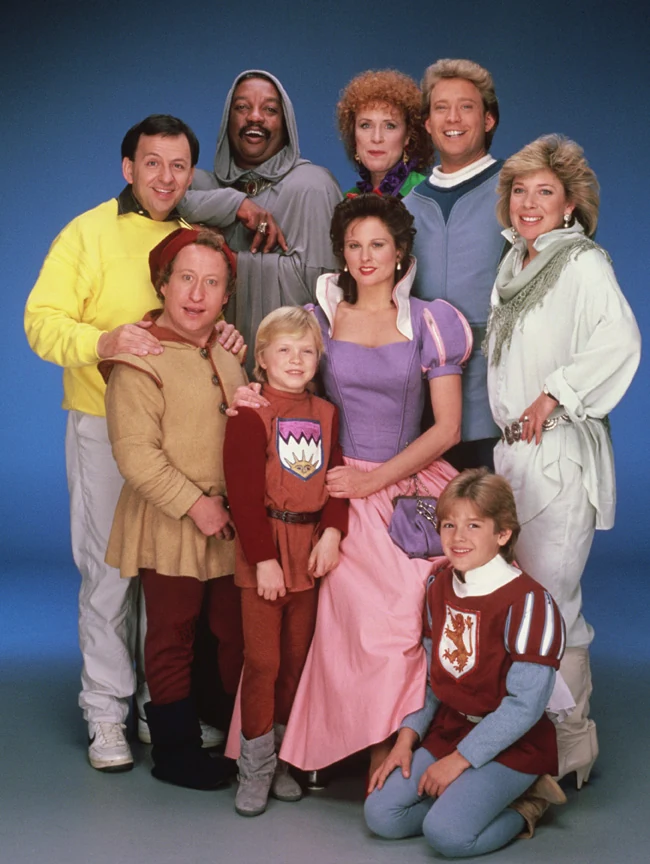
Snow White and Prince Charming are living in modern suburban California. The wicked queen is still a nuisance. The children are trying to manage school, and the family must negotiate credit cards, neighborhood customs, and the terrifying bureaucracy of modern life. That was The Charmings, a fairy-tale sitcom that started with a perfectly serviceable joke and then had to find new variations on it every week. The 1980s loved a fish-out-of-water comedy; this one brought the entire enchanted forest with it.
Christopher Rich played Prince Eric Charming. Caitlin O’Heaney initially played Snow White, with Carol Huston appearing later in the role. Judy Parfitt played Queen Lillian, the scheming relative who kept fantasy trouble alive in an otherwise familiar family house. The show’s comic engine was the collision of absolute fairy-tale assumptions with modern rules. A magical solution to an ordinary problem was usually just another way to create a bigger ordinary problem.
Consider the episode in which Snow receives a credit card, treats it as a supply of free money, and discovers the surprising persistence of the bill. That story could appear in any sitcom about newcomers to America, but an enchanted family’s misunderstanding gives it a special comic polish. Another episode has the queen turn children into mannequins and find she cannot reverse the effect. The premise let the writers introduce actual magic while keeping the embarrassment recognizable.
ABC aired the comedy in two short installments across 1987 and 1988, for just twenty-one produced episodes. For a forgotten show, it left a curious historical footnote: Mark Buxbaum won a 1988 Emmy for its lighting direction. It wasn’t a major sitcom institution; it was an elaborate fantasy dropped into a suburban television schedule. If you remember the mirror, the queen, and the living room, you remember the moment network comedy decided happily ever after might be a scheduling problem.
Max Headroom (ABC, 1987–1988)
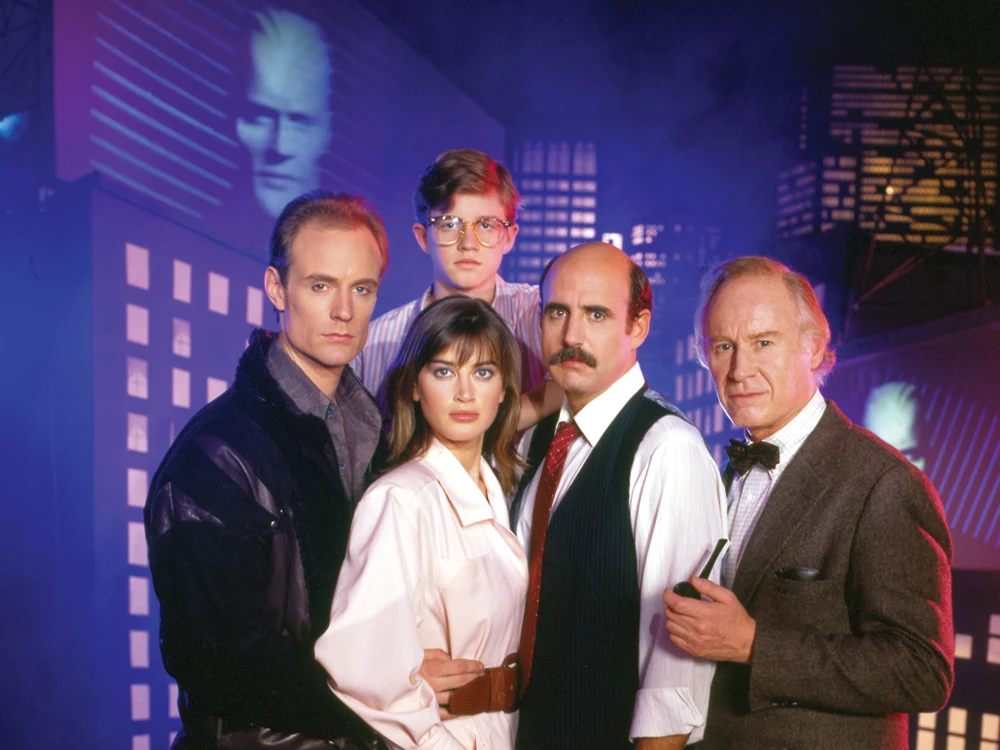
No forgotten eighties series looks quite so uncomfortable in the present as Max Headroom. That’s a compliment. Its vision of commercial television was dazzling, cynical, noisy, and ruled by institutions willing to do almost anything to keep viewers looking at a screen. A digital talking head with a stuttering voice became the public face of that anxiety. In the eighties, Max seemed like a joke about the future. Today, the unsettling part is how much of the joke still works.
Matt Frewer played the human reporter Edison Carter and the electronic personality Max Headroom. The American dramatic series grew out of a British concept, including a television movie and music-video presentation. Its world imagined news as a field of corporate competition where audience attention could become more valuable than public trust. Carter kept investigating stories that powerful people preferred to conceal. Max, meanwhile, could cut through the official language with irritating, unforgettable electronic commentary.
The visual style was a rebellion against ordinary studio television: crowded monitors, harsh lighting, cyberpunk decay, and imagery that made the medium itself appear unstable. A contemporary Los Angeles Times review by Lee Margulies praised the premiere’s visual originality. That judgment matters because the show wasn’t merely predicting future technology; it was asking what kind of society would surrender itself to televised manipulation. The forms of technology have changed, but the uncomfortable question survives.
ABC canceled it in October 1987; its Friday rivals included Dallas and Miami Vice. For a drama suspicious of audience measurement, that is an especially sour punch line. Max Headroom packed its brief ABC life into two short seasons, then enjoyed a cultural afterlife far bigger than its schedule. If you thought it was only a strange talking face from a commercial, there was a considerably angrier and smarter television show hiding behind that image.
Frank’s Place (CBS, 1987–1988)
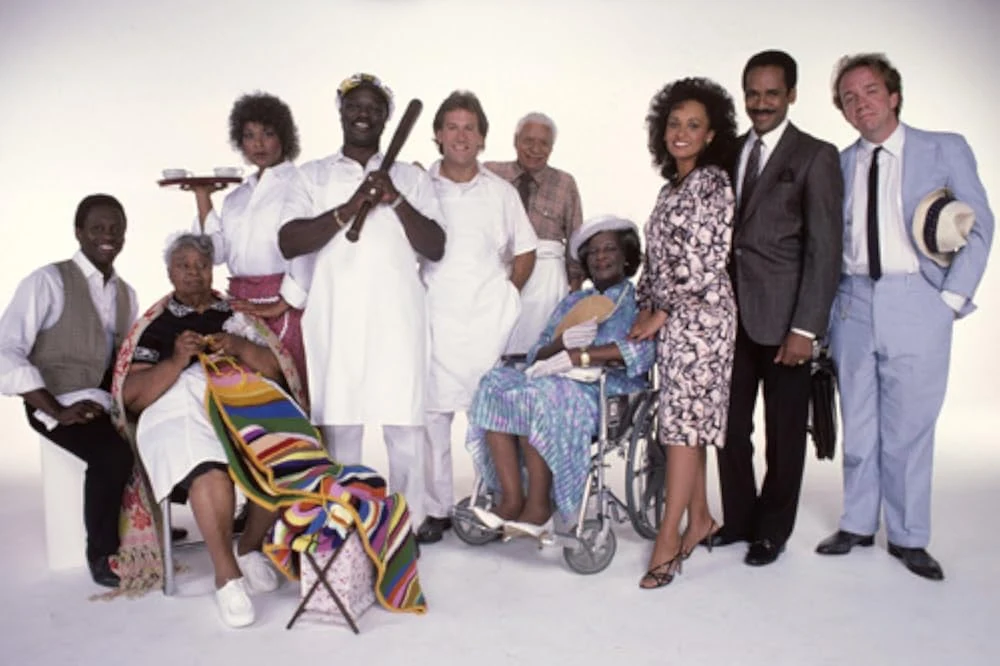
If the rest of this list makes you wonder what the networks were thinking, Frank’s Place raises the opposite question: how did such a thoughtful, unusual show get made at all? Tim Reid played Frank Parrish, a Boston professor who inherited his father’s New Orleans restaurant and discovered a world much richer than the comfortable life he’d expected to return to. The half-hour format and warm humor might suggest an ordinary sitcom. The program refused to be one.
The restaurant, Chez Louisiane, was a gathering place for staff, regular customers, visitors, hustlers, and neighbors, each carrying an entire story into the room. Daphne Reid played Hanna Griffin; Lincoln Kilpatrick and other strong ensemble performers helped create a community whose lives didn’t revolve around the neat requirements of a weekly punch line. One episode could be very funny. The next might approach a painful social problem without a reassuring burst of laughter. That tonal freedom was the show’s great strength and one reason network schedulers may have struggled to categorize it.
A December 1987 Washington Post feature noted its swings between laughter and sorrow. The restaurant didn’t require everyone to be funny on cue. The Television Academy’s history describes Hugh Wilson’s decision to shoot on film with one camera and no laugh track. You were allowed to sit with an uncomfortable moment instead of being instructed when to chuckle. Tim Reid’s steady presence gave the more colorful people around Frank room to shine without turning every visit into a parade of punch lines.
CBS moved its timeslot and eventually let the show go after one season. Critics and viewers who connected with its approach have continued to champion it. Frank’s Place was forgotten by the mass television schedule, not because it lacked substance but because its virtues didn’t fit an easy ratings-era category. In a decade that produced no shortage of comfortable, repeatable family comedies, here’s a series that trusted an audience to recognize life as messy, surprising, and sometimes impossible to settle in thirty minutes.
Werewolf (Fox, 1987–1988)
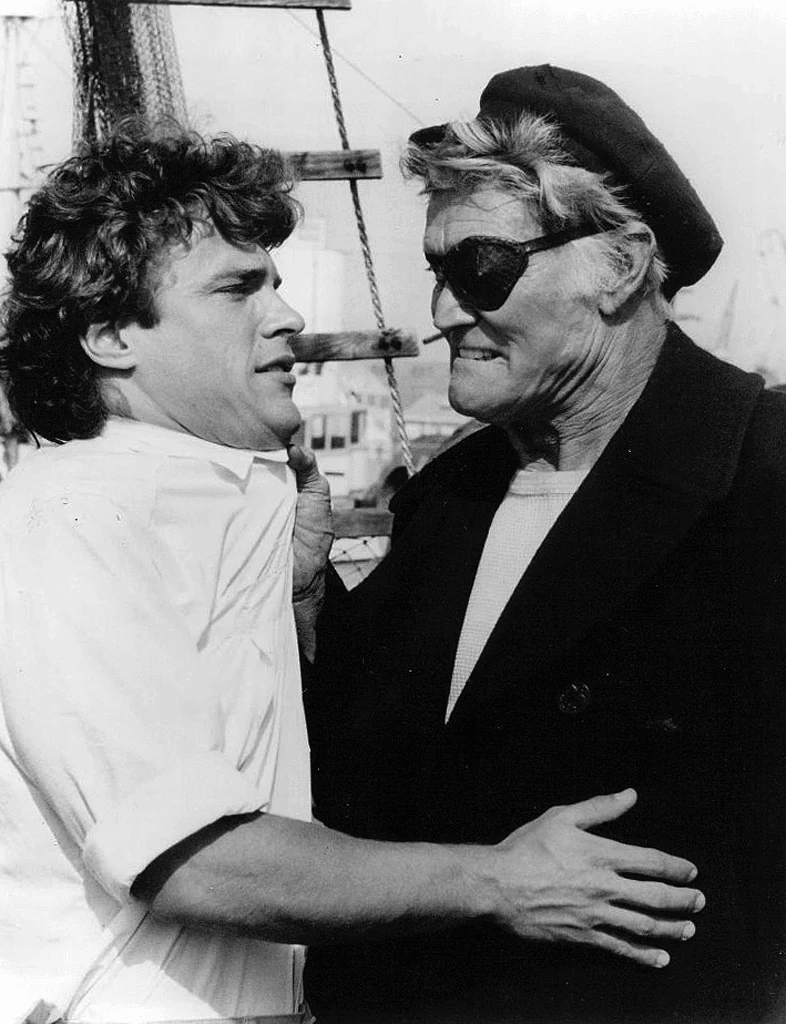
When Fox was still the new network trying to make its name, it offered a very different kind of supernatural television. Werewolf wasn’t a cheerful creature-of-the-week adventure. Its hero, Eric Cord, had been bitten and needed to find the source of the curse before his own transformations destroyed him and the people around him. John J. York played Eric as a fugitive who could barely trust himself. That was a striking departure from the untroubled competence of so many network action heroes.
The show opened with betrayal, panic, and a terrifying new bodily reality. Eric’s friend, already infected, helped pass the curse along. The path toward an answer involved Janos Skorzeny, played by Chuck Connors, and the pursuit of bounty hunter Alamo Joe, played by Lance LeGault. These were names out of an especially pulp paperback, but the continuing search gave the series a genuine narrative through-line. Eric wasn’t returning to the same apartment and job each week. He was wandering through a world where the next town could become a trap.
The transformation effects were central to the experience. In 1987, werewolves still meant makeup, prosthetics, physical performances, and a decision about how much the camera dared to show. The program had more of a horror-film sensibility than the relatively safe paranormal fantasies scattered elsewhere through the decade. It let the hero be the monster, a premise that asked viewers to root for someone whose body betrayed him. That uneasiness made the action feel consequential.
Fox ran twenty-nine episodes in 1987–88, longer than many entries here but hardly enough to exhaust the material. Its existence says something about the network’s early willingness to use horror and niche genre storytelling as an identity. The world hadn’t yet organized everything into recognizable streaming subgenres; this was simply an unnerving show turning up on a young network. If you remember it, you probably remember the pursuit, the dark road, and the sense that television had become a little less safe.
Probe (ABC, 1988)
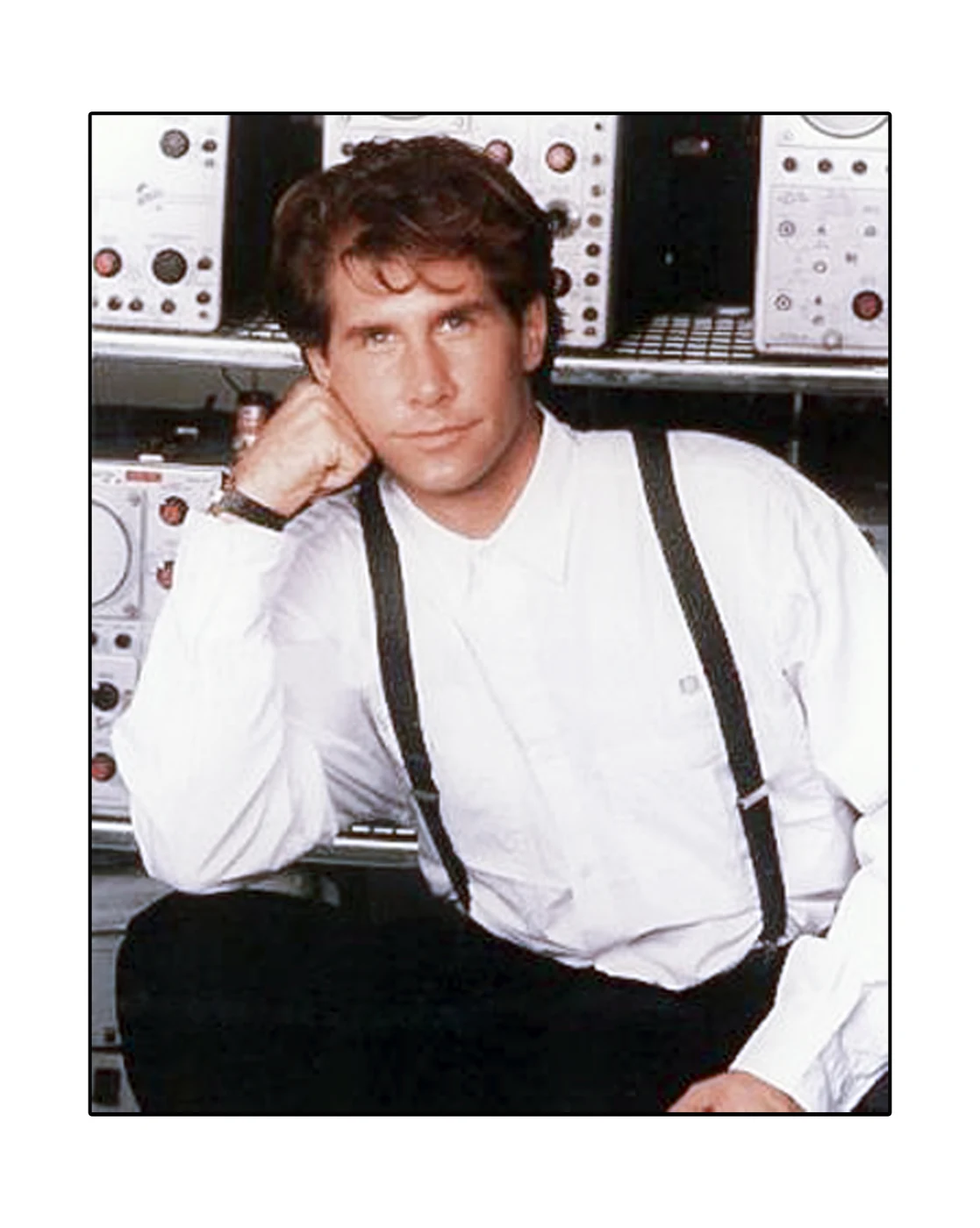
Imagine a genius inventor who doesn’t especially like dealing with other people, teamed with an assistant who has to navigate the practical world for him. Now give the pair a series of strange mysteries that require scientific reasoning rather than a bigger gun. Probe followed Austin James, played by Parker Stevenson, and Mickey Castle, played by Ashley Crow, through cases that borrowed freely from detective fiction, speculative technology, and the eccentricities of their central partnership.
Science-fiction author Isaac Asimov developed the concept with Michael Wagner. That association didn’t mean the program was a filmed science lecture. It meant the mysteries often depended on a question about how something worked, or how an intelligent person might misinterpret what seemed obvious. James was brilliant and socially awkward, the sort of investigator who could solve a problem by considering its technical structure but might miss the ordinary human explanation for why somebody wanted it solved. Castle’s presence kept him connected to people as well as machines.
The spring 1988 rollout was brisk: a two-hour Monday premiere on March 7, then a regular Thursday berth beginning March 10. Howard Rosenberg praised the computer mystery but criticized the pilot’s padding. Finding a new series still required some effort: if an audience failed to discover a new show promptly, there was no easy digital library waiting to catch viewers up. You had to know when Probe was on, and your friends had to know too, or a fascinating series could simply disappear before anybody could recommend it.
The run consisted of a two-hour pilot and six regular episodes—seven broadcasts, or eight hour-long parts when the pilot is split. That’s an almost cruelly small amount of time to build a scientific-detective television world. Later programs would make eccentric investigators and speculative mysteries feel more familiar, but Probe had its own witty, eccentric personality. It is the kind of show that makes you wonder whether television audiences rejected the premise, or whether the schedule simply never gave them a fair opportunity to understand it.
New Monkees (Syndication, 1987)
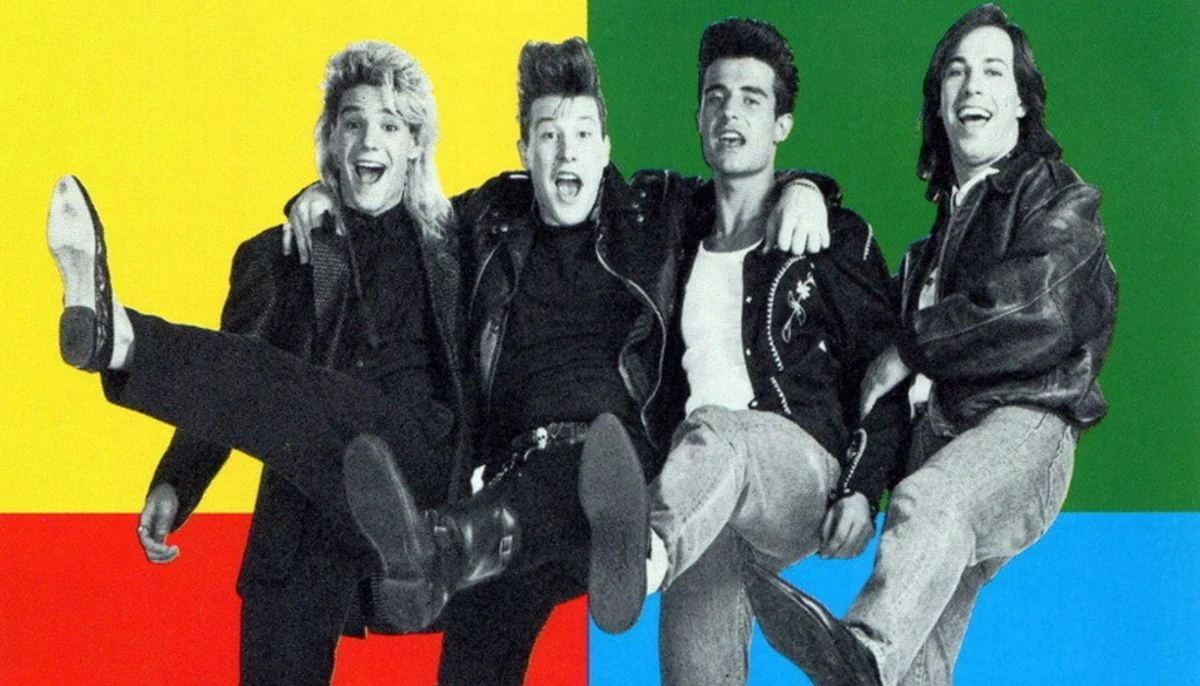
The original Monkees had a second wave of popularity in the eighties, just as MTV-era music and pop culture was turning the screen into an extension of the record store. Television responded with a plan that seems both inevitable and astonishing: make some new Monkees. Four young musicians—Larry Saltis, Jared Chandler, Marty Ross, and Dino Kovas—lived together in an outlandish house, chased musical success, and tumbled through sketches and music videos. The original series had borrowed from Beatlemania and sixties pop experimentation. The reboot wanted to channel the MTV age, which made sense in theory and proved much harder in practice.
The show understood that a music group on television needed a visual playground. A copy machine could create multiple versions of a band member. A laboratory accident could unleash sitcom identities. A dial might send the heroes into an alternate universe, where the familiar goofiness acquired a slightly strange new angle. The premises sound as if they were drawn from a stack of comedy sketches, because much of the format consisted of exactly that sort of fast-moving idea. It was built for colorful interruption.
There was also the uncomfortable business of inheriting a famous name. The original Monkees’ appeal included the personalities, music, and cultural moment that created the group; those qualities were not packaged technology you could simply install in a new house. The quartet did what they could with material that asked them to be a band and a television ensemble almost simultaneously. Many viewers were understandably skeptical, but the result remains a revealing artifact of the entertainment industry’s appetite for recycling a proven phenomenon.
The syndicated project produced thirteen episodes. Its brief run did little to create a lasting new musical institution, which makes it an especially complete example of eighties revival fever: a recognizable brand, new performers, an expensive concept, and no dependable way to make viewers care about the replacements. If you remember New Monkees, you have stumbled on the television version of an album you were certain existed until the record store told you otherwise.
Why these shows vanished so quickly
It is tempting to give every short-lived television series a flattering obituary: the show was brilliant, the network didn’t understand it, and a cruel scheduling decision destroyed something beautiful. Sometimes that’s close enough to the truth to be useful. But television history is more complicated than a procession of misunderstood geniuses. Plenty of these shows had awkward episodes, mismatched casts, storytelling formulas that didn’t sustain a full hour, or effects that were more expensive than their audiences could justify. Sometimes the audience simply preferred something else.
The important context is how little room new network shows had to grow. A new series competed in a finite collection of evening timeslots. A VCR helped, if you owned one and programmed it correctly. It still didn’t offer a season waiting on demand after a friend recommended a show. The printed listings mattered. So did a show’s lead-in and the programs on other channels. If an unusual idea arrived on the wrong night, you might never see it at all, even if it was exactly the kind of television you’d love.
The networks also had reasons to keep trying these experiments. A hit could become a fixture for years, and copying the last success was never quite enough. After Raiders of the Lost Ark made pulp adventures fashionable, old-fashioned flying heroes and exotic ports looked promising. When Tron and home computers made digital imagery exciting, programmers became action heroes. When youth-oriented films started treating outsiders as interesting protagonists, a show such as Square Pegs could feel like the natural next step. Some of those bets succeeded. These didn’t become major enduring hits, but that doesn’t make their original logic absurd.
Even a failed program told viewers something about its moment. Automan had faith that computer technology could reshape fantasy. Max Headroom feared that the machinery of television could reshape society. The Duck Factory was interested in the artists who created the entertainment. Frank’s Place trusted television to notice people who were usually pushed to the margins of network comedy. Put these shows side by side and the eighties stop looking like a single block of loud fashions and catchphrases. They begin to look like an argument about what television could become.
The contrast is clearest beside the hits that shared their television years. The 1981–82 season’s biggest shows supplied the established landscape just before Square Pegs and Voyagers! arrived; the 1982–83 ratings leaders show what dominated during their brief runs. Jump to the 1986–87 television rankings and the familiar giants make the coming experiments of Max Headroom and Frank’s Place look even less like safe bets.
The links to the rest of the decade
What makes the forgotten shows interesting is how clearly they connect to the programs everyone remembers. The danger-and-adventure optimism of Voyagers! and Tales of the Gold Monkey shares a period flavor with the great action television of the eighties, but those programs were usually working with weaker brand recognition and less time to establish a formula. If Manimal and Automan sometimes seemed to be searching for the right weekly balance, that’s a question the era’s larger action franchises also had to answer.
Square Pegs, It’s Your Move, and The Duck Factory belong in conversation with the decade’s sitcom tradition, particularly the family-centered shows that became prime-time institutions. Their jokes often felt sharper or more peculiar than the comfortable formulas surrounding them. Later television would embrace some of those rougher edges, but not always in time to rescue the originals. That is the frustrating pleasure of watching old television: sometimes the show that failed looks more contemporary than the show that survived.
The detective experiments have equally useful neighbors. Tucker’s Witch and Probe were testing what a mystery series could do with supernatural or scientific hooks while 1980s detective and private-eye shows were building more durable formulas. Max Headroom and Frank’s Place, meanwhile, reveal how much 1980s television drama could accommodate when creators were willing to challenge network habits. And Werewolf belongs to the early history of Fox trying to define an audience that the older networks weren’t always chasing.
There are also links that reach beyond the eighties. The seventies’ tradition of detective partnerships and offbeat fantasy is visible in these premises. The nineties’ fascination with eccentric investigators, self-aware television comedy, and continuing character stories in police drama makes them look less strange in retrospect. That is exactly why our 1970s television collection and 1990s TV guide matter here: cultural history gets more interesting when you can move back and forward instead of treating each decade as a sealed box.
The real reason we remember them
An episode of a forgotten show can become a bigger memory than five seasons of a hit you only half-watched. That sounds irrational until you think about how we encountered television. A rare broadcast could feel like a personal discovery. If nobody at school recognized the title, you had no easy way to prove it existed. Your memory became the archive. You carried around a glowing digital car, a talking ghost, a time-travel pocket watch, or a family trapped in a hostile parallel world while the networks carried on as if nothing had happened.
That isn’t a claim that the forgotten shows were secretly better than the classics. Most weren’t. Some of their dialogue now sounds painfully formal, and certain plot ideas collapse under the slightest pressure. But nostalgia that only celebrates flawless art would have very little room for real childhood. These shows were peculiar and sometimes messy, just like the experience of finding them on an ordinary evening when you were supposed to be doing homework.
The nicest surprise is how many people remember the same small details. Someone mentions Automan’s impossible turn and the entire room suddenly remembers it. Somebody whistles the Square Pegs theme and a long-disused corner of the brain switches on. A photograph of a cast can do the same thing faster than a thousand-word description. Television made shared memories even when nobody knew, at the time, that anybody else was sharing them.
So consider this an invitation to rummage through a television guide from the eighties and stop on the listings you would once have skipped. Some of the forgotten programs were daring. Some were merely peculiar. A few deserved longer lives than they got. All of them remind us that the decade’s television history is bigger, stranger, and more entertaining than its greatest-hits compilation. And somewhere out there, another person is still annoyed that Voyagers! never got a second season.
Frequently asked questions
What counts as a forgotten 80s TV show?
In this article, it means a series from the decade that is now comparatively obscure, often because it ran briefly, occupied an awkward timeslot, had a niche audience, or was rarely repeated. A show can be fondly remembered by its small original audience without having been a major ratings success. Our separate article about once-huge TV hits that faded from memory covers a different subject.
Why were so many interesting 1980s series canceled?
No single explanation fits every case. Ratings, schedules, production costs, creative problems, and changing network priorities all mattered. Some shows had strong ideas but limited appeal; others were poorly positioned against established programs. Short runs also gave networks and viewers little time to develop a relationship with unconventional characters or formats.
Which forgotten series are worth starting with?
For teen comedy, try Square Pegs. For family-friendly adventure, Voyagers! and Tales of the Gold Monkey make a terrific pair. For stranger science fiction, try Automan, Otherworld, or Probe. For comedy with a sharp edge, It’s Your Move or Sledge Hammer! fits the bill. And for drama that deserved a wider audience, Frank’s Place and Max Headroom are especially rewarding places to begin.
Is this a list of the lowest-rated shows of the decade?
No. We’re selecting programs for their distinctiveness, recognizability to a smaller audience, and interesting historical stories—not constructing a ratings chart. The annual 1980s TV rankings and the decade’s network-ratings coverage are better places for full-season audience comparisons.
Did any of these shows influence later television?
There are thematic connections, but direct influence should not be assumed without creator testimony or production records. Teen outsider comedy, eccentric detectives, character-driven science fiction, and serialized horror all became familiar later in television history. That’s different from claiming a specific later series copied a particular forgotten program.
Sources and further reading
- Square Pegs: TV Guide episode guide
- Voyagers!: TV Guide episode guide
- Tales of the Gold Monkey: Broadcast dates and episode listing
- The Powers of Matthew Star: TV Guide episode guide
- Manimal: Epguides episode list
- Automan: Epguides episode list
- Whiz Kids: TV Guide episode guide
- Tucker’s Witch: TV Guide episode guide
- It’s Your Move: Paley Center catalog
- The Duck Factory: TV Guide episode guide
- Jennifer Slept Here: TV Guide episode guide
- Otherworld: TV Guide episode guide
- Misfits of Science: TV Guide episode guide
- Sledge Hammer!: Broadcast dates and episode listing
- The Wizard: TV Guide episode guide
- Rags to Riches: TV Guide episode guide
- The Charmings: TV Guide episode guide
- Max Headroom: LA Times original review
- Max Headroom: LA Times contemporary cancellation report
- Frank’s Place: Washington Post 1987 feature
- Werewolf: TV Guide episode guide
- Probe: Broadcast dates and episode listing
- New Monkees: TV Guide episode guide
- The Duck Factory: Television Academy award record
- The Charmings: Television Academy award record
- Frank’s Place: Television Academy history and creator interviews
- Max Headroom: Episode and season listing
- Probe: Los Angeles Times premiere review, March 7, 1988
- Square Pegs: Anne Beatts — Television Academy oral history
- Tales of the Gold Monkey: Donald P. Bellisario — Television Academy oral history
- It’s Your Move / Married… with Children: Television Academy history
- Misfits of Science: Broadcast listing and pilot convention